EP0819389A2 - Feuerwehrbekleidung mit Innenschicht von hoher Gleiteigenschaft - Google Patents
Feuerwehrbekleidung mit Innenschicht von hoher Gleiteigenschaft Download PDFInfo
- Publication number
- EP0819389A2 EP0819389A2 EP97305219A EP97305219A EP0819389A2 EP 0819389 A2 EP0819389 A2 EP 0819389A2 EP 97305219 A EP97305219 A EP 97305219A EP 97305219 A EP97305219 A EP 97305219A EP 0819389 A2 EP0819389 A2 EP 0819389A2
- Authority
- EP
- European Patent Office
- Prior art keywords
- yarns
- set forth
- textile material
- fill
- warp
- Prior art date
- Legal status (The legal status is an assumption and is not a legal conclusion. Google has not performed a legal analysis and makes no representation as to the accuracy of the status listed.)
- Withdrawn
Links
- 239000000463 material Substances 0.000 title claims description 37
- 230000001681 protective effect Effects 0.000 claims abstract description 25
- 239000004744 fabric Substances 0.000 claims abstract description 18
- 239000004753 textile Substances 0.000 claims description 33
- 230000004888 barrier function Effects 0.000 claims description 17
- XLYOFNOQVPJJNP-UHFFFAOYSA-N water Substances O XLYOFNOQVPJJNP-UHFFFAOYSA-N 0.000 claims description 12
- 239000012528 membrane Substances 0.000 claims description 11
- 239000004760 aramid Substances 0.000 claims description 10
- 229920006231 aramid fiber Polymers 0.000 claims description 7
- 239000007788 liquid Substances 0.000 claims description 5
- 239000000835 fiber Substances 0.000 claims description 4
- 230000005540 biological transmission Effects 0.000 claims description 2
- 238000010276 construction Methods 0.000 description 9
- 229920000784 Nomex Polymers 0.000 description 4
- 239000004763 nomex Substances 0.000 description 4
- 229920003235 aromatic polyamide Polymers 0.000 description 3
- 235000009967 Erodium cicutarium Nutrition 0.000 description 2
- 240000003759 Erodium cicutarium Species 0.000 description 2
- 230000000694 effects Effects 0.000 description 2
- 229920000544 Gore-Tex Polymers 0.000 description 1
- 241000500881 Lepisma Species 0.000 description 1
- 239000012212 insulator Substances 0.000 description 1
- 238000000034 method Methods 0.000 description 1
- 238000012986 modification Methods 0.000 description 1
- 230000004048 modification Effects 0.000 description 1
Images


Classifications
-
- A—HUMAN NECESSITIES
- A62—LIFE-SAVING; FIRE-FIGHTING
- A62B—DEVICES, APPARATUS OR METHODS FOR LIFE-SAVING
- A62B17/00—Protective clothing affording protection against heat or harmful chemical agents or for use at high altitudes
- A62B17/001—Adaptations for donning, adjusting or increasing mobility, e.g. closures, joints
-
- A—HUMAN NECESSITIES
- A41—WEARING APPAREL
- A41D—OUTERWEAR; PROTECTIVE GARMENTS; ACCESSORIES
- A41D31/00—Materials specially adapted for outerwear
- A41D31/04—Materials specially adapted for outerwear characterised by special function or use
- A41D31/08—Heat resistant; Fire retardant
- A41D31/085—Heat resistant; Fire retardant using layered materials
-
- Y—GENERAL TAGGING OF NEW TECHNOLOGICAL DEVELOPMENTS; GENERAL TAGGING OF CROSS-SECTIONAL TECHNOLOGIES SPANNING OVER SEVERAL SECTIONS OF THE IPC; TECHNICAL SUBJECTS COVERED BY FORMER USPC CROSS-REFERENCE ART COLLECTIONS [XRACs] AND DIGESTS
- Y10—TECHNICAL SUBJECTS COVERED BY FORMER USPC
- Y10T—TECHNICAL SUBJECTS COVERED BY FORMER US CLASSIFICATION
- Y10T442/00—Fabric [woven, knitted, or nonwoven textile or cloth, etc.]
- Y10T442/30—Woven fabric [i.e., woven strand or strip material]
- Y10T442/3179—Woven fabric is characterized by a particular or differential weave other than fabric in which the strand denier or warp/weft pick count is specified
- Y10T442/322—Warp differs from weft
-
- Y—GENERAL TAGGING OF NEW TECHNOLOGICAL DEVELOPMENTS; GENERAL TAGGING OF CROSS-SECTIONAL TECHNOLOGIES SPANNING OVER SEVERAL SECTIONS OF THE IPC; TECHNICAL SUBJECTS COVERED BY FORMER USPC CROSS-REFERENCE ART COLLECTIONS [XRACs] AND DIGESTS
- Y10—TECHNICAL SUBJECTS COVERED BY FORMER USPC
- Y10T—TECHNICAL SUBJECTS COVERED BY FORMER US CLASSIFICATION
- Y10T442/00—Fabric [woven, knitted, or nonwoven textile or cloth, etc.]
- Y10T442/30—Woven fabric [i.e., woven strand or strip material]
- Y10T442/3854—Woven fabric with a preformed polymeric film or sheet
Definitions
- the present invention relates generally to protective garments such as the type which may be used by firefighters. More particularly, the invention relates to a protective garment having an improved high-lubricity inner lining.
- Firefighter garments are generally constructed having a number of discrete layers. Typically, these layers include an outer shell, a moisture barrier layer, a thermal barrier layer and an inner lining (or face cloth). The layers are generally made from appropriate thermally-resistant materials to provide protection against heat and flame.
- pajama check fabric In part due to the spun yarn, "pajama check” fabric generally exhibits a relatively low lubricity characteristic. In other words, a lining made from pajama check fabric will not be very "slick.” As such, the lining may cause friction as it rubs against adjacent surfaces, such as the clothing worn by the firefighter under the protective garment. Because firefighting activities can be extremely strenuous, this friction may tend to fatigue the wearer.
- Caldura Another fabric which has been utilized as an inner lining for protective garments is referred to as "Caldura.” This fabric is made from warp yarns of spun aramid fibers and fill yarns of multifilament aramid fibers. The yarns are woven together into a twill weave that produces the characteristic "twill lines" exhibited in such a construction.
- the present invention recognizes and addresses the foregoing disadvantages, and others of prior art constructions and methods. Accordingly, it is an object of the present invention to provide an improved protective garment suitable for use by a firefighter.
- the protective garment suitable for use by a firefighter.
- the protective garment includes an outer shell configured to cover and protect a predetermined portion of a wearer's body.
- An inner lining is located inside of the outer shell and has a first side of greater lubricity and a second side of lesser lubricity.
- the inner lining is adapted such that the first side thereof will be adjacent to the wearer's body during use.
- the inner lining comprises a predetermined textile material constructed from warp yarns and fill yarns having thermally-resistant characteristics, such as yarns made from aramid fibers.
- the warp yarns and fill yarns are woven together in a suitable satin weave.
- the warp yarns are multifilament yarns and the fill yarns are spun yarns, the first side of the textile material thus being a warp side thereof.
- the garment may further include a moisture barrier layer located adjacent to the second side of the inner lining.
- a thermally-resistant felt layer may also be located between the outer shell and the inner lining to inhibit transmission of heat from an ambient environment to the wearer's body.
- a removable liner assembly for use in a protective garment.
- the liner assembly comprises first and second lining layers connected together about their respective peripheries to form an inner cavity.
- a thermal barrier layer is positioned between the lining layers inside of the inner cavity.
- a moisture barrier layer is also provided, located adjacent one of the lining layers.
- Each of the lining layers comprises a predetermined textile material constructed from warp yarns and fill yarns having thermally-resistant characteristics.
- the warp yarns and fill yarns are woven together in a satin weave to produce a first side of greater lubricity and a second side of lesser lubricity.
- Respective second sides of the lining layers are opposed to one another on an inside of the inner cavity such that the first sides thereof will form an outer surface of the liner assembly.
- the thermal barrier layer comprises a felt constructed of thermally resistant fibers.
- the felt may be quilted to at least one of the lining layers by a plurality of crisscrossing stitch lines.
- the moisture barrier layer may comprise a membrane adhered to a second side of one of the lining layers.
- the membrane may be of a type substantially impermeable to liquid water but permeable to water vapor.
- a textile material suitable for use as a lining fabric in a protective garment comprises a plurality of warp yarns and fill yarns having thermally-resistant characteristics.
- the warp yarns and fill yarns are woven together in a satin weave.
- the warp yarns are multifilament yarns and the fill yarns are spun yarns such that a warp side of the textile material has a greater lubricity and a fill side of the textile material has a lesser lubricity.
- the textile material preferably has a weight of no greater than approximately 4.0 ounces per square yard.
- embodiments may be constructed wherein the warp yarns contribute at least approximately fifty-five (55) percent of the overall weight of the textile material.
- a 200 denier warp yarn and a 37 singles fill yarn has been found suitable for this purpose.
- a typical construction using such yarns may yield a thread count having more ends per inch than picks per inch.
- a membrane substantially impermeable to liquid water but permeable to water vapor may be adhered to the fill side of the textile material.
- FIG. 1 illustrates an improved protective garment 10 constructed in accordance with the present invention.
- Garment 10 includes a relatively tough outer shell 12 having a liner assembly 14 located therein. Outer shell 12 and liner assembly 14 together function to protect a wearer from heat and flame such as may be encountered during firefighting activities.
- liner assembly 14 is constructed as a separate unit that may be removed from outer shell 12.
- a zipper 16 is provided in this case to maintain liner assembly 14 in position within outer shell 12 as shown. It should be appreciated, however, that other suitable means of attachment, such as various hook and pile arrangements, may also be utilized for this purpose.
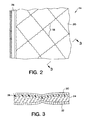
- liner assembly 14 includes a plurality of material layers quilted together by crisscrossing stitch lines 18.
- the outermost layers, i.e., lining layers 20 and 22, are connected together about their respective peripheries to form an inner cavity.
- a thermal barrier layer 24 and a moisture barrier layer 26 are located within the inner cavity, as shown.
- the half of zipper 16 that remains connected to liner assembly 14 when removed is indicated at 28.
- lining layer 20 will be adjacent the wearer's body during use, whereas lining layer 22 will be immediately inside of outer shell 12.
- lining layers 20 and 22 are made from a textile material having a first side of higher lubricity and a second side of lesser lubricity. The higher lubricity sides are directed outwardly such that the outer surface of liner assembly 14 will be relatively "slick.” This construction desirably reduces the friction that may otherwise be produced by rubbing against the wearer's clothing. Friction between the liner assembly 14 and outer shell 12 may also be reduced in this manner.
- an aramid felt such as a felt produced from DuPont.Nomex® fibers, is utilized to provide thermal barrier layer 24.
- the felt functions as an insulator to inhibit transfer of heat from the ambient environment to the wearer.
- Moisture barrier layer 26 is preferably a suitable polymeric membrane that is impermeable to liquid water but is permeable to water vapor. As such, exterior water (such as from a firefighter's water hose) will not penetrate the interior of garment 10, but perspiration from the firefighter can escape. Suitable membranes of this type are distributed by W.L. Gore & Associates under the trademark Gore-Tex.
- the higher lubricity side of lining layer 20 forms an outer surface of liner assembly 14.
- the membrane of moisture barrier layer 26 is adhered is the lower lubricity side of lining layer 20. This is advantageous because membranes of this type will generally adhere more readily to a rougher surface than to one which is smooth.
- Figures 4 and 5 illustrate an improved textile material 30 such as may be used to construct lining layers 20 and 22.
- textile material 30 includes a plurality of warp yarns 32 interwoven with a plurality of fill yarns 34.
- warp yarns 32 are multifilament yarns
- fill yarns 34 are spun yarns.
- warp yarns 32 and fill yarns 34 are each constructed from thermally resistant fibers, such as DuPont Nomex® aramid fibers.
- warp yarns 32 and fill yarns 34 are woven together utilizing a satin weave.
- a satin weave the interlacing of each warp yarn is at least one fill yarn apart from the interlacing of either of the two warp yarns next to it.
- the points of interlacing do not produce an unbroken line (such as with a twill weave), but are scattered about over the weave. The interlacings of the warp yarns are thus hidden by adjacent floats.
- warp yarns 32 will mostly appear on one side of textile material 30, whereas fill yarns 34 will mostly appear on the backside thereof. These two sides may be referred to as the warp side and fill side, respectively.
- warp yarns 32 are multifilament yarns
- the warp side will tend to have a lustrous surface of relatively high lubricity.
- the fill side will have a lesser lubricity, since it is dominated by the spun yarns.
- the "scattered" interlacings of a satin weave enhance the lubricity difference between the respective sides in relation to what would generally be achieved using, for example, a twill weave.
- the illustrated construction utilizes a particular satin weave referred to as "five shaft” satin. As a result of this weave, each warp yarn 32 crosses over four fill yarns 34 before interlacing with the fifth. An adjacent warp yarn 32 has the same interlace pattern, but is offset by two fill yarns 34, as clearly illustrated in Figure 4.
- a five shaft satin will produce a fabric in which about eighty (80) percent of the surface area of the "warp side" will be contributed by the warp yarns. Likewise, about eighty (80) percent of the surface area of the fill side will be contributed by the fill yarns.
- An even greater ratio of multifilament to spun surface may be achieved on the warp side if larger yarns are utilized for the warp yarns than are utilized for the fill yarns.
- warp yarns contributing at least fifty-five (55) percent of the overall weight of textile material 30.
- a weave having a higher count of warp yarn to fill yarn will also tend to increase the ratio of multifilament to spun surface area.
- the number of warp threads per inch may exceed the number of fill threads per inch in some presently preferred embodiments.
- each of these examples utilizes a 200 denier multifilament warp yarn and a 37 singles spun yarn for the fill. It should be appreciated, however, that other yarn sizes may also be used, as appropriate in a particular application. In addition, it may be desirable in some applications to utilize a spun warp and a multifilament fill. In should also be appreciated that various satin weaves other than a "five-shaft” satin may also be utilized. For example, it may be appropriate in some embodiments to use a 7-shaft or 9-shaft satin or a crowfoot satin such as a 4-shaft crowfoot satin.
Landscapes
- Health & Medical Sciences (AREA)
- Engineering & Computer Science (AREA)
- Textile Engineering (AREA)
- Toxicology (AREA)
- General Health & Medical Sciences (AREA)
- Business, Economics & Management (AREA)
- Emergency Management (AREA)
- Professional, Industrial, Or Sporting Protective Garments (AREA)
- Woven Fabrics (AREA)
Applications Claiming Priority (2)
| Application Number | Priority Date | Filing Date | Title |
|---|---|---|---|
| US08/683,578 US5858888A (en) | 1996-07-15 | 1996-07-15 | Firefighter garment utilizing improved high-lubricity lining material |
| US683578 | 1996-07-15 |
Publications (2)
| Publication Number | Publication Date |
|---|---|
| EP0819389A2 true EP0819389A2 (de) | 1998-01-21 |
| EP0819389A3 EP0819389A3 (de) | 1998-09-02 |
Family
ID=24744636
Family Applications (1)
| Application Number | Title | Priority Date | Filing Date |
|---|---|---|---|
| EP19970305219 Withdrawn EP0819389A3 (de) | 1996-07-15 | 1997-07-09 | Feuerwehrbekleidung mit Innenschicht von hoher Gleiteigenschaft |
Country Status (3)
| Country | Link |
|---|---|
| US (1) | US5858888A (de) |
| EP (1) | EP0819389A3 (de) |
| CA (1) | CA2210414C (de) |
Cited By (9)
| Publication number | Priority date | Publication date | Assignee | Title |
|---|---|---|---|---|
| TR199902112A3 (tr) * | 1998-09-01 | 2000-04-21 | Carl Freudenberg | Koruma giysisi üretimi için yari madde materyali ve imali için yöntem. |
| FR2811520A1 (fr) * | 2000-07-13 | 2002-01-18 | Europrotect France | Tissu de protection thermique |
| GB2451414A (en) * | 2007-07-27 | 2009-02-04 | Gen Electric | Waterproof breathable high-vis arc resistant laminate |
| USD618440S1 (en) | 2008-07-16 | 2010-06-29 | Parker Synergies, LLC | Venting motorcycle jacket |
| US7752681B2 (en) | 2002-05-24 | 2010-07-13 | Michel Licensing, Inc. | Article of clothing with wicking portion |
| USD620231S1 (en) | 2008-07-16 | 2010-07-27 | Parker Synergies Llc | Venting motorcycle jacket |
| USD622937S1 (en) | 2008-10-08 | 2010-09-07 | Sullivans, Inc. | Jacket with partially attached vest |
| US7966668B2 (en) | 2006-08-15 | 2011-06-28 | Sullivans, Inc. | Ventilated garment |
| CN103519423A (zh) * | 2013-10-22 | 2014-01-22 | 吴江市衣佳布世纺织有限公司 | 一种防爆服装 |
Families Citing this family (30)
| Publication number | Priority date | Publication date | Assignee | Title |
|---|---|---|---|---|
| US6247179B1 (en) * | 1996-07-15 | 2001-06-19 | Safety Components Fabric Technologies, Inc. | Firefighter garment utilizing improved high-lubricity lining material |
| RU2202660C2 (ru) | 1997-10-01 | 2003-04-20 | Е.И. Дюпон Де Немур Энд Компани | Способ изготовления арамидной ткани |
| US6430754B1 (en) | 2000-03-03 | 2002-08-13 | Lion Apparel, Inc. | Firefighting garment |
| US6562741B1 (en) | 2000-05-17 | 2003-05-13 | Norfab Corporation | Firefighter garment outer shell fabric utilizing stock dyed melamine fiber and ring-spun yarn for making the same |
| US8071492B2 (en) * | 2001-08-20 | 2011-12-06 | Pbi Performance Products, Inc. | Textile fabric for the outer shell of a firefighter's garment |
| US20080121305A1 (en) * | 2001-10-31 | 2008-05-29 | Metzger Michael B | Low friction fabric |
| US20060084337A1 (en) * | 2004-10-19 | 2006-04-20 | Southern Mills, Inc. | Blended outer shell fabrics |
| US7589036B2 (en) * | 2002-06-07 | 2009-09-15 | Southern Mills, Inc. | Flame resistant fabrics having increased strength |
| US7111328B2 (en) | 2003-02-13 | 2006-09-26 | Robison's Inc. | Hybrid ventilated garment |
| US7013496B2 (en) | 2003-09-05 | 2006-03-21 | Southern Mills, Inc. | Patterned thermal liner for protective garments |
| US20050186875A1 (en) * | 2004-02-03 | 2005-08-25 | Norfab Corporation | Firefighter garment outer shell fabric utilizing core-spun dref yarn |
| US20060089069A1 (en) * | 2004-10-27 | 2006-04-27 | Allen Michael B Ii | Simulated rip stop fabrics |
| US7634819B2 (en) * | 2007-03-28 | 2009-12-22 | Gary Grey | Single layer, two different sided hair wrap |
| USD555878S1 (en) | 2007-05-04 | 2007-11-27 | Robison's Inc. | Reconfigurable motorcycle jacket |
| US8001618B2 (en) | 2007-09-21 | 2011-08-23 | Sullivans, Inc. | Ventilated double-closure garment |
| US8327469B2 (en) * | 2008-04-09 | 2012-12-11 | Lion Apparel, Inc. | Protective garment with low friction characteristics |
| US8336116B2 (en) | 2008-04-28 | 2012-12-25 | Angela Jodie Gomes Seguin | Garment closure system |
| US8932965B1 (en) | 2008-07-30 | 2015-01-13 | International Textile Group, Inc. | Camouflage pattern with extended infrared reflectance separation |
| US8898821B2 (en) | 2009-05-19 | 2014-12-02 | Southern Mills, Inc. | Flame resistant fabric with anisotropic properties |
| US9386816B2 (en) | 2012-02-14 | 2016-07-12 | International Textile Group, Inc. | Fire resistant garments containing a high lubricity thermal liner |
| US8819866B2 (en) * | 2012-03-30 | 2014-09-02 | International Textile Group, Inc. | Flame resistant fabric and garments made therefrom |
| US10405594B2 (en) | 2015-05-21 | 2019-09-10 | International Textile Group, Inc. | Inner lining fabric |
| US20170130372A1 (en) | 2015-11-05 | 2017-05-11 | International Textile Group, Inc. | Woven fabric with intricate design |
| US10385481B2 (en) | 2015-12-18 | 2019-08-20 | International Textile Group, Inc. | Inner lining fabric with moisture management properties |
| USD934574S1 (en) | 2016-10-24 | 2021-11-02 | International Textile Group, Inc. | Flame resistant fabric |
| CA3171137A1 (en) | 2019-03-28 | 2020-10-01 | Southern Mills, Inc. | Flame resistant fabrics |
| IL293453A (en) | 2019-12-05 | 2022-07-01 | Southern Mills Inc | Fireproof fabrics are made from long yarns with the same fiber length and fiber yarns |
| USD1011768S1 (en) | 2020-04-27 | 2024-01-23 | Southern Mills, Inc. | Fabric |
| KR20240037351A (ko) | 2021-08-10 | 2024-03-21 | 써던 밀즈, 인코포레이티드 | 방염성 직물 |
| US12146244B1 (en) | 2022-07-21 | 2024-11-19 | Milliken & Company | Fire-resistant textile |
Family Cites Families (8)
| Publication number | Priority date | Publication date | Assignee | Title |
|---|---|---|---|---|
| FR1587779A (de) * | 1968-10-01 | 1970-03-27 | ||
| FR2476829A2 (fr) * | 1976-11-15 | 1981-08-28 | Cornic Roche Et Cie Ets | Gilet pare-coups d'intervention |
| FR2606601B1 (fr) * | 1986-11-17 | 1991-03-22 | Inst Textile De France | Materiau composite pour vetement de protection contre les projections de matieres et metaux en fusion |
| FR2649128A1 (fr) * | 1989-06-29 | 1991-01-04 | Porcher Textile | Tissu ininflammable extensible |
| US5136723A (en) * | 1991-02-15 | 1992-08-11 | Lion Apparel, Inc. | Firefighter garment with mesh liner |
| CA2091477C (en) * | 1993-03-11 | 1998-02-10 | Claude Barbeau | Textile material for inner lining of firefighter protective garment |
| CA2091478C (en) * | 1993-03-11 | 1996-09-24 | Claude Barbeau | Textile material for outer shell of firefighter garment |
| US5539928A (en) * | 1993-11-12 | 1996-07-30 | Lion Apparel, Inc. | Firefighter garment with low friction liner system |
-
1996
- 1996-07-15 US US08/683,578 patent/US5858888A/en not_active Expired - Lifetime
-
1997
- 1997-07-09 EP EP19970305219 patent/EP0819389A3/de not_active Withdrawn
- 1997-07-14 CA CA 2210414 patent/CA2210414C/en not_active Expired - Lifetime
Cited By (15)
| Publication number | Priority date | Publication date | Assignee | Title |
|---|---|---|---|---|
| EP0985355A3 (de) * | 1998-09-01 | 2000-05-31 | Firma Carl Freudenberg | Halbzeugmaterial zur Herstellung von Schutzbekleidung sowie Verfahren zu seiner Herstellung |
| US6407019B1 (en) | 1998-09-01 | 2002-06-18 | Firma Carl Freudenberg | Preform material for manufacturing a protective garment, and method for manufacturing it |
| CN1092565C (zh) * | 1998-09-01 | 2002-10-16 | 卡尔·弗罗伊登伯格公司 | 用于制造防护服的半成品材料及其制造方法 |
| TR199902112A3 (tr) * | 1998-09-01 | 2000-04-21 | Carl Freudenberg | Koruma giysisi üretimi için yari madde materyali ve imali için yöntem. |
| FR2811520A1 (fr) * | 2000-07-13 | 2002-01-18 | Europrotect France | Tissu de protection thermique |
| WO2002005671A1 (fr) * | 2000-07-13 | 2002-01-24 | Europrotect France | Tissu de protection thermique |
| US9655388B2 (en) | 2002-05-24 | 2017-05-23 | Joyce Michel | Article of clothing with wicking portion |
| US7752681B2 (en) | 2002-05-24 | 2010-07-13 | Michel Licensing, Inc. | Article of clothing with wicking portion |
| US8360816B2 (en) | 2002-05-24 | 2013-01-29 | Michel Licensing, Inc. | Article of clothing with wicking portion |
| US7966668B2 (en) | 2006-08-15 | 2011-06-28 | Sullivans, Inc. | Ventilated garment |
| GB2451414A (en) * | 2007-07-27 | 2009-02-04 | Gen Electric | Waterproof breathable high-vis arc resistant laminate |
| USD620231S1 (en) | 2008-07-16 | 2010-07-27 | Parker Synergies Llc | Venting motorcycle jacket |
| USD618440S1 (en) | 2008-07-16 | 2010-06-29 | Parker Synergies, LLC | Venting motorcycle jacket |
| USD622937S1 (en) | 2008-10-08 | 2010-09-07 | Sullivans, Inc. | Jacket with partially attached vest |
| CN103519423A (zh) * | 2013-10-22 | 2014-01-22 | 吴江市衣佳布世纺织有限公司 | 一种防爆服装 |
Also Published As
| Publication number | Publication date |
|---|---|
| CA2210414C (en) | 2005-06-14 |
| CA2210414A1 (en) | 1998-01-15 |
| EP0819389A3 (de) | 1998-09-02 |
| US5858888A (en) | 1999-01-12 |
Similar Documents
| Publication | Publication Date | Title |
|---|---|---|
| US5858888A (en) | Firefighter garment utilizing improved high-lubricity lining material | |
| US6247179B1 (en) | Firefighter garment utilizing improved high-lubricity lining material | |
| US11337473B2 (en) | Fire resistant garments containing a high lubricity thermal liner | |
| AU2002360160B2 (en) | Sheet of complex, multi-layer material which can be used to produce protective clothing, particularly for fire fighters | |
| US5920905A (en) | Firefighter garment with combination facecloth and moisture barrier | |
| US5323815A (en) | Textile material for inner lining of firefighter protective garment | |
| US6116059A (en) | Three-dimensional sport medical support spacer fabric | |
| US7589036B2 (en) | Flame resistant fabrics having increased strength | |
| US5539928A (en) | Firefighter garment with low friction liner system | |
| CA2720772C (en) | Protective garment with low friction characteristics | |
| GB2275934A (en) | Woven material for firefighter garment | |
| US10385481B2 (en) | Inner lining fabric with moisture management properties | |
| US10405594B2 (en) | Inner lining fabric | |
| CA2498018A1 (en) | Protective garment fabric having closed adjacent pockets and garments containing same | |
| US5499663A (en) | Textile material for inner lining of firefighter protective garment | |
| KR101210061B1 (ko) | 다층, 통기성 직물 | |
| EP0994207B1 (de) | Dreidimensional gewirkter Abstandsstoff für Schuheinlagen und Rücksäcke | |
| AU726941B2 (en) | Fabric providing protection from chain saws | |
| US5876834A (en) | Protective chain saw chaps | |
| CA2280557C (en) | Firefighter garment utilizing improved high-lubricity lining material | |
| JP3266540B2 (ja) | 防災作業衣 | |
| CA2169133C (en) | Firefighter garment with combination facecloth and moisture barrier | |
| CA2487985C (en) | Firefighter garment with combination facecloth and moisture barrier | |
| EP1469753A1 (de) | Schutzgewebe für kettensäge |
Legal Events
| Date | Code | Title | Description |
|---|---|---|---|
| PUAI | Public reference made under article 153(3) epc to a published international application that has entered the european phase |
Free format text: ORIGINAL CODE: 0009012 |
|
| AK | Designated contracting states |
Kind code of ref document: A2 Designated state(s): AT BE CH DE DK ES FI FR GB GR IE IT LI LU MC NL PT SE |
|
| AX | Request for extension of the european patent |
Free format text: AL;LT;LV;RO;SI |
|
| PUAL | Search report despatched |
Free format text: ORIGINAL CODE: 0009013 |
|
| AK | Designated contracting states |
Kind code of ref document: A3 Designated state(s): AT BE CH DE DK ES FI FR GB GR IE IT LI LU MC NL PT SE |
|
| AX | Request for extension of the european patent |
Free format text: AL;LT;LV;RO;SI |
|
| AKX | Designation fees paid | ||
| RBV | Designated contracting states (corrected) | ||
| STAA | Information on the status of an ep patent application or granted ep patent |
Free format text: STATUS: THE APPLICATION IS DEEMED TO BE WITHDRAWN |
|
| 18D | Application deemed to be withdrawn |
Effective date: 19990303 |