EP0819938A2 - Verfahren und Messsysteme zur Messung physikalischer Grössen von gering leitenden und nichtleitenden Fluiden - Google Patents
Verfahren und Messsysteme zur Messung physikalischer Grössen von gering leitenden und nichtleitenden Fluiden Download PDFInfo
- Publication number
- EP0819938A2 EP0819938A2 EP97110884A EP97110884A EP0819938A2 EP 0819938 A2 EP0819938 A2 EP 0819938A2 EP 97110884 A EP97110884 A EP 97110884A EP 97110884 A EP97110884 A EP 97110884A EP 0819938 A2 EP0819938 A2 EP 0819938A2
- Authority
- EP
- European Patent Office
- Prior art keywords
- conductivity
- switched
- measurement
- sensor
- measuring
- Prior art date
- Legal status (The legal status is an assumption and is not a legal conclusion. Google has not performed a legal analysis and makes no representation as to the accuracy of the status listed.)
- Granted
Links
Images



Classifications
-
- G—PHYSICS
- G01—MEASURING; TESTING
- G01N—INVESTIGATING OR ANALYSING MATERIALS BY DETERMINING THEIR CHEMICAL OR PHYSICAL PROPERTIES
- G01N33/00—Investigating or analysing materials by specific methods not covered by groups G01N1/00 - G01N31/00
- G01N33/26—Oils; Viscous liquids; Paints; Inks
- G01N33/28—Oils, i.e. hydrocarbon liquids
- G01N33/2835—Specific substances contained in the oils or fuels
- G01N33/2858—Metal particles
-
- G—PHYSICS
- G01—MEASURING; TESTING
- G01N—INVESTIGATING OR ANALYSING MATERIALS BY DETERMINING THEIR CHEMICAL OR PHYSICAL PROPERTIES
- G01N33/00—Investigating or analysing materials by specific methods not covered by groups G01N1/00 - G01N31/00
- G01N33/26—Oils; Viscous liquids; Paints; Inks
- G01N33/28—Oils, i.e. hydrocarbon liquids
- G01N33/2835—Specific substances contained in the oils or fuels
- G01N33/2847—Water in oils
-
- G—PHYSICS
- G01—MEASURING; TESTING
- G01N—INVESTIGATING OR ANALYSING MATERIALS BY DETERMINING THEIR CHEMICAL OR PHYSICAL PROPERTIES
- G01N33/00—Investigating or analysing materials by specific methods not covered by groups G01N1/00 - G01N31/00
- G01N33/26—Oils; Viscous liquids; Paints; Inks
- G01N33/28—Oils, i.e. hydrocarbon liquids
- G01N33/2888—Lubricating oil characteristics, e.g. deterioration
Definitions
- the invention relates to a method and systems for Measurement of physical quantities of low conductivity and non-conductive fluids such as rolling oil, lubricating oil, hydraulic oil, Brake fluids and fuels, the fluid between or in the field of action of at least two electrical conductive electrodes.
- non-conductive fluids such as rolling oil, lubricating oil, hydraulic oil, Brake fluids and fuels
- Measuring devices are available on the market with which one can the electrical conductivity of Can determine fluids.
- Existing conductivity meters for non- or low conductivity fluids such as Oils or fuels are not for measurement in flowing media (online operation) suitable.
- the fluid to be measured must be known Systems are in hibernation for several minutes so that the Meter shows a reliable value.
- the ongoing withdrawal of measurement samples is time-consuming and labor-intensive and with associated costs.
- Another disadvantage of Offline measuring devices can also be seen in the fact that one only limits reliable measured values of electrical conductivity can achieve, since the conductivity within a short time can change through many influences.
- additives e.g. in rolling oil to lower it again smooth production can be guaranteed.
- There between sampling and time of measurement due to the from Measuring device manufacturer stipulated rest period of the oil, there may be significant periods of time Eliminate the risk of electrostatic discharge be late.
- Optical systems are used to measure the contamination of fluids Measuring devices on the market that are used to determine the turbidity the degree of contamination of the fluids is measured.
- the turbidity no measure of the degree of contamination of many fluids such as Oiling can be because of the geometric dimensions of the fluid contained dirt particles are sometimes smaller than that Wavelength of light, so that these smallest dirt particles by one based on a refraction of light Turbidity measurement can no longer be detected.
- non-conductive and low-conductivity fluids leads to the fact that Means for increasing the electrical conductivity of fluids like rolling oil, be added prophylactically and that when filtering oils, filter media such as diatomaceous earth and Pale earth well before or only after it is exhausted be replaced.
- conductivity additives designated means to increase conductivity ecologically and health-wise, so that a flat rate preventive admixture of these agents high environmental pollution and causes disposal problems.
- the invention is based, for a small task conductive and non-conductive fluids such as rolling oil, lubricating oil, Hydraulic oil, brake fluids and fuels certain Method and measuring systems working according to the method for Online measurement of electrical conductivity for control an electrostatic charge and discharge preventing Minimum conductivity through a regulated introduction of Conductivity additives, the online measurement of the temporal Change in conductivity to determine the Very fine contamination entry and the degree of contamination that Difference measurement of conductivity in front of and behind a filter to check the function and quality of a filtering process and if necessary to regulate the filtering process by a regulated supply of filter aids, for online measurement the dielectric constant for detecting polar components such as Oil additives or water as well as for online measurement of the Permeability to determine the concentrations of Iron particles or ferromagnetic wear particles develop.
- a small task conductive and non-conductive fluids such as rolling oil, lubricating oil, Hydraulic oil, brake fluids and fuels
- the rolling oil circuit 1 shown schematically in FIG. 1 a cold strip mill 2 with a lubricating and Cooling oil for the rolling process is with a measuring system for online measurement the electrical conductivity of the rolling oil, the Degrees of oil pollution, mainly due to abrasion the rolling and the rolling stock and additives is effected, and the quality of the filtering process in the circuit arranged oil filter 3 equipped.
- the measuring system comprises two identical base sensors 4, 5.
- the Base sensor 4 is - seen in the direction of rotation a of the rolling oil - in a bypass line 6a of the main line 6 of the Rolling oil circuit 1 in front of the oil filter 3 and the base sensor 5 in a bypass line 6b of the main line 6 behind the Oil filter 3 installed.
- the Measurement signals from the base sensor 5 are sent to a control device 7 transmitted, the device 8 for initiating Conductivity additives in the rolling oil circuit 1 controls.
- the required minimum conductivity of the rolling oil of 50 pS / m adjusted.
- the one measured by the base sensor 5 behind the oil filter 3 Absolute value of the electrical conductivity of the rolling oil, the if necessary, based on the oil temperature, is also a Criterion for the degree of pollution of the oil and thus decisive for the time of preparation of the used and no longer due to a filter process cleaning rolling oil through a distillation or Rectification process.
- the one for measuring the electrical conductivity ⁇ , the Dielectric constant ⁇ r, permeability ⁇ and viscosity ⁇ of slightly conductive and non-conductive fluids such as rolling oil usable base sensor 4 according to FIG. 2 is in a vertical position into the bypass line 6a of the main line 6 of the Rolling oil circuit 1 built in to avoid that in Air accumulates in the base sensor, which the would falsify measurement results.
- the base sensor 4 has one Outer electrode 9, which acts as an electrically conductive metallic pipe section 9a is formed, in which a electrically conductive, preferably flowed around by the fluid Streamlined inner electrode 10 is arranged.
- the cylindrical inner electrode 10 is in a middle Useful electrode 10a and a front and a rear Screen electrode 10b, 10c divided.
- the useful electrode 10a Inner electrode 10 is insulated 11 of the two Shield electrodes 10b, 10c separately.
- the inner electrode 10 is held in the base sensor 4 by two spacers 12, the spacers 12 between the outer electrode 9 and the two shield electrodes 10b, 10b are installed.
- the Inner electrode 10 is for the passage of connecting lines partially designed as a hollow body for the measuring electronics 13.
- Temperature sensor 14 is used to measure the temperature of the Rolling oil.
- the Inner electrode 10 of the base sensor 4 with a rotary drive be equipped, its energy consumption or Rotation speed a measure of the viscosity of the Represents rolling oil.
- the tubular outer electrode 9 has an inlet and an outlet nozzle 15, 16 each with a pipe connection 17 for the installation of the base sensor 4 in the bypass line 6a the main line 6 of the rolling oil circuit 1.
- the ohmic resistance R x of the oil between the outer electrode 9 and the inner electrode 10 of the base sensor 4 is measured using the measuring system described below.
- FIG. 6 shows the block diagram of the new measuring system with the above-described basic sensor for measuring the specific conductivity ⁇ , the dielectric constant ⁇ r , the ferromagnetic permeability ⁇ , the viscosity ⁇ , and the temperature ⁇ of low-conductivity and non-conductivity fluids such as rolling oil.
- the measuring system according to the invention with the associated electronics for determining the sought resistance R x and the parasitic sensor capacitance C x is explained below. If the resistance R x and the sensor capacitance C x are known, the specific conductivity ⁇ and the dielectric constant ⁇ r can be calculated. Since these two quantities are temperature-dependent, a temperature measurement is required, which is not explained in more detail.
- Integrating measuring systems are used to determine the resistance R x and the parasitic sensor capacitance C x . These measuring systems are characterized by a high level of interference suppression and offer the further advantages that the measured variables obtained with the aid of the integration can easily be converted into frequencies which can be measured very precisely. Further advantageous properties of frequencies are interference-free remote transmission of the measurement signal and simple digitization. This is of crucial importance since the quantities R x and C x to be determined are recorded with a microcomputer, as can be seen from the block diagram of the measuring system according to FIG. 6. In this measuring system, the voltage supply is arranged separately in order to exclude interference with the measuring electronics caused by this.
- the equivalent circuit diagram of the conductivity sensor is reduced to the parallel connection of a resistor R x and a capacitor C x .
- R x is relevant for determining the conductivity, ie the parasitic sensor capacitance C x should not be included in the measurement result.
- the measuring system according to FIG. 7 now compensates the sensor capacitance C x , but at the same time allows other disturbance variables to take effect. Above all, the occurrence of polarization makes it impossible to determine the resistance using a DC voltage measurement. Offset sizes of the operational amplifiers would also falsify the measurement result. To prevent this, it is essential to work with an AC voltage. However, since a pure sinusoidal voltage does not compensate for the reactive current of the sensor capacitance, this is also measured.
- the method according to the invention works with a bipolar clocked DC voltage, but measurement is only carried out in the time periods in which the voltage applied to the sensor is constant.
- Fig. 8 shows the course of the bipolar clocked DC voltage with the measuring intervals shown.
- measuring system for measuring the specific electrical conductivity of a low conductive or non-conductive fluids such as rolling oil is applied to the base sensor 4 a test signal in the form of a clocked DC voltage switched, the frequency of the value of the conductivity K depends.
- the output voltage of the base sensor 4 is determined by integrates the integrator 18 and the output signal of the Integrators 18 switched to a Schmitt trigger 19, the Output signal in turn as a test signal to the base sensor 4 is switched. The integration is changed every time the Test signal set to zero.
- the circuit concept for the measuring system for measuring the Conductivity essentially consists of an astable flip-flop with the inverse integrator 18 and the non-inverting Schmitt trigger 19, The switch controlled by a monoflop 20 21 the integrator 18 during the polarity change of Measuring voltage deactivated and to the initial condition zero puts.
- the integrator with operational amplifier and the integration capacitor C n used in the measuring system is decisive for the measuring accuracy. Since the resistance R x to be measured can assume values in the terraohm range with very low conductivities of a fluid, the operational amplifier used should have a high input resistance. The offset sizes are eliminated by the measuring method according to the invention.
- the 10 shows the active integrator with its wiring.
- the sensor consisting of the parallel connection of R x and C x , forms the input impedance.
- the integration capacitor C n is located in the feedback and, in parallel, the analog switch S 1 controlled by a monoflop.
- the frequency is linearly dependent on ⁇ according to equation (3).
- the other sizes are constant. They are based on the geometric dimensions of the sensor and on the resistance ratio R 3 / R 2 , which determines the switching thresholds of the Schmitt trigger, which is not described in detail.
- the calculation of the integrator according to FIG. 10 shows that the parasitic sensor capacitance can be eliminated by short-circuiting the integration capacitor during the polarity change from U mess .
- the switch S 1 must be briefly activated with a control pulse of constant length t.
- a test signal in the form of a clocked direct current is switched to a base sensor in a measuring system for online measurement of the dielectric constant ⁇ r of such a fluid. whose frequency is proportional to the value of the dielectric constant ⁇ r .
- the resulting output voltage of the integrator implemented in this way is switched to a Schmitt trigger, the output signal of which is converted into a current and in turn is switched to the base sensor as a test signal.
- Fig. 12 illustrates the block diagram of a Measuring system for measuring the conductivity and the Dielectric constant of a fluid.
- the Water content for example, of transformer oils, Brake fluids and aviation fuel are determined.
- Brake fluid can absorb water in the Brake fluid forms vapor bubbles which Functionality of the brake system in motor vehicles affect.
- the temperature down to -40 ° C exposed to the brake fluid Water forms ice crystals, the pipes and valves of the Clogging the brake system and thereby the braking performance decrease, so that when the aircraft landed a Risk of accident can arise.
- water in aviation fuel e.g. the performance of the Aircraft engines are reduced.
Landscapes
- Chemical & Material Sciences (AREA)
- Health & Medical Sciences (AREA)
- Engineering & Computer Science (AREA)
- Life Sciences & Earth Sciences (AREA)
- Medicinal Chemistry (AREA)
- Oil, Petroleum & Natural Gas (AREA)
- General Chemical & Material Sciences (AREA)
- Food Science & Technology (AREA)
- Chemical Kinetics & Catalysis (AREA)
- Physics & Mathematics (AREA)
- Analytical Chemistry (AREA)
- Biochemistry (AREA)
- General Health & Medical Sciences (AREA)
- General Physics & Mathematics (AREA)
- Immunology (AREA)
- Pathology (AREA)
- Investigating Or Analyzing Materials By The Use Of Electric Means (AREA)
Abstract
Description
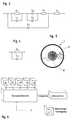
- Fig. 1
- eine schematische Darstellung eines Walzölkreislaufes mit einem Meßsystem zur Bestimmung der Leitfähigkeit des Walzöls,
- Fig. 2
- eine schematische Längsschnittdarstellung eines Basissensors,
- Fig. 3
- das Ersatzschaltbild des Basissensors nach Fig. 2, übernommen aus: Oehme, F.: Chemische Sensoren, Vieweg 1991,
- Fig. 4
- das vereinfachte Ersatzschaltbild des Basissensors,
- Fig. 5
- einen schematischen Querschnitt des Basissensors nach Fig. 2,
- Fig. 6
- das Blockschaltbild eines Meßsystems mit dem Basissensor nach den Fign. 2 bis 5 zur Messung verschiedener physikalischer Größen von gering leitenden und nichtleitenden Fluiden,
- Fig. 7
- das Schaltbild eines mit einer Gleichspannung betriebenen Basissensors zur Messung des ohmschen Widerstandes eines Fluids,
- Fig. 8
- den Verlauf einer bipolar getakteten Gleichspannung zum Betreiben eines Basissensors zur Messung des ohmschen Widerstandes eines Fluids,
- Fig. 9
- das Blockschaltbild eines Meßsystems zur Messung der elektrischen Leitfähigkeit eines Fluids,
- Fig. 10
- das Schaltbild des bei dem Meßsystem nach Fig. 9 eingesetzten Integrators mit Sensor und Analogschalter,
- Fig. 11
- das Diagramm der getakteten Eingangsspannung und der Ausgangsspannung des Integrators und
- Fig. 12
- das Blockschaltbild eines Meßsystems zur Messung der elektrischen Leitfähigkeit und der Dielektrizitätszahl eines Fluids.
- Rx
- gesuchter Widerstand
- Cx
- Kapazität des Sensors
- Rp
- Polarisationswiderstand
- Cp
- Polarisationskapazität
- Cd
- Doppelschichtkapazität
- Ck
- Kabelkapazität
- Rk
- Kabel- und Kontaktwiderstand
- Es bedeuten:
- ra Innenradius der Außenelektrode
ri Radius der Innenelektrode
l aktive Elektrodenlänge
Claims (9)
- Verfahren zur Messung physikalischer Größen von gering leitenden und nichtleitenden Fluiden wie Walzöl, Schmieröl, Hydrauliköl, Bremsflüssigkeiten und Kraftstoffen, wobei sich das Fluid zwischen mindestens zwei elektrisch leitenden Elektroden befindet, gekennzeichnet durch eine Messung der elektrischen Leitfähigkeit κ zur Regelung einer elektrostatische Auf- und Entladungen verhindernden Mindestleitfähigkeit von Fluiden, insbesondere von Walzöl durch eine geregelte Einleitung von Leitfähigkeitsadditiven und/oder eine Messung der zeitlichen Änderung der Leitfähigkeit zur Bestimmung des Feinstverschmutzeintrags und des Verunreinigungsgrades insbesondere durch elektrisch leitende metallische Abriebpartikel und/oder eine Differenzmessung der Leitfähigkeit vor und hinter einem Filter zur Prüfung der Funktion und Güte eines Filtervorganges und gegebenenfalls zur Regelung des Filtervorganges durch eine geregelte Zuführung von Filterhilfsmitteln und/oder eine Messung der Dielektrizitätszahl εr zum Erfassen polarer Komponenten wie Ölzusatzstoffe oder Wasser und/oder eine Messung der Permeabilität µ zur Bestimmung der Konzentrationen von Eisenpartikeln bzw. ferromagnetischen Abriebpartikeln, wobei die Messungen der verschiedenen physikalischen Größen als Online-Messungen mittels eines gemeinsamen Basissensors durchgeführt werden.
- Verfahren nach Anspruch 1, gekennzeichnet durch eine Messung des Absolutwertes der Leitfähigkeit zur Ermittlung des Grades der Gefahr der elektrostatischen Aufladung im Hinblick auf die Vermeidung elektrostatischer Entladungen.
- Meßsystem zur Online-Messung der elektrischen Leitfähigkeit κ eines Fluids gemäß dem Verfahren nach Anspruch 1 und 2, dadurch gekennzeichnet, daß auf den Basissensor (4) ein Testsignal in Form einer getakteten Gleichspannung oder eines getakteten Gleichstromes geschaltet wird, deren Frequenz vom Wert der Leitfähigkeit κ abhängt, und der sich einstellende Ausgangsstrom oder die Ausgangsspannung aufintegriert wird und das Ausgangssignal des Integrators (18) auf einen Schmitt-Trigger (19) geschaltet wird, dessen Ausgangssignal wiederum als Testsignal auf den Basissensor (4) geschaltet wird, und die Integration bei jeder Änderung des Testsignals (Flanken) auf null gesetzt wird.
- Meßsystem zur Online-Messung der Dielektrizitätszahl εr eines Fluids gemäß dem Verfahren nach Anspruch 1 und 2, dadurch gekennzeichnet, daß auf den Basissensor ein Testsignal in Form eines getakteten Gleichstromes geschaltet wird, dessen Frequenz dem Wert der Dielektrizitätszahl εr proportional ist, und die sich einstellende Ausgangsspannung des so realisierten Integrators auf einen Schmitt-Trigger geschaltet wird, dessen Ausgangssignal in einen Strom umgewandelt wiederum als Testsignal auf den Basissensor geschaltet wird.
- Meßsystem zur Online-Messung der Permeabilität µ eines Fluids gemäß dem Verfahren nach Anspruch 1 und 2, dadurch gekennzeichnet, daß auf den Basissensor ein Testsignal in Form einer getakteten Gleichspannung geschaltet wird, deren Frequenz vom Wert der Permeabilität µ abhängt und der sich einstellende Strom durch den Basissensor in eine Spannung umgewandelt wird und diese Ausgangsspannung des auf diese Weise realisierten Integrators auf einen Schmitt-Trigger geschaltet wird, dessen Ausgangsspannung wiederum als Testsignal auf den Basissensor geschaltet wird.
- Meßsystem nach einem der Ansprüche 3 bis 5, dadurch gekennzeichnet, daß mit Hilfe der Sensorelektronik eine automatische Selbstkalibrierung erfolgt, wobei ein Präzisionswiderstand, ein Präzisionskondensator und/oder eine Präszisionsinduktivität kurzzeitig anstelle des Basissensors in die Elektronik geschaltet wird.
- Meßsystem nach einem der Ansprüche 3 bis 5, dadurch gekennzeichnet, daß der Basissensor (4) eine als elektrisch leitender Rohrabschnitt (9a) ausgebildete Außenelektrode (9) aufweist, in dem (9a) mindestens eine elektrisch leitende, vom Fluid umströmte Innenelektrode (10) angeordnet ist, die aus mindestens zwei voneinander isolierten, elektrisch leitenden Teilen in Form einer Nutzelektrode (10a) und einer Schirmelektrode (10b, 10c) besteht, die zur Durchführung von Anschlußleitungen zumindest teilweise hohl ausgebildet sind, wobei der für die Messung bestimmte Teil (10a) der Innenelektrode (10) keinen direkten mechanischen Kontakt zu Halterungen (12) der Innenelektrode (10) besitzt und auf die anderen leitenden Bereiche (10b, 10c) der Innenelektrode (10) gleiche, jedoch elektrisch unabhängige Spannungen wie auf den für die Messung bestimmten Bereich (10a) geschaltet werden, wobei die anderen Bereiche (10b, 10c) zur Erzeugung einer geeigneten elektrischen Feldverteilung bestimmt sind und die Funktion von Halterungen übernehmen.
- Meßsystem nach Anspruch 7, gekennzeichnet durch die Viskositätsmessung eines Fluids über eine Rotation der Innenelektrode (10).
- Meßsystem nach Anspruch 7, dadurch gekennzeichnet, daß das Sensorsystem als planare Elektrodenanordnung mit nebeneinander liegenden oder konzentrisch angeordneten Elektroden realisiert wird, wobei neben den Nutzelektroden weitere Elektroden zur Schirmung und Formung des elektrischen Feldes dienen.
Applications Claiming Priority (2)
| Application Number | Priority Date | Filing Date | Title |
|---|---|---|---|
| DE19628690 | 1996-07-17 | ||
| DE19628690A DE19628690C2 (de) | 1996-07-17 | 1996-07-17 | Verfahren und Meßsysteme zur Messung physikalischer Größen von gering leitenden und nichtleitenden Fluiden |
Publications (3)
| Publication Number | Publication Date |
|---|---|
| EP0819938A2 true EP0819938A2 (de) | 1998-01-21 |
| EP0819938A3 EP0819938A3 (de) | 2002-03-13 |
| EP0819938B1 EP0819938B1 (de) | 2008-03-26 |
Family
ID=7799988
Family Applications (1)
| Application Number | Title | Priority Date | Filing Date |
|---|---|---|---|
| EP97110884A Expired - Lifetime EP0819938B1 (de) | 1996-07-17 | 1997-07-02 | Verfahren und Messsysteme zur Messung physikalischer Grössen von gering leitenden und nichtleitenden Fluiden |
Country Status (4)
| Country | Link |
|---|---|
| US (1) | US5973503A (de) |
| EP (1) | EP0819938B1 (de) |
| JP (1) | JP4057100B2 (de) |
| DE (2) | DE19628690C2 (de) |
Cited By (4)
| Publication number | Priority date | Publication date | Assignee | Title |
|---|---|---|---|---|
| NL2001521C2 (nl) * | 2008-04-25 | 2009-10-27 | Fluid Well Instr B V | Inrichting en werkwijze voor het meten van een elektrische eigenschap van een door een buis heen stromend fluïdum. |
| WO2011082884A1 (de) * | 2009-12-17 | 2011-07-14 | Robert Bosch Gmbh | Vorrichtung zur messung einer zusammensetzung eines kraftstoffgemischs |
| EP2964929A4 (de) * | 2013-03-06 | 2016-10-12 | United Technologies Corp | Ablagerungsüberwachungssystem für ölsystem bei einem gasturbinenmotor |
| WO2017108017A1 (de) * | 2015-12-22 | 2017-06-29 | Dürr Somac GmbH | Vorrichtung zur messung des wassergehaltes in bremsflüssigkeiten |
Families Citing this family (37)
| Publication number | Priority date | Publication date | Assignee | Title |
|---|---|---|---|---|
| US6223129B1 (en) * | 1998-05-13 | 2001-04-24 | Diverseylever, Inc. | Apparatus and method for conductivity measurement including probe contamination compensation |
| US6529841B2 (en) | 1998-05-13 | 2003-03-04 | Johnson Diversey, Inc. | Apparatus and method for conductivity measurement including probe contamination compensation |
| US7542866B1 (en) * | 1999-01-21 | 2009-06-02 | Rosemount Inc. | Threshold setting for a radar level transmitter |
| DE19905817C2 (de) * | 1999-02-12 | 2003-06-18 | Achenbach Buschhuetten Gmbh | Verfahren für die Aufbereitung und die Konditionierung von im Kreislauf gefahrenem Walzöl |
| US6278282B1 (en) | 1999-10-07 | 2001-08-21 | Detroit Diesel Corporation | Method and system for determining oil quality |
| US6268737B1 (en) | 1999-10-07 | 2001-07-31 | Detroit Diesel Corporation | Method and system for determining oil quality |
| DE19959005A1 (de) * | 1999-12-08 | 2001-06-13 | Abb Research Ltd | Verfahren und Vorrichtung zur Öl-in-Wasser Messung |
| DE10100773A1 (de) * | 2001-01-10 | 2002-07-11 | Hoka Gmbh | Ölqualitätssensor für Getriebe und Motoren |
| US6577112B2 (en) * | 2001-03-09 | 2003-06-10 | The Lubrizol Corporation | Method and apparatus for on-line monitoring of quality and/or condition of highly resistive fluids |
| US6575018B2 (en) * | 2001-07-06 | 2003-06-10 | Delphi Technologies, Inc. | Method for determining oil viscosity |
| US6781389B1 (en) | 2001-10-12 | 2004-08-24 | Ford Global Technologies, Llc | Conductivity sensor for detecting conductivity of a fluid |
| US6911830B2 (en) * | 2002-08-22 | 2005-06-28 | Delphi Technologies, Inc. | Diesel engine lubricating oil contaminant sensor method |
| GB0305155D0 (en) * | 2003-03-07 | 2003-04-09 | Suisse Electronique Microtech | Detection of water in brake fluid |
| FR2870346B1 (fr) * | 2004-05-17 | 2006-09-08 | Millipore Corp | Cellule de mesure de conductivite d'un fluide |
| DE102006060138B4 (de) * | 2006-12-18 | 2009-01-22 | Airbus France | Online-Sensor zum Überwachen chemischer Verunreinigungen in hydraulischen Flüssigkeiten |
| US7927095B1 (en) * | 2007-09-30 | 2011-04-19 | The United States Of America As Represented By The United States Department Of Energy | Time varying voltage combustion control and diagnostics sensor |
| DK2163887T3 (da) | 2008-09-15 | 2015-02-09 | Ulrich Kuipers | Fremgangsmåde og kredsløbsarrangement til måling af fysiske parametre i fluider og disses anvendelser |
| US20100321036A1 (en) * | 2009-06-22 | 2010-12-23 | Delaware Capital Formation, Inc. | Dual tone measurement of conductivity and dielectric properties |
| DE102010042637A1 (de) * | 2010-10-19 | 2012-04-19 | Endress + Hauser Conducta Gesellschaft für Mess- und Regeltechnik GmbH + Co. KG | Leitfähigkeitssensor |
| CN103460009B (zh) * | 2011-03-03 | 2016-07-06 | Ntn株式会社 | 滚动装置的状态监视系统和状态监视方法 |
| DE102011057092A1 (de) * | 2011-12-28 | 2013-07-04 | OCé PRINTING SYSTEMS GMBH | Vorrichtung zur Bestimmung der Leitfähigkeit eines Flüssigentwicklers |
| DE202012000569U1 (de) * | 2012-01-20 | 2013-04-23 | Seuffer Gmbh & Co.Kg | Sensorvorrichtung zur Erfassung von Flüssigkeitseigenschaften |
| DE102012016458A1 (de) * | 2012-08-17 | 2014-05-15 | Hydac Filter Systems Gmbh | Vorrichtung zum Feststellen von Partikelverschmutzungen in Fluiden |
| DE102013109217B4 (de) | 2013-08-26 | 2022-02-24 | MBA Instruments GmbH | Messsonde zum Messen der elektrischen Leitfähigkeit in gering leitenden Flüssigkeiten |
| CA2924724C (en) | 2013-09-18 | 2022-09-20 | Advantec Sensing As | Apparatus and method for characterization of fluids or powders by electrical permittivity |
| CN103926276B (zh) * | 2014-03-25 | 2016-01-20 | 天津大学 | 一种在线油液磨粒监测装置及检测方法 |
| ES2530691B1 (es) * | 2015-02-02 | 2015-11-03 | Zertan, S.A. | Método de medida de la presencia de agua en filtros de gasóleo y sensor de agua para efectuar dicho método |
| DE102015225502B3 (de) * | 2015-12-16 | 2016-06-23 | Achenbach Buschhütten GmbH & Co. KG | Messvorrichtung und Verfahren zur Messung der elektrischen Leitfähigkeit eines strömenden Fluids |
| DE102016109102B3 (de) * | 2016-05-18 | 2016-10-27 | Sick Ag | Kapazitiver Sensor und Verfahren zur Bestimmung der Permittivitätsverteilung in einem Objekt |
| US10965346B2 (en) | 2017-05-23 | 2021-03-30 | Nxp B.V. | Near-field device |
| US10389406B2 (en) | 2017-07-05 | 2019-08-20 | Nxp B.V. | Near-field device |
| TW201929987A (zh) * | 2018-01-02 | 2019-08-01 | 國立中央大學 | 檢測放電加工液的金屬及非金屬顆粒濃度之方法及檢測裝置 |
| IT201800005832A1 (it) * | 2018-05-29 | 2019-11-29 | Sistema multi-controllo per macchine lubrificate e relativo metodo | |
| US11035841B2 (en) * | 2019-07-09 | 2021-06-15 | Saudi Arabian Oil Company | Monitoring the performance of protective fluids in downhole tools |
| US11359458B2 (en) | 2020-06-23 | 2022-06-14 | Saudi Arabian Oil Company | Monitoring oil health in subsurface safety valves |
| GB2603022B (en) * | 2021-08-23 | 2023-03-08 | Fuel Active Ltd | A Fuel monitoring system |
| US20250377327A1 (en) * | 2024-06-06 | 2025-12-11 | Georg Fischer Signet Llc | Measurement of characteristics of a fluid |
Family Cites Families (12)
| Publication number | Priority date | Publication date | Assignee | Title |
|---|---|---|---|---|
| US3275018A (en) * | 1963-02-15 | 1966-09-27 | United States Steel Corp | Apparatus for measuring and controlling the concentration of rolling oil |
| CA1069976A (en) * | 1975-12-29 | 1980-01-15 | Raytheon Company | Electrolytic measurement system |
| JPS5885314A (ja) * | 1981-11-17 | 1983-05-21 | Nissan Motor Co Ltd | エンジンオイルの劣化検知装置 |
| SU1044893A1 (ru) * | 1982-04-15 | 1983-09-30 | Ивановский Ордена "Знак Почета" Энергетический Институт Им.В.И.Ленина | Устройство дл огневого обезвреживани жидких отходов |
| DE3843177C2 (de) * | 1988-12-22 | 1999-03-25 | Fev Motorentech Gmbh & Co Kg | Verfahren zur Feststellung des Alkoholgehaltes und/oder des Heizwertes von Kraftstoffen |
| CA1332183C (en) * | 1989-06-23 | 1994-09-27 | Richard W. Henderson | Capacitance probe assembly |
| US5033293A (en) * | 1990-03-09 | 1991-07-23 | Calsonic Corporation | Alcohol concentration detecting device |
| US5450358A (en) * | 1991-09-30 | 1995-09-12 | Mckesson Corporation | Method and system for monitoring the quality of a water purification apparatus |
| US5315243A (en) * | 1992-04-06 | 1994-05-24 | Her Majesty The Queen In Right Of Canada, As Represented By The Minister Of National Defence | Detection and discrimination between ferromagnetic and non-ferromagnetic conductive particles in a fluid |
| US5396178A (en) * | 1992-05-18 | 1995-03-07 | Dober Chemical Corporation | Apparatus and method for determining that equipment is clean |
| DE4334434A1 (de) * | 1993-10-08 | 1995-04-13 | Hoechst Ag | Verfahren zum Überwachen von Wasser auf organische Verunreinigungen |
| US5540086A (en) * | 1994-08-30 | 1996-07-30 | Kavlico Corporation | Oil deterioration sensor |
-
1996
- 1996-07-17 DE DE19628690A patent/DE19628690C2/de not_active Expired - Fee Related
-
1997
- 1997-07-02 DE DE59712931T patent/DE59712931D1/de not_active Expired - Lifetime
- 1997-07-02 EP EP97110884A patent/EP0819938B1/de not_active Expired - Lifetime
- 1997-07-10 US US08/890,977 patent/US5973503A/en not_active Expired - Lifetime
- 1997-07-16 JP JP19142097A patent/JP4057100B2/ja not_active Expired - Fee Related
Cited By (6)
| Publication number | Priority date | Publication date | Assignee | Title |
|---|---|---|---|---|
| NL2001521C2 (nl) * | 2008-04-25 | 2009-10-27 | Fluid Well Instr B V | Inrichting en werkwijze voor het meten van een elektrische eigenschap van een door een buis heen stromend fluïdum. |
| US8264241B2 (en) | 2008-04-25 | 2012-09-11 | Fluid Well Instruments, B.V. | Device and method for measuring an electrical property of a fluid flowing through a pipe |
| WO2011082884A1 (de) * | 2009-12-17 | 2011-07-14 | Robert Bosch Gmbh | Vorrichtung zur messung einer zusammensetzung eines kraftstoffgemischs |
| US9097696B2 (en) | 2009-12-17 | 2015-08-04 | Robert Bosch Gmbh | Device for measuring a composition of a fuel mixture |
| EP2964929A4 (de) * | 2013-03-06 | 2016-10-12 | United Technologies Corp | Ablagerungsüberwachungssystem für ölsystem bei einem gasturbinenmotor |
| WO2017108017A1 (de) * | 2015-12-22 | 2017-06-29 | Dürr Somac GmbH | Vorrichtung zur messung des wassergehaltes in bremsflüssigkeiten |
Also Published As
| Publication number | Publication date |
|---|---|
| EP0819938B1 (de) | 2008-03-26 |
| DE19628690A1 (de) | 1998-01-29 |
| DE59712931D1 (de) | 2008-05-08 |
| JP4057100B2 (ja) | 2008-03-05 |
| US5973503A (en) | 1999-10-26 |
| EP0819938A3 (de) | 2002-03-13 |
| JPH10132774A (ja) | 1998-05-22 |
| DE19628690C2 (de) | 1999-04-22 |
Similar Documents
| Publication | Publication Date | Title |
|---|---|---|
| DE19628690C2 (de) | Verfahren und Meßsysteme zur Messung physikalischer Größen von gering leitenden und nichtleitenden Fluiden | |
| DE10243748B4 (de) | Elektromagnetischer Durchflussmesser | |
| DE2948776C2 (de) | ||
| DE112011101496B4 (de) | Filtersystem für eine Kraftstoff-Filtrationsvorrichtung | |
| EP3152530B1 (de) | Verfahren und vorrichtung zur überwachung des füllstandes eines mediums in einem behälter | |
| EP2577253B1 (de) | Verfahren zum erfassen von partikeln in einem abgasstrom | |
| DE2636406A1 (de) | Verfahren und einrichtung zur feststellung leitfaehiger partikel in einem stroemungssystem | |
| EP0926475A2 (de) | Kapazitiver Füllstandssensor mit integrierter Schmutzfilmdetektion | |
| EP2718703A1 (de) | Impedanz-verfahren und anordnung zur bestimmung der zusammensetzung eines mehrphasengemischs | |
| DE102008005258A1 (de) | Verfahren zum Betrieb einer Durchflussmesseinrichtung, sowie eine Durchflussmesseinrichtung selbst | |
| DE3517065C2 (de) | Anordnung zur Überwachung des Mischungsverhältnisses zweier Flüssigkeiten | |
| EP2163887A1 (de) | Verfahren, Schaltungsanordnung, Sensor zur Messung physikalischer Grössen in Fluiden sowie deren Verwendung | |
| DE2401641A1 (de) | Elektrodenanordnung fuer einen elektromagnetischen stroemungsmesser | |
| DE102006031332B4 (de) | Messvorrichtung zum Nachweis von Fremdstoffen in einer Flüssigkeit | |
| EP3182107B1 (de) | Messvorrichtung und verfahren zur messung der elektrischen leitfähigkeit eines strömenden fluids | |
| WO2012031924A1 (de) | Verfahren zur überwachung der alterung eines organischen stoffes und messanordnung mit einem kondensator | |
| DE10343457C5 (de) | Vorrichtung zur Partikelmessung | |
| DE102009020311B4 (de) | Vorrichtung zur Bestimmung der elektrischen Ladung eines strömenden Fluids | |
| DE10100773A1 (de) | Ölqualitätssensor für Getriebe und Motoren | |
| WO2014019665A1 (de) | Verfahren zur quantifizierung der oxidationsstabilität eines kraftstoffs | |
| DE19708067A1 (de) | Verfahren und Vorrichtung zur In-situ-Bestimmung von Öleigenschaften | |
| EP1867422A2 (de) | Vorrichtung und Verfahren zur elektrochemischen Bearbeitung von Werkstücken | |
| DE102018126382B3 (de) | Kapazitiver Drucksensor | |
| DE3739153C1 (de) | Vorrichtung zur Ermittlung des Beginns eines Verfalls von bewegten,fluessigkeitsgeschmierten Teilen | |
| DE102022203021A1 (de) | Verfahren zur Füllstandsermittlung eines Rohrs, Auswertungseinheit, Durchflussmesssystem und Computerprogrammprodukt |
Legal Events
| Date | Code | Title | Description |
|---|---|---|---|
| PUAI | Public reference made under article 153(3) epc to a published international application that has entered the european phase |
Free format text: ORIGINAL CODE: 0009012 |
|
| AK | Designated contracting states |
Kind code of ref document: A2 Designated state(s): AT BE CH DE DK ES FI FR GB GR IE IT LI LU MC NL PT SE Kind code of ref document: A2 Designated state(s): DE FR GB IT |
|
| PUAL | Search report despatched |
Free format text: ORIGINAL CODE: 0009013 |
|
| AK | Designated contracting states |
Kind code of ref document: A3 Designated state(s): AT BE CH DE DK ES FI FR GB GR IE IT LI LU MC NL PT SE |
|
| 17P | Request for examination filed |
Effective date: 20020429 |
|
| 17Q | First examination report despatched |
Effective date: 20020725 |
|
| AKX | Designation fees paid |
Free format text: DE FR GB IT |
|
| GRAP | Despatch of communication of intention to grant a patent |
Free format text: ORIGINAL CODE: EPIDOSNIGR1 |
|
| GRAS | Grant fee paid |
Free format text: ORIGINAL CODE: EPIDOSNIGR3 |
|
| GRAA | (expected) grant |
Free format text: ORIGINAL CODE: 0009210 |
|
| AK | Designated contracting states |
Kind code of ref document: B1 Designated state(s): DE FR GB IT |
|
| REG | Reference to a national code |
Ref country code: GB Ref legal event code: FG4D Free format text: NOT ENGLISH |
|
| REF | Corresponds to: |
Ref document number: 59712931 Country of ref document: DE Date of ref document: 20080508 Kind code of ref document: P |
|
| GBT | Gb: translation of ep patent filed (gb section 77(6)(a)/1977) |
Effective date: 20080417 |
|
| ET | Fr: translation filed | ||
| PLBE | No opposition filed within time limit |
Free format text: ORIGINAL CODE: 0009261 |
|
| STAA | Information on the status of an ep patent application or granted ep patent |
Free format text: STATUS: NO OPPOSITION FILED WITHIN TIME LIMIT |
|
| 26N | No opposition filed |
Effective date: 20081230 |
|
| REG | Reference to a national code |
Ref country code: FR Ref legal event code: PLFP Year of fee payment: 20 |
|
| PGFP | Annual fee paid to national office [announced via postgrant information from national office to epo] |
Ref country code: DE Payment date: 20160926 Year of fee payment: 20 Ref country code: IT Payment date: 20160721 Year of fee payment: 20 Ref country code: GB Payment date: 20160722 Year of fee payment: 20 |
|
| PGFP | Annual fee paid to national office [announced via postgrant information from national office to epo] |
Ref country code: FR Payment date: 20160722 Year of fee payment: 20 |
|
| REG | Reference to a national code |
Ref country code: DE Ref legal event code: R071 Ref document number: 59712931 Country of ref document: DE |
|
| REG | Reference to a national code |
Ref country code: GB Ref legal event code: PE20 Expiry date: 20170701 |
|
| PG25 | Lapsed in a contracting state [announced via postgrant information from national office to epo] |
Ref country code: GB Free format text: LAPSE BECAUSE OF EXPIRATION OF PROTECTION Effective date: 20170701 |