EP0819939A2 - Méthode de détermination de la durabilité du verre - Google Patents
Méthode de détermination de la durabilité du verre Download PDFInfo
- Publication number
- EP0819939A2 EP0819939A2 EP97305423A EP97305423A EP0819939A2 EP 0819939 A2 EP0819939 A2 EP 0819939A2 EP 97305423 A EP97305423 A EP 97305423A EP 97305423 A EP97305423 A EP 97305423A EP 0819939 A2 EP0819939 A2 EP 0819939A2
- Authority
- EP
- European Patent Office
- Prior art keywords
- glass
- determining
- glass composition
- process according
- species
- Prior art date
- Legal status (The legal status is an assumption and is not a legal conclusion. Google has not performed a legal analysis and makes no representation as to the accuracy of the status listed.)
- Withdrawn
Links
- 239000011521 glass Substances 0.000 title claims abstract description 347
- 238000000034 method Methods 0.000 title claims abstract description 102
- 239000000203 mixture Substances 0.000 claims abstract description 131
- 238000006703 hydration reaction Methods 0.000 claims abstract description 74
- 230000008569 process Effects 0.000 claims abstract description 74
- 238000004090 dissolution Methods 0.000 claims abstract description 51
- 230000036571 hydration Effects 0.000 claims abstract description 46
- 239000000376 reactant Substances 0.000 claims abstract description 42
- 239000007864 aqueous solution Substances 0.000 claims abstract description 39
- 239000000463 material Substances 0.000 claims abstract description 38
- 239000000243 solution Substances 0.000 claims abstract description 35
- 239000011159 matrix material Substances 0.000 claims abstract description 24
- 238000010494 dissociation reaction Methods 0.000 claims abstract description 15
- 230000005593 dissociations Effects 0.000 claims abstract description 12
- 238000012544 monitoring process Methods 0.000 claims abstract description 11
- 230000015572 biosynthetic process Effects 0.000 claims abstract description 7
- VYPSYNLAJGMNEJ-UHFFFAOYSA-N Silicium dioxide Chemical compound O=[Si]=O VYPSYNLAJGMNEJ-UHFFFAOYSA-N 0.000 claims description 49
- 238000007496 glass forming Methods 0.000 claims description 34
- 238000005191 phase separation Methods 0.000 claims description 26
- 239000000047 product Substances 0.000 claims description 25
- 150000001768 cations Chemical class 0.000 claims description 24
- 239000000377 silicon dioxide Substances 0.000 claims description 24
- 230000036961 partial effect Effects 0.000 claims description 23
- 239000010802 sludge Substances 0.000 claims description 21
- 238000006243 chemical reaction Methods 0.000 claims description 18
- 229910052681 coesite Inorganic materials 0.000 claims description 14
- 229910052906 cristobalite Inorganic materials 0.000 claims description 14
- 229910052682 stishovite Inorganic materials 0.000 claims description 14
- 229910052905 tridymite Inorganic materials 0.000 claims description 14
- KGBXLFKZBHKPEV-UHFFFAOYSA-N boric acid Chemical compound OB(O)O KGBXLFKZBHKPEV-UHFFFAOYSA-N 0.000 claims description 11
- 230000008859 change Effects 0.000 claims description 11
- 238000010586 diagram Methods 0.000 claims description 11
- JEIPFZHSYJVQDO-UHFFFAOYSA-N iron(III) oxide Inorganic materials O=[Fe]O[Fe]=O JEIPFZHSYJVQDO-UHFFFAOYSA-N 0.000 claims description 11
- 210000004072 lung Anatomy 0.000 claims description 11
- CURLTUGMZLYLDI-UHFFFAOYSA-N Carbon dioxide Chemical compound O=C=O CURLTUGMZLYLDI-UHFFFAOYSA-N 0.000 claims description 10
- 239000002920 hazardous waste Substances 0.000 claims description 10
- PNEYBMLMFCGWSK-UHFFFAOYSA-N aluminium oxide Inorganic materials [O-2].[O-2].[O-2].[Al+3].[Al+3] PNEYBMLMFCGWSK-UHFFFAOYSA-N 0.000 claims description 9
- 210000001124 body fluid Anatomy 0.000 claims description 9
- 239000010839 body fluid Substances 0.000 claims description 9
- 229910052796 boron Inorganic materials 0.000 claims description 9
- 230000002285 radioactive effect Effects 0.000 claims description 9
- 230000002829 reductive effect Effects 0.000 claims description 9
- 239000004327 boric acid Substances 0.000 claims description 8
- 239000003673 groundwater Substances 0.000 claims description 8
- 238000004519 manufacturing process Methods 0.000 claims description 8
- JKQOBWVOAYFWKG-UHFFFAOYSA-N molybdenum trioxide Chemical compound O=[Mo](=O)=O JKQOBWVOAYFWKG-UHFFFAOYSA-N 0.000 claims description 8
- RMAQACBXLXPBSY-UHFFFAOYSA-N silicic acid Chemical compound O[Si](O)(O)O RMAQACBXLXPBSY-UHFFFAOYSA-N 0.000 claims description 8
- 235000012239 silicon dioxide Nutrition 0.000 claims description 8
- 239000003513 alkali Substances 0.000 claims description 7
- 229910052593 corundum Inorganic materials 0.000 claims description 7
- UQSXHKLRYXJYBZ-UHFFFAOYSA-N iron oxide Inorganic materials [Fe]=O UQSXHKLRYXJYBZ-UHFFFAOYSA-N 0.000 claims description 7
- 239000002901 radioactive waste Substances 0.000 claims description 7
- 229910001845 yogo sapphire Inorganic materials 0.000 claims description 7
- ZOXJGFHDIHLPTG-UHFFFAOYSA-N Boron Chemical compound [B] ZOXJGFHDIHLPTG-UHFFFAOYSA-N 0.000 claims description 6
- 229910000272 alkali metal oxide Inorganic materials 0.000 claims description 6
- QVGXLLKOCUKJST-UHFFFAOYSA-N atomic oxygen Chemical compound [O] QVGXLLKOCUKJST-UHFFFAOYSA-N 0.000 claims description 6
- 239000003607 modifier Substances 0.000 claims description 6
- 229910052760 oxygen Inorganic materials 0.000 claims description 6
- 239000001301 oxygen Substances 0.000 claims description 6
- 229910052708 sodium Inorganic materials 0.000 claims description 6
- 239000011734 sodium Substances 0.000 claims description 6
- 238000003860 storage Methods 0.000 claims description 6
- 229910052792 caesium Inorganic materials 0.000 claims description 5
- 229910002092 carbon dioxide Inorganic materials 0.000 claims description 5
- 125000002091 cationic group Chemical group 0.000 claims description 5
- -1 hydrogen ions Chemical class 0.000 claims description 5
- PLDDOISOJJCEMH-UHFFFAOYSA-N neodymium oxide Inorganic materials [O-2].[O-2].[O-2].[Nd+3].[Nd+3] PLDDOISOJJCEMH-UHFFFAOYSA-N 0.000 claims description 5
- MYMOFIZGZYHOMD-UHFFFAOYSA-N Dioxygen Chemical compound O=O MYMOFIZGZYHOMD-UHFFFAOYSA-N 0.000 claims description 4
- ODINCKMPIJJUCX-UHFFFAOYSA-N calcium oxide Inorganic materials [Ca]=O ODINCKMPIJJUCX-UHFFFAOYSA-N 0.000 claims description 4
- 229910000421 cerium(III) oxide Inorganic materials 0.000 claims description 4
- 239000007795 chemical reaction product Substances 0.000 claims description 4
- 229910001882 dioxygen Inorganic materials 0.000 claims description 4
- MRELNEQAGSRDBK-UHFFFAOYSA-N lanthanum oxide Inorganic materials [O-2].[O-2].[O-2].[La+3].[La+3] MRELNEQAGSRDBK-UHFFFAOYSA-N 0.000 claims description 4
- 229910052744 lithium Inorganic materials 0.000 claims description 4
- 238000007254 oxidation reaction Methods 0.000 claims description 4
- 230000001590 oxidative effect Effects 0.000 claims description 4
- KTUFCUMIWABKDW-UHFFFAOYSA-N oxo(oxolanthaniooxy)lanthanum Chemical compound O=[La]O[La]=O KTUFCUMIWABKDW-UHFFFAOYSA-N 0.000 claims description 4
- RUDFQVOCFDJEEF-UHFFFAOYSA-N yttrium(III) oxide Inorganic materials [O-2].[O-2].[O-2].[Y+3].[Y+3] RUDFQVOCFDJEEF-UHFFFAOYSA-N 0.000 claims description 4
- DGAQECJNVWCQMB-PUAWFVPOSA-M Ilexoside XXIX Chemical compound C[C@@H]1CC[C@@]2(CC[C@@]3(C(=CC[C@H]4[C@]3(CC[C@@H]5[C@@]4(CC[C@@H](C5(C)C)OS(=O)(=O)[O-])C)C)[C@@H]2[C@]1(C)O)C)C(=O)O[C@H]6[C@@H]([C@H]([C@@H]([C@H](O6)CO)O)O)O.[Na+] DGAQECJNVWCQMB-PUAWFVPOSA-M 0.000 claims description 3
- 229910052776 Thorium Inorganic materials 0.000 claims description 3
- 239000001569 carbon dioxide Substances 0.000 claims description 3
- 239000013056 hazardous product Substances 0.000 claims description 3
- 229910052745 lead Inorganic materials 0.000 claims description 3
- 230000003647 oxidation Effects 0.000 claims description 3
- 229910052710 silicon Inorganic materials 0.000 claims description 3
- 229910052695 Americium Inorganic materials 0.000 claims description 2
- 229910052684 Cerium Inorganic materials 0.000 claims description 2
- 229910052779 Neodymium Inorganic materials 0.000 claims description 2
- 229910052785 arsenic Inorganic materials 0.000 claims description 2
- 229910052788 barium Inorganic materials 0.000 claims description 2
- 229910052793 cadmium Inorganic materials 0.000 claims description 2
- 229910052804 chromium Inorganic materials 0.000 claims description 2
- 239000000499 gel Substances 0.000 claims description 2
- 238000005342 ion exchange Methods 0.000 claims description 2
- 229910052746 lanthanum Inorganic materials 0.000 claims description 2
- 239000002504 physiological saline solution Substances 0.000 claims description 2
- 239000002344 surface layer Substances 0.000 claims description 2
- 229910052713 technetium Inorganic materials 0.000 claims description 2
- 229910052725 zinc Inorganic materials 0.000 claims description 2
- 241000894007 species Species 0.000 claims 30
- 239000007805 chemical reaction reactant Substances 0.000 claims 5
- WHXSMMKQMYFTQS-UHFFFAOYSA-N Lithium Chemical compound [Li] WHXSMMKQMYFTQS-UHFFFAOYSA-N 0.000 claims 2
- 239000010703 silicon Substances 0.000 claims 2
- XUIMIQQOPSSXEZ-UHFFFAOYSA-N Silicon Chemical compound [Si] XUIMIQQOPSSXEZ-UHFFFAOYSA-N 0.000 claims 1
- 229910052739 hydrogen Inorganic materials 0.000 claims 1
- 239000001257 hydrogen Substances 0.000 claims 1
- 229910052751 metal Inorganic materials 0.000 claims 1
- 239000002184 metal Substances 0.000 claims 1
- 239000002253 acid Substances 0.000 abstract description 9
- 238000000611 regression analysis Methods 0.000 abstract 1
- 239000002699 waste material Substances 0.000 description 52
- 238000002386 leaching Methods 0.000 description 16
- 125000000129 anionic group Chemical group 0.000 description 12
- XLYOFNOQVPJJNP-UHFFFAOYSA-N water Substances O XLYOFNOQVPJJNP-UHFFFAOYSA-N 0.000 description 12
- 238000005816 glass manufacturing process Methods 0.000 description 11
- 239000002585 base Substances 0.000 description 10
- 239000000919 ceramic Substances 0.000 description 10
- 230000001419 dependent effect Effects 0.000 description 10
- 150000002500 ions Chemical class 0.000 description 10
- HEMHJVSKTPXQMS-UHFFFAOYSA-M Sodium hydroxide Chemical compound [OH-].[Na+] HEMHJVSKTPXQMS-UHFFFAOYSA-M 0.000 description 9
- 239000000126 substance Substances 0.000 description 9
- GWEVSGVZZGPLCZ-UHFFFAOYSA-N Titan oxide Chemical compound O=[Ti]=O GWEVSGVZZGPLCZ-UHFFFAOYSA-N 0.000 description 8
- 238000013459 approach Methods 0.000 description 8
- 230000007797 corrosion Effects 0.000 description 8
- 238000005260 corrosion Methods 0.000 description 8
- 230000000694 effects Effects 0.000 description 8
- 239000005388 borosilicate glass Substances 0.000 description 7
- 239000012530 fluid Substances 0.000 description 7
- 238000012360 testing method Methods 0.000 description 7
- 208000033116 Asbestos intoxication Diseases 0.000 description 6
- XEEYBQQBJWHFJM-UHFFFAOYSA-N Iron Chemical compound [Fe] XEEYBQQBJWHFJM-UHFFFAOYSA-N 0.000 description 6
- 206010003441 asbestosis Diseases 0.000 description 6
- 239000002131 composite material Substances 0.000 description 6
- 239000011152 fibreglass Substances 0.000 description 6
- 239000002002 slurry Substances 0.000 description 6
- 238000004017 vitrification Methods 0.000 description 6
- KKCBUQHMOMHUOY-UHFFFAOYSA-N Na2O Inorganic materials [O-2].[Na+].[Na+] KKCBUQHMOMHUOY-UHFFFAOYSA-N 0.000 description 5
- 230000004044 response Effects 0.000 description 5
- 230000002378 acidificating effect Effects 0.000 description 4
- 150000007513 acids Chemical class 0.000 description 4
- 239000004568 cement Substances 0.000 description 4
- 230000001276 controlling effect Effects 0.000 description 4
- 230000007123 defense Effects 0.000 description 4
- 238000011161 development Methods 0.000 description 4
- 239000000835 fiber Substances 0.000 description 4
- 239000003365 glass fiber Substances 0.000 description 4
- XLYOFNOQVPJJNP-ZSJDYOACSA-N heavy water Substances [2H]O[2H] XLYOFNOQVPJJNP-ZSJDYOACSA-N 0.000 description 4
- BDAGIHXWWSANSR-UHFFFAOYSA-N methanoic acid Natural products OC=O BDAGIHXWWSANSR-UHFFFAOYSA-N 0.000 description 4
- 239000000843 powder Substances 0.000 description 4
- 238000012545 processing Methods 0.000 description 4
- 238000012797 qualification Methods 0.000 description 4
- 150000003839 salts Chemical class 0.000 description 4
- 239000007858 starting material Substances 0.000 description 4
- 229910003641 H2SiO3 Inorganic materials 0.000 description 3
- FUJCRWPEOMXPAD-UHFFFAOYSA-N Li2O Inorganic materials [Li+].[Li+].[O-2] FUJCRWPEOMXPAD-UHFFFAOYSA-N 0.000 description 3
- FAPWRFPIFSIZLT-UHFFFAOYSA-M Sodium chloride Chemical compound [Na+].[Cl-] FAPWRFPIFSIZLT-UHFFFAOYSA-M 0.000 description 3
- 229910052782 aluminium Inorganic materials 0.000 description 3
- 238000004458 analytical method Methods 0.000 description 3
- 150000001450 anions Chemical class 0.000 description 3
- TVFDJXOCXUVLDH-UHFFFAOYSA-N caesium atom Chemical compound [Cs] TVFDJXOCXUVLDH-UHFFFAOYSA-N 0.000 description 3
- XUCJHNOBJLKZNU-UHFFFAOYSA-M dilithium;hydroxide Chemical compound [Li+].[Li+].[OH-] XUCJHNOBJLKZNU-UHFFFAOYSA-M 0.000 description 3
- 208000018459 dissociative disease Diseases 0.000 description 3
- 238000005516 engineering process Methods 0.000 description 3
- 230000007613 environmental effect Effects 0.000 description 3
- 231100001261 hazardous Toxicity 0.000 description 3
- 238000010438 heat treatment Methods 0.000 description 3
- XLYOFNOQVPJJNP-UHFFFAOYSA-M hydroxide Chemical compound [OH-] XLYOFNOQVPJJNP-UHFFFAOYSA-M 0.000 description 3
- 229910052742 iron Inorganic materials 0.000 description 3
- 230000007774 longterm Effects 0.000 description 3
- 230000007246 mechanism Effects 0.000 description 3
- 239000000155 melt Substances 0.000 description 3
- 230000002685 pulmonary effect Effects 0.000 description 3
- 239000012857 radioactive material Substances 0.000 description 3
- 230000000241 respiratory effect Effects 0.000 description 3
- OSWFIVFLDKOXQC-UHFFFAOYSA-N 4-(3-methoxyphenyl)aniline Chemical compound COC1=CC=CC(C=2C=CC(N)=CC=2)=C1 OSWFIVFLDKOXQC-UHFFFAOYSA-N 0.000 description 2
- 208000005623 Carcinogenesis Diseases 0.000 description 2
- BPQQTUXANYXVAA-UHFFFAOYSA-N Orthosilicate Chemical compound [O-][Si]([O-])([O-])[O-] BPQQTUXANYXVAA-UHFFFAOYSA-N 0.000 description 2
- 229910020489 SiO3 Inorganic materials 0.000 description 2
- PMZURENOXWZQFD-UHFFFAOYSA-L Sodium Sulfate Chemical compound [Na+].[Na+].[O-]S([O-])(=O)=O PMZURENOXWZQFD-UHFFFAOYSA-L 0.000 description 2
- 229910052770 Uranium Inorganic materials 0.000 description 2
- MCMNRKCIXSYSNV-UHFFFAOYSA-N Zirconium dioxide Chemical compound O=[Zr]=O MCMNRKCIXSYSNV-UHFFFAOYSA-N 0.000 description 2
- 229910052784 alkaline earth metal Inorganic materials 0.000 description 2
- 229910000287 alkaline earth metal oxide Inorganic materials 0.000 description 2
- XAGFODPZIPBFFR-UHFFFAOYSA-N aluminium Chemical compound [Al] XAGFODPZIPBFFR-UHFFFAOYSA-N 0.000 description 2
- 239000010425 asbestos Substances 0.000 description 2
- 230000036952 cancer formation Effects 0.000 description 2
- 231100000504 carcinogenesis Toxicity 0.000 description 2
- 238000012512 characterization method Methods 0.000 description 2
- 238000000354 decomposition reaction Methods 0.000 description 2
- 238000005202 decontamination Methods 0.000 description 2
- 230000003588 decontaminative effect Effects 0.000 description 2
- 230000003247 decreasing effect Effects 0.000 description 2
- QDOXWKRWXJOMAK-UHFFFAOYSA-N dichromium trioxide Chemical compound O=[Cr]O[Cr]=O QDOXWKRWXJOMAK-UHFFFAOYSA-N 0.000 description 2
- 238000009792 diffusion process Methods 0.000 description 2
- 238000005538 encapsulation Methods 0.000 description 2
- 235000019253 formic acid Nutrition 0.000 description 2
- 238000009472 formulation Methods 0.000 description 2
- 230000004927 fusion Effects 0.000 description 2
- 239000002927 high level radioactive waste Substances 0.000 description 2
- 230000007062 hydrolysis Effects 0.000 description 2
- 238000006460 hydrolysis reaction Methods 0.000 description 2
- PEYVWSJAZONVQK-UHFFFAOYSA-N hydroperoxy(oxo)borane Chemical compound OOB=O PEYVWSJAZONVQK-UHFFFAOYSA-N 0.000 description 2
- 239000004615 ingredient Substances 0.000 description 2
- 229910052500 inorganic mineral Inorganic materials 0.000 description 2
- 239000003456 ion exchange resin Substances 0.000 description 2
- 229920003303 ion-exchange polymer Polymers 0.000 description 2
- 239000005355 lead glass Substances 0.000 description 2
- 239000007788 liquid Substances 0.000 description 2
- 239000002925 low-level radioactive waste Substances 0.000 description 2
- 229910052748 manganese Inorganic materials 0.000 description 2
- 239000011572 manganese Substances 0.000 description 2
- 239000011707 mineral Substances 0.000 description 2
- 230000007935 neutral effect Effects 0.000 description 2
- 230000006911 nucleation Effects 0.000 description 2
- 238000010899 nucleation Methods 0.000 description 2
- 229910052698 phosphorus Inorganic materials 0.000 description 2
- 239000002244 precipitate Substances 0.000 description 2
- 229910052895 riebeckite Inorganic materials 0.000 description 2
- 239000012266 salt solution Substances 0.000 description 2
- 238000000926 separation method Methods 0.000 description 2
- 239000005368 silicate glass Substances 0.000 description 2
- 239000005361 soda-lime glass Substances 0.000 description 2
- 239000002689 soil Substances 0.000 description 2
- 238000001330 spinodal decomposition reaction Methods 0.000 description 2
- 230000006641 stabilisation Effects 0.000 description 2
- 238000011105 stabilization Methods 0.000 description 2
- 239000010935 stainless steel Substances 0.000 description 2
- 229910001220 stainless steel Inorganic materials 0.000 description 2
- 229910052712 strontium Inorganic materials 0.000 description 2
- 230000036962 time dependent Effects 0.000 description 2
- 229910052718 tin Inorganic materials 0.000 description 2
- 239000010457 zeolite Substances 0.000 description 2
- 229910000975 Carbon steel Inorganic materials 0.000 description 1
- BVKZGUZCCUSVTD-UHFFFAOYSA-L Carbonate Chemical compound [O-]C([O-])=O BVKZGUZCCUSVTD-UHFFFAOYSA-L 0.000 description 1
- KOPBYBDAPCDYFK-UHFFFAOYSA-N Cs2O Inorganic materials [O-2].[Cs+].[Cs+] KOPBYBDAPCDYFK-UHFFFAOYSA-N 0.000 description 1
- 101000993059 Homo sapiens Hereditary hemochromatosis protein Proteins 0.000 description 1
- 208000019693 Lung disease Diseases 0.000 description 1
- PWHULOQIROXLJO-UHFFFAOYSA-N Manganese Chemical compound [Mn] PWHULOQIROXLJO-UHFFFAOYSA-N 0.000 description 1
- 229910002651 NO3 Inorganic materials 0.000 description 1
- NHNBFGGVMKEFGY-UHFFFAOYSA-N Nitrate Chemical compound [O-][N+]([O-])=O NHNBFGGVMKEFGY-UHFFFAOYSA-N 0.000 description 1
- GRYLNZFGIOXLOG-UHFFFAOYSA-N Nitric acid Chemical compound O[N+]([O-])=O GRYLNZFGIOXLOG-UHFFFAOYSA-N 0.000 description 1
- IOVCWXUNBOPUCH-UHFFFAOYSA-M Nitrite anion Chemical compound [O-]N=O IOVCWXUNBOPUCH-UHFFFAOYSA-M 0.000 description 1
- 238000013494 PH determination Methods 0.000 description 1
- 229910052778 Plutonium Inorganic materials 0.000 description 1
- 201000010001 Silicosis Diseases 0.000 description 1
- KEAYESYHFKHZAL-UHFFFAOYSA-N Sodium Chemical compound [Na] KEAYESYHFKHZAL-UHFFFAOYSA-N 0.000 description 1
- 239000004115 Sodium Silicate Substances 0.000 description 1
- 238000003070 Statistical process control Methods 0.000 description 1
- 229910000831 Steel Inorganic materials 0.000 description 1
- 239000003082 abrasive agent Substances 0.000 description 1
- 238000005903 acid hydrolysis reaction Methods 0.000 description 1
- 239000000654 additive Substances 0.000 description 1
- 239000000853 adhesive Substances 0.000 description 1
- 230000001070 adhesive effect Effects 0.000 description 1
- 150000001342 alkaline earth metals Chemical class 0.000 description 1
- 239000012670 alkaline solution Substances 0.000 description 1
- 150000004645 aluminates Chemical class 0.000 description 1
- 239000005354 aluminosilicate glass Substances 0.000 description 1
- 239000003708 ampul Substances 0.000 description 1
- 239000003637 basic solution Substances 0.000 description 1
- 230000008901 benefit Effects 0.000 description 1
- 230000033228 biological regulation Effects 0.000 description 1
- 238000005422 blasting Methods 0.000 description 1
- 239000010962 carbon steel Substances 0.000 description 1
- 238000001311 chemical methods and process Methods 0.000 description 1
- 238000000576 coating method Methods 0.000 description 1
- 238000011109 contamination Methods 0.000 description 1
- 229910052802 copper Inorganic materials 0.000 description 1
- BERDEBHAJNAUOM-UHFFFAOYSA-N copper(I) oxide Inorganic materials [Cu]O[Cu] BERDEBHAJNAUOM-UHFFFAOYSA-N 0.000 description 1
- 230000008878 coupling Effects 0.000 description 1
- 238000010168 coupling process Methods 0.000 description 1
- 238000005859 coupling reaction Methods 0.000 description 1
- 239000013078 crystal Substances 0.000 description 1
- KRFJLUBVMFXRPN-UHFFFAOYSA-N cuprous oxide Chemical compound [O-2].[Cu+].[Cu+] KRFJLUBVMFXRPN-UHFFFAOYSA-N 0.000 description 1
- 239000008367 deionised water Substances 0.000 description 1
- 239000002274 desiccant Substances 0.000 description 1
- 238000013461 design Methods 0.000 description 1
- AKUNKIJLSDQFLS-UHFFFAOYSA-M dicesium;hydroxide Chemical compound [OH-].[Cs+].[Cs+] AKUNKIJLSDQFLS-UHFFFAOYSA-M 0.000 description 1
- 231100000676 disease causative agent Toxicity 0.000 description 1
- 238000001493 electron microscopy Methods 0.000 description 1
- 230000003628 erosive effect Effects 0.000 description 1
- 230000008020 evaporation Effects 0.000 description 1
- 238000001704 evaporation Methods 0.000 description 1
- 238000011049 filling Methods 0.000 description 1
- 239000005357 flat glass Substances 0.000 description 1
- 230000014509 gene expression Effects 0.000 description 1
- 239000000156 glass melt Substances 0.000 description 1
- 239000000383 hazardous chemical Substances 0.000 description 1
- 230000003301 hydrolyzing effect Effects 0.000 description 1
- 150000004679 hydroxides Chemical class 0.000 description 1
- 238000011065 in-situ storage Methods 0.000 description 1
- 239000011810 insulating material Substances 0.000 description 1
- 238000009413 insulation Methods 0.000 description 1
- 230000003993 interaction Effects 0.000 description 1
- 229910052741 iridium Inorganic materials 0.000 description 1
- 238000009533 lab test Methods 0.000 description 1
- 238000011068 loading method Methods 0.000 description 1
- 238000012423 maintenance Methods 0.000 description 1
- 238000005259 measurement Methods 0.000 description 1
- 230000008018 melting Effects 0.000 description 1
- 238000002844 melting Methods 0.000 description 1
- QSHDDOUJBYECFT-UHFFFAOYSA-N mercury Chemical compound [Hg] QSHDDOUJBYECFT-UHFFFAOYSA-N 0.000 description 1
- 229910052753 mercury Inorganic materials 0.000 description 1
- 238000002156 mixing Methods 0.000 description 1
- 239000006060 molten glass Substances 0.000 description 1
- 229910052759 nickel Inorganic materials 0.000 description 1
- 229910017604 nitric acid Inorganic materials 0.000 description 1
- 239000003758 nuclear fuel Substances 0.000 description 1
- 230000003287 optical effect Effects 0.000 description 1
- 239000005304 optical glass Substances 0.000 description 1
- 229910052762 osmium Inorganic materials 0.000 description 1
- 229910052763 palladium Inorganic materials 0.000 description 1
- 239000002245 particle Substances 0.000 description 1
- 230000000704 physical effect Effects 0.000 description 1
- 229910052697 platinum Inorganic materials 0.000 description 1
- OYEHPCDNVJXUIW-UHFFFAOYSA-N plutonium atom Chemical compound [Pu] OYEHPCDNVJXUIW-UHFFFAOYSA-N 0.000 description 1
- NOTVAPJNGZMVSD-UHFFFAOYSA-N potassium monoxide Inorganic materials [K]O[K] NOTVAPJNGZMVSD-UHFFFAOYSA-N 0.000 description 1
- 238000001556 precipitation Methods 0.000 description 1
- 238000002360 preparation method Methods 0.000 description 1
- 230000005855 radiation Effects 0.000 description 1
- 239000000700 radioactive tracer Substances 0.000 description 1
- 239000002994 raw material Substances 0.000 description 1
- 238000005546 reactive sputtering Methods 0.000 description 1
- 230000009467 reduction Effects 0.000 description 1
- 230000001105 regulatory effect Effects 0.000 description 1
- 239000012779 reinforcing material Substances 0.000 description 1
- 238000005067 remediation Methods 0.000 description 1
- 238000012958 reprocessing Methods 0.000 description 1
- 229910052703 rhodium Inorganic materials 0.000 description 1
- 230000035939 shock Effects 0.000 description 1
- 238000005245 sintering Methods 0.000 description 1
- 239000011780 sodium chloride Substances 0.000 description 1
- GROMGGTZECPEKN-UHFFFAOYSA-N sodium metatitanate Chemical compound [Na+].[Na+].[O-][Ti](=O)O[Ti](=O)O[Ti]([O-])=O GROMGGTZECPEKN-UHFFFAOYSA-N 0.000 description 1
- 159000000000 sodium salts Chemical class 0.000 description 1
- 235000019351 sodium silicates Nutrition 0.000 description 1
- 239000012265 solid product Substances 0.000 description 1
- 238000007711 solidification Methods 0.000 description 1
- 230000008023 solidification Effects 0.000 description 1
- 239000010959 steel Substances 0.000 description 1
- 238000013517 stratification Methods 0.000 description 1
- 238000005728 strengthening Methods 0.000 description 1
- CIOAGBVUUVVLOB-UHFFFAOYSA-N strontium atom Chemical compound [Sr] CIOAGBVUUVVLOB-UHFFFAOYSA-N 0.000 description 1
- 239000002887 superconductor Substances 0.000 description 1
- 229910052714 tellurium Inorganic materials 0.000 description 1
- 238000010998 test method Methods 0.000 description 1
- 239000012085 test solution Substances 0.000 description 1
- 239000003053 toxin Substances 0.000 description 1
- 231100000765 toxin Toxicity 0.000 description 1
- 108700012359 toxins Proteins 0.000 description 1
- 230000007704 transition Effects 0.000 description 1
- 238000013519 translation Methods 0.000 description 1
- 238000007740 vapor deposition Methods 0.000 description 1
- 230000000007 visual effect Effects 0.000 description 1
- 238000003466 welding Methods 0.000 description 1
- 229910052726 zirconium Inorganic materials 0.000 description 1
Images


Classifications
-
- G—PHYSICS
- G01—MEASURING; TESTING
- G01N—INVESTIGATING OR ANALYSING MATERIALS BY DETERMINING THEIR CHEMICAL OR PHYSICAL PROPERTIES
- G01N33/00—Investigating or analysing materials by specific methods not covered by groups G01N1/00 - G01N31/00
- G01N33/38—Concrete; Lime; Mortar; Gypsum; Bricks; Ceramics; Glass
- G01N33/386—Glass
-
- Y—GENERAL TAGGING OF NEW TECHNOLOGICAL DEVELOPMENTS; GENERAL TAGGING OF CROSS-SECTIONAL TECHNOLOGIES SPANNING OVER SEVERAL SECTIONS OF THE IPC; TECHNICAL SUBJECTS COVERED BY FORMER USPC CROSS-REFERENCE ART COLLECTIONS [XRACs] AND DIGESTS
- Y10—TECHNICAL SUBJECTS COVERED BY FORMER USPC
- Y10S—TECHNICAL SUBJECTS COVERED BY FORMER USPC CROSS-REFERENCE ART COLLECTIONS [XRACs] AND DIGESTS
- Y10S588/00—Hazardous or toxic waste destruction or containment
- Y10S588/901—Compositions
Definitions
- the present invention relates to glassmaking, more particularly to processes for making glass having certain desired durability characteristics.
- the present invention relates to processes for making glass that is extremely durable, e.g., glass that is suitable for the encapsulation of radioactive waste material for long term storage in geological waste repositories.
- the present invention relates to processes for making glass that, while retaining useful physical properties, will succumb to attack by aqueous fluids, such as fluids present in the lungs, thereby lessening the occurrence of pulmonary or respiratory conditions, carcinogenesis, or asbestosis-like conditions.
- the present invention is generally applicable to other commercial and industrial glassmaking processes.
- the present invention relates to methods of determining the aqueous leachate concentrations of various components in the glass, based upon the different components present in the glass, and the pH of the aqueous solution of the glass.
- the methods of the present invention are particularly applicable to determining glass leachate concentrations under expected leaching conditions based upon the feedstock components that are combined to form the glass.
- the present invention includes, as one of its aspects, the monitoring and control of the vitrification process.
- a particular aspect of the present invention relates to a process for monitoring and controlling vitrification of hazardous waste materials, such as waste sludges, radioactive materials and/or reactor wastes, reactive materials in need of stabilization, spent filter aids, incinerator ash (both municipal and radioactive), incinerator blowdown, contaminated cement or ceramic, ion exchange resins, zeolites, inorganic filter media, asbestos or glass fiber filters, soils or geologic minerals, such as mine tailings, which are to be disposed of or immobilized by vitrification, and particularly by placing the vitrified waste in a long term repository.
- hazardous waste materials such as waste sludges, radioactive materials and/or reactor wastes, reactive materials in need of stabilization, spent filter aids, incinerator ash (both municipal and radioactive), incinerator blowdown, contaminated cement or ceramic, ion exchange resins, zeolites, inorganic filter media, asbestos or glass fiber filters, soils or geologic minerals, such as mine tailings, which are to
- Another particular aspect of the present invention relates to the monitoring and control of processes for preparing fiberglass or powdered glass, particularly fiberglass or powdered glass (e.g., "blown in” insulation, short fibers, or other glass powders) desired to be soluble in aqueous solutions such as that present in lung tissue.
- fiberglass or powdered glass e.g., "blown in” insulation, short fibers, or other glass powders
- Glass can be defined as an inorganic product of fusion that has cooled to a rigid condition without crystalizing. Glass has been made and used for thousands of years, and most glass is currently made by processes that convert raw materials at a high temperature to a homogeneous melt, which can then be molded or otherwise formed into desired shapes. Other methods of preparing glasses include solution evaporation, sintering of gels, reactive sputtering, vapor deposition, neutron bombardment, microwave, and shock wave vitrification. A discussion of conventional glassmaking processes is provided in D.C. Boyd et al., Kirk-Othmer Encyclopedia of Chemical Technology, 4th ed., volume 12, pp.
- Glass in its various forms, is put to a wide variety of applications, including windows, ultrasonic delay lines, crucibles for growing crystals, and optical systems in analytical devices (vitreous silica); adhesives, cleansers, desiccants, abrasives, cement deflocculants, and surface coatings (sodium silicates); containers, flat glass, pressed and blown ware, and lighting products (soda-lime glasses); laboratory equipment, ovenware, piping, sealed-beam headlights, hazardous and radioactive waste vitrification, and pharmaceutical ampules (borosilicate glasses); airplane windows, frangible containers, lamp envelopes, and flat panel display devices (aluminosilicate glasses); and radiation windows, fluorescent-lamp envelopes, lead crystal, optical glass, artware, and cathode ray tubes (CRT) (lead glasses). Glass is also used in fiber form as insulating material and
- Glass durability ranges from highly soluble to highly durable and is dependent on the glass composition and the material to which the glass is exposed. Acids may react with silicate glass to cause a leaching effect or a complete dissolution of the glass. Leaching may occur by a selective exchange of protons in the acid for cations in the glass in a process that is basically diffusion controlled and temperature dependent, and that occurs at a decreasing rate over time. Basic corrosion of silicate glass occurs primarily by dissolution in strong bases (e.g., 5% NaOH solution at 95 °C). However, weaker alkaline solutions may both leach and dissolve glass. Corrosion by water occurs primarily by leaching, although low alkali, high alumina, and borosilicate glasses generally have high resistance to corrosion by water. The highest durability is usually exhibited at neutral pH.
- the durability of a glass affects its applicability for various uses. Nevertheless, the corrosion rate of a particular glass in a particular environment has previously been difficult to predict with any reliability. This is, in part, due to the difficulty of directly demonstrating the durability of a man-made glass on a geological or historical time scale in a laboratory experiment, and in part due to inadequacies in the predictive value of models of glass durability.
- the durability of glass is a function of both its kinetic rate of approach to equilibrium and its final thermodynamic equilibrium state in an aqueous environment.
- glass durability is significant to the development of durable commercial glasses and to the development of durable glasses for nuclear waste disposal, as well as to the development of glasses which are soluble in body fluids (e.g., fluids present in lung tissue).
- body fluids e.g., fluids present in lung tissue.
- thermodynamic approach to modeling glass durability that does not require a determination of the time dependent kinetics of the leaching process was first developed by Newton and Paul and is discussed in: Newton and Paul, Glass Technology , 21: 307-309 (1980); Paul, J. Mat. Sci. , 4:12, 2246-2268 (1977); and Paul, Chemistry of Glasses , Chapman & Hall, NY (1982).
- This approach treats glass as a mixture of species having known free energies of hydration and predicts glass durability from glass composition based upon thermodynamic hydration equations.
- Newton and Paul were unsuccessful in applying their approach to borosilicate glasses and to glasses with varying states of reduction/oxidation. Newton and Paul also did not model any pH dependency of the glass leaching.
- borosilicate glass has been proposed as a stable, permanent medium for the encapsulation and immobilization of radioactive or other hazardous waste, thereby allowing the waste to be disposed of in geological repositories.
- glass forming frit and the waste materials to be immobilized are fed into an electric melter, where electric current cause the frit to melt by Joule heating.
- the molten glass can be poured into molds or canisters, where the glass will harden. These molds or canisters can then be placed in a suitable repository for long term disposal or storage.
- the repository will, at some point, contain some amounts of groundwater, and that the glass will be exposed to this groundwater after the canisters or cans rust.
- Such intrusion of groundwater into, and passage through, a repository is considered to be the most likely mechanism by which radionuclides or other immobilized hazardous material may be removed from the waste glass and carried into the biosphere. It is therefore extremely important that the waste glass be stable and durable in the presence of groundwater over geological time scales.
- Glass has also been used in fibrous or powdered form for its insulative properties, as well as its strengthening properties in composite materials.
- fibrous or powdered glass is subject to inhalation and has been implicated as a possible causative agent for pulmonary and respiratory problems, including asbestosis and asbestosis-like conditions (silicosis).
- One approach to solving this problem is to prepare glass fiber or glass powder compositions having increased biosolubility, i.e., increased solubility in fluids likely to be encountered in the lung tissues after the fibers or particles are inhaled.
- EP 0 588 251 A1 also discloses that control of production processes for preparing such fibers is difficult, as is the maintenance of suitable glass performance characteristics along with biosolubility.
- EP 0 588 251 A1 discloses that, for those compositions having the desired moisture characteristics, only compositions having enthalpies of formation and calculated free energies of hydration within certain ranges had sufficient performance characteristics to be useful.
- the enthalpies of hydration are calculated by summing weighted component hydration enthalpies and including a term to account for the free energy of mixing.
- a large scale i.e., commercial or industrial scale
- This can be accomplished in a manner similar to that used for waste glass, i.e., determining the biosolubility characteristics of the glass based upon the known starting materials and adjusting these if necessary to obtain the desired combination of mechanical or chemical properties and biosolubility.
- the present invention provides a process for determining the durability of a glass composition in an aqueous solution.
- the process of the present invention allows the determination of the leachate concentration to be done prior to producing the glass composition, based upon an identification of the components of the glass-forming feedstock materials to be fed to a melter, and a prediction of the glass composition and homogeneity derived from this identification of feedstock materials. This allows the leaching characteristics of the resulting glass to be used in the control of the glassmaking process.
- Free energies are used in the present invention rather than enthalpies because chemical durability is a chemical process, and the reaction product is related to the free energy ( ⁇ G) rather than the enthalpy ( ⁇ H) of the overall reaction.
- ⁇ G free energy
- ⁇ H enthalpy
- the present invention is also directed to a method for determining whether a glass composition will be homogeneous or phase separated by applying a phase separation discriminator function. This determination can be conducted in conjunction with the determination of the aqueous stability discussed above, and the combined determinations may be carried out in any order.
- the processes discussed above can be used as part of a process for monitoring production of glass, for instance, by determining the composition of glass-forming feedstock materials to be fed to a melter, determining a final free energy ( ⁇ G f ) and optionally one or more leachate concentrations of one or more components of a glass composition in an aqueous solution of said glass composition based upon said composition of said glass-forming feedstock materials according to the process discussed above, and comparing this final free energy or at least one of the determined leachate concentrations to an allowable standard for free energy or for that component of the glass composition.
- This monitoring process can be used in conjunction with other process steps to control the glassmaking operation, for instance, determining whether said difference between said allowable standard for that component in the glass composition and the predicted leachate concentration meets or exceeds a preset value.
- These monitoring and control processes can also include determination of whether the glass will undergo phase separation (be homogeneous or inhomogeneous), as discussed above.
- the present invention also includes a method for preparing a glass that is at least partially soluble in body fluids, such as fluids found in the lung or physiological saline, by determining the relative solubility of the glass in these fluids based upon the glass forming starting materials. This allows processes for making, e.g., fiberglass, to be monitored and controlled to produce glass fibers that are less likely to be implicated in asbestosis, carcinogenesis, or other pulmonary disorders.
- body fluids such as fluids found in the lung or physiological saline
- the present invention is applicable generally to determine glass durability, and to monitor and control glassmaking processes for glasses having a wide range of uses, and prepared using a wide range of feedstocks. More specifically, the present invention is applicable to processes for making glasses which immobilize and encapsulate hazardous or radioactive waste, such as waste sludges, radioactive materials (including both high and low level radioactive wastes, such as reactor wastes), reactive materials requiring stabilization (such as sodium metal), spent filter aids, incinerator ash (both municipal and radioactive), incinerator blowdown, contaminated cement or ceramic, ion exchange resins, zeolites, inorganic filter media, asbestos or glass fiber filters, soils or geological minerals, such as mill tailings, and low level toxins.
- hazardous or radioactive waste such as waste sludges, radioactive materials (including both high and low level radioactive wastes, such as reactor wastes), reactive materials requiring stabilization (such as sodium metal), spent filter aids, incinerator ash (both municipal and radioactive), in
- the vitrified waste materials can safely be reprocessed and sometimes recycled or reused. This reduces or eliminates the need to dispose of or landfill this waste.
- the process is applicable to the preparation of glasses for the disposal of wastes containing radioactive materials (e.g., U, Th, Cs, Sr, Am, Ce, Nd, La, Co, Tc, Te, or Pu), or hazardous materials (e.g., RCRA materials, such as Ba, As, Cd, Cr, Pb, Se, Ag, Zn, and Ni), or both.
- radioactive materials e.g., U, Th, Cs, Sr, Am, Ce, Nd, La, Co, Tc, Te, or Pu
- hazardous materials e.g., RCRA materials, such as Ba, As, Cd, Cr, Pb, Se, Ag, Zn, and Ni
- a first step in the process requires determining if a glass meets the criteria in Table I that ensure formation of totally amorphous glasses (i.e., the criteria in the column headed "Most Conservative" in Table I).
- a preliminary glass dissolution estimator, ⁇ G p is determined from the summation of individual hydration reactions that will occur in the dissolution of the glass composition in the aqueous liquid to which it is exposed. This requires the selection of reactant species in the glass and in the aqueous solution, as well as any gaseous reactant species which might participate in the hydration reaction, such as molecular oxygen and/or carbon dioxide. Hydration product species are also selected, allowing balanced component hydration equations to be written.
- the composition of the glass product and the likely hydration reactants are estimated based upon the mole percentage of components present in the feedstock materials.
- Glass reactant species are chosen with a view toward writing hydration reactions likely to occur between the glass and the aqueous solution. This requires determining whether existing cations in the glass will anionically complex with silica or other oxides.
- These radii are obtained from published compilations available to those having skill in this art and can be obtained from Tables II and III, below.
- Network formers are written as oxide species such as SiO 2 or B 2 O 3 .
- Network modifier cations are written as oxide species which are highly anionically associated with [SiO 4 ] -4 tetrahedra, such as ⁇ Na 2 O + SiO 2 ⁇ .
- Intermediate role cations are written as oxide species which are not highly anionically associated with [SiO 4 ] -4 tetrahedra, such as TiO 2 , Nd 2 O 3 , Fe 2 O 3 , and Al 2 O 3 .
- the choice of glass reactant species assumes that network modifying ions in a glass couple with anionic [SiO 4 ] -4 groups as anionic associations, e.g., an [SiO 4 ] -4 structural group in the glass is ionically bonded to a network modifying ion such as an alkali or alkaline earth metal at the non-bridging oxygen site.
- the Tables II and III below provide measured and/or preferentially predicted valences and atomic radii for a variety of cationic and anionic species in glass. Most of the network modifying oxide species exhibit local coordinations of six or more oxygens. The valences of the cationic species given below are used to determine the oxide component of the anionic association groups for the network modifying hydration equations, e.g., CuO and Cu 2 O.
- glass reactant species for intermediate glass forming ions and the higher valence ions such as Al, Fe +3 , Zr, U, Th, and the rare earths, assumes less dependent coupling between these ions and the [SiO 4 ] -4 tetrahedra in a glass structure. For example, most of these ions exhibit coordination between six or nine oxygens in a glass structure and an intermediate ionic field strength.
- the valences for the cationic species given in the Table II below are used to determine the oxide reactant species for the intermediate glass component hydration equations used, e.g., FeO and Fe 2 O 3 .
- glass reactant species for the glass forming ions such as B, Si, and P assumes the known covalent bonding of these species with oxygen and the formation of anionic complexed in glass.
- the valences for the cationic species in the Table II below are used to determine the oxide species of the anionic association groups for the network former hydration equations.
- Table III below provides both ionic radii and covalent radii for glass forming species expressed as B 2 O 3 , SiO 2 , and P 2 O 5 .
- Metallic melt insolubles are not considered as reactant species.
- Other species such as Rh, Pd, Os, Ir, Cu, Sn, and Pt are considered if their glass redox indicates that the species are present as oxides bound ionically in the glass at the oxygen fugacities expected to be encountered during dissolution. If this is the case, these species are considered as glass reactants in a manner similar to that for intermediate glass forming ions (i.e., anionic association groups are not assumed).
- the selection of the aqueous reactant is dependent upon the pH of the aqueous solution to be encountered by the glass composition.
- H + should be used as the aqueous reactant.
- alkaline pH regimes pH > 7
- OH - or water should be used as the aqueous reactant.
- basic pH regimes the contribution of carbonic acid formed in solution from dissolved CO 2 is small enough to be ignored.
- carbonate rich groundwater or body (e.g., lung) fluid the contribution from carbonic acid should be included in the hydration reactions.
- the glass contains reduced species that can be leached therefrom, e.g., Fe +2 or U +4 .
- molecular oxygen in the aqueous solution will react with the reduced species to oxidize it.
- molecular oxygen should be included as a gaseous reactant.
- the aqueous solution is devoid of dissolved oxygen, oxidative dissolution will not occur, and oxygen need not be included as a reactant.
- the partial molar hydration free energy for each hydration reaction written for the reactant and product species determined above is weighted by the mole fraction of the corresponding associated and non-associated glass reactant species in the glass composition.
- the weighted free energies are then summed to obtain a preliminary free energy of hydration, or preliminary glass dissolution estimator, ⁇ G p .
- this preliminary glass dissolution estimator accounts for the dissolution effects occurring due to: (1) ion exchange between cations in the glass matrix and protons in the aqueous solution; (2) matrix dissolution, wherein siloxane bonds forming the glass matrix are attacked and broken by hydroxyl ions in the solution; and (3) surface layer formation, wherein certain species in the solution cause nucleation of precipitated amorphous or crystalline species on the glass surface exposed to the aqueous solution.
- An accelerated glass dissolution function is also determined in order to account for the free energy effects of dissociation of weak acids in basic aqueous solution, e.g., the dissociation of silicic and/or boric acid formed in the aqueous solution by dissolution of the silica and boria matrices in strong base, and for the free energy effects of accelerated matrix dissolution, i.e., the increased removal of silica and/or boria resulting from an increase in the activity of the hydroxyl ion in a strongly basic solution.
- weak acids in basic aqueous solution e.g., the dissociation of silicic and/or boric acid formed in the aqueous solution by dissolution of the silica and boria matrices in strong base
- free energy effects of accelerated matrix dissolution i.e., the increased removal of silica and/or boria resulting from an increase in the activity of the hydroxyl ion in a strongly basic solution.
- silica and boria matrices in the glass composition dissolve into silicic acid and boric acid, respectively, and then dissociate in strong base according to the following equations: M 2 O + SiO 2 + 2H 2 O ⁇ 2M + + 2OH - + H 2 SiO 3 H 2 SiO 3 + OH - ⁇ HSiO 3 - + H 2 O HSiO 3 - + OH - ⁇ SiO 3 -2 + H 2 O B 2 O 3 + 3H 2 O ⁇ 2H 3 BO 3 2H 3 BO 3 + 2OH - ⁇ 2H 2 BO 3 - + 2H 2 O 2H 2 BO 3 - + 2OH - ⁇ 2HBO 3 -2 + 2H 2 O 2HBO 3 -2 + 2OH - ⁇ 2BO 3 -3 + 2H 2 O
- the pH expected to exist in the solution of the glass composition is first determined by one of several methods, e.g., (1) a stepwise regression of tested leachate pH vs. molar glass composition, (2) a linear fit of ⁇ G p to measured pH, (3) a linear fit of solution pH to glass composition in terms of molar excess strong base components (expressed as the ratio [SB] glass /[WA] glass , where [SB] glass is the molar strong base concentration available in the glass (e.g., Li 2 O, Na 2 O, and K 2 O in the glass capable of forming OH - by hydrolysis) and [WA] glass is the molar weak acid concentration available in the glass (e.g., SiO 2 and B 2 O 3 in the glass capable of hydrolyzing to form silicic or boric acid)), or (4) measuring the pH.
- [SB] glass is the molar strong base concentration available in the glass (e.g., Li 2 O, Na 2 O, and K 2 O in the glass capable of
- Accelerated matrix dissolution occurs when the concentration of excess strong base in the leachate exceeds the buffer capacity of the weak acids in solution, i.e., the moles of strong base are greater than the moles of weak acid. This causes the leachate pH to rise and the stability of the product species for the partial molar hydration energy equations used to determine ⁇ G p to change. As a result, for pH values higher than 11, pH dependent ⁇ G i values must be derived for the accelerated attack of the high pH solutions on the residual glass matrix.
- the reactions used can be determined by writing buffer couple reactions for silica and boria hydration, e.g.: When the buffer couple equations are constructed for the most common hydration reactions in strong base for the various species undergoing accelerated dissolution, the following Table V is obtained.
- pH dependent partial molar hydration energies are also weighted by the mole fraction of the reactant component in the glass composition and summed to obtain ⁇ G a SB .
- This can conveniently be done in three steps: in the first step, the weighted free energies for reactions occurring at pH > 11 are summed; in the second step, the weighted free energies for reactions occurring pH > 12 are summed; and in the third step, the free energies from the first two steps are summed.
- the ⁇ G a function is then calculated by summing the terms ( 100 / MW ) ⁇ G a WA and ⁇ G a SB .
- a final free energy of hydration, ⁇ G f is then determined by summing the terms ⁇ G p and ⁇ G a . This final free energy of hydration can then be used to determine the durability of the glass composition in contact with the leachate solution.
- the expected concentrations of elements having maximum allowable leachate concentrations imposed by relevant regulations can be determined by determining the final free energy of hydration using the process disclosed above, and then using a correlation to obtain the expected leachate concentration, which can then be compared to the regulatory standard.
- elements that are required to be monitored by the Waste Acceptance Product Specifications (WAPS) applicable to the Defense Waste Processing Facility (DWPF) at the Savannah River Site (SRS) include B, Li, and Na.
- a series of ⁇ G f values for glasses of known stability under the expected leachate conditions could be developed, and the ⁇ G f values obtained by the present method compared to this series. If the obtained ⁇ G f value corresponds to that of a glass known to be stable under the expected leachate conditions, then the glass-forming materials can be allowed to proceed to the melter. If the obtained value does not correspond to a glass known to be stable under the expected leachate conditions, then the feedstock materials can be modified as discussed below.
- ⁇ G f it is possible to determine a value for ⁇ G f without first determining the pH of the leachate solution.
- hydration reactions are written for the reactant and product species expected in the expected pH range of the leachate solution, and the partial molar hydration free energy changes ( ⁇ G i ) associated with those reactions are weighted by the mole fractions of the oxide species (including associated glass components) to obtain a Preliminary Free Energy of Hydration, ⁇ G p , as discussed above.
- ⁇ G p values that are more negative than -7.5 kcal/mole accelerated glass dissolution occurs when the glass composition drives the leachate pH to exceed values of around 10, e.g., when the concentration of excess strong base in the leachate exceeds the buffer capacity of the weak acids in solution. If the ⁇ G p for a glass is more positive than -7.5 kcal, then the relationship between log NC i and ⁇ G p is linear. If the ⁇ G p for a glass is more negative than -7.5 kcal then the relationship is nonlinear.
- an accelerated glass dissolution parameter, ⁇ G a can be estimated by assuming that every mole of H 2 SiO 3 formed by hydration of alkali or alkaline earth oxides in glass undergoes dissociation, according to the following overall accelerated dissolution reactions: ⁇ M 2 O + SiO 2 ⁇ + H 2 O ⁇ 2M + + OH - + HSiO 3 - , and ⁇ M 2 O + SiO 2 ⁇ + H 2 O ⁇ 2M + + SiO 3 -2 .
- ⁇ G a is then calculated by multiplying the partial molar free energy, ⁇ G i , for each of these reactions by the mole fraction of the structurally associated silicate and oxide, and summing the products, in a manner similar to that described above.
- the first dissociation reactions make the largest impact on ⁇ G a .
- the ⁇ G a term includes an additional component resulting from additional dissociation reactions.
- Phase separation in glasses generally takes the form of two immiscible glass phases which differ in chemical composition and surface tension. Separation into two phases may have various causes, but the final result is that the original structurally homogeneous glass is separated into two or more vitreous (amorphous, noncrystalline) phases of different density, i.e., glass-in-glass phase separation. Morphologically, glass-in-glass phase separation may take the form of droplets or channels of various dimensions which have defined boundaries.
- Glasses can also phase separate by spinodal decomposition, which is separation of the two phases as sinusoidal composition fluctuations at the 20 to 200 ⁇ size. In the early stages, the composition fluctuations have diffuse boundaries which often cannot even be seen under electron microscopy. These boundaries sharpen during the later stages of spinodal decomposition approximating the sharper boundaries of phases which separate by a nucleation and growth mechanism.
- phase separation is of concern because one of the immiscible phases is always more soluble than the other, causing the overall durability of phase separated glasses to be poorer than for a homogeneous glass of the same composition. Because the amount of phase separation in a given glass is a strong function of the thermal history and/or heat treatment to which a glass is subjected, the extent of phase separation can only be controlled during production of glass if the thermal history and/or heat treatment is controlled.
- the present invention includes a method of determining in advance whether a particular glass composition can be expected to be phase separated, or homogeneous. This allows for control of the thermal history to avoid phase separation in processes where such control is possible. In processes where such thermal control is not possible, the present invention provides a method for determining whether phase separation will occur, in order to modify the feedstock composition so that the resulting glass will no longer be expected to undergo phase separation.
- a frit component function, x is determined to be the sum of all sources of alkali species (Na 2 O+Li 2 O+K 2 O+Cs 2 O - including alkali species introduced in the glass frit, waste, etc.) and B 2 O 3 and SiO 2 , in percent by weight based upon the sum of these components in the resulting glass.
- a sludge component function, y is determined to be the sum of Al 2 O 3 , Fe 2 O 3 , FeO calculated as Fe 2 O 3 , Nd 2 O 3 , Ce 2 O 3 , La 2 O 3 , Y 2 O 3 , CaO, and MoO 3 , in percent by weight based upon the sum of these components in the resulting glass,
- the glass composition formed by the melter will be homogeneous if the following inequality is satisfied: -1.6035 x - 5.6478 y + 210.9203 ⁇ 0. If this inequality is not satisfied, then the glass composition may be phase separated if the thermal history is not controlled. If the glass being produced is a radioactive or hazardous waste glass, then a homogeneous glass will be necessary. If the glass being produced is to be used in applications requiring biosolubility, then phase separation is desirable.
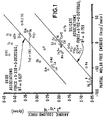
- An illustrative embodiment of the present invention involves its use in producing high level nuclear waste glass at Savannah River Site (SRS), shown in FIG. 2.
- SRS Savannah River Site
- Liquid, high level nuclear waste that has accumulated from over 35 years of reprocessing nuclear fuels for defense purposes is immobilized in borosilicate glass at the DWPF.
- a ceramic, slurry fed, Joule-heated electric melter produces borosilicate nuclear waste glass melts at approximately 1150 °C. This melt is poured into stainless steel canisters for eventual disposal in a geological waste repository.
- radioactive wastes produced by the defense industry were initially acidic and were neutralized with NaOH so that they could be safely stored in carbon steel tanks while a solidification technology was developed.
- This waste aged in the steel tanks and reacted with the NaOH, resulting in stratification into a sludge, salt cake, and salt solution.
- the sludge consists primarily of precipitates of hydroxides of iron and aluminum, and may vary from a high aluminum containing waste (HM) to a high iron containing waste (Purex).
- HM high aluminum containing waste
- Purex high iron containing waste
- This sludge contains most of the radioactivity in the waste except for radioactive cesium.
- the salt cake and salt solution contain mainly sodium salts of common anions (nitrate, nitrite, aluminate, and hydroxide).
- the salt fraction contains most of the radioactive cesium and only trace amounts of other radioactive species.
- the sludge is washed in waste storage tanks (1) in order to remove as much of the soluble nonradioactive ingredients as possible.
- Cesium is removed from the soluble salt fraction of the waste by precipitation as cesium tetraphenylborate. Residual strontium and plutonium in the salt waste are adsorbed on a small amount of sodium titanate.
- the resulting decontaminated salt waste is mixed with cement and disposed of as large monoliths.
- the resulting washed slurries are concentrated and pumped to the DWPF (2).
- Formic acid hydrolysis (3) is used to separate a precipitate hydrolysis aqueous product (PHA) (4), which contains glass forming sodium and boron, from the organic decomposition products of the tetraphenylborate salt in the salt-processing cell.
- Organic decomposition products are incinerated (5), and the PHA is transferred to the slurry receipt adjustment tank(6), where it is blended with washed sludge slurry. Any mercury in the waste is reduced to metallic form by the formic acid, ad removed by steam stripping (7).
- Nitric acid (8) is also added to prevent glass redox problems.
- the purified sludge-PHA mixture (9) is sent to a slurry mix evaporator (SME) (10), where a glass frit (11) is added. Any chemical adjustment of the glass formulation must be made in the SME.
- SME slurry mix evaporator
- Multiple SME batches are stored in the melter feed tank (MFT) (12) before slurry feeding to the DWPF melter (13).
- the glass is poured from the melter into stainless steel canisters (14) by a differential pressure technique. After filling, temporary seals are inserted into the canisters to prevent the introduction of water during decontamination. Contamination is removed from the canister surface by air-injected frit blasting (15). After decontamination, the canister is sealed using an upset resistance welding technique (16). The cleaned and sealed canisters are then sent to an interim storage facility (17) where they remain until shipment to a repository. The spent frit used to decontaminate the canisters is recycled to the melter via the SME.
- the method of determining glass durability based upon the composition of the feedstock materials according to the present invention allows the feedstock materials to be altered prior to feeding to the melter, in order to maximize waste loading of the resulting glass, minimize the use of purchased frit, and achieve acceptable durability without the need for measuring melt or glass properties in situ, and without the need first to prepare a sample of glass to be evaluated, since unacceptable waste glass, once made, cannot be remedied or reworked, and since the time and expense involved in reworking other glasses can be avoided.
- a glass composition to be formed in the DWPF is expected to have the following composition, in percent by weight, based upon the glass forming feedstock materials (glass frit, PHA, washed sludge): Na 2 O 23.55; FeO 3.28; B 2 O 3 5.25; CaO 4.26; SiO 2 62.00.
- the mole fraction of each oxide species is calculated as follows:
- the silica included in each associated complex depletes the available moles of unassociated silica by the number of moles assigned to the associated complex.
- a preliminary glass dissolution estimator, ⁇ G p is calculated by weighting the partial molar hydration free energy values for each hydration reaction and summing these weighted values, as follows:
- An accelerated glass dissolution function, ⁇ G a isdetermined by first determining the expected pH of the aqueous glass solution as follows:
- the units of this contribution are adjusted (i.e., the contribution is "denormalized") as follows:
- This final free energy of hydration is then used to determine normalized concentrations of B, Li, and Na in the leachate, using the correlation equations discussed above. These concentrations are then compared to the mean allowable concentration obtained by subjecting a benchmark waste glass identified in the DWPF Environmental Assessment to the Product Consistency Test (PCT, ASTM C1285-94).
- PCT Product Consistency Test
- ASTM C1285-94 Product Consistency Test
- a frit component function and a sludge component function are determined using the formulae disclosed above, and tested against the phase separation discriminator inequality disclosed above. If the concentrations determined above are more than two standard deviations below the mean of the benchmark glass, and the phase separation discriminator inequality is satisfied, the glass forming feedstocks are forwarded to the melter.
- concentrations determined above are less than two standard deviations below the mean, or the phase separation inequality is not satisfied, then one or more of the feedstock streams is subjected to remediation. For instance, more sludge or more Al 2 O 3 could be added to drive the composition from phase separation to homogeneity, or the composition or amount of the glass forming frit could be adjusted to obtain a more durable composition.
- a number of glasses were prepared using the SRS DWPF process, discussed above, on simulated waste feedstocks. During these runs, A series of "Functional Acceptance" runs of glass (the FA series) were used to build the melter inventory to an acceptable operating level and to achieve stable melter operation.
- the glass forming frit used to make the glasses for the FA series was specifically designed for reactor startup, as described in Jantzen, "Characterization of Defense Waste Processing Facility (DWPF) Startup Frit," U.S. DOE Report WSRC-RP-89-18, Westinghouse Savannah River Co., Savannah River Laboratory, Aiken, SC (1989).
- the last of the FA series was designated FA-13, and used a feedstock of blend sludge, PHA, and frit 202 (described in Schumacher, "Errors of DWPF Frit Analysis - Final Report," U.S. DOE Report WSRC-RP-92-37, Westinghouse Savannah River Co., Savannah River Technology Center, Aiken, SC (January, 1992).
- the blend sludge feedstock had a composition representing variations about the composite feed expected to the DWPF.
- the second qualification run, WP-15 was intended to provide a rapid transition between the composite sludge and a sludge having a high Fe concentration, and thus low resultant viscosity.
- the third run, WP-16 represented an extreme change in simulated sludge composition including a high Al concentration (and correspondingly high melt viscosity).
- the final qualification run, WP-17 used a composite sludge feed representing an abrupt return to normal melter operation from a condition of high melt viscosity.
- the pH of the expected leachate solution was determined, and the ⁇ G p , 100 / MW ⁇ G a WA , and ⁇ G f parameters were determined using the methods described above, and values for log 10 [NC i (g/L)] were determined according to the present invention, as described above.
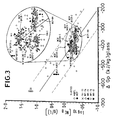
- the predicted values for log 10 [NC B (g/L)] are shown in FIG. 3 as a straight line. Overlain on these values are the actual measured leaching results for the FA-13 and WP-14 to WP-17 campaigns, as well as the measurements of actual glasses used to obtain the straight line relation between ⁇ G f and log 10 [NC B (g/L)] (i.e., the "Model Data").
- Each log 10 [NC B (g/L)] point is the average of three durability test responses. Over 387 glass samples were analyzed and plotted. Confidence limits (95%) for the individual glasses are represented by two straight lines parallel to the predicted leachate response. The actual leachate response for the FA-13 and WP-14 to WP-17 glasses are provided in the Table VI, below. The actual leaching data obtained for these simulated waste glasses agreed very well with the leaching behaviour determined according to the present invention, despite wide variations in sludge feed and glass fluidity. Similar figures can be constructed for Si, Li, and Na based upon the data in Table VI.
- the amount of glass is controlled to have a fixed ratio to the volume of solution in which the glass is immersed. This means that the relative surface area of the exposed glass to the volume of solution is fixed by the test procedure.
- the ratio of glass at 100-200 mesh size to volume of solution is 1gram/10ml.
Landscapes
- Chemical & Material Sciences (AREA)
- Engineering & Computer Science (AREA)
- Health & Medical Sciences (AREA)
- Life Sciences & Earth Sciences (AREA)
- Analytical Chemistry (AREA)
- Food Science & Technology (AREA)
- Medicinal Chemistry (AREA)
- Physics & Mathematics (AREA)
- Ceramic Engineering (AREA)
- Biochemistry (AREA)
- General Health & Medical Sciences (AREA)
- General Physics & Mathematics (AREA)
- Immunology (AREA)
- Pathology (AREA)
- Glass Compositions (AREA)
- Analysing Materials By The Use Of Radiation (AREA)
Applications Claiming Priority (2)
| Application Number | Priority Date | Filing Date | Title |
|---|---|---|---|
| US684553 | 1996-07-19 | ||
| US08/684,553 US5846278A (en) | 1996-07-19 | 1996-07-19 | Method of determining glass durability |
Publications (2)
| Publication Number | Publication Date |
|---|---|
| EP0819939A2 true EP0819939A2 (fr) | 1998-01-21 |
| EP0819939A3 EP0819939A3 (fr) | 2004-05-19 |
Family
ID=24748533
Family Applications (1)
| Application Number | Title | Priority Date | Filing Date |
|---|---|---|---|
| EP97305423A Withdrawn EP0819939A3 (fr) | 1996-07-19 | 1997-07-21 | Méthode de détermination de la durabilité du verre |
Country Status (2)
| Country | Link |
|---|---|
| US (1) | US5846278A (fr) |
| EP (1) | EP0819939A3 (fr) |
Cited By (2)
| Publication number | Priority date | Publication date | Assignee | Title |
|---|---|---|---|---|
| US10893578B2 (en) | 2017-10-11 | 2021-01-12 | Samsung Electronics Co., Ltd. | Composition for forming a heating element and method of preparing the composition |
| EP4063852B1 (fr) * | 2021-03-25 | 2025-11-26 | Schott Ag | Procédé de test pour l'évaluation de la qualité et récipient revêtu |
Families Citing this family (12)
| Publication number | Priority date | Publication date | Assignee | Title |
|---|---|---|---|---|
| US7476194B2 (en) * | 1999-10-20 | 2009-01-13 | Studsvik, Inc. | In-container mineralization |
| DE10107540B4 (de) * | 2001-02-17 | 2004-06-24 | Schott Glas | Verfahren zum kontinuierlichen Umschmelzen mit gestufter Einlage zur Vermeidung von Dichteunterschieden zwischen altem und neuem Glas |
| US6878616B1 (en) | 2003-11-21 | 2005-04-12 | International Business Machines Corporation | Low-k dielectric material system for IC application |
| US8742195B2 (en) * | 2004-02-26 | 2014-06-03 | Ch2M Hill, Inc. | Aluminum phosphate ceramics for waste storage |
| US7386997B2 (en) * | 2004-11-12 | 2008-06-17 | Culchrome, Llc | System for and method of batch analysis and optimization for glass manufacturing |
| JP5206261B2 (ja) * | 2007-10-26 | 2013-06-12 | 旭硝子株式会社 | 情報記録媒体基板用ガラス、磁気ディスク用ガラス基板および磁気ディスク |
| US11648549B2 (en) | 2018-11-29 | 2023-05-16 | Corning Incorporated | Ion exchange systems and methods for ion exchanging glass articles |
| WO2021021393A1 (fr) | 2019-07-31 | 2021-02-04 | Corning Incorporated | Compositions de bain de sel pour le renforcement d'articles en verre, procédés d'utilisation des compositions de bain de sel pour renforcer des articles en verre, et articles en verre ainsi renforcés |
| JP2023517710A (ja) | 2020-03-17 | 2023-04-26 | コーニング インコーポレイテッド | ガラス物品を強化するための塩浴組成物、塩浴システム、および方法 |
| WO2022039932A1 (fr) | 2020-08-17 | 2022-02-24 | Corning Incorporated | Systèmes et procédés pour le recyclage de matériaux échangeurs d'ions résiduaires |
| WO2022060584A2 (fr) | 2020-09-15 | 2022-03-24 | Corning Incorporated | Systèmes de bain de sel pour renforcer des articles en verre et procédés de régénération de sel fondu |
| CN120183543B (zh) * | 2025-05-23 | 2025-09-05 | 武汉理工大学 | 一种高放硼硅酸盐玻璃抗浸出性能的预测方法及应用 |
Family Cites Families (2)
| Publication number | Priority date | Publication date | Assignee | Title |
|---|---|---|---|---|
| US5102439A (en) * | 1991-04-23 | 1992-04-07 | Jantzen Carol M | Method for melting glass by measurement of non-bridging oxygen |
| US5401693A (en) * | 1992-09-18 | 1995-03-28 | Schuller International, Inc. | Glass fiber composition with improved biosolubility |
-
1996
- 1996-07-19 US US08/684,553 patent/US5846278A/en not_active Expired - Lifetime
-
1997
- 1997-07-21 EP EP97305423A patent/EP0819939A3/fr not_active Withdrawn
Non-Patent Citations (3)
| Title |
|---|
| JANTZEN C M ET AL: "THERMODYNAMIC MODEL OF NATURAL, MEDIEVAL AND NUCLEAR WASTE GLASS DURABILITY" NAT GLASSES, PROC OF THE INT CONF ON GLASS IN PLANET AND GEOL PHENOM;ALFRED, NY, USA AUG 14-18 1983, vol. 67, no. 1-3, 14 August 1983 (1983-08-14), pages 207-223, XP001189326 J Non Cryst Solids Sep 1983 * |
| PAUL A: "CHEMICAL DURABILITY OF GLASSES;A THERMODYNAMIC APPROACH" J MATER SCI NOV 1977, vol. 12, no. 11, November 1977 (1977-11), pages 2246-2268, XP008029189 * |
| PIODINEC M J ET AL: "STABILITY OF RADIOACTIVE WASTE GLASSES ASSESSED FROM HYDRATION THERMODYNAMICS" MATERIALS RESEARCH SOCIETY SYMPOSIUM PROCEEDINGS, MATERIALS RESEARCH SOCIETY, PITTSBURG, PA, US, vol. 26, 1984, pages 755-761, XP001056761 ISSN: 0272-9172 * |
Cited By (2)
| Publication number | Priority date | Publication date | Assignee | Title |
|---|---|---|---|---|
| US10893578B2 (en) | 2017-10-11 | 2021-01-12 | Samsung Electronics Co., Ltd. | Composition for forming a heating element and method of preparing the composition |
| EP4063852B1 (fr) * | 2021-03-25 | 2025-11-26 | Schott Ag | Procédé de test pour l'évaluation de la qualité et récipient revêtu |
Also Published As
| Publication number | Publication date |
|---|---|
| US5846278A (en) | 1998-12-08 |
| EP0819939A3 (fr) | 2004-05-19 |
Similar Documents
| Publication | Publication Date | Title |
|---|---|---|
| Ojovan et al. | Glassy wasteforms for nuclear waste immobilization | |
| Plodinec | Borosilicate glasses for nuclear waste imobilisation | |
| EP0819939A2 (fr) | Méthode de détermination de la durabilité du verre | |
| Abou Hussein | Vitrified municipal waste for the immobilization of radioactive waste: preparation and characterization of borosilicate glasses modified with metal oxides | |
| Ojovan et al. | Glasses for nuclear waste immobilization | |
| Bunker | Waste glass leaching: chemistry and kinetics | |
| Langowski et al. | Volatility literature of chlorine, iodine, cesium, strontium, technetium, and rhenium; technetium and rhenium volatility testing | |
| Dong et al. | Dechlorination and vitrification of electrochemical processing salt waste | |
| Ellison et al. | Effect of glass composition on waste form durability: a critical review | |
| Vernaz et al. | 5.18-Waste Glass | |
| El-Alaily et al. | Preparation and characterization of immobilizing radioactive waste glass from industrial wastes | |
| Lonergan et al. | A Critical Review of Ion Exchange in Nuclear Waste Glasses to Support the Immobilized Low-Activity Waste Integrated Disposal Facility Rate Model | |
| Jantzen | Using polymerization, glass structure, and quasicrystalline theory to produce high level radioactive borosilicate glass remotely: a 20+ year legacy | |
| Ojovan et al. | Glassy and glass composite nuclear wasteforms | |
| Ross et al. | Annual report Development and characterization of solidified forms for high-level wastes: 1978. | |
| Marcial | 8 Wasteform Development and | |
| Cornman | Long-term high-level waste technology. Composite quarterly technical report, July-September 1980 | |
| Buechele et al. | Analysis of Layer Structures Formed During Vapor Hydration Testing of High‐Sodium Waste Glasses | |
| Chick et al. | Annual report on the development and characterization of solidified forms for nuclear wastes, 1979 | |
| Brinkley | Characterization of Rocky Flats and Oak Ridge glass containing mixed wastes | |
| Sami et al. | Radiological and hydraulic durability of alkali-borosilicate radioactive waste immobilization matrix prepared from industrial waste glass grit: Insights into the microstructure alterations | |
| Marra et al. | Americium/Curium Vitrification Pilot Tests-Part II | |
| Lee | Michael I. Ojovan Immobilisation Science Laboratory, University of Sheffield, Sir Robert Hadfield Building, Mappin Street, Sheffield, S1 3JD, United Kingdom | |
| Marcial et al. | Wasteform Development and Qualification for Tank Waste Vitrification and Disposal | |
| Mohammad | Optimization of high-level waste loading in a borosilicate glass matrix by using chemical durability modeling approach |
Legal Events
| Date | Code | Title | Description |
|---|---|---|---|
| PUAI | Public reference made under article 153(3) epc to a published international application that has entered the european phase |
Free format text: ORIGINAL CODE: 0009012 |
|
| AK | Designated contracting states |
Kind code of ref document: A2 Designated state(s): AT BE CH DE DK ES FI FR GB GR IE IT LI LU MC NL PT SE |
|
| AX | Request for extension of the european patent |
Free format text: AL;LT;LV;RO;SI |
|
| PUAL | Search report despatched |
Free format text: ORIGINAL CODE: 0009013 |
|
| AK | Designated contracting states |
Kind code of ref document: A3 Designated state(s): AT BE CH DE DK ES FI FR GB GR IE IT LI LU MC NL PT SE |
|
| AX | Request for extension of the european patent |
Extension state: AL LT LV RO SI |
|
| 17P | Request for examination filed |
Effective date: 20040726 |
|
| 17Q | First examination report despatched |
Effective date: 20041014 |
|
| AKX | Designation fees paid |
Designated state(s): DE DK FR GB |
|
| STAA | Information on the status of an ep patent application or granted ep patent |
Free format text: STATUS: THE APPLICATION IS DEEMED TO BE WITHDRAWN |
|
| 18D | Application deemed to be withdrawn |
Effective date: 20050225 |