EP0820010A2 - Verfahren zur Schätzung des Leistungsverbrauchs eines Mikroprozessors - Google Patents
Verfahren zur Schätzung des Leistungsverbrauchs eines Mikroprozessors Download PDFInfo
- Publication number
- EP0820010A2 EP0820010A2 EP97112359A EP97112359A EP0820010A2 EP 0820010 A2 EP0820010 A2 EP 0820010A2 EP 97112359 A EP97112359 A EP 97112359A EP 97112359 A EP97112359 A EP 97112359A EP 0820010 A2 EP0820010 A2 EP 0820010A2
- Authority
- EP
- European Patent Office
- Prior art keywords
- instruction
- power consumption
- microprocessor
- cache
- instructions
- Prior art date
- Legal status (The legal status is an assumption and is not a legal conclusion. Google has not performed a legal analysis and makes no representation as to the accuracy of the status listed.)
- Granted
Links
Images




Classifications
-
- G—PHYSICS
- G06—COMPUTING OR CALCULATING; COUNTING
- G06F—ELECTRIC DIGITAL DATA PROCESSING
- G06F11/00—Error detection; Error correction; Monitoring
- G06F11/22—Detection or location of defective computer hardware by testing during standby operation or during idle time, e.g. start-up testing
- G06F11/24—Marginal checking or other specified testing methods not covered by G06F11/26, e.g. race tests
-
- G—PHYSICS
- G06—COMPUTING OR CALCULATING; COUNTING
- G06F—ELECTRIC DIGITAL DATA PROCESSING
- G06F2119/00—Details relating to the type or aim of the analysis or the optimisation
- G06F2119/06—Power analysis or power optimisation
Definitions
- the present invention relates to a method of estimating the power consumption of a microprocessor on each instruction the microprocessor reads out of a main memory or an instruction cache and executes.
- This method pays attention to the kind of each instruction to be executed by a microprocessor and estimates the power consumption of the microprocessor. Namely, the method finds out the individual power consumption of different instructions to be executed by the microprocessor in advance, applies the found power consumption to each instruction that is still in an assembler program, and estimates total power to be consumed by the instructions when they are actually executed by the microprocessor.
- This method executes a given instruction by the microprocessor and measures the power consumption thereof with a power meter connected to the microprocessor. If the microprocessor employs an instruction cache, it is necessary to separate cache-hit power consumption from cache-miss power consumption. These two kinds of power consumption are unable to find out with the use of a single instruction file. Namely, it is necessary to prepare an instruction file 101 of Fig. 1 for measuring the cache-miss power consumption of each instruction, as well as an instruction file 102 of Fig. 2 for measuring the cache-hit power consumption of each instruction.
- the instruction file 101 consists of a state setting section 103 for setting a microprocessor in a cache miss state, and a target instruction executing section 104 for executing target instructions for which power consumption is going to be estimated.
- the instruction file 102 consists of a state setting section 103 for setting a microprocessor in a cache hit state, and a target instruction executing section 104 for executing target instructions for which power consumption is going to be estimated.
- the state setting section 103 of Fig. 1 disables cached instructions and establishes a cache miss state
- the state setting section 103 of Fig. 2 executes, in advance, codes used by the instruction executing section 104 and establishes a cache hit state.
- the instruction files 101 and 102 are each long and intricate, and therefore, are difficult to prepare.
- an object of the present invention is to provide a method of estimating the power consumption of a microprocessor on each instruction, employing an instruction file that is simple and easy to prepare.
- an aspect of the present invention provides a method of estimating the power consumption of a microprocessor on each instruction the microprocessor reads out of a main memory or an instruction cache and executes through pipelined processing stages.
- the method includes a step of consecutively executing, at least two times, a group of target instructions whose number is at least twice as large as the number of instructions to be simultaneously transferred from the main memory to the instruction cache, a step of finding the power consumption of the microprocessor in each cycle in a given range of cycles in each of the first and second executions of the instruction group, a step of accumulating the power consumption in each cycle for a given number of cycles in a given range of cycles in the first execution of the instruction group, to find out the power consumption of the microprocessor for the given number of cycles, and a step of using the power consumption for the given number of cycles in the first execution of the instruction group and the power consumption in each cycle in the second execution of the instruction group, to estimate the power consumption of the microprocessor of reading a cache-hit instruction
- the estimated power consumption (Ph) of the microprocessor on a cache-hit instruction is obtained as the power consumption thereof in a given cycle in the second execution of the instruction group.
- Still another aspect of the present invention provides a method of estimating the power consumption of a microprocessor on a target instruction the microprocessor reads out of a main memory or an instruction cache and executes through pipelined processing stages.
- the method includes a step of executing, at least twice, the target instruction, a step of finding the power consumption of the microprocessor in one cycle in a given range of cycles in each of the first and second executions of the target instruction, a step of accumulating the power consumption in one cycle for a given number of cycles in the given range of cycles in the first execution of the target instruction, to find out the power consumption of the microprocessor for the given number of cycles, and a step of using the power consumption for the given number of cycles in the first execution of the target instruction and the power consumption in one cycle in the second execution of the target instruction, to estimate the cache-hit power consumption of the microprocessor of reading the target instruction out of the instruction cache and executing the same, as well as the cache-missed power consumption of the microprocessor of reading the target instruction out of
- Still another aspect of the present invention provides a system for estimating the power consumption of a microprocessor on each instruction the microprocessor reads out of a main memory or an instruction cache and executes.
- the system has a unit for entering a string of machine language instructions that include consecutive target instructions and a jump instruction to jump to the first one of the target instructions, the number of the target instructions being at least twice as large as the number of instructions simultaneously read out of the main memory, a unit for carrying out transistor- or gate-level simulations to simulate the microprocessor of reading the machine language instructions out of the main memory or the instruction cache and executing them, a unit for estimating the power consumption of the microprocessor on a cache-missed instruction according to the first execution of the consecutive target instructions, and a unit for estimating the power consumption of the microprocessor on a cache-hit instruction according to the second execution of the consecutive target instructions.
- Figures 3 and 4 show pipelined processing stages in a microprocessor to which the method of the present invention is applied.
- the microprocessor that executes target instructions for which power consumption is estimated is a microprocessor 3 of Fig. 5 having an internal instruction cache 1 and an external main memory 2, or a microprocessor 4 of Fig. 6 having an external instruction cache 1 and an external main memory 2.
- the microprocessor executes the target instructions through the pipelined processing stages shown in Figs. 3 and 4.
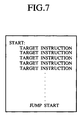
- the target instructions are listed in an instruction file of Fig. 7, which is used to simulate the power consumption of the microprocessor on each instruction.
- the target instructions are consecutively arranged, and a jump instruction is arranged at the end of the target instructions so that the target instructions are repeatedly executed.
- the number of the target instructions in the instruction file is within the number of instructions to be stored in the instruction cache 1 of Figs. 5 and 6.
- Any one of the microprocessors 3 and 4 of Figs. 5 and 6 executes instructions in five pipelined processing stages, i.e., a fetch stage (F), a decode stage (D), an execution stage (E), a data cache access stage (M), and a register write stage (W). Each stage is completed in one cycle. If an instruction cache miss occurs, four instructions are simultaneously read out of the main memory 2 in two cycles. Any cache miss causes a decode stall (Ds).
- Ds decode stall
- the target instructions of Fig. 7 are repeatedly executed due to the jump instruction.
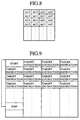
- the instruction cache 1 holds no instructions as shown in Fig. 8. Namely, all instructions are stored in the main memory 2 at this moment, and therefore, a cache miss occurs on every fourth instruction. More precisely, in the first execution, a cache miss occurs at first as shown in Fig. 3, and therefore, four target instructions are transferred from the main memory 2 to the instruction cache 1 and are stored therein. Thereafter, among the four target instructions, three that follow the first one are read out of the instruction cache 1 into the microprocessor, to produce cache hits. The same things happen thereafter. Namely, a cache miss occurs, and three cache hits follow. These are repeated.
- Any cache-missed instruction is executed in a pipeline of the fetch stage F, decode stall Ds, decode stage D, execution stage E, data cache access stage M, and register write stage W, as shown in Fig. 3.
- any cache-hit instruction is executed in a pipeline of the fetch stage F, decode stage D, execution stage E, data cache access stage M, and register write stage W, as shown in Fig. 3.
- the microprocessor operates along the pipelines shown in Fig. 3.
- the target instructions are stored in the instruction cache 1 in order of the first execution, as shown in Fig. 9. Then, every target instruction produces a cache hit. Consequently, every target instruction is executed through a pipeline of the fetch stage F, decode stage D, execution stage E, data cache access stage M, and register write stage W. In this case, the microprocessor operates along the pipelines shown in Fig. 4.
- each cycle involves five stages, i.e., the fetch stage F, decode stage D, execution stage E, data cache access stage M, and register write stage W that are required to execute one cache-hit instruction.
- Finding the power consumption of the microprocessor in any one of the four cycles leads to find the power consumption of the microprocessor on any cache-hit instruction the microprocessor reads out of the instruction cache 1 and executes.
- Fig. 3 To find power consumption in a cache miss state, five cycles are extracted starting from the sixth cycle, as shown in Fig. 3.
- the five cycles correspond to four instructions to be simultaneously transferred from the main memory 2 to the instruction cache 1 when a cache miss occurs, plus one stall that occurs when simultaneously transferring the four instructions to the instruction cache 1.
- the sixth cycle is equal to the number of the pipelined processing stages including the decode stall Ds. Hatched stages of Fig. 3 are moved to an upper dotted area of the same figure, to provide a pattern of Fig. 11.
- the pattern of Fig. 11 involves four sets of the five stages, i.e., the fetch stage F, decode stage D, execution stage E, data cache access stage M, and register write stage W, and one decode stall stage Ds that occurs whenever a cache miss occurs. This means that the extracted five cycles involve one cache miss and three cache hits.
- the power consumption of the microprocessor on each cache-missed instruction is obtainable by finding the power consumption of the extracted five cycles and by calculating ⁇ (the sum of power consumption for the five cycles) - (the power consumption in one cache-hit cycle) x 3 ⁇ .
- This technique is applicable to a general case with the number of pipelined processing stages of a microprocessor being P, the number of instructions to be simultaneously transferred from a main memory to an instruction cache under a cache miss state being I, and the total number of stalls that occur when executing the I instructions simultaneously transferred to and stored in the instruction cache being N.
- the power consumption of the microprocessor on each cache-hit instruction is obtained as the power consumption of the microprocessor in one cycle on or after the "P+1"th cycle in a second execution of instructions.
- a cache miss occurs at intervals of I cycles
- N stalls occur on a cache miss
- "I-1" cache hits and one cache miss occur in "I+N" cycles starting from the "P+n”th cycle. Therefore, the power consumption of the microprocessor on each cache-missed instruction is obtained by calculating ⁇ the sum of power consumption for "I+N" cycles starting from the "P+N"th cycle in a first execution of instructions ⁇ - ⁇ (the power consumption in a cache-hit cycle) x (I-1) ⁇ .
- the present invention employs a system for simulating CPU operations at transistor or gate levels.
- the transistor-level simulations achieve fine operations to improve estimating accuracy, and therefore, take a long simulation time and many resources.
- the gate-level simulations are effective to carry out large-scale simulations in a short time.
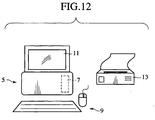
- Figure 12 shows a system for estimating power consumption according to the present invention.
- the system consists of a computer 5, a storage unit 7 such as a disk unit, input units 9 such as a mouse and a keyboard, and output units including a monitor 11 and a printer 13.
- the system incorporates a simulation program for simulating the operations of CPU and memories at transistor or gate levels.
- the simulation program may be prepared by amending an existing one according to requirements.
- a string of instructions such as those mentioned above are converted into machine language instructions at first. Instead, machine language instructions may directly be edited, or assembly language instructions are written, assembled, and edited. For example, the processes of Figs. 3 and 4 are written in an assembly language, to provide an infinite loop of Fig. 13.
- the number of IUEs per loop must be larger than twice the number of instructions to be simultaneously read out of a main memory.
- the target instructions When executed, the target instructions cause cache misses as shown in Fig. 3.
- the target instructions When a jump instruction is executed to enter a second execution, the target instructions are always fetched from the instruction cache and are again executed as shown in Fig. 4. Although one repetition of the loop is sufficient for measuring power consumption, the infinite loop will cause no problem because it is achieved through simulations. If required, the loop may be terminated by a proper timer interrupt. Thereafter, the machine language instructions are entered into a simulation program, which provides power consumption according to a current passing through each internal node.
- the power consumption of a microprocessor in given cycles of executing the instruction file of Fig. 7 is simulated, to find out the power consumption of the microprocessor on each instruction.
- the instruction file of the present invention used for estimating power consumption is simple and small compared with those of the prior art, and therefore, involves greatly reduced labor and time to prepare.
- a target instruction is repeatedly executed at least twice with the use of a repetition instruction such as a jump instruction, to calculate the power consumption of a microprocessor on the instruction in cache miss and cache hit states. This technique is also achievable with a simple instruction file.
- this is the simplest form of the present invention.
- These instructions may be written in an assembler language to form an infinite loop of Fig. 14.
- the target instruction first causes a cache miss and is executed as shown in Fig. 15.
- the jump instruction is executed, and the target instruction is fetched from an instruction cache and is again executed.
- the infinite loop may cause no problem because the loop is achieved in a simulation.
- the infinite loop may be terminated with a proper timer interrupt.
- the present invention repeatedly executes a group of instructions whose power consumption is to be estimated, and finds out the power consumption of each instruction in an instruction cache miss state and in an instruction cache hit state according to power consumption in given cycles. Accordingly, the present invention is capable of simplifying and reducing an instruction file used to find out the power consumption of each instruction, thereby reducing labor and time for preparing the instruction file.
Landscapes
- Engineering & Computer Science (AREA)
- General Engineering & Computer Science (AREA)
- Theoretical Computer Science (AREA)
- Computer Hardware Design (AREA)
- Quality & Reliability (AREA)
- Physics & Mathematics (AREA)
- General Physics & Mathematics (AREA)
- Advance Control (AREA)
- Power Sources (AREA)
- Memory System Of A Hierarchy Structure (AREA)
- Debugging And Monitoring (AREA)
Applications Claiming Priority (3)
| Application Number | Priority Date | Filing Date | Title |
|---|---|---|---|
| JP19045696A JP3494813B2 (ja) | 1996-07-19 | 1996-07-19 | マイクロプロセッサの消費電力見積もり方法 |
| JP190456/96 | 1996-07-19 | ||
| JP19045696 | 1996-07-19 |
Publications (3)
| Publication Number | Publication Date |
|---|---|
| EP0820010A2 true EP0820010A2 (de) | 1998-01-21 |
| EP0820010A3 EP0820010A3 (de) | 1998-06-17 |
| EP0820010B1 EP0820010B1 (de) | 2002-11-20 |
Family
ID=16258430
Family Applications (1)
| Application Number | Title | Priority Date | Filing Date |
|---|---|---|---|
| EP97112359A Expired - Lifetime EP0820010B1 (de) | 1996-07-19 | 1997-07-18 | Verfahren zur Schätzung des Leistungsverbrauchs eines Mikroprozessors |
Country Status (4)
| Country | Link |
|---|---|
| US (1) | US5941991A (de) |
| EP (1) | EP0820010B1 (de) |
| JP (1) | JP3494813B2 (de) |
| DE (1) | DE69717201T2 (de) |
Families Citing this family (68)
| Publication number | Priority date | Publication date | Assignee | Title |
|---|---|---|---|---|
| JP3618442B2 (ja) * | 1996-02-08 | 2005-02-09 | 株式会社東芝 | マイクロプロセッサのパワーエスティメータ装置 |
| JP3351725B2 (ja) * | 1997-01-08 | 2002-12-03 | 株式会社東芝 | パワーシミュレーション装置、パワーシミュレーション方法、及びパワーシミュレーションプログラムを記録した機械読み取り可能な記録媒体 |
| US6125334A (en) * | 1997-05-02 | 2000-09-26 | Texas Instruments Incorporated | Module-configurable full-chip power profiler |
| EP0926596B1 (de) * | 1997-12-23 | 2007-09-05 | Texas Instruments Inc. | Prozessor und Verfahren zum Verringern von dessen Energieverbrauch |
| JPH11232147A (ja) | 1998-02-16 | 1999-08-27 | Toshiba Corp | パワーエスティメーション装置、パワーエスティメーション方法、及びパワーエスティメーションプログラムを記録した機械読み取り可能な記録媒体 |
| US6415388B1 (en) * | 1998-10-30 | 2002-07-02 | Intel Corporation | Method and apparatus for power throttling in a microprocessor using a closed loop feedback system |
| US6553502B1 (en) * | 1999-01-11 | 2003-04-22 | Texas Instruments Incorporated | Graphics user interface for power optimization diagnostics |
| EP1096360B1 (de) * | 1999-10-25 | 2004-09-22 | Texas Instruments Incorporated | Intelligente Leistungssteuerung in verteilten Verarbeitungssystemen |
| US6651176B1 (en) * | 1999-12-08 | 2003-11-18 | Hewlett-Packard Development Company, L.P. | Systems and methods for variable control of power dissipation in a pipelined processor |
| US7620832B2 (en) * | 2000-09-20 | 2009-11-17 | Mips Technologies, Inc. | Method and apparatus for masking a microprocessor execution signature |
| US6625737B1 (en) * | 2000-09-20 | 2003-09-23 | Mips Technologies Inc. | System for prediction and control of power consumption in digital system |
| US7765095B1 (en) | 2000-10-26 | 2010-07-27 | Cypress Semiconductor Corporation | Conditional branching in an in-circuit emulation system |
| US8160864B1 (en) | 2000-10-26 | 2012-04-17 | Cypress Semiconductor Corporation | In-circuit emulator and pod synchronized boot |
| US8149048B1 (en) | 2000-10-26 | 2012-04-03 | Cypress Semiconductor Corporation | Apparatus and method for programmable power management in a programmable analog circuit block |
| US6724220B1 (en) | 2000-10-26 | 2004-04-20 | Cyress Semiconductor Corporation | Programmable microcontroller architecture (mixed analog/digital) |
| US8176296B2 (en) | 2000-10-26 | 2012-05-08 | Cypress Semiconductor Corporation | Programmable microcontroller architecture |
| US8103496B1 (en) | 2000-10-26 | 2012-01-24 | Cypress Semicondutor Corporation | Breakpoint control in an in-circuit emulation system |
| JP3724365B2 (ja) | 2000-12-04 | 2005-12-07 | 日産自動車株式会社 | 燃料電池システムの制御装置及び方法 |
| US20030061383A1 (en) * | 2001-09-25 | 2003-03-27 | Zilka Anthony M. | Predicting processor inactivity for a controlled transition of power states |
| US6834353B2 (en) * | 2001-10-22 | 2004-12-21 | International Business Machines Corporation | Method and apparatus for reducing power consumption of a processing integrated circuit |
| US7406674B1 (en) | 2001-10-24 | 2008-07-29 | Cypress Semiconductor Corporation | Method and apparatus for generating microcontroller configuration information |
| US8078970B1 (en) | 2001-11-09 | 2011-12-13 | Cypress Semiconductor Corporation | Graphical user interface with user-selectable list-box |
| US8042093B1 (en) | 2001-11-15 | 2011-10-18 | Cypress Semiconductor Corporation | System providing automatic source code generation for personalization and parameterization of user modules |
| US7770113B1 (en) | 2001-11-19 | 2010-08-03 | Cypress Semiconductor Corporation | System and method for dynamically generating a configuration datasheet |
| US7844437B1 (en) | 2001-11-19 | 2010-11-30 | Cypress Semiconductor Corporation | System and method for performing next placements and pruning of disallowed placements for programming an integrated circuit |
| US7774190B1 (en) | 2001-11-19 | 2010-08-10 | Cypress Semiconductor Corporation | Sleep and stall in an in-circuit emulation system |
| US6971004B1 (en) | 2001-11-19 | 2005-11-29 | Cypress Semiconductor Corp. | System and method of dynamically reconfiguring a programmable integrated circuit |
| US8069405B1 (en) | 2001-11-19 | 2011-11-29 | Cypress Semiconductor Corporation | User interface for efficiently browsing an electronic document using data-driven tabs |
| US6775787B2 (en) * | 2002-01-02 | 2004-08-10 | Intel Corporation | Instruction scheduling based on power estimation |
| US8103497B1 (en) | 2002-03-28 | 2012-01-24 | Cypress Semiconductor Corporation | External interface for event architecture |
| US7308608B1 (en) | 2002-05-01 | 2007-12-11 | Cypress Semiconductor Corporation | Reconfigurable testing system and method |
| US7761845B1 (en) | 2002-09-09 | 2010-07-20 | Cypress Semiconductor Corporation | Method for parameterizing a user module |
| US7434205B1 (en) | 2004-02-19 | 2008-10-07 | Steenhagen Shawn K | Virtual type interpretation, interaction and detection |
| US7295049B1 (en) | 2004-03-25 | 2007-11-13 | Cypress Semiconductor Corporation | Method and circuit for rapid alignment of signals |
| US8286125B2 (en) | 2004-08-13 | 2012-10-09 | Cypress Semiconductor Corporation | Model for a hardware device-independent method of defining embedded firmware for programmable systems |
| US8069436B2 (en) | 2004-08-13 | 2011-11-29 | Cypress Semiconductor Corporation | Providing hardware independence to automate code generation of processing device firmware |
| US7313709B2 (en) * | 2004-11-05 | 2007-12-25 | International Business Machines Corporation | Instruction set with thermal opcode for high-performance microprocessor, microprocessor, and method therefor |
| US7332976B1 (en) | 2005-02-04 | 2008-02-19 | Cypress Semiconductor Corporation | Poly-phase frequency synthesis oscillator |
| US7400183B1 (en) | 2005-05-05 | 2008-07-15 | Cypress Semiconductor Corporation | Voltage controlled oscillator delay cell and method |
| US8089461B2 (en) | 2005-06-23 | 2012-01-03 | Cypress Semiconductor Corporation | Touch wake for electronic devices |
| US8085067B1 (en) | 2005-12-21 | 2011-12-27 | Cypress Semiconductor Corporation | Differential-to-single ended signal converter circuit and method |
| US8067948B2 (en) | 2006-03-27 | 2011-11-29 | Cypress Semiconductor Corporation | Input/output multiplexer bus |
| US9564902B2 (en) | 2007-04-17 | 2017-02-07 | Cypress Semiconductor Corporation | Dynamically configurable and re-configurable data path |
| US7737724B2 (en) | 2007-04-17 | 2010-06-15 | Cypress Semiconductor Corporation | Universal digital block interconnection and channel routing |
| US8130025B2 (en) | 2007-04-17 | 2012-03-06 | Cypress Semiconductor Corporation | Numerical band gap |
| US8040266B2 (en) | 2007-04-17 | 2011-10-18 | Cypress Semiconductor Corporation | Programmable sigma-delta analog-to-digital converter |
| US8092083B2 (en) | 2007-04-17 | 2012-01-10 | Cypress Semiconductor Corporation | Temperature sensor with digital bandgap |
| US8026739B2 (en) | 2007-04-17 | 2011-09-27 | Cypress Semiconductor Corporation | System level interconnect with programmable switching |
| US8516025B2 (en) | 2007-04-17 | 2013-08-20 | Cypress Semiconductor Corporation | Clock driven dynamic datapath chaining |
| US8065653B1 (en) | 2007-04-25 | 2011-11-22 | Cypress Semiconductor Corporation | Configuration of programmable IC design elements |
| US8266575B1 (en) | 2007-04-25 | 2012-09-11 | Cypress Semiconductor Corporation | Systems and methods for dynamically reconfiguring a programmable system on a chip |
| US9720805B1 (en) | 2007-04-25 | 2017-08-01 | Cypress Semiconductor Corporation | System and method for controlling a target device |
| US8049569B1 (en) | 2007-09-05 | 2011-11-01 | Cypress Semiconductor Corporation | Circuit and method for improving the accuracy of a crystal-less oscillator having dual-frequency modes |
| US8166326B2 (en) * | 2007-11-08 | 2012-04-24 | International Business Machines Corporation | Managing power consumption in a computer |
| US20090132842A1 (en) * | 2007-11-15 | 2009-05-21 | International Business Machines Corporation | Managing Computer Power Consumption In A Computer Equipment Rack |
| US8041521B2 (en) * | 2007-11-28 | 2011-10-18 | International Business Machines Corporation | Estimating power consumption of computing components configured in a computing system |
| US8103884B2 (en) | 2008-06-25 | 2012-01-24 | International Business Machines Corporation | Managing power consumption of a computer |
| US8041976B2 (en) * | 2008-10-01 | 2011-10-18 | International Business Machines Corporation | Power management for clusters of computers |
| US8514215B2 (en) * | 2008-11-12 | 2013-08-20 | International Business Machines Corporation | Dynamically managing power consumption of a computer with graphics adapter configurations |
| US8311683B2 (en) * | 2009-04-29 | 2012-11-13 | International Business Machines Corporation | Processor cooling management |
| US9448964B2 (en) | 2009-05-04 | 2016-09-20 | Cypress Semiconductor Corporation | Autonomous control in a programmable system |
| US10496461B2 (en) * | 2011-06-15 | 2019-12-03 | Arm Finance Overseas Limited | Apparatus and method for hardware initiation of emulated instructions |
| US8904208B2 (en) * | 2011-11-04 | 2014-12-02 | International Business Machines Corporation | Run-time task-level dynamic energy management |
| EP2811407A4 (de) * | 2012-01-31 | 2015-09-30 | Nec Corp | Informationsverarbeitungsvorrichtung und stromverbrauch-berechnungsverfahren für die informationsverarbeitungsvorrichtung |
| US9588863B2 (en) | 2014-10-21 | 2017-03-07 | International Business Machines Corporation | Generation and application of stressmarks in a computer system |
| US10089155B2 (en) * | 2015-09-22 | 2018-10-02 | Advanced Micro Devices, Inc. | Power aware work stealing |
| US10255462B2 (en) | 2016-06-17 | 2019-04-09 | Arm Limited | Apparatus and method for obfuscating power consumption of a processor |
| PL445092A1 (pl) * | 2023-05-31 | 2024-12-02 | Akademia Górniczo-Hutnicza Im.Stanisława Staszica W Krakowie | Sposób wyznaczania zużycia energii, przez programowalny scalony układ cyfrowy dla wykonania pojedynczych instrukcji maszynowych |
Family Cites Families (4)
| Publication number | Priority date | Publication date | Assignee | Title |
|---|---|---|---|---|
| AU2816495A (en) * | 1994-06-03 | 1996-01-04 | Synopsys, Inc. | Method and apparatus for estimating the power dissipated by a digital circuit |
| US5557557A (en) * | 1994-10-04 | 1996-09-17 | Texas Instruments Incorporated | Processor power profiler |
| AU4610496A (en) * | 1994-12-22 | 1996-07-10 | Intel Corporation | System power consumption tracking and reporting |
| US5752259A (en) * | 1996-03-26 | 1998-05-12 | Advanced Micro Devices, Inc. | Instruction cache configured to provide instructions to a microprocessor having a clock cycle time less than a cache access time of said instruction cache |
-
1996
- 1996-07-19 JP JP19045696A patent/JP3494813B2/ja not_active Expired - Fee Related
-
1997
- 1997-07-17 US US08/895,695 patent/US5941991A/en not_active Expired - Fee Related
- 1997-07-18 DE DE69717201T patent/DE69717201T2/de not_active Expired - Lifetime
- 1997-07-18 EP EP97112359A patent/EP0820010B1/de not_active Expired - Lifetime
Non-Patent Citations (2)
| Title |
|---|
| LI Y -T S ET AL: "PERFORMANCE ESTIMATION OF EMBEDDED SOFTWARE WITH INSTRUCTION CACHE MODELING" 1995 IEEE/ACM INTERNATIONAL CONFERENCE ON COMPUTER-AIDED DESIGN (ICCAD), SAN JOSE, NOV. 5 - 9, 1995, 5 November 1995, INSTITUTE OF ELECTRICAL AND ELECTRONICS ENGINEERS, pages 380-387, XP000620923 * |
| TIWARI V ET AL: "POWER ANALYSIS OF EMBEDDED SOFTWARE: A FIRST STEP TOWARDS SOFTWARE POWER MINIMIZATION" IEEE TRANSACTIONS ON VERY LARGE SCALE INTEGRATION (VLSI) SYSTEMS, vol. 2, no. 4, December 1994, pages 437-445, XP000483631 * |
Also Published As
| Publication number | Publication date |
|---|---|
| JPH1040144A (ja) | 1998-02-13 |
| DE69717201D1 (de) | 2003-01-02 |
| US5941991A (en) | 1999-08-24 |
| EP0820010B1 (de) | 2002-11-20 |
| JP3494813B2 (ja) | 2004-02-09 |
| EP0820010A3 (de) | 1998-06-17 |
| DE69717201T2 (de) | 2003-07-10 |
Similar Documents
| Publication | Publication Date | Title |
|---|---|---|
| US5941991A (en) | Method of estimating power consumption of each instruction processed by a microprocessor | |
| Horowitz et al. | MIPS-X: A 20-MIPS peak, 32-bit microprocessor with on-chip cache | |
| US7840397B2 (en) | Simulation method | |
| Kim et al. | Strober: Fast and accurate sample-based energy simulation for arbitrary RTL | |
| Shafi et al. | Design and validation of a performance and power simulator for PowerPC systems | |
| Senn et al. | SoftExplorer: Estimating and optimizing the power and energy consumption of a C program for DSP applications | |
| JP5514211B2 (ja) | 分岐オーバーライドを用いたプロセッサ実行のシミュレーション | |
| Parikh et al. | Instruction scheduling for low power | |
| US7003441B2 (en) | Method for deriving the benchmark program for estimating the maximum power consumed in a microprocessor | |
| Herdt et al. | Towards early validation of firmware-based power management using virtual prototypes: A constrained random approach | |
| Atitallah et al. | MPSoC power estimation framework at transaction level modeling | |
| Olukotun et al. | Digital system simulation: Methodologies and examples | |
| US20110218791A1 (en) | System for Simulating Processor Power Consumption and Method of the Same | |
| Wolf et al. | Execution cost interval refinement in static software analysis | |
| Zielasko et al. | Virtual prototype driven application specific hardware optimization | |
| Yan et al. | WCET analysis of instruction caches with prefetching | |
| Hennessy et al. | Hardware/software codesign of processors: Concepts and examples | |
| US20120185231A1 (en) | Cycle-Count-Accurate (CCA) Processor Modeling for System-Level Simulation | |
| Plyaskin et al. | System-level software performance simulation considering out-of-order processor execution | |
| Lee et al. | An energy characterization framework for software-based embedded systems | |
| Kim et al. | Top-down retargetable framework with token-level design for accelerating simulation speed of processor architecture | |
| Park et al. | Fast cycle-accurate behavioral simulation for pipelined processors using early pipeline evaluation | |
| CN102132278B (zh) | 使用指令追踪或标出的处理器仿真 | |
| Niar et al. | Rapid performance and power consumption estimation methods for embedded system design | |
| Zaman et al. | CAPE: A cross-layer framework for accurate microprocessor power estimation |
Legal Events
| Date | Code | Title | Description |
|---|---|---|---|
| PUAI | Public reference made under article 153(3) epc to a published international application that has entered the european phase |
Free format text: ORIGINAL CODE: 0009012 |
|
| 17P | Request for examination filed |
Effective date: 19970718 |
|
| AK | Designated contracting states |
Kind code of ref document: A2 Designated state(s): BE DE FR GB |
|
| AX | Request for extension of the european patent |
Free format text: AL;LT;LV;RO;SI |
|
| PUAL | Search report despatched |
Free format text: ORIGINAL CODE: 0009013 |
|
| AK | Designated contracting states |
Kind code of ref document: A3 Designated state(s): AT BE CH DE DK ES FI FR GB GR IE IT LI LU MC NL PT SE |
|
| AX | Request for extension of the european patent |
Free format text: AL;LT;LV;RO;SI |
|
| AKX | Designation fees paid |
Free format text: BE DE FR GB |
|
| RBV | Designated contracting states (corrected) |
Designated state(s): BE DE FR GB |
|
| 17Q | First examination report despatched |
Effective date: 20010709 |
|
| GRAG | Despatch of communication of intention to grant |
Free format text: ORIGINAL CODE: EPIDOS AGRA |
|
| GRAG | Despatch of communication of intention to grant |
Free format text: ORIGINAL CODE: EPIDOS AGRA |
|
| GRAH | Despatch of communication of intention to grant a patent |
Free format text: ORIGINAL CODE: EPIDOS IGRA |
|
| GRAH | Despatch of communication of intention to grant a patent |
Free format text: ORIGINAL CODE: EPIDOS IGRA |
|
| GRAA | (expected) grant |
Free format text: ORIGINAL CODE: 0009210 |
|
| AK | Designated contracting states |
Kind code of ref document: B1 Designated state(s): BE DE FR GB |
|
| PG25 | Lapsed in a contracting state [announced via postgrant information from national office to epo] |
Ref country code: FR Free format text: LAPSE BECAUSE OF FAILURE TO SUBMIT A TRANSLATION OF THE DESCRIPTION OR TO PAY THE FEE WITHIN THE PRESCRIBED TIME-LIMIT Effective date: 20021120 Ref country code: BE Free format text: LAPSE BECAUSE OF FAILURE TO SUBMIT A TRANSLATION OF THE DESCRIPTION OR TO PAY THE FEE WITHIN THE PRESCRIBED TIME-LIMIT Effective date: 20021120 |
|
| REG | Reference to a national code |
Ref country code: GB Ref legal event code: FG4D |
|
| REF | Corresponds to: |
Ref document number: 69717201 Country of ref document: DE Date of ref document: 20030102 |
|
| PG25 | Lapsed in a contracting state [announced via postgrant information from national office to epo] |
Ref country code: GB Free format text: LAPSE BECAUSE OF NON-PAYMENT OF DUE FEES Effective date: 20030718 |
|
| EN | Fr: translation not filed | ||
| PLBE | No opposition filed within time limit |
Free format text: ORIGINAL CODE: 0009261 |
|
| STAA | Information on the status of an ep patent application or granted ep patent |
Free format text: STATUS: NO OPPOSITION FILED WITHIN TIME LIMIT |
|
| 26N | No opposition filed |
Effective date: 20030821 |
|
| GBPC | Gb: european patent ceased through non-payment of renewal fee |
Effective date: 20030718 |
|
| PGFP | Annual fee paid to national office [announced via postgrant information from national office to epo] |
Ref country code: DE Payment date: 20100714 Year of fee payment: 14 |
|
| PG25 | Lapsed in a contracting state [announced via postgrant information from national office to epo] |
Ref country code: DE Free format text: LAPSE BECAUSE OF NON-PAYMENT OF DUE FEES Effective date: 20120201 |
|
| REG | Reference to a national code |
Ref country code: DE Ref legal event code: R119 Ref document number: 69717201 Country of ref document: DE Effective date: 20120201 |