EP0820133B1 - Dispositif étalon optique - Google Patents
Dispositif étalon optique Download PDFInfo
- Publication number
- EP0820133B1 EP0820133B1 EP97305110A EP97305110A EP0820133B1 EP 0820133 B1 EP0820133 B1 EP 0820133B1 EP 97305110 A EP97305110 A EP 97305110A EP 97305110 A EP97305110 A EP 97305110A EP 0820133 B1 EP0820133 B1 EP 0820133B1
- Authority
- EP
- European Patent Office
- Prior art keywords
- wavelength
- etalon
- arrangement
- signal
- dither
- Prior art date
- Legal status (The legal status is an assumption and is not a legal conclusion. Google has not performed a legal analysis and makes no representation as to the accuracy of the status listed.)
- Expired - Lifetime
Links
Images




Classifications
-
- H—ELECTRICITY
- H01—ELECTRIC ELEMENTS
- H01S—DEVICES USING THE PROCESS OF LIGHT AMPLIFICATION BY STIMULATED EMISSION OF RADIATION [LASER] TO AMPLIFY OR GENERATE LIGHT; DEVICES USING STIMULATED EMISSION OF ELECTROMAGNETIC RADIATION IN WAVE RANGES OTHER THAN OPTICAL
- H01S3/00—Lasers, i.e. devices using stimulated emission of electromagnetic radiation in the infrared, visible or ultraviolet wave range
- H01S3/10—Controlling the intensity, frequency, phase, polarisation or direction of the emitted radiation, e.g. switching, gating, modulating or demodulating
- H01S3/13—Stabilisation of laser output parameters, e.g. frequency or amplitude
- H01S3/1303—Stabilisation of laser output parameters, e.g. frequency or amplitude by using a passive reference, e.g. absorption cell
-
- G—PHYSICS
- G02—OPTICS
- G02F—OPTICAL DEVICES OR ARRANGEMENTS FOR THE CONTROL OF LIGHT BY MODIFICATION OF THE OPTICAL PROPERTIES OF THE MEDIA OF THE ELEMENTS INVOLVED THEREIN; NON-LINEAR OPTICS; FREQUENCY-CHANGING OF LIGHT; OPTICAL LOGIC ELEMENTS; OPTICAL ANALOGUE/DIGITAL CONVERTERS
- G02F1/00—Devices or arrangements for the control of the intensity, colour, phase, polarisation or direction of light arriving from an independent light source, e.g. switching, gating or modulating; Non-linear optics
- G02F1/01—Devices or arrangements for the control of the intensity, colour, phase, polarisation or direction of light arriving from an independent light source, e.g. switching, gating or modulating; Non-linear optics for the control of the intensity, phase, polarisation or colour
- G02F1/21—Devices or arrangements for the control of the intensity, colour, phase, polarisation or direction of light arriving from an independent light source, e.g. switching, gating or modulating; Non-linear optics for the control of the intensity, phase, polarisation or colour by interference
-
- G—PHYSICS
- G02—OPTICS
- G02F—OPTICAL DEVICES OR ARRANGEMENTS FOR THE CONTROL OF LIGHT BY MODIFICATION OF THE OPTICAL PROPERTIES OF THE MEDIA OF THE ELEMENTS INVOLVED THEREIN; NON-LINEAR OPTICS; FREQUENCY-CHANGING OF LIGHT; OPTICAL LOGIC ELEMENTS; OPTICAL ANALOGUE/DIGITAL CONVERTERS
- G02F1/00—Devices or arrangements for the control of the intensity, colour, phase, polarisation or direction of light arriving from an independent light source, e.g. switching, gating or modulating; Non-linear optics
- G02F1/01—Devices or arrangements for the control of the intensity, colour, phase, polarisation or direction of light arriving from an independent light source, e.g. switching, gating or modulating; Non-linear optics for the control of the intensity, phase, polarisation or colour
- G02F1/03—Devices or arrangements for the control of the intensity, colour, phase, polarisation or direction of light arriving from an independent light source, e.g. switching, gating or modulating; Non-linear optics for the control of the intensity, phase, polarisation or colour based on ceramics or electro-optical crystals, e.g. exhibiting Pockels effect or Kerr effect
- G02F1/0327—Operation of the cell; Circuit arrangements
-
- H—ELECTRICITY
- H01—ELECTRIC ELEMENTS
- H01S—DEVICES USING THE PROCESS OF LIGHT AMPLIFICATION BY STIMULATED EMISSION OF RADIATION [LASER] TO AMPLIFY OR GENERATE LIGHT; DEVICES USING STIMULATED EMISSION OF ELECTROMAGNETIC RADIATION IN WAVE RANGES OTHER THAN OPTICAL
- H01S3/00—Lasers, i.e. devices using stimulated emission of electromagnetic radiation in the infrared, visible or ultraviolet wave range
- H01S3/10—Controlling the intensity, frequency, phase, polarisation or direction of the emitted radiation, e.g. switching, gating, modulating or demodulating
- H01S3/13—Stabilisation of laser output parameters, e.g. frequency or amplitude
- H01S3/1305—Feedback control systems
-
- H—ELECTRICITY
- H01—ELECTRIC ELEMENTS
- H01S—DEVICES USING THE PROCESS OF LIGHT AMPLIFICATION BY STIMULATED EMISSION OF RADIATION [LASER] TO AMPLIFY OR GENERATE LIGHT; DEVICES USING STIMULATED EMISSION OF ELECTROMAGNETIC RADIATION IN WAVE RANGES OTHER THAN OPTICAL
- H01S5/00—Semiconductor lasers
- H01S5/06—Arrangements for controlling the laser output parameters, e.g. by operating on the active medium
- H01S5/068—Stabilisation of laser output parameters
- H01S5/0683—Stabilisation of laser output parameters by monitoring the optical output parameters
- H01S5/0687—Stabilising the frequency of the laser
Definitions
- This invention relates to control systems for etalon arrangements to Fabry Perot dispersion compensators, to control systems for controlling the wavelength of a laser according to the output of an etalon arrangement, and to methods of transmitting data in an optical transmission system.
- chromatic dispersion causes different parts of the signal spectrum to arrive at the distant end of the system at different times.
- An optical signal carrying information has a finite bandwidth (spread in wavelengths). If these propagate at different velocities along the fibre, the narrow pulses will be dispersed.
- the dominant cause of chromatic dispersion is material dispersion, the variation in the refractive index versus wavelength of silica, the basic material from which all low loss transmission fibres are made.
- Chromatic dispersion is a potentially reversible process, because the optical frequency of any part of the signal contains the information of the delay it has suffered.
- Optical dispersion compensation requires an element which can produce a delay versus frequency characteristic equal and opposite to that of the fibre. It may be optically compensated either by using special dispersion shifted transmission fibre in the transmission path or by localised dispersion compensation (equalisation).
- One method of providing such compensation is to use an etalon.
- Such devices have a sharp response at resonant frequencies, which makes them suitable as filters. They also give a variable amount of dispersion, and so have been used as dispersion compensators.
- the Fabry Perot etalon is one example, which will be discussed in more detail.
- US Patent No 4,508,964 discloses a tunable Fabry-Perot filter.
- Fabry Perot etalon can be tuned across the full Erbium amplifier wavelength response window, it is a narrow band solution and one device can only compensate for the dispersion in a single specific wavelength channel. However it does offer low loss, small size and low cost.
- the particular advantage is that the compensation is easily adjustable by varying the tuning. This factor will become of greater importance in the future, as systems are required to operate over longer distances, and higher bit rates.
- US Patent No 5,173,908 discloses a control means for an etalon arrangement.
- US Patent No 4,434,490 discloses a method for removing the dependence of the control system on the signal power.
- the invention aims to provide improved systems and methods.
- a control system for an etalon arrangement comprising a pair of reflecting surfaces arranged in parallel, at least one of which is partially reflecting, said partially reflecting surface transmitting a monitoring signal, the control system comprising:
- Fabry Perot etalon dispersion compensator comprising:
- a method of transmitting data in an optical transmission system comprising a source transmitter and an etalon arrangement, the method comprising the steps of:
- the basic Fabry-Perot etalon is an all pass device, i.e. varying the tuning varies the dispersion but not the power transmitted or reflected. It also has a multiplicity of very narrow resonances.
- One major uncertainty is whether the compensator can be locked to the correct operating point, reliably over life.
- This embodiment of the invention would be more difficult to implement with sufficient accuracy than the possibility of locking to the signal power, as will be described herein.
- one way is to make the second mirror slightly transparent. The effect of this is to produce a small dip in the signal power (at the output port), as the etalon is tuned through resonance. While this alone could be monitored, a higher contrast signal is available by providing an additional monitor port, using the signal passing through the second mirror.
- the invention provides a locking technique which uses the monitor, yet can stabilise the dispersion for a wide range of coupling and loss variations, and input powers.
- Figure 1 shows an optical transmission system incorporating an embodiment of the control system of the invention.
- a source transmitter for example a laser transmitter, feeds a three port circulator 2, which in turn feeds an etalon 4 controlled by a control means 3.
- the laser transmitter includes a modulation means, eg for direct modulation or external modulation.
- the etalon 4 is shown as a reflective device, though the invention is applicable to transmissive devices.
- the three port circulator separates the output which can be fed to a receiver.
- the etalon or multiple etalon scan be located anywhere in the optical path.
- a monitoring signal is derived from the etalon, preferably by making the reflecting face of the etalon slightly transmissive. This monitoring signal is fed back to the control means to facilitate locking.
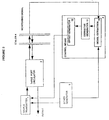
- Figure 2 shows one possible implementation of the system of figure 1.
- a dither generator 5 is provided for applying a dither to the response of the etalon 4.
- the dither is relatively low frequency, so that the signal extraction from the monitoring signal can be carried out using relatively low speed circuitry which is simpler and cheaper.
- the change in response of the etalon can be achieved by changing the spacing of the two reflective surfaces, for example by means of a Piezo-Electric element.
- the dither signal can be combined with a DC offset signal, as shown by the combiner element 6 in figure 2, the output of which is used to control the spacing of the etalon.
- the control means 3 as shown in figure 2, comprises a signal extraction function 10, which extracts the portion of the monitoring signal which is attributable to the dither signal. This can be done either by narrow band filtering, or by a synchronous detection circuit.
- a derivative generator 11 generates a second order derivative with respect to wavelength, and a first order derivative with respect to wavelength. from the monitoring signal.
- the system is immune to errors such as those due to detector leakage currents.
- the optimum offset is determined, by means of the offset generator 12, and fed to the etalon.
- the functions of the signal extraction, generation of the derivatives, and derivation of the offset can be carried out in a digital signal processor, or by use of conventional analogue circuitry.
- Figure 3 shows a variation in which the dither is applied to the source transmitter 1. Furthermore, instead of locking the etalon response to the wavelength of the source transmitter, in the embodiment of figure 3, the wavelength of the transmitter is locked to that of the etalon resonance.
- the basic control principles as described in relation to figure 2 can be applied in a similar way in figure 3.
- the etalon can be a stable cavity which is used as a wavelength reference for the laser.
- figure 4 Another alternative is shown in figure 4.
- the dither is applied to the etalon, while the offset is applied to the source transmitter 1, to lock it to the etalon response.
- the basic control principles set out for figure 2 can be applied equally to the arrangement of figure 4.
- the dither is a low frequency signal which enables the etalon to be adjusted for a predetermined amount of detuning, and thus a certain change in monitored power output. This change is also dependent on the etalon response characteristic and on long term changes in monitoring means (photodiode) and Etalon characteristics, and shorter term changes in input power.
- the dither is one preferred way of obtaining a change in monitored output. In principle low frequencies in the data being transmitted could be used as these can generate frequency dither.
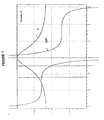
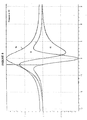
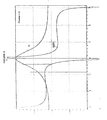
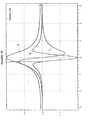
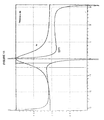
- the use of the derivatives enables most of the changes to be accounted for, so that the monitored output is dependent only on the etalon response characteristic. This enables the etalon to be controlled to operate at a particular point on its response curve, such that its dispersion remains constant over long periods, as will now be explained with reference to figures 5 to 11.
- the first order derivative represents the slope of the response, or delay, and thus represents dispersion directly.
- the peak of this first order derivative represents the point of maximum dispersion.
- the second order derivative represents the degree of curvature of the response.
- Derivative f1 shows a minimum at zero detuning and cannot be used to track the etalon on its own as its magnitude varies with optical power.
- Derivative f2 shows a zero-crossing at 75% transmission, i.e. the point with highest dispersion. Looking at f2 alone would enable control of the etalon to the point with maximum dispersion.
- Normalising f2 with f1 yields a signal that is independent of the input power.
- Etalon compensators could be applied at the transmitter, the receiver, or even in principle at the line amplifiers. However use at the line amplifiers is not preferred for the following reason.
- the Fabry-Perot dispersion varies strongly in both magnitude and sign across the bandwidth of the optical amplifier. It can only be locked to provide the correct dispersion for a specific channel. Other channels would have arbitrary dispersion values, depending on their relative wavelength to the "locked" channel.
- the etalon When located adjacent to the transmitter laser, there is the option of locking the laser to a fixed spacing compensator (instead of tuning the etalon). This has the advantage of eliminating the piezoelectric elements in the etalon, which present significant reliability concerns over life, temperature and humidity.
- the etalon could also be used as a high stability passive wavelength reference for the laser. The two techniques could in principle be combined.
- the monitor signal for the control loop might be acquired from the system receiver or from a separate monitor detector on the monitor port.
- Group delay measurements can be used directly to calculate the etalon dispersion, bearing in mind that the dispersion as seen by transmitted signal is the averaged value over the signal bandwidth.
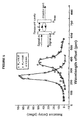
- the dispersion measured for one device was about 1000 ps/nm.
- a value of 1000 ps/nm will be used throughout the following calculations of the FOM.
- the measured total loss of the other channel under the same circumstances as before was 2.5 dB.
- the FOM therefore is 400 ps/(nm.dB).
- Wavelength tracking is necessary as the transmission window of the device (-4 GHz) is very narrow.
- the tracking method of the invention enables the device to be tracked off resonance without depending on the absolute signal power level.
- the etalon must be accurately aligned in wavelength with the signal, and a single device can be tuned to align with any wavelength of interest. Using the technique of the invention to lock the etalon to the correct operating point, then a stand-alone solution is feasible. This may be practical using local power monitoring. Integration with the transmitter might enable the piezoelectric actuators to be eliminated. Integration with the receiver would enable the tuning control loop to use eye closure information, and hence provide automatically optimised dispersion compensation.
Landscapes
- Physics & Mathematics (AREA)
- Electromagnetism (AREA)
- Optics & Photonics (AREA)
- Nonlinear Science (AREA)
- Engineering & Computer Science (AREA)
- Plasma & Fusion (AREA)
- General Physics & Mathematics (AREA)
- Lasers (AREA)
- Glass Compositions (AREA)
- Optical Communication System (AREA)
- Semiconductor Lasers (AREA)
Claims (13)
- Un système de commande pour un dispositif étalon optique (4) comprenant une paire de surfaces réfléchissantes disposées de façon parallèle, dont l'une au moins est partiellement réfléchissante, cette surface partiellement réfléchissante transmettant un signal de contrôle, le système de commande comprenant :des moyens pour contrôler la puissance de sortie du signal de contrôle;un générateur de variation périodique (5) pour appliquer une variation périodique à la réponse en longueur d'onde du dispositif étalon (4) ou à la longueur d'onde d'une source de signal (1) en amont du dispositif étalon; etdes moyens pour commander la réponse en longueur d'onde du dispositif (3), ces moyens comprenant :un générateur de dérivées (11) pour générer des dérivées du premier et du second ordre de la puissance de sortie du signal de contrôle, par rapport à la longueur d'onde du signal de contrôle; etun générateur de décalage (12) élaborant un signal de décalage à partir du rapport de ces dérivées, le signal de décalage réglant la réponse en longueur d'onde du dispositif.
- Le système de la revendication 1, dans lequel le système de commande comprend en outre :dans lequel le générateur de dérivées (11) génère les dérivées à partir de ladite partie du signal de contrôle.des moyens d'extraction de signal (10) qui extraient une partie du signal de contrôle qui est attribuable au signal de variation périodique,
- Le système de l'une quelconque des revendications précédentes, le dispositif étant un compensateur de dispersion à étalon de Fabry-Pérot, dans lequel on peut faire fonctionner les moyens de commande pour maintenir constante la dispersion du compensateur.
- Un système de commande pour commander une longueur d'onde de sortie d'un laser d'émetteur, dans un système de transmission optique qui comprend un dispositif étalon (4) en aval du laser, comme énoncé dans la revendication 1.
- Le système de la revendication 4, dans lequel le système de commande comprend en outre des moyens pour appliquer une variation périodique de longueur d'onde au laser, et les dérivées sont obtenues à partir d'une variation dans le signal de sortie contrôlé, occasionnée par la variation périodique.
- Le système de l'une quelconque des revendications précédentes, dans lequel les moyens de commande peuvent fonctionner de façon à maintenir constant un rapport entre une dérivée du premier ordre et une dérivée du second ordre de la réponse en longueur d'onde, à une longueur d'onde donnée.
- Le système de l'une quelconque des revendications précédentes, dans lequel les moyens de commande peuvent fonctionner de façon à maintenir à zéro la dérivée du second ordre.
- Le système de l'une quelconque des revendications précédentes, dans lequel les moyens de commande peuvent fonctionner en fonction du signe d'une dérivée du premier ordre de la réponse en longueur d'onde.
- Un système de transmission optique comprenant le laser d'émetteur, le dispositif étalon et le système de commande de la revendication 4 ou de l'une quelconque des revendications 5 à 8, considérées dans la dépendance de la revendication 4.
- Un dispositif étalon comprenant le système de commande de l'une quelconque des revendications 1 à 3, ou d'une revendication quelconque considérée dans la dépendance de l'une quelconque des revendications 1 à 3.
- Un compensateur de dispersion à étalon de Fabry-Pérot, comprenant :un dispositif étalon (4) comprenantune paire de surfaces réfléchissantes disposées de façon parallèle, dont l'une au moins est partiellement réfléchissante, cette surface partiellement réfléchissante transmettant un signal de contrôle;des moyens pour contrôler la puissance de sortie du signal de contrôle;un générateur de variation périodique (5) pour appliquer une variation périodique à la réponse en longueur d'onde du dispositif étalon (4); etdes moyens pour commander la réponse en longueur d'onde du compensateur de façon à maintenir la dispersion du compensateur sensiblement indépendante de variations de puissance d'entrée et des caractéristiques des moyens de contrôle, les moyens de commande comprenant :un générateur de dérivées (11) pour générer des dérivées du premier et du second ordre de la puissance de sortie du signal de contrôle, par rapport à la longueur d'onde du signal de contrôle; etun générateur de décalage (12) élaborant un signal de décalage à partir du rapport desdites dérivées, le signal de décalage réglant la réponse en longueur d'onde du dispositif.
- Un système de transmission optique comprenant le système de commande de l'une quelconque des revendications 1 à 8, ou le dispositif étalon de la revendication 10, ou le compensateur de la revendication 11.
- Un procédé d'émission de données dans un système de transmission optique comprenant un émetteur source (11) et un dispositif étalon (4), le procédé comprenant les étapes suivantes :on applique une variation périodique soit à la longueur d'onde de sortie de l'émetteur, soit à la réponse en longueur d'onde du dispositif étalon;on contrôle la puissance de sortie du dispositif étalon;on calcule un rapport de dérivées par rapport à la longueur d'onde, du signal de sortie contrôlé; eton génère un signal de décalage pour commander la longueur d'onde de sortie de l'émetteur, ou la réponse en longueur d'onde du dispositif étalon, sur la base du rapport des dérivées.
Applications Claiming Priority (9)
| Application Number | Priority Date | Filing Date | Title |
|---|---|---|---|
| US848337 | 1992-03-09 | ||
| GB9615302 | 1996-07-20 | ||
| GBGB9615302.8A GB9615302D0 (en) | 1996-07-20 | 1996-07-20 | Etalon arrangement |
| CA002203845A CA2203845C (fr) | 1996-07-20 | 1997-04-28 | Dispositif etalon |
| CA2203845 | 1997-04-28 | ||
| US08/848,337 US5828689A (en) | 1996-07-20 | 1997-04-30 | Etalon arrangement |
| JP9179766A JPH1068894A (ja) | 1996-07-20 | 1997-07-04 | エタロン装置 |
| JP179766/97 | 1997-07-04 | ||
| JP17976697 | 1997-07-04 |
Publications (3)
| Publication Number | Publication Date |
|---|---|
| EP0820133A2 EP0820133A2 (fr) | 1998-01-21 |
| EP0820133A3 EP0820133A3 (fr) | 1999-10-20 |
| EP0820133B1 true EP0820133B1 (fr) | 2003-05-14 |
Family
ID=27427347
Family Applications (1)
| Application Number | Title | Priority Date | Filing Date |
|---|---|---|---|
| EP97305110A Expired - Lifetime EP0820133B1 (fr) | 1996-07-20 | 1997-07-10 | Dispositif étalon optique |
Country Status (3)
| Country | Link |
|---|---|
| EP (1) | EP0820133B1 (fr) |
| AT (1) | ATE240601T1 (fr) |
| DE (1) | DE69721904T2 (fr) |
Family Cites Families (5)
| Publication number | Priority date | Publication date | Assignee | Title |
|---|---|---|---|---|
| GB2075746B (en) * | 1980-04-09 | 1983-12-07 | Secr Defence | Laser with feedback frequency control |
| US4434490A (en) * | 1982-03-31 | 1984-02-28 | The United States Of America As Represented By The Administrator Of The National Aeronautics And Space Administration | Spectrophone stabilized laser with line center offset frequency control |
| US4508964A (en) * | 1982-09-29 | 1985-04-02 | Rockwell International Corporation | Electro-optically tuned rejection filter |
| US5173908A (en) * | 1991-10-07 | 1992-12-22 | Coherent, Inc. | System for automatically adjusting the GVD of a Gires-Tournois interferometer |
| GB2274952B (en) * | 1993-01-23 | 1996-12-04 | Northern Telecom Ltd | Optical soliton pulse transmission system |
-
1997
- 1997-07-10 AT AT97305110T patent/ATE240601T1/de not_active IP Right Cessation
- 1997-07-10 EP EP97305110A patent/EP0820133B1/fr not_active Expired - Lifetime
- 1997-07-10 DE DE69721904T patent/DE69721904T2/de not_active Expired - Fee Related
Also Published As
| Publication number | Publication date |
|---|---|
| EP0820133A3 (fr) | 1999-10-20 |
| DE69721904D1 (de) | 2003-06-18 |
| EP0820133A2 (fr) | 1998-01-21 |
| ATE240601T1 (de) | 2003-05-15 |
| DE69721904T2 (de) | 2003-12-24 |
Similar Documents
| Publication | Publication Date | Title |
|---|---|---|
| CA2203845C (fr) | Dispositif etalon | |
| EP0240512B1 (fr) | Procede et systeme de reference pour frequences | |
| US5715265A (en) | Dispersion compensation | |
| CA2309436C (fr) | Dispositif de commande de la longueur d'onde d'un laser | |
| US5696859A (en) | Optical-filter array, optical transmitter and optical transmission system | |
| US6289028B1 (en) | Method and apparatus for monitoring and control of laser emission wavelength | |
| US5023947A (en) | Optical equalization receiver for lightwave communication systems | |
| US5557468A (en) | Chromatic dispersion compensation device | |
| EP0860042B1 (fr) | Procede et appareil de stabilisation d'un laser semiconducteur | |
| US5469288A (en) | Optical filter, method of controlling transmission wavelength thereof, and optical receiver using the method | |
| EP1524782A2 (fr) | Dispositif de synchronisation optique | |
| CA2510352A1 (fr) | Source d'alimentation pour systeme a fibre optique a compensation de dispersion | |
| KR100417170B1 (ko) | 광섬유에서신호를전송시키기위한방법및장치 | |
| CA2309437A1 (fr) | Systemes de communication optique a multiplexage par repartition de longueur d'onde (wdm) avec selecteurs optiques de longueur d'onde stabilises | |
| US20080212962A1 (en) | Chirp measurement method, chirp measurement apparatus and their application | |
| EP0844751A2 (fr) | Emetteur optique, dispositif terminal avec émetteur optique et système de communication optique avec contrÔle du signal optique transmis | |
| EP1258061B1 (fr) | Dispositif de verrouillage de frequence dans la fibre | |
| EP1628150B1 (fr) | Compensateur de dispersion avec système de suivi de longueur d'onde | |
| EP0820133B1 (fr) | Dispositif étalon optique | |
| JP2564622B2 (ja) | 半導体レーザの発振周波数安定化方法及び装置 | |
| US6327064B1 (en) | Frequency stabilized and crosstalk-free signal sources for optical communication systems | |
| US7031619B2 (en) | Method and system for dispersion control of electromagnetic signals in communication networks | |
| US5054875A (en) | Fiber-optic equalizer | |
| Chung | Temperature-tuned ZnS etalon filters for WDM systems | |
| EP0598387B1 (fr) | Ligne de transmission optique et technique de réduction de distorsion |
Legal Events
| Date | Code | Title | Description |
|---|---|---|---|
| PUAI | Public reference made under article 153(3) epc to a published international application that has entered the european phase |
Free format text: ORIGINAL CODE: 0009012 |
|
| AK | Designated contracting states |
Kind code of ref document: A2 Designated state(s): AT BE CH DE FR GB IT LI |
|
| RAP3 | Party data changed (applicant data changed or rights of an application transferred) |
Owner name: NORTEL NETWORKS CORPORATION |
|
| PUAL | Search report despatched |
Free format text: ORIGINAL CODE: 0009013 |
|
| AK | Designated contracting states |
Kind code of ref document: A3 Designated state(s): AT BE CH DE DK ES FI FR GB GR IE IT LI LU MC NL PT SE |
|
| RIC1 | Information provided on ipc code assigned before grant |
Free format text: 6H 01S 3/13 A, 6H 04B 10/18 B, 6H 04B 10/145 B, 6G 02F 1/21 B |
|
| 17P | Request for examination filed |
Effective date: 20000420 |
|
| AKX | Designation fees paid |
Free format text: AT BE CH DE FR GB IT LI |
|
| RAP1 | Party data changed (applicant data changed or rights of an application transferred) |
Owner name: NORTEL NETWORKS LIMITED |
|
| 17Q | First examination report despatched |
Effective date: 20011106 |
|
| GRAH | Despatch of communication of intention to grant a patent |
Free format text: ORIGINAL CODE: EPIDOS IGRA |
|
| RTI1 | Title (correction) |
Free format text: OPTICAL ETALON ARRANGEMENT |
|
| GRAH | Despatch of communication of intention to grant a patent |
Free format text: ORIGINAL CODE: EPIDOS IGRA |
|
| GRAA | (expected) grant |
Free format text: ORIGINAL CODE: 0009210 |
|
| AK | Designated contracting states |
Designated state(s): AT BE CH DE FR GB IT LI |
|
| PG25 | Lapsed in a contracting state [announced via postgrant information from national office to epo] |
Ref country code: LI Free format text: LAPSE BECAUSE OF FAILURE TO SUBMIT A TRANSLATION OF THE DESCRIPTION OR TO PAY THE FEE WITHIN THE PRESCRIBED TIME-LIMIT Effective date: 20030514 Ref country code: IT Free format text: LAPSE BECAUSE OF FAILURE TO SUBMIT A TRANSLATION OF THE DESCRIPTION OR TO PAY THE FEE WITHIN THE PRE;WARNING: LAPSES OF ITALIAN PATENTS WITH EFFECTIVE DATE BEFORE 2007 MAY HAVE OCCURRED AT ANY TIME BEFORE 2007. THE CORRECT EFFECTIVE DATE MAY BE DIFFERENT FROM THE ONE RECORDED.SCRIBED TIME-LIMIT Effective date: 20030514 Ref country code: CH Free format text: LAPSE BECAUSE OF FAILURE TO SUBMIT A TRANSLATION OF THE DESCRIPTION OR TO PAY THE FEE WITHIN THE PRESCRIBED TIME-LIMIT Effective date: 20030514 Ref country code: BE Free format text: LAPSE BECAUSE OF FAILURE TO SUBMIT A TRANSLATION OF THE DESCRIPTION OR TO PAY THE FEE WITHIN THE PRESCRIBED TIME-LIMIT Effective date: 20030514 Ref country code: AT Free format text: LAPSE BECAUSE OF FAILURE TO SUBMIT A TRANSLATION OF THE DESCRIPTION OR TO PAY THE FEE WITHIN THE PRESCRIBED TIME-LIMIT Effective date: 20030514 |
|
| REG | Reference to a national code |
Ref country code: GB Ref legal event code: FG4D |
|
| REG | Reference to a national code |
Ref country code: CH Ref legal event code: EP |
|
| REF | Corresponds to: |
Ref document number: 69721904 Country of ref document: DE Date of ref document: 20030618 Kind code of ref document: P |
|
| PGFP | Annual fee paid to national office [announced via postgrant information from national office to epo] |
Ref country code: GB Payment date: 20030709 Year of fee payment: 7 |
|
| PGFP | Annual fee paid to national office [announced via postgrant information from national office to epo] |
Ref country code: FR Payment date: 20030711 Year of fee payment: 7 |
|
| PGFP | Annual fee paid to national office [announced via postgrant information from national office to epo] |
Ref country code: DE Payment date: 20030717 Year of fee payment: 7 |
|
| RAP2 | Party data changed (patent owner data changed or rights of a patent transferred) |
Owner name: BOOKHAM TECHNOLOGY PLC |
|
| REG | Reference to a national code |
Ref country code: CH Ref legal event code: PL |
|
| PLBE | No opposition filed within time limit |
Free format text: ORIGINAL CODE: 0009261 |
|
| STAA | Information on the status of an ep patent application or granted ep patent |
Free format text: STATUS: NO OPPOSITION FILED WITHIN TIME LIMIT |
|
| ET | Fr: translation filed | ||
| 26N | No opposition filed |
Effective date: 20040217 |
|
| PG25 | Lapsed in a contracting state [announced via postgrant information from national office to epo] |
Ref country code: GB Free format text: LAPSE BECAUSE OF NON-PAYMENT OF DUE FEES Effective date: 20040710 |
|
| PG25 | Lapsed in a contracting state [announced via postgrant information from national office to epo] |
Ref country code: DE Free format text: LAPSE BECAUSE OF NON-PAYMENT OF DUE FEES Effective date: 20050201 |
|
| GBPC | Gb: european patent ceased through non-payment of renewal fee |
Effective date: 20040710 |
|
| PG25 | Lapsed in a contracting state [announced via postgrant information from national office to epo] |
Ref country code: FR Free format text: LAPSE BECAUSE OF NON-PAYMENT OF DUE FEES Effective date: 20050331 |
|
| REG | Reference to a national code |
Ref country code: FR Ref legal event code: ST |