EP0820170A2 - Système et procédé pour améliorer la performance d'un serveur dans un réseau de communication - Google Patents
Système et procédé pour améliorer la performance d'un serveur dans un réseau de communication Download PDFInfo
- Publication number
- EP0820170A2 EP0820170A2 EP97112081A EP97112081A EP0820170A2 EP 0820170 A2 EP0820170 A2 EP 0820170A2 EP 97112081 A EP97112081 A EP 97112081A EP 97112081 A EP97112081 A EP 97112081A EP 0820170 A2 EP0820170 A2 EP 0820170A2
- Authority
- EP
- European Patent Office
- Prior art keywords
- server
- packet
- call
- provider
- address
- Prior art date
- Legal status (The legal status is an assumption and is not a legal conclusion. Google has not performed a legal analysis and makes no representation as to the accuracy of the status listed.)
- Withdrawn
Links
- 238000004891 communication Methods 0.000 title claims abstract description 29
- 238000000034 method Methods 0.000 title claims abstract description 27
- 238000011156 evaluation Methods 0.000 claims abstract 3
- 238000012546 transfer Methods 0.000 claims description 7
- 230000015556 catabolic process Effects 0.000 claims description 4
- 238000006731 degradation reaction Methods 0.000 claims description 4
- 238000012545 processing Methods 0.000 abstract description 6
- 208000032370 Secondary transmission Diseases 0.000 abstract 1
- 238000004246 ligand exchange chromatography Methods 0.000 description 27
- 238000010586 diagram Methods 0.000 description 5
- 230000005540 biological transmission Effects 0.000 description 3
- 230000006870 function Effects 0.000 description 3
- 230000008859 change Effects 0.000 description 2
- 230000008569 process Effects 0.000 description 2
- 238000013519 translation Methods 0.000 description 2
- 230000009467 reduction Effects 0.000 description 1
- 238000012360 testing method Methods 0.000 description 1
Images


Classifications
-
- H—ELECTRICITY
- H04—ELECTRIC COMMUNICATION TECHNIQUE
- H04Q—SELECTING
- H04Q3/00—Selecting arrangements
- H04Q3/0016—Arrangements providing connection between exchanges
- H04Q3/0062—Provisions for network management
-
- H—ELECTRICITY
- H04—ELECTRIC COMMUNICATION TECHNIQUE
- H04L—TRANSMISSION OF DIGITAL INFORMATION, e.g. TELEGRAPHIC COMMUNICATION
- H04L9/00—Cryptographic mechanisms or cryptographic arrangements for secret or secure communications; Network security protocols
- H04L9/40—Network security protocols
-
- H—ELECTRICITY
- H04—ELECTRIC COMMUNICATION TECHNIQUE
- H04L—TRANSMISSION OF DIGITAL INFORMATION, e.g. TELEGRAPHIC COMMUNICATION
- H04L67/00—Network arrangements or protocols for supporting network services or applications
- H04L67/01—Protocols
- H04L67/10—Protocols in which an application is distributed across nodes in the network
- H04L67/1001—Protocols in which an application is distributed across nodes in the network for accessing one among a plurality of replicated servers
- H04L67/1004—Server selection for load balancing
-
- H—ELECTRICITY
- H04—ELECTRIC COMMUNICATION TECHNIQUE
- H04M—TELEPHONIC COMMUNICATION
- H04M7/00—Arrangements for interconnection between switching centres
- H04M7/006—Networks other than PSTN/ISDN providing telephone service, e.g. Voice over Internet Protocol (VoIP), including next generation networks with a packet-switched transport layer
Definitions
- This invention relates, in general, to communications network data transfer operations.
- the present invention relates to reducing the loading of servers in a communications network to increase network performance by automatically rerouting data packets to lightly loaded servers when the initial destination server is heavily loaded.
- Toll free calling is typically controlled by a central relay server that performs a look-up table function to determine the destination telephone number.
- the look-up function is necessary because, unlike toll calls in which an area code and phone number uniquely identifies a destination, toll free phone numbers are essentially non-geographic based (i.e., the same phone number is used to place a call regardless of the physical location of the actual destination).
- the central relay server which in reality may be simply the telephone switch nearest to the caller, translates the dialed phone number into the actual phone number of the recipient.
- the translation process may be an "intelligent" process, in that it may account for considerations such as time of day, network or server loading, caller ID, etc., or it may be a simple translation based solely on phone number. Once the phone number is translated, the call is placed to the recipient regardless of variations in loading. This may lead to a significant degradation in performance when either the network or the destination server become loaded down.
- packet networks communications are first converted from analog to digital, and then are divided up into packets. The packets are assigned an address and then transferred to the address. Once a packet is addressed, the network may attempt to route it to the appropriate destination. However, once the packet is placed on the network, the address may be changed by the network so that the call is routed to an actual call center that is best suited to handle the call in view of the overall network conditions (e.g., if the network routing to the original actual destination is heavily loaded, the network may change the destination address to a server that can be reached through less heavily loaded network resources).
- packet networks may help to alleviate network congestion
- packet networks as currently implemented do not address the problems related to server loading.
- the revised destination address is to an overloaded server, the data transfer to that server occurs resulting in further reductions in performance at the overloaded server. It would therefore be desirable to provide techniques for packet network communications that reduce server loading to improve overall network performance.
- the above and other objects of the invention are met by the present invention in which techniques are provided to reduce server loading in packet network topologies.
- the present invention includes a network topology that connects together many individual servers that are located at various different geographic points throughout the country. Incoming calls are converted by the local server into digital packets that are given a preliminary destination server address. The packets are then transmitted to the preliminary destination server which, in accordance with the principles of the present invention, may refuse the call and return the packet with an alternate address.
- Each destination server may have a different capacity and set of conditions under which the server determines that the quality of serviced provided by that server may suffer. When that threshold is reached, the server automatically refuses the call and returns the packet. The call, however, still must be processed. Therefore, the refusing server provides an address of an alternate server that the primary server believes is more able to handle the call. The sending server then takes the returned packet and retransmits it, this time using the alternate address as the primary address. Under such circumstances, server loading is reduced which maintains the quality of service provided by the servers to an acceptable, high quality level.
- Communication system 100 includes various groups of telephones 102, 104, 106 and 108 and toll free servers 112, 114, 116, and 118 connected respectively to LECs 122, 124, 126 and 128.
- each LEC is representative of a given geographic region in which substantially all of the phones in that region are connected together (e.g., LEC 122, which is located in region XX2, interconnects telephones 102 and toll free servers 112).
- Each LEC is, in actuality, formed via the interconnection of several end-offices which are each formed from the interconnection of small groups of telephones and servers in a given local area.
- each group of telephones i.e., 102, 104, 106 and 108 and servers (i.e., 112, 114, 116 and 118) are shown in FIG. 1 as being connected to a single, central location (i.e., 122, 124, 126 and 128), the telephones and servers are instead connected to the end-office they are physically closest to. Further, while only four LECs are shown, there are, at the present time, seven LECs that cover the entire country.
- Telephone calls between telephones within a LEC are considered local calls and are handled exclusively by the LEC to which they are attached (the term "telephone calls," in the present application, is intended to include calls placed via a telephone, as well as other calls that are placed via phone lines, such as data transmission via a modem, facsimile transmissions and other similar communications).
- Telephone calls between different LECs require that a communication link be made from the originating LEC through inter-exchange provider 140 to the destination LEC.
- Access tandems 132, 142, 152 and 162 respectively provide LECs 122, 124, 126 and 128 with a bi-directional link to inter-exchange provider 140.
- Each access tandem is, in turn, connected to one of local servers 142, 144, 146 and 148, respectively, that are each located within the physical region of the LEC (e.g., local server 142 is located in region XX2, along with LEC 122 and access tandem 132).
- the local servers are themselves interconnected via packet network 150.
- Toll free calls between telephones and servers are handled differently than "normal" phone calls.
- Toll free calls typically have a prefix (i.e., area code) of 800 or 888, although other toll free prefixes may be assigned at a future date.
- the toll free number dialed by the caller is not the destination telephone number, but is instead a number that is associated with a specific customer (or a specific account within a given customer).
- the incoming call is translated from the toll free number to an actual destination telephone number, which may be the telephone number for the local toll free server for that customer or the telephone number of some other server for that customer, by a central relay switch located within the LEC where the call was placed (such as within LEC 122).
- the customer may have additional toll free servers allocated to handling toll free calls from different parts of the country.
- American Airlines may have toll free servers in New York (e.g., one or more of servers 112) and California (e.g., one or more of servers 118) that, assuming ideal conditions, each handle the toll free calls in their respective localities.
- ideal conditions are sometimes rarely seen and, in fact, circumstances may be that the server in New York (server 112) is loaded close to its capacity, while the server in California (server 118) is less than half loaded.
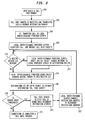
- a toll free call (or similar call) is initiated when a user, in a step 202, dials a toll free telephone number.
- the call is received by a switch in the end-office of the LEC that the caller s telephone is physically connected to and the dialed number is translated into a primary destination telephone number.
- the LEC in a step 206, transfers the call across the appropriate access tandem to a local server of the provider that provides toll free service for the destination customer.
- the provider local server in a step 208, converts the call from an analog call to a digital call and breaks the call up into packets.
- Each of the packets has an address block in which the primary destination number is loaded as the actual number being called.
- the local server checks to see if the actual number being called is within the region of coverage provided by the local server (e.g., this test would be true if the destination was server 114 because provider local server 144 is located in region XX4), in a step 210. If the server determines that it does not have access to the appropriate access tandem, it transmits the packet across network 150 to the appropriate server in a step 212. In either instance, the packet has been delivered to a provider local server that, in a step 214, sends the packet through the access tandem to the destination LEC. The destination LEC delivers the packet to the destination toll free server in a step 216.
- the destination server determines whether the incoming call would place the server in an undesirable condition (e.g., an overload condition) such that performance of the toll free server would be degraded. This determination, as described above, may be based on several factors which can be combined to establish a threshold value (e.g., time of day, network loading, server loading, caller ID, etc.). If the threshold is exceeded in step 218, the toll free server automatically rejects the call in a step 220 and sends the packet back to the source with a secondary destination address. When the transmitting server receives the packet back with the refusal and the secondary address, the server, in a step 222, replaces the actual number being called with the secondary address.
- an undesirable condition e.g., an overload condition
- the server After updating the address, the server once again determines whether the destination address is within the region of coverage provided by the provider server, in the step 210 (and processing continues from that point as described above). If the toll free server determines that the threshold value has not been exceeded, the call is completed in a step 224.
- the toll free cal is initiated when a user 102 dials a toll free number (e.g., 1-800-123-4567) (i.e., step 202).
- the call is received in an end-office within LEC 122 and translated into a primary telephone number (e.g., 1-800-123-4567 is translated into 818-888-8888) (i.e., step 204).
- LEC 122 then transfers the call across access tandem 132 to provider local server 142 (i.e., step 206).
- Server 142 digitizes the call and breaks it up into packets (i.e., step 208), and then determines whether the destination of the call (i.e., 818-888-8888, or for the sake of the present example, toll free server 118) is within server 142's region of coverage (i.e., step 210). In this example, toll free server 118 is within the region of coverage that provider server 148 controls, so server 142 sends the packet across network 150 to server 148 (i.e., step 212).
- provider server 148 receives the packet, it transfers the packet across tandem 138 to LEC 128 (i.e., step 214), which then sends the packet to toll free server 118 (i.e., step 216).
- Toll free server 118 checks to determines whether the threshold is exceeded by the incoming call (i.e., step 218) and, assuming that the threshold is exceeded, automatically rejects the call and transmits the packet back to the sender (i.e., server 142) with a secondary address (e.g., 414-444-44, or toll free server 114) (i.e., step 220).
- Provider server 142 receives the packet with the rejection and secondary address and updates the actual address to the secondary address (i.e., 818-888-8888 is changed to 414-444-4444) (i.e., step 222). Provider 142 then begins the same sequence with the secondary phone number as it did with the primary number (i.e., back to step 210).
- Provider 142 determines that provider server 144 is the appropriate server for the secondary number (i.e., step 210) and transfers the packet to server 144 (i.e., step 212).
- Server 144 sends the packet through access tandem 134 to LEC 124 (i.e., step 214), which delivers the packet to toll free server 114 (i.e., step 216).
- server 114 checks to see if the incoming call causes an overload condition and, assuming it does not, accepts the message to complete the connection (i.e., step 224).
- the principles of the present invention have many practical applications. For example, if a voice packet call were made to an individual s computer and that individual had left the house and gone to work, the individual s computer could be set to refuse the call and provide the individual s work computer as the secondary number. Thus, while the most basic application of the present invention is directed toward improving toll free service, persons skilled in the art will appreciate that the automatic call rejection and readdressing features of the present invention have other applications.
- An additional implementation of the present invention is where a small consortia of companies could join together and build a virtual nationwide network (e.g., plumbers or dentists). In that case, an individual would call, for example, 1-800-PLUMBER, and the call would be routed to the nearest plumber. If that plumber was busy or not home, his home computer could be set to refuse the incoming call and provide the number of an associate as the secondary number.
- a virtual nationwide network e.g., plumbers or dentists
- FIG. 3 A simplified schematic diagram of representative circuitry of a local provider server 340 (e.g., local provider server 142) that is part of communication system 100 (of FIG. 1) is shown in FIG. 3.
- Local server 340 includes four basic components: processor 352, input/output interface 354, processor memory 356, and system memory 358.
- Processor 352 may be as simple as a preprogrammed controller, or it may be as complex as a multi-processor array that performs multi-task processing.
- Processor memory 356 preferably includes cache memory and may also include processor registers (which may, instead, be included within processor 352). Additionally, processor 352 and processor memory 356 may be combined within a single integrated circuit or combined onto a single circuit board without departing from the spirit of the present invention (depending on how much memory is required).
- Input/output interface 354 performs various functions to interface processor 352 with the "outside world."
- the outside world includes network 350 and access tandem 330 (which is representative of any of access tandems 132, 134, 136 and 138 shown in FIG. 1) for processing information communications (including telephone and data communications), as described above.
- System memory 358 may include random access memory (RAM), hard drives, magneto-optical drives, tape drives, or any other conventional apparatus used to store information in a computer system.
- RAM random access memory
- FIG. 3 is described as being illustrative of a provider server, that similar circuitry is also required for any of the end-servers (e.g., end-servers 112, 114, 116 and 118).
- provider server 340 The principle difference between provider server 340 and any one of the end-servers is that the input/output interface for the end-servers is typically connected to the local LEC rather than to access tandem 330 and network 350, as shown in FIG. 3 (thus, the internal circuitry may be substantially similar).
- local server 340 provides various capabilities for the communications system 100.
- provider server 340 performs as follows.
- Processor 352 digitizes the incoming call that is currently located in processor memory 356 (in the step 206, the call was received and placed into processor memory 356 for further processing), and breaks the digitized call into packets.
- Processor 352 then analyzes the destination code to determine whether the call destination is within the region of coverage provided by the server.
- Processor 352 passes the initial packet of the call (and other packets, if convenient) to input/output interface 354 with instructions to transmit the call outward.
- the instructions provided by processor 352 will varying depending on whether the call is to be directed onto network 350 (i.e., the step 212) or directly to the local LEC via access tandem 330 (i.e., the step 214).
Landscapes
- Engineering & Computer Science (AREA)
- Computer Security & Cryptography (AREA)
- Computer Networks & Wireless Communication (AREA)
- Signal Processing (AREA)
- Data Exchanges In Wide-Area Networks (AREA)
- Exchange Systems With Centralized Control (AREA)
- Use Of Switch Circuits For Exchanges And Methods Of Control Of Multiplex Exchanges (AREA)
Applications Claiming Priority (2)
| Application Number | Priority Date | Filing Date | Title |
|---|---|---|---|
| US08/680,945 US5946299A (en) | 1996-07-15 | 1996-07-15 | Systems and methods for providing increased server performance, in a communications network |
| US680945 | 1996-07-15 |
Publications (2)
| Publication Number | Publication Date |
|---|---|
| EP0820170A2 true EP0820170A2 (fr) | 1998-01-21 |
| EP0820170A3 EP0820170A3 (fr) | 2000-07-05 |
Family
ID=24733159
Family Applications (1)
| Application Number | Title | Priority Date | Filing Date |
|---|---|---|---|
| EP97112081A Withdrawn EP0820170A3 (fr) | 1996-07-15 | 1997-07-15 | Système et procédé pour améliorer la performance d'un serveur dans un réseau de communication |
Country Status (4)
| Country | Link |
|---|---|
| US (1) | US5946299A (fr) |
| EP (1) | EP0820170A3 (fr) |
| JP (1) | JPH1093631A (fr) |
| CA (1) | CA2208294C (fr) |
Families Citing this family (32)
| Publication number | Priority date | Publication date | Assignee | Title |
|---|---|---|---|---|
| GB9603582D0 (en) | 1996-02-20 | 1996-04-17 | Hewlett Packard Co | Method of accessing service resource items that are for use in a telecommunications system |
| US6069890A (en) | 1996-06-26 | 2000-05-30 | Bell Atlantic Network Services, Inc. | Internet telephone service |
| US6154445A (en) | 1996-04-18 | 2000-11-28 | Bell Atlantic Network Services, Inc. | Telephony communication via varied redundant networks |
| US6473404B1 (en) | 1998-11-24 | 2002-10-29 | Connect One, Inc. | Multi-protocol telecommunications routing optimization |
| US6016307A (en) | 1996-10-31 | 2000-01-18 | Connect One, Inc. | Multi-protocol telecommunications routing optimization |
| US6754181B1 (en) | 1996-11-18 | 2004-06-22 | Mci Communications Corporation | System and method for a directory service supporting a hybrid communication system architecture |
| US6690654B2 (en) | 1996-11-18 | 2004-02-10 | Mci Communications Corporation | Method and system for multi-media collaboration between remote parties |
| US7145898B1 (en) | 1996-11-18 | 2006-12-05 | Mci Communications Corporation | System, method and article of manufacture for selecting a gateway of a hybrid communication system architecture |
| US6335927B1 (en) | 1996-11-18 | 2002-01-01 | Mci Communications Corporation | System and method for providing requested quality of service in a hybrid network |
| US6078582A (en) | 1996-12-18 | 2000-06-20 | Bell Atlantic Network Services, Inc. | Internet long distance telephone service |
| US6731625B1 (en) | 1997-02-10 | 2004-05-04 | Mci Communications Corporation | System, method and article of manufacture for a call back architecture in a hybrid network with support for internet telephony |
| US6137869A (en) | 1997-09-16 | 2000-10-24 | Bell Atlantic Network Services, Inc. | Network session management |
| US6574216B1 (en) | 1997-03-11 | 2003-06-03 | Verizon Services Corp. | Packet data network voice call quality monitoring |
| US6870827B1 (en) | 1997-03-19 | 2005-03-22 | Verizon Services Corp. | Voice call alternative routing through PSTN and internet networks |
| US6272126B1 (en) * | 1997-07-24 | 2001-08-07 | Bell Atlantic Network Services, Inc. | Internetwork telephony with enhanced features |
| US6614780B2 (en) * | 1998-01-02 | 2003-09-02 | Lucent Technologies Inc. | Internet calling apparatus and method |
| US20060224752A1 (en) * | 1999-05-03 | 2006-10-05 | Parekh Sanjay M | Determining geographic locations of private network Internet users |
| US7844729B1 (en) | 1999-05-03 | 2010-11-30 | Digital Envoy, Inc. | Geo-intelligent traffic manager |
| US6757740B1 (en) * | 1999-05-03 | 2004-06-29 | Digital Envoy, Inc. | Systems and methods for determining collecting and using geographic locations of internet users |
| US7685311B2 (en) | 1999-05-03 | 2010-03-23 | Digital Envoy, Inc. | Geo-intelligent traffic reporter |
| US6529955B1 (en) | 1999-05-06 | 2003-03-04 | Cisco Technology, Inc. | Proxy session count limitation |
| US6430619B1 (en) | 1999-05-06 | 2002-08-06 | Cisco Technology, Inc. | Virtual private data network session count limitation |
| US6480749B1 (en) * | 1999-11-10 | 2002-11-12 | Bellsouth Intellectual Property Corporation | Method for performance measurement and an analysis of local exchange carrier interconnections |
| US6965777B1 (en) * | 2000-11-16 | 2005-11-15 | Thomas Cast | Method of delivering short messages using a SMPP gateway with standard interface |
| US6975876B1 (en) * | 2000-11-17 | 2005-12-13 | Thomas Cast | System and method for performing throttle control in a SMPP gateway |
| US20060146820A1 (en) * | 2002-11-26 | 2006-07-06 | Robert Friedman | Geo-intelligent traffic manager |
| US7643627B2 (en) * | 2004-07-09 | 2010-01-05 | At&T Intellectual Property, I,L.P. | Methods, systems and storage mediums for providing a self-provisioning telephony service |
| JP2007221207A (ja) * | 2006-02-14 | 2007-08-30 | Hitachi Ltd | 管理装置及び通信システム |
| US9088658B2 (en) * | 2007-02-23 | 2015-07-21 | Cisco Technology, Inc. | Intelligent overload control for contact center |
| US8238538B2 (en) | 2009-05-28 | 2012-08-07 | Comcast Cable Communications, Llc | Stateful home phone service |
| US8443107B2 (en) * | 2009-11-11 | 2013-05-14 | Digital Envoy, Inc. | Method, computer program product and electronic device for hyper-local geo-targeting |
| CN106411567A (zh) * | 2016-08-30 | 2017-02-15 | 福建星网视易信息系统有限公司 | 一种服务器自动控制可负载客户端数量的方法及装置 |
Citations (2)
| Publication number | Priority date | Publication date | Assignee | Title |
|---|---|---|---|---|
| US5414752A (en) * | 1992-02-17 | 1995-05-09 | Telefonaktiebolaget L M Ericsson | Method for achieving communication between a plurality of participants |
| US5528513A (en) * | 1993-11-04 | 1996-06-18 | Digital Equipment Corp. | Scheduling and admission control policy for a continuous media server |
Family Cites Families (7)
| Publication number | Priority date | Publication date | Assignee | Title |
|---|---|---|---|---|
| US4771425A (en) * | 1984-10-29 | 1988-09-13 | Stratacom, Inc. | Synchoronous packet voice/data communication system |
| US5222128A (en) * | 1990-07-26 | 1993-06-22 | At&T Bell Laboratories | Telecommunication disaster plan |
| US5249223A (en) * | 1991-01-03 | 1993-09-28 | At&T Bell Laboratories | Call-load-control arrangement for an emergency-call-answering center |
| US5299259A (en) * | 1991-09-27 | 1994-03-29 | At&T Bell Laboratories | Distributing calls over serving centers of a large customer |
| US5384841A (en) * | 1993-10-27 | 1995-01-24 | Rockwell International Corporation | Automatic call distribution network with call overload system and method |
| US5661792A (en) * | 1994-10-18 | 1997-08-26 | At&T | Completing telecommunications calls in a competitive local and toll enviroment |
| US5592541A (en) * | 1995-05-31 | 1997-01-07 | Southwestern Bell Technology Resources, Inc. | Apparatus and method for forwarding incoming calls |
-
1996
- 1996-07-15 US US08/680,945 patent/US5946299A/en not_active Expired - Fee Related
-
1997
- 1997-06-19 CA CA002208294A patent/CA2208294C/fr not_active Expired - Fee Related
- 1997-07-15 JP JP9188841A patent/JPH1093631A/ja not_active Abandoned
- 1997-07-15 EP EP97112081A patent/EP0820170A3/fr not_active Withdrawn
Patent Citations (2)
| Publication number | Priority date | Publication date | Assignee | Title |
|---|---|---|---|---|
| US5414752A (en) * | 1992-02-17 | 1995-05-09 | Telefonaktiebolaget L M Ericsson | Method for achieving communication between a plurality of participants |
| US5528513A (en) * | 1993-11-04 | 1996-06-18 | Digital Equipment Corp. | Scheduling and admission control policy for a continuous media server |
Also Published As
| Publication number | Publication date |
|---|---|
| JPH1093631A (ja) | 1998-04-10 |
| CA2208294A1 (fr) | 1998-01-15 |
| MX9705208A (es) | 1998-05-31 |
| US5946299A (en) | 1999-08-31 |
| CA2208294C (fr) | 2002-04-23 |
| EP0820170A3 (fr) | 2000-07-05 |
Similar Documents
| Publication | Publication Date | Title |
|---|---|---|
| US5946299A (en) | Systems and methods for providing increased server performance, in a communications network | |
| JP3441728B2 (ja) | 接続を確立するための方法並びにその方法を実施するためのシステム | |
| US8213594B2 (en) | Method and apparatus for placing a long distance call based on a virtual phone number | |
| US4577065A (en) | Meet-me conference arrangement | |
| US6493321B1 (en) | Systems and methods for providing communications through an alternate communication network | |
| US5896448A (en) | Method and apparatus for routing calls based on call success history | |
| US5526413A (en) | Advanced intelligent network access by customer premise equipment | |
| US6463053B1 (en) | Voice-and-fax-over IP dialing plan | |
| EP1192791B1 (fr) | Reseau voix sur ip utilisant une signalisation ss7 et cooperation de noeuds ip avec points de signalisation | |
| US20030053447A1 (en) | System for interconnecting standard telephony communications equipment to internet protocol networks | |
| MXPA01008594A (es) | Metodos y sistmas para permitir responder una llamada a un mensaje de correo de voz. | |
| MXPA97001426A (en) | Control of telecommunication networks | |
| JP3120220B2 (ja) | 呼出し機能付き通信装置 | |
| CN1255264A (zh) | 在网络中用于通信控制的方法 | |
| AU699052B2 (en) | Subscriber signalling | |
| EP1054569A1 (fr) | Procédé pour établir une liaison à travers d'un réseau téléphonique et d'un réseau IP | |
| HK1002976A (en) | Systems and methods for providing increased server performance in a communications network | |
| RU2295201C1 (ru) | Способ и система для направления вызовов в межсетевом интерфейсе передачи речи по протоколу интернет (voip) | |
| WO1997024889A1 (fr) | Traitement ajustable des appels a l'arrivee directs et partages | |
| JP2820109B2 (ja) | インテリジェントネットワークにおける呼処理方式 | |
| MXPA97005208A (en) | Systems and methods for providing an increased operation of a server in a communication network | |
| US6236721B1 (en) | Method for route searching in telecommunications networks | |
| US20040174859A1 (en) | Device for transmitting signaling messages | |
| KR100323714B1 (ko) | 근거리 통신망(local area network : LAN) 텔리포니 시스템에서의 콜 서버 장치 및 그에 따른 서비스 제공 방법 | |
| JP2003348137A (ja) | 音声トラヒック帯域保証システム、音声トラヒック帯域保証方法、呼制御装置及びトラヒック管理装置ならびにプログラム |
Legal Events
| Date | Code | Title | Description |
|---|---|---|---|
| PUAI | Public reference made under article 153(3) epc to a published international application that has entered the european phase |
Free format text: ORIGINAL CODE: 0009012 |
|
| AK | Designated contracting states |
Kind code of ref document: A2 Designated state(s): DE FR GB IT |
|
| AX | Request for extension of the european patent |
Free format text: AL;LT;LV;RO;SI |
|
| PUAL | Search report despatched |
Free format text: ORIGINAL CODE: 0009013 |
|
| RIC1 | Information provided on ipc code assigned before grant |
Free format text: 7H 04L 12/56 A, 7H 04L 29/06 B, 7H 04Q 3/00 B |
|
| AK | Designated contracting states |
Kind code of ref document: A3 Designated state(s): AT BE CH DE DK ES FI FR GB GR IE IT LI LU MC NL PT SE |
|
| AX | Request for extension of the european patent |
Free format text: AL;LT;LV;RO;SI |
|
| 17P | Request for examination filed |
Effective date: 20001107 |
|
| AKX | Designation fees paid |
Free format text: DE FR GB IT |
|
| 17Q | First examination report despatched |
Effective date: 20010726 |
|
| STAA | Information on the status of an ep patent application or granted ep patent |
Free format text: STATUS: THE APPLICATION IS DEEMED TO BE WITHDRAWN |
|
| 18D | Application deemed to be withdrawn |
Effective date: 20030617 |
|
| REG | Reference to a national code |
Ref country code: HK Ref legal event code: WD Ref document number: 1002976 Country of ref document: HK |