EP0820174B1 - Empfänger für trägerlose AM-PM Modulation mit Frequenzbereichsentzerrer - Google Patents
Empfänger für trägerlose AM-PM Modulation mit Frequenzbereichsentzerrer Download PDFInfo
- Publication number
- EP0820174B1 EP0820174B1 EP97305361A EP97305361A EP0820174B1 EP 0820174 B1 EP0820174 B1 EP 0820174B1 EP 97305361 A EP97305361 A EP 97305361A EP 97305361 A EP97305361 A EP 97305361A EP 0820174 B1 EP0820174 B1 EP 0820174B1
- Authority
- EP
- European Patent Office
- Prior art keywords
- domain
- cap
- receiver
- frequency
- equalizer
- Prior art date
- Legal status (The legal status is an assumption and is not a legal conclusion. Google has not performed a legal analysis and makes no representation as to the accuracy of the status listed.)
- Expired - Lifetime
Links
- 238000001914 filtration Methods 0.000 claims description 13
- 238000000034 method Methods 0.000 claims description 7
- 230000005540 biological transmission Effects 0.000 description 10
- 238000004891 communication Methods 0.000 description 5
- 238000012545 processing Methods 0.000 description 4
- 238000013459 approach Methods 0.000 description 3
- 238000011084 recovery Methods 0.000 description 3
- 238000005070 sampling Methods 0.000 description 3
- 230000004075 alteration Effects 0.000 description 2
- 230000009977 dual effect Effects 0.000 description 2
- 230000006872 improvement Effects 0.000 description 2
- 238000012986 modification Methods 0.000 description 2
- 230000004048 modification Effects 0.000 description 2
- 230000003068 static effect Effects 0.000 description 2
- 238000007476 Maximum Likelihood Methods 0.000 description 1
- 230000006978 adaptation Effects 0.000 description 1
- 230000003044 adaptive effect Effects 0.000 description 1
- 230000008901 benefit Effects 0.000 description 1
- 238000004364 calculation method Methods 0.000 description 1
- 230000015556 catabolic process Effects 0.000 description 1
- 230000008859 change Effects 0.000 description 1
- 238000006731 degradation reaction Methods 0.000 description 1
- 230000001934 delay Effects 0.000 description 1
- 238000010295 mobile communication Methods 0.000 description 1
- 230000009467 reduction Effects 0.000 description 1
- 230000004044 response Effects 0.000 description 1
- 238000007493 shaping process Methods 0.000 description 1
- 230000011664 signaling Effects 0.000 description 1
- 238000001228 spectrum Methods 0.000 description 1
Images

Classifications
-
- H—ELECTRICITY
- H04—ELECTRIC COMMUNICATION TECHNIQUE
- H04L—TRANSMISSION OF DIGITAL INFORMATION, e.g. TELEGRAPHIC COMMUNICATION
- H04L27/00—Modulated-carrier systems
- H04L27/32—Carrier systems characterised by combinations of two or more of the types covered by groups H04L27/02, H04L27/10, H04L27/18 or H04L27/26
- H04L27/34—Amplitude- and phase-modulated carrier systems, e.g. quadrature-amplitude modulated carrier systems
- H04L27/38—Demodulator circuits; Receiver circuits
-
- H—ELECTRICITY
- H04—ELECTRIC COMMUNICATION TECHNIQUE
- H04L—TRANSMISSION OF DIGITAL INFORMATION, e.g. TELEGRAPHIC COMMUNICATION
- H04L27/00—Modulated-carrier systems
- H04L27/0004—Modulated-carrier systems using wavelets
-
- H—ELECTRICITY
- H04—ELECTRIC COMMUNICATION TECHNIQUE
- H04L—TRANSMISSION OF DIGITAL INFORMATION, e.g. TELEGRAPHIC COMMUNICATION
- H04L27/00—Modulated-carrier systems
- H04L27/01—Equalisers
-
- H—ELECTRICITY
- H04—ELECTRIC COMMUNICATION TECHNIQUE
- H04L—TRANSMISSION OF DIGITAL INFORMATION, e.g. TELEGRAPHIC COMMUNICATION
- H04L27/00—Modulated-carrier systems
- H04L27/0014—Carrier regulation
- H04L2027/0024—Carrier regulation at the receiver end
- H04L2027/0026—Correction of carrier offset
- H04L2027/0038—Correction of carrier offset using an equaliser
Definitions
- the present invention is related to modems, and more particularly, to a frequency domain CAP receiver for a modem.
- a Carrierless AM-PM (CAP) transmitter for a modem produces a passband line code directly, combining modulation and upconversion to passband frequencies.
- the data to be transmitted is filtered with passband shaping filters that produce energy in the required passband regions of the spectrum.
- CAP is very similar to quadrate amplitude modulation (QAM) followed by upconversion, but has a more convenient digital implementation when the transmitted signal's passband center frequency is close to the signal's bandwidth.
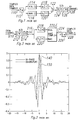
- a conventional CAP transmitter is shown in Figure 1.
- Complex data symbols 110 to be transmitted are upsampled by a factor of M 112 and split into their real 114 and imaginary 116 parts, which are filtered with the in-phase 118 and quadrature 120 CAP transmission filters g 1 [n] and g 2 [n] , respectively.
- the filter outputs are combined 122 and the result is passed through a D/A converter 124 and low pass filter 126 to produce the analog signal 128 required for, the transmission medium.
- a CAP receiver for a modem equalizes, performs downconversion from passband, and demodulates the line code with a single parallel filtering operation.
- the receiver filters are very similar to the transmit filters, and can be conveniently implemented.
- the requirements for the length of the receive filter increase For adequate performance, the filter length might have to be increased substantially. This length increase requires more computations per received symbol.
- a conventional CAP receiver for a modem is shown in Figure 3.
- the received analog signal 210 is low-pass filtered 212 and passed through the A/D converter 214.
- the digital signal 216 is then processed with the filters h 1 [n] 218 and h 2 [n] 220, which perform the CAP demodulation as well as channel equalization.
- Some form of channel estimation and equalization criterion is used to calculate the required values for h 1 [n] and h 2 [n] .
- the signals are combined 222 to form a complex data stream 224 and then downsampled by a factor of M to form a stream of complex data symbols 228 from which the transmitted information can be decoded.
- the filters in the receiver should be matched filters (matched to g 1 [n] and g 2 [n] ) to provide optimum reception.
- the receive filters must be adjusted to equalize the distortion as well as demodulate the CAP signal.
- the filters' ability to compensate for the channel distortion is affected by a number of factors, including the practical length chosen for the filter. When significant channel distortion is encountered, longer filters may be required. Indeed, restricting the filter length to that which can be practically implemented by time-domain filtering can limit the performance of a CAP receiver that has finite computational resources. Under these conditions, a frequency-domain CAP receiver of the present invention provides an attractive alternative to the computationally intensive time-domain implementation.
- the present invention provides apparatus and methods as set forth in the claims.
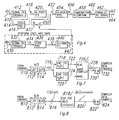
- y[k] X[k] H[k] 456.
- y[n] X[k] H[k] 456.
- the inverse DFT y c [n] 454 is computed, subjected to a combination algorithm 458 and converted to a serial stream 462.
- the sequence can be segmented into manageable lengths and processed a single segment at a time.
- the individual processed segments are then combined in a manner that forms the linear convolution of the two sequences.
- This segment combination procedure converts the circular convolution of many contiguous segments into a linear convolution.
- Two well established combination procedures are the overlap-add and the overlap-save algorithms (Oppenheim, Alan V. and Schafer, Ronald W., Discrete-Time Processing, Prentice Hall, New Jersey, 1989).
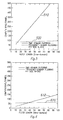
- the efficiency gains obtained from implementing a convolution in the frequency domain depends on the sizes of the two sequences to be convolved as well as the DFT size relative to the sequence sizes. In general, as the sequence lengths increase, the required time-domain convolution grows linearly with the size of one of the sequences. With the frequency-domain method, the length grows slowly.
- the number of operations required to implement the convolution in the frequency domain is 4 ⁇ N ⁇ log 2 N + 4 ⁇ N + 2 ⁇ L L - operations / sample
- the number of operations required to implement the time-domain filtering is 2 ⁇ P - 1 operations / sample
- the double-length FFT can be employed in the frequency-domain equalizer to reduce the number of required operations for the FFT and IFFT ( Winthrop, W. Smith and Smith, Joanne M., Handbook of Real-Time Fast Fourier Transforms, IEEE Press, Piscataway, New Jersey, 1995 ).
- the number of operations required to implement the convolution in the frequency domain is 5 ⁇ N ⁇ log 2 ( N 2 ) + 10 ⁇ N - 14 + 4 ⁇ N + L operations / sample
- a CAP receiver can incorporate the frequency-domain method of convolution to implement the receive filters (equalization and matched filtering for demodulation).
- a receive filter implemented in this manner is referred to as a frequency-domain equalizer (FDE).
- FDE frequency-domain equalizer
- the FDE also performs the demodulation.
- the simplest implementation simply replaces the two receive filters directly, as shown in Figure 7.
- the dual FDEs 718, 720 each operate on a real sequence and produce a real sequence 722, 724.
- the filter implemented in the frequency domain is a complex filter whose time-domain impulse response is h[n] , which is the combination of the in-phase and quadrature CAP demodulators and receive filters.
- the complexity of the FDE in the CAP receiver can be reduced by exploiting the double-length FFT algorithm for computing the FFT of a real input sequence. Also, we exploit the fact that the input sequence is always taken in blocks of L samples and padded with N-L zeros. Therefore, in the first FFT stage, only L complex multiplies are required.
- the complexity of the FDE in the CAP receiver can be further reduced by exploiting the fact that the sequence out of the FDE is downsampled, i.e. only every Mth sample is used.
- the IFFT in the FDE can be implemented with a decimation-in-time algorithm, and the IFFT structure can be pruned to eliminate unnecessary computations.
- the overall number of operations required to implement the frequency-domain CAP demodulation is approximately M L ⁇ 5 2 ⁇ N ⁇ log 2 ( N 2 ) + 5 4 ⁇ N ⁇ log 2 ( N 4 ) + 17 ⁇ N - 35 ⁇ P - 95 ⁇ operations / symbol
- the number of operations required to implement the time-domain CAP demodulator is 4 ⁇ P - 2 operations / symbol
- upsample/downsample factor M in a CAP transmission system will affect the efficiency of the frequency-domain CAP receiver.
- M the required computations for time-domain filtering in the receiver remains roughly the same if the fact that downsampling following filtering is used to eliminate unneeded computations.
- the FFT size, IFFT size, and multiplication by H[k] must be made larger even though the size of the output blocks remains the same.
- the required computations increase with the upsample factor.
- M 2,3,4
- the frequency-domain CAP receiver can prove advantageous.
- the number of operations that can be eliminated in the IFFT operation due to downsampling after the IFFT is directly effected by the specific value of M. Because the IFFT structure is exploited, values of 2, 4, and 8 produce the greatest savings.
- a further reduction in complexity can be achieved by exploiting the fact that the FFT and IFFT are performed back-to-back with only a single multiplication of each frequency-domain coefficient between the algorithms.
- the operations in the algorithms can be arranged so that the last stage of the FFT computation can be combined with the equalizer multiplication and the first stage of the IFFT.
- This can be achieved by computing a single multiplication factor for the three stages, where the single multiplication factor is the product of the three individual multiplication factors.
- this single multiplication factor must be adapted to meet the varying equalization requirements in the receiver.
- a static transmission channel requires a one-time estimation of the distortion and then calculation of the filter coefficients required for proper equalization.
- Transmission channels that vary significantly with time require adaptation of the equalizer to compensate for time-varying distortion.
- Channel estimation should be performed on a continuing basis to properly equalize the dynamic transmission channel.
- the rate at which the channel varies and the equalization criterion determine the amount of resources in a receiver that must be applied for the channel estimation and adjustment of the equalizer coefficients.
- the equalizer For extremely rapidly varying channels, such as those encountered in a mobile communications system, the equalizer must adapt rapidly. In fact, it is best to adjust the equalizer coefficients after every sample.
- Time-domain equalizers provide the ability to adjust the coefficients after every sample is processed because the equalization operations are performed on a sample-by-sample basis.
- the transmission channels encountered with most land-line communication systems vary extremely slowly. Rapid estimation of the channel and adjustment of the equalizer coefficients is not required. If the channel remains relatively static during a period of N samples, then the equalization can be performed on a block of N samples during the entire period. If required, the channel distortion is estimated again before the next period and the equalizer adjusted before processing the next block. In general, the block duration must be chosen so that the channel does not change significantly from the estimate before another estimate is calculated.
- Timing and synchronization can be performed in a block-based receiver using any of a number of algorithms designed for sample-based receivers ( Proakis, J.G., Digital Communications Third Edition, McGraw-Hill, New York, 1995 ; Lee, Edward A. and Messerschmitt, David G., Digital Communication, Kluwer Academic Publishers, Boston, 1994 ).
- One particularly attractive scheme that is easily implemented in a FDE-based CAP receiver uses a direct passband timing recovery algorithm ( Godard, Anthony N., Passband Timing Recovery in an All-Digital Modem Receiver, IEEE Transactions on Communications, COM-26:517-523, May 1978 ; Godard, Andrea N., U.S.
- Patent #4,969,163 Passband Timing Recovery in an All-Digital Modem Receiver, November, 1990).
- the timing information is derived from the real-valued passband signal, avoiding delays in the timing adjustment loop and allowing fast convergence.
- the sampling times are adjusted to occur at time instants when the channel phases at frequencies f o ⁇ + 1 - 2 ⁇ T are equal modulo 2p, where f o is the passband center frequency and T is the sampling interval.
Landscapes
- Engineering & Computer Science (AREA)
- Computer Networks & Wireless Communication (AREA)
- Signal Processing (AREA)
- Digital Transmission Methods That Use Modulated Carrier Waves (AREA)
- Circuits Of Receivers In General (AREA)
- Reduction Or Emphasis Of Bandwidth Of Signals (AREA)
Claims (3)
- Trägerloser Frequenzbereichs-AM-PM-CAP-Modemempfänger, mit:einem Analog/Digital-A/D-Umsetzer (714, 814);einem Entzerrer (716, 720, 818), der mit dem A/D-Umsetzer verbunden ist; undeinem Downsampler bzw. Abtastwertreduzierer, der mit dem Entzerrer verbunden ist, um einen Strom komplexer Datensignale zum Decodieren auszugeben,gekennzeichnet durchein Tiefpassfilter (712, 812), das mit einem Datenkanal (710, 810) verbunden ist; unddadurch, dass der Analog/Digital-A/D-Umsetzer (714, 814) mit dem Ausgang des Tiefpassfilters verbunden ist; undder Entzerrer (716, 720, 818) ein CAP-Frequenzbereichsentzerrer ist, der so beschaffen ist, dass er eine Entzerrung und eine angepasste Filterung für eine im Frequenzbereich implementierte Demodulation ausführt.
- Verfahren zum Erzeugen eines trägerlosen AM-PM-CAP-Signals aus einem Durchlassbandsignal, das umfasst:Tiefpassfiltern des Durchlassbandsignals;Umsetzen des gefilterten Signals in ein digitales Signal; undCAP-Frequenzbereichsentzerren des digitalen Signals durch Ausführen einer Entzerrung und einer angepassten Filterung für die Demodulation des digitalen Signals im Frequenzbereich.
- Verfahren nach Anspruch 2, das ferner ein Downsampling bzw. Reduzieren von Abtastwerten des digitalen Signals umfasst, um einen komplexen Datenstrom zu schaffen.
Applications Claiming Priority (2)
| Application Number | Priority Date | Filing Date | Title |
|---|---|---|---|
| US08/684,356 US5809069A (en) | 1996-07-19 | 1996-07-19 | Frequency-domain carrierless AM-PM demodulator |
| US684356 | 1996-07-19 |
Publications (3)
| Publication Number | Publication Date |
|---|---|
| EP0820174A2 EP0820174A2 (de) | 1998-01-21 |
| EP0820174A3 EP0820174A3 (de) | 2000-10-25 |
| EP0820174B1 true EP0820174B1 (de) | 2007-11-14 |
Family
ID=24747711
Family Applications (1)
| Application Number | Title | Priority Date | Filing Date |
|---|---|---|---|
| EP97305361A Expired - Lifetime EP0820174B1 (de) | 1996-07-19 | 1997-07-17 | Empfänger für trägerlose AM-PM Modulation mit Frequenzbereichsentzerrer |
Country Status (7)
| Country | Link |
|---|---|
| US (1) | US5809069A (de) |
| EP (1) | EP0820174B1 (de) |
| JP (1) | JP3909123B2 (de) |
| KR (1) | KR100492206B1 (de) |
| DE (1) | DE69738283T2 (de) |
| SG (1) | SG119131A1 (de) |
| TW (1) | TW353840B (de) |
Families Citing this family (18)
| Publication number | Priority date | Publication date | Assignee | Title |
|---|---|---|---|---|
| US5987073A (en) * | 1997-03-27 | 1999-11-16 | Thomson Consumer Electronics, Inc. | Symbol timing recovery network for a carrierless amplitude phase (CAP) signal |
| US6122703A (en) | 1997-08-15 | 2000-09-19 | Amati Communications Corporation | Generalized fourier transform processing system |
| US6700936B1 (en) * | 1998-05-05 | 2004-03-02 | British Broadcasting Corporation | Many-carrier transmission system and a receiver therefor |
| US6891887B1 (en) * | 1998-05-27 | 2005-05-10 | 3Com Corporation | Multi-carrier LAN adapter device using interpolative equalizer |
| SE517525C2 (sv) | 1999-09-07 | 2002-06-18 | Ericsson Telefon Ab L M | Förfarande och anordning för konstruktion av digitala filter |
| US6650700B1 (en) * | 1999-10-22 | 2003-11-18 | Zenith Electronics Corporation | Dual path ghost eliminating equalizer with optimum noise enhancement |
| US6731682B1 (en) * | 2000-04-07 | 2004-05-04 | Zenith Electronics Corporation | Multipath ghost eliminating equalizer with optimum noise enhancement |
| WO2002086755A1 (en) * | 2001-04-24 | 2002-10-31 | California Institute Of Technology | Method and apparatus for parallel signal processing |
| JP2005519521A (ja) * | 2002-03-05 | 2005-06-30 | コーニンクレッカ フィリップス エレクトロニクス エヌ ヴィ | 反復的な相関システムを介してダウンリンク同期化を有する移動端末装置 |
| US7346013B2 (en) * | 2002-07-18 | 2008-03-18 | Coherent Logix, Incorporated | Frequency domain equalization of communication signals |
| US8451933B2 (en) | 2002-07-18 | 2013-05-28 | Coherent Logix, Incorporated | Detection of low-amplitude echoes in a received communication signal |
| US20070053417A1 (en) * | 2005-09-08 | 2007-03-08 | Toshio Nagata | Methods and apparatus to perform fractional-spaced channel estimation for frequency-domain equalizers |
| US7978752B2 (en) * | 2006-03-15 | 2011-07-12 | Interdigital Technology Corporation | Method and apparatus for switching operating modes of a receiver |
| EP1879293B1 (de) * | 2006-07-10 | 2019-02-20 | Harman Becker Automotive Systems GmbH | Partitionierte Schnellfaltung in der Zeit- und Frequenzdomäne |
| JP2010219582A (ja) * | 2009-03-13 | 2010-09-30 | Sony Corp | フィルタリング装置、フィルタリング方法、プログラムおよびサラウンドプロセッサ |
| US8705604B2 (en) * | 2010-12-08 | 2014-04-22 | Massachusetts Institute Of Technology | Method and apparatus for complex in-phase/quadrature polyphase nonlinear equalization |
| CN104508999B (zh) * | 2013-07-24 | 2017-02-01 | 华为技术有限公司 | 一种信号发送和接收的方法、装置及系统 |
| CN106662115B (zh) * | 2014-08-05 | 2018-04-27 | 日立汽车系统株式会社 | 水泵及该水泵的制造方法 |
Family Cites Families (18)
| Publication number | Priority date | Publication date | Assignee | Title |
|---|---|---|---|---|
| US550479A (en) * | 1895-11-26 | Pyrometer | ||
| US3864632A (en) * | 1973-10-01 | 1975-02-04 | Rockwell International Corp | Fast Equalization System |
| US4087654A (en) * | 1975-11-28 | 1978-05-02 | Bell Telephone Laboratories, Incorporated | Echo canceller for two-wire full duplex data transmission |
| USRE31253E (en) * | 1976-09-07 | 1983-05-24 | Bell Telephone Laboratories, Incorporated | Echo cancellation in two-wire, two-way data transmission systems |
| US4247940A (en) * | 1979-10-15 | 1981-01-27 | Bell Telephone Laboratories, Incorporated | Equalizer for complex data signals |
| US4464545A (en) * | 1981-07-13 | 1984-08-07 | Bell Telephone Laboratories, Incorporated | Echo canceller |
| US4682358A (en) * | 1984-12-04 | 1987-07-21 | American Telephone And Telegraph Company | Echo canceller |
| US4800573A (en) * | 1987-11-19 | 1989-01-24 | American Telephone And Telegraph Company | Equalization arrangement |
| US4924492A (en) * | 1988-03-22 | 1990-05-08 | American Telephone And Telegraph Company | Method and apparatus for wideband transmission of digital signals between, for example, a telephone central office and customer premises |
| US4943980A (en) * | 1989-05-02 | 1990-07-24 | Intelligent Modem Corporation | Multi-carrier high speed modem |
| US5052000A (en) * | 1989-06-09 | 1991-09-24 | At&T Bell Laboratories | Technique for improving the operation of decision feedback equalizers in communications systems utilizing error correction |
| US5285474A (en) * | 1992-06-12 | 1994-02-08 | The Board Of Trustees Of The Leland Stanford, Junior University | Method for equalizing a multicarrier signal in a multicarrier communication system |
| US5317596A (en) * | 1992-12-01 | 1994-05-31 | The Board Of Trustees Of The Leland Stanford, Junior University | Method and apparatus for echo cancellation with discrete multitone modulation |
| US5479447A (en) * | 1993-05-03 | 1995-12-26 | The Board Of Trustees Of The Leland Stanford, Junior University | Method and apparatus for adaptive, variable bandwidth, high-speed data transmission of a multicarrier signal over digital subscriber lines |
| US5400322A (en) * | 1993-08-20 | 1995-03-21 | Amati Communications Corp. | Updating of bit allocations in a multicarrier modulation transmission system |
| US5461640A (en) * | 1994-06-03 | 1995-10-24 | Texas Instruments Incorporated | Method and system for optimizing an equalizer in a data transmission system |
| US5504479A (en) * | 1995-06-07 | 1996-04-02 | Western Atlas International, Inc. | Carrierless amplitude and phase modulation telementry for use in electric wireline well logging |
| US5646957A (en) * | 1995-07-28 | 1997-07-08 | Lucent Technologies Inc. | Burst update for an adaptive equalizer |
-
1996
- 1996-07-19 US US08/684,356 patent/US5809069A/en not_active Expired - Lifetime
-
1997
- 1997-07-17 DE DE69738283T patent/DE69738283T2/de not_active Expired - Lifetime
- 1997-07-17 EP EP97305361A patent/EP0820174B1/de not_active Expired - Lifetime
- 1997-07-18 KR KR1019970033462A patent/KR100492206B1/ko not_active Expired - Lifetime
- 1997-07-18 SG SG1997002495A patent/SG119131A1/en unknown
- 1997-07-22 JP JP19610797A patent/JP3909123B2/ja not_active Expired - Fee Related
- 1997-10-03 TW TW086110357A patent/TW353840B/zh not_active IP Right Cessation
Also Published As
| Publication number | Publication date |
|---|---|
| JPH1079766A (ja) | 1998-03-24 |
| TW353840B (en) | 1999-03-01 |
| KR100492206B1 (ko) | 2005-08-05 |
| EP0820174A3 (de) | 2000-10-25 |
| SG119131A1 (en) | 2006-02-28 |
| EP0820174A2 (de) | 1998-01-21 |
| DE69738283D1 (de) | 2007-12-27 |
| DE69738283T2 (de) | 2008-09-18 |
| KR980012843A (ko) | 1998-04-30 |
| JP3909123B2 (ja) | 2007-04-25 |
| US5809069A (en) | 1998-09-15 |
Similar Documents
| Publication | Publication Date | Title |
|---|---|---|
| EP0820174B1 (de) | Empfänger für trägerlose AM-PM Modulation mit Frequenzbereichsentzerrer | |
| EP1317813B1 (de) | Mehrträgerempfänger | |
| US6198778B1 (en) | Method and device for setup of clipping noise of a multicarrier modulation | |
| de Courville et al. | Blind equalization of OFDM systems based on the minimization of a quadratic criterion | |
| EP2693713B1 (de) | Entzerrung eines verteilten Pilot-OFDM-Signals | |
| US5285474A (en) | Method for equalizing a multicarrier signal in a multicarrier communication system | |
| US6693984B1 (en) | Method and apparatus for compensating for intersymbol interference in a received signal | |
| JP2003134086A (ja) | マルチキャリアデータ伝送システム | |
| JPH1079766A5 (de) | ||
| CN105453462B (zh) | 发送装置、接收装置以及通信系统 | |
| EP1856797B1 (de) | Drahtlose kommunikationseinrichtung zur durchführung der blockentzerrung auf der basis von vorherigen, aktuellen und/oder zukünftigen autokorrelationsmatrix-schätzungen und diesbezügliche verfahren | |
| EP2782304B1 (de) | Verfahren zum angleichen von fbmc-modulationen | |
| EP1420557B1 (de) | Kombinierte Entzerrung für einen DMT-Empfänger | |
| JP2934225B1 (ja) | Ofdm復調装置 | |
| Stojanovic | Performance analysis of filtered multitone modulation systems for underwater communication | |
| WO1999005795A2 (en) | System and method for optimizing high speed data transmission | |
| EP0700189B1 (de) | Verfahren und Vorrichtung für die Entzerrung von digitalen Signalen im Frequenzbereich | |
| WO2006039799A1 (en) | Systems and methods for ofdm transmission and reception | |
| JP2008511196A (ja) | 位相ドリフトを低減するための装置および方法 | |
| Berenguer et al. | FMT modulation: receiver filter bank definition for the derivation of an efficient implementation | |
| US7583742B2 (en) | Multi-band DMT receiver | |
| CN100483967C (zh) | 一种控制峰值功率的发射机和接收机 | |
| Baltar et al. | MLSE and MMSE subchannel equalization for filter bank based multicarrier systems: Coded and uncoded results | |
| JP2002026861A (ja) | 復調装置及び復調方法 | |
| KR100440833B1 (ko) | 이산 멀티톤 변조를 이용하여 발생시킨 신호를 위한디지탈 수신기 |
Legal Events
| Date | Code | Title | Description |
|---|---|---|---|
| PUAI | Public reference made under article 153(3) epc to a published international application that has entered the european phase |
Free format text: ORIGINAL CODE: 0009012 |
|
| AK | Designated contracting states |
Kind code of ref document: A2 Designated state(s): DE FR GB IT NL |
|
| PUAL | Search report despatched |
Free format text: ORIGINAL CODE: 0009013 |
|
| AK | Designated contracting states |
Kind code of ref document: A3 Designated state(s): AT BE CH DE DK ES FI FR GB GR IE IT LI LU MC NL PT SE |
|
| RIC1 | Information provided on ipc code assigned before grant |
Free format text: 7H 04L 25/49 A, 7H 04L 25/03 B |
|
| 17P | Request for examination filed |
Effective date: 20010425 |
|
| AKX | Designation fees paid |
Free format text: DE FR GB IT NL |
|
| 17Q | First examination report despatched |
Effective date: 20040809 |
|
| GRAP | Despatch of communication of intention to grant a patent |
Free format text: ORIGINAL CODE: EPIDOSNIGR1 |
|
| GRAS | Grant fee paid |
Free format text: ORIGINAL CODE: EPIDOSNIGR3 |
|
| GRAA | (expected) grant |
Free format text: ORIGINAL CODE: 0009210 |
|
| AK | Designated contracting states |
Kind code of ref document: B1 Designated state(s): DE FR GB IT NL |
|
| REG | Reference to a national code |
Ref country code: GB Ref legal event code: FG4D |
|
| REF | Corresponds to: |
Ref document number: 69738283 Country of ref document: DE Date of ref document: 20071227 Kind code of ref document: P |
|
| PG25 | Lapsed in a contracting state [announced via postgrant information from national office to epo] |
Ref country code: NL Free format text: LAPSE BECAUSE OF FAILURE TO SUBMIT A TRANSLATION OF THE DESCRIPTION OR TO PAY THE FEE WITHIN THE PRESCRIBED TIME-LIMIT Effective date: 20071114 |
|
| NLV1 | Nl: lapsed or annulled due to failure to fulfill the requirements of art. 29p and 29m of the patents act | ||
| ET | Fr: translation filed | ||
| PLBE | No opposition filed within time limit |
Free format text: ORIGINAL CODE: 0009261 |
|
| STAA | Information on the status of an ep patent application or granted ep patent |
Free format text: STATUS: NO OPPOSITION FILED WITHIN TIME LIMIT |
|
| 26N | No opposition filed |
Effective date: 20080815 |
|
| PG25 | Lapsed in a contracting state [announced via postgrant information from national office to epo] |
Ref country code: IT Free format text: LAPSE BECAUSE OF NON-PAYMENT OF DUE FEES Effective date: 20080731 |
|
| PGFP | Annual fee paid to national office [announced via postgrant information from national office to epo] |
Ref country code: GB Payment date: 20120625 Year of fee payment: 16 |
|
| PGFP | Annual fee paid to national office [announced via postgrant information from national office to epo] |
Ref country code: DE Payment date: 20120731 Year of fee payment: 16 Ref country code: FR Payment date: 20120712 Year of fee payment: 16 |
|
| GBPC | Gb: european patent ceased through non-payment of renewal fee |
Effective date: 20130717 |
|
| REG | Reference to a national code |
Ref country code: FR Ref legal event code: ST Effective date: 20140331 |
|
| PG25 | Lapsed in a contracting state [announced via postgrant information from national office to epo] |
Ref country code: GB Free format text: LAPSE BECAUSE OF NON-PAYMENT OF DUE FEES Effective date: 20130717 Ref country code: DE Free format text: LAPSE BECAUSE OF NON-PAYMENT OF DUE FEES Effective date: 20140201 |
|
| REG | Reference to a national code |
Ref country code: DE Ref legal event code: R119 Ref document number: 69738283 Country of ref document: DE Effective date: 20140201 |
|
| PG25 | Lapsed in a contracting state [announced via postgrant information from national office to epo] |
Ref country code: FR Free format text: LAPSE BECAUSE OF NON-PAYMENT OF DUE FEES Effective date: 20130731 |