EP0820194A1 - Méthode et dispositif pour télécommunication par radio via un réseau de télévision par câble - Google Patents
Méthode et dispositif pour télécommunication par radio via un réseau de télévision par câble Download PDFInfo
- Publication number
- EP0820194A1 EP0820194A1 EP96202060A EP96202060A EP0820194A1 EP 0820194 A1 EP0820194 A1 EP 0820194A1 EP 96202060 A EP96202060 A EP 96202060A EP 96202060 A EP96202060 A EP 96202060A EP 0820194 A1 EP0820194 A1 EP 0820194A1
- Authority
- EP
- European Patent Office
- Prior art keywords
- communication
- transmission protocol
- dect
- downstream
- network
- Prior art date
- Legal status (The legal status is an assumption and is not a legal conclusion. Google has not performed a legal analysis and makes no representation as to the accuracy of the status listed.)
- Withdrawn
Links
- 238000000034 method Methods 0.000 title claims abstract description 12
- 238000004891 communication Methods 0.000 claims abstract description 89
- 230000005540 biological transmission Effects 0.000 claims abstract description 36
- 238000011144 upstream manufacturing Methods 0.000 claims abstract description 30
- 238000006243 chemical reaction Methods 0.000 claims description 6
- 230000010354 integration Effects 0.000 description 7
- 238000010276 construction Methods 0.000 description 4
- 238000010586 diagram Methods 0.000 description 4
- 230000002452 interceptive effect Effects 0.000 description 3
- 238000001228 spectrum Methods 0.000 description 3
- 239000000835 fiber Substances 0.000 description 2
- 230000003287 optical effect Effects 0.000 description 2
- 230000002238 attenuated effect Effects 0.000 description 1
- 239000000969 carrier Substances 0.000 description 1
- 230000015556 catabolic process Effects 0.000 description 1
- 238000013461 design Methods 0.000 description 1
- 238000011161 development Methods 0.000 description 1
- 238000010295 mobile communication Methods 0.000 description 1
- 238000012986 modification Methods 0.000 description 1
- 230000004048 modification Effects 0.000 description 1
- 238000012545 processing Methods 0.000 description 1
- 238000012546 transfer Methods 0.000 description 1
Images




Classifications
-
- H—ELECTRICITY
- H04—ELECTRIC COMMUNICATION TECHNIQUE
- H04N—PICTORIAL COMMUNICATION, e.g. TELEVISION
- H04N7/00—Television systems
- H04N7/16—Analogue secrecy systems; Analogue subscription systems
- H04N7/173—Analogue secrecy systems; Analogue subscription systems with two-way working, e.g. subscriber sending a programme selection signal
- H04N7/17309—Transmission or handling of upstream communications
-
- H—ELECTRICITY
- H04—ELECTRIC COMMUNICATION TECHNIQUE
- H04L—TRANSMISSION OF DIGITAL INFORMATION, e.g. TELEGRAPHIC COMMUNICATION
- H04L12/00—Data switching networks
- H04L12/28—Data switching networks characterised by path configuration, e.g. LAN [Local Area Networks] or WAN [Wide Area Networks]
- H04L12/2801—Broadband local area networks
-
- H—ELECTRICITY
- H04—ELECTRIC COMMUNICATION TECHNIQUE
- H04M—TELEPHONIC COMMUNICATION
- H04M7/00—Arrangements for interconnection between switching centres
- H04M7/12—Arrangements for interconnection between switching centres for working between exchanges having different types of switching equipment, e.g. power-driven and step by step or decimal and non-decimal
- H04M7/1205—Arrangements for interconnection between switching centres for working between exchanges having different types of switching equipment, e.g. power-driven and step by step or decimal and non-decimal where the types of switching equipement comprises PSTN/ISDN equipment and switching equipment of networks other than PSTN/ISDN, e.g. Internet Protocol networks
- H04M7/121—Details of network access arrangements or protocols
- H04M7/1215—Details of network access arrangements or protocols where a cable TV network is used as an access to the PSTN/ISDN
-
- H—ELECTRICITY
- H04—ELECTRIC COMMUNICATION TECHNIQUE
- H04N—PICTORIAL COMMUNICATION, e.g. TELEVISION
- H04N21/00—Selective content distribution, e.g. interactive television or video on demand [VOD]
- H04N21/60—Network structure or processes for video distribution between server and client or between remote clients; Control signalling between clients, server and network components; Transmission of management data between server and client, e.g. sending from server to client commands for recording incoming content stream; Communication details between server and client
- H04N21/61—Network physical structure; Signal processing
- H04N21/6106—Network physical structure; Signal processing specially adapted to the downstream path of the transmission network
- H04N21/6118—Network physical structure; Signal processing specially adapted to the downstream path of the transmission network involving cable transmission, e.g. using a cable modem
-
- H—ELECTRICITY
- H04—ELECTRIC COMMUNICATION TECHNIQUE
- H04N—PICTORIAL COMMUNICATION, e.g. TELEVISION
- H04N21/00—Selective content distribution, e.g. interactive television or video on demand [VOD]
- H04N21/60—Network structure or processes for video distribution between server and client or between remote clients; Control signalling between clients, server and network components; Transmission of management data between server and client, e.g. sending from server to client commands for recording incoming content stream; Communication details between server and client
- H04N21/61—Network physical structure; Signal processing
- H04N21/6106—Network physical structure; Signal processing specially adapted to the downstream path of the transmission network
- H04N21/6131—Network physical structure; Signal processing specially adapted to the downstream path of the transmission network involving transmission via a mobile phone network
-
- H—ELECTRICITY
- H04—ELECTRIC COMMUNICATION TECHNIQUE
- H04N—PICTORIAL COMMUNICATION, e.g. TELEVISION
- H04N21/00—Selective content distribution, e.g. interactive television or video on demand [VOD]
- H04N21/60—Network structure or processes for video distribution between server and client or between remote clients; Control signalling between clients, server and network components; Transmission of management data between server and client, e.g. sending from server to client commands for recording incoming content stream; Communication details between server and client
- H04N21/61—Network physical structure; Signal processing
- H04N21/6156—Network physical structure; Signal processing specially adapted to the upstream path of the transmission network
- H04N21/6168—Network physical structure; Signal processing specially adapted to the upstream path of the transmission network involving cable transmission, e.g. using a cable modem
-
- H—ELECTRICITY
- H04—ELECTRIC COMMUNICATION TECHNIQUE
- H04N—PICTORIAL COMMUNICATION, e.g. TELEVISION
- H04N21/00—Selective content distribution, e.g. interactive television or video on demand [VOD]
- H04N21/60—Network structure or processes for video distribution between server and client or between remote clients; Control signalling between clients, server and network components; Transmission of management data between server and client, e.g. sending from server to client commands for recording incoming content stream; Communication details between server and client
- H04N21/61—Network physical structure; Signal processing
- H04N21/6156—Network physical structure; Signal processing specially adapted to the upstream path of the transmission network
- H04N21/6181—Network physical structure; Signal processing specially adapted to the upstream path of the transmission network involving transmission via a mobile phone network
-
- H—ELECTRICITY
- H04—ELECTRIC COMMUNICATION TECHNIQUE
- H04W—WIRELESS COMMUNICATION NETWORKS
- H04W92/00—Interfaces specially adapted for wireless communication networks
- H04W92/04—Interfaces between hierarchically different network devices
- H04W92/10—Interfaces between hierarchically different network devices between terminal device and access point, i.e. wireless air interface
Definitions
- the present invention relates to a method and an arrangement for radio telecommunication such as telephony, video, audio and/or high rate data and interactive data communication via a cable television network.
- Telecommunication services are, for the greater part, bounded to dedicated networks.
- Speech communication is mainly provided by the Public Switch Telephony Network (PSTN).
- Video and audio communication is handled by Cable TeleVision (CaTV) networks, and high rate data communication is exchanged over distinct data networks, for example.
- CaTV Cable TeleVision
- CIT Computer Integrated Telephony
- video conferencing is the result of the integration of telephony and video communications.
- Service integration at the operators' site will inevitably lead to integrated workstations for video, telephony, data communications etc. at the users' premises.
- Asynchronous Transfer Mode ATM
- Internet can be regarded as a first introduction of an integrated or converged network with which from an integrated (multi-media) workstation over an integrated network (Internet) a number of the above distinct services are available.
- ATM Asynchronous Transfer Mode
- It is an object of the present invention is to provide a solution for an integral provision of telecommunication services such as speech or telephony, video, audio, high rate data and interactive data communications.
- a method of integrated telecommunication via a Cable TeleVision (CaTV) network in a first or downstream direction from a first or head-end section to a second or subscriber section and in a second or upstream direction from the second or subscriber section to the first or head-end section comprising:
- CaTV networks are long-distance signal distribution systems which, via coaxial and optical cable, distribute radio, television and other information signals to a large number of geographically spread subscriber terminals.
- the present invention combines the advantages of the existing CaTV networks, i.e. high rate data capacity in downstream direction and a relatively low data rate capacity in the upstream direction.
- a common upstream communication facility for telephony and data communication at a telephony based data rates which upstream communication facility is also operative for communication in connection with downstream high data rate communication.
- the present invention is based on the insight that the majority of users, such as Internet users for example, generate relatively little traffic in the direction of the host or data source from which data are required (i.e. in the upstream direction of the CaTV network).
- the main data stream is in the direction of the users (i.e. in the downstream direction of the CaTV network).
- the first transmission protocol is operative at a low-end frequency sub-band of the CaTV network
- the second transmission protocol is operative at a video frequency band of the CaTV network.
- the first transmission protocol is an existing analogue or digital radio communication protocol arranged for serving at least telephony based data rates, in particular a Time Division Multiple Access (TDMA) radio communication protocol.
- TDMA Time Division Multiple Access
- the first transmission protocol is arranged to operate in accordance with the Digital Enhanced Cordless Telecommunications (DECT) standard.
- DECT is a low power, high capacity Multi Carrier/Time Division Multiple Access/Time Division Duplex (MC/TDMA/TDD) digital radio access technique, providing ten radio carriers, each divided into 24 time-slots which serve 12 duplex 32 kb/s communication channels, called a frame.
- the communication channels are continuously adaptively selected.
- a communication channel, when occupied, is individual to a radio link connection between a radio access station and a particular remote telecommunication unit, such as a cordless radio telephone.
- This type of access technique is known as Continuous Dynamic Channel Allocation (CDCA).
- the DECT protocol provides data exchange at rates of 32 kb/s or less up to 552 kb/s or more.
- the second transmission protocol may be likewise chosen from among existing analogue or digital radio communication protocols for high data rate exchange, in particular a Time Division Multiple Access (TDMA) radio communication protocol.
- TDMA Time Division Multiple Access
- high data rate exchange is provided over one or more 5 MHz bandwidth video channels of the CaTV network.
- 64 QAM modulation technique data at 34 Mb/s can be exchanged over such a channel.
- the invention relates also to an arrangement for integrated telecommunication via a Cable TeleVision (CaTV) network in a first or downstream direction from a first or head-end section to a second or subscriber section and in a second or upstream direction from the second or subscriber section to the first or head-end section, comprising:
- the first, second and third communication means are arranged to operate in accordance with a Time Division Multiple Access (TDMA) radio communication protocol.
- TDMA Time Division Multiple Access
- the first communication means operate in accordance with the Digital Enhanced Cordless Telecommunications (DECT) standard at the low-end frequency sub-band of the CaTV network and comprise DECT equipment, such as DECT access units and DECT remote units like mobile and fixed DECT subscriber terminal units and DECT relay units, and frequency conversion means to convert the DECT transmit and receive frequencies for transmission via the low-end frequency sub-band of the CaTV network.
- DECT Digital Enhanced Cordless Telecommunications
- the present invention relates further to a subscriber Network Terminal Unit (NTU) for use in an arrangement described above, and comprising signal multiplexer/demultiplexer means and one or a plurality of first, second and third communication means.
- NTU Subscriber Network Terminal Unit
- the signal multiplexer/demultiplexer and communication means connect to a first access terminal for connection to the CaTV network and a plurality of second access terminals for connecting user equipment such as a TV and radio-set, a personal computer, and mobile or cordless radio telephone equipment.
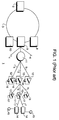
- Fig. 1 shows, in a schematic and illustrative manner, a typical construction of a prior art CaTV network.
- Fig. 2 shows a typical frequency spectrum of a prior art CaTV network and its services.
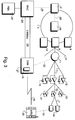
- Fig. 3 shows, in a schematic and illustrative manner, an embodiment of an arrangement for radio telecommunication via a CaTV network according to the present invention.
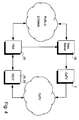
- Fig. 4 shows, in a schematic and illustrative manner, the arrangement of Fig. from a product point of view.
- Fig. 5 shows a simplified block diagram of a first embodiment of a network terminal unit according to the present invention.
- Fig. 6 shows a simplified block diagram of a second embodiment of a network terminal unit according to the present invention.
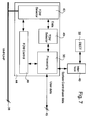
- Fig. 7 shows a simplified block diagram of part of the network terminal unit according to the present invention shown in Fig. 6.
- Fig. 8 shows a view of an embodiment of a subscriber interface unit or network terminal unit according to the present invention.
- Fig. 1 shows a typical construction of a CaTV network 1 for the distribution of broadcast signals, such as radio and TV programmes and other information signals which are received by or supplied to a head-end station 2.
- broadcast signals such as radio and TV programmes and other information signals which are received by or supplied to a head-end station 2.
- receiving and frequency conversion means are installed for receiving broadcast signals submitted by terrestrial, satellite and fixed line transmitters, respectively.
- the received and frequency converted signals are merged in the head-end station 2.
- the merged signals are distributed via a main or trunk network 3, distribution sections 4, district sections 5, feeder sections 6 and drop sections 7 to downstream subscriber CaTV terminals 14.
- the trunk network 3 is generally constructed from optical or fibre cable, whereas the distribution 4, district 5, feeder 6 and drop sections 7 are generally comprised of coaxial cable.
- the trunk network 3 connects to several trunk units 8, 9, 10 comprising amplifiers, splitters and the like, which trunk units 8, 9, 10 each connect through a distribution section 4 to a so-called distribution or district centre 11.
- Such district centre 11 likewise comprises amplifier, splitters, filter units and the like which are necessary for signal distribution over the CaTV network 1.
- district sections 5 connect through intermediate amplifiers 12 which, via feeder sections 6, output amplifiers 13 and drop sections 7 connect to multi tap or splitter units 14, the outputs of which terminate at CaTV subscriber terminals 15.
- intermediate amplifiers 12 which, via feeder sections 6, output amplifiers 13 and drop sections 7 connect to multi tap or splitter units 14, the outputs of which terminate at CaTV subscriber terminals 15.
- feeder sections 6 output amplifiers 13 and drop sections 7 connect to multi tap or splitter units 14, the outputs of which terminate at CaTV subscriber terminals 15.
- drop sections 7 connect to multi tap or splitter units 14, the outputs of which terminate at CaTV subscriber terminals 15.
- the other sections may have a similar construction.
- the above described direction of the signal flow from the head end station 2 towards the subscriber terminals 15 is called downstream.
- the direction of the signal flow from the CaTV terminals 15 towards the head end station 2 is called upstream.
- the intermediate amplifiers 12 comprise, in the upstream direction a bypass section which is generally an amplifier 16 or filter section, whereas the output amplifiers 13 may comprise a similar bypass amplifier or generally a filter section 17.
- Fig. 2 shows the frequency spectrum of existing CaTV networks in the Netherlands.
- FM audio and digital audio radio signals are broadcast in the frequency bands ranging from 87.5-160 MHz.
- TV and video signals are transmitted in three frequency bands ranging from 175-862 MHz, as shown.
- the frequency band from 45-73 MHz is dedicated to data communication at relatively high speed, such as 64 kb/s.
- the low-end sub-band ranging from 5-23 MHz is used for interactive duplex data at telephony based data rates, such as telephony, alarm data, control data for telemetric applications etc. at data rates of 9.6, 14.4, 28.8 and 32 kb/s.
- the low-end frequency band may be even extended up to 40 MHz.
- Fig. 3 shows a preferred arrangement according to the present invention for radio telecommunication in a CaTV network 1 as disclosed in Fig. 1.
- the arrangement shown serves upstream and downstream communication at telephony and telephony based data rates following the DECT protocol.
- DAN DECT Access Node
- Such a DAN 18 comprises a number of radio access units each comprising transceiver and communication control equipment, such as disclosed in the International Patent Application WO 94/19877 which relates to equipment operating in accordance with the DECT standard and which is incorporated here by reference.
- the transceiver output of the radio access units connects to the district sections 5 for providing radio communication 19 at the low-end CaTV frequency sub-band from 5-23 MHz or even up to 40 MHz.
- frequency conversion means 27 are required, such to convert the DECT radio frequency (RF) of about 2 GHz down to the low-end CaTV frequency band. It is advantageous to use the low-end CaTV frequency sub-band for telephony services, alarms and the like, because this band is also available in case of a CaTV power supply breakdown.
- a data link connection 24 of, for example, 2 Mb/s connects to a so called Radio Node Controller (RNC) 23, which in turn connects to a Private Branch Exchange (PBX) 25 and/or an exchange of a Public Switched Telephone Network (PSTN), for example.
- RNC Radio Node Controller
- PBX Private Branch Exchange
- PSTN Public Switched Telephone Network
- the data link connection 24 may be separate or form part of the CaTV network, for example a transmission channel occupied at a fibre optic trunk cable 3.
- the RNC 23 collects date from several DAN's 18 and data for exchange with the PBX 25.
- the RNC 23 and the PBX 25 are, preferably, installed at the head end station 2, as indicated with the broken line 26.
- NTU Network Terminating Unit
- data server means 28 are provided for high data rate transmission downstream of the CaTV network in accordance with a chosen transmission protocol.
- the data server means 28 are preferably installed at the head end station 2, as indicated with broken line 29, and connect to the RNC 23 and/or PBX 25, for example.
- Fig. 4 shows, from an equipment point of view, the arrangement of the invention as shown in Fig. 5.
- the DECT equipment i.e. the DAN's 18 and the RNC 23
- the PBX 25 may be an MD 110 of Ericsson
- the data server means 28 may, for example, be based on a standard Internet server with an ethernet (802.3) connection.
- the signal flows and their directions between the several equipment parts and the public domain and the CaTV network are indicated by arrow lines, such in accordance with the present invention.
- FIG. 5 shows a first embodiment of an NTU 30 according to the present invention.
- a CaTV access terminal 31 connects to signal multiplexer/demultiplexer means comprising a first High Pass (HP)/Low Pass (LP) filter section 32 and a second HP/LP filter section 36.
- the first filter section 32 having a first access terminal 33 for duplex exchange of information signals at the low-end frequency band 5-23 (40) MHz, a second access terminal 34 from which the multi-media frequency band of 45-73 MHz is available and a third output terminal 35 providing the audio and video frequency bands of the CaTV network and which connects to the second HP/LP filter section 36.
- To this second filter section 36 connects an audio or radio output terminal 37 and a video or TV output terminal 38.
- first communication means 39 serving downstream and upstream communication at telephony and telephony based data rates connect to the first access terminal 33 of the first filter section 32.
- the first communication means 39 are operative in accordance with the DECT protocol and may comprise frequency conversion means, such as the frequency conversion means 27 described above.
- the first communication means connect to third communication means taking the form of an interface unit 40 and having a first access terminal 41 for telephony communication, for example, and a second access terminal 42 for upstream data communication in connection with the downstream high data rate communication which is available at the video or TV terminal 38.
- the first access terminal 41 of the interface unit 40 may connect top an indoor antenna, for example, to provide at least indoor cordless or mobile radio communication.
- the first communication means 39 may be provided with a relay device or the like.
- the first access terminal 41 may also comprise a conventional telephone socket, for example.
- a modem unit (not shown) may be connected to the second access terminal 42 of the interface unit 40 and the TV terminal 38. Such to provide a data link having a high data rate downstream and a telephony based data rate upstream communication capacity.
- Fig. 6 shows a second embodiment of an NTU 43 according to the present invention.
- the interface unit 40 connects to second communication means 44 providing a common TDMA data bus or terminal 45, providing TDMA high rate data transmission downstream and TDMA telephony based data rate transmission upstream.
- a so-called frame relay multiplexer 46 may be provided, such to integrate data communications into the frames of the several TDMA protocols which may be operative.
- Fig. 7 shows a more detailed block diagram of the second communication means 44 of Fig. 5.
- High data rate information received via a video channel of the CaTV network for example, is provided at a Frequency Division Multiplexer (FDM) 47 controlled by a so-called FDM Control device 48.
- Downstream data received are provided to a Time Division Multiplex (TDM) selector 49 and processed in a processing device 50 and outputted as user data at the data bus or terminal 45.
- TDM Time Division Multiplex
- Upstream user data and system control from the data bus 45 is processed and further transmitted to the first communication means 39 and interface means 40, described above.
- Fig. 8 shows a view of an embodiment of an NTU 51 according to the present invention, comprising a cordless DECT antenna 52, a conventional telephone socket 53, several data access terminals, such as a V.24-connection access terminal 54 and an 802.14-connection access terminal 55, as well as a radio and TV access terminal 34, 38, respectively.
- the CaTV access terminal 31 is, in the embodiment shown, located at the left hand corner of the NTU 51.
- the invention provides a solution for integrated radio telecommunication over a CaTV network, comprising a standard upstream communication link based on telephony data-rates and a high data rate downstream communication link over an analogue CATV video channel.
- the solution according to the invention may be based on general accepted telecommunication standards, protocols and equipment, which makes it attractive to implement at short notice and without excessive development or design costs and risks, and meets in an integrated manner a number of different telecommunication needs of users.
- telecommunication services which can be handled are cordless or mobile radio telephony, high speed Internet, alarms, meter reading, wireless Local Area Network (LAN) applications, Integrated Services Digital Network (ISDN) applications, datacast applications etc.
- equipment operating according to the DECT standard is used. It will be appreciated that the invention is not limited to DECT.
- Other radio communication arrangements operating in accordance with the Personal Handyphone System (PHS) standard, the CT2 and CT3 standard and the Global System for Mobile communications (GSM) standard may be used for the purpose of the invention.
- PHS Personal Handyphone System
- CT2 and CT3 the CT2 and CT3 standard
- GSM Global System for Mobile communications
Landscapes
- Engineering & Computer Science (AREA)
- Signal Processing (AREA)
- Multimedia (AREA)
- Computer Networks & Wireless Communication (AREA)
- Two-Way Televisions, Distribution Of Moving Picture Or The Like (AREA)
- Telephonic Communication Services (AREA)
- Input Circuits Of Receivers And Coupling Of Receivers And Audio Equipment (AREA)
- Liquid Developers In Electrophotography (AREA)
- Mobile Radio Communication Systems (AREA)
Priority Applications (8)
| Application Number | Priority Date | Filing Date | Title |
|---|---|---|---|
| EP96202060A EP0820194A1 (fr) | 1996-07-19 | 1996-07-19 | Méthode et dispositif pour télécommunication par radio via un réseau de télévision par câble |
| JP10506581A JP2000515696A (ja) | 1996-07-19 | 1997-07-18 | Catv網を経ての統合無線通信の方法および装置 |
| US09/214,911 US6594827B1 (en) | 1996-07-19 | 1997-07-18 | Method and an arrangement for integrated radio telecommunication via a CATV network |
| AU37702/97A AU730058B2 (en) | 1996-07-19 | 1997-07-18 | A method and an arrangement for integrated radio telecommunication via a CATV network |
| EP97934518A EP0913057B1 (fr) | 1996-07-19 | 1997-07-18 | PROCEDE ET CONFIGURATION POUR RADIOTELECOMMUNICATIONS INTEGREES VIA UN RESEAU DE TELEVISION PAR CABLE (CaTV) |
| PCT/EP1997/003962 WO1998004086A1 (fr) | 1996-07-19 | 1997-07-18 | PROCEDE ET CONFIGURATION POUR RADIOTELECOMMUNICATIONS INTEGREES VIA UN RESEAU DE TELEVISION PAR CABLE (CaTV) |
| CA002260072A CA2260072A1 (fr) | 1996-07-19 | 1997-07-18 | Procede et configuration pour radiotelecommunications integrees via un reseau de television par cable (catv) |
| DE69701741T DE69701741T2 (de) | 1996-07-19 | 1997-07-18 | Verfahren und vorrichtung für integrierte funktelekommunikation über ein kabelfernsehnetzwerk |
Applications Claiming Priority (1)
| Application Number | Priority Date | Filing Date | Title |
|---|---|---|---|
| EP96202060A EP0820194A1 (fr) | 1996-07-19 | 1996-07-19 | Méthode et dispositif pour télécommunication par radio via un réseau de télévision par câble |
Publications (1)
| Publication Number | Publication Date |
|---|---|
| EP0820194A1 true EP0820194A1 (fr) | 1998-01-21 |
Family
ID=8224212
Family Applications (2)
| Application Number | Title | Priority Date | Filing Date |
|---|---|---|---|
| EP96202060A Withdrawn EP0820194A1 (fr) | 1996-07-19 | 1996-07-19 | Méthode et dispositif pour télécommunication par radio via un réseau de télévision par câble |
| EP97934518A Expired - Lifetime EP0913057B1 (fr) | 1996-07-19 | 1997-07-18 | PROCEDE ET CONFIGURATION POUR RADIOTELECOMMUNICATIONS INTEGREES VIA UN RESEAU DE TELEVISION PAR CABLE (CaTV) |
Family Applications After (1)
| Application Number | Title | Priority Date | Filing Date |
|---|---|---|---|
| EP97934518A Expired - Lifetime EP0913057B1 (fr) | 1996-07-19 | 1997-07-18 | PROCEDE ET CONFIGURATION POUR RADIOTELECOMMUNICATIONS INTEGREES VIA UN RESEAU DE TELEVISION PAR CABLE (CaTV) |
Country Status (7)
| Country | Link |
|---|---|
| US (1) | US6594827B1 (fr) |
| EP (2) | EP0820194A1 (fr) |
| JP (1) | JP2000515696A (fr) |
| AU (1) | AU730058B2 (fr) |
| CA (1) | CA2260072A1 (fr) |
| DE (1) | DE69701741T2 (fr) |
| WO (1) | WO1998004086A1 (fr) |
Cited By (6)
| Publication number | Priority date | Publication date | Assignee | Title |
|---|---|---|---|---|
| EP1107549A3 (fr) * | 1999-11-19 | 2001-10-04 | Pace Micro Technology Ltd | Dispositif de réception de données diffusées et système supportant d'appels VoIP |
| WO2001093459A1 (fr) * | 2000-05-31 | 2001-12-06 | Telefonaktiebolaget Lm Ericsson (Publ) | Dispositif et procede de synchronisation d'un element de reseau de telecommunications |
| WO2000072476A3 (fr) * | 1999-05-20 | 2002-01-17 | Transcept Inc | Signaux de reference et de commande vers l'avant integres |
| EP1164721A3 (fr) * | 2000-06-15 | 2003-04-02 | Pace Micro Technology Ltd | Synchronisation de système de télécommunication sans fils numérique amélioré |
| EP0975195A3 (fr) * | 1998-07-24 | 2004-03-03 | Hughes Electronics Corporation | Radiocommunication à modes de transport multiples |
| WO2005062611A1 (fr) * | 2003-12-22 | 2005-07-07 | Vector Sp Z O.O. | Procede et dispositif d'emission de donnees |
Families Citing this family (13)
| Publication number | Priority date | Publication date | Assignee | Title |
|---|---|---|---|---|
| US6876991B1 (en) | 1999-11-08 | 2005-04-05 | Collaborative Decision Platforms, Llc. | System, method and computer program product for a collaborative decision platform |
| US7016362B2 (en) * | 2002-01-11 | 2006-03-21 | Lockheed Martin Corporation | System for and method of implementing wireless neighborhood area networks |
| AU2003254164A1 (en) * | 2002-08-12 | 2004-02-25 | Passover, Inc. | Wlan services over catv |
| US8270336B2 (en) * | 2005-11-25 | 2012-09-18 | Go Net Systems Ltd. | Filtering process for enhancing OFDMA uplink reception sensitivity |
| US8130629B2 (en) * | 2005-11-25 | 2012-03-06 | Go Net Systems Ltd | Simultaneous simulcast and single cast hybrid multi-tone communication system |
| US8526359B2 (en) * | 2005-11-25 | 2013-09-03 | Go Net Systems Ltd. | Hybrid point to multipoint communication system |
| US8027299B2 (en) | 2005-11-25 | 2011-09-27 | Gal Zuckerman | Hybrid system having multiple downlink channels and a single uplink channel |
| US20070121743A1 (en) * | 2005-11-25 | 2007-05-31 | Go Networks, Inc. | Ubiquitous coverage OFDM hybrid system |
| US9142120B2 (en) | 2008-12-23 | 2015-09-22 | At&T Intellectual Property I, L.P. | Remote control device signal distribution |
| JP5346675B2 (ja) * | 2009-05-07 | 2013-11-20 | シンクレイヤ株式会社 | Ftth方式のcatvシステム |
| US8350641B2 (en) * | 2010-01-26 | 2013-01-08 | John Mezzalingua Associates, Inc. | Band selective isolation bridge for splitter |
| US9264012B2 (en) | 2012-06-25 | 2016-02-16 | Ppc Broadband, Inc. | Radio frequency signal splitter |
| US11637612B2 (en) | 2015-08-25 | 2023-04-25 | Cellium Technologies, Ltd. | Macro-diversity using hybrid transmissions via twisted pairs |
Citations (4)
| Publication number | Priority date | Publication date | Assignee | Title |
|---|---|---|---|---|
| EP0664637A1 (fr) * | 1994-01-21 | 1995-07-26 | News Datacom Ltd. | Réseaux des transmissions des câbles et téléphones intégrés |
| WO1995027352A1 (fr) * | 1994-04-05 | 1995-10-12 | Stanford Telecommunications, Inc. | Systeme bidirectionnel de transmission numerique a grande vitesse par cable |
| WO1995034168A2 (fr) * | 1994-06-09 | 1995-12-14 | Philips Electronics N.V. | Systeme de communication bidirectionnel a acces multiple, station centrale et station d'utilisateur s'adaptant a ce systeme |
| EP0695092A1 (fr) * | 1994-07-29 | 1996-01-31 | AT&T Corp. | Procédé et appareil pour effectuer des communications bidirectionelles à large bande pour réseaux |
Family Cites Families (21)
| Publication number | Priority date | Publication date | Assignee | Title |
|---|---|---|---|---|
| US5027426A (en) * | 1989-07-07 | 1991-06-25 | Chiocca Jr Joseph J | Signal coupling device and system |
| CA2067637C (fr) * | 1991-07-29 | 1997-11-18 | John Lappington | Systeme de distribution de signaux de radiotelephonie via un reseau de television par cable |
| US5181106A (en) * | 1991-07-31 | 1993-01-19 | Alcatel Network Systems, Inc. | Video line shelf arrangement in an optical fiber telecommunications network providing broadband switched video services |
| US5421030A (en) * | 1991-09-17 | 1995-05-30 | Com21, Inc. | Communications system and method for bi-directional communications between an upstream control facility and downstream user terminals |
| US5638422A (en) * | 1992-01-15 | 1997-06-10 | General Instrument Corp. | Distributed antenna personal communication networks system |
| US5440335A (en) * | 1993-05-28 | 1995-08-08 | U S West Advanced Technologies, Inc. | Method and apparatus for delivering passband and telephony signals in a coaxial cable network |
| CA2165424A1 (fr) * | 1993-06-16 | 1994-12-22 | Paul Baran | Reseau multiprotocole pour les communications personnelles |
| US5499241A (en) * | 1993-09-17 | 1996-03-12 | Scientific-Atlanta, Inc. | Broadband communications system |
| US5534912A (en) * | 1994-04-26 | 1996-07-09 | Bell Atlantic Network Services, Inc. | Extended range video on demand distribution system |
| GB9417318D0 (en) * | 1994-08-27 | 1994-10-19 | Philips Electronics Uk Ltd | Microwave cellular communications system and adaptable microwave transmitter |
| US5729824A (en) * | 1994-12-09 | 1998-03-17 | Raychem Corporation | Distributed digital loop carriers system using coaxial cable |
| US5764734A (en) * | 1994-12-21 | 1998-06-09 | Motorola, Inc. | Method and system for controlling access to a channel |
| SE514245C2 (sv) * | 1995-02-01 | 2001-01-29 | Telia Ab | Synkronisering av virtuella basstationer vid ett DECT-system |
| US5583864A (en) * | 1995-03-28 | 1996-12-10 | Bell Atlantic Network Services, Inc. | Level 1 gateway for video dial tone networks |
| US5745836A (en) * | 1995-09-01 | 1998-04-28 | Cable Television Laboratories, Inc. | Undesirable energy suppression system in a contention based communication network |
| SE515776C2 (sv) * | 1996-01-26 | 2001-10-08 | Telia Ab | System för radiokommunikation vid korta avstånd mellan sändare och mottagare |
| FI103450B1 (fi) * | 1996-04-23 | 1999-06-30 | Nokia Mobile Phones Ltd | Multimediapäätelaite ja menetelmä multimediavastaanoton toteuttamiseksi |
| JP2000511723A (ja) * | 1996-06-04 | 2000-09-05 | テレフオンアクチーボラゲツト エル エム エリクソン(パブル) | Ipサポートを備えたモデム |
| AU723719B2 (en) * | 1996-09-12 | 2000-09-07 | Telefonaktiebolaget Lm Ericsson (Publ) | A multi-mode telecommunication terminal device |
| WO1998024238A1 (fr) * | 1996-11-29 | 1998-06-04 | Siemens Aktiengesellschaft | Voie de retour sans fil pour recepteur de signaux tv numeriques |
| ES2193412T3 (es) * | 1996-12-09 | 2003-11-01 | Siemens Ag | Procedimiento y sistema de telecomunicaciones para el soporte de servicios multimedia a traves de un interfaz asi como un terminal de abonado configurado de manera correspondiente. |
-
1996
- 1996-07-19 EP EP96202060A patent/EP0820194A1/fr not_active Withdrawn
-
1997
- 1997-07-18 JP JP10506581A patent/JP2000515696A/ja not_active Ceased
- 1997-07-18 AU AU37702/97A patent/AU730058B2/en not_active Ceased
- 1997-07-18 DE DE69701741T patent/DE69701741T2/de not_active Expired - Fee Related
- 1997-07-18 WO PCT/EP1997/003962 patent/WO1998004086A1/fr not_active Ceased
- 1997-07-18 US US09/214,911 patent/US6594827B1/en not_active Expired - Lifetime
- 1997-07-18 CA CA002260072A patent/CA2260072A1/fr not_active Abandoned
- 1997-07-18 EP EP97934518A patent/EP0913057B1/fr not_active Expired - Lifetime
Patent Citations (4)
| Publication number | Priority date | Publication date | Assignee | Title |
|---|---|---|---|---|
| EP0664637A1 (fr) * | 1994-01-21 | 1995-07-26 | News Datacom Ltd. | Réseaux des transmissions des câbles et téléphones intégrés |
| WO1995027352A1 (fr) * | 1994-04-05 | 1995-10-12 | Stanford Telecommunications, Inc. | Systeme bidirectionnel de transmission numerique a grande vitesse par cable |
| WO1995034168A2 (fr) * | 1994-06-09 | 1995-12-14 | Philips Electronics N.V. | Systeme de communication bidirectionnel a acces multiple, station centrale et station d'utilisateur s'adaptant a ce systeme |
| EP0695092A1 (fr) * | 1994-07-29 | 1996-01-31 | AT&T Corp. | Procédé et appareil pour effectuer des communications bidirectionelles à large bande pour réseaux |
Cited By (7)
| Publication number | Priority date | Publication date | Assignee | Title |
|---|---|---|---|---|
| EP0975195A3 (fr) * | 1998-07-24 | 2004-03-03 | Hughes Electronics Corporation | Radiocommunication à modes de transport multiples |
| WO2000072476A3 (fr) * | 1999-05-20 | 2002-01-17 | Transcept Inc | Signaux de reference et de commande vers l'avant integres |
| US6513163B1 (en) | 1999-05-20 | 2003-01-28 | Transcept, Inc. | Embedded forward reference and control |
| EP1107549A3 (fr) * | 1999-11-19 | 2001-10-04 | Pace Micro Technology Ltd | Dispositif de réception de données diffusées et système supportant d'appels VoIP |
| WO2001093459A1 (fr) * | 2000-05-31 | 2001-12-06 | Telefonaktiebolaget Lm Ericsson (Publ) | Dispositif et procede de synchronisation d'un element de reseau de telecommunications |
| EP1164721A3 (fr) * | 2000-06-15 | 2003-04-02 | Pace Micro Technology Ltd | Synchronisation de système de télécommunication sans fils numérique amélioré |
| WO2005062611A1 (fr) * | 2003-12-22 | 2005-07-07 | Vector Sp Z O.O. | Procede et dispositif d'emission de donnees |
Also Published As
| Publication number | Publication date |
|---|---|
| DE69701741T2 (de) | 2000-08-31 |
| US6594827B1 (en) | 2003-07-15 |
| JP2000515696A (ja) | 2000-11-21 |
| DE69701741D1 (de) | 2000-05-25 |
| EP0913057B1 (fr) | 2000-04-19 |
| EP0913057A1 (fr) | 1999-05-06 |
| CA2260072A1 (fr) | 1998-01-29 |
| AU3770297A (en) | 1998-02-10 |
| WO1998004086A1 (fr) | 1998-01-29 |
| AU730058B2 (en) | 2001-02-22 |
Similar Documents
| Publication | Publication Date | Title |
|---|---|---|
| US5642155A (en) | Method and apparatus for supporting two-way telecommunications on CATV networks | |
| EP0820194A1 (fr) | Méthode et dispositif pour télécommunication par radio via un réseau de télévision par câble | |
| US6597670B1 (en) | Method and system for distributing subscriber services using wireless bidirectional broadband loops | |
| US10136180B2 (en) | Intelligent device system and method for distribution of digital signals on a wideband signal distribution system | |
| EP0695092B1 (fr) | Procédé et appareil pour effectuer des communications bidirectionelles à large bande pour réseaux | |
| US5756280A (en) | Multimedia distribution network including video switch | |
| US5543951A (en) | Method for receive-side clock supply for video signals digitally transmitted with ATM in fiber/coaxial subscriber line networks | |
| US5488413A (en) | CATV telephony system using subsplit band for both directions of transmission | |
| KR19990028524A (ko) | 광대역 통신 시스템용의 변조기 | |
| GB2285564A (en) | Customer premises ADSL signal distribution arrangement | |
| EP1173018B1 (fr) | Architecture et méthode pour fournir des produits et services interactifs à large bande en utilisant un central téléphonique disponible | |
| EP1383329A2 (fr) | Méthode et appareil de télécommunication de données | |
| RU2212115C2 (ru) | Оптимизированная система для распределения сигналов телевизионных и телекоммуникационных служб от периферийного узла к абонентским терминалам | |
| EP0779740B1 (fr) | Système de réseau de câble pour distribution vidéo et transmission bidirectionelle de données, avec conversion de bande de fréquence en voie de retour | |
| AU702701B2 (en) | Apparatus and method for supporting two-way communications on CATV networks | |
| Chen et al. | Architectural alternatives of wireless access through hybrid fiber/coax distribution plant | |
| Webb | A comparison of wireless local loop with competing access technologies | |
| NL9101040A (nl) | Transmissiesysteem voor het via een lokaal optisch netwerk overdragen van satellietsignalen. | |
| JPH09284219A (ja) | 伝送システム | |
| Dyke et al. | A review of the technical options for evolving FITL to support small business and residential services | |
| MXPA00007262A (en) | Method and system for distributing subscriber services using wireless bidirectional broadband loops | |
| JPH04160890A (ja) | 双方向catvシステム |
Legal Events
| Date | Code | Title | Description |
|---|---|---|---|
| PUAI | Public reference made under article 153(3) epc to a published international application that has entered the european phase |
Free format text: ORIGINAL CODE: 0009012 |
|
| AK | Designated contracting states |
Kind code of ref document: A1 Designated state(s): AT BE CH DE DK ES FI FR GB GR IE IT LI LU MC NL PT SE |
|
| AKX | Designation fees paid | ||
| RBV | Designated contracting states (corrected) | ||
| STAA | Information on the status of an ep patent application or granted ep patent |
Free format text: STATUS: THE APPLICATION IS DEEMED TO BE WITHDRAWN |
|
| 18D | Application deemed to be withdrawn |
Effective date: 19980722 |