EP0820344B1 - Procede pour faire fonctionner et controler un groupe de modules de membranes de filtration, et groupe de modules permettant la mise en oeuvre du procede - Google Patents
Procede pour faire fonctionner et controler un groupe de modules de membranes de filtration, et groupe de modules permettant la mise en oeuvre du procede Download PDFInfo
- Publication number
- EP0820344B1 EP0820344B1 EP95917407A EP95917407A EP0820344B1 EP 0820344 B1 EP0820344 B1 EP 0820344B1 EP 95917407 A EP95917407 A EP 95917407A EP 95917407 A EP95917407 A EP 95917407A EP 0820344 B1 EP0820344 B1 EP 0820344B1
- Authority
- EP
- European Patent Office
- Prior art keywords
- modules
- duct
- water
- permeate
- module
- Prior art date
- Legal status (The legal status is an assumption and is not a legal conclusion. Google has not performed a legal analysis and makes no representation as to the accuracy of the status listed.)
- Expired - Lifetime
Links
- 238000001914 filtration Methods 0.000 title claims abstract description 23
- 239000012528 membrane Substances 0.000 title claims abstract description 23
- 238000000034 method Methods 0.000 title claims abstract description 18
- XLYOFNOQVPJJNP-UHFFFAOYSA-N water Substances O XLYOFNOQVPJJNP-UHFFFAOYSA-N 0.000 claims abstract description 95
- 238000011001 backwashing Methods 0.000 claims abstract description 37
- 239000012466 permeate Substances 0.000 claims abstract description 30
- 230000035699 permeability Effects 0.000 claims abstract description 24
- 238000004519 manufacturing process Methods 0.000 claims abstract description 19
- 238000009434 installation Methods 0.000 claims description 34
- ZAMOUSCENKQFHK-UHFFFAOYSA-N Chlorine atom Chemical compound [Cl] ZAMOUSCENKQFHK-UHFFFAOYSA-N 0.000 claims description 15
- 229910052801 chlorine Inorganic materials 0.000 claims description 15
- 239000000460 chlorine Substances 0.000 claims description 15
- 238000005660 chlorination reaction Methods 0.000 claims description 12
- 238000004140 cleaning Methods 0.000 claims description 10
- 230000001105 regulatory effect Effects 0.000 claims description 5
- 238000011144 upstream manufacturing Methods 0.000 claims description 3
- 238000003745 diagnosis Methods 0.000 claims description 2
- 238000012544 monitoring process Methods 0.000 claims description 2
- 230000003068 static effect Effects 0.000 claims description 2
- 239000000126 substance Substances 0.000 claims 2
- 230000002035 prolonged effect Effects 0.000 claims 1
- 230000003134 recirculating effect Effects 0.000 claims 1
- 230000007547 defect Effects 0.000 abstract 1
- 238000002386 leaching Methods 0.000 description 18
- 239000003599 detergent Substances 0.000 description 7
- 230000000737 periodic effect Effects 0.000 description 4
- 239000000047 product Substances 0.000 description 4
- 241000894006 Bacteria Species 0.000 description 3
- 235000021183 entrée Nutrition 0.000 description 3
- 230000007257 malfunction Effects 0.000 description 3
- 230000033228 biological regulation Effects 0.000 description 2
- 230000006837 decompression Effects 0.000 description 2
- 238000009826 distribution Methods 0.000 description 2
- 238000005265 energy consumption Methods 0.000 description 2
- 239000012535 impurity Substances 0.000 description 2
- 238000005259 measurement Methods 0.000 description 2
- 238000011045 prefiltration Methods 0.000 description 2
- 230000035755 proliferation Effects 0.000 description 2
- 230000001960 triggered effect Effects 0.000 description 2
- 206010003504 Aspiration Diseases 0.000 description 1
- 240000008042 Zea mays Species 0.000 description 1
- 230000015572 biosynthetic process Effects 0.000 description 1
- 230000003750 conditioning effect Effects 0.000 description 1
- 230000007423 decrease Effects 0.000 description 1
- 230000001419 dependent effect Effects 0.000 description 1
- 238000010586 diagram Methods 0.000 description 1
- 239000003651 drinking water Substances 0.000 description 1
- 235000020188 drinking water Nutrition 0.000 description 1
- 230000000694 effects Effects 0.000 description 1
- 230000005611 electricity Effects 0.000 description 1
- 239000000446 fuel Substances 0.000 description 1
- 238000002347 injection Methods 0.000 description 1
- 239000007924 injection Substances 0.000 description 1
- 239000003607 modifier Substances 0.000 description 1
- 230000000750 progressive effect Effects 0.000 description 1
- 238000005086 pumping Methods 0.000 description 1
- 238000011084 recovery Methods 0.000 description 1
- 230000000717 retained effect Effects 0.000 description 1
- 239000007787 solid Substances 0.000 description 1
- 230000001052 transient effect Effects 0.000 description 1
- 238000005406 washing Methods 0.000 description 1
Images

Classifications
-
- B—PERFORMING OPERATIONS; TRANSPORTING
- B01—PHYSICAL OR CHEMICAL PROCESSES OR APPARATUS IN GENERAL
- B01D—SEPARATION
- B01D65/00—Accessories or auxiliary operations, in general, for separation processes or apparatus using semi-permeable membranes
- B01D65/02—Membrane cleaning or sterilisation ; Membrane regeneration
-
- B—PERFORMING OPERATIONS; TRANSPORTING
- B01—PHYSICAL OR CHEMICAL PROCESSES OR APPARATUS IN GENERAL
- B01D—SEPARATION
- B01D61/00—Processes of separation using semi-permeable membranes, e.g. dialysis, osmosis or ultrafiltration; Apparatus, accessories or auxiliary operations specially adapted therefor
- B01D61/02—Reverse osmosis; Hyperfiltration ; Nanofiltration
- B01D61/12—Controlling or regulating
-
- B—PERFORMING OPERATIONS; TRANSPORTING
- B01—PHYSICAL OR CHEMICAL PROCESSES OR APPARATUS IN GENERAL
- B01D—SEPARATION
- B01D61/00—Processes of separation using semi-permeable membranes, e.g. dialysis, osmosis or ultrafiltration; Apparatus, accessories or auxiliary operations specially adapted therefor
- B01D61/14—Ultrafiltration; Microfiltration
- B01D61/22—Controlling or regulating
-
- B—PERFORMING OPERATIONS; TRANSPORTING
- B01—PHYSICAL OR CHEMICAL PROCESSES OR APPARATUS IN GENERAL
- B01D—SEPARATION
- B01D2321/00—Details relating to membrane cleaning, regeneration, sterilization or to the prevention of fouling
- B01D2321/04—Backflushing
-
- B—PERFORMING OPERATIONS; TRANSPORTING
- B01—PHYSICAL OR CHEMICAL PROCESSES OR APPARATUS IN GENERAL
- B01D—SEPARATION
- B01D2321/00—Details relating to membrane cleaning, regeneration, sterilization or to the prevention of fouling
- B01D2321/12—Use of permeate
Definitions
- the invention relates to a method for making operate and control a group of modules filtration membranes, as well as the group of modules implementing the method, with an application particular to water filtration.
- Chlorination is carried out by injection by periodic pumping of chlorinated water into the circuits.
- a chlorination circuit When a chlorination circuit is provided for production downtime and a circuit of module group leaching, a low pump capacity and therefore low energy consumption, common and located on the permeate circuit, ensures the circulation of leaching product or chlorinated water in each of circuits respectively.
- Filtration in the modules can be done in mode frontal or in tangential mode. In front-end mode, installation does not require recirculation. However, we can operate in tangential with recirculation pumps, in using for example one pump per module. By proceeding so instead of the classic way that uses a single pump to recirculate water in all modules and the filtration loop, the required pump power and furthermore choose to recirculate periodically and on one or several modules.
- leaching there is a circuit including a laundry tub in which the operator places the appropriate detergent which is chosen according to the type of pollution treated and the condition of the membranes, according to known techniques in this regard.
- Leaching is done through the raw water circuit, the product of leaching diluted in raw water then being filtered by membranes that retain solid impurities which it can contain and which therefore do not penetrate in the filtered water circuit.
- the circulation is done by opening valves triggering a vacuum effect (from water pump type) to minimize power to start and suck the detergent through the membranes using a pump, called a circulator, low energy consumption. This pump is placed on the permeate circuit.
- the different circuits are determined by opening and closing of valves, details of which will be given below with reference to a typical installation allowing to implement the method described above.
- This installation includes the characteristics as defined in the claim 6, with any preferred characteristic as defined in dependent claims.
- a group of at least minus four modules connected in parallel and supplied with raw water by a common pipe on which a meter is mounted of water, a pressure regulator downstream of the pressure inlet and a pressure sensor.
- the permeate or treated water is collected in a common pipe fitted with a pressure sensor and a pressure regulator upstream of the exit.
- the pipe is fitted at the outlet with a chlorine ensuring possible chlorination of water processed directed to the distribution network either directly either via a tarpaulin reserve or a water tower.
- the backwashing circuit comprises a common pipe connected to the common pipe collecting the permeate and supplying each module successively with backwashing water constituted by the permeate supplied by the other modules by opening the valve of the backwashing water inlet pipe. while the other valves of the other pipes are closed, and each module is provided with an outlet pipe for the backwashing water leading to a common evacuation pipe; and the common backwash water supply line is fitted with a pressure sensor. Backwashing water is discharged to a sewer or the natural environment as possible.
- the backwashing circuit passes through the chlorine doser of the permeate circuit if the backwashing water is to be chlorinated, backwashing chlorination can in known manner improve the efficiency thereof.
- the pressure sensor on the backwash circuit supply cooperates with the water meter to determine the permeability Lp i in backwashing of the module during backwashing, and the permeate circuit pressure sensor cooperates with the circuit pressure sensor inlet and the water meter to determine permeability (Lp) or in production.
- the raw water supply line 1 brings the water to be treated under pressure to the inlet valve V 1 of the installation.
- the inlet pressure is obtained either by a pump or preferably in a natural way: penstock in the mountains, positioning of the installation below a natural lake or dam, high-flow watercourse.
- a prefilter F 1 with automatic cleaning leads the water to be treated to a water meter C 1 , for example with a pulse-emitting head connected to a management member G (to simplify the diagram, the connections between sensor members, members actuated and management device are not shown), then in a downstream pressure regulator VR 1 where the water pressure is regulated at a constant input value, for example at 3.2 bar.
- n 8
- a minimum number of modules is required, four or five in general, to supply the required amount of water.
- the quantity of water introduced will be reduced by the system with flow limiting member described above.
- the management body can be replaced by a simple recorder and it's an operator that calculates the permeability values and makes comparisons required.
- the management receives signals, processes and compares them with appropriate software.
- Each module (M 1 ... M 8 ) is supplied by a line 21, ... 28 equipped with an EV 10 ... EV 80 valve.
- Their permeate outlet pipe 31 ... 38 each equipped with a non-return valve AR 11 ... AR 81 brings the permeate to a common pipe 4 which is provided with a thermometer T, and at the outlet of a valve EV 3 then a chlorine doser D 1 to chlorinate the treated water to be distributed according to the needs of the distribution network.
- An upstream pressure regulator VR 2 adjusts the outlet pressure to a value lower than the inlet pressure, for example 2.5 bar.
- Each pipe 21, ... 28 has a bypass 21a, ..., 28a which allows, in front operating mode, to supply the modules with water to be treated or to evacuate the backwashing water at their two ends. . This avoids the formation of a zone of high concentration of impurities retained at the entrance of a module and therefore facilitates backwashing.
- These branches can each include a recirculation pump P 10 , ..., P 80 which allows, if desired, to operate the modules in tangential mode.
- the prefilter F 1 is cleaned using an exhaust pipe 12 provided with an EV valve 1 .
- the EV 10 valve (the one corresponding to the washed module) is closed as well as the EV 3 valve.
- the filtered water from modules 2 to 8 therefore passes through a line 5 fitted with a chlorine metering device D 2 and a three-way valve V 6 in position O2.
- each module is connected to line 5 by a line 51 ... 58 fitted with an EV 12 ... EV 82 valve.
- the associated valve EV 12 is open and the valves EV 22 ... EV 82 are closed.
- the water filtered by the modules M 2 to M 8 backwashes the module M 1 and is discharged via line 61 equipped with an EV valve 11 (open) to the common discharge line 6.
- the modules are washed successively by opening and closing the corresponding valves designated by the corresponding indices, with evacuation of the backwashing water via the pipes 62, ... 68 towards the pipe 6.
- the pressure sensors P 1 on line 2, P 2 on line 4 and P 3 on line 5 make it possible, in cooperation with the counter C 1, to make the permeability measurements described above.
- a detergent spout BO is connected by a pipe 7 provided with a valve V 9 to the last filtration module M 8 .
- the spout can be connected to one or more other modules or to the assembly via the common pipe 2.
- a pipe 71 provided with a valve V 7 takes part of the water circulating in the pipe 5 to bring it to the BO detergent drawer.
- valve V 6 being in the leaching position (arrow numbered 01 in the figure), the opening of the valves V 7 and V 9 and the starting of the circulator C cause the progressive aspiration of the detergent in the circuit and therefore leaching of modules. It is then emptied and one or more rinses of the installation before its return to production.
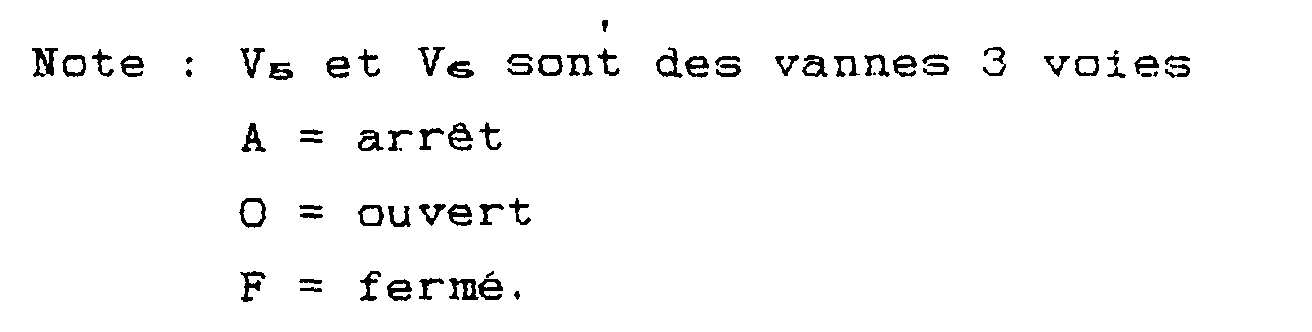
- Line 6 is fitted with a three-way valve V 5 discharges either into the natural environment (position O2) or into a detergent recovery tank if the latter is not suitable for the natural environment (position O1).
- the installation When the installation is on standby for production, i.e. when the treated water tank outside the installation is full and there is no demand for water, the installation undergoes a periodic chlorination in order to avoid the proliferation of bacteria in the permeate circuit.
- the circulator C starts up with opening or closing depending on the case of the appropriate valves and the water circulates in the pipes 4 and 5 passing through the modules and passing through the chlorine metering device D 2 , for example during from 1 to 4 minutes and with a periodicity of for example around 3 hours.
- the system also includes an EV 6 valve used for emptying before rinsing carried out following a leaching, Valves V 10 and V 12 for taking samples of raw water and treated water respectively and a chlorine metering valve V 13 decompression valve D 2 .
- the permeate outlet pipe 4 is equipped with an EV 2 valve and a bypass pipe 41 with a flow limiting device 42 which allows the installation to operate with a limited flow rate.
- the installation will try to start again with strong flow from time to time to determine if the peak of pollution has passed. If it does not succeed, an alarm is triggered to warn an operator who will come to wash out or shut down the installation if the raw water resource proves to be too polluted.
- the non-return valves can be replaced by valves but are more economical than these.
- valves EV 1 to EV 6 as well as the valves EV 10 to EV 80 allowing the entry of raw water into the modules M 1 to M 8 , the valves EV 11 to EV 81 allowing the outlet of raw water modules M 1 to M 8 and the valves EV 12 to EV 82 allowing the backwashing water to enter the modules M 1 to M 8 are automatic solenoid valves.
- all the preceding valves can be hydraulically or pneumatically operated.
- Valves V 1 to V 13 can be manually operated valves, thus requiring the presence of an operator for carrying out certain phases of operation. It can be seen from the preceding table that the position of these valves is only to be modified during leaching and subsequent emptying and rinsing operations.
- valves V 1 to V 9 can also be managed by the management unit G when this not only provides the permeability of each module directly in backwashing and the average permeability in production of the other modules, but also determines by calculation its permeability in production and performs the comparison to a theoretical value, a threshold value and / or to the value during the previous cycle or to the average value for several previous cycles, using appropriate software.
- Valves V 1 to V 9 can be electrically, bydraulically or pneumatically operated. Different types of control can be combined.
- valves V 10 and V 12 which are valves for taking samples of raw water and of treated water respectively are manual.
- V 13 is a chlorine system decompression valve.
Landscapes
- Engineering & Computer Science (AREA)
- Water Supply & Treatment (AREA)
- Chemical & Material Sciences (AREA)
- Chemical Kinetics & Catalysis (AREA)
- Nanotechnology (AREA)
- Separation Using Semi-Permeable Membranes (AREA)
Abstract
Description
- compact, c'est-à-dire de volume limité par rapport à sa capacité de production, ceci afin de faciliter son transport
- ayant une faible consommation en énergie électrique, donc avec un nombre de pompes minime
- comportant avantageusement un circuit de chloration et un circuit de lessivage
- permettant de faire un diagnostic de l'état des membranes de filtration et des éventuelles anomalies de fonctionnement, et de procéder aux opérations de remise en état appropriées.
- un encrassement trop important ce qui conduit à effectuer un lessivage de l'ensemble des modules, la différence entre perméabilité en filtration et perméabiiité en rétrolavage permettant en outre de faire un choix parmi les produits de lessivage disponibles,
- une rupture des membranes de filtration d'un module, ce qui amène à une mise hors service et à un changement de ce module,
- un dysfonctionnement d'une vanne.

Claims (11)
- Procédé de fonctionnement et de contrôle d'un groupe d'au moins quatre modules de membranes de filtration d'eau montés en parallèle avec rétrolavage périodique des modules, caractérisé en ce queon introduit l'eau brute à traiter dans le groupe de modules à une pression régulée et on régule la pression de sortie du perméat (eau filtrée) à une valeur inférieure à celle de la pression d'entrée, mais suffisante pour permettre les opérations de rétrolavage,on munit le groupe de modules d'un compteur d'eau sur la conduite d'entrée de l'eau brute et de trois capteurs de pression, un premier sur l'entrée de l'eau brute, un deuxième à la sortie du perméat, et un troisième sur le circuit de rétrolavage, le compteur et les capteurs fournissant des signaux à un organe de gestion,on effectue les rétrolavages des modules successivement l'un après l'autre, avec le perméat des autres modules, en individualisant ainsi chaque module au moment de son rétrolavage, ce qui permet à l'aide du compteur d'eau et des capteurs de pression de déterminer la perméabilité propre en rétrolavage du module ainsi individualisé et la perméabilité en production du reste des modules,on compare les valeurs ainsi déterminées des perméabilités à des valeurs théoriques, à des valeurs de seuil et/ou aux valeurs des cycles précédents pour, selon le diagnostic obtenu, modifier la périodicité des rétrolavages, procéder à un lessivage du groupe de modules et détecter une anomalie de fonctionnement pour la corriger.
- Procédé selon la revendication 1, caractérisé en ce qu'on prévoit un lessivage du groupe de modules et une chloration du circuit pendant les arrêts prolongés de la production du groupe de modules, une pompe commune sur le circuit perméat assurant la circulation dans le circuit de lessivage ou la circulation dans le circuit de chloration.
- Procédé selon la revendication 2, caractérisé en ce que, par mise en route de ladite pompe commune et ouverture de vannes du circuit de lessivage, on provoque l'aspiration d'un produit de lessivage dans le circuit de lessivage et au travers des membranes de filtration.
- Procédé selon l'une quelconque des revendications 1 à 3, caractérisé en ce que les signaux de pression et de comptage sont fournis à un opérateur qui calcule les perméabilités, les compare aux valeurs de référence retenues et procède au lessivage éventuellement nécessaire.
- Procédé selon l'une quelconque des revendications 1 à 3, caractérisé en ce que les signaux de pression et de comptage sont fournis à un organe de gestion comprenant un microprocesseur dont le logiciel calcule les perméabilités, les compare aux valeurs de référence retenues et procède de façon automatique au lessivage éventuellement nécessaire.
- Installation de traitement d'eau comportant un groupe d'au moins quatre modules de membranes de filtration pour la mise en oeuvre du procédé selon l'une quelconque des revendications 1 à 5, dans laquelle un groupe de modules (M1,...Mn) montés en parallèle sont alimentés en eau brute par des conduites individuelles (21,...,28) branchées sur une conduite commune (1 ; 2) équipée d'un compteur d'eau (C1), d'un régulateur de pression aval (VR1) et d'un capteur de pression d'entrée (P1), le perméat de chaque module étant amené à une conduite commune (4) équipée d'un capteur de pression de sortie (P2) et d'un régulateur de pression amont (VR2) ; un circuit de rétrolavage comprend une conduite commune (5) reliée à la conduite de sortie de perméat (4) et alimentant chaque module (Mi) successivement en eau de rétrolavage, constituée du perméat des autres modules, par une conduite (5i) d'entrée d'eau de rétrolavage, chaque conduite (5i) étant munie d'une vanne (EVi2), et chaque module (Mi) étant muni d'une conduite de sortie (6i) de l'eau de rétrolavage amenant à une conduite d'évacuation commune (6) ; et la conduite commune d'alimentation en eau de rétrolavage (5) est équipée d'un capteur de pression (P3).
- Installation selon la revendication 6, caractérisée en ce qu'un circuit de lessivage comporte un bac à lessive (BO) relié par une conduite (7) munie d'une vanne (V9) à l'alimentation en eau brute d'au moins un module et à la conduite d'évacuation (6) par une vanne (V8), une conduite (71) munie d'une vanne (V7) prélevant du perméat de la conduite commune d'alimentation en eau de rétrolavage (5), et un circuit de chloration comporte un doseur de chlore (D2) sur ladite conduite commune d'alimentation (5) ; une conduite (60) équipée d'une pompe de circulation (C) reliant la conduite commune (5) d'alimentation en eau de rétrolavage et la conduite commune (4) d'évacuation du perméat de manière que le circuit de chloration et le circuit de lessivage utilisent une même pompe de circulation (C).
- Installation selon l'une quelconque des revendications 6 ou 7, caractérisée en ce que les conduites individuelles (21,...,28) d'alimentation en eau brute des modules (M1,...,M8) comportent chacune une dérivation (21a,...,28a) reliée à une deuxième extrémité du module.
- Installation selon la revendication 8, caractérisée en ce que lesdites conduites de dérivation (21a,...,28a) sont équipées de pompes de recirculation (P10,...,P80).
- Installation selon l'une quelconque des revendications 6 à 9, caractérisée en ce que le doseur de chlore (D2) du circuit de chloration est un doseur de chlore statique.
- Installation selon l'une quelconque des revendications 6 à 10, caractérisée en ce que les vannes sont choisies parmi les vannes à commande manuelle, les vannes à commande électrique, les vannes à commande hydraulique, les vannes à commande pneumatique et les combinaisons de ces différents types.
Applications Claiming Priority (1)
| Application Number | Priority Date | Filing Date | Title |
|---|---|---|---|
| PCT/FR1995/000498 WO1996032183A1 (fr) | 1995-04-14 | 1995-04-14 | Procede pour faire fonctionner et controler un groupe de modules de membranes de filtration, et groupe de modules mettant en ×uvre le procede |
Publications (2)
| Publication Number | Publication Date |
|---|---|
| EP0820344A1 EP0820344A1 (fr) | 1998-01-28 |
| EP0820344B1 true EP0820344B1 (fr) | 1999-11-03 |
Family
ID=9475217
Family Applications (1)
| Application Number | Title | Priority Date | Filing Date |
|---|---|---|---|
| EP95917407A Expired - Lifetime EP0820344B1 (fr) | 1995-04-14 | 1995-04-14 | Procede pour faire fonctionner et controler un groupe de modules de membranes de filtration, et groupe de modules permettant la mise en oeuvre du procede |
Country Status (6)
| Country | Link |
|---|---|
| US (1) | US6001254A (fr) |
| EP (1) | EP0820344B1 (fr) |
| JP (1) | JP3701682B2 (fr) |
| AU (1) | AU2348695A (fr) |
| DE (2) | DE820344T1 (fr) |
| WO (1) | WO1996032183A1 (fr) |
Families Citing this family (58)
| Publication number | Priority date | Publication date | Assignee | Title |
|---|---|---|---|---|
| EP0952885B1 (fr) | 1996-12-20 | 2010-09-22 | Siemens Water Technologies Corp. | Procede de decapage |
| NL1009457C2 (nl) | 1998-06-19 | 1999-12-21 | Sepeq B V | Inrichting en werkwijze voor het filteren van een vloeistof. |
| US6214231B1 (en) * | 1999-08-27 | 2001-04-10 | Zenon Environmental Inc. | System for operation of multiple membrane filtration assemblies |
| EP1174177A3 (fr) | 2000-07-18 | 2002-12-04 | Nitto Denko Corporation | Elément de membrane enroulé en spirale, module à membrane enroulée en spirale et système de traitement utilisant ceux-ci, ainsi que procédé de fonctionnement et procédé de lavage correspondant |
| AUPR421501A0 (en) | 2001-04-04 | 2001-05-03 | U.S. Filter Wastewater Group, Inc. | Potting method |
| AUPR692401A0 (en) | 2001-08-09 | 2001-08-30 | U.S. Filter Wastewater Group, Inc. | Method of cleaning membrane modules |
| AUPS300602A0 (en) * | 2002-06-18 | 2002-07-11 | U.S. Filter Wastewater Group, Inc. | Methods of minimising the effect of integrity loss in hollow fibre membrane modules |
| CA2501628C (fr) | 2002-10-10 | 2012-12-04 | U.S. Filter Wastewater Group, Inc. | Agencement de filtration et de lavage a contre-courant pour modules de membranes |
| IL157581A (en) * | 2003-01-09 | 2004-08-31 | Ide Technologies Ltd | Direct osmosis membrane cleaning |
| US8268176B2 (en) | 2003-08-29 | 2012-09-18 | Siemens Industry, Inc. | Backwash |
| US20050067341A1 (en) * | 2003-09-25 | 2005-03-31 | Green Dennis H. | Continuous production membrane water treatment plant and method for operating same |
| AU2004289373B2 (en) | 2003-11-14 | 2010-07-29 | Evoqua Water Technologies Llc | Improved module cleaning method |
| US8758621B2 (en) | 2004-03-26 | 2014-06-24 | Evoqua Water Technologies Llc | Process and apparatus for purifying impure water using microfiltration or ultrafiltration in combination with reverse osmosis |
| AU2005282211B2 (en) | 2004-09-07 | 2011-04-21 | Evoqua Water Technologies Llc | Reduction of backwash liquid waste |
| US8506806B2 (en) | 2004-09-14 | 2013-08-13 | Siemens Industry, Inc. | Methods and apparatus for removing solids from a membrane module |
| EP1807181A4 (fr) | 2004-09-15 | 2009-04-22 | Siemens Water Tech Corp | Aeration variable en continu |
| CA2591580A1 (fr) | 2004-12-24 | 2006-06-29 | Siemens Water Technologies Corp. | Procede et appareil simples de lavage au gaz |
| ATE549076T1 (de) | 2004-12-24 | 2012-03-15 | Siemens Industry Inc | Reinigung in membranfiltrationssystemen |
| CN101184548B (zh) | 2005-04-29 | 2011-10-05 | 西门子水技术公司 | 用于膜滤器的化学清洗剂 |
| EP1726353A1 (fr) * | 2005-05-25 | 2006-11-29 | Johnson Diversey, Inc. | Filtration membranaire d'un produit |
| ES2599640T3 (es) | 2005-07-12 | 2017-02-02 | Zenon Technology Partnership | Control de procedimiento para un sistema de membrana sumergido |
| CN101287538B (zh) | 2005-08-22 | 2013-03-06 | 西门子工业公司 | 使用歧管以减少回洗的水过滤装置 |
| US7708887B2 (en) * | 2005-11-08 | 2010-05-04 | Siemens Water Technologies Corp. | Combination membrane/biolytic filtration |
| US20080093277A1 (en) * | 2006-06-13 | 2008-04-24 | John Armour | Cadence detection in a sequence of video fields |
| US8293098B2 (en) | 2006-10-24 | 2012-10-23 | Siemens Industry, Inc. | Infiltration/inflow control for membrane bioreactor |
| US20080179244A1 (en) * | 2007-01-26 | 2008-07-31 | Parkson Corporation | Drain-flush sequence and system for filter module |
| EP2129629A1 (fr) | 2007-04-02 | 2009-12-09 | Siemens Water Technologies Corp. | Commande d'infiltration/afflux améliorée pour bioréacteur à membranes |
| US9764288B2 (en) | 2007-04-04 | 2017-09-19 | Evoqua Water Technologies Llc | Membrane module protection |
| EP2152390B1 (fr) | 2007-05-29 | 2012-05-23 | Siemens Industry, Inc. | Nettoyage d'une membrane avec une pompe pneumatique pulsée |
| TW200927274A (en) * | 2007-09-18 | 2009-07-01 | Asahi Kasei Chemicals Corp | Hollow yarn film filtering apparatus |
| EP2331242B1 (fr) | 2008-07-24 | 2018-09-05 | Evoqua Water Technologies LLC | Système de cadre pour modules de filtration sur membrane |
| US8591740B2 (en) * | 2008-08-18 | 2013-11-26 | Siemens Water Technologies Llc | Method and system for biofouling control of shipboard components |
| AU2009282912B2 (en) | 2008-08-20 | 2014-11-27 | Evoqua Water Technologies Llc | Improved membrane system backwash energy efficiency |
| DE102008039676A1 (de) * | 2008-08-26 | 2010-03-04 | Inge Watertechnologies Ag | Einrichtung und Verfahren zum Rückspülen von Filtermembranmodulen |
| JP2010207800A (ja) * | 2009-02-16 | 2010-09-24 | Kuraray Co Ltd | ろ過ユニットおよびこれを備えたろ過装置 |
| US20100224558A1 (en) * | 2009-03-09 | 2010-09-09 | Jack Barker | Water Filtration System |
| WO2010142673A1 (fr) | 2009-06-11 | 2010-12-16 | Siemens Water Technologies Corp. | Procédés de nettoyage d'une membrane polymère poreuse et kit pour le nettoyage d'une membrane polymère poreuse |
| DE102009040142A1 (de) * | 2009-09-04 | 2011-03-10 | Krones Ag | Verfahren und Anlage zum Filtrieren von Wasser, insbesondere Ultrafiltrationsverfahren |
| US20130032540A1 (en) * | 2010-03-04 | 2013-02-07 | Terragroup Corporation | Lightweight modular water purification system with reconfigurable pump power options |
| EP2563501B1 (fr) | 2010-04-30 | 2019-05-15 | Evoqua Water Technologies LLC | Dispositif de distribution d'un écoulement de fluide |
| US8808539B2 (en) | 2010-05-24 | 2014-08-19 | Saudi Arabian Oil Company | Integrated system for monitoring permeate quality in water treatment facilities |
| US9022224B2 (en) | 2010-09-24 | 2015-05-05 | Evoqua Water Technologies Llc | Fluid control manifold for membrane filtration system |
| US9925499B2 (en) | 2011-09-30 | 2018-03-27 | Evoqua Water Technologies Llc | Isolation valve with seal for end cap of a filtration system |
| CN103958024B (zh) | 2011-09-30 | 2016-07-06 | 伊沃夸水处理技术有限责任公司 | 改进的歧管排列 |
| CN102657966B (zh) * | 2012-05-23 | 2014-07-23 | 宋泳 | 快速抽滤装置 |
| AU2013280452B2 (en) | 2012-06-28 | 2017-07-20 | Evoqua Water Technologies Llc | A potting method |
| US9962865B2 (en) | 2012-09-26 | 2018-05-08 | Evoqua Water Technologies Llc | Membrane potting methods |
| WO2014052071A1 (fr) | 2012-09-26 | 2014-04-03 | Evoqua Water Technologies Llc | Dispositif de sécurisation de membrane |
| KR20150059788A (ko) | 2012-09-27 | 2015-06-02 | 에보쿠아 워터 테크놀로지스 엘엘씨 | 침지된 막을 위한 가스 스코어링 장치 |
| US9550152B2 (en) * | 2013-03-07 | 2017-01-24 | Pentair Residential Filtration, Llc | Point of use filtration system with backwash |
| EP3052221B1 (fr) | 2013-10-02 | 2022-12-14 | Rohm & Haas Electronic Materials Singapore Pte. Ltd | Dispositif de réparation de module de filtration sur membrane |
| CN107847869B (zh) | 2015-07-14 | 2021-09-10 | 罗门哈斯电子材料新加坡私人有限公司 | 用于过滤系统的通气装置 |
| CN105645619B (zh) * | 2016-03-03 | 2018-06-05 | 北京四季沐歌太阳能技术集团有限公司 | 一种ro净水机故障检测报警系统 |
| US10633261B1 (en) * | 2016-08-02 | 2020-04-28 | Nimon Bondurant | Water filtration system and method of use |
| DE102018219186A1 (de) * | 2018-11-09 | 2020-05-14 | Krones Ag | Rückspülverfahren und Filtervorrichtung für die Crossflow-Filtration |
| US11524263B1 (en) * | 2019-08-15 | 2022-12-13 | Wigen Companies, Inc. | Filtration processes and systems |
| CN113304536B (zh) * | 2021-06-11 | 2022-05-17 | 广州市大进工业设备有限公司 | 一种过滤装置 |
| WO2025141404A1 (fr) * | 2023-12-27 | 2025-07-03 | Dubai Electricity & Water Authority Pjsc | Nouveau système de lavage à contre-courant pour filtres à milieux multiples destiné à une consommation de fluide réduite pendant le lavage à contre-courant |
Family Cites Families (10)
| Publication number | Priority date | Publication date | Assignee | Title |
|---|---|---|---|---|
| US3747763A (en) * | 1971-06-01 | 1973-07-24 | Phillips J E | Fluid treating system |
| CA981595A (en) * | 1972-06-15 | 1976-01-13 | Dorr-Oliver Incorporated | Defouling ultrafiltration cells |
| US4670150A (en) * | 1983-05-27 | 1987-06-02 | Neptune Microfloc, Incorporated | Cross-flow microfiltration lime softener |
| US4708790A (en) * | 1984-06-04 | 1987-11-24 | Champion International Corporation | Ultrafiltration system with regeneration control |
| US5262053A (en) * | 1988-07-15 | 1993-11-16 | Filtrox-Werk Ag | Filtration process, use of stabilizers installation for a filtration process, and procedure for operating said installation |
| IT1242864B (it) * | 1990-06-26 | 1994-05-18 | Perdomini Spa | Sistema automatico di controllo ed ottimizzazione di procedimenti di ultrafiltrazione in impianti industriali alimentari e/o chimici e/o chimico-farmaceutici e procedimento di ultrafiltrazione utilizzante tale sistema. |
| FR2668078B1 (fr) * | 1990-10-17 | 1992-12-24 | Dumez Lyonnaise Eaux | Procede pour le retrolavage de membrane tubulaires de filtration, et dispositif de mise en óoeuvre. |
| US5227071A (en) * | 1992-01-17 | 1993-07-13 | Madison Chemical Company, Inc. | Method and apparatus for processing oily wastewater |
| GB9214037D0 (en) * | 1992-07-01 | 1992-08-12 | Ici Plc | Membrane system |
| US5285903A (en) * | 1992-10-13 | 1994-02-15 | Sorenson Blaine F | Method for recovering particulate and scavenging formaldehyde in a wood panel fabrication process |
-
1995
- 1995-04-14 DE DE0820344T patent/DE820344T1/de active Pending
- 1995-04-14 JP JP53075796A patent/JP3701682B2/ja not_active Expired - Lifetime
- 1995-04-14 US US08/930,803 patent/US6001254A/en not_active Expired - Lifetime
- 1995-04-14 AU AU23486/95A patent/AU2348695A/en not_active Abandoned
- 1995-04-14 DE DE69513201T patent/DE69513201T2/de not_active Expired - Lifetime
- 1995-04-14 EP EP95917407A patent/EP0820344B1/fr not_active Expired - Lifetime
- 1995-04-14 WO PCT/FR1995/000498 patent/WO1996032183A1/fr not_active Ceased
Also Published As
| Publication number | Publication date |
|---|---|
| JPH11509769A (ja) | 1999-08-31 |
| US6001254A (en) | 1999-12-14 |
| DE820344T1 (de) | 1998-05-28 |
| AU2348695A (en) | 1996-10-30 |
| EP0820344A1 (fr) | 1998-01-28 |
| JP3701682B2 (ja) | 2005-10-05 |
| WO1996032183A1 (fr) | 1996-10-17 |
| DE69513201D1 (de) | 1999-12-09 |
| DE69513201T2 (de) | 2000-05-18 |
Similar Documents
| Publication | Publication Date | Title |
|---|---|---|
| EP0820344A1 (fr) | Procede pour faire fonctionner et controler un groupe de modules de membranes de filtration, et groupe de modules mettant en uvre le procede | |
| EP0473486B1 (fr) | Procédé de commande des modes de fonctionnement d'un appareil automatique de filtration d'eau sur membranes tubulaires | |
| EP0694312B1 (fr) | Dispositif et procédé pour préparer un liquide de traitement par filtration | |
| JP5563142B1 (ja) | 循環水利用システム | |
| FR2781168A1 (fr) | Procede et installation de traitement d'eau | |
| FR2716385A1 (fr) | Procédé et dispositif de rétrolavage de modules de filtration. | |
| EP2104551A2 (fr) | Procede de gestion optimisee d'une unite de filtration sur membrane, et installation pour sa mise en oeuvre | |
| WO2021069644A1 (fr) | Systeme de traitement et de recyclage des eaux grises, procede de traitement et de recyclage des eaux grises, procede de commande d'un systeme | |
| FR2994174A1 (fr) | Procede et installation de traitement d'eaux de ballast de navires | |
| FR2553752A1 (fr) | Procede et appareil pour le traitement des eaux usees | |
| FR3053035B1 (fr) | Installation de recyclage d'eaux usees grises d'un immeuble pour alimenter des chasses d'eau | |
| EP3353119A1 (fr) | Dispositif de traitement des eaux et embarcation comportant un tel dispositif | |
| FR2974285A1 (fr) | Douche | |
| JP5518248B1 (ja) | 循環水利用システムの塩濃度調整装置、循環水利用システム | |
| JP6141610B2 (ja) | 水処理装置の運転方法、及び飲用水を製造する方法 | |
| NL2029718B1 (en) | Water treatment system and water treatment method | |
| FR3031972A1 (fr) | Dispositif de purification d'un liquide pollue | |
| EP4081488B1 (fr) | Système et procede de traitement des eaux grises d'une habitation ou d'un immeuble d'habitations | |
| FR2609645A1 (fr) | Installation de filtration modulaire automatique | |
| FR2915209A1 (fr) | Dispositif pour l'entretien des canalisations notamment le detartrage et la desoxydation. | |
| FR2693374A1 (fr) | Installation pour la délivrance d'un liquide stérile et procédé de stérilisation permanente. | |
| JP5821349B2 (ja) | 水処理設備の制御装置 | |
| FR3082515A1 (fr) | Dispositif de traitement des eaux | |
| FR3150960A1 (fr) | Système et procédé de recyclage d’un liquide | |
| JP6300988B2 (ja) | 水処理装置の運転方法、及び飲用水を製造する方法 |
Legal Events
| Date | Code | Title | Description |
|---|---|---|---|
| PUAI | Public reference made under article 153(3) epc to a published international application that has entered the european phase |
Free format text: ORIGINAL CODE: 0009012 |
|
| 17P | Request for examination filed |
Effective date: 19971014 |
|
| AK | Designated contracting states |
Kind code of ref document: A1 Designated state(s): BE CH DE FR GB LI NL |
|
| GBC | Gb: translation of claims filed (gb section 78(7)/1977) | ||
| TCNL | Nl: translation of patent claims filed | ||
| DET | De: translation of patent claims | ||
| 17Q | First examination report despatched |
Effective date: 19980722 |
|
| GRAG | Despatch of communication of intention to grant |
Free format text: ORIGINAL CODE: EPIDOS AGRA |
|
| GRAG | Despatch of communication of intention to grant |
Free format text: ORIGINAL CODE: EPIDOS AGRA |
|
| GRAG | Despatch of communication of intention to grant |
Free format text: ORIGINAL CODE: EPIDOS AGRA |
|
| GRAH | Despatch of communication of intention to grant a patent |
Free format text: ORIGINAL CODE: EPIDOS IGRA |
|
| GRAH | Despatch of communication of intention to grant a patent |
Free format text: ORIGINAL CODE: EPIDOS IGRA |
|
| GRAA | (expected) grant |
Free format text: ORIGINAL CODE: 0009210 |
|
| AK | Designated contracting states |
Kind code of ref document: B1 Designated state(s): BE CH DE FR GB LI NL |
|
| REG | Reference to a national code |
Ref country code: CH Ref legal event code: EP |
|
| REF | Corresponds to: |
Ref document number: 69513201 Country of ref document: DE Date of ref document: 19991209 |
|
| GBT | Gb: translation of ep patent filed (gb section 77(6)(a)/1977) |
Effective date: 19991213 |
|
| PLBE | No opposition filed within time limit |
Free format text: ORIGINAL CODE: 0009261 |
|
| STAA | Information on the status of an ep patent application or granted ep patent |
Free format text: STATUS: NO OPPOSITION FILED WITHIN TIME LIMIT |
|
| 26N | No opposition filed | ||
| REG | Reference to a national code |
Ref country code: GB Ref legal event code: IF02 |
|
| PGFP | Annual fee paid to national office [announced via postgrant information from national office to epo] |
Ref country code: BE Payment date: 20140211 Year of fee payment: 20 |
|
| PGFP | Annual fee paid to national office [announced via postgrant information from national office to epo] |
Ref country code: GB Payment date: 20140422 Year of fee payment: 20 |
|
| PGFP | Annual fee paid to national office [announced via postgrant information from national office to epo] |
Ref country code: CH Payment date: 20140424 Year of fee payment: 20 Ref country code: NL Payment date: 20140425 Year of fee payment: 20 Ref country code: DE Payment date: 20140616 Year of fee payment: 20 Ref country code: FR Payment date: 20140318 Year of fee payment: 20 |
|
| REG | Reference to a national code |
Ref country code: DE Ref legal event code: R082 Ref document number: 69513201 Country of ref document: DE Representative=s name: GALLO, WOLFGANG, DIPL.-ING. (FH), DE |
|
| REG | Reference to a national code |
Ref country code: DE Ref legal event code: R071 Ref document number: 69513201 Country of ref document: DE |
|
| REG | Reference to a national code |
Ref country code: CH Ref legal event code: PL |
|
| REG | Reference to a national code |
Ref country code: GB Ref legal event code: PE20 Expiry date: 20150413 |
|
| PG25 | Lapsed in a contracting state [announced via postgrant information from national office to epo] |
Ref country code: GB Free format text: LAPSE BECAUSE OF EXPIRATION OF PROTECTION Effective date: 20150413 |