EP0820697B2 - Hautaufnehmende Vorrichtung zum Entnehmen des Anus - Google Patents
Hautaufnehmende Vorrichtung zum Entnehmen des Anus Download PDFInfo
- Publication number
- EP0820697B2 EP0820697B2 EP97202354A EP97202354A EP0820697B2 EP 0820697 B2 EP0820697 B2 EP 0820697B2 EP 97202354 A EP97202354 A EP 97202354A EP 97202354 A EP97202354 A EP 97202354A EP 0820697 B2 EP0820697 B2 EP 0820697B2
- Authority
- EP
- European Patent Office
- Prior art keywords
- skin
- vent
- pin
- holding element
- animal
- Prior art date
- Legal status (The legal status is an assumption and is not a legal conclusion. Google has not performed a legal analysis and makes no representation as to the accuracy of the status listed.)
- Expired - Lifetime
Links
Images

Classifications
-
- A—HUMAN NECESSITIES
- A22—BUTCHERING; MEAT TREATMENT; PROCESSING POULTRY OR FISH
- A22B—SLAUGHTERING
- A22B5/00—Accessories for use during or after slaughtering
- A22B5/0094—Cutting or blocking the rectum of a carcass, e.g. for avoiding fecal contamination
-
- A—HUMAN NECESSITIES
- A22—BUTCHERING; MEAT TREATMENT; PROCESSING POULTRY OR FISH
- A22C—PROCESSING MEAT, POULTRY, OR FISH
- A22C21/00—Processing poultry
- A22C21/06—Eviscerating devices for poultry
Definitions
- This invention is a device for cutting out the vent, which is the excretory canal of a slaughtered animal, such as poultry, pigs, other mammals or the like, in order to cut the vent completely out.
- the device uses a holding element to capture the skin surrounding the vent.
- a cutter cooperates with the holding element in order to cut through the typically highly-elastic skin with a shearing action.
- Vents of slaughtered animals such as poultry, pigs or the like must be cut out and removed during processing, typically as a prelude to eviscerating the animal.
- regulations require complete removal of the vent, including the orbicular muscle surrounding the vent exit.
- Devices also exist for clamping or positioning the orbicular muscle before cutting.
- U.S. Patent No. 5,133,686 fixes the orbicular muscle in place before cutting by using an annular gap carefully-sized to capture the orbicular muscle. Pulling the clamped orbicular muscle away from the carcass draws the intestines at least partially out.
- vent cutters are often placed on a rotary processor that operates on poultry or other carcasses suspended from an adjacent overhead conveyor and clamped to the processor during vent removal. Some machines leave a piece of orbicular muscle on a small number of carcasses. Possibly, this failure completely to cut out the orbicular muscle is caused by the movement of the rotary apparatus (the uncut orbicular muscle often occurs on the edge of the carcass trailing the direction of rotary movement) or the high elasticity of the animal skin that must be cut. In any event, left-over bits of orbicular muscle hurt the quality scores for the processing plants and may ultimately reduce the quality of the product.
- This invention overcomes the above problems by providing a holding element that holds the skin of the animal surrounding the vent exit.
- the holding element thereby prevents the skin from twisting when cut by the rotary cutter.
- the face surface of the holding element may be beveled to provide more surface area for contacting the skin. The increased surface area can better withstand the initiation of the cutting action. That cutting action begins first only at the "high" point of the bevel, which causes the cutting action to build up more smoothly, improving the cut.
- the face surface is roughened in order to capture and hold the skin, preventing it from the typical twisting that makes cutting more difficult.
- a series of grooves may be formed in the face surface. Such grooves capture and hold the skin. The grooves also form the skin into folds that are easier to cut through than the unfolded, elastic skin of the typical animal carcass.
- the holding element cooperates with the rotary cutter to cut through the skin with a shearing action that makes a cleaner, better cut.
- the cutter and holding element are positioned fairly close to one another, separated only by a small annular gap whose width ranges from about 0.1 to 1 millimeters (mm).
- An elongated centering pin terminating in a knob may be coaxial to and nested within the holding element, which, in turn, is coaxial to and nested within a rotary cutter.
- the rotary cutter may be generally cylindrical in shape.
- Each of these elements can move toward and away from a slaughtered animal, which is typically suspended from an overhead conveyor adjacent to a rotary processing machine holding numerous assemblies containing the pin, holding element and cutter. Clamping devices on the processor fix the poultry carcasses in position for cutting.
- blocks connected to each of the various assemblies slide within corresponding tracks in the processor.
- the slide blocks move the various elements of each assembly.
- the tracks and blocks can be arranged so that as the processor rotates, tracks move a sliding block down, which moves the centering pin into the vent of a poultry carcass held in an overhead conveyor and clamped to the side of the processor underneath the pin.
- the holding element is similarly moved toward the carcass.
- the terminating knob on the pin passes through the orbicular muscle into the vent.
- the resilient orbicular muscle closes around the pin shaft that has a smaller diameter than the knob on its terminating end. Meanwhile, the holding element has been brought to abut against the skin of the animal surrounding the vent.
- the face surface or the holding element may be appropriately beveled to improve contact with the carcass.
- slide blocks move the pin toward the holding element, which has a recess that cooperates with the shoulder of the knob to clasp the orbicular muscle. Moving the pin and holding element slightly further away from the carcass lifts the clamped orbicular muscle.
- the pin and holding element clasp the orbicular muscle between them. Also, the skin is held by the roughened face surface of the holding element. Because the cutter and holding element are fairly close to one another, a shearing force is created that improves cutting of the skin. Cutting may be further improved by using grooves to roughen the face surface. The grooves form folds in the skin, allowing the rotary cutter initially to focus its cutting forces on the tops of the folds.
- the pin and holding element After cutting, the pin and holding element are retracted from the carcass to pull away the orbicular muscle and an attached section of intestine. Separating the pin and holding element then releases the completely cut free orbicular muscle.
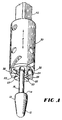
- Figure 1 shows a perspective view of the vent cutter of the present invention.
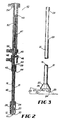
- Figure 2 shows a side, cross-sectional view of the vent cutter and assembly of the present invention.
- Figure 3 shows a side view of the holding element used in the vent cutter of the present invention.
- Figure 4 shows a front view of the vent cutter of the present invention.
- Figure 5 shows a schematic view of the vent cutter of the present invention in use.
- FIG 1 shows a perspective view of the vent cutter of the present invention.
- a centering pin 10 terminates in a generally cone-shaped probe 12 forming a shoulder 14 that leads to an elongated shaft 16.
- the centering pin 10 is coaxial to a holding element 20, shown as a partial, hollowed cylinder.
- Pin shaft 16 extends from and retracts into the holding element 20 so that the shoulder 14 of the probe 12 is drawn into a recess 26 formed in the holding element 20, as shown in Figure 2 .
- Both the pin 10 and holding element 20 may be nested within and coaxial to a rotary cutter 30 in order to form an assembly 40.
- a small annular space separates the outside of the holding element 20 from the inside of the cutter 30.
- the annular space between the holding element 20 and cutter 30 shown in the Figure 1 embodiment is about 0.25 millimeters ("mm") wide (This 0.25 mm width is the difference between the outer and inner diameters defining the annular space).
- the annular space may range between about 0.1 and 1 mm. Even more or less separation can be used so long as the cutter 30 can cooperate with the holding element 20 to shear through the skin.
- Pin 10 has a solid shaft 16 passing through a bore 28 in the holding element 20.
- the terminating end of the holding element 20 forms the recess 26 into which the shoulders 14 ofthe cone-shaped probe 12 seat.
- Pin shaft 16 extends through a hollow shaft 21 that, in turn, extends through a square shaft 42.
- Square shaft 42 rotates in order to spin blades 32 on the rotary cutter 30, which attaches to the square shaft 42 via a retainer 34. Since the square shaft 42 rotates, it connects to a fixed shaft 50 through a bushing 43 and washer 44 arrangement.
- Pin shaft 16 and hollow shaft 21 may extend and retract within the square shaft 42; but neither the pin shaft 16 nor the hollow shaft 21 rotates.
- Moving a first slide block 45 within a track or slot also moves the pin 10 and holding element 20.
- a bolt 46 secures first slide block 45 to the pin shaft 16.
- shoulder 14 engages recess 26, thereby also moving holding element 20.
- a spring 47 biases the hollow shaft 21 toward blades 32 on the cutter 30. The initial bias of the spring 47 may be adjusted by relocating into any of a number of spaced holes a set screw 48 against which one end of spring 47 bears. Another set screw 49 holds holding element 20 inside shaft 50 by protruding into slot 29.
- Moving a second block 52 within a slot or track extends and retracts moving the entire assembly 40 toward and away from an animal carcass held in, for instance, the clamps shown in Figure 4 .
- Those clamps are operated by sliding a third block 54 within a track
- gears shown in Figure 4
- slide blocks While the holding element 20 is in an end position adjacent to the carcass in order to hold the skin, slide blocks will extend the blade 32 toward the carcass held in the clamps, thereby initiating cutting and vent removal.
- Figure 3 shows additional detail about the holding element 20.
- a face surface 22 is formed at the terminating end of holding element 20.
- the face surface 22 is beveled at an angle 23 selected to maximize contact of the face surface 22 with the skin of a carcass, which typically is tilted by clamps on a processing station.
- angle 23 shown in Figure 3 is at a 10° angle to a line perpendicular to the axis of hollow shaft 21.
- Face surface 22 is roughened so as to better capture and hold the skin of a carcass.
- One way to roughen the surface is to form various grooves 24 in the face surface 22 so that teeth 25 can capture and hold the skin surrounding the animal's vent.
- face surface 22 may be provided with serrated edges, small ridges or strips of abrasive material such as sandpaper or the like.
- grooves 24 and teeth 25 with the spring 47 results in the spring 47 forcing the holding element 20 toward the animal, which forces skin into grooves 24 to form the skin into folds.
- Grooves 24 at the back 27 of the holding element 20 need not be as deep or sharply defined as grooves 24 at the front.
- the assembly 40 may be mounted in a rotary processor provided with various tracks for moving slide blocks 45, 52 and 54 in order to extend and retract elements of the assembly 40.
- the pin 10 or holding element 20 may also be extended and retracted by using hydraulics or solenoids.
- the rotary processor may have gears or other mechanisms for rotating the square shaft 42.
- Figure 5 shows a schematic view of an assembly 40 in operation.
- Probe 12 at the terminating end of pin 10 is located underneath skin 60 of a carcass.
- the elastic orbicular muscle at the end of the vent stretched around the probe 12 and then contracted around the narrower shaft 16. While this occurred, the cutter 30 and holding element 20 dropped toward the carcass.
- the holding element 20 first reached the carcass and holds the skin in grooves 24. Cutting was started and the probe 12 was then retracted toward the holding element 20 in order to clasp the orbicular muscle between the shoulders 14 of the probe 12 and the recess 26 formed in the holding element 20, which contacts the skin 60.
- holding element 20 acts both as a sleeve for encasing the orbicular muscle and as a means for holding the skin surrounding the vent.
- rotary cutter 30 advances axially in direction "A" toward the skin 60, it rotates in direction "R".
- Rotating blades 32 will cooperate with the holding element 20 to cut through the skin 60 with a shearing action.
- Forming the skin folds 62 also improves cutting performance because the blades 32 focus their cutting forces on the smaller surface area of the folds 62.
Landscapes
- Life Sciences & Earth Sciences (AREA)
- Engineering & Computer Science (AREA)
- Food Science & Technology (AREA)
- Wood Science & Technology (AREA)
- Zoology (AREA)
- Processing Of Meat And Fish (AREA)
Claims (12)
- Vorrichtung zum Entnehmen des Anus aus einem geschlachteten Tier mit:einer relativ zu dem Tier beweglichen Einrichtung (30) zum Schneiden des Anus;einer Einrichtung (10) zum Zentrieren der Schneideeinrichtung im Anus;einer Einrichtung (20) zum Halten der dem Anus benachbarten Haut (60) des Tieres,wobei die Halteeinrichtung eine aufgerauhte Stirnfläche (22) aufweist, die die Haut derart faßt, daß die zentrierte Schneideeinrichtung mit der Halteeinrichtung zum Durchscheren eines dem Anus benachbarten Hautabschnitts zusammenwirkt, dadurch gekennzeichnet, daß die Einrichtung zum Schneiden des Anus rotierbar ist, und daß die aufgerauhte Stirnfläche gestaltet ist um zu Verhüten daß die Haut gewunden würde.
- Vorrichtung nach Anspruch 1, gekennzeichnet durch
eine Reihe von Nuten (24), die die Stirnfläche (22) aufrauhen und durch die die Haut derart gefaßt wird, daß in der Haut Falten (62) geworfen werden. - Vorrichtung nach Anspruch 2, gekennzeichnet durch radiale Nuten (24).
- Vorrichtung nach einem der Ansprüche 1 bis 3, dadurch
gekennzeichnet, daß die Stirnfläche (22) im wesentlichen in einer zur Achse der Zentriereinrichtung geneigten Ebene derart liegt, daß ein erster Abschnitt der Stirnfläche vor einem zweiten Abschnitt der Stirnfläche mit der Haut in Kontakt treten kann. - Vorrichtung nach Anspruch 1, bestimmt zum Einsatz,
wenn der Anus einen ringförmigen Muskel aufweist, dadurch gekennzeichnet, daß die Zentriereinrichtung einen länglichen Stift (10) aufweist, der mit einer Nase (12) an einem Ende versehen ist, und daß die Halteeinrichtung ferner eine Ausnehmung (26) aufweist, die derart geformt ist, daß der ringförmige Muskel zwischen der Nase und der Ausnehmung gefaßt werden kann. - Vorrichtung nach Anspruch 1 mit:einem Zentrierstift (10) zum Einsetzen in den Anus;einem rotierenden Messer (30), das koaxial zum Stift angeordnet ist und eine innere Kante und eine Schneidkante (32) aufweist,wobei die Halteeinrichtung koaxial zu dem Stift und zu dem Messer angeordnet ist und zwischen ungefähr 0,1 und 1 mm von der inneren Kante beabstandet angeordnet ist und in eine dem Tier benachbarte Endposition zum Halten der Haut (60) des Tieres in der Endposition bewegt werden kann, wodurch die Schneidkante mit der Halteeinrichtung zum Durchschneiden der Haut des Tieres zusammenwirkt.
- Vorrichtung nach Anspruch 6, dadurch gekennzeichnet,
daß die Halteeinrichtung eine im wesentlichen zylindrische Hülse umfaßt, die in das Messer eingepaßt ist. - Vorrichtung nach Anspruch 7, bestimmt zum Einsatz,
wenn der Anus einen ringförmigen Muskel aufweist, dadurch gekennzeichnet, daß der Zentrierstift (10) eine Sonde (12) mit einer Schulter (14) aufweist, die derart geformt ist, daß sie in eine Ausnehmung (26) paßt, die durch die Hülse gebildet wird, wobei die Sonde aus dem Anus gezogen werden kann, damit der ringförmige Muskel zwischen der Schulter und der Ausnehmung gefaßt wird. - Vorrichtung nach Anspruch 6, dadurch gekennzeichnet, daß die Stirnfläche (22) zwischen ungefähr 5° und 20° relativ zu einer Geraden senkrecht zur Achse des Messers abgeschrägt ist.
- Vorrichtung nach Anspruch 1, bestimmt zum Einsatz,
wenn der Anus einen ringförmigen Muskel aufweist, gekennzeichnet durch:einen axial beweglichen Zentrierstift (10), der von einer im wesentlichen konisch geformten Nase (12) mit einer Schulter (14) abgeschlossen ist;ein Halteelement (20), das zum Stift koaxial ist und diesen umgibt und zwischen einer ersten Position und einer Endposition, in der das Halteelement sich gegen die Haut (60) des Tieres abstützt, beweglich ist, wobei das Halteelement eine Ausnehmung (26) aufweist, die im wesentlichen so geformt ist, daß sie die Schulter der Nase aufnimmt, wobei die Ausnehmung mit dem axial beweglichen Stift zum Klammern des ringförmigen Muskels zwischen der Schulter der Nase und der Ausnehmung zusammenwirkt;
und ein im wesentlichen zylindrisches rotierendes Messer (30), das vom Halteelement durch einen ringförmigen Zwischenraum getrennt ist und das mit dem Halteelement derart zusammenwirkt, daß eine Scherwirkung erzeugt wird, die die Haut des Tieres so durchschneidet, daß der Stift und das Halteelement derart bewegt werden können, daß der freigeschnittene ringförmige Muskel vom Tier weggezogen werden kann. - Vorrichtung nach Anspruch 10, dadurch gekennzeichnet,
daß der ringförmige Zwischenraum eine Weite zwischen 0,1 und 0,5 mm aufweist. - Vorrichtung nach Anspruch 6, gekennzeichnet durch
Schlitten (45, 52, 54), die den Stift, die Halteeinrichtung und das rotierende Messer ein- und ausfahren.
Applications Claiming Priority (2)
| Application Number | Priority Date | Filing Date | Title |
|---|---|---|---|
| US08/687,756 US5741176A (en) | 1996-07-26 | 1996-07-26 | Skin-holding vent cutter |
| US687756 | 1996-07-26 |
Publications (4)
| Publication Number | Publication Date |
|---|---|
| EP0820697A2 EP0820697A2 (de) | 1998-01-28 |
| EP0820697A3 EP0820697A3 (de) | 1998-04-08 |
| EP0820697B1 EP0820697B1 (de) | 2001-03-14 |
| EP0820697B2 true EP0820697B2 (de) | 2009-08-12 |
Family
ID=24761722
Family Applications (1)
| Application Number | Title | Priority Date | Filing Date |
|---|---|---|---|
| EP97202354A Expired - Lifetime EP0820697B2 (de) | 1996-07-26 | 1997-07-25 | Hautaufnehmende Vorrichtung zum Entnehmen des Anus |
Country Status (6)
| Country | Link |
|---|---|
| US (1) | US5741176A (de) |
| EP (1) | EP0820697B2 (de) |
| JP (1) | JPH1084860A (de) |
| DE (1) | DE69704236T2 (de) |
| DK (1) | DK0820697T3 (de) |
| ES (1) | ES2155960T3 (de) |
Families Citing this family (33)
| Publication number | Priority date | Publication date | Assignee | Title |
|---|---|---|---|---|
| NL1006691C2 (nl) * | 1997-07-30 | 1999-02-02 | Stork Mps Bv | Inrichting voor het scheiden van botmateriaal uit een vleesstuk. |
| AUPO943997A0 (en) | 1997-09-26 | 1997-10-16 | Meat Research Corporation | Anal sealing |
| AU735096B2 (en) * | 1997-09-26 | 2001-06-28 | Meat & Livestock Australia Limited | Anal sealing of carcasses |
| US6193595B1 (en) | 1998-02-20 | 2001-02-27 | Stork Gamco Incorporated | Methods and apparatus for performing processing operations on a slaughtered animal or part thereof |
| US6190250B1 (en) | 1998-02-20 | 2001-02-20 | Stork Gamco Incorporated | Method and apparatus for performing processing operations on a slaughtered animal or part thereof |
| NL1011287C2 (nl) * | 1999-02-12 | 2000-08-15 | Stork Mps Bv | Werkwijze en inrichting voor het losmaken van het veteind van een karkas. |
| NL1012463C2 (nl) * | 1999-06-29 | 2001-01-02 | Meyn Food Proc Technology Bv | Inrichting voor het lossnijden van de aars van geslacht gevogelte. |
| US6265004B1 (en) | 1999-11-19 | 2001-07-24 | G. Douglas Cagle | Poultry visceral cavity shaping method and product |
| NL1026016C2 (nl) * | 2004-04-23 | 2005-10-25 | Systemate Group Bv | Inrichting en werkwijze voor het lossnijden van een aars van een karkas. |
| US8157625B2 (en) * | 2010-01-26 | 2012-04-17 | Foodmate Bv | Method and apparatus for collecting meat from an animal part |
| US8632380B2 (en) * | 2010-01-26 | 2014-01-21 | Foodmate B.V. | Method and apparatus for removing a sleeve of meat from an animal part having bone with knuckles on each of its opposite ends |
| US8757354B2 (en) | 2010-04-19 | 2014-06-24 | Foodmate Bv | Turning block alignment |
| NL2004574C2 (en) | 2010-04-19 | 2011-10-20 | Foodmate B V | Rotatable article support for a conveyor. |
| NL2006075C2 (en) | 2011-01-26 | 2012-07-30 | Foodmate B V | Rotationally indexed article support for a conveyor system having an alignment station. |
| NL2004573C2 (en) | 2010-04-19 | 2011-10-20 | Foodmate B V | Turning block alignment. |
| US8789684B2 (en) | 2010-04-19 | 2014-07-29 | Foodmate Bv | Rotatable article support for a conveyor |
| US8641486B1 (en) * | 2010-11-16 | 2014-02-04 | M and M Poultry Equipment, Inc. | Venting blade assembly for poultry processing |
| US8727839B2 (en) | 2011-01-21 | 2014-05-20 | Foodmate Bv | Poultry wing cutter for narrow pitch poultry lines |
| US8267241B2 (en) | 2011-01-26 | 2012-09-18 | Foodmate Bv | Rotationally indexed article support for a conveyor system having an alignment station |
| US8882571B2 (en) | 2011-01-26 | 2014-11-11 | Foodmate Bv | Method of deboning animal thighs for separating and collecting meat therefrom and apparatus for performing the method |
| EP2667728B1 (de) | 2011-01-26 | 2015-07-29 | Foodmate B.V. | Verfahren zum entbeinen von tierschenkeln zur trennung und entnahme von fleisch daraus und vorrichtung zur durchführung des verfahrens |
| US8430728B2 (en) | 2011-02-14 | 2013-04-30 | Foodmate Bv | Special cut poultry wing cutter |
| KR101200624B1 (ko) | 2011-04-11 | 2012-11-16 | 주식회사 태진 | 자동 항문 절단기 |
| NL2009033C2 (en) | 2012-06-19 | 2013-12-23 | Foodmate B V | Weighing method and apparatus. |
| US8808068B2 (en) | 2012-10-29 | 2014-08-19 | Foodmate Bv | Method of and system for automatically removing meat from an animal extremity |
| NL2009718C2 (en) | 2012-10-29 | 2014-05-01 | Foodmate B V | Method of mechanically removing skin from animal parts. |
| US9078453B2 (en) | 2013-11-01 | 2015-07-14 | Foodmate B.V. | Method and system for automatically deboning poultry breast caps containing meat and a skeletal structure to obtain breast fillets therefrom |
| US8961274B1 (en) | 2013-12-18 | 2015-02-24 | Foodmate Bv | Selective tendon cutter and method |
| NL2017997B1 (en) * | 2016-12-14 | 2018-06-26 | Meyn Food Processing Tech Bv | Vent cutter and method for cutting loose tissue around a vent of poultry |
| MX2022010375A (es) * | 2020-03-31 | 2022-11-07 | Marel Red Meat B V | Perforadora de intestino ciego con portador de intestino ciego. |
| DK181104B1 (en) * | 2021-09-13 | 2022-12-16 | Teknologisk Inst | System for automatic cutting and sealing of the rectum of a pig carcasses |
| CN117979829A (zh) | 2021-09-29 | 2024-05-03 | 马瑞奥红肉私人有限公司 | 切割装置、包括切割装置的系统和用于切下动物屠体的直肠端部部分的方法 |
| WO2025228914A1 (en) * | 2024-04-29 | 2025-11-06 | Marel Poultry B.V. | Drill for vent cutter, vent cutter, method for making a vent opening |
Family Cites Families (15)
| Publication number | Priority date | Publication date | Assignee | Title |
|---|---|---|---|---|
| US3653093A (en) * | 1968-01-26 | 1972-04-04 | Johnson Co Gordon | Poultry eviscerating machine |
| US3555593A (en) * | 1968-01-26 | 1971-01-19 | Johnson Co Gordon | Method of eviscerating poultry |
| US3705440A (en) * | 1971-01-21 | 1972-12-12 | Gainesville Machine Co Inc | Fowl vent removal apparatus and method |
| NL156025B (nl) * | 1975-04-29 | 1978-03-15 | Meyn Pieter | Inrichting voor het uitsnijden van de aars van een vogel. |
| AU510751B2 (en) * | 1977-01-12 | 1980-07-10 | P Meyn | Poultry vent cutting |
| US4117570A (en) * | 1977-07-25 | 1978-10-03 | Pieter Meyn | Apparatus for cutting out the vent of a fowl |
| US4564977A (en) * | 1983-09-15 | 1986-01-21 | Simon-Johnson, Inc. | Poultry vent removal machine |
| NL189443C (nl) * | 1990-04-03 | 1994-06-16 | Stork Pmt | Cloaca-snijder. |
| NL9001308A (nl) * | 1990-06-08 | 1992-01-02 | Stork Pmt | Inrichting voor het uitsnijden van de aars van geslacht gevogelte. |
| NL9002712A (nl) * | 1990-10-16 | 1992-05-18 | Stork Pmt | Aarssnijder. |
| NL9002861A (nl) * | 1990-12-21 | 1992-07-16 | Stork Nijhuis Bv | Snijinrichting. |
| NL9101050A (nl) * | 1991-06-18 | 1993-01-18 | Stork Pmt | Werkwijze en inrichting voor het bewerken van de huid van een poot van een geslachte vogel. |
| NL9300686A (nl) * | 1993-04-22 | 1994-11-16 | Stork Rms Bv | Bestuurde inrichting voor het verwijderen van de aars van slachtdieren. |
| CA2177391C (en) * | 1994-09-26 | 2005-03-01 | Edward Graham Mills | Rectum separating |
| US5580304A (en) * | 1995-01-18 | 1996-12-03 | Baader North America Corporation | Method and apparatus for venting slaughtered poultry |
-
1996
- 1996-07-26 US US08/687,756 patent/US5741176A/en not_active Expired - Lifetime
-
1997
- 1997-07-25 ES ES97202354T patent/ES2155960T3/es not_active Expired - Lifetime
- 1997-07-25 DK DK97202354T patent/DK0820697T3/da active
- 1997-07-25 JP JP9199959A patent/JPH1084860A/ja active Pending
- 1997-07-25 DE DE69704236T patent/DE69704236T2/de not_active Expired - Fee Related
- 1997-07-25 EP EP97202354A patent/EP0820697B2/de not_active Expired - Lifetime
Also Published As
| Publication number | Publication date |
|---|---|
| US5741176A (en) | 1998-04-21 |
| JPH1084860A (ja) | 1998-04-07 |
| DK0820697T3 (da) | 2001-04-17 |
| DE69704236T2 (de) | 2001-10-11 |
| EP0820697A2 (de) | 1998-01-28 |
| DE69704236D1 (de) | 2001-04-19 |
| EP0820697B1 (de) | 2001-03-14 |
| EP0820697A3 (de) | 1998-04-08 |
| ES2155960T3 (es) | 2001-06-01 |
Similar Documents
| Publication | Publication Date | Title |
|---|---|---|
| EP0820697B2 (de) | Hautaufnehmende Vorrichtung zum Entnehmen des Anus | |
| US5368520A (en) | Apparatus and method for separating wings and attached breasts from poultry carcasses | |
| NL9001308A (nl) | Inrichting voor het uitsnijden van de aars van geslacht gevogelte. | |
| US4216565A (en) | Meat stripping machine for fowl | |
| US3213488A (en) | Poultry leg and oil gland remover | |
| CA1298449C (en) | Apparatus for filleting fish | |
| JPH07322814A (ja) | 動物の四肢の骨から肉を切り離しを準備する方法及び装置 | |
| US3705440A (en) | Fowl vent removal apparatus and method | |
| EP0822751B1 (de) | Gerät, messer und verfahren zum schneiden entlang spinalenfortsätzen in einer karkasse oder karkassenteil | |
| CN115702650B (zh) | 用于加工屠宰家禽的屠体部分的方法和装置 | |
| JPH0775513B2 (ja) | ヒレ肉取り装置 | |
| US4925691A (en) | Method and apparatus for pitting and slicing olives | |
| US4109347A (en) | Power operated apparatus for splitting carcasses of slaughtered animals | |
| DE69307323T2 (de) | Verfahren und vorrichtung zum entfernen von fleisch von knochen | |
| DE68911249T2 (de) | Verfahren und Apparat zum mechanischen Reinigen von Rundfischen. | |
| EP0362457A1 (de) | Einrichtung zur Entfernung des Fleisches von den Knochen der Schenkelteile von Geflügelstücken | |
| US4876954A (en) | Method and apparatus for pitting and slicing olives | |
| US2959810A (en) | Mechanical apparatus for removing the head of cod and like fish | |
| US3486187A (en) | Deboning method | |
| US3072162A (en) | Rotatable coring knife | |
| US4815167A (en) | Arrangement in machines for gutting fish | |
| KR101938970B1 (ko) | 선별 퀄러티가 향상되는 게 탈갑장치 | |
| KR102507346B1 (ko) | 육류가공용 공구 | |
| RU1824152C (ru) | Способ филетировани рыбы | |
| US3156005A (en) | Weasand meat splitter and puller |
Legal Events
| Date | Code | Title | Description |
|---|---|---|---|
| PUAI | Public reference made under article 153(3) epc to a published international application that has entered the european phase |
Free format text: ORIGINAL CODE: 0009012 |
|
| AK | Designated contracting states |
Kind code of ref document: A2 Designated state(s): DE DK ES FR GB IT NL |
|
| AX | Request for extension of the european patent |
Free format text: AL;LT;LV;RO;SI |
|
| PUAL | Search report despatched |
Free format text: ORIGINAL CODE: 0009013 |
|
| AK | Designated contracting states |
Kind code of ref document: A3 Designated state(s): AT BE CH DE DK ES FI FR GB GR IE IT LI LU MC NL PT SE |
|
| AX | Request for extension of the european patent |
Free format text: AL;LT;LV;RO;SI |
|
| AKX | Designation fees paid |
Free format text: DE DK ES FR GB IT NL |
|
| RBV | Designated contracting states (corrected) |
Designated state(s): DE DK ES FR GB IT NL |
|
| 17P | Request for examination filed |
Effective date: 19981006 |
|
| 17Q | First examination report despatched |
Effective date: 19981230 |
|
| GRAG | Despatch of communication of intention to grant |
Free format text: ORIGINAL CODE: EPIDOS AGRA |
|
| 17Q | First examination report despatched |
Effective date: 19981230 |
|
| GRAG | Despatch of communication of intention to grant |
Free format text: ORIGINAL CODE: EPIDOS AGRA |
|
| GRAH | Despatch of communication of intention to grant a patent |
Free format text: ORIGINAL CODE: EPIDOS IGRA |
|
| GRAH | Despatch of communication of intention to grant a patent |
Free format text: ORIGINAL CODE: EPIDOS IGRA |
|
| GRAA | (expected) grant |
Free format text: ORIGINAL CODE: 0009210 |
|
| AK | Designated contracting states |
Kind code of ref document: B1 Designated state(s): DE DK ES FR GB IT NL |
|
| REG | Reference to a national code |
Ref country code: DK Ref legal event code: T3 |
|
| REF | Corresponds to: |
Ref document number: 69704236 Country of ref document: DE Date of ref document: 20010419 |
|
| ET | Fr: translation filed | ||
| ITF | It: translation for a ep patent filed | ||
| REG | Reference to a national code |
Ref country code: ES Ref legal event code: FG2A Ref document number: 2155960 Country of ref document: ES Kind code of ref document: T3 |
|
| PLBQ | Unpublished change to opponent data |
Free format text: ORIGINAL CODE: EPIDOS OPPO |
|
| PLBI | Opposition filed |
Free format text: ORIGINAL CODE: 0009260 |
|
| REG | Reference to a national code |
Ref country code: GB Ref legal event code: IF02 |
|
| PLBF | Reply of patent proprietor to notice(s) of opposition |
Free format text: ORIGINAL CODE: EPIDOS OBSO |
|
| 26 | Opposition filed |
Opponent name: SFK-DANFOTECH A/S Effective date: 20011213 |
|
| NLR1 | Nl: opposition has been filed with the epo |
Opponent name: SFK-DANFOTECH A/S |
|
| PLBF | Reply of patent proprietor to notice(s) of opposition |
Free format text: ORIGINAL CODE: EPIDOS OBSO |
|
| PLBF | Reply of patent proprietor to notice(s) of opposition |
Free format text: ORIGINAL CODE: EPIDOS OBSO |
|
| RDAF | Communication despatched that patent is revoked |
Free format text: ORIGINAL CODE: EPIDOSNREV1 |
|
| APBP | Date of receipt of notice of appeal recorded |
Free format text: ORIGINAL CODE: EPIDOSNNOA2O |
|
| APBP | Date of receipt of notice of appeal recorded |
Free format text: ORIGINAL CODE: EPIDOSNNOA2O |
|
| APBQ | Date of receipt of statement of grounds of appeal recorded |
Free format text: ORIGINAL CODE: EPIDOSNNOA3O |
|
| APAA | Appeal reference recorded |
Free format text: ORIGINAL CODE: EPIDOS REFN |
|
| APBY | Invitation to file observations in appeal sent |
Free format text: ORIGINAL CODE: EPIDOSNOBA2O |
|
| APCA | Receipt of observations in appeal recorded |
Free format text: ORIGINAL CODE: EPIDOSNOBA4O |
|
| PLAQ | Examination of admissibility of opposition: information related to despatch of communication + time limit deleted |
Free format text: ORIGINAL CODE: EPIDOSDOPE2 |
|
| PLAR | Examination of admissibility of opposition: information related to receipt of reply deleted |
Free format text: ORIGINAL CODE: EPIDOSDOPE4 |
|
| PLBQ | Unpublished change to opponent data |
Free format text: ORIGINAL CODE: EPIDOS OPPO |
|
| PLAB | Opposition data, opponent's data or that of the opponent's representative modified |
Free format text: ORIGINAL CODE: 0009299OPPO |
|
| R26 | Opposition filed (corrected) |
Opponent name: SFK-DANFOTECH A/S Effective date: 20011213 |
|
| APBU | Appeal procedure closed |
Free format text: ORIGINAL CODE: EPIDOSNNOA9O |
|
| APBW | Interlocutory revision of appeal recorded |
Free format text: ORIGINAL CODE: EPIDOSNIRAPO |
|
| NLR1 | Nl: opposition has been filed with the epo |
Opponent name: SFK-DANFOTECH A/S |
|
| APAH | Appeal reference modified |
Free format text: ORIGINAL CODE: EPIDOSCREFNO |
|
| PGFP | Annual fee paid to national office [announced via postgrant information from national office to epo] |
Ref country code: GB Payment date: 20060630 Year of fee payment: 10 |
|
| PGFP | Annual fee paid to national office [announced via postgrant information from national office to epo] |
Ref country code: ES Payment date: 20060725 Year of fee payment: 10 |
|
| PGFP | Annual fee paid to national office [announced via postgrant information from national office to epo] |
Ref country code: FR Payment date: 20060726 Year of fee payment: 10 |
|
| PGFP | Annual fee paid to national office [announced via postgrant information from national office to epo] |
Ref country code: IT Payment date: 20060731 Year of fee payment: 10 |
|
| PLBP | Opposition withdrawn |
Free format text: ORIGINAL CODE: 0009264 |
|
| PLAY | Examination report in opposition despatched + time limit |
Free format text: ORIGINAL CODE: EPIDOSNORE2 |
|
| GBPC | Gb: european patent ceased through non-payment of renewal fee |
Effective date: 20070725 |
|
| PG25 | Lapsed in a contracting state [announced via postgrant information from national office to epo] |
Ref country code: GB Free format text: LAPSE BECAUSE OF NON-PAYMENT OF DUE FEES Effective date: 20070725 |
|
| REG | Reference to a national code |
Ref country code: FR Ref legal event code: ST Effective date: 20080331 |
|
| PG25 | Lapsed in a contracting state [announced via postgrant information from national office to epo] |
Ref country code: FR Free format text: LAPSE BECAUSE OF NON-PAYMENT OF DUE FEES Effective date: 20070731 |
|
| REG | Reference to a national code |
Ref country code: ES Ref legal event code: FD2A Effective date: 20070726 |
|
| PGFP | Annual fee paid to national office [announced via postgrant information from national office to epo] |
Ref country code: DK Payment date: 20080725 Year of fee payment: 12 Ref country code: DE Payment date: 20080724 Year of fee payment: 12 |
|
| PGFP | Annual fee paid to national office [announced via postgrant information from national office to epo] |
Ref country code: NL Payment date: 20080731 Year of fee payment: 12 |
|
| PG25 | Lapsed in a contracting state [announced via postgrant information from national office to epo] |
Ref country code: ES Free format text: LAPSE BECAUSE OF NON-PAYMENT OF DUE FEES Effective date: 20070726 |
|
| PUAH | Patent maintained in amended form |
Free format text: ORIGINAL CODE: 0009272 |
|
| STAA | Information on the status of an ep patent application or granted ep patent |
Free format text: STATUS: PATENT MAINTAINED AS AMENDED |
|
| 27A | Patent maintained in amended form |
Effective date: 20090812 |
|
| AK | Designated contracting states |
Kind code of ref document: B2 Designated state(s): DE DK ES FR GB IT NL |
|
| REG | Reference to a national code |
Ref country code: ES Ref legal event code: FD2A Effective date: 20070726 |
|
| PG25 | Lapsed in a contracting state [announced via postgrant information from national office to epo] |
Ref country code: IT Free format text: LAPSE BECAUSE OF NON-PAYMENT OF DUE FEES Effective date: 20070725 |
|
| NLR2 | Nl: decision of opposition |
Effective date: 20090812 |
|
| NLV1 | Nl: lapsed or annulled due to failure to fulfill the requirements of art. 29p and 29m of the patents act | ||
| PG25 | Lapsed in a contracting state [announced via postgrant information from national office to epo] |
Ref country code: NL Free format text: LAPSE BECAUSE OF FAILURE TO SUBMIT A TRANSLATION OF THE DESCRIPTION OR TO PAY THE FEE WITHIN THE PRESCRIBED TIME-LIMIT Effective date: 20010314 |
|
| PG25 | Lapsed in a contracting state [announced via postgrant information from national office to epo] |
Ref country code: DK Free format text: LAPSE BECAUSE OF FAILURE TO SUBMIT A TRANSLATION OF THE DESCRIPTION OR TO PAY THE FEE WITHIN THE PRESCRIBED TIME-LIMIT Effective date: 20091112 |
|
| PG25 | Lapsed in a contracting state [announced via postgrant information from national office to epo] |
Ref country code: DE Free format text: LAPSE BECAUSE OF NON-PAYMENT OF DUE FEES Effective date: 20100202 |