EP0822221A2 - Novel light stabilisers based on sterically hindered amines - Google Patents
Novel light stabilisers based on sterically hindered amines Download PDFInfo
- Publication number
- EP0822221A2 EP0822221A2 EP97112675A EP97112675A EP0822221A2 EP 0822221 A2 EP0822221 A2 EP 0822221A2 EP 97112675 A EP97112675 A EP 97112675A EP 97112675 A EP97112675 A EP 97112675A EP 0822221 A2 EP0822221 A2 EP 0822221A2
- Authority
- EP
- European Patent Office
- Prior art keywords
- alkyl
- hydrogen
- radical
- mmol
- formula
- Prior art date
- Legal status (The legal status is an assumption and is not a legal conclusion. Google has not performed a legal analysis and makes no representation as to the accuracy of the status listed.)
- Withdrawn
Links
- 0 Cc1nc(C)nc(*)n1 Chemical compound Cc1nc(C)nc(*)n1 0.000 description 1
Classifications
-
- C—CHEMISTRY; METALLURGY
- C07—ORGANIC CHEMISTRY
- C07D—HETEROCYCLIC COMPOUNDS
- C07D211/00—Heterocyclic compounds containing hydrogenated pyridine rings, not condensed with other rings
- C07D211/04—Heterocyclic compounds containing hydrogenated pyridine rings, not condensed with other rings with only hydrogen or carbon atoms directly attached to the ring nitrogen atom
- C07D211/06—Heterocyclic compounds containing hydrogenated pyridine rings, not condensed with other rings with only hydrogen or carbon atoms directly attached to the ring nitrogen atom having no double bonds between ring members or between ring members and non-ring members
- C07D211/08—Heterocyclic compounds containing hydrogenated pyridine rings, not condensed with other rings with only hydrogen or carbon atoms directly attached to the ring nitrogen atom having no double bonds between ring members or between ring members and non-ring members with hydrocarbon or substituted hydrocarbon radicals directly attached to ring carbon atoms
- C07D211/18—Heterocyclic compounds containing hydrogenated pyridine rings, not condensed with other rings with only hydrogen or carbon atoms directly attached to the ring nitrogen atom having no double bonds between ring members or between ring members and non-ring members with hydrocarbon or substituted hydrocarbon radicals directly attached to ring carbon atoms with substituted hydrocarbon radicals attached to ring carbon atoms
- C07D211/20—Heterocyclic compounds containing hydrogenated pyridine rings, not condensed with other rings with only hydrogen or carbon atoms directly attached to the ring nitrogen atom having no double bonds between ring members or between ring members and non-ring members with hydrocarbon or substituted hydrocarbon radicals directly attached to ring carbon atoms with substituted hydrocarbon radicals attached to ring carbon atoms with hydrocarbon radicals, substituted by singly bound oxygen or sulphur atoms
- C07D211/22—Heterocyclic compounds containing hydrogenated pyridine rings, not condensed with other rings with only hydrogen or carbon atoms directly attached to the ring nitrogen atom having no double bonds between ring members or between ring members and non-ring members with hydrocarbon or substituted hydrocarbon radicals directly attached to ring carbon atoms with substituted hydrocarbon radicals attached to ring carbon atoms with hydrocarbon radicals, substituted by singly bound oxygen or sulphur atoms by oxygen atoms
-
- C—CHEMISTRY; METALLURGY
- C08—ORGANIC MACROMOLECULAR COMPOUNDS; THEIR PREPARATION OR CHEMICAL WORKING-UP; COMPOSITIONS BASED THEREON
- C08K—Use of inorganic or non-macromolecular organic substances as compounding ingredients
- C08K5/00—Use of organic ingredients
- C08K5/16—Nitrogen-containing compounds
- C08K5/34—Heterocyclic compounds having nitrogen in the ring
- C08K5/35—Heterocyclic compounds having nitrogen in the ring having also oxygen in the ring
- C08K5/353—Five-membered rings
-
- C—CHEMISTRY; METALLURGY
- C07—ORGANIC CHEMISTRY
- C07D—HETEROCYCLIC COMPOUNDS
- C07D251/00—Heterocyclic compounds containing 1,3,5-triazine rings
- C07D251/02—Heterocyclic compounds containing 1,3,5-triazine rings not condensed with other rings
- C07D251/12—Heterocyclic compounds containing 1,3,5-triazine rings not condensed with other rings having three double bonds between ring members or between ring members and non-ring members
- C07D251/26—Heterocyclic compounds containing 1,3,5-triazine rings not condensed with other rings having three double bonds between ring members or between ring members and non-ring members with only hetero atoms directly attached to ring carbon atoms
- C07D251/28—Only halogen atoms, e.g. cyanuric chloride
-
- C—CHEMISTRY; METALLURGY
- C07—ORGANIC CHEMISTRY
- C07D—HETEROCYCLIC COMPOUNDS
- C07D251/00—Heterocyclic compounds containing 1,3,5-triazine rings
- C07D251/02—Heterocyclic compounds containing 1,3,5-triazine rings not condensed with other rings
- C07D251/12—Heterocyclic compounds containing 1,3,5-triazine rings not condensed with other rings having three double bonds between ring members or between ring members and non-ring members
- C07D251/26—Heterocyclic compounds containing 1,3,5-triazine rings not condensed with other rings having three double bonds between ring members or between ring members and non-ring members with only hetero atoms directly attached to ring carbon atoms
- C07D251/30—Only oxygen atoms
-
- C—CHEMISTRY; METALLURGY
- C07—ORGANIC CHEMISTRY
- C07D—HETEROCYCLIC COMPOUNDS
- C07D251/00—Heterocyclic compounds containing 1,3,5-triazine rings
- C07D251/02—Heterocyclic compounds containing 1,3,5-triazine rings not condensed with other rings
- C07D251/12—Heterocyclic compounds containing 1,3,5-triazine rings not condensed with other rings having three double bonds between ring members or between ring members and non-ring members
- C07D251/26—Heterocyclic compounds containing 1,3,5-triazine rings not condensed with other rings having three double bonds between ring members or between ring members and non-ring members with only hetero atoms directly attached to ring carbon atoms
- C07D251/40—Nitrogen atoms
- C07D251/42—One nitrogen atom
-
- C—CHEMISTRY; METALLURGY
- C07—ORGANIC CHEMISTRY
- C07D—HETEROCYCLIC COMPOUNDS
- C07D401/00—Heterocyclic compounds containing two or more hetero rings, having nitrogen atoms as the only ring hetero atoms, at least one ring being a six-membered ring with only one nitrogen atom
- C07D401/02—Heterocyclic compounds containing two or more hetero rings, having nitrogen atoms as the only ring hetero atoms, at least one ring being a six-membered ring with only one nitrogen atom containing two hetero rings
- C07D401/12—Heterocyclic compounds containing two or more hetero rings, having nitrogen atoms as the only ring hetero atoms, at least one ring being a six-membered ring with only one nitrogen atom containing two hetero rings linked by a chain containing hetero atoms as chain links
-
- C—CHEMISTRY; METALLURGY
- C07—ORGANIC CHEMISTRY
- C07D—HETEROCYCLIC COMPOUNDS
- C07D401/00—Heterocyclic compounds containing two or more hetero rings, having nitrogen atoms as the only ring hetero atoms, at least one ring being a six-membered ring with only one nitrogen atom
- C07D401/14—Heterocyclic compounds containing two or more hetero rings, having nitrogen atoms as the only ring hetero atoms, at least one ring being a six-membered ring with only one nitrogen atom containing three or more hetero rings
-
- C—CHEMISTRY; METALLURGY
- C08—ORGANIC MACROMOLECULAR COMPOUNDS; THEIR PREPARATION OR CHEMICAL WORKING-UP; COMPOSITIONS BASED THEREON
- C08K—Use of inorganic or non-macromolecular organic substances as compounding ingredients
- C08K5/00—Use of organic ingredients
- C08K5/16—Nitrogen-containing compounds
- C08K5/34—Heterocyclic compounds having nitrogen in the ring
- C08K5/3412—Heterocyclic compounds having nitrogen in the ring having one nitrogen atom in the ring
- C08K5/3432—Six-membered rings
- C08K5/3435—Piperidines
Definitions
- DE-A-4 327 297 compounds are known which are derived from 2,2,6,6-tetraalkylpiperidines and are converted into an extraction-stable form after exposure to ultraviolet light.
- the component that lowers the rate of migration is a derivative of cinnamic acid. It is held responsible that the stabilizer forms a covalent bond to the organic material.
- EP-A-389 427 describes compounds which simultaneously contain a derivative of 2,2,6,6-tetraalkylpiperidine and a benzophenone in the same molecule. However, only those benzophenones are disclosed which have ⁇ -hydroxyl groups and thus act as UV light absorbers.
- the invention also relates to the preparation of these compounds (I).
- the Compounds according to the invention can in principle be used in two Because of being built up.
- the compound according to the invention can be constructed in such a way that a benzophenone (II) with one or more equivalents of a suitable reagent R is converted into a reactive molecule (III):
- Bromessigkladrealkylester chloroacetate, methyl chloroformate, oxalic acid
- Oxalklaredihalogenid Oxalklaredialkylester
- Oxalklarehalogenidmonoester ethylene oxide, thionyl chloride (S
- the compound (III) is reacted with ZH to give the compound (I) according to the invention.
- the reactions take place in a protic or aprotic, organic Solvents, preferably a hydrocarbon, especially aromatic Hydrocarbons such as toluene, xylene or in mixtures thereof or in tetrahydrofuran.
- a protic or aprotic, organic Solvents preferably a hydrocarbon, especially aromatic Hydrocarbons such as toluene, xylene or in mixtures thereof or in tetrahydrofuran.
- a hydrocarbon especially aromatic Hydrocarbons such as toluene, xylene or in mixtures thereof or in tetrahydrofuran.
- aromatic Hydrocarbons such as toluene, xylene or in mixtures thereof or in tetrahydrofuran.
- Another option is to use one of the To use reaction components in excess as a solvent.
- the compounds according to the invention are outstandingly suitable for Stabilizing organic material against the effects of light, radiation, Oxygen and heat. You will in the organic material to be stabilized a concentration of 0.001 to 5% by weight, preferably 0.02 to 1.0% by weight, based on the organic material, before, during or after its production added.
- Organic materials include, for example, preliminary products for plastics, paints, Paints and oils, but especially plastics, paints, paints and oils yourself to understand.
- the present invention also relates to the action of Light, radiation, oxygen and heat stabilized organic materials, especially plastics, paints, paints and oils, which the Compounds according to the invention in the concentrations given above contain.
- organic materials include, for example, substances such as these are described on pages 13-18 of European patent application 95 109 778.1-1270, to which express reference is made here.
- the organic material stabilized by the compounds according to the invention may optionally contain further additives, for example antioxidants, light stabilizers, metal deactivators, antistatic agents, flame retardants, pigments and fillers.
- antioxidants and light stabilizers which are added in addition to the compounds according to the invention are, for example, compounds based on sterically hindered amines or sterically hindered phenols or costabilizers containing sulfur or phosphorus.
- Suitable additional additives include, for example, compounds as described on pages 18-29 of European patent application 95 109 778.1-1270, to which express reference is made here.
- Suitable additives are additionally: 2,2 ', 2''nitrilo [triethyl-tris (3,3', 5,5'-tetra-tert-butyl-1,1'-biphenyl-2,2 '-diyl) phosphite], bis [2-methyl-4,6-bis (1,1-dimethylethyl) phenol] ethyl phosphate, secondary hydroxylamines such as, for. B. distearylhydroxylamine or dilaurylstearylamine, zeolites such. B.
- DHT 4A oxides and hydroxides of aluminum, zinc, alkali and alkaline earth metals, Al, Ca, Mg, Zn stearate, where particularly fine-grained material is particularly suitable for individual applications, condensation product of N, N'-bis [(4,6-di (4-n-butylamino-2,2,6,6-tetramethylpiperid-4-yl) 1,3,5-triazin-2-yl] -3-aminopropylethylene-1,2 -diamine and 2,4-dichloro-6- (4-n-butylamino-2,2,6,6-tetramethylpiperid-4-yl) 1,3,5-triazine, 1,3, -2,4-di (benzilidene) -D-sorbitol, 1,3-2,4-di- (4-tolylidene) -D-sorbitol, 1,3-2,4-di (4-ethylbenzilide) -D-sorbitol.
- Hydrotalcites are preferred in the polymer in a concentration of 0.01 to 5 % By weight, in particular from 0.2 to 3% by weight, based on the total Polymer preparation used.
- the additives are added to the organic polymers by generally customary methods incorporated.
- the incorporation can, for example, by mixing or applying the compounds and optionally further additives in or on the polymer immediately after the polymerization or in the melt before or during the Shaping. Also by applying the dissolved or dispersed Connections to the polymer directly or mixing into a solution, suspension or emulsion of the polymer, optionally with subsequent evaporation of the Solvent, the incorporation can take place.
- the connections are also effective if they are subsequently in a granulated polymer in a separate Processing step are introduced.
- the compounds of the invention Formula (I) can also be in the form of a masterbatch of these compounds for example in a concentration of 1 to 75, preferably 2.5 to 30% by weight contains, to be added to be stabilized polymers.
- the reaction is carried out under nitrogen and in the absence of air and water.
- An amount of 25-100 mmol of compound A, B or C (Table 1) and a 10% excess of triethylamine are placed in 150 ml of toluene.
- An, based on A, B or C, an equimolar amount of an acid chloride D or E is dissolved in 30 ml of toluene and slowly added to the solution at 22 ° C. After stirring for 3 h at 109 ° C., a light precipitate is formed.
- the reaction mixture is poured onto water and the precipitate dissolves.
- the organic phase is washed with water, dried with sodium sulfate and filtered off.
- the reaction is carried out under nitrogen and in the absence of air and water.
- 40-100 mmol of the compound K - Q (see Table 3) are placed in 100 ml of anhydrous tetrahydrofuran.
- a 10% excess of sodium hydride (80% in paraffin) is added in portions at 20 ° C., the solution foaming up slightly and a precipitate separating out.
- the volatile constituents are removed in vacuo, the residue is mixed with 50 ml of methylene chloride and poured out three times with 50 ml of water each time.
- the change in the carbonindex within this period was used as a criterion for the stability of the film.
- a film was tested under the same conditions, but without the addition of a stabilizer according to the invention.
- the test results are summarized in Table 5: Increase in carbonylindex after 500 hours of exposure: stabilizer ⁇ (CO) Bis (2,2,6,6-tetramethyl-4-piperidyl) sebacate 0.02 from example 20 0.20 from example 25 0.23 none (400 h: 2.0)
- Table 5 underlines the very good light stability of stabilized according to the invention Polypropylene versus non-stabilized polypropylene, with almost the light stability of polypropylene stabilized with bis (2,2,6,6-tetramethyl-4-piperidyl) sebacate becomes.
- the film pieces were extracted with methylene chloride (24 h, 40 ° C.) and then exposed for a further 300 hours.
- the change in the carbonindex within this period 500 h total coating time) was used as the criterion of the stability of the film.
- a film was tested under the same conditions, but without the addition of a stabilizer according to the invention.
- Table 6 proves that the sun protection effect of those produced according to the invention Stabilizers are retained even after extraction with methylene chloride, and is better as bis (2,2,6,6-tetramethyl (4-piperidyl) sebacate.
- Example 29 Extraction behavior of the stabilizers in polypropylene films Exposure:
- test specimens produced as in Example 27 were exposed for 200 h in a weathering device (®Xenotest 1200). The test specimens were then subjected to hot extraction with methylene chloride and the remaining, non-extractable residual stabilizer content in the film was determined by means of a nitrogen determination (according to the chemiluminescence method). Before the exposure began, the predominant proportion of stabilizer with methylene chloride was extractable from the test specimens under the extraction conditions used. The test results are summarized in Table 7.
- the stabilizers according to the invention are present after exposure for 200 h Molecular weight change taking place with methylene chloride is significantly less good extractable than before exposure.
- the comparison test shows that the Stabilizers, which represent the prior art, are almost completely extractable.
Landscapes
- Chemical & Material Sciences (AREA)
- Organic Chemistry (AREA)
- Health & Medical Sciences (AREA)
- Chemical Kinetics & Catalysis (AREA)
- Medicinal Chemistry (AREA)
- Polymers & Plastics (AREA)
- Compositions Of Macromolecular Compounds (AREA)
- Hydrogenated Pyridines (AREA)
Abstract
Die vorliegende Erfindung bezieht sich auf neue UV-Stabilisatoren der allgemeinen
Formel (I),

die Substituenten die in der Beschreibung offenbarte Bedeutung besitzen.The present invention relates to new UV stabilizers of the general formula (I),
the substituents have the meaning disclosed in the description.
Diese Verbindungen eignen sich in hervorragender Weise zum Stabilisieren von organischem Material wie Kunststoffe, Lacke, Anstrichmittel und Öle gegen die Einwirkung von Licht, Strahlung, Sauerstoff und Wärme.These compounds are excellent for stabilizing organic material such as plastics, paints, paints and oils against the Exposure to light, radiation, oxygen and heat.
Description
Es ist bekannt, daß organische Materialien durch energiereiche Strahlung, Wärme oder Sauerstoff geschädigt werden. Die Oberflächenschicht organischer Materialien ist diesen schädigenden Einflüssen meist in besonderem Maße ausgesetzt. Das Problem macht sich besonders bei dünnen Artikeln, wie Fasern, Bändchen und Folien bemerkbar, führt aber auch bei dickwandigeren Artikeln zu einer Schädigung (z. B. Versprödung) besonders der Oberflächenschicht.It is known that organic materials due to high energy radiation, heat or oxygen is damaged. The surface layer of organic materials is these damaging influences are mostly exposed to a particularly high degree. The problem is particularly useful for thin items such as fibers, tapes and foils noticeable, but also leads to damage with thick-walled articles (e.g. Embrittlement) especially of the surface layer.
Es gibt bereits viele Druckschriften, die Verbindungen zur Stabilisierung von organischem Material beschreiben. Ein Teil davon betrifft Verbindungen auf der Basis von 2,2,6,6-Tetraalkylpiperidin. Diese Stabilisatoren müssen besonders in der Oberflächenschicht des organischen Materials in ausreichender Konzentration vorliegen, um einen effektiven Schutz zu bewirken. Die niedermolekularen Vertreter aus der Substanzklasse der 2,2,6,6-Tetraalkylpiperidine haben den Vorteil, schnell in die Oberflächenschicht zu migrieren und dort ihren schützenden Einfluß zu entfalten. Sie haben allerdings den gravierenden Nachteil, daß sie eine zu hohe Flüchtigkeit besitzen und aus dem organischen Material sehr gut extrahierbar sind. Die höhermolekularen Vertreter dieser Substanzklasse sind zwar nicht so gut extrahierbar, migrieren jedoch deutlich langsamer. In der Technik wird diesem Problem dadurch begegnet, daß man eine Mischung von niedermolekularen (schnell migrierenden) und hochmolekularen (langsam migrierenden) Stabilisatoren zum Einsatz bringt.There are already many publications that provide links to stabilize describe organic material. Part of it concerns connections based of 2,2,6,6-tetraalkylpiperidine. These stabilizers must be used especially in the Sufficient concentration of the surface layer of the organic material are present to provide effective protection. The low molecular weight representatives from the substance class of 2,2,6,6-tetraalkylpiperidines have the advantage of being quick in to migrate the surface layer and develop its protective influence there. However, they have the serious disadvantage that they are too volatile own and are very easy to extract from the organic material. The Higher molecular weight representatives of this class of substances are not so easily extractable, however migrate much slower. In engineering this solves this problem encountered a mixture of low molecular weight (rapidly migrating) and high molecular weight (slowly migrating) stabilizers.
Aus DE-A-4 327 297 sind Verbindungen bekannt, die sich von 2,2,6,6-Tetraalkylpiperidinen
herleiten und nach Einwirkung von ultraviolettem Licht in eine
extraktionsstabile Form umgewandelt werden. Bei der die Migrationsgeschwindigkeit
erniedrigenden Komponente handelt es sich in DE-A-4 327 297 um ein Derivat der
Zimtsäure. Sie wird dafür verantwortlich gemacht, daß der Stabilisator eine kovalente
Bindung zum organischen Material eingeht.
In EP-A-389 427 werden Verbindungen beschrieben, welche in demselben Molekül
zugleich ein Derivat des 2,2,6,6-Tetraalkylpiperidins und ein Benzophenon enthalten.
Dort werden jedoch lediglich solche Benzophenone offenbart, die α-Hydroxylgruppen
besitzen und so als UV-Licht-Absorber wirken.From DE-A-4 327 297 compounds are known which are derived from 2,2,6,6-tetraalkylpiperidines and are converted into an extraction-stable form after exposure to ultraviolet light. In DE-A-4 327 297, the component that lowers the rate of migration is a derivative of cinnamic acid. It is held responsible that the stabilizer forms a covalent bond to the organic material.
EP-A-389 427 describes compounds which simultaneously contain a derivative of 2,2,6,6-tetraalkylpiperidine and a benzophenone in the same molecule. However, only those benzophenones are disclosed which have α-hydroxyl groups and thus act as UV light absorbers.
Überraschenderweise konnte gefunden werden, daß geeignet substituierte Vertreter des Benzophenons (a) in organischen Materialien "schnell" migrieren und so in die Oberflächenschicht des Materials schnell einwandern, (b) nach Einwirkung von Licht der Wellenlänge von 280 - 700 nm (bevorzugt unter Einwirkung von Licht der Wellenlänge von 300 - 400 nm) in eine weniger gut bzw. gar nicht mehr extrahierbare Form gebracht werden und (c) auch in dieser neuen, nicht mehr extrahierbaren Form organische Materialien weiterhin vor den oben erwähnten schädigenden Einflüssen des ultravioletten Lichts wirkungsvoll schützen.Surprisingly, it was found that suitably substituted representatives of benzophenone (a) migrate "quickly" in organic materials and thus into the Immigrate quickly to the surface layer of the material, (b) after exposure to light the wavelength of 280 - 700 nm (preferably under the influence of light Wavelength of 300 - 400 nm) into a less good or no longer extractable Be brought into shape and (c) also in this new, no longer extractable form organic materials continue to suffer from the harmful effects mentioned above effective protection against ultraviolet light.
Gegenstand der Erfindung sind somit UV-Stabilisatoren der allgemeinen Formel (I),
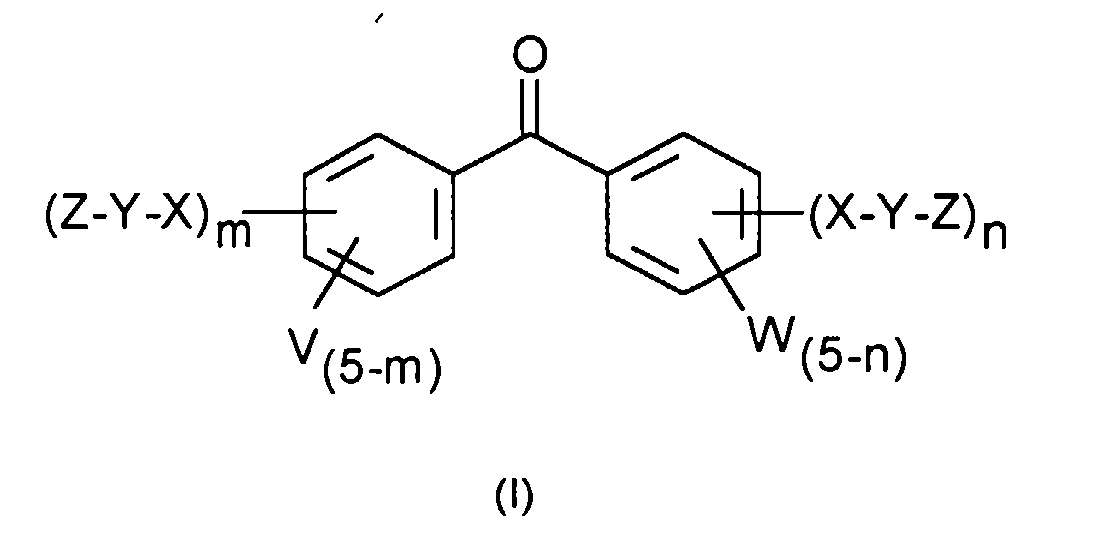
die im aromatischen Ring zur Carbonylgruppe α-ständigen Substituenten nicht OH
bedeuten dürfen,
- m und n
- unabhängig voneinander 0, 1 oder 2 bedeuten,
- V oder W
- unabhängig voneinander H, Hal, NO2, OH, OR1, CN, SR1, C1-C18-, vorzugsweise C1-C10-, insbesondere C1-C4-Alkyl, C3-C10-, vorzugsweise C5-C6-Cycloalkyl, unsubstituiertes oder mit OH, OR1, Hal oder NR1R2 substituiertes C6-C14-Aryl oder C7-C10-Arylalkyl, einen heteroaromatischen Rest mit 5-15, vorzugsweise 6-10 C-Atomen, NR1R2 oder COOR1 bedeuten,
- R1 und R2
- H, C1-C18-, vorzugsweise C1-C10-, insbesondere C1-C4-Alkyl, C3-C10-, vorzugsweise C5-C6-Cycloalkyl, unsubstituiertes oder mit OH, OR1 oder Hal substituiertes C6-C14-Aryl oder C7-C10-Arylalkyl, oder einen heteroaromatischen Rest mit 5-15, vorzugsweise 6-10 C-Atomen bedeuten,
- X
- einen zweibindigen Rest -O-, -S-, oder -C(O)- bedeutet,
- Y
- für X = O oder S -CH2-C(O)-, -C(O)-, -C(O)-C(O)-, -CH2-CHR1-,
-(CH2- CH2-O)n- (mit n = 1 - 8), vorzugsweise -C(O)- oder
-CH2-C(O)-, oder einen Rest
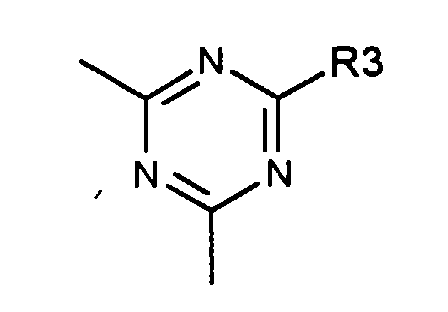
bedeutet, wobei R3 NR1R2, OR1, Halogen oder Z bedeutet,
- Y
- für X = -C(O)- eine direkte Bindung zu Z bedeutet,
- Z
- einen der folgenden Reste bedeutet,

worin
- R4
- Wasserstoff, C1-C20-, vorzugsweise C1-C10-, insbesondere C1-C5-Alkyl, ein Oxyl-Radikal, OH, NO, CH2CN, unsubstituiertes oder mit OH, OR1, Hal oder NR1R2 substituiertes C6-C14-Aryl oder C7-C10-Arylalkyl, Allyl, C1-C30-, vorzugsweise C1-C10-, insbesondere C1-C5-Alkyloxy, C5-C12-, vorzugsweise C6-C9-Cycloalkyloxy, C3-C10-, vorzugsweise C4-C8-Alkenyl, C3-C6-Alkinyl, C1-C10-, vorzugsweise C1-C5-Acyl, Halogen,
- R5
- Wasserstoff oder C1-C4-Alkyl, vorzugsweise Methyl, bedeutet.
which in the aromatic ring to the carbonyl group α-substituents may not mean OH,
- m and n
- independently of one another mean 0, 1 or 2,
- V or W
- independently of one another H, Hal, NO 2 , OH, OR 1 , CN, SR 1 , C 1 -C 18 -, preferably C 1 -C 10 -, in particular C 1 -C 4 alkyl, C 3 -C 10 -, preferably C 5 -C 6 cycloalkyl, unsubstituted or substituted by OH, OR 1 , Hal or NR 1 R 2 or C 6 -C 14 aryl or C 7 -C 10 arylalkyl, a heteroaromatic radical having 5-15, preferably 6 Mean -10 carbon atoms, NR 1 R 2 or COOR 1 ,
- R 1 and R 2
- H, C 1 -C 18 -, preferably C 1 -C 10 -, in particular C 1 -C 4 alkyl, C 3 -C 10 -, preferably C 5 -C 6 cycloalkyl, unsubstituted or with OH, OR 1 or Hal is substituted C 6 -C 14 aryl or C 7 -C 10 arylalkyl, or a heteroaromatic radical having 5-15, preferably 6-10, carbon atoms,
- X
- represents a double-bonded radical -O-, -S-, or -C (O) -,
- Y
- for X = O or S -CH 2 -C (O) -, -C (O) -, -C (O) -C (O) -, -CH 2 -CHR 1 -, - (CH 2 - CH 2 -O) n - (with n = 1-8), preferably -C (O) - or -CH 2 -C (O) -, or a radical where R 3 is NR 1 R 2 , OR 1 , halogen or Z,
- Y
- for X = -C (O) - means a direct bond to Z,
- Z.
- means one of the following residues,
wherein
- R 4
- Hydrogen, C 1 -C 20 -, preferably C 1 -C 10 -, in particular C 1 -C 5 alkyl, an oxyl radical, OH, NO, CH 2 CN, unsubstituted or with OH, OR 1 , Hal or NR 1 R 2 substituted C 6 -C 14 aryl or C 7 -C 10 arylalkyl, allyl, C 1 -C 30 -, preferably C 1 -C 10 -, in particular C 1 -C 5 alkyloxy, C 5 -C 12 -, preferably C 6 -C 9 cycloalkyloxy, C 3 -C 10 -, preferably C 4 -C 8 alkenyl, C 3 -C 6 alkynyl, C 1 -C 10 -, preferably C 1 -C 5 - Acyl, halogen,
- R 5
- Is hydrogen or C 1 -C 4 alkyl, preferably methyl.
Sehr gut geeignet sind auch Stabilisatoren, worin
die im aromatischen Ring zur Carbonylgruppe α-ständigen Substituenten nicht OH
bedeuten dürfen,
- m und n
- unabhängig voneinander 0, 1 oder 2 bedeuten,
- V oder W
- unabhängig voneinander H, NO2, OH, C1-C10-Alkyl, C5-C6-Cycloalkyl, unsubstituiertes oder mit OH oder NR1R2 substituiertes C6-C14-Aryl oder C7-C10-Arylalkyl, einen heteroaromatischen Rest mit 6-10 C-Atomen, NR1R2 oder COOR1 bedeuten,
- R1 und R2
- H, C1-C10-Alkyl, C5-C6-Cycloalkyl, unsubstituiertes oder mit OH substituiertes C6-C14-Aryl oder C7-C10-Arylalkyl, oder einen heteroaromatischen Rest mit 6-10 C-Atomen bedeuten,
- X
- einen zweibindigen Rest -O- oder -C(O)- bedeutet,
- Y
- für X = O -CH2-C(O)-, -C(O)- oder -CH2-CHR1- bedeutet,
- Z
- den Rest RA, RC, RD oder RE bedeutet, worin
- R4
- Wasserstoff, C1-C10-Alkyl, ein Oxyl-Radikal, OH, NO, unsubstituiertes oder mit OH oder NR1R2 substituiertes C6-C14-Aryl oder C7-C10-Arylalkyl, Allyl, C1-C10-Alkyloxy, C6-C9-Cycloalkyloxy, C4-C8-Alkenyl, C3-C6-Alkinyl, C1-C5-Acyl, Halogen, und
- R5
- Wasserstoff oder C1-C4-Alkyl bedeutet.
which in the aromatic ring to the carbonyl group α-substituents may not mean OH,
- m and n
- independently of one another mean 0, 1 or 2,
- V or W
- independently of one another H, NO 2 , OH, C 1 -C 10 alkyl, C 5 -C 6 cycloalkyl, unsubstituted or substituted by OH or NR 1 R 2 C 6 -C 14 aryl or C 7 -C 10 arylalkyl mean a heteroaromatic radical with 6-10 C atoms, NR 1 R 2 or COOR 1 ,
- R 1 and R 2
- H, C 1 -C 10 alkyl, C 5 -C 6 cycloalkyl, unsubstituted or OH-substituted C 6 -C 14 aryl or C 7 -C 10 arylalkyl, or a heteroaromatic radical having 6-10 C atoms mean,
- X
- denotes a double-bond radical -O- or -C (O) -,
- Y
- for X = O -CH 2 -C (O) -, -C (O) - or -CH 2 -CHR 1 - means
- Z.
- is the radical R A , R C , R D or R E , wherein
- R 4
- Hydrogen, C 1 -C 10 alkyl, an oxyl radical, OH, NO, unsubstituted or substituted by OH or NR 1 R 2 C 6 -C 14 aryl or C 7 -C 10 arylalkyl, allyl, C 1 - C 10 alkyloxy, C 6 -C 9 cycloalkyloxy, C 4 -C 8 alkenyl, C 3 -C 6 alkynyl, C 1 -C 5 acyl, halogen, and
- R 5
- Is hydrogen or C 1 -C 4 alkyl.
Besonders geeignete UV-Stabilisatoren sind Verbindungen der Formel I, worin die im aromatischen Ring zur Carbonylgruppe α-ständigen Substituenten nicht OH bedeuten dürfen,
- m und n
- unabhängig voneinander 0, 1 oder 2 bedeuten,
- V oder W
- unabhängig voneinander H, NO2, C1-C4-Alkyl, NR1R2 oder COOR1 bedeuten,
- R1 und R2
- H, C1-C4-Alkyl, unsubstituiertes oder mit OH substituiertes C6-C14-Aryl oder C7-C10-Arylalkyl bedeuten,
- X
- einen zweibindigen Rest -O- oder -C(O)- bedeutet,
- Y
- für X = -O- -C(O)- oder CH2-C(O)- bedeutet,
- Y
- für X = -C(O)- eine direkte Bindung zu Z bedeutet,
- Z
- einen Rest der Formel RC oder RE bedeutet, worin
- R4
- Wasserstoff, OH, NO, C1-C5-Alkyl, C1-C5-Alkyloxy,C1-C5-Acyl und
- R5
- Methyl bedeutet.
- m and n
- independently of one another mean 0, 1 or 2,
- V or W
- independently of one another are H, NO 2 , C 1 -C 4 alkyl, NR 1 R 2 or COOR 1 ,
- R 1 and R 2
- Is H, C 1 -C 4 alkyl, unsubstituted or OH-substituted C 6 -C 14 aryl or C 7 -C 10 arylalkyl,
- X
- denotes a double-bond radical -O- or -C (O) -,
- Y
- for X = -O- -C (O) - or CH 2 -C (O) - means
- Y
- for X = -C (O) - means a direct bond to Z,
- Z.
- is a radical of the formula R C or R E , wherein
- R 4
- Hydrogen, OH, NO, C 1 -C 5 alkyl, C 1 -C 5 alkyloxy, C 1 -C 5 acyl and
- R 5
- Methyl means.
Die Erfindung bezieht sich auch auf die Herstellung dieser Verbindungen (I). Die erfindungsgemäßen Verbindungen können grundsätzlich auf zwei verschiedenen Wegen aufgebaut werden.The invention also relates to the preparation of these compounds (I). The Compounds according to the invention can in principle be used in two Because of being built up.
Zum einen kann man die erfindungsgemäße Verbindung in einer Weise aufbauen, daß
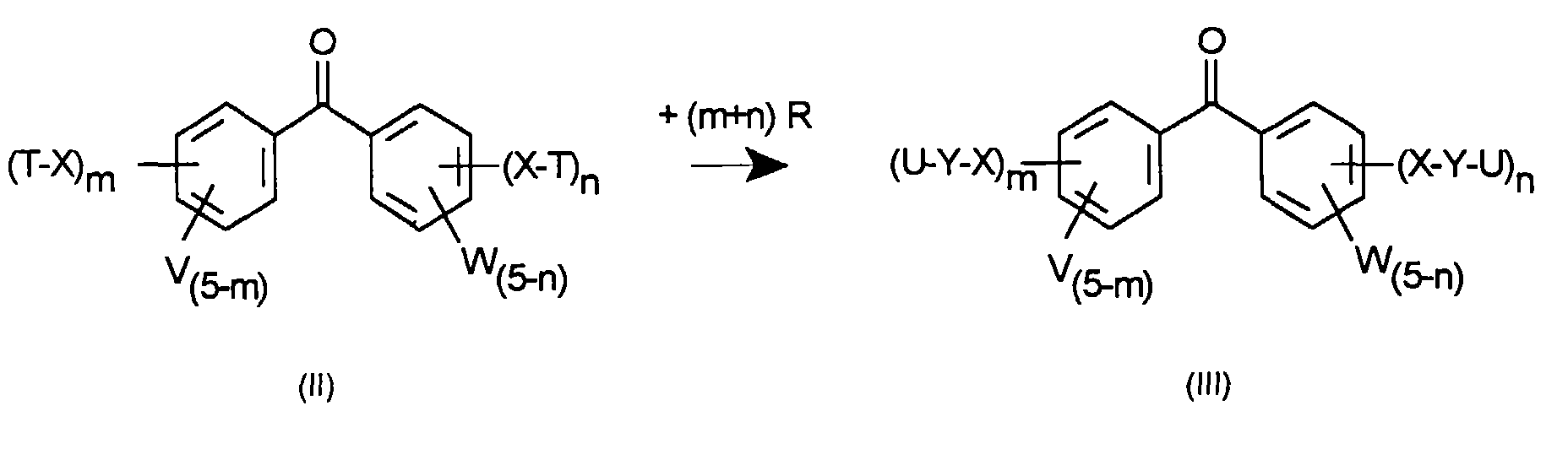
ein Benzophenon (II) mit einem oder mehreren Äquivalenten eines geeigneten
Reagenzes R in ein reaktives Molekül (III) überführt wird:

Bedeutung von T:
Bedeutung von R:
- R bedeutet
- Hal-CH2-C(O)-U,
U-C(O)-U,
U-C(O)-C-(O)-U,
Ethylenoxid
Hal-CH2-CHR1-Hal,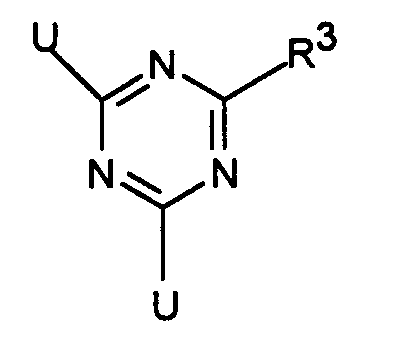
Bedeutung von U: U = Halogen, OR1, NR1R2.
Die übrigen Substituenten sind wie in Formel I definiert.Meaning of R:
- R means
- Hal-CH 2 -C (O) -U,
UC (O) -U,
UC (O) -C- (O) -U,
Ethylene oxide
Hal-CH 2 -CHR 1 -Hal,
Meaning of U: U = halogen, OR 1 , NR 1 R 2 .
The remaining substituents are as defined in formula I.

Bei dem Reagenz R handelt es sich z. B. um 2,4,6-Trichlor-s-triazin (= Cyanurchlorid), Phosgen, Bromessigsäurealkylester, Chloressigsäurealkylester, Chlorameisensäuremethylester, Oxalsäure, Oxalsäuredihalogenid, Oxalsäuredialkylester, Oxalsäurehalogenidmonoester, Ethylenoxid, Thionylchlorid (SOCl2), Phosphor(III)halogenid (PCl3 oder PBr3), Halogenwasserstoff (HCl, HBr), elementares Chlor. The reagent R is e.g. B. 2,4,6-trichloro-s-triazine (cyanuric chloride =), phosgene, Bromessigsäurealkylester, chloroacetate, methyl chloroformate, oxalic acid, Oxalsäuredihalogenid, Oxalsäuredialkylester, Oxalsäurehalogenidmonoester, ethylene oxide, thionyl chloride (SOCl 2), phosphorous (III) halide (PCl 3 or PBr 3 ), hydrogen halide (HCl, HBr), elemental chlorine.
In einem zweiten Schritt wird die Verbindung (III) mit Z-H zu der erfindungsgemäßen Verbindung (I) umgesetzt. Zur Reaktion kann auch das Anion Z- verwendet werden, welches vorzugsweise aus der Verbindung Z-H hergestellt wird (mit Z = in Formel I beschriebene Bedeutung und H = Wasserstoff). Falls es sich in Verbindung (II) bei -X-T um -C(O)OR1, -C(O)NR1R2, -C(O)-O-C(O)-R1 handelt, so kann auch bereits die Verbindung (II) mit Z-H oder mit dem Anion Z- zu der Zielverbindung (I) umgesetzt werden.In a second step, the compound (III) is reacted with ZH to give the compound (I) according to the invention. The anion Z - can also be used for the reaction, which is preferably prepared from the compound ZH (with Z = meaning described in formula I and H = hydrogen). If in -XT in compound (II) is -C (O) OR 1 , -C (O) NR 1 R 2 , -C (O) -OC (O) -R 1 , then the Compound (II) with ZH or with the anion Z - to the target compound (I).
Alternativ kann der Weg beschritten werden, zuerst ein literaturbekanntes Derivat des
2,2,6,6-Tetraalkylpiperidins, wie z. B. eine der Verbindungen Z-H oder Z-M mit (M = z.
B. Na, K ...), mit einem Reagenz (U-Y-U) zu dem Intermediat Z-Y-U umzusetzen. Z und
H haben die weiter oben angegebene Bedeutung.
Verbindung Z-Y-U wird in dieser Herstellungsvariante in einer anschließenden
Reaktion mit einem geeignet substituierten Derivat des Benzophenons
(= Verbindungen der Formel II mit -XT = -OH oder -SH) zu den erfindungsgemäßen
Verbindungen (I) umgesetzt.Alternatively, the way can be followed, first a literature derivative of 2,2,6,6-tetraalkylpiperidine, such as. B. one of the compounds ZH or ZM with (M = z. B. Na, K ...), with a reagent (UYU) to implement the intermediate ZYU. Z and H have the meaning given above.
In this production variant, compound ZYU is reacted in a subsequent reaction with a suitably substituted derivative of benzophenone (= compounds of the formula II with -XT = -OH or -SH) to give the compounds (I) according to the invention.
Die Umsetzungen erfolgen in einem protischen oder aprotischen, organischen Lösemittel, vorzugsweise einem Kohlenwasserstoff, insbesondere aromatischen Kohlenwasserstoffen wie beispielsweise Toluol, Xylol oder in Gemischen hieraus oder in Tetrahydrofuran. Eine weitere Möglichkeit besteht darin, eine der Reaktionskomponenten im Überschuß als Lösemittel zu verwenden.The reactions take place in a protic or aprotic, organic Solvents, preferably a hydrocarbon, especially aromatic Hydrocarbons such as toluene, xylene or in mixtures thereof or in tetrahydrofuran. Another option is to use one of the To use reaction components in excess as a solvent.
Die erfindungsgemäßen Verbindungen eignen sich in hervorragender Weise zum Stabilisieren von organischem Material gegen die Einwirkung von Licht, Strahlung, Sauerstoff und Wärme. Sie werden dem zu stabilisierenden organischen Material in einer Konzentration von 0,001 bis 5 Gew.-%, vorzugsweise von 0,02 bis 1,0 Gew.-%, bezogen auf das organische Material, vor, während oder nach seiner Herstellung zugesetzt. The compounds according to the invention are outstandingly suitable for Stabilizing organic material against the effects of light, radiation, Oxygen and heat. You will in the organic material to be stabilized a concentration of 0.001 to 5% by weight, preferably 0.02 to 1.0% by weight, based on the organic material, before, during or after its production added.
Unter organischem Material sind beispielsweise Vorprodukte für Kunststoffe, Lacke, Anstrichmittel und Öle, insbesondere jedoch Kunststoffe, Lacke, Anstrichmittel und Öle selbst, zu verstehen.Organic materials include, for example, preliminary products for plastics, paints, Paints and oils, but especially plastics, paints, paints and oils yourself to understand.
Gegenstand der vorliegenden Erfindung sind außerdem gegen die Einwirkung von Licht, Strahlung, Sauerstoff und Wärme stabilisierte organische Materialien, insbesondere Kunststoffe, Lacke, Anstrichmittel und Öle, welche die erfindungsgemäßen Verbindungen in den oben angegebenen Konzentrationen enthalten. Zu diesen organischen Materialien gehören beispielsweise Stoffe, wie sie beschrieben sind auf den Seiten 13-18 der Europäischen Patentanmeldung 95 109 778.1-1270, auf die hier ausdrücklich Bezug genommen wird.The present invention also relates to the action of Light, radiation, oxygen and heat stabilized organic materials, especially plastics, paints, paints and oils, which the Compounds according to the invention in the concentrations given above contain. These organic materials include, for example, substances such as these are described on pages 13-18 of European patent application 95 109 778.1-1270, to which express reference is made here.
Das durch die erfindungsgemäßen Verbindungen stabilisierte organische Material kann
gegebenenfalls noch weitere Additive enthalten, beispielsweise Antioxidantien
Lichtstabilisierungsmittel, Metalldesaktivatoren, antistatische Mittel, flammhemmende
Mittel, Pigmente und Füllstoffe. Antioxidantien und Lichtstabilisatoren, die neben den
erfindungsgemäßen Verbindungen zugesetzt werden, sind beispielsweise
Verbindungen auf der Basis sterisch gehinderter Amine oder sterisch gehinderter
Phenole oder Schwefel oder Phosphor enthaltende Costabilisatoren. Als geeignete
zusätzliche Additive kommen beispielsweise Verbindungen in Betracht, wie sie
beschrieben sind auf den Seiten 18-29 der Europäischen Patentanmeldung 95 109
778.1-1270, auf die hier ausdrücklich Bezug genommen wird.
Als weitere geeignete Additive kommen zusätzlich in Betracht:
2,2',2''-Nitrilo[triethyl-tris(3,3',5,5'-tetra-tert.butyl-1,1'-biphenyl-2,2'-diyl)phosphit],
Bis[2-methyl-4,6-bis(1,1-dimethylethyl)phenol]phosphorigsäure-ethylester,
sekundäre Hydroxylamine wie z. B. Distearylhydroxylamin oder Dilaurylstearylamin,
Zeolithe wie z. B. DHT 4A, Oxide und Hydroxide von Aluminium, Zink, Alkali- und
Erdalkalimetalle, Al-, Ca-, Mg-, Zn-Stearat, wobei für einzelne Anwendungen
besonders feinkörniges Material speziell geeignet ist, Kondensationsprodukt aus N,N'-Bis[(4,6-di(4-n-butylamino-2,2,6,6-tetramethylpiperid-4-yl)1,3,5-triazin-2-yl]-3-
aminopropyl-ethylen-1,2-diamin und 2,4-Dichlor-6-(4-n-butylamino-2,2,6,6-tetramethylpiperid-4-yl)1,3,5-triazin,
1,3,-2,4-Di(benziliden)-D-sorbitol, 1,3-2,4-Di-(4-tolyliden)-D-sorbitol,
1,3-2,4-Di(4-ethylbenziliden)-D-sorbitol.The organic material stabilized by the compounds according to the invention may optionally contain further additives, for example antioxidants, light stabilizers, metal deactivators, antistatic agents, flame retardants, pigments and fillers. Antioxidants and light stabilizers which are added in addition to the compounds according to the invention are, for example, compounds based on sterically hindered amines or sterically hindered phenols or costabilizers containing sulfur or phosphorus. Suitable additional additives include, for example, compounds as described on pages 18-29 of European patent application 95 109 778.1-1270, to which express reference is made here.
Other suitable additives are additionally: 2,2 ', 2''nitrilo [triethyl-tris (3,3', 5,5'-tetra-tert-butyl-1,1'-biphenyl-2,2 '-diyl) phosphite], bis [2-methyl-4,6-bis (1,1-dimethylethyl) phenol] ethyl phosphate, secondary hydroxylamines such as, for. B. distearylhydroxylamine or dilaurylstearylamine, zeolites such. B. DHT 4A, oxides and hydroxides of aluminum, zinc, alkali and alkaline earth metals, Al, Ca, Mg, Zn stearate, where particularly fine-grained material is particularly suitable for individual applications, condensation product of N, N'-bis [(4,6-di (4-n-butylamino-2,2,6,6-tetramethylpiperid-4-yl) 1,3,5-triazin-2-yl] -3-aminopropylethylene-1,2 -diamine and 2,4-dichloro-6- (4-n-butylamino-2,2,6,6-tetramethylpiperid-4-yl) 1,3,5-triazine, 1,3, -2,4-di (benzilidene) -D-sorbitol, 1,3-2,4-di- (4-tolylidene) -D-sorbitol, 1,3-2,4-di (4-ethylbenzilide) -D-sorbitol.
Mischungsbestandteil können auch Hydrotalcite sein, die beschrieben werden können
nach der allgemeinen Formel
- (M2+)
- Mg, Ca, Sr, Ba, Zn, Pb, Sn, Ni,
- (M3+)
- Al, B, Bi,
- An
- ein Anion der Wertigkeit n,
- n
- eine ganze Zahl von 1 - 4,
- x
- einen Wert zwischen 0 und 0,5,
- y
- einen Wert zwischen 0 und 2, und
- A
- OH-, Cl-, Br-, I-, ClO4 -, CH3COO-, C6H5COO-, CO3 2-, SO4 2-, (OOC-COO)2-, (CHOHCOO)2 2-, (CHOH)4CH2OHCOO-, C2H4(COO)2 2-, (CH2COO)2 2-, CH3CHOHCOO-, SiO3 2-, SiO4 4-, Fe(CN)6 3-, Fe(CN)6 4-, BO3 3-, PO3 3-, HPO4 2-, bedeutet.
- (M 2+ )
- Mg, Ca, Sr, Ba, Zn, Pb, Sn, Ni,
- (M 3+ )
- Al, B, Bi,
- A n
- an anion of valence n,
- n
- an integer from 1 to 4,
- x
- a value between 0 and 0.5,
- y
- a value between 0 and 2, and
- A
- OH - , Cl - , Br - , I - , ClO 4 - , CH 3 COO - , C 6 H 5 COO - , CO 3 2- , SO 4 2- , (OOC-COO) 2- , (CHOHCOO) 2 2- , (CHOH) 4 CH 2 OHCOO - , C 2 H 4 (COO) 2 2- , (CH 2 COO) 2 2- , CH 3 CHOHCOO - , SiO 3 2- , SiO 4 4 -, Fe (CN ) 6 3- , Fe (CN) 6 4- , BO 3 3- , PO 3 3- , HPO 4 2- .
Bevorzugt eingesetzt werden Hydrotalcite, in welchen (M2+) für (Ca2+), (Mg2+) oder
eine Mischung aus (Mg2+) und (Zn2+); (An-) für CO3 2-, BO3 3-, PO3 3- stehen.
Weiterhin können auch Hydrotalcite, die mit der Formel
Hier steht (M2+) für Mg2+ oder Zn2+, bevorzugterweise jedoch Mg2+.
(An-) steht für ein Anion, besonders aus der Gruppe CO3 2-, (OOC-COO)2-, OH- und S2-,
wobei n die Wertigkeit des lons beschreibt.
Here (M 2+ ) stands for Mg 2+ or Zn 2+ , but preferably Mg 2+ .
(A n- ) stands for an anion, especially from the group CO 3 2- , (OOC-COO) 2- , OH - and S 2- , where n describes the valence of the ion.
Hydrotalcite werden im Polymer bevorzugt in einer Konzentration von 0,01 bis 5 Gew.%, besonders von 0,2 bis 3 Gew.%, bezogen auf die gesamte Polymerzubereitung, eingesetzt.Hydrotalcites are preferred in the polymer in a concentration of 0.01 to 5 % By weight, in particular from 0.2 to 3% by weight, based on the total Polymer preparation used.
Die Additive werden nach allgemein üblichen Methoden in die organischen Polymere eingearbeitet. Die Einarbeitung kann beispielsweise durch Einmischen oder Aufbringen der Verbindungen und gegebenenfalls weiterer Additive in oder auf das Polymere unmittelbar nach der Polymerisation oder in die Schmelze vor oder während der Formgebung erfolgen. Auch durch Aufbringen der gelösten oder dispergierten Verbindungen auf das Polymere direkt oder Einmischen in eine Lösung, Suspension oder Emulsion des Polymeren, gegebenenfalls unter nachträglicher Verdunstung des Lösemittels, kann die Einarbeitung erfolgen. Die Verbindungen sind auch wirksam, wenn sie in ein bereits granuliertes Polymer nachträglich in einem gesonderten Verarbeitungsschritt eingebracht werden. Die erfindungsgemäßen Verbindungen der Formel (I) können auch in Form eines Masterbatches, der diese Verbindungen beispielsweise in einer Konzentration von 1 bis 75, vorzugsweise 2,5 bis 30 Gew.-% enthält, den zu stabilisierenden Polymeren zugesetzt werden.The additives are added to the organic polymers by generally customary methods incorporated. The incorporation can, for example, by mixing or applying the compounds and optionally further additives in or on the polymer immediately after the polymerization or in the melt before or during the Shaping. Also by applying the dissolved or dispersed Connections to the polymer directly or mixing into a solution, suspension or emulsion of the polymer, optionally with subsequent evaporation of the Solvent, the incorporation can take place. The connections are also effective if they are subsequently in a granulated polymer in a separate Processing step are introduced. The compounds of the invention Formula (I) can also be in the form of a masterbatch of these compounds for example in a concentration of 1 to 75, preferably 2.5 to 30% by weight contains, to be added to be stabilized polymers.
Die nachfolgenden Beispiele sollen die Erfindung näher erläutern. Alle Verbindungen konnten anhand ihrer 1H- bzw. 13C-NMR-Spektren eindeutig identifiziert werden. Die Herkunft der Ausgangsmaterialien ist in den entsprechenden Tabellen ausgewiesen.The following examples are intended to explain the invention in more detail. All compounds were clearly identified on the basis of their 1 H and 13 C NMR spectra. The origin of the starting materials is shown in the corresponding tables.
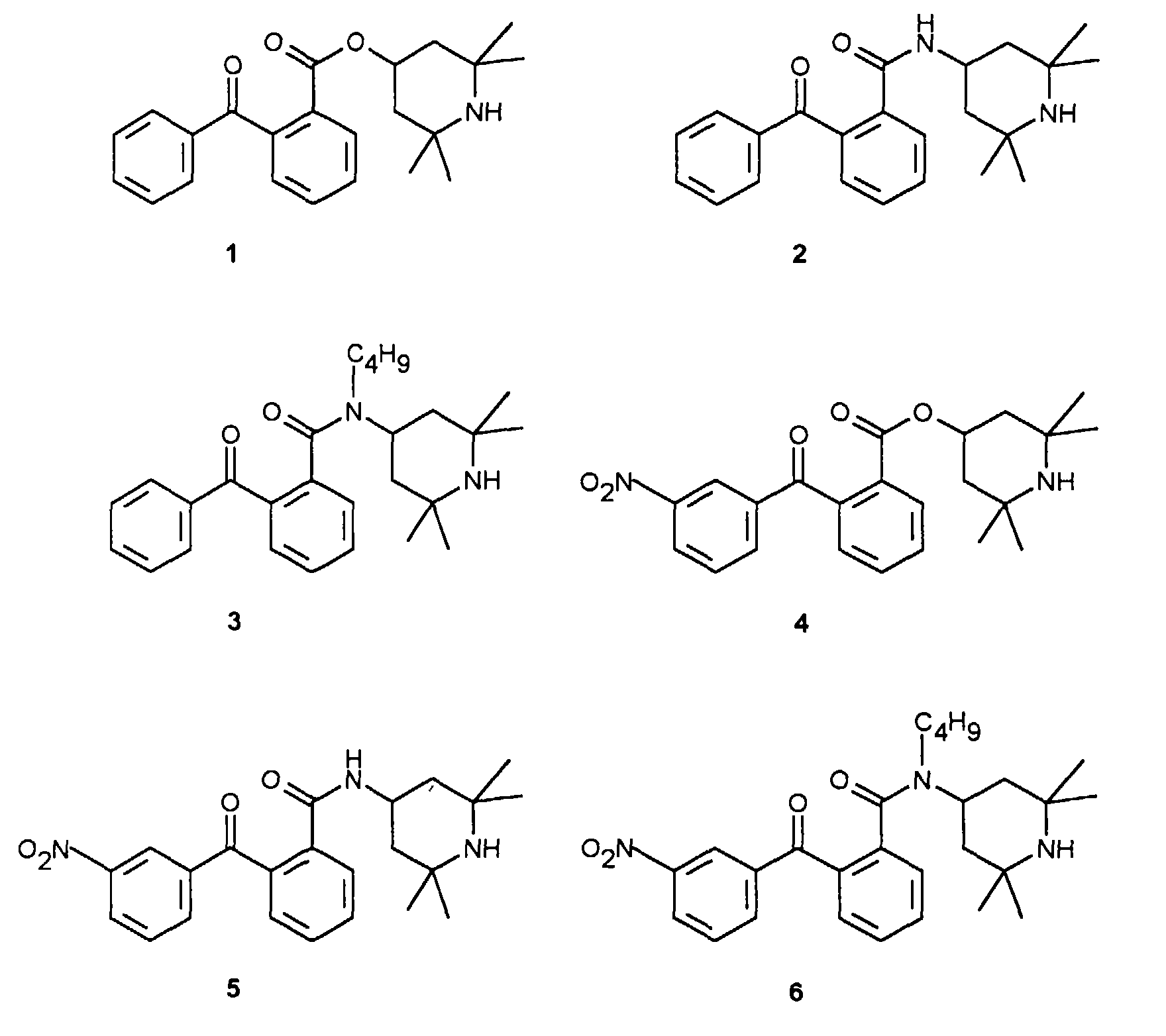
Die Umsetzung wird unter Stickstoff und unter Ausschluß von Luft und Wasser
durchgeführt.
Eine Menge von 25-100 mmol der Verbindung A, B oder C (Tabelle 1) und ein 10%iger
Überschuß von Triethylamin werden in 150 ml Toluol vorgelegt. Eine, bezogen auf A, B
oder C, äquimolare Menge eines Säurechlorides D oder E wird in 30 ml Toluol gelöst
und in die vorgelegte Lösung bei 22 °C langsam zugegeben. Nach 3 h Rühren bei
109 °C fällt ein heller Niederschlag aus. Die Reaktionsmischung wird auf Wasser
gegossen, der Niederschlag löst sich auf. Die organische Phase wird mit Wasser
gewaschen, mit Natriumsulfat getrocknet und von diesem abfiltriert. Die flüchtigen
Bestandteile werden im Vakuum entfernt, der Rückstand wird bei 80 °C im Vakuum
getrocknet.
B = 2,2,6,6-Tetramethyl-4-piperidinamin* (M = 156,31)
C = N-Butyl-2,2,6,6-tetramethyl-4-piperidinamin* (M = 212,43)
D = Benzophenon-2-carbonsäurechlorid***, (M = 244,68)
E = 3-Nitrobenzophenon-2
M = Molgewicht; vs = very strong; s = strong; sh = shoulder; m = medium; w = weak
An amount of 25-100 mmol of compound A, B or C (Table 1) and a 10% excess of triethylamine are placed in 150 ml of toluene. An, based on A, B or C, an equimolar amount of an acid chloride D or E is dissolved in 30 ml of toluene and slowly added to the solution at 22 ° C. After stirring for 3 h at 109 ° C., a light precipitate is formed. The reaction mixture is poured onto water and the precipitate dissolves. The organic phase is washed with water, dried with sodium sulfate and filtered off. The volatile constituents are removed in vacuo, the residue is dried at 80 ° C. in vacuo.
B = 2,2,6,6-tetramethyl-4-piperidinamine * (M = 156.31)
C = N-butyl-2,2,6,6-tetramethyl-4-piperidinamine * (M = 212.43)
D = benzophenone-2-carboxylic acid chloride ***, (M = 244.68)
E = 3-nitrobenzophenone-2
M = molecular weight; vs = very strong; s = strong; sh = shoulder; m = medium; w = weak
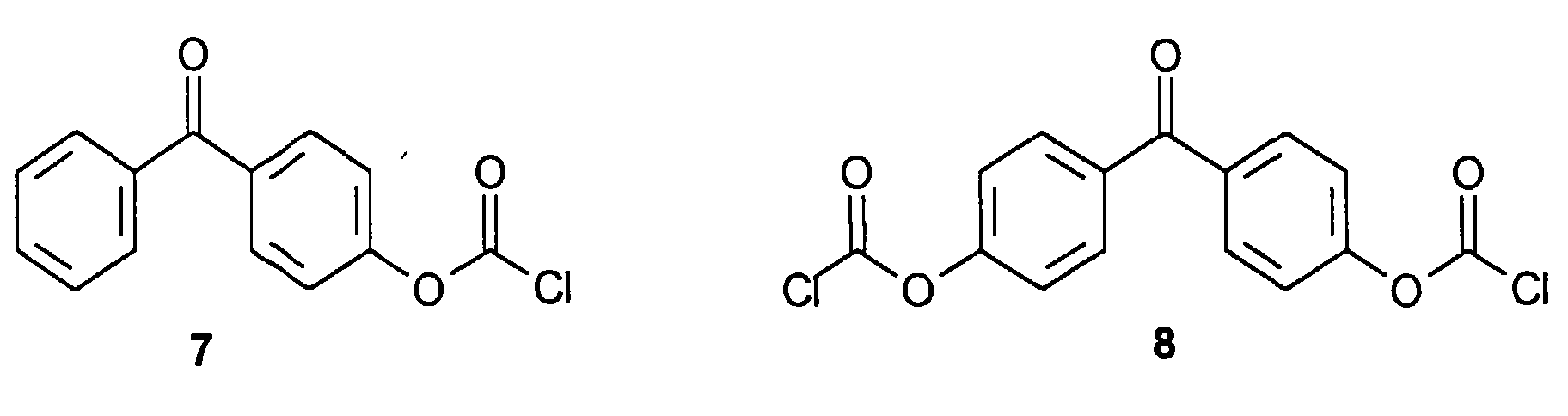
Etwa 50 - 120 mmol der Verbindung F oder G (vgl. Tabelle 2) und ein leichter Überschuß an N,N-Dimethylanilin werden in einer Mischung aus 150 ml Toluol und 50 ml Tetrahydrofuran vorgelegt. Über 16 Stunden wird bei 50 °C ein leichter Strom Phosgen durch die Lösung geleitet. Nach weiteren 2 Stunden Rühren bei 80 °C wird die Lösung auf Wasser gegossen. Die Mischung wird mit 10 %iger HCl auf pH 1 gebracht und mit 50 ml Methylenchlorid versetzt. Die organische Phase wird mit 10 %iger HCl gewaschen, abgetrennt, mit Natriumsulfat getrocknet, von diesem abfiltriert und im Vakuum vom Lösungsmittel befreit. Der Chlorameisensäureester wird in Form eines hellen, kristallinen Feststoffs isoliert.About 50-120 mmol of compound F or G (see Table 2) and a light one Excess N, N-dimethylaniline in a mixture of 150 ml of toluene and 50 ml of tetrahydrofuran submitted. A light current is generated at 50 ° C for 16 hours Phosgene passed through the solution. After stirring for a further 2 hours at 80 ° C. poured the solution onto water. The mixture is brought to pH 1 with 10% HCl brought and mixed with 50 ml of methylene chloride. The organic phase is 10 % HCl washed, separated, dried with sodium sulfate, filtered off and freed from the solvent in vacuo. The chloroformate is in shape of a bright, crystalline solid.

20-60 mmol der Verbindung A oder C (vgl. Tabelle 2) und ein leichter Überschuß eines
Amins werden in 150 ml Toluol vorgelegt. Der Chlorameisensäureester
(7 bzw. 8) wird in 30 ml Toluol gelöst und in die vorgelegte Lösung bei 20 °C unter
Eiskühlung langsam zugegeben. Nach 2 h Rühren bei 22 °C und 1 h bei
107 °C wird die Reaktionsmischung auf Wasser gegossen und mit 50 ml
Methylenchlorid versetzt. Die organische Phase wird mit Wasser gewaschen, mit
Natriumsulfat getrocknet und filtriert. Die flüchtigen Bestandteile werden im Vakuum
entfernt, der Rückstand wird bei 80 °C im Vakuum getrocknet.
B = N-Butyl-2,2,6,6-tetramethyl-4-piperidinamin** (M = 212,43)
C = N-Butyl-2,2,6,6-tetramethyl-4-piperidinamin* (M = 212,43)
F = 4-Hydroxybenzophenon*
G = 4,4
H = N,N-Dimethylanilin*
I = Pyridin*
J = Triethylamin*
B = N-butyl-2,2,6,6-tetramethyl-4-piperidinamine ** (M = 212.43)
C = N-butyl-2,2,6,6-tetramethyl-4-piperidinamine * (M = 212.43)
F = 4-hydroxybenzophenone *
G = 4.4
H = N, N-dimethylaniline *
I = pyridine *
J = triethylamine *

Die Umsetzung wird unter Stickstoff und unter Ausschluß von Luft und Wasser
durchgeführt.
40-100 mmol der Verbindung K - Q (vgl. Tabelle 3) werden in 100 ml wasserfreiem
Tetrahydrofuran vorgelegt. Ein 10%iger Überschuß an Natriumhydrid (80%ig in
Paraffin) wird bei 20 °C portionsweise zugegeben, wobei die Lösung leicht aufschäumt
und ein Niederschlag ausfällt. Nach 0,5 h Nachrühren ist der Vorgang beendet und
eine äquimolare Menge an Bromessigsäuremethylester wird langsam zugegeben. Nach
8 h Nachrühren bei 66 °C hellt sich die Farbe der Suspension deutlich auf. Die
flüchtigen Bestandteile werden im Vakuum entfernt, der Rückstand mit 50 ml
Methylenchlorid versetzt und dreimal mit je 50 ml Wasser ausgeschüttet. Die
organische Phase wird mit Natriumsulfat getrocknet, von diesem abfiltriert und im
Vakuum werden die flüchtigen Bestandteile entfernt.
L = 4-Hydroxybenzophenon*
M = 2-Methyl-4-hydroxy-4
N = 2-Methyl-4-hydroxy-3
O = 4-Hydroxy-4
P = 3,4-Dihydroxy-4
Q = 3,4-Dihydroxy-3
40-100 mmol of the compound K - Q (see Table 3) are placed in 100 ml of anhydrous tetrahydrofuran. A 10% excess of sodium hydride (80% in paraffin) is added in portions at 20 ° C., the solution foaming up slightly and a precipitate separating out. After stirring for 0.5 h, the process is complete and an equimolar amount of methyl bromoacetate is slowly added. After stirring for 8 h at 66 ° C, the color of the suspension lightens significantly. The volatile constituents are removed in vacuo, the residue is mixed with 50 ml of methylene chloride and poured out three times with 50 ml of water each time. The organic phase is dried with sodium sulfate, filtered off, and the volatiles are removed in vacuo.
L = 4-hydroxybenzophenone *
M = 2-methyl-4-hydroxy-4
N = 2-methyl-4-hydroxy-3
O = 4-hydroxy-4
P = 3,4-dihydroxy-4
Q = 3,4-dihydroxy-3
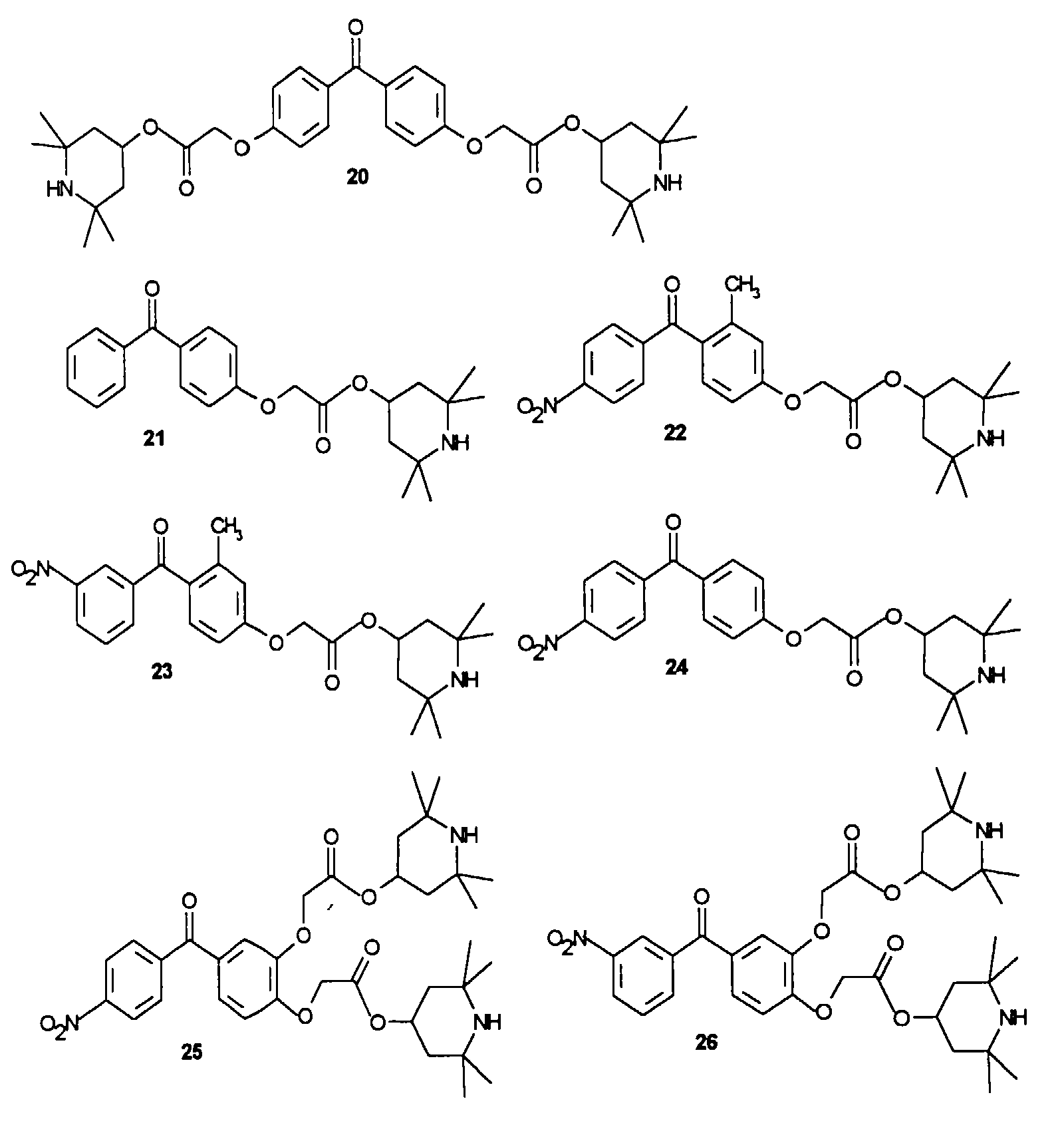
20 - 40 mmol des beschriebenen Methylesters (13 - 19), werden mit einer äquimolaren
Menge 2,2,6,6-Tetramethylpiperidin-4-ol (vgl. Tabelle 4) und 200 mg Lithiumamid
(9 mmol) in 200 ml Xylol bei 135°C über 8 h gerührt, wobei das langsam entstehende
Methanol zusammen mit etwas Xylol langsam kontinuierlich abdestilliert wird. Die
Mischung wird nach Erkalten in Wasser eingegossen. Die organische Phase wird
dreimal mit je 50 ml Wasser gewaschen, mit Natriumsulfat getrocknet und von diesem
abfiltriert. Nach Entfernen der flüchtigen Bestandteile im Vakuum wird das Produkt bei
80°C im Vakuum getrocknet.
100 Gewichtsteile unstabilisiertes Polypropylen ®Hostalen PPK wurden zusammen mit
0,1 Gewichtsteilen Calciumstearat, 0,05 Gewichtsteilen Pentaerythrityl-tetrakis-3-(3,5-di-t-butyl-4-hydroxyphenyl)-propionat
und 0,1 Gewichtsteilen des zu prüfenden
Stabilisators in einem Brabender-Mischer 10 min bei 200°C und 20 U/min geknetet.
Aus dieser Mischung wurde bei 190°C eine 100 µm starke Folie gepreßt und die auf
diese Weise erhaltenen Prüfkörper in einem Bewitterungsgerät (®Xenotest 1200) über
die Dauer von 500 Stunden belichtet. Als Kriterium der Stabilität der Folie wurde die
Veränderung des Carbonylindexes innerhalb dieser Zeitspanne herangezogen. Der
Carbonylindex CO wurde hierbei gemäß der Formel CO = E1720/E2020 (E bedeutet die
Extinktion bei der jeweiligen Wellenlänge) bestimmt. Zu Vergleichszwecken wurde eine
Folie unter den gleichen Bedingungen, jedoch ohne den Zusatz eines
erfindungsgemäßen Stabilisators getestet. Die Versuchsergebnisse sind in Tabelle 5
zusammengestellt:
Tabelle 5 unterstreicht die sehr gute Lichtstabilität von erfindungsgemäß stabilisiertem Polypropylen gegenüber nicht stabilisiertem Polypropylen, wobei fast die Lichtstabilität von mit Bis(2,2,6,6-tetramethyl-4-piperidyl)sebacat stabilisiertem Polyproylen erreicht wird.Table 5 underlines the very good light stability of stabilized according to the invention Polypropylene versus non-stabilized polypropylene, with almost the light stability of polypropylene stabilized with bis (2,2,6,6-tetramethyl-4-piperidyl) sebacate becomes.
100 Gewichtsteile unstabilisiertes Polypropylen ®Hostalen PPK wurden zusammen mit
0,1 Gewichtsteilen Calciumstearat, 0,05 Gewichtsteilen Pentaerythrityl-tetrakis-3-(3,5-di-t-butyl-4-hydroxyphenyl)-propionat
und 0,1 Gewichtsteilen des zu prüfenden
Stabilisators in einem Brabender-Mischer 10 min bei 200°C und 20 U/min geknetet.
Aus dieser Mischung wurde bei 190°C eine 100 µm starke Folie gepreßt und die auf
diese Weise erhaltenen Prüfkörper in einem Bewitterungsgerät (®Xenotest 1200) 200
Stunden belichtet. Nach dieser Vorbelichtung wurden die Folienstücke mit
Methylenchlorid extrahiert (24 h, 40°C) und anschließend über einen Zeitraum von
weiteren 300 Stunden belichtet. Als Kriterium der Stabilität der Folie wurde die
Veränderung des Carbonylindexes innerhalb dieser Zeitspanne (500 h
Gesamtbeschichtungszeit) herangezogen. Der Carbonylindex CO wurde hierbei gemäß
der Formel CO = E1720/E2020 bestimmt. Zu Vergleichszwecken wurde eine Folie unter
den gleichen Bedingungen, jedoch ohne den Zusatz eines erfindungsgemäßen
Stabilisators getestet. Die Versuchsergebnisse sind in Tabelle 6 zusammengestellt:
Tabelle 6 beweist, daß die Lichtschutzwirkung der erfindungsgemäß hergestellten Stabilisatoren auch nach Extraktion mit Methylenchlorid erhalten bleibt, und besser ist als Bis(2,2,6,6-tetramethyl(4-piperidyl)sebacat.Table 6 proves that the sun protection effect of those produced according to the invention Stabilizers are retained even after extraction with methylene chloride, and is better as bis (2,2,6,6-tetramethyl (4-piperidyl) sebacate.
Die analog Beispiel 27 hergestellten Prüfkörper wurden 200 h in einem
Bewitterungsgerät (®Xenotest 1200) belichtet. Danach wurden die Prüfkörper einer
Heißextraktion mit Methylenchlorid unterzogen und der in der Folie verbliebene, nicht
extrahierbare Restgehalt an Stabilisator über eine Stickstoffbestimmung (nach
Chemilumineszenzverfahren) bestimmt. Vor Beginn der Belichtung war unter den
verwendeten Extraktionsbedingungen der überwiegende Anteil an Stabilisator mit
Methylenchlorid aus den Prüfkörpern extrahierbar. Die Versuchsergebnisse sind in
Tabelle 7 zusammengefaßt.
Die erfindungsgemäßen Stabilisatoren sind nach 200 h Belichtung durch die dabei stattfindende Molgewichtsveränderung mit Methylenchlorid deutlich weniger gut extrahierbar als vor der Belichtung. Der Vergleichsversuch zeigt, daß die Stabilisatoren, die den Stand der Technik darstellen, fast vollständig extrahierbar sind.The stabilizers according to the invention are present after exposure for 200 h Molecular weight change taking place with methylene chloride is significantly less good extractable than before exposure. The comparison test shows that the Stabilizers, which represent the prior art, are almost completely extractable.
Claims (12)

die im aromatischen Ring zur Carbonylgruppe α-ständigen Substituenten nicht OH bedeuten dürfen,
- m und n
- unabhängig voneinander 0,1 oder 2 bedeuten,
- V oder W
- unabhängig voneinander H, Hal, NO2, OH, OR1, CN, SR1, C1-C18-Alkyl, C3-C10-Cycloalkyl, unsubstituiertes oder mit OH, OR1, Hal oder NR1R2 substituiertes C6-C14-Aryl oder C7-C10-Arylalkyl, einen heteroaromatischen Rest mit 5-15 C-Atomen, NR1R2 oder COOR1 bedeuten,
- R1 und R2
- H, C1-C18-Alkyl, C3-C10-Cycloalkyl, unsubstituiertes oder mit OH, OR1 oder Hal substituiertes C6-C14-Aryl oder C7-C10-Arylalkyl, oder einen heteroaromatischen Rest mit 5-15 C-Atomen bedeuten,
- X
- einen zweibindigen Rest -O-, -S- oder -C(O)- bedeutet,
- Y
- für X = O oder S -CH2-C(O)-, -C(O)-, -C(O)-C(O)-, -CH2-CHR1-,
-(CH2- CH2O)n- (mit n = 1 - 8) oder
bedeutet,
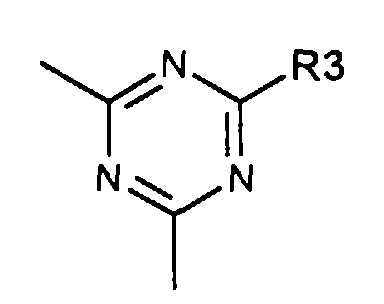
wobei R3 NR1R2, OR1, Halogen oder Z bedeutet, - Y
- für X = -C(O)- eine direkte Bindung zu Z bedeutet,
- Z
- einen der folgenden Reste
bedeutet,

worin - R4
- Wasserstoff, C1-C20-Alkyl, ein Oxyl-Radikal, OH, NO, CH2CN, unsubstituiertes oder mit OH, OR1, Hal oder NR1R2 substituiertes C6-C14-Aryl oder C7-C10-Arylalkyl, Allyl, C1-C30-Alkyloxy, C5-C12-Cycloalkyloxy, C3-C10-Alkenyl, C3-C6-Alkinyl, C1-C10-Acyl, Halogen, und
- R5
- Wasserstoff oder C1-C4-Alkyl bedeutet.
which in the aromatic ring to the carbonyl group α-substituents may not mean OH,
- m and n
- independently of one another represent 0.1 or 2,
- V or W
- independently of one another H, Hal, NO 2 , OH, OR 1 , CN, SR 1 , C 1 -C 18 alkyl, C 3 -C 10 cycloalkyl, unsubstituted or substituted by OH, OR 1 , Hal or NR 1 R 2 C 6 -C 14 aryl or C 7 -C 10 arylalkyl, a heteroaromatic radical having 5-15 C atoms, NR 1 R 2 or COOR 1 ,
- R 1 and R 2
- H, C 1 -C 18 alkyl, C 3 -C 10 cycloalkyl, unsubstituted or substituted by OH, OR 1 or Hal, C 6 -C 14 aryl or C 7 -C 10 arylalkyl, or a heteroaromatic radical with 5 -15 carbon atoms mean
- X
- represents a double-bonded radical -O-, -S- or -C (O) -,
- Y
- for X = O or S -CH 2 -C (O) -, -C (O) -, -C (O) -C (O) -, -CH 2 -CHR 1 -, - (CH 2 - CH 2 O) n - (with n = 1 - 8) or means
where R 3 is NR 1 R 2 , OR 1 , halogen or Z, - Y
- for X = -C (O) - means a direct bond to Z,
- Z.
- one of the following residues means
wherein - R 4
- Hydrogen, C 1 -C 20 alkyl, an oxyl radical, OH, NO, CH 2 CN, unsubstituted or substituted by OH, OR 1 , Hal or NR 1 R 2, C 6 -C 14 aryl or C 7 -C 10 arylalkyl, allyl, C 1 -C 30 alkyloxy, C 5 -C 12 cycloalkyloxy, C 3 -C 10 alkenyl, C 3 -C 6 alkynyl, C 1 -C 10 acyl, halogen, and
- R 5
- Is hydrogen or C 1 -C 4 alkyl.
die im aromatischen Ring zur Carbonylgruppe α-ständigen Substituenten nicht OH bedeuten dürfen,
- m und n
- unabhängig voneinander 0, 1 oder 2 bedeuten,
- V oder W
- unabhängig voneinander H, NO2, OH, C1-C10-Alkyl, C5-C6-Cycloalkyl, unsubstituiertes oder mit OH oder NR1R2 substituiertes C6-C14-Aryl oder C7-C10-Arylalkyl, einen heteroaromatischen Rest mit 6-10 C-Atomen, NR1R2 oder COOR1 bedeuten,
- R1 und R2
- H, C1-C10-Alkyl, C5-C6-Cycloalkyl, unsubstituiertes oder mit OH substituiertes C6-C14-Aryl oder C7-C10-Arylalkyl, oder einen heteroaromatischen Rest mit 6-10 C-Atomen bedeuten,
- X
- einen zweibindigen Rest -O- oder -C(O)- bedeutet,
- Y
- für X = O -CH2-C(O)-, -C(O)- oder -CH2-CHR1- bedeutet,
- Z
- den Rest RA, RC, RD oder RE bedeutet,
- R4
- Wasserstoff, C1-C10-Alkyl, ein Oxyl-Radikal, OH, NO, unsubstituiertes oder mit OH oder NR1R2 substituiertes C6-C14-Aryl oder C7-C10-Arylalkyl, Allyl, C1-C10-Alkyloxy, C6-C9-Cycloalkyloxy, C4-C8-Alkenyl, C3-C6-Alkinyl, C1-C5-Acyl, Halogen, und
- R5
- Wasserstoff oder C1-C4-Alkyl bedeutet.
which in the aromatic ring to the carbonyl group α-substituents may not mean OH,
- m and n
- independently of one another mean 0, 1 or 2,
- V or W
- independently of one another H, NO 2 , OH, C 1 -C 10 alkyl, C5-C 6 cycloalkyl, unsubstituted or substituted by OH or NR 1 R 2 C 6 -C 14 aryl or C 7 -C 10 arylalkyl, represent a heteroaromatic radical with 6-10 C atoms, NR 1 R 2 or COOR 1 ,
- R 1 and R 2
- H, C 1 -C 10 alkyl, C5-C 6 cycloalkyl, unsubstituted or substituted by OH C 6 -C 14 aryl or C 7 -C 10 arylalkyl, or a heteroaromatic radical having 6-10 C atoms ,
- X
- denotes a double-bond radical -O- or -C (O) -,
- Y
- for X = O -CH 2 -C (O) -, -C (O) - or -CH 2 -CHR 1 - means
- Z.
- represents the radical R A , R C , R D or R E ,
- R 4
- Hydrogen, C 1 -C 10 alkyl, an oxyl radical, OH, NO, unsubstituted or substituted by OH or NR 1 R 2 C 6 -C 14 aryl or C 7 -C 10 arylalkyl, allyl, C 1 - C 10 alkyloxy, C 6 -C 9 cycloalkyloxy, C 4 -C 8 alkenyl, C 3 -C 6 alkynyl, C 1 -C 5 acyl, halogen, and
- R 5
- Is hydrogen or C 1 -C 4 alkyl.
die im aromatischen Ring zur Carbonylgruppe α-ständigen Substituenten nicht OH bedeuten dürfen,
- m und n
- unabhängig voneinander 0, 1 oder 2 bedeuten,
- V oder W
- unabhängig voneinander H, NO2, C1-C4-Alkyl, NR1R2, oder COOR1 bedeuten,
- X
- einen zweibindigen Rest -O- oder -C(O)- bedeutet,
- Y
- für X = -O- -C(O)- oder CH2-C(O)- bedeutet,
- Y
- für X = -C(O)- eine direkte Bindung zu Z bedeutet und
- Z
- einen Rest der Formel RC oder RE bedeutet, worin
- R4
- Wasserstoff, OH, NO, C1-C5-Alkyl, C1-C5-Alkyloxy, C1-C5-Acyl und
- R5
- Methyl bedeutet.
which in the aromatic ring to the carbonyl group α-substituents may not mean OH,
- m and n
- independently of one another mean 0, 1 or 2,
- V or W
- independently of one another denote H, NO 2 , C 1 -C 4 alkyl, NR 1 R 2 , or COOR 1 ,
- X
- denotes a double-bond radical -O- or -C (O) -,
- Y
- for X = -O- -C (O) - or CH 2 -C (O) - means
- Y
- for X = -C (O) - means a direct bond to Z and
- Z.
- is a radical of the formula R C or R E , wherein
- R 4
- Hydrogen, OH, NO, C 1 -C 5 alkyl, C 1 -C 5 alkyloxy, C 1 -C 5 acyl and
- R 5
- Methyl means.
- R
- U-Y-U, Thionylchlorid, Phosphor(III)halogenid, Halogenwasserstoff, elementares Chlor bedeutet, wobei U Wasserstoff, Halogen, OR1 oder NR1R2 bedeutet, und
- R
- UYU, thionyl chloride, phosphorus (III) halide, hydrogen halide, elemental chlorine, where U is hydrogen, halogen, OR 1 or NR 1 R 2 , and
Applications Claiming Priority (2)
| Application Number | Priority Date | Filing Date | Title |
|---|---|---|---|
| DE19631244 | 1996-08-02 | ||
| DE19631244A DE19631244A1 (en) | 1996-08-02 | 1996-08-02 | New light stabilizers based on sterically hindered amines |
Publications (2)
| Publication Number | Publication Date |
|---|---|
| EP0822221A2 true EP0822221A2 (en) | 1998-02-04 |
| EP0822221A3 EP0822221A3 (en) | 1998-11-18 |
Family
ID=7801603
Family Applications (1)
| Application Number | Title | Priority Date | Filing Date |
|---|---|---|---|
| EP97112675A Withdrawn EP0822221A3 (en) | 1996-08-02 | 1997-07-24 | Novel light stabilisers based on sterically hindered amines |
Country Status (14)
| Country | Link |
|---|---|
| US (1) | US5919933A (en) |
| EP (1) | EP0822221A3 (en) |
| JP (1) | JPH10158243A (en) |
| KR (1) | KR19980018254A (en) |
| CN (1) | CN1173493A (en) |
| AU (1) | AU3236497A (en) |
| BR (1) | BR9706713A (en) |
| CA (1) | CA2212261A1 (en) |
| CZ (1) | CZ246497A3 (en) |
| DE (1) | DE19631244A1 (en) |
| IL (1) | IL121436A0 (en) |
| NO (1) | NO973555L (en) |
| SG (1) | SG50030A1 (en) |
| ZA (1) | ZA976879B (en) |
Cited By (2)
| Publication number | Priority date | Publication date | Assignee | Title |
|---|---|---|---|---|
| WO1998051759A1 (en) * | 1997-05-16 | 1998-11-19 | Cryovac, Inc. | Low migratory photoinitiators for oxygen-scavenging compositions |
| WO1998051758A1 (en) * | 1997-05-16 | 1998-11-19 | Chevron Chemical Company Llc | Photoinitiators and oxygen scavenging compositions |
Families Citing this family (11)
| Publication number | Priority date | Publication date | Assignee | Title |
|---|---|---|---|---|
| GB0009965D0 (en) * | 2000-04-25 | 2000-06-14 | Clariant Int Ltd | Synergistic stabilizer compositions comprising copolymers of ethylene with hin dered amine moieties containing acrylate or methacrylate comonomers |
| TWI226351B (en) * | 2000-07-14 | 2005-01-11 | Clariant Int Ltd | Synergistic mixtures of phosphorus-containing compounds for stabilizing polymers |
| GB0019465D0 (en) * | 2000-08-09 | 2000-09-27 | Clariant Int Ltd | Synergistic stabilizer for color stable pigmented thermoplastic polyners in prolonged contact with water |
| GB0104371D0 (en) * | 2001-02-22 | 2001-04-11 | Clariant Int Ltd | Color improving stabilizing compositions comprising leucine |
| EP1462478A1 (en) * | 2003-03-26 | 2004-09-29 | Clariant International Ltd. | Improved long term dimensional stability of pigmented polymer articles |
| JP5084143B2 (en) * | 2005-02-14 | 2012-11-28 | 株式会社Adeka | Light stabilizer emulsion composition |
| JP6323869B2 (en) * | 2014-07-18 | 2018-05-16 | 国立研究開発法人産業技術総合研究所 | Fullerene derivative and organic photoelectric conversion device using the same |
| CN105859607B (en) * | 2016-04-05 | 2018-05-15 | 浙江理工大学 | Benzophenone-hindered amine composite light stabilizer and preparation method thereof |
| US11417857B2 (en) * | 2018-01-24 | 2022-08-16 | Samsung Display Co., Ltd. | Heterocyclic compound and electronic apparatus |
| KR102595917B1 (en) * | 2018-01-24 | 2023-10-31 | 삼성디스플레이 주식회사 | Heterocyclic compound and electronic apparatus comprising the same |
| KR20190090415A (en) * | 2018-01-24 | 2019-08-02 | 삼성디스플레이 주식회사 | Electronic apparatus and method manufacturing the same |
Family Cites Families (6)
| Publication number | Priority date | Publication date | Assignee | Title |
|---|---|---|---|---|
| US4314933A (en) * | 1979-02-15 | 1982-02-09 | Ciba-Geigy Corporation | Method for light stabilization of two-layer uni-lacquer coatings |
| EP0389427B1 (en) * | 1989-03-21 | 1994-04-27 | Ciba-Geigy Ag | Compounds containing both uv-absorber and 1-hydrocarbyloxy hindered amine moieties and stabilized compositions |
| DE4327297B4 (en) * | 1992-08-17 | 2007-05-24 | Clariant Finance (Bvi) Ltd. | Use of piperidine compounds |
| US5739135A (en) * | 1993-09-03 | 1998-04-14 | Bristol-Myers Squibb Company | Inhibitors of microsomal triglyceride transfer protein and method |
| GB9507811D0 (en) * | 1995-04-18 | 1995-05-31 | Lambson Fine Chemicals Limited | Novel photoinitiators |
| DE19618197A1 (en) * | 1996-05-07 | 1997-11-13 | Hoechst Ag | New sterically hindered piperidine derivatives as light stabilizers for polymers |
-
1996
- 1996-08-02 DE DE19631244A patent/DE19631244A1/en not_active Withdrawn
-
1997
- 1997-07-24 EP EP97112675A patent/EP0822221A3/en not_active Withdrawn
- 1997-07-29 AU AU32364/97A patent/AU3236497A/en not_active Abandoned
- 1997-07-30 CN CN97115494A patent/CN1173493A/en active Pending
- 1997-07-31 IL IL12143697A patent/IL121436A0/en unknown
- 1997-07-31 KR KR1019970036302A patent/KR19980018254A/en not_active Withdrawn
- 1997-07-31 US US08/903,017 patent/US5919933A/en not_active Expired - Fee Related
- 1997-08-01 JP JP9208007A patent/JPH10158243A/en not_active Withdrawn
- 1997-08-01 NO NO973555A patent/NO973555L/en unknown
- 1997-08-01 BR BR9706713A patent/BR9706713A/en not_active Application Discontinuation
- 1997-08-01 CA CA002212261A patent/CA2212261A1/en not_active Abandoned
- 1997-08-01 ZA ZA976879A patent/ZA976879B/en unknown
- 1997-08-01 CZ CZ972464A patent/CZ246497A3/en unknown
- 1997-08-02 SG SG1997002770A patent/SG50030A1/en unknown
Cited By (6)
| Publication number | Priority date | Publication date | Assignee | Title |
|---|---|---|---|---|
| WO1998051759A1 (en) * | 1997-05-16 | 1998-11-19 | Cryovac, Inc. | Low migratory photoinitiators for oxygen-scavenging compositions |
| WO1998051758A1 (en) * | 1997-05-16 | 1998-11-19 | Chevron Chemical Company Llc | Photoinitiators and oxygen scavenging compositions |
| US6139770A (en) * | 1997-05-16 | 2000-10-31 | Chevron Chemical Company Llc | Photoinitiators and oxygen scavenging compositions |
| US6254802B1 (en) | 1997-05-16 | 2001-07-03 | Cryovac, Inc. | Low migratory photoinitiators for oxygen-scavenging compositions |
| US6464896B1 (en) | 1997-05-16 | 2002-10-15 | Cryovac, Inc. | Low migratory photoinitiators for oxygen-scavenging compositions |
| US6852894B2 (en) | 1997-05-16 | 2005-02-08 | Chevron Phillips Chemical Company Lp | Tribenzoyl compounds |
Also Published As
| Publication number | Publication date |
|---|---|
| SG50030A1 (en) | 2000-06-20 |
| US5919933A (en) | 1999-07-06 |
| AU3236497A (en) | 1998-02-12 |
| BR9706713A (en) | 1999-05-18 |
| IL121436A0 (en) | 1998-01-04 |
| NO973555L (en) | 1998-02-03 |
| NO973555D0 (en) | 1997-08-01 |
| CA2212261A1 (en) | 1998-02-02 |
| CZ246497A3 (en) | 1998-02-18 |
| EP0822221A3 (en) | 1998-11-18 |
| ZA976879B (en) | 1998-08-04 |
| JPH10158243A (en) | 1998-06-16 |
| KR19980018254A (en) | 1998-06-05 |
| DE19631244A1 (en) | 1998-02-12 |
| CN1173493A (en) | 1998-02-18 |
| MX9705956A (en) | 1998-05-31 |
Similar Documents
| Publication | Publication Date | Title |
|---|---|---|
| EP0822221A2 (en) | Novel light stabilisers based on sterically hindered amines | |
| EP0142467B1 (en) | Polymer compounds containing piperidyl groups and their use as stabilisers in synthetic polymers | |
| DE2545292C3 (en) | Azaadamantane compounds as stabilizers for organic polymer compositions | |
| DE3236070A1 (en) | PIPERIDYL DERIVATIVES MACROCYCLIC TRIAZINE COMPOUNDS WITH STABILIZING EFFECT ON POLYMERS AND METHOD FOR THE PRODUCTION THEREOF | |
| EP0001840A2 (en) | Stabilising mixtures, process for stabilising synthetic materials against light with these mixtures and synthetic materials so stabilised | |
| EP0057885A2 (en) | Substituted diazaspirodecanes, their preparation and their use for the stabilisation of organic polymers and these stabilised polymers | |
| DE3613194A1 (en) | NEW PIPERIDINE CONNECTIONS | |
| EP0025867A1 (en) | Alkylated diazaspirodecanes, their preparation and their use as light stabilisers | |
| DE2929993A1 (en) | NEW STABILIZERS | |
| EP0020297B1 (en) | Cyclic phosphoric acid ester amides, process for their preparation and their use as stabilizers | |
| EP0044499A1 (en) | Triazinylaminotriazines, their preparation, their use in stabilising synthetic polymers and products realised with them | |
| EP0013443A1 (en) | 2,2,6,6-Tetramethylpiperidine derivatives, process for their preparation and synthetic polymers stabilized with the aid thereof | |
| DE19738616A1 (en) | 4-hydroxyquinoline-3-carboxylic acid derivatives as light stabilizers | |
| EP0208264B1 (en) | 1-Oxa-3-oxo-4,8-diaza-spiro[4,5]decane compounds | |
| EP0061659B1 (en) | Piperidine groups containing esters,methods for their preparation, their use as stabilising agents for polymers, and polymers containing these compounds | |
| EP0119961B1 (en) | Oligo esters containing polyalkyl piperidine groups | |
| EP0008084A1 (en) | Novel urea derivatives, their preparation and their use as light stabilizer for polymers | |
| DE19738615A1 (en) | New light stabilizers based on sterically hindered amines | |
| EP0001207B1 (en) | Urea derivatives, their preparation and their use as light stabilisers | |
| EP0005441A1 (en) | Aminodibenzoxaphosphorines, process for their preparation and their use as stabilisators | |
| EP0064752B1 (en) | Phosphazenes substituted by piperidyl groups, process for preparing them, their use as stabilizers and polymer compositions stabilized by them | |
| EP0065169A1 (en) | Poly-bis-triazinylaminotriazinyl amines, their preparation, their use as stabilisers for plastics against light degradation and plastics stabilized by them | |
| EP0094350B1 (en) | 1-diorganocarbamoyl-polyalkyl piperidines and their preparation | |
| DE2849444A1 (en) | Piperidyl ester(s) of beta-amino crotonic acid - for stabilisation of polymers against light, heat and oxygen | |
| DE3805786C2 (en) | Piperidine compounds |
Legal Events
| Date | Code | Title | Description |
|---|---|---|---|
| PUAI | Public reference made under article 153(3) epc to a published international application that has entered the european phase |
Free format text: ORIGINAL CODE: 0009012 |
|
| AK | Designated contracting states |
Kind code of ref document: A2 Designated state(s): AT BE CH DE ES FR GB IT LI NL |
|
| PUAL | Search report despatched |
Free format text: ORIGINAL CODE: 0009013 |
|
| AK | Designated contracting states |
Kind code of ref document: A3 Designated state(s): AT BE CH DE DK ES FI FR GB GR IE IT LI LU MC NL PT SE |
|
| RHK1 | Main classification (correction) |
Ipc: C07D211/46 |
|
| AKX | Designation fees paid |
Free format text: AT BE CH DE ES FR GB IT LI NL |
|
| 17P | Request for examination filed |
Effective date: 19990810 |
|
| STAA | Information on the status of an ep patent application or granted ep patent |
Free format text: STATUS: THE APPLICATION HAS BEEN WITHDRAWN |
|
| 18W | Application withdrawn |
Withdrawal date: 20000218 |