EP0822635A2 - Schutzsystem für Leistungseinführungsstation - Google Patents
Schutzsystem für Leistungseinführungsstation Download PDFInfo
- Publication number
- EP0822635A2 EP0822635A2 EP97112567A EP97112567A EP0822635A2 EP 0822635 A2 EP0822635 A2 EP 0822635A2 EP 97112567 A EP97112567 A EP 97112567A EP 97112567 A EP97112567 A EP 97112567A EP 0822635 A2 EP0822635 A2 EP 0822635A2
- Authority
- EP
- European Patent Office
- Prior art keywords
- phase
- power
- receiving
- transformer
- protection apparatus
- Prior art date
- Legal status (The legal status is an assumption and is not a legal conclusion. Google has not performed a legal analysis and makes no representation as to the accuracy of the status listed.)
- Withdrawn
Links
Images





Classifications
-
- H—ELECTRICITY
- H02—GENERATION; CONVERSION OR DISTRIBUTION OF ELECTRIC POWER
- H02H—EMERGENCY PROTECTIVE CIRCUIT ARRANGEMENTS
- H02H7/00—Emergency protective circuit arrangements specially adapted for specific types of electric machines or apparatus or for sectionalised protection of cable or line systems, and effecting automatic switching in the event of an undesired change from normal working conditions
- H02H7/26—Sectionalised protection of cable or line systems, e.g. for disconnecting a section on which a short-circuit, earth fault, or arc discharge has occured
- H02H7/28—Sectionalised protection of cable or line systems, e.g. for disconnecting a section on which a short-circuit, earth fault, or arc discharge has occured for meshed systems
-
- H—ELECTRICITY
- H02—GENERATION; CONVERSION OR DISTRIBUTION OF ELECTRIC POWER
- H02H—EMERGENCY PROTECTIVE CIRCUIT ARRANGEMENTS
- H02H3/00—Emergency protective circuit arrangements for automatic disconnection directly responsive to an undesired change from normal electric working condition with or without subsequent reconnection ; integrated protection
- H02H3/003—Emergency protective circuit arrangements for automatic disconnection directly responsive to an undesired change from normal electric working condition with or without subsequent reconnection ; integrated protection responsive to reversal of power transmission direction
-
- H—ELECTRICITY
- H02—GENERATION; CONVERSION OR DISTRIBUTION OF ELECTRIC POWER
- H02H—EMERGENCY PROTECTIVE CIRCUIT ARRANGEMENTS
- H02H3/00—Emergency protective circuit arrangements for automatic disconnection directly responsive to an undesired change from normal electric working condition with or without subsequent reconnection ; integrated protection
- H02H3/26—Emergency protective circuit arrangements for automatic disconnection directly responsive to an undesired change from normal electric working condition with or without subsequent reconnection ; integrated protection responsive to difference between voltages or between currents; responsive to phase angle between voltages or between currents
- H02H3/265—Emergency protective circuit arrangements for automatic disconnection directly responsive to an undesired change from normal electric working condition with or without subsequent reconnection ; integrated protection responsive to difference between voltages or between currents; responsive to phase angle between voltages or between currents responsive to phase angle between voltages or between currents
Definitions
- the present invention relates to a protection apparatus for use with a spot network substation or a main/sub 2-line receiving substation, and more particularly to a protection apparatus for a substation having a circuit capable of generating a reverse power flow to a power source at an electric power company.
- a spot network substation is well known in which reverse power flow is generated. Since power supply reliability is very high, the spot network substation is widely used for building substations.
- a plurality of receiving lines are connected between three-phase and three-line power sources and a network bus connected to circuit breakers (CB's) for supplying power to an air conditioner, an elevator, and the like.
- CB's circuit breakers
- Each of the plurality of receiving lines is connected to a primary switching device, a network transformer, a protector CB and a current transformer in succession.
- the current transformer detects reverse energizing current upon energization of the network transformer by the network bus when a power source is stopped.
- This detected reverse energizing current causes a network relay connected to the current transformer to judge a presence of a reverse power flow state, i.e., a power-stop of the power source and trip the protector CB to protect the spot network substation.
- This system is collectively called a spot network protector.
- Various types of power sources such as spot network power sources and main/sub 2-line power sources have been used recently depending upon power user requirements. These various types of power sources are required to be managed collectively because of demands for efficient use of power sources. Furthermore, in order to improve reliability of power supply of spot network power sources more than a conventional system, for example, some three-line spot network power sources supply powers from different transformers and different substations. Collective management of these power sources with different transformers generates a voltage difference between power sources.
- the spot network protector for a spot network substation has a reverse power tripping function as described above. If a generator connected to a power line is operated, current flowing from the network bus connected to the generator through the power source causes to trip the protector CB. Therefore, this system is difficult to use if the generator is to be operated at high efficiency such as in the case of a co-generation system. Furthermore, an emergency generator is not possible to be switched unless once a full power-off is effected which is therefore inevitable.
- the present invention is to provide a protection apparatus capable of configuring a system which allows a combined use of not only a spot network substation connectable to a co-generation system and a spot network substation connected to spot network power sources but also a main/sub 2-line receiving substation.
- the protection apparatus of this invention pays attention to two phenomena, one being that the phase of a load side of a transformer lags from that of a power source side because of characteristics of energizing, and the other being that the voltage phase does not lag even during reverse power supply if a feeding CB at an electric power company is not opened.
- a unit capable of judging the direction of power by detecting a voltage phase a detector for detecting a voltage phase at each receiving line and a judging unit for judging the detected phase are provided on the primary side of a transformer of each receiving line. The operation conditions of the detector and judging unit are uniquely determined in this invention.
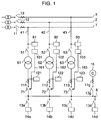
- Power sources 1, 2 and 3 of an electric power company are provided with power circuit breakers (CB) 11, 12 and 13 for the control of power supply and power protection.
- CB power circuit breakers
- One ends of receiving lines 41, 42 and 43 of a spot network substation are connected to the power sources 1, 2 and 3, and the other ends thereof are sequentially connected to primary switching devices 51, 52 and 53, network transformers 61, 62 and 63, and protector CB's 71, 72 and 73, and finally to a network bus 8.
- Loads 14a, 14b and 14c are connected via CB's 13a, 13b and 13c to the network bus 8 for the reception of power.
- a power generator 15 is connected via a CB 13g to the network bus 8.
- Detectors 91, 92 and 93 and judging units 101, 102 and 103 characteristic to this invention are connected to the receiving lines 41, 42 and 43.
- the detectors 91, 92 and 93 each detect a voltage of each phase, and the judging units 101, 102 and 103 each process the detected phase and judge a power-stop at each power source. If each judging unit 101, 102, 103 judges a power-stop at the receiving end of each corresponding receiving line 41, 42, 43, it sends a trip command 161, 162, 163 to each corresponding protector CB 71, 72, 73.
- Each detector 91, 92, 93 detects the voltage of each corresponding receiving line 41, 42, 43 by using a voltage divider made of resistors, capacities of dielectric substances or capacitors, a potential transformer or the like. Specifically, it detects the phase of zero voltage level crossing of the detected voltage with a precision of an electrical angle of 1 degree or smaller of the power frequency.
- Each judging unit 101, 102, 103 stores the zero voltage level crossing phase detected by each detector 91, 92, 93, and compares the newly detected phase with the already stored phase one period before.
- the newly detected phase lagged from the phase one period before by an angle or larger in the range from 1 to 15 degrees set by a setting unit provided in the judging unit 101, 102, 103 continues for a time or longer in the range from 0.15 to 1 second, then it judges that a power-stop of the corresponding power source has occurred, and sends a trip command to the corresponding protector CB so that reverse energizing from the network bus 8 to the suspended power source can be stopped.
- this embodiment uses a single judging unit 10 which can collectively process the voltages detected by the detecting units 91, 92 and 93 at the receiving lines 41, 42 and 43. If the judging unit 10 judges a power-stop at any one receiving point of the receiving lines 41, 42 and 43, it sends a corresponding one of trip commands 161, 162 and 163 to the corresponding one of the protector CB's 71, 72 and 73 connected to the receiving lines 41, 42 and 43.
- the judging unit 10 compares phases of zero voltage level crossing detected by the detectors 91, 92 and 93 and if one of the phases lagged from another phase by an angle or larger in the range from 1 to 15 degrees set by the setting unit provided in the judging unit 10, continues for a time or longer in the range from 0.15 to 1 second, then it judges that a power-stop of the corresponding power source connected to the judging unit which detected the delayed phase has occurred, and sends a trip command to the corresponding protector CB so that reverse energizing from the network bus 8 to the suspended power source can be stopped.
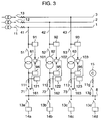
- detectors 94, 95 and 96 are provided for detecting secondary voltages of the network transformers 61, 62 and 63.
- the detectors 91, 92 and 93 connected to the same receiving lines 41, 42 and 43 as the detectors 94, 95 and 96 detect primary voltages of the network transformers 61, 62 and 63.
- phase angle between the primary and secondary voltages lagged by an angle or larger in the range from 1 to 15 degrees set by the setting unit provided in the judging unit 10 continues for a time or longer in the range from 0.15 to 1 second, then the corresponding one of the judging units 101, 102 and 103 judges that a power-stop of the corresponding power source connected to this judging unit has occurred, and sends a trip command to the corresponding protector CB so that reverse energizing from the network bus 8 to the suspended power source can be stopped.
- Power sources 1 and 2 of an electric power company are provided with power CB's 11 and 12 for the control of power supply and power protection.
- One ends of receiving lines 41 and 42 of a main/sub 2-line receiving substation are connected to the power sources 1 and 2, and the other ends thereof are sequentially connected to primary switching devices 51 and 52, transformers 171 and 172, and secondary CB's 181 and 182, and finally to feeding buses 191, 192 and 19g.
- a load 14a is connected via a CB 13a to the feeding bus 191
- a load 14b is connected via a CB 13b to the feeding bus 192
- a load 14c is connected via a CB 13c to the feeding bus 19g, respectively for the reception of power.
- a power generator 15 is connected via a CB 13g to the feeding bus 19g.
- Detectors 91 and 92 and judging units 101 and 102 characteristic to this invention are connected to the receiving lines 41 and 42.
- the detectors 91 and 92 each detect a voltage of each phase, and the judging units 101 and 102 each process the detected phase and judge a power-stop at each power source. If each judging unit 101, 102 judges a power-stop at the receiving end of each corresponding receiving line 41, 42, it sends a trip command 161, 162 to each corresponding secondary CB 181, 182 connected to the receiving line 41, 42.
- Each detector 91, 92 detects the voltage of each corresponding receiving line 41, 42 by using a voltage divider made of resistors, capacities of dielectric substances or capacitors, a potential transformer or the like. Specifically, it detects the phase of zero voltage level crossing of the detected voltage with a precision of an electrical angle of 1 degree or smaller of the power frequency.
- Each judging unit 101, 102 stores the zero voltage level crossing phase detected by each detector 91, 92, and compares the newly detected phase with the already stored phase one period before.
- the newly detected phase lagged from the phase one period before by an angle or larger in the range from 1 to 15 degrees set by a setting unit provided in the judging unit 101, 102 continues for a time or longer in the range from 0.15 to 1 second, then it judges that a power-stop of the corresponding power source has occurred, and sends a trip command to the corresponding secondary CB so that reverse energizing from the generator 15 via the feeding buses 191, 192, 19g to the suspended power source can be stopped.
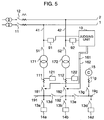
- Fig. 5 Another embodiment shown in Fig. 5 will be described.
- this embodiment uses a single judging unit 10 which can collectively process the voltages detected by the detecting units 91 and 92 at the receiving lines 41 and 42. If the judging unit 10 judges a power-stop at any one receiving point of the receiving lines 41 and 42, it sends a corresponding one of trip commands 161 and 162 to the corresponding one of the secondary CB's 181 and 182 connected to the receiving lines 41 and 42.
- the judging unit 10 compares phases of zero voltage level crossing detected by the detectors 91 and 92 and if one of the phases lagged from another phase by an angle or larger in the range from 1 to 15 degrees set by the setting unit provided in the judging unit 10, continues for a time or longer in the range from 0.15 to 1 second, then it judges that a power-stop of the corresponding power source connected to the judging unit which detected the delayed phase has occurred, and sends a trip command to the corresponding secondary CB so that reverse energizing from the generator 15 via the feeding buses 191, 192 and 19g to the suspended power source can be stopped.
- detectors 94 and 95 are provided for detecting secondary voltages of the transformers 171 and 172.
- the corresponding one of the judging units 101 and 102 judges that a power-stop of the corresponding power source connected to this judging unit has occurred, and sends a trip command to the corresponding secondary CB so that reverse energizing from the generator 15 via the feeding bus 191, 192, 19g to the suspended power source can be stopped.
- a change in the voltage vector will be described for the case where there is no power-stop of the power sources and for the case where one of a plurality of power sources is stopped.
- currents indicated at I1 and I2 flow from the power sources 1 and 2 and via network transformers 61 and 62 through a load 14a. If a feeder CB 12 at an electric power company is opened and the power source 2 is stopped, current indicated at I3 flows from the power source 1 and via the network transformer 61 through the load 14a, and the network transformer 62 is reversely energized so that the power source 2 is also reversely energized.
- Fig. 7 if there is no power-stop of the power sources, currents indicated at I1 and I2 flow from the power sources 1 and 2 and via network transformers 61 and 62 through a load 14a. If a feeder CB 12 at an electric power company is opened and the power source 2 is stopped, current indicated at I3 flows from the power source 1 and via the network transformer 61 through the load 14a, and the network transformer 62
- FIG. 8 is a schematic diagram showing a phase relationship between voltage vectors V1 and V2 at receiving lines 41 and 42 and a voltage vector Vnw at a network bus 8 respectively of one phase when there is no power-stop of the power sources.
- the voltage vectors V1 and V2 at the receiving lines 41 and 42 are generally equal, and the internal voltage drops Vt1 and Vt2 at the network transformers 61 and 62 caused by characteristics of energizing are also generally equal as shown in Fig. 8.
- the voltage vector Vnw at the network bus 8 is a difference between the voltage vectors V1 and V2 at the receiving lines 41 and 42 and the internal voltage drops Vt1 and Vt2 at the network transformers 61 and 62. Therefore, as shown in Fig. 8, the voltage vector Vnw has a phase lagged from the voltage vectors V1 and V2 at the receiving lines 41 and 42.
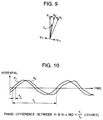
- Fig. 9 is a schematic diagram showing a phase relationship between the voltage vectors V1 and V2 at the receiving lines 41 and 42 and the voltage vector Vnw at the network bus 8 respectively of one phase when the feeder CB 12 at the electric power company is opened and the power source 2 is stopped. In Fig.
- the internal voltage drops Vt1 and Vt2 at the network transformers 61 and 62 caused by the current vector I3 have generally opposite phases as shown.
- the voltage vector Vnw at the network bus 8 is a difference between the voltage vector V1 and V2 at the receiving line 41 and the internal voltage drop Vt1 at the network transformers 61. Therefore, the voltage vector Vnw has a phase lagged from the voltage vector V1 at the receiving line 41.
- the voltage vector V2 at the receiving line 42 is a sum of the voltage vector Vnw and the internal voltage drop Vt1 at the network transformer 61. Therefore, as shown in Fig. 9, the voltage vector V2 has a phase lagged further from the voltage vector Vnw. This lagged phase has been confirmed to be in the range from 1 to 15 degrees according to analysis of various cases made by computers.
- Fig. 10 illustrates an example of detecting a phase difference between the voltage vectors V1 and V2 at the receiving lines 41 and 42.
- the phase difference is calculated from the equation shown in Fig. 10 by using a time difference T1 between zero voltage level crossing points of the voltage waveforms V1 and V2 and a period T2 of voltages V1 and V2.
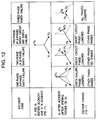
- an earth voltage of a non-earth fault phase rises for one- and two-phase earth faults
- an earth voltage of a short circuit phase lowers for a two- and three-phase short circuits.
- the voltage phase at the power source 1, 2, 3 detected by the detector 91, 92, 93 is in a phase lag or phase lead smaller than one degree.
- the judging unit 101, 102 and 103 connected to each detector stores this voltage phase as a zero voltage level crossing phase. If the feeder CB 13 is opened in this state, the network transformer 63 is reversely energized via the network bus 8 and the power source 3 is also reversely energized. At this time, as described with reference to Figs. 7 to 9, the voltage phase at the power source 3 lags by 1 to 15 degrees from the voltage phase immediately before the feeder CB 13 is opened.
- the judging unit 103 then compares zero voltage level crossing phase input from the detector 93 with the presently stored zero voltage level crossing phase, and calculates a phase lag by calculating a phase difference by the calculation method illustrated in Fig. 10 to thereby judge whether the power source 3 has been stopped. If it is judged that the power source has been stopped, the judging unit 103 sends a trip command 163 to the protector CB 73 to prevent reverse energizing of the power source 3 from the network bus 8.
- a conventional system supplies electric power from a high voltage bus to a low voltage bus and the protector CB connected to the bus to which electric power is supplied enters the conditions of tripping for reverse power flow.
- a power-stop is judged not from the direction of power flow but from the voltage phase difference. Therefore, if the feeder CB's 11, 12 and 13 are not opened, any delay of the voltage vectors at the power sources 1, 2 and 3 does not occur so that unnecessary cut-off of the protector CB's 71, 72 and 73 does not occur and pumping does not occur when an automatic close function is used in combination.
- the protector CB's 71, 72 and 73 are not opened from the same reasons described above so that the generator 15 can be operated at a high efficiency and power supply can be made. Since the detectors 91, 92 and 93 and judging units 101, 102 and 103 are provided separately for each receiving line 41, 42, 43, maintenance work does not make the device at another line during power reception operate erroneously.
- the judging unit 10 compares the phases of voltages at the receiving lines 41, 42 and 43 so that zero voltage level crossing phase before one period is not necessary to be stored and the judging unit can be simplified.
- the other operation and effects are the same as the unit of Fig. 1.
- the operation of the unit shown in Fig. 3 is basically the same as that of Fig. 2.
- this unit instead of using a voltage phase difference between the receiving lines 41, 42 and 43, the phase difference between the primary and secondary phases of each network transformer 61, 62, 63 is used for the judgement of power-stop. Therefore, this unit is applicable even to two lines among the receiving lines 41, 42 and 43.
- the operation and effects after the judgement of power-stop are the same as the unit shown in Fig. 1.
- the operation and effects of the protection apparatus shown in Fig. 4 will be described.
- Power is received from the power source 1 via the transformer 171.
- the generator 15 is operated being connected with a power line.
- the judging unit 101 stores a zero voltage level crossing phase of a voltage at the power source 1 detected by the detector 91.
- the power source 1 is reversely energized from the generator 15 via the feeding buses 191, 192 and 19g.
- the voltage phase of the power source 1 has a lag of 1 to 15 degrees relative to the voltage phase of the generator 15 and the voltage phase of the power source 1.
- the judging unit 101 then compares the zero voltage level crossing phase input from the detector 91 with the presently stored zero voltage level crossing phase, and calculates a phase lag by calculating a phase difference by the calculation method illustrated in Fig. 10 to thereby judge whether the power source 1 has been stopped. If it is judged that the power source has been stopped, the judging unit 101 sends a trip command 161 to the secondary CB 181 of the corresponding transformer to prevent reverse energizing of the power source 1 from the generator 15 via the feeding lines 191, 192 and 19g. Reverse energizing of the stopped power source can thus be prevented.
- the generator 15 is operated being connected with a power line.
- the judging unit 101 monitors a phase difference by comparing zero voltage level crossing phases of voltages at the power sources 1 and 2 detected by the detectors 91 and 92.
- the feeder CB's 11 and 12 at the electric power company are closed so that there is no phase difference between the power sources 1 and 2.
- the phase of an output voltage of the generator 15 is shown as the network bus voltage Vnw in Fig. 8. Namely, this phase is a phase lag relative to the power sources 1 and 2.
- the power source 1 is reversely energized from the generator 15 via the feeding lines 191, 192 and 19g.
- the voltage phase of the power source 1 is a phase lag relative to the output voltage phase of the generator 15. Therefore, the judging unit 10 detects that the voltage phase of the power source 1 is a phase lag relative to that of the power source 2 and judges that the power source 1 has stopped.
- the operation and effects after the power-stop judgement are the same as the unit shown in Fig. 4.
- the operation of the unit shown in Fig. 6 is basically the same as that of Fig. 5.
- this unit instead of using a voltage phase difference between the power sources 1 and 2, the phase difference between the primary and secondary phases of each transformer 171, 172 is used for the judgement of power-stop. Therefore, this unit is applicable even to one line among the two receiving lines 41 and 42.
- the operation and effects after the judgement of power-stop are the same as the unit shown in Fig. 5.
- the judgement method using the phase and direction of current is likely to be affected by a power factor of load, a load capacity and a harmonic content. To avoid this, high quality current transformers and potential transformers have been used. However, the judgement method using the phase of a primary voltage of a transformer is less affected by such external disturbances and so the detected waveform is less affected. Therefore, the performance required for the detection unit can be made less severe. Specifically, a conventional allowance is 1 % or less, whereas an allowance of about 20 % is possible so that cost can be reduced greatly.
- a power-stop of the power source 1, 2 or 3 There are two cases of a power-stop of the power source 1, 2 or 3. One case occurs when the feeder CB 11, 12 or 13 is opened by an electric power company for maintenance purpose. The other case occurs when the feeder CB 11, 12 or 13 is isolated by the receiving protection unit because of occurrence of an accident at the power source 1, 2 or 3.
- the voltage values of the power sources 1, 2 and 3 scarcely changes so that it is necessary to perform judgement based upon a phase difference.
- the operation and effects of setting a time, required for the judging units 101 to 103 and 10 shown in Figs. 1 to 6 to start detecting a phase difference and output the trip commands 161 to 163 to the CB's 71 to 73 and 181 to 182, longer than an operation time of the feeder CB's 11 to 13 at the electric power company, will be described with reference to Fig. 1.
- the power sources 1, 2 and 3 are interconnected by unrepresented interconnection CB's installed in a substation of the electric power company. Therefore, after an accident occurs at one power source, e.g., power source 1, current flows from the other power sources 2 and 3 to the accident point until the feeder CB 11 at the electric power company is opened.
- the time required for the judging units 101 to 103 and 10 to start detecting a phase difference and output the trip commands 161 to 163 to the CB's 71 to 73 and 181 to 182, is therefore set longer than an operation time of the feeder CB's 11 to 13 at the electric power company.
- the judgement can be performed under the conditions that the normal power sources 2 and 3 are not affected by the accident, and erroneous operations of the judging units 101 to 103 and 10 can be avoided.
- the operation time of the feeder CB's is set to 0.12 seconds or shorter, and an allowance time of short time durable current is 1 second. Therefore, the set time for the judging units 101 to 103 and 10 is required to be 0.15 to 1 second for ensuring normal operation.
- a work of removing the accident power source can therefore be performed safely.
- a power-stop to be caused by other than an accident without opening the primary switching devices 51 to 53, only the protector CB's 71 to 73 are closed when the power source 1, 2 or 3 recovers to thereafter receive electric power. Power supply reliability can therefore be improved.
- the protector CB's 71 to 73 are automatically closed if the state that the receiving lines 41 to 43 have no phase lag difference during an automatic operation, continues longer than a re-close time of the feeder CB's at the electric power company and exceeds a time set in the range from 2 to 20 seconds.
- This operation allows the protector CB's 71 to 73 to be closed without delay when the power-stop of the power sources 1, 2 and 3 is released by closing the feeder CB's 11, 12 and 13 at the electric power company, and allows a load per one network transformer 61, 62, 63 to be reduced. Therefore, a lifetime of the network transformers 61 to 63 can be prolonged and leveling of the network transformers 61 to 63 becomes possible.
- the power-stop of a power source is judged in this invention from a voltage phase difference of a power source, particularly from a phase lag state, by utilizing the fact that the voltage phase difference lags only upon occurrence of a power-stop of a power source. Therefore, even if current flows between power sources because of voltage difference, unnecessary circuit disconnection through CB tripping is not made and power can be reliably supplied to a load. Furthermore, even if reverse power flows from a generator to a power source, there is no phase delay. Therefore, even a spot network substation can use a generator connected to a power line. Still further, a main/sub 2-line receiving substation can be used in combination.
Landscapes
- Supply And Distribution Of Alternating Current (AREA)
- Measuring Phase Differences (AREA)
- Emergency Protection Circuit Devices (AREA)
Applications Claiming Priority (2)
| Application Number | Priority Date | Filing Date | Title |
|---|---|---|---|
| JP20343096A JP3184459B2 (ja) | 1996-08-01 | 1996-08-01 | 受電保護装置 |
| JP203430/96 | 1996-08-01 |
Publications (2)
| Publication Number | Publication Date |
|---|---|
| EP0822635A2 true EP0822635A2 (de) | 1998-02-04 |
| EP0822635A3 EP0822635A3 (de) | 1999-02-10 |
Family
ID=16473963
Family Applications (1)
| Application Number | Title | Priority Date | Filing Date |
|---|---|---|---|
| EP97112567A Withdrawn EP0822635A3 (de) | 1996-08-01 | 1997-07-22 | Schutzsystem für Leistungseinführungsstation |
Country Status (6)
| Country | Link |
|---|---|
| US (1) | US5892645A (de) |
| EP (1) | EP0822635A3 (de) |
| JP (1) | JP3184459B2 (de) |
| KR (1) | KR19980018252A (de) |
| CN (1) | CN1080943C (de) |
| TW (1) | TW480800B (de) |
Cited By (2)
| Publication number | Priority date | Publication date | Assignee | Title |
|---|---|---|---|---|
| EP0948111A3 (de) * | 1998-03-23 | 2001-05-09 | Electric Boat Corporation | Fehlerschutzanordnung und -verfahren für elektrische Energieversorgungsanlagen |
| JP2013143784A (ja) * | 2012-01-06 | 2013-07-22 | Hitachi Industrial Equipment Systems Co Ltd | 系統連系用装置 |
Families Citing this family (24)
| Publication number | Priority date | Publication date | Assignee | Title |
|---|---|---|---|---|
| US6407897B1 (en) * | 2000-03-31 | 2002-06-18 | Eaton Corporation | Network protector with diagnostics |
| US7355019B2 (en) * | 2000-06-06 | 2008-04-08 | Sibtech, Inc. | Cysteine-containing peptide tag for site-specific conjugation of proteins |
| KR100419261B1 (ko) * | 2001-10-23 | 2004-02-21 | 한국전력공사 | 스폿 네트워크 시스템의 저압 모선 지락고장보호장치 |
| JP3725468B2 (ja) * | 2001-12-25 | 2005-12-14 | 三菱電機株式会社 | 多重直接接地系統における地絡継電システム |
| US6914763B2 (en) * | 2002-01-15 | 2005-07-05 | Wellspring Heritage, Llc | Utility control and autonomous disconnection of distributed generation from a power distribution system |
| US20030165037A1 (en) * | 2002-03-01 | 2003-09-04 | Stephen Liscinksy | Three-phase supervisory circuit |
| US7808128B1 (en) * | 2004-11-12 | 2010-10-05 | Dgi Creations, Llc | Remote monitoring of control decisions for network protectors |
| CN100359775C (zh) * | 2005-06-28 | 2008-01-02 | 山东大学 | 一种降压变压器及其中低压侧母线的继电保护方法 |
| JP4575272B2 (ja) * | 2005-10-27 | 2010-11-04 | 株式会社日立製作所 | 分散型電源システム及び系統安定化方法 |
| EP1819022B1 (de) * | 2006-02-08 | 2015-09-23 | ABB Technology AG | Schaltfeldzonenbestimmung für Hoch- oder Mittelspannungschaltfeld |
| CN102246374B (zh) * | 2008-12-10 | 2015-05-27 | 西门子公司 | 用于监测供电网络的母线的方法和保护设备 |
| US8331071B2 (en) * | 2009-06-12 | 2012-12-11 | Northern Power Systems Utility Scale, Inc. | Interconnection switching system and method for connecting a distributed energy resource to an electrical power system |
| CN102108527B (zh) * | 2009-12-23 | 2014-03-26 | 贵阳铝镁设计研究院有限公司 | 一种大型铝电解厂供电方法及系统 |
| CN101916988B (zh) * | 2010-06-11 | 2013-01-16 | 中铁电气化勘测设计研究院有限公司 | 一种供电环网的智能保护回路架构系统及智能保护方法 |
| US20120267896A1 (en) * | 2011-04-20 | 2012-10-25 | Clipper Windpower, Inc. | Network Protection for Power Spot Networks |
| US8860353B1 (en) * | 2011-04-22 | 2014-10-14 | Dgi Creations, Llc | Protection for a network protector close motor |
| TWI411192B (zh) * | 2011-05-04 | 2013-10-01 | Power protection system and method | |
| US10345357B2 (en) * | 2016-02-29 | 2019-07-09 | The Boeing Company | Fault detection in variable differential transformer sensors based on zero-crossings of signals |
| JP6026068B1 (ja) * | 2016-04-22 | 2016-11-16 | 三菱電機株式会社 | 遮断器不動作保護リレーおよび保護リレーシステム |
| JP6673036B2 (ja) * | 2016-06-09 | 2020-03-25 | 住友電気工業株式会社 | 電力変換装置及び、遮断部の動作状態判定方法 |
| US10685778B2 (en) | 2017-04-12 | 2020-06-16 | Carte International Inc. | Intra-tank under-oil vacuum primary switches for medium voltage transformer applications |
| KR101944677B1 (ko) * | 2018-11-14 | 2019-01-31 | 박왕순 | 진상부하에 대한 비상전원공급 제어방법 |
| JP7196716B2 (ja) * | 2019-03-25 | 2022-12-27 | 東京電力ホールディングス株式会社 | 短絡監視装置、短絡監視方法、およびプログラム |
| CN110797849B (zh) * | 2019-11-28 | 2021-03-23 | 国网江苏省电力有限公司镇江供电分公司 | 比较线路两侧电压与备自投配合的线路断线保护方法 |
Family Cites Families (9)
| Publication number | Priority date | Publication date | Assignee | Title |
|---|---|---|---|---|
| US3947728A (en) * | 1974-05-23 | 1976-03-30 | Westinghouse Electric Corporation | Network protector relay |
| JPS538719A (en) * | 1976-07-13 | 1978-01-26 | Matsushita Electric Ind Co Ltd | Phase synchronous control device of revolving body |
| US4607309A (en) * | 1984-05-15 | 1986-08-19 | Westinghouse Electric Corp. | Apparatus for detecting arcing faults on low-voltage spot networks |
| JP2728398B2 (ja) * | 1987-03-18 | 1998-03-18 | 株式会社日立製作所 | スポツトネツトワーク受変電保護装置 |
| JPS6419916A (en) * | 1987-07-15 | 1989-01-24 | Hitachi Ltd | Spot network power receiving and transformation protector |
| JPH04244729A (ja) * | 1991-01-28 | 1992-09-01 | Hitachi Ltd | スポットネットワークシステム |
| JPH05308719A (ja) * | 1992-04-28 | 1993-11-19 | Hitachi Ltd | ネットワーク受変電システム |
| JPH0768624A (ja) * | 1993-06-25 | 1995-03-14 | Asahi Glass Co Ltd | 窓ガラス用モールの製造方法 |
| US6496342B1 (en) * | 1999-02-12 | 2002-12-17 | Bitronics Inc. | Distributed monitoring and protection system for a distributed power network |
-
1996
- 1996-08-01 JP JP20343096A patent/JP3184459B2/ja not_active Expired - Fee Related
-
1997
- 1997-07-22 EP EP97112567A patent/EP0822635A3/de not_active Withdrawn
- 1997-07-29 US US08/902,528 patent/US5892645A/en not_active Expired - Lifetime
- 1997-07-30 TW TW086110901A patent/TW480800B/zh not_active IP Right Cessation
- 1997-07-31 CN CN97115381A patent/CN1080943C/zh not_active Expired - Fee Related
- 1997-07-31 KR KR1019970036295A patent/KR19980018252A/ko not_active Ceased
Cited By (2)
| Publication number | Priority date | Publication date | Assignee | Title |
|---|---|---|---|---|
| EP0948111A3 (de) * | 1998-03-23 | 2001-05-09 | Electric Boat Corporation | Fehlerschutzanordnung und -verfahren für elektrische Energieversorgungsanlagen |
| JP2013143784A (ja) * | 2012-01-06 | 2013-07-22 | Hitachi Industrial Equipment Systems Co Ltd | 系統連系用装置 |
Also Published As
| Publication number | Publication date |
|---|---|
| KR19980018252A (ko) | 1998-06-05 |
| TW480800B (en) | 2002-03-21 |
| CN1080943C (zh) | 2002-03-13 |
| JP3184459B2 (ja) | 2001-07-09 |
| US5892645A (en) | 1999-04-06 |
| CN1173061A (zh) | 1998-02-11 |
| EP0822635A3 (de) | 1999-02-10 |
| JPH1051949A (ja) | 1998-02-20 |
Similar Documents
| Publication | Publication Date | Title |
|---|---|---|
| US5892645A (en) | Protection system for power receiving station | |
| US6452769B1 (en) | Electrical power distribution installation for electrical power system | |
| US11710959B2 (en) | Transformer rectifier unit power quality protection | |
| JPH08126210A (ja) | 商用電源連系自家用発電機の解列制御装置 | |
| US5959819A (en) | Reliable fault tolerant power supply for a protective relay | |
| US6307723B1 (en) | Parallel-feeder directional overcurrent protection | |
| JP3101736B2 (ja) | 配電線保護装置 | |
| Guzmán et al. | Reliable busbar and breaker failure protection with advanced zone selection | |
| KR100258484B1 (ko) | 배전선의 보호장치 | |
| CA2267304A1 (en) | System interconnection device and distributed power supply device including the same having instantaneous voltage drop counter-measure function | |
| JPH06233459A (ja) | 電力系統保護システム | |
| KR0185242B1 (ko) | 스폿-네트워크 배전시스템 및 그작동방법 | |
| US2162516A (en) | Automatic network protector | |
| JP3817921B2 (ja) | 系統連系装置 | |
| JP3249830B2 (ja) | 変圧器の運転システム | |
| JPS6347052B2 (de) | ||
| JP2860740B2 (ja) | 系統連系保護検出装置 | |
| Kundu | Technical requirements to connect parallel generators to the Ontario Hydro distribution electricity system | |
| JPH0819180A (ja) | 常用予備切替式受電設備 | |
| Feero et al. | Consortium for electric reliability technology solutions | |
| JP3086955B2 (ja) | 電力系統の停電極小化方法およびその装置 | |
| JPH06311641A (ja) | 単独運転検出装置 | |
| JPH1141948A (ja) | Cvcf出力電源系統の制御保護システム | |
| JPH07274399A (ja) | 配電系統制御方法 | |
| Interconnections | IEEE Standards |
Legal Events
| Date | Code | Title | Description |
|---|---|---|---|
| PUAI | Public reference made under article 153(3) epc to a published international application that has entered the european phase |
Free format text: ORIGINAL CODE: 0009012 |
|
| AK | Designated contracting states |
Kind code of ref document: A2 Designated state(s): DE FR |
|
| PUAL | Search report despatched |
Free format text: ORIGINAL CODE: 0009013 |
|
| AK | Designated contracting states |
Kind code of ref document: A3 Designated state(s): AT BE CH DE DK ES FI FR GB GR IE IT LI LU MC NL PT SE |
|
| 17P | Request for examination filed |
Effective date: 19990224 |
|
| AKX | Designation fees paid |
Free format text: DE FR |
|
| 17Q | First examination report despatched |
Effective date: 20011123 |
|
| GRAH | Despatch of communication of intention to grant a patent |
Free format text: ORIGINAL CODE: EPIDOS IGRA |
|
| GRAH | Despatch of communication of intention to grant a patent |
Free format text: ORIGINAL CODE: EPIDOS IGRA |
|
| STAA | Information on the status of an ep patent application or granted ep patent |
Free format text: STATUS: THE APPLICATION IS DEEMED TO BE WITHDRAWN |
|
| 18D | Application deemed to be withdrawn |
Effective date: 20030305 |