EP0823531A2 - Procédé et dispositif d'application d'un joint d'écartement en matériau plastique sur une plaque de verre - Google Patents
Procédé et dispositif d'application d'un joint d'écartement en matériau plastique sur une plaque de verre Download PDFInfo
- Publication number
- EP0823531A2 EP0823531A2 EP97113811A EP97113811A EP0823531A2 EP 0823531 A2 EP0823531 A2 EP 0823531A2 EP 97113811 A EP97113811 A EP 97113811A EP 97113811 A EP97113811 A EP 97113811A EP 0823531 A2 EP0823531 A2 EP 0823531A2
- Authority
- EP
- European Patent Office
- Prior art keywords
- nozzle
- strand
- mouth
- plane
- film
- Prior art date
- Legal status (The legal status is an assumption and is not a legal conclusion. Google has not performed a legal analysis and makes no representation as to the accuracy of the status listed.)
- Granted
Links
- 239000011521 glass Substances 0.000 title claims abstract description 108
- 239000004033 plastic Substances 0.000 title claims abstract description 31
- 229920003023 plastic Polymers 0.000 title claims abstract description 31
- 238000000034 method Methods 0.000 title claims abstract description 17
- 125000006850 spacer group Chemical group 0.000 title claims description 12
- 239000000463 material Substances 0.000 title description 16
- 239000000126 substance Substances 0.000 claims description 14
- 230000001154 acute effect Effects 0.000 claims description 6
- 230000000295 complement effect Effects 0.000 claims description 4
- 230000000630 rising effect Effects 0.000 abstract description 2
- 238000007599 discharging Methods 0.000 abstract 1
- 239000010408 film Substances 0.000 description 33
- 238000003825 pressing Methods 0.000 description 7
- 230000008901 benefit Effects 0.000 description 4
- 239000000853 adhesive Substances 0.000 description 3
- 230000001070 adhesive effect Effects 0.000 description 3
- 238000013459 approach Methods 0.000 description 3
- 230000000694 effects Effects 0.000 description 3
- 239000010409 thin film Substances 0.000 description 3
- 230000007704 transition Effects 0.000 description 3
- XLYOFNOQVPJJNP-UHFFFAOYSA-N water Chemical compound O XLYOFNOQVPJJNP-UHFFFAOYSA-N 0.000 description 3
- 229920002367 Polyisobutene Polymers 0.000 description 2
- 238000009792 diffusion process Methods 0.000 description 2
- 230000008569 process Effects 0.000 description 2
- 230000000750 progressive effect Effects 0.000 description 2
- 230000015572 biosynthetic process Effects 0.000 description 1
- 230000008859 change Effects 0.000 description 1
- 230000008878 coupling Effects 0.000 description 1
- 238000010168 coupling process Methods 0.000 description 1
- 238000005859 coupling reaction Methods 0.000 description 1
- 230000007423 decrease Effects 0.000 description 1
- 230000001419 dependent effect Effects 0.000 description 1
- 238000011161 development Methods 0.000 description 1
- 230000018109 developmental process Effects 0.000 description 1
- 238000005516 engineering process Methods 0.000 description 1
- 230000005484 gravity Effects 0.000 description 1
- 238000012432 intermediate storage Methods 0.000 description 1
- 238000003754 machining Methods 0.000 description 1
- 235000011837 pasties Nutrition 0.000 description 1
- 238000007789 sealing Methods 0.000 description 1
- 230000001360 synchronised effect Effects 0.000 description 1
- 229920001169 thermoplastic Polymers 0.000 description 1
- 239000004416 thermosoftening plastic Substances 0.000 description 1
Images




Classifications
-
- E—FIXED CONSTRUCTIONS
- E06—DOORS, WINDOWS, SHUTTERS, OR ROLLER BLINDS IN GENERAL; LADDERS
- E06B—FIXED OR MOVABLE CLOSURES FOR OPENINGS IN BUILDINGS, VEHICLES, FENCES OR LIKE ENCLOSURES IN GENERAL, e.g. DOORS, WINDOWS, BLINDS, GATES
- E06B3/00—Window sashes, door leaves, or like elements for closing wall or like openings; Layout of fixed or moving closures, e.g. windows in wall or like openings; Features of rigidly-mounted outer frames relating to the mounting of wing frames
- E06B3/66—Units comprising two or more parallel glass or like panes permanently secured together
- E06B3/673—Assembling the units
- E06B3/67326—Assembling spacer elements with the panes
- E06B3/6733—Assembling spacer elements with the panes by applying, e.g. extruding, a ribbon of hardenable material on or between the panes
-
- B—PERFORMING OPERATIONS; TRANSPORTING
- B05—SPRAYING OR ATOMISING IN GENERAL; APPLYING FLUENT MATERIALS TO SURFACES, IN GENERAL
- B05C—APPARATUS FOR APPLYING FLUENT MATERIALS TO SURFACES, IN GENERAL
- B05C5/00—Apparatus in which liquid or other fluent material is projected, poured or allowed to flow on to the surface of the work
- B05C5/02—Apparatus in which liquid or other fluent material is projected, poured or allowed to flow on to the surface of the work the liquid or other fluent material being discharged through an outlet orifice by pressure, e.g. from an outlet device in contact or almost in contact, with the work
- B05C5/0208—Apparatus in which liquid or other fluent material is projected, poured or allowed to flow on to the surface of the work the liquid or other fluent material being discharged through an outlet orifice by pressure, e.g. from an outlet device in contact or almost in contact, with the work for applying liquid or other fluent material to separate articles
- B05C5/0212—Apparatus in which liquid or other fluent material is projected, poured or allowed to flow on to the surface of the work the liquid or other fluent material being discharged through an outlet orifice by pressure, e.g. from an outlet device in contact or almost in contact, with the work for applying liquid or other fluent material to separate articles only at particular parts of the articles
- B05C5/0216—Apparatus in which liquid or other fluent material is projected, poured or allowed to flow on to the surface of the work the liquid or other fluent material being discharged through an outlet orifice by pressure, e.g. from an outlet device in contact or almost in contact, with the work for applying liquid or other fluent material to separate articles only at particular parts of the articles by relative movement of article and outlet according to a predetermined path
Definitions
- the invention is based on a method for applying a strand a plastic substance on a glass sheet to form a spacer with a predetermined target thickness for an insulating glass pane using a nozzle, which is moved around the edge of the glass sheet around it and thereby deposits the strand emerging from the nozzle on the glass sheet so that the beginning and collide the end of the strand by the thickness of the strand as it exits from the nozzle at the beginning on a route of a predetermined length of Increased zero to the target thickness and complementary to it at the end of the strand is reduced from the target thickness to zero on the same route.
- a process is known from WO 96/09456.
- the plastic strand is extruded and placed on the glass panel in such a way that the beginning and do not collide bluntly at the end of the strand, but over one Inclined surface, which is at an angle other than 90 ° to the plane of the Glass panel runs.
- the process is carried out using a nozzle, the Exit cross section is changeable by a slide and completely closed and that while moving along the glass panel is, can also be lifted from this.
- Between the beginning and end of the Strangs creates a joint in the known way of working, which during assembly and then pressing the insulating glass pane under pressure is set. This will make the two at the beginning and end of the strand formed inclined surfaces pressed against each other and stick together tightly.
- the invention has for its object to provide a measure with which the emergence of such a weak point in the seal of insulating glass panes, the plastic spacer of which is formed according to the method mentioned above, can be counteracted.
- the cohesion prevailing in the spacer causes that despite the pressing, the plastic material in the border area to the Glass sheet on which it was extruded, no longer or hardly flows, especially since if it is hot after application (as with thermoplastic Polyisobutylene is common) cooled in contact with the cold glass sheet and solidified.
- these problems are countered by using the nozzle first apply a film of plastic substance with a certain length and only then proceed as described in the WO 96/09456 was disclosed by following the application of the film the thickness of the strand as it exits the nozzle along a predetermined path Length L from the thickness of the film based on the target thickness D of Strand increased and complementary to it at the end of the strand on the same Distance L is reduced from the target thickness D to zero, which is due to progressive Closing the nozzle is achievable.
- the tip continues in a film.
- the transition from this film to the bevel at the beginning of the strand takes place by the progressive opening of those moving along the glass panel No abrupt, but flowing nozzle and can when extruding the end of the Strands covered by the pasty substance much more easily and completely are called the transition from the bevel at the top of the strand to the Glass sheet in the prior art according to WO 96/09456.
- the film is preferably not more than 0.3 mm thick applied in a thickness of only 0.1mm to 0.2mm. The minimum thickness The film should be sized so that the film is uninterrupted can be applied.
- the length of the film is not particularly critical. With a film, which some is a few centimeters long, you will reach your goal. A length of the Films from 0.5cm to 1cm.
- the internal tensions in the plastic material tend to to reduce the curvature of a slightly concavely sprayed surface, so that by relieving the internal stresses to a flat surface can be what is optimal for the adhesion on the first glass sheet and - if how it is preferred to work with approximately vertically arranged glass panels - a tilting of the strand from the glass sheet due to gravity countered effectively.
- the nozzle known from WO 96/09456 is used to carry out the method suitable.
- the nozzle is first opened only a narrow gap in order to afterwards, if a film of about 5 mm to a maximum of a few cm in length on the Glass panel has been applied by pressing the slider steadily up to to open the desired cross-section of the mouth.
- a nozzle that compared to that from WO 96/09456 known nozzle is modified in that it is not only the Direction of movement of the second drive is oriented opposite, but additionally with a smaller part of its mouth that level the glass sheet on which the strand is to be applied is facing.
- a such a nozzle has the advantage that the one that forms when opening Gap facing the glass sheet, so that the plastic emerging from the gap Material with much higher pressure hits the glass sheet than with an im flow direction of the tangential to the glass sheet surface Substance. With the new nozzle it is therefore achieved that the initially formed one Film connects perfectly to the glass sheet surface, without air connections and capillaries through which water vapor could otherwise diffuse later.
- the new nozzle has proven itself not only when applying the film, but also when applying the strand over its entire length, because even if the slider opens further to the strand in its desired cross-section to be applied to the glass sheet has the direction of flow of the substance from the Mouth of the nozzle out a stronger component towards the glass sheet than in the case of the nozzle known from WO 96/09456, so that the quality the overall adhesion of the strand to the glass sheet is improved.
- the side walls delimiting the mouth of the nozzle expediently extend perpendicular to the plane in which the glass sheet is located up to Bottom of the nozzle so that the thickness of the film is not towards its two edges increases.
- the thickness of the film tends towards both of its edges from.
- the Part of the mouth of the nozzle facing the glass plate is parallel to the glass plate Have edge, however, the bottom of the nozzle with the rest of the glass panel one acute angle should include the application of the end portion of the Strand towards the inclined surface of the beginning section of the strand facilitate.
- the wall at the tip of the slide which when closing the nozzle in the the part of the mouth facing the glass panel dips, closes with the glass panel preferably one in the direction of movement of the second drive of the nozzle opening acute angle.
- the advantage of this measure is that this wall at the top of the slider when applying the film like one Spatula acts, which presses the film onto the glass panel.
- a convenient angle for this task is 4 °.
- the smaller part of the mouth, which faces the glass sheet to be coated is through a recess in the bottom of the nozzle, but also through a Recess be formed at the tip of the slide, which only then takes effect when the slide is pulled back a little.
- the two Measures can also be combined with one another.
- the recess is located in the bottom of the nozzle, this has the advantage that you can Extrude the strand over its entire length to a higher pressure the glass panel brings. If you provide the recess in the slider, then it has the advantage that the course of the strand when forming corners by turning the nozzle around an axis perpendicular to the glass sheet and lying in the mouth is cheaper.
- the device shown in FIGS. 19 to 21 is from WO 96/09456 known and can in its basic structure also for the purposes of the present Invention can be used.
- the device has a carrier 1, which extends along a traverse 2 by a Drive 3 is displaceable perpendicular to the plane of Figure 20.
- the traverse itself is parallel to a plane 4, in which the surface during machining a glass panel lies, displaceable at right angles to the longitudinal extent of the cross member 2.
- a block 5 is also attached, which of a Rotating cylinder 6 around a plane parallel to plane 4 in the drawing plane of FIG. 20 lying axis 7 displaceable and by an electric motor 8 and a spindle 9 existing drive is displaceable perpendicular to level 4.
- the motor 8 Around this movement to a controllable extent and at a controllable speed To be able to perform, the motor 8 with a rotor position and speed sensor 10 connected.
- the block 5 carries two alternately operated refillable piston-cylinder units 11 and 12 for the intermediate storage and delivery of the plastic substance, from which spacers are to be formed.
- the piston-cylinder units 11 and 12 are each with a level indicator 13, 14 with limit switch equipped.
- the two piston-cylinder units 11 and 12 are based a common valve block 15, in which a heated pressure hose 16 flows through which the cylinders are supplied with the plastic substance.
- a rotary valve which alternately one piston-cylinder unit 11 or 12 with the pressure hose 16 and the other Piston-cylinder unit 12 or 11 connects to a nozzle 17.
- the nozzle 17 is located at the tip of a hollow nozzle shaft 18, which is rotatably mounted in a holder 19 in which a known per se Rotary coupling that is pressed out by one of the piston-cylinder units 11, 12 plastic material gets into the hollow nozzle shaft 18.
- a rotary drive is on the block 5 20 with slip ring transmitter 21 and rotor position and tachometer encoder 22 appropriate.
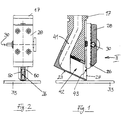
- the nozzle 17 has a bottom 23 which is inclined to the plane 4 and which is pointed approaches and immediately a mouth 24 oriented perpendicular to the plane 4 Nozzle limited.
- the mouth 24 has a substantially rectangular Cross-section.
- the axis of rotation 25 of the nozzle shaft 18 runs in the middle of the mouth perpendicular to level 4.
- a slide 26 is provided, which can be replaced between a wall 27 of the nozzle shaft running parallel to the axis 25 and a removable counter-holder 28 is arranged. Between the Wall 27 and the counter-holder 28, the slide 26 can be moved parallel to the axis 25 guided. In order to be able to move it, it is toothed 29 provided, which meshes with a pinion 30, which by a on the nozzle shaft 18 attached, small electric motor 31 can be driven in a controlled manner.
- the Slider position can be influenced by a potentiometer 32.
- the electric motor 31 and the motor 8 are electronic with each other synchronized.
- the nozzle 17 is passed through the glass sheet Actuation of the motor 8 is delivered, the slide 26 initially in its Closed position. The nozzle is then moved along the crosshead 2 and / or by moving the cross member 2 parallel to the glass sheet 33 in the direction of the arrow 34 moves in a direction opposite to the mouth 24.
- the start phase of the movement is the slider over a distance of length L. 26 open continuously until it reaches a predetermined position in which the off the strand 35 emerging from the nozzle 17 has reached its target thickness D. Because of the steady Opening the slide 26 receives the strand 35 in the start phase on the Distance L a steadily increasing thickness, so that the top of the strand there is formed by an inclined surface 36.
- the nozzle 17 is now guided parallel to the glass sheet 33 along its edge around it and lay a strand of constant cross section and constant thickness D from the glass sheet 33. Finally the nozzle approaches 17 back to their starting position. She continues unchanged until she is with her Bottom edge 37 reaches the tip 38 of the start portion of the strand 35. Because of the oblique course of the bottom 23 of the nozzle, the angle of which is somewhat larger is chosen as the angle of the inclined surface 36 with the glass sheet 33, it comes not to a flat contact of the bottom 23 with the inclined surface 36. Im further course of the movement of the nozzle 17 in the direction of arrow 34 is the Nozzle now controlled by operating the motor 8 so that their Lower edge 37 moved along the inclined surface 36.
- a critical point for the tightness of the insulating glass pane lies at the tip 38 the inclined surface 36, where a difficult to close capillary between the tip 38, the opposite end section 40 and the glass sheet 33 occur can.
- the occurrence of such a capillary can be prevented according to the invention trained nozzle can be effectively countered.
- the cross-sectional shape The recess 43 can be seen in FIG. 4:
- the recess 43 is in the Cross-section a circular section of low height, so that the thickness of the formed Film decreases from the center of the film to both of its edges.
- the bottom 23 is curved 44 provided, which is effective when the slider 26 is raised so far is that not only a film is formed through the recess 43 becomes.
- the curvature 44 has the effect that the strand 35 on its the glass sheet 33 facing side emerges slightly concave and then under the effect internal material tensions fully and fully connects with the glass sheet 33.
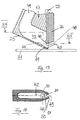
- FIG. 6 shows the nozzle 17 delivered to a glass sheet 33 before the start of the Applying the plastic substance; the slide 26 holds the nozzle 17 completely closed.
- Slider 26 With the start of the movement of the nozzle 17 along the glass sheet 33 in Direction of arrow 34 (or in the case of a stationary nozzle 17 when moving the Glass plate 33 in a direction opposite the arrow direction 34) Slider 26 initially only opened so little that the plastic material only can emerge through the recess 43. This position of the slide is for a distance of the nozzle 17, which is preferably only 0.5 cm to at most a few cm is maintained.
- the beginning and end of the line are then connected lengthways the inclined surface 36, as previously described with reference to FIG 22.
- the danger at the tip 38 of the inclined surface 36 there was a leak such a danger is eliminated by the invention, because the tip of the inclined surface 36 continues into the thin film 45.
- the tip of the thin film 45 are the prerequisites for a seamless connection with the strand 35 lying thereon much better than in the state of Technology.
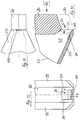
- the exemplary embodiment of the invention shown in FIGS. 10 to 12 differs differs from the embodiment shown in Figures 3 to 5 in that the recess 43 is not provided in the slider 26 but in the bottom 23 is.
- the recess 43 can be closed by one on the Inside the slide formed step 46, the inclination with the inclination of the bottom 23 matches and in the closed position of the slide 26 the recess 43 covered.
- the operation of this nozzle corresponds to the operation the nozzle from Figures 3 to 5; refer to FIGS. 6 to 9 referred.
- the third embodiment of the invention shown in FIGS. 13 and 14 differs from the second embodiment in that the recess 43 in the bottom 23 of the nozzle has larger dimensions than in the exemplary embodiment 10 to 12:
- the recess 43 extends in the direction of movement 34 of the nozzle 17 over a length of 2mm to 3mm.
- the slide 26 has an inward extension 47 with a stage 46, which on the floor 23 with the slide 26 closed Edge of the recess 43 sits.
- a further inclined surface 49 is provided in the bottom 23 at the edge of the recess 43, which has a smooth transition from the bottom 23 into the recess 43 allows.
- the sloping surface 49 lies opposite the slide 26 with its Extension 47 and forces the material flowing to the mouth 24 to change the flow direction in the direction of the recess 43. The plastic material therefore occurs not only when applying the film 45, but also when applying of the strand 35 with a movement component directed against the glass sheet 33 out of the nozzle 17 and thus adheres better to the Glass board 33.
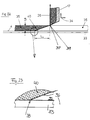
- FIGS. 15 to 18 show the working phases for the nozzle from FIGS. 13 and 14 corresponding to FIGS. 6 to 9.
- the axis of rotation 25 of the nozzle is perpendicular runs to the glass panel 33, in the plane of the main part 24 of the mouth, which, as in the prior art, opposes the direction of movement 34 is so that a spacer with perfectly contoured corners is uninterrupted can be extruded.
- the side walls 50 of the nozzle which limit their mouth laterally, initially run vertically with their edge 51 to the glass panel 33 and then parallel to the glass panel 33.
- the invention provided additional mouth cross-section formed by the recess 43 is directed exclusively against the glass panel 33.
Landscapes
- Engineering & Computer Science (AREA)
- Civil Engineering (AREA)
- Structural Engineering (AREA)
- Joining Of Glass To Other Materials (AREA)
- Liquid Crystal (AREA)
- Lining Or Joining Of Plastics Or The Like (AREA)
Applications Claiming Priority (2)
| Application Number | Priority Date | Filing Date | Title |
|---|---|---|---|
| DE19632063 | 1996-08-09 | ||
| DE19632063A DE19632063C1 (de) | 1996-08-09 | 1996-08-09 | Verfahren und Vorrichtung zum Auftragen eines plastischen Abstandhalters auf eine Glastafel |
Publications (3)
| Publication Number | Publication Date |
|---|---|
| EP0823531A2 true EP0823531A2 (fr) | 1998-02-11 |
| EP0823531A3 EP0823531A3 (fr) | 1999-05-06 |
| EP0823531B1 EP0823531B1 (fr) | 2001-10-10 |
Family
ID=7802161
Family Applications (1)
| Application Number | Title | Priority Date | Filing Date |
|---|---|---|---|
| EP97113811A Expired - Lifetime EP0823531B1 (fr) | 1996-08-09 | 1997-08-09 | Procédé et dispositif d'application d'un joint d'écartement en matériau plastique sur une plaque de verre |
Country Status (3)
| Country | Link |
|---|---|
| EP (1) | EP0823531B1 (fr) |
| AT (1) | ATE206797T1 (fr) |
| DE (2) | DE19632063C1 (fr) |
Cited By (5)
| Publication number | Priority date | Publication date | Assignee | Title |
|---|---|---|---|---|
| DE102007045104A1 (de) | 2007-09-20 | 2009-04-02 | Kömmerling Chemische Fabrik GmbH | Dichtungsmasse zur Herstellung von Zwei- oder Mehrscheiben-Isolierglas oder Solarmodulen |
| DE102009035002A1 (de) * | 2009-07-24 | 2011-01-27 | Bystronic Lenhardt Gmbh | Verfahren zum Herstellen einer Isolierglasscheibe |
| KR101408111B1 (ko) * | 2006-10-24 | 2014-06-16 | 비스트로닉 렌하르트 게엠베하 | 단열유리판의 두 유리패널 사이 공간 내에 페이스트 물질 스트랜드 주입 방법 및 장치 |
| IT201600082082A1 (it) * | 2016-08-04 | 2018-02-04 | Forel Spa | Dispositivo dosatore per la estrusione continua e la applicazione di un profilo distanziatore di un vetro isolante. |
| EP3279422A1 (fr) * | 2016-08-04 | 2018-02-07 | Forel Spa | Dispositif de dosage pour extruder un produit d'étanchéité à un seul ou à deux composants |
Families Citing this family (6)
| Publication number | Priority date | Publication date | Assignee | Title |
|---|---|---|---|---|
| DE29809483U1 (de) * | 1998-05-28 | 1999-10-21 | Nordson Corp., Westlake, Ohio | Vorrichtung zum wahlweisen Schließen einer Öffnung sowie Auftragskopf |
| AT406788B (de) | 1998-11-06 | 2000-09-25 | Lisec Peter | Verfahren zum auftragen von abstandhaltern für isolierglasscheiben aus thermoplastischem werkstoff |
| EP1236559A1 (fr) | 2001-03-02 | 2002-09-04 | SOCIETA' ITALIANA VETRO- SIV-SpA | Dispositif et procédé d'extrusion d'un profile à la périphérie de la surface d'un vitrage et un vitrage pourvu d'un cadre profilé |
| DE102013011390A1 (de) | 2013-05-08 | 2014-11-13 | Maschinenbau Gerold GmbH | Auftragsvorrichtung und -verfahren sowie Scheibe mit Strang |
| DE102019204773B4 (de) | 2019-04-03 | 2023-02-09 | IGK Isolierglasklebstoffe GmbH | System zur Herstellung eines Dichtmassenverbunds für Isolierglas, dessen Verwendung, Randverbund zur Herstellung von Isolierglas oder Solarmodulen und Isolierglaseinheit |
| IT201900016250A1 (it) | 2019-09-13 | 2021-03-13 | Forel Spa | Dispositivo e procedimento per l'estrusione e l'applicazione di profilo distanziatore del vetro isolante |
Citations (1)
| Publication number | Priority date | Publication date | Assignee | Title |
|---|---|---|---|---|
| WO1996009456A2 (fr) | 1994-09-22 | 1996-03-28 | Lenhardt Maschinenbau Gmbh | Procede et dispositif d'application d'un element d'ecartement en plastique sur une plaque de verre |
Family Cites Families (4)
| Publication number | Priority date | Publication date | Assignee | Title |
|---|---|---|---|---|
| US3957406A (en) * | 1971-04-26 | 1976-05-18 | Usm Corporation | Hot melt applicators |
| US4581276A (en) * | 1984-05-25 | 1986-04-08 | Saint-Gobain Vitrage | Adhesive bonding means for mounting glass sheets in a window aperture |
| DE4031236A1 (de) * | 1990-10-04 | 1992-04-09 | Ver Glaswerke Gmbh | Vorrichtung zum formen eines profilstrangs durch extrudieren unmittelbar auf dem rand einer glasscheibe |
| DE9415335U1 (de) * | 1994-09-22 | 1995-02-23 | Lenhardt Maschinenbau GmbH, 75242 Neuhausen | Vorrichtung zum Auftragen eines plastischen Abstandhalters auf eine Glastafel |
-
1996
- 1996-08-09 DE DE19632063A patent/DE19632063C1/de not_active Expired - Fee Related
-
1997
- 1997-08-09 EP EP97113811A patent/EP0823531B1/fr not_active Expired - Lifetime
- 1997-08-09 AT AT97113811T patent/ATE206797T1/de active
- 1997-08-09 DE DE59704843T patent/DE59704843D1/de not_active Expired - Lifetime
Patent Citations (1)
| Publication number | Priority date | Publication date | Assignee | Title |
|---|---|---|---|---|
| WO1996009456A2 (fr) | 1994-09-22 | 1996-03-28 | Lenhardt Maschinenbau Gmbh | Procede et dispositif d'application d'un element d'ecartement en plastique sur une plaque de verre |
Cited By (11)
| Publication number | Priority date | Publication date | Assignee | Title |
|---|---|---|---|---|
| KR101408111B1 (ko) * | 2006-10-24 | 2014-06-16 | 비스트로닉 렌하르트 게엠베하 | 단열유리판의 두 유리패널 사이 공간 내에 페이스트 물질 스트랜드 주입 방법 및 장치 |
| DE102007045104A1 (de) | 2007-09-20 | 2009-04-02 | Kömmerling Chemische Fabrik GmbH | Dichtungsmasse zur Herstellung von Zwei- oder Mehrscheiben-Isolierglas oder Solarmodulen |
| EP2420536A1 (fr) | 2007-09-20 | 2012-02-22 | Kömmerling Chemische Fabrik GmbH | Bord composite pour la fabrication de verre isolant à deux ou plusieurs vitres ou modules solaires |
| US8372909B2 (en) | 2007-09-20 | 2013-02-12 | Adco Products, Inc. | Composite edge for producing double or multiple pane insulation glass or solar modules |
| US9085708B2 (en) | 2007-09-20 | 2015-07-21 | Adco Products, Llc | Composite edge for producing double or multiple pane insulation glass or solar modules |
| DE102009035002A1 (de) * | 2009-07-24 | 2011-01-27 | Bystronic Lenhardt Gmbh | Verfahren zum Herstellen einer Isolierglasscheibe |
| IT201600082082A1 (it) * | 2016-08-04 | 2018-02-04 | Forel Spa | Dispositivo dosatore per la estrusione continua e la applicazione di un profilo distanziatore di un vetro isolante. |
| EP3279422A1 (fr) * | 2016-08-04 | 2018-02-07 | Forel Spa | Dispositif de dosage pour extruder un produit d'étanchéité à un seul ou à deux composants |
| EP3278946A1 (fr) * | 2016-08-04 | 2018-02-07 | Forel Spa | Dispositif de dosage pour extruder en continu et appliquer un profil d'espacement d'une unité de vitrage isolant |
| US20180038154A1 (en) * | 2016-08-04 | 2018-02-08 | Forel Spa | Dosage device for continuously extruding and applying a spacer profile of an insulating glazing unit |
| US11248414B2 (en) * | 2016-08-04 | 2022-02-15 | Forel Spa | Dosage device for continuously extruding and applying a spacer profile of an insulating glazing unit |
Also Published As
| Publication number | Publication date |
|---|---|
| EP0823531B1 (fr) | 2001-10-10 |
| EP0823531A3 (fr) | 1999-05-06 |
| DE19632063C1 (de) | 1998-03-12 |
| DE59704843D1 (de) | 2001-11-15 |
| ATE206797T1 (de) | 2001-10-15 |
Similar Documents
| Publication | Publication Date | Title |
|---|---|---|
| DE4433749C2 (de) | Verfahren und Vorrichtung zum Auftragen eines plastischen Abstandhalters auf eine Glastafel | |
| DE69629929T2 (de) | Verfahren und vorrichtung zum auftragen einer versiegelungsmasse in isolierglasscheiben | |
| DE3721593C2 (fr) | ||
| EP0823531B1 (fr) | Procédé et dispositif d'application d'un joint d'écartement en matériau plastique sur une plaque de verre | |
| CH638763A5 (de) | Einrichtung zum automatischen versiegeln von isolierglasscheiben. | |
| DE69006115T2 (de) | Vorrichtung zur Herstellung von durchsichtigen Kunststoffschichten, welche ein eingefärbtes filtrierendes Band in der Masse aufweisen. | |
| EP0258801B1 (fr) | Procédé de scellement de vitrages isolants rectangulaires | |
| DE10054900B4 (de) | Verfahren und Vorrichtung zum Aufbringen von Dünnbettmörtel | |
| EP0823318B1 (fr) | Procédé et dispositif d'application d'un élément d'écartement en plastique sur une plaque de verre | |
| CH666201A5 (de) | Streicheinrichtung zur beschichtung von warenbahnen. | |
| WO2008028970A1 (fr) | Dispositif pour la distribution de matière visqueuse ou pâteuse | |
| DE29613761U1 (de) | Vorrichtung zum Auftragen eines plastischen Abstandhalters auf eine Glastafel | |
| DE2916070A1 (de) | Vorrichtung und verfahren zum auftragen eines viskosen materials auf eine oberflaeche | |
| DE29613762U1 (de) | Vorrichtung zum Auftragen eines plastischen Abstandhalters auf eine Glastafel | |
| DE2206824B1 (de) | Vorrichtung zum beschichten von distanzprofilen fuer mehrscheibenisolierglas mit dicht- bzw. klebemitteln | |
| DE9415335U1 (de) | Vorrichtung zum Auftragen eines plastischen Abstandhalters auf eine Glastafel | |
| AT406979B (de) | Verfahren zum auftragen eines thermoplastischen abstandhalters auf eine glasscheibe im zuge der herstellung von isolierglasscheiben und zum durchführen des verfahrens verwendbare düse | |
| EP0497807A1 (fr) | Procede pour l'assemblage de deux panneaux de verre en une plaque de verre isolant et dispositif pour la realisation de ce procede | |
| DE3438181A1 (de) | Randabdichtung fuer streicheinrichtung zur beschichtung laufender warenbahnen | |
| DE2907210C3 (de) | Verfahren und Vorrichtung zum automatischen Versiegeln von Isolierglasscheiben | |
| DE68912289T2 (de) | Papierbeschichtung. | |
| AT399145B (de) | Verfahren und vorrichtung zum herstellen von isolierglasscheiben | |
| DE102023110217A1 (de) | Vorrichtung zum selektiven Auftragen von Haftmitteln, Verfahren zum Beschichten von Werkstücken, beschichtetes Werkstück und Verwendung davon | |
| DE10053539A1 (de) | Einrichtung zum Aufbringen einer Schicht eines pulverförmigen Materiales auf eine Oberfläche | |
| DE202006014190U1 (de) | Vorrichtung zum Abdichten einer Isolierglasscheibe |
Legal Events
| Date | Code | Title | Description |
|---|---|---|---|
| PUAI | Public reference made under article 153(3) epc to a published international application that has entered the european phase |
Free format text: ORIGINAL CODE: 0009012 |
|
| AK | Designated contracting states |
Kind code of ref document: A2 Designated state(s): AT DE FR GB IT |
|
| PUAL | Search report despatched |
Free format text: ORIGINAL CODE: 0009013 |
|
| AK | Designated contracting states |
Kind code of ref document: A3 Designated state(s): AT BE CH DE DK ES FI FR GB GR IE IT LI LU MC NL PT SE |
|
| 17P | Request for examination filed |
Effective date: 19990626 |
|
| AKX | Designation fees paid |
Free format text: AT DE FR GB IT |
|
| GRAG | Despatch of communication of intention to grant |
Free format text: ORIGINAL CODE: EPIDOS AGRA |
|
| GRAG | Despatch of communication of intention to grant |
Free format text: ORIGINAL CODE: EPIDOS AGRA |
|
| GRAH | Despatch of communication of intention to grant a patent |
Free format text: ORIGINAL CODE: EPIDOS IGRA |
|
| 17Q | First examination report despatched |
Effective date: 20010227 |
|
| GRAH | Despatch of communication of intention to grant a patent |
Free format text: ORIGINAL CODE: EPIDOS IGRA |
|
| GRAA | (expected) grant |
Free format text: ORIGINAL CODE: 0009210 |
|
| AK | Designated contracting states |
Kind code of ref document: B1 Designated state(s): AT DE FR GB IT |
|
| REF | Corresponds to: |
Ref document number: 206797 Country of ref document: AT Date of ref document: 20011015 Kind code of ref document: T |
|
| REF | Corresponds to: |
Ref document number: 59704843 Country of ref document: DE Date of ref document: 20011115 |
|
| REG | Reference to a national code |
Ref country code: GB Ref legal event code: IF02 |
|
| GBT | Gb: translation of ep patent filed (gb section 77(6)(a)/1977) |
Effective date: 20011220 |
|
| ET | Fr: translation filed | ||
| PLBE | No opposition filed within time limit |
Free format text: ORIGINAL CODE: 0009261 |
|
| STAA | Information on the status of an ep patent application or granted ep patent |
Free format text: STATUS: NO OPPOSITION FILED WITHIN TIME LIMIT |
|
| 26N | No opposition filed | ||
| REG | Reference to a national code |
Ref country code: FR Ref legal event code: PLFP Year of fee payment: 20 |
|
| PGFP | Annual fee paid to national office [announced via postgrant information from national office to epo] |
Ref country code: GB Payment date: 20160824 Year of fee payment: 20 Ref country code: DE Payment date: 20160628 Year of fee payment: 20 Ref country code: IT Payment date: 20160823 Year of fee payment: 20 |
|
| PGFP | Annual fee paid to national office [announced via postgrant information from national office to epo] |
Ref country code: FR Payment date: 20160825 Year of fee payment: 20 Ref country code: AT Payment date: 20160822 Year of fee payment: 20 |
|
| REG | Reference to a national code |
Ref country code: DE Ref legal event code: R071 Ref document number: 59704843 Country of ref document: DE |
|
| REG | Reference to a national code |
Ref country code: GB Ref legal event code: PE20 Expiry date: 20170808 |
|
| REG | Reference to a national code |
Ref country code: AT Ref legal event code: MK07 Ref document number: 206797 Country of ref document: AT Kind code of ref document: T Effective date: 20170809 |
|
| PG25 | Lapsed in a contracting state [announced via postgrant information from national office to epo] |
Ref country code: GB Free format text: LAPSE BECAUSE OF EXPIRATION OF PROTECTION Effective date: 20170808 |