EP0824003A2 - Vorrichtung und Verfahren zum Enthaaren - Google Patents
Vorrichtung und Verfahren zum Enthaaren Download PDFInfo
- Publication number
- EP0824003A2 EP0824003A2 EP97113922A EP97113922A EP0824003A2 EP 0824003 A2 EP0824003 A2 EP 0824003A2 EP 97113922 A EP97113922 A EP 97113922A EP 97113922 A EP97113922 A EP 97113922A EP 0824003 A2 EP0824003 A2 EP 0824003A2
- Authority
- EP
- European Patent Office
- Prior art keywords
- hair
- depilatory
- hair removal
- pad
- iontophoretic
- Prior art date
- Legal status (The legal status is an assumption and is not a legal conclusion. Google has not performed a legal analysis and makes no representation as to the accuracy of the status listed.)
- Granted
Links
Images

Classifications
-
- A—HUMAN NECESSITIES
- A61—MEDICAL OR VETERINARY SCIENCE; HYGIENE
- A61N—ELECTROTHERAPY; MAGNETOTHERAPY; RADIATION THERAPY; ULTRASOUND THERAPY
- A61N1/00—Electrotherapy; Circuits therefor
- A61N1/02—Details
- A61N1/04—Electrodes
- A61N1/0404—Electrodes for external use
- A61N1/0408—Use-related aspects
- A61N1/0428—Specially adapted for iontophoresis, e.g. AC, DC or including drug reservoirs
- A61N1/0432—Anode and cathode
- A61N1/044—Shape of the electrode
-
- A—HUMAN NECESSITIES
- A61—MEDICAL OR VETERINARY SCIENCE; HYGIENE
- A61N—ELECTROTHERAPY; MAGNETOTHERAPY; RADIATION THERAPY; ULTRASOUND THERAPY
- A61N1/00—Electrotherapy; Circuits therefor
- A61N1/18—Applying electric currents by contact electrodes
- A61N1/32—Applying electric currents by contact electrodes alternating or intermittent currents
- A61N1/325—Applying electric currents by contact electrodes alternating or intermittent currents for iontophoresis, i.e. transfer of media in ionic state by an electromotoric force into the body
-
- A—HUMAN NECESSITIES
- A61—MEDICAL OR VETERINARY SCIENCE; HYGIENE
- A61B—DIAGNOSIS; SURGERY; IDENTIFICATION
- A61B17/00—Surgical instruments, devices or methods
- A61B2017/00743—Type of operation; Specification of treatment sites
- A61B2017/00747—Dermatology
- A61B2017/00752—Hair removal or transplantation
-
- A—HUMAN NECESSITIES
- A61—MEDICAL OR VETERINARY SCIENCE; HYGIENE
- A61N—ELECTROTHERAPY; MAGNETOTHERAPY; RADIATION THERAPY; ULTRASOUND THERAPY
- A61N1/00—Electrotherapy; Circuits therefor
- A61N1/02—Details
- A61N1/04—Electrodes
- A61N1/0404—Electrodes for external use
- A61N1/0408—Use-related aspects
- A61N1/0428—Specially adapted for iontophoresis, e.g. AC, DC or including drug reservoirs
- A61N1/0432—Anode and cathode
- A61N1/0436—Material of the electrode
-
- A—HUMAN NECESSITIES
- A61—MEDICAL OR VETERINARY SCIENCE; HYGIENE
- A61N—ELECTROTHERAPY; MAGNETOTHERAPY; RADIATION THERAPY; ULTRASOUND THERAPY
- A61N1/00—Electrotherapy; Circuits therefor
- A61N1/02—Details
- A61N1/04—Electrodes
- A61N1/0404—Electrodes for external use
- A61N1/0408—Use-related aspects
- A61N1/0428—Specially adapted for iontophoresis, e.g. AC, DC or including drug reservoirs
- A61N1/0448—Drug reservoir
Definitions
- This invention relates generally to improvements in methods and apparatus for hair removal and, more particularly, to a new and improved system capable of long term and/or permanent mass or individual hair removal from a biological subject by appropriate iontophoretic delivery of a depilatory agent.
- Thioglycolate depilatories work by hydrolyzing disulfide bonds. Hair strength is a function of the disulfide bonds between cystine molecules. Cystine forms 15 percent of the keratin in hair and 2 percent of the keratin in skin. This is why thioglycolates preferentially hydrolyze the keratin in hair over that in skin.
- Modern formulations are usually aqueous solutions of thioglycolic acid mixed with alkali such as sodium hydroxide or calcium hydroxide.
- alkali such as sodium hydroxide or calcium hydroxide.
- these aqueous solutions of thioglycolates provide the important function of hydrating the hair shaft. This quickly gives the hair a jelly-like consistency so that it can be easily wiped away.
- Thioglycolate depilatories are marketed as pastes, lotions, or creams. A thick layer is applied to the face so that the depilatory does not dry out and lose effectiveness. Depending on the formulation, the depilatory is left on for between two and fourteen minutes. After the preparation is removed, the hairs that remain are typically wiped away with a wash cloth. A moisturizer should also be applied afterward to suppress any irritation.
- Depilatories are intended to act deep in the follicle where the hair shaft has not fully keratinized and therefore can rapidly absorb the chemical. As a result, several days usually elapse before the hair shaft is visible above the skin's surface. Also, for reasons that are not completely clear, the hair that regrows usually does not have the stubbly feel of shaven hair.
- thioglycolates are safe, adverse effects occur occasionally.
- Thioglycolate is a known contact allergen, and the fragrances used in depilatory preparations can also cause contact allergy.
- the alkalinity of certain preparations can cause an irritant dermatitis if left on the skin too long.
- hair removal is not permanent and hair regrowth is inevitable.
- thioglycolates are the most commonly used depilatories, they are not suitable for all situations. In particular, they are usually too slow in action to be useful to men with thick beards. Many men, especially blacks, suffer from pseudofolliculitis barbae ("razor bumps") in which the sharp tip of the shaven beard hair curls into the adjacent skin and causes a foreign body inflammatory reaction. Chemical depilation can help alleviate this problem by eliminating the possibility of nicking the "razor bumps" and by preventing stubbly, sharp-tipped hair from growing in. However, thioglycolates do not penetrate thick beard hairs rapidly enough to be a practical alternative to shaving.
- the present invention provides a new and improved hair removal system for iontophoretically delivering a depilatory agent into a site where hair removal is desired.
- the present invention is directed to methods and means for applying a suitable chemical depilatory agent to the site on a biological subject where hair is to be removed and subsequently iontophoretically delivering the depilatory agent deeply into the site to promote substantial damage or total destruction of the hair roots whereby long term and/or permanent hair removal is selectively accomplished.
- non-metallic iontophoresis electrodes and a chemical depilatory of preferably low viscosity are utilized for enhanced efficacy.
- the depilatory is preferably contained within felt storage pads or the like adjacent the electrodes of the iontophoretic delivery device.
- the depilatory agent may be topically applied directly to the hair at the site where hair removal is desired and iontophoresis is subsequently used to drive the depilatory into the site for controlled hair root destruction. In this latter case a depilatory of higher viscosity, spread over a larger surface area is preferred.
- the magnitude of the electrical current and the duration of treatment may be manipulated to effect varying degrees of hair root damage and thereby selectively accomplish either long term or permanent hair removal.
- the new and improved hair removal methods and apparatus of the present invention enable more rapid, reliable, comfortable, convenient, economical, long term and/or permanent mass and/or individual hair removal.
- Fig. 1 there is shown a flow chart illustrating the basic processes practiced in various aspects of the present invention.
- the purpose of the invention is to drive a suitable chemical depilatory agent deeply into a selected hair removal site located on a suitable biological subject, to effect varying degrees of damage to the hair roots for selective long term and/or permanent mass or individual hair removal at the selected site.
- the most widely used depilatories are highly alkaline creams containing calcium thioglycolates. Hair is composed primarily of the chemical keratin. One of keratin's building blocks is the sulfur-containing amino acid cystine. Cystine makes up 15 to 17 percent of the hair. The alkali and the thioglycolate attack the cystine and break the linkages which hold the keratin molecules together. The hair absorbs water, swells, loses its strength, becomes almost like jelly, and can easily be scraped away from the skin. Because approximately eight times more keratin is found in the hair than in the skin, the depilatory cream will preferentially act more readily on hair than skin. Therefore, in a properly formulated product, the hair can usually be removed without substantially affecting the surrounding skin adversely. Of greatest significance, however, is that the hair removal is only temporary and does not prevent regrowth of hair.
- a depilatory agent such as one including thioglycolate, and of relatively low viscosity, is either supplied to the storage pads of a suitable iontophoretic device (as in step 2) or applied topically to the hairs to be removed (as in step 3).
- the iontophoretic device is then applied to the selected hair removal site where the depilatory is to be delivered and, in step 5, the iontophoretic device is electrically energized with sufficient magnitude of electrical current and for sufficient periods of time to effect the desired degree of hair root damage for either long term or permanent hair removal.
- the depilatory is preferably of high viscosity and spread over a larger surface area than that of the electrode applied to the skin.
- the present invention accomplishes the ultimate hair removal process, a procedure that is at once either long term or permanent and involves multiple or massive hair removal.
- the process of electrolysis is well known for achieving permanency by introducing a needle into the follicle, having the needle connected to the negative terminal of a battery, with the body grounded remotely, and thus causing the collection of caustic sodium hydroxide to decompose the papilla and surrounding tissue.
- the equivalent of the electrolysis chemical i.e., a highly alkaline chemical, the same destructive events would take place resulting in substantial damage and either long term or permanent hair removal.
- an iontophoretic device is utilized to drive ions of the active chemicals of common depilatories to the root system of the growing hair and thus destroy or substantially impair the means for that hair to generate a new hair.
- the system can accomplish this over a wide area simultaneously to many hairs, limited only by the size of the iontophoretic applicator. The size is simply dictated by design.
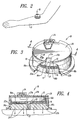
- an iontophoretic patch administration device 10 of relatively simple economical, reliable and compact construction , and suitable for the practice of the present invention, is shown installed upon the arm 11 of a suitable biological subject so that the patch contacts the skin of the subject for appropriate administration of desired hair removal treatment by iontophoretic delivery of a suitable chemical depilatory or the like.
- a larger structural and/or physical packaging unit (not shown) may be utilized, including a terminal electrode applicator for contact with the skin, and also embodying similar operational features.
- the iontophoretic patch 10 is a very compact, circular, cylindrical device fabricated primarily of an outer plastic shell with internal, preferably integrally molded, baffles.
- the plastic shell and baffles are typically molded of an electrically insulating, flexible vinyl material or the like.
- the internal baffles divide the interior of the iontophoretic patch 10 (currently marketed under the trademark LECTRO PATCH by General Medical Company of Los Angeles, California) into upper and lower, hollow internal chambers 12 and 13, respectively, more specifically, by means of an interior baffle member 14.
- the upper chamber 12 contains a compact electronics package 15, including a suitable microchip and battery power supply. This upper chamber 12 is electrically insulated from the lower chamber 13 by the plastic baffle member 14.
- the lower chamber 13 contains a pair of iontophoretic electrodes, 16a and 16b, typically of electrically conductive silicone/carbon material, and which are separated from each other by an electrically non-conductive plastic divider baffle 17 forming a separator wall which divides the lower compartment 13 into a pair of semi-circular electrode chambers and reservoirs 18a and 18b.
- the chambers 18a and 18b house the electrodes 16a, 16b and contain the appropriate substances such as a chemical depilatory agent to be ultimately administered to the biological subject at the selected hair removal site, the depilatory delivery path being indicated generally by the arrows 20 in Fig. 4.
- the iontophoretic electrodes 16a, 16b are suitably connected electrically into the electronics package 15 via electrically conductive tabs 21a and 21b, respectively, extending through appropriate slotted openings in the chamber dividing baffle member 14.
- the silicone/carbon electrodes 16a, 16b are typically fabricated of 1-2 ohm per square centimeter conductive plastic material. While the electrodes 16a, 16b are preferably of silicone/carbon in a presently preferred embodiment of the invention, they may be fabricated of other electrically conductive, non-corrosive materials as well. Preferably, however, non-metallic electrodes are used where a chemical depilatory is to be delivered. With the AC signal used in this system, there is little or no resistance build-up in the silicone/carbon electrodes.
- the drug reservoirs 18a and 18b typically contain a pair of felt pads 22a and 22b which have been appropriately saturated with the substances, i.e., a suitable chemical depilatory agent, to be dispensed.
- an electrical slide switch 24, allowing selection of dosage and treatment duration, projects physically, for access by an operator, through an upper plastic cover plate 26 adhered to the top of the outer shell of the iontophoretic device 10.
- the switch 24 is electrically connected in the chamber 12 to the electronics package 15.
- the switch 24 may be selectively moved between a "0" (off) position, to either a "LO” (low current or lower rate of depilatory delivery) or "HI” (high current or higher rate of depilatory delivery) switch positions, to either turn the device 10 "off” so as to cease electrical operation, or to set the device for either high or low electric current rate operation.
- An LED test indicator 28 extends from the electronics package chamber 12 below the cover plate 26, through an appropriate opening in the cover plate, and is observable from the top of the iontophoretic patch 10 to confirm proper electrical operation of the system for the user.
- the iontophoretic delivery device is not limited to being physically packaged as a patch 10.
- a larger electronics package may be housed in a remote instrument containing the electronics package, and either battery or plug-in electrical power may be utilized.
- a local applicator would then be electrically connected by cable to the remote instrument.
- the applicator would house suitable iontophoretic electrodes and drug reservoirs akin to the chamber 13 of the patch 10 in Figs. 2-4.
- depilatories containing thioglycolates are preferred, as are compositions of low viscosity and a water-like consistency which are easily absorbed by the felt pads 22a and 22b, previously described.
- the higher viscosity depilatories are more useful in the embodiment of the invention where the depilatory is applied directly to the delivery site rather than to the electrode pads. All such depilatories should also preferably be mild enough to treat the facial area in addition to other areas of the body.
- Suitable depilatories commonly available are marketed under the brand names "NAIR” (manufactured by Carter-Wallace, Inc.) and “NEET” (manufactured by Whitehall Laboratories, Inc.).
- NAIR manufactured by Carter-Wallace, Inc.
- NEET manufactured by Whitehall Laboratories, Inc.
- Such formulations, with the thickening ingredient removed to enhance absorption by the pads 22a and 22b, are preferable in the practice of the present invention where the electrode pads are soaked with the depilatory, but the thickening agent may be left intact if the depilatory is applied topically directly to the delivery site.
- thioglycolic acid, and calcium hydroxide or another alkali - depilatory creams usually contain several or all of the following: surfactants, to emulsify (suspend) any fats, oils and water used in preparation of the product and to promote wetting of the hair and washing off of the preparation; humectants (glycerol, propylene glycol), to prevent quick drying on the skin; water; polyethylene glycols; and fats, oils, or other fat materials.
- surfactants to emulsify (suspend) any fats, oils and water used in preparation of the product and to promote wetting of the hair and washing off of the preparation
- humectants glycerol, propylene glycol
- hair removal is accomplished with iontophoresis currents that may vary from approximately 0.5 ma. to approximately 1.0 ma. and for durations of treatment between approximately a few minutes and approximately fifteen minutes. Of course, this is by way of example only and may vary widely to establish desired electrical current density (e.g. less than 0.5 ma per cm 2 ), depending upon the particular chemical depilatory used, the size (area) of the iontophoresis electrodes adjacent the hair removal site, the tolerable comfort threshold and the extent of hair removal desired, i.e., long term or permanent. Reasonable experimentation with these parameters will produce the desired results. Typically, lower currents and shorter time durations are used initially to mitigate skin irritation and to determine experimentally the effect upon the hair for the particular subject and particular part of the anatomy where hair removal is desired.
- the new and improved hair removal methods and apparatus of the present invention satisfy a long existing need for more rapid, reliable, comfortable, convenient, economical, long term and/or permanent mass and/or individual hair removal.
Landscapes
- Health & Medical Sciences (AREA)
- Engineering & Computer Science (AREA)
- Biomedical Technology (AREA)
- Nuclear Medicine, Radiotherapy & Molecular Imaging (AREA)
- Radiology & Medical Imaging (AREA)
- Life Sciences & Earth Sciences (AREA)
- Animal Behavior & Ethology (AREA)
- General Health & Medical Sciences (AREA)
- Public Health (AREA)
- Veterinary Medicine (AREA)
- Bioinformatics & Cheminformatics (AREA)
- Cosmetics (AREA)
- Surgical Instruments (AREA)
- Medicines Containing Plant Substances (AREA)
- Electrotherapy Devices (AREA)
- Medicines Containing Material From Animals Or Micro-Organisms (AREA)
Applications Claiming Priority (2)
| Application Number | Priority Date | Filing Date | Title |
|---|---|---|---|
| US696721 | 1996-08-14 | ||
| US08/696,721 US6094594A (en) | 1996-08-14 | 1996-08-14 | Hair removal system |
Publications (3)
| Publication Number | Publication Date |
|---|---|
| EP0824003A2 true EP0824003A2 (de) | 1998-02-18 |
| EP0824003A3 EP0824003A3 (de) | 1998-03-11 |
| EP0824003B1 EP0824003B1 (de) | 2004-10-27 |
Family
ID=24798268
Family Applications (1)
| Application Number | Title | Priority Date | Filing Date |
|---|---|---|---|
| EP97113922A Expired - Lifetime EP0824003B1 (de) | 1996-08-14 | 1997-08-12 | Vorrichtung und Verfahren zum Enthaaren |
Country Status (6)
| Country | Link |
|---|---|
| US (4) | US6094594A (de) |
| EP (1) | EP0824003B1 (de) |
| JP (1) | JPH10146392A (de) |
| AT (1) | ATE280517T1 (de) |
| DE (1) | DE69731339T2 (de) |
| ES (1) | ES2230580T3 (de) |
Cited By (5)
| Publication number | Priority date | Publication date | Assignee | Title |
|---|---|---|---|---|
| WO2000021612A1 (en) * | 1998-10-09 | 2000-04-20 | Ultra Cure Ltd. | A method and device for hair removal |
| WO2006111968A2 (en) | 2005-04-22 | 2006-10-26 | Ecpoint Medical Inc. | Dc tissue treatment |
| EP1808197A4 (de) * | 2004-10-29 | 2008-04-23 | Transcu Ltd | Elektrode und iontophorese-gerät |
| WO2009086973A3 (en) * | 2008-01-08 | 2009-09-17 | Paola Fontani | Process for permanent body epilation |
| US8062783B2 (en) | 2006-12-01 | 2011-11-22 | Tti Ellebeau, Inc. | Systems, devices, and methods for powering and/or controlling devices, for instance transdermal delivery devices |
Families Citing this family (23)
| Publication number | Priority date | Publication date | Assignee | Title |
|---|---|---|---|---|
| US6094594A (en) * | 1996-08-14 | 2000-07-25 | Tapper; Robert | Hair removal system |
| DE69941327D1 (de) * | 1998-02-23 | 2009-10-08 | Swift Beef Co | Verfahren und anlage zum bearbeiten von abfällen bei der enthaarung von tieren |
| GB0015774D0 (en) * | 2000-06-28 | 2000-08-16 | Reckitt & Colmann Prod Ltd | Appliance |
| US20040039403A1 (en) * | 2002-08-23 | 2004-02-26 | Glucksman Dov Z. | Portable depilator |
| US20050192528A1 (en) * | 2004-01-08 | 2005-09-01 | Robert Tapper | Methods, apparatus and charged chemicals for control of ions, molecules or electrons |
| US8386030B2 (en) | 2005-08-08 | 2013-02-26 | Tti Ellebeau, Inc. | Iontophoresis device |
| US8295922B2 (en) | 2005-08-08 | 2012-10-23 | Tti Ellebeau, Inc. | Iontophoresis device |
| KR20080047600A (ko) | 2005-09-15 | 2008-05-29 | 티티아이 엘뷰 가부시키가이샤 | 로드형 이온토포레시스 장치 |
| WO2007041118A1 (en) | 2005-09-30 | 2007-04-12 | Tti Ellebeau, Inc. | Iontophoretic device and method of delivery of active agents to biological interface |
| JP4732871B2 (ja) * | 2005-11-25 | 2011-07-27 | Tti・エルビュー株式会社 | イオントフォレーシス装置 |
| WO2007079193A2 (en) | 2005-12-30 | 2007-07-12 | Tti Ellebeau, Inc. | Iontophoretic systems, devices, and methods of delivery of active agents to biological interface |
| US20100278759A1 (en) * | 2006-02-08 | 2010-11-04 | Howard Murad | Topical Therapeutic Delivery System |
| US20070191756A1 (en) * | 2006-02-13 | 2007-08-16 | Robert Tapper | System, method and apparatus for enhanced sweat control and the like |
| US20070203534A1 (en) * | 2006-02-13 | 2007-08-30 | Robert Tapper | Stimulating galvanic or slow AC current for therapeutic physiological effects |
| WO2008062365A2 (en) * | 2006-11-24 | 2008-05-29 | Koninklijke Philips Electronics N.V. | Iontophoretic device |
| WO2009083836A2 (en) * | 2007-12-21 | 2009-07-09 | The Procter & Gamble Company | Depilatory kit resulting in reduced odor and irritation |
| CN102762185A (zh) * | 2010-02-17 | 2012-10-31 | 宝洁公司 | 有效的脱毛剂制品 |
| EP2368541B1 (de) * | 2010-03-26 | 2011-12-21 | The Procter & Gamble Company | Verfahren zur Depilation und Depilierausrüstung |
| WO2011119557A2 (en) * | 2010-03-26 | 2011-09-29 | The Procter & Gamble Company | Kit and method for removing hair |
| US9717657B2 (en) | 2012-10-24 | 2017-08-01 | Amy Dukoff | Composition and method of using medicament for endodontic irrigation, stem cell preparations and tissue regeneration |
| US11700860B2 (en) | 2018-09-27 | 2023-07-18 | The United States Of America, As Represented By The Secretary Of Agriculture | Method to clean and decontaminate animal carcasses using alkaline thioglycolate-containing compound |
| BR112022016705A2 (pt) * | 2020-02-21 | 2022-10-11 | Massachusetts Gen Hospital | Sistemas e métodos para um sistema de transplante de cabelo com agulhas de extração e implantação |
| CN115068813B (zh) * | 2022-06-21 | 2024-01-02 | 久心医疗科技(苏州)有限公司 | 一种除颤电极及自动除颤仪 |
Family Cites Families (13)
| Publication number | Priority date | Publication date | Assignee | Title |
|---|---|---|---|---|
| CA796723A (en) * | 1962-03-06 | 1968-10-15 | Braun Ernest | Depilatory composition |
| FR2196820A1 (en) * | 1972-08-22 | 1974-03-22 | Legros Francis | Chemically loaded composite absorbent glove - for rapid and safe application to large areas of sterilised or dangerous reagents, esp. depilitants |
| US4121904A (en) * | 1976-10-26 | 1978-10-24 | Alberto-Culver Company | Depilatory composition for removing hair from live human skin |
| US4325367A (en) * | 1977-06-13 | 1982-04-20 | Robert Tapper | Iontophoretic treatment apparatus |
| US4618344A (en) * | 1982-06-01 | 1986-10-21 | The Procter & Gamble Company | Depilatory compositions |
| US5224927A (en) * | 1990-11-01 | 1993-07-06 | Robert Tapper | Iontophoretic treatment system |
| US5215520A (en) * | 1991-09-17 | 1993-06-01 | Centre Internationale De Recherches Dermatologiques Galderma (C.I.R.D. Galderma) | Method for delivering an active substance topically or percutaneously |
| ES2136605T3 (es) * | 1992-02-14 | 1999-12-01 | Drug Delivery Systems Inc | Dispositivo electrico de aplicacion transdermica de farmacos con un agente de contrarresto. |
| AU690069B2 (en) * | 1993-02-09 | 1998-04-23 | Tulsa Forte Pharmacy Enterprises, Inc. | A method for stimulating hair growth with cationic derivatives of minoxidil using therapeutic iontophoresis |
| US5669916A (en) * | 1994-09-28 | 1997-09-23 | The General Hospital Corporation | Method of hair removal |
| US5645825A (en) * | 1995-06-07 | 1997-07-08 | The Procter & Gamble Company | Depilatory compositions comprising sulfhydryl compounds |
| US5944685A (en) * | 1996-02-09 | 1999-08-31 | Polytronics, Ltd. | Skin-contact type medical treatment apparatus |
| US6094594A (en) * | 1996-08-14 | 2000-07-25 | Tapper; Robert | Hair removal system |
-
1996
- 1996-08-14 US US08/696,721 patent/US6094594A/en not_active Expired - Fee Related
-
1997
- 1997-08-12 DE DE69731339T patent/DE69731339T2/de not_active Expired - Fee Related
- 1997-08-12 ES ES97113922T patent/ES2230580T3/es not_active Expired - Lifetime
- 1997-08-12 AT AT97113922T patent/ATE280517T1/de not_active IP Right Cessation
- 1997-08-12 EP EP97113922A patent/EP0824003B1/de not_active Expired - Lifetime
- 1997-08-14 JP JP9219640A patent/JPH10146392A/ja active Pending
-
1999
- 1999-12-16 US US09/464,591 patent/US6206869B1/en not_active Expired - Fee Related
-
2000
- 2000-05-19 US US09/574,760 patent/US20010027288A1/en not_active Abandoned
- 2000-07-24 US US09/624,309 patent/US6425891B1/en not_active Expired - Fee Related
Cited By (5)
| Publication number | Priority date | Publication date | Assignee | Title |
|---|---|---|---|---|
| WO2000021612A1 (en) * | 1998-10-09 | 2000-04-20 | Ultra Cure Ltd. | A method and device for hair removal |
| EP1808197A4 (de) * | 2004-10-29 | 2008-04-23 | Transcu Ltd | Elektrode und iontophorese-gerät |
| WO2006111968A2 (en) | 2005-04-22 | 2006-10-26 | Ecpoint Medical Inc. | Dc tissue treatment |
| US8062783B2 (en) | 2006-12-01 | 2011-11-22 | Tti Ellebeau, Inc. | Systems, devices, and methods for powering and/or controlling devices, for instance transdermal delivery devices |
| WO2009086973A3 (en) * | 2008-01-08 | 2009-09-17 | Paola Fontani | Process for permanent body epilation |
Also Published As
| Publication number | Publication date |
|---|---|
| US6206869B1 (en) | 2001-03-27 |
| DE69731339T2 (de) | 2006-02-16 |
| EP0824003A3 (de) | 1998-03-11 |
| US6094594A (en) | 2000-07-25 |
| ATE280517T1 (de) | 2004-11-15 |
| EP0824003B1 (de) | 2004-10-27 |
| ES2230580T3 (es) | 2005-05-01 |
| JPH10146392A (ja) | 1998-06-02 |
| US6425891B1 (en) | 2002-07-30 |
| US20010027288A1 (en) | 2001-10-04 |
| DE69731339D1 (de) | 2004-12-02 |
Similar Documents
| Publication | Publication Date | Title |
|---|---|---|
| US6094594A (en) | Hair removal system | |
| US20090093749A1 (en) | Apparatus and method for skin treatment | |
| Bencini et al. | Long‐term epilation with long‐pulsed neodimium: YAG laser | |
| US5797926A (en) | Method and apparatus for permanent removal of multiple hairs with hair clamping springs | |
| US4317450A (en) | Method of epilation | |
| US4498474A (en) | Epilation method | |
| US6620158B2 (en) | Method of hair removal | |
| US5026369A (en) | Non-invasive method of removing hair through electrolysis | |
| JPH1024108A (ja) | 顔面被覆マスク | |
| Wanitphakdeedecha et al. | Physical means of treating unwanted hair | |
| JP2768456B2 (ja) | 化粧用マスク | |
| KR101793532B1 (ko) | 블랙헤드 제거기 | |
| JP4530211B2 (ja) | 毛髪への有効成分のイオン導入及び遠赤外線付与トリートメント装置 | |
| US5833687A (en) | Electrical current hair removal tweezers | |
| KR101166587B1 (ko) | 모발로의 유효성분의 이온도입 및 원적외선 부여트리트먼트 장치 | |
| US6059777A (en) | Method and process for non-invasive sub-epidermal permanent hair removal | |
| KR102628465B1 (ko) | 기능성 아이크림 화장품 | |
| CA1190602A (en) | Epilation method and system | |
| JPS622006Y2 (de) | ||
| Khanna | Cosmetic treatment of hirsutism | |
| Inaba et al. | Pharmaceutical and Physical Treatment Procedures for Axillary Bromidrosis | |
| CN112957609A (zh) | 一种头皮毛囊激活的再生处理系统 | |
| CA2450963A1 (en) | Method of hair removal | |
| Hutchins | The Treatment of Skin Disfigurements by Electrolysis | |
| JP2000004940A (ja) | 鼻の毛穴汚れとり装置 |
Legal Events
| Date | Code | Title | Description |
|---|---|---|---|
| PUAI | Public reference made under article 153(3) epc to a published international application that has entered the european phase |
Free format text: ORIGINAL CODE: 0009012 |
|
| PUAL | Search report despatched |
Free format text: ORIGINAL CODE: 0009013 |
|
| AK | Designated contracting states |
Kind code of ref document: A2 Designated state(s): AT BE CH DE DK ES FI FR GB GR IE IT LI LU MC |
|
| AX | Request for extension of the european patent |
Free format text: AL;LT;LV;RO;SI |
|
| AK | Designated contracting states |
Kind code of ref document: A3 Designated state(s): AT BE CH DE DK ES FI FR GB GR IE IT LI LU MC NL PT SE |
|
| AX | Request for extension of the european patent |
Free format text: AL;LT;LV;RO;SI |
|
| 17P | Request for examination filed |
Effective date: 19980629 |
|
| AKX | Designation fees paid |
Free format text: AT BE CH DE DK ES FI FR GB GR IE IT LI LU MC |
|
| RBV | Designated contracting states (corrected) |
Designated state(s): AT BE CH DE DK ES FI FR GB GR IE IT LI LU MC |
|
| 17Q | First examination report despatched |
Effective date: 20010412 |
|
| GRAP | Despatch of communication of intention to grant a patent |
Free format text: ORIGINAL CODE: EPIDOSNIGR1 |
|
| RBV | Designated contracting states (corrected) |
Designated state(s): AT BE CH DE DK ES FR GB GR IE IT LI NL PT SE |
|
| GRAS | Grant fee paid |
Free format text: ORIGINAL CODE: EPIDOSNIGR3 |
|
| GRAA | (expected) grant |
Free format text: ORIGINAL CODE: 0009210 |
|
| AK | Designated contracting states |
Kind code of ref document: B1 Designated state(s): AT BE CH DE DK ES FR GB GR IE IT LI NL PT SE |
|
| PG25 | Lapsed in a contracting state [announced via postgrant information from national office to epo] |
Ref country code: NL Free format text: LAPSE BECAUSE OF FAILURE TO SUBMIT A TRANSLATION OF THE DESCRIPTION OR TO PAY THE FEE WITHIN THE PRESCRIBED TIME-LIMIT Effective date: 20041027 Ref country code: LI Free format text: LAPSE BECAUSE OF FAILURE TO SUBMIT A TRANSLATION OF THE DESCRIPTION OR TO PAY THE FEE WITHIN THE PRESCRIBED TIME-LIMIT Effective date: 20041027 Ref country code: CH Free format text: LAPSE BECAUSE OF FAILURE TO SUBMIT A TRANSLATION OF THE DESCRIPTION OR TO PAY THE FEE WITHIN THE PRESCRIBED TIME-LIMIT Effective date: 20041027 Ref country code: BE Free format text: LAPSE BECAUSE OF FAILURE TO SUBMIT A TRANSLATION OF THE DESCRIPTION OR TO PAY THE FEE WITHIN THE PRESCRIBED TIME-LIMIT Effective date: 20041027 Ref country code: AT Free format text: LAPSE BECAUSE OF FAILURE TO SUBMIT A TRANSLATION OF THE DESCRIPTION OR TO PAY THE FEE WITHIN THE PRESCRIBED TIME-LIMIT Effective date: 20041027 |
|
| REG | Reference to a national code |
Ref country code: GB Ref legal event code: FG4D |
|
| REG | Reference to a national code |
Ref country code: CH Ref legal event code: EP |
|
| REG | Reference to a national code |
Ref country code: IE Ref legal event code: FG4D |
|
| REF | Corresponds to: |
Ref document number: 69731339 Country of ref document: DE Date of ref document: 20041202 Kind code of ref document: P |
|
| PG25 | Lapsed in a contracting state [announced via postgrant information from national office to epo] |
Ref country code: SE Free format text: LAPSE BECAUSE OF FAILURE TO SUBMIT A TRANSLATION OF THE DESCRIPTION OR TO PAY THE FEE WITHIN THE PRESCRIBED TIME-LIMIT Effective date: 20050127 Ref country code: GR Free format text: LAPSE BECAUSE OF FAILURE TO SUBMIT A TRANSLATION OF THE DESCRIPTION OR TO PAY THE FEE WITHIN THE PRESCRIBED TIME-LIMIT Effective date: 20050127 Ref country code: DK Free format text: LAPSE BECAUSE OF FAILURE TO SUBMIT A TRANSLATION OF THE DESCRIPTION OR TO PAY THE FEE WITHIN THE PRESCRIBED TIME-LIMIT Effective date: 20050127 |
|
| REG | Reference to a national code |
Ref country code: CH Ref legal event code: PL |
|
| REG | Reference to a national code |
Ref country code: ES Ref legal event code: FG2A Ref document number: 2230580 Country of ref document: ES Kind code of ref document: T3 |
|
| NLV1 | Nl: lapsed or annulled due to failure to fulfill the requirements of art. 29p and 29m of the patents act | ||
| PG25 | Lapsed in a contracting state [announced via postgrant information from national office to epo] |
Ref country code: IE Free format text: LAPSE BECAUSE OF NON-PAYMENT OF DUE FEES Effective date: 20050812 |
|
| ET | Fr: translation filed | ||
| PLBE | No opposition filed within time limit |
Free format text: ORIGINAL CODE: 0009261 |
|
| STAA | Information on the status of an ep patent application or granted ep patent |
Free format text: STATUS: NO OPPOSITION FILED WITHIN TIME LIMIT |
|
| 26N | No opposition filed |
Effective date: 20050728 |
|
| REG | Reference to a national code |
Ref country code: IE Ref legal event code: MM4A |
|
| PGFP | Annual fee paid to national office [announced via postgrant information from national office to epo] |
Ref country code: ES Payment date: 20070827 Year of fee payment: 11 |
|
| PG25 | Lapsed in a contracting state [announced via postgrant information from national office to epo] |
Ref country code: PT Free format text: LAPSE BECAUSE OF NON-PAYMENT OF DUE FEES Effective date: 20050327 |
|
| PGFP | Annual fee paid to national office [announced via postgrant information from national office to epo] |
Ref country code: GB Payment date: 20070830 Year of fee payment: 11 |
|
| PGFP | Annual fee paid to national office [announced via postgrant information from national office to epo] |
Ref country code: IT Payment date: 20070829 Year of fee payment: 11 Ref country code: DE Payment date: 20071001 Year of fee payment: 11 |
|
| PGFP | Annual fee paid to national office [announced via postgrant information from national office to epo] |
Ref country code: FR Payment date: 20070817 Year of fee payment: 11 |
|
| GBPC | Gb: european patent ceased through non-payment of renewal fee |
Effective date: 20080812 |
|
| REG | Reference to a national code |
Ref country code: FR Ref legal event code: ST Effective date: 20090430 |
|
| PG25 | Lapsed in a contracting state [announced via postgrant information from national office to epo] |
Ref country code: IT Free format text: LAPSE BECAUSE OF NON-PAYMENT OF DUE FEES Effective date: 20080812 Ref country code: FR Free format text: LAPSE BECAUSE OF NON-PAYMENT OF DUE FEES Effective date: 20080901 Ref country code: DE Free format text: LAPSE BECAUSE OF NON-PAYMENT OF DUE FEES Effective date: 20090303 |
|
| REG | Reference to a national code |
Ref country code: ES Ref legal event code: FD2A Effective date: 20080813 |
|
| PG25 | Lapsed in a contracting state [announced via postgrant information from national office to epo] |
Ref country code: GB Free format text: LAPSE BECAUSE OF NON-PAYMENT OF DUE FEES Effective date: 20080812 |
|
| PG25 | Lapsed in a contracting state [announced via postgrant information from national office to epo] |
Ref country code: ES Free format text: LAPSE BECAUSE OF NON-PAYMENT OF DUE FEES Effective date: 20080813 |