EP0824097A1 - Dérivés n-(alkyloxycarbonyl)-N-(2-hydroxy 3-alkyloxypropyl)-éthanolamine et leur utilisation dans et pour la préparation de compositions cosmétiques ou dermatologiques - Google Patents
Dérivés n-(alkyloxycarbonyl)-N-(2-hydroxy 3-alkyloxypropyl)-éthanolamine et leur utilisation dans et pour la préparation de compositions cosmétiques ou dermatologiques Download PDFInfo
- Publication number
- EP0824097A1 EP0824097A1 EP97401736A EP97401736A EP0824097A1 EP 0824097 A1 EP0824097 A1 EP 0824097A1 EP 97401736 A EP97401736 A EP 97401736A EP 97401736 A EP97401736 A EP 97401736A EP 0824097 A1 EP0824097 A1 EP 0824097A1
- Authority
- EP
- European Patent Office
- Prior art keywords
- hydroxy
- compound
- ethanolamine
- formula
- hexadecyloxypropyl
- Prior art date
- Legal status (The legal status is an assumption and is not a legal conclusion. Google has not performed a legal analysis and makes no representation as to the accuracy of the status listed.)
- Granted
Links
- 0 *OCC(CN)O Chemical compound *OCC(CN)O 0.000 description 1
Classifications
-
- A—HUMAN NECESSITIES
- A61—MEDICAL OR VETERINARY SCIENCE; HYGIENE
- A61Q—SPECIFIC USE OF COSMETICS OR SIMILAR TOILETRY PREPARATIONS
- A61Q19/00—Preparations for care of the skin
-
- A—HUMAN NECESSITIES
- A61—MEDICAL OR VETERINARY SCIENCE; HYGIENE
- A61K—PREPARATIONS FOR MEDICAL, DENTAL OR TOILETRY PURPOSES
- A61K8/00—Cosmetics or similar toiletry preparations
- A61K8/18—Cosmetics or similar toiletry preparations characterised by the composition
- A61K8/30—Cosmetics or similar toiletry preparations characterised by the composition containing organic compounds
- A61K8/40—Cosmetics or similar toiletry preparations characterised by the composition containing organic compounds containing nitrogen
- A61K8/44—Aminocarboxylic acids or derivatives thereof, e.g. aminocarboxylic acids containing sulfur; Salts; Esters or N-acylated derivatives thereof
-
- A—HUMAN NECESSITIES
- A61—MEDICAL OR VETERINARY SCIENCE; HYGIENE
- A61Q—SPECIFIC USE OF COSMETICS OR SIMILAR TOILETRY PREPARATIONS
- A61Q5/00—Preparations for care of the hair
- A61Q5/12—Preparations containing hair conditioners
-
- C—CHEMISTRY; METALLURGY
- C07—ORGANIC CHEMISTRY
- C07C—ACYCLIC OR CARBOCYCLIC COMPOUNDS
- C07C271/00—Derivatives of carbamic acids, i.e. compounds containing any of the groups, the nitrogen atom not being part of nitro or nitroso groups
- C07C271/06—Esters of carbamic acids
- C07C271/08—Esters of carbamic acids having oxygen atoms of carbamate groups bound to acyclic carbon atoms
- C07C271/10—Esters of carbamic acids having oxygen atoms of carbamate groups bound to acyclic carbon atoms with the nitrogen atoms of the carbamate groups bound to hydrogen atoms or to acyclic carbon atoms
- C07C271/16—Esters of carbamic acids having oxygen atoms of carbamate groups bound to acyclic carbon atoms with the nitrogen atoms of the carbamate groups bound to hydrogen atoms or to acyclic carbon atoms to carbon atoms of hydrocarbon radicals substituted by singly-bound oxygen atoms
-
- A—HUMAN NECESSITIES
- A61—MEDICAL OR VETERINARY SCIENCE; HYGIENE
- A61Q—SPECIFIC USE OF COSMETICS OR SIMILAR TOILETRY PREPARATIONS
- A61Q1/00—Make-up preparations; Body powders; Preparations for removing make-up
-
- A—HUMAN NECESSITIES
- A61—MEDICAL OR VETERINARY SCIENCE; HYGIENE
- A61Q—SPECIFIC USE OF COSMETICS OR SIMILAR TOILETRY PREPARATIONS
- A61Q19/00—Preparations for care of the skin
- A61Q19/007—Preparations for dry skin
Definitions
- the invention relates to N- (alkyloxycarbonyl) -N- (2-hydroxy-3-alkyloxypropyl) -ethanolamine derivatives. as well as their use in and for preparation cosmetic or dermatological compositions.
- N- (alkyloxy-carbonyl) -N- (2-hydroxy-3-alkyloxypropyl) -ethanolamine derivatives have interesting cosmetic properties, in particular properties moisturizing skin. It has in fact been found that by applying these products to the skin, it is possible to increase the fixation of water in the Stratum Corneum. These compounds can therefore be used as hydrating agents, in particular of the skin in humans. They allow to preserve or restore the suppleness of the skin, its elasticity, its resistance to body movement and its barrier function to the entry of toxic substances. They can thus be used in care products for dry skin or predisposed to drying. These compounds unexpectedly exhibit significantly greater water-binding activity in the Stratum Cornea than the lipophilic amides known in cosmetics for their moisturizing properties.
- N- (alkyloxycarbonyl) -N- (2-hydroxy-3-alkyloxypropyl) -ethanolamine derivatives according to the invention give the hair a particularly soft feel and facilitate their disentangling. They can be used as hair conditioning agents.
- An object of the invention relates to specific N- (alkyloxycarbonyl) -N- (2-hydroxy-3-alkyloxypropyl) -ethanolamine derivatives, the structure of which will be indicated below.
- Another subject of the invention relates to the use of said N- (alkyloxycarbonyl) -N- (2-hydroxy-3-alkyloxypropyl) -ethanolamine derivatives which will be defined below, in and for the preparation of cosmetic compositions or dermatological.
- Another subject of the invention relates to cosmetic or dermatological compositions containing these N- (alkyloxycarbonyl) -N- (2-hydroxy-3-alkyloxypropyl) -ethanolamine derivatives.
- Another object of the invention therefore relates to the use of these derivatives as hydrating agents, in and for the preparation of compositions for caring for the skin.
- Another subject of the invention relates to the use of these N- (alkyloxycarbonyl) -N- (2-hydroxy-3-alkyloxypropyl) -ethanolamine derivatives, as hair conditioning agents in and for the preparation of hair compositions.
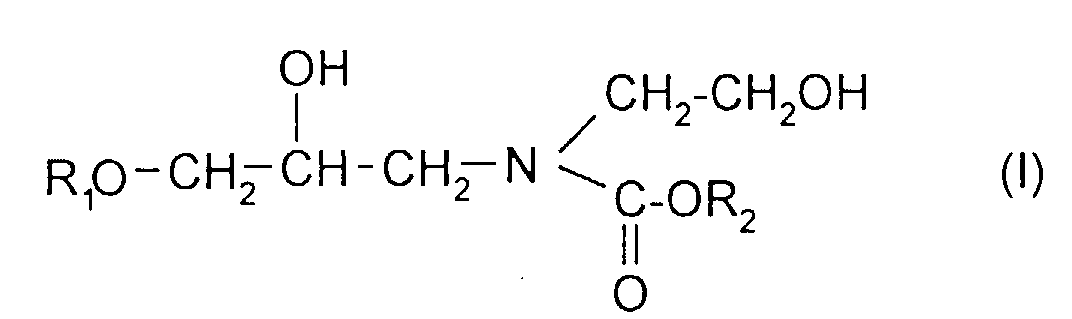
- N- (alkyloxycarbonyl) -N- (2-hydroxy-3-alkyloxypropyl) -ethanolamine derivatives according to the invention correspond to the following general formula (I): in which R 1 and R 2 , identical or different, represent an alkyl radical having from 8 to 26 carbon atoms, linear or branched, saturated or unsaturated and optionally hydroxylated.
- the cosmetic or dermatological compositions according to the invention are characterized in that they contain, in a cosmetically or dermatologically acceptable vehicle, at least one compound of formula (I) as defined above.
- the cosmetic or dermatological compositions according to the invention preferably comprise 0.001 to 15% by weight of compound of formula (I) relative to the total weight of the composition.
- the cosmetically acceptable vehicle used in the compositions of the invention is chosen from water; organic solvents compatible with skin or hair application such as acetone, isopropanol, ethanol; fatty acid triglycerides with 6-24 carbon atoms, glycol ethers, polyalkylene glycol esters and volatile silicones or mixtures thereof.
- compositions may be in the form of an aqueous or hydroalcoholic lotion, monophasic or polyphasic, monophasic or polyphasic gel, emulsion, cream, vesicular dispersion of ionic lipids or nonionic, said vesicles can then be used as an encapsulating agent for lipophilic or hydrophilic active ingredients, foam, spray.
- compositions for the care of the skin according to the invention can be in the form of a lotion, gel, emulsion, cream or foam to be applied to the skin.
- the hair compositions may be in the form of shampoo, conditioner to rinse or not, compositions for perm, hair straightening, coloring or bleaching, or alternatively in the form of compositions to rinse, to be applied before or after coloring, a perm or straightening or between the two stages of a perm or straightening.
- the cosmetic or dermatological compositions can moreover contain conventional cosmetic additives chosen from fatty substances, solvents organic, silicones, thickeners, softeners, surfactants, anionic, cationic, nonionic or amphoteric polymers, anti-foaming agents, hair conditioning agents such as proteins, vitamins, treating agents (anti-hair loss agents, anti-dandruff agents), dyes, perfumes, preservatives, propellants.
- conventional cosmetic additives chosen from fatty substances, solvents organic, silicones, thickeners, softeners, surfactants, anionic, cationic, nonionic or amphoteric polymers, anti-foaming agents, hair conditioning agents such as proteins, vitamins, treating agents (anti-hair loss agents, anti-dandruff agents), dyes, perfumes, preservatives, propellants.
- the fatty substance it is possible to use an oil or a wax or a mixture thereof, fatty acids, fatty alcohols, fatty acid esters such as triglycerides of C 6 to C 18 fatty acid, petrolatum, paraffin, lanolin, hydrogenated or acetylated lanolin.
- oils mention may be made of mineral, animal and vegetable oils or synthetic oils, and in particular petroleum jelly, paraffin, castor oil, jojoba, sesame oil, as well as silicone oils and gums and isoparaffins.
- the waxes mention may be made of animal, vegetable, mineral or synthetic waxes, and in particular beeswaxes, candellila waxes, ozokerites, microcrystalline waxes as well as silicone resins and waxes.
- organic solvents usually used in cosmetic compositions there may be mentioned more precisely monoalcohols or polyalcohols lower in C 1 to C 6 such as ethanol, isopropanol, ethylene glycol, diethylene glycol, propylene glycol, glycerol.
- the thickening agents can be chosen in particular from sodium alginate, gum arabic, cellulosic derivatives such as methylcellulose, hydroxymethylcellulose, hydroxyethylcellulose, hydroxypropylcellulose, hydroxypropylmethylcellulose, guar gum or its derivatives, xanthan gum, scleroglucans, crosslinked polyacrylic acids.
- surfactants and as polymers all those well known in the prior art can be used, in particular for their use in hair compositions.
- compositions may be in the form of a vesicular dispersion of ionic or non-ionic amphiphilic lipids. They are prepared in particular by causing the lipids to swell in an aqueous solution to form spherules dispersed in the aqueous medium as described in STANDISH & WATKINS, J. Mol. Biol., 13,238 (1965) or in patents FR-A-2,315,991 and FR-A-2,416,008 of the plaintiff.
- the different types of preparation processes are described in "Liposomes in cell biology and pharmacology", Edition INSERM / John Libery Eurotext, 1987, pages 6 to 18.
- the pH of the compositions according to the invention is generally between 4 and 8 and preferably between 5 and 7.
- This measurement highlights the variation in the hydration rate of the skin. It is carried out using a device comprising a central electrode in the form of a rod surrounded by a cylindrical electrode. Appliance is applied on the skin and a high frequency alternating current is applied. We finds that the greater the hydration of the skin, the more the amount of current consumed is high. This highlights the increase in conductivity of the skin and therefore the increase in its hydration rate.
- Example 2 The compound of Example 2 and that of reference A are prepared in an amount of 3% in the dichloromethane / methanol mixture (2/1 by volume) then applied to pieces of defatted stratum corneum.
- the conductivity of the stratum corneum is measured 20 hours after application. for each compound.
- This shampoo has the appearance of a clear liquid. He has good power foaming and brings softness and discipline to dry hair.
- Example 6 Conditioner
- This conditioner has the appearance of an opalescent liquid. Applied on hair, it improves the disentangling of wet hair as well as the softness and discipline with dried hair.
- a day cream is obtained in the form of an emulsion allowing to cover and protect the skin well, particularly suitable for skin normal and dry and which is hydrating for the skin.
- a night cream is obtained in the form of an emulsion allowing to cover and protect the skin well, particularly suitable for skin normal and dry.
Landscapes
- Health & Medical Sciences (AREA)
- Life Sciences & Earth Sciences (AREA)
- Veterinary Medicine (AREA)
- Animal Behavior & Ethology (AREA)
- General Health & Medical Sciences (AREA)
- Public Health (AREA)
- Chemical & Material Sciences (AREA)
- Organic Chemistry (AREA)
- Dermatology (AREA)
- Birds (AREA)
- Epidemiology (AREA)
- Cosmetics (AREA)
- Acyclic And Carbocyclic Compounds In Medicinal Compositions (AREA)
- Organic Low-Molecular-Weight Compounds And Preparation Thereof (AREA)
Abstract

Description
Il s'est donc avéré souhaitable de pouvoir appliquer sur la peau et/ou sur les cheveux des composés permettant de prévenir ou de corriger ces phénomènes et redonner ainsi à la peau sa souplesse et aux cheveux leur brillance et leur douceur.
Pour résoudre ces problèmes, on a déjà proposé d'utiliser dans des compositions cosmétiques ou dermatologiques des amides lipophiles notamment dans les demandes de brevet EP-A-227 994, EP-A-482 860 et DE 43 26 959.
On a en effet constaté qu'en appliquant ces produits sur la peau, il est possible d'augmenter la fixation d'eau dans le Stratum Corneum. Ces composés peuvent donc être utilisés comme agents hydratants, notamment de la peau chez l'humain.
Ils permettent de conserver ou de restaurer la souplesse de la peau, son élasticité, sa résistance au mouvement du corps et sa fonction de barrière à l'entrée des substances toxiques. Ils peuvent ainsi être utilisés dans des produits de soin pour les peaux sèches ou prédisposés à l'assèchement.
Ces composés présentent de façon inattendue une activité de fixation de l'eau dans le Stratum Cornéum sensiblement plus importante que les amides lipophiles connus en cosmétique pour leurs propriétés hydratantes.
Un objet de l'invention concerne des dérivés N-(alkyloxycarbonyl)-N-(2-hydroxy-3-alkyloxypropyl)-éthanolamine particuliers dont on indiquera la structure ci-dessous.
Un autre objet de l'invention concerne l'utilisation desdits dérivés N-(alkyloxycarbonyl)-N-(2-hydroxy-3-alkyloxypropyl)-éthanolamine que l'on définira par la suite, dans et pour la préparation de compositions cosmétiques ou dermatologiques.
Un autre objet de l'invention concerne les compositions cosmétiques ou dermatologiques contenant ces dérivés N-(alkyloxycarbonyl)-N-(2-hydroxy-3-alkyloxypropyl)-éthanolamine.
Un autre objet de l'invention concerne donc l'utilisation de ces dérivés comme agents hydratants, dans et pour la préparation de compositions pour le soin de la peau.
Un autre objet de l'invention concerne l'utilisation de ces dérivés N-(alkyloxycarbonyl)-N-(2-hydroxy-3-alkyloxypropyl)-éthanolamine, comme agents de conditionnement des cheveux dans et pour la préparation de compositions capillaires.
- la N-(hexadécyloxycarbonyl)-N-(2-hydroxy-3-hexadécyloxypropyl)-éthanolamine
- la N-(dodécyloxycarbonyl)-N-(2-hydroxy-3-hexadécyloxypropyl)-éthanolamine
- la N-(2-éthyl-hexyloxycarbonyl)-N-(2-hydroxy-3-hexadécyloxypropyl)-éthanolamine


- A est un groupe activant choisi parmi un atome d'halogène tel que chlore et un
azolide comme le résidu imidazolide de structure :

- R2 a les mêmes significations indiquées ci-dessus puis à ajouter au milieu réactionnel une base organique telle que la triéthylamine.
Les compositions cosmétiques ou dermatologiques selon l'invention comprennent de préférence 0,001 à 15% en poids de composé de formule (I) par rapport au poids total de la composition.
Le véhicule cosmétiquement acceptable utilisé dans les compositions de l'invention est choisi parmi l'eau; les solvants organiques compatibles avec une application cutanée ou capillaire tels que l'acétone, l'isopropanol, l'éthanol; les triglycérides d'acides gras à 6-24 atomes de carbone, les éthers de glycol, les esters de polyalkylèneglycols et les silicones volatiles ou leurs mélanges.
Les compositions capillaires peuvent se présenter sous forme de shampooing, d'après-shampooing à rincer ou non, de compositions pour permanente, défrisage, coloration ou décoloration, ou encore sous forme de compositions à rincer, à appliquer avant ou après une coloration, une permanente ou un défrisage ou encore entre les deux étapes d'une permanente ou d'un défrisage.
Parmi les huiles, on peut citer les huiles minérales, animales, végétales ou les huiles de synthèse, et notamment l'huile de vaseline, de paraffine, de ricin, de jojoba, de sésame, ainsi que les huiles et les gommes de silicone et les isoparaffines.
Parmi les cires, on peut citer les cires animales, végétales, minérales ou de synthèse, et notamment les cires d'abeilles, de Candellila, les ozokérites, les cires microcristallines ainsi que les cires et résines de silicone.
Les agents épaississants peuvent être choisis notamment parmi l'alginate de sodium, la gomme arabique, les dérivés cellulosiques tels que la méthylcellulose, l'hydroxymèthylcellulose, l'hydroxyéthylcellulose, l'hydroxypropylcellulose, l'hydroxypropylméthylcellulose, la gomme de guar ou ses dérivés, la gomme de xanthane, les scléroglucanes, les acides polyacryliques réticulés.
Comme agents tensio-actifs et comme polymères, on peut utiliser tous ceux bien connus de l'état de la technique notamment pour leur utilisation dans des compositions capillaires.
Puis on coule 15 ml (10,3 x 10⁻² mole) de triéthylamine. Le milieu hétérogène est chauffé 30 min à 50°C. On vérifie l'absence d'amine par C.C.M.
Après retour à température ambiante, on ajoute 500 ml d'eau. Le précipité formé est filtré, lavé avec de l'eau puis séché.
| C | H | N | O | |
| Calculée (%) | 72,67 | 12,36 | 2,23 | 12,74 |
| Trouvée (%) | 72,71 | 12,40 | 2,24 | 12,89 |
- C.C.M. (éluant = dichlorométhane/méthanol ; 9/1): tache unique
- Rf égal à environ 0,5
- Spectre RMN 1H 200 MHz conforme
- Point de fusion (capillaire) : 72-73°C
On ajoute 19,3 ml (13,9 x 10⁻² mole) de triéthylamine. Le milieu hétérogène est chauffé 30 mn à 50°C. On vérifie l'absence d'amine par C.C.M. Après retour à température ambiante, on ajoute 500 ml d'eau, on refroidit puis on ajoute 400ml d'acétone. Le précipité formé est filtré, lavé avec de l'acétone refroidie à 5°C.
| C | H | N | O | |
| Calculée (%) | 71,40 | 12,16 | 2,46 | 14,12 |
| Trouvée (%) | 71,39 | 12,24 | 2,26 | 14,12 |
- C.C.M. (éluant = dichlorométhane/méthanol ; 9/1): tache unique
- Rf égal à environ 0,5
- Spectre RMN 1H 200 MHz conforme
- Point de fusion (capillaire) : 55-56°C
On ajoute goutte à goutte 26,7 g (13,9 x 10⁻² mole) de chloroformiate d'éthyl-2 hexyle. La réaction est légèrement exothermique. Puis on ajoute 19,3 ml (13,9 x 10⁻² mole) de triéthylamine. Le milieu hétérogène est chauffé 30 min à 50°C. On vérifie l'absence d'amine par C.C.M. Après retour à température ambiante, on ajoute 500 ml d'eau et on extrait avec 800ml de dichlorométhane. La phase organique est lavée avec une solution de chlorure de sodium. On sèche la phase organique avec du sulfate de sodium et on évapore à sec. Le liquide obtenu est purifié par chromatographie.
| C | H | N | O | |
| Calculée (%) | 69,86 | 11,92 | 2,72 | 15,51 |
| Trouvée (%) | 69,20 | 11,85 | 3,04-3,20 | 15,53-15,80 |
- C.C.M. (éluant = dichlorométhane/méthanol ; 9/1): tache unique
- Rf égal à environ 0,5
- Spectre RMN 1H 200 MHz conforme
| Composé | Example 2 | Référence A |
| Conductivité | +44 +/-14 | -14 +/-8 |
- Alkyl (C9/C10/C11 - 20/40/40) polyglucoside (1,4) vendu sous la dénomination "APG 300" par HENKEL à 50 g % en matière active (MA) 15 g M.A.
- N-(dodécyloxycarbonyl)-N-(2-hydroxy-3-hexadecyl oxypropyl)-éthanolamine (composé de l'exemple 2) 2 g
- conservateurs, parfum qs
- eau qsp 100 g
- Chlorure de béhényl triméthyl ammonium à 80 % en poids dans un mélange eau/isopropanol (15/85) vendu sous la dénomination "CATINAL DC 80" par TOHO 2 g M.A.
- N-(2-éthyl-hexyloxycarbonyl)-N-(2-hydroxy-3-hexadécyloxypropyl)-éthanolamine (composé de l'exemple 3) 0,5 g
- conservateurs, parfum qs
- Eau qsp 100 g
pH spontané 7,2
- N-(hexadécyloxycarbonyl)-N-(2-hydroxy-3-hexadécyl oxypropyl)-éthanolamine (composé de l'exemple 1) 0,5 g
- Stéarate de glycéryle 2,5 g
- Huile minérale 6,2 g
- Myristate d'isopropyle 3 g
- Alcool cétylique 7g
- PEG 50-stéarate 2,5 g
- Conservateur 0,3 g
- Eau qsp 100 g
- Mélange d'octanoate de cétéaryle et de myristate d'isopropyle 2 g
- N-(dodécyloxycarbonyl)-N-(2-hydroxy- 3-hexadecyloxypropyl)-éthanolamine (composé de l'exemple 2) 0,5 g
- Huile minérale 7,5 g
- Mélange de stéarate de glycéryle et de PEG-100 stéarate 2 g
- Acide stéarique 1,4 g
- Alcool cétylique 0,1 g
- Hexyldécanol 1g
- Glycérine 3g
- Triéthanolamine 1,05 g
- Carbomer vendu sous la marque CARBOPOL 0,35 g
- Conservateur qs
- Eau qsp 100 g
- Mélange d'octanoate de cétéaryle et de myristate d'isopropyle 2 g
- N-(2-éthyl-hexyloxycarbonyl)-N-(2-hydroxy-3-hexadécyl oxypropyl)-éthanolamine (composé de l'exemple 3) 0,5 g
- Glycérine 10 g
- Gomme de cellulose 0,5 g
- Polyéthylène 0,5 g
- Sulfate de Magnésium 0,65 g
- Cyclométhicone 15,36 g
- Mélange d'isostéarate de polyglycéryle-4, de cétyl diméthicone copolyol et de laurate d'hexyle 4 g
- Conservateur qs
- Eau qsp 100 g
Claims (11)
- Composé répondant à la formule suivante :dans laquelle R1 et R2, identiques ou différents, représentent un radical alcoyle ayant de 8 à 26 atomes carbone, linéaire ou ramifié, saturé ou insaturé et éventuellement hydroxylé

- Composé choisi dans le groupe constitué par la N-(hexadécyloxycarbonyl)-N-(2-hydroxy-3-hexadécyloxypropyl)-éthanolamine ; la N-(dodécyloxycarbonyl)-N-(2-hydroxy-3-hexadécyloxypropyl)-éthanolamine ; la N-(2-éthyl-hexyloxycarbonyl)-N-(2-hydroxy-3-hexadécyloxypropyl)-éthanolamine.
- Procédé de préparation des composés de formule (I) selon la revendication 1 ou 2, caractérisé par le fait qu'il consiste à faire réagir, en présence d'un solvant organique, un composé de formule (II) suivante :dans laquelle R1 a les mêmes significations indiquées dans la revendication 1, avec un composé de formule (III) suivante :
 dans laquelle :
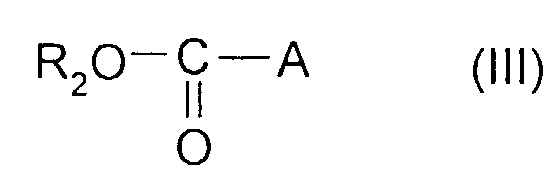 A est un groupe activant choisi parmi un atome d'halogène et un azolide ;R2 a les mêmes significations indiquées dans la revendication 1; puis à ajouter au milieu réactionnel obtenu une base organique.
 - Utilisation des composés de formule (I) selon la revendication 1 ou 2 dans et pour la préparation de compositions cosmétiques ou dermatologiques.
- Composition cosmétique ou dermatologique contenant dans un véhicule cosmétiquement acceptable ou dermatologiquement acceptable au moins un composé de formule (I) suivante :dans laquelle R1 et R2, identiques ou différents, représentent un radical alcoyle ayant de 8 à 26 atomes carbone, linéaire ou ramifié, saturé ou insaturé et éventuellement hydroxylé

- Composition selon la revendication 5, où le composé de formule (I) est choisi dans le groupe constitué par la N-(hexadécyloxycarbonyl)-N-(2-hydroxy-3-hexadécyloxypropyl)-éthanolamine ; la N-(dodécyloxycarbonyl)-N-(2-hydroxy-3-hexadécyloxypropyl)-éthanolamine ; la N-(2-éthyl-hexyloxycarbonyl)-N-(2-hydroxy-3-hexadècyloxypropyl)-éthanolamine.
- Composition selon la revendication 5 ou 6, caractérisée par le fait qu'elle comprend de 0,001 à 15% en poids de composé de formule (I) par rapport au poids total de la composition.
- Composition selon l'une quelconque des revendications 5 à 7, caractérisée par le fait qu'elle se présente sous forme de lotion aqueuse ou hydroalcoolique, monophasique ou polyphasique, de gel monophasique ou polyphasique, d'émulsion, de crème, de dispersion vésiculaire de lipides ioniques ou non ioniques, lesdites vésicules pouvant alors servir en tant qu'agent d'encapsulation pour des ingrédients actifs lipophiles ou hydrophiles, de mousse, de spray.
- Composition selon l'une quelconque des revendications 5 à 8, caractérisée par le fait qu'elle peut contenir en plus des additifs cosmétiques conventionnels choisis parmi les corps gras, les solvants organiques, les silicones, les épaississants, les adoucissants, les tensio-actifs, les polymères anioniques, cationiques, non-ioniques ou amphotères, les agents anti-mousses, les agents conditionneurs du cheveu tels que des protéines, des vitamines, les agents traitants (agents antichute, antipelliculaires), les colorants, les parfums, les conservateurs, les agents propulseurs.
- Utilisation d'au moins un composé de formule (I) tel que défini selon l'une quelconque des revendications 1 et 2, comme agent hydratant, dans et pour la préparation de compositions cosmétiques ou dermatologiques pour le soin de la peau.
- Utilisation d'au moins un composé de formule (I) tel que défini selon l'une quelconque des revendications 1 et 2, comme agent de conditionnement des cheveux dans et pour la préparation de compositions capillaires.
Applications Claiming Priority (2)
| Application Number | Priority Date | Filing Date | Title |
|---|---|---|---|
| FR9610230 | 1996-08-14 | ||
| FR9610230A FR2752420B1 (fr) | 1996-08-14 | 1996-08-14 | Derives n-(alkyloxycarbonyl)-n-(2-hydroxy-3-alkyloxypropyl)- ethanolamine et leur utilisation dans et pour la preparation de compositions cosmetiques ou dermatologiques |
Publications (2)
| Publication Number | Publication Date |
|---|---|
| EP0824097A1 true EP0824097A1 (fr) | 1998-02-18 |
| EP0824097B1 EP0824097B1 (fr) | 1998-12-30 |
Family
ID=9495071
Family Applications (1)
| Application Number | Title | Priority Date | Filing Date |
|---|---|---|---|
| EP97401736A Expired - Lifetime EP0824097B1 (fr) | 1996-08-14 | 1997-07-18 | Dérivés n-(alkyloxycarbonyl)-N-(2-hydroxy 3-alkyloxypropyl)-éthanolamine et leur utilisation dans et pour la préparation de compositions cosmétiques ou dermatologiques |
Country Status (8)
| Country | Link |
|---|---|
| US (1) | US5889047A (fr) |
| EP (1) | EP0824097B1 (fr) |
| JP (1) | JP2914938B2 (fr) |
| AT (1) | ATE175191T1 (fr) |
| CA (1) | CA2211812A1 (fr) |
| DE (1) | DE69700085T2 (fr) |
| ES (1) | ES2128882T3 (fr) |
| FR (1) | FR2752420B1 (fr) |
Cited By (1)
| Publication number | Priority date | Publication date | Assignee | Title |
|---|---|---|---|---|
| CN104961654A (zh) * | 2015-06-07 | 2015-10-07 | 德阳市德氏生物科技有限公司 | 一种关于Fmoc-DOOA·HCl的合成方法 |
Families Citing this family (2)
| Publication number | Priority date | Publication date | Assignee | Title |
|---|---|---|---|---|
| ES2250798T3 (es) * | 2003-08-08 | 2006-04-16 | Kpss-Kao Professional Salon Services Gmbh | Composicion cosmetica para el cabello, que comprende cetil peg/ppg-10/1 dimeticona y una ceramida. |
| TR2022021769A1 (tr) * | 2022-12-30 | 2024-07-22 | Acibadem Mehmet Ali Aydinlar Ueniversitesi | Yoğun nemlendi̇ri̇ci̇ kreme dönüşebi̇len kati yüz ve vücut nemlendi̇ri̇ci̇ formüller |
Citations (3)
| Publication number | Priority date | Publication date | Assignee | Title |
|---|---|---|---|---|
| EP0227994A1 (fr) * | 1985-12-20 | 1987-07-08 | Kao Corporation | Dérivés amides et médicament à usage externe les contenant |
| EP0482860A1 (fr) * | 1990-10-22 | 1992-04-29 | Unilever Plc | Composition cosmétique |
| EP0666251A1 (fr) * | 1994-02-07 | 1995-08-09 | L'oreal | Nouveaux N-(hydroxyalkyl) carbamates d'alkyle et leurs applications en cosmétique, plus particulièrement dans des compositions capillaires |
-
1996
- 1996-08-14 FR FR9610230A patent/FR2752420B1/fr not_active Expired - Fee Related
-
1997
- 1997-07-18 AT AT97401736T patent/ATE175191T1/de not_active IP Right Cessation
- 1997-07-18 EP EP97401736A patent/EP0824097B1/fr not_active Expired - Lifetime
- 1997-07-18 DE DE69700085T patent/DE69700085T2/de not_active Expired - Fee Related
- 1997-07-18 ES ES97401736T patent/ES2128882T3/es not_active Expired - Lifetime
- 1997-08-11 JP JP9216859A patent/JP2914938B2/ja not_active Expired - Lifetime
- 1997-08-13 CA CA002211812A patent/CA2211812A1/fr not_active Abandoned
- 1997-08-13 US US08/910,743 patent/US5889047A/en not_active Expired - Fee Related
Patent Citations (3)
| Publication number | Priority date | Publication date | Assignee | Title |
|---|---|---|---|---|
| EP0227994A1 (fr) * | 1985-12-20 | 1987-07-08 | Kao Corporation | Dérivés amides et médicament à usage externe les contenant |
| EP0482860A1 (fr) * | 1990-10-22 | 1992-04-29 | Unilever Plc | Composition cosmétique |
| EP0666251A1 (fr) * | 1994-02-07 | 1995-08-09 | L'oreal | Nouveaux N-(hydroxyalkyl) carbamates d'alkyle et leurs applications en cosmétique, plus particulièrement dans des compositions capillaires |
Cited By (1)
| Publication number | Priority date | Publication date | Assignee | Title |
|---|---|---|---|---|
| CN104961654A (zh) * | 2015-06-07 | 2015-10-07 | 德阳市德氏生物科技有限公司 | 一种关于Fmoc-DOOA·HCl的合成方法 |
Also Published As
| Publication number | Publication date |
|---|---|
| ES2128882T3 (es) | 1999-05-16 |
| FR2752420A1 (fr) | 1998-02-20 |
| EP0824097B1 (fr) | 1998-12-30 |
| JPH10158232A (ja) | 1998-06-16 |
| FR2752420B1 (fr) | 1998-10-02 |
| JP2914938B2 (ja) | 1999-07-05 |
| US5889047A (en) | 1999-03-30 |
| DE69700085T2 (de) | 1999-05-20 |
| ATE175191T1 (de) | 1999-01-15 |
| DE69700085D1 (de) | 1999-02-11 |
| CA2211812A1 (fr) | 1998-02-14 |
Similar Documents
| Publication | Publication Date | Title |
|---|---|---|
| CA2173543C (fr) | Composes de type ceramides, leur procede de preparation et leur utilisation | |
| EP0648204B1 (fr) | Utilisation en cosmetique de derives lipophiles des amino deoxyalditols, compositions cosmetiques les contenant, et nouveaux carbamates d'alkyle | |
| EP0647617B1 (fr) | Céramides, leur procédé de préparation et leurs applications en cosmétique | |
| CA2025790C (fr) | Nouveaux composes lipidiques derives des sphingosines, leur procede de preparation et leurs applications, notamment en cosmetique et en dermopharmacie | |
| EP0681827B1 (fr) | Utilisations de bioflavonoides comme agent de protection des phanères kératiniques | |
| CA2209432C (fr) | Utilisation de derives amino-alcools a fonction uree dans et pour la preparation de compositions cosmetiques ou dermatologiques | |
| FR2672288A1 (fr) | Nouveaux amides dipeptidiques derivant de la glycyl-serine, utilisables, notamment dans des compositions cosmetiques, pharmaceutiques ou alimentaires. | |
| CA2216569C (fr) | Utilisation de derives d'oxazolidinone comme agents anti-penetrants dans une composition cosmetique et/ou dermatologique | |
| EP0915081B1 (fr) | Composé de type céramide, procédé de préparation et utilisation | |
| FR2926979A1 (fr) | Nouveaux composes cationiques, compositions les comprenant, utilisation comme conditionneur, et procede de traitement cosmetique. | |
| FR2649697A1 (fr) | Nouveaux derives d'urethanne, leur preparation et leur application notamment comme agents hydratants dans des compositions cosmetiques ou pharmaceutiques destinees au traitement des peaux seches | |
| EP0824097B1 (fr) | Dérivés n-(alkyloxycarbonyl)-N-(2-hydroxy 3-alkyloxypropyl)-éthanolamine et leur utilisation dans et pour la préparation de compositions cosmétiques ou dermatologiques | |
| EP0942001B1 (fr) | Composés lipidiques dérivés des bases sphingoides, leur procédé de préparation et leurs utilisations en cosmétique et en dermopharmacie | |
| EP0682011B1 (fr) | Nouveaux dérivés de la sérine, leur préparation et leur utilisation dans des compositions cosmétiques ou dermatologiques | |
| EP0498729B1 (fr) | Dérivés de dipeptides à groupement uréthanne, leur préparation et leur application, notamment comme agents hydratants et comme agents tensioactifs dans des compositions cosmétiques, pharmaceutiques ou alimentaires | |
| CA2141408A1 (fr) | Composes hydro-fluoro-carbones et leur utilisation dans des compositions cosmetiques | |
| LU86229A1 (fr) | Compositions cosmetiques pour le traitement de la peau et des cheveux gras,a base de di(beta-hydroxyethyl)sulfoxyde,et leur application | |
| FR2733229A1 (fr) | Nouveaux lipoaminoacides a chaine fluoree, leur procede de preparation, leur utilisation et les compositions les comprenant |
Legal Events
| Date | Code | Title | Description |
|---|---|---|---|
| PUAI | Public reference made under article 153(3) epc to a published international application that has entered the european phase |
Free format text: ORIGINAL CODE: 0009012 |
|
| AK | Designated contracting states |
Kind code of ref document: A1 Designated state(s): AT BE CH DE ES FR GB IT LI NL SE |
|
| 17P | Request for examination filed |
Effective date: 19980124 |
|
| GRAG | Despatch of communication of intention to grant |
Free format text: ORIGINAL CODE: EPIDOS AGRA |
|
| 17Q | First examination report despatched |
Effective date: 19980713 |
|
| GRAG | Despatch of communication of intention to grant |
Free format text: ORIGINAL CODE: EPIDOS AGRA |
|
| GRAH | Despatch of communication of intention to grant a patent |
Free format text: ORIGINAL CODE: EPIDOS IGRA |
|
| GRAH | Despatch of communication of intention to grant a patent |
Free format text: ORIGINAL CODE: EPIDOS IGRA |
|
| AKX | Designation fees paid |
Free format text: AT BE CH DE ES FR GB IT LI NL SE |
|
| RBV | Designated contracting states (corrected) |
Designated state(s): AT BE CH DE ES FR GB IT LI NL SE |
|
| GRAA | (expected) grant |
Free format text: ORIGINAL CODE: 0009210 |
|
| AK | Designated contracting states |
Kind code of ref document: B1 Designated state(s): AT BE CH DE ES FR GB IT LI NL SE |
|
| PG25 | Lapsed in a contracting state [announced via postgrant information from national office to epo] |
Ref country code: NL Free format text: LAPSE BECAUSE OF FAILURE TO SUBMIT A TRANSLATION OF THE DESCRIPTION OR TO PAY THE FEE WITHIN THE PRESCRIBED TIME-LIMIT Effective date: 19981230 Ref country code: AT Free format text: LAPSE BECAUSE OF FAILURE TO SUBMIT A TRANSLATION OF THE DESCRIPTION OR TO PAY THE FEE WITHIN THE PRESCRIBED TIME-LIMIT Effective date: 19981230 |
|
| REF | Corresponds to: |
Ref document number: 175191 Country of ref document: AT Date of ref document: 19990115 Kind code of ref document: T |
|
| REG | Reference to a national code |
Ref country code: CH Ref legal event code: EP |
|
| REF | Corresponds to: |
Ref document number: 69700085 Country of ref document: DE Date of ref document: 19990211 |
|
| GBT | Gb: translation of ep patent filed (gb section 77(6)(a)/1977) |
Effective date: 19990129 |
|
| PG25 | Lapsed in a contracting state [announced via postgrant information from national office to epo] |
Ref country code: SE Free format text: LAPSE BECAUSE OF FAILURE TO SUBMIT A TRANSLATION OF THE DESCRIPTION OR TO PAY THE FEE WITHIN THE PRESCRIBED TIME-LIMIT Effective date: 19990330 |
|
| REG | Reference to a national code |
Ref country code: ES Ref legal event code: FG2A Ref document number: 2128882 Country of ref document: ES Kind code of ref document: T3 |
|
| NLV1 | Nl: lapsed or annulled due to failure to fulfill the requirements of art. 29p and 29m of the patents act | ||
| PG25 | Lapsed in a contracting state [announced via postgrant information from national office to epo] |
Ref country code: BE Free format text: LAPSE BECAUSE OF NON-PAYMENT OF DUE FEES Effective date: 19990731 |
|
| PLBE | No opposition filed within time limit |
Free format text: ORIGINAL CODE: 0009261 |
|
| STAA | Information on the status of an ep patent application or granted ep patent |
Free format text: STATUS: NO OPPOSITION FILED WITHIN TIME LIMIT |
|
| 26N | No opposition filed | ||
| BERE | Be: lapsed |
Owner name: L'OREAL Effective date: 19990731 |
|
| PGFP | Annual fee paid to national office [announced via postgrant information from national office to epo] |
Ref country code: FR Payment date: 20000711 Year of fee payment: 4 |
|
| PGFP | Annual fee paid to national office [announced via postgrant information from national office to epo] |
Ref country code: DE Payment date: 20000717 Year of fee payment: 4 |
|
| PGFP | Annual fee paid to national office [announced via postgrant information from national office to epo] |
Ref country code: ES Payment date: 20000719 Year of fee payment: 4 |
|
| PG25 | Lapsed in a contracting state [announced via postgrant information from national office to epo] |
Ref country code: GB Free format text: LAPSE BECAUSE OF NON-PAYMENT OF DUE FEES Effective date: 20010718 |
|
| PG25 | Lapsed in a contracting state [announced via postgrant information from national office to epo] |
Ref country code: ES Free format text: LAPSE BECAUSE OF NON-PAYMENT OF DUE FEES Effective date: 20010719 |
|
| PG25 | Lapsed in a contracting state [announced via postgrant information from national office to epo] |
Ref country code: LI Free format text: LAPSE BECAUSE OF NON-PAYMENT OF DUE FEES Effective date: 20010731 Ref country code: CH Free format text: LAPSE BECAUSE OF NON-PAYMENT OF DUE FEES Effective date: 20010731 |
|
| GBPC | Gb: european patent ceased through non-payment of renewal fee |
Effective date: 20010718 |
|
| REG | Reference to a national code |
Ref country code: CH Ref legal event code: PL |
|
| PG25 | Lapsed in a contracting state [announced via postgrant information from national office to epo] |
Ref country code: FR Free format text: LAPSE BECAUSE OF NON-PAYMENT OF DUE FEES Effective date: 20020329 |
|
| PG25 | Lapsed in a contracting state [announced via postgrant information from national office to epo] |
Ref country code: DE Free format text: LAPSE BECAUSE OF NON-PAYMENT OF DUE FEES Effective date: 20020501 |
|
| REG | Reference to a national code |
Ref country code: FR Ref legal event code: ST |
|
| REG | Reference to a national code |
Ref country code: ES Ref legal event code: FD2A Effective date: 20020810 |
|
| PG25 | Lapsed in a contracting state [announced via postgrant information from national office to epo] |
Ref country code: IT Free format text: LAPSE BECAUSE OF NON-PAYMENT OF DUE FEES;WARNING: LAPSES OF ITALIAN PATENTS WITH EFFECTIVE DATE BEFORE 2007 MAY HAVE OCCURRED AT ANY TIME BEFORE 2007. THE CORRECT EFFECTIVE DATE MAY BE DIFFERENT FROM THE ONE RECORDED. Effective date: 20050718 |