EP0824293A1 - Réseau de communication de données - Google Patents
Réseau de communication de données Download PDFInfo
- Publication number
- EP0824293A1 EP0824293A1 EP97305929A EP97305929A EP0824293A1 EP 0824293 A1 EP0824293 A1 EP 0824293A1 EP 97305929 A EP97305929 A EP 97305929A EP 97305929 A EP97305929 A EP 97305929A EP 0824293 A1 EP0824293 A1 EP 0824293A1
- Authority
- EP
- European Patent Office
- Prior art keywords
- recording data
- data packet
- network
- route recording
- memory
- Prior art date
- Legal status (The legal status is an assumption and is not a legal conclusion. Google has not performed a legal analysis and makes no representation as to the accuracy of the status listed.)
- Withdrawn
Links
Images
Classifications
-
- H—ELECTRICITY
- H04—ELECTRIC COMMUNICATION TECHNIQUE
- H04L—TRANSMISSION OF DIGITAL INFORMATION, e.g. TELEGRAPHIC COMMUNICATION
- H04L45/00—Routing or path finding of packets in data switching networks
- H04L45/26—Route discovery packet
-
- H—ELECTRICITY
- H04—ELECTRIC COMMUNICATION TECHNIQUE
- H04L—TRANSMISSION OF DIGITAL INFORMATION, e.g. TELEGRAPHIC COMMUNICATION
- H04L45/00—Routing or path finding of packets in data switching networks
-
- H—ELECTRICITY
- H04—ELECTRIC COMMUNICATION TECHNIQUE
- H04L—TRANSMISSION OF DIGITAL INFORMATION, e.g. TELEGRAPHIC COMMUNICATION
- H04L45/00—Routing or path finding of packets in data switching networks
- H04L45/20—Hop count for routing purposes, e.g. TTL
Definitions
- the invention relates to a data communication network having a number of end stations connected together for data communication therebetween.
- the invention is primarily concerned with local area networks but is also applicable to other types of network and is concerned with the operation of a network communication protocol in which route recording data packets or frames are sent along multiple paths.
- This approach is used in networks such as token ring source routing networks (All Routes Broadcast) and IPX Type 20 packets in routed networks (NETBIOS broadcasts).
- a bridge is a network interconnect device which links to subsidiary networks such as subsidiary self-contained token rings.
- Network interconnect devices also include routers which transfer data packets between networks of different type, e.g. token ring and ethernet and in this context extends to any device which connects different parts of a network.
- IPX Type 20 packets in routed networks are used to broadcast data throughout a group of IPX networks via routers.
- a router is a network interconnect device which links separate networks such as ethernets and token rings.
- Networking protocols attach auditing information to route recording data packets (known as All Routes Explorer - ARE packets) as they cross the network, such as a count of the number of devices they have crossed, or even identifiers of the devices they have crossed, in order to prevent the endless recirculation and duplication of AREs through the network in what is sometimes known as a "Broadcast Storm".
- IPX NETBIOS broadcasts keep a record of each IPX network they have crossed, and source route token ring bridges keep a record in the AREs, of both the unique Ring Numbers, together with an indication of which bridge was crossed between two rings.
- the protocols have default limits to the number of devices that can be crossed, after which the broadcast packets must be discarded.
- Some devices such as source route token ring bridges can impose reductions of the limits on the number of devices that can be crossed, and discard AREs before they reach the default limit of the protocol. These reductions are referred to herein as Static Hop Count Limits.
- any Static Hop Count Limits will reduce the number of active paths available in the network should interconnect devices in the network become inoperative for any reason.
- a data communication network has a number of end stations connected together for data communication therebetween, and at least one network interconnect device for receiving and transmitting data packets, the network interconnect device further including a memory and processing means, each end station and network interconnect device being adapted to transmit data in accordance with a protocol in which copies of a route recording data packet are transmitted along multiple routes through the network, wherein the memory of the network interconnect device is adapted to store information relating to the manner in which route recording data packets reach the network interconnect device, and wherein the processing means compares the manner in which a currently received route recording data packet has reached the network interconnect device location with information stored in the memory corresponding to a previously received version of the route recording data packet and only forwards the currently received route recording data packet if the comparison indicates a predetermined condition is satisfied.
- the network interconnect device stores information relating to the manner in which different types of route recording data packets reach the interconnect device.
- a global limit for example a hop count limit, applicable to all source locations is replaced by a limit for each of two or more types of route recording data packets. In this way, it is possible to optimise the limits depending upon the type of route recording data packet.
- the different types of route recording data packet will originate from different source locations but in some cases they could be generated by the same source location.
- the previously received version of the route recording data packet may be a copy of the original route recording data packet but is more likely to be a modification if it includes auditing information relating to its passage through the network.
- the network interconnect device will typically be a bridge or router but could simply be a filter placed within a network.
- the source location will typically be an end station or ring.
- the invention can be implemented in a variety of ways depending upon the auditing information available within the route recording data packets and the reduction of paths required.
- the information stored in the memory defines a time for a route recording data packet to reach the network interface device from a source location.
- the predetermined condition is satisfied if the time for the currently received route recording data packet to reach the network interconnect device from the source location is not greater than the corresponding stored time. Thus, only the route recording data packets which have reached the network interconnect device quickest are forwarded.
- other predetermined conditions could be applied instead depending upon the circumstances.
- the information stored in the memory defines the number of locations on the network through which the route recording data packet has passed before reaching the network interconnect device.
- a hop count is kept for two or more types of route recording data packets and in the preferred approach, the predetermined condition is satisfied if the number of locations through which the route recording data packet has passed is not greater than the number stored in the memory corresponding to a previously received version of the route recording data packet of the same type.
- the second example can be extended and, for example, the processing means may be adapted to determine and store in the memory information identifying some or all locations through which the route recording packet has passed to reach the network interconnect device. In this case, the processing means may be adapted only to forward received route recording data packets which have passed through locations corresponding to the locations stored in the memory for a previously received version of the route recording data packet.
- the processing means may be adapted to determine and store the locations in the order in which they have been passed through by the route recording data packet. In this case, the processing means will only forward route recording data packets which have passed through the locations in the same, stored order.
- Lists of previous locations visited by a route recording data packet are available in applications such as IPX NETBIOS broadcasts, token ring source routing All Routes Broadcasts and emulated LAN for ATM networks.
- Other audit information in the route recording data packet may also be used to choose the best route from the source location. For example, if the audit information contains information about the relative costs of each path, this could be used instead of, or in addition to, the lowest number of hops and the order of arrival, as a metric for choosing the best path from the source location.
- the processing means is adapted to update the information stored in the memory relating to a route recording data packet with information related to the currently received version of that route recording data packet if the currently received route recording data packet has reached the network interconnect device via a more efficient route.
- This application enables the stored information to be dynamically updated in complete contrast to the known, static systems. This then enables networks rapidly to be optimised in handling route recording data packets and minimises the risks of fault conditions such as broadcast storms.
- Efficiency can be judged in a variety of ways but will typically include one or more of lowest number of hops, shortest transit time from source location, and lowest cost route.
- the processing means is adapted to determine and store in the memory data identifying the port on which a route recording data packet was received which corresponds to information stored in the memory for that route recording data packet, the processing means only forwarding versions of that route recording data packet received on the same port.
- the advantage of this is that it requires no further auditing information within the route recording data packet but reduces the number of paths significantly for multiple port network interconnect devices.
- Sufficient information about each frame must be stored to distinguish between two frames from the same location that have only very limited differences in content.
- One way to achieve this is to cache a 32-bit CRC check of each frame and to use this to differentiate between frames from the same location.
- the likelihood of two different frames, from the same location, having the same 32-bit CRC check, and being filtered through different paths is extremely remote.
- the rate of frames lost due to identical CRC checks is likely to lower than physical corruption losses, and can be recovered from by higher level protocols.
- the processing means preferably erases the information after a predetermined time interval. This would also allow a source location to transmit along the quickest path even if this did not correspond to the path with the smallest number of hops, where hop count was stored.
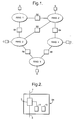
- the network shown in Figure 1 comprises five token rings 1-5 linked together, as shown, by bridge units B1-B6.
- Each token ring has a number of end stations some of which are shown labelled A-E.
- This configuration of token ring networks is conventional and as in any conventional token ring, the end stations can have a variety of forms including, for example, PCs.
- Data can be transmitted from one token ring to another via one or more of the bridge units B1-B6.
- the construction of the bridge unit B6 is shown in Figure 2.
- the unit includes a switch unit 6 having ports 7,8 connected to the token rings 3,4 respectively. Operation of the switch unit 6 is controlled by a suitably programmed processor 9 coupled to a memory 10. If the processor 9 determines that an incoming data frame should be copied from one token ring to the other, it will effect a suitable connection of the ports 7,8, via the switch unit 6 to achieve this.
- the source end station When an end station wishes to transmit a data frame to one or more other end stations then, in the case of a token ring operating an all routes broadcast protocol, the source end station first constructs a route recording data packet or All Routes Explorer (ARE) and broadcasts this to the network as a whole. For example, if the end station A wishes to transmit to the end station E, it will construct an All Routes Explorer (ARE) having a source address A and a destination address E and this will be transmitted around the token ring 1. When the ARE reaches the bridge B1, it will be copied onto the token ring 2 and a further copy will be transferred onto the token ring 5 via bridge B2.
- ARE All Routes Explorer
- each bridge will append audit information to the copies of the AREs which are made, for example identifying the bridge.
- the memory 10 instead records a hop count corresponding to each route recording data packet.
- the processing means 11 notes the hop count value contained within the ARE and this value is loaded into the memory 10 at a location corresponding to the ARE.
- the bridge B6 the first ARE from end station A is likely to have passed through bridges B1 and B5 and so a hop count value of two is stored in the memory 10.
- the bridge unit B6 may receive a further copy of the ARE from the end station A which has passed along a different route, for example through bridges B1, B3 and B4. This will, therefore, include within it a hop count value of three.
- the processing means 9 compares the incoming hop count value with the stored value and since in this case the current value is greater than the stored value, the switch B6 will not pass the incoming ARE onto R3.
- the memory 10 in each of the bridges B1-B6 will be built up with hop count values corresponding to each route recording data packet.
- the processor 9 will typically operate a time-out to cancel the stored value a predetermined interval after it was stored.
- the stored value is replaced by the incoming value so as to optimise use of the system and minimise the passage of AREs which have reached the bridge unit through less optimum paths.
- the memory 10 may further store the identity of the bridge units through which the ARE has passed to reach it. For example, in the case just described, if the first ARE received from the end station A has passed through bridge units B1 and B5, the identity of these two bridge units will be recorded in the memory 10 of B6. If subsequently a further version is received which has passed through bridge units B2 and B4, this will not be forwarded since the identities of the bridge units are different from those stored. It will be noted in this case that in both cases the hop count of the incoming ARE is two.
- the processor 9 could require the incoming ARE to have passed through the bridge units in the order in which they have been stored.
- the processor 9 can store in the memory 10 a value representing the time it has taken for the ARE to reach the bridge unit. This time can then be compared with times of successively received versions and only those having a time not greater than the stored time will be passed. Further, if an ARE has a time less than that stored, this can be used to update the stored value. It is possible, in some cases, for versions to be received at a bridge unit more quickly than another ARE from the same end station even though the first may have passed through more bridge units.
- the memory 10 can store information as to which port 7,8 received the ARE corresponding to the information which is stored in the memory 10. Thus, if a hop count is stored in the memory 10 corresponding to an ARE received on port 7, then the processor 9 will only forward versions satisfying the stored hop count if additionally they have been received on the same port 7.
Landscapes
- Engineering & Computer Science (AREA)
- Computer Networks & Wireless Communication (AREA)
- Signal Processing (AREA)
- Data Exchanges In Wide-Area Networks (AREA)
Applications Claiming Priority (2)
| Application Number | Priority Date | Filing Date | Title |
|---|---|---|---|
| GBGB9616801.8A GB9616801D0 (en) | 1996-08-09 | 1996-08-09 | Data communication network |
| GB9616801 | 1996-08-09 |
Publications (1)
| Publication Number | Publication Date |
|---|---|
| EP0824293A1 true EP0824293A1 (fr) | 1998-02-18 |
Family
ID=10798295
Family Applications (1)
| Application Number | Title | Priority Date | Filing Date |
|---|---|---|---|
| EP97305929A Withdrawn EP0824293A1 (fr) | 1996-08-09 | 1997-08-05 | Réseau de communication de données |
Country Status (3)
| Country | Link |
|---|---|
| US (1) | US5905712A (fr) |
| EP (1) | EP0824293A1 (fr) |
| GB (1) | GB9616801D0 (fr) |
Cited By (1)
| Publication number | Priority date | Publication date | Assignee | Title |
|---|---|---|---|---|
| EP1045552A1 (fr) * | 1999-04-12 | 2000-10-18 | International Business Machines Corporation | Equilibrage auto-adaptatif de charge dans un système de transmission de données en mode connecté |
Families Citing this family (9)
| Publication number | Priority date | Publication date | Assignee | Title |
|---|---|---|---|---|
| US6260072B1 (en) * | 1997-06-12 | 2001-07-10 | Lucent Technologies Inc | Method and apparatus for adaptive routing in packet networks |
| US6314110B1 (en) * | 1998-03-06 | 2001-11-06 | Cisco Technology, Inc. | Method and apparatus for distributed bandwidth allocation for a bi-directional ring media with spatial and local reuse |
| US7502315B2 (en) * | 1998-12-21 | 2009-03-10 | At&T Intellectual Property Ii, L.P. | Method for hybrid network planning |
| US7382736B2 (en) | 1999-01-12 | 2008-06-03 | Mcdata Corporation | Method for scoring queued frames for selective transmission through a switch |
| US7003551B2 (en) * | 2000-11-30 | 2006-02-21 | Bellsouth Intellectual Property Corp. | Method and apparatus for minimizing storage of common attachment files in an e-mail communications server |
| US6968447B1 (en) * | 2001-04-13 | 2005-11-22 | The United States Of America As Represented By The Secretary Of The Navy | System and method for data forwarding in a programmable multiple network processor environment |
| US7216282B2 (en) * | 2003-02-19 | 2007-05-08 | Harris Corporation | Mobile ad-hoc network (MANET) including forward error correction (FEC), interleaving, and multi-route communication features and related methods |
| US7382765B2 (en) * | 2003-04-30 | 2008-06-03 | Harris Corporation | Predictive routing in a moble ad hoc network |
| US7201705B2 (en) * | 2003-06-06 | 2007-04-10 | Rodgers Jr Robert E | Exercise apparatus with a variable stride system |
Citations (2)
| Publication number | Priority date | Publication date | Assignee | Title |
|---|---|---|---|---|
| EP0464680A2 (fr) * | 1990-06-27 | 1992-01-08 | Fujitsu Limited | Système de communication avec procédé pour établir des routages |
| US5323394A (en) * | 1992-04-07 | 1994-06-21 | Digital Equipment Corporation | Selecting optimal routes in source routing bridging without exponential flooding of explorer packets |
Family Cites Families (7)
| Publication number | Priority date | Publication date | Assignee | Title |
|---|---|---|---|---|
| US4873517A (en) * | 1988-06-23 | 1989-10-10 | International Business Machines Corporation | Method for selecting least weight end node to end node route in a data communications network |
| US5233604A (en) * | 1992-04-28 | 1993-08-03 | International Business Machines Corporation | Methods and apparatus for optimum path selection in packet transmission networks |
| US5398012A (en) * | 1992-11-24 | 1995-03-14 | International Business Machines Corporation | Distributed processing of route selection across networks and subnetworks |
| CA2124974C (fr) * | 1993-06-28 | 1998-08-25 | Kajamalai Gopalaswamy Ramakrishnan | Methode et appareil d'affectation de metriques de liaison dans les reseaux a trajet minimal |
| US5317566A (en) * | 1993-08-18 | 1994-05-31 | Ascom Timeplex Trading Ag | Least cost route selection in distributed digital communication networks |
| US5805593A (en) * | 1995-09-26 | 1998-09-08 | At&T Corp | Routing method for setting up a service between an origination node and a destination node in a connection-communications network |
| US5699347A (en) * | 1995-11-17 | 1997-12-16 | Bay Networks, Inc. | Method and apparatus for routing packets in networks having connection-oriented subnetworks |
-
1996
- 1996-08-09 GB GBGB9616801.8A patent/GB9616801D0/en active Pending
-
1997
- 1997-03-10 US US08/813,424 patent/US5905712A/en not_active Expired - Fee Related
- 1997-08-05 EP EP97305929A patent/EP0824293A1/fr not_active Withdrawn
Patent Citations (2)
| Publication number | Priority date | Publication date | Assignee | Title |
|---|---|---|---|---|
| EP0464680A2 (fr) * | 1990-06-27 | 1992-01-08 | Fujitsu Limited | Système de communication avec procédé pour établir des routages |
| US5323394A (en) * | 1992-04-07 | 1994-06-21 | Digital Equipment Corporation | Selecting optimal routes in source routing bridging without exponential flooding of explorer packets |
Non-Patent Citations (2)
| Title |
|---|
| CATANIA V ET AL: "A ROUTING STRATEGY FOR MAN INTERCONNECTION", NETWORKING IN THE NINETIES, BAL HARBOUR, APR. 7 - 11, 1991, vol. 2, 7 April 1991 (1991-04-07), INSTITUTE OF ELECTRICAL AND ELECTRONICS ENGINEERS, pages 608 - 615, XP000223385 * |
| DIXON R C ET AL: "ADDRESSING, BRIDGING, AND SOURCE ROUTING", IEEE NETWORK: THE MAGAZINE OF COMPUTER COMMUNICATIONS, vol. 2, no. 1, January 1988 (1988-01-01), pages 25 - 32, XP000615043 * |
Cited By (2)
| Publication number | Priority date | Publication date | Assignee | Title |
|---|---|---|---|---|
| EP1045552A1 (fr) * | 1999-04-12 | 2000-10-18 | International Business Machines Corporation | Equilibrage auto-adaptatif de charge dans un système de transmission de données en mode connecté |
| US6680947B1 (en) | 1999-04-12 | 2004-01-20 | International Business Machines Corporation | Auto adaptive load balancing in a connection oriented data transmission system |
Also Published As
| Publication number | Publication date |
|---|---|
| US5905712A (en) | 1999-05-18 |
| GB9616801D0 (en) | 1996-09-25 |
Similar Documents
| Publication | Publication Date | Title |
|---|---|---|
| US7519062B1 (en) | Method and apparatus for implementing forwarding decision shortcuts at a network switch | |
| EP0937353B1 (fr) | Acheminement dans un element de reseau reparti multicouches | |
| US6807172B1 (en) | Method and apparatus for learning and switching frames in a distributed network switch | |
| US6553028B1 (en) | Method and apparatus for multicast switching using a centralized switching engine | |
| US8472451B2 (en) | Method and apparatus for routing and forwarding between virtual routers within a single network element | |
| US6167444A (en) | Method and system for exchanging routing information | |
| US6807182B1 (en) | Stacked network devices including a protocol engine and distributed trunk ports and method of operating same | |
| US6735198B1 (en) | Method and apparatus for updating and synchronizing forwarding tables in a distributed network switch | |
| US6704318B1 (en) | Switched token ring over ISL (TR-ISL) network | |
| JP3123467B2 (ja) | ブリッジ | |
| US7586915B1 (en) | Technique for coupling entities via virtual ports | |
| US20010046229A1 (en) | Packet processor with real-time edit program construction engine | |
| US8306024B2 (en) | Preventing forwarding of a packet to a control plane | |
| EP1158725A2 (fr) | Procédé et dispositif supportant multi-protocoles du type routeur redondance | |
| CN100431309C (zh) | 生成树绕过方法和装置 | |
| US20070183415A1 (en) | Method and system for internal data loop back in a high data rate switch | |
| US20100232444A1 (en) | Frame transfer method and frame transfer device | |
| WO2004075482A1 (fr) | Systeme reseau, noeud de pont d'apprentissage, procede d'apprentissage, et programme associe | |
| GB2358760A (en) | Network switch with self-learning routing facility | |
| JPH10336249A (ja) | インターネットプロトコル中継網 | |
| WO1999000944A1 (fr) | Mecanisme de remplacement de champs de paquet dans un element de reseau reparti multicouche | |
| US6657951B1 (en) | Backup CRF VLAN | |
| US8949458B1 (en) | Automatic filtering to prevent network attacks | |
| US6563832B1 (en) | Token ring bridge distributed in a switched fabric | |
| US7983278B1 (en) | Redirect checking in a network device |
Legal Events
| Date | Code | Title | Description |
|---|---|---|---|
| PUAI | Public reference made under article 153(3) epc to a published international application that has entered the european phase |
Free format text: ORIGINAL CODE: 0009012 |
|
| AK | Designated contracting states |
Kind code of ref document: A1 Designated state(s): DE FR GB |
|
| AX | Request for extension of the european patent |
Free format text: AL;LT;LV;RO;SI |
|
| 17P | Request for examination filed |
Effective date: 19980807 |
|
| AKX | Designation fees paid |
Free format text: DE FR GB |
|
| RBV | Designated contracting states (corrected) |
Designated state(s): DE FR GB |
|
| RAP1 | Party data changed (applicant data changed or rights of an application transferred) |
Owner name: MADGE NETWORKS LIMITED |
|
| 17Q | First examination report despatched |
Effective date: 20031201 |
|
| STAA | Information on the status of an ep patent application or granted ep patent |
Free format text: STATUS: THE APPLICATION IS DEEMED TO BE WITHDRAWN |
|
| 18D | Application deemed to be withdrawn |
Effective date: 20040414 |