EP0825355A2 - Luftgeschmiertes hydrodynamisches Keramiklager - Google Patents
Luftgeschmiertes hydrodynamisches Keramiklager Download PDFInfo
- Publication number
- EP0825355A2 EP0825355A2 EP97202479A EP97202479A EP0825355A2 EP 0825355 A2 EP0825355 A2 EP 0825355A2 EP 97202479 A EP97202479 A EP 97202479A EP 97202479 A EP97202479 A EP 97202479A EP 0825355 A2 EP0825355 A2 EP 0825355A2
- Authority
- EP
- European Patent Office
- Prior art keywords
- bearing
- ceramic
- case
- mole percent
- zirconia
- Prior art date
- Legal status (The legal status is an assumption and is not a legal conclusion. Google has not performed a legal analysis and makes no representation as to the accuracy of the status listed.)
- Ceased
Links
- 239000000919 ceramic Substances 0.000 title claims abstract description 74
- RKTYLMNFRDHKIL-UHFFFAOYSA-N copper;5,10,15,20-tetraphenylporphyrin-22,24-diide Chemical compound [Cu+2].C1=CC(C(=C2C=CC([N-]2)=C(C=2C=CC=CC=2)C=2C=CC(N=2)=C(C=2C=CC=CC=2)C2=CC=C3[N-]2)C=2C=CC=CC=2)=NC1=C3C1=CC=CC=C1 RKTYLMNFRDHKIL-UHFFFAOYSA-N 0.000 claims abstract description 29
- 239000012530 fluid Substances 0.000 claims abstract description 5
- 238000004891 communication Methods 0.000 claims abstract description 4
- QCWXUUIWCKQGHC-UHFFFAOYSA-N Zirconium Chemical compound [Zr] QCWXUUIWCKQGHC-UHFFFAOYSA-N 0.000 claims abstract 2
- 229910052726 zirconium Inorganic materials 0.000 claims abstract 2
- MCMNRKCIXSYSNV-UHFFFAOYSA-N Zirconium dioxide Chemical compound O=[Zr]=O MCMNRKCIXSYSNV-UHFFFAOYSA-N 0.000 claims description 111
- 229910045601 alloy Inorganic materials 0.000 claims description 41
- 239000000956 alloy Substances 0.000 claims description 41
- 239000000203 mixture Substances 0.000 claims description 20
- 239000000843 powder Substances 0.000 claims description 19
- RVTZCBVAJQQJTK-UHFFFAOYSA-N oxygen(2-);zirconium(4+) Chemical compound [O-2].[O-2].[Zr+4] RVTZCBVAJQQJTK-UHFFFAOYSA-N 0.000 claims description 17
- 229910001928 zirconium oxide Inorganic materials 0.000 claims description 17
- RUDFQVOCFDJEEF-UHFFFAOYSA-N yttrium(III) oxide Inorganic materials [O-2].[O-2].[O-2].[Y+3].[Y+3] RUDFQVOCFDJEEF-UHFFFAOYSA-N 0.000 claims description 13
- CPLXHLVBOLITMK-UHFFFAOYSA-N magnesium oxide Inorganic materials [Mg]=O CPLXHLVBOLITMK-UHFFFAOYSA-N 0.000 claims description 11
- ODINCKMPIJJUCX-UHFFFAOYSA-N calcium oxide Inorganic materials [Ca]=O ODINCKMPIJJUCX-UHFFFAOYSA-N 0.000 claims description 9
- 229910010293 ceramic material Inorganic materials 0.000 claims description 9
- HYXGAEYDKFCVMU-UHFFFAOYSA-N scandium(III) oxide Inorganic materials O=[Sc]O[Sc]=O HYXGAEYDKFCVMU-UHFFFAOYSA-N 0.000 claims description 9
- 229910001404 rare earth metal oxide Inorganic materials 0.000 claims description 6
- CETPSERCERDGAM-UHFFFAOYSA-N ceric oxide Chemical compound O=[Ce]=O CETPSERCERDGAM-UHFFFAOYSA-N 0.000 claims description 4
- 229910000422 cerium(IV) oxide Inorganic materials 0.000 claims description 4
- TWNQGVIAIRXVLR-UHFFFAOYSA-N oxo(oxoalumanyloxy)alumane Chemical compound O=[Al]O[Al]=O TWNQGVIAIRXVLR-UHFFFAOYSA-N 0.000 claims description 4
- 238000000034 method Methods 0.000 description 38
- 238000005245 sintering Methods 0.000 description 36
- PNEYBMLMFCGWSK-UHFFFAOYSA-N aluminium oxide Inorganic materials [O-2].[O-2].[O-2].[Al+3].[Al+3] PNEYBMLMFCGWSK-UHFFFAOYSA-N 0.000 description 35
- 238000003754 machining Methods 0.000 description 20
- 239000002019 doping agent Substances 0.000 description 13
- 229920000728 polyester Polymers 0.000 description 12
- 230000008569 process Effects 0.000 description 10
- 229910052596 spinel Inorganic materials 0.000 description 10
- 239000011029 spinel Substances 0.000 description 10
- 239000011230 binding agent Substances 0.000 description 8
- 238000005422 blasting Methods 0.000 description 8
- 238000004519 manufacturing process Methods 0.000 description 8
- 238000005056 compaction Methods 0.000 description 7
- 239000000463 material Substances 0.000 description 7
- 239000011324 bead Substances 0.000 description 6
- 239000004033 plastic Substances 0.000 description 6
- 229920003023 plastic Polymers 0.000 description 6
- 230000008901 benefit Effects 0.000 description 5
- 239000002131 composite material Substances 0.000 description 5
- 238000002156 mixing Methods 0.000 description 5
- 239000010432 diamond Substances 0.000 description 4
- 229910003460 diamond Inorganic materials 0.000 description 4
- 238000000227 grinding Methods 0.000 description 4
- 229910052751 metal Inorganic materials 0.000 description 4
- 239000002184 metal Substances 0.000 description 4
- 239000002245 particle Substances 0.000 description 4
- 239000000047 product Substances 0.000 description 4
- 238000005299 abrasion Methods 0.000 description 3
- 230000002776 aggregation Effects 0.000 description 3
- 238000005275 alloying Methods 0.000 description 3
- 229910000421 cerium(III) oxide Inorganic materials 0.000 description 3
- 229910052593 corundum Inorganic materials 0.000 description 3
- 239000013078 crystal Substances 0.000 description 3
- 239000010987 cubic zirconia Substances 0.000 description 3
- 238000013461 design Methods 0.000 description 3
- 238000009826 distribution Methods 0.000 description 3
- 230000002706 hydrostatic effect Effects 0.000 description 3
- 238000001746 injection moulding Methods 0.000 description 3
- 230000010534 mechanism of action Effects 0.000 description 3
- 238000003801 milling Methods 0.000 description 3
- 229920002635 polyurethane Polymers 0.000 description 3
- 239000004814 polyurethane Substances 0.000 description 3
- 238000003825 pressing Methods 0.000 description 3
- 238000012545 processing Methods 0.000 description 3
- 238000007493 shaping process Methods 0.000 description 3
- 238000007514 turning Methods 0.000 description 3
- 229910001845 yogo sapphire Inorganic materials 0.000 description 3
- 239000004372 Polyvinyl alcohol Substances 0.000 description 2
- 229910000831 Steel Inorganic materials 0.000 description 2
- 238000005054 agglomeration Methods 0.000 description 2
- 238000013459 approach Methods 0.000 description 2
- 238000006243 chemical reaction Methods 0.000 description 2
- 238000009694 cold isostatic pressing Methods 0.000 description 2
- 238000000354 decomposition reaction Methods 0.000 description 2
- 238000000280 densification Methods 0.000 description 2
- 230000000694 effects Effects 0.000 description 2
- 229920001971 elastomer Polymers 0.000 description 2
- 238000005530 etching Methods 0.000 description 2
- 230000009477 glass transition Effects 0.000 description 2
- 239000000314 lubricant Substances 0.000 description 2
- 229920002120 photoresistant polymer Polymers 0.000 description 2
- 229920002451 polyvinyl alcohol Polymers 0.000 description 2
- 238000002360 preparation method Methods 0.000 description 2
- 239000010959 steel Substances 0.000 description 2
- 238000003826 uniaxial pressing Methods 0.000 description 2
- 229910001233 yttria-stabilized zirconia Inorganic materials 0.000 description 2
- 229920002799 BoPET Polymers 0.000 description 1
- 229920001875 Ebonite Polymers 0.000 description 1
- 108010010803 Gelatin Proteins 0.000 description 1
- 229910003112 MgO-Al2O3 Inorganic materials 0.000 description 1
- 239000005041 Mylar™ Substances 0.000 description 1
- 229910052581 Si3N4 Inorganic materials 0.000 description 1
- 229920005822 acrylic binder Polymers 0.000 description 1
- 238000004220 aggregation Methods 0.000 description 1
- 229910052782 aluminium Inorganic materials 0.000 description 1
- XAGFODPZIPBFFR-UHFFFAOYSA-N aluminium Chemical compound [Al] XAGFODPZIPBFFR-UHFFFAOYSA-N 0.000 description 1
- 230000000712 assembly Effects 0.000 description 1
- 238000000429 assembly Methods 0.000 description 1
- QVGXLLKOCUKJST-UHFFFAOYSA-N atomic oxygen Chemical compound [O] QVGXLLKOCUKJST-UHFFFAOYSA-N 0.000 description 1
- 238000000498 ball milling Methods 0.000 description 1
- 235000013871 bee wax Nutrition 0.000 description 1
- 239000012166 beeswax Substances 0.000 description 1
- 230000015572 biosynthetic process Effects 0.000 description 1
- 229910002114 biscuit porcelain Inorganic materials 0.000 description 1
- 239000006227 byproduct Substances 0.000 description 1
- 238000000975 co-precipitation Methods 0.000 description 1
- 238000000641 cold extrusion Methods 0.000 description 1
- 238000013329 compounding Methods 0.000 description 1
- 230000006835 compression Effects 0.000 description 1
- 238000007906 compression Methods 0.000 description 1
- 238000010276 construction Methods 0.000 description 1
- 238000001816 cooling Methods 0.000 description 1
- 238000005260 corrosion Methods 0.000 description 1
- 230000007797 corrosion Effects 0.000 description 1
- 238000005520 cutting process Methods 0.000 description 1
- 238000011161 development Methods 0.000 description 1
- 238000010586 diagram Methods 0.000 description 1
- 238000009792 diffusion process Methods 0.000 description 1
- 238000005553 drilling Methods 0.000 description 1
- 238000011049 filling Methods 0.000 description 1
- 229920000159 gelatin Polymers 0.000 description 1
- 239000008273 gelatin Substances 0.000 description 1
- 235000019322 gelatine Nutrition 0.000 description 1
- 235000011852 gelatine desserts Nutrition 0.000 description 1
- 238000010438 heat treatment Methods 0.000 description 1
- 239000012535 impurity Substances 0.000 description 1
- 229920000554 ionomer Polymers 0.000 description 1
- 238000000462 isostatic pressing Methods 0.000 description 1
- 230000001050 lubricating effect Effects 0.000 description 1
- 238000012423 maintenance Methods 0.000 description 1
- 238000013178 mathematical model Methods 0.000 description 1
- 230000013011 mating Effects 0.000 description 1
- 239000007769 metal material Substances 0.000 description 1
- 150000002739 metals Chemical class 0.000 description 1
- 125000002524 organometallic group Chemical group 0.000 description 1
- 229910052760 oxygen Inorganic materials 0.000 description 1
- 239000001301 oxygen Substances 0.000 description 1
- 239000012188 paraffin wax Substances 0.000 description 1
- 239000010702 perfluoropolyether Substances 0.000 description 1
- 238000005498 polishing Methods 0.000 description 1
- 229920000515 polycarbonate Polymers 0.000 description 1
- 239000004417 polycarbonate Substances 0.000 description 1
- 238000004382 potting Methods 0.000 description 1
- 239000002243 precursor Substances 0.000 description 1
- 239000004576 sand Substances 0.000 description 1
- 238000005488 sandblasting Methods 0.000 description 1
- 238000007569 slipcasting Methods 0.000 description 1
- 239000007787 solid Substances 0.000 description 1
- 239000004834 spray adhesive Substances 0.000 description 1
- 238000001694 spray drying Methods 0.000 description 1
- 229910002082 tetragonal zirconia polycrystal Inorganic materials 0.000 description 1
- 229920002554 vinyl polymer Polymers 0.000 description 1
Images


Classifications
-
- F—MECHANICAL ENGINEERING; LIGHTING; HEATING; WEAPONS; BLASTING
- F16—ENGINEERING ELEMENTS AND UNITS; GENERAL MEASURES FOR PRODUCING AND MAINTAINING EFFECTIVE FUNCTIONING OF MACHINES OR INSTALLATIONS; THERMAL INSULATION IN GENERAL
- F16C—SHAFTS; FLEXIBLE SHAFTS; ELEMENTS OR CRANKSHAFT MECHANISMS; ROTARY BODIES OTHER THAN GEARING ELEMENTS; BEARINGS
- F16C33/00—Parts of bearings; Special methods for making bearings or parts thereof
- F16C33/02—Parts of sliding-contact bearings
- F16C33/04—Brasses; Bushes; Linings
- F16C33/06—Sliding surface mainly made of metal
- F16C33/10—Construction relative to lubrication
- F16C33/1025—Construction relative to lubrication with liquid, e.g. oil, as lubricant
- F16C33/106—Details of distribution or circulation inside the bearings, e.g. details of the bearing surfaces to affect flow or pressure of the liquid
- F16C33/107—Grooves for generating pressure
-
- F—MECHANICAL ENGINEERING; LIGHTING; HEATING; WEAPONS; BLASTING
- F16—ENGINEERING ELEMENTS AND UNITS; GENERAL MEASURES FOR PRODUCING AND MAINTAINING EFFECTIVE FUNCTIONING OF MACHINES OR INSTALLATIONS; THERMAL INSULATION IN GENERAL
- F16C—SHAFTS; FLEXIBLE SHAFTS; ELEMENTS OR CRANKSHAFT MECHANISMS; ROTARY BODIES OTHER THAN GEARING ELEMENTS; BEARINGS
- F16C17/00—Sliding-contact bearings for exclusively rotary movement
- F16C17/04—Sliding-contact bearings for exclusively rotary movement for axial load only
- F16C17/045—Sliding-contact bearings for exclusively rotary movement for axial load only with grooves in the bearing surface to generate hydrodynamic pressure, e.g. spiral groove thrust bearings
-
- F—MECHANICAL ENGINEERING; LIGHTING; HEATING; WEAPONS; BLASTING
- F16—ENGINEERING ELEMENTS AND UNITS; GENERAL MEASURES FOR PRODUCING AND MAINTAINING EFFECTIVE FUNCTIONING OF MACHINES OR INSTALLATIONS; THERMAL INSULATION IN GENERAL
- F16C—SHAFTS; FLEXIBLE SHAFTS; ELEMENTS OR CRANKSHAFT MECHANISMS; ROTARY BODIES OTHER THAN GEARING ELEMENTS; BEARINGS
- F16C33/00—Parts of bearings; Special methods for making bearings or parts thereof
- F16C33/02—Parts of sliding-contact bearings
- F16C33/04—Brasses; Bushes; Linings
- F16C33/043—Sliding surface consisting mainly of ceramics, cermets or hard carbon, e.g. diamond like carbon [DLC]
-
- Y—GENERAL TAGGING OF NEW TECHNOLOGICAL DEVELOPMENTS; GENERAL TAGGING OF CROSS-SECTIONAL TECHNOLOGIES SPANNING OVER SEVERAL SECTIONS OF THE IPC; TECHNICAL SUBJECTS COVERED BY FORMER USPC CROSS-REFERENCE ART COLLECTIONS [XRACs] AND DIGESTS
- Y10—TECHNICAL SUBJECTS COVERED BY FORMER USPC
- Y10S—TECHNICAL SUBJECTS COVERED BY FORMER USPC CROSS-REFERENCE ART COLLECTIONS [XRACs] AND DIGESTS
- Y10S384/00—Bearings
- Y10S384/90—Cooling or heating
- Y10S384/913—Metallic compounds
Definitions
- This invention relates generally to hydrodynamic bearings, and more particularly, the invention concerns high precision zirconia polycrystal ceramic hydrodynamic bearing assemblages which are more durable and wear resistant, and can be cost effectively manufactured.
- Air-lubricated hydrodynamic bearings are known to be promising candidates for various high precision applications such as rotary scanners and VTR head assemblies for high recording densities, and flying spot laser sensitometers for high precision sensitometry.
- gas-lubricated bearings There are two different types of gas-lubricated bearings: externally pressurized (hydrostatic), and self-acting (hydrodynamic).
- Hydrostatic bearings can carry higher loads, but need external pressure supply. In hydrostatic bearings the pressure is generated through the motion of bearing surfaces. These bearings are most suitable for applications with light loads and high speeds.
- air lubricated hydrodynamic bearings have over other type of bearings generally include their simplicity of design, high accuracy, low flutter (speed variation), high stiffness, low vibration, low wear, long life (even at high speeds), contamination-free from lubricants, and wide use temperatures.
- Y-TZP ytrria-doped tetragonal zirconia polycrystal
- the application also teaches a method for producing articles having a core that is tetragonal zirconia alloy along with less than about 5 weight percent alumina and having a case that is cubic phase zirconia and cubic spinel (MgO-Al 2 O 3 ).
- Alpha-phase alumina is harder than tetragonal zirconia.
- Spinel is harder than ⁇ -alumina and about as hard as cubic zirconia.
- the method of our invention applies to a hydrodynamic bearing assemblage, i.e., a complete set of stationary bearing and rotating shaft made of ceramics or a complete set of rotating bearing and stationary shaft made of ceramics, particularly one member of assemblage made of Y-TZP.
- a hydrodynamic bearing assemblage i.e., a complete set of stationary bearing and rotating shaft made of ceramics or a complete set of rotating bearing and stationary shaft made of ceramics, particularly one member of assemblage made of Y-TZP.
- the shaft can come into direct contact with the inner surface of the bearing body at the starting and stopping of the bearings.
- the direct contact of the shaft and bearing can also occur if there is a large amount of imbalances in the rotation of the shaft.
- Air friction at the bearing/shaft assembly at very high rotational speeds (of the order of 3,000 to 6,000 rpm) can often cause temperature increase in the bearings and subsequent dimensional changes, which in turn interferes with its operation.
- Proper choices of ceramics in manufacturing these bearings are essential to overcome the problems described above.
- Another object of the invention is to provide a ceramic hydrodynamic bearings assemblages having both a rotating shaft and stationary bearing or a stationary shaft and a rotating bearing.
- a ceramic hydrodynamic bearing uses tetragonal zirconia ceramic material for manufacturing of either the stationary bearing/rotating shaft or the rotating bearing/stationary shaft in a cost effective way.
- an air lubricated hydrodynamic bearing assemblage comprising a generally cylindrical body having a bore opening therethrough and an interior wall extending lengthwise through the bore opening. At least one through hole formed in a circumferential portion of the body.
- the body including the interior wall of the bearing is made from a mixture of ceramic powder comprising a first concentration of particulate aluminum oxide and a second concentration of particulate zirconium oxide alloy.
- the zirconium oxide alloy consists essentially of zirconium oxide and a secondary oxide selected from the group consisting of MgO, CaO, Y 2 O 3 , Sc 2 O 3 , and rare earth oxides.
- the zirconium oxide alloy has a concentration of the secondary oxide of, in the case of Y 2 O 3 , about 0.5 to about 5 mole percent; in the case of MgO, about 0.1 to about 1.0 mole percent, in the case of CeO 2 , about 0.5 to about 15 mole percent, in the case of Sc 2 O 3 , about 0.5 to about 7.0 mole percent and in the case of CaO from about 0.5 to about 5 mole percent, relative to the total of said zirconium oxide alloy, said compacting further comprising forming a blank.
- End sleeves are arranged on opposite ends of the bearing body.
- the ceramic hydrodynamic bearing assemblage is complete when a shaft or journal formed of the same ceramic material is disposed in the bore opening of the bearing for rotation about the interior wall. Alternatively, if the shaft is fixed, the interior wall of the bearing may rotate about the shaft.
- the ceramic hydrodynamic bearings is reliable, easy to use, cost effective and efficient to practice.
- air lubricating hydrodynamic bearings of the invention are inexpensive to produce, while having characteristically high wearability, a longer life, easier manufacturability, better wear and improved abrasion resistance.
- Fig. 1 In the method of the invention, broadly illustrated in Fig. 1 (Steps A-F), ceramic powder comprising of primarily zirconium oxide , or a first concentration of particulate aluminum oxide and a second concentration of particulate zirconium oxide alloy is used for making hydrodynamic ceramic bearings, as discussed fully below.
- a typical hydrodynamic bearing 116 made in accordance with the method of the invention is illustrated in Figures 1 (Step F) and 3.
- the zirconium oxide alloy consists essentially of zirconium oxide and a secondary oxide selected from the group consisting of MgO, CaO, Y 2 O 3 , Sc 2 O 3 , and rare earth oxides.
- the zirconium oxide alloy has a concentration of the secondary oxide of, in the case of Y 2 O 3 , about 0.5 to about 5 mole percent; in the case of MgO, about 0.1 to about 1.0 mole percent, in the case of CeO 2 , about 0.5 to about 15 mole percent, in the case of Sc 2 O 3 , about 0.5 to about 7.0 mole percent and in the case of CaO from about 0.5 to about 5 mole percent, relative to the total of said zirconium oxide alloy, said compacting further comprising forming a blank.
- a mold is provided for receiving and processing the ceramic powder. The ceramic powder is then compacted (as described below) in the mold provided to form a ceramic billet.
- the ceramic billet is then shaped or green-machined so as to form a near net-shaped green ceramic bearing having opposing flange portions and a body portion between the opposing flange portions.
- the green ceramic bearing is sintered thereby forming a sintered net-shape ceramic bearing, as described more fully below.
- the ceramic bearing is then further machined or shaped, as indicated below.
- at least two air inlet ports are formed in the body portion of the bearing in fluid communications with air channels, having preferably a spiral pattern, formed in at least one flange portion of the bearing.
- step A diagrammatically illustrates the alloying process.
- Zirconia powder 100 is combined with one or more secondary oxide powders 102 to provide zirconia alloy powder 104 .
- the preparation of zirconia alloys is well known to those skilled in the art and zirconia alloys are available commercially.
- particulate zirconia alloy having 3 mole percent Y 2 O 3 is marketed by Z-TECH Corporation, Bow, New Hampshire, as "SYP-ULTRA 5.2 Yttria Stabilized Zirconia".
- tetragonal zirconia ceramic material for manufacturing a hydrodynamic bearing assemblage comprising either a stationary bearing/rotating shaft or a rotating bearing/stationary shaft in a cost effective way.
- the most preferred material which we prefer using is essentially zirconia having 100% tetragonal crystal structure.
- We developed this 100% tetragonal zirconia by alloying zirconia with a number of secondary oxides as described in U.S. Patent No. 5,336,282 and 5,358,913, hereby incorporated herein by reference.
- the preferred ceramic powder mixture most preferred in the method of making zirconia-alumina composites of the invention includes a particulate alumina and particulate alloys of ZrO 2 and additional "secondary oxide" selected from: MgO, CaO, Y 2 O 3 , Sc 2 O 3 and Ce 2 O 3 and other rare earth oxides (also referred to herein as "Mg-Ca-Y-Sc-rare earth oxides").
- Zirconia alloys useful in the methods of the invention have a metastable tetragonal crystal structure in the temperature and pressure ranges at which the ceramic article produced will be used.
- zirconia alloys having, wherein zirconium oxide alloy has a concentration of said secondary oxide of, in the case of Y 2 O 3 , about 0.5 to about 5 mole percent; in the case of MgO, about 0.1 to about 1.0 mole percent, in the case of CeO 2 , about 0.5 to about 15 mole percent, in the case of Sc 2 O 3 , about 0.5 to about 7.0 mole percent and in the case of CaO from about 0.5 to about 5 mole percent, relative to the total of said zirconium oxide alloy, said compacting further comprising forming a blank, exhibit a tetragonal structure.
- Preferred oxides for alloying with zirconia are Y 2 O 3 , MgO, CaO, Ce 2 O 3 and combinations of these oxides. It is preferred that the zirconia powder have high purity, greater than about 99.9 percent.
- Specific examples of useful zirconia alloys include: tetragonal structure zirconia alloys having from about 2 to about 5 mole percent Y 2 O 3 , or more preferably about 3 mole percent Y 2 O 3 . Examples of tetragonal structure zirconia alloys useful in the methods of the invention are disclosed in U.S. Patent No. 5,290,332.
- Such zirconia alloys are described in that patent as being useful to provide a "net-shape" ceramic article: a ceramic article that is dimensionally true after sintering and therefore does not necessitate further machining prior to use in its intended working environment.
- Step A' diagrammatically illustrates an alternative mixture of particulate zirconia alloy 104 and a particulate aluminum oxide 103 .
- This alternative mixture can be achieved by mixing mechanically or chemically, for example, mixing by co-precipitation.
- the particulate mixture formed is from about 75 to 100 percent by weight (weight/total weight of particulate mixture) Al 2 O 3 , and preferably is from about 80 to about 99 percent by weight Al 2 O 3 , or more preferably is from about 80 to about 95 percent by weight Al 2 O 3 .
- grain and agglomeration sizes and distributions, moisture contents, and binders can be varied in both the alumina and the zirconia alloy, in a manner known to those skilled in the art.
- "Grain” is defined as an individual crystal, which may be within a particle, having a spatial orientation that is distinct from that of adjacent grains.
- "Agglomerate” is defined as an aggregation of individual particles, each of which may comprise multiple grains.
- the grain and agglomeration sizes and distributions, and moisture contents of the alumina and the zirconia alloy are substantially the same and are selected as if the zirconia alloy was not going to be mixed with the alumina, that is in a manner known to the art to be suitable for the preparation of a zirconia alloy article.
- An example of convenient particulate characteristics for a particular embodiment of the invention is the following.
- Purity of ZrO 2 is preferably well controlled at 99.9 to 99.99 percent, that is, impurities are no more than about 0.1 to 0.01 percent.
- the grain size is from about 0.1 micrometers to about 0.6 micrometers.
- the average grain size is 0.3 micrometers.
- the distribution of grain sizes is 5-15 percent less than 0.1 micrometers, 40-60 percent less than 0.3 micrometers, and 85-95 percent less than 0.6 micrometers.
- the surface area of each individual grain ranges from about 10 to about 15 m 2 /gram or is preferably 14 m 2 /gram.
- Agglomerate size is from about 30 to about 60 micrometers and average agglomerate size is 40-60 micrometers.
- Moisture content is about 0.2 to 1.0 percent by volume of blank and is preferably 0.5 percent.
- the mixture of particulates is compacted in the presence of an organic binder.
- Step B binders such as gelatin or polyvinyl ionomer or more preferably polyvinyl alcohol, are added to and mixed with the particulate mixture Y-TZP, 104 or a composite mixture of Y-TZP and alumina, 103 , both illustrated in Step A and A', respectively.
- This can be achieved preferably by spray drying or ball milling prior to placement of the mixture in a compacting device.
- Step B also illustrates an alternative mixing process known to those who are proficient in the art as compounding in which the particulate mixture or mixtures are mixed with greater than 20% by weight of an organic binder such as paraffin at a temperature higher than the glass transition temperature of such binder for subsequent injection molding process, illustrated as Step C'.
- an organic binder such as paraffin
- the particulate mixture 106 is cold compacted using preferably an isostatic press 150 to provide an unsintered blank 108 (Fig. 1).
- Unsintered blank 108 is alternatively referred to herein as a "green preform".
- the terms "cold compaction” and the like refer to compression of the particulate mixture at a temperature below glass transition or decomposition temperature of the organic binder.
- the green preform can be produced by such methods as cold uniaxial pressing, cold isostatic pressing, or cold extrusion.
- the particulate mixture is preferably subjected to uniform compacting forces in order to provide a unsintered blank which has a uniform density.
- near net-shape green blank: 110' is generated using injection molding process.
- element 108 represents the product of both mixing and compaction, indicated by arrows 'B' & 'C' , respectively.
- Compaction and sintering are generally discussed herein as two consecutive operations, as indicated by steps "C” and "F", respectively, in Fig. 1, however, the invention is not limited to a particular sequence of compacting and sintering.
- compaction and sintering can be simultaneous in a single operation or partial compaction can be followed by sintering and further compaction.
- the interim product of compacting and sintering operations is referred to herein as a "blank:", which is illustrated as element 108 in Fig. 1.
- Blank 108 is at least partially compacted and is either unsintered or not fully sintered.
- the powder is cold compacted to provide a "green preform", which has a "green" density that is substantially less than the final sintered density of the ceramic article 116 . It is preferred that the green density be between about 40 and about 65 percent of the final sintered density, or more preferably be about 60 percent of the final sintered density.
- the cold isostatic pressing of the powder was done by filling rubber mold 152 with powder 106 and keeping the mold 152 sealed by plate 154 in autoclave 156 of cold isostatic press 150 . Mold 152 is then pressurized to about 25,000 pounds per square inch.
- Seal plate 154 may either be a metallic material, such as aluminum or steel or a hard rubber.
- near-net-shape bearing 110 is formed by green machining (as discussed below) of the blank 108 using carbide tools.
- spiral grooves 114 defining air channels are formed in flange portion 115 of net-shaped hydrodynamic bearing 110 .
- the bearing 110 is sintered to full density using preferably sintering schedules described in U.S. Patent No. 5,336,282 and 5,358,913, hereby incorporated herein by reference, and final precision machining were made to tight tolerances using diamond tools (Fig. 4).
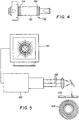
- the air channels 114 on the flange portion 115 of the bearing assemblage (for stationary bearing/rotating shaft the air channels are either on two opposing bearing faces or on one bearing face; for rotating bearing/stationary shaft the air channels are on the shaft body) were formed or engraved in the green ceramic near-net-shaped bearing 110 .
- various methods of forming air channels in the sintered ceramic bearing may be used, we prefer a novel technique which we developed comprising bead blasting through a polyester mask (prepared for example by the technique illustrated in Fig. 5), as described in details below.
- Step F sintering of the green machined air bearing 110 is performed in a temperature range from about 1400°C to about 1600°C, or more preferably about 1500°C. Preferable sintering times is in the range from about 1 hour to about 3 hours, or more preferably, about 2 hours. In a particular embodiment of the methods of the invention, the sintering peak temperature is 1500°C and that temperature is maintained for about 2 hours. It is preferred that the pre-sintered bearing 110 be slowly heated to sintering temperature and slowly cooled so as to avoid undesirable dimensional changes, distortions and crack development.
- preferred temperature ramps during heating are: about 0.3°C/minute for room temperature to about 300°C, about 0.1°C/minute for about 300°C to about 400°C, about 0.4°C/minute for about 400°C to about 600°C, and about 1.5°C/minute for about 600°C to about 1500°C.
- Preferred temperature ramps during cooling are: about 2°C/minute for about 1500°C to about 800°C and about 1.6°C/minute for about 800°C to room temperature.
- sintering may be achieved in the presence of a dopant selected from: MgO, FeO, ZnO, NiO, and MnO, and combination thereof, as discussed below in detail.
- a dopant selected from: MgO, FeO, ZnO, NiO, and MnO, and combination thereof, as discussed below in detail.
- the resulting alumina-zirconia ceramic article of the invention has a core of ⁇ -alumina or ⁇ -alumina and tetragonal zirconia alloy and a case of cubic spinel or cubic spinel along with cubic structure or cubic and monoclinic structure of zirconia alloy.
- the dopant oxide selected from: MgO, FeO, ZnO, CoO, NiO, and MnO, and combination thereof is in contact with the blank. It is preferred that the sintering result in a ceramic article 116 having a "full" or nearly theoretical density, and it is more preferred that the density of the ceramic article 116 be from about 99.5 to about 99.9 percent of theoretical density. Sintering is conducted in air or other oxygen containing atmosphere.
- the methods of the invention are not limited to any particular sintering pressure and temperature conditions. Sintering can be performed at atmospheric pressure or alternatively a higher pressure can be used during all or part of the sintering to reduce porosity. The sintering is continued for a sufficient time period for the case of the article being sintered to reach a thermodynamic equilibrium structure.
- An example of a useful range of elevated sintering pressures is from about 69 MPa to about 207 MPa, or more preferably about 100-103 MPa.
- the exact manner in which the dopant is in contact with the blank during sintering is not critical, however, the "case", as that term is used herein, is limited to those areas of the blank in contact with the dopant during sintering.
- a cubic spinel and tetragonal zirconia case can be readily produced by the methods of the invention on a portion of the overall surface of an article. It is not critical that the dopant be in contact with the blank during initial sintering, that is, sintering which does not result in an increase in density to full density.
- the concentration of alumina in the blank 108 is from about 5 weight percent (relative to the total weight of zirconia and alumina) to about 50 weight percent, then the method of the invention produces an article having a case that is cubic spinel and tetragonal zirconia and a core that is ⁇ -alumina and tetragonal zirconia.
- dopant in effect, diffuses past tetragonal zirconia until all of the dopant has contacted and reacted, i.e. "partitioned", with alumina.
- the method of the invention produces an article that has a case that is substantially composed of cubic spinel and cubic zirconia or cubic and monoclinic zirconia and a core that is ⁇ -alumina and tetragonal zirconia.
- dopant does not, in effect, diffuse past tetragonal zirconia until all of the dopant has contacted and reacted with alumina; but rather reacts with alumina and tetragonal zirconia in the same vicinity, leaving alumina deeper within the blank: unreacted.
- Ceramic parts can be fabricated to net-shape by the compaction processes such as dry pressing, injection molding, slip casting, and cold isostatic accompanied by green machining (Fig. 1, Step D).
- Green machining refers to the process of machining the ceramic particulate compact prior to densification.
- the part can be rigidly held by one of a numerous ways, including by simple mechanical gripping, by bonding or potting with a combination of beeswax and precision metal fixtures, the latter being preferred by the inventors.
- green machining can be accomplished in a variety of methods, including: turning, milling, drilling, form wheel grinding, and profile grinding. We prefer turning and profile grinding the billet during green machining to achieve the best results. Machining can be either dry or wet, depending on the binder present and whether or not the part has been bisque fired, i.e., fired at a high enough temperature to form bonds at particle-particle contact points, but not at a high enough temperature to produce densification.
- a further precision machining step F is required to meet dimensional tolerances, achieve improved surface finish or remove surface flaws. Maintaining dimensional tolerances to the extent of few millionths of an inch or achieving surface finish to less than 10 microinches is not possible unless final machining after sintering is undertaken.
- Precision machining is required when the part demands tolerances in certain dimensions less than 100 millionth of an inch and also to meet some dimensional tolerances such as roundness, perpendicularity, parallelness, etc.
- final precision machining of the sintered ceramic bearing requires diamond tooling and also sophisticated machines. Skilled artisans would know that milling, grinding, lapping and polishing are some effective procedures which are used in precision machining.
- the air lubricated hydrodynamic ceramic bearing 116 of the invention comprises a generally cylindrical body 117 having a bore opening 119 therethrough and an interior wall 125 defining a bearing surface extending lengthwise through the bore opening 119 .
- Air bearing 116 has at least two through holes 121 defining air inlet ports formed a circumferential portion of cylindrical body 117 .
- a pair of end flange portions 115 are arranged on opposite ends of the generally cylindrical body 117 . At least one of the end flange portions 115 have a spiral pattern air channels 114 formed therein in fluid commuications with the at least two air inlet ports 121 .
- air channels 114 can take any form and can be made by various techniques, we prefer using a bead blasting alumina grit through a polyester mask, as described below.
- a ceramic shaft is arranged in rotating contact with the bearing surface thereby forming an air lubricated hydrodynamic ceramic bearing assemblage.
- hydrodynamic bearing 116 of the invention is shown having spiral grooves 114 defining air channels arranged in at least one flange portion 115 in fluid communication with air inlet ports 121 formed in the body portion.
- the air channels 114 are formed on a flange portion 115 of the ceramic bearing 116 or, alternatively, air channels 134 may be formed on a circumferential portion 132 of ceramic shaft 130 (Fig. 4).
- the air channels are either on opposing faces of the bearing or on one bearing face as shown in Fig. 3.
- the air channels 134 are on the shaft body 132 , as illustrated in Fig. 4.
- Air channels provide air flow across the bearing surface which lubricates the bearing-shaft assembly. While the number of air inlet ports 121 may depend on the application, generally we prefer minimally two air inlet ports 121 in the bearing.
- data processing equipment such as personal computer 160 , is used to drive a CO 2 laser 162 .
- data processing equipment such as personal computer 160
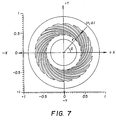
- polar coordinates r and ⁇ for the engraved spiral pattern in the ceramic article conform with the below empirical mathematical equation in which various values of x, y, r and ⁇ were used, as illustrated in Table 1.
- ⁇ 153.0649 + 176.4505 ln (r); wherein ⁇ defines the position of a spirally engraved portion relative to the r; and, r defines the distance from the center of the x, y coordinates to the leading edge of a spirally engraved portion comprising the spiral pattern.
- a corresponding trailing edge E t of a spirally engraved portion is rotatably about 11.43° from its corresponding leading edge E l .
- the database profile for the preferred spiral pattern is inputted into a data processing system, such as personal computer 160 , which communicates with the source of laser energy 162 .
- Laser beams 163 from the source of laser energy 162 is then directed onto the polyester sheet 170 for engraving, in accordance with the database profile, the predetermined spiral pattern therein, thereby forming the polyester mask 164 .
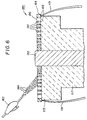
- Polyester mask 164 is then arranged in intimate contact using spray adhesive 166 (Fig. 6) with the ceramic article ( or bearing) so as to avoid distortions in the spiral pattern imparted to the ceramic article.
- Alumina grits in a conventional sand blaster
- the blasting nozzle is held at about 14 to 16 inches from the workpiece.
- the process of sand blasting to abrade hard surfaces is common to those who are familiar with the art and the machines are available commercially.
- the hard alumina grits upon impinging on relatively more brittle surface than the plastic mask, removes the ceramic preferentially and thus forms the pattern.
- the plastic mask is so chosen such that it survives the very aggressive bead blasting process. We prefer either polyester or polyurethane sheets, thickness of which ranges from 5 to 10 mil. Other plastics like polycarbonate, mylar, etc. did not survive the rigor of grit blasting.
- the apparatus 180 for bead blasting includes a source 182 of ceramic grits 184 , preferably alumina, a polyester mask 164 containing the spiral pattern 190 , as described above.
- a plug 192 is arranged in a central opening (not shown) in the mask 164 and through the flange portion 115 and bearing body 117 , as illustrated in Fig. 6.
- the apparatus 180 is substantially enclosed, with preferably a plastic shroud 119 , to protect portions of the bearing 116 that are not being engraved by the alumina grits 184 .
- Zirconia ceramic powder (prealloyed with secondary oxides described in U.S. Patent No. 5,336,282 and 5,358,913) were packed and sealed in molds made of rubber/polyurethane of 55 to 70 durometers of Shore hardness A (preferably 65 durometers). These molds were cold isostatically pressed in an autoclave at 15 to 30 kpsi (preferably 25 kilo pounds per square inch) to obtain billets of appropriate sizes in diameter and length.
- zirconia alloy powder is premixed with polyvinyl alcohol binder.
- Preformed blab produced by cold isostatically pressing are machined in their green state (i.e. before sintering) using carbide tools in lathe and milling machines.
- the cutting speeds in green machining of zirconia billets were maintained between 2800 and 3400 rpm (preferably at 32,000 rpm). In some cases, depending on the design, air inlet ports were drilled on the body of the bearings.
- the green machined and air channel engraved near-net-shaped air bearings are sintered following schedule described in U.S. Patent Nos. 5,336,282 and 5,358,913. After sintering the bearings achieved full theoretical density of 6.05 gms/cc for yttria stabilized zirconia.
- the final precision machining of the bearing assembly and lapping of the flange portion containing the engraved spiral pattern were carried out using diamond tools.
- the surface finish of the bearing assembly including the air channels were ⁇ 0.1 microns.
Landscapes
- Engineering & Computer Science (AREA)
- General Engineering & Computer Science (AREA)
- Mechanical Engineering (AREA)
- Chemical & Material Sciences (AREA)
- Oil, Petroleum & Natural Gas (AREA)
- Ceramic Engineering (AREA)
- Physics & Mathematics (AREA)
- Fluid Mechanics (AREA)
- Compositions Of Oxide Ceramics (AREA)
- Sliding-Contact Bearings (AREA)
- Magnetic Bearings And Hydrostatic Bearings (AREA)
Applications Claiming Priority (2)
| Application Number | Priority Date | Filing Date | Title |
|---|---|---|---|
| US701944 | 1991-05-17 | ||
| US08/701,944 US5738446A (en) | 1996-08-23 | 1996-08-23 | Air lubricated hydrodynamic ceramic bearings |
Publications (2)
| Publication Number | Publication Date |
|---|---|
| EP0825355A2 true EP0825355A2 (de) | 1998-02-25 |
| EP0825355A3 EP0825355A3 (de) | 1998-11-18 |
Family
ID=24819312
Family Applications (1)
| Application Number | Title | Priority Date | Filing Date |
|---|---|---|---|
| EP97202479A Ceased EP0825355A3 (de) | 1996-08-23 | 1997-08-11 | Luftgeschmiertes hydrodynamisches Keramiklager |
Country Status (3)
| Country | Link |
|---|---|
| US (1) | US5738446A (de) |
| EP (1) | EP0825355A3 (de) |
| JP (1) | JPH1082421A (de) |
Cited By (1)
| Publication number | Priority date | Publication date | Assignee | Title |
|---|---|---|---|---|
| CN108916230A (zh) * | 2018-02-06 | 2018-11-30 | 西安交通大学 | 一种螺旋节流的静压气体轴承 |
Families Citing this family (9)
| Publication number | Priority date | Publication date | Assignee | Title |
|---|---|---|---|---|
| JP3411421B2 (ja) * | 1995-03-31 | 2003-06-03 | 松下電器産業株式会社 | スピンドルモータ用スラスト板の製造方法 |
| JP3715360B2 (ja) * | 1995-11-20 | 2005-11-09 | 株式会社三協精機製作所 | エアー動圧軸受装置を用いたディスク駆動装置 |
| IL125332A0 (en) | 1998-07-13 | 1999-03-12 | Mamtirim Dan | Sprinkler and sealing assembly therefor |
| US6193199B1 (en) * | 1998-07-15 | 2001-02-27 | Nanomotion, Inc. | Sample stage including a slider assembly |
| US6402383B1 (en) * | 1999-02-25 | 2002-06-11 | Seagate Technology, Llc | Design methods for highly efficient high speed fluid dynamic bearing motors |
| US6254348B1 (en) * | 1999-04-19 | 2001-07-03 | Richard Lee | Structure of a radiating fan |
| US9259508B2 (en) | 2003-03-07 | 2016-02-16 | Louis A. Serafin, Jr. Trust | Ceramic manufactures |
| US7956499B2 (en) | 2005-06-02 | 2011-06-07 | Seagate Technology Llc | Motor magnetic force attenuator |
| US10232388B2 (en) | 2017-03-08 | 2019-03-19 | NaanDanJain Irrigation Ltd. | Multiple orientation rotatable sprinkler |
Citations (4)
| Publication number | Priority date | Publication date | Assignee | Title |
|---|---|---|---|---|
| US5224782A (en) | 1990-10-25 | 1993-07-06 | Ebara Corporation | Hydrodynamic bearing |
| US5290332A (en) | 1992-03-05 | 1994-03-01 | Eastman Kodak Company | Ceramic articles and methods for preparing ceramic articles and for sintering |
| EP0603818A1 (de) | 1992-12-22 | 1994-06-29 | Eastman Kodak Company | Verfahren zur Herstellung von Gegenständen aus Zirkoniumoxid mit tetragonalen Kernen und monoclinen Umhüllungen |
| US5336282A (en) | 1991-12-31 | 1994-08-09 | Eastman Kodak Company | Zirconia ceramics and a process of producing the same |
Family Cites Families (14)
| Publication number | Priority date | Publication date | Assignee | Title |
|---|---|---|---|---|
| US2624097A (en) * | 1951-01-09 | 1953-01-06 | Norton Co | Method of making dense, hard, abrasion resistant ceramic articles |
| US3606500A (en) * | 1968-10-15 | 1971-09-20 | William C Dee | Gas bearing assembly |
| GB1310526A (en) * | 1969-05-14 | 1973-03-21 | Smiths Industries Ltd | Gas-lubricated bearings |
| JPS58114803A (ja) * | 1981-12-28 | 1983-07-08 | Toshiba Tungaloy Co Ltd | 小径ドリル等の回転駆動装置 |
| JPS6014615A (ja) * | 1983-07-06 | 1985-01-25 | Ebara Corp | スラスト軸受およびその製造方法 |
| US4754494A (en) * | 1985-07-18 | 1988-06-28 | The Charles Stark Draper Laboratory, Inc. | Beryllium based, wear-resistant material for bearings and the like |
| JPS6356315U (de) * | 1986-09-30 | 1988-04-15 | ||
| US4728201A (en) * | 1986-12-17 | 1988-03-01 | Kurt Manufacturing Company, Inc. | Low velocity energized gas particle bearing |
| US4884899A (en) * | 1987-04-03 | 1989-12-05 | Schwartzman Everett H | Resiliently mounted fluid bearing assembly |
| JP2516967B2 (ja) * | 1987-04-30 | 1996-07-24 | 松下電器産業株式会社 | 軸受装置 |
| KR960000986B1 (ko) * | 1989-10-02 | 1996-01-15 | 가부시끼가이샤 윙· 하이세라 | 세라믹제 축받이 |
| DE69330509T2 (de) * | 1992-03-31 | 2002-04-11 | Sumitomo Electric Industries, Ltd. | Gleitbauteil und seine herstellung |
| JPH0668439A (ja) * | 1992-08-20 | 1994-03-11 | Ebara Corp | Vtr用ドラムモーター |
| JPH06351209A (ja) * | 1993-06-08 | 1994-12-22 | Ibiden Co Ltd | ブラシレスモータ |
-
1996
- 1996-08-23 US US08/701,944 patent/US5738446A/en not_active Expired - Lifetime
-
1997
- 1997-08-11 EP EP97202479A patent/EP0825355A3/de not_active Ceased
- 1997-08-22 JP JP9226847A patent/JPH1082421A/ja active Pending
Patent Citations (5)
| Publication number | Priority date | Publication date | Assignee | Title |
|---|---|---|---|---|
| US5224782A (en) | 1990-10-25 | 1993-07-06 | Ebara Corporation | Hydrodynamic bearing |
| US5336282A (en) | 1991-12-31 | 1994-08-09 | Eastman Kodak Company | Zirconia ceramics and a process of producing the same |
| US5290332A (en) | 1992-03-05 | 1994-03-01 | Eastman Kodak Company | Ceramic articles and methods for preparing ceramic articles and for sintering |
| US5358913A (en) | 1992-03-05 | 1994-10-25 | Eastman Kodak Company | Zirconia ceramic articles having a tetragonal core and cubic casing |
| EP0603818A1 (de) | 1992-12-22 | 1994-06-29 | Eastman Kodak Company | Verfahren zur Herstellung von Gegenständen aus Zirkoniumoxid mit tetragonalen Kernen und monoclinen Umhüllungen |
Non-Patent Citations (1)
| Title |
|---|
| DAVID W. RICHARDSON: "Modern Ceramic Engineering: Properties, Processes and Use in Design, 2nd Edition", 1992 |
Cited By (1)
| Publication number | Priority date | Publication date | Assignee | Title |
|---|---|---|---|---|
| CN108916230A (zh) * | 2018-02-06 | 2018-11-30 | 西安交通大学 | 一种螺旋节流的静压气体轴承 |
Also Published As
| Publication number | Publication date |
|---|---|
| EP0825355A3 (de) | 1998-11-18 |
| JPH1082421A (ja) | 1998-03-31 |
| US5738446A (en) | 1998-04-14 |
Similar Documents
| Publication | Publication Date | Title |
|---|---|---|
| US5776408A (en) | Method of engraving green ceramic articles | |
| EP0825159B1 (de) | Verfahren zur Herstellung von luftgeschmierten hydrodynamischen keramischen Lagern | |
| US5824123A (en) | Zirconia articles having tetragonal cores and monoclinic cases and preparation and sintering methods | |
| US5738446A (en) | Air lubricated hydrodynamic ceramic bearings | |
| EP0559215A1 (de) | Keramische Gegenstände sowie Verfahren zur Herstellung von keramischen Gegenständen und zum Sintern | |
| US5803852A (en) | Ceramic drive system | |
| JP4642956B2 (ja) | ベアリングボール、ベアリング、およびベアリングボールの製造方法 | |
| EP0729927A1 (de) | Gegenstände aus Aluminiumoxid-Keramik mit Oberflächen-kubischem Spinell, Verfahren zu ihrer Herstellung sowie Sintern | |
| EP0835852B1 (de) | In-situ Oberflächennitrierung von Zirkonoxidkeramiken | |
| US5683481A (en) | Method of making core shell structured articles based on alumina ceramics having spinel surfaces | |
| EP0824989A2 (de) | Verfahren zur Herstellung einer Maske nützlich beim Gravieren keramischer Gegenstände | |
| JP2003004040A (ja) | 転がり案内装置 | |
| US5839618A (en) | Materials feeder equipment | |
| US6164846A (en) | Apparatus and method for transporting a web | |
| JPH10194832A (ja) | セラミック物品 | |
| US5884387A (en) | Method of forming self-lubricating, ceramic elements for a drive system or similar apparatus | |
| US5885626A (en) | Die retaining element | |
| EP0835851A1 (de) | Keramischer Artikel mit einem Kern, der tetragonales Zirkonoxid enthält, und einer Schale, die Zirkonnitrid enthält | |
| EP0869296A2 (de) | Apparat und Verfahren zum Aufspulen von Bandmaterial | |
| EP0849242A1 (de) | Verfahren zur Herstellung eines keramischen Körpers mit einem Kern, der Zirkonoxid enthält, und einer Schale, die Zirkonborid enthält | |
| JPH05105510A (ja) | セラミツク材料 | |
| JPH10128600A (ja) | 材料搬送要素 |
Legal Events
| Date | Code | Title | Description |
|---|---|---|---|
| PUAI | Public reference made under article 153(3) epc to a published international application that has entered the european phase |
Free format text: ORIGINAL CODE: 0009012 |
|
| AK | Designated contracting states |
Kind code of ref document: A2 Designated state(s): DE FR GB NL |
|
| PUAL | Search report despatched |
Free format text: ORIGINAL CODE: 0009013 |
|
| AK | Designated contracting states |
Kind code of ref document: A3 Designated state(s): AT BE CH DE DK ES FI FR GB GR IE IT LI LU MC NL PT SE |
|
| 17P | Request for examination filed |
Effective date: 19990414 |
|
| AKX | Designation fees paid |
Free format text: DE FR GB NL |
|
| 17Q | First examination report despatched |
Effective date: 20010406 |
|
| STAA | Information on the status of an ep patent application or granted ep patent |
Free format text: STATUS: THE APPLICATION HAS BEEN REFUSED |
|
| 18R | Application refused |
Effective date: 20030530 |