EP0825663A2 - Chemical overcharge protection of lithium and lithium-ion secondary batteries - Google Patents
Chemical overcharge protection of lithium and lithium-ion secondary batteries Download PDFInfo
- Publication number
- EP0825663A2 EP0825663A2 EP97114457A EP97114457A EP0825663A2 EP 0825663 A2 EP0825663 A2 EP 0825663A2 EP 97114457 A EP97114457 A EP 97114457A EP 97114457 A EP97114457 A EP 97114457A EP 0825663 A2 EP0825663 A2 EP 0825663A2
- Authority
- EP
- European Patent Office
- Prior art keywords
- thianthrene
- cathode
- lithium
- anode
- electrolyte
- Prior art date
- Legal status (The legal status is an assumption and is not a legal conclusion. Google has not performed a legal analysis and makes no representation as to the accuracy of the status listed.)
- Withdrawn
Links
- 229910001416 lithium ion Inorganic materials 0.000 title abstract description 22
- 229910052744 lithium Inorganic materials 0.000 title abstract description 13
- HBBGRARXTFLTSG-UHFFFAOYSA-N Lithium ion Chemical compound [Li+] HBBGRARXTFLTSG-UHFFFAOYSA-N 0.000 title abstract description 6
- WHXSMMKQMYFTQS-UHFFFAOYSA-N Lithium Chemical compound [Li] WHXSMMKQMYFTQS-UHFFFAOYSA-N 0.000 title description 11
- 239000000126 substance Substances 0.000 title description 5
- 229910002097 Lithium manganese(III,IV) oxide Inorganic materials 0.000 claims abstract description 21
- GVIJJXMXTUZIOD-UHFFFAOYSA-N thianthrene Chemical compound C1=CC=C2SC3=CC=CC=C3SC2=C1 GVIJJXMXTUZIOD-UHFFFAOYSA-N 0.000 claims abstract description 21
- GATVHFQKUCJQGI-UHFFFAOYSA-N 1-(7-acetylthianthren-2-yl)ethanone Chemical compound CC(=O)C1=CC=C2SC3=CC(C(=O)C)=CC=C3SC2=C1 GATVHFQKUCJQGI-UHFFFAOYSA-N 0.000 claims abstract description 20
- 239000003153 chemical reaction reagent Substances 0.000 claims abstract description 17
- OKTJSMMVPCPJKN-UHFFFAOYSA-N Carbon Chemical compound [C] OKTJSMMVPCPJKN-UHFFFAOYSA-N 0.000 claims abstract description 14
- 229910052799 carbon Inorganic materials 0.000 claims abstract description 11
- -1 LiCr0.5V0.5S2 Inorganic materials 0.000 claims description 30
- 239000003792 electrolyte Substances 0.000 claims description 21
- 239000000203 mixture Substances 0.000 claims description 14
- KMTRUDSVKNLOMY-UHFFFAOYSA-N Ethylene carbonate Chemical compound O=C1OCCO1 KMTRUDSVKNLOMY-UHFFFAOYSA-N 0.000 claims description 13
- 229910001290 LiPF6 Inorganic materials 0.000 claims description 13
- 229920002239 polyacrylonitrile Polymers 0.000 claims description 11
- 229920000642 polymer Polymers 0.000 claims description 11
- 239000002904 solvent Substances 0.000 claims description 9
- 150000003839 salts Chemical class 0.000 claims description 6
- 239000005518 polymer electrolyte Substances 0.000 claims description 5
- 229910032387 LiCoO2 Inorganic materials 0.000 claims description 4
- 229910003005 LiNiO2 Inorganic materials 0.000 claims description 4
- 229910001540 lithium hexafluoroarsenate(V) Inorganic materials 0.000 claims description 4
- 229920000915 polyvinyl chloride Polymers 0.000 claims description 4
- 239000004800 polyvinyl chloride Substances 0.000 claims description 4
- 150000005029 thianthrenes Chemical class 0.000 claims description 4
- SECXISVLQFMRJM-UHFFFAOYSA-N N-Methylpyrrolidone Chemical compound CN1CCCC1=O SECXISVLQFMRJM-UHFFFAOYSA-N 0.000 claims description 3
- VUPKGFBOKBGHFZ-UHFFFAOYSA-N dipropyl carbonate Chemical compound CCCOC(=O)OCCC VUPKGFBOKBGHFZ-UHFFFAOYSA-N 0.000 claims description 3
- 238000003780 insertion Methods 0.000 claims description 3
- 230000037431 insertion Effects 0.000 claims description 3
- 229910001496 lithium tetrafluoroborate Inorganic materials 0.000 claims description 3
- QSZMZKBZAYQGRS-UHFFFAOYSA-N lithium;bis(trifluoromethylsulfonyl)azanide Chemical compound [Li+].FC(F)(F)S(=O)(=O)[N-]S(=O)(=O)C(F)(F)F QSZMZKBZAYQGRS-UHFFFAOYSA-N 0.000 claims description 3
- 239000003960 organic solvent Substances 0.000 claims description 3
- 229910013375 LiC Inorganic materials 0.000 claims description 2
- 229910013406 LiN(SO2CF3)2 Inorganic materials 0.000 claims description 2
- 229920003171 Poly (ethylene oxide) Polymers 0.000 claims description 2
- MHCFAGZWMAWTNR-UHFFFAOYSA-M lithium perchlorate Chemical compound [Li+].[O-]Cl(=O)(=O)=O MHCFAGZWMAWTNR-UHFFFAOYSA-M 0.000 claims description 2
- 229910001486 lithium perchlorate Inorganic materials 0.000 claims description 2
- YEJRWHAVMIAJKC-UHFFFAOYSA-N 4-Butyrolactone Chemical compound O=C1CCCO1 YEJRWHAVMIAJKC-UHFFFAOYSA-N 0.000 claims 2
- 229910012946 LiV2O5 Inorganic materials 0.000 claims 2
- 229910013028 LiVS2 Inorganic materials 0.000 claims 2
- 239000004014 plasticizer Substances 0.000 claims 2
- 150000003568 thioethers Chemical class 0.000 claims 2
- OIFBSDVPJOWBCH-UHFFFAOYSA-N Diethyl carbonate Chemical compound CCOC(=O)OCC OIFBSDVPJOWBCH-UHFFFAOYSA-N 0.000 claims 1
- KRHYYFGTRYWZRS-UHFFFAOYSA-M Fluoride anion Chemical compound [F-] KRHYYFGTRYWZRS-UHFFFAOYSA-M 0.000 claims 1
- 229930188620 butyrolactone Natural products 0.000 claims 1
- 150000004649 carbonic acid derivatives Chemical class 0.000 claims 1
- 229920001577 copolymer Polymers 0.000 claims 1
- IEJIGPNLZYLLBP-UHFFFAOYSA-N dimethyl carbonate Chemical compound COC(=O)OC IEJIGPNLZYLLBP-UHFFFAOYSA-N 0.000 claims 1
- 150000002148 esters Chemical class 0.000 claims 1
- 150000002170 ethers Chemical class 0.000 claims 1
- 150000002576 ketones Chemical class 0.000 claims 1
- 150000002596 lactones Chemical class 0.000 claims 1
- 239000002184 metal Substances 0.000 claims 1
- 229910052751 metal Inorganic materials 0.000 claims 1
- 229910001092 metal group alloy Inorganic materials 0.000 claims 1
- 229910044991 metal oxide Inorganic materials 0.000 claims 1
- 150000004706 metal oxides Chemical class 0.000 claims 1
- 229910052976 metal sulfide Inorganic materials 0.000 claims 1
- 150000004767 nitrides Chemical class 0.000 claims 1
- 239000011877 solvent mixture Substances 0.000 claims 1
- HXJUTPCZVOIRIF-UHFFFAOYSA-N sulfolane Chemical compound O=S1(=O)CCCC1 HXJUTPCZVOIRIF-UHFFFAOYSA-N 0.000 claims 1
- 150000003457 sulfones Chemical class 0.000 claims 1
- 150000001875 compounds Chemical class 0.000 abstract description 9
- 229910052596 spinel Inorganic materials 0.000 abstract description 5
- 239000011029 spinel Substances 0.000 abstract description 5
- 210000004027 cell Anatomy 0.000 description 55
- 230000003647 oxidation Effects 0.000 description 14
- 238000007254 oxidation reaction Methods 0.000 description 14
- 238000006243 chemical reaction Methods 0.000 description 9
- 238000002484 cyclic voltammetry Methods 0.000 description 8
- 239000011244 liquid electrolyte Substances 0.000 description 7
- RUOJZAUFBMNUDX-UHFFFAOYSA-N propylene carbonate Chemical compound CC1COC(=O)O1 RUOJZAUFBMNUDX-UHFFFAOYSA-N 0.000 description 6
- 238000000926 separation method Methods 0.000 description 6
- VQKFNUFAXTZWDK-UHFFFAOYSA-N 2-Methylfuran Chemical compound CC1=CC=CO1 VQKFNUFAXTZWDK-UHFFFAOYSA-N 0.000 description 4
- WYURNTSHIVDZCO-UHFFFAOYSA-N Tetrahydrofuran Chemical compound C1CCOC1 WYURNTSHIVDZCO-UHFFFAOYSA-N 0.000 description 4
- 238000009792 diffusion process Methods 0.000 description 4
- 239000002006 petroleum coke Substances 0.000 description 4
- 230000002829 reductive effect Effects 0.000 description 4
- 230000002441 reversible effect Effects 0.000 description 4
- 239000007787 solid Substances 0.000 description 4
- 239000000243 solution Substances 0.000 description 4
- 125000002777 acetyl group Chemical group [H]C([H])([H])C(*)=O 0.000 description 3
- 230000004913 activation Effects 0.000 description 3
- 239000003125 aqueous solvent Substances 0.000 description 3
- 238000011161 development Methods 0.000 description 3
- 230000018109 developmental process Effects 0.000 description 3
- 238000000605 extraction Methods 0.000 description 3
- 229910002804 graphite Inorganic materials 0.000 description 3
- 239000010439 graphite Substances 0.000 description 3
- 125000004435 hydrogen atom Chemical group [H]* 0.000 description 3
- 229910003002 lithium salt Inorganic materials 0.000 description 3
- 159000000002 lithium salts Chemical class 0.000 description 3
- 239000000463 material Substances 0.000 description 3
- 238000000034 method Methods 0.000 description 3
- QQONPFPTGQHPMA-UHFFFAOYSA-N propylene Natural products CC=C QQONPFPTGQHPMA-UHFFFAOYSA-N 0.000 description 3
- 230000009467 reduction Effects 0.000 description 3
- 238000012360 testing method Methods 0.000 description 3
- JWUJQDFVADABEY-UHFFFAOYSA-N 2-methyltetrahydrofuran Chemical compound CC1CCCO1 JWUJQDFVADABEY-UHFFFAOYSA-N 0.000 description 2
- XPDWGBQVDMORPB-UHFFFAOYSA-N Fluoroform Chemical class FC(F)F XPDWGBQVDMORPB-UHFFFAOYSA-N 0.000 description 2
- 229910010226 Li2Mn2O4 Inorganic materials 0.000 description 2
- 239000000654 additive Substances 0.000 description 2
- 239000006229 carbon black Substances 0.000 description 2
- RKTYLMNFRDHKIL-UHFFFAOYSA-N copper;5,10,15,20-tetraphenylporphyrin-22,24-diide Chemical compound [Cu+2].C1=CC(C(=C2C=CC([N-]2)=C(C=2C=CC=CC=2)C=2C=CC(N=2)=C(C=2C=CC=CC=2)C2=CC=C3[N-]2)C=2C=CC=CC=2)=NC1=C3C1=CC=CC=C1 RKTYLMNFRDHKIL-UHFFFAOYSA-N 0.000 description 2
- 230000000694 effects Effects 0.000 description 2
- JBTWLSYIZRCDFO-UHFFFAOYSA-N ethyl methyl carbonate Chemical compound CCOC(=O)OC JBTWLSYIZRCDFO-UHFFFAOYSA-N 0.000 description 2
- 125000000524 functional group Chemical group 0.000 description 2
- 229910021397 glassy carbon Inorganic materials 0.000 description 2
- 230000002427 irreversible effect Effects 0.000 description 2
- 239000007788 liquid Substances 0.000 description 2
- 239000012046 mixed solvent Substances 0.000 description 2
- 239000011255 nonaqueous electrolyte Substances 0.000 description 2
- 239000005486 organic electrolyte Substances 0.000 description 2
- 238000010525 oxidative degradation reaction Methods 0.000 description 2
- 229920002981 polyvinylidene fluoride Polymers 0.000 description 2
- 125000004805 propylene group Chemical group [H]C([H])([H])C([H])([*:1])C([H])([H])[*:2] 0.000 description 2
- HNJBEVLQSNELDL-UHFFFAOYSA-N pyrrolidin-2-one Chemical compound O=C1CCCN1 HNJBEVLQSNELDL-UHFFFAOYSA-N 0.000 description 2
- 238000007086 side reaction Methods 0.000 description 2
- 239000012453 solvate Substances 0.000 description 2
- 239000007858 starting material Substances 0.000 description 2
- 125000001424 substituent group Chemical group 0.000 description 2
- YLQBMQCUIZJEEH-UHFFFAOYSA-N tetrahydrofuran Natural products C=1C=COC=1 YLQBMQCUIZJEEH-UHFFFAOYSA-N 0.000 description 2
- 229920002554 vinyl polymer Polymers 0.000 description 2
- QOUKGHHEMMMMID-UHFFFAOYSA-N 1-(1-acetylthianthren-2-yl)ethanone Chemical compound C1=CC=C2SC3=C(C(C)=O)C(C(=O)C)=CC=C3SC2=C1 QOUKGHHEMMMMID-UHFFFAOYSA-N 0.000 description 1
- KHADNGUBNWXUPK-UHFFFAOYSA-N 1-thianthren-1-ylethanone Chemical compound S1C2=CC=CC=C2SC2=C1C=CC=C2C(=O)C KHADNGUBNWXUPK-UHFFFAOYSA-N 0.000 description 1
- RYGMFSIKBFXOCR-UHFFFAOYSA-N Copper Chemical compound [Cu] RYGMFSIKBFXOCR-UHFFFAOYSA-N 0.000 description 1
- VGGSQFUCUMXWEO-UHFFFAOYSA-N Ethene Chemical compound C=C VGGSQFUCUMXWEO-UHFFFAOYSA-N 0.000 description 1
- 239000005977 Ethylene Substances 0.000 description 1
- 229910006264 Li1+xMn2O4 Inorganic materials 0.000 description 1
- 229910000552 LiCF3SO3 Inorganic materials 0.000 description 1
- 102000029749 Microtubule Human genes 0.000 description 1
- 108091022875 Microtubule Proteins 0.000 description 1
- 125000000218 acetic acid group Chemical group C(C)(=O)* 0.000 description 1
- 230000000397 acetylating effect Effects 0.000 description 1
- 230000000996 additive effect Effects 0.000 description 1
- 229910052783 alkali metal Inorganic materials 0.000 description 1
- 150000001340 alkali metals Chemical class 0.000 description 1
- 125000000217 alkyl group Chemical group 0.000 description 1
- 229910052782 aluminium Inorganic materials 0.000 description 1
- XAGFODPZIPBFFR-UHFFFAOYSA-N aluminium Chemical compound [Al] XAGFODPZIPBFFR-UHFFFAOYSA-N 0.000 description 1
- 238000013459 approach Methods 0.000 description 1
- 125000003118 aryl group Chemical group 0.000 description 1
- 239000010406 cathode material Substances 0.000 description 1
- 125000001309 chloro group Chemical group Cl* 0.000 description 1
- 239000000571 coke Substances 0.000 description 1
- 239000011889 copper foil Substances 0.000 description 1
- 150000005676 cyclic carbonates Chemical class 0.000 description 1
- 125000004122 cyclic group Chemical group 0.000 description 1
- 230000001351 cycling effect Effects 0.000 description 1
- 230000005518 electrochemistry Effects 0.000 description 1
- 239000008151 electrolyte solution Substances 0.000 description 1
- 125000006575 electron-withdrawing group Chemical group 0.000 description 1
- 238000002474 experimental method Methods 0.000 description 1
- 239000000835 fiber Substances 0.000 description 1
- 239000011888 foil Substances 0.000 description 1
- 235000019253 formic acid Nutrition 0.000 description 1
- 150000004674 formic acids Chemical class 0.000 description 1
- 230000006872 improvement Effects 0.000 description 1
- 239000006193 liquid solution Substances 0.000 description 1
- 238000004519 manufacturing process Methods 0.000 description 1
- 239000011159 matrix material Substances 0.000 description 1
- 210000004688 microtubule Anatomy 0.000 description 1
- 125000000449 nitro group Chemical group [O-][N+](*)=O 0.000 description 1
- 150000007524 organic acids Chemical class 0.000 description 1
- 235000005985 organic acids Nutrition 0.000 description 1
- 239000011815 overcharge protection agent Substances 0.000 description 1
- 230000033116 oxidation-reduction process Effects 0.000 description 1
- 230000001590 oxidative effect Effects 0.000 description 1
- 229920003023 plastic Polymers 0.000 description 1
- 239000004033 plastic Substances 0.000 description 1
- 230000002265 prevention Effects 0.000 description 1
- 230000008569 process Effects 0.000 description 1
- 239000003223 protective agent Substances 0.000 description 1
- 230000001681 protective effect Effects 0.000 description 1
- 238000000197 pyrolysis Methods 0.000 description 1
- 238000006479 redox reaction Methods 0.000 description 1
- 230000008929 regeneration Effects 0.000 description 1
- 238000011069 regeneration method Methods 0.000 description 1
- 238000000807 solvent casting Methods 0.000 description 1
- 238000006467 substitution reaction Methods 0.000 description 1
- 230000002459 sustained effect Effects 0.000 description 1
- 238000012546 transfer Methods 0.000 description 1
Images


Classifications
-
- H—ELECTRICITY
- H01—ELECTRIC ELEMENTS
- H01M—PROCESSES OR MEANS, e.g. BATTERIES, FOR THE DIRECT CONVERSION OF CHEMICAL ENERGY INTO ELECTRICAL ENERGY
- H01M10/00—Secondary cells; Manufacture thereof
- H01M10/05—Accumulators with non-aqueous electrolyte
- H01M10/056—Accumulators with non-aqueous electrolyte characterised by the materials used as electrolytes, e.g. mixed inorganic/organic electrolytes
- H01M10/0564—Accumulators with non-aqueous electrolyte characterised by the materials used as electrolytes, e.g. mixed inorganic/organic electrolytes the electrolyte being constituted of organic materials only
- H01M10/0566—Liquid materials
- H01M10/0567—Liquid materials characterised by the additives
-
- H—ELECTRICITY
- H01—ELECTRIC ELEMENTS
- H01M—PROCESSES OR MEANS, e.g. BATTERIES, FOR THE DIRECT CONVERSION OF CHEMICAL ENERGY INTO ELECTRICAL ENERGY
- H01M10/00—Secondary cells; Manufacture thereof
- H01M10/42—Methods or arrangements for servicing or maintenance of secondary cells or secondary half-cells
- H01M10/4235—Safety or regulating additives or arrangements in electrodes, separators or electrolyte
-
- H—ELECTRICITY
- H01—ELECTRIC ELEMENTS
- H01M—PROCESSES OR MEANS, e.g. BATTERIES, FOR THE DIRECT CONVERSION OF CHEMICAL ENERGY INTO ELECTRICAL ENERGY
- H01M10/00—Secondary cells; Manufacture thereof
- H01M10/05—Accumulators with non-aqueous electrolyte
- H01M10/052—Li-accumulators
- H01M10/0525—Rocking-chair batteries, i.e. batteries with lithium insertion or intercalation in both electrodes; Lithium-ion batteries
-
- H—ELECTRICITY
- H01—ELECTRIC ELEMENTS
- H01M—PROCESSES OR MEANS, e.g. BATTERIES, FOR THE DIRECT CONVERSION OF CHEMICAL ENERGY INTO ELECTRICAL ENERGY
- H01M4/00—Electrodes
- H01M4/02—Electrodes composed of, or comprising, active material
- H01M4/36—Selection of substances as active materials, active masses, active liquids
- H01M4/58—Selection of substances as active materials, active masses, active liquids of inorganic compounds other than oxides or hydroxides, e.g. sulfides, selenides, tellurides, halogenides or LiCoFy; of polyanionic structures, e.g. phosphates, silicates or borates
- H01M4/583—Carbonaceous material, e.g. graphite-intercalation compounds or CFx
- H01M4/587—Carbonaceous material, e.g. graphite-intercalation compounds or CFx for inserting or intercalating light metals
-
- H—ELECTRICITY
- H01—ELECTRIC ELEMENTS
- H01M—PROCESSES OR MEANS, e.g. BATTERIES, FOR THE DIRECT CONVERSION OF CHEMICAL ENERGY INTO ELECTRICAL ENERGY
- H01M50/00—Constructional details or processes of manufacture of the non-active parts of electrochemical cells other than fuel cells, e.g. hybrid cells
- H01M50/50—Current conducting connections for cells or batteries
- H01M50/572—Means for preventing undesired use or discharge
-
- H—ELECTRICITY
- H01—ELECTRIC ELEMENTS
- H01M—PROCESSES OR MEANS, e.g. BATTERIES, FOR THE DIRECT CONVERSION OF CHEMICAL ENERGY INTO ELECTRICAL ENERGY
- H01M6/00—Primary cells; Manufacture thereof
- H01M6/14—Cells with non-aqueous electrolyte
- H01M6/16—Cells with non-aqueous electrolyte with organic electrolyte
- H01M6/162—Cells with non-aqueous electrolyte with organic electrolyte characterised by the electrolyte
- H01M6/168—Cells with non-aqueous electrolyte with organic electrolyte characterised by the electrolyte by additives
-
- H—ELECTRICITY
- H01—ELECTRIC ELEMENTS
- H01M—PROCESSES OR MEANS, e.g. BATTERIES, FOR THE DIRECT CONVERSION OF CHEMICAL ENERGY INTO ELECTRICAL ENERGY
- H01M6/00—Primary cells; Manufacture thereof
- H01M6/14—Cells with non-aqueous electrolyte
- H01M6/18—Cells with non-aqueous electrolyte with solid electrolyte
- H01M6/181—Cells with non-aqueous electrolyte with solid electrolyte with polymeric electrolytes
-
- Y—GENERAL TAGGING OF NEW TECHNOLOGICAL DEVELOPMENTS; GENERAL TAGGING OF CROSS-SECTIONAL TECHNOLOGIES SPANNING OVER SEVERAL SECTIONS OF THE IPC; TECHNICAL SUBJECTS COVERED BY FORMER USPC CROSS-REFERENCE ART COLLECTIONS [XRACs] AND DIGESTS
- Y02—TECHNOLOGIES OR APPLICATIONS FOR MITIGATION OR ADAPTATION AGAINST CLIMATE CHANGE
- Y02E—REDUCTION OF GREENHOUSE GAS [GHG] EMISSIONS, RELATED TO ENERGY GENERATION, TRANSMISSION OR DISTRIBUTION
- Y02E60/00—Enabling technologies; Technologies with a potential or indirect contribution to GHG emissions mitigation
- Y02E60/10—Energy storage using batteries
-
- Y—GENERAL TAGGING OF NEW TECHNOLOGICAL DEVELOPMENTS; GENERAL TAGGING OF CROSS-SECTIONAL TECHNOLOGIES SPANNING OVER SEVERAL SECTIONS OF THE IPC; TECHNICAL SUBJECTS COVERED BY FORMER USPC CROSS-REFERENCE ART COLLECTIONS [XRACs] AND DIGESTS
- Y10—TECHNICAL SUBJECTS COVERED BY FORMER USPC
- Y10T—TECHNICAL SUBJECTS COVERED BY FORMER US CLASSIFICATION
- Y10T29/00—Metal working
- Y10T29/49—Method of mechanical manufacture
- Y10T29/49002—Electrical device making
- Y10T29/49108—Electric battery cell making
Definitions
- This invention relates to electrochemical cells and more particularly to improved non-aqueous liquid and polymer electrolytes for cells incorporating alkali metal negative electrodes (anodes), and especially lithium anodes or lithium-ion anodes.
- the improvement features the use of a new lass of compounds as redox reagents, dissolved in non-aqueous electrolytes, to provide overcharge protection.
- the electrolyte solution is a crucial component in an ambient temperature secondary lithium cell.
- a non-aqueous solvent or mixture of solvents which dissolves an appreciable amount of lithium salts to form highly conducting solutions is desirable.
- the electrolyte should afford high efficiency for cycling of the lithium or lithium-ion electrode, and exhibit good thermal stability up to 70°C (the usual upper temperature limit for operation of ambient temperature batteries).
- the polymers are matrices to immobilize complexes (solvates) formed between Li salts, such as LiAsF 6 , LiCF 3 SO 3 , LiPF 6 , LiN(CF 3 SO 2 ) 2 and LiBF 4 , and an aprotic organic solvent (or mixture of such solvents) to allow fabrication of free-standing electrolyte films to be used in solid-state Li and Li-ion batteries (K.M. Abraham et al., U.S. Patents No. 5,219,679; 5,252,413; 5,457,860).
- Li salts such as LiAsF 6 , LiCF 3 SO 3 , LiPF 6 , LiN(CF 3 SO 2 ) 2 and LiBF 4
- an aprotic organic solvent or mixture of such solvents
- non-aqueous electrolyte (organic electrolyte) cells may not be overcharged without causing irreversible electrolyte side-reactions which deteriorate cell performance.
- Cells are safe guarded during laboratory charge/discharge tests by careful control of the voltage limits by means of the electronic equipment used the test.
- Electronic overcharge control comprises a sensing circuit which prevents current from flowing into the cell once it reaches the voltage corresponding to complete charge.
- the charge voltage limit is selected according to the electrochemical couple in the cell. For example, Carbon/LiMn 2 O 4 cells have an upper charge limit of 4.3V vs. Li + /Li.
- Chemical overcharge protection of a battery consisting of cells connected in series is particularly important for two reasons. Firstly, it will replace electronic overcharge controllers in individual cells. Electronic controllers lower the energy density of the battery and increase battery cost. Secondly, they will provide capacity balance among the individual cells and prevent oxidative degradation of the electrolyte. The capacity balance among the cells in a battery may be lost, especially after repeated charge/disc cycles. This means that the accessible capacity of individual cells may not remain equal. In this instance, the cathode of the cell with the lowest capacity will be pushed above the normal upper voltage limit. Oxidative degradation of the electrolyte will occur at these higher potentials, and this will degrade the cycle life of the battery at an accelerated rate.
- the weaker cell will contribute a larger fraction of the total cutoff voltage for the battery causing the capacity of the cells in the battery to become increasingly out of balance at each additional cycle, since the stronger cells will not be charged to their full capacity. The result is a reduced cycle life for the battery as compared to its individual cells.
- Necessary properties of a redox shuttle include: high solubility in the electrolyte; an oxidation potential slightly higher than the normal charge limit of the cell but lower than the oxidation potential of the electolyte; the ability of the oxidized form to be reduced at the anode without side reaction; and chemical stability in the cell of both the oxidized and reduced forms of the shuttle reagent.
- an object of this invention is the use of redox reagents to provide a means of chemical overcharge protection to secondary non-aqueous liquid and polymer electolyte cells with lithium or lithium-ion anodes.
- the invention features a rechargeable electrochemical cell which includes an anode, a cathode, and an electrolyte.
- the electolyte in a non-aqueous solvent or a mixture on non-aqueous solvents which may or may not be immobilized in a polymer matrix, and in which one or more salts and the redox reagent are dissolved.
- the redox reagent is ideally present in an amount sufficient to maintain proper mass transport for the desired steady overcharge current for the cell.
- R represents thianthrene (FIG. 1 ), or one of its derivatives such as 2,7-diacetyl thianthrene (FIG. 2 ).
- R is added to the electolyte where it is available for a reversible oxidation-reduction (redox) shuttle reaction.
- the electolyte may be a liquid solution with a single solvent, such as propylene carbonate-1.0M LiPF 6 , or a mixed-solvent solution such as 50% ethylene carbonate:50% propylene carbonate-1.0M LiPF 6 .
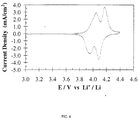
- FIG. 4 shows that Li is removed from LiMn 2 O 4 in two stages, with peaks centered at 4.05V and at 4.17V vs. Li + /Li. Consequently, although thianthrene exhibits the desired redox behavior, it is not suitable for use in the C/LiMn 2 O 4 cell since the activation of the redox shuttle would overlap with the removal of lithium from the cathode. This would interfere with the cathode utilization so that the cell would not charge fully.
- Table 2 shows the current function (i a p / ⁇ 1/2 , where i a is the peak current for the anodic peak and ⁇ is the scan rate) obtained for the oxidative and reductive peaks seen in the cyclic voltammogram for 2,7-diacetyl thianthrene, along with the voltages for the anodic and cathodic peaks ( a E p and c E p respectively), the peak width ( ⁇ a E p/2 ), and the peak separation ( ⁇ a E p ).
- the disordered carbon may be one obtained from the pyrolysis of petroleum coke, and known to those skilled in the field as 'petroleum coke' or 'coke'.
- the graphite may have the usual flake morphology, but may also be formed as graphite fibers or microtubules.
- the primary purpose of the acetyl functional groups of diacetyl thianthrene is to shift the redox potential to a more positive value.
- functional groups may be added to promote solubility of the derivatized compound in the electolyte.
- Other functional groups can be attached to thianthrene to either increase or decrease its redox potential. Electron withdrawing substituents such as acetyl, nitro and chloro groups are expected to increase the oxidation potential while electron releasing substituents such as alkyl groups will decrease this potential.
- thianthrene and its derivatives such as 2,7-diacetyl thianthrene useful as overcharge protection additives for lithium or lithium-ion cells.
- the choice of a particular redox reagent will vary with the cathode material used in a rechargeable Li or lithium-ion cell.
- the carbon/spinel LiMn 2 O 4 couple is mentioned specifically, other cathodes such as LiCoO 2 or LiNiO 2 might also be used.
- the preferred electolytes are resistive to oxidation in this range.
- liquid electolytes with ethylene carbonate (EC), propylene carbonate (PC), dipropyl carbonate (DPC), methyl ethyl carbonate (MEC) and similar solvents or mixtures of solvents are known to those skilled in the art as desirable electolytes for use with high voltage cathodes.
- these solvents or mixtures of solvents and the solvates which they form with lithium salts such as LiAsF 6 , LiPF 6 , LiClO 4 , LiN(SO 2 CF 3 ) 2 , LiC(SO 2 CF 3 ) 3 , LiBF 4 , and lithium salts of organic acids such as trichloroacetic, trifluoromethane sulfonic, and formic acids can be immobilized according to the teachings of the patents by Abraham et al. cited above.
- the example shows the usefulness of 2,7-diacetyl thianthrene in the presence of Li 1.5 Mn 2 O 4 , which is a mixture of 0.5 mole of LiMn 2 O 4 and 0.5 mole of Li 2 Mn 2 O 4 .
- the solid polymer electrolyte film used as a separator between the two electrodes had the composition 13.87% PAN:38.63% EC:38.63% PC:7.93% LiPF 6 :0.93% 2,7-diacetyl thianthrene.
- % stands for percent by weight.
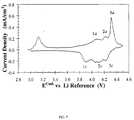
- FIG. 7 shows clearly the presence of the two peaks expected for the lithium extraction from LiMn 2 O 4 at 4.05 (1 a , and its inverse peak 1 c ; where a represents the anodic peak and c represents the cathodic peak) and 4.17V (2 a , 2 c ) and an additional reversible peak at 4.4V (3 a , 3 c ). These last peaks corresponds the oxidation and reduction of acetyl thianthrene.
Landscapes
- Chemical & Material Sciences (AREA)
- Engineering & Computer Science (AREA)
- Manufacturing & Machinery (AREA)
- Chemical Kinetics & Catalysis (AREA)
- Electrochemistry (AREA)
- General Chemical & Material Sciences (AREA)
- Physics & Mathematics (AREA)
- Condensed Matter Physics & Semiconductors (AREA)
- General Physics & Mathematics (AREA)
- Inorganic Chemistry (AREA)
- Secondary Cells (AREA)
- Battery Electrode And Active Subsutance (AREA)
Abstract
This invention features the use of redox reagents, dissolved in non-aqueous electolytes, to
provide overcharge protection for cells having lithium metal or lithium-ion negative electrodes
(anodes). In particular, the invention features the use of a class of compounds consisting of
thianthrene and its derivatives as redox shuttle reagents to provide overcharge protection.
Specific examples of this invention are thianthrene and 2,7-diacetyl thianthrene. One example of a
rechargeable battery in which 2,7-diacetyl thianthrene is used has carbon negative electrode
(anode) and spinel LiMn2O4 positive electrode (cathode).
Description
This invention was made with support from the Department of Energy under Contract DE-FC02-91CE50336
administered by the United States Advanced Battery Consortium. The consortium
and the U.S. Government have certain rights in this invention.
This invention relates to electrochemical cells and more particularly to improved non-aqueous
liquid and polymer electrolytes for cells incorporating alkali metal negative electrodes (anodes),
and especially lithium anodes or lithium-ion anodes. The improvement features the use of a new
lass of compounds as redox reagents, dissolved in non-aqueous electrolytes, to provide
overcharge protection.
The electrolyte solution is a crucial component in an ambient temperature secondary lithium cell.
A non-aqueous solvent or mixture of solvents which dissolves an appreciable amount of lithium
salts to form highly conducting solutions is desirable. The electrolyte should afford high
efficiency for cycling of the lithium or lithium-ion electrode, and exhibit good thermal stability up
to 70°C (the usual upper temperature limit for operation of ambient temperature batteries).
A highly desirable liquid electrolyte solution established for ambient temperature Li secondary
cells is described in U.S. Patent No. 4,489,145. It comprises a solution of LiAsF6 dissolved in a
mixed solvent of tetrahydrofuran (THF), 2-methyltetrahydrofuran (2-Me-THF), and 2-methylfuran
(2-Me-F). Other aprotic electrolytes have contained cyclic carbonates such as
propylene carbonate (PC) and ethylene carbonate (EC), and have been the subject of much study
in terms of both basic electrochemistry and battery applications for many years.
More recent developments have included the use of electrolytes based on polymers such as
polyacrylonitrile (PAN), poly(tetraethylene glycol diacrylate) (PEGDA), poly(vinyl) pyrrolidinone
(PVP), poly (vinyl chloride) (PVC), or poly(vinyl sulfone) (PVS). In these electrolytes the
polymers are matrices to immobilize complexes (solvates) formed between Li salts, such as
LiAsF6, LiCF3SO3, LiPF6, LiN(CF3SO2)2 and LiBF4, and an aprotic organic solvent (or mixture of
such solvents) to allow fabrication of free-standing electrolyte films to be used in solid-state Li
and Li-ion batteries (K.M. Abraham et al., U.S. Patents No. 5,219,679; 5,252,413; 5,457,860).
Unlike aqueous cells, non-aqueous electrolyte (organic electrolyte) cells may not be overcharged
without causing irreversible electrolyte side-reactions which deteriorate cell performance. Cells
are safe guarded during laboratory charge/discharge tests by careful control of the voltage limits
by means of the electronic equipment used the test. Electronic overcharge control comprises a
sensing circuit which prevents current from flowing into the cell once it reaches the voltage
corresponding to complete charge. The charge voltage limit is selected according to the
electrochemical couple in the cell. For example, Carbon/LiMn2O4 cells have an upper charge limit
of 4.3V vs. Li+/Li.
Chemical overcharge protection of a battery consisting of cells connected in series is particularly
important for two reasons. Firstly, it will replace electronic overcharge controllers in individual
cells. Electronic controllers lower the energy density of the battery and increase battery cost.
Secondly, they will provide capacity balance among the individual cells and prevent oxidative
degradation of the electrolyte. The capacity balance among the cells in a battery may be lost,
especially after repeated charge/disc cycles. This means that the accessible capacity of
individual cells may not remain equal. In this instance, the cathode of the cell with the lowest
capacity will be pushed above the normal upper voltage limit. Oxidative degradation of the
electrolyte will occur at these higher potentials, and this will degrade the cycle life of the battery
at an accelerated rate. Even if the electrolyte does not decompose, the weaker cell will contribute
a larger fraction of the total cutoff voltage for the battery causing the capacity of the cells in the
battery to become increasingly out of balance at each additional cycle, since the stronger cells will
not be charged to their full capacity. The result is a reduced cycle life for the battery as compared
to its individual cells.
A redox shuttle offers the best approach to cell overcharge protection. In this scheme, a material
with an appropriate oxidation potential is dissolved in the electrolyte where it remains unreactive
until the cell is charged fully. At a potential slightly above the cell charge limit (upper cutoff
voltage), the redox shuttle is activated by its electrochemical conversion. The cell potential
during overcharge is fixed at the oxidation potential of the redox shuttle. This process is
supported by diffusion of the oxidized products to the anode where they recombine to form the
starting material. Once the reformed material diffuses back to the cathode, it is oxidized and the
cathode potential is maintained indefinitely at the oxidation potential of the redox reagent, until
the time that charging is terminated.
Necessary properties of a redox shuttle include: high solubility in the electrolyte; an oxidation
potential slightly higher than the normal charge limit of the cell but lower than the oxidation
potential of the electolyte; the ability of the oxidized form to be reduced at the anode without
side reaction; and chemical stability in the cell of both the oxidized and reduced forms of the
shuttle reagent.
Accordingly, an object of this invention is the use of redox reagents to provide a means of
chemical overcharge protection to secondary non-aqueous liquid and polymer electolyte cells
with lithium or lithium-ion anodes.
The invention features a rechargeable electrochemical cell which includes an anode, a cathode,
and an electrolyte. The electolyte in a non-aqueous solvent or a mixture on non-aqueous solvents
which may or may not be immobilized in a polymer matrix, and in which one or more salts and the
redox reagent are dissolved. The redox reagent is ideally present in an amount sufficient to
maintain proper mass transport for the desired steady overcharge current for the cell.
In a preferred embodiment of the invention, thianthrenes (R) are used for the protection of lithium
and lithium-ion secondary cells from the effects of overcharge. Their activity is manifested
through the redox shuttle reactions depicted in Scheme I.
According to this scheme, R represents thianthrene (FIG. 1), or one of its derivatives such as 2,7-diacetyl
thianthrene (FIG. 2). R is added to the electolyte where it is available for a reversible
oxidation-reduction (redox) shuttle reaction. The electolyte may be a liquid solution with a
single solvent, such as propylene carbonate-1.0M LiPF6, or a mixed-solvent solution such as 50%
ethylene carbonate:50% propylene carbonate-1.0M LiPF6. Other embodiments of this invention
may have the liquid electrolyte immobilized into a polymer such as poly(acrylonitrile) (PAN),
poly(tetraethylene glycol diacrylate) (PEGDA), polyvinyl pyrrolidinone (PVP), poly(vinyl
chloride), poly(vinyl sulfone), poly(ethylene oxide) or poly(vinylidene fluoride) (PVdF) as
described in the aforementioned U.S. Patents pertaining to polymer electolytes.
The protective redox shuttle reaction is initiated when the cathode reaches the oxidation potential
of the redox reagent as in [1]. It proceeds with the diffusion of the oxidized species (R+) to the
anode where it is reformed as in [2]. The reaction is sustained by diffusion of the reformed
reagent back to the cathode. Judicious selection of the particular thianthrene will allow the
overcharge protection agent to be tailored to the appropriate cell voltage.
The redox potential of prospective shuttle candidates is determined readily from cyclic
voltammetry of glassy carbon microelectrodes in electrolyte containing the compound of interest.
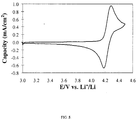
For example, a solution of 10 mM thianthrene, in 50% EC:50% PC-1.0M LiPF6, was tested at a
scan rate of 100 mV/s. FIG. 3 shows a symmetrical wave which is characteristic of a reversible
reaction with the peak oxidation current at 4.12V and the corresponding reduction (regeneration
of the starting material) at 4.06V vs. Li+/Li.
The redox potential of the insertion cathode determines the suitability of the protective agent.
FIG. 4 shows that Li is removed from LiMn2O4 in two stages, with peaks centered at 4.05V and
at 4.17V vs. Li+/Li. Consequently, although thianthrene exhibits the desired redox behavior, it is
not suitable for use in the C/LiMn2O4 cell since the activation of the redox shuttle would overlap
with the removal of lithium from the cathode. This would interfere with the cathode utilization so
that the cell would not charge fully.
In order to shift the redox potential to more positive values, it is necessary to modify the
thianthrene structure by replacing hydrogen atoms on the aromatic rings with electron
withdrawing groups. For this reason, thianthrene was derivatized by replacing hydrogen atoms in
the 2,7 positions with acetyl groups, according to a previously published procedure (S. Prema and
M. Srinivasan, Eur. Polym. J., 23, 897 (1987)). When this compound was tested under the same
conditions as thianthrene, the redox potential was found to have shifted to 4.3V for oxidation
and 4.2V for the subsequent reduction (FIG. 5). The redox potential ranges for the thianthrene
and the acetylized derivative compounds are given in Table 1.
| Redox Potential Ranges of Chemical Shuttle Reagents. | |
| Compound | Redox Potential Range (V vs. Li+/Li) |
| Thianthrene | 4.06-4.12 |
| 2,7-diacetyl Thianthrene | 4.19-4.30 |
Table 2 shows the current function (ia p/ν1/2, where ia is the peak current for the anodic peak
and ν is the scan rate) obtained for the oxidative and reductive peaks seen in the cyclic
voltammogram for 2,7-diacetyl thianthrene, along with the voltages for the anodic and cathodic
peaks (aEp and cEp respectively), the peak width (ΔaEp/2), and the peak separation (ΔaEp).
The peak width and the peak separation for a one-electron reaction can be predicted from the
Nernst equation according to equations [3] and [4] below:
Peak Width = Δa Ep/2 = a Ep - a Ep/2 = 2.20RT/nF = 0.0565/n @25°C Peak Separation = Δa Ep = a Ep - c Ep = 2.22RT/nF = 0.058/n @25°C
| Electrochemical Data for Cyclic Voltammetry of 2,7-Diacetyl Thianthrene at Different Sweep Rates. | |||||
| Sweep Rate ν (V/s) | Current Function ia p/ν1/2 A/(V/s)1/2 | Anodic Peak Voltage aEp (V) | Cathodic Peak Voltage cEp (V) | Peak Width ΔaEp/2 (V) | Peak Separation ΔaEp (V) |
| 0.001 | 1.897 x 10⁻⁴ | 4.255 | 4.205 | 0.055 | 0.050 |
| 0.005 | 1.824 x 10⁻⁴ | 4.258 | 4.200 | 0.053 | 0.058 |
| 0.010 | 1.820 x 10⁻⁴ | 4.260 | 4.200 | 0.055 | 0.060 |
| 0.020 | 1.789 x 10⁻⁴ | 4.260 | 4.200 | 0.055 | 0.060 |
| 0.050 | 1.766 x 10⁻⁴ | 4.260 | 4.200 | 0.055 | 0.060 |
The data in Table 2 were obtained from the cyclic voltammetry of 2,7-diacetyl thianthrene at
sweep rates of 1 mV/s to 50 mV/s, and they show close agreement between the experimental and
theoretical values for peal width and peak separation. This indicates that the redox of 2,7-diacetyl
thianthrene is a reverible reaction involving a one-electron transfer. The constancy of
the current function indicates that the redox reactions are diffusion controlled.
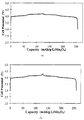
When Li/LiMn2O4 cells are cycled under constant current conditions, voltage profiles such as
those shown in FIG. 6 are obtained. In this instance, the upper charge limit was 4.2V for the first
cycle and 4.3V for the second cycle. The peaks observed in the cyclic voltammogram FIG. 4)
correspond to the plateaus in FIG. 6. Increasing the upper limit from 4.2V to 4.3V vs. Li+/Li
does not increase the available capacity significantly, nor does it jeopardize the integrity of the
electrolyte. Tests with similar cells for which the upper charge limit was increased progressively
to 5V vs. Li+/Li showed the electrolyte to be stable toward oxidation over this potential range.
Proper matching of the overcharge protection additive (shuttle) to the electrochemical couple
requires sufficient separation between the completion of lithium extraction from the cathode
reaction and the onset of the shuttle activation. For this reason, an ideal match for the LiMn2O4
cathode would probably involve a shuttle activated at potentials between 4.2 and 4.5V. This
would ensure complete cathode utililzation, yet be well within the voltage stability window of the
electrolyte.
In preferred embodiments, the redox shuttle is thianthrene (FIG. 1) or a derivative of thianthrene
such as 2,7-diacetyl thianthrene (FIG. 2), and the rechargeable cell is carbon/spinel LiMn2O4
containing a nonaqueous liquid electrolyte such as ethylene carbonaate/propylene carbonate-lithium
salt, or a nonaqueous polymer electolyte as described in U.S. Patents 4,857,423; 5,219,413;
5,252,413; and 5,474,860. The anode may be either disordered carbon or graphite. The
disordered carbon may be one obtained from the pyrolysis of petroleum coke, and known to those
skilled in the field as 'petroleum coke' or 'coke'. The graphite may have the usual flake
morphology, but may also be formed as graphite fibers or microtubules. The primary purpose of
the acetyl functional groups of diacetyl thianthrene is to shift the redox potential to a more
positive value. In a secondary role, functional groups may be added to promote solubility of the
derivatized compound in the electolyte. Other functional groups can be attached to thianthrene
to either increase or decrease its redox potential. Electron withdrawing substituents such as
acetyl, nitro and chloro groups are expected to increase the oxidation potential while electron
releasing substituents such as alkyl groups will decrease this potential.
We have discovered that thianthrene and its derivatives such as 2,7-diacetyl thianthrene useful
as overcharge protection additives for lithium or lithium-ion cells. The choice of a particular
redox reagent will vary with the cathode material used in a rechargeable Li or lithium-ion cell.
Thus, although the carbon/spinel LiMn2O4 couple is mentioned specifically, other cathodes such
as LiCoO2 or LiNiO2 might also be used.
Other features, objects and advantages will become apparent from the following specification
when read in connection with the accompanying drawings which show the principle involved and
the practical considerations in matching the cathode with the appropriate redox material.
Cyclic voltammetry was used to screen candidates for use as redox shuttle reagents for
overcharge protection in rechargeable Li or lithium-ion cells. Results of such experiments are
given in Table 1.
The requirement of the selection of a compound for use as a redox shuttle reagent for a given
positive electrode is that the oxidation potential of the shuttle reagent be slightly higher than the
full charge limit of the cell. In Li or lithium-ion cells with high voltage cathodes such as spinel
LiMn2O4, LiCoO2 or LiNiO2, oxidation of the redox reagent should take place after the full
capacity of the cathode has been accessed. For LiMn2O4 this means that the shuttle should be
activated at a potential above 4.2V vs. Li+/Li.
Substitution of acetyl groups for hydrogen atoms at the 2,7 positions in thianthrene resulted in a
shift of the redox potential to values more positive than those obtained with thianthrene.
The preferred electolytes are resistive to oxidation in this range. In particular, liquid electolytes
with ethylene carbonate (EC), propylene carbonate (PC), dipropyl carbonate (DPC), methyl ethyl
carbonate (MEC) and similar solvents or mixtures of solvents are known to those skilled in the art
as desirable electolytes for use with high voltage cathodes. Likewise, these solvents or mixtures
of solvents and the solvates which they form with lithium salts such as LiAsF6, LiPF6, LiClO4,
LiN(SO2CF3)2, LiC(SO2CF3)3, LiBF4, and lithium salts of organic acids such as trichloroacetic,
trifluoromethane sulfonic, and formic acids can be immobilized according to the teachings of the
patents by Abraham et al. cited above.
While the specific goal of this invention is the prevention of overcharge for cells incorporating
high voltage cathodes, the stability of the compound (thianthrene derivative) and the other
electolyte components at lower voltages allows its use with lower voltage cathodes also. Recent
developments in the area of lithium-ion cells have included work with two-phase mixtures,
notobly Li1+xMn2O4 which includes both spinel (4V) LiMn2O4 and tetragonal (3V) Li2Mn2O4.
During the initial activation of the cell, the 3V cathode capacity is available to compensate for
irreversible anode capacity. This low-voltage capacity is sacrificial, and is exhausted at the first
charge. Accordingly, to demonstrate the appropriateness of our invention with this most recent
cathode development, the example shows the usefulness of 2,7-diacetyl thianthrene in the
presence of Li1.5Mn2O4, which is a mixture of 0.5 mole of LiMn2O4 and 0.5 mole of Li2Mn2O4.
The cell used to demonstrate the invention conned a Li1.5Mn2O4 cathode, a solid polymer
electrolyte, and a carbon counter electrode. The cathode composition was 93.5% Li1.5Mn2O4:4%
carbon black:2.5% PAN containing the liquid electrolyte 50% EC:50% PC-1.0 M LiPF6, with 10
mM 2,7-diacetyl thianthrene. The carbon electrode comprised 97.5% petroleum coke:2.55 PAN
and the same liquid electrolyte. The solid polymer electrolyte film used as a separator between
the two electrodes had the composition 13.87% PAN:38.63% EC:38.63% PC:7.93%
LiPF6:0.93% 2,7-diacetyl thianthrene. Here % stands for percent by weight.
2,7-diacetyl thianthrene (DAcTH) was made by the method cited earlier, and used to prepare a
solid polymer electrolyte with the composition 13.87% PAN:38.63% EC:38.63% PC:0.93%
DAcTH:7.93% LiPF6. This electrolyte was passed between rollers to form a thin (5 mil) film and
used as a separator between the anode and cathode in a carbon/LiMn2O4 cell. The electrodes in
this cell were prepared by solvent casting from N-methylpyrollidinone. The cathode electrode
was 93.5% LiMn2O4:4% carbon black:2.5% PAN, while the anode electrode was 97.5%
petroleum coke:2.5% PAN. The current collector was aluminum foil for the cathode and copper
foil for the anode. Both electrodes were dried under vacuum at room temperature for 2 hours,
then hot-pressed at 130°C and 5,000 psig for 2 min. The electrodes were trimmed to size, and a
liquid electrolyte comprising 50% EC:50% PC-1.0M LiPF6, 10 mM 2,7-diacetyl thianthrene was
added to each electrode, with the excess allowed to drain away. The cell was assembled in a
metallized plastic bag which was heat-sealed at its periphery to prevent air and moisture
ingression.
This cell was tested under cyclic voltammetric conditions as per the cell described in FIG. 4 (20
µV/s, 4.5V upper limit). FIG. 7 shows clearly the presence of the two peaks expected for the
lithium extraction from LiMn2O4 at 4.05 (1a, and its inverse peak 1c; where a represents the
anodic peak and c represents the cathodic peak) and 4.17V (2a, 2c) and an additional reversible
peak at 4.4V (3a, 3c). These last peaks corresponds the oxidation and reduction of acetyl
thianthrene.
Claims (7)
- Electric current producing, rechargeable, electrochemical cell having an anode, a cathode and an electrolyte in contact with said anode and cathode, said electrolyte containing thianthrene or a derivative of thianthrene as a redox shuttle reagent to provide overcharge protection to the cell.
- Rechargeable cell according to claim 1 wherein said anode is Li and said cathode is LiMn2O4, LiCoO2, LiNiO2, LiV2O5, LiVS2, LiCr0.5V0.5S2, mixtures thereof or substantially similar oxides and sulfides.
- Rechargeable cell according to claim 1 wherein said anode is a Li insertion anode selected from carbon, metal alloys, metal oxides, metal sulfides and metal nitrides, and said cathode is LiMn2O4, LiCoO2, LiNiO2, LiV2O5, LiCr0.5V0.5S2, LiVS2 or mixtures thereof or substantially similar oxides and sulfides.
- Rechargeable cell according to claim 2 or 3 wherein said electrolyte comprises Li salt dissolved in an organic solvent or a solvent mixture selected from ethers, carbonates, esters, sulfones, ketones and lactones.
- Rechargeable cell according to claim 2 or 3 wherein said electrolyte comprises a polymer electrolyte composed of a Li salt, a polymer host and a plasticizer solvent.
- Rechargeable cell according to claim 5 wherein said Li salt is selected from LiPF6, LiAsF6, LiClO4, LiBF4, LiN(SO2CF3)2, LiC(SO2CF3)3, mixtures thereof or substantially similar salts; said polymer host is selected from polyacrylonitrile, poly(vinyl chloride), poly(vinyl pyrrolidinone), poly(vinyl sulfone), poly(vinylidine fluoride) or its copolymers, and poly(ethylene oxide) and said plasticizer solvent consists of an organic solvent selected from ethylene carbonate, dipropyl carbonate, dimethyl carbonate, diethyl carbonate, butyrolactone, N-methyl pyrrolidinone, sulfolane and mixtures thereof.
- Rechargeable cell according to claim 4 or 6 wherein the thianthrene derivative is 2,7-diacetyl thianthrene.
Applications Claiming Priority (2)
| Application Number | Priority Date | Filing Date | Title |
|---|---|---|---|
| US08/703,577 US5858573A (en) | 1996-08-23 | 1996-08-23 | Chemical overcharge protection of lithium and lithium-ion secondary batteries |
| US703577 | 1996-08-23 |
Publications (1)
| Publication Number | Publication Date |
|---|---|
| EP0825663A2 true EP0825663A2 (en) | 1998-02-25 |
Family
ID=24825938
Family Applications (1)
| Application Number | Title | Priority Date | Filing Date |
|---|---|---|---|
| EP97114457A Withdrawn EP0825663A2 (en) | 1996-08-23 | 1997-08-21 | Chemical overcharge protection of lithium and lithium-ion secondary batteries |
Country Status (2)
| Country | Link |
|---|---|
| US (1) | US5858573A (en) |
| EP (1) | EP0825663A2 (en) |
Cited By (8)
| Publication number | Priority date | Publication date | Assignee | Title |
|---|---|---|---|---|
| EP0936687A3 (en) * | 1998-01-30 | 1999-09-01 | Canon Kabushiki Kaisha | Lithium intercalating transition metal oxide, electrode structure, production processes thereof, and secondary lithium battery |
| WO2006124738A1 (en) * | 2005-05-17 | 2006-11-23 | 3M Innovative Properties Company | Substituted phenothiazine redox shuttles for rechargeable lithium-ion cell |
| US7648801B2 (en) | 2004-04-01 | 2010-01-19 | 3M Innovative Properties Company | Redox shuttle for overdischarge protection in rechargeable lithium-ion batteries |
| US7811710B2 (en) | 2004-04-01 | 2010-10-12 | 3M Innovative Properties Company | Redox shuttle for rechargeable lithium-ion cell |
| US8101302B2 (en) | 2008-02-12 | 2012-01-24 | 3M Innovative Properties Company | Redox shuttles for high voltage cathodes |
| EP2083468B1 (en) * | 2008-01-25 | 2012-04-25 | Byd Company Limited | Electrolyte for batteries and battery packs |
| EP3279223A1 (en) | 2016-08-05 | 2018-02-07 | Evonik Degussa GmbH | Use of polymers containing thianthrene as charge storage |
| WO2018024901A1 (en) | 2016-08-05 | 2018-02-08 | Evonik Degussa Gmbh | Use of thianthrene-containing polymers as a charge store |
Families Citing this family (51)
| Publication number | Priority date | Publication date | Assignee | Title |
|---|---|---|---|---|
| US7049029B2 (en) * | 2001-10-20 | 2006-05-23 | Samsung Sdi Co., Ltd. | Nonaqueous electrolyte composition for improving overcharge safety and lithium battery using the same |
| US6921612B2 (en) * | 2001-10-20 | 2005-07-26 | Samsung Sdi Co., Ltd. | Nonaqueous electrolyte composition for improving overcharge safety and lithium battery using the same |
| KR100428977B1 (en) * | 2001-11-24 | 2004-04-29 | 삼성에스디아이 주식회사 | Polymer electrolyte composition for improving overcharge safety and lithium battery using the same |
| US7968235B2 (en) * | 2003-07-17 | 2011-06-28 | Uchicago Argonne Llc | Long life lithium batteries with stabilized electrodes |
| US7498100B2 (en) * | 2003-08-08 | 2009-03-03 | 3M Innovative Properties Company | Multi-phase, silicon-containing electrode for a lithium-ion battery |
| US9012096B2 (en) * | 2004-05-28 | 2015-04-21 | Uchicago Argonne, Llc | Long life lithium batteries with stabilized electrodes |
| US20060046144A1 (en) * | 2004-09-01 | 2006-03-02 | 3M Innovative Properties Company | Anode composition for lithium ion battery |
| WO2006052313A1 (en) * | 2004-11-08 | 2006-05-18 | 3M Innovative Properties Company | Polyimide electrode binders |
| GB2437902B (en) * | 2005-03-02 | 2010-12-08 | Univ Chicago | Novel redox shuttles for overcharge protection of lithium batteries |
| US9184428B2 (en) * | 2005-03-15 | 2015-11-10 | Uchicago Argonne Llc | Non-aqueous electrolytes for lithium ion batteries |
| WO2006116251A2 (en) * | 2005-04-26 | 2006-11-02 | The University Of Chicago | Processes for making dense, spherical, active materials for lithium-ion cells |
| US7767349B2 (en) * | 2005-07-25 | 2010-08-03 | 3M Innovative Properties Company | Alloy compositions for lithium ion batteries |
| US7851085B2 (en) * | 2005-07-25 | 2010-12-14 | 3M Innovative Properties Company | Alloy compositions for lithium ion batteries |
| US7871727B2 (en) * | 2005-07-25 | 2011-01-18 | 3M Innovative Properties Company | Alloy composition for lithium ion batteries |
| CN101288200B (en) * | 2005-10-13 | 2012-04-18 | 3M创新有限公司 | How to use an electrochemical cell |
| US7906238B2 (en) * | 2005-12-23 | 2011-03-15 | 3M Innovative Properties Company | Silicon-containing alloys useful as electrodes for lithium-ion batteries |
| US7968231B2 (en) * | 2005-12-23 | 2011-06-28 | U Chicago Argonne, Llc | Electrode materials and lithium battery systems |
| US8367253B2 (en) * | 2006-02-02 | 2013-02-05 | U Chicago Argonne Llc | Lithium-ion batteries with intrinsic pulse overcharge protection |
| US20070269718A1 (en) * | 2006-05-22 | 2007-11-22 | 3M Innovative Properties Company | Electrode composition, method of making the same, and lithium ion battery including the same |
| EP1901388A1 (en) * | 2006-09-14 | 2008-03-19 | High Power Lithium S.A. | Overcharge and overdischarge protection in lithium-ion batteries |
| EP2067198A2 (en) | 2006-09-25 | 2009-06-10 | Board of Regents, The University of Texas System | Cation-substituted spinel oxide and oxyfluoride cathodes for lithium ion batteries |
| US7875388B2 (en) * | 2007-02-06 | 2011-01-25 | 3M Innovative Properties Company | Electrodes including polyacrylate binders and methods of making and using the same |
| US20080206631A1 (en) | 2007-02-27 | 2008-08-28 | 3M Innovative Properties Company | Electrolytes, electrode compositions and electrochemical cells made therefrom |
| US20080206641A1 (en) * | 2007-02-27 | 2008-08-28 | 3M Innovative Properties Company | Electrode compositions and electrodes made therefrom |
| US20090053589A1 (en) * | 2007-08-22 | 2009-02-26 | 3M Innovative Properties Company | Electrolytes, electrode compositions, and electrochemical cells made therefrom |
| US20080248386A1 (en) * | 2007-04-05 | 2008-10-09 | Obrovac Mark N | Electrodes with raised patterns |
| US20090111022A1 (en) * | 2007-10-24 | 2009-04-30 | 3M Innovative Properties Company | Electrode compositions and methods |
| US8277683B2 (en) * | 2008-05-30 | 2012-10-02 | Uchicago Argonne, Llc | Nano-sized structured layered positive electrode materials to enable high energy density and high rate capability lithium batteries |
| US8153301B2 (en) * | 2008-07-21 | 2012-04-10 | 3M Innovative Properties Company | Cathode compositions for lithium-ion electrochemical cells |
| US20100028784A1 (en) * | 2008-07-29 | 2010-02-04 | 3M Innovative Properties Company | Electrolyte composition, lithium-containing electrochemical cell, battery pack, and device including the same |
| US20100026240A1 (en) * | 2008-07-30 | 2010-02-04 | 3M Innovative Properties Company | Lithium ion battery pack charging system and device including the same |
| TWI411149B (en) * | 2008-12-31 | 2013-10-01 | Ind Tech Res Inst | Lithium battery and fabrication method thereof |
| US8137841B2 (en) * | 2009-08-31 | 2012-03-20 | 3M Innovative Properties Company | Cathode compositions for lithium-ion electrochemical cells |
| US20110183209A1 (en) | 2010-01-27 | 2011-07-28 | 3M Innovative Properties Company | High capacity lithium-ion electrochemical cells |
| EP2539956B1 (en) | 2010-05-25 | 2017-09-06 | UChicago Argonne, LLC | Polyether-functionalized redox shuttle additives for lithium ion batteries |
| US8968940B2 (en) | 2010-05-25 | 2015-03-03 | Uchicago Argonne, Llc | Redox shuttles for high voltage cathodes |
| US8877390B2 (en) | 2010-05-25 | 2014-11-04 | Uchicago Argonne, Llc | Redox shuttles for lithium ion batteries |
| US9761878B2 (en) | 2010-09-23 | 2017-09-12 | Robert Bosch Gmbh | Metal/oxygen battery with a clean surface for oxidizing redox additives |
| US9431660B2 (en) | 2010-09-23 | 2016-08-30 | Robert Bosch Gmbh | Lithium battery with charging redox couple |
| US20130330616A1 (en) | 2011-02-18 | 2013-12-12 | 3M Innovative Properties Company | Composite Particles, Methods of Making the Same, and Articles Including the Same |
| EP2719009B1 (en) | 2011-06-07 | 2017-06-21 | 3M Innovative Properties Company | Lithium-ion electrochemical cells including fluorocarbon electrolyte additives |
| US9601806B2 (en) | 2011-08-31 | 2017-03-21 | Uchicago Argonne, Llc | Redox shuttle additives for lithium-ion batteries |
| US8652672B2 (en) | 2012-03-15 | 2014-02-18 | Aquion Energy, Inc. | Large format electrochemical energy storage device housing and module |
| CN103427125B (en) * | 2012-05-15 | 2016-04-13 | 清华大学 | The round-robin method of sulfenyl polymer Li-ion battery |
| US8945756B2 (en) | 2012-12-12 | 2015-02-03 | Aquion Energy Inc. | Composite anode structure for aqueous electrolyte energy storage and device containing same |
| US9005822B2 (en) | 2013-03-06 | 2015-04-14 | Uchicago Argonne, Llc | Functional electrolyte for lithium-ion batteries |
| JP6778673B2 (en) * | 2017-11-22 | 2020-11-04 | 日本電信電話株式会社 | Lithium air secondary battery |
| KR102744303B1 (en) * | 2018-11-09 | 2024-12-18 | 삼성전자주식회사 | A polymer, composite positive active material comprising the same, and lithium secondary battery comprising the electrode including the positive active material |
| CN112467193B (en) * | 2021-01-28 | 2021-10-29 | 上海瑞浦青创新能源有限公司 | Safety lithium ion battery and preparation method thereof |
| CN113130999B (en) * | 2021-04-15 | 2023-08-29 | 东莞维科电池有限公司 | Lithium ion battery electrolyte and lithium ion battery |
| US12592382B2 (en) | 2022-10-11 | 2026-03-31 | Medtronic, Inc. | Electrochemical cells with lithium alloy anodes |
Family Cites Families (7)
| Publication number | Priority date | Publication date | Assignee | Title |
|---|---|---|---|---|
| US4489145A (en) * | 1983-10-18 | 1984-12-18 | Abraham Kuzhikalail M | Lithium battery |
| US5260145A (en) * | 1986-10-30 | 1993-11-09 | Hydro-Quebec | Production of organic cation radicals in an electrochemical cell |
| IT1218084B (en) * | 1988-06-16 | 1990-04-12 | Consiglio Nazionale Ricerche | CONDUCTIVE POLYMERS THAT CAN BE USED FOR THE REALIZATION OF COMPLETELY DRY BATTERIES |
| US5219679A (en) * | 1991-01-17 | 1993-06-15 | Eic Laboratories, Inc. | Solid electrolytes |
| US5252413A (en) * | 1992-04-07 | 1993-10-12 | Eic Laboratories, Inc. | Solid polymer electrolyte lithium batteries |
| FI95574C (en) * | 1994-02-16 | 1996-02-26 | Valtion Teknillinen | Electron-conducting molecular preparations |
| US5474860A (en) * | 1994-05-26 | 1995-12-12 | Eic Laboratories, Inc. | Solid polymer electrolytes |
-
1996
- 1996-08-23 US US08/703,577 patent/US5858573A/en not_active Expired - Fee Related
-
1997
- 1997-08-21 EP EP97114457A patent/EP0825663A2/en not_active Withdrawn
Cited By (11)
| Publication number | Priority date | Publication date | Assignee | Title |
|---|---|---|---|---|
| EP0936687A3 (en) * | 1998-01-30 | 1999-09-01 | Canon Kabushiki Kaisha | Lithium intercalating transition metal oxide, electrode structure, production processes thereof, and secondary lithium battery |
| US6932955B2 (en) | 1998-01-30 | 2005-08-23 | Canon Kabushiki Kaisha | Powder material, electrode structure, production processes thereof, and secondary lithium battery |
| US7648801B2 (en) | 2004-04-01 | 2010-01-19 | 3M Innovative Properties Company | Redox shuttle for overdischarge protection in rechargeable lithium-ion batteries |
| US7811710B2 (en) | 2004-04-01 | 2010-10-12 | 3M Innovative Properties Company | Redox shuttle for rechargeable lithium-ion cell |
| WO2006124738A1 (en) * | 2005-05-17 | 2006-11-23 | 3M Innovative Properties Company | Substituted phenothiazine redox shuttles for rechargeable lithium-ion cell |
| US7615312B2 (en) | 2005-05-17 | 2009-11-10 | 3M Innovative Properties Company | Substituted phenothiazine redox shuttles for rechargeable lithium-ion cell |
| EP2083468B1 (en) * | 2008-01-25 | 2012-04-25 | Byd Company Limited | Electrolyte for batteries and battery packs |
| US8101302B2 (en) | 2008-02-12 | 2012-01-24 | 3M Innovative Properties Company | Redox shuttles for high voltage cathodes |
| EP3279223A1 (en) | 2016-08-05 | 2018-02-07 | Evonik Degussa GmbH | Use of polymers containing thianthrene as charge storage |
| WO2018024901A1 (en) | 2016-08-05 | 2018-02-08 | Evonik Degussa Gmbh | Use of thianthrene-containing polymers as a charge store |
| US10608255B2 (en) | 2016-08-05 | 2020-03-31 | Evonik Operations Gmbh | Use of thianthrene-containing polymers as a charge store |
Also Published As
| Publication number | Publication date |
|---|---|
| US5858573A (en) | 1999-01-12 |
Similar Documents
| Publication | Publication Date | Title |
|---|---|---|
| US5858573A (en) | Chemical overcharge protection of lithium and lithium-ion secondary batteries | |
| EP3261164B1 (en) | Gel polymer electrolyte, method for preparing same, and electrochemical device comprising same | |
| EP2135320B1 (en) | Secondary battery comprising ternary eutectic mixtures and preparation method thereof | |
| CN101517809B (en) | Secondary battery containing eutectic mixture and preparation method thereof | |
| KR100573109B1 (en) | Organic electrolyte and lithium battery employing the same | |
| KR20000017619A (en) | Non-aqueous electrolyte battery | |
| KR20040065412A (en) | Organic electrolytic solution and lithium battery employing the same | |
| KR100528933B1 (en) | Organic electrolytic solution and lithium battery employing the same | |
| KR20010060192A (en) | Polymer electrolyte membrane for use in lithium batteries | |
| KR20180102666A (en) | An electrolyte solution, an anode, and a lithium-ion battery including the electrolyte solution and / | |
| KR100335222B1 (en) | Nonaqueous Electrolyte | |
| KR20060130441A (en) | Organic electrolyte and lithium battery employing the same | |
| KR101156537B1 (en) | Lithium polymer battery | |
| JP3974012B2 (en) | Electrolytes for electrochemical devices, electrolytes or solid electrolytes thereof, and batteries | |
| JP4076738B2 (en) | Lithium battery and electrolyte for lithium ion battery, electrolyte solution or solid electrolyte thereof, and lithium battery or lithium ion battery | |
| US20150099165A1 (en) | Electrolyte additive for a lithium-based energy storage device | |
| US7442471B1 (en) | Solvent systems comprising a mixture of lactams and esters for non-aqueous electrolytes and non-aqueous electrolyte cells comprising the same | |
| KR100459882B1 (en) | Non-aqueous electrolytes for lithium rechargeable battery and lithium rechargeable battery using the same | |
| JP4076748B2 (en) | Lithium battery and electrolyte for lithium ion battery, electrolyte solution or solid electrolyte thereof, and lithium battery or lithium ion battery | |
| US20250300223A1 (en) | Composition for gel polymer electrolyte, gel polymer electrolyte and electrochemical device comprising the same | |
| JP3730856B2 (en) | Electrolytes for electrochemical devices, electrolytes or solid electrolytes thereof, and batteries | |
| KR100810680B1 (en) | Non-aqueous electrolyte solution for high voltage lithium secondary battery of 4.4V or higher and lithium secondary battery comprising same | |
| KR101645529B1 (en) | Electrolyte comprising amide and ester and electrochemical device containing the same | |
| KR100440932B1 (en) | Electrolytes for lithium rechargeable battery | |
| KR20070103919A (en) | Non-aqueous electrolyte solution for high voltage lithium secondary battery of 4.4V or higher and lithium secondary battery comprising same |
Legal Events
| Date | Code | Title | Description |
|---|---|---|---|
| PUAI | Public reference made under article 153(3) epc to a published international application that has entered the european phase |
Free format text: ORIGINAL CODE: 0009012 |
|
| AK | Designated contracting states |
Kind code of ref document: A2 Designated state(s): AT BE CH DE DK ES FI FR GB GR IE IT LI LU MC NL PT SE |
|
| STAA | Information on the status of an ep patent application or granted ep patent |
Free format text: STATUS: THE APPLICATION IS DEEMED TO BE WITHDRAWN |
|
| 18D | Application deemed to be withdrawn |
Effective date: 20000407 |