EP0825744A2 - QADM mit Phasenverschachtelung - Google Patents
QADM mit Phasenverschachtelung Download PDFInfo
- Publication number
- EP0825744A2 EP0825744A2 EP97114296A EP97114296A EP0825744A2 EP 0825744 A2 EP0825744 A2 EP 0825744A2 EP 97114296 A EP97114296 A EP 97114296A EP 97114296 A EP97114296 A EP 97114296A EP 0825744 A2 EP0825744 A2 EP 0825744A2
- Authority
- EP
- European Patent Office
- Prior art keywords
- complex
- signal
- real
- audio
- qadm
- Prior art date
- Legal status (The legal status is an assumption and is not a legal conclusion. Google has not performed a legal analysis and makes no representation as to the accuracy of the status listed.)
- Withdrawn
Links
Images





Classifications
-
- H—ELECTRICITY
- H04—ELECTRIC COMMUNICATION TECHNIQUE
- H04L—TRANSMISSION OF DIGITAL INFORMATION, e.g. TELEGRAPHIC COMMUNICATION
- H04L27/00—Modulated-carrier systems
- H04L27/32—Carrier systems characterised by combinations of two or more of the types covered by groups H04L27/02, H04L27/10, H04L27/18 or H04L27/26
- H04L27/34—Amplitude- and phase-modulated carrier systems, e.g. quadrature-amplitude modulated carrier systems
- H04L27/345—Modifications of the signal space to allow the transmission of additional information
- H04L27/3461—Modifications of the signal space to allow the transmission of additional information in order to transmit a subchannel
- H04L27/3483—Modifications of the signal space to allow the transmission of additional information in order to transmit a subchannel using a modulation of the constellation points
Definitions
- the present invention relates to multimedia communications over the General Switched Telephone Network (GSTN) using high-speed modems and more particularly relates to the modems for simultaneous audio and data transmission using QADM ( Quadrature Audio/Data Modulation ).
- GSTN General Switched Telephone Network
- QADM Quadrature Audio/Data Modulation
- the basic QADM technology has been proposed to the International Telecommunications Union ( ITU ) since 1994 for simultaneous transmission of voice-band audio signals and data over the GSTN. Until its introduction, the only viable method for simultaneous audio and data was to couple three separate technologies: some speech coder, some data multiplexer and some data modem. As proposed and subsequently implemented, the technology uses an extension of echo canceled quadrature amplitude modulation ( QAM ) techniques and is compatible with existing data interfaces, startup procedures, data compressions, and applications software.
- QAM quadrature amplitude modulation
- QADM is a simple and useful technique for transmitting simultaneous audio and data.
- it since it adds the audio component to the data signal as part of the modulation procedure, its presence will affect the performance of the remote receiver. Therefore, care must be taken to avoid any adverse effects.
- a brief introduction to QADM is desirable.
- an audio component is transmitted to a receiving modem using the baseband data signal as a carrier .
- the audio component will appear as additive noise, which will be ignored in the decoding procedure.
- the audio decoder will then retrieve the audio signal from the baseband receiver noise , or decision error.
- a sampled analog signal can be transmitted in-band with a data signal, and be received with channel impairments such as attenuation and frequency distortion removed.
- an audio signal would be sampled at twice the symbol rate of the data transmission. Then for each data symbol in the complex baseband, two independent samples of audio may be added. However, significant gains in quality may be achieved by segmenting the audio signal into frames, and normalize and decorrelate the audio signal in each frame. Thus information on scaling and correlation in the signal is transmitted separately in digital form as side-information, and the residual signal can better take advantage of its channel by approaching maximum information content per transmitted energy.
- a typical QADM system is shown in Figure 1 .
- the input audio signal 101 is segmented into frames of size 10-30 ms each. Each frame of audio is analyzed and processed to remove correlation (for instance by linear predictive methods) and then scaled to a maximum amplitude.
- the correlation information and scale values 104 are multiplexed 103 with the input data bits 102 and transmitted as normal data.
- the scaled and decorrelated audio signal is converted to a complex signal 105, either by frequency translation to 0 Hz and filtering to make it a complex baseband signal, or simply by taking even samples to be the real part and odd samples to be the imaginary part.
- the complex audio signal 105 is added 106 to the complex output of the data-signal mapper 107.
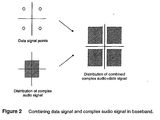
- the combined signal 108 will then become what is shown in Figure 2 .
- the combined signal is then modulated 109 as a regular data signal 110.
- the received signal 121 is first demodulated and equalized 122, and a signal point quantizing (slicing) is performed.
- the quantized signal is decoded 123 into data bits, which are then demultiplexed 124 to separate the data bits 125 from the side-information bits 126.
- the difference between the signal before and after quantizing is calculated. This is normally the quantizing error 127 in data-only transmission. In QADM, this is the received audio component in addition to channel noise.
- the received audio component is re-scaled and re-correlated, to yield an output audio signal 129.
- the audio component of a QADM signal will appear as noise at the data receiver.
- the signal (data signal) power is high enough relative to the noise (QADM signal) power, no data errors will occur and the audio will be decoded correctly.
- the signal coding normally assumes the noise is composed of Gaussian-distributed independent noise samples. It is further assumed that the noise signal does not affect receiver demodulation functions, such as gain control, timing and carrier recovery loops and equalization. Certain types of audio signals will, however, violate these assumptions and hence cause greater degradation than equivalent degrees of random noise.
- the audio encoding functions at the transmitter side will remove most of the correlation in the audio signal.
- the quantizing of the encoding parameters e.g. LPC coefficients
- This can cause enough regularity in the signal that the receiver may find a false demodulation state giving less error than the correct state.
- An example is in V.61-type QADM modulation, where a tone at the audio demodulation frequency gets mapped to 2 points, in essence creating a fixed constellation with twice the number of points as the data-only constellation. Then, two points corresponding to different data points can become closer to each other than the two points corresponding to a single data point, as shown in Figure 5 .
- This effect can cause a severe breakdown of the receiver. Apart from this effect, correlated signals can cause biases in various adaptive receiver functions.
- An audio processor for converting an input audio signal to complex audio samples for QADM processing by a modem for communication with a remote modem.
- the audio process comprises a decorrelator for processing the input audio to generate a residual signal, an adaptive scaler for adaptively scaling the long-term residual signal to generate a scaled residual signal, a randomizer for phase-randomizing the scaled residual signal to generate a complex signal with randomized phases, and a limiter for limiting the complex signal with randomized phases, such that the complex signal is transmitted by the modem to a remote modem.
- a solution in accordance with the present invention to the aforementioned problem is to add a random phase rotation of the audio component in the baseband. This results in a more uniform distribution around the original data point independent of the audio signal, and in almost all cases, at no cost.
- phase rotation has certain characteristics that would be produced if the phase rotation were actually randomly selected as independent samples of a uniform distribution. In practical implementations, it may suffice to select a finite sequence of phases and repeat it continuously. Thus the sequence is actually predetermined and fixed, but can be reasonably assumed to have been selected from an actual random sequence, and would be considered a typical sample thus selected. The important characteristic is that the gains that would be observed with a truly random sequence are preserved with this pseudo-random sequence.
- the solution in accordance with the present invention involves modifying the QADM audio processing as follows: a linear predictive coding unit 305 (short-term decorrelation), a pitch prediction unit 310 (long-term decorrelation), an adaptive scaling unit 315, a real-to-complex converter 316, a phase randomizer unit 320 and a limiter 325 as shown in Figure 3(a) .
- the real-to-complex converter 316 is also called a 1D-to-2D router in the draft specifications for the V.34Q specifications.
- the short-term decorrelation and long-term decorrelation units are sometimes simply referred to as one decorrelation unit.
- the audio processing should comprise a de-randomizer unit, a complex-to-real converter 352, an adaptive unscaling unit 355, a pitch prediction unit 360 (long-term recorrelation) and a linear predictive coding unit 365 (short-term recorrelation) before the reconstructed output audio signal is generated 370 as shown in Figure 3 (b).
- V.61 An alternative configuration for V.61 is shown in Figures 3(c) and 3(d) .
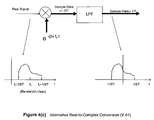
- the real-to-complex conversion is implicitly performed with a frequency shift from passband to baseband.
- the output signal is at a sample rate greater than or equal to 2/T, typically 3/T, where 1/T is the symbol rate of the modem data signal.
- the signal spectrum in the range (f c -1/2T) to (f c + 1/2T), where f c is a suitably chosen center frequency, is shifted to the range -1/2T to 1/2T, then low-pass filtered to produce a complex baseband signal with sample rate 1/T as shown in Figure 4(c) .
- Figure 4(d) shows the corresponding receiver operation, where the baseband signal is interpolated to a sample rate greater than or equal to 2/T, typically 3/T, then shifted in frequency to the range of (f c - 1/2T) to (f c + 1/2T).
- a randomized phase rotation would be applied to the signals between this real-to-complex conversion and the scaling operation (as shown in Figure 3(c) ).
- the receiver un-rotation would be applied to the signals between the inverse scaling and complex-to-real conversion.
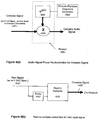
- Figure 4(a) illustrates a simplified block diagram for the phase randomization methodology.
- a complex sample 421 whether it is the complex signal as in V.61 or the complex signal after the real-to-complex converter 316 as in V.34Q, is multiplied by a signal 440 characterized by e j ⁇ (k) , where ⁇ (k) is the pseudo-random phase sequence.
- the pseudo-random phase sequence 450 may be a predetermined sequence of some kind, or generated using a pseudo-random bit generator.
- a simple method of accomplishing the goals of the phase randomization is to base the randomization on a pseudo-random binary sequence, where a 0 would cause no rotation, and a 1 causes a (90 + x) degree rotation, where x is a number between 5 and 40 degrees.
- the 90 degree component would distribute the points around the circumference, whereas the x would fill in the gaps .
- a 2-bit sequence could also be used, but then it is just as good to use the whole content of a n-bit register that generates a pseudo-random binary sequence to multiply a phase of 2 ⁇ /2 n .
- a shift register normally used to generate a binary pseudo-random sequence of length 127 can be used to generate a sequence of up to 64 different random phases. Only the first half of the sequence should be used since there is some loss of randomness when the shift register builds back to the all-1 state.
- the 2-dimensional audio component is thus rotated by ⁇ ( k ). In the receiver, the opposite rotation is performed based on the same sequence.
- the phase sequence ⁇ ( k ) may also be chosen to do an encryption mapping on the audio signals.
- the transmitter and the receiver can mutually agree, according to methods well known in the art, on a bit sequence based on prior information or exchange of encryption keys.
- the encryption method could be used to encode a sequence of 1's, and the output used to modify a regular pseudo-random sequence.
- seven bits could be taken from the encryption sequence and exclusive-OR'd with each phase value to produce a pseudo-random encrypted phase sequence.
Landscapes
- Engineering & Computer Science (AREA)
- Computer Networks & Wireless Communication (AREA)
- Signal Processing (AREA)
- Digital Transmission Methods That Use Modulated Carrier Waves (AREA)
- Transmission Systems Not Characterized By The Medium Used For Transmission (AREA)
- Telephonic Communication Services (AREA)
- Reduction Or Emphasis Of Bandwidth Of Signals (AREA)
Applications Claiming Priority (2)
| Application Number | Priority Date | Filing Date | Title |
|---|---|---|---|
| US08/699,269 US5742679A (en) | 1996-08-19 | 1996-08-19 | Optimized simultaneous audio and data transmission using QADM with phase randomization |
| US699269 | 1996-08-19 |
Publications (2)
| Publication Number | Publication Date |
|---|---|
| EP0825744A2 true EP0825744A2 (de) | 1998-02-25 |
| EP0825744A3 EP0825744A3 (de) | 2001-04-04 |
Family
ID=24808592
Family Applications (1)
| Application Number | Title | Priority Date | Filing Date |
|---|---|---|---|
| EP97114296A Withdrawn EP0825744A3 (de) | 1996-08-19 | 1997-08-19 | QADM mit Phasenverschachtelung |
Country Status (3)
| Country | Link |
|---|---|
| US (1) | US5742679A (de) |
| EP (1) | EP0825744A3 (de) |
| JP (1) | JPH10107864A (de) |
Cited By (3)
| Publication number | Priority date | Publication date | Assignee | Title |
|---|---|---|---|---|
| US6233275B1 (en) | 1994-12-09 | 2001-05-15 | Brent Townshend | High speed communications system for analog subscriber connections |
| US6233284B1 (en) | 1994-12-09 | 2001-05-15 | Brent Townshend | High speed communications system for analog subscriber connections |
| US6690749B2 (en) | 1994-12-09 | 2004-02-10 | Brent Townshend | High speed encoding and decoding apparatus and method for analog subscriber connections |
Families Citing this family (7)
| Publication number | Priority date | Publication date | Assignee | Title |
|---|---|---|---|---|
| US6005640A (en) * | 1996-09-27 | 1999-12-21 | Sarnoff Corporation | Multiple modulation format television signal receiver system |
| US6097753A (en) * | 1997-09-23 | 2000-08-01 | Paradyne Corporation | System and method for simultaneous voice and data with adaptive gain based on short term audio energy |
| US6961369B1 (en) * | 1999-11-09 | 2005-11-01 | Aware, Inc. | System and method for scrambling the phase of the carriers in a multicarrier communications system |
| US6961431B2 (en) * | 2001-02-28 | 2005-11-01 | Lockheed Martin Corp. | Analog privacy scrambler and scrambling method |
| US7143028B2 (en) * | 2002-07-24 | 2006-11-28 | Applied Minds, Inc. | Method and system for masking speech |
| ATE448638T1 (de) * | 2006-04-13 | 2009-11-15 | Fraunhofer Ges Forschung | Audiosignaldekorrelator |
| US20080207253A1 (en) * | 2007-02-27 | 2008-08-28 | Nokia Corporation | Multiradio management through quality level control |
Family Cites Families (5)
| Publication number | Priority date | Publication date | Assignee | Title |
|---|---|---|---|---|
| US3936828A (en) * | 1972-12-22 | 1976-02-03 | Communications Components Corporation | VLF navigation system |
| US5172118A (en) * | 1980-12-29 | 1992-12-15 | Raytheon Company | All weather tactical strike system (AWISS) and method of operation |
| US4456862A (en) * | 1982-09-22 | 1984-06-26 | General Dynamics, Pomona Division | Augmented proportional navigation in second order predictive scheme |
| US4754481A (en) * | 1985-06-24 | 1988-06-28 | Atlantic Telephone And Telegraph Company, At&T Bell Laboratories | Expanded partial response processing for analog signal enciphering and the like |
| US5448555A (en) * | 1993-06-14 | 1995-09-05 | At&T Corp. | Simultaneous analog and digital communication |
-
1996
- 1996-08-19 US US08/699,269 patent/US5742679A/en not_active Expired - Lifetime
-
1997
- 1997-08-18 JP JP9221559A patent/JPH10107864A/ja not_active Withdrawn
- 1997-08-19 EP EP97114296A patent/EP0825744A3/de not_active Withdrawn
Non-Patent Citations (1)
| Title |
|---|
| "Simultaneous voice and data technology", ATG'S COMMUNICATIONS TECHNOLOGY GUIDE SERIES, 1 January 1996 (1996-01-01), XP000863842, Retrieved from the Internet <URL:http://www.ies.net/Internet%20Telephony/Reading%20Material/voice%20&%20data.pdf> * |
Cited By (3)
| Publication number | Priority date | Publication date | Assignee | Title |
|---|---|---|---|---|
| US6233275B1 (en) | 1994-12-09 | 2001-05-15 | Brent Townshend | High speed communications system for analog subscriber connections |
| US6233284B1 (en) | 1994-12-09 | 2001-05-15 | Brent Townshend | High speed communications system for analog subscriber connections |
| US6690749B2 (en) | 1994-12-09 | 2004-02-10 | Brent Townshend | High speed encoding and decoding apparatus and method for analog subscriber connections |
Also Published As
| Publication number | Publication date |
|---|---|
| JPH10107864A (ja) | 1998-04-24 |
| US5742679A (en) | 1998-04-21 |
| EP0825744A3 (de) | 2001-04-04 |
Similar Documents
| Publication | Publication Date | Title |
|---|---|---|
| US5995539A (en) | Method and apparatus for signal transmission and reception | |
| KR100894194B1 (ko) | 모뎀 수신기에서의 비선형적인 왜곡 보상 | |
| US5367516A (en) | Method and apparatus for signal transmission and reception | |
| US4972474A (en) | Integer encryptor | |
| US20040240588A1 (en) | Compensation for non-linear distortion in a modem receiver | |
| US5742679A (en) | Optimized simultaneous audio and data transmission using QADM with phase randomization | |
| WO2006009583A2 (en) | Apparatus for wavelet modulation by adaptive filter bank | |
| US4754481A (en) | Expanded partial response processing for analog signal enciphering and the like | |
| US20030152155A1 (en) | Discrete multitone transmission and reception | |
| Kalet et al. | The capacity of PCM voiceband channels | |
| Fuldseth et al. | Robust subband video coding with leaky prediction | |
| US6901107B1 (en) | Systems, methods, and computer program products for generating a digital impairment learning signal having low energy content at direct current and Nyquist frequencies | |
| JP3069335B2 (ja) | マルチメディア多重伝送方法 | |
| JP3069333B2 (ja) | マルチメディア多重受信方法及び装置 | |
| JP3069334B2 (ja) | マルチメディア多重伝送方法及び装置 | |
| JP3069331B2 (ja) | マルチメディア多重伝送方法及び装置 | |
| JP3069332B2 (ja) | マルチメディア多重伝送方法及び装置 | |
| Khaliluzzaman et al. | Analyzing image transmission quality using filter and C-QAM | |
| Lervik et al. | A new approach to objective evaluation of power-and bandwidth-limited integrated communication systems | |
| PROAKIS | Signal Processing in Communications | |
| DAEIBAL et al. | Low Power Image Transmission using HUFFMAN & SPIHT Encoding over OFDM Channel | |
| JP2000307671A (ja) | マルチメディア多重伝送装置 |
Legal Events
| Date | Code | Title | Description |
|---|---|---|---|
| PUAI | Public reference made under article 153(3) epc to a published international application that has entered the european phase |
Free format text: ORIGINAL CODE: 0009012 |
|
| AK | Designated contracting states |
Kind code of ref document: A2 Designated state(s): DE FR GB |
|
| PUAL | Search report despatched |
Free format text: ORIGINAL CODE: 0009013 |
|
| AK | Designated contracting states |
Kind code of ref document: A3 Designated state(s): AT BE CH DE DK ES FI FR GB GR IE IT LI LU MC NL PT SE |
|
| 17P | Request for examination filed |
Effective date: 20011002 |
|
| AKX | Designation fees paid |
Free format text: DE FR GB |
|
| RAP1 | Party data changed (applicant data changed or rights of an application transferred) |
Owner name: CONEXANT SYSTEMS, INC. |
|
| STAA | Information on the status of an ep patent application or granted ep patent |
Free format text: STATUS: THE APPLICATION HAS BEEN WITHDRAWN |
|
| 18W | Application withdrawn |
Effective date: 20060317 |