EP0826964A2 - Bestimmung von Proteinen - Google Patents
Bestimmung von Proteinen Download PDFInfo
- Publication number
- EP0826964A2 EP0826964A2 EP97402023A EP97402023A EP0826964A2 EP 0826964 A2 EP0826964 A2 EP 0826964A2 EP 97402023 A EP97402023 A EP 97402023A EP 97402023 A EP97402023 A EP 97402023A EP 0826964 A2 EP0826964 A2 EP 0826964A2
- Authority
- EP
- European Patent Office
- Prior art keywords
- protein
- marker
- proteins
- amount
- molecular weight
- Prior art date
- Legal status (The legal status is an assumption and is not a legal conclusion. Google has not performed a legal analysis and makes no representation as to the accuracy of the status listed.)
- Granted
Links
Images


Classifications
-
- G—PHYSICS
- G01—MEASURING; TESTING
- G01N—INVESTIGATING OR ANALYSING MATERIALS BY DETERMINING THEIR CHEMICAL OR PHYSICAL PROPERTIES
- G01N33/00—Investigating or analysing materials by specific methods not covered by groups G01N1/00 - G01N31/00
- G01N33/48—Biological material, e.g. blood, urine; Haemocytometers
- G01N33/50—Chemical analysis of biological material, e.g. blood, urine; Testing involving biospecific ligand binding methods; Immunological testing
- G01N33/68—Chemical analysis of biological material, e.g. blood, urine; Testing involving biospecific ligand binding methods; Immunological testing involving proteins, peptides or amino acids
- G01N33/6803—General methods of protein analysis not limited to specific proteins or families of proteins
Definitions
- the present invention relates to a system in which a target protein to be analyzed is determined for its molecular weight (type) and amount (amount of the protein) simultaneously and easily by use of a marker.
- the present invention plays an important part in fields such as biochemistry, clinical chemistry and analytical chemistry.
- SDS-polyacrylamide gel electrophoresis SDS-polyacrylamide gel electrophoresis
- the density of a band is proportional to the amount of a charged protein in SDS-PAGE, so it is tentatively possible to estimate the concentration of a target protein in a sample by charging different lanes with a changing amount of a protein of known amount for comparison of density.
- a conventionally used marker protein was inappropriate for the estimation of the amount of the target protein because such protein was a mixture of various proteins with variability in stainability among their respective bands.
- all bands of the marker proteins were regulated to exhibit a constant density or a specific band was regulated to be darker as a mark. Therefore, it was necessary to charge and electrophorese different amounts of proteins on plural lanes in order to quantify a sample protein.
- the object of the present invention is to solve the problem of the prior art.
- the present inventors developed a new marker and made the present invention with the aim of developing a novel measurement system in which a calibration protein curve can be prepared from a staining pattern of said marker in 1 lane after regulation of the ratio in amount of the respective marker proteins having different molecular weights.
- the present invention was completed at last as a result of extensive research to achieve said object, and it relates to a method in which a target protein is determined for its molecular weight (type) and content (amount of the protein) simultaneously and very easily by simultaneous electrophoresis of the marker and a sample containing a target protein to be analyzed.
- the present invention embraces, as a fundamental technical concept, a method of determining the molecular weight (type) and/or the amount (content) of a target protein wherein a marker consisting of proteins having different molecular weights and being regulated at the same or different amounts is electrophoresed simultaneously with a sample containing a target protein to be analyzed (a mixture containing a single protein or a plural number of proteins) and then stained, and the densities of the bands are compared with one another visually or with a densitometer.
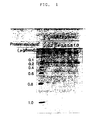
- FIG. 1 is a photograph of a stained gel after SDS-polyacrylamide gel electrophoresis of a protein standard (molecular weight marker) and BSA.
- FIG. 2 is a densitogram showing the result of the analysis of the protein standard lane in FIG. 1 in a densitometer.
- FIG. 3 is a protein calibration curve prepared on the basis of the results in FIGS. 1 and 2.
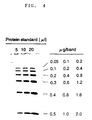
- FIG. 4 is a photograph of a stained gel after SDS-polyacrylamide gel electrophoresis of the protein standard charged in different amounts.
- a marker consisting of proteins having different molecular weights and being regulated at the same or different amounts is widely used as the marker of the present invention.
- Preferable marker proteins are separated from one another in electrophoresis to form individual sharp zones with uniform and excellent stainability.
- the marker in the present invention is dissolved in a suitable liquid, e.g., buffer and used for electrophresis.
- Such a preferable marker includes a molecular weight marker.
- marker proteins are a protein comprising a domain(s) selected from the group consisting of domains E, D, A, B and C of protein A, a protein comprising a domain(s) selected from the group consisting of domains C 1 , C 2 and C 3 of protein G and a protein comprising a domain(s) selected from the the group of domains of other IgG-binding protein (e.g. protein M).
- Such molecular weight marker proteins can be produced by genetic engineering means as described in Japanese Patent No. 2519136, and for example, the following marker can be obtained:
- a molecular weight marker consisting of at least two IgG-binding artificial proteins each comprising one or more iterations of a unit comprising one or more IgG-binding domains selected from the group consisting of domains A, B, C, D, and E of protein A"; the IgG-binding domains mean domains capable of bonding to IgG.
- gel staining e.g. dye staining and silver staining
- the molecular weight and protein amount as desired can be arbitrarily regulated by selecting the type and mixing ratio of the constituent marker proteins.
- the necessary data for preparing a calibration curve are obtained by electrophoresing the molecular weight marker in only 1 lane. Because the amount of a protein is proportional to the density of its band, the amount of the protein can visually be estimated approximately or can be determined using a calibration curve and further accurately with a densitometer.
- a molecular weight marker composed of proteins with different molecular weights and regulated at different amounts is prepared by mixing e.g. pA(AB) 1 to pA(AB) 6 in amounts of 1.0, 0.8, 0.6, 0.4, 0.2 and 0.1 ⁇ g respectively.
- the measurement kit according to the present invention contains such a molecular weight marker, and the measurement kit may further contain a set of a buffer, a coloring agent, other necessary reagent etc. as necessary.
- the molecular weight marker thus prepared is electrophoresed simultaneously with a sample containing a target protein to be analyzed (which can be analyzed whether it contains a single protein or a plural number of proteins) and then stained, and the band of each marker protein in the lane of the molecular weight marker is compared with the position and/or density of each band in the sample lane, whereby the molecular weight (type) and/or the amount (content or concentration) of the target protein is determined.
- the present invention is epoch-making in that it enables quantification of a protein in a sample by the density of the band and simultaneous estimation of its type by the position of the band.
- the target protein can be measured or estimated visually though approximately in the case of hurry or with a densitometer for more accurate measurement, so the measurement can be effected as necessary.
- the present invention is superior in that not only a single protein but also a mixture of various proteins can be determined all at once.
- a marker consisting of pA(AB) 6 (M.W. 81,807), pA(AB) 5 (M. W. 68,406), pA(AB) 4 (M.W. 55,004), pA(AB) 3 (M.W. 41,603), pA(AB) 2 (M.W. 28,201) and pA(AB) 1 (M.W.
- a protein in a sample can be determined for its molecular weight (or type: e.g. BSA) by use of the position of the band as well as for its amount (or concentration) by use of the density of the band.
- molecular weight or type: e.g. BSA
- the molecular weight or amount of each protein in an unknown sample not only the molecular weight or amount of each protein in an unknown sample, but also both the molecular weight and amount of each protein can be determined simultaneously by means of the marker such as the molecular weight marker.
- the molecular weight and protein amount desired can be regulated arbitrarily by selecting the type and mixing ratio of constituent marker proteins.
- the necessary data for preparing a calibration curve is obtained by electrophoresing the molecular weight marker in only 1 lane, and the amount of the charged protein is proportional to the density of its band, so the amount of the protein can be estimated approximately by visual examination or determined using the calibration curve.
- the present invention further provides a marker such as a molecular weight marker etc. for practicing this method and a measurement kit containing the necessary reagents.
- the protein in the unknown sample can be determined for its type (molecular weight) and its concentration (amount) simultaneously by visually examining the position and density of its stained band or with a densitometer for more accurate measurement.
Landscapes
- Life Sciences & Earth Sciences (AREA)
- Health & Medical Sciences (AREA)
- Engineering & Computer Science (AREA)
- Molecular Biology (AREA)
- Hematology (AREA)
- Chemical & Material Sciences (AREA)
- Urology & Nephrology (AREA)
- Physics & Mathematics (AREA)
- Immunology (AREA)
- Biomedical Technology (AREA)
- Biophysics (AREA)
- Analytical Chemistry (AREA)
- Biotechnology (AREA)
- Proteomics, Peptides & Aminoacids (AREA)
- Microbiology (AREA)
- Bioinformatics & Computational Biology (AREA)
- Bioinformatics & Cheminformatics (AREA)
- Food Science & Technology (AREA)
- Medicinal Chemistry (AREA)
- Cell Biology (AREA)
- Biochemistry (AREA)
- General Health & Medical Sciences (AREA)
- General Physics & Mathematics (AREA)
- Pathology (AREA)
- Investigating Or Analysing Biological Materials (AREA)
- Peptides Or Proteins (AREA)
- Investigating Or Analysing Materials By Optical Means (AREA)
Applications Claiming Priority (3)
| Application Number | Priority Date | Filing Date | Title |
|---|---|---|---|
| JP246859/96 | 1996-08-30 | ||
| JP8246859A JPH1073569A (ja) | 1996-08-30 | 1996-08-30 | 蛋白の測定 |
| JP24685996 | 1996-08-30 |
Publications (3)
| Publication Number | Publication Date |
|---|---|
| EP0826964A2 true EP0826964A2 (de) | 1998-03-04 |
| EP0826964A3 EP0826964A3 (de) | 1999-03-10 |
| EP0826964B1 EP0826964B1 (de) | 2003-01-22 |
Family
ID=17154796
Family Applications (1)
| Application Number | Title | Priority Date | Filing Date |
|---|---|---|---|
| EP19970402023 Expired - Lifetime EP0826964B1 (de) | 1996-08-30 | 1997-08-29 | Bestimmung von Proteinen |
Country Status (3)
| Country | Link |
|---|---|
| EP (1) | EP0826964B1 (de) |
| JP (1) | JPH1073569A (de) |
| DE (1) | DE69718579T2 (de) |
Cited By (1)
| Publication number | Priority date | Publication date | Assignee | Title |
|---|---|---|---|---|
| EP1006357A3 (de) * | 1998-12-04 | 2003-05-02 | Hitachi Software Engineering Co., Ltd. | Markerprobe, Verfahren und Vorrichtung für die Elektrophorese |
Families Citing this family (2)
| Publication number | Priority date | Publication date | Assignee | Title |
|---|---|---|---|---|
| SE0002041D0 (sv) * | 2000-05-12 | 2000-06-13 | Amersham Pharm Biotech Ab | Gel spot picker |
| DE10244502B4 (de) * | 2002-09-25 | 2006-06-01 | Universität Gesamthochschule Kassel | Molekulargewichtsmarker für Proteine und Verfahren zu dessen Herstellung |
Family Cites Families (3)
| Publication number | Priority date | Publication date | Assignee | Title |
|---|---|---|---|---|
| JPS5571945A (en) * | 1978-11-27 | 1980-05-30 | Oriental Yeast Co Ltd | Wide range molecular weight marker |
| EP0550771B1 (de) * | 1991-07-25 | 1999-09-29 | Oriental Yeast Co., Ltd. | Künstliches immunoglobulin-bindendes protein |
| AU669308B2 (en) * | 1993-10-07 | 1996-05-30 | Beckman Instruments, Inc. | Use of capillary electrophoresis for quantitating the concentration of protein components and of the total proteinin fluids |
-
1996
- 1996-08-30 JP JP8246859A patent/JPH1073569A/ja active Pending
-
1997
- 1997-08-29 EP EP19970402023 patent/EP0826964B1/de not_active Expired - Lifetime
- 1997-08-29 DE DE1997618579 patent/DE69718579T2/de not_active Expired - Fee Related
Cited By (1)
| Publication number | Priority date | Publication date | Assignee | Title |
|---|---|---|---|---|
| EP1006357A3 (de) * | 1998-12-04 | 2003-05-02 | Hitachi Software Engineering Co., Ltd. | Markerprobe, Verfahren und Vorrichtung für die Elektrophorese |
Also Published As
| Publication number | Publication date |
|---|---|
| JPH1073569A (ja) | 1998-03-17 |
| EP0826964B1 (de) | 2003-01-22 |
| DE69718579T2 (de) | 2003-11-20 |
| DE69718579D1 (de) | 2003-02-27 |
| EP0826964A3 (de) | 1999-03-10 |
Similar Documents
| Publication | Publication Date | Title |
|---|---|---|
| Jackson et al. | The demonstration of new human brain-specific proteins by high-resolution two-dimensional polyacrylamide gel electrophoresis | |
| Pesce et al. | Rapid differentiation of glomerular and tubular proteinuria by sodium dodecyl sulfate polyacrylamide gel electrophoresis | |
| US4018662A (en) | Method and apparatus for simultaneous quantitative analysis of several constituents in a sample | |
| Groth et al. | Two new staining procedures for quantitative estimation of proteins on electrophoretic strips | |
| Marotta et al. | Characterization of multiple forms of brain tubulin subunits | |
| Van Raamsdonk et al. | Detection of antigens and antibodies by an immuno-peroxidase method applied on thin longitudinal sections of SDS-polyacrylamide gels | |
| Olsson et al. | Fast horizontal electrophoresis. I. Isoelectric focusing and polyacrylamide gel electrophoresis using PhastSystem™ | |
| Chiou et al. | Evaluation of commonly used electrophoretic methods for the analysis of proteins and peptides and their application to biotechnology | |
| US4094759A (en) | Method for simultaneous quantitative analysis of several constituents in a sample | |
| DE69418450D1 (de) | Verwendung von kapillarer elektroforese zur quantitativen bestimmung von proteinkomponenten und des gesamten proteingehaltes in flussigkeiten | |
| Gorovsky et al. | Histone content of chromosomal loci active and inactive in RNA synthesis | |
| Céspedes et al. | Indirect enzyme-linked immunosorbent assay for the identification of sole (Solea solea), European plaice (Pleuronectes platessa), flounder (Platichthys flesus), and Greenland halibut (Reinhardtius hippoglossoides) | |
| EP0826964A2 (de) | Bestimmung von Proteinen | |
| Tollaksen et al. | The use of carbamylated charge standards for testing batches of ampholytes used in two‐dimensional electrophoresis | |
| Burdett et al. | Proteins of human amniotic fluid. II. Mapping by two-dimensional electrophoresis. | |
| EP1847831A1 (de) | Verfahren zur Bestimmung der Zusammensetzung von Textilfasern | |
| Stastny et al. | Tissue proteins in breast cancer, as studied by use of two-dimensional electrophoresis. | |
| Heydorn et al. | Identification of Neuron‐Specific Enolase and Nonneuronal Enolase in Human and Rat Brain on Two‐Dimensional Polyacrylamide Gels | |
| Pesce et al. | Method for measuring the concentration of urinary proteins according to their molecular size category. | |
| Jenkins et al. | Capillary electrophoresis procedures for serum protein analysis: comparison with established techniques | |
| Lundebye et al. | Improved quantification of stress proteins by western blotting | |
| Vera et al. | Fluorescent labeling of nitrocellulose-bound proteins at the nanogram level without changes in immunoreactivity | |
| Gianazza et al. | An examination of heart proteins by two-dimensional electrophoresis. | |
| Annadurai et al. | High resolution two‐dimensional mapping of tissue‐specific polypeptides in the desert locust, Schistocerca gregaria | |
| Cline et al. | Identification of alpha1-lipoproteins in crossed immunoelectrophoresis. |
Legal Events
| Date | Code | Title | Description |
|---|---|---|---|
| PUAI | Public reference made under article 153(3) epc to a published international application that has entered the european phase |
Free format text: ORIGINAL CODE: 0009012 |
|
| AK | Designated contracting states |
Kind code of ref document: A2 Designated state(s): DE FR GB |
|
| AX | Request for extension of the european patent |
Free format text: AL;LT;LV;RO;SI |
|
| PUAL | Search report despatched |
Free format text: ORIGINAL CODE: 0009013 |
|
| AK | Designated contracting states |
Kind code of ref document: A3 Designated state(s): AT BE CH DE DK ES FI FR GB GR IE IT LI LU MC NL PT SE |
|
| AX | Request for extension of the european patent |
Free format text: AL;LT;LV;RO;SI |
|
| 17P | Request for examination filed |
Effective date: 19990611 |
|
| AKX | Designation fees paid |
Free format text: DE FR GB |
|
| 17Q | First examination report despatched |
Effective date: 20010813 |
|
| GRAG | Despatch of communication of intention to grant |
Free format text: ORIGINAL CODE: EPIDOS AGRA |
|
| GRAG | Despatch of communication of intention to grant |
Free format text: ORIGINAL CODE: EPIDOS AGRA |
|
| GRAH | Despatch of communication of intention to grant a patent |
Free format text: ORIGINAL CODE: EPIDOS IGRA |
|
| GRAH | Despatch of communication of intention to grant a patent |
Free format text: ORIGINAL CODE: EPIDOS IGRA |
|
| GRAA | (expected) grant |
Free format text: ORIGINAL CODE: 0009210 |
|
| AK | Designated contracting states |
Kind code of ref document: B1 Designated state(s): DE FR GB |
|
| REG | Reference to a national code |
Ref country code: GB Ref legal event code: FG4D |
|
| REF | Corresponds to: |
Ref document number: 69718579 Country of ref document: DE Date of ref document: 20030227 Kind code of ref document: P |
|
| ET | Fr: translation filed | ||
| PLBE | No opposition filed within time limit |
Free format text: ORIGINAL CODE: 0009261 |
|
| STAA | Information on the status of an ep patent application or granted ep patent |
Free format text: STATUS: NO OPPOSITION FILED WITHIN TIME LIMIT |
|
| 26N | No opposition filed |
Effective date: 20031023 |
|
| PGFP | Annual fee paid to national office [announced via postgrant information from national office to epo] |
Ref country code: DE Payment date: 20070716 Year of fee payment: 11 |
|
| PGFP | Annual fee paid to national office [announced via postgrant information from national office to epo] |
Ref country code: GB Payment date: 20070712 Year of fee payment: 11 |
|
| PGFP | Annual fee paid to national office [announced via postgrant information from national office to epo] |
Ref country code: FR Payment date: 20070713 Year of fee payment: 11 |
|
| GBPC | Gb: european patent ceased through non-payment of renewal fee |
Effective date: 20080829 |
|
| REG | Reference to a national code |
Ref country code: FR Ref legal event code: ST Effective date: 20090430 |
|
| PG25 | Lapsed in a contracting state [announced via postgrant information from national office to epo] |
Ref country code: FR Free format text: LAPSE BECAUSE OF NON-PAYMENT OF DUE FEES Effective date: 20080901 Ref country code: DE Free format text: LAPSE BECAUSE OF NON-PAYMENT OF DUE FEES Effective date: 20090303 |
|
| PG25 | Lapsed in a contracting state [announced via postgrant information from national office to epo] |
Ref country code: GB Free format text: LAPSE BECAUSE OF NON-PAYMENT OF DUE FEES Effective date: 20080829 |