EP0827111A1 - Procédés et dispositifs de traitement d'un ensemble de données - Google Patents
Procédés et dispositifs de traitement d'un ensemble de données Download PDFInfo
- Publication number
- EP0827111A1 EP0827111A1 EP97401971A EP97401971A EP0827111A1 EP 0827111 A1 EP0827111 A1 EP 0827111A1 EP 97401971 A EP97401971 A EP 97401971A EP 97401971 A EP97401971 A EP 97401971A EP 0827111 A1 EP0827111 A1 EP 0827111A1
- Authority
- EP
- European Patent Office
- Prior art keywords
- data
- elementary
- sub
- sets
- mapping
- Prior art date
- Legal status (The legal status is an assumption and is not a legal conclusion. Google has not performed a legal analysis and makes no representation as to the accuracy of the status listed.)
- Withdrawn
Links
Images










Classifications
-
- G—PHYSICS
- G06—COMPUTING OR CALCULATING; COUNTING
- G06T—IMAGE DATA PROCESSING OR GENERATION, IN GENERAL
- G06T9/00—Image coding
- G06T9/001—Model-based coding, e.g. wire frame
Definitions
- the present invention concerns, in general terms, a method and a device for the processing of data, notably the representation, generation, retrieval, regeneration or iterative processing of data.
- the present invention relates to the transmission (that is to say the remote representation) and/or the storage (that is to say the representation in a memory) of data, with or without compression thereof.
- These data can advantageously consist of the digital or analogue data of an image or sequence of images, and/or the digital or analogue data relating to sound (music, speech, etc) and/or the digital or analogue data relating to any mono or multi-dimensional signal.
- the present invention relates to the representation of any mono or multi-dimensional data.
- “Set of data” set of any data representing physical quantities (usually voltage levels) which can themselves represent other physically perceptible or measurable quantities.
- the sets of data concerned are images, sound or mono or multi-dimensional signals, etc.
- image instead of the "set of data” relating to the image. That which will be disclosed below with regard to “images” or “sub-images” is respectively applicable to “sets of data” or “sub-sets of data” and vice versa.
- “Representation of data” any "processing” of a set of data of a given type, resulting a perfect or imperfect transformation of the said set of data into another type.
- the data can consist of the 256 grey levels of the pixels of an image, their representation consisting of a series of binary words able to be stored or transmitted; conversely, the representation of the data consisting of the said binary words can consist of their transformation in order once again to have data of the same type as the initial data.
- Primary representation by convention, any processing resulting in the transformation of data of a first type into data of a second type. In this case the term “primary processing" of the data will be used.
- Secondary representation by convention, the transformation of data of the second type resulting from a primary processing. In this case the term “secondary processing” will be used.
- Retrieval of data the particular case of a secondary representation in which the data of the second type are transformed into data of the first type. This retrieval can be perfect or imperfect.
- a “metric space” is a set of elements provided with a functional distance which is symmetrical and positive and satisfies the triangular inequality. This space is “complete” when it contains all the limit points of all the convergent sequences.
- a “Lipschitz mapping” a mapping which transforms the points of a metric space in the same space and for which all the ratios of the distance of two elements transformed by the said mapping to the distance of the said two elements are bounded.
- a “contractive mapping” or “contraction” a Lipschitz mapping for which the smallest of the majorants (contraction factor) of the said set of ratios is less than unity.
- all convergent mappings (successive approximations) in a sub-set of the metric space are contractive.
- a “similarity” is a Lipschitz mapping for which the ratio of the distance of two transformed elements to the distance of the said elements is a fixed quantity.
- a linear similarity is a "similitude”.
- a “contractive similarity” is a Lipschitz mapping for which the ratio of the distance of two transformed elements to the distance of the said elements is a fixed quantity strictly less than unity.
- the "fixed point" of a contraction of a complete metric space in the same space is the single element of the space which is left invariant by the said contractive mapping.
- the "construction" of a contractive mapping on a set of data consists of constituting a family of contractions able to transform the data and select the parameters of one of the said contractions in order to satisfy one or more predetermined conditions.
- the "method of successive approximations" makes it possible to iteratively approach the fixed point of a contraction as close as is desired. Starting from an arbitrary element, the said contraction is applied to this arbitrary element. The same contraction is then applied to the previously obtained transform. By reiterating this process the single fixed point of the contraction is successively and ineluctably approached.
- a best approximation of an element in a metric space is a point of a sub-set of candidates, which are themselves points of the said space, which minimises the distance to the said element.
- a good approximation of an element in a metric space is a point of a sub-set of the said space which is close with a predetermined error to a predetermined best approximation.
- the method consists of processing or storing parameter information relating to the addresses of the reference sub-images selected in the dictionary, in order to represent each of the original elementary sub-images.
- the retrieval of the initial image, the method and device described in this document perform the following operations: using an arbitrary starting image, steps similar to those above are carried out, that is to say the arbitrary starting image is partitioned and a dictionary is formed from the elementary sub-images thereof.
- the dictionary is formed only partially, performing for each sub-image only the predetermined operation corresponding to the relevant address of the dictionary of the sub-image in question.
- the data thus obtained are used in order to reiterate this process until the difference between two consecutively obtained images is less than a predetermined threshold.
- the image lastly obtained is then an approximation of the initial image.
- the method and device described in this document seek out the fixed points of the elementary fractal transformations whose coefficients were received without however explaining how this search is effected.
- the initial image is thus retrieved by carrying out a combining of the retrieved sub-images.
- the inventors sought to develop a data processing method of the same type as the methods of the prior art analysed above, but having better performance both with regard to the quality of the retrieved data and with regard to the processing speed.
- US-A-5 065 447 is very limited with regard to processing time.
- the author of US-A-5 065 447 was led to the production of a large dictionary constructed on the basis of numerous transformations of sub-images in the method according to US-A-5 065 447: it is a case in fact of artificially multiplying the resemblance elements, which certainly makes it possible to improve the quality of the retrieved image substantially, but at the expense of the computing time.
- the inventors therefore sought to produce a method and a device for processing data, notably for images, making it possible to obtain better performance than the aforesaid prior art, both with regard to the quality of the data or of the retrieved image and with regard to the computing speed, and able to result in a significant compression of the data to be transmitted or stored.
- the present invention relates first of all to a method for the primary processing of a set of data representing physical qualities, characterised in that it includes: b) a step of "construction" of a global contractive mapping of the so-called “first type” for the said set of data, the fixed point of which constitutes an approximation of all or part of this set, using, to do this, at least one mapping belonging to the group of mappings consisting of multi-dimensional mappings and non-linear mappings and determining the parameters of the global contractive mapping so as:
- the present invention then relates to a device for the primary processing of a set of data representing physical quantities, characterised in that it includes:
- Another important characteristic of the invention lies in the fact that, in order to construct the said global contractive mapping, it is necessary to use, to do this, at least one mapping belonging to the group of mappings consisting of multi-dimensional mappings and non-linear mappings. In doing this, any recourse to mathematical transformations belonging to the class of contractive similarities is excluded, which makes it possible to avoid the drawbacks set out above.
- the expert has at his disposal a very wide range of mathematical tools on which he is able to draw. He can consequently choose from amongst these tools those which are the most favourable to performance, for example in conjunction with the type of data to be represented or the particular application involved.
- Such a possibility does not exist in the prior art analysed above and proves highly advantageous.
- the expert can choose, for the local processing, mappings which are not necessarily contractive, which gives him an important choice in the possibilities of local processing of the image and also leaves him a great deal of freedom.
- he can choose, at local level, Lipschitz mappings which enable him to facilitate the implementation of the contractive nature of the global mapping.
- the present invention relates in particular to a method of primary processing of a set of data representing physical quantities comprising: a) a "partitioning" step in the course of which the said set of data is partitioned into m “elementary sub-sets”; characterised in that it also includes: b) a "construction” step in which, for each of the said elementary sub-sets, n working sub-sets are taken into consideration, n being greater than 1, and an elementary mapping of the n working sub-sets is constructed in the elementary sub-set in question, determining the parameters of the elementary mapping so as:
- the present invention relates to a device for the primary processing of a set of data representing physical quantities, characterised in that it includes:
- the method and device allow a representation of a set of data, notably those relating to an image, with where applicable a significant amount of compression.
- n working sub-sets or working sub-images
- n being strictly greater than unity
- the method according to the invention avoids the poor performance related to the use of fractal transforms as described in the document WO-A-93/17519. This is because, by constructing each elementary mapping in question from the n working sub-sets, the quality of the retrieval is notably improved, in so far as the number n of working sub-sets is high.
- n 4
- the inventors found, with regard to quality, that the method according to the invention made possible, all other things being equal, an improvement in the error rate of approximately 15% compared with the method and device described in the document WO-A-93/17519.
- the processing of an image is notably accelerated compared with the aforementioned US document.
- the inventors found that, for an image of 512 x 512 pixels with 3 x 256 colour levels, the processing time was of the order of less than 100 seconds on a workstation; they also have every reason to believe that the improvements made to the method and device briefly described above will make it possible to obtain performance with regard to speed.
- the method of primary processing of a set of data representing physical quantities comprises:
- the device for the primary processing of a set of data representing physical quantities includes:
- mappings belonging to the class of mappings consisting of multi-dimensional mappings and non-linear mappings. It will also be noted here that, like the constructed elementary mappings belonging to the group of mappings consisting of multi-dimensional mappings and non-linear mappings, the mappings belonging to the class of similitudes is avoided, with the advantages observed above.
- this aspect of the invention advantageously makes it possible to avoid the long analysis with the formation of a dictionary followed by a search for the reference sub-image as described in the document US-A-5 065 447.
- the speed of processing of a set of data, and notably of an image, is thereby considerably increased.
- the method of primary processing of a set of data representing physical quantities comprises:
- the device for the primary processing of a set of data representing physical quantities includes:
- mappings constructed belong to the group of mappings consisting of multi-dimensional mappings and non-linear mappings, the mappings belonging to the class of similitudes are avoided, with the advantages observed above.
- the fact of providing that at least one working sub-set has a size different from that of the corresponding elementary sub-set makes it possible to broaden, for the expert, the choice of the type of elementary mapping which he will use, in order to constitute the global contractive mapping. In this way, the expert can even more easily adapt the implementation of the method to particular situations relating to data to be processed.
- the range of parameters corresponding to the elementary mappings is thereby broadened, which improves the quality of retrieval of data, and in particular when said data relate to an image.
- the present invention relates to a method for the secondary processing of a set of data including a set of parameters resulting from the primary processing of initial data effected by implementing the methods described briefly above, characterised in that it includes: c) an "iterative calculation" step in the course of which, using the said set of parameters, use is made of a method of successive approximations converging towards the fixed point of a global contractive mapping of the so-called "second type", the latter fixed point constituting a secondary representation of the said set of initial data.
- the present invention relates to a device for the processing of data suitable for the secondary processing of a set of parameters resulting from the primary processing of the initial data produced by the use of one or other of the primary processing methods according to the first two aspects of the invention defined above, the data processing device being characterised in that it includes:
- the representation of the set of initial data reached at the end of the secondary processing in reality constitutes a retrieval of the said initial data with, where applicable, the predetermined error mentioned above.
- the primary processing makes it possible to transform and/or to compress these data, for example with a view to their storage or transmission, and the secondary processing makes it possible to retrieve them.
- the secondary representation no longer constitutes a retrieval of the initial data but in reality constitutes a transformation thereof. This will be the case for example when an initial colour image has been the subject of a primary processing and is then represented by an image with one grey level: in both cases it is indeed the same image, however the data relating to the image obtained at the end of the secondary processing are no longer of the same type as the initial data.
- account is taken on the one hand of the said set of parameters and on the other hand of an arbitrary set of data referred to as the “initialisation” set, and, in order to effect the said global contractive mapping of the so-called "second type":
- the said second logic means include:
- the method of successive approximations used for the secondary processing is implemented in a particularly simple manner using the parameters obtained at the end of the primary processing.
- the inventors noted, in the field of image processing with compression, the performance both with regard to the quality of the image retrieved and with regard to the speed of processing mentioned above.
- the present invention also relates, in another of its aspects, to a method of processing a set of data representing a physical quantity comprising a primary processing phase and a secondary processing phase, the said processings being in accordance with those briefly defined above.
- the data processing device incorporates a primary processing device and a secondary processing device as defined above.
- This aspect of the invention combines, within the same processing method, a primary processing phase and a secondary processing phase. These arrangements can be particularly advantageous should it be desired to transform data of one type into data of another type. Thus for example, in certain image processing applications, it may be useful to be able to transform a colour image into a grey-level image. According to this aspect of the invention, such a transformation will consist on the one hand of a primary processing of the colour image, followed (immediately or otherwise) by a secondary processing of the parameters thus obtained, in the course of which a global contractive mapping of the so-called "second type" (different from the global contractive mapping effected during the primary processing) will be effected so as to retrieve a different type of image, in the example cited a grey-level image. This is an example of "complex processing".
- a 512 x 512 pixel colour image with 3 x 256 colour levels is considered here.
- This digital image requires 512 x 512 x 24 bits to be stored, that is to say 6.29 Mbits.
- the square root of the mean square deviation is taken into consideration, averaged over all the pixels and all the components (conventionally referred to as RMSQ).
- the efficacy of a compression algorithm is expressed by the link between the compression rate obtained for a given deviation (RMSQ).
- the invention proceeds from the demonstration by the inventors of the fact that the fixed-point theory can be used to perform such an approximation.
- the approximation of a set of initial data is an operation consisting of seeking, in a family of candidates for representation, the candidate or candidates which minimise a predetermined criterion.
- the criterion is expressed by a distance between two elements of a metric space, which can be expressed by the following equation:
- the data to be processed are applications of ⁇ R q in R d : where R q and R d are spaces which are a product of R of a given number ( n or d ) of dimensions.
- the set of data to be processed is a given metric space E .
- the data of the initial image consist of a table of correspondence which at each pixel position ( xy ) in the field of definition [0.511] ⁇ [0.511] associates three positive values of level between 0 and 255. It is seen that these data of the initial image in reality constitute a mapping f ⁇ E of a field of the space R 2 in a field of the space R 3 :
- the problem of the approximation of a set of data to be processed f ⁇ E consist therefore of seeking, in a family of candidates for the representation G ⁇ E, the candidate or candidates g * in G which minimise the distance (1). This is expressed by the following equation: The said candidates belong to the set: where:
- the candidates for representation can be defined as being fixed points relative to contractions, a family of contractions being determined conjointly. Under these conditions, seeking the best approximation amounts to determining the fixed points relating to the contraction minimising the said predetermined error criterion in this family of contractions.
- ⁇ (X) is the extension to a sub-set of contractions X ,(X ⁇ CON(E)) of the link existing between a contraction and its fixed point.
- the essential step for arriving at a representation of data to be processed notably in the context of a compression of the data, consists of:
- the parameters thus determined must allow, for retrieving the initial set of data, the implementation of a method of successive approximations converging towards the fixed point of the said global contractive transform representing the said set of initial data, which makes it possible, for the reasons set out above, to retrieve, with the best approximation, the said set of data to be processed.
- the expert has, in order to constitute the family of contractions able to transform the data, a large range of choice of mathematical mappings in the group of mappings consisting of multi-dimensional mappings and non-linear mappings.
- the global contraction will be constructed in pieces, and for each piece a specific multi-dimensional linear mapping will be used. It will be possible to use other mappings, for example non-linear mappings.
- a general method a preferred implementation of which will be described in detail below, thus affords a very large number of possibilities of processing the data, with a view to representing them.
- the inventors showed that, in order to seek a contraction whose fixed point constitutes the best approximation of the initial data, it was necessary first of all to seek a candidate constituting in itself a good approximation, which constitutes a practical approach for resolving such a problem.
- the inventors showed that the said practical approach can consist of finding the contraction which minimises the distance between the initial data and transforms, taking account of an estimated contraction factor.
- the global contraction is constructed in pieces. To do this, a step of "partitioning" of all the data relating to the image is performed, in the course of which the said set is partitioned into m “elementary sub-sets”.
- the initial image is partitioned into m elementary sub-images.
- K i ⁇ , i ',..., m ⁇ where K 1 . ..., K m are sub-sets defined in the said metric space ⁇ , required to comply with the following four conditions:
- partitioning of an initial data of a given type amounts, in general terms, to defining a restriction g
- This characteristic advantageously facilitates the work of constructing the global contraction, by reducing this work to that of finding the elementary mathematical transformations which each have the object of permitting the retrieval of the elementary sub-set K i .
- the sub-sets of data include even fewer data than the initial set, and consequently it is substantially easier to find mathematical transformations enabling these data to be retrieved, it being stated once again that all the mathematical transformations must, at the level of the entire image, constitute a global contractive mapping.
- the elementary Lipschitz mapping in question is constructed from these n working sub-sets.
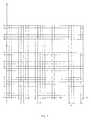
- the 512 x 512 pixel image is partitioned into 256 square elementary sub-sets of 32 x 32 pixels (see Figure 1).
- Figure 1 illustrates diagrammatically on the y axis the ranking of certain lines of the image and on the x axis the ranking of certain columns. For reasons of clarity, the scale used on the x axis and y axis is not uniform.
- the first 9 squares of 32 x 32 pixels are illustrated, so as to show the rankings and columns constituting the boundary of said squares.
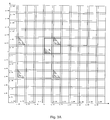
- the division of the 512 x 512 pixel image into working sub-sets is illustrated in Figure 2. It is similar to the partitioning of Figure 1, except that the working sub-sets of 32 x 32 pixels are offset by 16 pixels in both directions compared with the elementary sub-sets.
- the elementary sub-sets resulting from the partitioning are illustrated in thick lines whilst the working sub-sets resulting from the division are illustrated in dotted lines and are hatched.
- FIG 3 illustrates how, in this embodiment, each working sub-set L j is linked to a given elementary sub-set K i .
- the elementary sub-set K i having the coordinates (x i ,y i ) is illustrated in thick lines, whilst the corresponding working sub-sets are illustrated in dotted lines, the other sub-sets being outlined in fine lines.
- to each of the sub-sets K i are linked four working sub-sets L j (numbered L 1 , ..., L 4 ) offset by 16 pixels in both directions. In reality it is a case of four sub-sets resulting from the division which cover the elementary sub-set in question (resulting from the partitioning).
- K i [ x i , x i + 31 ] x [ y i , y i + 31 ]
- L 1 [ x i - 16 , x i + 15 ] x [ y i + 16 , y i + 47 ]
- L 2 [ x i + 16 , x i + 47 ] x [ y i + 16 , y i + 47 ]
- L 3 [ x i - 16 , x i + 15 ] x [ y i - 16 , y i + 15 ]
- L 4 [ x i + 16 , x i + 47 ] x [ y i - 16 , y i + 15 ]
- the sub-sets resulting from the division have the same dimensions as those resulting from the partitioning; in addition, in this embodiment, the division of the image into working sub-sets constitutes not a tiling but a simple partitioning because of the fact that the working sub-sets have a size identical to the sub-sets and the offset is equal to half a side of the square sub-sets in question.
- the global contractive mapping consists of taking an element g of the metric space E so as to transform it into an element T(g) of the same metric space E, which is expressed by T : g ⁇ E ⁇ T ( g ) ⁇ E
- equation (9) merely explains the type of special data in question: to each pair of values ( x,y ) taken in the field of definition (in this case the plane image ⁇ ) there corresponds a value in the mapping field R d , that is to say three values amongst 256 levels of three primary colours. It will also be observed that, it being a case of image processing, the field of definition is R 2 , whilst the mapping field is R 3 since the colour image has three components.
- each "piece" of the global contractive mapping is a multi-linear mapping of the type: where:
- the factors ( a 1 , ..., a n , b ) are here the "parameters" within the meaning of the invention of the elementary mapping relative to the sub-set K i . All the factors ( a 1 , ..., a n , b ) Ki relating to the m elementary sub-sets ( K 1 , ..., K m ) constitutes, in this embodiment, the "set of parameters" of the global contractive mapping within the meaning of the invention.
- the factors a j , b associated with each of the sub-sets K i constitute the primary representation of the set of initial data.
- the parameters resulting from the primary processing are the subject of the secondary processing, with a view to retrieving, with the error rate mentioned above, the initial data.
- the object of the secondary processing is to deliver data of a type other than that of the initial data.
- a step of "iterative calculation” is carried out, in the course of which, using the said parameters ( a 1 , ..., a n , b ), use is made of a method of successive approximations converging towards the fixed point of the global contractive mapping ( T ), this fixed point constituting a representation of the said set of initial data ( f ⁇ E ).
- the global contractive mapping defined in equations (8) and (10) is used in the data retrieval process. This is because, as the aim of the secondary processing described above is, in this embodiment, to obtain a retrieval of the initial data which is as faithful as possible, it is the same global contractive mapping which is used during the retrieval step.
- the global contractive mapping used during the primary processing is of the so-called "first type"; the one used during the secondary processing is of the so-called "second type".
- the global contractive mapping of the second type is identical to that of the first type.
- the global contractive mapping of the second type will be different from that of the first type.
- the present invention is certainly not limited to any particular image format but allows the processing of images of all sizes.
- the image processed and retrieved is a 512 x 512 pixel image with 256 colour levels on each of three components, red, green and blue.
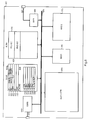
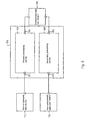
- the coding device bears the general reference 500.
- ROM 530 a program is recorded for processing data at the input 591, with compression thereof in accordance with the method described above.
- the compression program which in Figure 4 bears the reference 531, is described below with the help of Figures 10 to 15.
- All the means 510, 530, 531, 550, 560 and 570 constitute here an embodiment of "first logic transformation means" within the meaning of the invention.
- all these elements could be incorporated in one and the same integrated circuit (ASIC).
- ASIC integrated circuit
- the random access memory RAM 510 includes, amongst other things, the following registers designed for using the program 531:
- the part CACHE 514 of the memory 510 includes the following registers:
- the register 560 REG 1 is designed to add, for each elementary sub-set, the factors a 1 , a 2 , a 3 , a 4 and b , relating to each working sub-set.
- the register 570 REG 2 is designed to store the list of addresses of all the elementary sub-sets K i .
- the said coordinates are recorded once and for all, since in this embodiment the device is designed to process an image whose 512 x 512 pixel structure is partitioned once and for all.
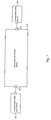
- Figure 5 depicts, connected respectively to the input and output means:
- the source 592 can include numerous means within the knowledge of an expert. For example, it can consist of a hard-disk or diskette or compact-disk (CD ROM) reader.
- the data of the image to be compressed can therefore advantageously be recorded on the corresponding media: hard disk, diskette or compact disk.
- This recording can be effected in any way known to experts.
- the source 592 can also consist of a video interface, able to deliver the data of the image to be compressed at the input 591.
- the source 592 can also consist of data reception means connected to a transmission network, the source 592 being able to transform the data received into a suitable format for them to be able to be presented at the input of the primary processing device.
- the user means 582 can also consist of means of storing the compressed image (hard disk, diskette, CD ROM etc) or a simple interface designed to deliver the video signal in a known format to other user means such as means intended for example to transmit this compressed image remotely or to store it.
- These means 582 can moreover consist of a data transmission device connected to a telecommunications network.
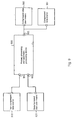
- the secondary processing device is able to retrieve, using the factors a 1 , a 2 , a 3 , a 4 and b relating to each of the m sub-sets, the initial image, in colour. It is also able to deliver the data relating to a grey-level image corresponding to an original colour image.
- These data output from the secondary processing device, representing grey levels in this example, are of a different type from those representing the initial colour image which were the subject of the primary processing.
- the set of means 610, 630, 631, 650, 560 and 570 constitutes here an embodiment of "second logic means” within the meaning of the invention.
- the set of means 610, 630, 632, 650, 560 and 570 constitutes here another embodiment of "second logic means” within the meaning of the invention.
- all these elements can be incorporated in one and the same integrated circuit (ASIC) suitable for the secondary processing.
- ASIC integrated circuit
- the random access memory RAM 610 includes, amongst other things, the following registers intended for implementing the programs 631 and 632:
- the part CACHE 614 of the memory 610 has registers 515 to 520 identical to those described in relation to Figure 4.
- the register 560 REG identical to that of the device of Figure 4, is intended to store, for each elementary sub-set, the factors a 1 , a 2 , a 3 , a 4 and b .
- the register 570 REG identical to that of the device of Figure 4, is intended to store the list of addresses of all the elementary sub-sets K i .
- the said coordinates are stored once and for all, since in this embodiment the device is intended to retrieve an image whose 512 x 512 pixel structure has been partitioned once and for all.
- Figure 7 depicts, connected respectively to the input and output means:
- the source 682 can consist of means of storing the compressed image (hard disk, diskette, CD ROM etc) or a simple interface designed to deliver them.
- the means 682 can also consist of a data reception system connected to a telecommunications network.
- the means 692 can consist for example of means of storing decompressed data or a simple interface delivering the decompressed data at its output. They can also consist of a device for transmitting decompressed data over a telecommunications network.
- This device is capable of simultaneously processing compressions of images and decompressions. It is consequently composed of the devices described in relation to Figures 4 and 6. It is a question in this case of the primary processing device 500 and secondary processing device 600. This type of apparatus is referred to as "full-duplex".
- the device can execute only a primary processing or a secondary processing but never at the same time. It can also perform a "complex" processing including a primary processing and a secondary processing performed one after the other.
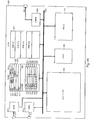
- the block diagram of such a device is depicted in Figures 9 and 9a.
- This device which bears the reference 800, includes conjointly the resources of the devices 500 and 600 described above, avoiding duplication.
- the configuration program 831 which will be described below in relation to Figure 19, enables the device 800 to perform:
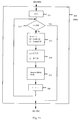
- an initialisation of the registers is performed (IM 511, CNT 513) and of the two registers REG 1 560 and REG 2 570.
- the files relating to the colour components R, G, B are accessible separately and are supplied in a predetermined order, namely:
- a first test is carried out for the purpose of determining whether or not the counter CNT 513 is equal to 3.
- step 202 in the course of which:
- each colour component is presented as a series of 262,144 values f(x,y) corresponding to the level of the colour in question for each of the pixels of the image. This series is loaded into the register IM 511.
- each working sub-image has as many data as the elementary sub-images.
- This partitioning is effected by determining the coordinates (x,y) of the bottom left-hand corner of each of the m sub-sets K i in question.
- the sub-set K i illustrated in Figure 3 has the coordinates (x i , y i ), which correspond to those of its bottom left-hand corner.
- Each of the addresses of the bottom left-hand corners of the blocks of 32 x 32 pixels corresponds to a particular address in the list recorded in the register IM 511 of the random access memory 510.
- the program switches to the test 212, in the course of which it is checked whether or not the list is complete. If not, the program switches to step 213, and a variable B is determined as the quotient of a complete division of ( i -1) by 16. The remainder of the division (variable C) will be stored in the register 524.
- the coordinates of the bottom left-hand corner of the elementary sub-set K i in question are stored in the variables (x i ,y i ) during step 214.
- the values of the variables x i and y i thus obtained are then copied into the register 570, REG 2, during step 215.
- the counter i is incremented and the program then runs the test 212 again.
- test 212 When the test 212 is positive, the program then switches to the test 205, in the course of which it is checked whether or not the list recorded in the register REG 2 is empty. If not, this means that there are still elementary sub-sets K i to be processed and the program switches to step 206.
- the first elementary sub-image in the list recorded in the register REG 2 is eliminated. This sub-image is recorded in a register CSI 515 of the cache memory of the RAM 510.
- step 207 in the course of which, from the address recorded in the register CSI, a search is made for the four adjacent sub-images L 1 , L 2 , L 3 , L 4 (see Figure 3). For this purpose, the rule stated above is applied.
- step 207 is to determine the values f(x,y) of the colour component associated with each of the pixels of the working sub-sets L 1 , L 2 , L 3 and L 4 related geometrically and in a predetermined manner to the elementary sub-set in question K i .
- the set of values f(x,y) related to the pixels of the sub-set L 1 (respectively L 2 , L 3 and L 4 ) will hereinafter be denoted f(L 1 ) (respectively f(L 2 ) f(L 3 ) and f(L 4 ) ) .
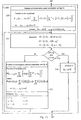
- the detailed flow diagram of this step is depicted in Figure 12.
- the controller 550 copies, into the arithmetic unit 550, the coordinates ( x i ,y i ) of the bottom left-hand pixel of K i and stored in the register REG2 507 at step 217.
- the arithmetic unit 550 determines the coordinates of each pixel of each working sub-set in accordance with the following table: L 1 : [ x i -16, x i + 15 ] x [ y i + 16, y i + 47 ] L 2 : [ x i +16, x i + 47 ] x [ y i + 16 , y i + 47 ] L 3 : [ x i -16, x i + 15 ] x [ y i - 16 , y i + 15 ] L 4 : [ x i +16, x i + 47 ] x [ y i - 16 , y i + 15 ]
- the arithmetic unit 550 will seek, for the colour component in the course of processing, the value corresponding to each of the 32 2 pixels of L 1 (respectively L 2 , L 3 and L 4 ) and stores the set of 32 2 values in the register f ( L 1 ) 516 (respectively f(L 2 ) 517, f(L 3 ) 518 and f(L 4 ) 519) of the cache 514).
- step 208 in the course of which, in general terms, the parameters a i (in this case a 1 , a 2 , a 3 , a 4 ) and b are calculated by using the method of least squares with the constraints described above (see equations 12 and 13).
- step 208 is given in the flow diagram depicted in Figure 13. It should be stated that, in order to determine the factors a 1 , a 2 , a 3 , a 4 and b , it is necessary to resolve a problem of minimisation of a function under constraints. Above it was seen, in conjunction with equations 14 to 29, that this amounts to iteratively resolving two types of problem of minimisation under constraints. The explanations given above for a general case are put into practice for determining the four parameters a 1 , a 2 , a 3 , a 4 and the parameter b .
- step 220 the first problem of minimisation without constraints is resolved.
- the function: is minimised for values ( a 1 , ..., a 4 , b ) running throughout .
- values a 1 , ..., a 4 , b
- the unique solution to this problem ( a 1 , ..., a 4 , b ) ⁇ is the solution of the linear system (19).
- step 220 is subdivided into four steps 230-233.
- Step 232 has recourse to a conventional routine of inverting a system of linear equations, in this case with 5 unknowns.
- the linear system to be inverted is as follows:
- the solution a 1 , ..., a 4 , b will be stored at step 233 in the register 520 of the CACHE 514.
- step 221 Figure 13
- the program then switches to the test 222 in the course of which it is checked whether the sets UV and LV are empty. If this test is positive, the values currently present in the CACHE 520 constitute (step 224) the solution of the problem with constraints.
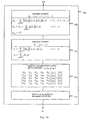
- step 233 If it is negative, certain constraints are active for the solution of the problem with constraints. In this case (step 233; see Figure 15), it is necessary to resolve a restricted problem.
- Step 242 has recourse to a conventional routine of inverting a system of linear equations, in this case with four unknowns.
- the linear system to be inverted is as follows:
- step 223 it is necessary to review whether the solution thus obtained still satisfies the constraints. To do this, step 221 and the test 222 are executed once again. This process until the test 222 is positive.
- step 209 in the course of which the factors a 1 , a 2 , a 3 , a 4 and b are recorded in the memory REG 1.
- step 209 the program switches again to the test 205, and all the operations 205-209 are reiterated as long as the memory REG 2 is not empty.
- the program switches once again to the test 201 in order to check whether or not the counter CNT 513 is equal to 3. In the affirmative, this signifies that the three colours have been processed.
- the program then switches to the final step 210.
- the parameters of the global contractive mapping are in the register REG 1 560. These parameters constitute a primary representation of the initial data which were recorded in the data source 592. The following performance was observed on a 512 x 512 pixel colour image with 252 levels:
- program 632 In conjunction with Figure 18, a variant of the program 631 (program 632) will be described.
- the data obtained are of a different type from the original data since they concern the data of a grey-level image corresponding to the original colour image.
- an initialisation is carried out of the registers IM, RE and IT of the random access memory 610, of the two memories REG 1 560 and REG 2 570, and of the counter CNT 513.
- a first test is carried out for the purpose of determining whether or not the content of the counter CNT is equal to 3. If so, the three components have been retrieved and the decompression program is ended (step 402).
- the program switches to step 403, in the course of which the compressed data of the input memory are loaded into the memory REG 1 560.
- the compressed data are formed by a sequence of five numbers, namely the factors a 1 , a 2 , a 3 , a 4 and b relating to each elementary sub-set K i .
- each component has been compressed into 256 sequences of five numbers a 1 , ..., a 4 , b in the course of the primary treatment as performed by the program 531 described above. This sequence of 256 x 5 numbers is loaded into REG 1 560.
- step 404 in the course of which the list of sub-images will be created.
- the list of references is obtained at each elementary sub-set.
- it is a question of a list of the coordinates ( x i , y i ) of the bottom left-hand pixel of each elementary sub-set K i , of 32 x 32 pixels.
- the constitution of the list is identical to the procedure of step 204 described above in conjunction with Figure 11.
- step 406 in the course of which:
- the program then executes a number p of iterations referenced on the loop 450 in order to enable the retrieval of a component of the image.
- the program switches first of all to the test 407, in the course of which it is checked whether the content of the register IT 612 is positive and non null.
- test 407 If the test 407 is positive, the program switches to the test 408, in the course of which it is checked whether or not the list recorded in REG 2 570 is empty.
- test 408 If the test 408 is negative, the program switches to step 410 and executes it until all the elementary sub-sets K i have been processed.
- step 410 The details of step 410 will now be described in Figure 17.
- Step 410 itself comprises steps 411 to 415:
- the coordinates ( x i ,y i ) of the elementary sub-set K i in question are withdrawn and are copied into the register CSI 515.
- the factors ( a 1 , ..., a 4 , b ) relating to the sub-sets K i in question are copied from the register REG 1 to the register 520 of the CACHE 614.
- step 412 is to determine the working sub-sets related geometrically and in a predetermined manner to the elementary sub-set K i in question.
- This step includes the same operations as at step 207 described above in conjunction with Figure 12.
- the values f(L 1 ), f(L 2 ), f(L 3 ) and f(L 4 ) of the pixels relating respectively to L 1 , L 2 , L 3 , and L 4 are respectively copied into the registers 516, 517, 518 and 519 of the CACHE 614.
- step 413 and 414 in the course of which there is calculated, for each pixel ( x,y ) of K i , the value using the factors stored in the register 520 and the data f(L 1 ) , ..., f(L 4 ) stored in the register 516 and 519 (step 413), and this value is stored (step 414) in the register RE 621 of the RAM 610.
- test 408 If the test 408 is positive, the content of the register RE 621 is copied into the register IM 611, and the content of the register IT 612 is reduced by one unit.
- Test 407 is once again carried out. As long as this test is positive this means that the number of iterations provided by the number recorded in the register p have not finished and the operations 408 to 410 are reiterated. When the test 407 is negative or null, the number of iterations provided is ended, for the component in the course of processing, and the program leaves the loop 450. This component is therefore decompressed.
- Step 405 is carried out, which consists of copying the content of the register IM 511 into the output buffer OBFR 690.
- the program then switches to test 401.
- test 401 As long as the test 401 is negative, this means that there remains at least one component completely compressed.
- the register IM in fact includes the list of the values corresponding to each pixel for the components previously decompressed. This value list is the initial arbitrary image for the following component.
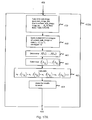
- Figure 16a illustrates, in this regard, the progress of step 406.
- the test of the counter CNT is carried out. If its content is equal to zero, this means that it is a case of the start of the decompression process and the register IM 511 is initialised at 128 for each pixel (step 431). The register IT is initialised at the value p (step 432).
- step 433 the register IM 511 is loaded with the content of the register RE 621, that is to say with the values corresponding to the components previously decompressed.
- This makes it possible to decrease the number of iterations p by two units (cf step 434 where IT is initialised at the value p-2) since the initial image is very close to the final image. The calculation time is reduced because of this characteristic.
- the counter CNT is then incremented by one unit (step 435).
- test 401 When the three components have been decompressed, the test 401 is positive.
- the data relating to each of the three colour components have in turn been copied into the output buffer OBFR 690, from where they have been transferred to the decompressed data user means 682 ( Figure 7).
- the program 632 will now be described in conjunction with Figure 18.
- This program is a variant of the program 631 which was described in conjunction with Figures 16 and 17.
- the program 632 makes it possible to obtain, using the parameters relating to a so-called original colour image, the data of a corresponding grey-level.
- the program 632 has, overall, a structure similar to that of the program 631.
- the inventors sought to use the routines of the program 631 as far as possible.
- Such a procedure proves advantageous, on the assumption that the programs 631 and 632 are designed to be used within the same device incorporating both a primary processing device and a secondary processing device.
- the first step of the program 632 is an initalisation step 400 similar to that described above.
- the program then switches to a test 449 similar to the test 401 described above, in the course of which it is determined whether or not the content of the counter CNT is equal to 3.
- step 451 is carried out, in the course of which the data relating to the first colour component will be read in the buffer register IBFR 680 in order to load them into the register REG 1 560.
- the counter CNT is incremented by one unit. The three colour components are thus read successively and loaded into the register REG 1 560.
- Step 404 of the flow diagram of Figure 18 is identical to step 404 of the flow diagram of Figure 16 described above.
- step 452 This step is detailed in Figure 19.
- step 452 a global contractive mapping of the "second type" is determined, making it possible to obtain data of a type different from the original data, in this case a grey-level image, using parameters relating to a colour image.
- the inventors sought to use, as far as possible, the iteration routine 450 in the course of which the contractive mapping of the first type (the original one) is used in order to execute the method of successive approximations.
- the contractive mapping of the second type has a structure similar to that of the contractive mapping of the first type; however, its factors are different and will be determined in the course of step 452.
- experts will be able to effect contractive mappings of the "second type" which differ both with regard to their structure and with regard to the parameters used. In reality, the nature of the contractive mapping of the second type depends on the nature of the data of the second type which it is sought to obtain.
- the factors r , g and b are in this case conventional factors of composition of the colour components in order to make it possible to transform a colour image into a grey-level image.
- the advantage in this case is that factors r , g and b of values already known in the prior art for other mappings can be used in order to define a global contractive mapping of the second type on compressed data (that is to say on parameters) in order to obtain decompressed data relating to a grey-level image.
- the factors a iS and b s are therefore substitution factors which will be used in the course of the iteration routine 450.
- the data converge towards the fixed point of the contraction thus defined, relating to a grey-level image corresponding to the original colour image.
- step 452 first of all includes a test 453, in the course of which it is checked whether or not the list recorded in the course of step 404 in the register REG 2 (670) is empty.
- the substitution factors thus calculated for each of the sub-sets K i are stored in the register REG 1 (560), where they come to replace the factors a iR , b R , a iG , b G , a iB , b B relating to the colour components of the said sub-set K i .
- step 456 the coordinates relating to the elementary sub-sets processed K i are eliminated.
- the coordinates of the last elementary sub-set appearing in the list, and which will be processed in the course of the following loop, are the coordinates relating to the sub-image K i-1 .
- the program then re-switches to the test 453, in order to see whether or not the list of sub-images in the register REG 2 is empty.
- step 406A including the steps 433 and 434 described above in conjunction with Figure 16A.
- step 406 the program switches to the loop 450 identical to the one described above in conjunction with Figure 16. It is during the loop 450 that the method of successive approximations is used in the course of a predetermined number of iterations p (2 ⁇ p ⁇ 10).
- step 407 of the loop 450 When the planned number of iterations have been effected, that is to say the test 407 of the loop 450 is positive, the program switches to step 405, similar to that described above in conjunction with Figure 16, in the course of which the content of the register IM (611) is copied into the output buffer OBFR (690). The program then switches to a final step 402.
- the configuration program bears the reference 831 in Figures 9A and 20.
- the device 800 illustrated in Figure 9A has four operating modes, which will be detailed below.
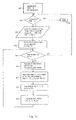
- the operating mode of the apparatus is first of all selected (step 832).
- the mode is selected by entering a value equal to 0, 1 or 2 in the register MOD 822 and a value of 0 or 1 in the register CHTY.
- This recording can take place by any means within the knowledge of experts. In particular, it could be done by means of a switch arranged on the casing of the apparatus 800 with four positions each corresponding to the desired operating mode. This switch would make it possible to send the appropriate signals to the RAM memory 810, so as to load the values indicated into the registers MOD or CHTY.
- This initialisation can also be carried out in a similar manner by means of a keyboard, not shown in Figure 9A.
- a first test is carried out on the register MOD in order to determine whether or not its content is equal to zero. If the test 833 is positive, this means that the operating mode chosen is the first of those mentioned above and the program 531 is implemented using data fed from the data source 810, the compressed data being delivered at the output 881 to the compressed data user means 860 ( Figure 9).
- test 833 If the test 833 is negative, a test is carried out at step 834 for the purpose of determining whether or not the content of the register MOD is equal to 1.
- test 834 If the test 834 is positive, a test 840 is then carried out on the content of the register CHTY for the purpose of determining whether or not it is equal to 1.
- test 840 is negative, this means that the device of Figures 9 and 9A is in the second operating mode, that is to say in the one where it is used to retrieve the original data of a colour image from parameters (compressed data) fed at the input 881, from a source 861 ( Figure 9).
- the decompressed data delivered at the output 892 of the device 800 are fed to the decompressed data user means 820.
- test 840 If the test 840 is positive, this means that the device 800 is in the third operating mode, that is to say the one in which it is used to perform a secondary processing of compressed data and deliver data of a type different from those of the original data, in this case data relating to a grey-level image corresponding to an original colour image.
- the program 632 is implemented using parameters delivered by a source of compressed data 861.
- the decompressed data are delivered at the output 692 and fed to user means 820.
- test 834 is negative, this means that the content of the register MOD is equal to 2.
- the device 800 which is then in its fourth operating mode, is used to transform a colour image into a grey-level image. It is a case here of an example of complex processing within the meaning of the present invention, including a primary processing phase and a secondary processing phase.
- the primary processing and secondary processing programs are used sequentially.
- the program 531 makes it possible, using data delivered by a source of non-compressed data 810 at the output 891 of the device 800, to compress these data, in order to obtain parameters a i , b , relating to each of the elementary sub-sets K i of the original image. These parameters, in accordance with that which was described above in conjunction with Figure 10, are all present in the register REG 1 560 at the end of the program 531.
- the main program of Figure 20 then activates a direct switching to step 404 of the program 632 described above in conjunction with Figure 18 (as illustrated in Figure 20 and, in dotted lines, in Figure 18). Steps 452, 406, 450, 405 and 402 of the end of the program 632 described above in conjunction with Figure 18 are then executed.
- the transformed data are then present at the buffer register OBFR 893 of the device 800 and transferred to the decompressed data user means 820.
- These data are those relating to a grey-level image corresponding to the colour image whose data were transferred into the device 800 from the source 810.
- sub-program including all the steps 404, 452, 406, 450, 405 and 402 of the program 632 constitutes here a particular mode of implementation of a secondary processing method according to the invention. It is this particular sub-program which is here used following the program 631 in order to constitute an example of a "complex" processing within the meaning of the present invention.
- the image to be processed is here an image of 512 x 512 pixels partitioned into square sub-sets of 32 x 32 pixels, in accordance with that which was described above in conjunction with Figure 1.
- the working sub-sets here have a size twice that of the elementary sub-sets, so that the 512 x 512 pixel image is divided into square sub-sets of 64 x 64 pixels. However, so that four working sub-sets correspond to a given elementary sub-set (see Figure 3A), the offset used for the division of the image is 32 pixels, the division of the image then resulting in a tiling.
- step 207A a search is carried for the four adjacent sub-images L 1 , L 2 , L 3 , L 4 (see Figure 3A) from the address recorded in the register CS1. For this purpose, the rule stated above is applied.
- step 207A determines the values f(x,y) of the colour component associated with each of the pixels of the working sub-sets L 1 , L 2 , L 3 , L 4 linked geometrically and in a predetermined manner to the elementary sub-set K i in question.
- the set of values f(x,y) related to the pixels of the sub-set L 1 will hereinafter be denoted f(L 1 ) (respectively f(L 2 ), f(L 3 ) and (L 4 )) in accordance with the notations used above.
- the sub-sets f(L i ) In order to be able to perform the operations of comparison with the sub-set K i , it is necessary to bring the sub-sets f(L i ) to the same size.
- Several methods are available to the expert. In this embodiment, where the size of the working sub-sets is 64 x 64 pixels and that of the elementary sub-sets 32 x 32 pixels, a mean value per square of 4 pixels is adopted. The set of these mean values will be denoted, for a working sub-set L i in question: f(L i/2 ). The detailed flow diagram of this step is depicted in Figure 12A.
- the coordinates ( x i ,y i ) of the bottom left-hand pixel of the elementary sub-set K i in question are copied into the arithmetic unit 550, and are stored in the register REG 2 570. Then the arithmetic unit 550 determines the coordinates of each pixel of each working sub-set in accordance with Table 2, as indicated at step 318.
- the arithmetic unit 550 will seek, for the colour component in the course of processing, the value corresponding to each of the 64 2 pixels of L i (respectively L 2 , L 3 and L 4 ) and stores all the 64 2 values in the register f(L 1 ) 516 (respectively f(L 1 ) 517, f(L 3 ) 518 and f(L 4 ) 519) of the cache 514.
- the arithmetic unit 550 processes each square of 2 x 2 values of f(L 1 ) and substitutes for this a corresponding value of f(L 1/2 ) in the register 516.
- the corresponding value of f(L 1/2 ) will be obtained by calculating the mean of the values of the said square of 2 x 2 values of f(L 1 ).
- the other sets f(L 2 ) ,..., f(L 4 ) are then processed in the same way.
- the values of f(L 1/2 ),...,f(L 4/2 ) are stored in the memory CACHE 514, in the registers f(L 1 ) 516, ..., f(L 4 ) 519.
- step 208 in the course of which, as indicated above, the parameters a i (in this case a 1 , a 2 , a 3 , a 4 ) and b are calculated using the method of least squares with the constraints described above (see equations 12 and 13). However, in this embodiment, the value of ⁇ will be less than ⁇ 2 / n .
- the decompression program functions in a similar manner to the program 631 described above in conjunction with Figures 16 and 17.
- the operation 410 must be modified as disclosed above and will be referenced as 410A, illustrated in Figure 17A.
- step 410A The details of step 410A are described in conjunction with Figure 17A.
- Step 410A itself comprises steps 459 to 465: steps 459 and 460 are identical to steps 411 and 412 described above ( Figure 17).
- the program then switches to steps 461, 462 and 463, in the course of which the values f(L 1/2 ) , ..., f (L 4 ) are determined. Then at step 462 the values f(L 1/2 ) f (L 4/2 ) are determined. To do this, the arithmetic unit 550 processes each square of 4 values of f(L 1 ) and substitutes for it a corresponding value of f(L 1/2 ) in the register 516. In this embodiment the corresponding value of f(L 1/2 ) is obtained by calculating the mean of the values of the said square. The other sets f(L 2 ), ..., f(L 4 ) are then processed in the same way.
- step 463 for each pixel (x,y) of K i , the value is calculated using the factors of 520 and the data f ( L 1/2 ),..., f (L 4/2 ) of 516 to 519 (step 462), and this value is stored (step 463) at the corresponding pixel in the register RE 621 of the RAM 410.
- step 464 is identical to step 414 ( Figure 17).
- a complex processing can also be carried out, enabling the data to be transformed, as described above in conjunction with Figure 20, using the modified compression 531 and decompression 631 programs as disclosed above in conjunction with Figures 10, 11, 12A, 13, 14 and 17A.
- a global contractive mapping is used, composed of non-linear mappings.
- the image to be processed is also a 512 x 512 pixel image.
- This image is partitioned into elementary sub-sets and divided into working sub-sets in the same way as that described above in conjunction with Figures 1 to 3.
- each "piece" of the global contractive mapping is a non-linear Lipschitz elementary mapping of the type: where:
- the factors ( a 1 , ..., a n , b ) are here the "parameters" within the meaning of the invention of the elementary mapping relating to the sub-set K i .
- the set of factors ( a 1 , ..., a n , b ) Ki relating to the m elementary sub-sets ( K 1 , ..., K m ) constitutes here also the "set of parameters" of the global contractive mapping within the meaning of the invention.
- step 207 relating to the calculations of the factors changes.
- This variant of step 207 (marked 207B) will now be described notably in conjunction with Figure 12B.
- Step 207B includes the steps 322 and 323 respectively identical to steps 217 and 218 described above in conjunction with Figure 12.
- the values f(L 1 , ..., f(L 4 ) are read in the register IM 511.
- step 326 the values g 1 [f(L 1 )] , ..., g 4 [f(L 4 ] are stored in the registers 516 to 519 of the CACHE 514.
- the decompression program functions in a similar manner to the program 631 described above in conjunction with Figures 16 and 17.
- the operation 410 must be modified as disclosed below. This new operation is referenced 410B and is illustrated in Figure 17B.
- Step 410B itself comprises steps 471 to 475:
- the coordinates (x i ,y i ) of the elementary sub-set K i in question are withdrawn and are copied into the register CS1 515.
- the factors ( a 1 , ..., a 4 , b ) relating to the sub-sets K i in question are copied from the register REG 1 to the register 520 of the CACHE 614.
- step 472 determines the working sub-sets linked geometrically and in a predetermined manner to the elementary sub-set K i in question.
- This step includes the same operations as at step 207 described above in conjunction with Figure 12.
- L4 of the pixels relating respectively to L 1 , L 2 , L 3 and L 4 are respectively copied into the registers 516, 517, 518 and 519 of the CACHE 614.
- the program then switches to steps 473 and 474, in the course of which, for each pixel ( x,y ) of K i , the value is calculated using the factors stored in the register 520 and the data f(L 1 ) , ..., f(L 4 ) stored in the register of 516 to 519 (step 474), and this value is stored at the corresponding pixel in the register RE 621 of the RAM 610.
- a complex processing can also be carried out, for transforming the data as described above in conjunction with Figure 20, using modified compression 531 and decompression 631 programs as disclosed above in conjunction with Figures 12B and 17B.
Landscapes
- Engineering & Computer Science (AREA)
- Multimedia (AREA)
- Physics & Mathematics (AREA)
- General Physics & Mathematics (AREA)
- Theoretical Computer Science (AREA)
- Compression, Expansion, Code Conversion, And Decoders (AREA)
- Compression Or Coding Systems Of Tv Signals (AREA)
- Compression Of Band Width Or Redundancy In Fax (AREA)
- Image Processing (AREA)
Applications Claiming Priority (2)
| Application Number | Priority Date | Filing Date | Title |
|---|---|---|---|
| FR9610636 | 1996-08-30 | ||
| FR9610636 | 1996-08-30 |
Publications (1)
| Publication Number | Publication Date |
|---|---|
| EP0827111A1 true EP0827111A1 (fr) | 1998-03-04 |
Family
ID=9495327
Family Applications (1)
| Application Number | Title | Priority Date | Filing Date |
|---|---|---|---|
| EP97401971A Withdrawn EP0827111A1 (fr) | 1996-08-30 | 1997-08-22 | Procédés et dispositifs de traitement d'un ensemble de données |
Country Status (3)
| Country | Link |
|---|---|
| US (1) | US6456743B1 (fr) |
| EP (1) | EP0827111A1 (fr) |
| JP (1) | JPH10112858A (fr) |
Families Citing this family (4)
| Publication number | Priority date | Publication date | Assignee | Title |
|---|---|---|---|---|
| DE10054814A1 (de) * | 2000-11-04 | 2002-05-08 | Philips Corp Intellectual Pty | Verfahren und Vorrichtung zur Registrierung von Bildern |
| DE10119622A1 (de) * | 2001-04-20 | 2002-10-24 | Siemens Ag | Verfahren zum Betreiben eines modularen Steuersystems sowie danach arbeitendes Steuersystem |
| US9286643B2 (en) | 2011-03-01 | 2016-03-15 | Applaud, Llc | Personalized memory compilation for members of a group and collaborative method to build a memory compilation |
| JP7310495B2 (ja) * | 2019-09-26 | 2023-07-19 | オムロン株式会社 | 制御システム、情報処理装置およびプログラム |
Citations (1)
| Publication number | Priority date | Publication date | Assignee | Title |
|---|---|---|---|---|
| US5416856A (en) * | 1992-03-30 | 1995-05-16 | The United States Of America As Represented By The Secretary Of The Navy | Method of encoding a digital image using iterated image transformations to form an eventually contractive map |
Family Cites Families (1)
| Publication number | Priority date | Publication date | Assignee | Title |
|---|---|---|---|---|
| US5065447A (en) | 1989-07-05 | 1991-11-12 | Iterated Systems, Inc. | Method and apparatus for processing digital data |
-
1997
- 1997-08-22 EP EP97401971A patent/EP0827111A1/fr not_active Withdrawn
- 1997-08-29 JP JP9234776A patent/JPH10112858A/ja not_active Withdrawn
- 1997-08-29 US US08/921,379 patent/US6456743B1/en not_active Expired - Fee Related
Patent Citations (1)
| Publication number | Priority date | Publication date | Assignee | Title |
|---|---|---|---|---|
| US5416856A (en) * | 1992-03-30 | 1995-05-16 | The United States Of America As Represented By The Secretary Of The Navy | Method of encoding a digital image using iterated image transformations to form an eventually contractive map |
Non-Patent Citations (2)
| Title |
|---|
| HURTGEN B ET AL: "On the convergence of fractal transforms", ICASSP-94. 1994 IEEE INTERNATIONAL CONFERENCE ON ACOUSTICS, SPEECH AND SIGNAL PROCESSING (CAT. NO.94CH3387-8), PROCEEDINGS OF ICASSP '94. IEEE INTERNATIONAL CONFERENCE ON ACOUSTICS, SPEECH AND SIGNAL PROCESSING, ADELAIDE, SA, AUSTRALIA, 19-22 APRIL 1, ISBN 0-7803-1775-0, 1994, NEW YORK, NY, USA, IEEE, USA, pages V/561 - 4 vol.5, XP000616850 * |
| POPESCU D C ET AL: "Generalized square isometries: An improvement for fractal image coding", IMAGE ANALYSIS AND PROCESSING. 8TH INTERNATIONAL CONFERENCE, ICIAP '95. PROCEEDINGS, PROCEEDINGS OF 8TH INTERNATIONAL CONFERENCE ON IMAGE ANALYSIS AND PROCESSING, SAN REMO, ITALY, 13-15 SEPT. 1995, ISBN 3-540-60298-4, 1995, BERLIN, GERMANY, SPRINGER-VERLAG, GERMANY, pages 637 - 642, XP000618006 * |
Also Published As
| Publication number | Publication date |
|---|---|
| US6456743B1 (en) | 2002-09-24 |
| JPH10112858A (ja) | 1998-04-28 |
Similar Documents
| Publication | Publication Date | Title |
|---|---|---|
| US6498866B2 (en) | Methods and devices for processing data and notably for compressing and decompressing images | |
| JP3251084B2 (ja) | 圧縮画像の仮想編集方法及びその装置 | |
| US5886651A (en) | System and method for nested split coding of sparse data sets | |
| Lai et al. | A fast fractal image coding based on kick-out and zero contrast conditions | |
| JPH11502043A (ja) | フラクタル変換を使用するデジタルデータの圧縮伸張方法および装置 | |
| AU5538690A (en) | Method and apparatus for manipulating digital video data | |
| JP2821489B2 (ja) | 静止画像圧縮処理装置及び方法 | |
| JP2008530829A (ja) | 係数の位置をコード化する方法及び装置 | |
| EP0827111A1 (fr) | Procédés et dispositifs de traitement d'un ensemble de données | |
| US6266451B1 (en) | Method and device for the processing of data notably the compression and decompression of image data | |
| CN116894457B (zh) | 深度学习模型的网络权重存取方法 | |
| US6304604B1 (en) | Method and apparatus for configuring compressed data coefficients to minimize transpose operations | |
| US6163628A (en) | Method of data reduction by means of fractal image coding | |
| Di Francesco et al. | Quantum Q systems: from cluster algebras to quantum current algebras | |
| US7451170B2 (en) | Rapid and low cost of inverse discrete cosine transform system and method thereof | |
| JP4673524B2 (ja) | ディジタルデータをフィルタリングする方法 | |
| Vieira et al. | Stellar mesh simplification using probabilistic optimization | |
| US6279062B1 (en) | System for reducing data transmission between coprocessors in a video compression/decompression environment by determining logical data elements of non-zero value and retrieving subset of the logical data elements | |
| Koike et al. | Applications of the sequence selection property to bi-Lipschitz geometry | |
| Bejancu | Wiener–Hopf difference equations and semi-cardinal interpolation with integrable convolution kernels | |
| Charlesworth et al. | Analogues of entropy in bi-free probability theory: microstates | |
| US6373989B1 (en) | Iterated image transformation and decoding apparatus and method, and recording medium | |
| Maurer | Computer experiments in finite algebra | |
| Wong et al. | Fractal-based image coding with polyphase decomposition | |
| Chittineni | On Device Independent Color Characterization Modeling and Management |
Legal Events
| Date | Code | Title | Description |
|---|---|---|---|
| PUAI | Public reference made under article 153(3) epc to a published international application that has entered the european phase |
Free format text: ORIGINAL CODE: 0009012 |
|
| AK | Designated contracting states |
Kind code of ref document: A1 Designated state(s): DE FR GB IT |
|
| 17P | Request for examination filed |
Effective date: 19980729 |
|
| AKX | Designation fees paid |
Free format text: DE FR GB IT |
|
| RBV | Designated contracting states (corrected) |
Designated state(s): DE FR GB IT |
|
| 17Q | First examination report despatched |
Effective date: 20021008 |
|
| STAA | Information on the status of an ep patent application or granted ep patent |
Free format text: STATUS: THE APPLICATION IS DEEMED TO BE WITHDRAWN |
|
| 18D | Application deemed to be withdrawn |
Effective date: 20030219 |