EP0828540B1 - Dreidimensionelles, magnetisch und mechanisch zusammengehaltenes geduldspiel, insbesondere zum gebrauch von blinden - Google Patents
Dreidimensionelles, magnetisch und mechanisch zusammengehaltenes geduldspiel, insbesondere zum gebrauch von blinden Download PDFInfo
- Publication number
- EP0828540B1 EP0828540B1 EP96914236A EP96914236A EP0828540B1 EP 0828540 B1 EP0828540 B1 EP 0828540B1 EP 96914236 A EP96914236 A EP 96914236A EP 96914236 A EP96914236 A EP 96914236A EP 0828540 B1 EP0828540 B1 EP 0828540B1
- Authority
- EP
- European Patent Office
- Prior art keywords
- fragments
- puzzle
- dimensional puzzle
- dimensional
- puzzle according
- Prior art date
- Legal status (The legal status is an assumption and is not a legal conclusion. Google has not performed a legal analysis and makes no representation as to the accuracy of the status listed.)
- Expired - Lifetime
Links
Images




Classifications
-
- A—HUMAN NECESSITIES
- A63—SPORTS; GAMES; AMUSEMENTS
- A63F—CARD, BOARD, OR ROULETTE GAMES; INDOOR GAMES USING SMALL MOVING PLAYING BODIES; VIDEO GAMES; GAMES NOT OTHERWISE PROVIDED FOR
- A63F9/00—Games not otherwise provided for
- A63F9/06—Patience; Other games for self-amusement
- A63F9/12—Three-dimensional [3D] jig-saw puzzles
- A63F9/1288—Sculpture puzzles
-
- A—HUMAN NECESSITIES
- A63—SPORTS; GAMES; AMUSEMENTS
- A63F—CARD, BOARD, OR ROULETTE GAMES; INDOOR GAMES USING SMALL MOVING PLAYING BODIES; VIDEO GAMES; GAMES NOT OTHERWISE PROVIDED FOR
- A63F9/00—Games not otherwise provided for
- A63F9/0001—Games specially adapted for handicapped, blind or bed-ridden persons
- A63F2009/0003—Games specially adapted for blind or partially sighted people
- A63F2009/0004—Games specially adapted for blind or partially sighted people using BRAILLE
-
- A—HUMAN NECESSITIES
- A63—SPORTS; GAMES; AMUSEMENTS
- A63F—CARD, BOARD, OR ROULETTE GAMES; INDOOR GAMES USING SMALL MOVING PLAYING BODIES; VIDEO GAMES; GAMES NOT OTHERWISE PROVIDED FOR
- A63F9/00—Games not otherwise provided for
- A63F9/06—Patience; Other games for self-amusement
- A63F9/0613—Puzzles or games based on the use of optical filters or elements, e.g. coloured filters, polaroid filters, transparent sheets with opaque parts
- A63F2009/0615—Puzzles or games based on the use of optical filters or elements, e.g. coloured filters, polaroid filters, transparent sheets with opaque parts transparent
-
- A—HUMAN NECESSITIES
- A63—SPORTS; GAMES; AMUSEMENTS
- A63F—CARD, BOARD, OR ROULETTE GAMES; INDOOR GAMES USING SMALL MOVING PLAYING BODIES; VIDEO GAMES; GAMES NOT OTHERWISE PROVIDED FOR
- A63F9/00—Games not otherwise provided for
- A63F9/06—Patience; Other games for self-amusement
- A63F9/12—Three-dimensional [3D] jig-saw puzzles
- A63F9/1208—Connections between puzzle elements
- A63F2009/1212—Connections between puzzle elements magnetic connections
-
- A—HUMAN NECESSITIES
- A63—SPORTS; GAMES; AMUSEMENTS
- A63F—CARD, BOARD, OR ROULETTE GAMES; INDOOR GAMES USING SMALL MOVING PLAYING BODIES; VIDEO GAMES; GAMES NOT OTHERWISE PROVIDED FOR
- A63F9/00—Games not otherwise provided for
- A63F9/06—Patience; Other games for self-amusement
- A63F9/12—Three-dimensional [3D] jig-saw puzzles
- A63F9/1208—Connections between puzzle elements
- A63F2009/1224—Connections between puzzle elements using two or more types of connections
Definitions
- the present invention relates to a puzzle three-dimensional.
- Three-dimensional puzzles are games of well-known patience, which may have a function educational, in particular a role of awakening to sculpture and artistic awareness when they reproduce famous or original works of art, such as museum pieces.
- Still other puzzles such as the one disclosed in US-A-4,865,324, consist of parts associated with the both by mechanical and magnetic means. Rooms, geometric in shape, are precisely magnetized and provided with protuberances and matched cavities, arranged symmetrically with respect to the center of the parts.
- the invention proposes a puzzle three-dimensional comprising fragments of shapes and / or distinct and arbitrary dimensions that cannot occupy that a unique position within said puzzle, at least two said fragments each comprising at least one element magnetic oriented so that said fragments attract when properly positioned.
- Document FR-A-2 517 979 discloses a puzzle three-dimensional of the aforementioned type, the different constituent fragments are kept assembled by magnetization and can be cubic or not, identical or different.
- the cohesion of the puzzle is insufficient and it does not provide the sensations required for application in activities educational or cultural activities for children, or in games for the blind.
- the puzzle three-dimensional disclosed in US-A-3,779,558, which is made up of assembled parts either by means mechanical, either by magnetic means, and whose mutually contacting surfaces are not fully matched to each other, the different pieces of this known puzzle not having, moreover, a form and a totally arbitrary thickness.
- each of the puzzle fragments according to the invention is provided with at least one relief and / or a hollow of positioning likely to be matched with respectively a recess and / or a positioning relief provided on an adjacent fragment, so that said fragments are assembled both by means mechanical and magnetic.
- the fragments which have distinct and arbitrary shapes and / or dimensions, are closely matched to each other along their mutually adjacent surfaces. The cohesion of the whole is therefore reinforced.
- Reliefs and positioning troughs each have a shape and / or one size (s), what makes the invention particularly suitable for the aforementioned applications.
- a fragment can cooperate by one of its faces with one or more other fragments or with one or several parts of other fragments.
- At least one of said fragments represents an individual object such as an artistic plastic form, figurative or not, taking up or not the main theme of the puzzle.
- At least one of the puzzle fragments represents an object individualized and the other fragments are arranged around said object.
- variations in the surface exterior of the individualized object can constitute a set of reliefs and positioning hollows which cooperate respectively with hollows and reliefs of positioning of at least some of said others fragments.
- the object will take the form of a known sculpture, which may be inserted in another known or original sculpture or in a pyramid, for example, made up of fragments at least part of which has a surface matched to a portion of the surface of said object and forms a first layer around it and possibly another part forms one or more layers around this first layer.
- the object inserted in the three-dimensional puzzle could possibly be a original as is, which does not contain element (s) magnetic and the cohesion of the whole puzzle will be, in this case, ensured by the fragments arranged around this one, at least two of which contain at least one element magnetic.
- the object is opaque and that at least some of the other fragments are translucent.
- the magnetic elements are not visible, only the two fragments forming the top and the base of the pyramid will be opaque and contain one or more elements magnetic ensuring the cohesion of the whole, the others fragments being translucent.
- the global puzzle will be broken down into a so-called puzzle "primary" having exactly the same external shape as the global puzzle, but which will present one or more spaces interior voids, and either an individual object or a secondary puzzle.
- the reconstructed puzzle consists of two parts substantially symmetrical about a median plane and one of said fragments constitutes substantially one of said parts. This a particular fragment can therefore serve as a support for others fragments of the puzzle and model to piece together the puzzle.
- the puzzle further comprises a support formed of at least one substantially flat continuous surface comprising at least one magnetic element and provided with reliefs and / or depressions positioning, which are adapted to cooperate respectively with at least some of the hollows and / or reliefs of positioning of said fragments, so that said fragments form at least one layer on said surface.
- the puzzle stand can be attached to a wall or on the floor or suspended from the ceiling. So the puzzle can for example take the form of a wall sculpture to be reconstructed, which can possibly be formed of several layers of superimposed fragments each of which can evoke a theme, a school of sculpture, etc.
- This mode of embodiment of the invention is particularly suited to use as a group game, for use by children and blind or sighted adolescents, in areas of games or cultural spaces.
- the reliefs provided on the different fragments are formed by any cylindrical projecting form, pyramidal, parallelepiped, etc. such as a boss, a tip, etc. and the corresponding troughs can have the shape of a hole, a groove, a notch, a parallelepiped recess, etc.
- at least one of said fragments may be covered with an embossed inscription constituting minus part of the fragment positioning reliefs on which it is worn, which inscription can be made up of any signs or symbols, such as numbers, letters isolated or assembled in words or sentences, in any alphabet and any language, Braille inscriptions, hieroglyphs, ideograms, etc.
- the puzzle according to the invention can be used as a tool teaching assistant for blind children in learning the Braille alphabet, planning by example that the series of letters obtained once the puzzle completed constitutes a word identifying the object achieved.
- the inscriptions may also indicate the date of work, origin, title, name of sound author, etc. or constitute a text which retraces the history of the object.
- the materials constituting the different fragments of the puzzle can be any material 'likely to be cut, shaped, chiseled, molded, cast, formed, etc., by example of plaster, resin, etc. These materials can be worked either manually or industrially, to make the puzzle fragments according to the invention. In general, the prototype will be produced manually, by plaster example, and the fragments obtained will then be molded for scale reproduction industrial.
- the magnetic element consists of at least one of the following: a permanent magnet, a material magnetic, a mixture of magnetic materials, a mixture of one or more magnetic materials with one or more several non-magnetic materials, etc. Mixtures can be made by heating, sintering or melting materials in the form of powders or aggregates. Their bet in form can then be carried out by methods classic industrialists. The different fragments of the same puzzle can consist of the same elements magnetic, different magnetic elements or some may be non-magnetic, but held in place by surrounding magnetic elements.
- Figure 1 is an example of a self-supporting three-dimensional puzzle according to a first embodiment of the invention
- Apple 1 is made up of forty-two three-dimensional fragments, only some of which are visible in Figure 1, such as 2, 3, 4, 5 which each different dimensions and shapes, so that each fragment is unique and occupies a unique position at within puzzle 1.
- fragments 3, 4 and 5 each represents a slice of the apple, cut horizontally from it.
- Figures 2 and 3 are sectional views, respectively horizontal and vertical, which show better the irregular contours of the different fragments, and this in the three dimensions.
- each fragment such as 2a-c, 3 etc. contains at least one magnet rectangular in shape such as 62a-c, 63a-c, etc. which are oriented in such a way, as indicated by the arrows shown in Figure 3, that their polarities are reversed.
- the magnets 63c, 63a and 63b of the fragment 3 for example, are attracted to magnets 62c, 62a and 62b of fragments 2c, 2a and 2b, and vice versa, which contributes to bringing said fragments together.
- Figure 4 illustrates more precisely the structure different fragments of the apple shown in previous figures.
- the puzzle of Figures 1 to 3 is shown partially reconstituted; it is made of an unfinished apple 7 surrounded of eight 8a-h fragments to place on it.
- Each of the fragments 8a-h is provided with hollows and / or reliefs.
- fragment 8a is provided with ten depressions, such as 9, substantially hemispherical, of two projections, such as 10, substantially pyramidal and a recess 11 having a trapezoid section.
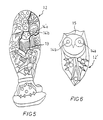
- Figure 5 illustrates another puzzle according to the invention which, when fully reconstituted, represents an owl in twenty-eight fragments.
- the puzzle is partially reconstructed and the different fragments have the same characteristics as those of FIGS. 1 to 4.
- some of the fragments take the form particularity of a well individualized object.
- FIG. 6 which represents a stylized owl head, whose eyes are formed by hollows 14a and 14b substantially hemispherical and whose contour is delimited by a circular recess 15.
- These hollows 14a, 14b are adapted to cooperate with reliefs paired 14'a, 14'b provided on fragment 12 of the figure 5.
- Fragments 12 and 13 are, for more than clarity, delimited by a thicker line in Figure 5.
- Figures 7a and 7b show another form execution of the puzzle according to the invention which represents here, in a reconstructed state, a bear in twenty-two fragments of which only some are visible in these figures.
- the reconstructed puzzle is approximately symmetrical about the longitudinal median plane of the animal represented.
- One of the side faces is monobloc, that is to say that it is formed of a single fragment 16, while the other 17 consists of several three-dimensional fragments such as 18.
- the role of the first monobloc face 16 is to serve both support for fragments of the three-dimensional puzzle and model to reconstruct the other side.
- Figure 8 shows a puzzle according to the invention, in which a fragment of large dimensions (not visible in this figure) serves as wall mount to other puzzle pieces, such as 21 and 22, illustrated on a larger scale in FIG. 8a, which form a single layer on it. It is well understood, however, that the support fragment could be covered with several successive layers of the others fragments.
- Figures 9 and 9a-b illustrate a puzzle according to yet another embodiment of the invention.
- the reconstructed puzzle 101 shown in Figure 9, reproduces an Egyptian goddess bust.
- Each of the fragments 23 to 26 of the puzzle 101 has, on at least one of its opposite surfaces, reliefs or depressions comprising a letter of the Braille alphabet and intended to cooperate, respectively, with the depressions or the reliefs provided on an adjacent fragment.
- the fragment 24 illustrated in FIG. 9a presents, on its lower surface 24I, two circular reliefs 24a and 24b representing the letter c in the Braille alphabet, as well as a rectangular relief 124 which serves to define the direction of reading of the braille sign. highlighting it.
- the reliefs 24a and 24b are respectively paired with depressions 25a and 25b formed in the upper surface 25S of the fragment 25, as seen in FIG. 9b.
- the letters appearing on the different fragments 23-26 of the puzzle can be used to facilitate their assembly by a blind person, a logical series of letters or a word being for example formed as the fragments are assembled each other.
- the fragment 24 can itself be considered as an individualized object within the puzzle to which it belongs.
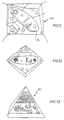
- Figure 13 illustrates a large puzzle 201, called “global puzzle”, whose external shape is that of a pyramid and which is made up of fragments, so-called “primary fragments”, among which were dispersed and integrated other fragments, called “fragments
- the fragments of the puzzle 101 represented in FIG. 9, which will be designated in the following by "secondary puzzle” constitute said secondary fragments.
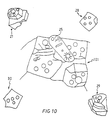
- Figure 10 shows the global puzzle 201 in partially completed state, which includes in particular, as a secondary fragment, the fragment 25 illustrated in FIG. 9b. Although it does is not visible in this figure, the global puzzle 201 also includes, in already formed layers, as other secondary fragments, fragments 23, 24 and 26 illustrated in Figure 9, which are arranged in locations spaced from each other.
- Figure 11 represents the same global puzzle 201 at a later stage of construction, in which the primary fragments 27 to 30, illustrated in figure 10, were assembled to the puzzle overall 201 partially reconstructed.
- Figure 12 represents the complementary puzzle part to that illustrated in Figure 11. It is clear from these figures that the omission of the secondary fragment 25 in the global puzzle 201 does not affect the configuration anymore exterior of this puzzle as its magnetic cohesion. This form of execution therefore achieves a sort of pull-out assembly where secondary fragments can either be embedded within the overall puzzle, either be omitted from it and joined together to form, on the one hand, the puzzle primary which, in this case, will have exactly the same external shape than the global puzzle but will present internal empty spaces and, on the other hand, said puzzle secondary.
- the invention proposes a three-dimensional puzzle, reproducing for example a known sculpture, formed of fragments distinct and arbitrary configuration, which are assembled by magnetic forces and by means mechanical, the latter being constituted by a set reliefs and hollows including the number, size, layout and shape are variable, making the invention particularly well suited to the realization educational games appealing to the sense of touch of users, and therefore particularly suitable for non seers.
Landscapes
- Engineering & Computer Science (AREA)
- Multimedia (AREA)
- Toys (AREA)
- Electrochromic Elements, Electrophoresis, Or Variable Reflection Or Absorption Elements (AREA)
- Devices For Indicating Variable Information By Combining Individual Elements (AREA)
- Hard Magnetic Materials (AREA)
Claims (12)
- Dreidimensionales Puzzle, bestehend aus Stücken (2a-c, 3, 4, 5; 8a-h, 8'a, 8'h; 12, 12', 13; 16, 18; 21, 22; 23-30), die nur eine einzige Stellung im Inneren des Puzzles einnehmen können, wobei mindestens zwei dieser Stücke (2a-c, 3, 4, 5; 8a-h, 8'a, 8'h; 12, 12', 13; 16, 18; 21, 22; 23-30) jeweils mindestens ein magnetisches Element (62a-c, 63a-c) umfassen, das so gerichtet ist, dass diese Stücke sich anziehen, wenn sie richtig positioniert sind, dadurch gekennzeichnet, dass die Oberfläche jedes der Stükke (2a-c, 3, 4, 5; 8a-h, 8'a, 8'h; 12, 12', 13; 16, 18; 21, 22; 23-30) außerdem mindestens mit einer Positionierungserhöhung (9', 10, 11', 109, 110', 209; 14'a-b; 24a-b) und/oder einer Positionierungsvertiefung (9, 10', 11, 109', 110, 209'; 14a-b, 15; 25a-b) versehen ist, die jeweils mit einer Positionierungsvertiefung (9, 10', 11, 109', 110, 209'; 14a-b, 15; 25a-b) und/oder einer Positionierungserhöhung (9', 10, 11', 109, 110', 209; 14'a-b; 24a-b) gepaart werden kann, die auf einem benachbarten Stück (2a-c, 3, 4, 5; 8a-h, 8'a, 8'h; 12, 12', 13; 16, 18; 21, 22; 23-30) vorgesehen ist, wobei die Positionierungserhöhungen (9', 10, 11', 109, 110', 209; 14'a-b; 24a-b) und Positionierungsvertiefungen (9, 10', 11, 109', 110, 209'; 14a-b, 15; 25a-b) jeweils eine einzige Form und/oder Größe haben, so dass die Stücke (2a-c, 3, 4, 5; 8a-h, 8'a, 8'h; 12, 12', 13; 16, 18; 21, 22; 23-30) gleichzeitig durch mechanische und magnetische Mittel zusammengefügt sind,
und dass diese Stücke verschiedene und willkürliche Formen und/oder Abmessungen haben und miteinander längs ihrer einander benachbarten Flächen eng gepaart sind. - Dreidimensionales Puzzle nach Anspruch 1, dadurch gekennzeichnet, dass mindestens eines der Stücke (24, 25) mit einer erhabenen (309; 24a-b) oder vertieften (25a-b) Beschriftung bedeckt ist, die jeweils mindestens einen Teil der Positionierungserhöhungen oder -vertiefungen dieses Stücks bildet.
- Dreidimensionale Puzzle nach Anspruch 2, dadurch gekennzeichnet, dass diese Beschriftung (24a-b, 25a-b) aus einem oder mehreren Buchstaben und/oder einem oder mehreren Ziffern der Blindenschrift besteht.
- Dreidimensionales Puzzle nach einem der Ansprüche 1 bis 3, dadurch gekennzeichnet, dass mindestens eines der Stücke (12'; 24) ein individuelles Objekt darstellt.
- Dreidimensionales Puzzle nach Anspruch 4, dadurch gekennzeichnet, dass die anderen Stücke um dieses Objekt (12'; 24) herum angeordnet sind.
- Dreidimensionales Puzzle nach Anspruch 5, dadurch gekennzeichnet, dass das Objekt opak ist und mindestens manche der anderen Stücke durchscheinend sind.
- Dreidimensionales Puzzle nach einem der Ansprüche 1 bis 3, "Gesamtpuzzle" (201) genannt, dadurch gekennzeichnet, dass es Primärstücke (27-30) und Sekundärstücke (23-26) umfasst, wobei die Sekundärstücke (23-26)dafür ausgelegt sind, in zusammengefügtem Zustand unabhängig von den Primärstücken (27-30) ein dreidimensionales Puzzle, "Sekundärpuzzle" (101) genannt, zu bilden, das ein individuelles Objekt darstellt, undzwischen den Primärstücken (27-30) verteilt und eingefügt werden können, um das Gesamtpuzzle (201) zu bilden.
- Dreidimensionales Puzzle nach einem der Ansprüche 5 bis 7, dadurch gekennzeichnet, dass die äußere Konfiguration und die Kohäsion des Gesamtpuzzles (201) vom Vorhandensein dieses Objekts oder dieser Sekundärstücke (23-26) unabhängig sind.
- Dreidimensionales Puzzle nach einem der Ansprüche 1 bis 3, dadurch gekennzeichnet, dass das zusammengesetzte Puzzle aus zwei Teilen (16, 17) besteht, die bezüglich einer Mittelebene im wesentlichen symmetrisch sind, und eines dieser Stücke (16) im wesentlichen einen dieser Teile bildet.
- Dreidimensionales Puzzle nach einem der Ansprüche 1 bis 3, dadurch gekennzeichnet, dass es außerdem einen Träger besitzt, der von mindestens einer durchgehenden, im wesentlichen ebenen Fläche gebildet wird, die mindestens ein magnetisches Element aufweist und mit Positionierungserhöhungen und/oder -vertiefungen versehen ist, die dafür ausgelegt sind, mindestens mit manchen der Positionierungsvertiefungen und/oder -erhöhungen der Stücke (21, 22) zusammenzuwirken, so dass diese Stücke (21, 22) auf dieser Fläche mindestens eine Schicht bilden.
- Dreidimensionales Puzzle nach einem der vorhergehenden Ansprüche, dadurch gekennzeichnet, dass es im zusammengesetzten Zustand ein Kunstwerk darstellt.
- Verwendung des dreidimensionalen Puzzles nach einem der Ansprüche 3 bis 11 für das Erlernen der Blindenschrift.
Applications Claiming Priority (3)
| Application Number | Priority Date | Filing Date | Title |
|---|---|---|---|
| FR9505121A FR2733433B1 (fr) | 1995-04-28 | 1995-04-28 | Puzzle tridimensionnel a cohesion magnetique et mecanique |
| FR9505121 | 1995-04-28 | ||
| PCT/FR1996/000625 WO1996033785A1 (fr) | 1995-04-28 | 1996-04-24 | Puzzle tridimensionnel a cohesion magnetique et mecanique, destine notamment a un usage par des non-voyants |
Publications (2)
| Publication Number | Publication Date |
|---|---|
| EP0828540A1 EP0828540A1 (de) | 1998-03-18 |
| EP0828540B1 true EP0828540B1 (de) | 2001-07-11 |
Family
ID=9478541
Family Applications (1)
| Application Number | Title | Priority Date | Filing Date |
|---|---|---|---|
| EP96914236A Expired - Lifetime EP0828540B1 (de) | 1995-04-28 | 1996-04-24 | Dreidimensionelles, magnetisch und mechanisch zusammengehaltenes geduldspiel, insbesondere zum gebrauch von blinden |
Country Status (7)
| Country | Link |
|---|---|
| US (1) | US5895044A (de) |
| EP (1) | EP0828540B1 (de) |
| JP (1) | JP3724808B2 (de) |
| AT (1) | ATE202945T1 (de) |
| DE (1) | DE69613838D1 (de) |
| FR (1) | FR2733433B1 (de) |
| WO (1) | WO1996033785A1 (de) |
Families Citing this family (19)
| Publication number | Priority date | Publication date | Assignee | Title |
|---|---|---|---|---|
| FR2765118B1 (fr) * | 1997-06-27 | 1999-10-01 | Jean Charles Nahon | Jeu de patience comprenant une pluralite de pieces a assembler |
| DE29809820U1 (de) * | 1998-05-15 | 1998-08-13 | Weber, Jean-Marc, Wetzikon | Zusammensetzbarer symmetrischer Körper |
| US6547244B2 (en) | 2000-08-25 | 2003-04-15 | Danielle Connelly | Game board apparatus for use by the sight-impaired |
| US6623007B2 (en) | 2001-09-14 | 2003-09-23 | William M. Logue | Multi-piece 3-D structure of an image with releasable friction-interlock |
| US7273375B2 (en) * | 2003-01-24 | 2007-09-25 | Wolf Roger P | Teaching aid device and method of teaching |
| US20060071424A1 (en) * | 2004-10-05 | 2006-04-06 | Len Burge | Three-dimensional puzzle |
| US20110227285A1 (en) * | 2005-10-06 | 2011-09-22 | June Kessler | Puzzle assembly |
| CA2538431A1 (en) * | 2006-02-22 | 2007-08-22 | Su-Lian Chuang | Three dimensional jigsaw puzzle |
| US7584565B2 (en) * | 2006-10-05 | 2009-09-08 | Jazwares, Inc. | Jigsaw puzzle display frame |
| US20090309302A1 (en) * | 2008-06-16 | 2009-12-17 | Jerry Joe Langin-Hooper | Logic puzzle |
| US8074989B1 (en) * | 2010-06-23 | 2011-12-13 | Bassett Donald F | Puzzle for the physically or visually impaired |
| WO2015005644A1 (ko) * | 2013-07-10 | 2015-01-15 | 한경대학교 산학협력단 | 시각 장애인용 퍼즐 기구 |
| KR101325487B1 (ko) * | 2013-07-10 | 2013-11-07 | 한경대학교 산학협력단 | 시각 장애인용 퍼즐 기구 |
| WO2016023066A1 (en) * | 2014-08-11 | 2016-02-18 | Lavermicocca, Giovanni | Improved three dimensional puzzle |
| US9836981B2 (en) * | 2015-06-29 | 2017-12-05 | John David Skeete | Puzzle teaching system |
| US10265638B2 (en) * | 2016-03-16 | 2019-04-23 | Volodymyr Gutnyk | Three-dimensional magnetic construction kit-toy |
| GB201806760D0 (en) * | 2018-04-25 | 2018-06-06 | Smith Thomas Colin | Puzzle |
| KR102679105B1 (ko) * | 2021-01-25 | 2024-06-27 | 대구대학교 산학협력단 | 입체형 퍼즐 |
| FR3126184B1 (fr) * | 2021-08-23 | 2024-03-29 | Julie Stelianides | Ensemble d’éléments à assembler, notamment pour personnes malvoyantes |
Family Cites Families (12)
| Publication number | Priority date | Publication date | Assignee | Title |
|---|---|---|---|---|
| US2570625A (en) * | 1947-11-21 | 1951-10-09 | Zimmerman Harry | Magnetic toy blocks |
| US3564735A (en) * | 1967-06-26 | 1971-02-23 | Raymond James Fisher | Tactile toys |
| US3523384A (en) * | 1967-12-13 | 1970-08-11 | Adelson Louis | Fastenable three-dimensional puzzle pieces |
| US3596380A (en) * | 1970-01-08 | 1971-08-03 | James J Williams | Combination toy and educational apparatus |
| US3689075A (en) * | 1970-07-31 | 1972-09-05 | Adelson Louis | Three-dimensional puzzles |
| US3779558A (en) * | 1972-01-12 | 1973-12-18 | C Moreau | Alternative puzzle system |
| FR2569126A1 (fr) * | 1974-05-30 | 1986-02-21 | Couvelaire Marie | Jeu de construction dit puzzle pouvant servir egalement de revetement decoratif |
| US4513970A (en) * | 1983-01-24 | 1985-04-30 | Ovidiu Opresco | Polymorphic twist puzzle |
| IT1224133B (it) * | 1984-12-17 | 1990-09-26 | Giorgio Giorgi | Gioco geometrico i cui pezzi combinandosi danno luogo a numerosissime figure geometriche |
| FR2614210B1 (fr) * | 1987-04-22 | 1990-06-15 | Beroff Andre | Structure constituee de modules polyedriques articules avec moyens de maintien en forme utilisable notamment comme jeu. |
| US4865324A (en) * | 1988-02-04 | 1989-09-12 | Dov Nesis | Magnetic wheel puzzle |
| US5127652A (en) * | 1990-11-09 | 1992-07-07 | Vicki Unger | Toy and puzzle with reversible breakability |
-
1995
- 1995-04-28 FR FR9505121A patent/FR2733433B1/fr not_active Expired - Fee Related
-
1996
- 1996-04-24 AT AT96914236T patent/ATE202945T1/de not_active IP Right Cessation
- 1996-04-24 US US08/930,550 patent/US5895044A/en not_active Expired - Fee Related
- 1996-04-24 DE DE69613838T patent/DE69613838D1/de not_active Expired - Lifetime
- 1996-04-24 WO PCT/FR1996/000625 patent/WO1996033785A1/fr not_active Ceased
- 1996-04-24 EP EP96914236A patent/EP0828540B1/de not_active Expired - Lifetime
- 1996-04-24 JP JP53222296A patent/JP3724808B2/ja not_active Expired - Fee Related
Also Published As
| Publication number | Publication date |
|---|---|
| WO1996033785A1 (fr) | 1996-10-31 |
| JPH11503948A (ja) | 1999-04-06 |
| US5895044A (en) | 1999-04-20 |
| DE69613838D1 (de) | 2001-08-16 |
| ATE202945T1 (de) | 2001-07-15 |
| FR2733433B1 (fr) | 1997-06-27 |
| EP0828540A1 (de) | 1998-03-18 |
| JP3724808B2 (ja) | 2005-12-07 |
| FR2733433A1 (fr) | 1996-10-31 |
Similar Documents
| Publication | Publication Date | Title |
|---|---|---|
| EP0828540B1 (de) | Dreidimensionelles, magnetisch und mechanisch zusammengehaltenes geduldspiel, insbesondere zum gebrauch von blinden | |
| CA2242008A1 (fr) | Jeu de patience comprenant une pluralite de pieces a assembler | |
| FR2735375A1 (fr) | Objet tridimensionnel reconstitue a la maniere d'un puzzle a partir de pieces fragmentaires | |
| FR2511604A1 (fr) | Puzzle sous forme de cube | |
| EP2282821B1 (de) | Spiel mit kleinen magnetisch nebeneinander platzierbaren und stapelbaren würfeln | |
| CA2206353C (fr) | Taille papillon | |
| FR2533450A1 (fr) | Procede pour produire un puzzle | |
| FR2545370A1 (fr) | Structure a elements multiples, telle qu'un puzzle, et procede pour l'utiliser | |
| JP3759369B2 (ja) | 組合せ型リング | |
| FR2906158A1 (fr) | Jeu de combinaison utilisant la rotation et le retournement des faces d'un cube forme de petits cubes lies entre eux mecaniquement et magnetiquement. | |
| FR2911792A1 (fr) | Casse-tete en trois dimensions compose de cubes a reconstituer solidaires entre eux permettant une diversite de formes geometriques finales a obtenir | |
| Bourneuf | Un Procédé narratif: les récits alternés | |
| EP0106770B1 (de) | Bausteine, besonders für Konstruktions- oder Puzzlespiele und solche Spiele | |
| FR2774306A1 (fr) | Dispositif de jeu | |
| FR3103690A1 (fr) | Pièce d’ameublement ou de décoration personnalisable | |
| FR2753127A1 (fr) | Meubles obtenus par pliage d'un materiau en feuille semi-rigide, leur procede d'obtention et flans destines a la mise en oeuvre de ce procede | |
| Foucher | The Portraits of Septimius Severus (AD 193-211) | |
| JP3061865U (ja) | キーホルダー飾り具 | |
| WO1995015797A1 (fr) | Assortiment de jeux se composant chacun d'une planche de jeu et d'une serie de pions | |
| FR2534145A1 (fr) | Puzzle tridimensionnel | |
| Durand et al. | Entre Gautier et Du Camp. D’une dédicace à l’autre: la position des Fleurs du Mal | |
| BE464481A (de) | ||
| FR2512350A1 (fr) | Jeux casse-tete a partir d'elements imbriques | |
| FR3062316A1 (fr) | Jouet du type casse-tete tridimensionnel | |
| Sosoe | Kantian Ethics and SocialismHarry van der Linden Indianapolis, IN, Hackett Publishing Company, 1988, xii, 370 p. |
Legal Events
| Date | Code | Title | Description |
|---|---|---|---|
| PUAI | Public reference made under article 153(3) epc to a published international application that has entered the european phase |
Free format text: ORIGINAL CODE: 0009012 |
|
| 17P | Request for examination filed |
Effective date: 19971113 |
|
| AK | Designated contracting states |
Kind code of ref document: A1 Designated state(s): AT BE CH DE ES FR GB GR IT LI SE |
|
| GRAG | Despatch of communication of intention to grant |
Free format text: ORIGINAL CODE: EPIDOS AGRA |
|
| 17Q | First examination report despatched |
Effective date: 20000922 |
|
| GRAG | Despatch of communication of intention to grant |
Free format text: ORIGINAL CODE: EPIDOS AGRA |
|
| GRAH | Despatch of communication of intention to grant a patent |
Free format text: ORIGINAL CODE: EPIDOS IGRA |
|
| GRAH | Despatch of communication of intention to grant a patent |
Free format text: ORIGINAL CODE: EPIDOS IGRA |
|
| GRAA | (expected) grant |
Free format text: ORIGINAL CODE: 0009210 |
|
| AK | Designated contracting states |
Kind code of ref document: B1 Designated state(s): AT BE CH DE ES FR GB GR IT LI SE |
|
| PG25 | Lapsed in a contracting state [announced via postgrant information from national office to epo] |
Ref country code: IT Free format text: LAPSE BECAUSE OF FAILURE TO SUBMIT A TRANSLATION OF THE DESCRIPTION OR TO PAY THE FEE WITHIN THE PRESCRIBED TIME-LIMIT;WARNING: LAPSES OF ITALIAN PATENTS WITH EFFECTIVE DATE BEFORE 2007 MAY HAVE OCCURRED AT ANY TIME BEFORE 2007. THE CORRECT EFFECTIVE DATE MAY BE DIFFERENT FROM THE ONE RECORDED. Effective date: 20010711 Ref country code: AT Free format text: LAPSE BECAUSE OF FAILURE TO SUBMIT A TRANSLATION OF THE DESCRIPTION OR TO PAY THE FEE WITHIN THE PRESCRIBED TIME-LIMIT Effective date: 20010711 |
|
| REF | Corresponds to: |
Ref document number: 202945 Country of ref document: AT Date of ref document: 20010715 Kind code of ref document: T |
|
| REG | Reference to a national code |
Ref country code: CH Ref legal event code: EP |
|
| REF | Corresponds to: |
Ref document number: 69613838 Country of ref document: DE Date of ref document: 20010816 |
|
| PG25 | Lapsed in a contracting state [announced via postgrant information from national office to epo] |
Ref country code: SE Free format text: LAPSE BECAUSE OF FAILURE TO SUBMIT A TRANSLATION OF THE DESCRIPTION OR TO PAY THE FEE WITHIN THE PRESCRIBED TIME-LIMIT Effective date: 20011011 |
|
| PG25 | Lapsed in a contracting state [announced via postgrant information from national office to epo] |
Ref country code: GR Free format text: LAPSE BECAUSE OF FAILURE TO SUBMIT A TRANSLATION OF THE DESCRIPTION OR TO PAY THE FEE WITHIN THE PRESCRIBED TIME-LIMIT Effective date: 20011012 Ref country code: DE Free format text: LAPSE BECAUSE OF FAILURE TO SUBMIT A TRANSLATION OF THE DESCRIPTION OR TO PAY THE FEE WITHIN THE PRESCRIBED TIME-LIMIT Effective date: 20011012 |
|
| GBT | Gb: translation of ep patent filed (gb section 77(6)(a)/1977) |
Effective date: 20011005 |
|
| REG | Reference to a national code |
Ref country code: CH Ref legal event code: NV Representative=s name: CRONIN INTELLECTUAL PROPERTY |
|
| REG | Reference to a national code |
Ref country code: GB Ref legal event code: IF02 |
|
| PG25 | Lapsed in a contracting state [announced via postgrant information from national office to epo] |
Ref country code: ES Free format text: LAPSE BECAUSE OF FAILURE TO SUBMIT A TRANSLATION OF THE DESCRIPTION OR TO PAY THE FEE WITHIN THE PRESCRIBED TIME-LIMIT Effective date: 20020131 |
|
| PLBE | No opposition filed within time limit |
Free format text: ORIGINAL CODE: 0009261 |
|
| STAA | Information on the status of an ep patent application or granted ep patent |
Free format text: STATUS: NO OPPOSITION FILED WITHIN TIME LIMIT |
|
| 26N | No opposition filed | ||
| PG25 | Lapsed in a contracting state [announced via postgrant information from national office to epo] |
Ref country code: FR Free format text: LAPSE BECAUSE OF NON-PAYMENT OF DUE FEES Effective date: 20021231 |
|
| REG | Reference to a national code |
Ref country code: FR Ref legal event code: ST |
|
| PGFP | Annual fee paid to national office [announced via postgrant information from national office to epo] |
Ref country code: CH Payment date: 20070410 Year of fee payment: 12 |
|
| REG | Reference to a national code |
Ref country code: CH Ref legal event code: PCAR Free format text: CRONIN INTELLECTUAL PROPERTY;CHEMIN DE PRECOSSY 31;1260 NYON (CH) |
|
| PGFP | Annual fee paid to national office [announced via postgrant information from national office to epo] |
Ref country code: GB Payment date: 20070418 Year of fee payment: 12 |
|
| PGFP | Annual fee paid to national office [announced via postgrant information from national office to epo] |
Ref country code: BE Payment date: 20070430 Year of fee payment: 12 |
|
| BERE | Be: lapsed |
Owner name: *BAHRAMIAN MOHAMMAD HOSSEIN Effective date: 20080430 |
|
| REG | Reference to a national code |
Ref country code: CH Ref legal event code: PL |
|
| GBPC | Gb: european patent ceased through non-payment of renewal fee |
Effective date: 20080424 |
|
| PG25 | Lapsed in a contracting state [announced via postgrant information from national office to epo] |
Ref country code: LI Free format text: LAPSE BECAUSE OF NON-PAYMENT OF DUE FEES Effective date: 20080430 Ref country code: CH Free format text: LAPSE BECAUSE OF NON-PAYMENT OF DUE FEES Effective date: 20080430 |
|
| PG25 | Lapsed in a contracting state [announced via postgrant information from national office to epo] |
Ref country code: BE Free format text: LAPSE BECAUSE OF NON-PAYMENT OF DUE FEES Effective date: 20080430 |
|
| PG25 | Lapsed in a contracting state [announced via postgrant information from national office to epo] |
Ref country code: GB Free format text: LAPSE BECAUSE OF NON-PAYMENT OF DUE FEES Effective date: 20080424 |