EP0829295A2 - Catalyseur et procédé de purification catalytique des gaz d'échappement d'un procédé DMT - Google Patents
Catalyseur et procédé de purification catalytique des gaz d'échappement d'un procédé DMT Download PDFInfo
- Publication number
- EP0829295A2 EP0829295A2 EP97112481A EP97112481A EP0829295A2 EP 0829295 A2 EP0829295 A2 EP 0829295A2 EP 97112481 A EP97112481 A EP 97112481A EP 97112481 A EP97112481 A EP 97112481A EP 0829295 A2 EP0829295 A2 EP 0829295A2
- Authority
- EP
- European Patent Office
- Prior art keywords
- catalyst
- exhaust gas
- component
- oxidation
- dmt
- Prior art date
- Legal status (The legal status is an assumption and is not a legal conclusion. Google has not performed a legal analysis and makes no representation as to the accuracy of the status listed.)
- Withdrawn
Links
Images
Classifications
-
- B—PERFORMING OPERATIONS; TRANSPORTING
- B01—PHYSICAL OR CHEMICAL PROCESSES OR APPARATUS IN GENERAL
- B01D—SEPARATION
- B01D53/00—Separation of gases or vapours; Recovering vapours of volatile solvents from gases; Chemical or biological purification of waste gases, e.g. engine exhaust gases, smoke, fumes, flue gases, aerosols
- B01D53/34—Chemical or biological purification of waste gases
- B01D53/74—General processes for purification of waste gases; Apparatus or devices specially adapted therefor
- B01D53/86—Catalytic processes
- B01D53/8668—Removing organic compounds not provided for in B01D53/8603 - B01D53/8665
-
- B—PERFORMING OPERATIONS; TRANSPORTING
- B01—PHYSICAL OR CHEMICAL PROCESSES OR APPARATUS IN GENERAL
- B01J—CHEMICAL OR PHYSICAL PROCESSES, e.g. CATALYSIS OR COLLOID CHEMISTRY; THEIR RELEVANT APPARATUS
- B01J23/00—Catalysts comprising metals or metal oxides or hydroxides, not provided for in group B01J21/00
- B01J23/38—Catalysts comprising metals or metal oxides or hydroxides, not provided for in group B01J21/00 of noble metals
- B01J23/40—Catalysts comprising metals or metal oxides or hydroxides, not provided for in group B01J21/00 of noble metals of the platinum group metals
-
- B—PERFORMING OPERATIONS; TRANSPORTING
- B01—PHYSICAL OR CHEMICAL PROCESSES OR APPARATUS IN GENERAL
- B01D—SEPARATION
- B01D53/00—Separation of gases or vapours; Recovering vapours of volatile solvents from gases; Chemical or biological purification of waste gases, e.g. engine exhaust gases, smoke, fumes, flue gases, aerosols
- B01D53/34—Chemical or biological purification of waste gases
- B01D53/74—General processes for purification of waste gases; Apparatus or devices specially adapted therefor
- B01D53/86—Catalytic processes
-
- B—PERFORMING OPERATIONS; TRANSPORTING
- B01—PHYSICAL OR CHEMICAL PROCESSES OR APPARATUS IN GENERAL
- B01J—CHEMICAL OR PHYSICAL PROCESSES, e.g. CATALYSIS OR COLLOID CHEMISTRY; THEIR RELEVANT APPARATUS
- B01J21/00—Catalysts comprising the elements, oxides, or hydroxides of magnesium, boron, aluminium, carbon, silicon, titanium, zirconium, or hafnium
- B01J21/06—Silicon, titanium, zirconium or hafnium; Oxides or hydroxides thereof
- B01J21/063—Titanium; Oxides or hydroxides thereof
-
- B—PERFORMING OPERATIONS; TRANSPORTING
- B01—PHYSICAL OR CHEMICAL PROCESSES OR APPARATUS IN GENERAL
- B01J—CHEMICAL OR PHYSICAL PROCESSES, e.g. CATALYSIS OR COLLOID CHEMISTRY; THEIR RELEVANT APPARATUS
- B01J27/00—Catalysts comprising the elements or compounds of halogens, sulfur, selenium, tellurium, phosphorus or nitrogen; Catalysts comprising carbon compounds
- B01J27/02—Sulfur, selenium or tellurium; Compounds thereof
- B01J27/053—Sulfates
-
- B—PERFORMING OPERATIONS; TRANSPORTING
- B01—PHYSICAL OR CHEMICAL PROCESSES OR APPARATUS IN GENERAL
- B01J—CHEMICAL OR PHYSICAL PROCESSES, e.g. CATALYSIS OR COLLOID CHEMISTRY; THEIR RELEVANT APPARATUS
- B01J35/00—Catalysts, in general, characterised by their form or physical properties
- B01J35/50—Catalysts, in general, characterised by their form or physical properties characterised by their shape or configuration
- B01J35/56—Foraminous structures having flow-through passages or channels, e.g. grids or three-dimensional [3D] monoliths
-
- B—PERFORMING OPERATIONS; TRANSPORTING
- B01—PHYSICAL OR CHEMICAL PROCESSES OR APPARATUS IN GENERAL
- B01J—CHEMICAL OR PHYSICAL PROCESSES, e.g. CATALYSIS OR COLLOID CHEMISTRY; THEIR RELEVANT APPARATUS
- B01J37/00—Processes, in general, for preparing catalysts; Processes, in general, for activation of catalysts
- B01J37/02—Impregnation, coating or precipitation
- B01J37/0201—Impregnation
-
- B—PERFORMING OPERATIONS; TRANSPORTING
- B01—PHYSICAL OR CHEMICAL PROCESSES OR APPARATUS IN GENERAL
- B01J—CHEMICAL OR PHYSICAL PROCESSES, e.g. CATALYSIS OR COLLOID CHEMISTRY; THEIR RELEVANT APPARATUS
- B01J37/00—Processes, in general, for preparing catalysts; Processes, in general, for activation of catalysts
- B01J37/08—Heat treatment
Definitions
- the invention relates to a catalyst for processes for the purification of pressurized exhaust gases, such as those obtained after the oxidation of para-xylene (pX) with air in the liquid phase in the production of dimethyl terephthalate (DMT).
- a method for producing such a catalyst and a process for the purification of pressurized exhaust gases such as those obtained after the oxidation of para-xylene (pX) with air in the liquid phase in the production of dimethyl terephthalate (DMT)
- the pressurized, oxygen-containing exhaust gas from the oxidation being initially removed a one- or multi-stage condensation, a one- or multi-stage absorption and subsequently, optionally with the addition of oxygen, is carried out via a catalytic post-combustion operated under pressure.
- DMT i.e. H. to produce terephthalic acid of appropriate quality from particularly high-DMT fractions or high-purity DMT by targeted hydrolysis.
- the oxidation of a mixture of para-xylene (pX) and para-toluic acid methyl ester (p-TE or pT ester) is generally carried out with atmospheric oxygen in the presence of a heavy metal catalyst (DE-PS 20 10 137) at a temperature of about 140 to 180 ° C and a pressure of about 4 to 8 bar abs. carried out in the liquid phase.
- the oxidation stage results in a reaction mixture which contains predominantly monomethyl terephthalate (MMT), p-toluic acid (p-TA) and terephthalic acid (TA) dissolved or suspended in p-TE and with methanol at a temperature of about 250 to 280 ° C. and a pressure of 20 to 25 bar abs. is esterified.
- MMT monomethyl terephthalate
- p-TA p-toluic acid
- TA terephthalic acid
- an exhaust gas is generated during the oxidation, which is largely saturated with aliphatic and aromatic compounds depending on the pressure and temperature.
- the exhaust gas also contains reaction by-products, including the low-boiling compounds acetaldehyde, formaldehyde and the corresponding methyl acetals, dimethyl ether, acetic acid and formic acid and their methyl esters.
- the waste gas from the oxidation essentially contains atmospheric nitrogen, a residual oxygen content of 0.5 to 4% by weight, CO 2 with 1 to 3% by weight and 0.3 to 2.0% by weight of CO .
- the exhaust gas is usually first cooled in several stages, with the higher and medium-boiling valuable products gradually condensing out.
- the valuable products remaining in the exhaust gas predominantly methanol and pX, are subsequently removed in a multi-stage absorption except for traces from the exhaust gas, the valuable products enriched in the absorbents being returned to the process.
- EP 0 544 729 B1 discloses a process for purifying an oxidizing exhaust gas, which originates from an air oxidation of xylene and is under a pressure of 5 to 50 bar, wherein at least the xylene is initially under pressure in an exhaust gas scrubbing by absorption with an ester, for example para -Toluylklaremethylester (p-TE) or benzoic acid methyl ester (BME) or an ester mixture, for example from p-TE and BME, is largely removed.
- an ester for example para -Toluylklaremethylester (p-TE) or benzoic acid methyl ester (BME) or an ester mixture, for example from p-TE and BME, is largely removed.
- a condensation stage can also be connected upstream of the absorption.
- the oxidizable substances still present in the exhaust gas after the absorptive cleaning are to be burned under pressure and the exhaust gas under pressure is to be used in an expansion turbine to generate energy.
- Such combustion units necessary for the combustion of exhaust gases under pressure are complex and expensive, both in terms of purchase and in operation.
- suitable pressure combustion chambers are practically no longer available on the market.
- EP 0 544 726 B1 mentions the possibility of catalytically burning the oxidizable constituents in the exhaust gas, the exhaust gas to be burned generally being saturated with water vapor after the absorption scrubbing.
- VDI guideline 3476 Catalytic processes for exhaust gas cleaning , VDI Handbook for Air Quality, Volume 6 (June 1990), describes, among other things, the removal of CO, hydrocarbons and NO x from car exhaust gases using Pt / Rh / Pd on ceramic substrates at temperatures of 300 to 950 ° C.
- noble metal or metal oxide catalysts on ceramic supports, surface-rich supported catalysts or full contacts are also mentioned in general.
- EP 0 664 148 A1 teaches a process for cleaning pressurized exhaust gases by catalytic afterburning at an operating temperature between 250 and 800 ° C. and pressures between 2 and 20 bar, in particular using catalysts with platinum and / or palladium on ⁇ - Alumina.
- the invention was therefore based on the object of providing a catalyst system which meets the requirements for purifying the waste gases resulting from the production of DMT in the oxidation. Another concern of the present invention was to integrate such exhaust gas purification measures into the DMT process from an economic point of view.
- a catalyst which contains at least one oxide of titanium and at least one element from subgroup VIII of the Periodic Table of the Elements in metallic and / or oxidic form is outstanding for the process for purifying exhaust gas under pressure , which comes from the oxidation of para-xylene (pX) with air in the liquid phase in the production of dimethyl terephthalate (DMT), is suitable, since even after a comparatively long operating period there was no significant deactivation, the required exhaust gas values could be met and is characterized by excellent economic service life.
- pX para-xylene
- DMT dimethyl terephthalate
- the titanium oxide or a precursor compound for component a) suitably originates from the so-called sulfate process, so that the catalyst according to the invention preferably contains sulfate as further component c), with component c) being obtained in particular in amounts of 0.1 to 10% by weight on its weight.
- Sulfate as component c) can be present in the catalyst according to the invention as such or, for example, also as hydrogen sulfate or oxide sulfate or water-containing oxide sulfate of a corresponding metal or as sulfuric acid attached to or adhering to an oxidic metal compound.
- Sulphate can also coexist in several of the aforementioned forms.
- Component a) is suitably present in the catalyst according to the invention as titanium dioxide, for example as rutile. However, component a) is preferably predominantly in the anatase form in the catalyst according to the invention. However, titanium oxides with oxygen deficiency or water-containing oxides, oxide hydroxides or hydroxides or sulfates, including the hydrogen sulfates, for example oxide sulfates or water-containing oxide sulfate of titanium, or titanium oxides with attached or adhering sulfuric acid can also be present. Component b) may also be present in a proportion in a sulfate form in the catalyst according to the invention.
- the catalyst according to the invention can suitably be used as additional components barium sulfate and / or oxides of tungsten and / or oxides of vanadium and / or oxides of zircon and / or corresponding sulfates and / or phosphates, including the hydrogen phosphates, and / or oxides of silicon and / or Contain silicates.
- the structure of the catalyst according to the invention can be spherical, tubular, ring-shaped or also saddle-shaped or honeycomb-shaped.
- Catalysts according to the invention generally have around 200 to 2,000 m 2 / m 3 of geometric surface, preferably extrudates, for example with a diameter of 4 mm.
- the present invention also relates to a process for the preparation of a catalyst according to claims 1 to 9, which is characterized in that component b) is impregnated onto moldings which contain at least component a), individually or in a mixture, by immersion and / or spray applies.
- a method for producing shaped carriers based on titanium oxide, also called shaped bodies, is known, for. B. disclosed in DE-PS 26 58 569.
- shaped bodies based on titanium oxide as can be obtained, inter alia, from the preparation and extrusion of moldable titanium oxide-containing materials, subsequent drying and calcination of the shaped bodies, and suitably a BET surface area between 10 to 200 m 2 / g and have a pore volume between 0.1 and 0.6 cm 3 / g.
- the moldings can be reinforced, for example by glass fibers, to improve the mechanical properties.
- component b) of the catalyst according to the invention is applied to the support by a so-called impregnation, the moldings generally being brought into contact with a solution which contains component b) suitably in the form of dissolved salts.
- a solution is used for the impregnation of the moldings, for the preparation of which component b) is preferably used as nitrate.
- the impregnation can be carried out by spraying the moldings one or more times with a solution or by immersing the moldings one or more times in a solution.
- the impregnated moldings are suitably dried, preferably with access to air, in a temperature range from 30 to 650 ° C. and post-calcined, i.e. that is, thermally aftertreated.
- component b) can be fixed on the molded body by simple thermal treatment of the impregnated molded bodies in metallic and / or oxidic form and without further residues, such as, for example, halides. Furthermore, costly and time-consuming work steps, such as those required for 'wash coating' or a reduction step with hydrogen in the gas phase, can also be saved.
- Component b) is preferably present for the most part in the region of the surface of the shaped catalyst body in the catalyst according to the invention, ie. that is, so-called shell impregnation is preferred here.
- the component according to the invention preferably contains platinum and / or palladium and / or rhodium as component b).
- the present invention further relates to a process for the purification of pressurized exhaust gases, such as those obtained after the oxidation of para-xylene (pX) with air in the liquid phase in the production of dimethyl terephthalate (DMT), the pressurized, oxygen-containing one Exhaust gas from the oxidation is first passed through a single or multi-stage condensation, a single or multi-stage absorption and subsequently, optionally with the addition of oxygen, via a catalytic post-combustion operated under pressure, which is characterized in that one is used for the catalytic post-combustion Catalyst according to claims 1 to 13 is used.
- pressurized exhaust gases such as those obtained after the oxidation of para-xylene (pX) with air in the liquid phase in the production of dimethyl terephthalate (DMT)
- the pressurized, oxygen-containing one Exhaust gas from the oxidation is first passed through a single or multi-stage condensation, a single or multi-stage absorption and subsequently,
- the valuable products contained in the exhaust gas - essentially pX, p-TE, DMT, methyl benzoate (BME) - are obtained from the oxidation exhaust gas of an air oxidation of pX. and methanol - in a condensation unit, possibly also in the downstream scrubber or absorption unit, for the most part removed and returned to the process in a suitable manner.
- the condensation is usually at temperatures in the range from 15 to 80 ° C and pressures from 3 to 20 bar abs. operated.
- the exhaust gas coming from the condensation which is under pressure, is suitably first heated in a countercurrent heat exchanger, for example from approx. 25 ° C. to around 120 ° C. at pressures of 3 to 20 bar abs., And then fed into a scrubber unit.
- the absorption unit can consist of several scrubber stages, for example exhaust gas scrubbing with BME or an ester mixture can take place first.
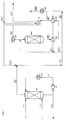
- FIG. 1 shows a preferred embodiment of the method according to the invention, cf. Legend.
- the exhaust gas (110) can be suitably saturated with the waste water (100) obtained in the process, the so-called process water generally containing organic components.
- the so-called process water generally containing organic components.
- a so-called saturator (AS) is used for this.
- the process water is preferably circulated via a pump (P1) and a heat exchanger (W1) heated with low pressure steam and fed in at the top of the saturator (AS) .
- the exhaust gas is saturated with water and the essentially volatile organic substances contained in the original process water.
- a small part of the waste water (120) can be drawn off from the sump part of the saturator (AS) , for example at an appropriate point in the process.
- the exhaust gas leaving the absorption unit usually contains by-products, such as CO, and low-boiling compounds, such as CO.
- by-products such as CO
- low-boiling compounds such as CO.
- the exhaust gas under pressure can now be sent to a catalytic post-combustion.
- the catalytic converter according to the invention is used here for catalytic afterburning (KNV) .
- the catalytic afterburning reactor is usually designed as a fixed bed reactor and can accommodate both bulk and monolithic catalysts.
- Honeycomb-shaped monoliths are suitably used, which are generally distinguished by a very low pressure drop, which has a positive effect in the exhaust gas purification process according to the invention, in particular in the energy recovery by an exhaust gas turbine.
- the catalytic afterburning is preferably carried out at pressures between 2 and 20 bar abs., Particularly preferably 5 to 10 bar abs., And a working temperature between 160 and 650 ° C., particularly preferably between 200 and 550 ° C.
- GHSV space velocity
- process air (141) is usually first heated via an electrically operated heat exchanger (W4) and passed over the reactor (KNV) until it has reached its intended operating temperature, which ensures that the catalytic converter starts up .
- the reactor can then be exposed to exhaust gas.
- the catalytic post-combustion then runs largely self-sufficiently thermally.
- the exhaust gas upstream of the catalyst usually contains vaporous water in amounts of 0.04 to 2.8 kg / Nm 3 , in particular 0.1 to 0.4 kg water per Nm 3 exhaust gas.
- the exhaust gas stream (150) to be cleaned is countercurrently cleaned with the exhaust gas emerging from the reactor before entering the catalyst region Exhaust gas (clean gas) (180) preheated (160, 161, 170) by a suitable arrangement of appropriate heat exchangers (W2, W3 ) .
- the oxidation in the DMT process is generally adjusted so that the oxygen required for catalytic combustion is present in the exhaust gas before the exhaust gas enters the reactor.
- the oxygen content in the exhaust gas (130) can be increased if necessary by supplying compressed air (140) .
- compressed air 140
- the oxygen content in the clean gas (180, 190) is preferably set to a value of 0.5 to 2% by volume.
- the clean gas (190) can be expanded via an exhaust gas turbine (TU) to generate mechanical or electrical energy.
- an exhaust gas turbine For the energy recovery by means of an expansion turbine, use is generally made of clean gas streams which are abs under a pressure of preferably more than 3 bar. stand. Since the exhaust gas usually now meets the requirements, it can be discharged through a chimney (210) .
- the temperature can be controlled, if necessary by supplying unheated exhaust gas, in such a way that the clean gas leaving the exhaust gas turbine has a temperature of approximately 125 ° C.
- the clean gas stream can also be branched off at least in part upstream of the turbine, cooled to temperatures of ⁇ 40 ° C. after appropriate drying (W 5) and suitably as an inert gas, for example for Blanketing in the process, reuse (200) .
- Figure 1 shows a preferred embodiment of the method according to the invention for cleaning pressurized exhaust gases from the oxidation in the Witten-DMT process.
- Table 1 a + b shows material flows, their composition and the respective operating conditions, cf. Legend.
- the flue gas and waste water quantities and their compositions are typical for a DMT / PTA system with a capacity of 240 kt / a.
- the wastewater (20,000 kg / h) (100) from the DMT / PTA plant is fed into the upper part of the saturator.
- the saturator is equipped with either valve bottoms or with structured packing.
- the wastewater is circulated (121) by means of a circulation pump (P1) via a heat exchanger (W1) heated with low pressure steam.
- P1 circulation pump
- W1 heat exchanger
- a small part of the laundry sump product is removed (120) and returned to a suitable point in the DMT / PTA process.
- process air (141 ) is first run into the catalytic post-combustion via the electrically heated heat exchanger (W4) until a temperature is reached which ensures that the reaction starts.
- the washed exhaust gas (130) which is saturated with water and the organic constituents of the wastewater, is heated to 250 ° C (150, 160, 170) and at a temperature of 121.5 ° C and a pressure of 7.1 bar via the countercurrent heat exchanger driven into the catalytic afterburning reactor.
- the inlet temperature of the exhaust gas upstream of the reactor can be set via the material flow (161) both when starting up and during normal operation. Air oxygen required for combustion can also be supplied via the material flow (140) .
- the reactor (KNV) is with the catalyst type H 5922 from Hüls AG, cf. Example 1, and is equipped with a space velocity in the range of around 30,000 operated.
- the cleaned exhaust gas leaves the reactor at a temperature of 401 ° C (180) and is placed on the jacket side of the heat exchanger (W2, W3) to heat the exhaust gas, with the clean gas on a Temperature of 277 ° C cools (190) and then expanded to normal pressure via the exhaust gas turbine (TU) coupled to the air compressor (210) and discharged into the atmosphere via the chimney.
- W2, W3 the jacket side of the heat exchanger
- Figure 1 shows a preferred embodiment of the method according to the invention for cleaning pressurized exhaust gases from the oxidation in the Witten-DMT process.
Landscapes
- Chemical & Material Sciences (AREA)
- Engineering & Computer Science (AREA)
- Chemical Kinetics & Catalysis (AREA)
- Materials Engineering (AREA)
- Organic Chemistry (AREA)
- Environmental & Geological Engineering (AREA)
- Analytical Chemistry (AREA)
- Biomedical Technology (AREA)
- Health & Medical Sciences (AREA)
- General Chemical & Material Sciences (AREA)
- Oil, Petroleum & Natural Gas (AREA)
- Physics & Mathematics (AREA)
- Thermal Sciences (AREA)
- Catalysts (AREA)
- Exhaust Gas Treatment By Means Of Catalyst (AREA)
- Organic Low-Molecular-Weight Compounds And Preparation Thereof (AREA)
Applications Claiming Priority (2)
| Application Number | Priority Date | Filing Date | Title |
|---|---|---|---|
| DE19637792 | 1996-09-17 | ||
| DE19637792A DE19637792A1 (de) | 1996-09-17 | 1996-09-17 | Katalysator und Verfahren zur katalytischen Abgasreinigung im DMT-Prozeß |
Publications (2)
| Publication Number | Publication Date |
|---|---|
| EP0829295A2 true EP0829295A2 (fr) | 1998-03-18 |
| EP0829295A3 EP0829295A3 (fr) | 1998-07-01 |
Family
ID=7805837
Family Applications (1)
| Application Number | Title | Priority Date | Filing Date |
|---|---|---|---|
| EP97112481A Withdrawn EP0829295A3 (fr) | 1996-09-17 | 1997-07-19 | Catalyseur et procédé de purification catalytique des gaz d'échappement d'un procédé DMT |
Country Status (11)
| Country | Link |
|---|---|
| EP (1) | EP0829295A3 (fr) |
| JP (1) | JPH10137586A (fr) |
| KR (1) | KR19980024648A (fr) |
| CN (1) | CN1176847A (fr) |
| BG (1) | BG62558B1 (fr) |
| CA (1) | CA2215539A1 (fr) |
| CZ (1) | CZ287997A3 (fr) |
| DE (1) | DE19637792A1 (fr) |
| HU (1) | HUP9701546A3 (fr) |
| PL (1) | PL321885A1 (fr) |
| TR (1) | TR199700969A2 (fr) |
Cited By (1)
| Publication number | Priority date | Publication date | Assignee | Title |
|---|---|---|---|---|
| WO2006080753A1 (fr) * | 2004-11-04 | 2006-08-03 | Lg Chem, Ltd. | Catalyseur pour l'oxydation partielle de methylbenzenes et procede de production d'aldehydes aromatiques mettant en oeuvre un tel catalyseur |
Families Citing this family (1)
| Publication number | Priority date | Publication date | Assignee | Title |
|---|---|---|---|---|
| CN102908799B (zh) * | 2011-08-01 | 2014-08-20 | 中国石油化工股份有限公司 | 芳烃储罐排放废气的处理方法 |
Family Cites Families (5)
| Publication number | Priority date | Publication date | Assignee | Title |
|---|---|---|---|---|
| GB1541928A (en) * | 1975-12-23 | 1979-03-14 | Sakai Chemical Industry Co | Production of shaped catalysts or carriers comprising titanium oxide |
| JP3064417B2 (ja) * | 1990-08-21 | 2000-07-12 | セラテック,インコーポレイテッド | 放出制御性製剤及び方法 |
| DE4026733A1 (de) * | 1990-08-24 | 1992-02-27 | Huels Chemische Werke Ag | Verfahren zur reinigung eines oxidationsabgases |
| DE4212020A1 (de) * | 1992-04-09 | 1993-10-14 | Consortium Elektrochem Ind | Katalysator für die katalytische Nachverbrennung von Kohlenmonoxid und/oder oxidierbare organische Verbindungen enthaltenden Abgasen |
| DE4401407A1 (de) * | 1994-01-19 | 1995-08-03 | Degussa | Verfahren zur Reinigung von unter Druck stehenden Abgasen durch katalytische Nachverbrennung |
-
1996
- 1996-09-17 DE DE19637792A patent/DE19637792A1/de not_active Withdrawn
-
1997
- 1997-06-03 BG BG101555A patent/BG62558B1/bg unknown
- 1997-07-19 EP EP97112481A patent/EP0829295A3/fr not_active Withdrawn
- 1997-09-01 PL PL97321885A patent/PL321885A1/xx unknown
- 1997-09-12 CZ CZ972879A patent/CZ287997A3/cs unknown
- 1997-09-13 KR KR1019970047281A patent/KR19980024648A/ko not_active Withdrawn
- 1997-09-15 CA CA002215539A patent/CA2215539A1/fr not_active Abandoned
- 1997-09-16 CN CN97118464A patent/CN1176847A/zh active Pending
- 1997-09-16 JP JP9250734A patent/JPH10137586A/ja active Pending
- 1997-09-16 HU HU9701546A patent/HUP9701546A3/hu unknown
- 1997-09-17 TR TR97/00969A patent/TR199700969A2/xx unknown
Cited By (1)
| Publication number | Priority date | Publication date | Assignee | Title |
|---|---|---|---|---|
| WO2006080753A1 (fr) * | 2004-11-04 | 2006-08-03 | Lg Chem, Ltd. | Catalyseur pour l'oxydation partielle de methylbenzenes et procede de production d'aldehydes aromatiques mettant en oeuvre un tel catalyseur |
Also Published As
| Publication number | Publication date |
|---|---|
| BG101555A (bg) | 1998-09-30 |
| CN1176847A (zh) | 1998-03-25 |
| CZ287997A3 (cs) | 1998-04-15 |
| HUP9701546A3 (en) | 1999-03-01 |
| KR19980024648A (ko) | 1998-07-06 |
| MX9706920A (es) | 1998-07-31 |
| HUP9701546A2 (hu) | 1998-10-28 |
| HU9701546D0 (en) | 1997-11-28 |
| TR199700969A3 (tr) | 1998-04-21 |
| DE19637792A1 (de) | 1998-03-19 |
| CA2215539A1 (fr) | 1998-03-17 |
| BG62558B1 (bg) | 2000-02-29 |
| TR199700969A2 (xx) | 1998-04-21 |
| PL321885A1 (en) | 1998-03-30 |
| EP0829295A3 (fr) | 1998-07-01 |
| JPH10137586A (ja) | 1998-05-26 |
Similar Documents
| Publication | Publication Date | Title |
|---|---|---|
| DE60133473T2 (de) | Verfahren zur Herstellung von Acrylsäure | |
| WO1992003214A1 (fr) | Procede de purification des gaz degages pendant une reaction d'oxydation avec recuperation d'energie | |
| DE69909063T2 (de) | Verfahren zur trennung und reinigung von adipinsäure | |
| KR100868601B1 (ko) | 수용액으로부터의 포름산의 제거 방법 | |
| WO2006005504A1 (fr) | Procede de production de 1,6-hexanediol d'une purete superieure a 99,5 % | |
| EP0829295A2 (fr) | Catalyseur et procédé de purification catalytique des gaz d'échappement d'un procédé DMT | |
| EP1343743B1 (fr) | Procede de production de tetrahydrofurane | |
| EP0544729B1 (fr) | Procede de purification des gaz degages pendant une reaction d'oxydation | |
| JP4933037B2 (ja) | 無水マレイン酸およびその水素化誘導体の同時生成方法 | |
| DE2430567A1 (de) | Verfahren zur herstellung von anthrachinon | |
| EP0542838A1 (fr) | Procede de recuperation du soufre contenu dans un courant de gaz contenant du h 2?s sous haute pression. | |
| WO2008110468A1 (fr) | Procédé de production d'acide acétique et d'acide formique par oxydation en phase gazeuse d'éthanol | |
| CN101448808A (zh) | 防止富马酸在马来酸酐生产中沉积的方法 | |
| JP4472108B2 (ja) | カルボン酸水添触媒 | |
| EP1501816B1 (fr) | Procede de production de gamma-butyrolactone | |
| EP0975578B1 (fr) | Production d'amines aromatiques au moyen de nouveaux catalyseurs d'hydrogenation | |
| EP1483238B1 (fr) | Procede de production simultanee de tetrahydrofurane et de pyrrolidones | |
| MXPA97006920A (en) | Catalyst and procedure for the catalytic cleaning of exhaust gases in the process | |
| DE19718116A1 (de) | Verfahren zur Herstellung von d,l-Menthol | |
| DE19963409A1 (de) | Verfahren zur Regenerierung von Katalysatoren | |
| DE2715667A1 (de) | Verfahren zur herstellung von butandiol-(1.4) | |
| DE3404337A1 (de) | Verfahren zur herstellung von trimethylhydrochinon | |
| DE10226179A1 (de) | Verfahren zur Herstellung von (Meth)acrylsäureestern | |
| JPH1160523A (ja) | 1,6−ヘキサンジオールの製造法 |
Legal Events
| Date | Code | Title | Description |
|---|---|---|---|
| PUAI | Public reference made under article 153(3) epc to a published international application that has entered the european phase |
Free format text: ORIGINAL CODE: 0009012 |
|
| AK | Designated contracting states |
Kind code of ref document: A2 Designated state(s): BE CH DE ES FR GB IT LI NL |
|
| AX | Request for extension of the european patent |
Free format text: AL;LT;LV;RO;SI |
|
| PUAL | Search report despatched |
Free format text: ORIGINAL CODE: 0009013 |
|
| AK | Designated contracting states |
Kind code of ref document: A3 Designated state(s): AT BE CH DE DK ES FI FR GB GR IE IT LI LU MC NL PT SE |
|
| AX | Request for extension of the european patent |
Free format text: AL;LT;LV;RO;SI |
|
| 17P | Request for examination filed |
Effective date: 19981210 |
|
| AKX | Designation fees paid |
Free format text: BE CH DE ES FR GB IT LI NL |
|
| RBV | Designated contracting states (corrected) |
Designated state(s): BE CH DE ES FR GB IT LI NL |
|
| RAP1 | Party data changed (applicant data changed or rights of an application transferred) |
Owner name: DEGUSSA-HUELS AKTIENGESELLSCHAFT |
|
| STAA | Information on the status of an ep patent application or granted ep patent |
Free format text: STATUS: THE APPLICATION HAS BEEN WITHDRAWN |
|
| 18W | Application withdrawn |
Withdrawal date: 20000205 |