EP0829453A1 - Procédé et dispositif de traitement d'un gaz contenant de l'hydrogène sulfuré et du dioxyde de soufre comportant une étape d'appauvrissement en soufre du solvant recyclé - Google Patents
Procédé et dispositif de traitement d'un gaz contenant de l'hydrogène sulfuré et du dioxyde de soufre comportant une étape d'appauvrissement en soufre du solvant recyclé Download PDFInfo
- Publication number
- EP0829453A1 EP0829453A1 EP97402087A EP97402087A EP0829453A1 EP 0829453 A1 EP0829453 A1 EP 0829453A1 EP 97402087 A EP97402087 A EP 97402087A EP 97402087 A EP97402087 A EP 97402087A EP 0829453 A1 EP0829453 A1 EP 0829453A1
- Authority
- EP
- European Patent Office
- Prior art keywords
- sulfur
- solvent
- reactor
- organic solvent
- gas
- Prior art date
- Legal status (The legal status is an assumption and is not a legal conclusion. Google has not performed a legal analysis and makes no representation as to the accuracy of the status listed.)
- Granted
Links
- NINIDFKCEFEMDL-UHFFFAOYSA-N Sulfur Chemical compound [S] NINIDFKCEFEMDL-UHFFFAOYSA-N 0.000 title claims abstract description 127
- 239000002904 solvent Substances 0.000 title claims abstract description 55
- 238000000034 method Methods 0.000 title claims abstract description 28
- 239000007789 gas Substances 0.000 title claims description 46
- RWSOTUBLDIXVET-UHFFFAOYSA-N Dihydrogen sulfide Chemical compound S RWSOTUBLDIXVET-UHFFFAOYSA-N 0.000 title claims description 15
- 239000005864 Sulphur Substances 0.000 title abstract 7
- RAHZWNYVWXNFOC-UHFFFAOYSA-N Sulphur dioxide Chemical compound O=S=O RAHZWNYVWXNFOC-UHFFFAOYSA-N 0.000 title description 23
- 235000010269 sulphur dioxide Nutrition 0.000 title 1
- 239000004291 sulphur dioxide Substances 0.000 title 1
- 239000003960 organic solvent Substances 0.000 claims abstract description 45
- XLYOFNOQVPJJNP-UHFFFAOYSA-N water Substances O XLYOFNOQVPJJNP-UHFFFAOYSA-N 0.000 claims abstract description 31
- 239000003054 catalyst Substances 0.000 claims abstract description 24
- 239000007788 liquid Substances 0.000 claims abstract description 16
- 239000013078 crystal Substances 0.000 claims abstract description 7
- 239000000725 suspension Substances 0.000 claims abstract description 5
- 239000011593 sulfur Substances 0.000 claims description 94
- 229910052717 sulfur Inorganic materials 0.000 claims description 93
- 238000006243 chemical reaction Methods 0.000 claims description 14
- 239000007791 liquid phase Substances 0.000 claims description 13
- 229910000037 hydrogen sulfide Inorganic materials 0.000 claims description 12
- 239000012071 phase Substances 0.000 claims description 10
- 239000000203 mixture Substances 0.000 claims description 8
- 238000001816 cooling Methods 0.000 claims description 7
- 238000004064 recycling Methods 0.000 claims description 4
- 239000007787 solid Substances 0.000 claims description 4
- 150000008064 anhydrides Chemical class 0.000 claims description 3
- 230000000779 depleting effect Effects 0.000 claims description 2
- 230000008018 melting Effects 0.000 claims description 2
- 238000002844 melting Methods 0.000 claims description 2
- 238000002156 mixing Methods 0.000 claims description 2
- 239000007790 solid phase Substances 0.000 claims description 2
- 238000011084 recovery Methods 0.000 claims 1
- LYCAIKOWRPUZTN-UHFFFAOYSA-N Ethylene glycol Chemical compound OCCO LYCAIKOWRPUZTN-UHFFFAOYSA-N 0.000 description 24
- 150000003464 sulfur compounds Chemical class 0.000 description 14
- WGCNASOHLSPBMP-UHFFFAOYSA-N hydroxyacetaldehyde Natural products OCC=O WGCNASOHLSPBMP-UHFFFAOYSA-N 0.000 description 13
- DURPTKYDGMDSBL-UHFFFAOYSA-N 1-butoxybutane Chemical compound CCCCOCCCC DURPTKYDGMDSBL-UHFFFAOYSA-N 0.000 description 7
- VGGSQFUCUMXWEO-UHFFFAOYSA-N Ethene Chemical compound C=C VGGSQFUCUMXWEO-UHFFFAOYSA-N 0.000 description 3
- PEDCQBHIVMGVHV-UHFFFAOYSA-N Glycerine Chemical class OCC(O)CO PEDCQBHIVMGVHV-UHFFFAOYSA-N 0.000 description 3
- 125000004429 atom Chemical group 0.000 description 3
- 238000009835 boiling Methods 0.000 description 3
- 125000004432 carbon atom Chemical group C* 0.000 description 3
- MTHSVFCYNBDYFN-UHFFFAOYSA-N diethylene glycol Chemical compound OCCOCCO MTHSVFCYNBDYFN-UHFFFAOYSA-N 0.000 description 3
- -1 glycol ethers Chemical class 0.000 description 3
- 238000002347 injection Methods 0.000 description 3
- 239000007924 injection Substances 0.000 description 3
- COBPKKZHLDDMTB-UHFFFAOYSA-N 2-[2-(2-butoxyethoxy)ethoxy]ethanol Chemical compound CCCCOCCOCCOCCO COBPKKZHLDDMTB-UHFFFAOYSA-N 0.000 description 2
- ABBQHOQBGMUPJH-UHFFFAOYSA-M Sodium salicylate Chemical compound [Na+].OC1=CC=CC=C1C([O-])=O ABBQHOQBGMUPJH-UHFFFAOYSA-M 0.000 description 2
- 239000002253 acid Substances 0.000 description 2
- 150000001875 compounds Chemical class 0.000 description 2
- ULNIIYXAXLNRIE-UHFFFAOYSA-N cyclohexane;2-methylpropan-2-ol Chemical compound CC(C)(C)O.C1CCCCC1 ULNIIYXAXLNRIE-UHFFFAOYSA-N 0.000 description 2
- SNRUBQQJIBEYMU-UHFFFAOYSA-N dodecane Chemical compound CCCCCCCCCCCC SNRUBQQJIBEYMU-UHFFFAOYSA-N 0.000 description 2
- 150000002148 esters Chemical class 0.000 description 2
- 238000011049 filling Methods 0.000 description 2
- 238000009434 installation Methods 0.000 description 2
- VNWKTOKETHGBQD-UHFFFAOYSA-N methane Chemical compound C VNWKTOKETHGBQD-UHFFFAOYSA-N 0.000 description 2
- 150000007524 organic acids Chemical class 0.000 description 2
- 238000012856 packing Methods 0.000 description 2
- 229920001223 polyethylene glycol Polymers 0.000 description 2
- 229920005862 polyol Polymers 0.000 description 2
- 150000003077 polyols Chemical class 0.000 description 2
- 239000000523 sample Substances 0.000 description 2
- 238000000926 separation method Methods 0.000 description 2
- 239000000243 solution Substances 0.000 description 2
- ZUHZGEOKBKGPSW-UHFFFAOYSA-N tetraglyme Chemical compound COCCOCCOCCOCCOC ZUHZGEOKBKGPSW-UHFFFAOYSA-N 0.000 description 2
- YODZTKMDCQEPHD-UHFFFAOYSA-N thiodiglycol Chemical compound OCCSCCO YODZTKMDCQEPHD-UHFFFAOYSA-N 0.000 description 2
- 229950006389 thiodiglycol Drugs 0.000 description 2
- IIYFAKIEWZDVMP-UHFFFAOYSA-N tridecane Chemical compound CCCCCCCCCCCCC IIYFAKIEWZDVMP-UHFFFAOYSA-N 0.000 description 2
- 238000011144 upstream manufacturing Methods 0.000 description 2
- 238000009834 vaporization Methods 0.000 description 2
- DEUGOISHWHDTIR-UHFFFAOYSA-N (1-hydroxy-5,5-dimethylhexyl) 2-methylpropanoate Chemical compound C(C(C)C)(=O)OC(CCCC(C)(C)C)O DEUGOISHWHDTIR-UHFFFAOYSA-N 0.000 description 1
- OAYXUHPQHDHDDZ-UHFFFAOYSA-N 2-(2-butoxyethoxy)ethanol Chemical compound CCCCOCCOCCO OAYXUHPQHDHDDZ-UHFFFAOYSA-N 0.000 description 1
- WFSMVVDJSNMRAR-UHFFFAOYSA-N 2-[2-(2-ethoxyethoxy)ethoxy]ethanol Chemical compound CCOCCOCCOCCO WFSMVVDJSNMRAR-UHFFFAOYSA-N 0.000 description 1
- WMKLOPKWBZQHHF-UHFFFAOYSA-N 2-butoxyethoxybenzene Chemical compound CCCCOCCOC1=CC=CC=C1 WMKLOPKWBZQHHF-UHFFFAOYSA-N 0.000 description 1
- CRWNQZTZTZWPOF-UHFFFAOYSA-N 2-methyl-4-phenylpyridine Chemical compound C1=NC(C)=CC(C=2C=CC=CC=2)=C1 CRWNQZTZTZWPOF-UHFFFAOYSA-N 0.000 description 1
- QCDWFXQBSFUVSP-UHFFFAOYSA-N 2-phenoxyethanol Chemical compound OCCOC1=CC=CC=C1 QCDWFXQBSFUVSP-UHFFFAOYSA-N 0.000 description 1
- CUZKCNWZBXLAJX-UHFFFAOYSA-N 2-phenylmethoxyethanol Chemical compound OCCOCC1=CC=CC=C1 CUZKCNWZBXLAJX-UHFFFAOYSA-N 0.000 description 1
- 241000252505 Characidae Species 0.000 description 1
- UDSFAEKRVUSQDD-UHFFFAOYSA-N Dimethyl adipate Chemical compound COC(=O)CCCCC(=O)OC UDSFAEKRVUSQDD-UHFFFAOYSA-N 0.000 description 1
- UFHFLCQGNIYNRP-UHFFFAOYSA-N Hydrogen Chemical compound [H][H] UFHFLCQGNIYNRP-UHFFFAOYSA-N 0.000 description 1
- 239000002202 Polyethylene glycol Substances 0.000 description 1
- 240000008042 Zea mays Species 0.000 description 1
- CUBCNYWQJHBXIY-UHFFFAOYSA-N benzoic acid;2-hydroxybenzoic acid Chemical compound OC(=O)C1=CC=CC=C1.OC(=O)C1=CC=CC=C1O CUBCNYWQJHBXIY-UHFFFAOYSA-N 0.000 description 1
- 230000015572 biosynthetic process Effects 0.000 description 1
- 238000004523 catalytic cracking Methods 0.000 description 1
- 230000003197 catalytic effect Effects 0.000 description 1
- 210000004027 cell Anatomy 0.000 description 1
- 239000000919 ceramic Substances 0.000 description 1
- 238000002425 crystallisation Methods 0.000 description 1
- 230000008025 crystallization Effects 0.000 description 1
- SBZXBUIDTXKZTM-UHFFFAOYSA-N diglyme Chemical compound COCCOCCOC SBZXBUIDTXKZTM-UHFFFAOYSA-N 0.000 description 1
- 238000007599 discharging Methods 0.000 description 1
- TXKMVPPZCYKFAC-UHFFFAOYSA-N disulfur monoxide Inorganic materials O=S=S TXKMVPPZCYKFAC-UHFFFAOYSA-N 0.000 description 1
- 238000005516 engineering process Methods 0.000 description 1
- 230000008014 freezing Effects 0.000 description 1
- 238000007710 freezing Methods 0.000 description 1
- 239000003517 fume Substances 0.000 description 1
- 159000000011 group IA salts Chemical class 0.000 description 1
- 238000010438 heat treatment Methods 0.000 description 1
- 229930195733 hydrocarbon Natural products 0.000 description 1
- 150000002430 hydrocarbons Chemical class 0.000 description 1
- 229910052739 hydrogen Inorganic materials 0.000 description 1
- 239000001257 hydrogen Substances 0.000 description 1
- 238000005259 measurement Methods 0.000 description 1
- 239000003345 natural gas Substances 0.000 description 1
- 235000005985 organic acids Nutrition 0.000 description 1
- QQONPFPTGQHPMA-UHFFFAOYSA-N propylene Natural products CC=C QQONPFPTGQHPMA-UHFFFAOYSA-N 0.000 description 1
- 238000000746 purification Methods 0.000 description 1
- 239000012429 reaction media Substances 0.000 description 1
- 230000001105 regulatory effect Effects 0.000 description 1
- 150000003839 salts Chemical class 0.000 description 1
- 229920006395 saturated elastomer Polymers 0.000 description 1
- 229960004025 sodium salicylate Drugs 0.000 description 1
- 159000000000 sodium salts Chemical class 0.000 description 1
- 230000008023 solidification Effects 0.000 description 1
- 238000007711 solidification Methods 0.000 description 1
- 231100000167 toxic agent Toxicity 0.000 description 1
- ZIBGPFATKBEMQZ-UHFFFAOYSA-N triethylene glycol Chemical compound OCCOCCOCCO ZIBGPFATKBEMQZ-UHFFFAOYSA-N 0.000 description 1
- 230000008016 vaporization Effects 0.000 description 1
- 239000003021 water soluble solvent Substances 0.000 description 1
Images
Classifications
-
- C—CHEMISTRY; METALLURGY
- C01—INORGANIC CHEMISTRY
- C01B—NON-METALLIC ELEMENTS; COMPOUNDS THEREOF; METALLOIDS OR COMPOUNDS THEREOF NOT COVERED BY SUBCLASS C01C
- C01B17/00—Sulfur; Compounds thereof
- C01B17/02—Preparation of sulfur; Purification
- C01B17/04—Preparation of sulfur; Purification from gaseous sulfur compounds including gaseous sulfides
- C01B17/05—Preparation of sulfur; Purification from gaseous sulfur compounds including gaseous sulfides by wet processes
-
- C—CHEMISTRY; METALLURGY
- C10—PETROLEUM, GAS OR COKE INDUSTRIES; TECHNICAL GASES CONTAINING CARBON MONOXIDE; FUELS; LUBRICANTS; PEAT
- C10G—CRACKING HYDROCARBON OILS; PRODUCTION OF LIQUID HYDROCARBON MIXTURES, e.g. BY DESTRUCTIVE HYDROGENATION, OLIGOMERISATION, POLYMERISATION; RECOVERY OF HYDROCARBON OILS FROM OIL-SHALE, OIL-SAND, OR GASES; REFINING MIXTURES MAINLY CONSISTING OF HYDROCARBONS; REFORMING OF NAPHTHA; MINERAL WAXES
- C10G70/00—Working-up undefined normally gaseous mixtures obtained by processes covered by groups C10G9/00, C10G11/00, C10G15/00, C10G47/00, C10G51/00
-
- B—PERFORMING OPERATIONS; TRANSPORTING
- B01—PHYSICAL OR CHEMICAL PROCESSES OR APPARATUS IN GENERAL
- B01D—SEPARATION
- B01D53/00—Separation of gases or vapours; Recovering vapours of volatile solvents from gases; Chemical or biological purification of waste gases, e.g. engine exhaust gases, smoke, fumes, flue gases, aerosols
- B01D53/34—Chemical or biological purification of waste gases
- B01D53/46—Removing components of defined structure
- B01D53/48—Sulfur compounds
- B01D53/52—Hydrogen sulfide
- B01D53/523—Mixtures of hydrogen sulfide and sulfur oxides
Definitions
- the present invention relates to a method and a device for treating an effluent gas from a Claus unit or a gas containing hydrogen sulfide and anhydride sulfurous.
- the Claus process is widely used to recover elemental sulfur from gaseous feeds containing hydrogen sulfide (H 2 S).
- H 2 S hydrogen sulfide
- fumes emitted by installations of Claus type units contain significant quantities of acid gases. It is then necessary to treat these effluents (tail gas) from Claus units to eliminate the majority of toxic compounds in order to comply with anti-pollution standards. These standards are becoming increasingly stringent and there is a need to continuously improve existing technology.
- the object of the invention is to remedy the drawbacks of the prior art.
- Another object of the invention is to meet the most stringent standards for combating atmospheric pollution by sulfur compounds.
- Another object of the invention is to be able to modify existing installations having a Claus unit and an effluent treatment unit from said unit (Unit Clauspol) at a very low cost.
- the invention relates to a method for treating a gas containing hydrogen sulfide and sulfur dioxide in which it is contacted in at minus a gas-liquid reactor-contactor, at an adequate temperature, the gas with a organic solvent containing a catalyst and a gaseous effluent is recovered containing significantly more hydrogen sulfide and sulfur dioxide but containing sulfur in vapor form, the process being characterized in that the gaseous effluent from the reactor-contactor is brought into contact with the same organic solvent or another organic solvent at a temperature lower than that of sulfur solidification (95 ° C for example) in a reactor-cooler.
- the invention relates to a method for treating a gas containing hydrogen sulfide and sulfur dioxide in which we put contact in a first gas-liquid contact and reaction zone at a temperature adequate gas (3) with at least one organic solvent and separately recovering effluent containing water and sulfur vapor, and sulfur, the process being characterized in that the gaseous effluent is introduced into a second contact zone, it is brought into contact, under appropriate conditions, with at least one recycled organic solvent depleted in sulfur, a purified gas is recovered separately which does not substantially contain of sulfur vapor and said solvent rich in sulfur, at least part of said sample is taken solvent rich in sulfur, advantageously at most 50% of the flow rate, said part is cooled solvent so as to obtain a suspension of sulfur crystals in the solvent, separates the sulfur crystals from the solvent and said cooled part of the solvent is recycled, depleted in sulfur, at least in part, in the second contact zone, the process being characterized in that at least one of the two contact zones contains at least one catalyst.
- the remaining part of the organic solvent rich in sulfur from the second contact zone can be recycled in the second zone contact and more precisely in its upper part after being possibly cooled.
- the process it is possible to cool the part of solvent intended to be depleted in sulfur by an indirect heat exchange or by mixing with a adequate amount of water or a combination of these at a temperature generally below the melting point of sulfur and preferably below temperature between 40 and 110 ° C.
- the amount of water advantageously introduced is such that a solvent / water mixture of 30 to 70% by weight of water is obtained.
- the sulfur depletion operation consists of taking at least part of the organic solvent enriched in sulfur, which generally corresponds to at most 50% of the flow leaving the second contact zone and preferably from 2 to 10% of the phase flow liquid, to cool it to a temperature such that a suspension of crystals is obtained of sulfur in the solvent saturated with sulfur at said cooling temperature.
- the solvent depleted in sulfur compared to that present in the second contactor reactor, can be reheated to the temperature of this second contactor reactor before being reintroduced there.
- a monophasic solution of said organic solvent can be withdrawn at least in part from the lower part of the first contact zone, it is cooled so as to remove at least part of the heat of reaction involved and we recycle it in the first contact zone.
- the temperature of the second contact zone can be lower than the temperature of the first, preferably from 15 to 20 ° C.
- a solvent line can be connected between the means for recycling the single-phase solution from the first reactor whose temperature has been lowered, and the inlet of the heat exchanger cooling the at least part of the solvent enriched in sulfur.
- This line serves as a backup line in solvent for the second contactor reactor.
- the catalyst into the first contactor reactor. This eliminates the majority of the sulfur present in the form of H 2 S and SO 2 and contained in the gas to be treated, the second reactor providing only a finishing treatment with reduced device dimensions. Obviously, it can be introduced only in the second reactor-contactor, or even in both.
- the method according to the invention can be implemented according to two variants, in vertical reactors.
- the invention also relates to a device for treating a gas containing hydrogen. sulfur and sulfur dioxide.
- a device for treating a gas containing hydrogen. sulfur and sulfur dioxide usually includes a first contactor reactor (2) gas-liquid, means (3) for supplying gas to be treated and means (5) supplying organic solvent, means for recovering (25) sulfur and means (20) for discharging a gaseous effluent containing sulfur in vapor form, the device being characterized in that it comprises a second reactor-contactor (102) connected to the outlet means of the gaseous effluent, supply means (105) in an organic solvent depleted in sulfur connected to the second reactor-contactor, means for recovering (120) a gaseous effluent purified of sulfur connected to the second reactor-contactor, means for drawing off (104) a liquid phase containing the organic solvent and sulfur connected to the second reactor-contactor, at least one means for depleting sulfur in at least part of the liquid phase connected to means for drawing off the liquid phase, comprising at least one means (190) for cooling of said phase connected
- a line connected to the withdrawal means of said liquid phase can be connected to the means for supplying solvent depleted in sulfur from the second contactor reactor to recycle the remaining part of the phase liquid.
- the first contactor reactor may be advantageous to combine the first contactor reactor and the second contactor reactor in the same enclosure. However, these two reactor-contactors can be separated. This is the case in particular where the second contactor reactor comprises a mixer-contactor of the venturi-scrubber type associated with a separator of the purified gaseous effluent, of the liquid phase, the draw-off line of which is connected by means of depletion in sulfur.
- alkaline salts can be used organic acids such as benzoic acid and salicylic acid as catalysts.
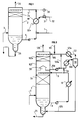
- a vertical contactor reactor (2) receives a gas containing H 2 S and SO 2 via a supply line (3) in its lower part.
- This reactor comprises a column (2) containing a bed for filling Intalox stools, for example, having the property of retaining the sodium salts formed during the reaction.
- An organic solvent containing a soluble catalyst fed by a line (1) and coming from a recycling line (4) at the bottom of the reactor-contactor (2), is introduced by a line (5) at the top of this reactor so that the contact of the gas to be treated and the solvent is effected against the current.
- the solvent in the line (4) is cooled by a heat exchanger (19), the temperature of which is controlled and regulated by a measurement system (30) associated with a valve (31) located on a line for introducing hot water. (32) around 80 ° C. This water is discharged through a line (32a).
- the purified gas is withdrawn from the reactor by a line (20) at the head of the reactor while the sulfur formed settles at the bottom of the reactor and is extracted by a line (25).
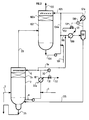
- Figure 2 illustrating an embodiment of the device according to the invention, it has two separate vertical reactor-contactors, the first of which conforms to the description of Figure 1 with the same references.
- This reactor (102) comprises a packing bed (102a) which may or may not be identical to that of the first reactor.
- Catalyst supplied via line (101) and organic solvent are introduced via lines (104), (104a) and (105) at the head of the second contactor reactor which therefore produces a counter-current liquid gas contact in the lining.
- a part, 2 to 10% for example, of the solvent containing sulfur and of catalyst drawn off by the line (104) is cooled to 60-70 ° C by an indirect heat exchanger (190) via a line (116), this which produces the crystallization of sulfur and the depletion in sulfur of the solvent.
- the heat exchange is carried out by injection of water (132) and evacuation (132a) on a line (121) upstream of an exchanger (121a).
- the sulfur in suspension is sent to a hydrocyclone (118) where the solvent is separated sulfur.
- a line (121) on which is possibly located another heat exchanger (121a) for heating the sulfur-depleted solvent is connected to the line (104a), possibly cooled in turn, and their content is recycled by the line (105) above the lining (102a).
- a cooling control valve (131) connected to the exchanger (190) is associated with a temperature control (130) connected to a temperature probe which is disposed upstream of the exchanger (121a) on the line (121).
- the purified gas is recovered at the head of the second reactor-contactor by a line (120).
- a line (5a) connected to line (5) of the first contactor reactor makes it possible to produce an addition of solvent and catalyst in the second by introducing it at the inlet of the exchanger (190).
- the Claus unit has an efficiency of 94%.
- the feed, the organic solvent, the catalyst and the packing are those of Example 1.
- the operating conditions of the first contactor reactor (2) are those of Example 1.
- the Claus unit has an efficiency of 94%.
- the conditions are similar to those of the reactor of Example 1; debit conditions gas and gas composition to be treated are the same.
- the composition of input (line 3) and output (line 120) of the unit are given in Table III.
- the Claus unit has an efficiency of 94%.
Landscapes
- Chemical & Material Sciences (AREA)
- Engineering & Computer Science (AREA)
- Organic Chemistry (AREA)
- Oil, Petroleum & Natural Gas (AREA)
- General Chemical & Material Sciences (AREA)
- Chemical Kinetics & Catalysis (AREA)
- Analytical Chemistry (AREA)
- Health & Medical Sciences (AREA)
- Environmental & Geological Engineering (AREA)
- Biomedical Technology (AREA)
- Inorganic Chemistry (AREA)
- Treating Waste Gases (AREA)
- Physical Or Chemical Processes And Apparatus (AREA)
- Catalysts (AREA)
Abstract
Description
- l'équilibre thermodynamique de la réaction est tel que la réaction n'est jamais complète. De l'hydrogène sulfuré et du dioxyde de soufre restent en équilibre avec le soufre et l'eau formés. Typiquement, la quantité de soufre présent dans H2S et SO2 qui n'ont pas réagi et que l'on retrouve dans l'effluent réactionnel (de Clauspol) correspond à environ 0,1% du soufre total de la charge initiale de l'unité Claus. Une meilleure conversion peut être envisagée à une température opératoire plus faible mais cette température doit être maintenue au-dessus du point de congélation du soufre (environ 120°C), sinon le réacteur serait obstrué par du soufre solide ;
- la présence de soufre liquide non séparé dans le réacteur-contacteur, qui est entraíné dans le solvant et le catalyseur qui circulent et que l'on recycle dans le réacteur-contacteur. En effet, toutes les gouttelettes de soufre liquide ne sont pas séparées du solvant et la présence de soufre liquide entraíne irrémédiablement la présence de soufre gazeux dans l'effluent due à la tension de vapeur du soufre. Par exemple, la quantité de soufre non récupéré attribuable à sa tension de vapeur est d'environ 0,1% poids de soufre de la charge initiale.
Avantageusement, la température de la seconde zone de contact peut être inférieure à la température de la première, de préférence de 15 à 20°C.
C'est le cas notamment où le deuxième réacteur-contacteur comprend un mélangeur-contacteur de type venturi-scrubber associé à un séparateur de l'effluent gazeux épuré, de la phase liquide dont la ligne de soutirage est connectée au moyen d'appauvrissement en soufre.
- selon une première variante, si le solvant organique est miscible à l'eau, il peut être refroidi par échange de chaleur dans un échangeur de chaleur, avant d'être mélangé à l'effluent gazeux à épurer, par un appoint d'eau à une température inférieure à celle du solvant organique dont la chaleur de vaporisation au contact de l'effluent gazeux permettra d'abaisser la température du mélange, ou par une combinaison des deux étapes ci-dessus. De préférence, on refroidira par injection d'eau.
- selon une deuxième variante, si le solvant organique n'est pas miscible à l'eau, il peut être refroidi de la même manière que celles selon la première variante. De préférence, on refroidira par un échangeur de chaleur.
- dans la catégorie des solvants insolubles dans l'eau, on trouve les hydrocarbures de température d'ébullition supérieurs à 250°C et de préférence le dodécane, le tridécane, le naphta de points d'ébullition compris entre 225 et 335°C.
- dans la catégorie des solvants solubles dans l'eau de température d'ébullition supérieure à 200°C, on trouve les polyols de 2 à 15 atomes de carbone et de préférence le glycérol, le thiodiglycol, le cyclohexane diméthyléthanol, les esters d'acides de 5 à 15 atomes de carbone et plus particulièrement le triméthylpentane-diol monoisobutyrate et le diméthyladipate, les éthers de glycol de 5 à 15 atomes de carbone et avantageusement le butoxytriglycol, l'éthoxytriglycol, le diéthylène glycol butyléther, l'éthylène glycol phényl éther, le terpinyl éthylène glycol monobenzyl éther, l'éthylène glycol butyl phényl éther, le diéthylène glycol, le diéthylène glycol diméthyléther, le diéthylène glycol dibutyl éther, le triéthylène glycol, le tétra éthylène glycol diméthyl éther, le propylène n-butyl éther, le dipropylène n-butyléther, le tripropylène n-butyléther, le tripropylène n-butyléther, et les polyéthylènes glycol de masses moléculaires 200, 300, 400 ou 600.
- la figure 2 montrant deux réacteurs-contacteurs dissociés,
- et la figure 3 représentant les deux réacteurs-contacteurs dans une même enceinte.
Une partie, 2 à 10% par exemple, du solvant contenant du soufre et du catalyseur soutirée par la ligne (104) est refroidie à 60-70°C par un échangeur indirect de chaleur (190) via une ligne (116), ce qui produit la cristallisation du soufre et l'appauvrissement en soufre du solvant. L'échange de chaleur est réalisé par injection d'eau (132) et évacuation (132a) sur une ligne (121) en amont d'un échangeur (121a).
- le premier réacteur-contacteur ne contient pas de catalyseur et donc de ligne d'alimentation (1) en catalyseur dans la ligne de solvant (4),
- le gaz en partie débarrassé de H2S et SO2 (20) est introduit directement dans la partie inférieure du second étage (102) par l'intermédiaire de la cheminée (20) qui récupère en outre le solvant, le catalyseur et du soufre soutiré par la ligne (104) pour être appauvri en partie en soufre par l'échangeur (190) et l'hydrocyclone (118).
- Débit : 500 m3/h.
- Température : 123°C.
- Débit de soufre produit (ligne 25): 315 kg/h.
| Gaz entrée (ligne 3) | Gaz sortie (ligne 20) | |
| % volume | % volume | |
| H2S | 1,234 | 0,126 |
| SO2 | 0,617 | 0,063 |
| CO2 | 4,000 | 4,072 |
| COS | 0,015 | 0,009 |
| CS2 | 0,015 | 0,009 |
| S * / v | 0,140 | 0,031 |
| N2 | 60,000 | 61,079 |
| H2O | 34,000 | 34,612 |
| somme des composés soufrés | 2,036 | 0,247 |
| S * / v = soufre vapeur + soufre vésiculaire |
| Gaz entrée (ligne 3) | Gaz sortie (ligne 20) | |
| % volume | % volume | |
| H2S | 1,234 | 0,040 |
| SO2 | 0,617 | 0,020 |
| CO2 | 4,000 | 4,084 |
| COS | 0,015 | 0,009 |
| CS2 | 0,015 | 0,009 |
| Sv* | 0,140 | 0,003 |
| N2 | 59,990 | 61,180 |
| H2O | 33,990 | 34,670 |
| somme des composés soufrés | 2,032 | 0,090 |
| S * / v = soufre vapeur + soufre vésiculaire |
| Gaz entrée (ligne 3) | Gaz sortie (ligne 20) | |
| % volume | % volume | |
| H2S | 1,234 | 0,063 |
| SO2 | 0,617 | 0,0315 |
| CO2 | 4,000 | 4,000 |
| COS | 0,015 | 0,006 |
| CS2 | 0,015 | 0,006 |
| S * / v | 0,140 | 0,004 |
| N2 | 60,000 | 60,000 |
| H2O | 34,000 | 34,000 |
| somme des composés soufrés | 2,036 | 0,1165 |
| S * / v = soufre vapeur + soufre vésiculaire |
Claims (18)
- Procédé de traitement d'un gaz contenant de l'hydrogène sulfuré et de l'anhydride sulfureux dans lequel on met en contact dans une première zone de contact et de réaction gaz-liquide à une température adéquate le gaz (3) avec au moins un solvant organique et on récupère séparément un effluent contenant de l'eau et du soufre vapeur, et du soufre, le procédé étant caractérisé en ce qu'on introduit l'effluent gazeux dans une deuxième zone de contact, dans des conditions appropriées, avec au moins un solvant organique recyclé appauvri en soufre; on récupère séparément un gaz épuré ne contenant sensiblement pas de soufre vapeur et ledit solvant riche en soufre, on prélève une partie au moins dudit solvant riche en soufre, avantageusement au plus 50% du débit, on refroidit ladite partie du solvant de façon à obtenir une suspension de cristaux de soufre dans le solvant, on sépare les cristaux de soufre du solvant et on recycle ladite partie de solvant refroidie, appauvrie en soufre au moins en partie, dans la deuxième zone de contact, le procédé étant en outre caractérisé en ce qu'au moins une des deux zones de contact contient au moins un catalyseur.
- Procédé selon la revendication 1 dans lequel la partie restante du solvant riche en soufre est recyclée en tête dans la seconde zone de contact.
- Procédé selon la revendication 1 ou 2 dans lequel on refroidit ladite partie de solvant destinée à être appauvrie en soufre par un échange indirect de chaleur.
- Procédé selon l'une des revendications 1 à 3 dans lequel on refroidit ladite partie de solvant destinée à être appauvrie par mélange avec une quantité adéquate d'eau et de préférence avec une quantité telle qu'on obtient un mélange solvant-eau contenant de 30 à 70% en poids d'eau.
- Procédé selon l'une des revendications 1 à 4 dans lequel on refroidit ladite partie de solvant à une température inférieure à la température de fusion du soufre et de préférence à une température comprise entre 40 et 110°C.
- Procédé selon l'une des revendications 1 à 5 dans lequel on soutire au moins en partie une solution monophasique du dit solvant organique de la partie inférieure de la première zone de contact, on la refroidit de façon à éliminer une partie au moins de la chaleur de réaction mise en jeu et on la recycle dans la première zone de contact.
- Procédé selon l'une des revendications 1 à 6 dans lequel la température de la seconde zone de contact est inférieure à la température de la première.
- Procédé selon l'une des revendications 1 à 7 dans lequel le solvant organique de la première zone de contact et le solvant organique de la seconde zone de contact sont un même solvant.
- Procédé selon l'une des revendications 1 à 8 dans lequel la première zone de contact contient le catalyseur.
- Procédé selon l'une des revendications 1 à 9, dans lequel on effectue la mise en contact du gaz et du solvant organique dans la première zone de contact et celle de l'effluent gazeux et du solvant organique dans la deuxième zone de contact à contre-courant, l'alimentation en gaz ou en effluent gazeux étant réalisée dans la partie inférieure des zones de contact, et l'alimentation en solvant organique dans la partie supérieure des zones de contact.
- Procédé selon l'une des revendications 1 à 10 dans lequel on effectue la mise en contact du gaz et du solvant organique dans la première zone de contact et celle de l'effluent gazeux et du solvant organique dans la deuxième zone de contact à co-courant, l'alimentation en gaz ou en effluent gazeux étant réalisée dans la partie supérieure des zones de contact ainsi que l'alimentation en solvant organique.
- Dispositif de traitement d'un gaz contenant de l'hydrogène sulfuré et de l'anhydride sulfureux comprenant un premier réacteur-contacteur (2) gaz-liquide, des moyens (3) d'alimentation en gaz à traiter et des moyens (5) d'alimentation en solvant organique, des moyens de récupération (25) du soufre et des moyens (20) de sortie d'un effluent gazeux contenant du soufre sous forme vapeur, le dispositif étant caractérisé en ce qu'il comporte un deuxième réacteur-contacteur (102) connecté aux moyens de sortie de l'effluent gazeux, des moyens d'alimentation (105) en un solvant organique appauvri en soufre connectés au deuxième réacteur-contacteur, des moyens de récupération (120) d'un effluent gazeux épuré en soufre reliés au deuxième réacteur-contacteur, des moyens de soutirage (104) d'une phase liquide contenant le solvant organique et du soufre reliés au deuxième réacteur-contacteur, au moins un moyen d'appauvrissement en soufre d'une partie au moins de la phase liquide relié aux moyens de soutirage de la phases liquide, comprenant au moins un moyen (190) de refroidissement de ladite phase connecté à un moyen de séparation (118) du soufre solide qui délivre une phase solide (125) de soufre à une première extrémité et une phase (121) liquide appauvrie en soufre à une deuxième extrémité, la deuxième extrémité étant connectée aux moyens (105) d'alimentation en solvant appauvri en soufre, le dispositif étant en outre caractérisé en ce qu'un au moins des réacteurs-contacteurs contient un catalyseur.
- Dispositif selon la revendication 12, dans lequel une ligne (104a) connectée aux moyens (104) de soutirage de la phase liquide contenant le solvant organique et du soufre est reliée aux moyens (105) d'alimentation en solvant organique appauvri en soufre.
- Dispositif selon l'une des revendications 12 à 13 dans laquelle le moyen de refroidissement est choisi dans le groupe formé par un échangeur de chaleur, un appoint d'eau et une combinaison des deux.
- Dispositif selon l'une des revendications 12 à 14 dans lequel le premier réacteur-contacteur (2) comporte côté extrémité inférieure un moyen (4) de soutirage d'une solution monophasique, des moyens (19) de contrôle de température de la solution associés à un échangeur thermique et connectés au moyen de soutirage de la solution et des moyens de recyclage (5) de la solution monophasique refroidie dans le premier réacteur-contacteur.
- Dispositif selon l'une des revendications 12 à 15 dans lequel le premier réacteur-contacteur (2) et le second réacteur-contacteur (102) sont contenus dans une même enceinte.
- Dispositif selon la revendication (12) dans lequel le deuxième réacteur-contacteur comprend un mélangeur-contacteur de type venturi-scrubber associé à un séparateur de l'effluent gazeux épuré, de la phase liquide.
- Dispositif selon l'une des revendications 12 à 17 dans lequel une ligne (5a) est connectée entre les moyens (5) de recyclage dans le premier réacteur-contacteur de la solution monophasique provenant du premier réacteur-contacteur, qui a été refroidie et l'entrée du moyen de refroidissement (190) de la phase liquide.
Applications Claiming Priority (2)
| Application Number | Priority Date | Filing Date | Title |
|---|---|---|---|
| FR9611409 | 1996-09-16 | ||
| FR9611409A FR2753396B1 (fr) | 1996-09-16 | 1996-09-16 | Procede et dispositif de traitement d'un gaz contenant de l'hydrogene sulfure et du dioxyde de soufre comportant une etape d'appauvrissement en soufre du solvant recycle |
Publications (2)
| Publication Number | Publication Date |
|---|---|
| EP0829453A1 true EP0829453A1 (fr) | 1998-03-18 |
| EP0829453B1 EP0829453B1 (fr) | 2002-02-20 |
Family
ID=9495874
Family Applications (1)
| Application Number | Title | Priority Date | Filing Date |
|---|---|---|---|
| EP97402087A Expired - Lifetime EP0829453B1 (fr) | 1996-09-16 | 1997-09-08 | Procédé et dispositif de traitement d'un gaz contenant de l'hydrogène sulfuré et du dioxyde de soufre comportant une étape d'appauvrissement en soufre du solvant recyclé |
Country Status (8)
| Country | Link |
|---|---|
| US (2) | US5935547A (fr) |
| EP (1) | EP0829453B1 (fr) |
| KR (1) | KR100451526B1 (fr) |
| CN (1) | CN1087965C (fr) |
| CA (1) | CA2214424C (fr) |
| DE (1) | DE69710541T2 (fr) |
| ES (1) | ES2173405T3 (fr) |
| FR (1) | FR2753396B1 (fr) |
Families Citing this family (23)
| Publication number | Priority date | Publication date | Assignee | Title |
|---|---|---|---|---|
| FR2735460B1 (fr) * | 1995-06-15 | 1997-07-25 | Inst Francais Du Petrole | Procede et dispositif de traitement d'un gaz contenant de l'hydrogene sulfure, comportant une etape d'elimination du soufre cristallise par refroidissement |
| FR2756197B1 (fr) | 1996-11-25 | 1999-01-08 | Inst Francais Du Petrole | Composition et son utilisation pour convertir un gaz contenant de l'hydrogene sulfure et de l'anhydride sulfureux en soufre |
| FR2757147B1 (fr) | 1996-12-12 | 1999-01-29 | Inst Francais Du Petrole | Procede et dispositif d'epuration d'un gaz contenant de l'hydrogene sulfure et du dioxyde de soufre |
| FR2784370B1 (fr) * | 1998-10-08 | 2001-03-09 | Inst Francais Du Petrole | Procede et dispositif de traitement d'un gaz contenant de l'hydrogene sulfure et du dioxyde de soufre, comportant une etape d'elimination de sous-produits solides |
| FR2786111B1 (fr) * | 1998-11-20 | 2000-12-15 | Inst Francais Du Petrole | Procede et dispositif de traitement d'un gaz contenant de l'hydrogene sulfure et du dioxyde de soufre, comportant une etape d'elimination de sous-produits |
| CA2433277C (fr) * | 2003-06-25 | 2008-02-26 | Clean-Flo Gas Filtration Systems (1987) Ltd. | Milieu pour la purification de gaz servant a eliminer les sulfures de circuits de gaz |
| RU2246344C1 (ru) * | 2003-07-02 | 2005-02-20 | Общество с ограниченной ответственностью "Синтез-Инжиниринг" | Установка для проведения тепломассообменных процессов |
| FR2882942B1 (fr) | 2005-03-09 | 2007-06-15 | Inst Francais Du Petrole | Procede perfectionne de traitement d'un gaz contenant de l'hydrogene sulfure et du dioxyde de soufre |
| CN1748841A (zh) * | 2005-05-28 | 2006-03-22 | 方达辉 | 规流填料塔 |
| US7378068B2 (en) * | 2005-06-01 | 2008-05-27 | Conocophillips Company | Electrochemical process for decomposition of hydrogen sulfide and production of sulfur |
| EP1728554A1 (fr) * | 2005-06-02 | 2006-12-06 | Research Institute of Petroleum Industry | Procédé pour éliminer des particules de soufre d'une solution aqueuse de catalyseur et pour éliminer le sulfure d'hydrogène d'un courant gazeux |
| WO2007033082A2 (fr) | 2005-09-12 | 2007-03-22 | Abela Pharmaceuticals, Inc. | Compositions comprenant du diméthylsulfoxyde (dmso) |
| US8480797B2 (en) | 2005-09-12 | 2013-07-09 | Abela Pharmaceuticals, Inc. | Activated carbon systems for facilitating use of dimethyl sulfoxide (DMSO) by removal of same, related compounds, or associated odors |
| US8435224B2 (en) | 2005-09-12 | 2013-05-07 | Abela Pharmaceuticals, Inc. | Materials for facilitating administration of dimethyl sulfoxide (DMSO) and related compounds |
| AU2006291134C1 (en) | 2005-09-12 | 2013-08-15 | Abela Pharmaceuticals, Inc. | Systems for removing dimethyl sulfoxide (DMSO) or related compounds, or odors associated with same |
| BRPI0921494A2 (pt) | 2008-11-03 | 2018-10-30 | Prad Reasearch And Development Ltd | método de planejamento de uma operação de amostragem para uma formação subterrãnea, método de contolar uma operação de amostragem de formação subterrânea, método de controlar uma operação de perfuração para uma formação subterrãnea, e método de realizar uma amostragem durante a operação de perfuração. |
| US8309047B2 (en) * | 2009-09-15 | 2012-11-13 | Alstom Technology Ltd | Method and system for removal of carbon dioxide from a process gas |
| US9839609B2 (en) | 2009-10-30 | 2017-12-12 | Abela Pharmaceuticals, Inc. | Dimethyl sulfoxide (DMSO) and methylsulfonylmethane (MSM) formulations to treat osteoarthritis |
| CN102886194A (zh) * | 2011-07-21 | 2013-01-23 | 天津渤大硫酸工业有限公司 | 熔硫除异味吸收装置 |
| CN103623689B (zh) * | 2013-12-12 | 2016-06-29 | 北京博源恒升高科技有限公司 | 多元醇复合溶液脱除气体中SOx的方法 |
| CN105561720A (zh) * | 2015-12-21 | 2016-05-11 | 天津欧盼科技开发有限公司 | 一种用于降低环境污染的装置 |
| CN105642053A (zh) * | 2016-01-15 | 2016-06-08 | 湖南弘润化工科技有限公司 | 苯甲酸造粒过程中含粉尘尾气处理装置及处理方法 |
| CN110339713B (zh) * | 2019-08-23 | 2022-02-08 | 江西樟树冠京香料有限公司 | 一种挥发性有机物的处理系统及其处理工艺 |
Citations (2)
| Publication number | Priority date | Publication date | Assignee | Title |
|---|---|---|---|---|
| FR2122674A5 (en) * | 1971-01-19 | 1972-09-01 | Inst Francais Du Petrole | Sulphur prodn - from hydrogen sulphide and sulphur dioxide |
| FR2411802A1 (fr) * | 1977-12-15 | 1979-07-13 | Raffinage Cie Francaise | Procede d'elimination de l'hydrogene sulfure contenu dans un melange gazeux |
Family Cites Families (15)
| Publication number | Priority date | Publication date | Assignee | Title |
|---|---|---|---|---|
| US2881047A (en) * | 1956-05-29 | 1959-04-07 | Laurence S Reid | Method of simultaneously removing hydrogen sulfide from gaseous mixtures and producing sulfur therefrom |
| FR1592092A (fr) * | 1968-02-29 | 1970-05-11 | ||
| GB1223732A (en) * | 1968-07-29 | 1971-03-03 | Inst Francais Du Petrole | Process for purifying a gas containing hydrogen sulfide with production of sulfur |
| FR2115721A5 (fr) * | 1970-11-30 | 1972-07-07 | Inst Francais Du Petrole | |
| FR2138371B2 (fr) * | 1971-01-19 | 1973-05-25 | Inst Francais Du Petrole | |
| GB1351578A (en) * | 1972-07-13 | 1974-05-01 | Kh Nii Endokrinologii I Khim G | Method of producing delta,-testololactone |
| JPS5116187A (fr) * | 1975-06-10 | 1976-02-09 | Mitsuo Kyomizu | |
| JPS5228111A (en) * | 1975-08-28 | 1977-03-02 | Penta Ocean Construction | Method of barking for extremely poor subsoil |
| DE3239603A1 (de) * | 1982-10-26 | 1984-04-26 | Linde Ag, 6200 Wiesbaden | Verfahren zum gleichzeitigen entfernen von h(pfeil abwaerts)2(pfeil abwaerts)s, so(pfeil abwaerts)2(pfeil abwaerts) und elementarem schwefel aus gasgemischen |
| DE3428548A1 (de) * | 1984-08-02 | 1986-02-13 | Linde Ag, 6200 Wiesbaden | Verfahren zur erzeugung von elementarem schwefel |
| US5389351A (en) * | 1992-11-04 | 1995-02-14 | Hasebe; Nobuyasu | Method for desulfurizing a gas |
| NL9302081A (nl) * | 1993-11-30 | 1995-06-16 | Gastec Nv | Werkwijze voor het verwijderen van elementaire zwavel uit een gasstroom. |
| FR2722428B1 (fr) * | 1994-07-13 | 1996-09-27 | Rhone Poulenc Chimie | Catalyseurs pour le traitement de gaz contenant des composes soufres; utilisation et procede de traitement d'un gaz contenant des composes soufres |
| FR2735460B1 (fr) * | 1995-06-15 | 1997-07-25 | Inst Francais Du Petrole | Procede et dispositif de traitement d'un gaz contenant de l'hydrogene sulfure, comportant une etape d'elimination du soufre cristallise par refroidissement |
| FR2753395B1 (fr) * | 1996-09-16 | 1998-11-06 | Inst Francais Du Petrole | Procede et dispositif de traitement d'un gaz contenant de l'hydrogene sulfure et de l'anhydride sulfureux, comportant une etape d'elimination du soufre par refroidissement de l'effluent gazeux |
-
1996
- 1996-09-16 FR FR9611409A patent/FR2753396B1/fr not_active Expired - Fee Related
-
1997
- 1997-09-08 EP EP97402087A patent/EP0829453B1/fr not_active Expired - Lifetime
- 1997-09-08 DE DE69710541T patent/DE69710541T2/de not_active Expired - Lifetime
- 1997-09-08 ES ES97402087T patent/ES2173405T3/es not_active Expired - Lifetime
- 1997-09-12 KR KR1019970047013A patent/KR100451526B1/ko not_active Expired - Fee Related
- 1997-09-15 CA CA002214424A patent/CA2214424C/fr not_active Expired - Fee Related
- 1997-09-16 CN CN97120663A patent/CN1087965C/zh not_active Expired - Fee Related
- 1997-09-16 US US08/929,445 patent/US5935547A/en not_active Expired - Lifetime
-
1999
- 1999-05-06 US US09/305,454 patent/US6309609B1/en not_active Expired - Lifetime
Patent Citations (2)
| Publication number | Priority date | Publication date | Assignee | Title |
|---|---|---|---|---|
| FR2122674A5 (en) * | 1971-01-19 | 1972-09-01 | Inst Francais Du Petrole | Sulphur prodn - from hydrogen sulphide and sulphur dioxide |
| FR2411802A1 (fr) * | 1977-12-15 | 1979-07-13 | Raffinage Cie Francaise | Procede d'elimination de l'hydrogene sulfure contenu dans un melange gazeux |
Also Published As
| Publication number | Publication date |
|---|---|
| CN1087965C (zh) | 2002-07-24 |
| US6309609B1 (en) | 2001-10-30 |
| DE69710541T2 (de) | 2002-07-11 |
| DE69710541D1 (de) | 2002-03-28 |
| US5935547A (en) | 1999-08-10 |
| CA2214424A1 (fr) | 1998-03-16 |
| EP0829453B1 (fr) | 2002-02-20 |
| MX9706926A (es) | 1998-08-30 |
| ES2173405T3 (es) | 2002-10-16 |
| CN1180583A (zh) | 1998-05-06 |
| FR2753396B1 (fr) | 1998-10-30 |
| FR2753396A1 (fr) | 1998-03-20 |
| CA2214424C (fr) | 2006-04-18 |
| KR100451526B1 (ko) | 2004-12-08 |
| KR19980024586A (ko) | 1998-07-06 |
Similar Documents
| Publication | Publication Date | Title |
|---|---|---|
| EP0829453B1 (fr) | Procédé et dispositif de traitement d'un gaz contenant de l'hydrogène sulfuré et du dioxyde de soufre comportant une étape d'appauvrissement en soufre du solvant recyclé | |
| CA2576905C (fr) | Procede d'extraction de l'hydrogene sulfure contenu dans un gaz hydrocarbone | |
| FR2573671A1 (fr) | Procede pour extraire de facon selective le sulfure d'hydrogene de melanges gazeux contenant aussi du dioxyde de carbone. | |
| EP0829452B1 (fr) | Procédé et dispositif de traitement d'un gaz contenant de l'hydrogène sulfuré et de l'anhydride sulfureux, comportant une étape d'élimination du soufre par réfroidissement de l'effluent gazeux | |
| FR2578531A1 (fr) | Procede de desulfuration de gaz contenant de l'hydrogene sulfure | |
| EP0832039B1 (fr) | Procede et dispositif de traitement d'un gaz contenant de l'hydrogene sulfure, comportant une etape d'elimination du soufre cristallise par refroidissement | |
| KR20050016385A (ko) | 탄화수소 함유 가스 정제 방법 | |
| CA2514087C (fr) | Procede de capture des mercaptans contenus dans une charge gazeuse | |
| EP0899320B1 (fr) | Procédé et unité d'hydrotraitement d'une charge pétrolière comprenant le craquage de l'ammoniac et le recyclage de l'hydrogène dans l'unité | |
| CA2253763C (fr) | Procede de recuperation du soufre a haute pression | |
| CA2290143C (fr) | Procede et dispositif de traitement d'un gaz contenant de l'hydrogene sulfure et du dioxyde de soufre, comportant une etape d'elimination de sous-produits | |
| CA2222356C (fr) | Procede et dispositif d'epuration d'un gaz contenant de l'hydrogene sulfure et du dioxyde de soufre | |
| FR2896509A1 (fr) | Procede de capture des mercaptans contenus dans un gaz naturel par concentration. | |
| EP0992454A1 (fr) | Procédé et dispositif de traitement d'un gaz contenant de l'hydrogène sulfuré et du dioxyde de soufre, comportant une étape d'elimination de sous-produits solides | |
| US4664903A (en) | Removal of sulfur compounds from gases | |
| FR2941630A1 (fr) | Procede et dispositif de desulfuration d'un gaz, comprenant une etape d'elimination du soufre par refroidissement d'un flux gazeux | |
| FR2918386A1 (fr) | Procede d'elimination des mercaptans contenus dans les effluents liquides et gazeux. | |
| FR2501663A1 (fr) | Procede et installation de traitement des gaz acides pour la recuperation et la production de soufre et de gaz carbonique | |
| EP0102894A1 (fr) | Procédé d'élimination de l'hydrogène sulfuré contenu dans un mélange gazeux | |
| MXPA97006926A (en) | Procedure and device for the treatment of a gas containing hydrogenosulfurate and sulfur dioxide, which takes a stiff employment stage of the solvent recicl | |
| MXPA97006925A (en) | Procedure and ungas treatment device containing sulfurated hydrogen and sulfuride anhydride, which takes a sulfur removal stage by cooling the effluent gase |
Legal Events
| Date | Code | Title | Description |
|---|---|---|---|
| PUAI | Public reference made under article 153(3) epc to a published international application that has entered the european phase |
Free format text: ORIGINAL CODE: 0009012 |
|
| AK | Designated contracting states |
Kind code of ref document: A1 Designated state(s): DE ES GB IT NL |
|
| AX | Request for extension of the european patent |
Free format text: AL;LT;LV;RO;SI |
|
| RIN1 | Information on inventor provided before grant (corrected) |
Inventor name: DEZAEL, CLAUDE Inventor name: VILTARD, JEAN-CHARLES Inventor name: LECOMTE, FABRICE |
|
| 17P | Request for examination filed |
Effective date: 19980918 |
|
| AKX | Designation fees paid |
Free format text: DE ES GB IT NL |
|
| RBV | Designated contracting states (corrected) |
Designated state(s): DE ES GB IT NL |
|
| 17Q | First examination report despatched |
Effective date: 19990715 |
|
| GRAG | Despatch of communication of intention to grant |
Free format text: ORIGINAL CODE: EPIDOS AGRA |
|
| GRAG | Despatch of communication of intention to grant |
Free format text: ORIGINAL CODE: EPIDOS AGRA |
|
| GRAH | Despatch of communication of intention to grant a patent |
Free format text: ORIGINAL CODE: EPIDOS IGRA |
|
| GRAH | Despatch of communication of intention to grant a patent |
Free format text: ORIGINAL CODE: EPIDOS IGRA |
|
| REG | Reference to a national code |
Ref country code: GB Ref legal event code: IF02 |
|
| GRAA | (expected) grant |
Free format text: ORIGINAL CODE: 0009210 |
|
| AK | Designated contracting states |
Kind code of ref document: B1 Designated state(s): DE ES GB IT NL |
|
| REF | Corresponds to: |
Ref document number: 69710541 Country of ref document: DE Date of ref document: 20020328 |
|
| GBT | Gb: translation of ep patent filed (gb section 77(6)(a)/1977) |
Effective date: 20020419 |
|
| REG | Reference to a national code |
Ref country code: ES Ref legal event code: FG2A Ref document number: 2173405 Country of ref document: ES Kind code of ref document: T3 |
|
| PLBE | No opposition filed within time limit |
Free format text: ORIGINAL CODE: 0009261 |
|
| STAA | Information on the status of an ep patent application or granted ep patent |
Free format text: STATUS: NO OPPOSITION FILED WITHIN TIME LIMIT |
|
| 26N | No opposition filed |
Effective date: 20021121 |
|
| REG | Reference to a national code |
Ref country code: DE Ref legal event code: R081 Ref document number: 69710541 Country of ref document: DE Owner name: IFP ENERGIES NOUVELLES, FR Free format text: FORMER OWNER: INSTITUT FRANCAIS DU PETROLE, RUEIL-MALMAISON, HAUTS-DE-SEINE, FR Effective date: 20110331 |
|
| PGFP | Annual fee paid to national office [announced via postgrant information from national office to epo] |
Ref country code: DE Payment date: 20140925 Year of fee payment: 18 |
|
| PGFP | Annual fee paid to national office [announced via postgrant information from national office to epo] |
Ref country code: GB Payment date: 20140922 Year of fee payment: 18 Ref country code: ES Payment date: 20140917 Year of fee payment: 18 |
|
| PGFP | Annual fee paid to national office [announced via postgrant information from national office to epo] |
Ref country code: IT Payment date: 20140923 Year of fee payment: 18 |
|
| PGFP | Annual fee paid to national office [announced via postgrant information from national office to epo] |
Ref country code: NL Payment date: 20140921 Year of fee payment: 18 |
|
| REG | Reference to a national code |
Ref country code: DE Ref legal event code: R119 Ref document number: 69710541 Country of ref document: DE |
|
| PG25 | Lapsed in a contracting state [announced via postgrant information from national office to epo] |
Ref country code: IT Free format text: LAPSE BECAUSE OF NON-PAYMENT OF DUE FEES Effective date: 20150908 |
|
| GBPC | Gb: european patent ceased through non-payment of renewal fee |
Effective date: 20150908 |
|
| REG | Reference to a national code |
Ref country code: NL Ref legal event code: MM Effective date: 20151001 |
|
| PG25 | Lapsed in a contracting state [announced via postgrant information from national office to epo] |
Ref country code: GB Free format text: LAPSE BECAUSE OF NON-PAYMENT OF DUE FEES Effective date: 20150908 Ref country code: DE Free format text: LAPSE BECAUSE OF NON-PAYMENT OF DUE FEES Effective date: 20160401 |
|
| PG25 | Lapsed in a contracting state [announced via postgrant information from national office to epo] |
Ref country code: NL Free format text: LAPSE BECAUSE OF NON-PAYMENT OF DUE FEES Effective date: 20151001 |
|
| REG | Reference to a national code |
Ref country code: ES Ref legal event code: FD2A Effective date: 20161027 |
|
| PG25 | Lapsed in a contracting state [announced via postgrant information from national office to epo] |
Ref country code: ES Free format text: LAPSE BECAUSE OF NON-PAYMENT OF DUE FEES Effective date: 20150909 |