EP0830428B1 - Klebriggemachte segmentierte polydiorganosiloxanpolyharnstoff copolymere und ein verfahren zu deren herstellung - Google Patents
Klebriggemachte segmentierte polydiorganosiloxanpolyharnstoff copolymere und ein verfahren zu deren herstellung Download PDFInfo
- Publication number
- EP0830428B1 EP0830428B1 EP96925246A EP96925246A EP0830428B1 EP 0830428 B1 EP0830428 B1 EP 0830428B1 EP 96925246 A EP96925246 A EP 96925246A EP 96925246 A EP96925246 A EP 96925246A EP 0830428 B1 EP0830428 B1 EP 0830428B1
- Authority
- EP
- European Patent Office
- Prior art keywords
- zone
- polydimethylsiloxane
- polydiorganosiloxane
- segmented copolymer
- sensitive adhesive
- Prior art date
- Legal status (The legal status is an assumption and is not a legal conclusion. Google has not performed a legal analysis and makes no representation as to the accuracy of the status listed.)
- Expired - Lifetime
Links
- 229920001577 copolymer Polymers 0.000 title claims description 246
- 229920002396 Polyurea Polymers 0.000 title claims description 190
- 238000000034 method Methods 0.000 title claims description 67
- 230000008569 process Effects 0.000 title claims description 47
- -1 aralkylene Chemical group 0.000 claims description 326
- 239000004820 Pressure-sensitive adhesive Substances 0.000 claims description 187
- 150000004985 diamines Chemical class 0.000 claims description 176
- 229920005989 resin Polymers 0.000 claims description 173
- 239000011347 resin Substances 0.000 claims description 173
- 239000000203 mixture Substances 0.000 claims description 153
- BPQQTUXANYXVAA-UHFFFAOYSA-N Orthosilicate Chemical compound [O-][Si]([O-])([O-])[O-] BPQQTUXANYXVAA-UHFFFAOYSA-N 0.000 claims description 57
- 229920000768 polyamine Polymers 0.000 claims description 56
- 239000005056 polyisocyanate Substances 0.000 claims description 43
- 229920001228 polyisocyanate Polymers 0.000 claims description 43
- 238000006243 chemical reaction Methods 0.000 claims description 36
- 239000000376 reactant Substances 0.000 claims description 25
- 125000004432 carbon atom Chemical group C* 0.000 claims description 22
- 239000004831 Hot glue Substances 0.000 claims description 14
- 239000012948 isocyanate Substances 0.000 claims description 14
- 150000002513 isocyanates Chemical class 0.000 claims description 14
- 150000001412 amines Chemical class 0.000 claims description 13
- 238000002156 mixing Methods 0.000 claims description 12
- 125000000391 vinyl group Chemical group [H]C([*])=C([H])[H] 0.000 claims description 11
- 125000000217 alkyl group Chemical group 0.000 claims description 10
- 229910020485 SiO4/2 Inorganic materials 0.000 claims description 7
- 229910020388 SiO1/2 Inorganic materials 0.000 claims description 6
- 239000007795 chemical reaction product Substances 0.000 claims description 5
- 125000000753 cycloalkyl group Chemical group 0.000 claims description 5
- 125000003709 fluoroalkyl group Chemical group 0.000 claims description 5
- 125000002947 alkylene group Chemical group 0.000 claims description 4
- 229910052739 hydrogen Inorganic materials 0.000 claims description 4
- 239000001257 hydrogen Substances 0.000 claims description 4
- 125000004435 hydrogen atom Chemical class [H]* 0.000 claims description 4
- 125000003118 aryl group Chemical group 0.000 claims description 3
- 125000004950 trifluoroalkyl group Chemical group 0.000 claims description 3
- 125000004955 1,4-cyclohexylene group Chemical group [H]C1([H])C([H])([H])C([H])([*:1])C([H])([H])C([H])([H])C1([H])[*:2] 0.000 claims description 2
- YCKRFDGAMUMZLT-UHFFFAOYSA-N Fluorine atom Chemical compound [F] YCKRFDGAMUMZLT-UHFFFAOYSA-N 0.000 claims description 2
- 229920001774 Perfluoroether Polymers 0.000 claims description 2
- 229910020447 SiO2/2 Inorganic materials 0.000 claims description 2
- 125000002993 cycloalkylene group Chemical group 0.000 claims description 2
- 239000011737 fluorine Substances 0.000 claims description 2
- 229910052731 fluorine Inorganic materials 0.000 claims description 2
- 125000000623 heterocyclic group Chemical group 0.000 claims description 2
- UJMWVICAENGCRF-UHFFFAOYSA-N oxygen difluoride Chemical compound FOF UJMWVICAENGCRF-UHFFFAOYSA-N 0.000 claims description 2
- 125000005010 perfluoroalkyl group Chemical group 0.000 claims description 2
- 125000001997 phenyl group Chemical group [H]C1=C([H])C([H])=C(*)C([H])=C1[H] 0.000 claims description 2
- 125000000843 phenylene group Chemical group C1(=C(C=CC=C1)*)* 0.000 claims description 2
- 229920000233 poly(alkylene oxides) Polymers 0.000 claims description 2
- ORGHESHFQPYLAO-UHFFFAOYSA-N vinyl radical Chemical compound C=[CH] ORGHESHFQPYLAO-UHFFFAOYSA-N 0.000 claims description 2
- 229910052727 yttrium Inorganic materials 0.000 claims description 2
- 239000007864 aqueous solution Substances 0.000 claims 1
- 238000000157 electrochemical-induced impedance spectroscopy Methods 0.000 claims 1
- 235000013870 dimethyl polysiloxane Nutrition 0.000 description 239
- 229920000435 poly(dimethylsiloxane) Polymers 0.000 description 239
- 239000004205 dimethyl polysiloxane Substances 0.000 description 237
- YXFVVABEGXRONW-UHFFFAOYSA-N Toluene Chemical compound CC1=CC=CC=C1 YXFVVABEGXRONW-UHFFFAOYSA-N 0.000 description 186
- 239000000463 material Substances 0.000 description 140
- 239000000243 solution Substances 0.000 description 125
- 238000013016 damping Methods 0.000 description 97
- KFZMGEQAYNKOFK-UHFFFAOYSA-N Isopropanol Chemical compound CC(C)O KFZMGEQAYNKOFK-UHFFFAOYSA-N 0.000 description 91
- 230000001070 adhesive effect Effects 0.000 description 89
- 239000000853 adhesive Substances 0.000 description 88
- 239000010410 layer Substances 0.000 description 85
- 238000000576 coating method Methods 0.000 description 46
- 239000002904 solvent Substances 0.000 description 42
- 238000012360 testing method Methods 0.000 description 40
- 239000002131 composite material Substances 0.000 description 39
- 239000011248 coating agent Substances 0.000 description 37
- 229940079593 drug Drugs 0.000 description 27
- 239000003814 drug Substances 0.000 description 27
- 239000000758 substrate Substances 0.000 description 26
- 125000005442 diisocyanate group Chemical group 0.000 description 23
- 229920000642 polymer Polymers 0.000 description 23
- 238000010276 construction Methods 0.000 description 22
- 239000011521 glass Substances 0.000 description 22
- 238000003860 storage Methods 0.000 description 22
- XLYOFNOQVPJJNP-UHFFFAOYSA-N water Substances O XLYOFNOQVPJJNP-UHFFFAOYSA-N 0.000 description 21
- 229910000831 Steel Inorganic materials 0.000 description 19
- 230000007797 corrosion Effects 0.000 description 19
- 238000005260 corrosion Methods 0.000 description 19
- 229920001296 polysiloxane Polymers 0.000 description 19
- 239000007787 solid Substances 0.000 description 19
- 239000010959 steel Substances 0.000 description 19
- VYPSYNLAJGMNEJ-UHFFFAOYSA-N Silicium dioxide Chemical compound O=[Si]=O VYPSYNLAJGMNEJ-UHFFFAOYSA-N 0.000 description 17
- 239000012299 nitrogen atmosphere Substances 0.000 description 17
- HMMGMWAXVFQUOA-UHFFFAOYSA-N octamethylcyclotetrasiloxane Chemical compound C[Si]1(C)O[Si](C)(C)O[Si](C)(C)O[Si](C)(C)O1 HMMGMWAXVFQUOA-UHFFFAOYSA-N 0.000 description 17
- WYURNTSHIVDZCO-UHFFFAOYSA-N Tetrahydrofuran Chemical compound C1CCOC1 WYURNTSHIVDZCO-UHFFFAOYSA-N 0.000 description 16
- 229920001971 elastomer Polymers 0.000 description 16
- 239000000546 pharmaceutical excipient Substances 0.000 description 16
- 239000000047 product Substances 0.000 description 16
- 230000004224 protection Effects 0.000 description 16
- 239000000945 filler Substances 0.000 description 15
- 239000012943 hotmelt Substances 0.000 description 15
- 230000003068 static effect Effects 0.000 description 15
- AZYRZNIYJDKRHO-UHFFFAOYSA-N 1,3-bis(2-isocyanatopropan-2-yl)benzene Chemical compound O=C=NC(C)(C)C1=CC=CC(C(C)(C)N=C=O)=C1 AZYRZNIYJDKRHO-UHFFFAOYSA-N 0.000 description 13
- 239000010408 film Substances 0.000 description 13
- 239000005060 rubber Substances 0.000 description 13
- 238000003756 stirring Methods 0.000 description 13
- IJGRMHOSHXDMSA-UHFFFAOYSA-N Atomic nitrogen Chemical compound N#N IJGRMHOSHXDMSA-UHFFFAOYSA-N 0.000 description 12
- 239000012790 adhesive layer Substances 0.000 description 12
- 229910052782 aluminium Inorganic materials 0.000 description 12
- 230000001680 brushing effect Effects 0.000 description 12
- 239000003054 catalyst Substances 0.000 description 12
- 239000000654 additive Substances 0.000 description 11
- XAGFODPZIPBFFR-UHFFFAOYSA-N aluminium Chemical compound [Al] XAGFODPZIPBFFR-UHFFFAOYSA-N 0.000 description 11
- 229920000728 polyester Polymers 0.000 description 11
- 239000004743 Polypropylene Substances 0.000 description 10
- 239000000835 fiber Substances 0.000 description 10
- 238000010438 heat treatment Methods 0.000 description 10
- NIMLQBUJDJZYEJ-UHFFFAOYSA-N isophorone diisocyanate Chemical compound CC1(C)CC(N=C=O)CC(C)(CN=C=O)C1 NIMLQBUJDJZYEJ-UHFFFAOYSA-N 0.000 description 10
- 239000002245 particle Substances 0.000 description 10
- 229920001155 polypropylene Polymers 0.000 description 10
- 239000003190 viscoelastic substance Substances 0.000 description 10
- QTBSBXVTEAMEQO-UHFFFAOYSA-N Acetic acid Chemical compound CC(O)=O QTBSBXVTEAMEQO-UHFFFAOYSA-N 0.000 description 9
- ZMANZCXQSJIPKH-UHFFFAOYSA-N Triethylamine Chemical compound CCN(CC)CC ZMANZCXQSJIPKH-UHFFFAOYSA-N 0.000 description 9
- 230000008901 benefit Effects 0.000 description 9
- 239000011888 foil Substances 0.000 description 9
- 229910052751 metal Inorganic materials 0.000 description 9
- 239000002184 metal Substances 0.000 description 9
- 150000003254 radicals Chemical class 0.000 description 9
- 239000004698 Polyethylene Substances 0.000 description 8
- 239000004567 concrete Substances 0.000 description 8
- 239000012456 homogeneous solution Substances 0.000 description 8
- 229920000573 polyethylene Polymers 0.000 description 8
- 229920000139 polyethylene terephthalate Polymers 0.000 description 8
- 239000005020 polyethylene terephthalate Substances 0.000 description 8
- 238000002360 preparation method Methods 0.000 description 8
- YLQBMQCUIZJEEH-UHFFFAOYSA-N tetrahydrofuran Natural products C=1C=COC=1 YLQBMQCUIZJEEH-UHFFFAOYSA-N 0.000 description 8
- ZMXDDKWLCZADIW-UHFFFAOYSA-N N,N-Dimethylformamide Chemical compound CN(C)C=O ZMXDDKWLCZADIW-UHFFFAOYSA-N 0.000 description 7
- 239000004202 carbamide Substances 0.000 description 7
- 238000001035 drying Methods 0.000 description 7
- 238000010894 electron beam technology Methods 0.000 description 7
- 239000011159 matrix material Substances 0.000 description 7
- 238000005259 measurement Methods 0.000 description 7
- 239000012528 membrane Substances 0.000 description 7
- 239000000843 powder Substances 0.000 description 7
- 230000035882 stress Effects 0.000 description 7
- 238000004448 titration Methods 0.000 description 7
- 238000011282 treatment Methods 0.000 description 7
- XSQUKJJJFZCRTK-UHFFFAOYSA-N urea group Chemical group NC(=O)N XSQUKJJJFZCRTK-UHFFFAOYSA-N 0.000 description 7
- GPXCORHXFPYJEH-UHFFFAOYSA-N 3-[[3-aminopropyl(dimethyl)silyl]oxy-dimethylsilyl]propan-1-amine Chemical compound NCCC[Si](C)(C)O[Si](C)(C)CCCN GPXCORHXFPYJEH-UHFFFAOYSA-N 0.000 description 6
- VTYYLEPIZMXCLO-UHFFFAOYSA-L Calcium carbonate Chemical compound [Ca+2].[O-]C([O-])=O VTYYLEPIZMXCLO-UHFFFAOYSA-L 0.000 description 6
- VEXZGXHMUGYJMC-UHFFFAOYSA-N Hydrochloric acid Chemical compound Cl VEXZGXHMUGYJMC-UHFFFAOYSA-N 0.000 description 6
- 239000010426 asphalt Substances 0.000 description 6
- 230000000052 comparative effect Effects 0.000 description 6
- 230000007613 environmental effect Effects 0.000 description 6
- 238000009472 formulation Methods 0.000 description 6
- 238000010528 free radical solution polymerization reaction Methods 0.000 description 6
- 239000003550 marker Substances 0.000 description 6
- 238000012986 modification Methods 0.000 description 6
- 230000004048 modification Effects 0.000 description 6
- 229910052757 nitrogen Inorganic materials 0.000 description 6
- 239000000049 pigment Substances 0.000 description 6
- 229920000098 polyolefin Polymers 0.000 description 6
- 239000011541 reaction mixture Substances 0.000 description 6
- 239000000377 silicon dioxide Substances 0.000 description 6
- 238000013271 transdermal drug delivery Methods 0.000 description 6
- 230000015572 biosynthetic process Effects 0.000 description 5
- 230000003247 decreasing effect Effects 0.000 description 5
- 230000006870 function Effects 0.000 description 5
- 230000000704 physical effect Effects 0.000 description 5
- 238000006116 polymerization reaction Methods 0.000 description 5
- 229920001451 polypropylene glycol Polymers 0.000 description 5
- 229920002635 polyurethane Polymers 0.000 description 5
- 239000004814 polyurethane Substances 0.000 description 5
- 230000005855 radiation Effects 0.000 description 5
- SCPYDCQAZCOKTP-UHFFFAOYSA-N silanol Chemical compound [SiH3]O SCPYDCQAZCOKTP-UHFFFAOYSA-N 0.000 description 5
- 238000009736 wetting Methods 0.000 description 5
- MFGOFGRYDNHJTA-UHFFFAOYSA-N 2-amino-1-(2-fluorophenyl)ethanol Chemical compound NCC(O)C1=CC=CC=C1F MFGOFGRYDNHJTA-UHFFFAOYSA-N 0.000 description 4
- MYYHQYQIMDUNNW-UHFFFAOYSA-N 3-[fluoro(dimethyl)silyl]propan-1-amine Chemical compound C[Si](C)(F)CCCN MYYHQYQIMDUNNW-UHFFFAOYSA-N 0.000 description 4
- XKRFYHLGVUSROY-UHFFFAOYSA-N Argon Chemical compound [Ar] XKRFYHLGVUSROY-UHFFFAOYSA-N 0.000 description 4
- 239000004215 Carbon black (E152) Substances 0.000 description 4
- HEDRZPFGACZZDS-UHFFFAOYSA-N Chloroform Chemical compound ClC(Cl)Cl HEDRZPFGACZZDS-UHFFFAOYSA-N 0.000 description 4
- MZRVEZGGRBJDDB-UHFFFAOYSA-N N-Butyllithium Chemical compound [Li]CCCC MZRVEZGGRBJDDB-UHFFFAOYSA-N 0.000 description 4
- AYCPARAPKDAOEN-LJQANCHMSA-N N-[(1S)-2-(dimethylamino)-1-phenylethyl]-6,6-dimethyl-3-[(2-methyl-4-thieno[3,2-d]pyrimidinyl)amino]-1,4-dihydropyrrolo[3,4-c]pyrazole-5-carboxamide Chemical compound C1([C@H](NC(=O)N2C(C=3NN=C(NC=4C=5SC=CC=5N=C(C)N=4)C=3C2)(C)C)CN(C)C)=CC=CC=C1 AYCPARAPKDAOEN-LJQANCHMSA-N 0.000 description 4
- PXHVJJICTQNCMI-UHFFFAOYSA-N Nickel Chemical compound [Ni] PXHVJJICTQNCMI-UHFFFAOYSA-N 0.000 description 4
- 229920000297 Rayon Polymers 0.000 description 4
- FAPWRFPIFSIZLT-UHFFFAOYSA-M Sodium chloride Chemical compound [Na+].[Cl-] FAPWRFPIFSIZLT-UHFFFAOYSA-M 0.000 description 4
- GWEVSGVZZGPLCZ-UHFFFAOYSA-N Titan oxide Chemical compound O=[Ti]=O GWEVSGVZZGPLCZ-UHFFFAOYSA-N 0.000 description 4
- 239000002253 acid Substances 0.000 description 4
- 238000013019 agitation Methods 0.000 description 4
- 229920001400 block copolymer Polymers 0.000 description 4
- HUCVOHYBFXVBRW-UHFFFAOYSA-M caesium hydroxide Inorganic materials [OH-].[Cs+] HUCVOHYBFXVBRW-UHFFFAOYSA-M 0.000 description 4
- 239000003795 chemical substances by application Substances 0.000 description 4
- 238000010924 continuous production Methods 0.000 description 4
- 238000004132 cross linking Methods 0.000 description 4
- 238000007872 degassing Methods 0.000 description 4
- 239000012530 fluid Substances 0.000 description 4
- 229910021485 fumed silica Inorganic materials 0.000 description 4
- 229930195733 hydrocarbon Natural products 0.000 description 4
- 238000010030 laminating Methods 0.000 description 4
- AMXOYNBUYSYVKV-UHFFFAOYSA-M lithium bromide Chemical compound [Li+].[Br-] AMXOYNBUYSYVKV-UHFFFAOYSA-M 0.000 description 4
- PQXKHYXIUOZZFA-UHFFFAOYSA-M lithium fluoride Chemical compound [Li+].[F-] PQXKHYXIUOZZFA-UHFFFAOYSA-M 0.000 description 4
- 239000003607 modifier Substances 0.000 description 4
- 150000007524 organic acids Chemical class 0.000 description 4
- 239000000123 paper Substances 0.000 description 4
- 239000008188 pellet Substances 0.000 description 4
- 230000002829 reductive effect Effects 0.000 description 4
- 239000000126 substance Substances 0.000 description 4
- 238000012546 transfer Methods 0.000 description 4
- VCGRFBXVSFAGGA-UHFFFAOYSA-N (1,1-dioxo-1,4-thiazinan-4-yl)-[6-[[3-(4-fluorophenyl)-5-methyl-1,2-oxazol-4-yl]methoxy]pyridin-3-yl]methanone Chemical compound CC=1ON=C(C=2C=CC(F)=CC=2)C=1COC(N=C1)=CC=C1C(=O)N1CCS(=O)(=O)CC1 VCGRFBXVSFAGGA-UHFFFAOYSA-N 0.000 description 3
- PZWQOGNTADJZGH-SNAWJCMRSA-N (2e)-2-methylpenta-2,4-dienoic acid Chemical compound OC(=O)C(/C)=C/C=C PZWQOGNTADJZGH-SNAWJCMRSA-N 0.000 description 3
- JZUHIOJYCPIVLQ-UHFFFAOYSA-N 2-methylpentane-1,5-diamine Chemical compound NCC(C)CCCN JZUHIOJYCPIVLQ-UHFFFAOYSA-N 0.000 description 3
- UPMLOUAZCHDJJD-UHFFFAOYSA-N 4,4'-Diphenylmethane Diisocyanate Polymers C1=CC(N=C=O)=CC=C1CC1=CC=C(N=C=O)C=C1 UPMLOUAZCHDJJD-UHFFFAOYSA-N 0.000 description 3
- CYJRNFFLTBEQSQ-UHFFFAOYSA-N 8-(3-methyl-1-benzothiophen-5-yl)-N-(4-methylsulfonylpyridin-3-yl)quinoxalin-6-amine Chemical compound CS(=O)(=O)C1=C(C=NC=C1)NC=1C=C2N=CC=NC2=C(C=1)C=1C=CC2=C(C(=CS2)C)C=1 CYJRNFFLTBEQSQ-UHFFFAOYSA-N 0.000 description 3
- RYGMFSIKBFXOCR-UHFFFAOYSA-N Copper Chemical compound [Cu] RYGMFSIKBFXOCR-UHFFFAOYSA-N 0.000 description 3
- YMWUJEATGCHHMB-UHFFFAOYSA-N Dichloromethane Chemical compound ClCCl YMWUJEATGCHHMB-UHFFFAOYSA-N 0.000 description 3
- 239000004593 Epoxy Substances 0.000 description 3
- 239000004677 Nylon Substances 0.000 description 3
- 239000004793 Polystyrene Substances 0.000 description 3
- NIXOWILDQLNWCW-UHFFFAOYSA-N acrylic acid group Chemical group C(C=C)(=O)O NIXOWILDQLNWCW-UHFFFAOYSA-N 0.000 description 3
- 239000003963 antioxidant agent Substances 0.000 description 3
- 230000005540 biological transmission Effects 0.000 description 3
- TVFDJXOCXUVLDH-UHFFFAOYSA-N caesium atom Chemical compound [Cs] TVFDJXOCXUVLDH-UHFFFAOYSA-N 0.000 description 3
- 229910000019 calcium carbonate Inorganic materials 0.000 description 3
- 238000005266 casting Methods 0.000 description 3
- 230000015556 catabolic process Effects 0.000 description 3
- 239000012230 colorless oil Substances 0.000 description 3
- 238000001816 cooling Methods 0.000 description 3
- 238000006731 degradation reaction Methods 0.000 description 3
- 239000008367 deionised water Substances 0.000 description 3
- 229910021641 deionized water Inorganic materials 0.000 description 3
- 230000001419 dependent effect Effects 0.000 description 3
- 239000000806 elastomer Substances 0.000 description 3
- 229920006226 ethylene-acrylic acid Polymers 0.000 description 3
- 239000006260 foam Substances 0.000 description 3
- 238000005227 gel permeation chromatography Methods 0.000 description 3
- JEIPFZHSYJVQDO-UHFFFAOYSA-N iron(III) oxide Inorganic materials O=[Fe]O[Fe]=O JEIPFZHSYJVQDO-UHFFFAOYSA-N 0.000 description 3
- 238000004898 kneading Methods 0.000 description 3
- 239000000155 melt Substances 0.000 description 3
- 229920001778 nylon Polymers 0.000 description 3
- 239000003921 oil Substances 0.000 description 3
- TWNQGVIAIRXVLR-UHFFFAOYSA-N oxo(oxoalumanyloxy)alumane Chemical compound O=[Al]O[Al]=O TWNQGVIAIRXVLR-UHFFFAOYSA-N 0.000 description 3
- 239000004014 plasticizer Substances 0.000 description 3
- 239000004417 polycarbonate Substances 0.000 description 3
- 229920000515 polycarbonate Polymers 0.000 description 3
- 229920006267 polyester film Polymers 0.000 description 3
- 229920002223 polystyrene Polymers 0.000 description 3
- 238000012545 processing Methods 0.000 description 3
- 239000011253 protective coating Substances 0.000 description 3
- 230000001681 protective effect Effects 0.000 description 3
- 238000010926 purge Methods 0.000 description 3
- 239000002964 rayon Substances 0.000 description 3
- 238000010992 reflux Methods 0.000 description 3
- 238000000518 rheometry Methods 0.000 description 3
- 229940024463 silicone emollient and protective product Drugs 0.000 description 3
- 239000007921 spray Substances 0.000 description 3
- 239000003381 stabilizer Substances 0.000 description 3
- 229920001169 thermoplastic Polymers 0.000 description 3
- 239000004416 thermosoftening plastic Substances 0.000 description 3
- 230000007704 transition Effects 0.000 description 3
- 229920002554 vinyl polymer Polymers 0.000 description 3
- 239000003643 water by type Substances 0.000 description 3
- JIABEENURMZTTI-UHFFFAOYSA-N 1-isocyanato-2-[(2-isocyanatophenyl)methyl]benzene Polymers O=C=NC1=CC=CC=C1CC1=CC=CC=C1N=C=O JIABEENURMZTTI-UHFFFAOYSA-N 0.000 description 2
- JRBJSXQPQWSCCF-UHFFFAOYSA-N 3,3'-Dimethoxybenzidine Chemical compound C1=C(N)C(OC)=CC(C=2C=C(OC)C(N)=CC=2)=C1 JRBJSXQPQWSCCF-UHFFFAOYSA-N 0.000 description 2
- QZWKEPYTBWZJJA-UHFFFAOYSA-N 3,3'-Dimethoxybenzidine-4,4'-diisocyanate Chemical group C1=C(N=C=O)C(OC)=CC(C=2C=C(OC)C(N=C=O)=CC=2)=C1 QZWKEPYTBWZJJA-UHFFFAOYSA-N 0.000 description 2
- XEEYBQQBJWHFJM-UHFFFAOYSA-N Iron Chemical compound [Fe] XEEYBQQBJWHFJM-UHFFFAOYSA-N 0.000 description 2
- 239000005058 Isophorone diisocyanate Substances 0.000 description 2
- 239000004642 Polyimide Substances 0.000 description 2
- BLRPTPMANUNPDV-UHFFFAOYSA-N Silane Chemical group [SiH4] BLRPTPMANUNPDV-UHFFFAOYSA-N 0.000 description 2
- XLOMVQKBTHCTTD-UHFFFAOYSA-N Zinc monoxide Chemical compound [Zn]=O XLOMVQKBTHCTTD-UHFFFAOYSA-N 0.000 description 2
- SGLGHCOQJRYSPY-UHFFFAOYSA-N [SiH3][O-].NCCCC([N+](C)(C)C)(C)C Chemical compound [SiH3][O-].NCCCC([N+](C)(C)C)(C)C SGLGHCOQJRYSPY-UHFFFAOYSA-N 0.000 description 2
- 238000007259 addition reaction Methods 0.000 description 2
- 230000000996 additive effect Effects 0.000 description 2
- 230000002411 adverse Effects 0.000 description 2
- 230000032683 aging Effects 0.000 description 2
- 229910052786 argon Inorganic materials 0.000 description 2
- 230000004888 barrier function Effects 0.000 description 2
- HIFVAOIJYDXIJG-UHFFFAOYSA-N benzylbenzene;isocyanic acid Polymers N=C=O.N=C=O.C=1C=CC=CC=1CC1=CC=CC=C1 HIFVAOIJYDXIJG-UHFFFAOYSA-N 0.000 description 2
- OHJMTUPIZMNBFR-UHFFFAOYSA-N biuret Chemical group NC(=O)NC(N)=O OHJMTUPIZMNBFR-UHFFFAOYSA-N 0.000 description 2
- 239000007767 bonding agent Substances 0.000 description 2
- 229910052792 caesium Inorganic materials 0.000 description 2
- 229910052799 carbon Inorganic materials 0.000 description 2
- 239000000919 ceramic Substances 0.000 description 2
- 230000008859 change Effects 0.000 description 2
- 239000010960 cold rolled steel Substances 0.000 description 2
- 238000009833 condensation Methods 0.000 description 2
- 239000010949 copper Substances 0.000 description 2
- 229910052802 copper Inorganic materials 0.000 description 2
- 239000003085 diluting agent Substances 0.000 description 2
- 230000009977 dual effect Effects 0.000 description 2
- 230000008030 elimination Effects 0.000 description 2
- 238000003379 elimination reaction Methods 0.000 description 2
- 238000010828 elution Methods 0.000 description 2
- 229920006332 epoxy adhesive Polymers 0.000 description 2
- 239000005038 ethylene vinyl acetate Substances 0.000 description 2
- 238000001704 evaporation Methods 0.000 description 2
- 230000008020 evaporation Effects 0.000 description 2
- 238000001125 extrusion Methods 0.000 description 2
- 238000007765 extrusion coating Methods 0.000 description 2
- 239000004744 fabric Substances 0.000 description 2
- 239000003063 flame retardant Substances 0.000 description 2
- HTDJPCNNEPUOOQ-UHFFFAOYSA-N hexamethylcyclotrisiloxane Chemical compound C[Si]1(C)O[Si](C)(C)O[Si](C)(C)O1 HTDJPCNNEPUOOQ-UHFFFAOYSA-N 0.000 description 2
- RRAMGCGOFNQTLD-UHFFFAOYSA-N hexamethylene diisocyanate Chemical compound O=C=NCCCCCCN=C=O RRAMGCGOFNQTLD-UHFFFAOYSA-N 0.000 description 2
- 239000008240 homogeneous mixture Substances 0.000 description 2
- 238000007757 hot melt coating Methods 0.000 description 2
- 230000002209 hydrophobic effect Effects 0.000 description 2
- 239000012535 impurity Substances 0.000 description 2
- 238000002347 injection Methods 0.000 description 2
- 239000007924 injection Substances 0.000 description 2
- 238000001746 injection moulding Methods 0.000 description 2
- 239000011256 inorganic filler Substances 0.000 description 2
- 229910003475 inorganic filler Inorganic materials 0.000 description 2
- 125000001449 isopropyl group Chemical group [H]C([H])([H])C([H])(*)C([H])([H])[H] 0.000 description 2
- 239000004816 latex Substances 0.000 description 2
- 229920000126 latex Polymers 0.000 description 2
- 238000004519 manufacturing process Methods 0.000 description 2
- 150000002739 metals Chemical class 0.000 description 2
- 238000000465 moulding Methods 0.000 description 2
- 239000002547 new drug Substances 0.000 description 2
- 229910052759 nickel Inorganic materials 0.000 description 2
- 231100000344 non-irritating Toxicity 0.000 description 2
- 239000004745 nonwoven fabric Substances 0.000 description 2
- 239000003960 organic solvent Substances 0.000 description 2
- 230000010355 oscillation Effects 0.000 description 2
- 229920000647 polyepoxide Polymers 0.000 description 2
- 229920001721 polyimide Polymers 0.000 description 2
- 239000004800 polyvinyl chloride Substances 0.000 description 2
- 229920000915 polyvinyl chloride Polymers 0.000 description 2
- 230000008439 repair process Effects 0.000 description 2
- 239000011369 resultant mixture Substances 0.000 description 2
- 229910052701 rubidium Inorganic materials 0.000 description 2
- IGLNJRXAVVLDKE-UHFFFAOYSA-N rubidium atom Chemical compound [Rb] IGLNJRXAVVLDKE-UHFFFAOYSA-N 0.000 description 2
- CPRMKOQKXYSDML-UHFFFAOYSA-M rubidium hydroxide Chemical compound [OH-].[Rb+] CPRMKOQKXYSDML-UHFFFAOYSA-M 0.000 description 2
- 150000003839 salts Chemical class 0.000 description 2
- 238000005488 sandblasting Methods 0.000 description 2
- 238000009738 saturating Methods 0.000 description 2
- 238000007789 sealing Methods 0.000 description 2
- 238000000926 separation method Methods 0.000 description 2
- 239000013464 silicone adhesive Substances 0.000 description 2
- XGVXKJKTISMIOW-ZDUSSCGKSA-N simurosertib Chemical compound N1N=CC(C=2SC=3C(=O)NC(=NC=3C=2)[C@H]2N3CCC(CC3)C2)=C1C XGVXKJKTISMIOW-ZDUSSCGKSA-N 0.000 description 2
- 239000011780 sodium chloride Substances 0.000 description 2
- 238000001228 spectrum Methods 0.000 description 2
- 239000006188 syrup Substances 0.000 description 2
- 235000020357 syrup Nutrition 0.000 description 2
- 238000010345 tape casting Methods 0.000 description 2
- 229920001897 terpolymer Polymers 0.000 description 2
- 238000010998 test method Methods 0.000 description 2
- 239000004408 titanium dioxide Substances 0.000 description 2
- RUELTTOHQODFPA-UHFFFAOYSA-N toluene 2,6-diisocyanate Chemical compound CC1=C(N=C=O)C=CC=C1N=C=O RUELTTOHQODFPA-UHFFFAOYSA-N 0.000 description 2
- WYTZZXDRDKSJID-UHFFFAOYSA-N (3-aminopropyl)triethoxysilane Chemical compound CCO[Si](OCC)(OCC)CCCN WYTZZXDRDKSJID-UHFFFAOYSA-N 0.000 description 1
- GFNDFCFPJQPVQL-UHFFFAOYSA-N 1,12-diisocyanatododecane Chemical compound O=C=NCCCCCCCCCCCCN=C=O GFNDFCFPJQPVQL-UHFFFAOYSA-N 0.000 description 1
- RTTZISZSHSCFRH-UHFFFAOYSA-N 1,3-bis(isocyanatomethyl)benzene Chemical compound O=C=NCC1=CC=CC(CN=C=O)=C1 RTTZISZSHSCFRH-UHFFFAOYSA-N 0.000 description 1
- VGHSXKTVMPXHNG-UHFFFAOYSA-N 1,3-diisocyanatobenzene Chemical compound O=C=NC1=CC=CC(N=C=O)=C1 VGHSXKTVMPXHNG-UHFFFAOYSA-N 0.000 description 1
- ALQLPWJFHRMHIU-UHFFFAOYSA-N 1,4-diisocyanatobenzene Chemical compound O=C=NC1=CC=C(N=C=O)C=C1 ALQLPWJFHRMHIU-UHFFFAOYSA-N 0.000 description 1
- OVBFMUAFNIIQAL-UHFFFAOYSA-N 1,4-diisocyanatobutane Chemical compound O=C=NCCCCN=C=O OVBFMUAFNIIQAL-UHFFFAOYSA-N 0.000 description 1
- AHBNSOZREBSAMG-UHFFFAOYSA-N 1,5-diisocyanato-2-methylpentane Chemical compound O=C=NCC(C)CCCN=C=O AHBNSOZREBSAMG-UHFFFAOYSA-N 0.000 description 1
- LCJLEYPRGLFMGM-UHFFFAOYSA-N 1-(chloromethyl)-2,4-diisocyanatobenzene Chemical compound ClCC1=CC=C(N=C=O)C=C1N=C=O LCJLEYPRGLFMGM-UHFFFAOYSA-N 0.000 description 1
- KGRVJHAUYBGFFP-UHFFFAOYSA-N 2,2'-Methylenebis(4-methyl-6-tert-butylphenol) Chemical compound CC(C)(C)C1=CC(C)=CC(CC=2C(=C(C=C(C)C=2)C(C)(C)C)O)=C1O KGRVJHAUYBGFFP-UHFFFAOYSA-N 0.000 description 1
- VSIKJPJINIDELZ-UHFFFAOYSA-N 2,2,4,4,6,6,8,8-octakis-phenyl-1,3,5,7,2,4,6,8-tetraoxatetrasilocane Chemical compound O1[Si](C=2C=CC=CC=2)(C=2C=CC=CC=2)O[Si](C=2C=CC=CC=2)(C=2C=CC=CC=2)O[Si](C=2C=CC=CC=2)(C=2C=CC=CC=2)O[Si]1(C=1C=CC=CC=1)C1=CC=CC=C1 VSIKJPJINIDELZ-UHFFFAOYSA-N 0.000 description 1
- CLXPYTBRAZHUFD-UHFFFAOYSA-N 2-(4-fluorophenyl)-3-methylmorpholine Chemical compound CC1NCCOC1C1=CC=C(F)C=C1 CLXPYTBRAZHUFD-UHFFFAOYSA-N 0.000 description 1
- VNHJXLYOGVYVOG-UHFFFAOYSA-N 3-[dimethyl(oxido)silyl]propan-1-amine;tetramethylazanium Chemical compound C[N+](C)(C)C.C[Si](C)([O-])CCCN VNHJXLYOGVYVOG-UHFFFAOYSA-N 0.000 description 1
- KVCQTKNUUQOELD-UHFFFAOYSA-N 4-amino-n-[1-(3-chloro-2-fluoroanilino)-6-methylisoquinolin-5-yl]thieno[3,2-d]pyrimidine-7-carboxamide Chemical compound N=1C=CC2=C(NC(=O)C=3C4=NC=NC(N)=C4SC=3)C(C)=CC=C2C=1NC1=CC=CC(Cl)=C1F KVCQTKNUUQOELD-UHFFFAOYSA-N 0.000 description 1
- DDFHBQSCUXNBSA-UHFFFAOYSA-N 5-(5-carboxythiophen-2-yl)thiophene-2-carboxylic acid Chemical compound S1C(C(=O)O)=CC=C1C1=CC=C(C(O)=O)S1 DDFHBQSCUXNBSA-UHFFFAOYSA-N 0.000 description 1
- NIXOWILDQLNWCW-UHFFFAOYSA-M Acrylate Chemical compound [O-]C(=O)C=C NIXOWILDQLNWCW-UHFFFAOYSA-M 0.000 description 1
- 229910002012 Aerosil® Inorganic materials 0.000 description 1
- 229910052582 BN Inorganic materials 0.000 description 1
- PZNSFCLAULLKQX-UHFFFAOYSA-N Boron nitride Chemical compound N#B PZNSFCLAULLKQX-UHFFFAOYSA-N 0.000 description 1
- OKTJSMMVPCPJKN-UHFFFAOYSA-N Carbon Chemical compound [C] OKTJSMMVPCPJKN-UHFFFAOYSA-N 0.000 description 1
- 229920000049 Carbon (fiber) Polymers 0.000 description 1
- 241000723418 Carya Species 0.000 description 1
- VYZAMTAEIAYCRO-UHFFFAOYSA-N Chromium Chemical compound [Cr] VYZAMTAEIAYCRO-UHFFFAOYSA-N 0.000 description 1
- XDTMQSROBMDMFD-UHFFFAOYSA-N Cyclohexane Chemical compound C1CCCCC1 XDTMQSROBMDMFD-UHFFFAOYSA-N 0.000 description 1
- 239000009261 D 400 Substances 0.000 description 1
- 229920002430 Fibre-reinforced plastic Polymers 0.000 description 1
- 238000005481 NMR spectroscopy Methods 0.000 description 1
- 229920003298 Nucrel® Polymers 0.000 description 1
- 235000014676 Phragmites communis Nutrition 0.000 description 1
- 229920012485 Plasticized Polyvinyl chloride Polymers 0.000 description 1
- 229920003171 Poly (ethylene oxide) Polymers 0.000 description 1
- 229910020487 SiO3/2 Inorganic materials 0.000 description 1
- 229920003350 Spectratech® Polymers 0.000 description 1
- 229910000639 Spring steel Inorganic materials 0.000 description 1
- 239000004809 Teflon Substances 0.000 description 1
- 229920006362 Teflon® Polymers 0.000 description 1
- 230000006750 UV protection Effects 0.000 description 1
- 238000005299 abrasion Methods 0.000 description 1
- 239000003522 acrylic cement Substances 0.000 description 1
- 230000004913 activation Effects 0.000 description 1
- 238000004026 adhesive bonding Methods 0.000 description 1
- 239000002998 adhesive polymer Substances 0.000 description 1
- 125000003342 alkenyl group Chemical group 0.000 description 1
- 229910045601 alloy Inorganic materials 0.000 description 1
- 239000000956 alloy Substances 0.000 description 1
- 230000004075 alteration Effects 0.000 description 1
- PNEYBMLMFCGWSK-UHFFFAOYSA-N aluminium oxide Inorganic materials [O-2].[O-2].[O-2].[Al+3].[Al+3] PNEYBMLMFCGWSK-UHFFFAOYSA-N 0.000 description 1
- 125000004103 aminoalkyl group Chemical group 0.000 description 1
- 239000004599 antimicrobial Substances 0.000 description 1
- 229940090047 auto-injector Drugs 0.000 description 1
- 238000010923 batch production Methods 0.000 description 1
- 239000011324 bead Substances 0.000 description 1
- 230000009286 beneficial effect Effects 0.000 description 1
- 239000011230 binding agent Substances 0.000 description 1
- 230000036765 blood level Effects 0.000 description 1
- 238000009835 boiling Methods 0.000 description 1
- 125000004799 bromophenyl group Chemical group 0.000 description 1
- ZOAIGCHJWKDIPJ-UHFFFAOYSA-M caesium acetate Chemical compound [Cs+].CC([O-])=O ZOAIGCHJWKDIPJ-UHFFFAOYSA-M 0.000 description 1
- 238000003490 calendering Methods 0.000 description 1
- 239000006229 carbon black Substances 0.000 description 1
- 239000004917 carbon fiber Substances 0.000 description 1
- 229920002301 cellulose acetate Polymers 0.000 description 1
- OUKMJYHQZXBWNQ-UHFFFAOYSA-N cesium oxidosilane Chemical compound [Cs+].[SiH3][O-] OUKMJYHQZXBWNQ-UHFFFAOYSA-N 0.000 description 1
- 239000003153 chemical reaction reagent Substances 0.000 description 1
- 239000011651 chromium Substances 0.000 description 1
- 229910052804 chromium Inorganic materials 0.000 description 1
- 239000004927 clay Substances 0.000 description 1
- 239000008199 coating composition Substances 0.000 description 1
- 239000010941 cobalt Substances 0.000 description 1
- 229910017052 cobalt Inorganic materials 0.000 description 1
- GUTLYIVDDKVIGB-UHFFFAOYSA-N cobalt atom Chemical compound [Co] GUTLYIVDDKVIGB-UHFFFAOYSA-N 0.000 description 1
- 238000007906 compression Methods 0.000 description 1
- 230000006835 compression Effects 0.000 description 1
- 238000000748 compression moulding Methods 0.000 description 1
- 239000012141 concentrate Substances 0.000 description 1
- 235000008504 concentrate Nutrition 0.000 description 1
- 230000005494 condensation Effects 0.000 description 1
- 230000001143 conditioned effect Effects 0.000 description 1
- 230000003750 conditioning effect Effects 0.000 description 1
- 239000004020 conductor Substances 0.000 description 1
- 239000000356 contaminant Substances 0.000 description 1
- 238000011109 contamination Methods 0.000 description 1
- PMHQVHHXPFUNSP-UHFFFAOYSA-M copper(1+);methylsulfanylmethane;bromide Chemical compound Br[Cu].CSC PMHQVHHXPFUNSP-UHFFFAOYSA-M 0.000 description 1
- 229910052593 corundum Inorganic materials 0.000 description 1
- 229920006037 cross link polymer Polymers 0.000 description 1
- 239000003431 cross linking reagent Substances 0.000 description 1
- 238000001723 curing Methods 0.000 description 1
- 238000007766 curtain coating Methods 0.000 description 1
- 125000004122 cyclic group Chemical group 0.000 description 1
- 238000013480 data collection Methods 0.000 description 1
- 230000007547 defect Effects 0.000 description 1
- 238000005238 degreasing Methods 0.000 description 1
- 230000032798 delamination Effects 0.000 description 1
- 230000001627 detrimental effect Effects 0.000 description 1
- 238000011161 development Methods 0.000 description 1
- 230000018109 developmental process Effects 0.000 description 1
- KORSJDCBLAPZEQ-UHFFFAOYSA-N dicyclohexylmethane-4,4'-diisocyanate Chemical compound C1CC(N=C=O)CCC1CC1CCC(N=C=O)CC1 KORSJDCBLAPZEQ-UHFFFAOYSA-N 0.000 description 1
- CZZYITDELCSZES-UHFFFAOYSA-N diphenylmethane Chemical compound C=1C=CC=CC=1CC1=CC=CC=C1 CZZYITDELCSZES-UHFFFAOYSA-N 0.000 description 1
- 238000007598 dipping method Methods 0.000 description 1
- 238000006073 displacement reaction Methods 0.000 description 1
- 239000012153 distilled water Substances 0.000 description 1
- 238000009826 distribution Methods 0.000 description 1
- 238000012377 drug delivery Methods 0.000 description 1
- 239000013583 drug formulation Substances 0.000 description 1
- 239000000975 dye Substances 0.000 description 1
- 230000000694 effects Effects 0.000 description 1
- 230000005684 electric field Effects 0.000 description 1
- 239000003792 electrolyte Substances 0.000 description 1
- 239000008151 electrolyte solution Substances 0.000 description 1
- 239000003822 epoxy resin Substances 0.000 description 1
- 239000011151 fibre-reinforced plastic Substances 0.000 description 1
- 239000011152 fibreglass Substances 0.000 description 1
- 238000001914 filtration Methods 0.000 description 1
- 239000012467 final product Substances 0.000 description 1
- 238000010579 first pass effect Methods 0.000 description 1
- 125000000524 functional group Chemical group 0.000 description 1
- 239000007789 gas Substances 0.000 description 1
- 238000004817 gas chromatography Methods 0.000 description 1
- 230000002496 gastric effect Effects 0.000 description 1
- 239000003365 glass fiber Substances 0.000 description 1
- LNEPOXFFQSENCJ-UHFFFAOYSA-N haloperidol Chemical compound C1CC(O)(C=2C=CC(Cl)=CC=2)CCN1CCCC(=O)C1=CC=C(F)C=C1 LNEPOXFFQSENCJ-UHFFFAOYSA-N 0.000 description 1
- 230000036541 health Effects 0.000 description 1
- 230000002440 hepatic effect Effects 0.000 description 1
- UQEAIHBTYFGYIE-UHFFFAOYSA-N hexamethyldisiloxane Chemical compound C[Si](C)(C)O[Si](C)(C)C UQEAIHBTYFGYIE-UHFFFAOYSA-N 0.000 description 1
- 229940073561 hexamethyldisiloxane Drugs 0.000 description 1
- 239000004700 high-density polyethylene Substances 0.000 description 1
- 238000009474 hot melt extrusion Methods 0.000 description 1
- 150000004678 hydrides Chemical class 0.000 description 1
- 238000005470 impregnation Methods 0.000 description 1
- 230000006872 improvement Effects 0.000 description 1
- 229910052742 iron Inorganic materials 0.000 description 1
- 238000005304 joining Methods 0.000 description 1
- 229920004889 linear high-density polyethylene Polymers 0.000 description 1
- 229920000092 linear low density polyethylene Polymers 0.000 description 1
- 239000004707 linear low-density polyethylene Substances 0.000 description 1
- 239000007788 liquid Substances 0.000 description 1
- 239000012669 liquid formulation Substances 0.000 description 1
- 229920001684 low density polyethylene Polymers 0.000 description 1
- 239000004702 low-density polyethylene Substances 0.000 description 1
- 230000000873 masking effect Effects 0.000 description 1
- 238000010128 melt processing Methods 0.000 description 1
- 239000002923 metal particle Substances 0.000 description 1
- 239000011104 metalized film Substances 0.000 description 1
- 125000002496 methyl group Chemical group [H]C([H])([H])* 0.000 description 1
- 239000011325 microbead Substances 0.000 description 1
- 239000002557 mineral fiber Substances 0.000 description 1
- 238000013008 moisture curing Methods 0.000 description 1
- 238000000643 oven drying Methods 0.000 description 1
- 230000001590 oxidative effect Effects 0.000 description 1
- ITMJUULNSKIGHA-UHFFFAOYSA-N oxidosilane rubidium(1+) Chemical compound [Rb+].[SiH3][O-] ITMJUULNSKIGHA-UHFFFAOYSA-N 0.000 description 1
- 239000003973 paint Substances 0.000 description 1
- 150000002978 peroxides Chemical class 0.000 description 1
- 229920003023 plastic Polymers 0.000 description 1
- 239000004033 plastic Substances 0.000 description 1
- 229920001084 poly(chloroprene) Polymers 0.000 description 1
- 229920001200 poly(ethylene-vinyl acetate) Polymers 0.000 description 1
- 229920001281 polyalkylene Polymers 0.000 description 1
- 229920002959 polymer blend Polymers 0.000 description 1
- 229920006254 polymer film Polymers 0.000 description 1
- 239000013047 polymeric layer Substances 0.000 description 1
- 230000000379 polymerizing effect Effects 0.000 description 1
- 239000002244 precipitate Substances 0.000 description 1
- 230000002028 premature Effects 0.000 description 1
- 238000003822 preparative gas chromatography Methods 0.000 description 1
- 238000003825 pressing Methods 0.000 description 1
- 230000009467 reduction Effects 0.000 description 1
- 238000003303 reheating Methods 0.000 description 1
- 230000004044 response Effects 0.000 description 1
- 230000002441 reversible effect Effects 0.000 description 1
- 239000011435 rock Substances 0.000 description 1
- 150000003297 rubidium Chemical class 0.000 description 1
- 229920006395 saturated elastomer Polymers 0.000 description 1
- 125000005372 silanol group Chemical group 0.000 description 1
- 239000004447 silicone coating Substances 0.000 description 1
- 229920002050 silicone resin Polymers 0.000 description 1
- 238000004513 sizing Methods 0.000 description 1
- 230000037380 skin damage Effects 0.000 description 1
- 238000002791 soaking Methods 0.000 description 1
- 239000011343 solid material Substances 0.000 description 1
- 238000004611 spectroscopical analysis Methods 0.000 description 1
- 239000004834 spray adhesive Substances 0.000 description 1
- 238000001694 spray drying Methods 0.000 description 1
- 238000005507 spraying Methods 0.000 description 1
- 239000010935 stainless steel Substances 0.000 description 1
- 229910001220 stainless steel Inorganic materials 0.000 description 1
- 239000004575 stone Substances 0.000 description 1
- 239000002344 surface layer Substances 0.000 description 1
- 238000003786 synthesis reaction Methods 0.000 description 1
- 239000008399 tap water Substances 0.000 description 1
- 235000020679 tap water Nutrition 0.000 description 1
- 239000002470 thermal conductor Substances 0.000 description 1
- 229920002397 thermoplastic olefin Polymers 0.000 description 1
- 229920001187 thermosetting polymer Polymers 0.000 description 1
- 239000004634 thermosetting polymer Substances 0.000 description 1
- DVKJHBMWWAPEIU-UHFFFAOYSA-N toluene 2,4-diisocyanate Chemical compound CC1=CC=C(N=C=O)C=C1N=C=O DVKJHBMWWAPEIU-UHFFFAOYSA-N 0.000 description 1
- 230000037317 transdermal delivery Effects 0.000 description 1
- 125000000725 trifluoropropyl group Chemical group [H]C([H])(*)C([H])([H])C(F)(F)F 0.000 description 1
- 229920001862 ultra low molecular weight polyethylene Polymers 0.000 description 1
- 229910052720 vanadium Inorganic materials 0.000 description 1
- 239000002966 varnish Substances 0.000 description 1
- 238000011179 visual inspection Methods 0.000 description 1
- 229910001845 yogo sapphire Inorganic materials 0.000 description 1
- 239000011787 zinc oxide Substances 0.000 description 1
Images

Definitions
- This invention relates to polydiorganosiloxane polyurea segmented copolymers and a process for making the same.
- Pressure-sensitive adhesive tapes have been used for more than half a century for a variety of marking, holding, protecting, sealing and masking purposes.
- Pressure-sensitive adhesive tapes comprise a backing, or substrate, and a pressure-sensitive adhesive.
- Pressure-sensitive adhesives are materials which adhere with no more than applied finger pressure and are aggressively and permanently tacky. Pressure-sensitive adhesives require no activation, exert a strong holding force and tend to be removable from a smooth surface without leaving a residue.
- interesting pressure-sensitive adhesives are silicone based adhesives.
- polydiorganosiloxane pressure-sensitive adhesives have been made in solution.
- Conventional solvent based polydiorganosiloxane pressure-sensitive adhesives are generally blends of high molecular weight silanol functional polydiorganosiloxanes, i.e., polydiorganosiloxane gums, and copolymeric silanol functional silicate resin, i.e., MQ resins, which comprise R 3 SiO 1/2 units and SiO 4/2 units.
- MQ resins copolymeric silanol functional silicate resin
- Solutions of intercondensed polydiorganosiloxane pressure-sensitive adhesives are generally applied to a backing, heated to remove solvent, and crosslinked, if necessary, to improve physical properties. If crosslinking is needed, peroxide catalysts are commonly used. Disadvantages of solution applied polydiorganosiloxane pressure-sensitive adhesives include the need for elaborate drying ovens to remove solvent, and if crosslinking is required, ovens which operate at temperatures greater than 140°C are needed to initiate diaryl peroxide crosslinking catalysts. Such high oven temperatures limit the substrates useful in making pressure-sensitive adhesive tapes to those which can withstand the elevated temperatures.
- pressure-sensitive adhesive tapes are used for many different applications in the hospital and health areas, but basically they perform one of two functions. They are used to restrict movement, such as in various strapping applications, or they are used to hold something in place, such as a wound dressing. It is important in each function that the pressure-sensitive adhesive tape be compliant with and non-irritating to the skin and adhere well to the skin without causing skin damage on removal.
- pressure-sensitive adhesives have been used in transdermal patch adjations as drug transport membranes or to attach drug transport membranes to skin. Although there is continued development of new drugs and the need for different transport rates of existing drugs, pressure-sensitive adhesives are still needed that can transport such drugs at various rates. Furthermore, there is a continuing need to adhere new drug transport membrances to skin during a treatment period.
- Corrosion protection materials must be delivered in a conformable form for optimal performance.
- the ability of pressure-sensitive adhesives to instantly attach to exposed surfaces is very useful for applying protective constructions and for convenient repair of breached protective coatings associated with steel pipelines and related structures subject to corrosion. In these and related applications, the material must not readily flow or be easily rubbed off.
- Some of the properties of commercially available silicones are known to provide some degree of corrosion protection.
- Dual wall heat shrink tubes generally are coextruded tubes of polyolefin (the shrinkable sleeve) and EVA (for hot melt sealing). Use of these products is limited by the rheology of the hot melt.
- High temperature heat shrink tubes are generally made of fluorinated materials. Hotmelts used in dual wall heat shrink can be of a wide range of materials, as described in US Patent No. 4,509,820. However, no hotmelt adhesive with satisfactory flow and temperature stability has been identified for use at the shrink temperature of high temperature tubing.
- Preformed pavement marking materials include pavement marking sheet materials and raised pavement markers that are used as highway and pedestrian crosswalk markings. They are often reflective and strategically oriented to enhance reflective efficiency when illuminated by vehicle headlamps at night.
- the marking materials must adhere to a variety of surfaces such as concrete or asphalt, that may be cold, hot, oily, damp, rough or smooth.
- Present pavement marking adhesive generally have inadequate initial bonding or inadequate permanent bonding to roadway surfaces that are illustrated by five problem areas: (1) limited adhesive tack at cold temperatures resulting in a narrow application window, (2) reduced durability under shear or impact causing difficult removal of temporary markings, (3) low molecular weight fractions in the adhesives on removable markings that stain light colored concrete surfaces, (4) limited ductility allowing raised markers to sometimes shatter upon impact by vehicle tires and (5) insufficient elasticity to fill in gaps between markers and rough road surfaces, thus often leading to premature detachment of the marker from the roadway surface.
- Hot melt adhesives are compositions that can be used to bond nonadhereing surfaces together into a composite. During application to a substrate, hot melt adhesives should be sufficiently fluid to wet the surface completely and leave no voids, even if the surface is rough. Consequently, the adhesive must be low in viscosity at the time of application. However, the bonding adhesive generally sets into a solid to develop sufficient cohesive strength to remain adhered to the substrate under stressful conditions.
- the transition from fluid to solid may be accomplished in several ways.
- the hot melt adhesive may be thermoplastic that softens and melts when heated and becomes hard again when cooled. Such heating results in sufficiently high fluidity to achieve successful wetting.
- the hot melt adhesive may be dissolved in a solvent or carrier that lowers the viscosity of the adhesive sufficiently to permit satisfactory wetting and raised the adhesive viscosity when the solvent or carrier is removed. Such an adhesive can be heat activated, if necessary.
- Damping is the dissipation of mechanical energy as heat by a material in contact with the source of that energy.
- the temperature range and frequency range over which damping occurs can be quite broad, depending upon the particular application. For instance, for damping in tall buildings that experience wind sway or seismic vibrations, the frequency range can go to as low as about 0.1 Hertz (Hz) up to about 10 Hz.
- Higher frequency damping applications can be those such as for computer disk drives (on the order of 1000 Hz) or higher frequency applications (10,000 Hz).
- outdoor damping applications expose damping treatments to a wide range of temperature and humidity conditions.
- viscoelastic materials consist of single components or polymer blends. Since presently known single component viscoelastic materials perform over fairly narrow temperature ranges, conventional solutions to wide temperature variations incorporate multiple layers of viscoelastic material, with each layer being optimized for a different temperature range.
- EP-A-0 250 248, EP-A-0 380 236 and WO95/03354 describe organopolysiloxane polyurea block copolymers which are prepared by a solvent process.
- the present invention provides a tackified composition comprising:
- compositions of the present invention typically have inherent viscosities of at least 0.8 dL/g, or are essentially insoluble in common organic solvents such as, for example, chloroform, tetrahydrofuran, dimethyl formamide, toluene, isopropyl alcohol, and combinations thereof.
- the composition may optionally contain the product of the addition reaction of at least one polydiorganosiloxane monoamine and at least one polyisocyanate and optionally polydiorganosiloxane diamine.
- the composition may also have vibration damping, PSA, hot melt, and corrosion protection characteristics.
- compositions of the present invention are particularly useful as pressure-sensitive adhesives and in one aspect of the present invention, the pressure-sensitive adhesives (PSAs) can be used to fabricate PSA articles, wherein the PSA articles comprise a flexible substrate and a layer of PSA prepared according to the present invention.
- the substrate may be any substrate that would be known to those skilled in the art, may be previously made or coextruded with the PSA, and may further be coated or treated to provide a low energy release surface, such as coating with a low adhesion backsize, a release coating and the like.
- the substrate may be made of a low surface energy material such as, for example, TEFLONTM and polyolefins.
- Particularly useful articles include medical tapes, transdermal drug delivery systems, corrosion protection tapes and pavement markers.
- hot melt adhesives can be used as prepared rods, sheets, pellets and the like that can be subsequently applied in a molten state or heat activated to produce an adhesive bond between different substrates.
- the substrate may be any substrate that would be known to those skilled in the art and the invention would be especially useful in adhering low surface energy materials and electronic components.
- the polydiorganosiloxane polyurea segmented copolymer pressure-sensitive adhesives in this invention provide to metal substrates superior corrosion protection and ease of application. They also offer the appropriate combination of viscosity, thermal stability and transparency for heat shrink applications.
- the present invention also provides a vibration damping composite comprising at least one substrate and at least one layer of the composition of the present invention
- the substrate may be flexible, stiff, or rigid.
- the substrate may be any substrate that would be known to those skilled in the art and may further be coated or treated to provide a low energy release surface, such as coating with a low adhesion backsize, a release coating and the like.
- Such composites may be a constrained layer construction, wherein the construction comprises at least one substrate having a stiffness sufficient to cause resonation within the substrate in response to an internal or external applied force and at least one layer of the composition of the present invention.
- the constrained layer construction preferably has a composite loss factor, tan ⁇ greater than or equal to 0.40 in the temperature range of between about -80 and 150°C and in the frequency range of 0.01 to 100,000 Hz as evaluated by a Polymer Laboratories Dynamic Mechanical Thermal Analyzer Mark II in the shear mode. The useful temperature range depends on both the frequency and the characteristics of the damping composition.
- the composite article construction may be such to provide a bi-directional vibration damping constrained layer construction comprising at least two rigid members, and at least one layer of the composition of the present invention.
- each rigid member has a stiffness exceeding that of a 0.25 cm steel plate.
- the vibration damping composition has a tan ⁇ greater than or equal to 0.4 in the temperature range of -80°C and 150°C and in the frequency range of 0.1 to 10 Hz, as evaluated by a Polymer Laboratories Dynamic Mechanical Thermal Analyzer Mark II in the shear mode.
- shaped articles can be produced, for example, by techniques such as compression molding, injection molding, casting, calendaring and extrusion.
- compositions of the present invention have excellent physical properties typically associated with polydiorganosiloxane polymers such as moderate thermal and oxidative stabilities, UV resistance, low surface energy and hydrophobicity, resistance to degradation from exposure to heat and water, good dielectric properties, good adhesion to low surface energy substrates, low index of refraction, and flexibility at low temperatures.
- the compositions exhibit a combination of unexpected properties including, for example, excellent mechanical strength upon cooling, allowing subsequent operations to contact the surface soon after the compositions have been applied, excellent damping performance over a broad temperature range, an ability to withstand large strains, excellent adhesion to a variety of substrates when formulated for adhesion, and handling characteristics that permit easy attainment of desired thicknesses and shapes.
- compositions of the invention have good resistance to environmental conditions and good performance over a broad range of frequency and temperature.
- Vibration damping compositions of the present invention have wide utility for minimizing adverse vibration in constrained layer damping treatments as well as minimizing adverse wind sway and seismic influences in buildings subject to wide temperature and humidity variations.
- the polyurea functionality of the polydiorganosiloxane-based compositions allows the formulation to take advantage of thermally disassociable crosslinks that are formed via hydrogen bonding of the urea functional groups in the polymer backbone. These crosslinks are thermally disassociated during hot melt processing to allow coating and can reform on cooling to restore the original mechanical properties without the need for additional crosslinking agents.
- the present invention further provides a method of making the above described tackified composition, the process comprising the steps of
- the substantial elimination of solvent in the process of the present invention has many advantages involving the environment, economics, and safety.
- This solventless process is environmentally advantageous as there are no solvents to be evaporated from the final composition.
- the continuous nature of this process has several other inherent advantages over conventional solution polymerization processes.
- the isocyanate to amine ratio can be varied below and, more notably, above 1:1 to optimize the properties while still obtaining strong, extrudable materials.
- Another advantage of this process is the ability to utilize high molecular weight polydiorganosiloxane polyurea segmented copolymers which are not obtainable using solution polymerization processes due to the insolubility of the forming polymer in the solvent medium or excessively high viscosities at practical solution concentrations.
- Yet another advantage of this solventless, continuous process is the ability to add or blend, in line, the silicate resin, as well as various fillers, and other property modifiers into the polydiorganosiloxane polyurea segmented copolymer before, during, or after formation of the copolymer.
- nonreactive additives such as fillers, plasticizers, pigments, stabilizers, antioxidants, flame retardants, compatibilizers and the like may be added at any point in each of the above processes.
- Figure 1 is a perspective view of a bi-directional vibration damper of the present invention.
- Figure 2 is a cross-sectional view of a transdermal matrix device of the present invention.
- Figure 3 is a cross-sectional view of a transdermal reservoir device of the present invention.
- Figure 4 is a cross-sectional view of a transdermal drug-in-adhesive device of the present invention.
- Figure 5 is a cross-sectional view of a transdermal multilaminate device of the present invention.
- Figure 6 is a cross-sectional view of an alternative embodiment of a transdermal multilaminate device of the present invention.
- the polydiorganosiloxane polyurea segmented copolymers of the invention can be represented by the repeating unit: wherein:
- Polydiorganosiloxane diamines useful in the process of the present invention can be represented by the formula wherein each of R, Y, D, and p are defined as above. Generally, the number average molecular weight of the polydiorganosiloxane diamines useful in the present invention are greater than about 700.
- Polydiorganosiloxane diamines (also referred to as silicone diamines) useful in the present invention are any which fall within Formula II above and including those having molecular weights in the range of about 700 to 150,000.
- Polydiorganosiloxane diamines are disclosed, for example, in U.S. Pat. No. 3, 890,269, U.S. Pat. No. 4, 661,577, U.S. Pat. No. 5,026,890, U. S. Pat. No. 5,276,122, and International Patent Publication No. WO 95/03354.
- Polydiorganosiloxane diamines are commercially available from, for example, Shin Etsu Silicones of America, Inc., Torrance, CA, and Hüls America, Inc. Preferred are substantially pure polydiorganosiloxane diamines prepared as disclosed in U.S. Pat. No. 5,214,119 .
- the polydiorganosiloxane diamines having such high purity are prepared from the reaction of cyclic organosilanes and bis(aminoalkyl)disiloxanes utilizing an anhydrous amino alkyl functional silanolate catalyst such as tetramethylammonium-3-aminopropyldimethyl silanolate, preferably in an amount less than 0.15 weight percent based on the weight of the total amount of cyclic organosiloxane with the reaction run in two stages.
- an anhydrous amino alkyl functional silanolate catalyst such as tetramethylammonium-3-aminopropyldimethyl silanolate
- Particularly preferred polydiorganosiloxane diamines are prepared using cesium and rubidium catalysts.
- the preparation of polydiorganosiloxane diamine includes combining under reaction conditions
- the reaction is then terminated by adding a volatile organic acid to form a mixture of a polydiorganosiloxane diamine usually having greater than about 0.01 weight percent silanol impurities and one or more of the following: a cesium salt of the organic acid, a rubidium salt of the organic acid, or both such that there is a small molar excess of organic acid in relation to catalyst.
- a cesium salt of the organic acid a rubidium salt of the organic acid, or both such that there is a small molar excess of organic acid in relation to catalyst.
- the silanol groups of the reaction product are then condensed under reaction conditions to form polydiorganosiloxane diamine having less than or equal to about 0.01 weight percent silanol impurities while the unreacted cyclic siloxane is stripped.
- the salt is removed by subsequent filtration.
- polydiorganosiloxane diamines useful in the present invention include but are not limited to polydimethylsiloxane diamine, polydiphenylsiloxane diamine, polytrifluoropropylmethylsiloxane diamine, polyphenylmethylsiloxane diamine, polydiethylsiloxane diamine, polydivinylsiloxane diamine, polyvinylmethylsiloxane diamine, poly(5-hexenyl)methylsiloxane diamine, and copolymers and mixtures thereof.
- organic polyamines useful in the present invention include but are not limited to polyoxyalkylene diamine such as D-230, D-400, D-2000, D-4000, DU-700, ED-2001 and EDR-148 available from Huntsman, polyoxyalkylene triamines such as T-3000 and T-5000 available from Huntsman, polyalkylenes such as Dytek A and Dytek EP available from DuPont.
- polyoxyalkylene diamine such as D-230, D-400, D-2000, D-4000, DU-700, ED-2001 and EDR-148 available from Huntsman
- polyoxyalkylene triamines such as T-3000 and T-5000 available from Huntsman
- polyalkylenes such as Dytek A and Dytek EP available from DuPont.
- Different polyisocyanates in the reaction will modify the properties of the polydiorganosiloxane polyurea segmented copolymer.
- a polycarbodiimide-modified diphenylmethane diisocyanate such as ISONATETM 143L, available from Dow Chemical Co.
- the resulting polydiorganosiloxane polyurea segmented copolymer has enhanced solvent resistance when compared with copolymers prepared with other diisocyanates.
- tetramethyl- m -xylylene diisocyanate is used, the resulting segmented copolymer has a very low melt viscosity that makes it particularly useful for injection molding.
- Diisocyanates useful in the process of the present invention can be represented by the formula OCN ⁇ Z ⁇ NCO (IV)
- any diisocyanate that can react with a polyamine, and in particular with polydiorganosiloxane diamine of Formula II can be used in the present invention.
- diisocyanates include, but are not limited to, aromatic diisocyanates, such as 2,6-toluene diisocyanate, 2,5-toluene diisocyanate, 2,4-toluene diisocyanate, m -phenylene diisocyanate, p -phenylene diisocyanate, methylene bis( o -chlorophenyl diisocyanate), methylenediphenylene-4,4'-diisocyanate, polycarbodiimide-modified methylenediphenylene diisocyanate, (4,4'-diisocyanato-3,3',5,5'-tetraethyl) diphenylmethane, 4,4'-diisocyanato-3,3'-dimethoxyb
- Preferred diisocyanates include 2,6-toluene diisocyanate, methylenediphenylene-4,4'-diisocyanate, polycarbodiimide-modified methylenediphenyl diisocyanate, 4,4'-diisocyanato-3,3'-dimethoxybiphenyl( o -dianisidine diisocyanate), tetramethyl- m -xylylene diisocyanate, methylenedicyclohexylene-4,4'-diisocyanate, 3-isocyanatomethyl-3,5,5-trimethylcyclohexyl isocyanate (isophorone diisocyanate), 1,6-diisocyanatohexane, 2,2,4-trimethylhexyl diisocyanate, and cyclohexylene-1,4-diisocyanate.
- tetramethyl- m -xylylene diisocyanate Particularly preferred is tetramethyl- m -xylylene diisocyanate.
- Polydiorganosiloxane polyurea segmented copolymers produced using tetramethyl-m-xylylene diisocyanate generally have lower melt viscosities than similar copolymers produced using other diisocyanates, and a higher modulus.
- triisocyanate that can react with a polyamine, and in particular with polydiorganosiloxane diamine of Formula II, can be used in the present invention.
- triisocyanates include, but are not limited to, polyfunctional isocyanates, such as those produced from biurets, isocyanurates, adducts and the like.
- polyfunctional isocyanates such as those produced from biurets, isocyanurates, adducts and the like.
- Some commercially available polyisocyanates include portions of the DESMODURTM and MONDURTM series from Bayer and the PAPITM series of Dow Plastics.
- Preferred triisocyanates include DESMODURTM N-3300 and MONDURTM 489.
- the relative amounts of amine and isocyanate can be varied over a much broader range than those produced by previous methods.
- Molar ratios of isocyanate to amine continuously provided to the reactor are preferably from 1:1 to 1.2:1.
- the polydiorganosiloxane polyamine component employed to prepare polydiorganosiloxane polyurea segmented copolymers of this invention provides a means of adjusting the modulus of the resultant copolymer.
- high molecular weight polydiorganosiloxane polyamines provide copolymers of lower modulus
- low molecular polydiorganosiloxane polyamines provide polydiorganosiloxane polyurea segmented copolymers of higher modulus.
- polydiorganosiloxane polyurea segmented copolymer compositions contain an optional organic polyamine
- this optional component provides yet another means of modifying the modulus of copolymers of this invention.
- concentration of organic polyamine as well as the type and molecular weight of the organic polyamine determine how it influences the modulus of polydiorganosiloxane polyurea segmented copolymers containing this component.
- the silicate resin plays an important role in determining the physical properties of the compositions of the present invention. For example, as silicate resin content is increased from low to high concentration the glassy to rubbery transition occurs at increasingly higher temperatures. Thus, varying silicate resin concentration in vibration damping applications shifts the area of maximum damping to the desired temperature range. Of course the M to Q ratio, D and T content, and molecular weight of resins may significantly influence the relative "hardness" of the resin and must be considered when selecting resin type and concentration. Furthermore, one need not be limited to a single silicate resin as it may be beneficial to employ a combination of resins in a single composition to achieve desired performance.
- the silicate resins useful in the present invention include those resins composed of the following structural units M, D, T, and Q, and combinations thereof.
- MQ silicate resins, MQD silicate resins, and MQT silicate resins which also may be referred to as copolymeric silicate resins and which preferably have a number average molecular weight of about 100 to about 50,000, more preferably about 500 to about 10,000 and generally have methyl substituents.
- the silicate resins include both nonfunctional and functional resins, the functional resins having one or more functionalities including, for example, silicon-bonded hydrogen, silicon-bonded alkenyl, and silanol.
- MQ silicate resins are copolymeric silicate resins having R' 3 SiO 1/2 units and SiO 4/2 units.
- Such resins are described in, for example, Encyclopedia of Polymer Science and Engineering, vol. 15, John Wiley & Sons, New York, (1989), pp 265-270, and U.S. Pat. No. 2,676,182, U.S. Pat. No. 3,627,851, U.S. Pat. No, 3,772,247, and U.S. Pat. No. 5,248,739.
- MQ silicate resins having functional groups are described in U.S. Pat. No. 4,774,310 that has silyl hydride groups, U.S. Pat. No. 5,262,558 that has vinyl and trifluoropropyl groups, and U.S. Pat. No. 4,707,531 that has silyl hydride and vinyl groups.
- MQ silicate resins are generally prepared in solvent. Dried, or solventless, MQ silicate resins can be prepared, as described in U.S. Pat. No. 5,319,040, U.S. Pat. No. 5,302,685, and U.S. Pat. No. 4,935,484.
- MQD silicate resins are terpolymers having R' 3 SiO 1/2 units, SiO 4/2 units, and R' 2 SiO 2/2 units such as are taught in U.S. Pat. No. 2,736,721.
- MQT silicate resins are terpolymers having R' 3 SiO 1/2 units, SiO 4/2 units and R'SiO 3/2 units such as are taught in U.S. Pat. No. 5,110,890 and Japanese Kokai HE 2-36234.
- silicate resins include SR-545, MQ resin in toluene, available from General Electric Co., Silicone Resins Division, Waterford, N.Y.; MQOH resins, which are MQ resins available from PCR, Inc. Gainesville, FL; MQR-32-1, MQR-32-2, and MQR-32-3 which are MQD resins in toluene, available from Shin-Etsu Silicones of America, Inc., Torrance, CA, and PC-403 a hydride functional MQ resin in toluene available from Rhone-Poulenc, Latex and Specialty Polymers, Rock Hill, SC. Such resins are generally supplied in organic solvent and may be employed in compositions of the present invention as received.
- organic solutions of silicate resin may also be dried by any number of techniques known in the art, such as spray drying, oven drying and the like, or steam separation to provide a silicate resin at substantially 100% nonvolatile content for use in compositions of the present invention.
- Also useful in compositions of the present invention are blends of two or more silicate resins.
- the optional polydiorganosiloxane oligourea segmented copolymer component of this invention provides yet another means of varying the modulus of copolymeric compositions containing this component. Similar to the function of the polydiorganosiloxane polyamine, the optional polydiorganosiloxane oligourea segmented copolymer can serve to either increase or decrease the modulus of the resultant copolymer, depending upon the particular polydiorganosiloxane mono- and di-amines employed in the preparation of the polydiorganosiloxane oligourea segmented copolymer.
- the composition preferably contains about 20 to 80 parts by weight polydiorganosiloxane polyurea segmented copolymer, more preferably about 25 to 75 parts by weight, most preferably about 30 to 70 parts by weight.
- the composition preferably contains about 20 to 80 parts by weight silicate resin, more preferably about 25 to 75 parts by weight, most preferably about 30 to 70 parts by weight.
- the total parts by weight of the polydiorganosiloxane polyurea segmented copolymer and the silicate resin equal 100.
- composition may optionally contain polydiorganosiloxane oligourea segmented copolymer which, when present, is preferably present in an amount of from about 5 to 50 parts per 100 total parts of polydiorganosiloxane polyurea segmented copolymer and silicate resin.
- the optional polydiorganosiloxane oligourea segmented copolymers can be represented by Formula V, as follows: where:
- the optional polydiorganosiloxane urea segmented oligomer components of Formula V may be made by either a solvent process or a solventless process similar to that used for making polydiorganosiloxane urea segmented polymer except the input materials comprise:
- polydiorganosiloxane oligourea segmented copolymers In the process for making polydiorganosiloxane oligourea segmented copolymers, the polydiorganosiloxane monoamine(s), isocyanate(s), and optionally polydiorganosiloxane diamine(s) are mixed in a reaction vessel and allowed to react to form the polydiorganosiloxane oligourea segmented copolymer which can then be removed from the reaction vessel.
- composition of the present invention may also optionally contain various fillers and other property modifiers.
- Fillers such as fumed silica, carbon fibers, carbon black, glass beads, glass bubbles, glass fibers, mineral fibers, clay particles, organic fibers, e.g., nylon, KEVLARTM, metal particles, and the like which can be added in amounts up to about 50 parts per 100 parts of polydiorganosiloxane urea segmented polymer and silicate resin, provided that if and when incorporated, such additives are not detrimental to the function and functionality of the final polymer product.
- additives such as dyes, pigments, flame retardants, stabilizers, antioxidants, compatibilizers, antimicrobial agents such as zinc oxide, electrical conductors, thermal conductors such as aluminum oxide, boron nitride, aluminum nitride, and nickel particles, and the like can be blended into these systems in amounts of from about 1 to 50 volume percent of the composition.
- compositions and constructions of the present invention are made by a continuous solventless process.
- Examples of prior art solvent processes by which the polyorganosiloxane polyurea segmented copolymer can be prepared include: Tyagi et al., "Segmented Organosiloxane Copolymers: 2. Thermal and Mechanical Properties of Siloxane-Urea Copolymers," Polymer, vol. 25, December, 1984 and U.S. Pat. No. 5,214,119 (Leir et al.).
- the silicate resin can then be added to the solvent solution of the polyorganosiloxane polyurea segmented polymer to form the composition useful in the constructions and methods of bonding, corrosion protection, or vibrationally damping an article.
- reactants including at least one polyamine, wherein such polyamine is at least one polydiorganosiloxane diamine or a mixture of at least one polydiorganosiloxane diamine and at least one organic polyamine and at least one polyisocyanate diamine are mixed in a reactor and allowed to react to form the polydiorganosiloxane polyurea segmented copolymer that can then be removed from the reaction vessel.
- compositions of the present invention result from the copolymer molecular weight and architecture. Flexibility of the process of the present invention leads to interesting materials, some of which, though they may not be fully soluble in solvents for inherent viscosity or molecular weight determination, may nevertheless be quite useful materials in terms of physical properties and can still be extrudable.
- One skilled in the art can expect the optimum material for a particular application to be a function of isocyanate-to-amine ratio, polyisocyanate and polyamine architecture, order of reactant addition mixing speed, temperature, reactor throughput, reactor configuration and size, residence time, residence time distribution, and whether any fillers, additives, or property modifiers are added. This process allows the freedom to vary the molecular weight and architecture over quite a wide range, thus enabling one to tailor the properties to suit a variety of applications.
- any reactor that can provide intimate mixing of polyamine and polyisocyanate and the reaction products there of is suitable for use in the invention.
- the reaction may be carried out as a batch process using, for example, a flask equipped with a mechanical stirrer, provided the product of the reaction has a sufficiently low viscosity at the processing temperature to permit mixing, or as a continuous process using, for example, a single screw or twin screw extruder.
- the reactor is a wiped surface counter-rotating or co-rotating twin screw extruder.
- the temperature in the reactor should be sufficient to permit the reaction between the polyisocyanate and the polyamine to occur.
- the temperature should also be sufficient to permit conveying of the materials through the reactor, and any subsequent processing equipment such as, for example, feedblocks and dies.
- the temperature should preferably be in the range of about 140 to 250°C, more preferably in the range of about 160 to 220°C.
- Residence time in the reactor typically varies from about 5 seconds to 8 minutes, more typically from about 15 seconds to 3 minutes.
- the residence time depends on several parameters, including, for example, the length to diameter ratio of the reactor, mixing rates, overall flowrates, reactants, and the need to blend in additional materials.
- the reaction can easily take place in as little as 5:1 length to diameter units of a twin screw extruder.
- a wiped surface reactor When a wiped surface reactor is used, it preferably has relatively close clearances between the screw flight lands and the barrel, with this value typically lying between 0.1 to about 2 mm.
- the screws utilized are preferably fully or partially intermeshing or fully or partially wiped in the zones where a substantial portion of the reaction takes place.
- both reactants are preferably fed into an extruder at unvarying rates, particularly when using higher molecular weight polyamines, i.e., with molecular weights of about 50,000 and higher. Such feeding generally reduces undesirable variability of the final product.
- One method of ensuring the continuous feeding into the extruder when a very low flow polyisocyanate stream isused is to allow the polyisocyanate feed line to touch or very nearly touch the passing threads of the screws.
- Another method would be to utilize a continuous spray injection device which produces a continuous stream of fine droplets of the polyisocyanates into the reactor.
- additives such as tackifying resins, inorganic fillers, or other materials essentially non-reactive with the polydiorganosiloxane polyurea segmented copolymer reactants
- the additives to be blended are added further downstream in the reactor after a substantial portion of the reaction of the polyamine and polyisocyanate has taken place.
- the silicate resin which is blended with the polydiorganosiloxane polyurea segmented block copolymer and the optional inorganic fillers, or other materials which are essentially non-reactive with the polydiorganosiloxane polyurea segmented copolymer reactants can also be added further downstream in the reactor after a substantial portion of the reaction of the polyamine and polyisocyanate has taken place.
- Another suitable order of addition is introduction of the polyamine first, the silicate resin and the other materials second, and the polyisocyanate third, with the polyisocyanate fed in a continuous manner.
- silicate resin and other additives can be conveyed in the reactor, it can be added into the reactor first with the polyamine and polyisocyanate following separately at later stages in the process.
- Various streams can also be blended together before addition, such as blending in small amounts of fumed silica with the polyamine.
- the various reactants and additives can be added in any order provided the addition of an additive does not interfere with the reaction of the reactants.
- An additive that is particularly reactive with a polyisocyanate reactant typically would not be added until after the reaction of the polyisocyanate with a polyamine reactant.
- the reactants can be added simultaneously or sequentially into the reactor and in any sequential order, for example, the polyisocyanate stream can be the first component added into the reactor in a manner such as mentioned above. Polyamine can then be added downstream in the reactor. Alternately, the polyisocyanate stream can also be added after the polyamine has been introduced into the reactor.
- the process of the present invention has several advantages over conventional solution polymerization processes for making polydiorganosiloxane polyurea segmented copolymers such as (1) the ability to vary the isocyanate to amine ratio to obtain materials with properties superior to solution polymerized materials, (2) the capability of polymerizing high molecular weight compositions that cannot be easily produced using solution polymerization, (3) the ability to directly produce shaped articles with reduced heat histories, (4) the ability to directly blend in fillers, tackifying resins, plasticizers, and other property modifiers, and (5) the elimination of solvent.
- the ability to eliminate the presence of solvent during the reaction of polyamine and polyisocyanate yields a much more efficient reaction.
- the average residence time using the process of the present invention is typically 10 to 1000 times shorter than that required in solution polymerization.
- a small amount of non-reactive solvent can be added, if necessary, for example, from about 0.5% up to about 5% of the total composition, in this process either as a carrier for injecting otherwise solid materials or in order to increase stability of an otherwise low flowrate stream of material into the reaction chamber.
- polydiorganosiloxane urea segmented copolymer could be made by the continuous solventless process and subsequently mixed in solvent with the silicate resin, optional polydiorganosiloxane urea oligomer, and optional filler components.
- compositions of the present invention can be used to make pressure-sensitive adhesive tapes, pressure-sensitive adhesive transfer tapes, pressure sensitive spray adhesives, pressure-sensitive adhesive medical tapes, including for example transdermal drug delivering devices, or pressure-sensitive adhesive coatings directly onto desired articles.
- Pressure-sensitive adhesive articles are made by applying the pressure-sensitive adhesive by well known hot melt or solvent coating process.
- Any suitable substrates that can by used including, but not limited to, for example, cloth and fiber-glass cloth, metalized films and foils, polymeric films, nonwovens, paper and polymer coated paper, and foam backings.
- Polymer films include, but are not limited by, polyolefins such as polypropylene, polyethylene, low density polyethylene, linear low density polyethylene and high density polyethylene; polyesters such as polyethylene terephthalate; polycarbonates; cellulose acetates; polyimides such as KAPTONTM.
- Nonwovens generally made from randomly oriented fibers, include, but are not limited by, nylon, polypropylene, ethylene-vinyl acetate copolymer, polyurethane, rayon and the like.
- Foam backings include, but are not limited by acrylic, silicone, polyurethane, polyethylene, neoprene rubber, and polypropylene, and may be filled or unfilled. Backings that are layered, such as polyethylene-aluminum membrane composites, are also suitable.
- these materials are typically applied by first making a tape construction which comprises a layer of the pressure-sensitive adhesive material coated on a backing.
- the exposed surface of the PSA coating may be subsequently applied to a surface from which it could be released later or directly to the desired substrate.
- a transfer tape can be made by coating the composition between two liners both of which are coated with a release coating.
- the release liners often comprise a clear polymeric material such as polyolefin or polyester that is transparent to ultraviolet radiation.
- each release liner is first coated with a release material for the pressure-sensitive adhesive utilized in the invention.
- compositions of the present invention are also useful in medical applications including transdermal drug delivery devices.
- Transdermal drug delivery devices are designed to deliver a therapeutically effective amount of drug through or to the skin of a patient.
- Transdermal drug delivery provides significant advantages; unlike injection, it is noninvasive; unlike oral administration, it avoids hepatic first pass metabolism, it minimizes gastrointestinal effects, and it provides stable blood levels.
- transdermal drug delivery devices A variety of transdermal drug delivery devices has been described.
- Devices known to the art include matrix devices in which the drug is placed within a nonadhesive polymeric material; reservoir devices in which the drug is placed in a liquid and delivered to the skin through a rate controlling membrane; drug-in-adhesive devices in which the drug is placed within an adhesive polymer; and more complex multilaminate devices involving several distinct layers, e.g. layers for containing drug, for containing excipients, for controlling the rate of release of the drug and excipients, and for attaching the device to the skin.
- All of the devices incorporate a drug formulation, an adhesive to maintain contact with the patient's skin, a release liner that protects the device during storage and is removed prior to the application of the device to the skin, and a backing that protects the device from external factors while in use.
- a matrix device is shown in Figure 2.
- Device 10 comprises a backing 12, a matrix 14 containing the drug and optionally excipients, a concentric adhesive layer 16 surrounding the matrix 14, and a release liner 18 .
- a reservoir device is shown in Figure 3.
- Device 20 comprises a backing 22, a liquid formulation 24 containing the drug and optionally excipients, a membrane 25 for controlling the rate at which the drug and excipients are delivered to the skin, an adhesive layer 26, and a release liner 28 .
- the adhesive layer may also be present as a concentric ring as depicted in connection with the matrix device ( Figure 2).
- Device 30 comprises a backing 32 , an adhesive layer 37 containing drug and optionally excipients, and a release liner 38 .
- Device 40 comprises a backing 42 , an adhesive layer 47 containing drug and optionally excipients, a second adhesive layer 43 that controls the rate at which the drug and excipients are delivered to the skin, and a release liner 48.
- Device 50 comprises a backing 52 , an adhesive layer 57 containing drug and optionally excipients, a membrane 55 , a second adhesive layer 56 , and a release liner 58 .
- the membrane may be selected to control the rate at which the drug and excipients are delivered to the skin or to provide physical stability to the device.
- Skin adhesion is a critical requirement of any transdermal drug delivery system. Because drug delivery is directly proportional to the skin contact area, the device must establish and maintain sufficient skin adhesion until it is removed.
- Adhesives that are used in skin contacting layers will preferably exhibit the following properties: good initial skin adhesion, i.e. tack; adequate adhesion during the wear period; clean release from the skin; and skin compatibility (nonirritating and nonsensitizing). It is important that these properties be maintained when the adhesive is exposed to the particular drug and excipients being used in a given device.
- Adhesives used in layers that either contain drug and excipients or through which drug and excipients pass must also be compatible with the drug and excipients.
- the adhesives will not react chemically with the drug or excipients.
- transdermal delivery devices can be made in the form of an article such as a tape, a patch, a sheet, a dressing or any other form known to those skilled in the art.
- the device will be in the form of a patch of a size suitable to deliver a preselected amount of the drug.
- Suitable release liners include those enumerated above in connection with the preparation of PSA tapes.
- Pavement marking sheet materials generally comprise a top layer, a composite laminate layer, and an adhesive layer or layers for adherence to pavement.
- the materials for the top layer and the adhesive should be selected such that they bond strongly enough together to resist delamination under conditions to which the pavement marking is exposed.
- the top layer is typically a flexible polymeric layer which is preferably durable and wear resistant.
- Illustrative examples of materials from which top layers may be made include but are not limited to polyvinyls, polyurethanes, epoxy resins, polyamines, polyureas, and polyesters. Mixtures of such materials may also be used. Suitable polymeric materials may be either thermoplastic or thermosetting polymers.
- the top layer also comprises a plurality of retroreflective particles and/or skid resistant particles embedded in the top layer with some particles protruding from the top surface.
- a base sheet may optionally be applied to the lower surface of the top layer to impart desired conformability and strength.
- the base sheet may contain particulate fillers to reduce cost and modify properties such as surface hardness or flexibility. Pigments may optionally be added to the top layer or the base sheet to impart desired coloration.
- the pavement marking sheet materials generally have a layer of rubber resin adhesive applied to the lower surface for adherence to pavement.
- the polydiorganosiloxane polyurea segmented copolymer-based pressure-sensitive adhesive may be applied directly to the lower surface of the top layer if no base layer is present or it may be applied to the lower surface of the base layer, if present. Further, the adhesive can be advantageously applied to the lower surface of the rubber resin pressure-sensitive adhesive.
- the polydiorganosiloxane polyurea segmented copolymer is preferably applied as a 100% solids hot-melt coatable composition and may be applied by various methods including knife coating or extrusion coating.
- the pressure-sensitive adhesive of the invention is formed as an adhesive layer between release coated liners, i.e., a transfer tape, one release coated liner is removed and the adhesive is adhered to the top layer, base layer or rubber resin pressure-sensitive adhesive of the pavement marking material as appropriate. The other release liner, now on the lower surface of the pavement marking material may then be removed before application to a pavement surface.
- the pavement marking sheet materials of the present invention possess excellent adhesion to various pavement surfaces, stable peel force values over time, and excellent performance over broad temperature ranges and under high moisture conditions.
- composition of the present invention may also be used in pressure-sensitive adhesives that readily attach to prepared and unprepared surfaces, especially metals, providing a highly conformable, continuous interfacial silicone coating that prevents ingress of environmental contaminants that corrosively attack unprotected surfaces.
- the invention addresses a market need for a protective coating which can be applied outside of controlled laboratory or factory conditions. The coating will adhere to cold, wet or rusty metal as well as to existing protective coatings such as epoxy, polyethylene and polypropylene on oil and gas pipelines.
- a non-exhaustive list of applications includes: permanent repair of coating defects or holidays; coating of pipe ends which have been stripped for joining; protection of parts which must be bare before in- field assembly; a removable means of preventing flash rust of bare metal before further processing; and as a protective adhesive between adjacent coated or uncoated steel parts, as in a rebar mat.
- a pressure sensitive adhesive patch typically consists of a protective silicones pressure sensitive adhesive and optionally a barrier or edge adhesive, layers of conformable barrier or backing materials, or combinations of these materials.
- the backing does not shield electric field lines, making an open structure backing more preferable to solid films of, for example, polyethylene or PVC.
- a tapered or profiled adhesive layer to better match surface topology may be preferred when patching some surfaces.
- composition of the present invention may also be used as pressure-sensitive adhesives or hot melt adhesives for heat shrink tubes. These constructions provide a single article that can withstand the high temperatures experienced during the heat shrink operation and provide an environmental seal after cooling. The rheology, heat stability, tack, and clarity of these materials make them especially suitable for this application.
- compositions of the invention can also be coated onto a differential release liner; i.e., a release liner having a first release coating on one side of the liner and a second release coating coated on the opposite side.
- the two release coatings preferably have different release values.
- one release coating may have a release value of 5 grams/cm (that is, 5 grams of force is needed to remove a strip of material 1 cm wide from the coating) while the second release coating may have a release value of 15 grams/cm.
- the material can be coated over the release liner coating having the higher release value.
- the resulting tape can be wound into a roll. As the tape is unwound, the pressure-sensitive adhesive adheres to the release coating with the higher release value. After the tape is applied to a substrate, the release liner can be removed to expose an adhesive surface for further use.
- Useful release liners that can be used in the above constructions include those that are suitable for use with silicone adhesives.
- One example is the polyfluoropolyether coated liner described in European Patent Publication No. 433070.
- Other useful release liner release coating compositions are described in European Patent Publication No. 378420, U.S. Patent No.4,889,753, and European Patent Publication No. 311262.
- liners and compositions include Dow Corning SYL-OFFTM Q2-7785 fluorosilicone release coating, available from Dow Coming Corp., Midland, MI, X-70-029NS fluorosilicone release coatings available from Shin-Etsu Silicones of America, Inc., Torrance, CA; S TAKE-OFFTM 2402 fluorosilicone release liner from Release International, Bedford Park, IL and the like.
- Hot melt adhesives are compositions that can be used to bond nonadhering surfaces together into a composite. During application to a substrate, hot melt adhesives should be sufficiently fluid to wet the surface completely and leave no voids, even if the surface is rough. Consequently, the adhesive must be low in viscosity at the time of application. However, the bonding adhesive generally sets into a solid to develop sufficient cohesive strength to remain adhered to the substrate under stressful conditions.
- the transition from fluid to solid may be accomplished in several ways.
- the hot melt adhesive may be a thermoplastic that softens and melts when heated and becomes hard again when cooled. Such heating results in sufficiently high fluidity to achieve successful wetting.
- the hot melt adhesive may be dissolved in a solvent or carrier that lowers the viscosity of the adhesive sufficiently to permit satisfactory wetting and raises the adhesive viscosity when the solvent or carrier is removed. Such an adhesive can be heat activated, if necessary.
- compositions of the present invention may also be used as vibration damping materials alone, that is, free layer treatment, or in conjunction with a stiff layer, that is, as part of a constrained-layer treatment.
- Vibration damping materials are most efficiently used if they are sandwiched between the structure/device to be damped and a relatively stiff layer, such as thin sheet metal. This forces the viscoelastic material to be deformed in shear as the panel vibrates, dissipating substantially more energy than when the material deforms in extension and compression, as occurs in a free layer treatment.
- constrained-layer constructions consist of a laminate of one or more stiff layers and one or more layers of the vibration damping material.
- Constrained-layer constructions can be prepared by several processes.
- a layer of the vibration damping material is coated onto a release liner by conventional solution coating or hot melt coating techniques known in the art.
- the layer of resulting viscoelastic material is transferred to a stiff backing and adhered thereto, thereby providing a constrained-layer construction.
- a layer of vibration damping material is coated directly onto a stiff backing by conventional solution coating or hot melt coating techniques known in the art.
- the constrained-layer construction is then affixed to the structure requiring damping.
- the construction may be attached in any manner provided that the constraining layer is only fixed to the vibrating structure via the viscoelastic material interface, i.e. free of mechanical attachment. When the structure subsequently vibrates under the influence of an internally or externally applied force, the vibration is damped.
- Bi-directional damping is the transference of subsonic oscillations of a structure, such as a building, into the shear deformation of a viscoelastic material for the purpose of damping the oscillations of the structure.
- materials which have maximum vibration damping capability preferably have shear storage moduli, G', between about 6.9 x 10 3 Pa to 3.45 x 10 7 Pa, more preferably 3.45 x 10 4 Pa to 1.4 x 10 7 Pa, most preferably 3.45 x 10 5 Pa to 6.9 x 10 6 Pa at the use temperature, and have a tan ⁇ as high as possible over the use temperature and frequency range.
- the materials also preferably have an elongation in tension of at least 100 percent or a shear strain capability of at least 100 percent within their use range of temperature and frequency.
- the vibration damping material When the vibration damping material has pressure-sensitive adhesive properties, the material can usually be adhered to a stiff layer without the use of an additional bonding agent. However, it is sometimes necessary to use a thin layer, for example, 20-50 ⁇ m in thickness, of a high strength adhesive, such as, for example, an acrylic adhesive, an epoxy adhesive, or a silicone adhesive, all of which are well-known to those skilled in the art, to bond the vibration damping composition of the invention to a structure.
- a high strength adhesive such as, for example, an acrylic adhesive, an epoxy adhesive, or a silicone adhesive, all of which are well-known to those skilled in the art
- the layer of vibration damping material has a thickness of at least 0.01 mm up to about 100 mm, more preferably 0.05 to 100 mm.
- the damping material can be applied by any of the techniques known in the art such as by spraying, dipping, knife, or curtain coating, or molding, laminating, casting, or extruding.
- a stiff layer is an essential part of constrained-layer vibration-damping constructions of the present invention.
- a suitable material for a stiff layer preferably has a stiffness of at least about 100 times the stiffness, i.e., storage modulus, of the vibration damping material, the stiffness of the stiff layer being measured in extension.
- the desired stiffness of the stiff layer can be varied by adjusting the thickness of this layer, for example, from about 25 micrometers to 5 centimeters, depending on the modulus of the stiff layer.
- stiff materials for use in a constrained-layer construction include, for example, metals such as iron, steel, nickel, aluminum, chromium, cobalt, and copper, and alloys thereof and stiff polymeric materials such as polystyrene; polyester; polyvinyl chloride; polyurethane; polycarbonate; polyimide; and polyepoxide; fiber-reinforced plastics such as glass fiber-reinforced, ceramic fiber-reinforced, and metal fiber-reinforced polyester; glasses; and ceramics.
- metals such as iron, steel, nickel, aluminum, chromium, cobalt, and copper, and alloys thereof
- stiff polymeric materials such as polystyrene; polyester; polyvinyl chloride; polyurethane; polycarbonate; polyimide; and polyepoxide
- fiber-reinforced plastics such as glass fiber-reinforced, ceramic fiber-reinforced, and metal fiber-reinforced polyester; glasses; and ceramics.
- the vibration damping compositions of the present invention are useful in a variety of applications that demand effective damping over a broad range of temperature and frequency, with the additional requirement that minimum and/or maximum modulus requirements, over a specified range of temperatures, also be satisfied. It is often desirable that the region of maximum damping, that is, the point at which the loss factor is near a maximum occurs in the center of the desired damping temperature and frequency range. Designing the optimum damping material for a specific application requires understanding the effect the polydiorganosiloxane polyurea segmented copolymer, the silicate resin, optional polydiorganosiloxane oligourea segmented copolymer and filler, and concentration of each have on damping performance.
- compositions of the invention can be pressure-sensitive adhesive materials, heat activated adhesive vibration damping materials, and non adhesive materials.
- a bonding agent i.e., a material to affix the damping material to either a constraining layer and/or a resonating structure depending on the particular use geometry desired.
- vibration damping materials providing pressure-sensitive adhesive properties
- these materials are typically applied by first making a tape construction which comprises a layer of the vibration damping material coated between two liners at least one of which is coated with a release material.
- a transfer tape can be made by coating the composition between two liners both of which are coated with a release coating.
- the release liners typically comprise polymeric material such as polyester, polyethylene, polyolefin and the like, or release coated paper or polyethylene coated paper.
- each release liner is first coated or primed with a release material for the vibration damping materials utilized in the invention.
- vibration damping materials of the invention having pressure-sensitive adhesive qualities adhere well to polyesters, polycarbonates, polyolefins such as polyethylene and polypropylene, and TEFLONTM of which the latter two classes of materials are traditionally known to be difficult materials to bond.
- the actual number average molecular weight of polydiorganosiloxane or organic polyamines were determined by the following acid titration. Sufficient diamine to yield about 1 milliequivalent of amine is dissolved in 50/50 tetrahydrofuran/isopropyl alcohol to form a 10% solution. This solution is titrated with 0.1N hydrochloric acid with bromophenyl blue as an indicator to determine number average molecular weight.
- the diamines were polydiorganosiloxane diamines, the molecular weights of these diamines were dependent on the exact ratio of the reactants used in the diamine synthesis and the extent of stripping cyclic siloxanes. Remaining cyclics are diluents which increase the apparent molecular weight of polydiorganosiloxane diamine.
- a mixture of 4.32 parts bis(3-aminopropyl)tetramethyl disiloxane and 95.68 parts octamethylcyclotetrasiloxane was placed in a batch reactor and purged with nitrogen for 20 minutes. The mixture was then heated in the reactor to 150°C. Catalyst, 100 ppm of 50% aqueous cesium hydroxide, was added and heating continued for 6 hours until the bis(3-aminopropyl) tetramethyl disiloxane had been consumed. The reaction mixture was cooled to 90°C neutralized with excess acetic acid in the presence of some triethylamine, and heated under high vacuum to remove cyclic siloxanes over a period of at least five hours.
- the material was cooled to ambient temperature, filtered to remove any cesium acetate which had formed, and titrated with 1.0N hydrochloric acid to determine number average molecular weight. Four lots were prepared. The molecular weights of Polydimethylsiloxane Diamine A were Lot 1: 5280, Lot 2: 5330, Lot 3: 5570, and Lot 4: 5260.
- Polydimethylsiloxane diamine was prepared as described for Polydimethylsiloxane Diamine A except 2.16 parts bis(3-aminopropyl)tetramethyl disiloxane and 97.84 parts octamethylcyclotetrasiloxane were used. Two lots were prepared. The molecular weights of Polydimethylsiloxane Diamine B were Lot 1: 10,700 and Lot 2: 10,700.
- the material was cooled to ambient temperature, filtered, and titrated with 1.0N hydrochloric acid to determine number average molecular weight. Three lots were prepared. The molecular weights of Polydimethylsiloxane Diamine C were Lot 1: 22,300, Lot 2: 22,000, and Lot 3: 19,000.
- Polydimethylsiloxane diamine was prepared as described for Polydimethylsiloxane Diamine C except 12.43 parts Polydiorganosiloxane Diamine A and 87.57 parts octamethylcyclotetrasiloxane were used. Three lots were prepared. The molecular weights of Polydimethylsiloxane Diamine D were Lot 1: 37,800, Lot 2: 35,700 and Lot 3: 34,800.
- Polydimethylsiloxane diamine was prepared as described for Polydimethylsiloxane Diamine C except that 8.7 parts Polydimethylsiloxane Diamine A and 91.3 parts octamethylcyclotetrasiloxane were used. Three lots were prepared. The molecular weights of Polydimethylsiloxane Diamine E were Lot 1: 58,700, Lot 2: 52,900, and Lot 3: 50,200.
- Polydimethylsiloxane diamine was prepared as described for Polydimethylsiloxane Diamine C except that 5.8 parts Polydimethylsiloxane Diamine A and 94.2 parts octamethylcyclotetrasiloxane were used.
- the molecular weight of Polydimethylsiloxane Diamine F was 71,000.
- Polydimethylsiloxane diamine was prepared as described for Polydimethylsiloxane Diamine C except that 4.35 parts Polydimethylsiloxane Diamine A and 95.65 parts octamethylcyclotetrasiloxane were used.
- the molecular weight of Polydimethylsiloxane Diamine G was 105,000.
- Polydimethylsiloxane diamine was prepared by placing in a batch reactor under nitrogen purge and with stirring 1.98 parts bis(3-aminopropyl)tetramethyldisiloxane and 9.88 parts octamethylcyclotetrasiloxane. The mixture was heated to 91°C and a trace (about 0.15 parts) of 3-aminopropyldimethyltetramethylammonium silanolate catalyst was added. To the resultant mixture was added dropwise over a 5 hour period 88.0 parts octamethylcyclotetrasiloxane. The reaction mixture was maintained at 91°C for an additional 7 hours and was then heated to 149°C for 30 minutes to decompose the catalyst. The product was then stripped at 91°C and 2700 N/m 2 (2700 Pa) for about 120 minutes to remove volatile materials. The molecular weight of the resulting Polydimethylsiloxane Diamine H was 9970.
- the flask was cooled to ambient temperature and then 2 mL triethylamine and 0.38 mL acetic acid were added. With good agitation flask was placed under a vacuum of 100 N/m2 (100 Pa), heated to 150°C, and maintained at 150°C for 5 hours to remove volatile materials. After 5 hours heat was removed and contents cooled to ambient temperature.
- the molecular weight of Polydiphenyldimethyl siloxane Diamine I was 9620.
- Polydimethylsiloxane diamine was prepared by placing in a batch reactor under nitrogen purge and with stirring 4.42 parts bis(3-aminopropyl)tetra-methyldisiloxane and 22.25 parts octamethylcyclotetrasiloxane. The mixture was heated to 91°C and a trace (about 0.03 parts) of 3-aminopropyldimethyl-tetramethylammonium silanolate catalyst was added. To the resultant mixture was added dropwise over a 5 hour period 73.30 parts octamethylcyclotetrasiloxane. The reaction mixture was maintained at 91°C for an additional 7 hours and was then heated to 149°C for 30 minutes to decompose the catalyst. The product was then stripped at 91°C and 2700 N/m 2 (2660 Pa) for about 120 minutes to remove volatile materials. The molecular weight of Polydimethylsiloxane Diamine I was 4930.
- polydiorganosiloxane polyurea segmented copolymers were prepared either by a solvent based process or by a solventless process as described below. All polyisocyanates were used as received and the polyisocyanate:polyamine ratios were calculated using the polyisocyanate molecular weight reported by the polyisocyanate supplier and the polydiorganosilicone diamine molecular weight as determined by acid titration.
- Methylenedicyclohexylene-4,4'-diisocyanate was fed at a rate of 1.20 g/min (0.00458 mol/min) into the sixth zone of a Leistritz 18 mm diameter twin screw extruder under nitrogen atmosphere and Polydimethylsiloxane Diamine X-22-161A, Lot 112052 (from Shin-Etsu Silicones of America, Inc., Torrance, California), molecular weight of 1620, was injected at a rate of 7.7 g/min (0.00475 mol/min) into the seventh zone.
- the feed line of the methylenedicyclohexylene-4,4'-diisocyanate was placed close enough to the screw that each passing of the screw threads took a small amount of diisocyanate into the screw, resulting in a complete wetting of the screw forward of this addition point and dry screws behind this point.
- the extruder was used in co-rotating mode with double-start fully intermeshing screws throughout the entire length of the barrel, rotating at 150 revolutions per minute.
- the temperature profile for each of the 90 mm long zones was: zones 1 through 5 - 40°C; zone 6 - 60°C; zone 7 -100°C; zone 8 - 154°C; and endcap - 170°C.
- the resultant polydimethylsiloxane polyurea segmented copolymer which had an inherent viscosity of 0.19 dL/g was extruded into a strand, cooled in air, and collected.
- Polydimethylsiloxane Diamine C Lot 1, molecular weight 22,300, was injected at a rate of 25.9 g/min (0.00118 mol/min) into the fifth zone of a Leistritz 34 mm diameter 8 zone counter-rotating twin screw extruder and methylenedicyclohexylene-4,4'-diisocyanate was added at a rate of 0.335 g/min (0.00128 mol/min) into the sixth zone with the feed line brushing the screws.
- the screws were fully intermeshing screws rotating at 47 revolutions per minute.
- the temperature profile for each of the 120 mm long zones was: zones 1 through 4 - 25°C; zone 5 - 50°C; zone 6 - 75°C; zone 7 - 120°C; zone 8 - 150°C; and endcap - 180°C.
- the resultant polydimethylsiloxane polyurea segmented copolymer was extruded into a strand, cooled in air, and collected.
- Polydimethylsiloxane Diamine D Lot 1, molecular weight 37,800, was injected at a rate of 22.5 g/min (0.000595 mol/min) into the second zone of a Leistritz 34 mm diameter counter-rotating twin screw extruder and methylenedicyclohexylene-4,4'-diisocyanate was fed at a rate of 0.206 g/min (0.000786 mol/min) into the eighth zone of the extruder.
- the screws were fully intermeshing double start 12 mm pitch elements rotating at 50 revolutions per minute.
- the temperature profile for each of the 120 mm long zones was: zone 1 - 30°C; zone 2 - 50°C; zone 3 - 80°C; zone 4 - 130 °C; zone 5 - 160°C; zone 6 - 170°C; and zones 6 through 10 and endcap - 180°C.
- the resultant polydimethylsiloxane polyurea segmented copolymer was extruded into a strand, cooled in air, and collected.
- Polydimethylsiloxane Polyurea Segmented Copolymer D was prepared as Polydimethylsiloxane Polyurea Segmented Copolymer B, except Polydimethylsiloxane Diamine G, molecular weight 105,000, was used in place of Polydimethylsiloxane Diamine C and was fed at a rate of 13.6 g/min (0.000130 mol/min), methylenedicyclohexylene-4,4'-diisocyanate was fed at a rate of 0.033 g/min (0.000126 mol/min), and the screw speed was 25 revolutions per minute.
- the resultant polydimethylsiloxane polyurea segmented copolymer which had an inherent viscosity of 2.51 dL/g was extruded into a strand, cooled in air, and collected.
- 3-Isocyanatomethyl-3,5,5-trimethylcyclohexyl isocyanate was fed at a rate of 0.338 g/min (0.00152 mol/min) into the first zone of a Leistritz 18 mm diameter twin screw extruder under nitrogen atmosphere with the feed line brushing the screws and Polydimethylsiloxane Diamine A, Lot 2, molecular weight 5330, was injected at a rate of 8.0 g/min (0.00150 mol/min) into the second zone.
- the extruder was used in co-rotating mode with double-start fully intermeshing screws throughout the entire length of the barrel, rotating at 100 revolutions per minute. 20 mm long sections of kneading blocks were placed in zones 3, 4, and 5.
- the temperature profile for each of the 90 mm long zones was: zone 1 - 30°C; zone 2 - 75°C; zone 3 - 120°C; zone 4 - 130°C; zone 5 - 140°C; zone 6 - 150°C; zone 7 - 155°C; zone 8 - 170°C; and endcap - 170°C.
- the resultant polydimethylsiloxane polyurea segmented copolymer which had an inherent viscosity of 1.89 dL/g was extruded into a strand, cooled in air, and collected.
- Polydimethylsiloxane Diamine A Lot 1, molecular weight 5280, was fed at a rate of 227 g/min (0.0430 mol/min) into zone seven of a Berstorff 40 mm diameter co-rotating twin screw extruder and methylenedicyclohexylene-4,4'-diisocyanate and was fed at a rate of 11.26 g/min (0.0430 mol/min) into zone eight. Double-start fully intermeshing screws were used throughout the entire length of the barrel, rotating at 20 revolutions per minute.
- the temperature profile for each of the 160 mm long zones was: zone 1 - 20°C; zones 2 through 6 - 50°C; zones 7 and 8 - 55°C; zone 9 - 115°C; zone 10 -152°C; endcap and melt pump- 180°C.
- the resultant polydimethylsiloxane polyurea segmented copolymer was extruded into a strand, cooled in a water bath, pelletized, and collected.
- Polydimethylsiloxane Diamine A Lot 2, molecular weight 5330, was injected at a rate of 76.1 g/min (0.0143 mol/min) into zone two of a Berstorff 40 mm diameter co-rotating twin screw extruder and tetramethyl-m-xylylene diisocyanate was fed at a rate of 3.97 g/min (0.0163 mol/min) into zone 8 of with the feed line brushing the screws. Double-start fully intermeshing screws were used throughout the entire length of the barrel, rotating at 100 revolutions per minute.
- the temperature profile for each of the 160 mm long zones was: zone 1 - 27°C; zones 2 through 8 - 60°C; zone 9 - 120°C; zone 10 - 175°C; and endcap - 180°C.
- the resultant polydimethylsiloxane polyurea segmented copolymer which had an inherent viscosity of 0.46 dL/g was extruded into a strand, cooled in a water bath, pelletized, and collected.
- Polydimethylsiloxane Polyurea Segmented Copolymer H was prepared as Polydiorganosiloxane Polyurea Segmented Copolymer E, except a blend of 50 parts by weight of methylenedicyclohexylene-4,4'-diisocyanate and 50 parts by weight of tetramethyl- m -xylylene diisocyanate was substituted for the 3-isocyanatomethyl-3,5,5-trimethylcyclohexyl isocyanate and fed at a rate of 0.425 g/min (0.00168 mol/min) into zone six, Polydimethylsiloxane Diamine J, molecular weight 4930, was substituted for the Polydimethylsiloxane Diamine A and fed at a rate of 7.8 g/min (0.00158 mol/min) into zone seven, kneading blocks were not placed in zones 3, 4, and 5, and the temperature profile for each of the 90 mm long zones was: zones 1 through 5 -
- the extruder was used in co-rotating mode with double-start fully intermeshing screws throughout the entire length of the barrel, rotating at 50 revolutions per minute.
- the temperature profile for each of the 90 mm long zones was: zones 1 through 3 - 30°C; zone 4 - 45°C; zone 5 - 95°C; zone 6 - 120°C; zone 7 - 160°C; and zone 8 and endcap - 180°C.
- the resultant polydimethylsiloxane polyurea segmented copolymer which had an inherent viscosity of 1.26 dL/g was extruded into a strand, cooled in air, and collected.
- polydiorganosiloxane monoamines were prepared for various examples according to the procedures of U.S. Pat. No. 5,091,483, which is incorporated herein by reference.
- the terminating agent used in preparing the monoamines was prepared according to Example 6 of U.S. Pat. No. 5,091,483.
- the actual number average molecular weight of the different lots was determined using the acid titration as described with regard to the polydiorganosiloxane and organic polyamines.
- Polydiorganosiloxane polyurea segmented copolymer based pressure-sensitive adhesive coatings on polyester film were covered with a release liner and cut into 12.7 mm (0.5 inch) by 15 cm (6 inch) strips.
- the release liner was removed and the strip adhered to a 10 cm (4 inch) by 20 cm (8 inch) clean, solvent washed glass coupon using a 2 kg (4-1/2 pound) roller passed twice over the strip.
- the bonded assembly dwelled at room temperature for about twenty minutes and was tested for 180° peel adhesion using an I-Mass peel tester at a separation rate of 30.5 cm/minute (12 inches/minute) over a 10 second data collection time. Two samples were tested; the reported adhesion value is an average of the two samples.
- the pressure-sensitive adhesive tapes have an 180° peel adhesion of at least about 5.5 N/dm (5 oz/inch), more preferably at least about 21.8 N/dm (20 oz/inch).
- Polydiorganosiloxane polyurea segmented copolymer based pressure-sensitive adhesive coatings on polyester film were covered with a release liner and cut into 12.7 mm (0.5 inch) by 15 cm (6 inch) strips.
- the release liner was removed and the strip adhered to a stainless steel panel such that a 12.7 mm by 12.7 mm portion of each strip was in firm contact with the panel and one end portion of the tape being free.
- the panel with coated strip attached was held in a rack such that the panel formed an angle of 178° with the extended tape free end which was tensioned by application of a force of one kilogram applied as a hanging weight from the free end of the coated strip.
- the 2° less than 180° was used to negate any peel forces, thus ensuring that only shear forces were measured, in an attempt to more accurately determine the holding power of the tape being tested.
- the time elapsed for each tape example to separate from the test panel was recorded as the shear strength. Unless otherwise noted, all shear failures reported herein were cohesive failures of the adhesive.
- Samples were prepared as for the Shear Strength test except a 500 gram weight and aluminum panels were used, the contact area was 12.7 mm by 25.4 mm, and the rack was in a forced air oven at 70°C. If the sample was still attached to the aluminum panel after 10,000 minutes, the distance that the sample slid on the aluminum plate was measured and recorded as the shear creep.
- the number average molecular weight of each polydimethylsiloxane polyurea segmented copolymer was determined via gel permeation chromatography with an HP 1090 Chromatograph, an HP 1047A Refractive Index Detector, and an HP Diode Array Ultraviolet Detector set at 254 nanometers prior to addition of tackifying resin.
- the copolymer was dissolved in tetrahydrofuran at 0.5%, filtered with a 0.2 mm Teflon filter, and 50 microliters were injected into two columns in series, a Jordi Association Mixed Bed Column and a Waters 100A. The elution rate was 1.0 milliliter per minute.
- the molecular weight given was based on polystyrene standards obtained from Pressure Chemical Company, Pittsburgh, PA.
- Inherent viscosities were measured at 30°C using a Canon-Fenske viscometer (Model No. 50 P296) with chloroform solutions at 30°C at concentrations of between 0.18 and 0.26 g/dL. Inherent viscosities of the materials of the invention were found to be essentially independent of concentration in the range of 0.1 to 0.4 g/dL.
- Moisture Vapor Transport Rate (MVTR)
- the Moisture Vapor Transmission Rate - Upright (MVTR up ) was measured on samples using a modified ASTM E 96-80.
- a sample assembly was made by first laminating a thirty-five millimeter diameter sample of a 0.025 cm thick film of the adhesive to a 0.0275 cm thick polyurethane web having a MVTR up of 2000 to 2400 g/m 2 /24 hours measured at 40°C and a relative humidity differential of 80 percent. Then the laminated sample was sandwiched between the adhesive surfaces of two axially aligned foil adhesive rings having 2.54 cm diameter holes. The sample was pulled to ensure a flat, wrinkle-free and void-free foil/sample/foil laminate.
- a four-ounce (0.14 liters) glass jar was filled with distilled water.
- the jar was fitted with a screw-on cap having a 3.8 cm diameter hole concentrically aligned with a rubber washer having a 4.445 cm outside diameter and a 2.84 cm inside diameter.
- the foil/sample/foil laminate was concentrically positioned on the rubber washer and the sample-containing sub-assembly was screwed loosely onto the jar.
- the sample in the assembly was then tested.
- the assembly equilibrated by being placed into a chamber maintained at a temperature of 40°C and 20 percent relative humidity. After four hours, the assembly was then removed from the chamber and weighed to the nearest 0.01 gram (W 1 ), the cap was screwed tightly onto the jar without bulging the sample, and the assembly was immediately returned to the chamber for 18 more hours. The assemble was then removed and weighed to the nearest 0.01 gram (W 2 ).
- MVTR up (W 1 - W 2 )(4.74 x 10 4 )/t
- Moisture Vapor Transmission Rate - Inverted was measured in the same manner as MVTR up except that the assembly was inverted inside the chamber once the cap was tightly screwed onto the jar so that the water directly contacted the foil/sample/foil laminate while the assembly was within the chamber.
- Skin adhesion testing was carried out by placing tape samples 2.5 cm wide by 5 cm long on the back of a human subject. Each tape was rolled down with one forward and one reverse pass using a 2 Kg roller moved at a rate of about 30 cm/min. Adhesion to the skin was measured as the peel force required to remove the tape at 180° angle at a 15 cm/min rate of removal. Adhesion was measured immediately after initial application (T o ) and after 24 hours (T 24 ). Preferred skin adhesives generally exhibit a T o of between about 50 to 100 grams (1.9 to 3.8 N/dm) and a T 24 of between about 150 to 300 grams (5.8 to 11.5 N/dm). Results of 9 tests were averaged to yield the reported value.
- the skin underlying the tape sample was visually inspected to determine the amount of adhesive residue on the skin surface and was rated as:
- Samples were prepared at a thickness of about 750 ⁇ m using one of the following methods:
- the storage modulus, G', and the loss factor, tan ⁇ were determined using a Polymer Laboratories Dynamic Mechanical Thermal Analyzer (DMTA) Mark II and a technique of multiplexing frequency during a thermal scan, i. e., properties were measured while both frequency and temperature were changing.
- the temperature was varied from -100°C to 200°C at a rate of 2°C/minute continuous at a strain setting of 1. Measurements were reported at a frequency of 1.0 Hz and were taken at about 3°C to 5°C intervals and interpolated to obtain measurements at 10°C intervals for reporting purposes.
- the storage modulus, G', utility window refers to the temperature range over which the storage modulus is between 3.45 ⁇ 10 5 Pa and 6.9x10 6 Pa.
- the loss factor, tan ⁇ , utility window refers to the temperature range over which the loss factor is greater than or equal to 0.4.
- the useful temperature range refers to the temperature range over which storage modulus, G', is between 3.45 ⁇ 10 5 Pa and 6.9 ⁇ 10 6 Pa and the loss factor, tan ⁇ , is greater than 0.4.
- Polydiorganosiloxane polyurea segmented copolymers were tested as heat activated adhesives by creating overlap shear specimens, between two steel members, having an overlap area of about 1.61 cm 2 and pulling the overlap shear sample in an H-frame style Sintech testing machine at a crosshead rate of 50.8 cm/min to assess adhesion. Samples were prepared for testing as follows. Steel members measuring 0.32 cm x 1.27 cm x 5.08 cm were cleaned by sandblasting.
- EIS measurements yield information on the level of corrosion protection provided by coatings over metal, providing a convenient method for studying pressure-sensitive adhesives in one aspect of the invention.
- Detailed information for this type of impedence measurement exists in an articleby M. Kendig and J. Scully ("Corrosion", vol. 46, No. 1, pages 22-29 (1990)). Measurements were made according to ASTM - G 106 with a 3% NaCl in deionized water solution.
- the steel test panel was subjected to three cycles of alternately soaking, then drying the steel to develop rust on the test surface.
- the pressure-sensitive adhesive tape was then applied to the surface of the plate through tap water, followed by two hours of conditioning, and finally peel testing.
- Static shears were performed according to ASTM D3654-78, PSTC-7. Pressure-sensitive adhesive coatings were solution coated at 25 to 38 ⁇ m.
- the feed line of the diisocyanate was placed sufficiently close to the screw such that each passing of the screw threads took a small amount of diisocyanate onto the screw.
- the extruder was used in co-rotating mode with double-start fully intermeshing screws rotating at 75 revolutions per minute.
- the temperature profile for each of the 90 mm long zones was: zone 1 - 30°C; zone 2 - 34°C; zone 3 -43°C; zone 4 - 66°C; zone 5 - 120°C; zones 6 and 7 - 1500C; zone 8 - 180°C; and endcap - 190°C.
- the resultant pressure-sensitive adhesive was extruded into a strand, cooled in air, and collected.
- the pressure-sensitive adhesive was later dissolved in toluene/isopropyl alcohol (50/50) to 30 percent solids, coated onto 38 ⁇ m (1.5 mil) thick polyethylene terephthalate film with a knife coater, and air dried.
- Example 2 a polydiorganosiloxane polyurea based pressure-sensitive adhesive was prepared as in Reference Example 1 except that Polydimethylsiloxane Diamine B, Lot 1, molecular weight 10,700, was substituted for Polydimethylsiloxane Diamine A and was fed at a rate of 6.22 g/min (0.000581 mol/min), the methylenedicyclohexylene-4,4'-diisocyanate was fed at a rate of 0.170 g/min (0.000649 mol/min), and the temperature profile was zone 1 - 30°C; zone 2 - 32°C; zone 3 - 38°C; zone 4 - 56°C; zone 5 - 100°C; zone 6 - 140°C, and 7 - 150°C; zone 8 - 180°C; and endcap - 190°C.
- the resultant adhesive was collected and solution coated as described in Reference Example 1.
- Example 3 the polydiorganosiloxane polyurea based pressure-sensitive adhesive was prepared as in Example 2 except that Polydimethylsiloxane Diamine C, Lot 1, molecular weight 22,300, was used and was fed at a rate of 6.22 g/min (0.000279 mol/min), and the methylenedicyclohexylene-4,4'-diisocyanate was fed at a rate of 0.0850 g/min (0.000324 mol/min). The resultant pressure-sensitive adhesive was collected and solution coated as described in Reference Example 1.
- Example 4 the 18 mm extruder used in Reference Example 1 was used in counter-rotating mode.
- Polydimethylsiloxane Diamine F molecular weight 71,000, was fed into the first zone of the extruder at a rate of 6.40 g/min (0.0000901 mol/min).
- Dried MQ tackifying resin dried to about 1 % toluene by evaporation of the toluene in SR-545 in trays at ambient temperature for four days, then further drying under vacuum at 55°C for 16 hours, was fed into the second zone of the extruder at 6.4 g/min.
- Methylenedicyclohexylene-4,4'-diisocyanate was fed into zone 6 of the extruder at 0.0225 g/min (0.0000859 mol/min). Screw rotation was 120 revolutions per minute.
- the temperature profile for each of the 90 mm long zones was: zone 1 - 30°C; zones 2-5 - 50°; zone 6 - 70°C; zones 7-8 and endcap - 145°C.
- the extrudate was cooled in air and collected.
- the resulting polydiorganosiloxane polyurea based pressure-sensitive adhesive was collected and solution coated as described in Reference Example 1.
- Example 5 dried MQ tackifying resin, spray dried to 1% toluene from SR-545 under nitrogen, was fed at a rate of 77.2 g/min into the first zone of a 10 zone Berstorff 40 mm diameter, 1600 mm length, co-rotating twin screw extruder fitted with fully self-wiping double-start screws.
- Tetramethyl- m -xylylene diisocyanate was fed into zone 8 of this extruder at a rate of 2.01 g/min (0.00824 mol/min) with the feed line brushing the screws.
- the extruder screw speed was 100 revolutions per minute and the temperature profile for each of the 160 mm zones was: zone 1 - 27°C; zones 2 through 8 - 60°C; zone 9 - 120°C; zone 10 - 175°C; and endcap - 180°C.
- the resultant pressure-sensitive adhesive was collected and solution coated as described in Reference Example 1.
- MQ resin dried as in Example 5, was fed at a rate of 16.9 g/min into the fifth zone of the extruder.
- the temperature profile was: zone 1 - 20°C; zone 2 - 50°C; zone 3 - 80°C; zone 4 - 130°C; zone 5 - 170°C; zones 6 through 10 and endcap - 180°C.
- the extrudate was cooled in air and collected.
- the resultant pressure-sensitive adhesive was collected and solution coated as described in Reference Example 1.
- Example 7 dry MQ resin, dried as in Example 4 and Polydimethylsiloxane Diamine C, Lot 2, molecular weight 22,000, were fed at a rate of 14.7 g/min (0.000668 mol/min) into the first zone of a Leistritz 34 mm diameter 1200 mm long counter-rotating twin screw extruder. 3-Isocyanato-methyl-3,5,5-trimethylcyclohexyl isocyanate was fed at a rate of 0.182 g/min (0.000820 mol/min) into the fifth zone of the extruder with the feed line off of the screw threads. The double-start fully intermeshing screws rotated at 30 revolutions per minute.
- the temperature profile for each of the 120 mm zones was: zone 1 - 30°C; zones 2 through 5 - 50°C; zone 6 - 100°C; zones 7 and 8 - 150°C; zones 9 and 10 - 160°C; and endcap - 180°C. Vacuum was pulled on zone 8.
- the resultant pressure-sensitive adhesive was collected and solution coated as described in Referene Example 1.
- Each of the pressure-sensitive adhesive tapes of Examples 1-7 had a thickness of about 0.025 mm (1 mil). Each tape was tested for 180° peel adhesion and shear strength. The results are set forth in Table 1 Example 180° Peel Strength (N/dm) Shear Strength (min) 1 34 >10,000 2 40 >10,000 3 43 3200 (pop off) 4 69 7270 5 50 10,000 6 39 8 7 48 1200
- SR-545 MQ was dried as in Example 5 and fed into the first zone of a Werner-Pfleiderer 1350 mm long, 30 mm diameter co-rotating twin screw extruder at a rate of 39.4 g/min.
- Methylenedicyclohexylene-4,4'-diisocyanate was fed at a rate of 0.290 g/min (0.00111 mol/min) with the diisocyanate feed line lightly brushing the screw threads.
- the temperature profile of the extruder was: zone 1 - not controlled; zone 2 - 163°C; and zone 3 - 188°C. Necktube and die (12.7 cm wide ) temperatures were 210°C.
- the extrudate was cast between nip rolls with a 35.6 ⁇ m (1.4 mil) polyethylene terephthalate film on one roll and a release liner on the other.
- Example 9 dried SR-545 MQ resin, dried as in Example 5, in a manner similar to Example 7 was added at a rate of 13.0 g/min into the first zone of a Leistritz 34 mm diameter 1200 mm long counter-rotating extruder fitted with fully intermeshing double-start screws rotating at 250 revolutions per minute.
- Methylenedicyclohexylene-4,4'-diisocyanate was fed at a rate of 0.0550 g/min (0.000210 mol/min) into the eighth zone of the extruder with the feed line lightly brushing the screw threads.
- the temperature profile was: zone 1 - 60°C; zone 2 - 50°C; zones 3 through 7 - 60°C; zone 8 - 95°C; zone 9 - 120°C; zone 10 - 160°C; and endcap - 190°C.
- the resulting adhesive was collected and hot melt coated as described in Reference Example 8.
- Example 10 the polydiorganosiloxane polyurea based pressure-sensitive adhesive was prepared as in Example 9 except that the SR-545 MQ powder was fed in at a rate of 16.1 g/min.
- Example 11 the polydiorganosiloxane polyurea based pressure-sensitive adhesive was prepared as in Example 10 except that the dried SR-545 MQ resin was added at a rate of 14.4 g/min, Polydimethylsiloxane Diamine G, molecular weight 105,000, was injected at a rate of 14.1 g/min (0.000134 mol/min), the methylenedicyclohexylene-4,4'-diisocyanate was fed at a rate of 0.0440 g/min (0.000168 mol/min), and the temperature profile was; zone 1 - 40°C; zone 2 - 59°C; zone 3 - 53°C; zone 4 - 61°C; zone 5 - 57°C; zone 6 - 54°C; zones 7 - 66°C; zone 8 - 95°C; zone 9 - 120°C; zone 10 - 160°C; and endcap - 190°C.
- Example 12 a homogeneous mixture of 25 percent Polydimethylsiloxane Diamine A, Lot 1, molecular weight 5,280, and 75 percent Polydimethylsiloxane Diamine E, Lot 1, molecular weight 58,700, was prepared. This diamine mixture was fed at a rate of 16.0 g/min (0.000962 mol/min) into the first zone of a Leistritz 34 mm diameter 1224 mm long counter-rotating extruder fitted with fully intermeshing double-start screws rotating at 50 revolutions per minute. SR-545 MQ resin dried in a manner similar to Example 4 was added into the second zone of the extruder at a rate of 15.7 g/min.
- Methylenedicyclo-hexylene-4,4'-diisocyanate was fed into the sixth zone of the extruder at a rate of 0.270 g/min (0.00103 mol/min) with the feed line lightly brushing the screw threads.
- the extruder temperatures were: zone 1 - 20°C; zone 2 - 35°C; zone 3- 35°C; zone 4- 50°C; zone 5 - 50°C; zone 6 - 86°C; zone 7 - 150°C; zone 8 - 170°C; zone 9 - 180°C; zone 10 - 180°C; and endcap - 170°C.
- the resulting adhesive was collected and hot melt coated as described in Reference Example 8.
- a polydiorganosiloxane polyurea based pressure-sensitive adhesive was prepared as in Example 3 except that Polydimethylsiloxane Diamine E, Lot 1, molecular weight 58,700, was substituted for Diamine C at a rate of 14.7 g/min (0.000250 mol/min) and SR-545 MQ resin, dried as in Example 4, at a rate of 14.8 g/min, were fed into the first zone of the extruder.
- the polydiorganosiloxane polyurea based pressure-sensitive adhesive was prepared as in Reference Example 13 except that a solution containing 18.5 parts 3-isocyanatomethyl-3,5,5-trimethylcyclohexyl isocyanate, 74.1 parts octamethylcyclotetrasiloxane and 7.4 parts tetrahydrofuran was substituted for the methylenedicyclohexylene-4,4'-diisocyanate solution and fed into zone 7 at a rate of 0.054 grams diisocyanate/min (0.00024 mol/min) and the dried MQ resin was fed into the first zone, (dried MQ tackifying resin containing less than 0.1% toluene, obtained from GE Silicone Products Division, Waterford, NY), and the temperature of zone 10 and the endcap were 180°C.
- the resulting adhesive was collected and solvent coated as described in Reference Example 1.
- the polydiorganosiloxane polyurea based pressure-sensitive adhesive was prepared as in Reference Example 14 except that SR-545 MQ resin, dried as in Example 4, was added at a rate of 17.4 g/min. The resulting adhesive was collected and solvent coated as described in Reference Example 1.
- a polydiorganosiloxane polyurea based pressure-sensitive adhesive was prepared as in Reference Example 13 except that a solution containing 18.5 parts 3-isocyanatomethyl-3,5,5-trimethylcyclohexyl isocyanate, 74.1 parts octamethylcyclotetrasiloxane, and 7.4 parts tetrahydrofuran was substituted for the methylenedicyclohexylene-4,4'-diisocyanate solution and used at a rate of 0.054 grams diisocyanate/min (0.00024 mol/min) and the temperature profile in zone 10 and the endcap was 160°C.
- the resulting adhesive was collected and solvent coated as described in Reference Example 1.
- Each pressure-sensitive adhesive tape had an adhesive thickness of about 25 ⁇ m (1 mil) and was tested for 180° peel adhesion and shear strength. The results are set forth in Table 3.
- Reference Examples 13-15 demonstrate that diluents can be used.
- Reference Example 16 demonstrates that crosslinking the adhesive using electron beam radiation only slightly affects 180° peel adhesion while shear strength is improved.
- Example 18 methylenedicyclohexylene-4,4'-diisocyanate was fed at a rate of 0.59 g/min (0.0023 mol/min) into the back of the first zone of a Leistritz 34 mm diameter 1200 mm long counter-rotating twin screw extruder and Polydimethylsiloxane Diamine A, Lot 4, molecular weight 5,260, was added into the forward portion of zone 1 of the extruder at a rate of 10.9 g/min (0.00207 mol/min). The screws were fully intermeshing double start 12 mm pitch elements rotating at 150 revolutions per minute.
- the temperature profile for each of the 120 mm zones was: zone 1 - 30°C; zone 2 - 150°C; zone 3 - 160°C; zones 4 through 10 and endcap - 170°C.
- the resultant polydimethylsiloxane polyurea segmented copolymer product was cooled and collected.
- polydimethylsiloxane polyurea segmented elastomer was prepared as in Example 18 except that the methylenedicyclohexylene-4,4'-diisocyanate was fed at a rate of 0.26 g/min (0.00099 mol/min), Polydimethylsiloxane Diamine C, Lot 3, molecular weight 19,000, was fed at a rate of 18.1 g/min (0.000953 mol/mm), the screw speed was 100 revolutions per minute, and the temperature profile was: zone 1 - 30°C; zone 2 - 155°C; zone 3 - 175°C; zones 4 through 8 - 200°C, zone 9 - 220°C; and zone 10 and endcap - 200°C.
- a pressure-sensitive adhesive solution was prepared as in Example 18, except that the viscosity of the solution was adjusted by adding 7.5 g 70/30 toluene/2-propanol blend (by weight) to obtain a coatable viscosity.
- the solution was coated to produce the same dry coating thickness as Example 18. 180° peel adhesion was 58 N/dm.
- Example 20 methylenedicyclohexylene-4,4'-diisocyanate at 0.0715 g/min (0.000273 mol/min) and Polydimethylsiloxane Diamine D, Lot 1, 37,800 molecular weight, at 7.96 g/min (0.000211 mol/min), were fed into the first zone of a Leistritz 18 mm twin screw extruder. The extruder was used in co-rotating mode with double-start fully intermeshing screws throughout the entire length of the barrel, rotating at 100 revolutions per minute.
- the temperature profile for each of the 90 mm zones was: zone 1 - 30°C; zone 2 - 77°C; zone 3 - 120 °C; zone 4 - 130°C; zone 5 - 140°C; zone 6 - 155°C; zone 7 - 165°C; zone 8 - 175°C; and endcap - 180°C.
- a pressure-sensitive adhesive solution was prepared as in Example 18, except that an additional 45 g 70/30 toluene/2-propanol mixture (by weight) was added to obtain a coatable viscosity. The solution was coated to produce the same dry coating thickness as Example 18. 180° peel adhesion was 72 N/dm.
- the polydimethylsiloxane polyurea segmented copolymer was prepared as in Example 18 except that the methylenedicyclohexylene-4,4'-diisocyanate was fed at a rate of 0.060 g/min (0.00023 mol/min), the Polydimethylsiloxane Diamine E, Lot 1, molecular weight 58,700, was fed at a rate of 13.1 g/min (0.000223 mol/min), and the screw speed was 50 revolutions per minute.
- a pressure-sensitive adhesive solution composed of 150 parts of the polydimethylsiloxane urea segmented copolymer and 600 parts of 70/30 toluene/2-propanol (by weight) and 32.5 g SR-545 MQ resin solution were introduced into an 8 oz glass jar and agitated slowly to dissolve the copolymer and obtain a uniform composition.
- a coating was prepared as in Example 18. 180° peel adhesion was 97 N/dm.
- the pressure-sensitive adhesive tapes prepared in Examples 18-21 illustrate that reactively extruded polydimethylsiloxane polyurea segmented copolymers derived from polydimethylsiloxanes of a variety of molecular weights ranging from about 5,000 to 60,000 provide pressure-sensitive adhesives when tackified with MQ resin in solution. As the molecular weight of the diamine used increases, the 180° peel adhesion also increases.
- Example 22 methylenedicyclohexylene -4,4'-diisocyanate was fed into the first zone of a Leistritz 18 mm co-rotating twin screw extruder at a rate of 0.190 g/min (0.000725 mol/min) under nitrogen atmosphere and a homogeneous blend of 25.0 percent by weight Diamine A, Lot 3, 5,570 molecular weight, and 75.0 percent by weight Diamine E, Lot 3, 50,200 molecular weight, mixed one day in advance of the reaction and having a calculated number average molecular weight of 16,700, was injected into the second zone at a rate of 11.3 g/min (0.000677 mol/min).
- the extruder had double-start fully intermeshing screws throughout the entire length of the barrel, rotating at 100 revolutions per minute.
- the temperature profile for each of the 90 mm zones was: zone 1 - 30°C; zone 2 - 75°C; zone 3 - 120°C; zone 4 - 130°C; zone 5 - 140°C; zone 6 - 150°C; zone 7 - 155°C; zone 8 - 170°C; and endcap - 170°C.
- Example 23 Polydimethylsiloxane Diamine D, Lot 1, 37,800 molecular weight, was fed at a rate of 22.5 g/min (0.000595 mol/min) into zone 2 of a Leistritz 34 mm diameter 1224 mm long counter-rotating extruder and methylenedicyclohexylene-4,41-diisocyanate was added at a rate of 0.206 g/min (0.000786 mol/min) into zone eight with the feed line lightly brushing the screws. The extruder was fitted with fully intermeshing double-start screws rotating at 50 revolutions per minute.
- the temperature profile was: zone 1 - 30°C; zone 2 - 50°C; zone 3 - 80°C; zone 4 - 130°C; zone 5 - 160°C; zone 6 - 170°C; and zones 7 through 10 and endcap - 180°C.
- the polydimethylsiloxane polyurea segmented copolymer product was cooled and collected. Then 150 g of polydimethylsiloxane urea segmented copolymer and 600 g toluene/2-propanol (70/30 by weight) were agitated slowly in a glass jar to form a polydimethylsiloxane polyurea segmented copolymer solution.
- Example 24 a polydimethylsiloxane polyurea segmented copolymer based pressure-sensitive adhesive was made as in Example 23, except 75.0 g of the copolymer solution of Example 23 was added to 16.2 g SR-545 solution and 8.2 g toluene/2-propanol. The sample was coated as in Example 23. Results are set forth in Table 4.
- Example 25 a polydimethylsiloxane polyurea segmented copolymer based pressure-sensitive adhesive was made as in Example 23, except 68.7 g of the copolymer solution of Example 23 was added to 18.2 g SR-545 solution and 13.0 g toluene/2-propanol. The sample was coated as in Example 23. Results are set forth in Table 4.
- Example 26 a polydimethylsiloxane polyurea segmented copolymer based pressure-sensitive adhesive was made as in Example 23, except 62.5 g of the copolymer solution of Example 23 was added to 20.2 g SR-545 solution and 17.3 g toluene/2-propanol. The sample was coated as in Example 23. Results are set forth in Table 4.
- Example 27 a polydimethylsiloxane polyurea segmented copolymer based pressure-sensitive adhesive was made as in Example 23, except 56.3 g of the copolymer solution of Example 23 was added to 22.3 g SR-545 solution and 21.5 g toluene/2-propanol. The sample was coated as in Example 23. Results are set forth in Table 4.
- Example 28 a polydimethylsiloxane polyurea segmented copolymer based pressure-sensitive adhesive was made as in Example 23, except 50.0 g of the copolymer solution of Example 23 was added to 24.3 g SR-545 solution and 25.7 g toluene/2-propanol. The sample was coated as in Example 23. Results are set forth in Table 4.
- Example 29 a polydimethylsiloxane polyurea segmented copolymer based pressure-sensitive adhesive was made as in Example 23, except 43.8 g of the copolymer solution of Example 23 was added to 26.3 g SR-545 solution and 30.0 g toluene/2-propanol. The sample was coated as in Example 23. Results are set forth in Table 4.
- compositions prepared in Examples 23-29 illustrate that a wide range of MQ resin concentrations effectively tackify reactively extruded polydimethylsiloxane polyurea segmented copolymer to provide polydimethylsiloxane polyurea segmented copolymer based pressure-sensitive adhesives.
- amount of MQ tackifying resin increased to 55 weight percent, the 180° peel values increased.
- the shear creep increased with increasing amounts of MQ resin.
- Example 30 Polydimethylsiloxane Diamine C, Lot 1, 22,300 molecular weight, was injected at a rate of 25.9 g/min (0.00116 mol/min) into zone 5 of a Leistritz 34 mm 8 zone counter-rotating fully intermeshing twin screw extruder and methylenedicyclohexylene-4,4'-diisocyanate was added into open zone 6 at a rate of 0.335 g/min (0.00128 mol/min) with the feed line brushing the screws.
- the temperature profile for each of the 160 mm long zones was: zone 4 - 25°C; zone 5 - 50°C; zone 6 - 75°C; zone 7 - 120°C; zone 8 - 150°C; and endcap - 180°C.
- the screw speed was 45 revolutions per minute.
- 50.0 g of the polydimethylsiloxane polyurea segmented copolymer, 79.0 g SR-545 solution, and 193.5 g toluene/2-propanol (70/30 by weight) was introduced into a glass jar and agitated slowly to obtain a homogeneous solution.
- a coating was prepared as in Example 18.
- the 180° peel adhesion was 41 N/dm.
- Example 31 polydimethylsiloxane polyurea segmented copolymer was prepared as in Example 30 except that the Polydimethylsiloxane Diamine C, Lot 1, molecular weight 22,300, was fed at a rate of 25.4 g/min (0.00114 mol/min), and the tetramethyl- m -xylylene diisocyanate was fed at a rate of 0.306 g/min (0.00125 mol/min).
- compositions of Examples 30 and 31 demonstrate that a variety of diisocyanates may be employed in preparing polydimethylsiloxane polyurea segmented copolymers via reactive extrusion for use in polydimethylsiloxane polyurea segmented copolymer based pressure-sensitive adhesive compositions. Also the MQ resin can be added to the polydimethylsiloxane polyurea segmented copolymer subsequent to the polymerization of the copolymer.
- Example 32 75 g of the polydimethylsiloxane polyurea segmented copolymer solution of Example 20 was mixed with 26.7 g MQR-32-1 (an MQD tackifying resin having 2 weight percent dimethylsiloxane units supplied at 70 weight percent solids in toluene, available from Shin-Etsu Silicones of America, Inc., Torrance CA) to form an homogeneous solution.
- MQR-32-1 an MQD tackifying resin having 2 weight percent dimethylsiloxane units supplied at 70 weight percent solids in toluene, available from Shin-Etsu Silicones of America, Inc., Torrance CA
- This solution was coated as in Example 18 to form a pressure-sensitive adhesive tape with 55% MQD resin.
- the 180° peel adhesion was 79 N/dm.
- Example 33 a pressure-sensitive adhesive was prepared as in Example 32 except 26.1 g MQR-32-2 (an MQD tackifying resin having 5 weight percent dimethylsiloxane units supplied at 70 weight percent solids in toluene, available from Shin-Etsu Silicones of America, Inc., Torrance CA) was substituted for the MQR-32-1 to form an homogeneous solution. This solution was coated as in Example 18 to form a pressure-sensitive adhesive tape with 55% MQD resin. The 180° peel adhesion was 74 N/dm.
- Example 34 a pressure-sensitive adhesive was prepared as in Example 32 except 26.1 g MQR-32-3 (an MQD tackifying resin having 8 weight percent dimethylsiloxane units supplied at 70 weight percent solids in toluene, available from Shin-Etsu Silicones of America, Inc., Torrance CA) was substituted for the MQR-32-1 to form an homogeneous solution. This solution was coated as in Example 18 to form a pressure-sensitive adhesive tape with 55% MQD resin. The 180° peel adhesion was 61 N/dm.
- Examples 32-34 illustrate that reactively extruded polydimethylsiloxane polyurea segmented copolymers tackified with various MQD resins provide polydimethylsiloxane polyurea segmented copolymer based pressure-sensitive adhesives. Increasing amounts of the dimethylsiloxane units in the MQD resin reduced the 180° peel adhesion, although each of the adhesives of Examples 32-34 exhibited good 180° peel adhesion.
- Example 35 40.5 g SR-545 MQ tackifying resin solution and 36.4 g MQR-32-1 MQD tackifying resin solution were mixed to form a resin solution. 33.3 g of this resin solution and 58.3 g of the polydimethylsiloxane polyurea segmented copolymer solution of Example 20 were then mixed to form a homogeneous solution.
- the pressure-sensitive adhesive solution was coated as in Example 18 to form a pressure-sensitive adhesive tape that was applied to a polypropylene coupon, 3 mm thick, 5.1 cm wide and 12.7 cm long, which had been washed 3 times with 2-propanol and dried as in Example 18. Samples were tested for 180° peel adhesion after 20 minutes dwell. 180° peel adhesion to the polypropylene was 104 N/dm.
- Example 36 80.9 g SR-545 MQ tackifying resin solution and 71.2 g MQR-32-2 MQD tackifying resin solution were mixed to form a resin solution. 33.0 g of this resin solution and 58.3 g of the polydimethylsiloxane polyurea segmented copolymer solution of Example 20 were mixed, coated, and tested as in Example 35. The 180° peel adhesion to polypropylene was 100 N/dm.
- Example 37 65.3 g SR-545 MQ tackifying resin solution and 55.6 g MQR-32-3 MQD tackifying resin solution were mixed to form a resin solution. 32.1 g of this resin solution and 58.3 g of the polydimethylsiloxane polyurea segmented copolymer solution of Example 20 were mixed, coated, and tested as in Example 35. Peel adhesion to polypropylene was 84 N/dm.
- compositions prepared in Examples 35-37 illustrate that reactively extruded polydimethylsiloxane polyurea segmented copolymers can be tackified with blends of MQ and MQD tackifying resins to provide polydimethylsiloxane polyurea segmented copolymer based pressure-sensitive adhesives.
- the compositions prepared using MQD resins with lesser amounts of the dimethylsiloxane units had higher 180° peel adhesion.
- Example 38 methylenedicyclohexylene-4,4'-diisocyanate was fed into the first zone of an 18 mm Leistritz co-rotating twin screw extruder having a 40:1 length:diameter ratio at a rate of 0.0590 g/min (0.000225 mol/min) with nitrogen atmosphere purge.
- the extruder had double-start fully intermeshing screws throughout the entire length of the barrel, rotating at 100 revolutions per minute.
- the temperature profile for each of the 90 mm zones was: zone 1 - 30°C; zone 2 - 75°C; zone 3 - 120°C; zone 4 - 130°C; zone 5 - 140°C; zone 6 - 150°C; zone 7 - 155°C; zone 8 - 170°C; and endcap - 170°C.
- 20 parts by weight polydimethylsiloxane polyurea segmented copolymer and 80 parts by weight toluene/2-propanol (70/30 by weight) were mixed and agitated to form a homogeneous solution.
- Example 39 a polydimethylsiloxane polyurea segmented copolymer based pressure-sensitive adhesive was prepared and tested as in Example 38 except the methylenedicyclohexylene-4,4'-diisocyanate was fed at a rate of 0.700 g/min (0.000267 mol/min).
- Pavement marking composite laminate layers were prepared frompolydiorganosiloxane polyurea segmented copolymers as follows.
- Pellets of a calcium carbonate filled ultra low density polyethylene, Spectrum Color 1080906 EUV, available from Reed Spectrum Division of Sandoz Chemicals Corporation, Minneapolis, Minnesota were dried and extruded using a Killion single screw extruder equipped with a film die onto a carrier web of polyester scrim, BAYEX XP 482 available from BAYEX Division of Bay Mills Limited, St. Catharines, Ontario, Canada, to form a 10.5 mil (267 micrometer) thick sheet of composite conformable sheet material on a scrim carrier web.
- EAA ethylene-methacrylic acid
- This composite conformable marking sheet web was carried over the surface of a hot can heated to a temperature of 210°C., (e.g. sufficiently hot to bring the pigmented top layer material to a softened, nearly molten condition, but not so hot that the carrier web would melt.
- a temperature of 210°C. e.g. sufficiently hot to bring the pigmented top layer material to a softened, nearly molten condition, but not so hot that the carrier web would melt.
- glass microbeads 200 to 600 micrometers in size, 1.9 refractive index, surface treated with UNION CARBIDETM A-1100 brand ⁇ -aminopropyl-triethoxy silane
- small particles of aluminum oxide grit (30 grit) were sprinkled onto the hot surface of the top layer.
- the pigmented top layer with particles on its surface was maintained at the high temperature by wrapping it around the hot can with the web moving at a speed of 0.02 m/sec (4 fpm) so that the particles could partially sink into the surface of the polymer and that the polymer could wet the surface of the particles while still in the nearly molten state.
- the web was then passed over a cooler roll to re-solidify the film containing the reflective elements and anti-skid particles in the top surface.
- the carrier web was stripped from the lower surface of the composite laminate sheet and the sheet was wound up into a roll of conformable marking sheet.
- a composite layer of adhesive was prepared by saturating and subsequently coating a fibrous web, 1.6 ounce/yard 2 (57 g/m 2 ) Typar Spunbonded Polypropylene available from Reemay, Inc., Old Hickory, Tennessee, with a rubber resin pressure-sensitive adhesive as described in U.S. Pat. No. 4,299,874.
- the composite layer of adhesive had a thickness of 16 mils (400 micrometers).
- the composite layer of rubber resin pressure-sensitive adhesive was laminated to the lower surface of Composite Laminate Layer A to provide a composite laminate sheet with an adhesive coated lower surface.
- a composite laminate was prepared as in Example 8 of U.S. Pat. No. 5,194,113.
- a composite laminate was prepared as in Example 5 of U.S. Pat. No. 5,194,113.
- a composite layer of adhesive was prepared by saturating and subsequently coating a fibrous web, 2.4 ounce/yard 2 (86 g/m 2 ) REEMAYTM nonwoven polyester available from Reemay, Inc., Old Hickory, TN, with a rubber resin pressure-sensitive adhesive as described in U.S. Pat. No. 4,299,874.
- the composite layer of adhesive had a thickness of 15 mils (375 ⁇ m).
- the composite layer of rubber resin pressure-sensitive adhesive was laminated to the lower surface of a pavement marking backing sheet like that disclosed in Table I of U.S. Pat. 4,490,432 having a rubber layer with a thickness of 18 mils (450 ⁇ m) and a vinyl top layer with a thickness of 2 to 3 mils (50 to 75 ⁇ m), to provide a composite laminate sheet with an adhesive coated lower surface.
- the temperature profile of the each of the 120 mm long zones was: zones 1 and 2 - 30°C; zone 3 - 35°C; zones 4 and 5 - 50°C; zone 6 - 100°C; zone 7 - 170°C; zones 8 through 10 - 180°C; and endcap - 140°C.
- the extrudate was cooled in air and collected to provide a polydimethylsiloxane polyurea segmented copolymer-based pressure-sensitive adhesive that was hot melt coatable at 100% solids.
- This polydimethylsiloxane polyurea segmented copolymer-based pressure-sensitive adhesive was coated as in Reference Example 8 onto the rubber resin pressure-sensitive adhesive coated side of Composite Laminate Layer C at thickness of 50 ⁇ m (2 mils) to provide a pavement marking sheet having a bottom layer of polydimethylsiloxane polyurea segmented copolymer-based pressure-sensitive adhesive.
- a pavement marking sheet was prepared as in Reference Example 40 except the polydimethylsiloxane polyurea segmented copolymer-based pressure-sensitive adhesive was applied to the adhesive coated lower surface of Composite Laminate Layer B.
- a pavement marking sheet was prepared as in Reference Example 40 except the polydimethylsiloxane polyurea segmented copolymer-based pressure-sensitive adhesive was coated onto the aluminum foil side of Composite Laminate Layer D at a thickness of 125 ⁇ m (5 mils).
- a pavement marking sheet was prepared as in Reference Example 40 except the polydimethylsiloxane polyurea segmented copolymer-based pressure-sensitive adhesive was coated onto the lower surface of Composite Laminate Layer A at a thickness of 125 ⁇ m (5 mils).
- Example 44 a pavement marking sheet was prepared as in Reference Example 40 except the polydimethylsiloxane polyurea segmented copolymer-based pressure-sensitive adhesive was prepared with the following modifications.
- the MQ resin was fed at a rate of 18.4 g/min and the methylenedicyclohexylene-4,4'-diisocyanate was fed at a rate of 0.072 g/min (0.00027 mol/min).
- Example 45 a pavement marking sheet was prepared as in Reference Example 41 except the polydimethylsiloxane polyurea segmented copolymer-based pressure-sensitive adhesive of Example 44 was substituted for that of Reference Example 40.
- Example 46 a pavement marking sheet was prepared as in Reference Example 42 except the polydimethylsiloxane polyurea segmented copolymer-based pressure-sensitive adhesive of Example 44 was substituted for that of Reference Example 40.
- Example 47 a pavement marking sheet was prepared as in Reference Example 43 except the polydimethylsiloxane polyurea segmented copolymer-based pressure-sensitive adhesive of Example 44 was substituted for that of Reference Example 40.
- the release liners were removed from samples of dimension 304 cm by 10 cm (10 feet by 4 inches) of marking sheets of Examples 40 - 47 and these samples were applied to a concrete pavement surface having a temperature of about 1°C (34°F).
- the samples were tamped against the surface using a 3M Roller Tamper Cart (model RTC-2 available from the 3M Company, St. Paul, Minnesota) with a 90 kg (200 lbs) load.
- the adhesion of the marking sheets of Examples 40 through 47 to dry pavement was excellent.
- the pressure-sensitive adhesives of the marking sheets of Examples 40 through 47 exhibited surprisingly good tackiness and ease of bonding to the concrete pavement surface at the low temperature of 1°C (34°F).
- the polydimethylsiloxane polyurea segmented copolymer-based pressure-sensitive adhesive of Reference Example 17 was coated as in Reference Example 8 onto the release coated side of TAKE-OFFTM 2402 release liner at thickness of 125 ⁇ m (5 mils).
- a Composite Laminate layer was prepared by laminating together by hand at light pressure four layers of a 875 ⁇ m (35 mil) thick foamed acrylic pressure-sensitive adhesive, Acrylic Foam Tape Y4253 Type 40 available from 3M Company, St.
- the Composite Laminate layer was laminated by hand to the bottom surface of the marker body of a 3M Brand 280 Series Raised Pavement Marker, available from 3M Company, St. Paul, Minnesota.
- the S TAKE-OFFTM 2402 release liner was peeled from the surface of the polydimethylsiloxane polyurea segmented copolymer-based pressure-sensitive adhesive and the pressure-sensitive adhesive was laminated to the bottom surface of the Composite Laminate layer attached to the marker body to produce a pavement marker having a bottom layer polydimethylsiloxane polyurea segmented copolymer-based pressure-sensitive adhesive.
- the 3M SCOTCHPAKTM 1022 Release Liner was removed from the lower surface of the pavement marker and replaced with a further sheet of S TAKE-OFFTM 2402 release liner.
- a polydimethylsiloxane polyurea segmented copolymer-based pressure-sensitive adhesive was coated on a release liner as in Reference Example 48 and a second release liner was laminated at the nip to the surface of the pressure-sensitive adhesive as in Reference Example 48.
- the S TAKE-OFFTM 2402 release liner was peeled from the surface of the pressure-sensitive adhesive and the pressure-sensitive adhesive was laminated to the rubber resin adhesive coated lower surface of SCOTCHLANETM 620 Series pavement marking tape available from 3M Company, St. Paul, Minnesota, to provide a pavement marking sheet.
- the 3M SCOTCHPAKTM 1022 release liner was removed from the lower surface of the pavement marking sheet and the composite laminate pavement marking tape was applied to an asphalt traffic bearing pavement surface and tamped into place as in Examples 40-47, except that the air temperature was about 22°C and the pavement surface temperature was about 28°C.
- the marking sheet was peeled from the pavement surface at a peel angle of 90 degrees at a constant rate of 47.5 cm/min (18.7 inches/min) and the peel force was measured.
- the peel force was 1.3-1.4 N/cm width (3-3.25 lb./4 in width) and the pavement surface under the marking sheet was dry on removal of the marking.
- SR-545 MQ resin dried as in Reference Example 1, was fed at a rate of 9.35 g/min into zone 1 of a Berstorff 25 mm diameter 737.5 mm long co-rotating twin screw extruder.
- Polydimethylsiloxane Diamine G molecular weight 105,000, was injected into zone two at a rate of 9.35 g/min (0.0000890 mol/min).
- Methylenedicyclohexylene-4,4'-diisocyanate was fed at a rate of 0.0403 g/min (0.000154 mol/min) into zone six of the extruder with the feed line lightly brushing the screws.
- the extruder was fitted with fully intermeshing double-start screws throughout, rotating at 125 revolutions per minute.
- the temperature profile of each of the 125 mm long zones was: zone 1 - 27°C; zones 2 and 3 - 32°C; zone 4 - 50°C; zone 5 - 100°C; zone 6 - 160°C; and endcap - 170°C.
- the extrudate was cooled in air and collected to provide a polydimethylsiloxane polyurea segmented copolymer-based pressure-sensitive adhesive that was hot melt coatable at 100% solids.
- This polydimethylsiloxane polyurea segmented copolymer-based pressure-sensitive adhesive was used to make a pavement marking sheet in the manner of Reference Example 40, coated at a thickness of 76 ⁇ m (3 mils) onto the adhesive coated lower surface of Composite Laminate Layer E.
- a pavement marking sheet was prepared as in Reference Example 50, except that the polydimethylsiloxane polyurea segmented copolymer-based pressure-sensitive adhesive was coated at a thickness of 32 ⁇ m (1.25 mils).
- a pavement marking sheet was prepared as in Reference Example 51 except that the polydimethylsiloxane polyurea segmented copolymer-based pressure-sensitive adhesive was coated onto the adhesive coated lower surface of STAMARKTM 5730 Series pavement marking sheet available from 3M Company, St. Paul, Minnesota.
- a pavement marking sheet was prepared as in Reference Example 50 except that the polydimethylsiloxane polyurea segmented copolymer-based pressure-sensitive adhesive used was prepared with an MQ resin flowrate of 11.4 g/min.
- a pavement marking sheet was prepared as in Reference Example 53 except the pressure-sensitive adhesive was coated at a thickness of 32 ⁇ m (1.25 mils).
- the release liner was stripped from the surface of the pavement marking sheet of Reference Example 50.
- the pressure-sensitive adhesive surface was then exposed to electron beam radiation.
- the electron beam source was a 300 KeV Electrocurtain available from Energy Sciences, Incorporated, Woburn, Massachussetts with a voltage setting of 200 KV, a line speed of 7.6 m/min (25 fpm) and the current adjusted so as to provide an electron beam radiation dose of 3 Mrad to crosslink the pressure-sensitive adhesive.
- a release liner, S TAKE-OFFTM 2402 was laminated to the pressure-sensitive adhesive surface of the pavement marking sheet.
- the second block was placed in a tub of water with the water level such that the 5 cm (two inch) thick block was halfway immersed in the water, i.e., the water depth was approximately 2.5 cm (1 inch) to allow the water to percolate through and saturate the block, but not to cover the top surface of the block to which the markings were attached. After about two hours both blocks appeared to be saturated with water. At that time, the adhesion of the markings to the blocks was assessed qualitatively by manually peeling the markings from the blocks.
- Each of the pavement marking sheets Reference Examples 51 and 56 were adhered to the surfaces of each block and exhibited some resistance to being peeled.
- pavement marking sheets were prepared by coating various polydimethylsiloxane polyurea segmented copolymer-based pressure-sensitive adhesives were applied to the adhesive coated lower surfaces of various pavement marking sheet materials available from 3M Company, St. Paul, Minnesota, using the procedure of Reference Example 40.
- the pavement marking sheet materials, the pressure-sensitive adhesive and adhesive thickness are set forth in Table 7.
- Samples 152 cm by 10 cm (5 feet by 4 inches) of marking sheets from Reference Examples 50 - 70 were applied to the edge line area of an asphalt roadway pavement surface late in the fall season. Air and pavement temperatures were about 9°C (45°F). The samples were adhered to the asphalt using the procedures as in Examples 40-47. After 5 months exposure through a winter season in Minnesota, the marking sheets of Reference Examples 50 - 70 were in place and well adhered to the roadway surface.
- MQ resin powder containing less than 1% toluene (GE Silicones, material 1170-002, lot EF002) was fed at a rate of 30.1 g/min into the back portion of zone 1 of a Berstorff 40 mm diameter 1600 mm length corotating twin screw extruder and Polydimethylsiloxane Diamine D, Lot 3, 34,800 molecular weight, was fed at a rate of 29.9 g/min (0.000859 mol/min) into the forward portion of zone 1.
- the diisocyanate feed line was placed close to the screw threads as in Reference Example 1. Double start fully intermeshing screws, rotating at 100 revolutions per minute, were used throughout the entire length of the barrel.
- the temperature profile for each of the 160 mm zones was: zones 1 through 7 set at 50°C; zone 8 - 60°C; zone 9 - 120°C; zone 10 - 180°C; endcap and meltpump - 180°C.
- the resultant pressure-sensitive adhesive was collected and solution coated as described in Reference Example 1. Peel strength was 44 N/dm.
- a polydimethylsiloxane polyurea based pressure-sensitive adhesive was prepared as in Reference Example 71, except that a mixture of 10 parts by weight MONDUR 489 (polyisocyanate with NCO equivalent weight of 137, Bayer, Pittsburgh, PA 15205) and 90 parts by weight methylenedicyclohexylene-4,4'-diisocyanate was fed at a rate of 0.226 g/min (0.00172 equivalents NCO/min) to provide an NCO:NH2 ratio of 1.00:1.00.
- the resultant pressure-sensitive adhesive was collected and solution coated as described in Reference Example 1. Peel strength was 44 N/dm.
- a filled polydimethylsiloxane polyurea based pressure-sensitive adhesive was prepared as in Reference Example 71.
- MQ resin powder was fed at a rate of 21.6 g/min.
- Methylenedicyclohexylene-4,4'-diisocyanate was fed at a rate of 0.183 g/min (0.00699 mol/min) into zone 8 to provide an NCO:NH2 ratio of 1.00:1.00.
- the resultant pressure-sensitive adhesive was collected in hot melt coated as described in Reference Example 8. Peel strength was 4.1 N/dm. Thermal conductivity, measured by ASTM method C518, was 0.16 W/m°K. A similar elastomer with no filler or MQ had a conductivity of 0.10 W/m°K.
- Example 74 the polydimethylsiloxane polyurea based pressure-sensitive adhesive of Reference Example 40 was coated as in Example 8 at a thickness of 38 ⁇ m (1.5 mil) onto a release liner and laminated to a nonwoven rayon fiber backing to form a pressure-sensitive adhesive tape.
- the backing was formed by first passing 2.5 to 5 cm long, 1.5 denier viscose-rayon staple fibers through a twin cylinder card (available from Spinnbau GmbH, Bremen, Germany) to form a fluffy fiber web with a fiber weight of between 41 g/m 2 and 54 g/m 2 .
- the fluffy fiber web was compacted to a tissue-like condition and sized by being fed through the nip of a pair of horizontal squeeze rolls, the lower one of which dipped in an aqueous bath of fiber-binding rubbery acrylate sizing latex (RHOPLEXTM B-15, available from Rohm and Haas Co.), diluted with water to provide a size weight approximately equal to the weight of the fiber)and then dried.
- RHOPLEXTM B-15 fiber-binding rubbery acrylate sizing latex
- Example 75 a pressure-sensitive adhesive tape was made as in Reference Example 74 with the polydimethylsiloxane polyurea based pressure-sensitive adhesive of Example 44.
- Example 76 a pressure-sensitive adhesive tape was made as in Reference Example 74 with a polydimethylsiloxane polyurea based pressure-sensitive adhesive prepared as in Reference Example 40 with the following modifications.
- Polydimethylsiloxane Diamine F, molecular weight 71,000 was injected at a rate of 15.9 g/min (0.000224 mol/min).
- the MQ resin powder was fed at a rate of 15.7 g/min.
- Methylenedicyclohexylene-4,4'-diisocyanate was fed at a rate of 0.054 g/min (0.000206 mol/min).
- the temperatures of zones 7 and 8 were 170°C and zones 9 and 10 were 190°C.
- Example 77 a pressure-sensitive adhesive tape was made as in Reference Example 74 with a polydimethylsiloxane polyurea based pressure-sensitive adhesive prepared as in Reference Example 50 but with the following modifications.
- the MQ resin powder was fed at a rate of 18.9 g/min.
- Polydimethylsiloxane Diamine E, Lot 2, molecular weight 52,900 was injected at a rate of 18.9 g/min (0.000357 mol/min).
- Methylenedicyclohexylene-4,4'-diisocyanate was fed at a rate of 0.114 g/min (0.000435 mol/min).
- the pressure-sensitive adhesive tapes were tested for upright and inverted MVTR, skin adhesion immediately after application, T 0 , and after 24 hours, T 24 , skin adhesion lift after 24 hours, T 24 lift, skin adhesion residue after 24 hours, T 24 residue and skin adhesion to a wet surface immediately after application, T 0 wet.
- the results are set forth in Table 8.
- Example 79 Polydimethylsiloxane Diamine F, 71,000 molecular weight, was fed at a rate of 32.1 g/min (0.000452 mol/min) with dried MQ tackifying resin, spray dried to 1% toluene from SR-545 under nitrogen, at a rate of 32.0 g/min, into zone 1 of a Berstorff 40mm diameter 1600 mm length corotating twin screw extruder.
- Methylenedicyclohexylene-4,4'-diisocyanate was fed at a rate of 0.105 g/min (0.000401 equivalents NCO/min) into zone 4 to provide an NCO:NH 2 ratio of 0.89:1.00.
- the diisocyanate feed line was placed close to the screw threads as in Reference Example 1. Double start fully intermeshing screws, rotating at 100 revolutions per minute, were used throughout the entire length of the barrel. Vacuum was pulled on zone 8.
- the temperature profile for each of the 160 mm zones was: zone 1 - 20°C; zones 2 and 3 - 50°C; zone 4 - 60°C; zone 5 - 100°C; zone 6 - 130°C; zone 7 - 160°C; zone 8 - 180°C; zone 9 - 160°C; zone 10 - 160°C; endcap and meltpump - 160°C.
- This polydimethylsiloxane polyurea based pressure-sensitive adhesive was collected and coated onto a nonwoven rayon fiber backing at 41 ⁇ m (1.6 mil) thickness as in Reference Example 74.
- Example 80 the polydimethylsiloxane polyurea based pressure-sensitive adhesive of Example 79 was coated on a backing prepared as described in Reference Example 74 in a discontinuous pattern at a coating weight of 0.6 g/dm 2 as described in Reference Example 1 in the patent application publication entitled "An Adhesive Sheet Material Suitable for Use on Wet Surfaces", U.S. Serial No. 08/317,854, filed on October 4, 1994.
- Comparative Examples C1 and C2 tackified block copolymer pressure-sensitive adhesive tapes with a continuous and discontinuous adhesive coating, respectively, were prepared as described in Example 1 of U.S. Serial No. 08/317,854, filed on October 4, 1994.
- a polydimethylsiloxane polyurea segmented copolymer was prepared in an 18mm Leistritz as in Reference Example 1 with the following modifications.
- the temperature profile for each of the 90mm zones was: zones 1 to 3 - 30°C; zone 4 - 50°C; zone 5 - 80°C; zone 6 - 150°C; zone 7 - 180°C; zone 8 - 190°C; and endcap - 195°C.
- a 1:1 molar blend of Polydimethylsiloxane Diamine E, Lot 3, molecular weight 50,200, and Dytek ATM (2-methyl-1,5-pentanediamine obtained from DuPont) was fed at a rate of 6.16 g/min (0.000242 mol/min) into zone 1 of the extruder. Screw rotation rate was 75 revolutions per minute. Methylenedicyclohexylene-4,4'-diisocyanate was fed into zone 4 at a rate of 0.0635 g/min (0.000242 mol/min).
- the resultant polydimethylsiloxane polyurea segmented copolymer was extruded into a 3 mm diameter strand, cooled in air, and collected.
- This polyurea was mostly solubl e in 50/50 isopropanol/toluene. It was partially dissolved, blended with MQ tackifying resin at 50 parts polydimethylsiloxane polyurea segmented copolymer to 50 parts MQ resin, coarsely filtered, then coated to produce a pressure-sensitive adhesive tape as in Example 18, with the exception that the final adhesive thickness was about 3 mil. Peel testing was performed at a rate of 90 inches/min. after the tape had dwelled on the glass plate for about one minute.
- the twin screw extruder of Reference Example 50 was used with the following modifications.
- the screw was operated at 100 revolutions per minute, and was constructed with double start fully intermeshing screws used in combination with partially intermeshing screws.
- One set of 25mm length kneading blocks was located at the start of zone 4 and three sets located at the end of zone 5.
- the temperature profile for each of the zones was: zone 1 - 30°C; zone 2 - 75°C; zone 3 - 100°C; zone 4 - 125°C; zone 5 - 150°C; zone 6 - 175°C; endcap and meltpump - 175°C and necktube - 190°C.
- the feedstock reagents were maintained under a nitrogen atmosphere.
- Polydimethylsiloxane Diamine A Lot 1, 5280 molecular weight was fed at a rate of 4,84 g/min (0.000917 mol/min) into the first part of zone 1 and tetramethyl-m-xylylene diisocyanate (obtained from Cytec) was fed at a rate of 3.19 g/min (0.0131 mol/min) into the second part of zone 1.
- JeffamineTM D-4000 polyoxypropylenediamine obtained from Huntsman Corporation, titrated molecular weight 4660 g/mol for Lot #513-1-0393-0594) was injected at 29.1 g/min (0.00624 mol/min) into zone 3.
- Dytek ATM (2-methyl-1,5-pentanediamine obtained from DuPont, titrated molecular weight 117 g/mol for Lot #SC94030211) was injected at zone 4 at a rate of 0.687 g/min (0.00587 mol/min).
- the polydimethylsiloxane polyurea segmented copolymer was collected, blended, and coated as in Reference Example 81, with the exception that 7 parts copolymer and 3 parts MQ resin were employed, to produce a pressure-sensitive adhesive tape.
- the number average molecular weight of the product was determined via gel permeation chromatography with a HP 1090 Chromatograph equipped with a HP 1037A Refractive Index detector, a Waters 590 pump, a Waters Wisp auto-injector, and a Kariba column oven at R.T.
- the copolymer was dissolved in DMF w/v 0.05% LiBr at 15mg/5mL, filtered with a 0.2 micron nylon filter, and 100 microliters were injected into a Jordi Mixed Bed column.
- the elution rate was 0.5 mL/min in DMF + 0.05% w/v LiBr.
- Calibration was based on Polystryene standards from Pressure Chemical Company, Pittsburgh, PA thus reported molecular weights are the Polystyrene equivalents.
- the number average molecular weight was 5.9x10 4 .
- a pressure-sensitive adhesive tape was produced as in Reference Example 82, except the tackifier was FORALTM 85, available from Hercules Inc., at 50 parts tackifier to 50 parts polydimethylsiloxane polyurea segmented copolymer and the sample required heating to dissolve the tackifier.
- FORALTM 85 available from Hercules Inc.
- Reference Example 84 a pressure-sensitive adhesive tape was produced as in Reference Example 82, except 25 parts was FORALTM 85, available from Hercules Inc., and 25 parts MQ resin were blended with 50 parts polydimethylsiloxane polyurea segmented copolymer and the sample required heating to dissolve the tackifier.
- the peel adhesion data found in Table 10 for Reference Examples 81-84 show that the pressure-sensitive adhesive of Reference Example 81 based on a polydimethylsiloxane polyurea segmented copolymer derived from an equimolar mixture of polydimethylsiloxane diamine of about 50,000 molecular weight and Dytek ATM, available from DuPont, a short chain hydrocarbon diamine, when tackified with MQ resin provides a pressure-sensitive adhesive.
- the peel adhesion data for Reference Examples 82 - 84 show that pressure-sensitive adhesives based on a polydimethylsiloxane polyurea segmented copolymer derived from a polydimethylsiloxane diamine of about 5300 molecular weight and two organic diamines; JeffamineTM D-4000, a polypropylene oxide diamine having a molecular weight of about 4,500 and Dytek ATM, a short chain hydrocarbon diamine having a molecular weight of about 100, where polypropylene oxide constitutes about 77 weight percent of the copolymer, when tackified with an MQ silicate resin, an organic tackifying resin, or a combination of MQ and organic tackifying resins provide useful pressure-sensitive adhesives.
- vibration damping materials were prepared by mixing various polydimethylsiloxane polyurea segmented copolymers, SR-545 (MQ silicate resin, 60 weight percent in toluene, available from General Electric Silicone Products Division, Waterford, NY), toluene and isopropanol in the amounts shown in Table 11.
- Example 85 the solution was cast into a reservoir lined with a release liner and dried to form vibration damping material.
- Examples 86-88 the solutions were coated onto a release liner and dried.
- the storage modulus, G', and loss factor, tan ⁇ , were determined and are reported in Table 12.
- vibration damping materials were prepared as in Examples 85-88 using the amounts of various polydimethylsiloxane polyurea segmented copolymers, silicate resin, toluene and isopropanol as set forth in Table 13.
- Example 89 and 92 the solutions were coated onto a release liner and dried to form vibration damping material.
- Example 90 and 91 the solutions were cast into a reservoir lined with a release liner and dried to form a vibration damping material.
- Each sample was evaluated for storage modulus, G', and loss factor, tan ⁇ at 1 Hz. The results are set forth in Table 14.
- Example 89-92 which were prepared using polydimethylsiloxane polyurea segmented copolymers of polydimethylsiloxane diamines of about 5300 molecular weight and various diisocyanates, had similar useful temperature ranges of 17 to 78°C, 16 to 65°C, 23 to 79°C and 9 to 73°C, respectively.
- Examples 91 and 92 were also evaluated as heat activated adhesives and afforded stress at break values of 0.99 MN/m 2 and 0.93 MN/m 2 , respectively.
- Example 99 a homogeneous mixture of 25 parts Polydimethylsiloxane Diamine E, Lot 1, molecular weight 58,700, and 75 parts Polydimethylsiloxane Diamine A, lot 1, molecular weight 5,280, was fed at a rate of 15.9 g/min (0.00233 mol/min) into the first zone of a Leistritz 34 mm diameter counter-rotating twin screw extruder.
- Dried SR-545 MQ silicate resin prepared from SR-545 MQ silicate resin solution which was dried to about 13 percent toluene by evaporation of the toluene from the SR-545 resin solution for 4 day, then further drying under vacuum at 55°C for 16 hours, was fed at a rate of 15.7 g/min into the second zone of the extruder.
- Methylenedicyclohexylene-4,4'-diisocyanate was fed at a rate of 0.65 g/min (0.00248 mol/min) into the sixth zone of the extruder.
- the extruder was outfitted with fully intermeshing screws throughout, and the screws were rotating at 50 revolutions per minute.
- the temperature profile for each of the 120 mm long zones was: zone 1 - 25°C; zones 2 and 3 - 35°C; zones 4 and 5 - 50°C; zone 6 - 86°C; zone 7 - 150°C; zone 8 - 170°C; zones 9 and 10 - 180°C; and endcap - 170°C.
- the vibration damping material was cooled and collected. Subsequently, the polydimethylsiloxane polyurea segmented copolymer-based vibration damping material was melt pressed between parallel 1/8 inch thick aluminum plates, lined with release liner, at 160°C to shape the vibration damping material.
- Example 100 25 parts of the polydimethylsiloxane polyurea segmented copolymer-based vibration damping material of Example 99 and 25 parts of 70:30 parts toluene:isopropanol were slowly agitated in a glass jar until homogeneous. The solution was coated onto a release liner and dried to shape the vibration damping material.
- Table 17 shows that vibration damping compositions of the present invention used directly from an extruder, or resolvated and cast from solvent provide similar broad useful temperature ranges, i.e., -10 to 94°C for Example 99 and -2 to 104°C for Example 100.
- vibration damping compositions formulated using a polydimethylsiloxane polyurea segmented copolymer prepared using a blend of six polydimethylsiloxane diamines having molecular weights of from 5280 to 105,000, with a calculated average molecular weight of 17,600, can provide a composition having a useful temperature range of from 31 to 72°C.
- Example 102 8 parts Polydimethylsiloxane Polyurea Segmented Copolymer C, 12 parts dried SR-545 MQ resin, dried as in Reference Examples 96-98, and 80 parts of 70:30 parts toluene:isopropanol were slowly agitated in a glass jar until homogeneous. Then 1.6 parts hydrophilic silica (CAB-O-SILTM M-5, available from Cabot Corp., Boston, MA) were added and the solution was stirred with an air stirrer for 4 hours.
- CAB-O-SILTM M-5 available from Cabot Corp., Boston, MA
- Example 103 a solution was prepared as in Example 102 except the amounts of Copolymer C and MQ resin were twice that of Example 102 and 7.1 parts hydrophobic silica (AEROSIL TM, available from Degussa Corp., Teterboro, NJ) were substituted for the hydrophilic silica.
- Example 104 a solution was prepared as in Example 102 except 8.6 parts ground calcium carbonate (CAMEL-KOTETM, available from Jenstar Stone Products C., Hunt Valley, MD) were substituted for the hydrophilic silica.
- CAMEL-KOTETM ground calcium carbonate
- Example 87 Example 102
- Example 103 Example 104
- Example 103 was also evaluated as a heat activated adhesive and afforded a stress at break value of 0.97 MN/m 2 .
- Example 105 Temp (°C) G' (Pa) Tan ⁇ -90 6.68 ⁇ 10 7 0.02 -80 6.40 ⁇ 10 7 0.02 -70 5.91 ⁇ 10 7 0.04 -60 5.37 ⁇ 10 7 0.06 -50 5.02 ⁇ 10 7 0.07 -40 4.56 ⁇ 10 7 0.10 -30 4.04 ⁇ 10 7 0.12 -20 3.42 ⁇ 10 7 0.17 -10 2.91 ⁇ 10 7 0.21 0 2.19 ⁇ 10 7 0.30 10 1.48 ⁇ 10 7 0.43 20 8.48 ⁇ 10 6 0.63 30 4.25 ⁇ 10 6 0.83 40 2.31 ⁇ 10 6 0.92 50 1.21 ⁇ 10 6 0.98 60 6.50 ⁇ 10 5 0.97 70 3.65 ⁇ 10 5 0.89 80 2.28 ⁇ 10 5 0.77 90 1.62 ⁇ 10 5 0.66 100 1.25 ⁇ 10 5 0.60 110 9.97 ⁇ 10 4 0.55 120 7.99 ⁇ 10 4 0.54 130 6.32 ⁇ 10 4 0.54 140 4.91 ⁇ 10 4 0.57 150 3.67 ⁇ 10 4 0.61 160
- Example 106 12.6 parts of the polydimethylsiloxane polyurea segmented copolymer-based vibration damping material of Example 99, 7.6 parts SR-545 MQ silicate resin solution, 9.0 parts Polydimethylsiloxane Oligourea Segmented Copolymer A, and 70.8 parts of 70:30 parts toluene:isopropanol were slowly agitated in a glass jar until homogeneous. The solution was coated onto a release liner and dried.
- Example 107 a solution was prepared as in Example 106 except 6.8 parts Polydimethylsiloxane Oligourea Segmented Copolymer B were substituted for the parts Polydimethylsiloxane Oligourea Segmented Copolymer A and 73.0 parts toluene:isopropanol were used.
- Example 108 a solution was prepared as in Example 106 except 9.0 parts Polydimethylsiloxane Oligourea Segmented Copolymer C were substituted for the Polydimethylsiloxane Oligourea Segmented Copolymer A.
- Example 109 a solution was prepared as in Example 106 except no polydimethylsiloxane oligourea segmented copolymer was added.
- MQD silicate resin (MQR-32-3, 70 weight percent in toluene, available from Shin-Etsu Silicones of America, Inc., Torrance, CA), the toluene from the solution having been previously evaporated, was fed at 7.7 g/min into the second zone of the extruder.
- the extruder was used in co-rotating mode with double-start fully intermeshing screws throughout the entire length of the barrel, rotating at 75 revolutions per minute.
- the temperature profile for each of the 90 mm long zones was: zones 1 and 2 - 22°C; zone 3 - 50°C; zone 4 - 100°C; zone 5 - 140°C; zones 6 and 7 - 180°C; and zone 8 and endcap - 200°C;
- the extrudate was cooled in air and collected.
- the polydimethylsiloxane polyurea segmented copolymer-based vibration damper material was melt pressed between parallel 3.2 mm (1/8 in) thick aluminum plates, lined with release liner, at 160°C.
- Example 111 95 parts by weight Polydimethylsiloxane Diamine A, Lot 1, 5,280 molecular weight, was blended well with 5 parts by weight AEROSILTM R-972 fumed silica. Incorporated air bubbles were allowed to degas overnight.
- the polydimethylsiloxane diamine/fumed silica mixture was injected into zone two at a rate of 59.5 g/min (0.0107 mol diamine/min).
- Dicyclohexylmethane-4,4'-diisocyanate was fed at a rate of 2.95 g/min (0.0113 mol/min) into zone five to provide an NCO:NH 2 ratio of 1.06:1.
- Double-start fully intermeshing screws were used throughout the entire length of the barrel, rotating at 225 revolutions per minute.
- the temperature profile for each of the 160 mm long zones was: zone 1 -30°C; zone 2 - 53°C; zone 3 - 57°C; zone 4 - 58°C; zone 5 - 74°C; zone 6 - 125°C; zone 7 - 168°C; zones 8, 9, 10, endcap, and melt pump - 200°C. Vacuum was pulled on zone 8.
- the thus-prepared vibration damping material exiting the extruder was collected in a square aluminum frame, measuring about 330 mm per side and having a depth of about 19 mm, lined with fluorosilicone coated 50.8 ⁇ m polyethylene terephthalate-based release liner, and allowed to cool to room temperature.
- a bi-directional vibration damper was constructed using this composition.
- the release liners were removed and the slab was cut into 4 pieces 165 mm x 165 mm.
- the pieces were stacked atop one another, between pieces of polyethylene terephthalate-based release liner described above, and pressed in a heated platen press with gap set at 19 mm for 10 minutes at 127°C.
- the sample was removed from the press, allowed to cool to room temperature, and placed in a vacuum oven at 80°C at a pressure of 0.25 mm Hg for 16 hours to degas the sample.
- the release liners were removed from the sample, replaced with two new release liners, the sample was placed back in the platen press with gap set at 13.4 mm for 60 minutes at 127°C, and then removed from the press. Release liners were once again removed and replaced with new release liners, and the sample was pressed an additional 3 hours at 127°C with a gap of 13.4 mm.
- the flat bubble free slab was removed from the press and allowed to cool to room temperature. Release liners were removed from the slab and the broad faces of the slab were abraded with a SCOTCHBRITETM #7447 Hand Pad, available from 3M Company, St. Paul, MN, to roughen the surface of the slab.
- a bi-directional damper similar in appearance to Figure 1, was constructed by bonding, using epoxy adhesive, vibration damping material 1 of Figure 1, to a 4.7 mm thick cold rolled steel plate 2 and to members 3a and 3b of Figure 1, that had been cleaned prior to assembly by sand blasting and solvent degreasing.
- the epoxy bonded bi-directional damping assembly was fixtured for 24 hours at room temperature to maintain parallelism between the steel members and the vibration damping material during epoxy cure.
- the damper assembly was rigidly mounted in an MTS model number 312.21 hydraulically actuated closed loop feedback control testing machine fit with a temperature controlled chamber.
- the viscoelastic material was equilibrated at 24°C and conditioned by cyclically deforming the viscoelastic material a total of 3 cycles at 50% strain and a frequency of 0.1 Hz. Three cycles of dynamic mechanical testing were then performed at temperatures of 0, 10, 21, and 36°C at strains of 50% and 100% at each temperature.
- the storage modulus, G', and loss factor, tan ⁇ were determined at 1 Hz and are reported in Table 23.
- Reference Examples 112 and 113 the polydimethylsiloxane polyurea segmented copolymers of Reference Examples 71 and 72, respectively were tested for vibration damping properties.
- the materials of Reference Examples 112 and 113 were melt pressed between parallel aluminum plates as described in Example 99, with the exception that the press temperature was 127°C.
- the storage modulus, G', and loss factor, tan ⁇ , measured at 1 Hz were determined and are reported in Table 24.
- Reference Example 112 was also evaluated as a heat activated adhesive and afforded a stress at break value of 0.45 MN/m 2 .
- Reference Example 114 the polydimethylsiloxane polyurea segmented copolymer of Reference Example 73 was tested for vibration damping properties.
- the material was melt pressed between parallel aluminum plates as described in Reference Example 112.
- the storage modulus, G', and loss factor, tan ⁇ , measured at 1 Hz were determined and are reported in Table 25.
- vibration damping compositions were prepared by mixing the polydimethylsiloxane polyurea segmented copolymers of Reference Examples 81 - 84, dried MQ resin and/or organic tackifying resin FORALTM 85, available from Hercules Inc., toluene, and isopropanol as shown in Table 26. Samples were agitated slowly until dissolved. Reference Examples 117 and 118, containing organic tackifying resin, FORAL 85TM, required heat to dissolve the tackifying resin.
- the samples were then coated onto release liner, dried for 15 minutes at a temperature of 70°C, and laminated to form a vibration damping material.
- the storage modulus, G', and loss factor, tan ⁇ , measured at 1 Hz were determined and are reported in Table 27.
- Reference Example 115 based on a polydimethylsiloxane polyurea segmented copolymer derived from equimolar quantities of a polydimethylsiloxane diamine of about 50,000 molecular weight and Dytek ATM, a short chain hydrocarbon diamine, provides a vibration damping material with a useful temperature range of -25 to 35°C when tackified with MQ resin.
- Example 119 MQ resin powder containing less than 1% toluene (GE Silicones, material 1170-002) was fed at a rate of 42.8 g/min into zone I of a Berstorff 40mm diameter 1600 mm length corotating twin screw extruder.
- Methylenedicyclohexylene-4,4'-diisocyanate was fed at a rate of 0.585 g/min (0.00223 mol/min) into zone 5 to provide an NCO:NH 2 ratio of 1.29:1.00.
- the diisocyanate feed line was placed close to the screw threads as in Reference Example 1. Double start fully intermeshing screws, rotating at 100 revolutions per minute, were used throughout the entire length of the barrel.
- the temperatures set for each of the 160 mm zones were: zone - 25°C; zones 2 through 4 - 40°C; zone 5 - 60°C; zone 6 - 120°C; zone 7 - 160°C; and zones 8 through 10, endcap, and melt pump - 180°C. Vacuum was pulled on zone 8.
- the polydiorganosiloxane polyurea segmented copolymer pressure-sensitive adhesive was collected and cooled in air,
- Example 120 polydiorganosiloxane polyurea segmented copolymer pressure-sensitive adhesive was produced as in Example 119, with the following changes.
- the MQ resin flowrate was 55.8 g/min
- the polydimethylsiloxane diamine was Polydimethylsiloxane Diamine F, molecular weight 71,000, injected at 37.0 g/min (0.000521 mol/min), and the diisocyanate was fed at 0.143 g/min (0.000546 mol/min).
- the temperature set points were: zone 4 - 60°C; zone 5 - 120°C; zone 6 - 160°C; and zone 7 - 180°C.
- Example 121 polydiorganosiloxane polyurea segmented copolymer pressure-sensitive adhesive was produced as in Example 120, except the MQ resin flowrate was 30.4 g/min.
- Dow Corning Silicone pressure-sensitive adhesive 280A was coated and thermally cured according to the manufacturer's specifications.
- Example 119-121 and Comparative Example C1 were tested for dry peel against steel, wet rusty peel, initial corrosion protection via EIS, and corrosion protection after 3 weeks of aging in the electrolyte solution. The results are set forth in Table 27.
- Initial Resistance ( ⁇ /cm 2 ) Resistance after 3 weeks ( ⁇ /cm 2 ) 119 22,000 53 57 42 4448 >4x10 11 2x10 10 120 71,000 60 92 114 >10,000 2x10 10 6x10 9 121 71,000 45 53 48 127 2x10 11 4x10 10 C3 Dow Corning 280A, cured 516 >1x10 9 ⁇ 10
- Comparative Example C3 is a commercial silicone PSA that does not offer corrosion resistance.
- Example 122 polydiorganosiloxane polyurea segmented copolymer pressure-sensitive adhesive was produced as in Example 119, with the following changes.
- the MQ resin flowrate was 31.4 g/min
- the polydimethylsiloxane diamine was Polydimethylsiloxane Diamine G, molecular weight 105,000, injected at 29.0 g/min (0.000276 mol/min) into zone 3, and the diisocyanate was fed at 0.0803 g/min (0.000307 mol/min).
- Screw speed was 250 revolutions per minute.
- Zone 1 was set at 15°C.
- polydiorganosiloxane polyurea segmented copolymer pressure-sensitive adhesives were produced in a manner similar to Example 122, but with different MQ and diisocyanate flowrates, as listed in Table 28.
- the polydiorganosiloxane polyurea segmented copolymer pressure-sensitive adhesives of Examples 122 - 126 were coated at 0.2 mm onto polyester backing, applied to grit blasted steel, and soaked in deionized water at 50°C for 3 months. Table 28 lists these pressure-sensitive adhesive formulations in decreasing order of protection, as determined by visual inspection.
- Example 127 a polydiorganosiloxane polyurea segmented copolymer pressure-sensitive adhesive was produced as in Example 119 with the following changes.
- the MQ resin flowrate was 21.6 g/min
- the polydimethylsiloxane diamine was Polydimethylsiloxane Diamine D, Lot 1, molecular weight 37,800, injected at 21.5 g/min (0.000569 mol/min)
- the isocyanate, Dow ISONATETM 2143L was fed at 0.168 g/min (0.000568 mol/min).
- the temperature set points were: zone 1 - 30°C; zones 2 through 4 - 50°C; zone 5 - 60°C; zone 6 - 100°C; zone 7 - 160°C; and zones 8 - 10, endcap, and melt pump - 180°C.
- a pressure-sensitive adhesive tape was produced via solvent coating, as in Reference Example 1, to produce a 0.4 mm thick pressure-sensitive adhesive layer. This tape was applied over a pre-existing rust spot on a steel plate. This construction was placed in an aerated, room temperature electrolyte (3% NaCl in deionized water) for seven days. Corrosion of the bare metal occurred rapidly, while the appearance of the surface under the tape did not change.
- the polydiorganosiloxane polyurea segmented copolymer pressure-sensitive adhesive of Reference Example 125 was extruded, as in Reference Example 8, as a 0.2 mm thick film onto release liners. Strips of the adhesive were cut from the film, wrapped around a twisted connection between two copper wires, and inserted into an expanded THVTM heat shrink tube (3M Co.). A standard heat shrink oven was used to shrink the outer tube, which caused the adhesive to flow around the wires and seal the connection. The test pieces were immersed in 5 wt% salt water and attached to a 50 volt power supply, as specified in the Initial Current Leakage Test (ICLT), Military Specification 23053.
- ICLT Initial Current Leakage Test
- the test sequence was repeated on six more samples sealed with smaller adhesive strips, producing identical results.
- the polydiorganosiloxane polyurea segmented copolymer pressure-sensitive adhesive possesses a rheology at the heat shrink temperature high enough that the pressure-sensitive adhesive does not flow out of the desired configuration, yet is appropriate to for conforming around the desired geometry.
Landscapes
- Polyurethanes Or Polyureas (AREA)
- Silicon Polymers (AREA)
- Adhesives Or Adhesive Processes (AREA)
- Vibration Prevention Devices (AREA)
- Materials For Medical Uses (AREA)
Claims (10)
- Klebriggemachte Zusammensetzung, umfassend:wobei die Zusammensetzung erhältlich ist durch ein Verfahren umfassend die Schritte(A) ein Polydiorganosiloxan-Polyharnstoff-segmentiertes Copolymer umfassend ein Reaktionsprodukt von(i) mindestens einem Polyamin, wobei das Polyamin mindestens ein Polydiorganosiloxandiamin oder ein Gemisch von mindestens einem Polydiorganosiloxandiamin und mindestens einem organischen Polyamin umfaßt, und(ii) mindestens einem Polyisocyanat, wobei das Molverhältnis von Isocyanat zu Amin zwischen 0,9:1 und 0,95:1 oder zwischen 1,05:1 und 1,3:1 liegt; und(B) mindestens ein Silicatharz,wobei das mindestens eine Silicatharz (B) zu irgendeinem Punkt des Verfahrens vor, während oder nach dem Reaktionsschritt zugegeben wird.(a) der kontinuierlichen Zufuhr von Reaktanten, dieenthalten, zu einem Reaktor;(ii) das mindestens eine Polyisocyanat und(i) das mindestens eine Polyamin oder das Gemisch des mindestens einen Polydiorganosiloxandiamins mit dem mindestens einen organischen Polyamin(b) des Mischens der Reaktanten unter lösungsmittelfreien Bedingungen;(c) des Umsetzenlassens der Reaktanten unter Bildung eines Polydiorganosiloxan-Polyharnstoff-segmentierten Copolymers; und(d) des Transportierens der Zusammensetzung aus dem Reaktor;
- Klebriggemachte Zusammensetzung nach Anspruch 1, wobei das Polydiorganosiloxan-Polyharnstoff-segmentierte Copolymer durch die wiederkehrende Einheit:wiedergegeben ist, wobei:
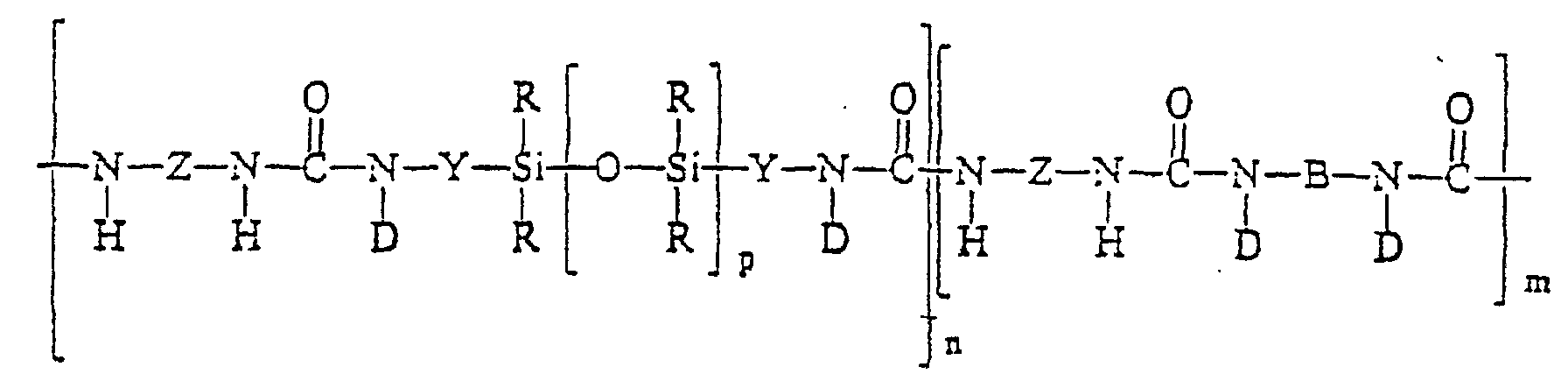 jedes R eine Einheit ist, die unabhängig ein Alkylrest mit etwa 1 bis 12 Kohlenstoffatomen, der mit Trifluoralkyl- oder Vinylgruppen substituiert sein kann, ein Vinylrest oder höherer Alkenylrest, wiedergegeben durch die Formel -R2(CH2)aCH=CH2, wobei R2 -(CH2)b- oder -(CH2)cCH=CH- ist und a 1, 2 oder 3 ist; b 0, 3 oder 6 ist; und c 3, 4 oder 5 ist, ein Cycloalkylrest mit etwa 6 bis 12 Kohlenstoffatomen, der mit Alkyl-, Fluoralkyl- und Vinylgruppen substituiert sein kann, oder ein Arylrest, vorzugsweise mit etwa 6 bis 20 Kohlenstoffatomen, der mit Alkyl-, Cycloalkyl-, Fluoralkyl- und Vinylgruppen substituiert sein kann, ist oder R ein Perfluoralkylrest, ein Fluor enthaltender Rest oder ein Perfluorether enthaltender Rest ist;jedes Z ein mehrwertiger Rest ist, der ein Arylenrest oder ein Aralkylenrest mit etwa 6 bis 20 Kohlenstoffatomen, ein Alkylen- oder Cycloalkylenrest mit etwa 6 bis 20 Kohlenstoffatomen ist;jedes Y ein mehrwertiger Rest ist, der unabhängig ein Alkylenrest mit 1 bis 10 Kohlenstoffatomen, ein Aralkylenrest oder ein Arylenrest mit 6 bis 20 Kohlenstoffatomen ist;jedes D ausgewählt ist aus Wasserstoff, einem Alkylrest mit 1 bis 10 Kohlenstoffatomen, Phenyl, und einem Rest, der eine B oder Y beinhaltende Ringstruktur unter Bildung eines Heterocyclus vervollständigt;B ein mehrwertiger Rest, ausgewählt aus Alkylen, Aralkylen, Cycloalkylen, Phenylen, Polyalkylenoxid, einschließlich Copolymeren und Gemischen davon, ist;m eine Zahl ist, die 0 bis etwa 1000 ist;n eine Zahl ist, die gleich oder größer als 1 ist; undp eine Zahl ist, die etwa 10 oder größer ist.
 - Klebriggemachte Zusammensetzung nach Anspruch 2, wobei mindestens 50% der Einheiten R Methylreste sind, wobei die anderen Einheiten R einwertige Alkyl- oder substituierte Alkylreste mit 1 bis 12 Kohlenstoffatomen, Alkenylenreste, Phenylreste oder substituierte Phenylreste sind.
- Klebriggemachte Zusammensetzung nach Anspruch 2, wobei Z für 2,6-Tolylen, 4,4'-Methylendiphenylen, 3,3'-Dimethoxy-4,4'-biphenylen, Tetramethyl-m-xylylen, 4,4'-Methylendicyclohexylen, 3,5,5-Trimethyl-3-methylencyclohexylen, 1,6-Hexamethylen, 1,4-Cyclohexylen, 2,2,4-Trimethylhexylen und Gemische davon steht.
- Klebriggemachte Zusammensetzung nach einem der Ansprüche 1 bis 4, wobei das Silicatharz ein MQ-Harz mit Triorganosiloxy-Einheiten und SiO4/2-Einheiten, ein MQD-Harz mit R3SiO1/2-Einheiten, SiO4/2-Einheiten und R2SiO2/2-Einheiten, wobei R ein Gemisch von Alkylresten mit 1 bis 4 Kohlenstoffatomen ist, oder ein MQT-Harz mit R3SiO1/2-Einheiten, SiO4/2-Einheiten und RSiO3-Einheiten, wobei R ein Gemisch von Alkylresten mit 1 bis 4 Kohlenstoffatomen ist, bedeutet.
- Verwendung der klebriggemachten Zusammensetzung nach den Ansprüchen 1 bis 5 als Haftkleber oder Schmelzkleber.
- Mit Haftkleber beschichteter Gegenstand, umfassend eine Schicht, die die klebriggemachte Zusammensetzung nach den Ansprüchen 1 bis 5 und einen Träger umfaßt.
- Beschichteter Gegenstand, umfassend eine klebriggemachte Zusammensetzung nach einem der Ansprüche 1 bis 5, wobei der beschichtete Gegenstand einen Oberflächenwiderstand des Films von 1 MΩ/cm2, gemessen durch elektrochemische Impedanzspektroskopie nach 3-wöchigem Ausgesetztsein korrosiver Umgebung in einer 3% wäßrigen NaCl-Lösung, aufweist.
- Schrumpfschlauch, umfassend die klebriggemachte Zusammensetzung nach einem der Ansprüche 1 bis 5.
- Verfahren zur Herstellung der klebriggemachten Zusammensetzung nach Anspruch 1, umfassend:wobei das Verfahren die Schritte(A) ein Polydiorganosiloxan-Polyharnstoff-segmentiertes Copolymer umfassend ein Reaktionsprodukt von(i) mindestens einem Polyamin, wobei das Polyamin mindestens ein Polydiorganosiloxandiamin oder ein Gemisch von mindestens einem Polydiorganosiloxandiamin und mindestens einem organischen Polyamin umfaßt, und(ii) mindestens einem Polyisocyanat, wobei das Molverhältnis von Isocyanat zu Amin zwischen 0,9:1 und 0,95:1 oder zwischen 1,05:1 und 1,3:1 liegt; und(B) mindestens ein Silicatharz,umfaßt, wobei das mindestens eine Silicatharz (B) zu irgendeinem Punkt des Verfahrens vor, während oder nach dem Reaktionsschritt zugegeben wird.(a) der kontinuierlichen Zufuhr von Reaktanten, dieenthalten, zu einem Reaktor;(ii) das mindestens eine Polyisocyanat und(i) das mindestens eine Polyamin oder das Gemisch des mindestens einen Polydiorganosiloxandiamins mit dem mindestens einen organischen Polyamin(b) des Mischens der Reaktanten unter lösungsmittelfreien Bedingungen;(c) des Umsetzenlassens der Reaktanten unter Bildung eines Polydiorganosiloxan-Polyharnstoff-segmentierten Copolymers; und(d) des Transportierens der Zusammensetzung aus dem Reaktor;
Applications Claiming Priority (5)
| Application Number | Priority Date | Filing Date | Title |
|---|---|---|---|
| US42893495A | 1995-04-25 | 1995-04-25 | |
| US42778895A | 1995-04-25 | 1995-04-25 | |
| US428934 | 1995-04-25 | ||
| US427788 | 1995-04-25 | ||
| PCT/US1996/005852 WO1996035458A2 (en) | 1995-04-25 | 1996-04-25 | Tackified polydiorganosiloxane polyurea segmented copolymers and a process for making same |
Publications (2)
| Publication Number | Publication Date |
|---|---|
| EP0830428A2 EP0830428A2 (de) | 1998-03-25 |
| EP0830428B1 true EP0830428B1 (de) | 2002-09-04 |
Family
ID=27027513
Family Applications (1)
| Application Number | Title | Priority Date | Filing Date |
|---|---|---|---|
| EP96925246A Expired - Lifetime EP0830428B1 (de) | 1995-04-25 | 1996-04-25 | Klebriggemachte segmentierte polydiorganosiloxanpolyharnstoff copolymere und ein verfahren zu deren herstellung |
Country Status (9)
| Country | Link |
|---|---|
| EP (1) | EP0830428B1 (de) |
| JP (1) | JP4267690B2 (de) |
| KR (1) | KR19990008022A (de) |
| CN (1) | CN1183113A (de) |
| AU (1) | AU6540196A (de) |
| BR (1) | BR9608381A (de) |
| CA (1) | CA2218912A1 (de) |
| DE (1) | DE69623465T2 (de) |
| IL (1) | IL118025A0 (de) |
Cited By (3)
| Publication number | Priority date | Publication date | Assignee | Title |
|---|---|---|---|---|
| US9359529B2 (en) | 2008-10-29 | 2016-06-07 | 3M Innovative Properties Company | Electron beam cured silicone materials |
| US9546296B2 (en) | 2014-12-15 | 2017-01-17 | Ppg Industries Ohio, Inc. | Coating compositions, coatings and methods for sound and vibration damping and water resistance |
| US10100216B2 (en) | 2014-12-15 | 2018-10-16 | Ppg Industries Ohio, Inc. | Coating compositions, coatings and methods for sound and vibration damping and water resistance |
Families Citing this family (15)
| Publication number | Priority date | Publication date | Assignee | Title |
|---|---|---|---|---|
| WO2000075210A1 (en) * | 1999-06-07 | 2000-12-14 | 3M Innovative Properties Company | Polyurea-based adhesives, articles therefrom, and methods of their preparation and use |
| US6730397B2 (en) * | 2001-12-18 | 2004-05-04 | 3M Innovative Properties Company | Silicone pressure sensitive adhesives, articles and methods |
| US7407709B2 (en) * | 2003-12-22 | 2008-08-05 | 3M Innovative Properties Company | Silicone pressure sensitive adhesive and articles |
| FR2875182B1 (fr) * | 2004-09-16 | 2006-11-17 | Saint Gobain | Profile d'amortisseur acoustique entre un vitrage et la carrosserie d'un vehicule |
| DE102005054781A1 (de) * | 2005-11-15 | 2007-05-16 | Tesa Ag | Verwendung eines doppelseitigen Haftklebebandes zur Verklebung bei der Herstellung von Elektronikartikel |
| EP2120812B1 (de) * | 2006-12-20 | 2014-10-29 | Coloplast A/S | Haftklebstoff-zusammensetzung mit einem salz |
| US20110206924A1 (en) * | 2008-10-29 | 2011-08-25 | Liu Junkang J | Electron beam cured, nonfunctionalized silicone pressure sensitive adhesives |
| BRPI0914379A2 (pt) * | 2008-10-29 | 2015-10-20 | 3M Innovative Properties Co | "adesivo, artigo médico e método para adesão de um substrato médico a um substrato biológico" |
| EP2760952B1 (de) * | 2011-09-30 | 2018-03-21 | 3M Innovative Properties Company | Flexible strassenmarkierungen |
| CN104411791B (zh) * | 2012-07-03 | 2017-06-09 | 3M创新有限公司 | 可热活化的硅氧烷基粘合剂 |
| DE102015113111B4 (de) * | 2015-08-10 | 2020-01-30 | Infineon Technologies Ag | Leistungshalbleitermodul mit verbesserter Abdichtung |
| WO2017116935A1 (en) * | 2015-12-31 | 2017-07-06 | 3M Innovative Properties Company | Silicone-based adhesive compositions and adhesive articles |
| WO2020039372A1 (en) * | 2018-08-23 | 2020-02-27 | 3M Innovative Properties Company | Tackified and filled silicone adhesive compositions |
| CN112680167A (zh) * | 2020-12-25 | 2021-04-20 | 成都硅宝科技股份有限公司 | 一种耐候性高强度聚氨酯密封胶及其制备方法 |
| CN118440665B (zh) * | 2024-05-28 | 2024-11-12 | 东莞市新懿电子材料技术有限公司 | 一种耐高低温、超强粘接性的有机硅密封胶及其制备方法 |
-
1996
- 1996-04-25 IL IL11802596A patent/IL118025A0/xx unknown
- 1996-04-25 KR KR1019970707546A patent/KR19990008022A/ko not_active Withdrawn
- 1996-04-25 DE DE69623465T patent/DE69623465T2/de not_active Expired - Lifetime
- 1996-04-25 BR BR9608381A patent/BR9608381A/pt not_active Application Discontinuation
- 1996-04-25 CA CA2218912A patent/CA2218912A1/en not_active Abandoned
- 1996-04-25 AU AU65401/96A patent/AU6540196A/en not_active Abandoned
- 1996-04-25 EP EP96925246A patent/EP0830428B1/de not_active Expired - Lifetime
- 1996-04-25 CN CN 96193544 patent/CN1183113A/zh active Pending
- 1996-04-25 JP JP53410396A patent/JP4267690B2/ja not_active Expired - Fee Related
Cited By (3)
| Publication number | Priority date | Publication date | Assignee | Title |
|---|---|---|---|---|
| US9359529B2 (en) | 2008-10-29 | 2016-06-07 | 3M Innovative Properties Company | Electron beam cured silicone materials |
| US9546296B2 (en) | 2014-12-15 | 2017-01-17 | Ppg Industries Ohio, Inc. | Coating compositions, coatings and methods for sound and vibration damping and water resistance |
| US10100216B2 (en) | 2014-12-15 | 2018-10-16 | Ppg Industries Ohio, Inc. | Coating compositions, coatings and methods for sound and vibration damping and water resistance |
Also Published As
| Publication number | Publication date |
|---|---|
| DE69623465T2 (de) | 2003-08-14 |
| DE69623465D1 (de) | 2002-10-10 |
| JPH11505560A (ja) | 1999-05-21 |
| AU6540196A (en) | 1996-11-29 |
| CN1183113A (zh) | 1998-05-27 |
| IL118025A0 (en) | 1996-08-04 |
| CA2218912A1 (en) | 1996-11-14 |
| JP4267690B2 (ja) | 2009-05-27 |
| BR9608381A (pt) | 1999-06-15 |
| KR19990008022A (ko) | 1999-01-25 |
| EP0830428A2 (de) | 1998-03-25 |
Similar Documents
| Publication | Publication Date | Title |
|---|---|---|
| US6664359B1 (en) | Tackified polydiorganosiloxane polyurea segmented copolymers and a process for making same | |
| WO1996035458A2 (en) | Tackified polydiorganosiloxane polyurea segmented copolymers and a process for making same | |
| EP0830428B1 (de) | Klebriggemachte segmentierte polydiorganosiloxanpolyharnstoff copolymere und ein verfahren zu deren herstellung | |
| EP0934360B1 (de) | Polydiorganosiloxan-ureum-enthaltende polymerzusammensetzungen | |
| JP4709176B2 (ja) | 硬化性かつ粘着性のポリジオルガノシロキサンオリゴウレアセグメント化共重合体 | |
| US6407195B2 (en) | Tackified polydiorganosiloxane oligourea segmented copolymers and a process for making same | |
| EP2167567B1 (de) | Polydiorganosiloxan-polyamid-copolymere mit organischen weichsegmenten | |
| CN101346448B (zh) | 粘合剂组合物 | |
| EP2162485B1 (de) | Verzweigte polydiorganosiloxan-polyamid-copolymere | |
| CN101688045B (zh) | 含有聚二有机硅氧烷-聚酰胺的组分与有机聚合物的混合物 | |
| CN108603090A (zh) | 粘合剂组合物 | |
| JP7618539B2 (ja) | 粘着付与及び充填シリコーン接着剤組成物 | |
| MXPA97008137A (en) | Segmented segmented polidiorganosiloxan-poliurea copolymer, adhesives, and process for your manufacture | |
| MXPA99003661A (es) | Mezclas polimericas que contienen componentes quecontienen polidiorganosiloxano urea | |
| KR20070021119A (ko) | 실리콘 감압 접착제 및 물품 |
Legal Events
| Date | Code | Title | Description |
|---|---|---|---|
| PUAI | Public reference made under article 153(3) epc to a published international application that has entered the european phase |
Free format text: ORIGINAL CODE: 0009012 |
|
| 17P | Request for examination filed |
Effective date: 19971121 |
|
| AK | Designated contracting states |
Kind code of ref document: A2 Designated state(s): DE ES FR GB IT NL SE |
|
| 17Q | First examination report despatched |
Effective date: 19980703 |
|
| GRAG | Despatch of communication of intention to grant |
Free format text: ORIGINAL CODE: EPIDOS AGRA |
|
| GRAG | Despatch of communication of intention to grant |
Free format text: ORIGINAL CODE: EPIDOS AGRA |
|
| GRAH | Despatch of communication of intention to grant a patent |
Free format text: ORIGINAL CODE: EPIDOS IGRA |
|
| GRAH | Despatch of communication of intention to grant a patent |
Free format text: ORIGINAL CODE: EPIDOS IGRA |
|
| GRAA | (expected) grant |
Free format text: ORIGINAL CODE: 0009210 |
|
| AK | Designated contracting states |
Kind code of ref document: B1 Designated state(s): DE ES FR GB IT NL SE |
|
| PG25 | Lapsed in a contracting state [announced via postgrant information from national office to epo] |
Ref country code: NL Free format text: LAPSE BECAUSE OF FAILURE TO SUBMIT A TRANSLATION OF THE DESCRIPTION OR TO PAY THE FEE WITHIN THE PRESCRIBED TIME-LIMIT Effective date: 20020904 Ref country code: IT Free format text: LAPSE BECAUSE OF FAILURE TO SUBMIT A TRANSLATION OF THE DESCRIPTION OR TO PAY THE FEE WITHIN THE PRE;WARNING: LAPSES OF ITALIAN PATENTS WITH EFFECTIVE DATE BEFORE 2007 MAY HAVE OCCURRED AT ANY TIME BEFORE 2007. THE CORRECT EFFECTIVE DATE MAY BE DIFFERENT FROM THE ONE RECORDED.SCRIBED TIME-LIMIT Effective date: 20020904 |
|
| REG | Reference to a national code |
Ref country code: GB Ref legal event code: FG4D |
|
| REF | Corresponds to: |
Ref document number: 69623465 Country of ref document: DE Date of ref document: 20021010 |
|
| PG25 | Lapsed in a contracting state [announced via postgrant information from national office to epo] |
Ref country code: SE Free format text: LAPSE BECAUSE OF FAILURE TO SUBMIT A TRANSLATION OF THE DESCRIPTION OR TO PAY THE FEE WITHIN THE PRESCRIBED TIME-LIMIT Effective date: 20021204 |
|
| NLV1 | Nl: lapsed or annulled due to failure to fulfill the requirements of art. 29p and 29m of the patents act | ||
| ET | Fr: translation filed | ||
| PG25 | Lapsed in a contracting state [announced via postgrant information from national office to epo] |
Ref country code: ES Free format text: LAPSE BECAUSE OF FAILURE TO SUBMIT A TRANSLATION OF THE DESCRIPTION OR TO PAY THE FEE WITHIN THE PRESCRIBED TIME-LIMIT Effective date: 20030328 |
|
| PLBE | No opposition filed within time limit |
Free format text: ORIGINAL CODE: 0009261 |
|
| STAA | Information on the status of an ep patent application or granted ep patent |
Free format text: STATUS: NO OPPOSITION FILED WITHIN TIME LIMIT |
|
| 26N | No opposition filed |
Effective date: 20030605 |
|
| PGFP | Annual fee paid to national office [announced via postgrant information from national office to epo] |
Ref country code: FR Payment date: 20070417 Year of fee payment: 12 |
|
| REG | Reference to a national code |
Ref country code: FR Ref legal event code: ST Effective date: 20081231 |
|
| PG25 | Lapsed in a contracting state [announced via postgrant information from national office to epo] |
Ref country code: FR Free format text: LAPSE BECAUSE OF NON-PAYMENT OF DUE FEES Effective date: 20080430 |
|
| PGFP | Annual fee paid to national office [announced via postgrant information from national office to epo] |
Ref country code: GB Payment date: 20130424 Year of fee payment: 18 |
|
| GBPC | Gb: european patent ceased through non-payment of renewal fee |
Effective date: 20140425 |
|
| PG25 | Lapsed in a contracting state [announced via postgrant information from national office to epo] |
Ref country code: GB Free format text: LAPSE BECAUSE OF NON-PAYMENT OF DUE FEES Effective date: 20140425 |
|
| PGFP | Annual fee paid to national office [announced via postgrant information from national office to epo] |
Ref country code: DE Payment date: 20150422 Year of fee payment: 20 |
|
| REG | Reference to a national code |
Ref country code: DE Ref legal event code: R071 Ref document number: 69623465 Country of ref document: DE |