EP0830899B1 - Verfahren zur rückgewinnung von farben - Google Patents
Verfahren zur rückgewinnung von farben Download PDFInfo
- Publication number
- EP0830899B1 EP0830899B1 EP97900039A EP97900039A EP0830899B1 EP 0830899 B1 EP0830899 B1 EP 0830899B1 EP 97900039 A EP97900039 A EP 97900039A EP 97900039 A EP97900039 A EP 97900039A EP 0830899 B1 EP0830899 B1 EP 0830899B1
- Authority
- EP
- European Patent Office
- Prior art keywords
- paint
- receiver
- membrane
- hollow fiber
- paints
- Prior art date
- Legal status (The legal status is an assumption and is not a legal conclusion. Google has not performed a legal analysis and makes no representation as to the accuracy of the status listed.)
- Expired - Lifetime
Links
- 239000003973 paint Substances 0.000 title claims abstract description 144
- 239000000463 material Substances 0.000 title claims abstract description 33
- 238000000034 method Methods 0.000 title claims abstract description 30
- 239000012528 membrane Substances 0.000 claims abstract description 100
- 239000012510 hollow fiber Substances 0.000 claims abstract description 54
- 239000003960 organic solvent Substances 0.000 claims abstract description 39
- XLYOFNOQVPJJNP-UHFFFAOYSA-N water Substances O XLYOFNOQVPJJNP-UHFFFAOYSA-N 0.000 claims abstract description 34
- 238000000108 ultra-filtration Methods 0.000 claims abstract description 5
- 238000005507 spraying Methods 0.000 claims description 31
- 238000001471 micro-filtration Methods 0.000 claims description 4
- 238000001914 filtration Methods 0.000 abstract description 3
- 239000000835 fiber Substances 0.000 abstract description 2
- 238000007592 spray painting technique Methods 0.000 abstract 2
- 230000003750 conditioning effect Effects 0.000 abstract 1
- 239000011248 coating agent Substances 0.000 description 17
- 238000000576 coating method Methods 0.000 description 17
- 239000007788 liquid Substances 0.000 description 13
- 239000007787 solid Substances 0.000 description 10
- 238000011084 recovery Methods 0.000 description 9
- -1 ether alcohols Chemical class 0.000 description 8
- 239000000428 dust Substances 0.000 description 7
- 239000007864 aqueous solution Substances 0.000 description 5
- 235000019441 ethanol Nutrition 0.000 description 5
- CTQNGGLPUBDAKN-UHFFFAOYSA-N O-Xylene Chemical compound CC1=CC=CC=C1C CTQNGGLPUBDAKN-UHFFFAOYSA-N 0.000 description 4
- 238000004519 manufacturing process Methods 0.000 description 4
- 239000002904 solvent Substances 0.000 description 4
- 239000008096 xylene Substances 0.000 description 4
- ZWEHNKRNPOVVGH-UHFFFAOYSA-N 2-Butanone Chemical compound CCC(C)=O ZWEHNKRNPOVVGH-UHFFFAOYSA-N 0.000 description 3
- 239000004698 Polyethylene Substances 0.000 description 3
- 239000000853 adhesive Substances 0.000 description 3
- 150000001412 amines Chemical class 0.000 description 3
- 239000012530 fluid Substances 0.000 description 3
- 229920000573 polyethylene Polymers 0.000 description 3
- LFQSCWFLJHTTHZ-UHFFFAOYSA-N Ethanol Chemical compound CCO LFQSCWFLJHTTHZ-UHFFFAOYSA-N 0.000 description 2
- 239000004743 Polypropylene Substances 0.000 description 2
- 230000001070 adhesive effect Effects 0.000 description 2
- 150000001298 alcohols Chemical class 0.000 description 2
- 238000005452 bending Methods 0.000 description 2
- 239000003795 chemical substances by application Substances 0.000 description 2
- 238000010790 dilution Methods 0.000 description 2
- 239000012895 dilution Substances 0.000 description 2
- 239000006185 dispersion Substances 0.000 description 2
- 238000001035 drying Methods 0.000 description 2
- 230000007613 environmental effect Effects 0.000 description 2
- 239000003822 epoxy resin Substances 0.000 description 2
- 150000002148 esters Chemical class 0.000 description 2
- RTZKZFJDLAIYFH-UHFFFAOYSA-N ether Substances CCOCC RTZKZFJDLAIYFH-UHFFFAOYSA-N 0.000 description 2
- 150000002170 ethers Chemical class 0.000 description 2
- 239000011491 glass wool Substances 0.000 description 2
- 229930195733 hydrocarbon Natural products 0.000 description 2
- 150000002430 hydrocarbons Chemical class 0.000 description 2
- 239000002440 industrial waste Substances 0.000 description 2
- 150000002576 ketones Chemical class 0.000 description 2
- 239000003595 mist Substances 0.000 description 2
- 239000004745 nonwoven fabric Substances 0.000 description 2
- 239000003921 oil Substances 0.000 description 2
- 239000000123 paper Substances 0.000 description 2
- 239000002245 particle Substances 0.000 description 2
- 239000012466 permeate Substances 0.000 description 2
- 229920000647 polyepoxide Polymers 0.000 description 2
- 229920001155 polypropylene Polymers 0.000 description 2
- 239000011148 porous material Substances 0.000 description 2
- 229920005989 resin Polymers 0.000 description 2
- 239000011347 resin Substances 0.000 description 2
- 238000000926 separation method Methods 0.000 description 2
- 229910001220 stainless steel Inorganic materials 0.000 description 2
- 239000010935 stainless steel Substances 0.000 description 2
- 229920002803 thermoplastic polyurethane Polymers 0.000 description 2
- 238000009736 wetting Methods 0.000 description 2
- 238000004804 winding Methods 0.000 description 2
- RRQYJINTUHWNHW-UHFFFAOYSA-N 1-ethoxy-2-(2-ethoxyethoxy)ethane Chemical compound CCOCCOCCOCC RRQYJINTUHWNHW-UHFFFAOYSA-N 0.000 description 1
- OAYXUHPQHDHDDZ-UHFFFAOYSA-N 2-(2-butoxyethoxy)ethanol Chemical compound CCCCOCCOCCO OAYXUHPQHDHDDZ-UHFFFAOYSA-N 0.000 description 1
- 239000004640 Melamine resin Substances 0.000 description 1
- 229920000877 Melamine resin Polymers 0.000 description 1
- 239000002033 PVDF binder Substances 0.000 description 1
- 239000004952 Polyamide Substances 0.000 description 1
- 239000004695 Polyether sulfone Substances 0.000 description 1
- BZHJMEDXRYGGRV-UHFFFAOYSA-N Vinyl chloride Chemical compound ClC=C BZHJMEDXRYGGRV-UHFFFAOYSA-N 0.000 description 1
- 150000001242 acetic acid derivatives Chemical class 0.000 description 1
- 239000002253 acid Substances 0.000 description 1
- 150000007513 acids Chemical class 0.000 description 1
- 239000000654 additive Substances 0.000 description 1
- 229920000180 alkyd Polymers 0.000 description 1
- PNEYBMLMFCGWSK-UHFFFAOYSA-N aluminium oxide Inorganic materials [O-2].[O-2].[O-2].[Al+3].[Al+3] PNEYBMLMFCGWSK-UHFFFAOYSA-N 0.000 description 1
- 229920002678 cellulose Polymers 0.000 description 1
- 239000001913 cellulose Substances 0.000 description 1
- 238000007865 diluting Methods 0.000 description 1
- 239000003085 diluting agent Substances 0.000 description 1
- 238000009503 electrostatic coating Methods 0.000 description 1
- 238000003912 environmental pollution Methods 0.000 description 1
- 230000004927 fusion Effects 0.000 description 1
- 229910010272 inorganic material Inorganic materials 0.000 description 1
- 239000011147 inorganic material Substances 0.000 description 1
- 238000003780 insertion Methods 0.000 description 1
- 230000037431 insertion Effects 0.000 description 1
- 238000002156 mixing Methods 0.000 description 1
- 229920000620 organic polymer Polymers 0.000 description 1
- 229920002492 poly(sulfone) Polymers 0.000 description 1
- 229920002239 polyacrylonitrile Polymers 0.000 description 1
- 229920002647 polyamide Polymers 0.000 description 1
- 229920001225 polyester resin Polymers 0.000 description 1
- 239000004645 polyester resin Substances 0.000 description 1
- 229920006393 polyether sulfone Polymers 0.000 description 1
- 239000002861 polymer material Substances 0.000 description 1
- 229920000915 polyvinyl chloride Polymers 0.000 description 1
- 239000004800 polyvinyl chloride Substances 0.000 description 1
- 229920000131 polyvinylidene Polymers 0.000 description 1
- 229920002981 polyvinylidene fluoride Polymers 0.000 description 1
- 230000002265 prevention Effects 0.000 description 1
- 238000004064 recycling Methods 0.000 description 1
- HBMJWWWQQXIZIP-UHFFFAOYSA-N silicon carbide Chemical compound [Si+]#[C-] HBMJWWWQQXIZIP-UHFFFAOYSA-N 0.000 description 1
- 229910010271 silicon carbide Inorganic materials 0.000 description 1
- 229920002050 silicone resin Polymers 0.000 description 1
- 229920002379 silicone rubber Polymers 0.000 description 1
- 239000004945 silicone rubber Substances 0.000 description 1
- 239000007921 spray Substances 0.000 description 1
- 239000000725 suspension Substances 0.000 description 1
- 238000009423 ventilation Methods 0.000 description 1
- 125000000391 vinyl group Chemical group [H]C([*])=C([H])[H] 0.000 description 1
- 229920002554 vinyl polymer Polymers 0.000 description 1
- 239000002699 waste material Substances 0.000 description 1
- 238000005303 weighing Methods 0.000 description 1
Images



Classifications
-
- B—PERFORMING OPERATIONS; TRANSPORTING
- B01—PHYSICAL OR CHEMICAL PROCESSES OR APPARATUS IN GENERAL
- B01D—SEPARATION
- B01D63/00—Apparatus in general for separation processes using semi-permeable membranes
- B01D63/02—Hollow fibre modules
- B01D63/025—Bobbin units
-
- B—PERFORMING OPERATIONS; TRANSPORTING
- B01—PHYSICAL OR CHEMICAL PROCESSES OR APPARATUS IN GENERAL
- B01D—SEPARATION
- B01D63/00—Apparatus in general for separation processes using semi-permeable membranes
- B01D63/02—Hollow fibre modules
- B01D63/024—Hollow fibre modules with a single potted end
-
- B—PERFORMING OPERATIONS; TRANSPORTING
- B01—PHYSICAL OR CHEMICAL PROCESSES OR APPARATUS IN GENERAL
- B01D—SEPARATION
- B01D63/00—Apparatus in general for separation processes using semi-permeable membranes
- B01D63/08—Flat membrane modules
- B01D63/087—Single membrane modules
-
- B—PERFORMING OPERATIONS; TRANSPORTING
- B05—SPRAYING OR ATOMISING IN GENERAL; APPLYING FLUENT MATERIALS TO SURFACES, IN GENERAL
- B05B—SPRAYING APPARATUS; ATOMISING APPARATUS; NOZZLES
- B05B14/00—Arrangements for collecting, re-using or eliminating excess spraying material
- B05B14/40—Arrangements for collecting, re-using or eliminating excess spraying material for use in spray booths
- B05B14/46—Arrangements for collecting, re-using or eliminating excess spraying material for use in spray booths by washing the air charged with excess material
- B05B14/462—Arrangements for collecting, re-using or eliminating excess spraying material for use in spray booths by washing the air charged with excess material and separating the excess material from the washing liquid, e.g. for recovery
-
- B—PERFORMING OPERATIONS; TRANSPORTING
- B05—SPRAYING OR ATOMISING IN GENERAL; APPLYING FLUENT MATERIALS TO SURFACES, IN GENERAL
- B05B—SPRAYING APPARATUS; ATOMISING APPARATUS; NOZZLES
- B05B14/00—Arrangements for collecting, re-using or eliminating excess spraying material
- B05B14/40—Arrangements for collecting, re-using or eliminating excess spraying material for use in spray booths
- B05B14/46—Arrangements for collecting, re-using or eliminating excess spraying material for use in spray booths by washing the air charged with excess material
- B05B14/462—Arrangements for collecting, re-using or eliminating excess spraying material for use in spray booths by washing the air charged with excess material and separating the excess material from the washing liquid, e.g. for recovery
- B05B14/463—Arrangements for collecting, re-using or eliminating excess spraying material for use in spray booths by washing the air charged with excess material and separating the excess material from the washing liquid, e.g. for recovery by means of ultrafiltration
-
- Y—GENERAL TAGGING OF NEW TECHNOLOGICAL DEVELOPMENTS; GENERAL TAGGING OF CROSS-SECTIONAL TECHNOLOGIES SPANNING OVER SEVERAL SECTIONS OF THE IPC; TECHNICAL SUBJECTS COVERED BY FORMER USPC CROSS-REFERENCE ART COLLECTIONS [XRACs] AND DIGESTS
- Y02—TECHNOLOGIES OR APPLICATIONS FOR MITIGATION OR ADAPTATION AGAINST CLIMATE CHANGE
- Y02P—CLIMATE CHANGE MITIGATION TECHNOLOGIES IN THE PRODUCTION OR PROCESSING OF GOODS
- Y02P70/00—Climate change mitigation technologies in the production process for final industrial or consumer products
- Y02P70/10—Greenhouse gas [GHG] capture, material saving, heat recovery or other energy efficient measures, e.g. motor control, characterised by manufacturing processes, e.g. for rolling metal or metal working
Definitions
- the present invention relates to a method for recovering the paints suitable to an object whereby, in a booth for a spray coating used for coating a material, the oversprayed paints can be easily recovered and recycled as they are or after a simple adjustment as reusable paints and it also relates to a receiver used for said recovery.
- the US patent 3891547 refers to a fluid filter containing hollow fibers which are terminated at their respective ends in manifolds. Such a filter is employed for filtration of solid particles from fluid suspensions. The filter, therefore, serves to filter particles from a fluid in which they are dispersed.
- the filter comprises a mesh made of hollow fibers.
- the dry method is a method where oversprayed paints are received by fencing boards or by a filter made of glass wool, nonwoven fabric, paper, etc.
- the wet method is a method where the oversprayed paints are received by a liquid mist such as water and oil, a curtain-like liquid flow, a tank for recovered liquid, etc.
- the present invention has been achieved for solving the problems mentioned hereinabove and an object of the present invention is to offer a method for recovering the paints suitable to an object whereby, in a booth for a spray coating used for coating a material, the oversprayed paints can be easily recovered and recycled as they are or after a simple adjustment as reusable paints and also to offer a receiver used for said recovery.
- the present inventors have conducted an intensive study on a method of recovering the paints for solving the above problems and have found that, when a receiver using a ultrafiltration membrane (UF membrane) or a microfiltration membrane (MF membrane) is placed before a filter or a wet dust collector for receiving the oversprayed paints or is placed instead of such a filter or a wet dust collector and then water is passed through the UF membrane or the MF membrane in case the paints are aqueous type or, in case the paints are organic solvent type, an organic solvent is passed therethrough, then the oversprayed paints adhered onto the receiver flow down to a gravitational direction and, as a result, the oversprayed paints which are capable of being reused as they are or after a simple adjustment can be recovered under the receiver.
- UF membrane ultrafiltration membrane
- MF membrane microfiltration membrane
- the surface of the receiver When the surface of the receiver is made of an UF or MF membrane and then water or organic solvent is passed through the UF or MF membrane, the surface of the receiver becomes in a wet state by water or organic solvent which is permeated from the UF or MF membrane whereby the oversprayed paints adhered on the receiver surface are not dried but flow down to the gravitational direction. It has now been found that, when the paints are recovered by the method of the present invention, the receiver (UF or MF membrane) is hardly stained by the paints since water or organic solvent is always oozed out from the receiver (UF or MF membrane) and, since the amount of water or organic solvent used is small, the paints can be efficiently recovered without too much dilution.
- the present inventors have found a method for recovering the paints suitable to an object that, in a booth for a spray coating used for coating a material, the oversprayed paints can be easily recovered and recycled as they are or after a simple adjustment as reusable paints and also a receiver used for said recovery whereupon the present invention has been achieved.
- the present invention relates to a method for recovering paints, characterized in that, a receiver using an ultrafiltration membrane or a microfiltration membrane is placed in a spray coating booth and water or organic solvent is contacted the one side of said membrane so that the oversprayed paint is received on the other side of said membrane and recovered therefrom.
- the present invention also relates to a receiver placed in a spray coating booth for recovering paints, whereby said receiver has two or more hollow fiber membranes arranged on a plate where at least one end of the membranes is open, with a fixing material which fixes and holds the hollow fiber membranes on the plate and distributing pipes connecting to the open end of each of the hollow fiber membranes.
- the receiver used in the present invention is placed in a spray coating booth although the receiver may be placed and used in any other place upon conducting a coating.
- a spray booth dry and wet systems which have been known already may be used. In that case, it is necessary that, based upon the location of the coating machine, the receiver is placed behind or a side of the material to be coated and in front of the filter or the wet dust collector receiving the spray coating booth although it is also possible that the receiver is placed instead of the filter or the wet dust collector which receives the paints in the spray coating booth.
- the receiver used in the present invention may be in any shape, any size and any number.
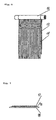
- hollow fiber membrane of UF or MF membrane it is preferred that, as shown in Fig. 1, hollow fiber membrane of UF or MF membrane is made into a net-like shape and placed in a single or plural layer(s) or, as shown in Fig. 2, hollow fiber membrane of UF or MF membrane is spirally wound on the surface of a support column followed by setting up vertically.
- plural fibers are placed in plural rows with certain intervals, that is most preferred.
- Fig. 1 When plural fibers are placed in plural rows with certain intervals, that is most preferred.
- the receiver which is used in the present invention may be any membrane which permeates water or organic solvent regardless of the degree of the pressure.
- Commonly used receivers are membranes such as an MF membrane and an UF membrane.
- the receiver used in the present invention is capable of passing water or organic solvent therethrough but, depending upon the type of the UF or MF membrane used and the structure of the receiver, it is also possible to pass by means of a capillary phenomenon, a siphonage or a compulsory compressing. With respect to water and organic solvent which is passed through the UF or MF membrane, such is used which is able to dissolve the paints used for the coating.
- organic solvent that may be used which is selected from hydrocarbons such as xylene, alcohols such as ethyl alcohol, ethers such as diethyl carbitol, ketones such as methyl ethyl ketone, esters such as acetates and ether alcohols such as butyl carbitol as well as two or more of them as a mixed organic solvent may be used.
- the organic solvent is preferred which is a constituting component of the paints used and which has a low volatility at ambient temperature.
- Coating of the paint used in the present invention can be conducted by coating means such as an air spray coating, an airless spray coating and an electrostatic coating while it is also possible to conduct such paint coating by means of a shower coating, a curtain flow coating, etc.
- coating means such as an air spray coating, an airless spray coating and an electrostatic coating while it is also possible to conduct such paint coating by means of a shower coating, a curtain flow coating, etc.
- any paint may be used so far as it contains water or organic solvent and its examples are alkyd resin paints, acryl resin paints, polyester resin paints, vinyl resin paints, melamine resin paints, epoxy resin paints and urethane resin paints.
- the oversprayed paint adhered onto the receiver flows down to the gravitational direction and is recovered at the lower part of the receiver and it is also possible that a receiver is placed in the direction of a slope or an inclined board or the like is placed under the receiver so that the oversprayed paint is recovered at the side of the receiver.
- a recovering tank may be placed at the area where the oversprayed paint flows down to a gravitational direction so that the paint can be collected thereby.
- the recovered paint can be reused as it is or after adjustment.
- diluents such as hydrocarbons, alcohols, ethers, ketones, esters, ether alcohols and water, neutralizers such as amines and acids and other additives are added thereto depending upon the components of the oversprayed paint followed by mixing and filtering for reuse.
- a receiver of the present invention will be explained hereunder by referring to Fig. 6 and Fig. 7.
- a plate 18 On a plate 18, many hollow fiber membranes 17 having opening(s) either on one or both end(s) thereof are arranged in parallel with predetermined intervals and fixed and held by a fixing material 19 while, at an open end of the hollow fiber membrane 17, there is a distributing pipe 16 connecting therewith.
- the receiver of the present invention is used by placing it vertically and, when compressed water, aqueous solution containing amine or solvent contained in the aqueous paint or organic solvent contained in the paint of organic solvent type is supplied to the distributing pipe, water or said aqueous solution or organic solvent oozes out from the surface of each of the hollow fiber membranes to keep the hollow fiber membrane surface in a wet state whereby the adhered oversprayed paint (an aqueous paint, a paint of an aqueous type such as an aqueous dispersion type or a paint containing organic solvent) is washed out and flown down to the gravitational direction. As a result of collecting this flown down liquid, it is now possible to recover the oversprayed paint.
- aqueous solution containing amine or solvent contained in the aqueous paint or organic solvent contained in the paint of organic solvent type is supplied to the distributing pipe, water or said aqueous solution or organic solvent oozes out from the surface of each of the hollow fiber membranes to keep the hollow fiber
- the receiver of the present invention utilizes the characteristics that, because of the use of water or organic solvent, aqueous type paint or organic solvent type paint is not dried due to water or organic solvent oozing out to the surface of the hollow fiber membrane. Since the surface of the hollow fiber membrane is always in a wet state as such, the oversprayed paint is not adhered and, in addition, an adhesion can be prevented by small amount of water or organic solvent whereby the paint can be recovered without too much dilution.
- any size and any numbers of the receiver may be used in the present invention.
- two or more receivers arranged in parallel may be used.
- the pore size of the UF and MF membranes used in the present invention is 0.001-10 micrometers or, preferably, 0.001-0.1 micrometer and can be selected within a wide range from an extent of ultrafiltration membrane to that of a microfiltration membrane.
- the material for the membrane examples include organic polymer materials such as polyethylene, polypropylene, polyvinylidene fluoride, polyvinylidene 4-fluoride, polysulfone, polyether sulfone, polyacrylonitrile, polyamide and cellulose types and inorganic materials such as alumina and silicon carbide and, although there is no particular limitation therefor, membranes having an affinity to water or to organic solvent are particularly preferred because the membranes having no affinity thereto form droplets of a relatively big size when water or organic solvent is oozed out from the surface resulting in a low wetting on the surface.
- organic polymer materials such as polyethylene, polypropylene, polyvinylidene fluoride, polyvinylidene 4-fluoride, polysulfone, polyether sulfone, polyacrylonitrile, polyamide and cellulose types and inorganic materials such as alumina and silicon carbide and, although there is no particular limitation therefor, membranes having an affinity to water or to organic solvent are particularly preferred because the
- the thickness of the hollow fiber membrane used here in terms of an outer diameter it is 0.5-6 mm, preferably 1-6 mm and, more preferably, 2-6 mm.
- the outer diameter is 1 mm or smaller however, attachment of the distributing pipe thereto is difficult and a surface area occupying in a receiver is big and, therefore, a minute control of water or organic solvent oozing out therefrom is difficult. Accordingly, thick hollow fiber membranes are preferred.
- the inner diameter it is sufficient if water or organic solvent can pass therethrough and said inner diameter can be set freely.
- the hollow fiber membranes may be arranged in such a manner that they are placed adjacently or, at the longest, they are placed with an interval corresponding to the outer diameter of the hollow fiber membranes.
- the interval is longer than the outer diameter of the hollow fiber membranes, it is not possible to keep the moisture of the intervals between the hollow fiber membranes and the plate within such an extent that the oversprayed paint is not adhered thereto and, as a result thereof, adhesion of said paint to the plate is resulted.
- the length of the hollow fiber membrane it is preferred that the length is made a bit longer than that of the plate in view of attachment of a distributing pipe to an upper end of the plate and also of collection of the oversprayed paint flown down beneath the plate.
- any material may be used so far as it is an adhesive agent which is capable of adhering the hollow fiber membrane to the plate and its examples are epoxy resin, urethane resin and silicone resin. If there is no problem of its removal due to wetting by water or by organic solvent, fixing and holding of the hollow fiber membrane may be conducted even by a method where a sticking tape having adhesives on both sides thereof is attached thereto.
- the plate used in the receiver of the present invention With respect to a material for the plate used in the receiver of the present invention, those which have satisfactory resistance to solvents and do not absorb water therewith such as SUS, vinyl chloride, polyethylene and polypropylene may be freely selected and used. There is no particular limitation for the thickness of the plate but, in view of a practical use, the thickness giving no bending or weighing down is necessary. Incidentally, the plate is quite essential for making the hollow fiber membranes adjacent each other without curling or bending, for fixing/holding them with certain intervals and also for keeping the efficiency for receiving the oversprayed paint when certain intervals are formed among the hollow fiber membranes.
- the distributing pipe used in the receiver of the present invention is a pipe having the same numbers of nozzles as the numbers of the hollow fiber membranes and, for connecting each of the nozzles with the open end of the hollow fiber membrane, various types of tubes, capillary tubes, etc. may be used.
- the connection is conducted by means of insertion, adhesion, fusion, etc.
- the distributing pipe is used for supplying water, an aqueous solution containing amines or solvent or an organic solvent contained in a paint of an organic solvent type and, when both ends of the hollow fiber membrane are open, it is possible that one end is used for supplying the above-mentioned water, aqueous solution or organic solvent while another end is used as a liquid-collecting tube for circulating said water, aqueous solution or organic solvent.
- the receiver of the present invention is applicable to an aqueous paint and to a paint of an aqueous type such as a water dispersion type and, moreover, it is applicable to a paint of an organic solvent type when a material which is not deteriorated by organic solvents is used for the hollow fiber membrane and for the fixing material followed by supplying the organic solvent into the hollow fiber membranes.
- the hollow fiber membrane is placed in grooves of a grooved plate and, at the same time, a plate to which a fixing material is coated is held on the above-mentioned plate so that the hollow fiber membrane is transferred and fixed onto the plate and then a distributing pipe connecting to an open end of each of the hollow fiber membranes is attached thereto.
- the grooves used here it is preferred that their size is almost same as the outer diameter of the hollow fiber membrane so that said membrane can be surely placed therein while their depth is made to such an extent that the surface of the hollow fiber membrane is slightly projected out therefrom.
- various kinds of adhesives may be used as mentioned already and, when it is applied to the plate, spraying is most commonly used although application by means of a roller or a brush is possible as well.
- the material may be used after diluting with a solvent.
- Application may be done all over the plate or may be done partially so that a part of the hollow fiber membrane is held and fixed. After the application, the coated surface is kept on the above-mentioned plate where the hollow fiber membrane is placed and allowed to stand until the fixing material becomes hard whereby the transfer and the fixing are completed.
- a receiver 17 of the present invention which is placed vertically between the material to be coated and a ventilating fan 13, flown downward and recovered in a paint recovering vessel which is located at a lower area. Since the recovered paint is not so much diluted, said paint may be recycled as it is or after simple concentration or simple adjustment of the components.
- a receiver prepared by making hollow fibers of an UF membrane into a net-like shape as shown in Fig. 1 was arranged in two parallel rows without intervals where the UF membranes of the receiver are alternated as shown in Fig. 4.
- a paint recovering vessel was placed as a tank for reserving a paint flown down from a receiver (as if a bowl for reserving a dropping liquid).
- a paint recovering vessel 12 was placed as same as in Example 1.
- Xylene was passed through the receivers of Examples 1 and 2 prepared as such and, in a spray coating booth environment at the room temperature of 23°C, "Stanlac #90" (anticorrosive paint of a type drying at ambient temperature; solid content: 36%; manufactured by Shinto Paint Co., Ltd.) (the solid content being adjusted with xylene) was subjected to an air spray coating for five seconds at an emitting rate of 300 g of the paint per minute followed by allowing to stand for 60 seconds. This was repeated for 36 times and the paint in an amount of 900 g as a whole was subjected to an air spray coating in a state where no material to be coated was present.
- "Stanlac #90" anticorrosive paint of a type drying at ambient temperature; solid content: 36%; manufactured by Shinto Paint Co., Ltd.
- Example 2 Shape of the Receiver net-shaped rod-shaped Emitted Amount of Paint (grams/minute) 300 300 Total Coating Time (minutes) 3 3 Coated Paint Amount (grams) 900 900 Recovered Paint Amount (grams) 802 811 Solid Content in Recovered Paint (%) 40 38 Weight of Adjusted Paint (grams) 891 856 Recovery Rate (%) 99 90 (decimals raised to a unit)
- a receiver prepared by making hollow fibers of an UF membrane into a net-like shape as shown in Fig. 1 was arranged in two parallel rows without intervals where the UF membranes of the receiver were alternated as shown in Fig. 4.
- a paint recovering vessel was placed as a tank for reserving a paint flown down from a receiver (as if a bowl for reserving a dropping liquid).
- the receivers of Examples 3 and 4 prepared as such were air-sprayed in a spray coating booth environment at the room temperature of 23°C with "Aubas AW #70" (an aqueous anticorrosive paint of a type drying at ambient temperature; solid content: 36%; manufactured by Shinto Paint Co., Ltd.) for five seconds at an emitting rate of 300 g of the paint per minute followed by allowing to stand for 60 seconds. This was repeated for 36 times and the paint in an amount of 900 g as a whole was subjected to an air spray coating in a state where no material to be coated was present. After that, this was allowed to stand for ten minutes and the amounts of recovered paint and of solid content in the recovered paint received in the recovering vessel for the oversprayed paint placed under the receiver were measured.
- "Aubas AW #70" an aqueous anticorrosive paint of a type drying at ambient temperature; solid content: 36%; manufactured by Shinto Paint Co., Ltd.
- Example 4 Shape of the Receiver net-shaped rod-shaped Emitted Amount of Paint (grams/minute) 300 300 Total Coating Time (minutes) 3 3 Coated Paint Amount (grams) 900 900 Recovered Paint Amount (grams) 623 750 Solid Content in Recovered Paint (%) 37 36 Weight of Adjusted Paint (grams) 641 750 Recovery Rate (%) 72 84 (decimals raised to a unit)
- the oversprayed paint in a spray coating booth used for coating a material can be easily recovered for reuse as it is or after a simple adjustment. Accordingly, an excessive use of a paint can be saved and the amount of waste paint is reduced whereby it is no longer necessary to discard the filters of the spray coating booth or to subject a wet dust collector to a solid-liquid separation for a long period. Thus, it is clear that this is an excellent method for recovering the paints.
- the spray coating booth according to Fig. 1 is net-like shaped containing stainless steel wires with a diameter of 1mm.
- the hollow fiber UF membrane 3 according to Fig. 2 is wound on a polyvinylchloride pipe diameter of 20mm.
- the hollow fiber is a polyachrylonitrile hollow fiber with a nominal fractionatable molecular weight of 50.000.
- the MF membrane according to Fig. 3 uses a case made of stainless steel, bags prepared by adhesion of filmy MF membrane sides and a silicone rubber hose with an outer diameter of 5 mm and inner diameter of 3 mm.
- the filmy MF membrane is made of polyethylene with a pore size of 0,1 ⁇ m.
- the spray coating booth according to Fig. 4 is a dry booth with an airless spraying gun, a net-shaped receiver according to Fig. 1 and a vent with an exhausting fan.
- the dry booth according to Fig. 5 corresponds essentially to the dry booth according to Fig. 4 with an additional dry filter added to a net-shaped receiver according to Fig. 2.
- the present method is quite appropriate as a method for recovering the paints where, in a spray coating booth used for coating a material, the oversprayed paint can be easily recovered for reuse as it is or after a simple adjustment.
- the oversprayed paint can be easily recovered only by oozing out the water or the organic solvent from the surface of the hollow fiber membrane and, since the recovered paint shows only little change in the concentration, it can be reused as it is or after simple concentration, adjustment of the components, etc. Further, the receiver is hardly stained with the adhered paint and can be used for a long period and, in addition, it can be manufactured by a simple method. Accordingly, it is quite suitable as a receiver for oversprayed paints.
Landscapes
- Chemical & Material Sciences (AREA)
- Chemical Kinetics & Catalysis (AREA)
- Separation Using Semi-Permeable Membranes (AREA)
- Details Or Accessories Of Spraying Plant Or Apparatus (AREA)
Claims (3)
- Verfahren zur Rückgewinnung von Anstrichfarben, dadurch gekennzeichnet, dass eine Aufnahmevorrichtung (11, 18), die eine Ultrafiltrationsmembran (3) oder eine Mikrofiltrationsmembran verwendet, in einer Sprühbeschichtungskabine (10, 20) zur Aufnahme überschüssig versprühter Farbe platziert ist, dass Wasser oder ein organisches Lösungsmittel durch die Membran hindurch von einer Seite derselben zur anderen Seite derselben geleitet wird und die überschüssig versprühte Farbe auf der anderen Seite der Membran aufgenommen und rückgewonnen wird.
- Verfahren nach Anspruch 1, dadurch gekennzeichnet, dass die Membran eine Hohlfasermembran (3, 17) beinhaltet.
- Aufnahmevorrichtung, die in einer Sprühbeschichtungskabine platziert ist, um das Verfahren nach Anspruch 1 auszuführen, wobei die Aufnahmevorrichtung (11, 18) zwei oder mehr Hohlfasermembranen (3, 17) aufweist, die auf einer Platte (18) angeordnet sind, wo wenigstens ein Ende der Membranen offen ist, mit einem Befestigungsmaterial (19), das die Hohlfasermembranen auf der Platte fixiert und hält, und mit Verteilerrohren (16), die mit dem offenen Ende jeder der Hohlfasermembranen verbunden sind.
Applications Claiming Priority (7)
| Application Number | Priority Date | Filing Date | Title |
|---|---|---|---|
| JP20378/96 | 1996-01-10 | ||
| JP8020378A JPH09187698A (ja) | 1996-01-10 | 1996-01-10 | 塗料回収方法 |
| JP2037896 | 1996-01-10 | ||
| JP31261896 | 1996-11-11 | ||
| JP8312618A JPH10137554A (ja) | 1996-11-11 | 1996-11-11 | 中空糸膜プレート及びその製造方法 |
| JP312618/96 | 1996-11-11 | ||
| PCT/JP1997/000001 WO1997025154A1 (en) | 1996-01-10 | 1997-01-06 | Paint recovering method and collecting material |
Publications (3)
| Publication Number | Publication Date |
|---|---|
| EP0830899A1 EP0830899A1 (de) | 1998-03-25 |
| EP0830899A4 EP0830899A4 (de) | 2000-12-20 |
| EP0830899B1 true EP0830899B1 (de) | 2003-08-20 |
Family
ID=26357317
Family Applications (1)
| Application Number | Title | Priority Date | Filing Date |
|---|---|---|---|
| EP97900039A Expired - Lifetime EP0830899B1 (de) | 1996-01-10 | 1997-01-06 | Verfahren zur rückgewinnung von farben |
Country Status (4)
| Country | Link |
|---|---|
| US (1) | US5882522A (de) |
| EP (1) | EP0830899B1 (de) |
| DE (1) | DE69724207T2 (de) |
| WO (1) | WO1997025154A1 (de) |
Families Citing this family (10)
| Publication number | Priority date | Publication date | Assignee | Title |
|---|---|---|---|---|
| US6352575B1 (en) | 2000-06-05 | 2002-03-05 | Ch2M Hill, Inc. | Apparatus and method for centralized recovery of volatile organic compounds |
| US6726750B2 (en) | 2000-06-05 | 2004-04-27 | Ch2M Hill, Inc. | Apparatus and method for efficient recovery of volatile organic compounds |
| US6565625B2 (en) | 2000-08-30 | 2003-05-20 | Jackie Hearld | Method and apparatus for separation and recovery of a liquid from a gas stream |
| JP3933058B2 (ja) | 2002-02-25 | 2007-06-20 | 日立化成工業株式会社 | マイクロ流体システム用支持ユニット及びその製造方法 |
| ATE448018T1 (de) * | 2004-02-18 | 2009-11-15 | Hitachi Chemical Co Ltd | Mikrofluidische einheit mit hohlfaser-kanal |
| US8021466B2 (en) | 2008-03-18 | 2011-09-20 | Carpenter Co. | Fluid flow filter and method of making and using |
| CN102825718A (zh) * | 2011-06-17 | 2012-12-19 | 王普国际股份有限公司 | 塑胶制品粉体涂装的制程方法及回收再利用系统 |
| US20130136867A1 (en) * | 2011-07-15 | 2013-05-30 | Tiao-Tang LI | Environmental friendly process for manufacturing and recycling a painted plastic product |
| CN108480103B (zh) * | 2018-05-07 | 2023-11-03 | 张家港市天源制漆涂装有限公司 | 一种新型的水性涂料回收喷涂装置 |
| US20200032082A1 (en) * | 2018-07-27 | 2020-01-30 | Huzaifa Hatimbhai Matawala | Oil paints recycling |
Family Cites Families (12)
| Publication number | Priority date | Publication date | Assignee | Title |
|---|---|---|---|---|
| US3891547A (en) * | 1972-10-10 | 1975-06-24 | Daniel P Y Chang | Permeable hollow fiber filter |
| JPS5150950A (en) * | 1974-10-30 | 1976-05-06 | Dainippon Toryo Kk | Kanshikitosobuusuno toryomisutokaishusochi |
| JPS51120972A (en) * | 1975-04-16 | 1976-10-22 | Kikuo Shiba | Exhaust gas purifying method and its device |
| JPS52119647A (en) * | 1976-04-01 | 1977-10-07 | Dainippon Toryo Co Ltd | Equipment of recovering over-sprayed paint |
| US4265642A (en) * | 1979-03-01 | 1981-05-05 | Abcor, Inc. | Process of removal of solvent vapors |
| US4353715A (en) * | 1980-02-14 | 1982-10-12 | Abcor, Inc. | Apparatus for and process of removal of solvent vapors |
| US5009758A (en) * | 1988-08-16 | 1991-04-23 | Mazda Motor Manufacturing (Usa) Corp. | Closed noncontinuous electrodeposition painting system |
| US5124127A (en) * | 1989-01-26 | 1992-06-23 | Shiley, Incorporated | Hollow fiber blood oxygenator |
| US5248424A (en) * | 1990-08-17 | 1993-09-28 | Zenon Environmental Inc. | Frameless array of hollow fiber membranes and method of maintaining clean fiber surfaces while filtering a substrate to withdraw a permeate |
| EP0554865B2 (de) * | 1992-02-07 | 2001-10-24 | Nippon Paint Co., Ltd. | Verwendung von wässrigen Anstrichzusammensetzungen |
| DE4213671A1 (de) * | 1992-04-25 | 1993-10-28 | Herberts Gmbh | Verfahren zur Rückgewinnung des Oversprays von wäßrigen Überzugsmitteln beim Spritzauftrag in Spritzkabinen |
| JP2880622B2 (ja) * | 1993-05-14 | 1999-04-12 | 日本ペイント株式会社 | 回収塗料の分離液の再使用方法 |
-
1997
- 1997-01-06 WO PCT/JP1997/000001 patent/WO1997025154A1/ja not_active Ceased
- 1997-01-06 DE DE69724207T patent/DE69724207T2/de not_active Expired - Fee Related
- 1997-01-06 EP EP97900039A patent/EP0830899B1/de not_active Expired - Lifetime
- 1997-01-06 US US08/913,229 patent/US5882522A/en not_active Expired - Fee Related
Also Published As
| Publication number | Publication date |
|---|---|
| DE69724207D1 (de) | 2003-09-25 |
| EP0830899A4 (de) | 2000-12-20 |
| US5882522A (en) | 1999-03-16 |
| DE69724207T2 (de) | 2004-03-25 |
| WO1997025154A1 (en) | 1997-07-17 |
| EP0830899A1 (de) | 1998-03-25 |
Similar Documents
| Publication | Publication Date | Title |
|---|---|---|
| US5882522A (en) | Paint recovering method and collecting material | |
| CN102630182B (zh) | 具有改善的容尘量和改善的抗高湿度环境性能的空气过滤介质 | |
| US8545600B2 (en) | Method for the deposition of paint overspray, and deposition liquid | |
| KR102025500B1 (ko) | Tfc 멤브레인을 통해 물 플럭스를 개선시키기 위한 방법 | |
| JP2002502308A (ja) | 非孔質の気体透過性膜 | |
| AU659726B2 (en) | Process for recovering the overspray of aqueous coating agents during spray application in spray booths | |
| KR19990063962A (ko) | 도료 미스트의 포집 및 회수 시스템 및 그 방법 | |
| GB2120952A (en) | Process and apparatus for filtration of a suspension | |
| JP2904912B2 (ja) | スプレーブース及びその制御装置及び制御方法 | |
| US20140158043A1 (en) | Protective dust suppression coating systems for paint booths | |
| JP6051405B2 (ja) | 塗装ミスト処理装置 | |
| JP4588910B2 (ja) | 排気循環路を備えた水溶性塗料の塗装ブース | |
| JPH10137554A (ja) | 中空糸膜プレート及びその製造方法 | |
| JP3177648B2 (ja) | 新規な水性塗料の回収方法 | |
| JP4060435B2 (ja) | 水系塗料の回収方法及び回収装置 | |
| JPH09187698A (ja) | 塗料回収方法 | |
| JP4330203B2 (ja) | 塗料の回収方法及び捕集材 | |
| JP3130780U (ja) | 塗料ミスト捕集フィルター | |
| DE2537220A1 (de) | Vorrichtung und verfahren zum waschen von gasen, vornehmlich zum reinigen, befeuchten und kuehlen von luft | |
| JP2004066036A (ja) | 水性塗料用塗装システム | |
| WO1997020614A1 (en) | System for collecting and recovering paint mist, and method therefor | |
| JP2002066410A (ja) | 水性塗料のリサイクルシステムおよびそれを用いた異物除去方法 | |
| JPH10314655A (ja) | 粉体塗装ブース | |
| JPH1119484A (ja) | 平膜プレート | |
| JP2003275667A (ja) | 水系塗料の回収方法 |
Legal Events
| Date | Code | Title | Description |
|---|---|---|---|
| PUAI | Public reference made under article 153(3) epc to a published international application that has entered the european phase |
Free format text: ORIGINAL CODE: 0009012 |
|
| 17P | Request for examination filed |
Effective date: 19970802 |
|
| AK | Designated contracting states |
Kind code of ref document: A1 Designated state(s): DE FR GB |
|
| A4 | Supplementary search report drawn up and despatched |
Effective date: 20001103 |
|
| AK | Designated contracting states |
Kind code of ref document: A4 Designated state(s): DE FR GB |
|
| RAP1 | Party data changed (applicant data changed or rights of an application transferred) |
Owner name: SHINTO PAINT COMPANY, LIMITED Owner name: ASAHI KASEI KABUSHIKI KAISHA |
|
| 17Q | First examination report despatched |
Effective date: 20011128 |
|
| GRAH | Despatch of communication of intention to grant a patent |
Free format text: ORIGINAL CODE: EPIDOS IGRA |
|
| GRAS | Grant fee paid |
Free format text: ORIGINAL CODE: EPIDOSNIGR3 |
|
| GRAA | (expected) grant |
Free format text: ORIGINAL CODE: 0009210 |
|
| AK | Designated contracting states |
Designated state(s): DE FR GB |
|
| REG | Reference to a national code |
Ref country code: GB Ref legal event code: FG4D |
|
| REF | Corresponds to: |
Ref document number: 69724207 Country of ref document: DE Date of ref document: 20030925 Kind code of ref document: P |
|
| ET | Fr: translation filed | ||
| REG | Reference to a national code |
Ref country code: FR Ref legal event code: TQ |
|
| PLBE | No opposition filed within time limit |
Free format text: ORIGINAL CODE: 0009261 |
|
| STAA | Information on the status of an ep patent application or granted ep patent |
Free format text: STATUS: NO OPPOSITION FILED WITHIN TIME LIMIT |
|
| 26N | No opposition filed |
Effective date: 20040524 |
|
| REG | Reference to a national code |
Ref country code: GB Ref legal event code: 732E |
|
| PGFP | Annual fee paid to national office [announced via postgrant information from national office to epo] |
Ref country code: FR Payment date: 20041216 Year of fee payment: 9 |
|
| PGFP | Annual fee paid to national office [announced via postgrant information from national office to epo] |
Ref country code: GB Payment date: 20041224 Year of fee payment: 9 |
|
| PGFP | Annual fee paid to national office [announced via postgrant information from national office to epo] |
Ref country code: DE Payment date: 20050304 Year of fee payment: 9 |
|
| PG25 | Lapsed in a contracting state [announced via postgrant information from national office to epo] |
Ref country code: GB Free format text: LAPSE BECAUSE OF NON-PAYMENT OF DUE FEES Effective date: 20060106 |
|
| PG25 | Lapsed in a contracting state [announced via postgrant information from national office to epo] |
Ref country code: FR Free format text: LAPSE BECAUSE OF NON-PAYMENT OF DUE FEES Effective date: 20060131 |
|
| PG25 | Lapsed in a contracting state [announced via postgrant information from national office to epo] |
Ref country code: DE Free format text: LAPSE BECAUSE OF NON-PAYMENT OF DUE FEES Effective date: 20060801 |
|
| GBPC | Gb: european patent ceased through non-payment of renewal fee |
Effective date: 20060106 |
|
| REG | Reference to a national code |
Ref country code: FR Ref legal event code: ST Effective date: 20060929 |