EP0831454B1 - Schlaginstrument mit Klangstaben zur klare Tonerregung einer exakten Tonskale - Google Patents
Schlaginstrument mit Klangstaben zur klare Tonerregung einer exakten Tonskale Download PDFInfo
- Publication number
- EP0831454B1 EP0831454B1 EP97116488A EP97116488A EP0831454B1 EP 0831454 B1 EP0831454 B1 EP 0831454B1 EP 97116488 A EP97116488 A EP 97116488A EP 97116488 A EP97116488 A EP 97116488A EP 0831454 B1 EP0831454 B1 EP 0831454B1
- Authority
- EP
- European Patent Office
- Prior art keywords
- tone
- vibration
- order
- bar
- percussion instrument
- Prior art date
- Legal status (The legal status is an assumption and is not a legal conclusion. Google has not performed a legal analysis and makes no representation as to the accuracy of the status listed.)
- Expired - Lifetime
Links
Images




Classifications
-
- G—PHYSICS
- G10—MUSICAL INSTRUMENTS; ACOUSTICS
- G10D—STRINGED MUSICAL INSTRUMENTS; WIND MUSICAL INSTRUMENTS; ACCORDIONS OR CONCERTINAS; PERCUSSION MUSICAL INSTRUMENTS; AEOLIAN HARPS; SINGING-FLAME MUSICAL INSTRUMENTS; MUSICAL INSTRUMENTS NOT OTHERWISE PROVIDED FOR
- G10D13/00—Percussion musical instruments; Details or accessories therefor
- G10D13/01—General design of percussion musical instruments
- G10D13/08—Multi-toned musical instruments with sonorous bars, blocks, forks, gongs, plates, rods or teeth
Definitions
- This invention relates to a percussion instrument and, more particularly, to tone bars incorporated in the percussion instrument for generating clear tones exactly tuned along a scale.
- a marimba, a vibraphone, glockenspiel and xylophone belong to the percussion instrument, and a plurality of tone bars are laid on a pattern like the keyboard of a standard piano.
- a player selectively strikes the tone bars with mallets to as to play a tune on the percussion instrument.
- the tone bars vibrate, and generate respective tones.
- the tone bars are held in contact with strings or small pieces of felt stretched over or provided on a frame. The contact points between each tone bar and the strings/felt pieces are matched with the nodes of the first-order vibrations generated in the tone bar.
- a longitudinal vibration, transverse vibrations and a torsional vibration are mixed in the vibrations of the tone bar.
- One of the transverse vibrations proceeds in the direction of the thickness of the tone bar, and is hereinbelow referred to as “vertical flexural vibration”.
- the other of the transverse vibrations proceeds in the direction of the width of the tone bar, and is hereinbelow referred to as “horizontal flexural vibration”.
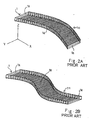
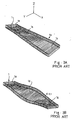
- Figures 1A to 1D, figures 2A and 2B and figures 3A and 3B illustrate the vertical flexural vibration, the horizontal flexural vibration and the torsional vibration, respectively.
- the surface to be struck with a mallet is called as “major surface”, and the major surface without vibrations is referred to as "reference surface”.
- a three-axis reference system is represented by x, y and z axes, and the reference surface is defined by x-axis and y-axis.
- FIG. 1A to 1D show the first-order to the fourth-order vibrations of the vertical flexural vibration. Although the vertical flexural vibration further contains higher-order vibrations over the fourth-order vibration, they are not shown.
- Reference numeral 1 designates a tone bar, and the first-order vibration, the second-order vibration, the third-order vibration and the fourth-order vibration are indicated by V0, V1, V2 and V3, respectively.
- the vertical flexural vibration causes lateral lines 1a on the major surface to change the position on virtual planes defined by y-axis and z-axis. However, points on each lateral line are equal in distance from the reference surface.
- the first-order vibration V0 has two nodes at both ends of the tone bar 1, and the node is incremented by one together with the vibration order.
- Figures 2A and 2B show the horizontal flexural vibration generated in the tone bar 1, and h0 and h1 indicate the first-order vibration and the second-order vibration, respectively.
- the horizontal flexural vibration causes the lateral lines 1a to change the position on a virtual plane parallel to the reference surface, but the lateral lines 1a are not changed in the virtual planes perpendicular to the reference surface.
- the first-order vibration h0 has two nodes on both ends of the tone bar 1, and the node is incremented together with the vibration order.
- Figures 3A and 3b show the torsional vibration generated in the tone bar 1, and t0 and t1 indicate the first-order vibration and the second-order vibration, respectively.
- the torsional vibration causes a twisting motion to take place and the lateral lines 1a decline at different angles.
- the node is also incremented together with the vibration order.
- the displacement of the horizontal flexural vibration and the displacement of the torsional vibration are much smaller than the displacement of the vertical flexural vibration, and, for this reason, the tone bars are designed and tuned in consideration of the vertical flexural vibration.
- the tone bars are designed for the glockenspiel, only the first-order vibration V0 is usually taken into account.
- the tone bars of the glockenspiel are identical in cross section with one another, and only the length is changed so as to change the frequency of the first-order vibration.
- the frequency ratio of the second-order vibration to the fourth-order vibration to the first-order vibration is 1 : 2.757 : 5.404 : 8.933, and is not represented by integers. This means that the glockenspiel generates percussion sounds which are not exactly tuned along the scale.
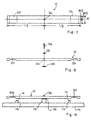
- FIGS. 4A and 4B illustrate a tone bar 2 for those percussion instruments.
- a pair of string holes 2a/2b is formed in both end portions 2c/2d of the tone bar 2, and a central portion 2e is thinner than the end portions 2c/2d.
- a recess 2f is formed in the central portion 2e, and the recess 2f changes the frequencies of high-order vibrations
- the frequency ratio of the second-order vibration to the first-order vibration is regulated to 1 : 4
- the frequency ratio of the second-order vibration and the third-order vibration to the first-order vibration is regulated to 1 : 4 : 10.
- Figures 5A and 5B show a tone bar 3.
- a pair of string holes 3a/3b is formed in the boundaries between the end portions 3c/3d and the central portion 3e, and two recesses 3f/3g are formed in the central portion 3e.
- the frequency ratio of the second-order vibration and the third-order vibration to the first-order vibration is regulated to 1 : 3 : 6 or 1 : 3 : 7 by virtue ofthe recesses 3f/3g.
- the frequency ratio is represented by integers
- the tone bars generate percussion sounds close to tones along the scale, and achieve clear intervals and good consonance.
- the good consonance results in a gentle beat produced through interference between a plurality of sounds with a small frequency difference.
- the tone bar 2 Comparing the tone bar 2 with the tone bar 3, the tone bar 2 has the frequency ratio closer to 2 n than the tone bar 3, and, accordingly, achieves the consonance and the intervals better than those of the tone bar 3. However, the consonance and the intervals are worse than those of a string instrument or a wind instrument.
- the recess 2f and the recesses 3f/3g are formed in the central portions 2e and 3e, and are open to the reverse surfaces of the central portions 2e and 3e.
- Japanese Patent Publication of Examined Application (Kokoku) No. 60-159894 proposes to laterally constrict a tone bar. In this instance, recesses are open to the side surfaces of the central portion.
- Japanese Patent Publication of Unexamined Application (Kokai) No. 8-202351 proposes to form recesses in not only the central portion but also end portions to as to make the frequency ratio between the first-order vibration, the second-order vibration and the third-order vibration much closer to 2 n .
- the invention disclosed in the Japanese Patent Publication of Examined Application and the invention disclosed in the Japanese Patent Publication of Unexamined Application were assigned to Yamaha Corporation.
- the recesses merely affect the vertical flexural vibrations of the tone bars, and can regulate the frequency ratio of the vertical flexural vibrations
- the horizontal flexural vibration and the torsional vibration are not taken into account, and are not tuned
- the tone bar prolongs the torsional vibration rather than the transverse vibrations, and are noisy.
- Orduna-Bustamande F. “Nonuniform Beams with harmonically related Overtones for Use in Percussion Instruments", Journal of the Acoustical Society of America, vol. 90, no. 6, 1 December 1991, pages 2935-2941; EP-A-0 723 255, and Yiching Lin et al.: "Transient Response of thick rectangular Bars subjected to transverse elastic Impact", Journal of the Acoustical Society of America, vol. 91, no. 5, 1 May 1992, pages 2674-2685.
- the present invention proposes to regulate a frequency ratio of the second-order transverse vibration to the first-order torsional vibration to 1 : 2.
- a percussion instrument largely comprises a frame structure 11, a plurality of tone bars 12 supported by the frame structure 11, assembling parts 13 for assembling the tone bars 12 with the frame structure 11 and cushion members 14.
- the tone bars 12 are laid on the pattern of the keyboard of an acoustic piano, and a player selectively strikes the tone bars 12 with mallets (not shown).
- the tone bars 12 are arranged into two rows 12a and 12b, and the tone bars 12 in the first row respectively generate natural tones.
- the tone bars 12 in the second row respectively generate the semitones between the natural tones
- the tone bars 12 have respective rectangular cross sections, and the length and the thickness are decreased from the tone bar 12 for the lowest pitch tone toward the highest pitch tone.
- the frame structure 11 includes a supporting board 11a horizontally extending over a floor (not shown) and plurality of supporting bars 11b, 11c, 11d, 11e and 11f attached to the upper surface of the supporting board 11a
- the supporting bars 11b to 11f are arranged in parallel to one another, and extend in the longitudinal direction of the supporting board 11a
- the supporting bars 11b to 11f are spaced from one another in the lateral direction of the supporting board 11a, and are different in height.
- the supporting bars 11b, 11c and 11d are associated with the tone bars 12 for the natural tones, and the supporting bar 11b is higher than the other supporting bars 11c and 11d.
- the supporting bars 11e and 11f are associated with the tone bars 12 for the semitones, and are higher than the supporting bars 11b to 11d. For this reason, the tone bars 12 for the semitones are provided over the tone bars 12 for the natural tones.
- a through-hole 12c is formed at a center point of the tone bar 12.
- the center line in the direction of the width W meets the center line in the direction of the length L at the center point.
- the through-hole 12c is enlarged at the upper portion thereof (see figure 8).
- Recesses 12d and 12e are respectively formed in both end portions of the tone bar 12.
- a central portion of the tone bar is constant in thickness, and any recess is formed in the central portion.
- a plurality of bolts 13a, a plurality of felt pads 13b, a plurality of felt washers 13c and spacer pins 13d are the assembling parts
- the felt washer 13c is received into the enlarged portion of the through-hole 12c, and the felt pad 13b is inserted between the upper surface of the supporting bar 11b.
- the bolt 13a passes through the felt washer 13c, the through-hole 12c and the felt pad 13b, and is screwed into the supporting bar 11b.
- the bolt 13a does not strongly presses the tone bar 12 against the felt pad 13b, and the tone bar 12 is shakable with respect to the supporting bar 11b. For this reason, not only the vertical flexural vibration but also the torsional vibration take place in the tone bar 12.
- the supporting bars 11c/11d are opposed to the boundaries between the central portion and the end portions of the tone bar 12, and the cushion members 14 are attached to the upper surfaces of the supporting bars 11c/11d. For this reason, even if the tone bar 12strongly shakes, the boundaries are brought into collision with the cushion members 14, and the tone bar 12 does not generate noise.
- the pins 13d are implanted into the supporting bars 11c and 11d at intervals, and restrict a turning motion of the tone bar 12. For this reason, the tone bar 12 is never brought into contact with the adjacent tone bars 12
- the tone bars 12 for the semitones are loosely connected to the supporting bar 11e in a similar manner to the tone bars 12 for the natural tones, and are also shakable.
- the rear end portions of the tone bars 12 for the natural tones are overlapped with front end portions of the tone bars 12 for the semitones, and the pins 13d implanted into the supporting bar 11f restrict the turning motion of the tone bars 12 for the semitones
- the pins 13d are preferably formed of soft material such as synthetic resin. The soft material prevents the pins 13d from noise at the collision with the tone bars 12.
- the tone bar 12 is shakably supported at the center point thereof is that the center point is matched with a node of the second-order vibration of the vertical flexural vibration and a node of the first-order vibration of the torsional vibration.
- the second-order vibration has a nodal line coincidence with the center line at L/2
- figure 3A teaches us that the node of the first-order vibration is coincidence with the center point at L/2 and W/2.
- the vertical flexural vibration has the even vibration orders, i.e., the second vibration order V1, the fourth vibration order, ...
- the torsional vibration has the odd vibration orders, i.e., the first vibration order, the third vibration order,....
- the vibrations with the anti-nodes at the center point hardly take place in the tone bar 12 due to the restriction at the anti-nodes, and the vertical flexural vibration does not have the odd vibration orders, i.e., the first order vibration, the third order vibration. ., and the torsional vibration does not have the even vibration orders such as the second order vibration.
- both of the vertical flexural vibration and the torsional vibration are controlled, and the ratio V1 : t0 is regulated to 1 : 2 or a multiple thereof.
- the second-order vertical flexural vibration generates a fundamental tone of the tone bar 12
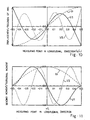
- the present inventors measured the vertical flexural vibration and the torsional vibration, and plotted the second-order vertical flexural vibration, the fourth-order vertical flexural vibration and the first-order torsional vibration as indicated by V1, V3 and t0, respectively.
- the abscissa was indicative of x/L where x was the distance from the center point and L was the length of the tone bar.
- the displacement was measured for the second-order vertical flexural vibration and the fourth-order vertical flexural vibration, and the seconds of arc were measured for the first-order torsional vibration.
- the restriction at the center point allows the tone bar to generate the second-order vertical flexural vibration, the fourth-order vertical flexural vibration and the first-order torsional vibration.
- the tone bar continues the torsional vibration longer than the vertical flexural vibration, and the percussion sound is prolonged
- the prior art tone bars 2 and 3 shown in figures 4A and 5A are restricted at the nodes of the first-order vertical flexural vibration by strings. For this reason, the second-order vertical flexural vibration is restricted in the tone bar 12.
- the restriction at the center point allows the tone bar to generate high-order vibrations. Although the high-order vibrations do not affect the interval between the tones generated by different tone bars, the high-order vibrations make the tone clear and sharp.
- the frequency ratio V1 : t0 is regulated to 1 : 2 or a multiple thereof.
- the second-order vertical flexural vibration V1 gives the fundamental tone to the percussion sound, and the first-order torsional vibration t0 generates a harmonic tone one octave higher than the fundamental tone. For this reason, the uncomfortable beat does not take place, and the percussion sounds are consonant with one another.
- Another advantage of the second-order vertical flexural vibration serving as the fundamental tone is loudness larger than that of the first-order vertical flexural vibration serving as the fundamental tone, because the percussion sound is radiated from the area wider than that of the first-order vertical flexural vibration
- Vn (m n 2 )/(2 12 ⁇ )(h/L 2 )( (E/ ⁇ ) )
- Vtn ⁇ (n+1)/L ⁇ ⁇ (b/h) (G/ ⁇ )
- L length of the tone bar
- b width of the tone bar
- h thickness of the tone bar
- E Young's modulus
- G the modulus of shearing elasticity
- ⁇ density
- m n is a constant determined by the vibration order n
- ⁇ is a constant determined by b/h.
- the frequency Vn of the transverse direction is proportional to the thickness h.
- the width b does not affect the frequency Vn.
- the frequency Vtn is dependent on ⁇ .
- ⁇ is a constant determined by the ratio between the width b and the thickness h.
- b/h 1
- ⁇ has the maximum value.
- ⁇ is decreased.
- the square cross section, i.e., the ratio b/h I maximizes the frequency Vtn, and the frequency Vtn is decreased together with the thickness
- the length L and the thickness h are determined so as to have the second-order vertical flexural vibration regulated to a target pitch.
- the tone bars 12 are gradually decreased in width from the lowest pitch tone toward the highest pitch tone.
- the tone bar 12 has the recesses 12d/12e in both end portions, and the recesses 12d/12e are outside the nodes of the second-order vertical flexural vibration V1.
- the recesses 12d/12e regulates the frequency ratio of V1: t0 : V3 to 1 : 2 : 3
- the frequency ratio of V0 : V1 : V2 : V3 of the tone bar is 1.000 : 2.757 : 5 404 : 8.933
- the restriction at the center point eliminates the first-order vertical flexural vibration V0 and the third-order vertical flexural vibration V2 from the tone bar
- the fourth-order vertical flexural vibration V3 remains together with the second-order vertical flexural vibration V1
- the frequency ratio is not desirable for the consonance.
- the recesses 12d/12e are formed outside the nodes of the nodes of the second-order vertical flexural vibration for partially decreasing the thickness, the recesses selectively decrease the frequency of the fourth-order vertical flexural vibration V3
- the frequency regulation is described hereinbelow. Bending moment and the torsional moment affects the vertical flexural vibration and the torsional vibration, respectively. If a portion where the bending moment/torsional moment is large is partially cut off, the tone bar decreases the frequency of the vertical flexural vibration/torsional vibration. On the other hand, if a portion outside the outermost node of the flexural vibration/torsional vibration is partially cut off, the tone bar increases the frequency of the vertical flexural vibration/torsional vibration. Thus, the frequency of the vibration is controllable by partially removing the tone bar.
- Figure 11 illustrates the bending moment for the second-order vertical flexural vibration V1, the bending moment for the fourth-order vertical flexural vibration and the torsional moment for the first-order torsional vibration.
- the bending moment for the second-order vertical flexural vibration and the bending moment for the fourth-order vertical flexural vibration are minimized at the center point. If the tone bar is partially cut away at the center point, the tone bar selectively decreases the frequency of the first-order torsional vibration without any influence on the frequency of the second-order vertical flexural vibration and the frequency of the fourth-order vertical flexural vibration.
- the decrement of the frequency of the fourth-order vertical flexural vibration is much larger than those of the second-order vertical flexural vibration and the first-order torsional vibration.
- the frequency ratio V1 : t0 V3 is regulated to 1 : 2: 3 in the tone bar 12.
- FIGS 12 and 13 illustrate a tone bar 21 incorporated in another percussion instrument embodying the present invention.
- the percussion instrument implementing the second embodiment is similar to the first embodiment except for the configuration of the tone bar 21, and, for this reason, description is focused on the configuration of the tone bar 21.
- the tone bar 21 has a pair of recesses 21a/21b corresponding to the recesses 12d/12e and a pair of recesses 21c/21d formed in the central area on both sides of a through hole 21e.
- the pair of recesses 21c/21d aims at decreasing the frequency of fourth-order vertical flexural vibration V3, and the two pairs of recesses 21a/21b and 21c/21d exactly regulate the frequency ratio of V1 ⁇ t0 : V3 to 1 : 2 : 3.
- FIGS 14 and 15 illustrate a tone bar 22 incorporated in yet another percussion instrument embodying the present invention.
- the percussion instrument implementing the third embodiment is similar to the first embodiment except for the configuration of the tone bar 22, and, for this reason, description is focused on the configuration of the tone bar 22.
- the tone bar 22 has a pair of recesses 22a/22b corresponding to the recesses 12d/12e and a pair of recesses 22c/22d formed spaced from a through hole 22e rather than the pair of recesses 21c/21d.
- the pair of recesses 22c/22d aims at decreasing the frequency of second-order vertical flexural vibration V1, and the two pairs of recesses 22a/22b and 22c/22d exactly regulate the frequency ratio of V1 : V3 to 1 : 2 : 3.
- FIGS 16 and 17 illustrate a tone bar 23 incorporated in still another percussion instrument embodying the present invention.
- the percussion instrument implementing the fourth embodiment is similar to the first embodiment except for the configuration of the tone bar 23, and, for this reason, description is focused on the configuration of the tone bar 23.
- the tone bar 23 has a pair of recesses 23a/23b corresponding to the recesses 12d/12e, a pair of recesses 23c/23d corresponding to the recesses 21c/21d on both sides of a through-hole 23e and a pair of recesses 23f/23g corresponding to the recesses 22c/22d.
- the pair of recesses 23c/23d and the pair of recesses 23f/23g aims at decreasing the frequency of the fourth-order vertical flexural vibration V3 and the frequency of the second-order vertical flexural vibration V1, and the three pairs of recesses 23a/23b, 23c/23d and 23f/23g exactly regulate the frequency ratio of V1 : t0 : V3 to 1 : 2 : 3.
- the edge between the reverse surface and the curved surface defining the recess may be rounded.
- the tone bars may be arranged in a single row.
Landscapes
- Physics & Mathematics (AREA)
- Engineering & Computer Science (AREA)
- Acoustics & Sound (AREA)
- Multimedia (AREA)
- Electrophonic Musical Instruments (AREA)
Claims (9)
- Ein Schlaginstrument, das Folgendes aufweist:gekennzeichnet dadurch, dasseinen Rahmen (11) mit zumindest einen Tragstab (11b/11e), undeine Vielzahl von Tonstäben (12; 21; 22; 23), die von dem zumindest einen Tragestab getragen sind,
jeder der Vielzahl von Klangstäben einen Mittelpunkt verbunden mit dem zumindest einen Tragestab hat, um so zu gestatten, dass eine Querschwingung zweiter Ordnung (VI) und eine Torsionsschwingung erster Ordnung (t0) darin stattfinden, und dadurch, dass
jeder der Vielzahl von Klangstäben konstruiert ist, so dass er ein Frequenzverhältnis der Querschwingung zweiter Ordnung zur Torsionsschwingung erster Ordnung von 1:2 vorsieht. - Schlaginstrument nach Anspruch 1, wobei die Konstruktion der Klangstäbe ausgeführt wird durch ein Verhältnis einer Breite (b) eines jeden Klangstabs zu einer Dicke (h) eines jeden der Klangstäbe.
- Schlaginstrument nach einem der Ansprüche 1 oder 2, wobei jeder der Vielzahl der Klangstäbe eine Kontur (12d/12e; 21a/21b/21c/21d; 22a/22b/22c/22d; 23a/23b/23c/23d/23f/23g) hat für das Regulieren der Querschwingung zweiter Ordnung der Torsionsschwingung erster Ordnung und einer Querschwingung vierter Ordnung auf ein Frequenzverhältnis von 1:2:3.
- Schlaginstrument nach einem der vorhergehenden Ansprüche, wobei die Vielzahl von Klangstäben in einer allgemein rechteckigen Parallelepipetkonfiguration geformt sind, und wobei eine Mittellinie in einer Längsrichtung auf eine Mittellinie in einer Querrichtung beim Mittelpunkt auftrifft.
- Schlaginstrument nach einem der Ansprüche 3 oder 4, wobei die Kontur durch einen verformten Teil eines jeden Klangstabs ausgeführt wird, der dünner ist als ein anderer Teil des Klangstabs.
- Schlaginstrument nach Anspruch 5, bei welchem der deformierte Teil eine Oberseite hat, die koplanar ist mit einem unteren Teil des anderen Teils und eine deformierte Unterseite hat, die näher zur Oberseite ist als der untere Teil des anderen Teils.
- Schlaginstrument nach Anspruch 6, in welchem der deformierte Teil bei einer Position angeordnet ist, bei welcher ein Biegemoment für die Querschwingung zweiter Ordnung maximiert ist.
- Schlaginstrument nach Anspruch 6, in welchem der deformierte Teil bei einer Position angeordnet ist, in welcher ein Biegemoment für die Querschwingung der vierten Ordnung maximiert ist.
- Schlaginstrument nach Anspruch 7, in welchem jeder Klangstab ferner einen weiteren deformierten Teil hat, der bei einer Position angeordnet ist, bei welcher ein Biegemoment für die Querschwingung vierter Ordnung maximiert ist.
Applications Claiming Priority (3)
| Application Number | Priority Date | Filing Date | Title |
|---|---|---|---|
| JP24992296 | 1996-09-20 | ||
| JP249922/96 | 1996-09-20 | ||
| JP8249922A JPH1097241A (ja) | 1996-09-20 | 1996-09-20 | 音板打楽器用音板 |
Publications (3)
| Publication Number | Publication Date |
|---|---|
| EP0831454A2 EP0831454A2 (de) | 1998-03-25 |
| EP0831454A3 EP0831454A3 (de) | 1999-09-15 |
| EP0831454B1 true EP0831454B1 (de) | 2003-03-19 |
Family
ID=17200187
Family Applications (1)
| Application Number | Title | Priority Date | Filing Date |
|---|---|---|---|
| EP97116488A Expired - Lifetime EP0831454B1 (de) | 1996-09-20 | 1997-09-22 | Schlaginstrument mit Klangstaben zur klare Tonerregung einer exakten Tonskale |
Country Status (4)
| Country | Link |
|---|---|
| US (1) | US5902945A (de) |
| EP (1) | EP0831454B1 (de) |
| JP (1) | JPH1097241A (de) |
| DE (1) | DE69719889T2 (de) |
Families Citing this family (11)
| Publication number | Priority date | Publication date | Assignee | Title |
|---|---|---|---|---|
| US6469238B1 (en) * | 1999-08-08 | 2002-10-22 | Steven George Risley | Method and apparatus for teaching rhythm |
| WO2002019316A1 (en) * | 2000-08-28 | 2002-03-07 | Tokyo Yusyo Co., Ltd | Keyboard for musical instrument |
| US20060249004A1 (en) * | 2003-12-17 | 2006-11-09 | Bunker Robert M | Pure Tone and Beat Generator |
| JP4632089B2 (ja) * | 2005-12-13 | 2011-02-16 | ヤマハ株式会社 | 音板打楽器の音源ユニット |
| KR100859905B1 (ko) | 2005-12-13 | 2008-09-23 | 야마하 가부시키가이샤 | 건반식 음판 타악기, 상기 음판 타악기용의 공명 관 및공명 상자 |
| KR100869414B1 (ko) | 2005-12-13 | 2008-11-21 | 야마하 가부시키가이샤 | 건반식 음판 타악기용의 음판 및 그 제조방법, 음판타악기의 음원 유닛 및 건반식 타악기 |
| US20080078278A1 (en) * | 2006-09-20 | 2008-04-03 | Malmark, Inc. | Bell ensemble |
| JP5070844B2 (ja) * | 2007-01-11 | 2012-11-14 | ヤマハ株式会社 | 鍵盤式打楽器 |
| USD717365S1 (en) * | 2011-10-28 | 2014-11-11 | Le Freque Holding B.V. | Sound bridge for a wind instrument |
| US10650793B2 (en) * | 2017-12-15 | 2020-05-12 | Playcore Wisconsin, Inc. | Tonal musical instruments for outdoor installation |
| CN112649508B (zh) * | 2021-01-19 | 2023-01-06 | 贵州联建土木工程质量检测监控中心有限公司 | 一种房屋质量检测用钢针小锤 |
Family Cites Families (6)
| Publication number | Priority date | Publication date | Assignee | Title |
|---|---|---|---|---|
| US1293723A (en) * | 1917-10-24 | 1919-02-11 | Jefferson Claude Deagan | Xylophone. |
| US1632751A (en) * | 1923-01-22 | 1927-06-14 | Leedy Mfg Company | Musical bar |
| US1838502A (en) * | 1930-10-30 | 1931-12-29 | J C Deagan Inc | Vibrant bar for musical instruments |
| US2655069A (en) * | 1950-10-06 | 1953-10-13 | Stromberg Carlson Co | Means for and method of tuning vibrating bars or rods |
| US5198602A (en) * | 1991-12-09 | 1993-03-30 | Roper Daleth F | Sound bar for percussive musical instrument |
| JP3552319B2 (ja) * | 1995-01-20 | 2004-08-11 | ヤマハ株式会社 | 音板打楽器用音板 |
-
1996
- 1996-09-20 JP JP8249922A patent/JPH1097241A/ja active Pending
-
1997
- 1997-09-17 US US08/932,283 patent/US5902945A/en not_active Expired - Lifetime
- 1997-09-22 DE DE69719889T patent/DE69719889T2/de not_active Expired - Lifetime
- 1997-09-22 EP EP97116488A patent/EP0831454B1/de not_active Expired - Lifetime
Also Published As
| Publication number | Publication date |
|---|---|
| DE69719889D1 (de) | 2003-04-24 |
| JPH1097241A (ja) | 1998-04-14 |
| DE69719889T2 (de) | 2004-02-05 |
| EP0831454A3 (de) | 1999-09-15 |
| EP0831454A2 (de) | 1998-03-25 |
| US5902945A (en) | 1999-05-11 |
Similar Documents
| Publication | Publication Date | Title |
|---|---|---|
| JP3552319B2 (ja) | 音板打楽器用音板 | |
| US5198601A (en) | Tuning means for stringed musical instrument | |
| US8378191B2 (en) | Soundboard bracing structure system for musical stringed instruments | |
| US6426454B1 (en) | Stringed musical instruments and method therefor | |
| EP0831454B1 (de) | Schlaginstrument mit Klangstaben zur klare Tonerregung einer exakten Tonskale | |
| CN102498513B (zh) | 琴弦-琴马连接系统和方法 | |
| CN1808565B (zh) | 弦乐器弦枕以及弦乐器 | |
| US4911055A (en) | Increased torque bridge for guitars | |
| JPH0136635B2 (de) | ||
| US5355756A (en) | Sound-enhanced stringed musical instruments | |
| US5198602A (en) | Sound bar for percussive musical instrument | |
| US7288706B2 (en) | Stringed musical instrument with multiple bridge-soundboard units | |
| US20080000342A1 (en) | Soundboard for Acoustic Guitar | |
| JP3503247B2 (ja) | 音板および音板打楽器 | |
| JP3404678B2 (ja) | 少なくとも一種の楽音を発生する装置 | |
| KR20230029482A (ko) | 현악기에서 종파를 감소시키기 위한 새들 및 브리지 | |
| JPS63213893A (ja) | 弦楽器 | |
| JP3604360B2 (ja) | 音響孔を有する弦楽器 | |
| KR200173865Y1 (ko) | 기타의 공명상자 | |
| US5339717A (en) | Keyboard instrument having soundboard with unconstrained edges | |
| US4481855A (en) | Zither-like instruments | |
| JP3836043B2 (ja) | 弦鳴楽器 | |
| French | Dynamics of an archtop jazz guitar | |
| Anderssen et al. | The challenge for the piano maker | |
| WO2024156363A1 (en) | Idiophone |
Legal Events
| Date | Code | Title | Description |
|---|---|---|---|
| PUAI | Public reference made under article 153(3) epc to a published international application that has entered the european phase |
Free format text: ORIGINAL CODE: 0009012 |
|
| 17P | Request for examination filed |
Effective date: 19970922 |
|
| AK | Designated contracting states |
Kind code of ref document: A2 Designated state(s): DE FR GB NL |
|
| PUAL | Search report despatched |
Free format text: ORIGINAL CODE: 0009013 |
|
| AK | Designated contracting states |
Kind code of ref document: A3 Designated state(s): AT BE CH DE DK ES FI FR GB GR IE IT LI LU MC NL PT SE |
|
| AKX | Designation fees paid | ||
| RBV | Designated contracting states (corrected) |
Designated state(s): DE FR GB NL |
|
| REG | Reference to a national code |
Ref country code: DE Ref legal event code: 8566 |
|
| 17Q | First examination report despatched |
Effective date: 20010627 |
|
| GRAH | Despatch of communication of intention to grant a patent |
Free format text: ORIGINAL CODE: EPIDOS IGRA |
|
| GRAH | Despatch of communication of intention to grant a patent |
Free format text: ORIGINAL CODE: EPIDOS IGRA |
|
| GRAA | (expected) grant |
Free format text: ORIGINAL CODE: 0009210 |
|
| AK | Designated contracting states |
Designated state(s): DE FR GB NL |
|
| REG | Reference to a national code |
Ref country code: GB Ref legal event code: FG4D |
|
| REF | Corresponds to: |
Ref document number: 69719889 Country of ref document: DE Date of ref document: 20030424 Kind code of ref document: P |
|
| PG25 | Lapsed in a contracting state [announced via postgrant information from national office to epo] |
Ref country code: GB Free format text: LAPSE BECAUSE OF NON-PAYMENT OF DUE FEES Effective date: 20030922 |
|
| ET | Fr: translation filed | ||
| PLBE | No opposition filed within time limit |
Free format text: ORIGINAL CODE: 0009261 |
|
| STAA | Information on the status of an ep patent application or granted ep patent |
Free format text: STATUS: NO OPPOSITION FILED WITHIN TIME LIMIT |
|
| 26N | No opposition filed |
Effective date: 20031222 |
|
| PG25 | Lapsed in a contracting state [announced via postgrant information from national office to epo] |
Ref country code: NL Free format text: LAPSE BECAUSE OF NON-PAYMENT OF DUE FEES Effective date: 20040401 |
|
| GBPC | Gb: european patent ceased through non-payment of renewal fee |
Effective date: 20030922 |
|
| PG25 | Lapsed in a contracting state [announced via postgrant information from national office to epo] |
Ref country code: FR Free format text: LAPSE BECAUSE OF NON-PAYMENT OF DUE FEES Effective date: 20040528 |
|
| NLV4 | Nl: lapsed or anulled due to non-payment of the annual fee |
Effective date: 20040401 |
|
| REG | Reference to a national code |
Ref country code: FR Ref legal event code: ST |
|
| PGFP | Annual fee paid to national office [announced via postgrant information from national office to epo] |
Ref country code: DE Payment date: 20100915 Year of fee payment: 14 |
|
| PG25 | Lapsed in a contracting state [announced via postgrant information from national office to epo] |
Ref country code: DE Free format text: LAPSE BECAUSE OF NON-PAYMENT OF DUE FEES Effective date: 20130403 |
|
| REG | Reference to a national code |
Ref country code: DE Ref legal event code: R119 Ref document number: 69719889 Country of ref document: DE Effective date: 20130403 |