EP0831456A2 - Verfahren und Vorrichtung zur Spracherkennung - Google Patents
Verfahren und Vorrichtung zur Spracherkennung Download PDFInfo
- Publication number
- EP0831456A2 EP0831456A2 EP97307276A EP97307276A EP0831456A2 EP 0831456 A2 EP0831456 A2 EP 0831456A2 EP 97307276 A EP97307276 A EP 97307276A EP 97307276 A EP97307276 A EP 97307276A EP 0831456 A2 EP0831456 A2 EP 0831456A2
- Authority
- EP
- European Patent Office
- Prior art keywords
- speaker
- models
- output probability
- speech
- speech recognition
- Prior art date
- Legal status (The legal status is an assumption and is not a legal conclusion. Google has not performed a legal analysis and makes no representation as to the accuracy of the status listed.)
- Granted
Links
- 238000000034 method Methods 0.000 title claims abstract description 90
- 238000004364 calculation method Methods 0.000 claims abstract description 43
- 238000012545 processing Methods 0.000 claims description 11
- 238000004458 analytical method Methods 0.000 claims description 5
- 238000013139 quantization Methods 0.000 claims description 3
- 230000008569 process Effects 0.000 abstract description 27
- 238000009826 distribution Methods 0.000 description 14
- 230000007480 spreading Effects 0.000 description 6
- 230000001419 dependent effect Effects 0.000 description 5
- 230000006870 function Effects 0.000 description 5
- 238000010586 diagram Methods 0.000 description 4
- 230000015572 biosynthetic process Effects 0.000 description 2
- 238000007796 conventional method Methods 0.000 description 2
- 238000002474 experimental method Methods 0.000 description 2
- 230000006872 improvement Effects 0.000 description 2
- 241000132092 Aster Species 0.000 description 1
- 230000003466 anti-cipated effect Effects 0.000 description 1
- 230000008901 benefit Effects 0.000 description 1
- 238000004891 communication Methods 0.000 description 1
- 230000006866 deterioration Effects 0.000 description 1
- 239000006185 dispersion Substances 0.000 description 1
- 230000000694 effects Effects 0.000 description 1
- 238000005516 engineering process Methods 0.000 description 1
- 239000004973 liquid crystal related substance Substances 0.000 description 1
Images




Classifications
-
- G—PHYSICS
- G10—MUSICAL INSTRUMENTS; ACOUSTICS
- G10L—SPEECH ANALYSIS TECHNIQUES OR SPEECH SYNTHESIS; SPEECH RECOGNITION; SPEECH OR VOICE PROCESSING TECHNIQUES; SPEECH OR AUDIO CODING OR DECODING
- G10L15/00—Speech recognition
- G10L15/08—Speech classification or search
- G10L15/14—Speech classification or search using statistical models, e.g. Hidden Markov Models [HMMs]
- G10L15/142—Hidden Markov Models [HMMs]
-
- G—PHYSICS
- G10—MUSICAL INSTRUMENTS; ACOUSTICS
- G10L—SPEECH ANALYSIS TECHNIQUES OR SPEECH SYNTHESIS; SPEECH RECOGNITION; SPEECH OR VOICE PROCESSING TECHNIQUES; SPEECH OR AUDIO CODING OR DECODING
- G10L15/00—Speech recognition
- G10L15/08—Speech classification or search
-
- G—PHYSICS
- G10—MUSICAL INSTRUMENTS; ACOUSTICS
- G10L—SPEECH ANALYSIS TECHNIQUES OR SPEECH SYNTHESIS; SPEECH RECOGNITION; SPEECH OR VOICE PROCESSING TECHNIQUES; SPEECH OR AUDIO CODING OR DECODING
- G10L15/00—Speech recognition
- G10L15/08—Speech classification or search
- G10L15/18—Speech classification or search using natural language modelling
- G10L15/183—Speech classification or search using natural language modelling using context dependencies, e.g. language models
- G10L15/19—Grammatical context, e.g. disambiguation of the recognition hypotheses based on word sequence rules
Definitions
- the present invention relates to a speech recognition method and an apparatus therefor, and more particularly to a speech recognition method for recognizing the input speech utilizing a model, and an apparatus therefor.
- HMM Hidden Markov Model
- higher performance of recognition can be obtained by forming details in the direction of speaker classes, represented by genders.
- the load of recognition process increases mainly in the output probability calculation of HMM in case of the detailed model formation in the direction of phoneme environment, the load increases both in the output probability calculation and in the language search in case of the detailed model formation in the direction of speaker classes.
- the real-time process is a very important factor that has to be attained in combination with the high recognition rate. It is therefore necessary to realize the real-time process of speech recognition while improving the recognition rate thereof, and, for this purpose, it is necessary to realize a high-speed process utilizing speaker class models.
- the present invention is to enable high-speed speech recognition with a high recognition rate, by analyzing the input speech, determining the output probability of models, namely an unspecified speaker model and plural speaker models clustered according to plural speaker classes, and the result of analysis of the input speech, and determining the result of recognition of the input speech based on thus determined output probability.
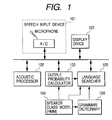
- Fig. 1 is a functional block diagram of an apparatus embodying the present invention.
- a speech input device 101 including a microphone or an A/D converter for entering the speech of an input speaker; an acoustic process unit 102 for determining speech parameters by acoustic analysis; an output probability calculation unit 103 for calculating a common coarse output probability and a fine output probability for each speaker class; a speaker class model (HMM: Hidden Markov Model) 104; a language search unit 105 for a common coarse language search and a fine language search for each speaker class; a grammar/dictionary unit 106 employed in the language processing; and a display device 107 for outputting the result.
- HMM Hidden Markov Model
- Fig. 1 is a functional block diagram of a speech recognition apparatus embodying the present invention
- Fig. 8 shows the hardware configuration of such speech recognition apparatus and the functions of the blocks in Fig. 1 are realized by the components shown in Fig. 8.
- the function of the speech input device 101 is realized by a speech input device 86, and the functions of the acoustic process unit 102, the output probability calculation unit 103 and the language search unit 105 are realized under the control of a CPU 83 according to a control program stored in a ROM 81 or a RAM 82.
- the speaker class HMM model 104 and the grammar/dictionary 106 are stored in the ROM 81 or the RAM 82.
- the control program, the HMM and the dictionary stored in the RAM 82 and the parameters required in various processes may be installed from a CD-ROM 84 through an interface (I/F) 85 or from another terminal (not shown) through a public communication line.
- the display device 107 can be realized by a display device 87 such as a CRT or a liquid crystal display device, and various instruction can be entered by input means 88 such as a keyboard, a mouse and/or a tablet.
- a display device 87 such as a CRT or a liquid crystal display device
- input means 88 such as a keyboard, a mouse and/or a tablet.
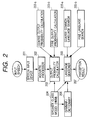
- the speech recognition apparatus is composed of the above-mentioned components and functions according to the flow shown in Fig. 2.
- a speech cut out by the speech input device 201 (corresponding to 101) is analyzed into speech parameters in each frame by the acoustic process unit 202 (corresponding to 102), and the output probability calculation unit 203 (corresponding to 103) calculates the output probability utilizing the HMM 204 (corresponding to 104).
- the HMM 204 (corresponding to 104) stores speaker class models clustered into plural speaker classes.
- the output probability calculation unit At the output probability calculation in 203, the output probability calculation unit at first calculates a common coarse output probability (203-a), and, based on the result of such calculation, calculates again a fine output probability for each speaker class that may contribute to the result of recognition (203-b).
- a common output probability is determined from these output probabilities, and the language search unit 205 (corresponding to 105) executes a common language search based on the grammar/dictionary 206 (corresponding to 106) and the common output probability determined above, thereby determining a candidate of recognition (205-a).
- the language search unit 205 (corresponding to 105) then executes a fine language search for each speaker class, utilizing the fine output probability for each speaker class, thereby determining a recognition result and its likelihood (205-b). These results are outputted as the results of recognition on 207 (corresponding to 107).
- a speaker class speakers having acoustically similar features are clustered.
- the similarity of the acoustic features of the speakers can be measured by various methods, such as:
- the method (1) can be realized by studying the continuous HMM of one distribution for one state for each speaker, utilizing the entire speech space and measuring the similarity between the speakers by determining the distance of the HMM of the speakers.
- the average of the distribution of each speaker becomes a cepstrum means because the entire speech space of each speaker is represented by one distribution, so that the difference between the speakers may not become conspicuous. Consequently this method cannot be considered preferable.
- the method (2) can be realized by preparing a code book (for example of a code word size of 1024) of an unspecified speaker (namely studying the discrete distribution HMM of one state of 1024 code words), determining the probabilities of appearance of such code words for each speaker and measuring the similarity between the speakers by the deviation of such appearing probabilities.
- This method is preferable to the method (1) in that the speech space is divided into partial spaces.
- the measured similarity between the speakers may be based on the similarity between a sound of a speaker and another sound of another speaker, and this method cannot be considered preferable in consideration of such possibility.
- the method (3) can be realized by preparing models in consideration of the sound for each speaker, and measuring the similarity between the speakers by the sums of the similarities of the corresponding models. For example phoneme HMM's of 1 distribution for 3 states are prepared for each speaker, and the similarity between the speakers is measured by determining the similarity in each corresponding state of each corresponding phoneme of the speakers and calculating the sum of such similarities.
- the similarity between the speakers is measured in consideration of the entire speech space of the speakers while making correspondence between the phoneme partial spaces represented by the phoneme and the state, and can therefore be given in consideration of the sound feature, also reflecting the detailed difference in the acoustic feature of each speaker.
- the similarity between the speakers can also be measured in more detailed manner by replacing the phoneme model with a more detailed HMM dependent on the phoneme environment.
- the similarity between the speakers is determined by the above-explained method (3), and the speaker classes are prepared according to such similarity.
- the algorithm for preparing the speaker classes In the following there will be explained the algorithm for preparing the speaker classes.
- the speaker classes are prepared as explained in the foregoing.
- the prepared speaker classes may be utilized as they are, but the spreading of the speakers may be different in the different classes, according to the above-mentioned method of preparation. If it is desirable to have similar levels of spreading among the different speaker classes, it is possible to fetch, in succession, a closer speaker to each speaker class until the level of spreading (sum of similarities to the central speaker) of the class showing the widest spreading (i.e. having the largest sum of the similarities to the central speaker) becomes similar to the level of spreading of other classes.
- Such determination of the speaker classes provides uniform spreading of the speaker classes, and the speaker at the boundary belongs to plural speaker classes, so that the speech recognition can be relieved from the significant influence resulting from the error in the determination of the speaker classes.
- the phoneme environment-dependent HMM's are prepared by the ordinary EM algorithm, utilizing the speech data of the speakers belonging to each of thus prepared speaker classes. For example, in 4 speaker classes, there are prepared phoneme environment-dependent HMM's of 12 distributions in 3 states (238 kinds).
- a conventional speech recognition method utilizing speaker class HMM there are basically conducted, in parallel manner, the speech recognition processes by the kinds (N) of the speaker class HMM's, there is required the speech processing of N times, in comparison with the case of employing only one speaker class, namely an unspecified speaker class HMM. Consequently the output probability calculation and the language search required are also N times. If the calculations of such amount are necessary, the use of the speaker class HMM's in the actual speech recognition inevitably necessitates a computer of a very high speed or of parallel processing, in order to realize the real-time process. Such use therefore becomes expensive and is practically unrealistic.
- a speech recognition method utilizing the speaker class HMM's and capable of significantly reducing the amount of the above-mentioned calculations.
- the proposed method is illustrated in Fig. 4.
- the proposed speech recognition process is featured by a fact that the unspecified speaker HMM is always used also in the recognition of the speaker class HMM.
- the unspecified speaker HMM corresponds to an upper speaker class of all the speaker class HMM's. It is intended to improve the efficiency of the output probability calculation and the language search, by employing the result of the unspecified speaker HMM as the estimated value of each speaker class HMM.
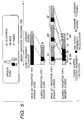
- Fig. 5 schematically shows the comparison of the process time of the speech recognition employing the speaker class HMM, in the conventional method and in the method of the present invention, taking the process time in the abscissa.
- the uppermost graph shows the process time of the conventional recognition employing only one speaker class (unspecified speaker class), and the second graph shows the process time of the recognition employing an unspecified speaker class, made faster by IDMM+SQ (present invention).
- the third graph shows the process time of the conventional recognition employing IDMM+SQ and the speaker class HMM's of 3 speaker classes simply in parallel manner (as shown in Fig. 3), while the lowermost graph shows the process time of the high-speed speech recognition method with 3 speaker classes, utilizing the proposed speaker class HMM's (as shown in Fig.
- the process time required for the output probability calculation (Bjot) and the forward/backward language search is variable, depending on the task constituting the object of recognition and on the performance of HMM's, but can be considered to be represented as a reasonable length in the contemplated range.
- the process time required for the backward language search represented as considerably long in these graphs, is less than 0.1 seconds in practice.
- the proposed method requires the IDMM+SQ calculation for the unspecified speaker HMM and the forward search only once, so that the advantage of the proposed method becomes larger with the increase in the number N.
- the amount of the output probability re-calculation for the speaker classes and of the backward language search, increasing with the number N of the speaker classes is limited in the entire calculations. Consequently the method of the present invention can be executed, in the entire process, at a very high speed.
- Fig. 7 Results of an experiment conducted with plural speaker classes are shown in Fig. 7.
- the speech recognition was experimented with (a) an unspecified speaker class (g1), (2) male and female speaker classes (g2), and (3) 8 speaker classes consisting of four male classes and four female classes (g8).
- Phoneme environment-dependent HMM's of 6 distributions for 3 states were prepared for each of the above-mentioned speaker classes (1) - (3) (238 kinds in total), and recognition experiment was conducted for 520 words (telephone speeches) pronounced by twenty male and female speakers.
Landscapes
- Engineering & Computer Science (AREA)
- Physics & Mathematics (AREA)
- Human Computer Interaction (AREA)
- Computational Linguistics (AREA)
- Health & Medical Sciences (AREA)
- Audiology, Speech & Language Pathology (AREA)
- Probability & Statistics with Applications (AREA)
- Acoustics & Sound (AREA)
- Multimedia (AREA)
- Information Retrieval, Db Structures And Fs Structures Therefor (AREA)
- Image Analysis (AREA)
- Machine Translation (AREA)
- Document Processing Apparatus (AREA)
Applications Claiming Priority (3)
| Application Number | Priority Date | Filing Date | Title |
|---|---|---|---|
| JP24997296 | 1996-09-20 | ||
| JP249972/96 | 1996-09-20 | ||
| JP8249972A JPH1097276A (ja) | 1996-09-20 | 1996-09-20 | 音声認識方法及び装置並びに記憶媒体 |
Publications (3)
| Publication Number | Publication Date |
|---|---|
| EP0831456A2 true EP0831456A2 (de) | 1998-03-25 |
| EP0831456A3 EP0831456A3 (de) | 1998-10-14 |
| EP0831456B1 EP0831456B1 (de) | 2003-11-19 |
Family
ID=17200934
Family Applications (1)
| Application Number | Title | Priority Date | Filing Date |
|---|---|---|---|
| EP97307276A Expired - Lifetime EP0831456B1 (de) | 1996-09-20 | 1997-09-18 | Verfahren und Vorrichtung zur Spracherkennung |
Country Status (4)
| Country | Link |
|---|---|
| US (1) | US6108628A (de) |
| EP (1) | EP0831456B1 (de) |
| JP (1) | JPH1097276A (de) |
| DE (1) | DE69726235T2 (de) |
Cited By (3)
| Publication number | Priority date | Publication date | Assignee | Title |
|---|---|---|---|---|
| US5895447A (en) * | 1996-02-02 | 1999-04-20 | International Business Machines Corporation | Speech recognition using thresholded speaker class model selection or model adaptation |
| WO2001022400A1 (en) * | 1999-09-22 | 2001-03-29 | Microsoft Corporation | Iterative speech recognition from multiple feature vectors |
| EP1207517A1 (de) * | 2000-11-16 | 2002-05-22 | Sony International (Europe) GmbH | Verfahren zur Spracherkennung |
Families Citing this family (31)
| Publication number | Priority date | Publication date | Assignee | Title |
|---|---|---|---|---|
| US6684186B2 (en) * | 1999-01-26 | 2004-01-27 | International Business Machines Corporation | Speaker recognition using a hierarchical speaker model tree |
| JP2001075964A (ja) * | 1999-08-31 | 2001-03-23 | Sony Corp | 情報処理装置および情報処理方法、並びに記録媒体 |
| JP3969908B2 (ja) | 1999-09-14 | 2007-09-05 | キヤノン株式会社 | 音声入力端末器、音声認識装置、音声通信システム及び音声通信方法 |
| US7689416B1 (en) | 1999-09-29 | 2010-03-30 | Poirier Darrell A | System for transferring personalize matter from one computer to another |
| US6526379B1 (en) * | 1999-11-29 | 2003-02-25 | Matsushita Electric Industrial Co., Ltd. | Discriminative clustering methods for automatic speech recognition |
| JP3728172B2 (ja) | 2000-03-31 | 2005-12-21 | キヤノン株式会社 | 音声合成方法および装置 |
| JP2001282278A (ja) * | 2000-03-31 | 2001-10-12 | Canon Inc | 音声情報処理装置及びその方法と記憶媒体 |
| JP4632384B2 (ja) * | 2000-03-31 | 2011-02-16 | キヤノン株式会社 | 音声情報処理装置及びその方法と記憶媒体 |
| US7039588B2 (en) * | 2000-03-31 | 2006-05-02 | Canon Kabushiki Kaisha | Synthesis unit selection apparatus and method, and storage medium |
| JP3728177B2 (ja) | 2000-05-24 | 2005-12-21 | キヤノン株式会社 | 音声処理システム、装置、方法及び記憶媒体 |
| US7047192B2 (en) * | 2000-06-28 | 2006-05-16 | Poirier Darrell A | Simultaneous multi-user real-time speech recognition system |
| JP2002073072A (ja) * | 2000-08-31 | 2002-03-12 | Sony Corp | モデル適応装置およびモデル適応方法、記録媒体、並びにパターン認識装置 |
| EP1326164A4 (de) * | 2000-10-11 | 2005-12-28 | Canon Kk | Informationsverarbeitungsgerät, informationsverarbeitungsverfahren und speichermedium |
| US7529666B1 (en) * | 2000-10-30 | 2009-05-05 | International Business Machines Corporation | Minimum bayes error feature selection in speech recognition |
| JP2002268681A (ja) * | 2001-03-08 | 2002-09-20 | Canon Inc | 音声認識システム及び方法及び該システムに用いる情報処理装置とその方法 |
| US7038690B2 (en) * | 2001-03-23 | 2006-05-02 | Microsoft Corporation | Methods and systems for displaying animated graphics on a computing device |
| US7239324B2 (en) | 2001-03-23 | 2007-07-03 | Microsoft Corporation | Methods and systems for merging graphics for display on a computing device |
| US20020143540A1 (en) * | 2001-03-28 | 2002-10-03 | Narendranath Malayath | Voice recognition system using implicit speaker adaptation |
| JP3542578B2 (ja) * | 2001-11-22 | 2004-07-14 | キヤノン株式会社 | 音声認識装置及びその方法、プログラム |
| JP2004012698A (ja) * | 2002-06-05 | 2004-01-15 | Canon Inc | 情報処理装置及び情報処理方法 |
| JP4280505B2 (ja) * | 2003-01-20 | 2009-06-17 | キヤノン株式会社 | 情報処理装置及び情報処理方法 |
| JP4587160B2 (ja) * | 2004-03-26 | 2010-11-24 | キヤノン株式会社 | 信号処理装置および方法 |
| JP4541781B2 (ja) * | 2004-06-29 | 2010-09-08 | キヤノン株式会社 | 音声認識装置および方法 |
| US20070124148A1 (en) * | 2005-11-28 | 2007-05-31 | Canon Kabushiki Kaisha | Speech processing apparatus and speech processing method |
| JP4188989B2 (ja) * | 2006-09-15 | 2008-12-03 | 本田技研工業株式会社 | 音声認識装置、音声認識方法、及び音声認識プログラム |
| US8548807B2 (en) * | 2009-06-09 | 2013-10-01 | At&T Intellectual Property I, L.P. | System and method for adapting automatic speech recognition pronunciation by acoustic model restructuring |
| US8392189B2 (en) * | 2009-09-28 | 2013-03-05 | Broadcom Corporation | Speech recognition using speech characteristic probabilities |
| CN102074236B (zh) * | 2010-11-29 | 2012-06-06 | 清华大学 | 一种分布式麦克风的说话人聚类方法 |
| US9311914B2 (en) * | 2012-09-03 | 2016-04-12 | Nice-Systems Ltd | Method and apparatus for enhanced phonetic indexing and search |
| CN104143326B (zh) * | 2013-12-03 | 2016-11-02 | 腾讯科技(深圳)有限公司 | 一种语音命令识别方法和装置 |
| CN111613219B (zh) * | 2020-05-15 | 2023-10-27 | 深圳前海微众银行股份有限公司 | 语音数据识别方法、设备及介质 |
Family Cites Families (13)
| Publication number | Priority date | Publication date | Assignee | Title |
|---|---|---|---|---|
| US4837831A (en) * | 1986-10-15 | 1989-06-06 | Dragon Systems, Inc. | Method for creating and using multiple-word sound models in speech recognition |
| US4914703A (en) * | 1986-12-05 | 1990-04-03 | Dragon Systems, Inc. | Method for deriving acoustic models for use in speech recognition |
| US5220629A (en) * | 1989-11-06 | 1993-06-15 | Canon Kabushiki Kaisha | Speech synthesis apparatus and method |
| JPH03150599A (ja) * | 1989-11-07 | 1991-06-26 | Canon Inc | 日本語音節の符号化方式 |
| US5271088A (en) * | 1991-05-13 | 1993-12-14 | Itt Corporation | Automated sorting of voice messages through speaker spotting |
| JPH04362698A (ja) * | 1991-06-11 | 1992-12-15 | Canon Inc | 音声認識方法及び装置 |
| JP3066920B2 (ja) * | 1991-06-11 | 2000-07-17 | キヤノン株式会社 | 音声認識方法及び装置 |
| JP2795058B2 (ja) * | 1992-06-03 | 1998-09-10 | 松下電器産業株式会社 | 時系列信号処理装置 |
| US5606643A (en) * | 1994-04-12 | 1997-02-25 | Xerox Corporation | Real-time audio recording system for automatic speaker indexing |
| JP3745403B2 (ja) * | 1994-04-12 | 2006-02-15 | ゼロックス コーポレイション | オーディオデータセグメントのクラスタリング方法 |
| US5598507A (en) * | 1994-04-12 | 1997-01-28 | Xerox Corporation | Method of speaker clustering for unknown speakers in conversational audio data |
| JP2871561B2 (ja) * | 1995-11-30 | 1999-03-17 | 株式会社エイ・ティ・アール音声翻訳通信研究所 | 不特定話者モデル生成装置及び音声認識装置 |
| US5787394A (en) * | 1995-12-13 | 1998-07-28 | International Business Machines Corporation | State-dependent speaker clustering for speaker adaptation |
-
1996
- 1996-09-20 JP JP8249972A patent/JPH1097276A/ja not_active Withdrawn
-
1997
- 1997-09-16 US US08/931,527 patent/US6108628A/en not_active Expired - Lifetime
- 1997-09-18 EP EP97307276A patent/EP0831456B1/de not_active Expired - Lifetime
- 1997-09-18 DE DE69726235T patent/DE69726235T2/de not_active Expired - Lifetime
Non-Patent Citations (3)
| Title |
|---|
| KOSAKA T ET AL: "TREE-STRUCTURED SPEAKER CLUSTERING FOR FAST SPEAKER ADAPTATION" PROCEEDINGS OF THE INTERNATIONAL CONFERENCE ON ACOUSTICS, SPEECH, SIGNAL PROCESSING (ICASSP), SPEECH PROCESSING 1. ADELAIDE, APR. 19 - 22, 1994, vol. VOL. 1, 19 April 1994, pages I-245-I-248, XP000529391 INSTITUTE OF ELECTRICAL AND ELECTRONICS ENGINEERS * |
| RIGOLL G: "SPEAKER ADAPTATION FOR LARGE VOCABULARY SPEECH RECOGNITION SYSTEMS USING "SPEAKER MARKOV MODELS"" SPEECH PROCESSING 1, GLASGOW, MAY 23 - 26, 1989, vol. VOL. 1, no. CONF. 14, 23 May 1989, pages 5-8, XP000089659 INSTITUTE OF ELECTRICAL AND ELECTRONICS ENGINEERS * |
| SUGIYAMA M ET AL: "SPEECH SEGMENTATION AND CLUSTERING PROBLEM BASED ON AN UNKNOWN-MULTIPLE NU SIGNAL SOURCE MODEL / AN APPLICATION TO SEGMENTED SPEECH CLUSTERING BASED ON SPEAKER FEATURES" SYSTEMS & COMPUTERS IN JAPAN, vol. 25, no. 9, August 1994, pages 83-92, XP000483308 * |
Cited By (4)
| Publication number | Priority date | Publication date | Assignee | Title |
|---|---|---|---|---|
| US5895447A (en) * | 1996-02-02 | 1999-04-20 | International Business Machines Corporation | Speech recognition using thresholded speaker class model selection or model adaptation |
| WO2001022400A1 (en) * | 1999-09-22 | 2001-03-29 | Microsoft Corporation | Iterative speech recognition from multiple feature vectors |
| US6542866B1 (en) | 1999-09-22 | 2003-04-01 | Microsoft Corporation | Speech recognition method and apparatus utilizing multiple feature streams |
| EP1207517A1 (de) * | 2000-11-16 | 2002-05-22 | Sony International (Europe) GmbH | Verfahren zur Spracherkennung |
Also Published As
| Publication number | Publication date |
|---|---|
| DE69726235D1 (de) | 2003-12-24 |
| DE69726235T2 (de) | 2004-08-19 |
| EP0831456B1 (de) | 2003-11-19 |
| EP0831456A3 (de) | 1998-10-14 |
| JPH1097276A (ja) | 1998-04-14 |
| US6108628A (en) | 2000-08-22 |
Similar Documents
| Publication | Publication Date | Title |
|---|---|---|
| US6108628A (en) | Speech recognition method and apparatus using coarse and fine output probabilities utilizing an unspecified speaker model | |
| EP0805434B1 (de) | Verfahren und System zur Spracherkennung mittels verborgener Markoff-Modelle mit kontinuierlichen Ausgangswahrscheinlichkeiten | |
| EP1400952B1 (de) | Umgebungs- und sprecheradaptierte Spracherkennung | |
| EP0966736B1 (de) | Verfahren zum diskriminativen training von spracherkennungsmodellen | |
| KR100679044B1 (ko) | 사용자 적응형 음성 인식 방법 및 장치 | |
| US5675706A (en) | Vocabulary independent discriminative utterance verification for non-keyword rejection in subword based speech recognition | |
| CN101989424B (zh) | 语音处理设备和方法 | |
| EP1269464B1 (de) | Diskriminatives Trainieren von Hidden Markov Modellen für die Erkennung fliessender Sprache | |
| US6845357B2 (en) | Pattern recognition using an observable operator model | |
| EP0847041A2 (de) | Verfahren und Vorrichtung zur Spracherkennung mit Rauschadaptierung | |
| US20110077943A1 (en) | System for generating language model, method of generating language model, and program for language model generation | |
| US5787396A (en) | Speech recognition method | |
| US20020188446A1 (en) | Method and apparatus for distribution-based language model adaptation | |
| JP2002507010A (ja) | 同時に起こるマルチモード口述のための装置及び方法 | |
| EP1355295A2 (de) | Spracherkennungsvorrichtung, -verfahren und computerlesbares Medium mit entsprechend gespeichertem Programm | |
| EP1005019B1 (de) | Segmentbasiertes Verfahren zur Messung eines Ähnlichkeitsgrads für die Spracherkennung | |
| US20050049872A1 (en) | Class detection scheme and time mediated averaging of class dependent models | |
| JP3961780B2 (ja) | 言語モデル学習装置およびそれを用いた音声認識装置 | |
| WO1995034064A1 (en) | Speech-recognition system utilizing neural networks and method of using same | |
| JP3444108B2 (ja) | 音声認識装置 | |
| JP2938866B1 (ja) | 統計的言語モデル生成装置及び音声認識装置 | |
| JPH1185188A (ja) | 音声認識方法及びそのプログラム記録媒体 | |
| JP3027544B2 (ja) | 統計的言語モデル生成装置及び音声認識装置 | |
| JP2001083986A (ja) | 統計モデル作成方法 | |
| US20020133343A1 (en) | Method for speech recognition, apparatus for the same, and voice controller |
Legal Events
| Date | Code | Title | Description |
|---|---|---|---|
| PUAI | Public reference made under article 153(3) epc to a published international application that has entered the european phase |
Free format text: ORIGINAL CODE: 0009012 |
|
| AK | Designated contracting states |
Kind code of ref document: A2 Designated state(s): DE FR GB IT |
|
| AX | Request for extension of the european patent |
Free format text: AL;LT;LV;RO;SI |
|
| PUAL | Search report despatched |
Free format text: ORIGINAL CODE: 0009013 |
|
| AK | Designated contracting states |
Kind code of ref document: A3 Designated state(s): AT BE CH DE DK ES FI FR GB GR IE IT LI LU MC NL PT SE |
|
| AX | Request for extension of the european patent |
Free format text: AL;LT;LV;RO;SI |
|
| 17P | Request for examination filed |
Effective date: 19990226 |
|
| AKX | Designation fees paid |
Free format text: DE FR GB IT |
|
| 17Q | First examination report despatched |
Effective date: 20010628 |
|
| RIC1 | Information provided on ipc code assigned before grant |
Free format text: 7G 10L 15/14 A |
|
| GRAH | Despatch of communication of intention to grant a patent |
Free format text: ORIGINAL CODE: EPIDOS IGRA |
|
| GRAS | Grant fee paid |
Free format text: ORIGINAL CODE: EPIDOSNIGR3 |
|
| GRAA | (expected) grant |
Free format text: ORIGINAL CODE: 0009210 |
|
| AK | Designated contracting states |
Kind code of ref document: B1 Designated state(s): DE FR GB IT |
|
| PG25 | Lapsed in a contracting state [announced via postgrant information from national office to epo] |
Ref country code: IT Free format text: LAPSE BECAUSE OF FAILURE TO SUBMIT A TRANSLATION OF THE DESCRIPTION OR TO PAY THE FEE WITHIN THE PRESCRIBED TIME-LIMIT;WARNING: LAPSES OF ITALIAN PATENTS WITH EFFECTIVE DATE BEFORE 2007 MAY HAVE OCCURRED AT ANY TIME BEFORE 2007. THE CORRECT EFFECTIVE DATE MAY BE DIFFERENT FROM THE ONE RECORDED. Effective date: 20031119 |
|
| REG | Reference to a national code |
Ref country code: GB Ref legal event code: FG4D |
|
| REF | Corresponds to: |
Ref document number: 69726235 Country of ref document: DE Date of ref document: 20031224 Kind code of ref document: P |
|
| ET | Fr: translation filed | ||
| PLBE | No opposition filed within time limit |
Free format text: ORIGINAL CODE: 0009261 |
|
| STAA | Information on the status of an ep patent application or granted ep patent |
Free format text: STATUS: NO OPPOSITION FILED WITHIN TIME LIMIT |
|
| 26N | No opposition filed |
Effective date: 20040820 |
|
| PGFP | Annual fee paid to national office [announced via postgrant information from national office to epo] |
Ref country code: FR Payment date: 20080923 Year of fee payment: 12 |
|
| REG | Reference to a national code |
Ref country code: FR Ref legal event code: ST Effective date: 20100531 |
|
| PG25 | Lapsed in a contracting state [announced via postgrant information from national office to epo] |
Ref country code: FR Free format text: LAPSE BECAUSE OF NON-PAYMENT OF DUE FEES Effective date: 20090930 |
|
| PGFP | Annual fee paid to national office [announced via postgrant information from national office to epo] |
Ref country code: DE Payment date: 20140930 Year of fee payment: 18 |
|
| PGFP | Annual fee paid to national office [announced via postgrant information from national office to epo] |
Ref country code: GB Payment date: 20140924 Year of fee payment: 18 |
|
| REG | Reference to a national code |
Ref country code: DE Ref legal event code: R119 Ref document number: 69726235 Country of ref document: DE |
|
| GBPC | Gb: european patent ceased through non-payment of renewal fee |
Effective date: 20150918 |
|
| PG25 | Lapsed in a contracting state [announced via postgrant information from national office to epo] |
Ref country code: GB Free format text: LAPSE BECAUSE OF NON-PAYMENT OF DUE FEES Effective date: 20150918 Ref country code: DE Free format text: LAPSE BECAUSE OF NON-PAYMENT OF DUE FEES Effective date: 20160401 |