EP0832292B1 - Verfahren zur detektion von influenzavirus endonuklease durch dna-polymerase verlängerung - Google Patents
Verfahren zur detektion von influenzavirus endonuklease durch dna-polymerase verlängerung Download PDFInfo
- Publication number
- EP0832292B1 EP0832292B1 EP96920610A EP96920610A EP0832292B1 EP 0832292 B1 EP0832292 B1 EP 0832292B1 EP 96920610 A EP96920610 A EP 96920610A EP 96920610 A EP96920610 A EP 96920610A EP 0832292 B1 EP0832292 B1 EP 0832292B1
- Authority
- EP
- European Patent Office
- Prior art keywords
- product
- rna
- labeled
- sample
- influenza
- Prior art date
- Legal status (The legal status is an assumption and is not a legal conclusion. Google has not performed a legal analysis and makes no representation as to the accuracy of the status listed.)
- Expired - Lifetime
Links
Images


Classifications
-
- C—CHEMISTRY; METALLURGY
- C12—BIOCHEMISTRY; BEER; SPIRITS; WINE; VINEGAR; MICROBIOLOGY; ENZYMOLOGY; MUTATION OR GENETIC ENGINEERING
- C12Q—MEASURING OR TESTING PROCESSES INVOLVING ENZYMES, NUCLEIC ACIDS OR MICROORGANISMS; COMPOSITIONS OR TEST PAPERS THEREFOR; PROCESSES OF PREPARING SUCH COMPOSITIONS; CONDITION-RESPONSIVE CONTROL IN MICROBIOLOGICAL OR ENZYMOLOGICAL PROCESSES
- C12Q1/00—Measuring or testing processes involving enzymes, nucleic acids or microorganisms; Compositions therefor; Processes of preparing such compositions
- C12Q1/70—Measuring or testing processes involving enzymes, nucleic acids or microorganisms; Compositions therefor; Processes of preparing such compositions involving virus or bacteriophage
- C12Q1/701—Specific hybridization probes
-
- C—CHEMISTRY; METALLURGY
- C12—BIOCHEMISTRY; BEER; SPIRITS; WINE; VINEGAR; MICROBIOLOGY; ENZYMOLOGY; MUTATION OR GENETIC ENGINEERING
- C12Q—MEASURING OR TESTING PROCESSES INVOLVING ENZYMES, NUCLEIC ACIDS OR MICROORGANISMS; COMPOSITIONS OR TEST PAPERS THEREFOR; PROCESSES OF PREPARING SUCH COMPOSITIONS; CONDITION-RESPONSIVE CONTROL IN MICROBIOLOGICAL OR ENZYMOLOGICAL PROCESSES
- C12Q1/00—Measuring or testing processes involving enzymes, nucleic acids or microorganisms; Compositions therefor; Processes of preparing such compositions
- C12Q1/68—Measuring or testing processes involving enzymes, nucleic acids or microorganisms; Compositions therefor; Processes of preparing such compositions involving nucleic acids
- C12Q1/6844—Nucleic acid amplification reactions
- C12Q1/6846—Common amplification features
Definitions
- This invention relates to a novel sensitive assay to detect and quantify the presence of influenza virus endonuclease and inhibitors of influenza virus endonuclease activity.
- influenza A virus genome consists of eight negative-sense single-stranded RNA segments. Synthesis of viral mRNA is catalyzed by a viral-encoded RNA-dependent RNA polymerase (E.C. 2.7.7.48). Influenza virus transcription is initiated by a mechanism in which prirners are generated by cleaving host cell transcripts 10-13 nucleotides from their 5' cap structure. The cleavage and priming reactions are dependent on the transcript possessing a cap-1 structure containing a 7-methylated terminal G and a 2'-O-methylated penultimate purine base (7mGpppRm).
- influenza endonuclease represents an attractive target for development of antiviral agents, and recently both small molecule (Tomassini et al ., 1994 AntiMicrob . Agents and Chemo. 38:2827-2837) and oligonucleotide inhibitors (Chung et al ., 1994 Proc. Natl . Acad . Sci . USA 91:2372-2376) have been described.
- An ideal assay system should have: a) high throughput; b) the ability to distinguish influenza endonuclease-catalyzed cleavage from nonspecific RNA cleavage; and c) high sensitivity.
- Previous endonuclease assays involved the use of polyacrylamide gel electrophoresis to separate product from substrate (Plotch et al ., 1981 Cell 23: 847-858) which is not convenient for processing large numbers of samples.
- This invention is directed to a novel, accurate, sensitive, rapid assay which is specific for influenza virus endonuclease activity.
- This invention comprises a method measuring the influenza endonuclease activity of a sample comprising:
- the sample to be analyzed may contain an unknown quantity of influenza endonuclease.
- the amount of influenza endonuclease present in the sample may be quantified.
- the sample may contain a known amount of influenza endonuclease and a molecule whose influenza endonuclease inhibitory activity is to be determined.
- the amount of labeled hybrid polymerase product is compared to the amount of labeled hybrid polymerase product produced by a control sample where no inhibitors were present, and the degree of inhibitory activity present in the sample can be determined.
- any detection method may be employed.
- a preferred method is to pass the sample containing labeled hybrid polymerase product and excess labeled mononucleotide through a filter which traps the labeled hybrid polymerase product and determining the amount of labeled hybrid polymerase product which has been trapped on the filter.
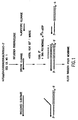
- FIGURE 1 is a flowchart illustrating the DNA polymerase amplification assay for influenza virus endonuclease.
- FIGURE 2 is a photograph of a phosphorimager scan of a 20% acrylamide 8M urea polyacrylamide gel demonstrating the effects of primer length and temperature on polymerase-catalyzed extension reactions.
- the lane labeled 19 corresponds to an uncapped RNA primer (19 nt) with the sequence of the AlMV substrate (5'-GUUUUUAUUUUUAAUUUUC-3') (SEQ.ID.NO.:1); lanes labeled 14-6 correspond to RNA primers of the indicated length derived from 3' deletions of the 19 nt primer.
- the lane labeled b corresponds to a 13 nt RNA derived from the 5' end of b-globin mRNA (5'-ACACUUGCUUUUG-3') (SEQ.ID.NO.:2).
- the lane labeled D corresponds to a 13 nt DNA with the AlMV primer sequence (5'-GTTTTTATTTTTA-3') (SEQ.D.NO.:3).
- FIGURE 3 is a graph demonstrating the linear response of DNA polymerase extension. Reactions were carried out as described in Example 1. The line drawn through the points is a linear least-squares fit to the data with a correlation coefficient of 0.9999
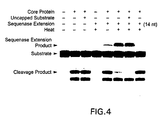
- FIGURE 4 is a gel demonstrating polymerase-catalyzed extension of the influenza endonuclease cleavage product, as described in Example 1.
- the substrate can be any 5'-capped RNA which is cleaved by the influenza endonuclease.
- the endonuclease substrate is derived from the 5' end of the AlMV 4 RNA, which has been previously demonstrated to be a substrate for the influenza endonuclease and is cleaved at nucleotide A13.
- the influenza endonuclease substrate is a 19 nt 5'- capped RNA substrate which is cleaved by the influenza endonuclease, generating a 13 nt product.
- the 19 nt 5'-capped RNA substrate may be made by treating a 19 nt RNA containing a 5'-triphosphate with a guanylyltransferase.
- Guanylyl-transferases are well known and may be obtained commercially; for example, Vaccinia virus guanylyl-transferase may be purchased from Bethesda Research Laboratories, Gaithersburg, MD.
- This 13 nt RNA product resulting from cleavage of the 19 nt product by the influenza endonuclease is then used as a primer for a DNA polymerase-catalyzed extension reaction.
- a DNA template is required.
- the DNA template is a two-part molecule: it contains a 3'-region which is substantially complementary to the 13 nt RNA primer, joined to a template 5'-extension region.
- the 5'-extension region may be made from any desired nucleotides, it is preferred that they be substantially repeated nucleotides, and that the nucleotides present in the extension region not be present in the 3'-complementary region of the DNA in order to achieve specificity for product cleaved at the correct position.
- the 5'-extension region made up of repeated nucleotides. If the 5'-extension region is not made from substantially repeated nucleotides, then there may be specificity problems with the assay, unless the extension region is quite long to amplify the signal of the correct cleavage product relative to non-specific products.
- the length of the extension region there is no particular limit as to the length of the extension region; it may be as short as a single nucleotide or as long as existing synthesis methods permit (up to or exceeding 50 nucleotides).
- the 5'- extension region is at least one nucleotide residue in length, and is more preferably at least about 10 residues in length.
- the template extension region should preferably be a poly-dC, a poly-dG, a poly-dA, or a poly-dT region. In one preferred embodiment of this invention, the template extension region is a poly-dC residue 10 nt in length.
- the 13 nt RNA product will be extended in length by labeled mononucleotides which are complementary to the nucleotides present in the DNA template extension region.
- the template extension region is a 10 residue poly-C
- the 13 nt RNA product will be extended 10 bases by a labeled poly-G sequence.
- any type of label which is conventionally used in the nucleotide assay arts may be used to label the nucleotides which will be incorporated into the product extension region of the RNA, such as fluorescent or absorption labels, it is preferred to use a radiolabel.
- the product extension region is poly- a - 32 P labeled dGMP (as shown in Figure 1).
- the 3'-OH of the primer is preferably blocked.
- Numerous blocking materials are known and suitable, and include cordycepin (3'-deoxyadenosine) and other 3'-bases without a 3'-OH moiety, and other blocking moieties.
- the 3'-OH is blocked with a (3-amino-2-hydroxy)-propoxyphosphoryl moiety.
- the 3'-OH is blocked by the introduction of a 3'-3'-A-5' linkage. While it is possible to run an assay of this invention without blocking the 3'-OH of the primer, blocking the 3'-OH end helps to prevent background signal and thus helps to increase the sensitivity of the assay.
- Sequenase® Version 2 a mutant of bacteriophage T7 DNA polymerase (obtained from United States Biochemicals, Cleveland, Ohio) in which the 3' to 5' exonuclease activity is abolished by in vitro mutagenesis (Tabor et al ., 1989 J . Biol. Chem 264:6447-6458) is the DNA polymerase.
- This polymerase is preferred because it is able to use oligoribonucleotides as primers, it replicates with high fidelity and does not have a 3' to 5' "proofreading" activity.
- detection of the labeled hybrid polymerase product may be achieved by any appropriate means. Generally this may include a step of separating labeled mononucleotide from labeled hybrid polymerase product. In a preferred embodiment, detection is achieved by filtering the sample mixture (which at this point in the assay method, contains the labeled hybrid polymerase product and excess labeled mononucleotide) through a nylon membrane. The unincorporated excess labeled mononucleotides flow through the membrane while the labeled hybrid polymerase reaction product is captured. If the label was a radiolabel, then the amount of radioactivity bound to the filter may be quantitated using a phosphorirnager or by a plate reading scintillation counter.
- This assay has distinct advantages over the prior art assays in that it does not involve an electrophoresis step and may be run in 96-well microtiter plate format.
- Other key advantages of the assay of this invention are that it monitors the substrate cleavage reaction only at the correct position in the sequence, thereby discriminating against nonspecific RNA cleavage products.
- this assay is sensitive enough to detect 200 attomoles (2 X 10 -16 moles) of product generated in a typical cleavage reaction.
- the specificity of the assay is achieved through the choice of the DNA template and the high fidelity of the T7 DNA Sequenase® polymerase. Under the conditions of a typical reaction more than 90% of the substrate is not cleaved, but this does not interfere with the specificity of the assay because the uncleaved RNA substrate does not serve as a primer for polymerization, since the 3' end cannot base-pair to the template. In addition, nonspecific cleavage products with 3' termini other than A13 will not be extended. Although these shorter sequences may hybridize with the template, they are not extended by the DNA polymerase because this reaction would require dATP or dTTP, which are not present in the reaction mixture in the case where the template extension region consists of poly-dC.
- polymerase extension reaction is dependent on hybridization of the RNA primer onto the DNA template. Therefore, for effective hybridization of the RNA primer to the DNA template, polymerase extension reactions are preferably carried out at least 10°C below the melting temperature of the DNA:RNA complex.
- a typical preferred reaction temperature is 0°C for a primer:template complex with a melting temperature of 14°C.
- Figure 2 illustrates the specificity of the Sequenase® -catalyzed extension reaction and the effects of temperature.
- Synthetic, uncapped RNA and DNA primers of various lengths and sequences were hybridized with the DNA template and extended with Sequenase® and a - 32 P-dGTP.
- the reaction is carried out at 0°C the only primers that give efficient extension are the 13 nt AlMV RNA and the corresponding sequence in DNA.
- the reaction conditions have been optimized such that the most intense band corresponds to complete primer extension. A fainter band above the most intense band corresponds to a single base addition.
- the polymerase extension reaction can be conveniently monitored by filtration through nylon membranes. Under the conditions described, quantitative binding of the extended product can be observed, with only a small amount (less than 0.0003%) of the unincorporated a - 32 P-dGTP being retained on the nylon membrane.
- the filtration process can be performed using a 96-well manifold and the filter-bound radioactivity can be quantitated with either a phosphorimager device or a microplate scintillation counter.
- Figure 3 shows the sensitivity and linear response using nylon membrane filtration and phosphorimager detection for extension of the 13 nt AlMV RNA primer. Excellent linearity is observed up to 200 pM primer in a reaction volume of 20 mL. Note that under typical assay conditions approximately 10% of the substrate will be converted to hybrid polymerase extension reaction product, corresponding to 40 pM of product; this amount is well within the linearity range and detection limits of the assay.
- a background primer-independent reaction is observed which is manifest as a faint band running above the major extension products across all lanes in Figure 2 and as a nonzero y-intercept in Figure 3.
- the former background signal is absent and the latter is dramatically reduced, suggesting that they are correlated.
- the background signals are independent of the presence of influenza core protein but they are dependent on Sequenase® .
- the background is due to a Sequenase® -catalyzed addition of a- 32 P dGTP to the single-stranded template.
- Much higher background signals are observed using a template in which the 3'-OH group is not blocked by an aminolinker moiety, suggesting that the reaction requires a free 3'-OH.
- the background signals can be further reduced by treatment of the aminolinker-blocked template with ddATP and terminal deoxynucleotidyl transferase, which suggests that presence of a free 3'-OH containing impurity in the template.
- the dissociation of the cleavage product is likely to be quite slow and the heating step may serve to release the bound product by denaturing the influenza endonuclease complex.
- a faint band observed above the polymerase extension product likely corresponds to addition of an extra dG residue to the blunt-ended extended primer/template duplex, as was observed in Figure 2.
- the coupled assay is not affected by the presence of a 10-fold excess of unlabeled uncapped AlMV substrate.
- the 24 nt template that contains a 14 nt complementary region was added instead of the 13 nt complementary template.
- the specific cleavage product is not extended in this sample, which confirms that the major product corresponds to cleavage at A13 and not at A14.
- the DNA polymerase coupled assay was validated for detecting influenza endonuclease inhibitors by using the inhibitor, (4-[N-benzene-sulfonyl-3-(4-chlorobenzyl)piperidin-3-yl]-2,4-dioxobutanoic acid), which we have previously identified using the gel-based assay.
- This compound is similar to the 4-substituted 2,4- dioxobutanoic acids recently described as inhibitors of the influenza endonuclease (Tomassini et al ., 1994 AntiMicrob . Agents Chemother . 38:2827-2837).
- the DNA polymerase coupled assay provides a convenient method to determine the cleavage position of capped substrates.
- the site of cleavage by the influenza endonuclease was determined by generating sequence ladders with alkaline digestion or by digestion with RNAases and electrophoresis.
- the former method suffers from ambiguities arising from lability of the m7G residue in the cap structure to alkaline hydrolysis and the latter from the faster electrophoretic mobility of the 3'-phosphorylated sequences generated by RNases relative to the unphosphorylated 3'-OH ends generated by the influenza endonuclease.
- the cleavage site can be unambiguously defined using the DNA polymerase coupled assay of this invention by comparing the extension reactions catalyzed using templates with complementary regions corresponding to the expected cleavage products.
- Figure 4 illustrates this aspect of the invention, where the template with a 13 nt complementary region serves as a substrate, whereas the 14 nt complementary template does not.
- Another major advantage of the coupled assay of this invention over existing methodologies is that the oligonucleotide product of interest can be detected in the presence of other sequences provided that they do not serve to prime polymer-ization. Thus, precise measurements of the reaction of interest can be performed even in complex, impure preparations.
- Oligo-deoxyribonucleotides and uncapped oligo-ribonucleotides were synthesized by Midland Certified Reagent Company (Midland, TX) and were purified by anion-exchange HPLC. Triphosphorylated oligonucleotides were synthesized and capped. The sequence of the 19 nt substrate oligo-ribonucleotide is 5'-GUUUUUAUUUUUA-AUUUUC-3' (SEQ.ID. NO.:1). 3'-Truncated ribonucleotides were also synthesized which correspond to the 5'-region of the substrate with lengths of 14, 13, 12, 10 and 6 nt.
- a 23 nt template was used in all experiments with the sequence: 5'-Biotin-CCCCCCCCTAAAAATAAAAAC-amino-3' (SEQ.ID.NO.:4), where the 5'-biotin is N-biotinyl-6-aminohexyloxyphosphoryl moiety and the 3'-amino is 3-amino-2-hydroxy)-propoxy-phosphoryl.
- a 24 nt template was used with the sequence: 5'-Biotin-CCCCCCCCTTAAAAATA-AAAAC-amino-3' (SEQ.ID.NO.:5).
- a- 32 P-dGTP (3000 Ci/mmole) was obtained from Dupont NEN. Unlabeled dGTP was obtained from Pharmacia. Sequenase® Version 2.0 was obtained from United States Biochemicals (Cleveland, OH).
- the polymerase extension reactions contained 1 nM primer, 50 nM template, 500 nM Sequenase® , and 500 nM dGTP and were carried out for 2 hours at the indicated temperature. The reactions were analyzed on 20% polyacrylamide 8M urea gels.
- Influenza cleavage reactions were performed at 25°C in a buffer containing 100 mM tris[hydroxymethyl]aminomethane (Tris) pH 8.0, 50 mM KCl, 0.25 mM MgCl 2 , 5 mM dithiothreitol (DTT), 4% (v/v) dimethyl sulfoxide (DMSO), in DEPC treated water.
- Polymerase extension reactions were performed in the same buffer, except that the MgCl 2 concentration was increased to 10 mM and the DMSO concentration to 9%.
- 500 nM dGTP was employed in extension reactions using end-labeled primers and a mixture of 50 nM a- 32 P-dGTP and 450 nM unlabeled dGTP was employed with unlabeled primers. Unless otherwise indicated, extension reactions were performed at 0°C. For the inhibition measurements, the compound (4-[N-benzenesulfonyl-3-(4-chlorobenzyl)piperidin-3-yl]-2,4-dioxobutanoic acid) was preincubated with influenza core protein for 10 min.
- the cleavage reactions were initiated by adding 0.4 nM of unlabeled (gel assay) or end-labeled (polymerase extension assay) substrate in a 15 mL volume reaction containing 0.75 mL influenza core protein and were run for 10 min at 25°C.
- the extension reaction was carried out in a 20 mL volume containing 50 nM Sequenase® , 500 nM dGTP, 50 nM template for 18 h at 0°C.
- Reactions were analyzed either by electrophoresis in 20% polyacrylamide gels containing 8 M urea or by filtering through 0.2 mm pore Nytran® membranes in a 96-well manifold (Schleicher and Schuell, Keene, NH).
- samples were diluted with 200 mL of 250 mM EDTA, pH 8.0 and 200 mL was loaded onto the membrane equilibrated in 5X SSC (0.75 M NaCl, 75 mM sodium citrate, pH 7.0) and filtered immediately. Each well was washed five times with 200 mL of 5X SSC, and the filter was removed from the manifold washed 3 times in 100 mL of 5X SSC.
Landscapes
- Chemical & Material Sciences (AREA)
- Life Sciences & Earth Sciences (AREA)
- Organic Chemistry (AREA)
- Health & Medical Sciences (AREA)
- Engineering & Computer Science (AREA)
- Zoology (AREA)
- Wood Science & Technology (AREA)
- Proteomics, Peptides & Aminoacids (AREA)
- Immunology (AREA)
- Molecular Biology (AREA)
- Biochemistry (AREA)
- Microbiology (AREA)
- Biophysics (AREA)
- Analytical Chemistry (AREA)
- Physics & Mathematics (AREA)
- Genetics & Genomics (AREA)
- Biotechnology (AREA)
- Bioinformatics & Cheminformatics (AREA)
- General Engineering & Computer Science (AREA)
- General Health & Medical Sciences (AREA)
- Virology (AREA)
- Chemical Kinetics & Catalysis (AREA)
- Measuring Or Testing Involving Enzymes Or Micro-Organisms (AREA)
- Saccharide Compounds (AREA)
Claims (16)
- Verfahren, welches die Influenza-Endonuklease-Aktivität einer Probe mißt, umfassend:A) Zugeben eines influenza-Endonuklease-Substrats zu einer Probe, deren Influenza-Endonuklease-Aktivität untersucht werden soll, um ein RNA-Produkt zu erzeugen;B) Hybridisieren des RNA-Produkts mit einer DNA-Matrize, welche DNA-Matrize einen ersten Abschnitt, der im wesentlichen komplementär zu dem RNA-Produkt ist, und einen 5'-Verlängerungsbereich, der mit dem 5'-Ende des ersten Abschnitts verknüpft ist, wobei der Verlängerungsbereich mindestens ein Nukleotid umfaßt, umfaßt, unter Hybridisierungsbedingungen zur Bildung eines RNA:DNA-Heteroduplexes;C) Zugeben eines markierten Mononukleotids, welches komplementär zu dem Verlängerungsbereich ist;D) Zugeben einer DNA-Polymerase zu der Heteroduplex-Struktur unter Bedingungen, welche es der DNA-Polymerase ermöglichen, die Addition des markierten Mononukleotids zu dem 3'-Ende des RNA-Produkts zu katalysieren, um ein markiertes Hybrid-Polymeraseprodukt zu erzeugen; undE) Messen der Menge an markiertem Hybrid-Polymeraseprodukt als Maß der Menge an Influenza-Endonuklease-Aktivität der Probe.
- Verfahren nach Anspruch 1, worin der Verlängerungsbereich der DNA-Matrize Nukleotide umfaßt, die in dem ersten Abschnitt der DNA-Matrize nicht vorhanden sind.
- Verfahren nach Anspruch 2, worin der Verlängerungsbereich der DNA-Matrize im wesentlichen wiederholte Nukleotide umfaßt.
- Verfahren nach Anspruch 3, worin der Verlängerungsbereich eine Länge von mindestens 10 Nukleotiden aufweist.
- Verfahren nach Anspruch 1, worin das Influenza-Endonuklease-Substrat von dem 5'-Ende der Alfalfa-Mosaikvirus 4-RNA stammt.
- Verfahren nach Anspruch 5, worin das Substrat SEQ-ID-NR. 1 ist.
- Verfahren nach Anspruch 4, worin der zweite Abschnitt der DNA-Matrize einen Poly-C-Rest umfaßt.
- Verfahren nach Anspruch 1, worin die markierten Mononukleotide radioaktiv markiert sind.
- Verfahren nach Anspruch 1, worin die Menge des markierten Hybrid-Polymeraseprodukts gemessen wird, indem die Probe, welche markiertes Hybrid-Polymeraseprodukt und überschüssiges markiertes Mononukleotid umfaßt, durch einen Filter geleitet wird, so daß das markierte Hybrid-Polymeraseprodukt auf dem Filter abgefangen wird, und die Menge der auf dem Filter befindlichen Markierung gemessen wird.
- Verfahren nach Anspruch 9, worin der Filter ein Nylonfilter ist.
- Verfahren nach Anspruch 10, worin die Markierung eine radioaktive Markierung ist.
- Verfahren nach Anspruch 1, worin die zu untersuchende Probe einen mutmaßlichen Inhibitor von Influenza-Endonuklease-Aktivität enthält.
- Verfahren nach Anspruch 12, welches ferner den Vergleich der Menge an Influenza-Endonuklease-Aktivität der Probe mit einer Aktivität, die für eine Kontrollprobe, umfassend Influenza-Endonuklease, die nicht in Gegenwart eines mutmaßlichen Inhibitors vorliegt, bestimmt wurde, umfaßt.
- Verfahren nach Anspruch 1, worin das Verfahren durchgeführt wird, um die Wirkung eines mutmaßlichen Influenza-Inhibitors festzustellen, unter der Voraussetzung, daß:in dem Schritt (A) das Influenza-Endonuklease-Substrat ein mit einem 5'-Cap versehenes Influenza-Endonuklease-Substrat von 19 Nukleotiden ist, welches im wesentlichen von dem 5'-Ende von Alfalfa-Mosaikvirus-RNA stammt, und wobei die Probe mutmaßlich einen Influenza-Endonuklease-Inhibitor enthält, dessen Aktivität untersucht werden soll, um das RNA-Produkt zu erzeugen, wobei das RNA-Produkt ein RNA-Produkt von 13 Nukleotiden ist;in dem Schritt (B) das 13-Nukleotid-RNA-Produkt mit der DNA-Matrize, bei welcher der erste Abschnitt im wesentlichen komplementär zu dem 13-Nukleotid-RNA-Produkt ist und der Verlängerungsbereich mindestens 10 Nukleotide umfaßt, die in dem ersten Abschnitt nicht vorhanden sind, unter Hybridisierungsbedingungen zur Bildung der RNA:DNA-Heteroduplex-Struktur hybridisiert wird;in dem Schritt (D) das markierte Mononukleotid radioaktiv markiert ist und das markierte Hybrid-Polymeraseprodukt radioaktiv markiert ist; undin dem Schritt (E) die Menge des markierten Hybrid-Polymeraseprodukts mit einem Verfahren gemessen wird, welches das Filtrieren der Probe von Schritt (D) durch Leiten der Probe durch einen Nylonfilter, so daß das radioaktiv markierte Hybrid-Polymeraseprodukt von dem Filter abgefangen wird, und das Messen der Menge an markiertem Hybrid-Polymeraseprodukt, die auf dem Filter abgefangen wurde, und das Vergleichen dieser Menge mit derjenigen Menge, welche erhalten wird, wenn kein mutmaßlicher Influenza-Endonuklease-Inhibitor in einer Kontrollprobe vorliegt, umfaßt
- Verfahren nach Anspruch 14, worin der Verlängerungsbereich der DNA-Matrize mindestens 10 im wesentlichen wiederholte Cytosin-Nukleotide umfaßt.
- Verfahren nach Anspruch 15, worin das markierte Nukleotid radiaktiv markiertes dGTP ist.
Applications Claiming Priority (3)
| Application Number | Priority Date | Filing Date | Title |
|---|---|---|---|
| US487759 | 1995-06-07 | ||
| US08/487,759 US5660989A (en) | 1995-06-07 | 1995-06-07 | DNA polymerase extension assay for influenza virus endonuclease |
| PCT/US1996/008320 WO1996040993A1 (en) | 1995-06-07 | 1996-06-03 | Dna polymerase extension assay for influenza virus endonuclease |
Publications (3)
| Publication Number | Publication Date |
|---|---|
| EP0832292A1 EP0832292A1 (de) | 1998-04-01 |
| EP0832292A4 EP0832292A4 (de) | 1999-05-26 |
| EP0832292B1 true EP0832292B1 (de) | 2002-01-30 |
Family
ID=23937008
Family Applications (1)
| Application Number | Title | Priority Date | Filing Date |
|---|---|---|---|
| EP96920610A Expired - Lifetime EP0832292B1 (de) | 1995-06-07 | 1996-06-03 | Verfahren zur detektion von influenzavirus endonuklease durch dna-polymerase verlängerung |
Country Status (8)
| Country | Link |
|---|---|
| US (1) | US5660989A (de) |
| EP (1) | EP0832292B1 (de) |
| JP (1) | JPH11506606A (de) |
| AT (1) | ATE212675T1 (de) |
| CA (1) | CA2222753A1 (de) |
| DE (1) | DE69618955T2 (de) |
| ES (1) | ES2170860T3 (de) |
| WO (1) | WO1996040993A1 (de) |
Families Citing this family (5)
| Publication number | Priority date | Publication date | Assignee | Title |
|---|---|---|---|---|
| DE69618957T2 (de) * | 1995-06-07 | 2002-08-14 | MERCK & CO., INC. | Dna-polymerase verlängungs assay |
| US6100028A (en) * | 1996-06-03 | 2000-08-08 | Merck & Co., Inc. | DNA polymerase extension assay |
| CA2802193A1 (en) * | 2000-10-05 | 2002-04-11 | Hai Kang Life Corporation Limited | A kit for detecting non-pathogenic or pathogenic influenza a subtype h5 virus |
| US20090215050A1 (en) * | 2008-02-22 | 2009-08-27 | Robert Delmar Jenison | Systems and methods for point-of-care amplification and detection of polynucleotides |
| WO2014164874A2 (en) | 2013-03-13 | 2014-10-09 | Becton, Dickinson And Company | Methods and compositions for modulation of amplification efficiency |
Family Cites Families (3)
| Publication number | Priority date | Publication date | Assignee | Title |
|---|---|---|---|---|
| US4521509A (en) * | 1982-11-24 | 1985-06-04 | Research Corporation | Method for degrading DNA |
| US4994368A (en) * | 1987-07-23 | 1991-02-19 | Syntex (U.S.A.) Inc. | Amplification method for polynucleotide assays |
| DE69618957T2 (de) * | 1995-06-07 | 2002-08-14 | MERCK & CO., INC. | Dna-polymerase verlängungs assay |
-
1995
- 1995-06-07 US US08/487,759 patent/US5660989A/en not_active Expired - Fee Related
-
1996
- 1996-06-03 DE DE69618955T patent/DE69618955T2/de not_active Expired - Fee Related
- 1996-06-03 WO PCT/US1996/008320 patent/WO1996040993A1/en not_active Ceased
- 1996-06-03 ES ES96920610T patent/ES2170860T3/es not_active Expired - Lifetime
- 1996-06-03 JP JP9500959A patent/JPH11506606A/ja not_active Withdrawn
- 1996-06-03 CA CA002222753A patent/CA2222753A1/en not_active Abandoned
- 1996-06-03 AT AT96920610T patent/ATE212675T1/de not_active IP Right Cessation
- 1996-06-03 EP EP96920610A patent/EP0832292B1/de not_active Expired - Lifetime
Also Published As
| Publication number | Publication date |
|---|---|
| ATE212675T1 (de) | 2002-02-15 |
| DE69618955T2 (de) | 2002-08-14 |
| US5660989A (en) | 1997-08-26 |
| EP0832292A4 (de) | 1999-05-26 |
| ES2170860T3 (es) | 2002-08-16 |
| WO1996040993A1 (en) | 1996-12-19 |
| EP0832292A1 (de) | 1998-04-01 |
| DE69618955D1 (de) | 2002-03-14 |
| JPH11506606A (ja) | 1999-06-15 |
| CA2222753A1 (en) | 1996-12-19 |
Similar Documents
| Publication | Publication Date | Title |
|---|---|---|
| US6048687A (en) | Cycling DNA/RNA amplification electrochemiluminescent probe assay | |
| US5112734A (en) | Target-dependent synthesis of an artificial gene for the synthesis of a replicatable rna | |
| KR100527265B1 (ko) | 폴리뉴클레오티드 서열의 선형 등온 증폭을 위한 방법 및조성물 | |
| CA2662837C (en) | Methods and substances for isolation and detection of small polynucleotides | |
| JP3572340B2 (ja) | 特定核酸配列の検出方法 | |
| US7112407B2 (en) | Method of assay of target nucleic acid | |
| EP0373960A2 (de) | 4 Selbstfortsetzendes System für Sequenzreplikation | |
| KR0161327B1 (ko) | 핵산의 민감한 검출 방법 | |
| JP2788034B2 (ja) | ポリヌクレオチドのアツセイのための増幅方法 | |
| JPH09510351A (ja) | 等温鎖置換核酸増幅法 | |
| US6063572A (en) | Method of assay of nucleic acid sequences | |
| US6100028A (en) | DNA polymerase extension assay | |
| CN108588279A (zh) | Hev测定 | |
| US5660989A (en) | DNA polymerase extension assay for influenza virus endonuclease | |
| CA2073989A1 (en) | Immobilization of nucleic acids | |
| EP0833945B1 (de) | Dna-polymerase verlängungs assay | |
| WO1990006376A1 (en) | Target nucleic acid amplification/detection systems | |
| JP3071797B2 (ja) | 複製rnaベースの増幅/検出系 | |
| EP1002878A2 (de) | Hepatitis C Viren RNS-bindendes oligo DNS und Verfahren für dessen Herstellung | |
| Cole et al. | Assay for influenza virus endonuclease using DNA polymerase extension of a specific cleavage product | |
| JPH07231799A (ja) | 特定のポリヌクレオチドの検出方法及び当該方法に用いる検出用キット | |
| US6756198B2 (en) | Oligonucleotide for highly sensitive detection of hepatitis C virus and method for detection thereof | |
| HK1173746A (en) | Methods and compositions for linear isothermal amplification of polynucleotide sequences | |
| WO2004029294A1 (en) | New sequencing method for sequencing rna molecules | |
| WO2009029875A1 (en) | Method for the labeling and detection of small polynucleotides |
Legal Events
| Date | Code | Title | Description |
|---|---|---|---|
| PUAI | Public reference made under article 153(3) epc to a published international application that has entered the european phase |
Free format text: ORIGINAL CODE: 0009012 |
|
| 17P | Request for examination filed |
Effective date: 19980107 |
|
| AK | Designated contracting states |
Kind code of ref document: A1 Designated state(s): AT BE CH DE DK ES FI FR GB GR IE IT LI LU NL PT SE |
|
| A4 | Supplementary search report drawn up and despatched |
Effective date: 19990414 |
|
| AK | Designated contracting states |
Kind code of ref document: A4 Designated state(s): AT BE CH DE DK ES FI FR GB GR IE IT LI LU NL PT SE |
|
| 17Q | First examination report despatched |
Effective date: 20000802 |
|
| GRAG | Despatch of communication of intention to grant |
Free format text: ORIGINAL CODE: EPIDOS AGRA |
|
| GRAG | Despatch of communication of intention to grant |
Free format text: ORIGINAL CODE: EPIDOS AGRA |
|
| GRAH | Despatch of communication of intention to grant a patent |
Free format text: ORIGINAL CODE: EPIDOS IGRA |
|
| GRAH | Despatch of communication of intention to grant a patent |
Free format text: ORIGINAL CODE: EPIDOS IGRA |
|
| GRAA | (expected) grant |
Free format text: ORIGINAL CODE: 0009210 |
|
| REG | Reference to a national code |
Ref country code: GB Ref legal event code: IF02 |
|
| AK | Designated contracting states |
Kind code of ref document: B1 Designated state(s): AT BE CH DE DK ES FI FR GB GR IE IT LI LU NL PT SE |
|
| PG25 | Lapsed in a contracting state [announced via postgrant information from national office to epo] |
Ref country code: NL Free format text: LAPSE BECAUSE OF FAILURE TO SUBMIT A TRANSLATION OF THE DESCRIPTION OR TO PAY THE FEE WITHIN THE PRESCRIBED TIME-LIMIT Effective date: 20020130 Ref country code: LI Free format text: LAPSE BECAUSE OF FAILURE TO SUBMIT A TRANSLATION OF THE DESCRIPTION OR TO PAY THE FEE WITHIN THE PRESCRIBED TIME-LIMIT Effective date: 20020130 Ref country code: GR Free format text: LAPSE BECAUSE OF FAILURE TO SUBMIT A TRANSLATION OF THE DESCRIPTION OR TO PAY THE FEE WITHIN THE PRESCRIBED TIME-LIMIT Effective date: 20020130 Ref country code: FI Free format text: LAPSE BECAUSE OF FAILURE TO SUBMIT A TRANSLATION OF THE DESCRIPTION OR TO PAY THE FEE WITHIN THE PRESCRIBED TIME-LIMIT Effective date: 20020130 Ref country code: CH Free format text: LAPSE BECAUSE OF FAILURE TO SUBMIT A TRANSLATION OF THE DESCRIPTION OR TO PAY THE FEE WITHIN THE PRESCRIBED TIME-LIMIT Effective date: 20020130 Ref country code: BE Free format text: LAPSE BECAUSE OF FAILURE TO SUBMIT A TRANSLATION OF THE DESCRIPTION OR TO PAY THE FEE WITHIN THE PRESCRIBED TIME-LIMIT Effective date: 20020130 Ref country code: AT Free format text: LAPSE BECAUSE OF FAILURE TO SUBMIT A TRANSLATION OF THE DESCRIPTION OR TO PAY THE FEE WITHIN THE PRESCRIBED TIME-LIMIT Effective date: 20020130 |
|
| REF | Corresponds to: |
Ref document number: 212675 Country of ref document: AT Date of ref document: 20020215 Kind code of ref document: T |
|
| REG | Reference to a national code |
Ref country code: CH Ref legal event code: EP |
|
| REF | Corresponds to: |
Ref document number: 69618955 Country of ref document: DE Date of ref document: 20020314 |
|
| REG | Reference to a national code |
Ref country code: IE Ref legal event code: FG4D |
|
| PG25 | Lapsed in a contracting state [announced via postgrant information from national office to epo] |
Ref country code: SE Free format text: LAPSE BECAUSE OF FAILURE TO SUBMIT A TRANSLATION OF THE DESCRIPTION OR TO PAY THE FEE WITHIN THE PRESCRIBED TIME-LIMIT Effective date: 20020430 Ref country code: PT Free format text: LAPSE BECAUSE OF FAILURE TO SUBMIT A TRANSLATION OF THE DESCRIPTION OR TO PAY THE FEE WITHIN THE PRESCRIBED TIME-LIMIT Effective date: 20020430 Ref country code: DK Free format text: LAPSE BECAUSE OF FAILURE TO SUBMIT A TRANSLATION OF THE DESCRIPTION OR TO PAY THE FEE WITHIN THE PRESCRIBED TIME-LIMIT Effective date: 20020430 |
|
| PG25 | Lapsed in a contracting state [announced via postgrant information from national office to epo] |
Ref country code: LU Free format text: LAPSE BECAUSE OF NON-PAYMENT OF DUE FEES Effective date: 20020603 Ref country code: IE Free format text: LAPSE BECAUSE OF NON-PAYMENT OF DUE FEES Effective date: 20020603 |
|
| ET | Fr: translation filed | ||
| NLV1 | Nl: lapsed or annulled due to failure to fulfill the requirements of art. 29p and 29m of the patents act | ||
| REG | Reference to a national code |
Ref country code: CH Ref legal event code: PL |
|
| REG | Reference to a national code |
Ref country code: ES Ref legal event code: FG2A Ref document number: 2170860 Country of ref document: ES Kind code of ref document: T3 |
|
| PLBE | No opposition filed within time limit |
Free format text: ORIGINAL CODE: 0009261 |
|
| STAA | Information on the status of an ep patent application or granted ep patent |
Free format text: STATUS: NO OPPOSITION FILED WITHIN TIME LIMIT |
|
| 26N | No opposition filed | ||
| REG | Reference to a national code |
Ref country code: IE Ref legal event code: MM4A |
|
| PGFP | Annual fee paid to national office [announced via postgrant information from national office to epo] |
Ref country code: GB Payment date: 20030501 Year of fee payment: 8 |
|
| PGFP | Annual fee paid to national office [announced via postgrant information from national office to epo] |
Ref country code: FR Payment date: 20030602 Year of fee payment: 8 |
|
| PGFP | Annual fee paid to national office [announced via postgrant information from national office to epo] |
Ref country code: ES Payment date: 20030619 Year of fee payment: 8 |
|
| PGFP | Annual fee paid to national office [announced via postgrant information from national office to epo] |
Ref country code: DE Payment date: 20030630 Year of fee payment: 8 |
|
| PG25 | Lapsed in a contracting state [announced via postgrant information from national office to epo] |
Ref country code: GB Free format text: LAPSE BECAUSE OF NON-PAYMENT OF DUE FEES Effective date: 20040603 |
|
| PG25 | Lapsed in a contracting state [announced via postgrant information from national office to epo] |
Ref country code: ES Free format text: LAPSE BECAUSE OF NON-PAYMENT OF DUE FEES Effective date: 20040604 |
|
| PG25 | Lapsed in a contracting state [announced via postgrant information from national office to epo] |
Ref country code: DE Free format text: LAPSE BECAUSE OF NON-PAYMENT OF DUE FEES Effective date: 20050101 |
|
| GBPC | Gb: european patent ceased through non-payment of renewal fee |
Effective date: 20040603 |
|
| PG25 | Lapsed in a contracting state [announced via postgrant information from national office to epo] |
Ref country code: FR Free format text: LAPSE BECAUSE OF NON-PAYMENT OF DUE FEES Effective date: 20050228 |
|
| REG | Reference to a national code |
Ref country code: FR Ref legal event code: ST |
|
| PG25 | Lapsed in a contracting state [announced via postgrant information from national office to epo] |
Ref country code: IT Free format text: LAPSE BECAUSE OF NON-PAYMENT OF DUE FEES;WARNING: LAPSES OF ITALIAN PATENTS WITH EFFECTIVE DATE BEFORE 2007 MAY HAVE OCCURRED AT ANY TIME BEFORE 2007. THE CORRECT EFFECTIVE DATE MAY BE DIFFERENT FROM THE ONE RECORDED. Effective date: 20050603 |
|
| REG | Reference to a national code |
Ref country code: ES Ref legal event code: FD2A Effective date: 20040604 |