EP0832299B1 - Verwendung von nukleinsäureliganden in der durchflusszytometrie - Google Patents
Verwendung von nukleinsäureliganden in der durchflusszytometrie Download PDFInfo
- Publication number
- EP0832299B1 EP0832299B1 EP96919017A EP96919017A EP0832299B1 EP 0832299 B1 EP0832299 B1 EP 0832299B1 EP 96919017 A EP96919017 A EP 96919017A EP 96919017 A EP96919017 A EP 96919017A EP 0832299 B1 EP0832299 B1 EP 0832299B1
- Authority
- EP
- European Patent Office
- Prior art keywords
- target molecule
- nucleic acid
- molecule
- target
- dna
- Prior art date
- Legal status (The legal status is an assumption and is not a legal conclusion. Google has not performed a legal analysis and makes no representation as to the accuracy of the status listed.)
- Expired - Lifetime
Links
Images

Classifications
-
- C—CHEMISTRY; METALLURGY
- C12—BIOCHEMISTRY; BEER; SPIRITS; WINE; VINEGAR; MICROBIOLOGY; ENZYMOLOGY; MUTATION OR GENETIC ENGINEERING
- C12N—MICROORGANISMS OR ENZYMES; COMPOSITIONS THEREOF; PROPAGATING, PRESERVING, OR MAINTAINING MICROORGANISMS; MUTATION OR GENETIC ENGINEERING; CULTURE MEDIA
- C12N15/00—Mutation or genetic engineering; DNA or RNA concerning genetic engineering, vectors, e.g. plasmids, or their isolation, preparation or purification; Use of hosts therefor
- C12N15/09—Recombinant DNA-technology
- C12N15/10—Processes for the isolation, preparation or purification of DNA or RNA
- C12N15/1034—Isolating an individual clone by screening libraries
- C12N15/1048—SELEX
-
- A—HUMAN NECESSITIES
- A61—MEDICAL OR VETERINARY SCIENCE; HYGIENE
- A61K—PREPARATIONS FOR MEDICAL, DENTAL OR TOILETRY PURPOSES
- A61K47/00—Medicinal preparations characterised by the non-active ingredients used, e.g. carriers or inert additives; Targeting or modifying agents chemically bound to the active ingredient
- A61K47/50—Medicinal preparations characterised by the non-active ingredients used, e.g. carriers or inert additives; Targeting or modifying agents chemically bound to the active ingredient the non-active ingredient being chemically bound to the active ingredient, e.g. polymer-drug conjugates
- A61K47/51—Medicinal preparations characterised by the non-active ingredients used, e.g. carriers or inert additives; Targeting or modifying agents chemically bound to the active ingredient the non-active ingredient being chemically bound to the active ingredient, e.g. polymer-drug conjugates the non-active ingredient being a modifying agent
- A61K47/54—Medicinal preparations characterised by the non-active ingredients used, e.g. carriers or inert additives; Targeting or modifying agents chemically bound to the active ingredient the non-active ingredient being chemically bound to the active ingredient, e.g. polymer-drug conjugates the non-active ingredient being a modifying agent the modifying agent being an organic compound
- A61K47/549—Sugars, nucleosides, nucleotides or nucleic acids
-
- B—PERFORMING OPERATIONS; TRANSPORTING
- B82—NANOTECHNOLOGY
- B82Y—SPECIFIC USES OR APPLICATIONS OF NANOSTRUCTURES; MEASUREMENT OR ANALYSIS OF NANOSTRUCTURES; MANUFACTURE OR TREATMENT OF NANOSTRUCTURES
- B82Y5/00—Nanobiotechnology or nanomedicine, e.g. protein engineering or drug delivery
-
- C—CHEMISTRY; METALLURGY
- C07—ORGANIC CHEMISTRY
- C07H—SUGARS; DERIVATIVES THEREOF; NUCLEOSIDES; NUCLEOTIDES; NUCLEIC ACIDS
- C07H19/00—Compounds containing a hetero ring sharing one ring hetero atom with a saccharide radical; Nucleosides; Mononucleotides; Anhydro-derivatives thereof
- C07H19/02—Compounds containing a hetero ring sharing one ring hetero atom with a saccharide radical; Nucleosides; Mononucleotides; Anhydro-derivatives thereof sharing nitrogen
- C07H19/04—Heterocyclic radicals containing only nitrogen atoms as ring hetero atom
- C07H19/06—Pyrimidine radicals
-
- C—CHEMISTRY; METALLURGY
- C07—ORGANIC CHEMISTRY
- C07H—SUGARS; DERIVATIVES THEREOF; NUCLEOSIDES; NUCLEOTIDES; NUCLEIC ACIDS
- C07H19/00—Compounds containing a hetero ring sharing one ring hetero atom with a saccharide radical; Nucleosides; Mononucleotides; Anhydro-derivatives thereof
- C07H19/02—Compounds containing a hetero ring sharing one ring hetero atom with a saccharide radical; Nucleosides; Mononucleotides; Anhydro-derivatives thereof sharing nitrogen
- C07H19/04—Heterocyclic radicals containing only nitrogen atoms as ring hetero atom
- C07H19/06—Pyrimidine radicals
- C07H19/10—Pyrimidine radicals with the saccharide radical esterified by phosphoric or polyphosphoric acids
-
- C—CHEMISTRY; METALLURGY
- C07—ORGANIC CHEMISTRY
- C07H—SUGARS; DERIVATIVES THEREOF; NUCLEOSIDES; NUCLEOTIDES; NUCLEIC ACIDS
- C07H21/00—Compounds containing two or more mononucleotide units having separate phosphate or polyphosphate groups linked by saccharide radicals of nucleoside groups, e.g. nucleic acids
-
- C—CHEMISTRY; METALLURGY
- C07—ORGANIC CHEMISTRY
- C07K—PEPTIDES
- C07K14/00—Peptides having more than 20 amino acids; Gastrins; Somatostatins; Melanotropins; Derivatives thereof
- C07K14/001—Peptides having more than 20 amino acids; Gastrins; Somatostatins; Melanotropins; Derivatives thereof by chemical synthesis
-
- C—CHEMISTRY; METALLURGY
- C12—BIOCHEMISTRY; BEER; SPIRITS; WINE; VINEGAR; MICROBIOLOGY; ENZYMOLOGY; MUTATION OR GENETIC ENGINEERING
- C12N—MICROORGANISMS OR ENZYMES; COMPOSITIONS THEREOF; PROPAGATING, PRESERVING, OR MAINTAINING MICROORGANISMS; MUTATION OR GENETIC ENGINEERING; CULTURE MEDIA
- C12N15/00—Mutation or genetic engineering; DNA or RNA concerning genetic engineering, vectors, e.g. plasmids, or their isolation, preparation or purification; Use of hosts therefor
- C12N15/09—Recombinant DNA-technology
- C12N15/11—DNA or RNA fragments; Modified forms thereof; Non-coding nucleic acids having a biological activity
- C12N15/115—Aptamers, i.e. nucleic acids binding a target molecule specifically and with high affinity without hybridising therewith ; Nucleic acids binding to non-nucleic acids, e.g. aptamers
-
- C—CHEMISTRY; METALLURGY
- C12—BIOCHEMISTRY; BEER; SPIRITS; WINE; VINEGAR; MICROBIOLOGY; ENZYMOLOGY; MUTATION OR GENETIC ENGINEERING
- C12N—MICROORGANISMS OR ENZYMES; COMPOSITIONS THEREOF; PROPAGATING, PRESERVING, OR MAINTAINING MICROORGANISMS; MUTATION OR GENETIC ENGINEERING; CULTURE MEDIA
- C12N9/00—Enzymes; Proenzymes; Compositions thereof; Processes for preparing, activating, inhibiting, separating or purifying enzymes
- C12N9/10—Transferases (2.)
- C12N9/12—Transferases (2.) transferring phosphorus containing groups, e.g. kinases (2.7)
- C12N9/1241—Nucleotidyltransferases (2.7.7)
- C12N9/1276—RNA-directed DNA polymerase (2.7.7.49), i.e. reverse transcriptase or telomerase
-
- C—CHEMISTRY; METALLURGY
- C12—BIOCHEMISTRY; BEER; SPIRITS; WINE; VINEGAR; MICROBIOLOGY; ENZYMOLOGY; MUTATION OR GENETIC ENGINEERING
- C12Q—MEASURING OR TESTING PROCESSES INVOLVING ENZYMES, NUCLEIC ACIDS OR MICROORGANISMS; COMPOSITIONS OR TEST PAPERS THEREFOR; PROCESSES OF PREPARING SUCH COMPOSITIONS; CONDITION-RESPONSIVE CONTROL IN MICROBIOLOGICAL OR ENZYMOLOGICAL PROCESSES
- C12Q1/00—Measuring or testing processes involving enzymes, nucleic acids or microorganisms; Compositions therefor; Processes of preparing such compositions
- C12Q1/68—Measuring or testing processes involving enzymes, nucleic acids or microorganisms; Compositions therefor; Processes of preparing such compositions involving nucleic acids
-
- C—CHEMISTRY; METALLURGY
- C12—BIOCHEMISTRY; BEER; SPIRITS; WINE; VINEGAR; MICROBIOLOGY; ENZYMOLOGY; MUTATION OR GENETIC ENGINEERING
- C12Q—MEASURING OR TESTING PROCESSES INVOLVING ENZYMES, NUCLEIC ACIDS OR MICROORGANISMS; COMPOSITIONS OR TEST PAPERS THEREFOR; PROCESSES OF PREPARING SUCH COMPOSITIONS; CONDITION-RESPONSIVE CONTROL IN MICROBIOLOGICAL OR ENZYMOLOGICAL PROCESSES
- C12Q1/00—Measuring or testing processes involving enzymes, nucleic acids or microorganisms; Compositions therefor; Processes of preparing such compositions
- C12Q1/68—Measuring or testing processes involving enzymes, nucleic acids or microorganisms; Compositions therefor; Processes of preparing such compositions involving nucleic acids
- C12Q1/6804—Nucleic acid analysis using immunogens
-
- C—CHEMISTRY; METALLURGY
- C12—BIOCHEMISTRY; BEER; SPIRITS; WINE; VINEGAR; MICROBIOLOGY; ENZYMOLOGY; MUTATION OR GENETIC ENGINEERING
- C12Q—MEASURING OR TESTING PROCESSES INVOLVING ENZYMES, NUCLEIC ACIDS OR MICROORGANISMS; COMPOSITIONS OR TEST PAPERS THEREFOR; PROCESSES OF PREPARING SUCH COMPOSITIONS; CONDITION-RESPONSIVE CONTROL IN MICROBIOLOGICAL OR ENZYMOLOGICAL PROCESSES
- C12Q1/00—Measuring or testing processes involving enzymes, nucleic acids or microorganisms; Compositions therefor; Processes of preparing such compositions
- C12Q1/68—Measuring or testing processes involving enzymes, nucleic acids or microorganisms; Compositions therefor; Processes of preparing such compositions involving nucleic acids
- C12Q1/6811—Selection methods for production or design of target specific oligonucleotides or binding molecules
-
- C—CHEMISTRY; METALLURGY
- C12—BIOCHEMISTRY; BEER; SPIRITS; WINE; VINEGAR; MICROBIOLOGY; ENZYMOLOGY; MUTATION OR GENETIC ENGINEERING
- C12Q—MEASURING OR TESTING PROCESSES INVOLVING ENZYMES, NUCLEIC ACIDS OR MICROORGANISMS; COMPOSITIONS OR TEST PAPERS THEREFOR; PROCESSES OF PREPARING SUCH COMPOSITIONS; CONDITION-RESPONSIVE CONTROL IN MICROBIOLOGICAL OR ENZYMOLOGICAL PROCESSES
- C12Q1/00—Measuring or testing processes involving enzymes, nucleic acids or microorganisms; Compositions therefor; Processes of preparing such compositions
- C12Q1/68—Measuring or testing processes involving enzymes, nucleic acids or microorganisms; Compositions therefor; Processes of preparing such compositions involving nucleic acids
- C12Q1/6813—Hybridisation assays
-
- C—CHEMISTRY; METALLURGY
- C12—BIOCHEMISTRY; BEER; SPIRITS; WINE; VINEGAR; MICROBIOLOGY; ENZYMOLOGY; MUTATION OR GENETIC ENGINEERING
- C12Q—MEASURING OR TESTING PROCESSES INVOLVING ENZYMES, NUCLEIC ACIDS OR MICROORGANISMS; COMPOSITIONS OR TEST PAPERS THEREFOR; PROCESSES OF PREPARING SUCH COMPOSITIONS; CONDITION-RESPONSIVE CONTROL IN MICROBIOLOGICAL OR ENZYMOLOGICAL PROCESSES
- C12Q1/00—Measuring or testing processes involving enzymes, nucleic acids or microorganisms; Compositions therefor; Processes of preparing such compositions
- C12Q1/68—Measuring or testing processes involving enzymes, nucleic acids or microorganisms; Compositions therefor; Processes of preparing such compositions involving nucleic acids
- C12Q1/6876—Nucleic acid products used in the analysis of nucleic acids, e.g. primers or probes
-
- C—CHEMISTRY; METALLURGY
- C12—BIOCHEMISTRY; BEER; SPIRITS; WINE; VINEGAR; MICROBIOLOGY; ENZYMOLOGY; MUTATION OR GENETIC ENGINEERING
- C12Q—MEASURING OR TESTING PROCESSES INVOLVING ENZYMES, NUCLEIC ACIDS OR MICROORGANISMS; COMPOSITIONS OR TEST PAPERS THEREFOR; PROCESSES OF PREPARING SUCH COMPOSITIONS; CONDITION-RESPONSIVE CONTROL IN MICROBIOLOGICAL OR ENZYMOLOGICAL PROCESSES
- C12Q1/00—Measuring or testing processes involving enzymes, nucleic acids or microorganisms; Compositions therefor; Processes of preparing such compositions
- C12Q1/70—Measuring or testing processes involving enzymes, nucleic acids or microorganisms; Compositions therefor; Processes of preparing such compositions involving virus or bacteriophage
-
- C—CHEMISTRY; METALLURGY
- C12—BIOCHEMISTRY; BEER; SPIRITS; WINE; VINEGAR; MICROBIOLOGY; ENZYMOLOGY; MUTATION OR GENETIC ENGINEERING
- C12Q—MEASURING OR TESTING PROCESSES INVOLVING ENZYMES, NUCLEIC ACIDS OR MICROORGANISMS; COMPOSITIONS OR TEST PAPERS THEREFOR; PROCESSES OF PREPARING SUCH COMPOSITIONS; CONDITION-RESPONSIVE CONTROL IN MICROBIOLOGICAL OR ENZYMOLOGICAL PROCESSES
- C12Q1/00—Measuring or testing processes involving enzymes, nucleic acids or microorganisms; Compositions therefor; Processes of preparing such compositions
- C12Q1/70—Measuring or testing processes involving enzymes, nucleic acids or microorganisms; Compositions therefor; Processes of preparing such compositions involving virus or bacteriophage
- C12Q1/701—Specific hybridization probes
- C12Q1/702—Specific hybridization probes for retroviruses
- C12Q1/703—Viruses associated with AIDS
-
- G—PHYSICS
- G01—MEASURING; TESTING
- G01N—INVESTIGATING OR ANALYSING MATERIALS BY DETERMINING THEIR CHEMICAL OR PHYSICAL PROPERTIES
- G01N33/00—Investigating or analysing materials by specific methods not covered by groups G01N1/00 - G01N31/00
- G01N33/48—Biological material, e.g. blood, urine; Haemocytometers
- G01N33/50—Chemical analysis of biological material, e.g. blood, urine; Testing involving biospecific ligand binding methods; Immunological testing
- G01N33/53—Immunoassay; Biospecific binding assay; Materials therefor
- G01N33/531—Production of immunochemical test materials
-
- G—PHYSICS
- G01—MEASURING; TESTING
- G01N—INVESTIGATING OR ANALYSING MATERIALS BY DETERMINING THEIR CHEMICAL OR PHYSICAL PROPERTIES
- G01N33/00—Investigating or analysing materials by specific methods not covered by groups G01N1/00 - G01N31/00
- G01N33/48—Biological material, e.g. blood, urine; Haemocytometers
- G01N33/50—Chemical analysis of biological material, e.g. blood, urine; Testing involving biospecific ligand binding methods; Immunological testing
- G01N33/53—Immunoassay; Biospecific binding assay; Materials therefor
- G01N33/531—Production of immunochemical test materials
- G01N33/532—Production of labelled immunochemicals
-
- C—CHEMISTRY; METALLURGY
- C12—BIOCHEMISTRY; BEER; SPIRITS; WINE; VINEGAR; MICROBIOLOGY; ENZYMOLOGY; MUTATION OR GENETIC ENGINEERING
- C12N—MICROORGANISMS OR ENZYMES; COMPOSITIONS THEREOF; PROPAGATING, PRESERVING, OR MAINTAINING MICROORGANISMS; MUTATION OR GENETIC ENGINEERING; CULTURE MEDIA
- C12N2310/00—Structure or type of the nucleic acid
- C12N2310/10—Type of nucleic acid
- C12N2310/13—Decoys
-
- C—CHEMISTRY; METALLURGY
- C12—BIOCHEMISTRY; BEER; SPIRITS; WINE; VINEGAR; MICROBIOLOGY; ENZYMOLOGY; MUTATION OR GENETIC ENGINEERING
- C12N—MICROORGANISMS OR ENZYMES; COMPOSITIONS THEREOF; PROPAGATING, PRESERVING, OR MAINTAINING MICROORGANISMS; MUTATION OR GENETIC ENGINEERING; CULTURE MEDIA
- C12N2310/00—Structure or type of the nucleic acid
- C12N2310/30—Chemical structure
- C12N2310/32—Chemical structure of the sugar
- C12N2310/322—2'-R Modification
-
- C—CHEMISTRY; METALLURGY
- C12—BIOCHEMISTRY; BEER; SPIRITS; WINE; VINEGAR; MICROBIOLOGY; ENZYMOLOGY; MUTATION OR GENETIC ENGINEERING
- C12N—MICROORGANISMS OR ENZYMES; COMPOSITIONS THEREOF; PROPAGATING, PRESERVING, OR MAINTAINING MICROORGANISMS; MUTATION OR GENETIC ENGINEERING; CULTURE MEDIA
- C12N2310/00—Structure or type of the nucleic acid
- C12N2310/50—Physical structure
- C12N2310/53—Physical structure partially self-complementary or closed
-
- C—CHEMISTRY; METALLURGY
- C40—COMBINATORIAL TECHNOLOGY
- C40B—COMBINATORIAL CHEMISTRY; LIBRARIES, e.g. CHEMICAL LIBRARIES
- C40B40/00—Libraries per se, e.g. arrays, mixtures
-
- F—MECHANICAL ENGINEERING; LIGHTING; HEATING; WEAPONS; BLASTING
- F02—COMBUSTION ENGINES; HOT-GAS OR COMBUSTION-PRODUCT ENGINE PLANTS
- F02B—INTERNAL-COMBUSTION PISTON ENGINES; COMBUSTION ENGINES IN GENERAL
- F02B75/00—Other engines
- F02B75/02—Engines characterised by their cycles, e.g. six-stroke
- F02B2075/022—Engines characterised by their cycles, e.g. six-stroke having less than six strokes per cycle
- F02B2075/027—Engines characterised by their cycles, e.g. six-stroke having less than six strokes per cycle four
-
- G—PHYSICS
- G01—MEASURING; TESTING
- G01N—INVESTIGATING OR ANALYSING MATERIALS BY DETERMINING THEIR CHEMICAL OR PHYSICAL PROPERTIES
- G01N15/00—Investigating characteristics of particles; Investigating permeability, pore-volume or surface-area of porous materials
- G01N15/10—Investigating individual particles
- G01N15/14—Optical investigation techniques, e.g. flow cytometry
Definitions
- a nucleic acid ligand is a non-naturally occurring nucleic acid having a specific binding affinity for a target.
- a nucleic acid ligand can be directed to any target in any format that is suitable for use in flow cytometry.
- the nucleic acid ligands bind cell surface proteins with high affinity and specificity.
- the nucleic acid ligands bind intracellular proteins.
- the nucleic acid ligands bind to targets in a substance which has been coated on a solid support, such as a bead.
- the method utilized herein for identifying and preparing said nucleic acid ligands is called SELEX, an acronym for Systematic Evolution of Ligands by EXponential enrichment.
- the invention includes high-affinity nucleic acid ligands having attached one or more fluorophore molecules which may be employed in flow cytometric methodologies.
- SELEX Systematic Evolution of Ligands by Exponential enrichment
- the SELEX method involves selection from a mixture of candidate oligonucleotides and step-wise iterations of binding, partitioning and amplification, using the same general selection scheme, to achieve virtually any desired criterion of binding affinity and selectivity.
- the SELEX method includes steps of contacting the mixture with the target under conditions favorable for binding, partitioning unbound nucleic acids from those nucleic acids which have bound specifically to target molecules, dissociating the nucleic acid-target complexes, amplifying the nucleic acids dissociated from the nucleic acid-target complexes to yield a ligand-enriched mixture of nucleic acids, then reiterating the steps of binding, partitioning, dissociating and amplifying through as many cycles as desired to yield highly specific, high affinity nucleic acid ligands to the target molecule.
- United States Patent US 5,580,737 entitled “High-Affinity Nucleic Acid Ligands That Discriminate Between Theophylline and Caffeine”
- United States Patent US 6,291,184 entitled “Systematic Evolution of Ligands by EXponential Enrichment: Solution SELEX”
- United States Patent US 6,344,318 entitled “Methods of Producing Nucleic Acid Ligands” describes methods for obtaining improved nucleic acid ligands after SELEX has been performed.
- United States Patent US 6,300, 074 entitled “Systematic Evolution of Ligands by EXponential Enrichment: Chemi-SELEX”, describes methods for covalently linking a ligand to its target.
- the SELEX method encompasses the identification of high-affinity nucleic acid ligands containing modified nucleotides conferring improved characteristics on the ligand, such as improved in vivo stability or improved delivery characteristics. Examples of such modifications include chemical substitutions at the ribose and/or phosphate and/or base positions. SELEX-identified nucleic acid ligands containing modified nucleotides are described in United States Patent US 6,465,189 , entitled "High Affinity Nucleic Acid Ligands Containing Modified Nucleotides", that describes oligonucleotides containing nucleotide derivatives chemically modified at the 5- and 2'-positions of pyrimidines.
- United States Patent US 5,580, 737 supra describes highly specific nucleic acid ligands containing one or more nucleotides modified with 2'-amino (2'-NH 2 ), 2'-fluoro (2'-F), and/or 2'-O-methyl (2'-OMe).
- the SELEX method encompasses combining selected oligonucleotides with other selected oligonucleotides and non-oligonucleotide functional units as described in United States Patent US 5,637,459 entitled “Systematic Evolution of Ligands by Exponential Enrichment: Chimeric SELEX” and United States Patent US 6,465,189 entitled “Systematic Evolution of Ligands by Exponential Enrichment: Blended SELEX", respectively.
- These applications allow the combination of the broad array of shapes and other properties, and the efficient amplification and replication properties, of oligonucleotides with the desirable properties of other molecules.
- Each of the above described patent applications describe modifications of the basic SELEX procedure.
- the SELEX process is very powerful.
- the nucleic acid ligands obtained by the SELEX process have the ability to act in many capacities.
- One of the capacities that nucleic acid ligands possess is the ability to bind specifically to a target.
- Flow cytometry the measurement of cells in a moving liquid stream, is well established as a valuable analytical tool in research laboratories and clinical settings ( Hayes, Cytometry Supplement, (1988) 3:7-17 ). Flow cytometry is unique, as compared to other diagnostic techniques, in its capability to perform simultaneous multiparameter analysis and to separate (or sort) unique cell populations from heterogeneous mixtures.
- Cellular analysis generally comprises the analyses of cells. This analysis can include visual inspection via light or fluorescent light microscopy and can further include automated analysis by means of image analysis and flow cytometry. In each instance, cells are stained with one or more labeled cell surface markers and then examined. Examination of the cells and their markers can provide information regarding the lineage of the cell and/or its maturational stage.
- Flow cytometry comprises a well known methodology for identifying and distinguishing between different cell types in a non-homogeneous sample.
- the sample may be drawn from a variety of sources such as blood, lymph, urine, or may be derived from suspensions of cells from hard tissues such as kidney or liver.
- cells are passed substantially one at a time through one or more sensing regions where each cell is interrogated by an energy source.
- the energy source generally comprises means that emits light of a single wavelength such as that provided by a laser (e.g. , He/Ne or argon) or a mercury arc lamp with appropriate filters.
- various light collection means such as photomultiplier tubes, are used to gather light that passes through each cell (generally referred to as forward light scatter), light that is reflected orthogonal to the direction of the flow of the cells through the sensing region (generally referred to as orthogonal light scatter) and one or more light collection means to collect fluorescent light that may be emitted from the cell as it passes through the sensing region and is interrogated by the energy source.
- forward light scatter light that is reflected orthogonal to the direction of the flow of the cells through the sensing region
- orthogonal light scatter one or more light collection means to collect fluorescent light that may be emitted from the cell as it passes through the sensing region and is interrogated by the energy source.
- Flow cytometers further comprise data recording and storage means, such as a computer, wherein separate channels record and store the light scattered and fluorescence emitted by each cell as it passes through the sensing region.
- data recording and storage means such as a computer
- Flow cytometers further comprise data recording and storage means, such as a computer, wherein separate channels record and store the light scattered and fluorescence emitted by each cell as it passes through the sensing region.
- Characteristics that can be determined by flow cytometry include, but are not limited to, size, shape, granualarity, and binding properties. Such analysis is most useful in analyzing characteristics of cells for the collection of information which would be useful in areas of research, hemotology, immunology and the like. One may be interested, for example, in determining specific characteristics of individual cells so that the cells may be classified, identified, quantified and then sorted for further investigations, analyses or other activities.
- cell sorters There are a number of well-known cell sorters available at present using flow cytometry techniques for the analysis of characteristics of individual cells and the subsequent sorting of those cells of particular interest.
- One such fluorescence-activated cell sorter is known as the FACS Vantage TM cell sorter, sold by Becton Dickinson Immunocytometry Systems, San Jose, CA.
- oligonucleotides are also being used in diagnostics, but in a different manner. Sequence information of oligonucleotide probes is used to specifically target genomic complementary base sequences in techniques such as Southern blotting, in situ hybridization and polymerase-based amplifications. However, information stored in an oligonucleotide is not being generally used to detect non-nucleic acid molecules.
- the information content (linear sequence) of nucleic acids relies on Watson/Crick base pairing and can only discriminate among DNAs.
- structural content three-dimensional structures
- nucleic acid ligands can be used in diagnostic applications for any type of target. Before SELEX, the structural content of nucleic acids was essentially not appreciated and there was no way to utilize the structural capabilities of nucleic acids.
- nucleic acid ligands in diagnostic assays which were previously dependent on antibody recognition has not been previously demonstrated.
- This application discloses a method for using SELEX-derived high affinity oligonucleotide ligands in flow cytometry.
- the present invention includes the use of nucleic acid ligands in flow cytometry applications. More specifically, the nucleic acid ligands contain one or more fluorescent molecules and are employed in flow cytometry methodologies.
- the present invention includes a method for detecting the presence of a target compound in a substance which may contain said target compound comprising a) mixing said substance which may contain said target compound with a fluorophore labelled nucleic acid ligand which is capable of binding to said target molecule; b) optionally removing any unbound nucleic acid ligand from said mixture; and c) analysis by flow cytometry and determining whether said labelled nucleic acid ligand is bound to said target.
- the target in the substance may be presented in a number of different formats.
- the target may be a cell surface protein or intracellular protein presented in the context of the cell in a homogeneous or heterogeneous environment.
- the target may also be a soluble analyte in a substance which has been coated on a solid support, such as a bead.
- the present invention also includes an embodiment wherein the target is a soluble analyte in a substance that is first captured on a solid support by a capture molecule, is second detected by a detector molecule, and is third analyzed by flow cytometry to determine whether said target is in said substance.
- This embodiment provides a method for detecting the presence of a target compound in a substance which may contain said target compound comprising a) immobilizing on a particulate solid support a capture molecule capable of binding to said target molecule; b) exposing a substance which may contain said target compound to said capture molecule; c) adding to said capture molecule:target molecule complex a fluorophore-labelled detector molecule capable of binding to said target molecule; and d) detecting said capture molecule:target molecule:detector molecule complex by flow cytometry; wherein said capture molecule, detector molecule or both are a nucleic acid ligand to said target molecule.
- Nucleic acid ligand is defined herein as a non-naturally occurring nucleic acid having a specific binding affinity for a target molecule, such target molecule being a three dimensional chemical structure other than a polynucleotide that binds to the nucleic acid ligand through a mechanism which predominantly depends on Watson/Crick base pairing or triple helix binding, wherein the nucleic acid ligand is not a nucleic acid having the known physiological function of being bound by the target molecule.
- the nucleic acid ligand is a single stranded nucleic acid ligand.
- the nucleic acid ligands are identified through the method known as SELEX.
- SELEX is described in U.S. Patent US 5,270, 163 , entitled Systematic Evolution of Ligands by EXponential Enrichment, now abandoned, U.S. Patent US 6,465,189 , , entitled Nucleic Acid Ligands, United States Patent entitled Nucleic Acid Ligands, now United States Patent No. 5,270,163 , . These applications are collectively called the SELEX Patent Applications.
- the SELEX Patent Applications describe and elaborate on this process in great detail. Included are targets that can be used in the process; methods for partitioning nucleic acids within a candidate mixture; and methods for amplifying partitioned nucleic acids to generate an enriched candidate mixture.
- the SELEX Patent Applications also describe ligands obtained to a number of target species, including both protein targets where the protein is and is not a nucleic acid binding protein.
- SELEX provides high affinity ligands of a target molecule. This represents a singular achievement that is unprecedented in the field of nucleic acids research. Affinities of SELEX-derived nucleic acid ligands often lie in the same range observed with structurally large monoclonal antibodies.
- nucleic acid ligands of the present invention offer additional advantages over antibodies.
- Nucleic acid ligands may have a greater specificity for target compounds than the specificity exhibited by conventional antibodies as demonstrated in United States Patent US 5,580,737 , entitled "High Affinity Nucleic Acid Ligands the Discriminate Between Theophylline and Caffeine.”
- antibodies generally have multiple binding sites, only two of which are specific for a target compound, the entire molecule of the nucleic acid ligand may be utilized for the binding of a target compound.
- the nucleic acid ligands of the invention are identified and prepared to contain a single specific binding site. Thus, there is potentially far less nonspecific binding of nontarget compounds when nucleic acid ligands are utilized in flow cytometry. This provides a more reliable detection signal for the presence of target compound.
- oligonucleotide ligands that bind a variety of target molecules with high affinity and specificity. These oligonucleotide ligands can be used in diagnostics.
- molecular recognition is coupled to detection which is usually accomplished by attaching different reporter groups to a ligand.
- the reporter groups are molecular species exemplified generally by fluorophores, radioisotopes, enzymes, and the like.
- oligonucleotides must tolerate the attachment of other molecular species without losing their affinity and specificity.
- the oligonucleotides can be easily modified to include other useful moieties such as fluorophores such as fluorescein, radioisotopes such as phosphorous 32 ( 32 P), steroids such as cholesterol or digoxygenin, biotins and peptides.
- fluorophores such as fluorescein
- radioisotopes such as phosphorous 32 ( 32 P)
- steroids such as cholesterol or digoxygenin
- biotins and peptides peptides.
- the various modifications allow the choice of an available reporter system. In fact, it is generally possible to covalently or even non-covalently link the oligonucleotide directly to a reporter fluorophore.
- nucleic acid ligands in flow cytometry may offer certain added benefits.
- oligonucleotides derivatized with various reporter groups, such as fluorophores, at defined positions can be obtained by direct chemical synthesis of the oligomer.
- Functional groups that react with proteins and other molecules can also be placed in an oligonucleotide chain during synthesis.
- the reporter group attachment sites on an oligonucleotide are easier to control.
- nucleic acid ligands in flow cytometry are small molecules that cannot be conjugated to larger proteins to illicit an immune response in mice or rabbits such as glucose, and catecholamines such as epinephrine, norepinephrine and a-3-deoxy- D -manno-octulosonic acid (a trisaccharide specific for Chlamydia organisms).
- nucleic acid ligands are expected to be effective in intracellular staining, i.e., nucleic acid ligands can be used in detecting the expression of target molecules at the cellular level.
- nucleic acid ligands can be used in detecting the expression of target molecules at the cellular level.
- detection of intracellular protein levels by intracellular staining is gaining popularity.
- This is being accomplished by antibodies.
- the small size of SELEX-derived nucleic acid ligands offers an additional advantage over structurally large antibodies (- 160 kD) to be used as intracellular probes.
- the binding of the Fc region of antibodies to Fc receptors on cells creates a problem that may challenge the interpretation of flow cytometric data.
- the use of nucleic acid ligand probes may simplify this problem.
- flow cytometry is the analysis and optional sorting of particles, preferably cells, to which a fluorophore has been stoichiometrically bound.
- the analysis and sorting is based on various characteristics, including but not limited to, size, shape, granularity, and binding characteristics.
- the particles are passed through a beam of light and analyzed.
- the particles can further be sorted into one of two flasks depending on fluorescence or scatter characteristics.
- the particles are found in a substance which may or may not contain a target molecule of interest.
- the substance can be coated on a solid support, such as a bead, for use in flow cytometry.
- labelled nucleic acid ligand is contacted with a substance which may contain a target molecule, typically a heterogeneous population of cells, and allowed to form a labelled nucleic acid ligand: target complex when the target against which the nucleic acid ligand was evolved is present in the substance, typically on the surface of the cell or alternatively, the target may reside intracellularly.
- the labelled nucleic acid ligand: target complex is identified by the presence of the fluorescent label on the nucleic acid when the ligand:cell complex is analyzed by a flow cytometer.
- the nucleic acid ligand is attached, either directly or through a linker, to a fluorophore.
- the fluorophore can be any one known in the art which includes, but is not limited to, fluoroscein, rhodamine, Cy5 reactive dye, Cy3 reactive dye (both from Biological Detection Systems, Inc., Pittsburg, PA), allophycocyanin, peridinine chlorophyll-a protein (PerCP), phycoerythrin, and green fluoroscein protein (GFP).
- the optional linker group can be any suitable spacer moiety. Suitable linker groups are exemplified by PEG, poly vinyl alcohol, polyacrylates and polypeptides.
- linkage between the linker group and the nucleic acid optionally is cleavable, leaving the nucleic acid intact.
- suitable cleavable linkages include, but are not limited to, photochemically labile linkers, disulfides, and carbonates.
- the linkage can also be cleavable with enzymes, such as DNAse and proteinases.
- a second step staining of the primary nucleic acid ligand can be advantageous.
- SA-PE biotinylated DNA and streptavidin-phycoerythrin
- Another embodiment of the present invention provides a method for detecting the presence of a soluble target compound in a substance which may contain said said target compound comprising a) immobilizing on a particulate solid support a capture molecule capable of binding to said target molecule; b) exposing a substance which may contain said target compound to said immobilized capture molecule to form a capture molecule:target molecule complex; c) adding to said capture molecule:target molecule complex a detector molecule capable of binding to said target molecule; and d) detecting said capture molecule:target molecule:detector molecule complex by flow cytometry; wherein said capture molecule, detector molecule or both are a nucleic acid ligand to said target molecule.
- the capture molecule and/or the detector molecule must be a nucleic acid ligand to fall within the scope of the present invention. However, it is not required that both the capture molecule and the detector molecule be nucleic acid ligands.
- the ability of nucleic acid ligands to bind a target simultaneously with anti-target antibodies allows the development of a sandwich assay in which the nucleic acid ligand can be used as a capture and an anti-target antibody or a nucleic acid ligand can be used as a detector.
- the nucleic acid ligand can be used as the detector molecule, with either a nucleic acid ligand or an antibody being used as the capture molecule.
- both the capture molecule and the detector molecule are nucleic acid ligands.
- the capture molecule must bind to the target molecule to form a capture molecule:target molecule complex.
- the detector molecule must also bind to the target molecule, but additionally must comprise a detection system wherein a capture molecule:target molecule:detector molecule complex can be identified.
- the detector molecule comprises a detection system which comprises a wide array of known chemical entities which are applicable to flow cytometry, preferably fluorophores as described above.
- Flow cytometry is a diagnostic tool which is predominately used in the research market, but also is used in clinical settings.
- the preferred use of the flow cytometry applications of the present invention is for the detection of target compounds for the clinical diagnosis of physiologic conditions.
- the labelled nucleic acid will most frequently be contacted with a substance which may contain a target compound and is then applied to a flow cytometer to determine whether any nucleic acid ligands bound to the target compound.
- the substance is usually a biological material which may or may not contain the target compound of interest.
- biological materials include blood, plasma, serum, sputum, urine, semen, cerebrospinal fluid, bronchial aspirate, and macerated tissue.
- Non-cellular biological material can be coated on beads for use in flow cytometry.
- the flow cytometry applications of the present invention are useful for both human and veterinary diagnostics.
- Other samples which may be assayed in the flow cytometry applications of the invention include foods and environmental discharges such as liquid wastes.
- Example 1 the present application is exemplified by using polystyrene beads coated with human neutrophil elastase (HNE) as the target and a DNA sequence that binds HNE with high affinity as the oligonucleotide ligand employed.
- the performance of the DNA ligand is compared to an anti-HNE antibody in detecting HNE on beads under flow cytometry conditions.
- human neutrophil elastase coated on 3.3 micron beads and a high-affinity DNA ligand for HNE isolated by in vitro selection were used as a model to demonstrate the feasibility of using oligonucleotides, instead of, or in addition to, antibodies in flow cytometry.
- fluoresceinated DNA ligand is equally effective in detecting HNE beads as is fluoresceinated anti-HNE antibody.
- Example 2 an L-selectin ligand is used to determine whether L-selectin is on the surface of lymphocytes.
- Spacer phosphoramidites that introduce an 18-atom spacer arm to oligonucleotides, Fluorescein-ON phosphoramidite and symmetric branching 3'-3' linking CPG were purchased from Clontech (Palo Alto, CA).
- Mouse anti-HNE antibody was obtained from Dako Corp. (Carpinteria, CA ).
- Rat anti-mouse IgG 1 , clone X56 was labeled with fluorescein isothiocyanate (FITC) to contain approximately one fluorescein per molecule of antibody.
- FLUORICON Polystyrene Assay Particles, 3.3 micron, were obtained from Baxter Healthcare (Mundelein, IL).
- HNE was bought as a salt-free lyophilized solid from Athens Research and Technology (Athens, GA). All other reagents were of analytical grade and were purchased from commercial sources. Enzymes were purchased from commercial sources.
- Oligonucleotides containing fluorescein were chemically synthesized by standard solid phase chemistry using cyanoethyl phosphoramidites. Symmetric branching 3'-3' linking CPG was used to synthesize the tail-to-tail dimer via standard solid phase oligonucleotide synthesis procedures. After deprotection, DNA sequences were purified by denaturing polyacrylamide gel electrophoresis to ensure size homogeneity.
- Polystyrene beads were successively washed with PBS containing 0.1 % SDS, PBS containing 0.01% TWEEN 20 and then with acetate buffer (50 mM NaOAc, 0.15 M NaCl, pH 5.65). Beads (0.5% solids) in acetate buffer were coated with HNE (0.5 ⁇ g/cm 2 of bead surface area) for 30 min and then washed and suspended (approx. 5 X 10 5 beads/ ⁇ L) in acetate buffer containing 2% BSA. HNE coated beads were stored at 4°C until use.
- HNE coated beads Staining of HNE coated beads was achieved by incubating beads (approx. 3 X 10 5 ) with varying concentrations of fluoresceinated oligonucleotides in 50 ⁇ L of binding buffer consisting of 100 mM Tris-HCl (pH 7.0), 0.15 M NaCl, 6 mM KCl, 2 mM MgCl 2 and 1% BSA for 30 min at room temperature. The beads were then washed with 2mL of the same buffer and suspended in 0.5 mL for analysis. Staining with mouse anti-HNE was accomplished in the same method except that bound antibody was detected by a second step fluorescein isothiocyanate (FITC) labeled antibody (X56-FITC).
- FITC fluorescein isothiocyanate
- X-56 was stoicheometrically labeled with FITC. Analysis was performed on a FACScanTM flowcytometer (Becton Dickinson). The sensitivity of the flowcytometer was adjusted so that the autofluorescence of the unstained beads was located in the middle of the first decade.
- DNA ligands containing fluorescein either near the 3' end or in the middle were radiolabeled at the 5' end with 32 P-g-ATP and T4 polynucleotide kinase.
- DNAs carrying fluorescein at the 5' end were radiolabeled with 32 P-a-ddATP with terminal transferase.
- Radiolabeled DNAs were purified by denaturing polyacrylamide gel electrophoresis.
- K d s were calculated by using the fluorescence signal plotted against the concentration of the fluoresceinated ligand.
- the relative quantum yield for each fluorescein labeled oligonucleotide was obtained by measuring the fluorescence (excitation 492 nm and emission 518 nm) in binding buffer relative to the fluorescence of a solution of fluorescein isothiocyanate (FITC).
- the concentration of each oligonucleotide was adjusted so that the absorption at 494 nm was approximately the same, and small differences from the absorbance of the reference FITC solution were normalized (fluorescence x gain-1 x OD 494 -1 ).
- Fluorescein was directly attached to either 5' end or near the 3' end of the sequence to obtain DNA-5F (SEQ ID NO: 2) and DNA-3F (SEQ ID NO: 3), respectively. Due to the lack of commercially available CPG to introduce fluorescein at the 3' end, fluorescein was placed as a penultimate residue at the 3' end of DNA-3F.
- DNA-LNK-5F (SEQ ID NO: 4) and DNA-LNK-3F (SEQ ID NO: 5) constructs two additions of spacer phosphoramidite, each consisting of six ethylene glycol units, were placed between DNA and fluorescein at either 5' or 3' end, respectively. Two dimers of the sequence, each containing two fluorescein molecules, were also synthesized.
- dimers were linked by ethylene glycol linkers in either head to tail (DNA-DIMER-HT) (SEQ ID NO: 6) or tail to tail orientation (DNA-DIMER-TT (SEQ ID NO: 7).
- DNA-DIMER-HT head to tail
- DNA-DIMER-TT tail to tail orientation
- Complementary regions that base pair in the proposed structure were extended in DNA-EXT (SEQ ID NO: 8) and the extension contained two fluoresceins spaced by 7 nucleotides. This spacing is believed to prevent intrastrand fluorescence quenching.
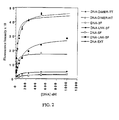
- DNA-DIMER-HT had the lowest K d (0.5 nM), an order of magnitude better than the best monomeric form (DNA-3F).
- Fig. 1 The binding of DNA-LNK-3F and DNA-3F to HNE coated polystyrene beads detected by flow cytometric analysis is shown in Fig. 1 .
- the addition of either ligand generated a clear change in signal (panels II and III) analogous to the addition of an anti-HNE antibody (panel IV).
- the fluorescence intensity differs between the two constructs; the signal produced by DNA-LNK-3F upon binding to HNE on beads is higher and in the same range as that of the antibody than the signal produced by DNA-3F.
- the only difference between these two constructs is the way in which fluorescein was linked.
- the construct that produced the signal intensity comparable to that of the antibody had fluorescein attached through an ethylene glycol tether.
- Fig. 2 shows the intensities of fluorescence signals generated by different ligand constructs upon binding to HNE on beads plotted as a function of the ligand concentration. Based on this result, ligand constructs can be categorized into three groups; molecules that generate high, moderate and low signals. Constructs that gave high signal included a dimer (DNA-DIMER-TT) containing two fluorescein molecules and a monomer in which the fluorescein was attached near the 3' end by an ethylene glycol linker (DNA-LNK-3F). Monomeric forms in which fluorescein was directly attached either to the 5' (DNA-5F) or near the 3' end (DNA-3F) as well as DNA-EXT gave very poor signal in flow cytometry.
- DNA-DIMER-TT dimer
- DNA-LNK-3F ethylene glycol linker
- the two K d measurements for ligand binding to HNE in solution and on beads were obtained by two different techniques. To determine whether the discrepancy is due to the two experimental approaches, the binding of two radiolabeled ligands (DNA-3F and DNA-LNK-3F) to HNE on beads was measured showing K d s of 140 and 300 nM, respectively. The K d s of these two ligands binding to HNE on beads measured by radioactivity were somewhat higher than those obtained by flow cytometry. The radioactivity measurement requires that the radioactivity retained by the total number of beads is measured as a function of the input DNA concentration. Thus, the measured value of radioactivity is very sensitive to the number of beads that survive after several washes.
- the K d s of ligand binding to HNE on beads were higher than those obtained by filter binding technique (Table 2 & 3).
- ligand binding site(s) on HNE should be well accessible since the protein is in solution.
- site(s) may not be fully available once the protein is coated onto a solid surface (beads) and this may explain high K d values observed for ligand binding to the protein presented on beads.
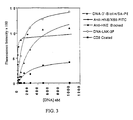
- the antibody binding data presented in Fig. 3 was obtained by two step staining proceedure, in which the HNE-bound anti-HNE antibody was stained with a fluorosceinated secondary antibody.
- the possibility of second step staining for oligonucleotide was investigated by using a biotinylated DNA ligand (biotin was attached to the 3' end through a linker) and streptavidin labeled with phycoerythrin (SA-PE).
- SA-PE phycoerythrin
- L-selectin is a protein that is expressed on the surface of most leukocytes, particularly neutrophils and naive lymphocytes, under various physiological conditions. Therefore, the ability to determine the presence of L-selectin on the surface of certain cell types is clinically useful. Flow cytometry can be used to make such a determination by the procedures outlined by Picker, et al. (J. Immunol. (1993) 150:1105-1121 ). A ssDNA ligand to L-selectin is used as the labelled nucleic acid ligand. The ssDNA ligand was identified as described in concurrently filed patent application entitled "High Affinity Nucleic Acid Ligands to Lectins,".
- the ssDNA ligand was termed #227 and had the following sequence: 5'CTACCTACGATCTGACTAGCCGGACATGAGCGTTACAAGGTGCTAAA C GTAACGTACTTGCTTACTCTCATGTAGTTCC-3' (SEQ ID NO: 9).
- the nucleic acid ligand was labelled and used in flow cytometry in place of an antibody as described by Picker et al., supra or as described in Example 1.
Landscapes
- Chemical & Material Sciences (AREA)
- Health & Medical Sciences (AREA)
- Life Sciences & Earth Sciences (AREA)
- Engineering & Computer Science (AREA)
- Organic Chemistry (AREA)
- Molecular Biology (AREA)
- Genetics & Genomics (AREA)
- Wood Science & Technology (AREA)
- Zoology (AREA)
- Immunology (AREA)
- General Health & Medical Sciences (AREA)
- Biotechnology (AREA)
- Biochemistry (AREA)
- Proteomics, Peptides & Aminoacids (AREA)
- Bioinformatics & Cheminformatics (AREA)
- General Engineering & Computer Science (AREA)
- Microbiology (AREA)
- Analytical Chemistry (AREA)
- Biophysics (AREA)
- Physics & Mathematics (AREA)
- Biomedical Technology (AREA)
- Medicinal Chemistry (AREA)
- Hematology (AREA)
- Virology (AREA)
- Urology & Nephrology (AREA)
- Pathology (AREA)
- Crystallography & Structural Chemistry (AREA)
- Pharmacology & Pharmacy (AREA)
- Food Science & Technology (AREA)
- Nanotechnology (AREA)
- General Physics & Mathematics (AREA)
- Plant Pathology (AREA)
- Cell Biology (AREA)
- Chemical Kinetics & Catalysis (AREA)
- Veterinary Medicine (AREA)
- AIDS & HIV (AREA)
- General Chemical & Material Sciences (AREA)
- Epidemiology (AREA)
- Animal Behavior & Ethology (AREA)
- Public Health (AREA)
Claims (21)
- Verfahren zur Detektion der Gegenwart eines Targetmoleküls in einer Probe, die das Targetmolekül enthalten kann, umfassend das Mischen der Probe mit einem Fluorophor-markierten Nucleinsäure-Aptamer, das an das Targetmolekül mit hoher Affinität und Spezifität bindet, sowie das Analysieren des Gemisches mittels Durchflusszytometrie, um zu bestimmen, ob das markierte Nucleinsäure-Aptamer an das Targetmolekül band, worin das Targetmolekül kein Polynucleotid ist.
- Verfahren nach Anspruch 1, worin das ungebundene Nucleinsäure-Aptamer aus dem Gemisch vor der Analyse mittels Durchflusszytometrie entfernt wird.
- Verfahren nach Anspruch 1, worin das Fluorophor des Fluorophor-markierten Nucleinsäure-Aptamers aus der aus Fluorescein, Rhodamin, Cy5-reaktivem Farbstoff, Cy3-reaktivem Farbstoff, Allophycocyanin, Peridininchlorophyll-a-Protein (PerCP), Phycoerythrin und grünem Fluoresceinprotein (GFP) bestehenden Gruppe ausgewählt ist.
- Verfahren nach Anspruch 1, worin die Probe eine biologische Flüssigkeit ist.
- Verfahren nach Anspruch 1, worin die Probe Zellen umfasst.
- Verfahren nach Anspruch 4, worin die Probe aus der aus Blut, Plasma, Serum, Sputum, Urin, Samen, Zerebrospinalflüssigkeit, bronchialem Aspirat und mazeriertem Gewebe bestehenden Gruppe ausgewählt ist.
- Verfahren nach Anspruch 6, worin die Probe aus der aus Blut, Plasma, Serum und mazeriertem Gewebe bestehenden Gruppe ausgewählt ist.
- Verfahren nach Anspruch 1, worin das Targetmolekül auf der Oberfläche einer Zelle vorliegt.
- Verfahren nach Anspruch 1, worin das Targetmolekül intrazellulär ist.
- Verfahren nach Anspruch 9, worin das Targetmolekül zytoplasmatisch ist.
- Verfahren nach einem der Ansprüche 1 bis 8, worin das Targetmolekül ein Zelloberflächenprotein ist.
- Verfahren nach einem der Ansprüche 1 bis 7, 9 oder 10, worin das Targetmolekül ein intrazelluläres Protein ist.
- Verfahren zur Detektion der Gegenwart eines Targetmoleküls in einer Probe, die das Targetmolekül enthalten kann, worin das Targetmolekül kein Polynucleotid ist, wobei das Verfahren Folgendes umfasst:a) das Identifizieren eines Nucleinsäure-Aptamers aus einem Kandidatengemisch aus Nucleinsäuren, wobei das Nucleinsäure-Aptamer ein Ligand des Targetmoleküls ist, der an das Targetmolekül mit hoher Affinität und Spezifität bindet, und zwar durch das Verfahren, das Folgendes umfasst:i) das Kontaktieren des Kandidatengemisches mit dem Targetmolekül, worin Nucleinsäuren mit einer erhöhten Affinität zu dem Target im Vergleich zu dem Kandidatengemisch von dem Rest des Kandidatengemisches getrennt werden können;ii) das Trennen der Nucleinsäuren mit erhöhter Affinität vom Rest des Kandidatengemisches;iii) das Amplifizieren der Nucleinsäuren mit erhöhter Affinität, um ein Ligandenangereichertes Gemisch an Nucleinsäuren zu ergeben; undiv) das Identifizieren des Nucleinsäure-Aptamers, das an das Targetmolekül mit hoher Affinität und Spezifität bindet;b) das Assoziieren des Nucleinsäure-Aptamers mit einem Fluorophor, um ein markiertes Nucleinsäure-Aptamer zu bilden;c) das Mischen des markierten Nucleinsäure-Aptamers mit einer Probe, die das Target-Molekül enthalten kann, so dass das Nucleinsäure-Aptamer an das Target-Molekül bindet; sowied) das Analysieren des Gemisches mittels Durchflusszytometrie, um zu bestimmen, ob das markierte Nucleinsäure-Aptamer an das Targetmolekül band.
- Verfahren nach Anspruch 13, worin ungebundenes Nucleinsäure-Aptamer zwischen den Schritten c) und d) aus dem Gemisch entfernt wird.
- Verfahren nach einem der Ansprüche 13 oder 14, worin das Targetmolekül ein Zelloberflächenmolekül ist.
- Verfahren nach einem der Ansprüche 13 oder 14, worin das Targetmolekül ein intrazelluläres Protein ist.
- Verfahren zur Detektion der Gegenwart eines löslichen Targetmoleküls in einer Probe, die das Target-Molekül enthalten kann, mittels Durchflusszytometrie, umfassend:a) das Immobilisieren eines Einfangmoleküls auf einem Partikel-Feststoffträger, der das Targetmolekül bindet;b) das Exponieren einer Probe, die das Targetmolekül enthalten kann, gegenüber dem Einfangmolekül;c) das Hinzufügen eines Fluorophor-markierten Detektormoleküls, das an das Targetmolekül bindet, zu dem Einfangmolekül:Targetmolekül-Komplex; sowied) das Detektieren des Einfangmolekül:Targetmolekül:Detektormolekül-Komplexes mittels Durchflusszytometrie; worin das Einfangmolekül, das Detektormolekül oder beide ein Nucleinsäure-Aptamer zu dem Target-Molekül sind, das an das Target-Molekül mit hoher Affinität und Spezifität bindet, und worin das Targetmolekül kein Polynucleotid ist.
- Verfahren nach Anspruch 17, worin der Partikel-Feststoffträger eine Perle ist.
- Verfahren nach Anspruch 17, worin die Schritte b) und c) gleichzeitig ausgeführt werden.
- Verfahren nach einem der Ansprüche 17 bis 19, worin das Targetmolekül ein Zelloberflächenprotein ist.
- Verfahren nach einem der Ansprüche 17 bis 19, worin das Targetmolekül ein intrazelluläres Protein ist.
Applications Claiming Priority (3)
| Application Number | Priority Date | Filing Date | Title |
|---|---|---|---|
| US479729 | 1995-06-07 | ||
| US08/479,729 US5853984A (en) | 1990-06-11 | 1995-06-07 | Use of nucleic acid ligands in flow cytometry |
| PCT/US1996/008089 WO1996041019A1 (en) | 1995-06-07 | 1996-05-30 | Use of nucleic acid ligands in flow cytometry |
Publications (3)
| Publication Number | Publication Date |
|---|---|
| EP0832299A1 EP0832299A1 (de) | 1998-04-01 |
| EP0832299A4 EP0832299A4 (de) | 2004-10-06 |
| EP0832299B1 true EP0832299B1 (de) | 2010-05-05 |
Family
ID=23905182
Family Applications (1)
| Application Number | Title | Priority Date | Filing Date |
|---|---|---|---|
| EP96919017A Expired - Lifetime EP0832299B1 (de) | 1995-06-07 | 1996-05-30 | Verwendung von nukleinsäureliganden in der durchflusszytometrie |
Country Status (6)
| Country | Link |
|---|---|
| US (1) | US5853984A (de) |
| EP (1) | EP0832299B1 (de) |
| AT (1) | ATE466960T1 (de) |
| AU (1) | AU6147096A (de) |
| DE (1) | DE69638183D1 (de) |
| WO (1) | WO1996041019A1 (de) |
Families Citing this family (83)
| Publication number | Priority date | Publication date | Assignee | Title |
|---|---|---|---|---|
| US20020077306A1 (en) * | 1994-07-14 | 2002-06-20 | Ludger Dinkelborg | Conjugates made of metal complexes and oligonucleotides, agents containing the conjugates, their use in radiodiagnosis as well as process for their production |
| US6449562B1 (en) | 1996-10-10 | 2002-09-10 | Luminex Corporation | Multiplexed analysis of clinical specimens apparatus and method |
| US6605429B1 (en) | 1997-01-23 | 2003-08-12 | Immusol, Incorporated | Gene functional analysis and discovery using randomized or target-specific ribozyme gene vector libraries |
| US20020015997A1 (en) * | 1997-06-16 | 2002-02-07 | Lafferty William Michael | Capillary array-based sample screening |
| US20030013115A1 (en) * | 1997-06-16 | 2003-01-16 | Diversa Corporation, A Delaware Corporation | Capillary array-based sample screening |
| DE19741084A1 (de) * | 1997-09-18 | 1999-03-25 | Knoell Hans Forschung Ev | Hochaffine Nukleinsäuremoleküle mit funktionellen Gruppen zur spezifischen Erkennung von Zielmolekülen, ihre Herstellung und Verwendung |
| US20070166741A1 (en) | 1998-12-14 | 2007-07-19 | Somalogic, Incorporated | Multiplexed analyses of test samples |
| US20060057573A1 (en) | 2002-02-15 | 2006-03-16 | Somalogic, Inc | Methods and reagents for detecting target binding by nucleic acid ligands |
| US6242246B1 (en) * | 1997-12-15 | 2001-06-05 | Somalogic, Inc. | Nucleic acid ligand diagnostic Biochip |
| AU2322099A (en) * | 1998-01-16 | 1999-08-02 | Luminex Corporation | Multiplexed analysis of clinical specimens apparatus and methods |
| DE19829495A1 (de) * | 1998-07-02 | 2000-01-05 | Jacques Paysan | Reagenzien und deren Anwendung zur Untersuchung von Wechselwirkungen zwischen zellulären Molekülen und deren Lokalisation in Zellen |
| US6100035A (en) | 1998-07-14 | 2000-08-08 | Cistem Molecular Corporation | Method of identifying cis acting nucleic acid elements |
| US20040259079A1 (en) * | 1998-07-22 | 2004-12-23 | Immusol, Inc. | Substantially complete ribozyme libraries |
| US6867289B1 (en) * | 1998-10-26 | 2005-03-15 | Board Of Regents, The University Of Texas Systems | Thio-modified aptamer synthetic methods and compositions |
| US20040242521A1 (en) * | 1999-10-25 | 2004-12-02 | Board Of Regents, The University Of Texas System | Thio-siRNA aptamers |
| US20060172925A1 (en) * | 1998-10-26 | 2006-08-03 | Board Of Regents, The University Of Texas System | Thio-siRNA aptamers |
| AU1429401A (en) | 1999-07-02 | 2001-02-05 | Conceptual Mindworks, Inc. | Organic semiconductor recognition complex and system |
| US6635430B1 (en) * | 1999-07-16 | 2003-10-21 | Dupont Pharmaceuticals Company | Filtrate plate device and reversible-well plate device |
| US20020037506A1 (en) * | 2000-04-18 | 2002-03-28 | Yun Lin | Aptamer based two-site binding assay |
| US20030207271A1 (en) * | 2000-06-30 | 2003-11-06 | Holwitt Eric A. | Methods and compositions for biological sensors |
| WO2002006827A1 (en) * | 2000-07-05 | 2002-01-24 | The General Hospital Corporation | Compounds and methods for fluorescently labeling nucleic acids |
| US7465540B2 (en) * | 2000-09-21 | 2008-12-16 | Luminex Corporation | Multiple reporter read-out for bioassays |
| IL150020A0 (en) * | 2000-10-10 | 2002-12-01 | Diversa Corp | High throughput or capillary-based screening for a bioactivity or biomolecule |
| CA2436448A1 (en) * | 2001-02-02 | 2002-08-15 | Dana-Farber Cancer Institute, Inc. | Rare event detection system |
| EP2070939B1 (de) | 2001-05-25 | 2014-04-02 | Duke University | Modulatoren von pharmakologischen Wirkstoffen |
| US20030162190A1 (en) * | 2001-11-15 | 2003-08-28 | Gorenstein David G. | Phosphoromonothioate and phosphorodithioate oligonucleotide aptamer chip for functional proteomics |
| US6916247B2 (en) * | 2001-11-23 | 2005-07-12 | Cyberscan Technology, Inc. | Modular entertainment and gaming systems |
| WO2003070190A2 (en) * | 2002-02-19 | 2003-08-28 | Syntherica Corporation | Surrogate antibodies and methods of preparation and use thereof |
| WO2004016586A2 (en) | 2002-08-16 | 2004-02-26 | Board Of Regents The University Of Texas System | Compositions and methods related to flavivirus envelope protein domain iii antigens |
| CA2749227A1 (en) * | 2002-10-16 | 2005-01-13 | Board Of Regents Of The University Of Texas System | Bead bound combinatorial oligonucleoside phosphorothioate and phosphorodithioate aptamer libraries |
| JP2006518469A (ja) * | 2003-02-19 | 2006-08-10 | シンセリカ・コーポレイション | 代替抗体の集合を用いてスクリーニングするための組成物及び方法 |
| EP1635693A2 (de) * | 2003-05-23 | 2006-03-22 | Board Of Regents, The University Of Texas System | Screening mit hohem durchsatz von aptamer-bibliotheken für die spezifische bindung an proteine auf viren und anderen erregern |
| CA2526690C (en) | 2003-05-23 | 2014-01-14 | Board Of Regents The University Of Texas System | Structure based and combinatorially selected oligonucleoside phosphorothioate and phosphorodithioate aptamer targeting ap-1 transcription factors |
| US7727969B2 (en) | 2003-06-06 | 2010-06-01 | Massachusetts Institute Of Technology | Controlled release nanoparticle having bound oligonucleotide for targeted delivery |
| EP1648909A4 (de) * | 2003-07-24 | 2008-11-12 | Univ Texas | Thioaptamere, die die entdeckung von physiologischen pfaden und neue therapeutische strategien ermöglichen |
| US20050048498A1 (en) * | 2003-08-29 | 2005-03-03 | Applera Corporation | Compositions, methods, and kits for assembling probes |
| US20050069895A1 (en) * | 2003-08-29 | 2005-03-31 | Applera Corporation | Compositions, methods, and kits for fabricating coded molecular tags |
| US7198900B2 (en) * | 2003-08-29 | 2007-04-03 | Applera Corporation | Multiplex detection compositions, methods, and kits |
| CA2545006C (en) * | 2003-12-12 | 2013-09-17 | Saint Louis University | Biosensors for detecting macromolecules and other analytes |
| US9492400B2 (en) | 2004-11-04 | 2016-11-15 | Massachusetts Institute Of Technology | Coated controlled release polymer particles as efficient oral delivery vehicles for biopharmaceuticals |
| WO2006125094A2 (en) * | 2005-05-18 | 2006-11-23 | Board Of Regents, The University Of Texas System | Combinatorial selection of phosphorothioate aptamers for rnases |
| US8956857B2 (en) | 2005-06-06 | 2015-02-17 | Mediomics, Llc | Three-component biosensors for detecting macromolecules and other analytes |
| US7795009B2 (en) * | 2005-06-15 | 2010-09-14 | Saint Louis University | Three-component biosensors for detecting macromolecules and other analytes |
| CA2611198C (en) * | 2005-06-10 | 2015-04-28 | Saint Louis University | Methods for the selection of aptamers |
| US7811809B2 (en) * | 2005-06-15 | 2010-10-12 | Saint Louis University | Molecular biosensors for use in competition assays |
| US20060292576A1 (en) * | 2005-06-23 | 2006-12-28 | Quest Diagnostics Investments Incorporated | Non-in situ hybridization method for detecting chromosomal abnormalities |
| WO2007070682A2 (en) | 2005-12-15 | 2007-06-21 | Massachusetts Institute Of Technology | System for screening particles |
| CA2648099C (en) | 2006-03-31 | 2012-05-29 | The Brigham And Women's Hospital, Inc | System for targeted delivery of therapeutic agents |
| EP2019691B1 (de) | 2006-05-15 | 2020-08-12 | Massachusetts Institute of Technology | Polymere für funktionelle partikel |
| US9381477B2 (en) | 2006-06-23 | 2016-07-05 | Massachusetts Institute Of Technology | Microfluidic synthesis of organic nanoparticles |
| US20110136099A1 (en) | 2007-01-16 | 2011-06-09 | Somalogic, Inc. | Multiplexed Analyses of Test Samples |
| US7855054B2 (en) | 2007-01-16 | 2010-12-21 | Somalogic, Inc. | Multiplexed analyses of test samples |
| EP2134830A2 (de) | 2007-02-09 | 2009-12-23 | Massachusetts Institute of Technology | Oszillations-zellkultur-bioreaktor |
| WO2008124632A1 (en) | 2007-04-04 | 2008-10-16 | Massachusetts Institute Of Technology | Amphiphilic compound assisted nanoparticles for targeted delivery |
| WO2008124634A1 (en) | 2007-04-04 | 2008-10-16 | Massachusetts Institute Of Technology | Polymer-encapsulated reverse micelles |
| DK2172566T4 (da) | 2007-07-17 | 2022-06-13 | Somalogic Inc | Fremgangsmåde til generering af aptamerer med forbedrede off-rates |
| CA2917512C (en) | 2007-10-12 | 2025-08-05 | President And Fellows Of Harvard College | VACCINE NANOTECHNOLOGY |
| US8906700B2 (en) | 2007-11-06 | 2014-12-09 | Ambergen, Inc. | Methods and compositions for phototransfer |
| US8093063B2 (en) * | 2007-11-29 | 2012-01-10 | Quest Diagnostics Investments Incorporated | Assay for detecting genetic abnormalities in genomic nucleic acids |
| US8343498B2 (en) | 2008-10-12 | 2013-01-01 | Massachusetts Institute Of Technology | Adjuvant incorporation in immunonanotherapeutics |
| US8343497B2 (en) | 2008-10-12 | 2013-01-01 | The Brigham And Women's Hospital, Inc. | Targeting of antigen presenting cells with immunonanotherapeutics |
| US8591905B2 (en) | 2008-10-12 | 2013-11-26 | The Brigham And Women's Hospital, Inc. | Nicotine immunonanotherapeutics |
| US8277812B2 (en) | 2008-10-12 | 2012-10-02 | Massachusetts Institute Of Technology | Immunonanotherapeutics that provide IgG humoral response without T-cell antigen |
| CA2744003C (en) | 2008-11-21 | 2016-03-15 | Mediomics Llc | Biosensor for detecting multiple epitopes on a target |
| US8236570B2 (en) | 2009-11-03 | 2012-08-07 | Infoscitex | Methods for identifying nucleic acid ligands |
| US8841429B2 (en) | 2009-11-03 | 2014-09-23 | Vivonics, Inc. | Nucleic acid ligands against infectious prions |
| WO2011100561A1 (en) | 2010-02-12 | 2011-08-18 | Saint Louis University | Molecular biosensors capable of signal amplification |
| US9058905B2 (en) | 2012-04-06 | 2015-06-16 | Ihi Southwest Technologies | Automated inside reactor inspection system |
| CN103566377A (zh) | 2012-07-18 | 2014-02-12 | 上海博笛生物科技有限公司 | 癌症的靶向免疫治疗 |
| KR20150090072A (ko) | 2012-10-23 | 2015-08-05 | 카리스 라이프 사이언스 스위스 홀딩스 게엠베하 | 압타머 및 이의 용도 |
| US10942184B2 (en) | 2012-10-23 | 2021-03-09 | Caris Science, Inc. | Aptamers and uses thereof |
| EP2935628B1 (de) | 2012-12-19 | 2018-03-21 | Caris Life Sciences Switzerland Holdings GmbH | Zusammensetzungen und verfahren für aptamer-screening |
| WO2015073848A1 (en) | 2013-11-14 | 2015-05-21 | Shehadeh Lina A | Methods and compositions employing an osteopontin aptamer to deliver nucleic acids into smooth muscle, endothelial, cardiac and progenitor/stem cells |
| EP3092255A4 (de) | 2014-01-10 | 2017-09-20 | Birdie Biopharmaceuticals Inc. | Verbindungen und zusammensetzungen zur behandlung egfr-exprimierender tumoren |
| EP3143158A1 (de) * | 2014-05-14 | 2017-03-22 | Stratos Genomics, Inc. | Translokationssteuerung zur messung einer nanopore |
| CA2954446A1 (en) | 2014-07-09 | 2016-01-14 | Shanghai Birdie Biotech, Inc. | Anti-pd-l1 combinations for treating tumors |
| CN112546230A (zh) | 2014-07-09 | 2021-03-26 | 博笛生物科技有限公司 | 用于治疗癌症的联合治疗组合物和联合治疗方法 |
| CN112546238A (zh) | 2014-09-01 | 2021-03-26 | 博笛生物科技有限公司 | 用于治疗肿瘤的抗-pd-l1结合物 |
| US10274484B2 (en) | 2014-09-12 | 2019-04-30 | Mediomics Llc | Molecular biosensors with a modular design |
| CN107613980A (zh) | 2015-05-31 | 2018-01-19 | 源生公司 | 用于免疫疗法的组合组合物 |
| CN110049763A (zh) | 2016-10-14 | 2019-07-23 | Cns生物科学股份有限公司 | 治疗脊髓损伤个体的神经性疼痛的方法 |
| EP3332812A1 (de) | 2016-12-07 | 2018-06-13 | Rheinische Friedrich-Wilhelms-Universität Bonn | Nukleinsäurebasierte anordnung und verwendung der anordnung in der krebstherapie |
| TW202214869A (zh) | 2020-08-18 | 2022-04-16 | 西班牙商雷勁那賽克斯公司 | 用於檢測 sars-cov-2 刺突蛋白之組合物及方法 |
Family Cites Families (11)
| Publication number | Priority date | Publication date | Assignee | Title |
|---|---|---|---|---|
| US4599307A (en) * | 1983-07-18 | 1986-07-08 | Becton, Dickinson And Company | Method for elimination of selected cell populations in analytic cytology |
| US4727020A (en) * | 1985-02-25 | 1988-02-23 | Becton, Dickinson And Company | Method for analysis of subpopulations of blood cells |
| DE3546807C2 (de) * | 1985-03-30 | 1991-03-28 | Marc Genf/Geneve Ch Ballivet | |
| US4704891A (en) * | 1986-08-29 | 1987-11-10 | Becton, Dickinson And Company | Method and materials for calibrating flow cytometers and other analysis instruments |
| WO1989006694A1 (en) * | 1988-01-15 | 1989-07-27 | Trustees Of The University Of Pennsylvania | Process for selection of proteinaceous substances which mimic growth-inducing molecules |
| US5270163A (en) * | 1990-06-11 | 1993-12-14 | University Research Corporation | Methods for identifying nucleic acid ligands |
| WO1992014843A1 (en) * | 1991-02-21 | 1992-09-03 | Gilead Sciences, Inc. | Aptamer specific for biomolecules and method of making |
| AU2580892A (en) * | 1991-09-05 | 1993-04-05 | Isis Pharmaceuticals, Inc. | Determination of oligonucleotides for therapeutics, diagnostics and research reagents |
| US6172208B1 (en) * | 1992-07-06 | 2001-01-09 | Genzyme Corporation | Oligonucleotides modified with conjugate groups |
| PT668931E (pt) * | 1992-09-29 | 2006-05-31 | Gilead Sciences Inc | Ligandos de acidos nucleicos e metodos para producao dos mesmos |
| US20170110787A1 (en) | 2015-10-14 | 2017-04-20 | Apple Inc. | Electronic Devices With Millimeter Wave Antennas And Metal Housings |
-
1995
- 1995-06-07 US US08/479,729 patent/US5853984A/en not_active Expired - Lifetime
-
1996
- 1996-05-30 AU AU61470/96A patent/AU6147096A/en not_active Abandoned
- 1996-05-30 WO PCT/US1996/008089 patent/WO1996041019A1/en not_active Ceased
- 1996-05-30 AT AT96919017T patent/ATE466960T1/de not_active IP Right Cessation
- 1996-05-30 EP EP96919017A patent/EP0832299B1/de not_active Expired - Lifetime
- 1996-05-30 DE DE69638183T patent/DE69638183D1/de not_active Expired - Lifetime
Also Published As
| Publication number | Publication date |
|---|---|
| AU6147096A (en) | 1996-12-30 |
| DE69638183D1 (de) | 2010-06-17 |
| ATE466960T1 (de) | 2010-05-15 |
| WO1996041019A1 (en) | 1996-12-19 |
| EP0832299A4 (de) | 2004-10-06 |
| EP0832299A1 (de) | 1998-04-01 |
| US5853984A (en) | 1998-12-29 |
Similar Documents
| Publication | Publication Date | Title |
|---|---|---|
| US5853984A (en) | Use of nucleic acid ligands in flow cytometry | |
| Jayasena | Aptamers: an emerging class of molecules that rival antibodies in diagnostics | |
| US4824775A (en) | Cells labeled with multiple Fluorophores bound to a nucleic acid carrier | |
| Li et al. | Single‐step procedure for labeling DNA strand breaks with fluorescein‐or BODIPY‐conjugated deoxynucleotides: detection of apoptosis and bromodeoxyuridine incorporation | |
| Davis et al. | Use of a high affinity DNA ligand in flow cytometry | |
| KR101623992B1 (ko) | 개선된 fret-프로브 및 이의 용도 | |
| EP0779934B1 (de) | Zusammensetzungen und verfahren zur anewndung in nachweis von analyten | |
| US5731153A (en) | Identification of random nucleic acid sequence aberrations using dual capture probes which hybridize to different chromosome regions | |
| AU773402B2 (en) | Aptamers as reagents for high throughput screening | |
| US9134302B2 (en) | Analyte detection utilizing polynucleotide sequences, composition, process and kit | |
| US5641629A (en) | Spectroscopically detectable nucleic acid ligands | |
| US5650275A (en) | Target detection method using spectroscopically detectable nucleic acid ligands | |
| CA2250525A1 (en) | Method for detecting a target compound using a nucleic acid ligand | |
| US20090042206A1 (en) | Multiplexed Analyses of Test Samples | |
| WO1998033941A1 (en) | Flow cell selex | |
| JP2007529994A (ja) | ヘアピン標識したプローブと使用方法 | |
| CA2262403A1 (en) | Biomarkers and targets for diagnosis, prognosis and management of prostate disease | |
| US4670380A (en) | Assays utilizing labeled nucleic acid probes | |
| US5545521A (en) | Method for detecting bioindividuals by use of nonnatural type nucleic acid probe | |
| US20030143598A1 (en) | Bioconjugate-nanoparticle probes | |
| JP2025510610A (ja) | 可溶性st2タンパク質を特異的に認識する核酸アプタマー及びその使用 | |
| US6270972B1 (en) | Kit for detecting nucleic acid sequences using competitive hybridization probes | |
| US5783387A (en) | Method for identifying and quantifying nucleic acid sequence aberrations | |
| AU726457C (en) | Method for detecting a target compound using a nucleic acid ligand | |
| US20080020382A1 (en) | Biological Microbeads for Various Flow Cytometric Applications |
Legal Events
| Date | Code | Title | Description |
|---|---|---|---|
| PUAI | Public reference made under article 153(3) epc to a published international application that has entered the european phase |
Free format text: ORIGINAL CODE: 0009012 |
|
| 17P | Request for examination filed |
Effective date: 19971203 |
|
| AK | Designated contracting states |
Kind code of ref document: A1 Designated state(s): AT BE CH DE DK ES FI FR GB GR IE IT LI LU MC NL PT SE |
|
| RAP1 | Party data changed (applicant data changed or rights of an application transferred) |
Owner name: NEXSTAR PHARMACEUTICALS, INC. |
|
| RAP1 | Party data changed (applicant data changed or rights of an application transferred) |
Owner name: GILEAD SCIENCES, INC. |
|
| A4 | Supplementary search report drawn up and despatched |
Effective date: 20040820 |
|
| RIC1 | Information provided on ipc code assigned before grant |
Ipc: 7C 12Q 1/68 B Ipc: 7C 12Q 1/70 A |
|
| GRAP | Despatch of communication of intention to grant a patent |
Free format text: ORIGINAL CODE: EPIDOSNIGR1 |
|
| GRAS | Grant fee paid |
Free format text: ORIGINAL CODE: EPIDOSNIGR3 |
|
| GRAA | (expected) grant |
Free format text: ORIGINAL CODE: 0009210 |
|
| AK | Designated contracting states |
Kind code of ref document: B1 Designated state(s): AT BE CH DE DK ES FI FR GB GR IE IT LI LU MC NL PT SE |
|
| REG | Reference to a national code |
Ref country code: GB Ref legal event code: FG4D |
|
| REG | Reference to a national code |
Ref country code: CH Ref legal event code: EP |
|
| REG | Reference to a national code |
Ref country code: IE Ref legal event code: FG4D |
|
| REF | Corresponds to: |
Ref document number: 69638183 Country of ref document: DE Date of ref document: 20100617 Kind code of ref document: P |
|
| REG | Reference to a national code |
Ref country code: NL Ref legal event code: VDEP Effective date: 20100505 |
|
| PG25 | Lapsed in a contracting state [announced via postgrant information from national office to epo] |
Ref country code: SE Free format text: LAPSE BECAUSE OF FAILURE TO SUBMIT A TRANSLATION OF THE DESCRIPTION OR TO PAY THE FEE WITHIN THE PRESCRIBED TIME-LIMIT Effective date: 20100505 Ref country code: NL Free format text: LAPSE BECAUSE OF FAILURE TO SUBMIT A TRANSLATION OF THE DESCRIPTION OR TO PAY THE FEE WITHIN THE PRESCRIBED TIME-LIMIT Effective date: 20100505 Ref country code: ES Free format text: LAPSE BECAUSE OF FAILURE TO SUBMIT A TRANSLATION OF THE DESCRIPTION OR TO PAY THE FEE WITHIN THE PRESCRIBED TIME-LIMIT Effective date: 20100816 |
|
| PG25 | Lapsed in a contracting state [announced via postgrant information from national office to epo] |
Ref country code: FI Free format text: LAPSE BECAUSE OF FAILURE TO SUBMIT A TRANSLATION OF THE DESCRIPTION OR TO PAY THE FEE WITHIN THE PRESCRIBED TIME-LIMIT Effective date: 20100505 Ref country code: AT Free format text: LAPSE BECAUSE OF FAILURE TO SUBMIT A TRANSLATION OF THE DESCRIPTION OR TO PAY THE FEE WITHIN THE PRESCRIBED TIME-LIMIT Effective date: 20100505 |
|
| PG25 | Lapsed in a contracting state [announced via postgrant information from national office to epo] |
Ref country code: MC Free format text: LAPSE BECAUSE OF NON-PAYMENT OF DUE FEES Effective date: 20100531 |
|
| PG25 | Lapsed in a contracting state [announced via postgrant information from national office to epo] |
Ref country code: PT Free format text: LAPSE BECAUSE OF FAILURE TO SUBMIT A TRANSLATION OF THE DESCRIPTION OR TO PAY THE FEE WITHIN THE PRESCRIBED TIME-LIMIT Effective date: 20100906 Ref country code: DK Free format text: LAPSE BECAUSE OF FAILURE TO SUBMIT A TRANSLATION OF THE DESCRIPTION OR TO PAY THE FEE WITHIN THE PRESCRIBED TIME-LIMIT Effective date: 20100505 |
|
| PG25 | Lapsed in a contracting state [announced via postgrant information from national office to epo] |
Ref country code: BE Free format text: LAPSE BECAUSE OF FAILURE TO SUBMIT A TRANSLATION OF THE DESCRIPTION OR TO PAY THE FEE WITHIN THE PRESCRIBED TIME-LIMIT Effective date: 20100505 |
|
| PLBE | No opposition filed within time limit |
Free format text: ORIGINAL CODE: 0009261 |
|
| STAA | Information on the status of an ep patent application or granted ep patent |
Free format text: STATUS: NO OPPOSITION FILED WITHIN TIME LIMIT |
|
| PG25 | Lapsed in a contracting state [announced via postgrant information from national office to epo] |
Ref country code: IT Free format text: LAPSE BECAUSE OF FAILURE TO SUBMIT A TRANSLATION OF THE DESCRIPTION OR TO PAY THE FEE WITHIN THE PRESCRIBED TIME-LIMIT Effective date: 20100505 |
|
| 26N | No opposition filed |
Effective date: 20110208 |
|
| PG25 | Lapsed in a contracting state [announced via postgrant information from national office to epo] |
Ref country code: IE Free format text: LAPSE BECAUSE OF NON-PAYMENT OF DUE FEES Effective date: 20100530 |
|
| REG | Reference to a national code |
Ref country code: DE Ref legal event code: R097 Ref document number: 69638183 Country of ref document: DE Effective date: 20110207 |
|
| PG25 | Lapsed in a contracting state [announced via postgrant information from national office to epo] |
Ref country code: GR Free format text: LAPSE BECAUSE OF FAILURE TO SUBMIT A TRANSLATION OF THE DESCRIPTION OR TO PAY THE FEE WITHIN THE PRESCRIBED TIME-LIMIT Effective date: 20100806 |
|
| PG25 | Lapsed in a contracting state [announced via postgrant information from national office to epo] |
Ref country code: LU Free format text: LAPSE BECAUSE OF NON-PAYMENT OF DUE FEES Effective date: 20100530 |
|
| REG | Reference to a national code |
Ref country code: FR Ref legal event code: PLFP Year of fee payment: 20 |
|
| PGFP | Annual fee paid to national office [announced via postgrant information from national office to epo] |
Ref country code: GB Payment date: 20150527 Year of fee payment: 20 Ref country code: DE Payment date: 20150528 Year of fee payment: 20 Ref country code: CH Payment date: 20150527 Year of fee payment: 20 |
|
| PGFP | Annual fee paid to national office [announced via postgrant information from national office to epo] |
Ref country code: FR Payment date: 20150519 Year of fee payment: 20 |
|
| REG | Reference to a national code |
Ref country code: DE Ref legal event code: R071 Ref document number: 69638183 Country of ref document: DE |
|
| REG | Reference to a national code |
Ref country code: CH Ref legal event code: PL |
|
| REG | Reference to a national code |
Ref country code: GB Ref legal event code: PE20 Expiry date: 20160529 |
|
| PG25 | Lapsed in a contracting state [announced via postgrant information from national office to epo] |
Ref country code: GB Free format text: LAPSE BECAUSE OF EXPIRATION OF PROTECTION Effective date: 20160529 |