EP0832969A2 - Katalytisch aktive Wirkstoffkombination zur Verstärkung der Bleichwirkung - Google Patents
Katalytisch aktive Wirkstoffkombination zur Verstärkung der Bleichwirkung Download PDFInfo
- Publication number
- EP0832969A2 EP0832969A2 EP97116145A EP97116145A EP0832969A2 EP 0832969 A2 EP0832969 A2 EP 0832969A2 EP 97116145 A EP97116145 A EP 97116145A EP 97116145 A EP97116145 A EP 97116145A EP 0832969 A2 EP0832969 A2 EP 0832969A2
- Authority
- EP
- European Patent Office
- Prior art keywords
- weight
- active ingredient
- ingredient combination
- parts
- bleach
- Prior art date
- Legal status (The legal status is an assumption and is not a legal conclusion. Google has not performed a legal analysis and makes no representation as to the accuracy of the status listed.)
- Granted
Links
Classifications
-
- C—CHEMISTRY; METALLURGY
- C11—ANIMAL OR VEGETABLE OILS, FATS, FATTY SUBSTANCES OR WAXES; FATTY ACIDS THEREFROM; DETERGENTS; CANDLES
- C11D—DETERGENT COMPOSITIONS; USE OF SINGLE SUBSTANCES AS DETERGENTS; SOAP OR SOAP-MAKING; RESIN SOAPS; RECOVERY OF GLYCEROL
- C11D3/00—Other compounding ingredients of detergent compositions covered in group C11D1/00
- C11D3/39—Organic or inorganic per-compounds
- C11D3/3902—Organic or inorganic per-compounds combined with specific additives
- C11D3/3905—Bleach activators or bleach catalysts
- C11D3/3932—Inorganic compounds or complexes
Definitions
- the present invention relates to a bleach-enhancing active ingredient combination, the one Transition metal salt, an ammonium salt and an oxidizing agent contains a method to produce such a combination of active ingredients, the use of such Combination of active ingredients to enhance the bleaching effect of, in particular, inorganic Peroxygen compounds, especially when bleaching colored ones Soiling on hard surfaces, and detergents for hard surfaces contain such a combination of active ingredients.
- Inorganic peroxygen compounds especially hydrogen peroxide and solid peroxygen compounds, which dissolve in water to release hydrogen peroxide, such as sodium perborate and sodium carbonate perhydrate, have long been used as oxidizing agents for disinfection and bleaching purposes.
- the oxidizing effect of these substances in dilute solutions depends strongly on the temperature; For example, with H 2 O 2 or perborate in alkaline bleaching liquors, sufficiently quick bleaching of soiled textiles can only be achieved at temperatures above about 80 ° C.
- the oxidation effect of the inorganic peroxygen compounds can be improved by the addition of so-called bleach activators, for which numerous suggestions, especially from the substance classes of the N- or O-acyl compounds, for example multiply acylated alkylenediamines, in particular tetraacetylethylenediamine, acylated glycolurils, in particular tetraacetylglycoluril, N- acylated hydantoins, hydrazides, triazoles, Hydrotriazine, urazoles, diketopiperazines, sulfuryl amides and cyanurates, also carboxylic anhydrides, especially phthalic anhydride, Carbonklareester, especially sodium nonanoyloxybenzenesulfonate, sodium isononanoyloxybenzenesulfonate and acylated sugar derivatives, such as pentaacetylglucose, are known in the literature.
- the bleach activators for which numerous suggestions
- the present invention has the improvement of the oxidation and bleaching effect of inorganic Peroxygen bonds at low temperatures below 80 ° C, especially in the temperature range of approx. 15 ° C to 45 ° C.
- transition metal salts which as such in make a significant contribution to achieving this goal, a significant bleach-catalyzing
- a significant bleach-catalyzing Have an effect on stained soils that stick to hard surfaces are in the transition metal salts in the form of a combination of active ingredients additionally contains an ammonium salt and optionally an oxidizing agent.
- the object of the invention is an intimate mixture of the components, in particular bleach-strengthening active ingredient combination, prepared in particle form, that by intimately mixing a water-soluble salt of a divalent Transition metal, selected from cobalt, iron, copper and ruthenium, one water-soluble ammonium salt, in particular ammonium halide, sulfate, -carbonate, -hydrogen carbonate, -phosphate, -phosphonate, -nitrate, -perchlorate and / or -citrate belong, and optionally an oxidizing agent based on peroxygen as well inert, ie unreactive with any oxidizing agent present Carrier material, in particular alkali sulfate, alkali carbonate, alkali chloride, alkali silicate and mixtures thereof are available.
- a water-soluble salt of a divalent Transition metal selected from cobalt, iron, copper and ruthenium
- one water-soluble ammonium salt in particular ammonium hal
- the active ingredient combination preferably contains 0.01% by weight to 1% by weight, in particular 0.1 wt .-% to 0.5 wt .-%, transition metal from the transition metal salt.
- the ammonium salt content is preferably 0.5% by weight to 25% by weight, in particular 1 wt% to 10 wt%.
- the rest to 100 wt .-% can be made of inert Carrier material exist.
- Active ingredient combination 1% by weight to 20% by weight, in particular 2% by weight to 10% by weight Peroxygen based oxidizers included.
- the preferred divalent transition metal salts include cobalt (II) chloride, the can be used in anhydrous form or as hexahydrate, cobalt (II) sulfate, cobalt (II) carbonate and cobalt (II) acetate, alone or in admixtures.
- the transition metal is in the form of the active ingredient combination mentioned above used.
- this can be done by mixing in the usual way Mixers available mixing of the divalent transition metal salt with the be further components of the active ingredient combination.
- Mixing is preferred 1 part by weight of the divalent transition metal salt with 0.5 part by weight to 10 parts by weight, in particular 2 parts by weight to 7.5 parts by weight of ammonium salt, up to 20 parts by weight, in particular 2 parts by weight to 10 parts by weight of oxidizing agent Peroxygen base and 50 parts by weight to 150 parts by weight, especially 70 parts by weight up to 100 parts by weight of inert carrier material.
- Components of the combination of active ingredients also in powder form, including a build-up granulation, optionally using conventional granulation aids such as aqueous ones Alkali silicate solutions or solutions of salts of polymeric polycarboxylates, subject to facilitate the handling of the active ingredient combination.
- the nitrogen content (from the Ammonium salt), which is preferred based on the transition metal before the annealing is in the atomic ratio range from about 6: 1 to about 4: 1, and is after Annealing in the atomic ratio range from about 2: 1 to less than 3: 1.
- this procedure presumably forms polynuclear transition metal complexes in which ammonia, the anions of the ammonium salt and the anions of the carrier material salts assume the role of the ligands.
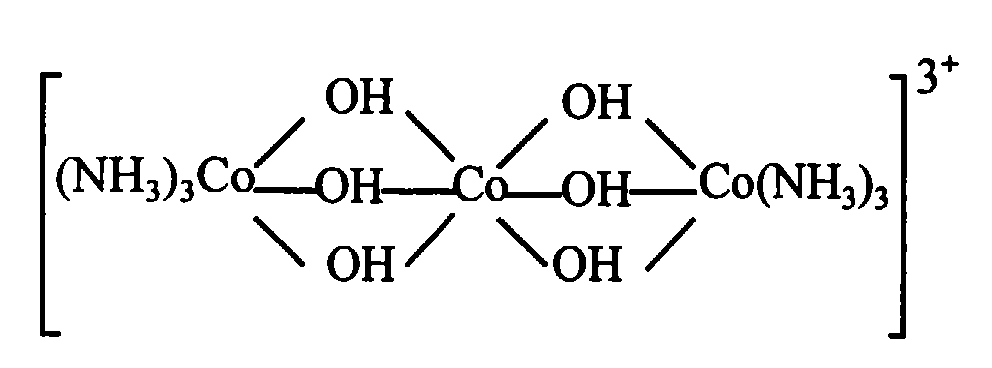
- Co (II) salts it is known that, particularly in the presence of peroxidic oxidizing agents, there are known to be significantly more stable Co (III) complexes, which in polymer form are multinuclear complexes, possibly of the type of the face-sharing trinuclear complex shown below by way of example are present, the replacement of at least individual bridging ⁇ -OH groups by bridging ⁇ -imino or ⁇ -amino groups and further linking to even higher-nucleus complexes is also conceivable.
- Such formation of polynuclear complexes presumably also takes place when the constituents are mixed intimately without subsequent tempering or when the non-tempered combination of active ingredients is used in the aqueous system.
- a bleach-enhancing active ingredient combination according to the invention is preferably used in Cleaning solutions for hard surfaces, especially for dishes, for bleaching colored stains used.
- the term bleaching is used here the bleaching of dirt on the hard surface, especially tea, as well as the bleaching of the dishwashing liquid from the hard Understand the surface of detached dirt.
- the invention further relates to cleaning agents for hard surfaces, in particular Detergents for dishes and preferably those for use in mechanical cleaning processes which contain an active ingredient combination described above, and a method for cleaning hard surfaces, in particular of Dishes using such a combination of active ingredients in aqueous, if appropriate solution containing further detergent components.
- the use according to the invention consists essentially in the presence of a hard surface contaminated with colored stains create, among which a peroxidic oxidizing agent and the bleaching enhancer Active ingredient combinations can react with each other, with the aim of being more oxidizing to obtain effective secondary products.
- a peroxidic oxidizing agent and the bleaching enhancer Active ingredient combinations can react with each other, with the aim of being more oxidizing to obtain effective secondary products.
- Such conditions exist in particular when both reactants meet in aqueous solution. This can be done by separate addition of the peroxygen compound and the active ingredient combination to one if necessary, detergent-containing solution.
- an inventive Cleaning agent for hard surfaces the combination of active ingredients and, if necessary contains an oxidant containing peroxygen.
- the active ingredient combination according to the invention is an oxidizing agent based on peroxygen.
- the peroxygen compound can also be used separately, in substance or as a preferably aqueous solution or suspension, added to the solution if a peroxide-free cleaning agent is used.
- the conditions can be varied widely depending on the intended use. So come in addition to purely aqueous solutions, also mixtures of water and suitable organic Solvents as a reaction medium in question.
- the quantities of peroxygen compounds used are generally chosen so that in the solutions between 10 ppm and 10% active oxygen, preferably between 50 ppm and 5,000 ppm Active oxygen is present.
- the amount of bleach enhancer used Active ingredient combination depends on the application. Depending on the desired level of activation the combination of active ingredients is used in such amounts that 0.00001 mol to 0.025 mol, preferably 0.0001 mol to 0.02 mol, of transition metal per Moles of peroxygen compound can be used, but in special cases this can Limits can also be exceeded or fallen short of.
- Another object of the invention is a cleaning agent for hard surfaces, especially for dishes which contain 0.25% by weight to 25% by weight, in particular 1% by weight up to 10 wt .-% of a bleach-enhancing active ingredient combination in addition to the usual, with the Active ingredient combination contains compatible ingredients.
- the cleaning agents according to the invention which are in powder or tablet form Solids, homogeneous solutions or suspensions can also exist
- active ingredient combination used according to the invention are all known and in Such agents contain common ingredients.
- the agents according to the invention can in particular builder substances, surface-active surfactants, peroxygen compounds, water-miscible organic solvents, enzymes, sequestering agents, electrolytes, pH regulators and other auxiliaries, such as silver corrosion inhibitors, foam regulators, contain additional peroxygen activators as well as colors and fragrances.
- a cleaning agent for hard surfaces according to the invention can also abrasive components, in particular from the group comprising quartz flours, Wood flours, plastic flours, chalks and micro glass balls and their mixtures, contain.
- Abrasives are preferred in the cleaning agents according to the invention do not contain more than 20% by weight, in particular from 5% by weight to 15% by weight.
- Another object of the invention is a means for machine cleaning Tableware containing 15% by weight to 60% by weight, in particular 20% by weight to 50% by weight water-soluble builder component, 5% by weight to 25% by weight, in particular 8% by weight up to 17% by weight of bleaching agent based on oxygen, in each case based on the total agent, which the bleach-activating active ingredient combination, in particular in amounts of 1 wt .-% to 10 wt .-%, the information on the amount of bleaching the any amount of oxidizing agent contained in the active ingredient combination lock in.
- Such an agent is particularly low alkaline, that is to say its 1% by weight Solution has a pH of 8 to 11.5, preferably 9 to 11.
- polymeric Alkali phosphates in the form of their alkaline neutral or acidic sodium or Potassium salts can be present.
- examples include tetrasodium diphosphate, Disodium dihydrogen diphosphate, pentasodium triphosphate, so-called Sodium hexametaphosphate and the corresponding potassium salts respectively Mixtures of sodium and potassium salts.
- Their quantities can range up to about 60% by weight, based on the total agent; however, it is possible that the Agents according to the invention are free from such phosphates.
- builder components are native or organic polymers synthetic origin, especially polycarboxylates, especially in hard water regions act as a co-builder.
- polyacrylic acids and Copolymers of maleic anhydride and acrylic acid and the sodium salts of these Polymer acids Commercial products include Sokalan® CP 5 and PA 30 from the company BASF.
- Polymers of native origin that can be used as co-builders include for example oxidized starch, such as from the international patent application WO 94/05762 known, and polyamino acids such as polyglutamic acid or Polyaspartic acid.
- the preferred builder components include Salts of citric acid, especially sodium citrate.
- sodium citrate come anhydrous Trisodium citrate and preferably trisodium citrate dihydrate. Trisodium citrate dihydrate can be used as a fine or coarse crystalline powder.
- the acids corresponding to the co-builder salts mentioned are also present.
- an oxygen-based bleach come primarily hydrogen peroxide as well Alkali perborate or tetrahydrate and / or alkali percarbonate into consideration, with sodium being the preferred alkali metal. Hydrogen peroxide can also with the help of an enzymatic system, i.e. an oxidase and its substrate, be generated.
- the use of sodium percarbonate has in particular Dishwashing detergent benefits as it is particularly beneficial on the Corrosion behavior affects glasses.
- the oxygen-based bleach is therefore preferably an alkali percarbonate, especially sodium percarbonate.
- known peroxycarboxylic acids for example Dodecanediperic acid or phthalimidopercarboxylic acids, optionally on aromatics may be substituted.
- the addition of small amounts known bleach stabilizers such as phosphonates, borates or metaborates and metasilicates as well as magnesium salts such as Magnesium sulfate may be useful.
- Bleach activators that is, compounds that operate under perhydrolysis conditions optionally substituted perbenzoic acid and / or peroxocarboxylic acids with 1 to 10 carbon atoms, in particular result in 2 to 4 carbon atoms. They are suitable usual bleach activators cited at the beginning, the O- and / or N-acyl groups of mentioned number of carbon atoms and / or optionally substituted benzoyl groups.
- Multi-acylated alkylenediamines are preferred (TAED), acylated glycolurils, especially tetraacetylglycoluril (TAGU), acylated triazine derivatives, especially 1,5-diacetyl-2,4-dioxohexahydro-1,3,5-triazine (DADHT), acylated phenyl sulfonates, especially nonanoyl or Isononanoyloxybenzenesulfonate, acylated polyhydric alcohols, especially triacetin, Ethylene glycol diacetate and 2,5-diacetoxy-2,5-dihydrofuran as well as acetylated sorbitol and Mannitol, and acylated sugar derivatives, in particular pentaacetyl glucose (PAG), pentaacetyl fructose, Tetraacetylxy
- PAG pentaacetyl glucose
- agents according to the invention in addition to the bleach-enhancing active ingredient combination 0.5% by weight to 6% by weight, in particular 2% by weight to 4% by weight of such under perhydrolysis conditions Peroxocarboxylic acid releasing compound present.
- the weight ratio of compound releasing peroxocarboxylic acid under perhydrolysis conditions Transition metal from the active ingredient combination is preferably in the range of 2000: 1 to 20: 1, in particular from 800: 1 to 100: 1.
- the machine dishwashing detergents according to the invention are preferably low-alkaline and contain the customary alkali carriers such as, for example, alkali silicates, alkali carbonates and / or alkali hydrogen carbonates.
- Alkali silicates can be used in amounts of up to 30% by weight. %, based on the total, may be included.
- the use of the highly alkaline metasilicates as alkali carriers is preferably avoided entirely.
- the alkali carrier system preferably used in the agents according to the invention is a mixture of carbonate and hydrogen carbonate, preferably sodium carbonate and hydrogen carbonate, which is contained in an amount of up to 60% by weight, preferably 10% by weight to 40% by weight .
- the ratio of carbonate and bicarbonate used varies, but an excess of sodium bicarbonate is usually used, so that the weight ratio between bicarbonate and carbonate is generally 1: 1 to 15: 1.
- agents according to the invention are 20% by weight to 40% by weight of water-soluble organic builder, in particular alkali citrate, 5% by weight to Contain 15 wt .-% alkali carbonate and 20 wt .-% to 40 wt .-% alkali disilicate.
- surfactants in particular weakly foaming nonionic surfactants, can also be added to the agents according to the invention, which serve to improve the detachment of greasy soils, as wetting agents and, if appropriate, as granulating aids in the production of the cleaning agents.
- Their amount can be up to 10% by weight, in particular up to 5% by weight, and is preferably in the range from 0.5% by weight to 3% by weight.
- Extremely low-foaming compounds are usually used in particular in cleaning agents for use in automatic dishwashing processes. These preferably include C 12 -C 18 alkyl polyethylene glycol polypropylene glycol ethers, each containing up to 8 moles of ethylene oxide and propylene oxide units in the molecule.
- C 12 -C 18 alkyl polyethylene glycol polybutylene glycol ether each with up to 8 moles of ethylene oxide and butylene oxide units in the molecule
- end-capped alkyl polyalkylene glycol mixed ethers and the foaming but ecologically active C 8 -C 14- alkyl polyglucosides with a degree of polymerization of about 1 to 4 (e.g. APG® 225 and APG® from Henkel) and / or C 12 -C 14 -alkyl polyethylene glycols with 3 to 8 ethylene oxide units in the molecule.
- surfactants from the family of glucamides such as, for example, alkyl-N-methyl-glucamides, in which the alkyl part preferably originates from a fatty alcohol with the C chain length C 6 -C 14 . It is partially advantageous if the surfactants described are used as mixtures, for example the combination of alkyl polyglycoside with fatty alcohol ethoxylates or glucamide with alkyl polyglycosides.
- transition metals are known to counteract the corrosion of silver can
- the bleach-enhancing transition metal-containing active ingredient combinations according to the invention usually used in amounts that are too small to match one To be able to effect silver corrosion protection, so that in the invention
- Detergents for tableware silver corrosion inhibitors are also used can be.
- Preferred silver corrosion inhibitors are organic disulfides, bi- or trivalent phenols, optionally alkyl- and / or aryl-substituted triazoles such as Benzotriazole, manganese, titanium, zirconium, hafnium, bismuth, vanadium or cerium salts and / or complexes in which the metals mentioned in one of the oxidation stages II, III, IV, V or VI are present.
- the agents according to the invention can contain enzymes such as proteases, amylases, Contain pullulanases, cutinases and lipases, for example proteases such as BLAP®, Optimase®, Opticlean®, Maxacal®, Maxapem®, Alcalase®, Esperase® and / or Savinase®, amylases such as Termamyl®, Amylase-LT®, Maxamyl®, Duramyl® and / or Purafect® OxAm, lipases such as Lipolase®, Lipomax®, Lumafast® and / or Lipozym®.
- proteases such as BLAP®, Optimase®, Opticlean®, Maxacal®, Maxapem®, Alcalase®, Esperase® and / or Savinase®
- amylases such as Termamyl®, Amylase-LT®, Maxamyl®, Duramyl® and / or Pura
- the optionally used enzymes can, as for example in the international Patent applications WO 92/11347 or WO 94/23005 described, adsorbed on carriers and / or be embedded in coating substances to protect them against premature Protect inactivation. They are in the cleaning agents according to the invention preferably in amounts up to 5% by weight, in particular from 0.1% by weight to 2% by weight, contain, particularly preferably enzymes stabilized against oxidative degradation, such as for example from international patent applications WO 94/02597, WO 94/02618, WO 94/18314, WO 94/23053 or WO 95/07350, known, can be used.
- the cleaning agents foam too much during use, they can still up to 6% by weight, preferably about 0.5% to 4% by weight of a foam suppressant Compound, preferably from the group of silicone oils, mixtures of silicone oil and hydrophobicized silica, paraffins, paraffin-alcohol combinations, more hydrophobic Silicic acid, the bis fatty acid amide, and other other well-known in the trade available defoamers can be added.
- a foam suppressant Compound preferably from the group of silicone oils, mixtures of silicone oil and hydrophobicized silica, paraffins, paraffin-alcohol combinations, more hydrophobic Silicic acid, the bis fatty acid amide, and other other well-known in the trade available defoamers can be added.
- Other optional ingredients in the invention Agents are, for example, perfume oils.
- usable organic solvents include alcohols with 1 to 4 carbon atoms, especially methanol, ethanol, isopropanol and tert-butanol, Diols with 2 to 4 carbon atoms, in particular ethylene glycol and propylene glycol, and their mixtures and the ethers derived from the compound classes mentioned.
- Such water-miscible solvents are in the cleaning agents according to the invention preferably not more than 20% by weight, in particular from 1% by weight to 15% by weight, available.
- the agents according to the invention cannot be systemic and environmentally compatible acids, especially citric acid, acetic acid, tartaric acid, malic acid, Lactic acid, glycolic acid, succinic acid, glutaric acid and / or adipic acid, however also mineral acids, especially sulfuric acid or alkali hydrogen sulfates, or bases, in particular ammonium or alkali metal hydroxides.
- Such pH regulators are preferably not more than 10% by weight, in particular, in the agents according to the invention from 0.5% by weight to 6% by weight.
- agents for machine cleaning according to the invention of dishes they contain 50% to 60% by weight sodium phosphate, 15 wt .-% to 25 wt .-% sodium carbonate or its mixture with polymer Polycarboxylate, 5% to 15% by weight sodium perborate or percarbonate, 0.5% by weight up to 5% by weight under perhydrolysis conditions releasing peroxocarboxylic acid Bleach activator, 0.5% to 7.5% surfactant, 2% to 10% by weight Sodium silicate and 0.1% to 0.75% by weight of silver corrosion inhibitor, especially benzotriazole or a benzotriazole derivative.
- the agents according to the invention are preferably in powder, granular, tablet form or solids prepared as other shaped bodies, which in themselves known manner, for example by mixing, granulating, roller compacting and / or by spray drying the thermally resilient components and admixing the more sensitive components, in particular enzymes, bleaches and Bleaching catalyst can be expected to be produced.
- the procedure is preferably such that all constituents are mixed with one another in a mixer and the mixture by means of conventional tablet presses, for example eccentric presses or rotary presses, with compression pressures in the range from 200 ⁇ 10 5 Pa to 1 500 ⁇ 10 5 Pa pressed.
- a tablet produced in this way preferably has a weight of 15 g to 40 g, in particular 20 g to 30 g, with a diameter of 35 mm to 40 mm.
- agents according to the invention in the form of non-dusting, storage-stable free-flowing powders and / or granules with high bulk densities in the range of 800 up to 1000 g / l can be achieved in that the Builder components with at least a portion of liquid mixture components mixed by increasing the bulk density of this premix and subsequently - if desired after intermediate drying - the other components of the agent, including the bleach-catalyzing combination of active ingredients, with the so obtained Premix combined.
- Cleaning agents according to the invention in the form of aqueous or other conventional Solutions containing solvents are particularly advantageous by simple Mixing the ingredients in bulk or as a solution in an automatic Mixers can be made.
- Agents for cleaning dishes according to the invention can be used both in household dishwashers as used in commercial dishwashers. The addition is done by hand or by means of suitable dosing devices.
- the application concentrations in the cleaning liquor are usually about 1 to 8 g / l, preferably 2 to 5 g / l.
- a machine wash program is generally followed by some on the Cleaning cycle following intermediate rinse cycles with clear water and one Rinse aid supplemented with a customary rinse aid and ended. After this Drying gives a completely clean and in when using agents according to the invention hygienically perfect dishes.
- cobalt (II) chloride hexahydrate From 173 parts by weight of cobalt (II) chloride hexahydrate, 9375 parts by weight of anhydrous sodium sulfate, 4420 parts by weight of anhydrous sodium carbonate, 625 parts by weight of ammonium chloride, 580 parts by weight of sodium percarbonate and 3000 parts by weight of aqueous alkali silicate solution, otherwise as described in Example 1, a cobalt-containing active ingredient combination C2 was prepared. An atomic ratio Co to N of 1: 4.42 was found. It was annealed at 80 ° C for 40 minutes. In the active ingredient combination C3 obtained afterwards, the atomic ratio Co to N was approximately 1: 2.9.
- a cleaning agent ( V1 ) for the automatic cleaning of dishes containing 45 parts by weight of sodium citrate, 5 parts by weight of sodium carbonate, 31 parts by weight of sodium hydrogen carbonate, 1 part by weight of protease and amylase granules, 2 parts by weight.
Landscapes
- Chemical & Material Sciences (AREA)
- Inorganic Chemistry (AREA)
- Life Sciences & Earth Sciences (AREA)
- Engineering & Computer Science (AREA)
- Chemical Kinetics & Catalysis (AREA)
- Oil, Petroleum & Natural Gas (AREA)
- Wood Science & Technology (AREA)
- Organic Chemistry (AREA)
- Detergent Compositions (AREA)
- Catalysts (AREA)
Abstract
Description

| Noten für die Belagsentfernung | |
| Mittel | Belagsentfernung |
| M1 | 10 |
| M2 | 10 |
| M3 | 10 |
| V1 | 3-4 |
| V2 | 7-8 |
Claims (21)
- Bleichverstärkende Wirkstoffkombination, erhältlich durch inniges Vermischen eines wasserlöslichen Salzes eines zweiwertigen Übergangsmetalles, ausgewählt aus Cobalt, Eisen, Kupfer und Ruthenium sowie deren Mischungen, eines wasserlöslichen Ammoniumsalzes und gegebenenfalls eines Oxidationsmittels auf Persauerstoffbasis sowie inerten Trägermaterials.
- Wirkstoffkombination nach Anspruch 1, dadurch gekennzeichnet, daß sie 0,01 Gew.-% bis 1 Gew.-%, insbesondere 0,1 Gew.-% bis 0,5 Gew.-% Übergangsmetall enthält.
- Wirkstoffkombination nach Anspruch 1 oder 2, dadurch gekennzeichnet, daß sie 0,5 Gew.-% bis 25 Gew.-%, insbesondere 1 Gew.-% bis 10 Gew.-% Ammoniumsalz enthält.
- Wirkstoffkombination nach einem der Ansprüche 1 bis 3, dadurch gekennzeichnet, daß sie 1 Gew.-% bis 20 Gew.-%, insbesondere 2 Gew.-% bis 10 Gew.-% Oxidationsmittel auf Persauerstoffbasis enthält.
- Wirkstoffkombination nach Anspruch 4, dadurch gekennzeichnet, daß das Oxidationsmittel Alkaliperborat und/oder Alkalipercarbonat ist.
- Wirkstoffkombination nach einem der Ansprüche 1 bis 5, dadurch gekennzeichnet, daß das Übergangsmetallsalz ein Co-Salz, insbesondere Cobalt(II)-chlorid ist.
- Wirkstoffkombination nach einem der Ansprüche 1 bis 6, dadurch gekennzeichnet, daß das Ammoniumsälz ein Ammoniumhalogenid, -sulfat, -carbonat, -hydrogencarbonat, -phosphat, -phosphonat, -nitrat, -perchlorat und/oder -citrat ist.
- Verfahren zur Herstellung einer bleichverstärkenden Wirkstoffkombination durch inniges Vermischen eines wasserlöslichen Salzes eines zweiwertigen Übergangsmetalles, ausgewählt aus Cobalt, Eisen, Kupfer und Ruthenium sowie deren Mischungen, eines wasserlöslichen Ammoniumsalzes und gegebenenfalls eines Oxidationsmittels auf Persauerstoffbasis sowie inerten Trägermaterials.
- Verfahren nach Anspruch 8, dadurch gekennzeichnet, daß man 1 Gew.-Teil des zweiwertigen Übergangsmetallsalzes mit 0,5 Gew.-Teilen bis 10 Gew.-Teilen, insbesondere 2 Gew.-Teilen bis 7,5 Gew.-Teilen Ammoniumsalz, bis zu 20 Gew.-Teilen, insbesondere 2 Gew.-Teilen bis 10 Gew.-Teilen Oxidationsmittel auf Persauerstoffbasis und 50 Gew.-Teilen bis 150 Gew.-Teilen, insbesondere 70 Gew.-Teilen bis 100 Gew.-Teilen inertem Trägermaterial vermischt.
- Verfahren nach Anspruch 8 oder 9, dadurch gekennzeichnet, daß man das Vermischen der Bestandteile im wesentlichen bei Raumtemperatur beziehungsweise bei der sich durch den Energieeintrag des Mischers ergebenden Temperatur durchführt und eine thermische Nachbehandlung der Wirkstoffkombination über einen Zeitraum von bis zu 120 Minuten, insbesondere 15 Minuten bis 60 Minuten, anschließt.
- Verfahren nach Anspruch 10, dadurch gekennzeichnet, daß man im Rahmen der thermischen Nachbehandlung die Wirkstoffkombination auf Temperaturen im Bereich von 40 °C bis 90 °C, insbesondere 60 °C bis 80 °C erwärmt.
- Verwendung einer Wirkstoffkombination gemäß einem der Ansprüche 1 bis 7 als Aktivator für insbesondere anorganische Persauerstoffverbindungen in wäßrigen Reinigungslösungen für harte Oberflächen, insbesondere für Geschirr.
- Verwendung einer Wirkstoffkombination gemäß einem der Ansprüche 1 bis 7 in Reinigungslösungen für harte Oberflächen, insbesondere für Geschirr, zum Bleichen von gefärbten Anschmutzungen.
- Verwendung nach Anspruch 12, dadurch gekennzeichnet, daß die zu aktivierende Persauerstoffverbindung aus der Gruppe umfassend organische Persäuren, Wasserstoffperoxid, Perborat und Percarbonat sowie deren Gemische ausgewählt wird.
- Reinigungsmittel für harte Oberflächen, insbesondere zur Reinigung von Geschirr, dadurch gekennzeichnet, daß es eine bleichverstärkende Wirkstoffkombination gemäß einem der Ansprüche 1 bis 7 neben üblichen, mit der Wirkstoffkombination verträglichen Inhaltsstoffen enthält.
- Mittel zur insbesondere maschinellen Reinigung von Geschirr nach Anspruch 15, dadurch gekennzeichnet, daß es 0,25 Gew.-% bis 25 Gew.-%, insbesondere 1 Gew.-% bis 10 Gew.-% der bleichverstärkenden Wirkstoffkombination enthält.
- Niederalkalisches Mittel zum maschinellen Reinigen von Geschirr, enthaltend 15 Gew.-% bis 60 Gew.-%, insbesondere 20 Gew.-% bis 50 Gew.-% wasserlösliche Builderkomponente, 5 Gew.-% bis 25 Gew.-%, insbesondere 8 Gew.-% bis 17 Gew.-% Bleichmittel auf Sauerstoffbasis, jeweils bezogen auf das gesamte Mittel, dadurch gekennzeichnet, daß es eine Wirkstoffkombination gemäß einem der Ansprüche 1 bis 7, insbesondere in Mengen von 1 Gew.-% bis 10 Gew.-%, enthält.
- Mittel nach einem der Ansprüche 15 bis 17, dadurch gekennzeichnet, daß zusätzlich zu der bleichverstärkenden Wirkstoffkombination 0,5 Gew.-% bis 6 Gew.-%, insbesondere 2 Gew.-% bis 4 Gew.-% unter Perhydrolysebedingungen Peroxocarbonsäure abspaltende Verbindung anwesend ist.
- Mittel nach Anspruch 15 oder 16, dadurch gekennzeichnet, daß es 50 Gew.-% bis 60 Gew.-% Natriumphosphat, 15 Gew.-% bis 25 Gew.-% Natriumcarbonat oder dessen Abmischung mit polymerem Polycarboxylat, 5 Gew.-% bis 15 Gew.-% Natriumperborat oder -percarbonat, 0,5 Gew.-% bis 5 Gew.-% unter Perhydrolysebedingungen Peroxocarbonsäure freisetzenden Bleichaktivator, 0,5 Gew.-% bis 7,5 Gew.-% Tensid, 2 Gew.-% bis 10 Gew.-% Natriumsilikat und 0,1 Gew.-% bis 0,75 Gew.-% Silberkorrosionsschutzmittel, insbesondere Benzotriazol oder ein Benzotriazolderivat, enthält.
- Mittel nach Anspruch 18 oder 19, dadurch gekennzeichnet, daß das Gewichtsverhältnis von unter Perhydrolysebedingungen Peroxocarbonsäure abspaltender Verbindung zu Übergangsmetall aus der Wirkstoffkombination im Bereich von 2000:1 bis 20:1, insbesondere von 800:1 bis 100:1 liegt.
- Verfahren zur Reinigung von harten Oberflächen, insbesondere von Geschirr, dadurch gekennzeichnet, daß man eine Wirkstoffkombination gemäß einem der Ansprüche 1 bis 7 in wäßriger, gegebenenfalls weitere Reinigungsmittelbestandteile enthaltender Lösung einsetzt.
Applications Claiming Priority (4)
| Application Number | Priority Date | Filing Date | Title |
|---|---|---|---|
| DE19639599 | 1996-09-26 | ||
| DE1996139599 DE19639599A1 (de) | 1996-09-26 | 1996-09-26 | Katalytisch aktive Wirkstoffkombination zur Verstärkung der Bleichwirkung |
| DE1997109284 DE19709284A1 (de) | 1997-03-07 | 1997-03-07 | Katalytisch aktive Wirkstoffkombination zur Verstärkung der Bleichwirkung |
| DE19709284 | 1997-03-07 |
Publications (3)
| Publication Number | Publication Date |
|---|---|
| EP0832969A2 true EP0832969A2 (de) | 1998-04-01 |
| EP0832969A3 EP0832969A3 (de) | 1998-09-02 |
| EP0832969B1 EP0832969B1 (de) | 2004-11-17 |
Family
ID=26029814
Family Applications (1)
| Application Number | Title | Priority Date | Filing Date |
|---|---|---|---|
| EP97116145A Expired - Lifetime EP0832969B1 (de) | 1996-09-26 | 1997-09-17 | Katalytisch aktive Wirkstoffkombination zur Verstärkung der Bleichwirkung |
Country Status (3)
| Country | Link |
|---|---|
| EP (1) | EP0832969B1 (de) |
| DE (1) | DE59712085D1 (de) |
| ES (1) | ES2233987T3 (de) |
Cited By (7)
| Publication number | Priority date | Publication date | Assignee | Title |
|---|---|---|---|---|
| WO2000075270A1 (de) * | 1999-06-04 | 2000-12-14 | Henkel Kommanditgesellschaft Auf Aktien | Herstellung einer bleichkatalytisch aktiven wirkstoffkombination |
| WO2001042417A1 (de) * | 1999-12-10 | 2001-06-14 | Henkel Kommanditgesellschaft Auf Aktien | Mehrphasige reinigungsmitteltabletten |
| KR100630289B1 (ko) * | 1998-12-15 | 2006-09-29 | 헨켈 코만디트게젤샤프트 아우프 악티엔 | 고형 세제 중의 표백 활성제로서의 입상 아세토니트릴유도체 |
| WO2012000846A1 (en) | 2010-06-28 | 2012-01-05 | Basf Se | Metal free bleaching composition |
| US9790452B2 (en) | 2013-03-27 | 2017-10-17 | Basf Se | Block copolymers as soil release agents in laundry processes |
| US10214606B2 (en) | 2013-11-27 | 2019-02-26 | Basf Se | Random copolymers as soil release agents in laundry processes |
| CN113830944A (zh) * | 2021-10-15 | 2021-12-24 | 吉林建筑大学 | 一种控制再生水中有机微污染物的方法 |
Families Citing this family (6)
| Publication number | Priority date | Publication date | Assignee | Title |
|---|---|---|---|---|
| DE19914811A1 (de) | 1999-03-31 | 2000-10-05 | Henkel Kgaa | Enzym- und bleichaktivatorhaltige Wasch- und Reinigungsmittel |
| JP2008531829A (ja) | 2005-03-04 | 2008-08-14 | ザ プロクター アンド ギャンブル カンパニー | 腐食防止剤を有する自動食器洗浄用組成物 |
| US8492324B2 (en) | 2008-04-09 | 2013-07-23 | Basf Se | Use of metal hydrazide complex compounds as oxidation catalysts |
| WO2013060708A1 (en) | 2011-10-25 | 2013-05-02 | Basf Se | Use of comb or block copolymers as soil antiredeposition agents and soil release agents in laundry processes |
| IN2014CN03742A (de) | 2011-10-25 | 2015-09-04 | Basf Se | |
| WO2017186480A1 (en) | 2016-04-26 | 2017-11-02 | Basf Se | Metal free bleaching composition |
Family Cites Families (6)
| Publication number | Priority date | Publication date | Assignee | Title |
|---|---|---|---|---|
| GB1120944A (en) * | 1964-07-24 | 1968-07-24 | Unilever Ltd | Catalysts |
| US4088595A (en) * | 1973-12-21 | 1978-05-09 | Agence Nationale De Valorisation De La Recherche (Anvar) | Detergent composition comprising a system producing superoxide ions |
| EP0025608A2 (de) * | 1979-09-18 | 1981-03-25 | Süd-Chemie Ag | Katalysator zur kontrollierten Zersetzung von Peroxoverbindungen, seine Herstellung und Verwendung; Wasch- oder Bleichmittel und Verfahren zur Herstellung eines Peroxoverbindungen enthaltenden Wasch- oder Bleichmittels |
| ES2016465A6 (es) * | 1989-06-14 | 1990-11-01 | Camp Jabones | Composiciones detergentes y blanqueantes para el lavado de textiles eficaces en aguas duras y a bajas temperaturas, y utilizacion de las mismas. |
| DE69407776T2 (de) * | 1993-04-08 | 1998-08-06 | Procter & Gamble | Zusammensetzung und verfahren zur verbinderung der farbstoffübertragung |
| WO1996006155A1 (en) * | 1994-08-24 | 1996-02-29 | The Procter & Gamble Company | Bleach compositions comprising metal-containing bleach catalysts and ammonium salts |
-
1997
- 1997-09-17 EP EP97116145A patent/EP0832969B1/de not_active Expired - Lifetime
- 1997-09-17 DE DE59712085T patent/DE59712085D1/de not_active Expired - Lifetime
- 1997-09-17 ES ES97116145T patent/ES2233987T3/es not_active Expired - Lifetime
Cited By (7)
| Publication number | Priority date | Publication date | Assignee | Title |
|---|---|---|---|---|
| KR100630289B1 (ko) * | 1998-12-15 | 2006-09-29 | 헨켈 코만디트게젤샤프트 아우프 악티엔 | 고형 세제 중의 표백 활성제로서의 입상 아세토니트릴유도체 |
| WO2000075270A1 (de) * | 1999-06-04 | 2000-12-14 | Henkel Kommanditgesellschaft Auf Aktien | Herstellung einer bleichkatalytisch aktiven wirkstoffkombination |
| WO2001042417A1 (de) * | 1999-12-10 | 2001-06-14 | Henkel Kommanditgesellschaft Auf Aktien | Mehrphasige reinigungsmitteltabletten |
| WO2012000846A1 (en) | 2010-06-28 | 2012-01-05 | Basf Se | Metal free bleaching composition |
| US9790452B2 (en) | 2013-03-27 | 2017-10-17 | Basf Se | Block copolymers as soil release agents in laundry processes |
| US10214606B2 (en) | 2013-11-27 | 2019-02-26 | Basf Se | Random copolymers as soil release agents in laundry processes |
| CN113830944A (zh) * | 2021-10-15 | 2021-12-24 | 吉林建筑大学 | 一种控制再生水中有机微污染物的方法 |
Also Published As
| Publication number | Publication date |
|---|---|
| EP0832969A3 (de) | 1998-09-02 |
| ES2233987T3 (es) | 2005-06-16 |
| DE59712085D1 (de) | 2004-12-23 |
| EP0832969B1 (de) | 2004-11-17 |
Similar Documents
| Publication | Publication Date | Title |
|---|---|---|
| EP0912690B1 (de) | Katalytisch wirksame aktivatorkomplexe mit n 4?-liganden für persauerstoffverbindungen | |
| EP2329000B1 (de) | Verwendung von mangan-oxalaten als bleichkatalysatoren | |
| EP0944707B1 (de) | Acetonitril-derivate als bleichaktivatoren in reinigungsmitteln | |
| EP2329001B1 (de) | Bleichkatalysatormischungen bestehend aus mangansalzen und oxalsäure oder deren salze | |
| EP0832969B1 (de) | Katalytisch aktive Wirkstoffkombination zur Verstärkung der Bleichwirkung | |
| DE19709284A1 (de) | Katalytisch aktive Wirkstoffkombination zur Verstärkung der Bleichwirkung | |
| EP1155110A1 (de) | Verfahren zur herstellung compoundierter acetonitril-derivate | |
| EP1000136A1 (de) | Glucanasehaltiges reinigungsmittel für harte oberflächen | |
| EP0846156B1 (de) | Reinigungsmittel mit aktivatorkomplexen für persauerstoffverbindungen | |
| DE19713851B4 (de) | Verwendung von Komplexen des Molybdäns, Vanadiums oder Wolframs zur Verstärkung der Bleichwirkung | |
| EP1105454A1 (de) | Mangankomplexe als katalysatoren für persauerstoffverbindungen zur reinigung von harten oberflächen, insbesondere von geschirr | |
| WO2000050553A1 (de) | Compoundierte acetonitril-derivate als bleichaktivatoren in reinigungsmitteln | |
| EP0891415A1 (de) | Reinigungsmittel mit oligoamminaktivatorkomplexen für persauerstoffverbindungen | |
| EP0864641A1 (de) | Verwendung von in Käfigverbindungen eingeschlossenen Übergangsmetallkomplexen zur Verstärkung der Bleichwirkung | |
| EP0845524A2 (de) | Verwendung von Wolframaten und Molybdaten zur Verstärkung der Bleichwirkung | |
| WO2000075270A1 (de) | Herstellung einer bleichkatalytisch aktiven wirkstoffkombination | |
| EP1969112B1 (de) | Reinigungsmittel mit bleichkatalytisch aktiven komplexen | |
| DE19639599A1 (de) | Katalytisch aktive Wirkstoffkombination zur Verstärkung der Bleichwirkung | |
| EP1111035A2 (de) | Wirkstoffkombination zur Einarbeitung in Wasch- oder Reinigungsmittel | |
| DE19649103A1 (de) | Reinigungsmittel mit Carbonato-Oligoamminkomplexen | |
| DE19613104A1 (de) | Reinigungsmittel mit Oligoamminaktivatorkomplexen für Persauerstoffverbindungen | |
| DE19800623A1 (de) | Verwendung von Mn-Thiosemicarbazonkomplexen zur Verstärkung der Bleichwirkung von Persauerstoffverbindungen |
Legal Events
| Date | Code | Title | Description |
|---|---|---|---|
| PUAI | Public reference made under article 153(3) epc to a published international application that has entered the european phase |
Free format text: ORIGINAL CODE: 0009012 |
|
| 17P | Request for examination filed |
Effective date: 19970917 |
|
| AK | Designated contracting states |
Kind code of ref document: A2 Designated state(s): BE DE ES FR GB IT NL |
|
| AX | Request for extension of the european patent |
Free format text: AL;LT;LV;RO;SI |
|
| PUAL | Search report despatched |
Free format text: ORIGINAL CODE: 0009013 |
|
| AK | Designated contracting states |
Kind code of ref document: A3 Designated state(s): AT BE CH DE DK ES FI FR GB GR IE IT LI LU MC NL PT SE |
|
| AX | Request for extension of the european patent |
Free format text: AL;LT;LV;RO;SI |
|
| AKX | Designation fees paid |
Free format text: BE DE ES FR GB IT NL |
|
| RBV | Designated contracting states (corrected) |
Designated state(s): BE DE ES FR GB IT NL |
|
| 17Q | First examination report despatched |
Effective date: 20030303 |
|
| GRAP | Despatch of communication of intention to grant a patent |
Free format text: ORIGINAL CODE: EPIDOSNIGR1 |
|
| GRAS | Grant fee paid |
Free format text: ORIGINAL CODE: EPIDOSNIGR3 |
|
| GRAA | (expected) grant |
Free format text: ORIGINAL CODE: 0009210 |
|
| AK | Designated contracting states |
Kind code of ref document: B1 Designated state(s): BE DE ES FR GB IT NL |
|
| PG25 | Lapsed in a contracting state [announced via postgrant information from national office to epo] |
Ref country code: NL Free format text: LAPSE BECAUSE OF FAILURE TO SUBMIT A TRANSLATION OF THE DESCRIPTION OR TO PAY THE FEE WITHIN THE PRESCRIBED TIME-LIMIT Effective date: 20041117 |
|
| REG | Reference to a national code |
Ref country code: GB Ref legal event code: FG4D Free format text: NOT ENGLISH |
|
| REF | Corresponds to: |
Ref document number: 59712085 Country of ref document: DE Date of ref document: 20041223 Kind code of ref document: P |
|
| GBT | Gb: translation of ep patent filed (gb section 77(6)(a)/1977) |
Effective date: 20050308 |
|
| NLV1 | Nl: lapsed or annulled due to failure to fulfill the requirements of art. 29p and 29m of the patents act | ||
| REG | Reference to a national code |
Ref country code: ES Ref legal event code: FG2A Ref document number: 2233987 Country of ref document: ES Kind code of ref document: T3 |
|
| ET | Fr: translation filed | ||
| PLBE | No opposition filed within time limit |
Free format text: ORIGINAL CODE: 0009261 |
|
| STAA | Information on the status of an ep patent application or granted ep patent |
Free format text: STATUS: NO OPPOSITION FILED WITHIN TIME LIMIT |
|
| PG25 | Lapsed in a contracting state [announced via postgrant information from national office to epo] |
Ref country code: BE Free format text: LAPSE BECAUSE OF NON-PAYMENT OF DUE FEES Effective date: 20050930 |
|
| 26N | No opposition filed |
Effective date: 20050818 |
|
| BERE | Be: lapsed |
Owner name: *HENKEL K.G.A.A. Effective date: 20050930 |
|
| PGFP | Annual fee paid to national office [announced via postgrant information from national office to epo] |
Ref country code: DE Payment date: 20140911 Year of fee payment: 18 |
|
| PGFP | Annual fee paid to national office [announced via postgrant information from national office to epo] |
Ref country code: GB Payment date: 20140917 Year of fee payment: 18 Ref country code: ES Payment date: 20140812 Year of fee payment: 18 |
|
| PGFP | Annual fee paid to national office [announced via postgrant information from national office to epo] |
Ref country code: IT Payment date: 20140912 Year of fee payment: 18 |
|
| PGFP | Annual fee paid to national office [announced via postgrant information from national office to epo] |
Ref country code: FR Payment date: 20140906 Year of fee payment: 18 |
|
| REG | Reference to a national code |
Ref country code: DE Ref legal event code: R119 Ref document number: 59712085 Country of ref document: DE |
|
| PG25 | Lapsed in a contracting state [announced via postgrant information from national office to epo] |
Ref country code: IT Free format text: LAPSE BECAUSE OF NON-PAYMENT OF DUE FEES Effective date: 20150917 |
|
| GBPC | Gb: european patent ceased through non-payment of renewal fee |
Effective date: 20150917 |
|
| REG | Reference to a national code |
Ref country code: FR Ref legal event code: ST Effective date: 20160531 |
|
| PG25 | Lapsed in a contracting state [announced via postgrant information from national office to epo] |
Ref country code: DE Free format text: LAPSE BECAUSE OF NON-PAYMENT OF DUE FEES Effective date: 20160401 Ref country code: GB Free format text: LAPSE BECAUSE OF NON-PAYMENT OF DUE FEES Effective date: 20150917 |
|
| PG25 | Lapsed in a contracting state [announced via postgrant information from national office to epo] |
Ref country code: FR Free format text: LAPSE BECAUSE OF NON-PAYMENT OF DUE FEES Effective date: 20150930 |
|
| REG | Reference to a national code |
Ref country code: ES Ref legal event code: FD2A Effective date: 20161027 |
|
| PG25 | Lapsed in a contracting state [announced via postgrant information from national office to epo] |
Ref country code: ES Free format text: LAPSE BECAUSE OF NON-PAYMENT OF DUE FEES Effective date: 20150918 |