EP0833015A2 - Bardeau - Google Patents
Bardeau Download PDFInfo
- Publication number
- EP0833015A2 EP0833015A2 EP97306391A EP97306391A EP0833015A2 EP 0833015 A2 EP0833015 A2 EP 0833015A2 EP 97306391 A EP97306391 A EP 97306391A EP 97306391 A EP97306391 A EP 97306391A EP 0833015 A2 EP0833015 A2 EP 0833015A2
- Authority
- EP
- European Patent Office
- Prior art keywords
- shingle
- ultra
- substrate
- aromatic
- polycarbonate
- Prior art date
- Legal status (The legal status is an assumption and is not a legal conclusion. Google has not performed a legal analysis and makes no representation as to the accuracy of the status listed.)
- Granted
Links
Images
Classifications
-
- E—FIXED CONSTRUCTIONS
- E04—BUILDING
- E04D—ROOF COVERINGS; SKY-LIGHTS; GUTTERS; ROOF-WORKING TOOLS
- E04D1/00—Roof covering by making use of tiles, slates, shingles, or other small roofing elements
- E04D1/12—Roofing elements shaped as plain tiles or shingles, i.e. with flat outer surface
- E04D1/20—Roofing elements shaped as plain tiles or shingles, i.e. with flat outer surface of plastics; of asphalt; of fibrous materials
-
- E—FIXED CONSTRUCTIONS
- E04—BUILDING
- E04D—ROOF COVERINGS; SKY-LIGHTS; GUTTERS; ROOF-WORKING TOOLS
- E04D1/00—Roof covering by making use of tiles, slates, shingles, or other small roofing elements
- E04D1/12—Roofing elements shaped as plain tiles or shingles, i.e. with flat outer surface
- E04D1/23—Roofing elements shaped as plain tiles or shingles, i.e. with flat outer surface with tapered thickness
-
- Y—GENERAL TAGGING OF NEW TECHNOLOGICAL DEVELOPMENTS; GENERAL TAGGING OF CROSS-SECTIONAL TECHNOLOGIES SPANNING OVER SEVERAL SECTIONS OF THE IPC; TECHNICAL SUBJECTS COVERED BY FORMER USPC CROSS-REFERENCE ART COLLECTIONS [XRACs] AND DIGESTS
- Y10—TECHNICAL SUBJECTS COVERED BY FORMER USPC
- Y10T—TECHNICAL SUBJECTS COVERED BY FORMER US CLASSIFICATION
- Y10T428/00—Stock material or miscellaneous articles
- Y10T428/31504—Composite [nonstructural laminate]
- Y10T428/31507—Of polycarbonate
Definitions
- the invention relates to construction materials and more particularly to shingles for roofing and siding applications on the exterior of a building.
- Building panels useful as a roofing and siding material have been described as being thermoformed from polycarbonate resins; see for example U.S. patent 4,308,702.
- the polycarbonate resin used in thermoforming can be compounded with fillers such as glass fibers and with other additives such as coloring pigments.
- fillers such as glass fibers
- coloring pigments such as coloring pigments.
- polycarbonate resins can be formulated to provide molded articles with a wide range of properties advantageous to exterior building panels, resistance to ultra-violet light degradation is difficult to achieve, without sacrificing moldability.
- Useful quantities of ultra-violet absorbing compounds, when added to polycarbonate resins, particularly in the presence of coloring pigments adversely affect the polymers melt rheology making melt flow difficult to control.
- the invention comprises a self-supporting, laminate shingle for the exterior of a building construction, having resistance to ultra-violet radiation caused degradation, which comprises;
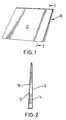
- Figure 1 is a view-in-perspective of an embodiment roof shingle of the invention.
- Figure 2 is a cross-sectional view along lines 2-2 of Figure 1.
- FIG. 1 is a view-in-perspective of an embodiment roof shingle 10 which can be used in a building construction as an exterior siding or roof shingle.
- the surface 12 exposed to the weather can be smooth or textured as will be described more fully hereinafter.
- the shingle 10 is a laminated structure, consisting of a thermoplastic, synthetic polymeric resin substrate 14 covered on the side 12 with a laminated film 18 of a flexible, straight chain, aromatic polycarbonate resin.
- the substrate 14 may be thermoformed from any conventional, synthetic polymeric resin having sufficient ability to be self-supporting.
- Substrate 14 is advantageously 10 to 300 mils in thickness.
- Representative of such polymeric resins are polyolefins (e.g. polyvinyl chloride, polyvinyl fluoride, polyethylene) polystyrene (ABS), acrylic resins and the like.
- the substrate 14 is molded from a thermoplastic, aromatic, straight-chain polycarbonate resin.
- the preferred aromatic, straight-chain polycarbonate resins for substrate 14 are a well known class of thermoformable resins, prepared by the interfacial polymerization of a dihydric phenol with a carbonyl halide (the carbonate precursor) in the presence of a water immiscible solvent.
- reaction conditions of the preparative processes may vary, several of the preferred processes typically involve dissolving or dispersing a diphenol reactant in aqueous caustic, adding the resulting mixture to a suitable water immiscible solvent medium and contacting the reactants with a carbonate precursor, under controlled pH conditions.
- suitable water immiscible solvents include methylene chloride, 1,2-dichloroethane, chlorobenzene, toluene, and the like.
- polycarbonate as used herein is inclusive of polyester-carbonates [also known as “copoly-(ester-carbonates)” or “polyester-polycarbonates”], a well known class of thermoplastic resin as is their preparation; see for example the descriptions given in U.S. Patents 3,169,121 and 4,487,896. Also incorporated herein by reference thereto.
- polyester-carbonate resins are prepared by the same polymerization techniques used for polycarbonate homopolyners, but with the added presence of an ester precursor.
- the preferred process for preparing polycarbonate homopolymers and polyester-carbonate resins comprises a phosgenation reaction.
- the temperature at which the phosgenation reaction proceeds may vary from below 0°C, to above 100°C.
- the phosgenation reaction preferably proceeds at temperatures of from about room temperatures (25°C) to 50°C. Since the reaction is exothermic, the rate of phosgene addition may be used to control the reaction temperature.
- the amount of phosgene required will generally depend upon the amount of the dihydric phenol reactant added.
- the dihydric phenols employed are known, and the reactive groups are the two phenolic hydroxyl groups.
- Some of the dihydric phenols are represented by the general formula: wherein A is a divalent hydrocarbon radical containing from 1 to about 15 carbon atoms; a substituted divalent hydrocarbon radical containing from 1 to about 15 carbon atoms and substituent groups such as halogen; -S- ; -S(O)- ; -S(O) 2 - ; -O- ; or -C(O)- ; each X is independently selected from the group consisting of hydrogen, halogen, and a monovalent hydrocarbon radical such as an alkyl group of from 1 to about 8 carbon atoms, an aryl group of from 6-18 carbon atoms, an aralkyl group of from 7 to about 14 carbon atoms, an alkaryl group of from 7 to about 14 carbon atoms, an alkoxy group of from 1 to about 8 carbon atoms, or an aryloxy group
- dihydric phenols such as (4-hydroxyphenyl)methane, 2,2-bis(4-hydroxyphenyl)propane (also known as bisphenol-A), 2,2-bis(4-hydroxy-3,5-dibromophenyl)propane; dihydric phenol ethers such as bis(4-hydroxyphenyl) ether, bis(3,5-dichloro-4-hydroxyphenyl) ether; dihydroxydiphenyls such as p,p'-dihydroxydiphenyl, 3,3'-dichloro-4,4'-dihydroxydiphenyl; dihydroxyaryl sulfones such as bis(4-hydroxyphenyl) sulfone, bis (3,5-dimethyl-4-hydroxyphenyl) sulfone, dihydroxybenzenes such as resorcinol, hydroquinone, halo- and alkylsubstituted dihydroxybenzenes such as 1,4-phenols such as (4-hydroxyphenyl)
- the carbonate precursor can be either a carbonyl halide, a diarylcarbonate or a bishaloformate.
- the carbonyl halides include carbonyl bromide, carbonyl chloride, and mixtures thereof.
- the bishaloformates include the bishaloformates of dihydric phenols such as bischloroformates of 2,2-bis(4-hydroxyphenyl)propane, 2,2-bis(4-hydroxy-3,5-dichlorophenyl)propane, hydroquinone, and the like, or bishaloformates of glycols such as bishaloformates of ethylene glycol, and the like. While all of the above carbonate precursors are useful, carbonyl chloride, also known as phosgene, is preferred.
- any dicarboxylic acid conventionally used in the preparation of linear polyesters may be utilized as the ester precursor in the preparation of the polyester-carbonate resins used in the instant invention.
- the dicarboxylic acids which may be utilized include the aliphatic dicarboxylic acids, the aromatic dicarboxylic acids, and the aliphaticaromatic dicarboxylic acids. These acids are well known and are disclosed for example in U.S. Pat. No. 3,169,121 which is hereby incorporated herein by reference.
- dicarboxylic acids are those represented by the general formula: HOOC - R 1 - COOH wherein R 1 represents a divalent aliphatic radical such as alkylene, alkylidene, cycloalkylene or substituted alkylene or alkylidene; an aromatic radical such as phenylene, naphthylene, biphenylene, substituted phenylene and the like; a divalent aliphatic-aromatic hydrocarbon radical such as an aralkyl or alkaryl radical; or two or more aromatic groups connected through non-aromatic linkages of the formula: - E - wherein E is a divalent alkylene or alkylidene group.
- R 1 represents a divalent aliphatic radical such as alkylene, alkylidene, cycloalkylene or substituted alkylene or alkylidene
- an aromatic radical such as phenylene, naphthylene, biphenylene, substituted phenylene and the like
- E may also consist of two or more alkylene or alkylidene groups, connected by a non-alkylene or alkylidene group, connected by a non-alkylene or non-alkylidene group, such as an aromatic linkage, a tertiary amino linkage, an ether linkage, a carbonyl linkage, a silicon-containing linkage, or by a sulfur-containing linkage such as sulfide, sulfoxide, sulfone and the like.
- E may be a cycloaliphatic group of five to seven carbon atoms, inclusive, (e.g.
- E may also be a carbon-free sulfur-containing linkage, such as sulfide, sulfoxide or sulfone; an ether linkage; a carbonyl group; a direct bond; a tertiary nitrogen group; or a silicon-containing linkage such as silane or siloxy.
- sulfur-containing linkage such as sulfide, sulfoxide or sulfone
- ether linkage such as sulfide, sulfoxide or sulfone
- ether linkage such as a carbonyl group; a direct bond; a tertiary nitrogen group; or a silicon-containing linkage such as silane or siloxy.
- Other groups which E may represent will occur to those skilled in the art.
- aromatic dicarboxylic acids which may be used in preparing the poly(ester-carbonate) include phthalic acid, isophthalic acid, terephthalic acid, homophthalic acid, o-, m-, and p-phenylenediacetic acid, and the polynuclear aromatic acids such as diphenyl dicarboxylic acid, and isomeric naphthalene dicarboxylic acids.
- the aromatics may be substituted with Y groups.
- Y may be an inorganic atom such as chlorine, bromine, fluorine and the like; an organic group such as the nitro group; an organic group such as alkyl; or an oxy group such as alkoxy, it being only necessary that Y be inert to and unaffected by the reactants and the reaction conditions.
- Particularly useful aromatic dicarboxylic acids are those represented by the general formula: wherein j is a positive whole integer having a value of from 0 to 4 inclusive; and each R 3 is independently selected from the group consisting of alkyl radicals, preferably lower alkyl (1 to about 4 carbon atoms).
- aromatic dicarboxylic acids are isophthalic acid, terephthalic acid, and mixtures thereof.
- aliphatic dicarboxylic acids within the formula given above wherein R 1 is alkylene are butanedioic acid, hexanedioic acid, octanedioic acid, decanedioic acid, dodecanedioic acid and the like. Preferred are dicarboxylic acids having from 4 to 18 carbon atoms, inclusive.
- dicarboxylic acid is used herein it is to be understood that this term includes mixtures of two or more dicarboxylic acids.
- the proportions of reactants employed to prepare the polyester-carbonate resins used in the invention will vary. Those skilled in the art are aware of useful proportions, as described in the U.S. patents referred to above.
- the amount of the ester bonds may be from about 5 to about 90 mole percent, relative to the carbonate bonds. For example, 5 moles of bisphenol A reacting completely with 4 moles of isophthaloyl dichloride and 1 mole of phosgene would give a polyester-carbonate of 80 mole percent ester bonds.
- the preferred polycarbonates for use in substrate 14 are those derived from bisphenol A and phosgene and having an intrinsic viscosity of about 0.3 to about 1.5 deciliters per gram in methylene chloride at 25°C.
- a molecular weight regulator (a chain stopper) is generally added to the reaction mixture prior to or during the contacting with carbonate and ester precursors.
- Useful molecular weight regulators include, but are not limited to, monohydric phenols such as phenol, chroman-I, para-tertiarybutylphenol, p-cumylphenol and the like. Techniques for the control of molecular weight are well known in the art and are used for controlling the molecular weight of the polyester-carbonate resins used in the present invention.
- preferred polycarbonates described herein may be characterized as containing recurring polycarbonate chain units of the formula:- wherein D is a divalent aromatic radical of the dihydric phenol employed in the resin preparation; and may contain repeating or recurring carboxylic chain units of the formula:- - O - R 1 - O - D - wherein D and R 1 have the meanings previously ascribed to them.
- the preferred polycarbonate resins are advantageously reinforced with a fibrous reinforcing agent.
- Fibrous reinforcing agents employed in plastic molding compositions are generally well known and are represented by glass fibers, mineral fibers such as rockwool, carbon fibers and the like.
- Preferred reinforcing agents are glass fibers such as cut glass filaments (long glass fiber and short glass fiber) rovings and staple fiber.
- the filamentous glass that may be used in the substrate 14 are well known to those skilled in the art and is widely available from a number of manufacturers.
- the glass may be untreated or, preferably, treated with silane or titanate coupling agents. It is convenient to use the filamentous glass in the form of chopped strands of from about 0.25 cm to about 5 cm long.
- the polycarbonate compositions for substrate 14 advantageously include an impact-modifying proportion of an impact modifier.
- Any of the known impact modifiers for polycarbonates may be used.
- Representative of such impact-modifiers are selectively hydrogenated linear, sequential or radial teleblock copolymers of a vinyl aromatic compound (A) and (A') n and an olefinic elastomer (B) of the A-B-A'; A (B-A-B) n A; A ( B-A ) n B; or B [( A-B n ) B] 4 type wherein n is an integer of from 1 to 10 inclusive; see for example Haefele et al, U.S. Pat. No. 3,333,024, which is incorporated herein by reference.
- ABS polymers are defined, for example, in the Modern Plastics Encyclopedia, 1989 edition, page 92, as the family of thermoplastics made from the three monomers acrylonitrile, butadiene and styrene, and more specifically as a mixture (alloy) of styreneacrylonitrile copolymer with SAN-grafted polybutadiene rubber.
- Impact-modifying agents for use with the polyester-carbonate based substrates 14 also include the various polyacrylate resins known in the art.
- polyacrylates are commercially available from many sources, e.g., Rohm & Haas Chemical Company, Philadelphia, Pa. under the trade designations Acryloid® KM 330, and 7709 XP; Goodyear Tire & Rubber Company, Akron, Ohio under the trade designation RXL® 6886; from American Cyanamid Company, Stamford, CT., under the trade designation Cyanacryl® 770; from M&T Chemicals Co., Trenton, NJ, under the trade designation Durostrength® 200; and from Polysar Corporation, Canada, under the trade designation Polysar® ⁇ 1006.
- the polyacrylate resin impact modifiers may be added to the polycarbonate resins in conventional amounts of from 0.01% to 50% by weight based on the weight of the overall composition and usually in amounts of from 0.01% to 10% by weight on the same basis.
- polyamide-polyether block copolymers which may be represented by the formula: wherein PA represents the polyamide segment, PE represents a polyether segment and n is an integer such that the block copolymer has a weight average molecular weight (M W ) of from about 5,000 to about 100,000.
- M W weight average molecular weight
- Polyamide-polyether block copolymers of the class described above are generally well known and may be prepared for example by the condensation reaction of a prepolyamide and a polyoxyalkylene glycol, by conventional technique; see for example the preparative methods described in U.S.
- the polyamide-polyether block copolymers so prepared are commercially available and may be wide ranging in their make-up from a wide range of prepolyamides and polyoxyalkylene glycols.
- Impact-modifying proportions of the polyamide-polyether block copolymers are generally within the range of from about 0.1 to 10 percent by weight of the resin composition.
- thermoplastic compositions employed as substrate 14 may also be compounded with conventional molding aids such as, for example, antioxidants; antistatic agents; hydrolytic stabilizers such as the epoxides disclosed in U.S. Pats. Nos. 3,489,716, 4,138,379 and 3,839,247, all of which are incorporated herein by reference; color stabilizers such as the organophosphites; thermal stabilizers such as phosphite; mold release agents and the like.
- molding aids such as, for example, antioxidants; antistatic agents; hydrolytic stabilizers such as the epoxides disclosed in U.S. Pats. Nos. 3,489,716, 4,138,379 and 3,839,247, all of which are incorporated herein by reference; color stabilizers such as the organophosphites; thermal stabilizers such as phosphite; mold release agents and the like.
- Preferred embodiment shingles of the invention include in the polycarbonate substrate 14 as an additive ingredient, flame retarding agents.
- flame retarding agents in the polycarbonate substrate 14 as an additive ingredient, flame retarding agents.
- the presence of impact-modifiers in polycarbonate based molding compositions is degradative to the action of fire retardants.
- reductions in flame-retardance due to presence of the impact-modifier is not significant.
- Some particularly useful flame retardants are the alkali and alkaline earth metal salts of sulfonic acids. These types of flame retardants and there use are disclosed in U.S. Pats. Nos. 3,933,734; 3,931,100; 3,978,024; 3,948,851; 3,926,980; 3,919,167; 3,909,490; 3,953,396; 3,953,300; 3,917,559; 3,951,910 and 3,940,366, all of which are hereby incorporated herein by reference.
- Flame-retarding proportions of flame retardants vary in accordance with the specific flame retardant. In general, a flame-retarding proportion comprises from 0.01 to about 20 weight percent of the total polycarbonate composition.
- Films 18 of flexible polycarbonate resins are generally well known and are available commercially from the General Electric Company, Plastics Division, Pittsfield, Mass.
- the films 18 are prepared from the polycarbonate resins described above, having a thickness of 1 to 15 mils and formulated to contain from about 1 to 30 percent by weight of an ultra-violet light absorbing agent.
- ultra-violet light absorbing agents are those described, for example, in the U.S. Patents 2,976,259; 3,043,709; 3,049,443, 3,214,436, 3,309,220; 4,556,606 and Re 2, 976 all of which are incorporated herein by reference thereto.
- the ultra-violet light absorbing agent selected for use in the present invention is Tinuvin® 234 a benzotriazole manufactured by Ciba-Geigy Corporation, Hawthorne, New York.
- a conventional coloring pigment may also be blended into the film resin 18 in a coloring proportionm, but is preferably blended into the polycarbonate resin forming the substrate 14.
- the film 18 is, according to the method of the present invention, laminated to a surface 12 of the substrate 14 for protection of the surface 12 from weathering. Lamination can be carried out by one of several known techniques.
- the substrate 12 and film 18 may be co-extruded using the techniques in U.S. Patent 4,056,344, or as described in U.S. Patent 4,992,322.
- the film 18 is prepared separately from the substrate 14 and laminated thereon under heat and pressure using conventional laminating presses. The latter method possesses the advantages of avoiding melt flow problems which may be associated with extrusion of the substrate 14 or film 18 and an ability to texture the surface 12 of the shingle 10.
- the film 18 can bear a surface impregnation or coating of the ultra-violet light absorbing compound and pigment, applied for example by the method described in U.S. Patent 5,271,968.
- a surface film 18 can be prepared with high ultra-violet light resistance at the surface 12 and have a color present.
- a co-extruded sheet was formed with a polycarbonate resin core and a cap of film of polycarbonate resin (about 10 mils thick) on the exterior of the core, following the procedure of U.S. Patent 4,056,344.
- the cap layer comprised a polycarbonate resin blend containing 8.0 percent by weight of Tinuvin® 234 (Ciba-Geigy Corp.) a benzotriazole U-V light absorbing compound and a coloring proportion of a pigment.
- the co-extruded sheet was tested for its resistance to weathering. The test results (Delta E Color) are shown in the Table below.
- the core extrusion (without a cap) was painted with a number of urethane or acrylic enamels and tested also.
- the test results are given in the Table below.
Landscapes
- Engineering & Computer Science (AREA)
- Architecture (AREA)
- Civil Engineering (AREA)
- Structural Engineering (AREA)
- Laminated Bodies (AREA)
- Compositions Of Macromolecular Compounds (AREA)
- Roof Covering Using Slabs Or Stiff Sheets (AREA)
Applications Claiming Priority (2)
| Application Number | Priority Date | Filing Date | Title |
|---|---|---|---|
| US08/697,802 US5902683A (en) | 1996-08-30 | 1996-08-30 | Construction shingle |
| US697802 | 1996-08-30 |
Publications (3)
| Publication Number | Publication Date |
|---|---|
| EP0833015A2 true EP0833015A2 (fr) | 1998-04-01 |
| EP0833015A3 EP0833015A3 (fr) | 1998-12-23 |
| EP0833015B1 EP0833015B1 (fr) | 2004-10-27 |
Family
ID=24802603
Family Applications (1)
| Application Number | Title | Priority Date | Filing Date |
|---|---|---|---|
| EP97306391A Expired - Lifetime EP0833015B1 (fr) | 1996-08-30 | 1997-08-21 | Bardeau |
Country Status (7)
| Country | Link |
|---|---|
| US (1) | US5902683A (fr) |
| EP (1) | EP0833015B1 (fr) |
| JP (1) | JPH10227103A (fr) |
| CN (1) | CN1134577C (fr) |
| DE (1) | DE69731351T2 (fr) |
| ES (1) | ES2231846T3 (fr) |
| SG (1) | SG65012A1 (fr) |
Cited By (1)
| Publication number | Priority date | Publication date | Assignee | Title |
|---|---|---|---|---|
| EP1916352A3 (fr) * | 2006-10-27 | 2015-02-25 | CertainTeed Corporation | Elément de couverture avec réflectance solaire améliorée |
Families Citing this family (30)
| Publication number | Priority date | Publication date | Assignee | Title |
|---|---|---|---|---|
| DE10006651A1 (de) * | 2000-02-15 | 2001-08-16 | Bayer Ag | Zusammensetzung enthaltend Polycarbonat und Pigmente |
| US7125601B1 (en) | 2000-10-18 | 2006-10-24 | 3M Innovative Properties Company | Integrated granule product |
| US20080063844A1 (en) * | 2001-06-29 | 2008-03-13 | Mannington Mills, Inc. | Surface coverings containing aluminum oxide |
| US7140153B1 (en) | 2002-08-26 | 2006-11-28 | Davinci Roofscapes, Llc | Synthetic roofing shingles |
| US7520098B1 (en) | 2004-01-16 | 2009-04-21 | Davinci Roofscapes, Llc | Stepped tile shingle |
| ES2641567T3 (es) * | 2004-03-11 | 2017-11-10 | Da Vinci Roofscapes, L. L. C. | Teja con pestaña de desviación de agua con enclavamiento |
| US20080014446A1 (en) * | 2004-10-07 | 2008-01-17 | General Electric Company | Window shade and a multi-layered article, and methods of making the same |
| US7851051B2 (en) * | 2005-02-08 | 2010-12-14 | Elk Premium Building Products, Inc. | Roofing material |
| US7576148B2 (en) * | 2005-11-09 | 2009-08-18 | Kraton Polymers U.S. Llc | Blown asphalt compositions |
| WO2009158475A1 (fr) * | 2008-06-25 | 2009-12-30 | Boltaron Performance Products, Llc | Composition de stratifié composite |
| US8445568B2 (en) * | 2008-09-25 | 2013-05-21 | Sabic Innovative Plastics Ip B.V. | Flame retardant thermoplastic composition and articles formed therefrom |
| US8889248B2 (en) | 2008-10-31 | 2014-11-18 | Sabic Global Technologies B.V. | Multiwall sheet, an article, a method of making a multiwall sheet |
| US8572921B2 (en) * | 2009-03-27 | 2013-11-05 | Davinci Roofscapes, Llc | One piece hip and ridge shingle |
| US8136322B2 (en) | 2009-08-25 | 2012-03-20 | Tamko Building Products, Inc. | Composite shingle |
| WO2013081478A1 (fr) | 2011-11-30 | 2013-06-06 | Zinniatek Limited | Systèmes photovoltaïques |
| CA3199118C (fr) | 2013-03-15 | 2025-09-09 | Certainteed Llc | Produit de construction panache et procede |
| US9884443B2 (en) | 2013-03-15 | 2018-02-06 | Certainteed Corporation | System, method and article for siding corner |
| WO2014189391A1 (fr) | 2013-05-23 | 2014-11-27 | Zinniatek Limited | Systèmes photovoltaïques |
| WO2015132756A1 (fr) | 2014-03-07 | 2015-09-11 | Zinniatek Limited | Système de toiture thermique solaire |
| US9303410B2 (en) * | 2013-12-18 | 2016-04-05 | Certainteed Corporation | Single panel siding product |
| CA2874660C (fr) | 2013-12-18 | 2021-09-14 | Stephen W. Steffes | Produit de parement en panneau |
| WO2016088026A1 (fr) * | 2014-12-01 | 2016-06-09 | Zinniatek Limited | Produit de couverture, de bardage ou de parement |
| USD792615S1 (en) | 2014-12-12 | 2017-07-18 | Certainteed Corporation | Siding panel |
| US9765513B2 (en) | 2014-12-15 | 2017-09-19 | Certainteed Corporation | System, method and apparatus for corner siding |
| US10060132B2 (en) | 2015-02-20 | 2018-08-28 | Building Materials Investment Corporation | Shingle with film covered surfaces |
| US10724243B2 (en) | 2015-06-16 | 2020-07-28 | Building Materials Investment Corporation | Process for in-line extrusion of coating onto roofing shingles during manufacturing and roofing shingles made by the process |
| US10195640B2 (en) | 2015-06-29 | 2019-02-05 | Building Materials Investment Corporation | Method and apparatus for coating a moving substrate |
| US11255088B2 (en) | 2015-07-17 | 2022-02-22 | Building Materials Investment Coporation | Method of extruding polymer film onto a mat and products incorporating the resulting composite mat |
| CA3053632A1 (fr) | 2017-02-21 | 2018-08-30 | Zinniatek Limited | Substrat ayant une surface decoree et procede de production |
| US11426915B2 (en) | 2020-07-21 | 2022-08-30 | Bmic Llc | Method and apparatus for die coating a substrate with high viscosity materials |
Family Cites Families (12)
| Publication number | Priority date | Publication date | Assignee | Title |
|---|---|---|---|---|
| US3582398A (en) * | 1965-05-18 | 1971-06-01 | Gen Electric | Polycarbonate substrate with an acrylate coating thereon |
| US4034528A (en) * | 1976-06-18 | 1977-07-12 | Aegean Industries, Inc. | Insulating vinyl siding |
| US4096011A (en) * | 1976-12-10 | 1978-06-20 | Aegean Industries, Inc. | Method of manufacturing exterior siding |
| US4308702A (en) * | 1976-12-28 | 1982-01-05 | Gaf Corporation | Plastic building panel and method for making same |
| US4339503A (en) * | 1981-03-02 | 1982-07-13 | Ppg Industries, Inc. | Protection of polycarbonate from ultraviolet radiation |
| DE8233007U1 (de) * | 1982-11-25 | 1983-03-24 | Röhm GmbH, 6100 Darmstadt | Polycarbonat-kunststofftafel |
| DE3617978A1 (de) * | 1986-05-28 | 1987-12-03 | Bayer Ag | Verzweigte thermoplastische polycarbonate mit verbessertem schutz gegen uv-licht |
| DE3739765A1 (de) * | 1987-11-24 | 1989-06-08 | Bayer Ag | Beschichtete formkoerper und ein verfahren zu ihrer herstellung |
| DE4216103A1 (de) * | 1992-05-15 | 1993-11-18 | Roehm Gmbh | Folie-geschützter Polycarbonatkunststoffkörper |
| US5306456A (en) * | 1993-03-10 | 1994-04-26 | Ciba-Geigy Corporation | Preparing laminated thermoplastics stabilized with bisbenzophenones |
| EP0638414A3 (fr) * | 1993-08-11 | 1995-04-26 | Gen Electric | Matériau non tissé utilisé comme substrate dans des matériaux composites thermoplastiques pour panneaux de toiture. |
| GB2290745A (en) * | 1994-07-01 | 1996-01-10 | Ciba Geigy Ag | Coextruded stabilised laminated thermolastics |
-
1996
- 1996-08-30 US US08/697,802 patent/US5902683A/en not_active Expired - Fee Related
-
1997
- 1997-08-21 EP EP97306391A patent/EP0833015B1/fr not_active Expired - Lifetime
- 1997-08-21 DE DE69731351T patent/DE69731351T2/de not_active Expired - Lifetime
- 1997-08-21 ES ES97306391T patent/ES2231846T3/es not_active Expired - Lifetime
- 1997-08-25 SG SG1997003036A patent/SG65012A1/en unknown
- 1997-08-26 JP JP9229099A patent/JPH10227103A/ja active Pending
- 1997-08-29 CN CNB97117914XA patent/CN1134577C/zh not_active Expired - Fee Related
Cited By (1)
| Publication number | Priority date | Publication date | Assignee | Title |
|---|---|---|---|---|
| EP1916352A3 (fr) * | 2006-10-27 | 2015-02-25 | CertainTeed Corporation | Elément de couverture avec réflectance solaire améliorée |
Also Published As
| Publication number | Publication date |
|---|---|
| US5902683A (en) | 1999-05-11 |
| CN1180123A (zh) | 1998-04-29 |
| ES2231846T3 (es) | 2005-05-16 |
| EP0833015B1 (fr) | 2004-10-27 |
| DE69731351T2 (de) | 2006-02-16 |
| EP0833015A3 (fr) | 1998-12-23 |
| JPH10227103A (ja) | 1998-08-25 |
| DE69731351D1 (de) | 2004-12-02 |
| CN1134577C (zh) | 2004-01-14 |
| SG65012A1 (en) | 1999-05-25 |
Similar Documents
| Publication | Publication Date | Title |
|---|---|---|
| EP0833015B1 (fr) | Bardeau | |
| US4600632A (en) | UV-stabilized polycarbonate mouldings | |
| US5360861A (en) | Polyester-carbonate resin compositions of improved impact-resistance | |
| US4643937A (en) | Laminate formed from a polyarylate sheet and a polycarbonate and/or polyester sheet | |
| US6031036A (en) | Flame resistant thermoplastic blends having reduced drippage | |
| GB2047723A (en) | Process for obtaining copolyester-carbonates | |
| US4224215A (en) | Filled polycarbonate compositions | |
| US5759689A (en) | Coextruded polycarbonate sheet with improved weathering | |
| US4804566A (en) | Multilayer polyester structures and containers thereof | |
| US4552949A (en) | Polycarbonate of spiro dihydric phenol | |
| US4230769A (en) | Glass-polycarbonate laminate | |
| US4598130A (en) | Blends of a polyarylate and a poly(ester carbonate) | |
| US4129546A (en) | Plasticized with a minor amount of an oligomeric polymeric polycarbonate | |
| EP0375942B1 (fr) | Compositions de polycarbonates ignifugées | |
| EP0834525B1 (fr) | Orthoesters en tant que capteur de bisphenol A dans les produits en polycarbonate | |
| US5274017A (en) | Flame retardant carbonate polymer containing selected metal oxides | |
| JP4907755B2 (ja) | ポリカーボネート樹脂積層体 | |
| US4218357A (en) | Plasticized polycarbonate composition | |
| US6887573B2 (en) | Polycarbonate polyester articles with enhanced adhesion between outer layer and base substrate | |
| US4937031A (en) | Process for preparing thermoplastic composites | |
| US4918149A (en) | Polyphthalatecarbonate/polycarbonate resin blends | |
| US4290934A (en) | Plasticized polycarbonate composition | |
| US4143023A (en) | Plasticized polycarbonate composition | |
| US4661567A (en) | Polycarbonate end capped with vinylene carbonate compound | |
| US4605726A (en) | Polyestercarbonate from spiro dihydric phenol |
Legal Events
| Date | Code | Title | Description |
|---|---|---|---|
| PUAI | Public reference made under article 153(3) epc to a published international application that has entered the european phase |
Free format text: ORIGINAL CODE: 0009012 |
|
| AK | Designated contracting states |
Kind code of ref document: A2 Designated state(s): DE ES FR GB IT NL |
|
| AX | Request for extension of the european patent |
Free format text: AL;LT;LV;RO;SI |
|
| PUAL | Search report despatched |
Free format text: ORIGINAL CODE: 0009013 |
|
| AK | Designated contracting states |
Kind code of ref document: A3 Designated state(s): AT BE CH DE DK ES FI FR GB GR IE IT LI LU MC NL PT SE |
|
| AX | Request for extension of the european patent |
Free format text: AL;LT;LV;RO;SI |
|
| 17P | Request for examination filed |
Effective date: 19990623 |
|
| AKX | Designation fees paid |
Free format text: DE ES FR GB IT NL |
|
| 17Q | First examination report despatched |
Effective date: 20020924 |
|
| GRAP | Despatch of communication of intention to grant a patent |
Free format text: ORIGINAL CODE: EPIDOSNIGR1 |
|
| GRAS | Grant fee paid |
Free format text: ORIGINAL CODE: EPIDOSNIGR3 |
|
| GRAA | (expected) grant |
Free format text: ORIGINAL CODE: 0009210 |
|
| AK | Designated contracting states |
Kind code of ref document: B1 Designated state(s): DE ES FR GB IT NL |
|
| PG25 | Lapsed in a contracting state [announced via postgrant information from national office to epo] |
Ref country code: IT Free format text: LAPSE BECAUSE OF FAILURE TO SUBMIT A TRANSLATION OF THE DESCRIPTION OR TO PAY THE FEE WITHIN THE PRE;WARNING: LAPSES OF ITALIAN PATENTS WITH EFFECTIVE DATE BEFORE 2007 MAY HAVE OCCURRED AT ANY TIME BEFORE 2007. THE CORRECT EFFECTIVE DATE MAY BE DIFFERENT FROM THE ONE RECORDED.SCRIBED TIME-LIMIT Effective date: 20041027 |
|
| REG | Reference to a national code |
Ref country code: GB Ref legal event code: FG4D |
|
| REF | Corresponds to: |
Ref document number: 69731351 Country of ref document: DE Date of ref document: 20041202 Kind code of ref document: P |
|
| REG | Reference to a national code |
Ref country code: ES Ref legal event code: FG2A Ref document number: 2231846 Country of ref document: ES Kind code of ref document: T3 |
|
| ET | Fr: translation filed | ||
| PLBE | No opposition filed within time limit |
Free format text: ORIGINAL CODE: 0009261 |
|
| STAA | Information on the status of an ep patent application or granted ep patent |
Free format text: STATUS: NO OPPOSITION FILED WITHIN TIME LIMIT |
|
| 26N | No opposition filed |
Effective date: 20050728 |
|
| REG | Reference to a national code |
Ref country code: GB Ref legal event code: 732E |
|
| PGFP | Annual fee paid to national office [announced via postgrant information from national office to epo] |
Ref country code: NL Payment date: 20080803 Year of fee payment: 12 Ref country code: ES Payment date: 20080922 Year of fee payment: 12 |
|
| REG | Reference to a national code |
Ref country code: FR Ref legal event code: TP |
|
| NLS | Nl: assignments of ep-patents |
Owner name: SABIC INNOVATIVE PLASTICS IP B.V. Effective date: 20081023 |
|
| REG | Reference to a national code |
Ref country code: NL Ref legal event code: V1 Effective date: 20100301 |
|
| PG25 | Lapsed in a contracting state [announced via postgrant information from national office to epo] |
Ref country code: NL Free format text: LAPSE BECAUSE OF NON-PAYMENT OF DUE FEES Effective date: 20100301 |
|
| REG | Reference to a national code |
Ref country code: ES Ref legal event code: FD2A Effective date: 20090822 |
|
| PG25 | Lapsed in a contracting state [announced via postgrant information from national office to epo] |
Ref country code: ES Free format text: LAPSE BECAUSE OF NON-PAYMENT OF DUE FEES Effective date: 20090822 |
|
| PGFP | Annual fee paid to national office [announced via postgrant information from national office to epo] |
Ref country code: DE Payment date: 20140813 Year of fee payment: 18 |
|
| PGFP | Annual fee paid to national office [announced via postgrant information from national office to epo] |
Ref country code: GB Payment date: 20140820 Year of fee payment: 18 Ref country code: FR Payment date: 20140808 Year of fee payment: 18 |
|
| REG | Reference to a national code |
Ref country code: DE Ref legal event code: R119 Ref document number: 69731351 Country of ref document: DE |
|
| GBPC | Gb: european patent ceased through non-payment of renewal fee |
Effective date: 20150821 |
|
| REG | Reference to a national code |
Ref country code: FR Ref legal event code: ST Effective date: 20160429 |
|
| PG25 | Lapsed in a contracting state [announced via postgrant information from national office to epo] |
Ref country code: GB Free format text: LAPSE BECAUSE OF NON-PAYMENT OF DUE FEES Effective date: 20150821 Ref country code: DE Free format text: LAPSE BECAUSE OF NON-PAYMENT OF DUE FEES Effective date: 20160301 |
|
| PG25 | Lapsed in a contracting state [announced via postgrant information from national office to epo] |
Ref country code: FR Free format text: LAPSE BECAUSE OF NON-PAYMENT OF DUE FEES Effective date: 20150831 |