EP0833263A2 - Base de données, procédé pour créer une base de données et procédé pour interroger une base de données - Google Patents
Base de données, procédé pour créer une base de données et procédé pour interroger une base de données Download PDFInfo
- Publication number
- EP0833263A2 EP0833263A2 EP97440084A EP97440084A EP0833263A2 EP 0833263 A2 EP0833263 A2 EP 0833263A2 EP 97440084 A EP97440084 A EP 97440084A EP 97440084 A EP97440084 A EP 97440084A EP 0833263 A2 EP0833263 A2 EP 0833263A2
- Authority
- EP
- European Patent Office
- Prior art keywords
- database
- data
- eds
- terms
- data records
- Prior art date
- Legal status (The legal status is an assumption and is not a legal conclusion. Google has not performed a legal analysis and makes no representation as to the accuracy of the status listed.)
- Withdrawn
Links
Images




Classifications
-
- G—PHYSICS
- G06—COMPUTING OR CALCULATING; COUNTING
- G06F—ELECTRIC DIGITAL DATA PROCESSING
- G06F16/00—Information retrieval; Database structures therefor; File system structures therefor
- G06F16/20—Information retrieval; Database structures therefor; File system structures therefor of structured data, e.g. relational data
- G06F16/24—Querying
- G06F16/245—Query processing
- G06F16/2458—Special types of queries, e.g. statistical queries, fuzzy queries or distributed queries
- G06F16/2468—Fuzzy queries
Definitions
- the invention relates to a database according to claim 1, a method for deriving a database according to claim 5 and a method to get a list of records according to a database query the preamble of claim 7.
- An object of the invention is to provide a database that a Faster database query compared to the prior art allows fuzzy linguistic terms. Another job of The invention is to provide a method according to which Database can be obtained from a number of records. A Another object of the invention is to provide a method according to a query of such a database with fuzzy linguistic Terms can be done.
- the task is related to the database by the characteristics of the Claim 1, with respect to the method of such a database to be obtained by the features of claim 5 and in relation to the Method for querying such a database by the characteristics of the Claim 7 solved.
- Advantageous configurations are the dependent claims.
- An advantage of a database according to the invention and the inventive method for querying such a database is that there are users who do not have specific expertise regarding the Having the contents of the database enables a database query perform. Therefore, the invention is particularly suitable for technical Databases.
- Another advantage of the new method of querying a database is it that this procedure is especially for users who are not familiar with the Querying databases are familiar, easy to use and easy to use suitable for use as an online service.
- the invention enables the query of a database with unsharp linguistic terms by a user.
- the importance of blurred Linguistic terms depend on the context in which they are used and the language feeling of the user group. So give for example terms such as size (large, small) or sportiness (unsportsmanlike, very sporty) no absolute values, according to which in one Database could be searched, but a relative rating in the Comparison of individual database entries.
- To the fuzzy linguistic Contains terms for a query of the database each record in the database on the fuzzy linguistic terms Membership values that indicate the degree to which a particular fuzzy linguistic term compared to the other data sets applies to the associated data record.
- the database is from the first Derived records and contains one for each first record associated second record in which the membership values are stored are.
- An embodiment of the invention is a database of N various motor vehicles. This database can be blurred with the linguistic terms cost, safety, sportiness and comfort be queried.
- Figure 1 is an extract from the database DB in the form of a table shown.
- the lines contain the individual data records DS DB database.
- In the first column there is a serial number NR for every record DS.
- the type designation TP is in the second column of the motor vehicles contained in the DB database.
- the four others Columns contain the membership values WW of each data record DS for the individual fuzzy linguistic terms SB.
- the range of possible Membership values WW range from 0 to 10000 in the exemplary embodiment, where 5000 the average values of those contained in the database DB Corresponds to motor vehicles.
- the database is derived from a number N of first data records.
- a first data record EDS in the form of a table shown. It contains the type designation TP of a motor vehicle and technical and commercial data DAT for the motor vehicle.
- the first column contains data fields DF such as new price and fuel consumption, the associated data DAT are in the second column.
- a membership value of a second one contained in the database Record can be made up of multiple data fields of a first record depend.
- the membership value is blurred Linguistic term sportiness derived from the following data fields of the first records: performance, acceleration and top speed.
- the membership values are preferably determined by using Membership functions and formation of fuzzy interferences after the Rules of fuzzy logic theory (see e.g. A Fuzzy, Knowledge-based Support Tool for Production Operations management, C.P. Schlueter et al, Expert Systems Vol. 11 No. 1, 1994, pp. 3 to 11).
- Other Possibilities would be the membership values according to the opinion independent experts or a ranking of motor vehicles for every fuzzy linguistic concept and for the Membership values a certain statistical distribution, for example the normal distribution to assume.
- the first data records can be in the form of a source database.
- the database can then contain a reference, e.g. a pointer to the associated first record of the source database be included.
- a reference e.g. a pointer to the associated first record of the source database be included.
- the database can also be used in every second record contain part of the data from the first data records.
- the first Data records are then no longer required.
- As a result Database query will then not list the first records issued, but a list of the second contained in the database Records.
- first Deriving records first becomes the fuzzy linguistic Terms SB selected to which membership values belong to the database should be derived.
- these are the fuzzy linguistic terms SB costs, security, sportiness and Comfort.
- the ones in FIG 3 performed steps schematically represented for the term sportiness.
- the data fields DF are determined in the first data records Influence the membership values. For the example of sportiness in Figure 3, these are the data fields acceleration, maximum speed and performance. Then look at the data of the data fields first membership functions MF11, MF12, MF13 applied to which in following is discussed in more detail. This makes linguistic Input terms get to from the data a sharp logical level SLE on input terms of a linguistic, fuzzy logic level ULE to get.
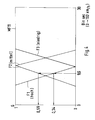
- FIG. 4 shows a membership function MF11 for the acceleration B data field of the first data records as a diagram.
- the diagram contains functions F1, F2, F3 for three linguistic input terms: high, medium and low, which stands for relative linguistic evaluations "high acceleration”, “medium acceleration” and “low acceleration”.
- a weight G of each linguistic evaluation is obtained from the three functions, which indicates the degree to which the linguistic evaluation applies to a specific acceleration value. It can be seen from the membership function MF11 that an acceleration value of 9.6 sec (from 0 to 100 km / h) is described to a degree of 0.34 by the "high acceleration” rating and 0.59 by the " medium acceleration” rating.
- Such membership functions for data fields are based on of expertise on the content of the first records and below Consideration of the language understanding of the user group regarding the importance of linguistic evaluations.
- the number of Entry dates are not set to three. So can also be Set up membership functions with four or more entry terms. Membership functions can also be seen from the first records derive if it is assumed that this is for each linguistic evaluation a given distribution, for example the normal distribution (Gaussian distribution) fulfill.
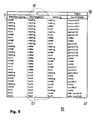
- Figure 5 shows the rule sets RS for the example of sportiness in the form of a Table.
- the table contains all possible combinations of Input terms ET of the data fields DF that correspond to the membership value for Contribute to sportiness.
- Standard sentences for the individual fuzzy linguistic terms are like membership functions based on expertise in the Content of the first data records and taking into account the Language understanding of the user group established.
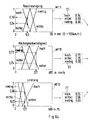
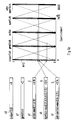
- FIGS. 6a to 6c show those shown schematically in FIG. 3 Steps shown in detail for an example.
- Figure 6d indicates how the figures 6a to 6c are to be placed side by side:
- Figure 6a is in portrait format to arrange, to the right of this is Figure 6b in landscape format.
- Right of Figure 6b is then to position Figure 6c also in landscape format.
- FIG. 6a initially shows how input terms ET of a fuzzy logic level are obtained for a specific motor vehicle from first membership functions MF11, MF12, MF13.
- the motor vehicle has an acceleration of 9.6 sec (0 - 100 km / h).
- the entry terms high, medium and low with the associated weights 0.34, 0.59 and 0.00 are read from the first membership function MF11.
- the membership function MF12 delivers the entry terms and weights for a top speed of 221 km / h: high 0.72, medium 0.25 and low 0.00, as well as the membership function MF13 for an output of 127 hp the entry dates and weights: high 0.21, medium 0.66 and low 0.00.
- the fuzzy interference is formed from the input terms. This step is shown in Figure 6b.
- the predefined rule sets RS applied. There are all combinations formed by input terms ET of different data fields in which the weights of all input terms ET are not equal to 0.
- the RS rule sets provide an exit term AT for each combination.
- the weight G of the individual output terms AT is calculated according to the rule of fuzzy logic Theory as the minimum min of the combined weights Entry dates ET.
- Multiplier DoS (Degree of Support) occur with any combination. He represents a correction factor to weight the individual rule sets.
- the maximum max is formed from the weights of the starting terms AT of the same name according to the rules of the fuzzy logic theory. This step can be seen in FIG. 6c. As a result of the fuzzy interference, the following initial terms AT with the associated weights G are obtained in the example: medium 0.18, sporty 0.41 and very sporty 0.34.
- FIG. 6c also shows the second membership function MF2, from which the the starting terms AT and their weights G the sought Affiliation value as focus (center-of-maximum method) emerges.
- the end result for the membership value the sportiness is therefore 7970.
- Another possibility, one The membership value is to be determined as the center-of-area Method in which the areas under the function curves are taken into account becomes.
- a method for obtaining a list of data records on a database query that best match the database query is shown in FIG. 7 in a flow chart.
- a database query is made by a user in a first step S1.
- the user specifies a membership value for the motor vehicle he is looking for in the unsharp language terms. For example, if the user desires a sporty but nevertheless inexpensive motor vehicle, he chooses a high membership value for sportiness and a low membership value for costs.
- the database query corresponds to a vector K , which consists of the four membership values specified by the user:
- the first data record is read from the database.
- This can also be used as a vector A by including the membership values stored in the database:
- a fourth step S4 it is particularly advantageous in a fourth step S4 to use an evaluation function f on the difference vector D to apply.
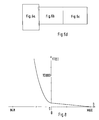
- a possible evaluation function is shown in FIG. 8. On the horizontal axis is a component of the vector D plotted and the associated function value on the vertical axis. Since the range of values that the components of A and K can assume there is a maximum MAX and a minimum MIN value that the components of D can accept. In the exemplary embodiment, the largest value is MAX 10000 and the smallest value MIN is -10000.
- the evaluation function f shown in FIG. 8 is: where O is a positive offset value, which is 1000 in the exemplary embodiment, and D is a component of the vector D .
- the fourth step can also be omitted if the best possible match is required when querying the database and if the query criteria are not to be met if the query criteria are not upgraded.
- this case corresponds to the application of an evaluation function f , which is the identity function.
- a final value E is used as a norm of the evaluated difference vector B educated.
- the norm can be, for example, the geometric mean value from the components of the evaluated difference vector B be: where the index i is the individual components of the vector B designated. Other possible norms could be the sum of the amounts of the individual components or the sum of higher powers of the components.
- This end value E is stored for the relevant data record in the database and the next data record is read. The same procedure is used as for the first one in order to also calculate a final value E for the next data set. The next data record is then read again and so on until condition B1 is met that the last data record in the database has been reached and an end value E has been calculated for it.
- a list sorted according to the end values E is created of the records are output, with the record being the smallest End value E comes first.
- end values E stored, but for example only the lowest 10 of the previously calculated final values. This saves storage space and that for the Sorting the list required time is shortened. It will be issued at the end a list of the 10 vehicles that are best on the Database query and thus fit the user's request.
- the database in the exemplary embodiment can act as a buying advisor for the Serve buying a new motor vehicle.
- the user is in this case a customer who requests a database query indicates new motor vehicle.
- the database query is adapted to the language feeling of a user. This can be done by means of an adaptation function, which is determined from information provided by the user, and which is based on the components of the first vector ( K ), the second vector ( A ), the difference vector ( D ) or the evaluated difference vector ( B ) is applied.
- Information about the user can be, for example, his age, his income, his driving experience or his previously used type of motor vehicle.
- An adjustment function can then be determined from this, which, for example, reduces the desired membership value for costs in the case of a high income.
- the fuzzy linguistic terms can also be weighted. If, for example, a user indicates that he places particular value on an inexpensive vehicle and less on sportiness, this can be taken into account using the adaptation function. In the case mentioned, an over-fulfillment of the desired membership value for costs would be rewarded by a data set with a stronger upgrading of the data set than an over-fulfillment of the desired membership value for sportiness. Conversely, an under-fulfillment of the desired membership value for costs would lead to a greater devaluation of the corresponding data record than an equally large under-fulfillment of the desired affiliation value for sportiness. To achieve this, the adaptation function can be based on the corresponding components of the difference vector D or the evaluated difference vector B be applied.
- An advantage of the method of querying the database is that it is for Users who have no knowledge of database handling easily is to be handled, since only one input device for each unsharp linguistic term of a predetermined amount of fuzzy linguistic Terms a desired input value from a given range possible input values must be specified. On an input device can do this, for example, by means of a graphically represented Slider made for each fuzzy linguistic term will.
- the procedure for querying the database is also particularly suitable for Users who do not or have little specialized knowledge of the content concerning the database. So hangs the fuzzy linguistic Term costs in the exemplary embodiment not only from the purchase price and from Consumption, but also from the cubic capacity via the vehicle tax and on the motor vehicle tax on the performance of the motor vehicle. A User doing a database query with the fuzzy linguistic However, if you want to carry out the term costs, you need this specialist knowledge not available because it is already in the database.
- the procedure is suitable for interrogation the database also especially for use as an online service in particular on the Internet.
Landscapes
- Engineering & Computer Science (AREA)
- Physics & Mathematics (AREA)
- Theoretical Computer Science (AREA)
- Fuzzy Systems (AREA)
- Mathematical Physics (AREA)
- Software Systems (AREA)
- Probability & Statistics with Applications (AREA)
- Computational Linguistics (AREA)
- Data Mining & Analysis (AREA)
- Databases & Information Systems (AREA)
- General Engineering & Computer Science (AREA)
- General Physics & Mathematics (AREA)
- Automation & Control Theory (AREA)
- Information Retrieval, Db Structures And Fs Structures Therefor (AREA)
Applications Claiming Priority (2)
| Application Number | Priority Date | Filing Date | Title |
|---|---|---|---|
| DE19639349A DE19639349A1 (de) | 1996-09-25 | 1996-09-25 | Datenbank, Verfahren zum Ableiten einer Datenbank und Verfahren zur Abfrage einer Datenbank |
| DE19639349 | 1996-09-25 |
Publications (2)
| Publication Number | Publication Date |
|---|---|
| EP0833263A2 true EP0833263A2 (fr) | 1998-04-01 |
| EP0833263A3 EP0833263A3 (fr) | 2000-08-23 |
Family
ID=7806837
Family Applications (1)
| Application Number | Title | Priority Date | Filing Date |
|---|---|---|---|
| EP97440084A Withdrawn EP0833263A3 (fr) | 1996-09-25 | 1997-09-23 | Base de données, procédé pour créer une base de données et procédé pour interroger une base de données |
Country Status (5)
| Country | Link |
|---|---|
| EP (1) | EP0833263A3 (fr) |
| JP (1) | JPH10187764A (fr) |
| AU (1) | AU3917997A (fr) |
| CA (1) | CA2215140A1 (fr) |
| DE (1) | DE19639349A1 (fr) |
Cited By (1)
| Publication number | Priority date | Publication date | Assignee | Title |
|---|---|---|---|---|
| WO2005048135A1 (fr) * | 2003-11-06 | 2005-05-26 | General Electric Company | Procede et systeme de recherche intelligente de proprietes du petrole brut et connaissances associees |
Families Citing this family (3)
| Publication number | Priority date | Publication date | Assignee | Title |
|---|---|---|---|---|
| DE19963123B4 (de) * | 1999-12-24 | 2004-09-16 | Deutsche Telekom Ag | Analytisches Informationssystem |
| DE10219515A1 (de) * | 2002-04-30 | 2003-11-13 | Volkswagen Ag | Werkstoffspezifische Kennzeichnung eines Bauteils |
| CN112465337B (zh) * | 2020-11-25 | 2024-10-15 | 重庆邮电大学 | 一种基于犹豫模糊语言术语集的污水处理厂选址方法 |
Family Cites Families (5)
| Publication number | Priority date | Publication date | Assignee | Title |
|---|---|---|---|---|
| JPH03260769A (ja) * | 1990-03-09 | 1991-11-20 | S R Soken Kk | ファジイ検索方法 |
| JP2804403B2 (ja) * | 1991-05-16 | 1998-09-24 | インターナショナル・ビジネス・マシーンズ・コーポレイション | 質問回答システム |
| JP2768007B2 (ja) * | 1991-09-30 | 1998-06-25 | オムロン株式会社 | ファジィ検索装置および方法,データ・ベース作成装置および方法,検索装置および方法ならびにメンバーシップ関数作成装置および方法 |
| DE69223979T2 (de) * | 1991-10-04 | 1998-08-27 | Omron Tateisi Electronics Co | Fuzzy-züruckgewinnungsgerät und verfahren dafür |
| EP0639814B1 (fr) * | 1993-08-20 | 2000-06-14 | Canon Kabushiki Kaisha | Appareil et méthode de recherche textuelle adaptive, non-littérale |
-
1996
- 1996-09-25 DE DE19639349A patent/DE19639349A1/de not_active Withdrawn
-
1997
- 1997-09-23 EP EP97440084A patent/EP0833263A3/fr not_active Withdrawn
- 1997-09-24 AU AU39179/97A patent/AU3917997A/en not_active Abandoned
- 1997-09-24 CA CA002215140A patent/CA2215140A1/fr not_active Abandoned
- 1997-09-25 JP JP9301393A patent/JPH10187764A/ja active Pending
Cited By (1)
| Publication number | Priority date | Publication date | Assignee | Title |
|---|---|---|---|---|
| WO2005048135A1 (fr) * | 2003-11-06 | 2005-05-26 | General Electric Company | Procede et systeme de recherche intelligente de proprietes du petrole brut et connaissances associees |
Also Published As
| Publication number | Publication date |
|---|---|
| JPH10187764A (ja) | 1998-07-21 |
| EP0833263A3 (fr) | 2000-08-23 |
| AU3917997A (en) | 1998-04-02 |
| CA2215140A1 (fr) | 1998-03-25 |
| DE19639349A1 (de) | 1998-03-26 |
Similar Documents
| Publication | Publication Date | Title |
|---|---|---|
| EP0910829B1 (fr) | Systeme de banque de donnees | |
| DE69433165T2 (de) | Assoziatives textsuch- und wiederauffindungssystem | |
| DE69031772T2 (de) | Verfahren zur Informations-Wiedergewinnung für ein Datenbanksystem | |
| DE69811066T2 (de) | Datenzusammenfassungsgerät. | |
| DE69423137T2 (de) | Verfahren zur Verarbeitung mehrerer elektronisch gespeicherte Dokumente | |
| DE60118973T2 (de) | Verfahren zum abfragen einer struktur komprimierter daten | |
| DE3855494T2 (de) | Abfragevorrichtung und -methode | |
| DE69521435T2 (de) | Verfahren und einrichtung zum extrahieren von information aus einer datenbank | |
| DE10034694B4 (de) | Verfahren zum Vergleichen von Suchprofilen sowie dessen Verwendung | |
| EP0833263A2 (fr) | Base de données, procédé pour créer une base de données et procédé pour interroger une base de données | |
| DE4435903A1 (de) | Verfahren, EDV-System und Zugriffsfilter zum gebietsorientierten Zugriff auf eine Datenbank | |
| DE19624614C2 (de) | Verfahren zum Entwurf oder zur Adaption eines Fuzzy-Reglers oder eines Systems von verknüpften Fuzzy-Reglern | |
| EP1285385B1 (fr) | Procede de recherche d'objets | |
| WO1998007100A1 (fr) | Selection assistee par ordinateur de donnees d'entrainement pour reseau neuronal | |
| DE10160920B4 (de) | Verfahren und Vorrichtung zur Erzeugung eines Extrakts von Dokumenten | |
| EP1124187A1 (fr) | Appareil, support d'enregistrement et méthode pour retrouver des objets ayant une forte similarité avec un objet donné | |
| DE102016217191A1 (de) | Verfahren zum Auswählen und Bewerten von einer Vielzahl von Datensätzen aus zumindest einer Datenquelle | |
| EP1783631A1 (fr) | Procédé destiné à trier des jeux de données par relevance feedback | |
| DE102008012187A1 (de) | Darstellung von Bildschirminhalten in Abhängigkeit von Kompetenzfunktionen | |
| EP0563077B1 (fr) | Procede pour la determination mecanisee d'elements de donnees identiques contenus dans deux sequences de donnees | |
| EP4506867A1 (fr) | Procédé et appareil de traitement assisté par ordinateur d'un circuit quantique sur une unité de traitement quantique | |
| DE102020209999A1 (de) | Verfahren und Vorrichtung zum Steuern einer Kryptowährung | |
| DE102009020499A1 (de) | Verfahren zum suchenden Abgleich zwischen mindestens einer Suchdatenmenge mit mindestens einer Objektdatenmenge | |
| DE102005027575A1 (de) | Verfahren zur Auswahl von Datensätzen | |
| DE10017608B4 (de) | Verfahren zur Durchführung von Operationen in einem Datenbanksystem |
Legal Events
| Date | Code | Title | Description |
|---|---|---|---|
| PUAI | Public reference made under article 153(3) epc to a published international application that has entered the european phase |
Free format text: ORIGINAL CODE: 0009012 |
|
| AK | Designated contracting states |
Kind code of ref document: A2 Designated state(s): AT BE CH DE ES FR GB IT LI NL SE |
|
| RAP3 | Party data changed (applicant data changed or rights of an application transferred) |
Owner name: ALCATEL |
|
| RAP3 | Party data changed (applicant data changed or rights of an application transferred) |
Owner name: ALCATEL |
|
| PUAL | Search report despatched |
Free format text: ORIGINAL CODE: 0009013 |
|
| AK | Designated contracting states |
Kind code of ref document: A3 Designated state(s): AT BE CH DE DK ES FI FR GB GR IE IT LI LU MC NL PT SE |
|
| AKX | Designation fees paid |
Free format text: AT BE CH DE ES FR GB IT LI NL SE |
|
| STAA | Information on the status of an ep patent application or granted ep patent |
Free format text: STATUS: THE APPLICATION IS DEEMED TO BE WITHDRAWN |
|
| 18D | Application deemed to be withdrawn |
Effective date: 20010331 |