EP0833458A2 - Verfahren und Anordnung zur Echokompensation - Google Patents
Verfahren und Anordnung zur Echokompensation Download PDFInfo
- Publication number
- EP0833458A2 EP0833458A2 EP97113607A EP97113607A EP0833458A2 EP 0833458 A2 EP0833458 A2 EP 0833458A2 EP 97113607 A EP97113607 A EP 97113607A EP 97113607 A EP97113607 A EP 97113607A EP 0833458 A2 EP0833458 A2 EP 0833458A2
- Authority
- EP
- European Patent Office
- Prior art keywords
- signal
- auxiliary
- coefficients
- echo
- echo cancellation
- Prior art date
- Legal status (The legal status is an assumption and is not a legal conclusion. Google has not performed a legal analysis and makes no representation as to the accuracy of the status listed.)
- Withdrawn
Links
Images

Classifications
-
- H—ELECTRICITY
- H04—ELECTRIC COMMUNICATION TECHNIQUE
- H04B—TRANSMISSION
- H04B3/00—Line transmission systems
- H04B3/02—Details
- H04B3/20—Reducing echo effects or singing; Opening or closing transmitting path; Conditioning for transmission in one direction or the other
- H04B3/23—Reducing echo effects or singing; Opening or closing transmitting path; Conditioning for transmission in one direction or the other using a replica of transmitted signal in the time domain, e.g. echo cancellers
Definitions
- the invention relates to a method and an arrangement for Echo cancellation with a filter whose coefficients are in Dependence on an echo signal can be regulated.
- Echo cancellers are used in signal connections, in particular Voice connections, used with long term. Your task is caused by transmit signals as echo signals to compensate for designated interference signals that are not caused by a Complete decoupling of the transmission paths arise, for example in the hybrid and at reflection points the transformer of a connected two-wire line.
- the echo signal is simulated from the transmitted signal by means of a filter arrangement and subtracted from the received signal composed of the received signal and the echo signal.
- adaptive digital filters often transversal filters (FIR filters)
- FIR filters transversal filters
- Echo cancellers should on the one hand be quick and accurate set according to the echo signal and on the other hand their Keep setting stable if there is simultaneous intercom Speech signals overlay the echo signal. Cause problems also strong environmental noise, which is also the echo signal are superimposed.
- the echo canceller should still adjust can. For a quick setting, the filter coefficients quickly, i.e. change with large increments, for a precise and noise-insensitive setting a fine-tuned filter adjustment is necessary.
- auxiliary coefficients for Controlling the control behavior proves to be particularly advantageous.
- the auxiliary coefficients become like the filter coefficients determined from the same signals, but the Auxiliary coefficients continuously reduced, so that after the Correlation values reach around zero vary.
- the auxiliary coefficient can also, according to the desired Control behavior, always by a constant amount or after a predetermined algorithm can be reduced
- the echo canceller shown in FIG. 1 is for PCM-coded Signals executed.
- the telephone connection between a first participant TE1 and a second participant TE2 has such a long running time that the first Participant TE1 generated transmission signal s (t) based on the insufficient decoupling of the transmit and receive signal path disturbing via the Echoweg EW as echo signal ec (t) noticeable.
- the long running time can be for example satellite connections or very long cables be caused, but also by coding the signals, the for example bit rate reduction or error correction to serve.
- the disturbing echo signals arise mainly in the hybrid circuit GA of the second participant TE2, which the Signal s (t) as analog signals via a digital-to-analog converter DAW are fed.
- the analog echo signal is the Speech signal sp (t) superimposed and with this into a digital Sum signal es (t) implemented.
- the echo canceller has a delay chain formed by register T, which together with the multipliers M and the summer SUM forms a transversal filter.
- the transmission signal s (t) converted into linear signal values x 0 (t), x 1 (t), x 2 (t), ..., x n (t) is fed to this filter.
- the registers work with the clock of the transmitted data words or samples.
- the correlators K0 to Kn are preceded by known relativizing devices REL, which relate the current amplitude values to the previous amplitude values (mean, effective or peak values). To a certain extent there is a normalization which leads to the relativized signal values x * 0 , ..., x * n + 1 .
- the echo equalizer When considering the mode of operation, it is initially assumed that there is no two-way communication. With the help of the transversal filter, the echo equalizer generates a correction signal ke (t) which is modeled as closely as possible on the echo signal ec (t) and is subtracted from it. The remaining error signal (residual echo signal) e (t) controls the correlators, which each consist of a simple multiplier X0, X1 ... and a summation circuit formed from a memory ST and an adder AD.
- Each correlator determines a filter coefficient C0, C1, ... with which the transmission signal s (t) - after implementation and different delay in the registers of the transversal filter - multiplied in one of the multipliers M. becomes. Often there is still an adjustment of the orders of magnitude totalized value and the required filter coefficient required by a between the correlator and the assigned multiplier M inserted circuit or by shifting the binary digits.
- the of the signal components delivered to the multipliers are in one Summer SUM combined to the correction signal ke (t).
- An auxiliary correlator KH0 to KHn is assigned to each correlator. Its multipliers XH0, XH1, ... are supplied with the same input values as the assigned correlator, but the stored auxiliary coefficient is reduced regularly with the occurrence of a clock pulse TI (time interval, for example, 4 ms). This function is implemented by a divider D and a subtractor SUB. If the signal is missing or / and uncorrelated, the auxiliary coefficient is therefore changed in the direction of zero.
- the amount of the auxiliary coefficient HC0, HC1, ... is formed from the auxiliary coefficient in an amount image B, which controls the respectively assigned multiplier X0, X1, ... of the associated correlator K0, K1, ...
- a speech signal sp (t) of the second Participant transferred to the first participant TE1, which the unwanted Echo signal ec (t) is superimposed.
- Echo signal is the sum signal es (t) at the send path input of the second subscriber to the subtractor SUB.
- a Speech recognition SE therefore ensures that the control process interrupted when certain conditions are met that suggest two-way communication, for example if the sum signal es (t) is greater than the transmission signal s (t) of the first participant.
- the basic circuit diagram can be simplified in terms of circuitry, by dividing the multipliers of the correlators and Auxiliary correlators can be used together or as parts a computing unit.
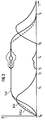
- the control process ends at time T1.
- the remaining error signal is not correlated or has an extremely low amplitude. Since the auxiliary coefficient is now continuously reduced, its value decreases until it becomes zero at time T 2 .
- the reduction of the Auxiliary coefficients by dividing its current value by one constant factor F (e.g. 64) divided and in a subtractor SUB is subtracted from the current value.
- F constant factor
- the course of the filter coefficient can also be the current one Value to be reduced by constant amounts, etc.
- the function can be switched or by threshold values limited to certain phases of the control process.
Landscapes
- Engineering & Computer Science (AREA)
- Computer Networks & Wireless Communication (AREA)
- Signal Processing (AREA)
- Cable Transmission Systems, Equalization Of Radio And Reduction Of Echo (AREA)
- Filters That Use Time-Delay Elements (AREA)
Abstract
Description
Bei höheren Anforderungen an den Echokompensator werden adaptive digitale Filter, häufig Transversalfilter (FIR-Filter), eingesetzt, deren Koeffizienten einstellbar sind. Ein solcher Echokompensator ist beispielsweise in den "Kleinheubacher Berichten" 26, 1983 des fernmeldetechnischen Zentralamtes in Darmstadt, Seiten 427 - 435 beschrieben.
- Figur 1
- ein Prinzipschaltbild des Echokompensators und.
- Figur 2
- ein Zeitdiagramm.
Der Echoentzerrer erzeugt mit Hilfe des Transversalfilters ein Korrektursignal ke(t), das dem Echosignal ec(t) möglichst genau nachgebildet ist und von diesem subtrahiert wird. Das verbleibende Fehlersignal (Restechosignal) e(t) steuert die Korrelatoren, die jeweils aus einem einfachen Multiplizierer X0, X1 ... und einer aus einem Speicher ST und einem Addierer AD gebildeten Summationsschaltung bestehen.
Ist der Betrag des Hilfkoeffizienten noch gering, so wird der Filterkoeffizient Kx anfangs trotzdem nur sehr langsam ansteigen. Die Funktion CS zeigt zum Vergleich den Anstieg des Filterkoeffizienten eines herkömmlichen Kompensators ohne die Beaufschlagung mit dem Hilfskoeffizienten. Steigt dann der Betrag des Hilfskoeffizienten aufgrund der Korrelation zwischen Sendesignal und Echo bzw. Fehlersignal stark an, nimmt die Schrittweite des Filterkoeffizient immer mehr zu, bis der Hilfskoeffizient gegen Ende des Abgleichvorganges wieder kleiner wird, weil auch das Fehlersignal kleiner geworden ist und die periodische Verminderung überwiegt. Damit sinkt auch die Änderungsgeschwindigkeit des Filterkoeffizienten zusätzlich, so daß ein sehr stabiler und genauer Abgleich erzielt wird. Der Regelvorgang ist zum Zeitpunkt T1 beendet. Das verbleibende Fehlersignal ist nicht korreliert oder weist eine äußerst geringe Amplitude auf. Da der Hilfskoeffizient nun fortlaufend weiter verringert wird, sinkt sein Wert, bis er zum Zeitpunkt T2 Null wird.

Hier zeigen sich die großen Vorteile dieser Schaltung. Wenn beispielsweise das Gegensprechen des zweiten Teilnehmers TE2 zwischen den Zeitpunkten T3 und T4 noch nicht erkannt wurde, was zu einer Unterbrechung des Regelvorganges geführt hätte, können sich durch zufällige Korrelation zwar die Hifskoeffizienten rasch ändern, sie werden aber keine größeren Werte erreichen, da störenden Signalanteile nicht mit dem Sendesignal s(t) korreliert sind und korrelierte Signale die Voraussetzung für ein stärkeres Anwachsen der Hilfskoeffizienten sind. Kleine Hilfskoeffizienten bedeuten aber eine verlangsamte Koeffizientenregelung: es kommt daher nur zu kleinen Änderungen der Filterkoeffizienten Cx (x = 0, 1, 2, ...). Das Regelverhalten ist äußerst stabil.
Claims (10)
- Verfahren zur Echokompensation, bei dem durch Korrelation eines Sendesignals s(t) und eines Fehlersignals e(t) Filterkoeffizienten (C0, C1, ... ) gewonnenen werden, die ein Korrektursignal ke(t) bestimmen, das zur Eliminierung eines störenden Signalanteils e(t) von dem Empfangssignal em(t) subtrahiert wird,
dadurch gekennzeichnet,daß in derselben Weise Hifskoeffizienten (HC0, HC1; ... ) ermittelt werden, deren Betrag das die Größe des Produkts aus dem Sendesignal s(t) und dem Fehlersignal e(t) steuert, unddaß der Wert der Hilfskoeffizienten (HC0, HC1; ... ) fortlaufend verringert wird. - Verfahren zur Echokompensation,
dadurch gekennzeichnet,daß fortlaufend ein konstanter Bruchteil des Wertes des Hifskoeffizienten (HC0, HC1; ... ) subtrahiert wird. - Verfahren zur Echokompensation,
dadurch gekennzeichnet,daß fortlaufend ein konstanter Betrag vom Betrag des Hifskoeffizienten (HC0, HC1; ... ) subtrahiert wird. - Verfahren zur Echokompensation,
dadurch gekennzeichnet,daß zur Ermittung der Filterkoeffizienten (C0, C1, ... ) und Hilfskoeffizienten (HC0, HC1; ... ) nur das Vorzeichenbit des Fehlersignals e(t) verwendet wird. - Verfahren zur Echokompensation,
dadurch gekennzeichnet,daß zur Ermittung der Filterkoeffizienten (C0, C1, ... ) und Hilfskoeffizienten (HC0, HC1; ... ) ein relativiertes Fehlersignal e*(t) verwendet wird, das die unterschiedlichen Amplituden des Fehlersignals e(t) zumindest weitgehend ausgleicht. - Verfahren zur Echokompensation nach einem der vorhergehenden Ansprüche,
dadurch gekennzeichnet,daß zur Ermittlung der der Filterkoeffizienten (C0, C1, ... ) und Hilfskoeffizienten (HC0, HC1; ... ) ein relativiertes Sendesignal (x*0(t), ..., x*n(t)) verwendet wird, das die unterschiedlichen Amplituden des Sendesignals zumindest weitgehend ausgleicht. - Anordnung zur Echokompensation mit einer Filteranordnung (T, M, SUM) zur Erzeugung eines Kompensationssignals ke(t) aus dem Sendesignal s(t) und Korrelatoren (K0, K1, K2, ...) zur Einstellung der Filterkoeffizienten (C0, C1, C2, ...) sowie einer Subtraktionseinrichtung (SUB), der zur Eliminierung des störenden Echosignals es(t) das gewonnene Kompensationssignal ke(t) zugeführt wird,
dadurch gekennzeichnet,daß den Korrelatoren (K0, K1, K2, ...) jeweils ein Hilfskorrelator (KH0, KH1, KH2, ...) zugeordnet ist, dem wie dem Korrelator ebenfalls das Sendesignal (s(t) bzw. x0(t), x1(t), x2(t), ..., xn(t)) und ein Fehlersignal e(t) zugeführt wird, aus denen Hilfskoeffizienten (HC0, HC1, ... ) ermittelt werden, deren Betrag schrittweise verkleinert wird, unddaß die Korrelatoren (K0, K1, K2, ...) derart ausgebildet sind, daß das aus den Eingangssignalen gebildete Produkt in seinem Wert von den Hilfskorrelatoren (KH0, KH1, KH2, ...) mitbestimmt wird. - Anordnung zur Echokompensation nach Anspruch 7
dadurch gekennzeichnet,daß ein Signalkonverter (LIN1) vorgesehen ist, der ein PCM-codiertes Sendesignal s(t) in ein linear codiertes Sendesignal x0(t), x1(t), x2(t), ..., xn(t) umsetzt. - Anordnung zur Echokompensation nach Anspruch 7 oder 8,
dadurch gekennzeichnet,daß den Korrelatoren (K0, K1, K2, ...) und Hilfskorrelatoren (KH0, KH1, KH2, ...) eine Relativierungseinrichtung (REL) vorgeschaltet ist, die die Amplituden von in der Lautstärke schwankenden unterschiedlichen Sendesignalen s(t) zumindest weitgehend ausgleicht. - Anordnung zur Echokompensation
dadurch gekennzeichnet,daß der Hilfskorrelator (KH0, KH1, KH2, ...) einen Dividierer (D) enthält, der den gespeicherten Wert des Hilfskoeffizienten (HC0, HC1, ... ) durch einen Faktor >1 dividiert, und einen Subtrahierer (SUB) enthält, der dem Speicher (ST) des Korrelators (KH0, KH1, KH2, ...) vorgeschaltet ist.
Applications Claiming Priority (2)
| Application Number | Priority Date | Filing Date | Title |
|---|---|---|---|
| DE19639703 | 1996-09-26 | ||
| DE19639703A DE19639703C2 (de) | 1996-09-26 | 1996-09-26 | Verfahren und Anordnung zur Echokompensation |
Publications (2)
| Publication Number | Publication Date |
|---|---|
| EP0833458A2 true EP0833458A2 (de) | 1998-04-01 |
| EP0833458A3 EP0833458A3 (de) | 2000-12-06 |
Family
ID=7807048
Family Applications (1)
| Application Number | Title | Priority Date | Filing Date |
|---|---|---|---|
| EP97113607A Withdrawn EP0833458A3 (de) | 1996-09-26 | 1997-08-06 | Verfahren und Anordnung zur Echokompensation |
Country Status (4)
| Country | Link |
|---|---|
| US (1) | US5953410A (de) |
| EP (1) | EP0833458A3 (de) |
| CN (1) | CN1086073C (de) |
| DE (1) | DE19639703C2 (de) |
Families Citing this family (8)
| Publication number | Priority date | Publication date | Assignee | Title |
|---|---|---|---|---|
| US7068780B1 (en) * | 2000-08-30 | 2006-06-27 | Conexant, Inc. | Hybrid echo canceller |
| US7003093B2 (en) * | 2000-09-08 | 2006-02-21 | Intel Corporation | Tone detection for integrated telecommunications processing |
| US20020116186A1 (en) * | 2000-09-09 | 2002-08-22 | Adam Strauss | Voice activity detector for integrated telecommunications processing |
| US6738358B2 (en) * | 2000-09-09 | 2004-05-18 | Intel Corporation | Network echo canceller for integrated telecommunications processing |
| US20030219113A1 (en) * | 2002-05-21 | 2003-11-27 | Bershad Neil J. | Echo canceller with double-talk and channel impulse response adaptation |
| US7480377B2 (en) * | 2003-12-31 | 2009-01-20 | Intel Corporation | Dual adaptive filter apparatus and method |
| DE102004025576B4 (de) * | 2004-05-25 | 2006-03-30 | Infineon Technologies Ag | Sende-und Empfangsanordnung mit einer Regelung zur Störsignalunterdrückung |
| DE102005039621A1 (de) * | 2005-08-19 | 2007-03-01 | Micronas Gmbh | Verfahren und Vorrichtung zur adaptiven Reduktion von Rausch- und Hintergrundsignalen in einem sprachverarbeitenden System |
Family Cites Families (13)
| Publication number | Priority date | Publication date | Assignee | Title |
|---|---|---|---|---|
| LU85402A1 (de) * | 1983-12-01 | 1984-09-11 | Siemens Ag | Verfahren und schaltungsanordnung zur kompensation von uebersprech-u./o.echosignalen |
| EP0280898A1 (de) * | 1987-02-18 | 1988-09-07 | Siemens Aktiengesellschaft | Schaltungsanordnung zum Unterdrücken von Echosignalen |
| DE3874997T2 (de) * | 1987-07-20 | 1993-03-25 | Nippon Electric Co | Echokompensator. |
| FR2628918B1 (fr) * | 1988-03-15 | 1990-08-10 | France Etat | Dispositif annuleur d'echo a filtrage en sous-bandes de frequence |
| DE3879200D1 (de) * | 1988-08-30 | 1993-04-15 | Siemens Ag | Verfahren und schaltungsanordnung fuer eine digitale regelung der frequenz und/oder der phase von abtasttaktimpulsen. |
| JPH0748681B2 (ja) * | 1989-02-23 | 1995-05-24 | 日本電気株式会社 | エコー消去器の係数制御方法 |
| JP2518433B2 (ja) * | 1990-01-24 | 1996-07-24 | 日本電気株式会社 | ダブルト―ク検出回路 |
| NL9001016A (nl) * | 1990-04-27 | 1991-11-18 | Philips Nv | Digitale echocompensator met een dubbelspraakdetector. |
| JP2836277B2 (ja) * | 1991-03-14 | 1998-12-14 | 国際電信電話株式会社 | エコーキャンセル装置 |
| JP2853455B2 (ja) * | 1992-05-15 | 1999-02-03 | ケイディディ株式会社 | エコーキャンセラ |
| US5473686A (en) * | 1994-02-01 | 1995-12-05 | Tandy Corporation | Echo cancellation apparatus |
| US5535194A (en) * | 1994-07-14 | 1996-07-09 | Motorola, Inc. | Method and apparatus for echo canceling with double-talk immunity |
| US5852661A (en) * | 1995-02-17 | 1998-12-22 | Advanced Micro Devices, Inc. | Adaptive echo cancellation used with echo suppression to reduce short and long duration echoes |
-
1996
- 1996-09-26 DE DE19639703A patent/DE19639703C2/de not_active Expired - Fee Related
-
1997
- 1997-08-06 EP EP97113607A patent/EP0833458A3/de not_active Withdrawn
- 1997-09-26 US US08/938,961 patent/US5953410A/en not_active Expired - Fee Related
- 1997-09-26 CN CN97119625A patent/CN1086073C/zh not_active Expired - Fee Related
Also Published As
| Publication number | Publication date |
|---|---|
| US5953410A (en) | 1999-09-14 |
| DE19639703C2 (de) | 1999-05-20 |
| DE19639703A1 (de) | 1998-04-09 |
| CN1179653A (zh) | 1998-04-22 |
| CN1086073C (zh) | 2002-06-05 |
| EP0833458A3 (de) | 2000-12-06 |
Similar Documents
| Publication | Publication Date | Title |
|---|---|---|
| DE2713478C2 (de) | ||
| DE3687114T2 (de) | Datenuebertragungssystem. | |
| DE69216321T2 (de) | Jitterkompensationseinrichtung für einen Echokompensator | |
| DE2914945A1 (de) | Elektronische gabelschaltung | |
| DE2734941C2 (de) | Echoauslöscheinrichtung | |
| DE2846105C2 (de) | Schaltungsanordnung zur Echounterdrückung bei Duplexübertragung | |
| DE69325357T2 (de) | Eine Technik zur Reduzierung von Echos in Konferenzkommunikationen | |
| DE19639703C2 (de) | Verfahren und Anordnung zur Echokompensation | |
| DE3044582C2 (de) | Digitaler Verstärker, insbesondere zur Verwendung in einer digitalen Fernsprech-Teilnehmerschaltung | |
| EP0019194B1 (de) | Digital-Fernmeldesystem mit mindestens einem Vierdrahtleitungsabschnitt | |
| EP0280898A1 (de) | Schaltungsanordnung zum Unterdrücken von Echosignalen | |
| DE2245542A1 (de) | Vorrichtung zur echounterdrueckung | |
| EP0133298B1 (de) | Verfahren und Schaltungsanordnung zur Kompensation von Echosignalen | |
| DE19639702C2 (de) | Verfahren und Anordnung zur Begrenzung des Restechos | |
| DE3877279T2 (de) | Digitale recheneinrichtung fuer eine anlage zur datenuebertragung im 2b1q-code oder aehnlichem. | |
| DE1957637C3 (de) | Echounterdrücker | |
| DE3238550A1 (de) | Stoerungsunterdruecker | |
| DE2647305A1 (de) | Verfahren und vorrichtung zur echokompensation | |
| DE3040241A1 (de) | Schaltungsanordnung zur messung der daempfung einer uebertragungsstrecke | |
| DE3908865A1 (de) | Geraet zur verarbeitung digitaler signale | |
| DE3212056A1 (de) | Verfahren und schaltungsanordnung zur durchfuehrung des verfahrens zur adaptiven echoloeschung in endgeraeten fuer duplex-datenuebertragung ueber zweidrahtleitungen | |
| DE2334546C2 (de) | Echokompensator | |
| EP0543274B1 (de) | Verfahren und Anordnung zur Steuerung eines Restecho-Begrenzers | |
| DE3610383A1 (de) | Adaptiver entscheidungsrueckgekoppelter entzerrer | |
| DE3702316C1 (en) | Method and circuit arrangements for adaptive echo cancellation in terminals for duplex transmission |
Legal Events
| Date | Code | Title | Description |
|---|---|---|---|
| PUAI | Public reference made under article 153(3) epc to a published international application that has entered the european phase |
Free format text: ORIGINAL CODE: 0009012 |
|
| AK | Designated contracting states |
Kind code of ref document: A2 Designated state(s): DE FR GB IT |
|
| AX | Request for extension of the european patent |
Free format text: AL;LT;LV;RO;SI |
|
| PUAL | Search report despatched |
Free format text: ORIGINAL CODE: 0009013 |
|
| AK | Designated contracting states |
Kind code of ref document: A3 Designated state(s): AT BE CH DE DK ES FI FR GB GR IE IT LI LU MC NL PT SE |
|
| AX | Request for extension of the european patent |
Free format text: AL;LT;LV;RO;SI |
|
| 17P | Request for examination filed |
Effective date: 20010122 |
|
| AKX | Designation fees paid |
Free format text: DE FR GB IT |
|
| 17Q | First examination report despatched |
Effective date: 20060626 |
|
| STAA | Information on the status of an ep patent application or granted ep patent |
Free format text: STATUS: THE APPLICATION IS DEEMED TO BE WITHDRAWN |
|
| 18D | Application deemed to be withdrawn |
Effective date: 20061107 |