EP0833488B1 - Page Web, interface permettant de fixer des caractéristiques téléphoniques - Google Patents
Page Web, interface permettant de fixer des caractéristiques téléphoniques Download PDFInfo
- Publication number
- EP0833488B1 EP0833488B1 EP97306773A EP97306773A EP0833488B1 EP 0833488 B1 EP0833488 B1 EP 0833488B1 EP 97306773 A EP97306773 A EP 97306773A EP 97306773 A EP97306773 A EP 97306773A EP 0833488 B1 EP0833488 B1 EP 0833488B1
- Authority
- EP
- European Patent Office
- Prior art keywords
- client
- feature
- server
- provider
- internet
- Prior art date
- Legal status (The legal status is an assumption and is not a legal conclusion. Google has not performed a legal analysis and makes no representation as to the accuracy of the status listed.)
- Expired - Lifetime
Links
- 238000004891 communication Methods 0.000 claims description 37
- 230000004044 response Effects 0.000 claims description 18
- 238000000034 method Methods 0.000 claims description 8
- 230000004048 modification Effects 0.000 description 4
- 238000012986 modification Methods 0.000 description 4
- 238000012546 transfer Methods 0.000 description 4
- 238000013519 translation Methods 0.000 description 3
- 238000010586 diagram Methods 0.000 description 2
- 238000005516 engineering process Methods 0.000 description 2
- 230000006870 function Effects 0.000 description 2
- 230000003993 interaction Effects 0.000 description 2
- 238000007726 management method Methods 0.000 description 2
- 230000004913 activation Effects 0.000 description 1
- 230000005540 biological transmission Effects 0.000 description 1
- 230000009849 deactivation Effects 0.000 description 1
- 238000013461 design Methods 0.000 description 1
- QYSGYZVSCZSLHT-UHFFFAOYSA-N octafluoropropane Chemical compound FC(F)(F)C(F)(F)C(F)(F)F QYSGYZVSCZSLHT-UHFFFAOYSA-N 0.000 description 1
- 238000012358 sourcing Methods 0.000 description 1
Images

Classifications
-
- H—ELECTRICITY
- H04—ELECTRIC COMMUNICATION TECHNIQUE
- H04M—TELEPHONIC COMMUNICATION
- H04M1/00—Substation equipment, e.g. for use by subscribers
- H04M1/253—Telephone sets using digital voice transmission
- H04M1/2535—Telephone sets using digital voice transmission adapted for voice communication over an Internet Protocol [IP] network
-
- H—ELECTRICITY
- H04—ELECTRIC COMMUNICATION TECHNIQUE
- H04M—TELEPHONIC COMMUNICATION
- H04M3/00—Automatic or semi-automatic exchanges
- H04M3/42—Systems providing special services or facilities to subscribers
- H04M3/42136—Administration or customisation of services
- H04M3/42153—Administration or customisation of services by subscriber
- H04M3/42161—Administration or customisation of services by subscriber via computer interface
-
- H—ELECTRICITY
- H04—ELECTRIC COMMUNICATION TECHNIQUE
- H04M—TELEPHONIC COMMUNICATION
- H04M7/00—Arrangements for interconnection between switching centres
- H04M7/0024—Services and arrangements where telephone services are combined with data services
- H04M7/003—Click to dial services
-
- H—ELECTRICITY
- H04—ELECTRIC COMMUNICATION TECHNIQUE
- H04M—TELEPHONIC COMMUNICATION
- H04M1/00—Substation equipment, e.g. for use by subscribers
- H04M1/247—Telephone sets including user guidance or feature selection means facilitating their use
- H04M1/2477—Telephone sets including user guidance or feature selection means facilitating their use for selecting a function from a menu display
-
- H—ELECTRICITY
- H04—ELECTRIC COMMUNICATION TECHNIQUE
- H04M—TELEPHONIC COMMUNICATION
- H04M3/00—Automatic or semi-automatic exchanges
- H04M3/42—Systems providing special services or facilities to subscribers
- H04M3/56—Arrangements for connecting several subscribers to a common circuit, i.e. affording conference facilities
-
- H—ELECTRICITY
- H04—ELECTRIC COMMUNICATION TECHNIQUE
- H04Q—SELECTING
- H04Q2213/00—Indexing scheme relating to selecting arrangements in general and for multiplex systems
- H04Q2213/13109—Initializing, personal profile
-
- H—ELECTRICITY
- H04—ELECTRIC COMMUNICATION TECHNIQUE
- H04Q—SELECTING
- H04Q2213/00—Indexing scheme relating to selecting arrangements in general and for multiplex systems
- H04Q2213/13141—Hunting for free outlet, circuit or channel
-
- H—ELECTRICITY
- H04—ELECTRIC COMMUNICATION TECHNIQUE
- H04Q—SELECTING
- H04Q2213/00—Indexing scheme relating to selecting arrangements in general and for multiplex systems
- H04Q2213/13175—Graphical user interface [GUI], WWW interface, visual indication
-
- H—ELECTRICITY
- H04—ELECTRIC COMMUNICATION TECHNIQUE
- H04Q—SELECTING
- H04Q2213/00—Indexing scheme relating to selecting arrangements in general and for multiplex systems
- H04Q2213/13204—Protocols
-
- H—ELECTRICITY
- H04—ELECTRIC COMMUNICATION TECHNIQUE
- H04Q—SELECTING
- H04Q2213/00—Indexing scheme relating to selecting arrangements in general and for multiplex systems
- H04Q2213/13349—Network management
-
- H—ELECTRICITY
- H04—ELECTRIC COMMUNICATION TECHNIQUE
- H04Q—SELECTING
- H04Q2213/00—Indexing scheme relating to selecting arrangements in general and for multiplex systems
- H04Q2213/13389—LAN, internet
Definitions
- This invention relates to communication systems, including telephone systems and the Internet.
- voice calls can be carried by the Internet (or some other data transport network) between a pair of Internet phones or voice-enabled computers. It is also known that voice calls carried by the Internet can be interfaced by a gateway to the telephone network so that an Internet phone or a voice-enabled computer connected to the Internet can engage in a voice call with a standard telephone connected to the telephone network. Illustrative examples of such capabilities are disclosed in "Netspeak's Hot Internet Sun Product", Computer Telephony , Vol. 5, Issue 8 (March 1996), pp. 120-124, and in “Internet Hop Off", Computer Telephony , Vol. 4, Issue 3 (March 1996), pp. 10-11.
- Telephony features can be provided to computers or terminals on a local area network (or some other data transport network) via a feature server.
- An illustrative example of such capability is disclosed in U.S. Patent No. 5,550,906.
- Telephony features are features that are provided to telephones and telephone calls by modern telecommunications switching systems, such as the Lucent Technologies Inc. Definity® private branch exchange.
- call redirection e.g., call forwarding, call coverage
- multiple call appearances e.g., hold, drop, transfer, conference
- call center agent features e.g., agent login, agent logout, after-work mode, etc.
- call center management information features e.g., maximum time in queue, queue length, skill-based split staffing levels, etc.
- calling party information features e.g., position in queue, advertising-on-hold, etc.
- feature servers is limited to "closed” networks that are controlled by a single entity --e.g., a single company's local area network-- that can dictate what equipment and feature-access protocol is used on the network, and that the use of feature servers is not possible on "open” networks such as the Internet.
- This invention is directed to solving these and other problems and disadvantages of the prior art.
- a way for clients to access server-based telephony features in a non-telephony client-server network, such as the Internet in a platform-independent and network-independent fashion and without need for any modifications to the clients.
- WWW World Wide Web
- browsers allow Internet clients to access WWW information servers over the Internet in a platform-independent and network-independent fashion, and this capability is exploited by the invention in that clients use browsers to access server-based telephony features via the Internet in a manner similar to how they conventionally access information via the WWW.
- the feature accesses are affected in a platform-independent and network-independent fashion by conventional Internet clients.
- an apparatus that enables telephony features to be accessed in a client-server network as defined in claim 5.
- the client request an individual telephony feature by communicating data (e.g., a marked up feature-form page) that correspond to that feature with the server via the predefined protocol.
- data e.g., a marked up feature-form page
- the server responds to the communicated data by requesting a provider of the telephony features to provide the individual telephony feature to the client, and the provider does so.
- the server thus does for the client what the client was not able to do itself.
- the capability to access telephony features is easily implementable in and retrofittable into conventional networks, such as the Internet, without modification of either the Internet or its communication protocol, or the clients.
- a method of accessing telephony features over the Internet by using the World Wide Web comprises the following steps.
- a WWW browser of a client requests a WWW page that defines a telephony feature form from a WWW server via the Internet.
- the WWW server responds by providing the requested WWW page to the client via the Internet.
- the WWW browser indicates selection of an individual telephony feature by marking up the telephony feature form of the received WWW page, and the client sends the marked up WWW page via the Internet to an interpreter (e.g., to the WWW server).
- the interpreter interprets, the marked up telephony feature form to determine the selected individual telephony feature.
- a provider of the telephony features then provides the selected individual telephony feature.
- the conventional WWW and WWW browsers are used without modification to access telephony features via the Internet.
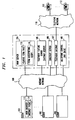
- FIG. 1 shows a combined data-and-telephony communications network.
- the non-telephony portion of the communications network of FIG. 1 comprises a plurality of clients 101-103 and servers 104-106 interconnected by the Internet network 109, and a multipoint control unit (MCU) 108 for providing multipoint connections (conference calls, for example).
- the telephony portion of the communications network of FIG. 1 comprises a plurality of telephones 111-112 interconnected by a telephone network 110, and a telephony gateway 107 that interconnects the Internet network 109 with telephone network 110.
- MCU multipoint control unit
- Servers 104-106 include a World-Wide Web (WWW) server 104.
- the World-Wide Web is a de-facto standard protocol for finding and transferring information on the Internet between information-requesting clients and information-sourcing servers. Information is typically transferred in data entities known as pages.
- the World Wide Web is based on (includes) the Transmission Control Protocol/Internet Protocol (TCP/IP) for effecting communications connections over the Internet.
- TCP/IP Transmission Control Protocol/Internet Protocol
- the World Wide Web also provides a means for client interactions with pages of information, known as the hypertext mark-up language (HTML).
- HTML hypertext mark-up language
- Servers 104-106 further include a directory server 106 which provides conventional directory services to clients 101-103, and a telephony feature server 105 which provides telephony features to clients 101-103.
- Telephony feature server 105 also functions as a "gateway keeper", in the parlance of the ITU H.323 protocol standard, for telephony gateway 107 which is a "gateway" in the parlance of the H.323 protocol standard.
- Units 104-108 may either be individual entities, or they may comprise a single entity that performs all of their functions. An illustrative such single entity is the Lucent Technologies Inc. Multi Media Communications eXchange (MMCX).
- MMCX Multi Media Communications eXchange
- each client 101-103 is equipped with a WWW browser 113, such as a Netscape Navigator or a Microsoft Internet Explorer.
- a WWW browser 113 such as a Netscape Navigator or a Microsoft Internet Explorer.
- each client 101-102 is equipped with an Internet phone 114, such as the Intel Iphone, or the Netscape CoolTalk or LiveMedia products.
- WWW server 104 includes a feature-form page 115 and an associated form-interpreting script 116.
- Page 115 allows users of clients 101-102 to select and activate or deactivate telephony features and to specify and enter parameters for those features via browsers 113, and script 116 interprets the users' selections and entries.
- page 115 presents users of clients 101-102 with a plurality of virtual (graphical-display) actuators each corresponding to, and labeled with, a corresponding feature, and for each feature that has user-specifiable parameters, provides one or more fill-in-the blank fields in which the users can enter desired parameter values (e.g., telephone numbers).
- desired parameter values e.g., telephone numbers
- page 115 The use that is made of page 115 by clients 101-103 to access telephony features is flowcharted in FIG. 2.
- a user of a client 101 uses browser 113 to access server 104 and select page 115 in a conventional WWW manner, at step 200.
- Server 104 receives the request, at step 202, and in response conventionally downloads page 115 to client 101, at step 204.
- the downloaded page 115 carries a blank feature form --one on which features are not selected and parameters are not filled out.
- Browser 113 receives page 115, and presents (displays) page 115 to the user via a display of client 101, at step 206, again in a conventional manner.
- browser 113 uses browser 113 to mark up the feature form: the user selects individual features and fills in parameter values on the feature form of page 115, at step 208.
- browser 113 uploads the marked up page 115 back to server 104, at step 210, again in a conventional WWW manner.
- Server 104 receives the marked up page 115, at step 212, and in response executes form-interpreting script 116 to interpret the marked up page 115, i.e., to determine from the feature form which features the user selected, whether the user selected to activate or deactivate selected features, and what parameters the user has specified for selected features, at step 214. Based on this determination, server 104 may find that client 101 may need to be connected to server 105. In that case, server 104 communicates in the conventional Internet manner (using the TCP/IP protocol) with client 101 to cause it to redirect its connection to server 105, at step 216.
- Client 101 responds to any received redirection instructions from server 104, at step 226, by terminating its connection to server 104 and establishing a new connection to server 105, at step 228, again conventionally (by using the TCP/IP protocol).
- Server 104 then downloads the data that it derived from marked up page 115 to telephone feature server 105 as a feature access request, at step 218. If necessary, server 105 responds to receipt of this request, at step 220, by again redirecting the data (but not the control) portion of the connection of client 101 to another entity, such as gateway 107 or MCU 108, at step 222.
- Server 105 also interacts with server 106, gateway 107, and MCU 108 and uses the received data in the interactions in a conventional manner to effect the feature and parameter selections made by the user, at step 224.
- Client 101 responds to any received redirection instructions from server 105, at step 226, by terminating its data (media) connection to server 105 and establishing a new data connection to the entity indicated by the redirection instructions, at step 228.
- client 101 maintains its control connection to server 105, whereby server 105 can send conventional Internet network 109 commands to client 101.
- server 104 responds to the user's selection of a telephone call by sending directions to client 101 to connect to telephony feature server 105, and sends a telephone call request along with an identifier of client 101 and the called telephone number to server 105.
- server 105 correlates client 101 with the telephone call request and sends directions to client 101 to access telephony gateway 107.
- Gateway 107 establishes a call to telephone 111 through telephone network 110, and when client 101 accesses gateway 107 through Internet network 109, gateway 107 correlates client 101 with the telephone call and interfaces the Internet connection with the telephone call.
- server 104 responds to the user's selection of a conference call by sending directions to client 101 to connect to telephony feature server 105, and sends a conference call request along with an identifier of client 101 and the called telephone numbers, URLs, and/or handles to server 105.
- server 105 When client 101 accesses server 105 through Internet network 109, server 105 correlates client 101 with the conference call request, sends any received URLs and/or handles to directory server 106 for translation into presently-corresponding URLs, and sends a conference identifier and any called telephone numbers to gateway 107. In response, server 106 returns the presently-corresponding URLs, and gateway 107 establishes calls to called telephones 111-112 through telephone network 110. Server 105 also sends directions to client 101 to connect to MCU 108, sends the identifier of client 101 and the presently-corresponding URLs of called clients 102-103 along with the conference identifier to MCU 108, and sends directions to MCU 108 to access gateway 107 with the conference identifier.
- MCU 108 accesses gateway 107 through Internet network 109 and provides the conference identifier to gateway 107.
- gateway 107 interfaces the telephone calls to telephones 111-112 with the Internet connection to MCU 108.
- MCU 108 also establishes connections to called clients 102-103 through the Internet network 109, and conferences together the Internet connections to called clients 102-103, client 101, and telephone gateway 107.
- server 104 To activate redirection of incoming calls to another destination (e.g., another client 102), user of client 101 uses browser 113 to click on a "redirection on" feature virtual button of downloaded page 115 and fills in one or more URLs or handles of one or more clients 102 in a corresponding field.
- server 104 Upon receipt of the marked up page 115, server 104 responds to the user's selection by sending a redirection activation request along with the received URLs or handles to server 105.
- Server 105 responds by sending the received URLs or handles to directory server 106 for translation into presently-corresponding URLs.
- server 105 When server 106 returns the presently-corresponding URLs, server 105 sends then back to directory server 106 with instructions to store them as a sequence of presently-corresponding URLs for the URL of client 101. Thereafter, any Internet or telephone calls placed by any client 102-103 or telephone 111-112 to client 101 will be redirected by directory server 106 to the presently-corresponding URLs in sequence until one of them accepts the call or the sequence is exhausted, in a conventional manner.
- server 104 responds by sending a redirection deactivation request along with the URL of client 101 to server 105.
- Server 105 responds by sending the URL of client 101 to directory server 106 with instructions to store it as the presently-corresponding URL for client 101. Thereafter, any Internet or telephone calls placed by any client 102-103 or telephone 111-112 to client 101 will be directed by directory server 106 to client 101, in a conventional manner.
- server 104 responds to the user's selection by sending a transfer request along with the received URLs or handles of clients 102 and 103 to server 105.
- Server 105 responds by sending the received URL or handle of client 103 to directory server 106 for translation into a presently-corresponding URL.
- directory-server 106 returns the presently-corresponding URL, server 105 sends this URL of client 103 to client 102 along with instructions to connect to this URL.
- Client 102 responds by breaking the Internet network 109 connection to client 101 and establishing a new Internet network 109 connection to client 103, in a conventional manner.
- the marked-up feature form page can be returned by a client to an entity other than WWW server 104 --to telephony feature server 105, for example-- in which case the form-interpreting script would be executed by that entity.
- each client's browser may be permanently equipped with an "applet" (e.g., a Java application running on the client's browser) that presents the client's user with a user interface for selecting features and parameters (e.g., a feature form) and then communicates the user's selections, in Java or otherwise (instead of a marked up HTML document page), to a server.
- an "applet” e.g., a Java application running on the client's browser
- features and parameters e.g., a feature form
Landscapes
- Engineering & Computer Science (AREA)
- Signal Processing (AREA)
- General Engineering & Computer Science (AREA)
- Telephonic Communication Services (AREA)
- Computer And Data Communications (AREA)
- Data Exchanges In Wide-Area Networks (AREA)
Claims (8)
- Procédé pour accéder à des fonctions téléphoniques dans un réseau (109) client-serveur, dans lequel des clients (101 à 103) et des serveurs (104) communiquent les uns avec les autres, via un protocole de communication défini à l'avance, comprenant les étapes suivantes :le client (101) demande (200 à 210) une fonction téléphonique particulière qui n'est pas accessible via une commande du protocole de communication défini à l'avance, en communiquant des données correspondantes au serveur, via le protocole défini à l'avance ;le serveur (104) répond aux données communiquées en demandant (212 à 218) à un fournisseur (105) des fonctions téléphoniques de fournir la fonction téléphonique particulière au client ;le serveur répond en outre, aux données communiquées en demandant (216) au client de se connecter au fournisseur ;en réponse à la requête de connexion au fournisseur, le client établit (226, 228) une connexion de communication de données et de commande avec le fournisseur ;en réponse à la requête émanant du serveur, de fourniture de la fonction téléphonique particulière, le fournisseur fournit (220 à 224) la fonction téléphonique particulière au client, y compris les étapes suivantes :le fournisseur (222) donne au client l'instruction de réacheminer une partie de données de la connexion de communication de données et de commande du fournisseur à une entité (106 ; 107 ; 108) de communication et de maintenir une partie de commande de la connexion de communication de données et de commande, connectée au fournisseur, de manière à ce que le fournisseur puisse exercer un contrôle sur le client, tandis que le client communique avec l'entité ; eten réponse à l'instruction, le client établit (228) une connexion de communication avec l'entité de communication pour communiquer avec l'entité de communication.
- Procédé suivant la revendication 1 comprenant Internet et ayant le Web pour protocole de communication défini à l'avance, dans lequel :l'étape où le client émet une requête en communiquant comprend les étapes suivantes :le client demande (200) une page (115) de formulaire de fonctions au serveur,en réponse à la réception de la page de formulaire de fonctions provenant du serveur, le client balise (206 à 208) le formulaire de fonctions pour indiquer le choix de la fonction particulière et des paramètres quelconques de la fonction sélectionnée, etle client envoie (210) la page de formulaire de fonctions balisée au serveur ; etl'étape où le serveur répond en demandant un fournisseur comprend les étapes suivantes :en réponse à la requête d'une page de formulaire de fonctions émanant du client, il envoie (202 à 204) la page de formulaire de fonctions au client,en réponse à la réception de la page de formulaire de fonctions balisée provenant du client, il interprète (212 à 214) la page de formulaire de fonctions balisée pour déterminer la fonction particulière et les paramètres quelconques, eten réponse à la détermination, il demande (218) au fournisseur de fournir la fonction particulière en utilisant les paramètres quelconques.
- Procédé suivant la revendication 1 dans un réseau comprenant Internet et ayant le Web (WWW) pour protocole de communication défini à l'avance, dans lequel :l'étape où le client émet une requête en communiquant comprend les étapes suivantes :un navigateur (113) Web d'un client demande (200) une page (115) Web qui définit un formulaire de fonctions téléphoniques, à un serveur Web via Internet,en réponse à la requête, le serveur Web fournit (202 à 204) la page Web demandée au client via Internet,en réponse à la réception de la page Web demandée, le navigateur Web indique la sélection de la fonction téléphonique particulière en balisant (206 à 208) le formulaire de fonctions téléphoniques de la page Web reçue ; etle client envoie (210) la page Web balisée à un interpréteur (116) via Internet ; etl'étape où le serveur répond en outre, comprend l'étape suivante :en réponse à la réception par l'interpréteur de la page Web balisée, l'interpréteur interprète (212 à 214) le formulaire de fonctions téléphoniques balisé pour déterminer la fonction téléphonique sélectionnée.
- Procédé selon la revendication 3, dans lequel
l'étape où le serveur répond en outre, comprend l'étape suivante :en réponse à la détermination, le serveur demande (216) au client, via un protocole TCP/IP sur Internet, de se connecter au fournisseur ; etl'étape où le client établit une connexion de communication de données et de commande comprend l'étape suivante :en réponse à la requête de connexion au fournisseur, le client établit (226 à 228) une connexion de communication de données et de commande avec le fournisseur, via le protocole TCP/IP sur Internet. - Dispositif qui permet d'accéder à des fonctions téléphoniques dans un réseau (109) client-serveur, dans lequel des clients (101 à 103) et des serveurs (104) communiquent les uns avec les autres, via un protocole de communication défini à l'avance, et dans lequel un fournisseur (105) des fonctions téléphoniques répond à des requêtes de fonctions en fournissant les fonctions demandées, le dispositif comprenant :un serveur (104) conçu pour se connecter au réseau afin de communiquer avec un client (101) via le protocole défini à l'avance et d'obtenir des données correspondant à une fonction téléphonique particulière qui n'est pas accessible via une commande du protocole de communication défini à l'avance, demandée par le client, le serveur étant conçu pour répondre aux données obtenues, en demandant (216) au client d'établir une connexion de communication de données et de commande avec le fournisseur et en demandant au fournisseur de fournir la fonction téléphonique particulière au client ; etle fournisseur (105) conçu pour répondre à la requête en fournissant la fonction téléphonique particulière, pour faire en sorte que le client réachemine une partie de données de la connexion de communication de données et de commande du fournisseur à une entité (106 ; 107 ; 108) de communication et qu'il maintienne une partie de commande de la connexion de communication de données et de commande, connectée au fournisseur, de manière à ce que le fournisseur puisse exercer un contrôle sur le client, tandis que le client communique avec l'entité.
- Procédé suivant la revendication 5 pour un réseau qui comprend Internet et qui a le Web pour protocole de communication défini à l'avance, dans lequel :e serveur comprend :une page (115) de formulaire de fonctions,un moyen (104 : 202 à 204) répondant à la réception en provenance d'un client d'une requête de la page de formulaire de fonctions, en envoyant la page de formulaire de fonctions au client,un moyen (106 ; 104 : 212 à 214) répondant à la réception en provenance d'un client de la page de formulaire de fonctions balisée par le client pour indiquer le choix de la fonction particulière et des paramètres quelconques de la fonction sélectionnée, en interprétant la page de formulaire de fonctions balisée afin de déterminer la fonction sélectionnée et les paramètres quelconques, etun moyen (104 : 218) répondant à la détermination, en demandant au fournisseur de fournir la fonction sélectionnée en utilisant les paramètres quelconques.
- Dispositif suivant la revendication 5 pour un réseau qui comprend Internet et qui a le Web (WWW) pour protocole de communication défini à l'avance, dans lequel :le serveur est un serveur Web qui comprend :un dispositif (104 : 202 à 204) conçu pour répondre à une requête de page (115) Web qui définit un formulaire de fonctions téléphoniques, reçue en provenance d'un client via Internet, au moyen du Web, en fournissant la page Web demandée au client via Internet au moyen du Web, etun interpréteur (116, 104 : 212 à 214) conçu pour répondre à la réception, en provenance du client via Internet, au moyen du Web, de la page Web définissant à présent le formulaire de fonctions téléphoniques balisé par le client pour indiquer le choix d'une fonction téléphonique particulière, en interprétant le formulaire de fonctions téléphoniques balisé pour déterminer la fonction téléphonique sélectionnée.
- Dispositif suivant la revendication 6, dans lequel :le serveur comprend en outre :un deuxième dispositif (104: 216 à 218) conçu pour répondre à la détermination, en demandant au fournisseur des fonctions téléphoniques de fournir la fonction téléphonique sélectionnée et en demandant au client, via un protocole TCP/IP sur Internet, d'établir la connexion de communication de données et de commande avec le fournisseur via le protocole TCP/IP sur Internet.
Applications Claiming Priority (2)
| Application Number | Priority Date | Filing Date | Title |
|---|---|---|---|
| US710220 | 1996-09-13 | ||
| US08/710,220 US6031836A (en) | 1996-09-13 | 1996-09-13 | Web-page interface to telephony features |
Publications (2)
| Publication Number | Publication Date |
|---|---|
| EP0833488A1 EP0833488A1 (fr) | 1998-04-01 |
| EP0833488B1 true EP0833488B1 (fr) | 2005-08-31 |
Family
ID=24853125
Family Applications (1)
| Application Number | Title | Priority Date | Filing Date |
|---|---|---|---|
| EP97306773A Expired - Lifetime EP0833488B1 (fr) | 1996-09-13 | 1997-09-02 | Page Web, interface permettant de fixer des caractéristiques téléphoniques |
Country Status (5)
| Country | Link |
|---|---|
| US (1) | US6031836A (fr) |
| EP (1) | EP0833488B1 (fr) |
| JP (1) | JP3315903B2 (fr) |
| CA (1) | CA2208912C (fr) |
| DE (1) | DE69734090T2 (fr) |
Families Citing this family (136)
| Publication number | Priority date | Publication date | Assignee | Title |
|---|---|---|---|---|
| US6108704A (en) | 1995-09-25 | 2000-08-22 | Netspeak Corporation | Point-to-point internet protocol |
| GB9603582D0 (en) | 1996-02-20 | 1996-04-17 | Hewlett Packard Co | Method of accessing service resource items that are for use in a telecommunications system |
| US6194992B1 (en) * | 1997-04-24 | 2001-02-27 | Nomadix, Llc | Mobile web |
| JP2000516053A (ja) * | 1996-05-07 | 2000-11-28 | ウェブライン コミュニケーションズ コーポレーション | インターネットマルチメディアの内容を電話及びオーディオ通信と統合するための方法及びその装置 |
| US6728784B1 (en) * | 1996-08-21 | 2004-04-27 | Netspeak Corporation | Collaborative multimedia architecture for packet-switched data networks |
| US6266328B1 (en) * | 1996-08-26 | 2001-07-24 | Caritas Technologies, Inc. | Dial up telephone conferencing system controlled by an online computer network |
| US6862625B1 (en) | 1996-09-27 | 2005-03-01 | Avaya Technology Corp. | Method and apparatus for real time network communication |
| GB9621524D0 (en) * | 1996-10-16 | 1996-12-04 | British Telecomm | Multimedia call centre |
| US7263526B1 (en) | 1996-10-30 | 2007-08-28 | Avaya Technology Corp. | Method and apparatus for embedding chat functions in a web page |
| US6785708B1 (en) | 1996-10-30 | 2004-08-31 | Avaya Inc. | Method and apparatus for synchronizing browse and chat functions on a computer network |
| US5917817A (en) * | 1996-12-06 | 1999-06-29 | International Business Machines Corporation | User invocation of services in public switched telephone network via parallel data networks |
| US5946684A (en) | 1997-02-18 | 1999-08-31 | Ameritech Corporation | Method and system for providing computer-network related information about a calling party |
| US6785266B2 (en) * | 1998-03-02 | 2004-08-31 | Robert Swartz | Internet controlled telephone system |
| US6778652B2 (en) * | 1997-03-14 | 2004-08-17 | Itex, Inc. | Method and apparatus for establishing and facilitating a voice call connection from a client computer to a PSTN extension |
| US6816880B1 (en) * | 1997-03-26 | 2004-11-09 | Concerto Software, Inc. | Browser user inter face for client workstation |
| US6209036B1 (en) * | 1997-06-06 | 2001-03-27 | International Business Machines Corporation | Management of and access to information and other material via the world wide web in an LDAP environment |
| CA2296488C (fr) * | 1997-07-15 | 2007-05-01 | British Telecommunications Public Limited Company | Gestion d'appels multimedia |
| US6483911B1 (en) * | 1997-11-05 | 2002-11-19 | Unisys Corporation | Methods and apparatus for providing external access to executable call flows of a network application |
| SE510954C2 (sv) * | 1997-11-11 | 1999-07-12 | Ericsson Telefon Ab L M | Metod och anordning för verifiering av talportstjänster |
| US6424994B1 (en) * | 1997-11-26 | 2002-07-23 | Microsoft Corporation | Switchable calling within combined conferencing and calling |
| EP0924940B1 (fr) * | 1997-12-19 | 2003-03-19 | Telefonaktiebolaget Lm Ericsson | Dispositif et méthode de commande de services de base et de services supplémentaires dans un système téléphonique |
| GB2334646B (en) * | 1998-02-19 | 2003-02-19 | Leighton Hanna King | Dial on demand internet web site |
| US6714641B2 (en) * | 1998-04-03 | 2004-03-30 | Nortel Networks, Ltd | Web based personal directory |
| US6175832B1 (en) * | 1998-05-11 | 2001-01-16 | International Business Machines Corporation | Method, system and program product for establishing a data reporting and display communication over a network |
| EP1080573B1 (fr) * | 1998-05-20 | 2007-08-29 | BRITISH TELECOMMUNICATIONS public limited company | Numeroteur |
| GB9810880D0 (en) * | 1998-05-20 | 1998-07-22 | British Telecomm | Dialler |
| US6567398B1 (en) * | 1998-06-05 | 2003-05-20 | Lucent Technologies Inc. | Distributed call system |
| US6480484B2 (en) * | 1998-06-09 | 2002-11-12 | Avaya Technology Corp. | Internet-intranet greeting service |
| US6088433A (en) | 1998-07-09 | 2000-07-11 | Sbc Technology Resources, Inc. | System and method for forwarding call from disconnected telephone number to new telephone number |
| DE19835433A1 (de) * | 1998-08-05 | 2000-02-10 | Siemens Ag | Telefon mit konfigurierbarer Bedienoberfläche |
| US6889195B2 (en) * | 1998-09-15 | 2005-05-03 | Cim Ltd. | System and method for utilizing a computer network in conjunction with traditional telemarketing |
| US6876632B1 (en) | 1998-09-25 | 2005-04-05 | Hitachi, Ltd. | Intelligent network with an internet call waiting function |
| US6128304A (en) * | 1998-10-23 | 2000-10-03 | Gte Laboratories Incorporated | Network presence for a communications system operating over a computer network |
| US7245607B1 (en) * | 1998-11-09 | 2007-07-17 | Siemens Communications, Inc. | Apparatus and method for telephony feature access and gatekeeper policy interaction on combined ToL/PBX systems |
| US7194554B1 (en) * | 1998-12-08 | 2007-03-20 | Nomadix, Inc. | Systems and methods for providing dynamic network authorization authentication and accounting |
| US8713641B1 (en) | 1998-12-08 | 2014-04-29 | Nomadix, Inc. | Systems and methods for authorizing, authenticating and accounting users having transparent computer access to a network using a gateway device |
| US8266266B2 (en) * | 1998-12-08 | 2012-09-11 | Nomadix, Inc. | Systems and methods for providing dynamic network authorization, authentication and accounting |
| US6400804B1 (en) * | 1998-12-10 | 2002-06-04 | At&T Corp. | On-hold activity selection apparatus and method |
| US6718015B1 (en) * | 1998-12-16 | 2004-04-06 | International Business Machines Corporation | Remote web page reader |
| US6868140B2 (en) * | 1998-12-28 | 2005-03-15 | Nortel Networks Limited | Telephony call control using a data network and a graphical user interface and exchanging datagrams between parties to a telephone call |
| US7216348B1 (en) | 1999-01-05 | 2007-05-08 | Net2Phone, Inc. | Method and apparatus for dynamically balancing call flow workloads in a telecommunications system |
| US6614784B1 (en) * | 1999-01-15 | 2003-09-02 | Telefonaktiebolaget L M Ericsson (Publ) | System and method for providing supplementary services (SS) in an integrated telecommunications network |
| US6463145B1 (en) * | 1999-01-29 | 2002-10-08 | Microsoft Corporation | Computer-implemented call forwarding options and methods therefor in a unified messaging system |
| US6791970B1 (en) | 1999-02-11 | 2004-09-14 | Mediaring Ltd. | PC-to-phone for least cost routing with user preferences |
| US6707811B2 (en) * | 1999-03-19 | 2004-03-16 | Estara, Inc. | Internet telephony for ecommerce |
| US7082422B1 (en) | 1999-03-23 | 2006-07-25 | Microstrategy, Incorporated | System and method for automatic transmission of audible on-line analytical processing system report output |
| US6567796B1 (en) | 1999-03-23 | 2003-05-20 | Microstrategy, Incorporated | System and method for management of an automatic OLAP report broadcast system |
| US8321411B2 (en) | 1999-03-23 | 2012-11-27 | Microstrategy, Incorporated | System and method for management of an automatic OLAP report broadcast system |
| US6690672B1 (en) * | 1999-04-05 | 2004-02-10 | Avaya Inc. | Method and apparatus for placing an intelligent telephone call using an internet browser |
| US6631186B1 (en) * | 1999-04-09 | 2003-10-07 | Sbc Technology Resources, Inc. | System and method for implementing and accessing call forwarding services |
| US6891940B1 (en) | 2000-07-19 | 2005-05-10 | Sbc Technology Resources, Inc. | System and method for providing remote access to telecommunications services |
| US20020009071A1 (en) * | 1999-05-06 | 2002-01-24 | Erez Yaary | Communication system and a method for performing telephone calls |
| AU2765800A (en) * | 1999-05-11 | 2000-11-16 | Alcatel | Method for configuring a telephone's keys to access network services |
| US9208213B2 (en) | 1999-05-28 | 2015-12-08 | Microstrategy, Incorporated | System and method for network user interface OLAP report formatting |
| US8607138B2 (en) | 1999-05-28 | 2013-12-10 | Microstrategy, Incorporated | System and method for OLAP report generation with spreadsheet report within the network user interface |
| US7039040B1 (en) * | 1999-06-07 | 2006-05-02 | At&T Corp. | Voice-over-IP enabled chat |
| US6404746B1 (en) * | 1999-07-13 | 2002-06-11 | Intervoice Limited Partnership | System and method for packet network media redirection |
| US6292542B1 (en) * | 1999-08-11 | 2001-09-18 | At&T Corp. | Method and apparatus for handling an in-call request for emergency services |
| US6885734B1 (en) | 1999-09-13 | 2005-04-26 | Microstrategy, Incorporated | System and method for the creation and automatic deployment of personalized, dynamic and interactive inbound and outbound voice services, with real-time interactive voice database queries |
| US6850603B1 (en) | 1999-09-13 | 2005-02-01 | Microstrategy, Incorporated | System and method for the creation and automatic deployment of personalized dynamic and interactive voice services |
| US6768788B1 (en) | 1999-09-13 | 2004-07-27 | Microstrategy, Incorporated | System and method for real-time, personalized, dynamic, interactive voice services for property-related information |
| US6940953B1 (en) * | 1999-09-13 | 2005-09-06 | Microstrategy, Inc. | System and method for the creation and automatic deployment of personalized, dynamic and interactive voice services including module for generating and formatting voice services |
| US7197461B1 (en) | 1999-09-13 | 2007-03-27 | Microstrategy, Incorporated | System and method for voice-enabled input for use in the creation and automatic deployment of personalized, dynamic, and interactive voice services |
| US6829334B1 (en) | 1999-09-13 | 2004-12-07 | Microstrategy, Incorporated | System and method for the creation and automatic deployment of personalized, dynamic and interactive voice services, with telephone-based service utilization and control |
| US7266181B1 (en) | 1999-09-13 | 2007-09-04 | Microstrategy, Incorporated | System and method for the creation and automatic deployment of personalized dynamic and interactive voice services with integrated inbound and outbound voice services |
| US8130918B1 (en) | 1999-09-13 | 2012-03-06 | Microstrategy, Incorporated | System and method for the creation and automatic deployment of personalized, dynamic and interactive voice services, with closed loop transaction processing |
| US6836537B1 (en) | 1999-09-13 | 2004-12-28 | Microstrategy Incorporated | System and method for real-time, personalized, dynamic, interactive voice services for information related to existing travel schedule |
| US7340040B1 (en) | 1999-09-13 | 2008-03-04 | Microstrategy, Incorporated | System and method for real-time, personalized, dynamic, interactive voice services for corporate-analysis related information |
| US20050223408A1 (en) * | 1999-09-13 | 2005-10-06 | Microstrategy, Incorporated | System and method for real-time, personalized, dynamic, interactive voice services for entertainment-related information |
| US6964012B1 (en) * | 1999-09-13 | 2005-11-08 | Microstrategy, Incorporated | System and method for the creation and automatic deployment of personalized, dynamic and interactive voice services, including deployment through personalized broadcasts |
| CA2343754A1 (fr) * | 1999-09-24 | 2001-04-05 | Dialpad.Com. Inc. | Systeme de communications evolutif |
| US7418402B2 (en) | 1999-11-18 | 2008-08-26 | First Aura, Llc | Method and system for providing local information over a network |
| FR2801453B1 (fr) * | 1999-11-22 | 2002-02-08 | Cit Alcatel | Procede de provisionnement domestique et itinerant pour un terminal mobile |
| DE19958508A1 (de) * | 1999-12-04 | 2001-06-07 | Deutsche Telekom Ag | Einrichtung zur Bedienung eines Endgerätes |
| CN100355262C (zh) * | 1999-12-21 | 2007-12-12 | 川铁情报系统株式会社 | 呼叫中心运用方法及装置 |
| US6922721B1 (en) * | 2000-10-17 | 2005-07-26 | The Phonepages Of Sweden Ab | Exchange of information in a communication system |
| US8400946B2 (en) * | 2000-01-19 | 2013-03-19 | Sony Corporation | System and method for sharing common location-related information between communication devices |
| US6996072B1 (en) | 2000-01-19 | 2006-02-07 | The Phonepages Of Sweden Ab | Method and apparatus for exchange of information in a communication network |
| US20070124481A1 (en) * | 2000-01-19 | 2007-05-31 | Sony Ericsson Mobile Communications Ab | System and method for sharing event-triggered, location-related information between communication devices |
| US20070129074A1 (en) * | 2000-01-19 | 2007-06-07 | Bloebaum L S | System, Method and Device For Providing Secondary Information To A Communication Device |
| US6977909B2 (en) * | 2000-01-19 | 2005-12-20 | Phonepages Of Sweden, Inc. | Method and apparatus for exchange of information in a communication network |
| US7248862B2 (en) * | 2000-01-19 | 2007-07-24 | Sony Ericsson Mobile Communications Ab | Method and apparatus for retrieving calling party information in a mobile communications system |
| US20070127645A1 (en) * | 2000-01-19 | 2007-06-07 | Sony Ericsson Mobile Communications Ab | Technique for providing secondary information to a user equipment |
| FI113827B (fi) * | 2000-02-17 | 2004-06-15 | Wicom Comm Oy | Pakettiverkkopuhelinjärjestelmä |
| US6798768B1 (en) * | 2000-02-23 | 2004-09-28 | Lucent Technologies Inc. | Multimedia call routing in an IP network |
| WO2001065808A2 (fr) * | 2000-02-28 | 2001-09-07 | Iperia, Inc. | Appareil et procede relatifs a une interface entre des services telephoniques et un controleur logiciel de commutation |
| WO2001072023A1 (fr) * | 2000-03-17 | 2001-09-27 | Direkt Communications Llc | Systeme et procede relatifs a des jetons pour services internet |
| US7324635B2 (en) * | 2000-05-04 | 2008-01-29 | Telemaze Llc | Branch calling and caller ID based call routing telephone features |
| US6574328B1 (en) * | 2000-05-04 | 2003-06-03 | Telemaze, Inc. | Telephone call control system for the public switched telephone network |
| US6532288B1 (en) * | 2000-05-04 | 2003-03-11 | Telemaze, Inc. | Tandem access control processor connected to the public switched telephone network for controlling features |
| US6643364B1 (en) | 2000-05-17 | 2003-11-04 | Intel Corporation | Providing telephony services |
| US7269160B1 (en) | 2000-05-26 | 2007-09-11 | Buffalo International, Inc. | Voice over internet call center integration |
| HK1052567B (en) * | 2000-06-07 | 2010-12-17 | Cyberfone Technologies Inc. | System for securely communicating amongst client computer systems |
| DE10030603A1 (de) * | 2000-06-21 | 2002-01-03 | Mannesmann Vdo Ag | Externe Bedieneinheit für ein Mobilfunktelefon |
| US20020048283A1 (en) * | 2000-06-29 | 2002-04-25 | Ching-Yi Lin | Phone appliance with display screen and methods of using the same |
| US6826403B1 (en) | 2000-09-12 | 2004-11-30 | Phonepages Of Sweden Ab | Method and system for identifying a user |
| JP2002185656A (ja) * | 2000-10-02 | 2002-06-28 | Toshiaki Ueno | 音声通話接続代行課金支援システム |
| FI113139B (fi) * | 2000-10-03 | 2004-02-27 | Sonera Oyj | Menetelmä, palvelin ja järjestelmä yhteyden muodostamiseksi puheluita varten |
| US7213073B1 (en) * | 2000-11-20 | 2007-05-01 | Broadsoft, Inc. | Call management system |
| US20020116497A1 (en) * | 2000-12-07 | 2002-08-22 | Tung Berkat S. | Method for managing PC to PC audio communications |
| US7593355B1 (en) * | 2001-01-10 | 2009-09-22 | Cisco Technology, Inc. | Method and apparatus for an enhanced VoIP call initiation interface |
| KR100416982B1 (ko) * | 2001-01-29 | 2004-02-05 | 삼성전자주식회사 | 웹 브라우저가 내장된 이동통신 단말기에서 인터넷 접속제어방법 |
| US20020123904A1 (en) * | 2001-02-22 | 2002-09-05 | Juan Amengual | Internet shopping assistance technology and e-mail place |
| US8069419B2 (en) * | 2001-04-18 | 2011-11-29 | Sas Institute Inc. | Graphical user interface check-list button control and method |
| US20020191587A1 (en) * | 2001-06-19 | 2002-12-19 | Roger Wong | Communication system |
| EP1282294A3 (fr) * | 2001-07-30 | 2004-12-08 | Alcatel | Méthode et système personalisé de fourniture de services de télécommunication |
| US20030055985A1 (en) * | 2001-08-03 | 2003-03-20 | Joshua Corb | System and method for integrating voice over internet protocol network with personal computing devices |
| SE0102729D0 (sv) * | 2001-08-15 | 2001-08-15 | Phone Pages Sweden Ab | Method and apparatus for exchange of information in a communication network |
| US7266591B1 (en) | 2001-12-17 | 2007-09-04 | Verizon Business Global Llc | Providing content delivery during a call hold condition |
| DE10204687A1 (de) * | 2002-02-06 | 2003-08-14 | Tenovis Gmbh & Co Kg | Verfahren zur Nutzung eines Telephonie-Dienstes in einer Web-Applikation sowie Vorrichtung |
| US6775362B1 (en) * | 2002-03-06 | 2004-08-10 | Alcatel | Graphical telephone system |
| US7372952B1 (en) | 2002-03-07 | 2008-05-13 | Wai Wu | Telephony control system with intelligent call routing |
| US7324633B2 (en) * | 2002-05-30 | 2008-01-29 | At&T Delaware Intellectual Property, Inc. | Web integrated interactive voice response |
| US6954524B2 (en) * | 2002-06-07 | 2005-10-11 | Sbc Properties, L.P. | System and method for implementing and accessing call forwarding services |
| US7852828B2 (en) | 2002-08-07 | 2010-12-14 | Cisco Technology, Inc. | Extended telephony functionality at end points |
| AU2003259084B9 (en) | 2002-08-07 | 2009-06-25 | Cisco Technology, Inc. | Providing telephony services using intelligent end points |
| US7099918B2 (en) * | 2002-08-16 | 2006-08-29 | Sas Institute Inc. | Web-based form validation system and method |
| AU2002347129A1 (en) * | 2002-11-13 | 2004-06-03 | Intel China Ltd. | Multi-modal web interaction over wireless network |
| US7746848B2 (en) * | 2002-12-05 | 2010-06-29 | Resource Consortium Limited | Virtual PBX based on feature server modules |
| AU2003299591A1 (en) * | 2002-12-05 | 2004-06-30 | Symbolic Intelligence Enhanced Systems, Inc. | Virtual pbx based on sip and feature servers |
| US7945035B2 (en) * | 2003-02-28 | 2011-05-17 | Siemens Enterprise Communications, Inc. | Dynamic presence proxy for call sessions |
| US7702811B2 (en) * | 2003-04-30 | 2010-04-20 | International Business Machines Corporation | Method and apparatus for marking of web page portions for revisiting the marked portions |
| US7434175B2 (en) * | 2003-05-19 | 2008-10-07 | Jambo Acquisition, Llc | Displaying telephone numbers as active objects |
| US7769145B2 (en) * | 2003-05-19 | 2010-08-03 | Q Tech Systems, Inc. | Telephone calling interface |
| US20050018652A1 (en) * | 2003-07-21 | 2005-01-27 | Siemens Information And Communication Networks, Inc. | System and method for proxy gatekeeper in H.323 based IP telephony systems |
| US7567661B1 (en) | 2003-12-31 | 2009-07-28 | Nortel-Networks Limited | Telephony service information management system |
| US7818178B2 (en) * | 2004-06-09 | 2010-10-19 | Alcatel-Lucent Usa Inc. | Method and apparatus for providing network support for voice-activated mobile web browsing for audio data streams |
| US9049289B1 (en) | 2004-10-22 | 2015-06-02 | RPX Clearinghouse LLP | Remote telephony service management |
| US7702565B2 (en) * | 2004-11-17 | 2010-04-20 | Q Tech Systems, Llc | Reverse billing in online search |
| JP4784314B2 (ja) * | 2006-01-20 | 2011-10-05 | 沖電気工業株式会社 | 電話通信システム |
| US20090197233A1 (en) * | 2008-02-06 | 2009-08-06 | Ordinate Corporation | Method and System for Test Administration and Management |
| US8238538B2 (en) | 2009-05-28 | 2012-08-07 | Comcast Cable Communications, Llc | Stateful home phone service |
| US8718241B2 (en) * | 2010-05-07 | 2014-05-06 | Salesforce.Com, Inc. | Methods and apparatus for interfacing with a phone system in an on-demand service environment |
| US20170153790A1 (en) * | 2015-11-30 | 2017-06-01 | Honeywell International Inc. | Incident management using a mobile device |
| US9888290B1 (en) * | 2016-03-24 | 2018-02-06 | Sprint Communications Company L.P. | Service denial notification in secure socket layer (SSL) processing |
| US11163434B2 (en) | 2019-01-24 | 2021-11-02 | Ademco Inc. | Systems and methods for using augmenting reality to control a connected home system |
Family Cites Families (12)
| Publication number | Priority date | Publication date | Assignee | Title |
|---|---|---|---|---|
| US5327486A (en) * | 1993-03-22 | 1994-07-05 | Bell Communications Research, Inc. | Method and system for managing telecommunications such as telephone calls |
| US5568540A (en) * | 1993-09-13 | 1996-10-22 | Active Voice Corporation | Method and apparatus for selecting and playing a voice mail message |
| US5608446A (en) * | 1994-03-31 | 1997-03-04 | Lucent Technologies Inc. | Apparatus and method for combining high bandwidth and low bandwidth data transfer |
| US5550906A (en) * | 1994-08-05 | 1996-08-27 | Lucent Technologies Inc. | Telecommunications feature server |
| US5530852A (en) * | 1994-12-20 | 1996-06-25 | Sun Microsystems, Inc. | Method for extracting profiles and topics from a first file written in a first markup language and generating files in different markup languages containing the profiles and topics for use in accessing data described by the profiles and topics |
| CA2139081C (fr) * | 1994-12-23 | 1999-02-02 | Alastair Gordon | Systeme et methode de messagerie unifies |
| US5742670A (en) * | 1995-01-09 | 1998-04-21 | Ncr Corporation | Passive telephone monitor to control collaborative systems |
| US5764736A (en) * | 1995-07-20 | 1998-06-09 | National Semiconductor Corporation | Method for switching between a data communication session and a voice communication session |
| US5572643A (en) * | 1995-10-19 | 1996-11-05 | Judson; David H. | Web browser with dynamic display of information objects during linking |
| US5805587A (en) * | 1995-11-27 | 1998-09-08 | At&T Corp. | Call notification feature for a telephone line connected to the internet |
| US5790548A (en) * | 1996-04-18 | 1998-08-04 | Bell Atlantic Network Services, Inc. | Universal access multimedia data network |
| US5712901A (en) * | 1996-06-26 | 1998-01-27 | Mci Communications Corporation | Automatic voice/text translation of phone mail messages |
-
1996
- 1996-09-13 US US08/710,220 patent/US6031836A/en not_active Expired - Lifetime
-
1997
- 1997-06-26 CA CA002208912A patent/CA2208912C/fr not_active Expired - Fee Related
- 1997-09-02 DE DE69734090T patent/DE69734090T2/de not_active Expired - Lifetime
- 1997-09-02 EP EP97306773A patent/EP0833488B1/fr not_active Expired - Lifetime
- 1997-09-10 JP JP24497497A patent/JP3315903B2/ja not_active Expired - Fee Related
Also Published As
| Publication number | Publication date |
|---|---|
| JPH10145429A (ja) | 1998-05-29 |
| EP0833488A1 (fr) | 1998-04-01 |
| DE69734090D1 (de) | 2005-10-06 |
| US6031836A (en) | 2000-02-29 |
| DE69734090T2 (de) | 2006-06-29 |
| JP3315903B2 (ja) | 2002-08-19 |
| CA2208912C (fr) | 2001-07-31 |
| CA2208912A1 (fr) | 1998-03-13 |
Similar Documents
| Publication | Publication Date | Title |
|---|---|---|
| EP0833488B1 (fr) | Page Web, interface permettant de fixer des caractéristiques téléphoniques | |
| US6226286B1 (en) | Apparatus and method for communication between data network and telecommunication network | |
| US6418146B1 (en) | Integrated communication center functionality for WAP devices | |
| EP1420572B1 (fr) | Procédé d'établissement d'appel | |
| US6868140B2 (en) | Telephony call control using a data network and a graphical user interface and exchanging datagrams between parties to a telephone call | |
| EP1313300B1 (fr) | Système et procédé pour l'accès à distance d'un téléphone | |
| AU728548C (en) | Device and method for communication between a data network and a telecommunications network | |
| JP2004519119A (ja) | 電話呼出のip接続からの遠隔自動転送のための方法およびシステム | |
| US9210142B2 (en) | Method for providing internet services to a telephone user | |
| JPH10336349A (ja) | 分散情報検索手段を用いた電話発信方法およびコンピュータ読み取り可能な記録媒体 | |
| EP1377087B1 (fr) | Utilization de la signalisation d'établissement d'appel pour la demande des donées | |
| US20150029898A1 (en) | Method, apparatus, and article of manufacture for web-based control of a call server | |
| KR100294704B1 (ko) | 데이터통신시스템및데이터통신운용방법 | |
| US20060143308A1 (en) | Effortless association between services in a communication system and methods thereof | |
| EP1334599B1 (fr) | Procede d'utilisation d'un explorateur web pour envoyer des informations d'une premiere entite web a une pluralite de deuxiemes entites web | |
| US20050138032A1 (en) | Network based client-server communications | |
| CA2270046C (fr) | Dispositif et procede utilises pour etablir une communication entre un reseau de donnees et un reseau de telecommunication | |
| US20080005299A1 (en) | Method for sending messages to a mobile telephone | |
| FI109066B (fi) | Menetelmä ja järjestelmä liittymän tilan muuttamiseksi | |
| MXPA99003859A (en) | Device and method for communication between a data network and a telecommunications network | |
| WO1999026398A1 (fr) | Agencement dans un ou plusieurs reseaux de communication ou les voies de communication sont etablies entre deux ou plusieurs parties | |
| MXPA98002752A (es) | Metodo y aparato para interaccion de voz en una red, utilizando definiciones de interaccion con parametros |
Legal Events
| Date | Code | Title | Description |
|---|---|---|---|
| PUAI | Public reference made under article 153(3) epc to a published international application that has entered the european phase |
Free format text: ORIGINAL CODE: 0009012 |
|
| AK | Designated contracting states |
Kind code of ref document: A1 Designated state(s): DE FR GB |
|
| AX | Request for extension of the european patent |
Free format text: AL;LT;LV;RO;SI |
|
| 17P | Request for examination filed |
Effective date: 19980914 |
|
| AKX | Designation fees paid |
Free format text: DE FR GB |
|
| RBV | Designated contracting states (corrected) |
Designated state(s): DE FR GB |
|
| 17Q | First examination report despatched |
Effective date: 20031016 |
|
| GRAP | Despatch of communication of intention to grant a patent |
Free format text: ORIGINAL CODE: EPIDOSNIGR1 |
|
| GRAS | Grant fee paid |
Free format text: ORIGINAL CODE: EPIDOSNIGR3 |
|
| GRAA | (expected) grant |
Free format text: ORIGINAL CODE: 0009210 |
|
| AK | Designated contracting states |
Kind code of ref document: B1 Designated state(s): DE FR GB |
|
| REG | Reference to a national code |
Ref country code: GB Ref legal event code: FG4D |
|
| REF | Corresponds to: |
Ref document number: 69734090 Country of ref document: DE Date of ref document: 20051006 Kind code of ref document: P |
|
| ET | Fr: translation filed | ||
| PLBE | No opposition filed within time limit |
Free format text: ORIGINAL CODE: 0009261 |
|
| STAA | Information on the status of an ep patent application or granted ep patent |
Free format text: STATUS: NO OPPOSITION FILED WITHIN TIME LIMIT |
|
| 26N | No opposition filed |
Effective date: 20060601 |
|
| REG | Reference to a national code |
Ref country code: FR Ref legal event code: PLFP Year of fee payment: 20 |
|
| PGFP | Annual fee paid to national office [announced via postgrant information from national office to epo] |
Ref country code: GB Payment date: 20160920 Year of fee payment: 20 Ref country code: DE Payment date: 20160921 Year of fee payment: 20 |
|
| PGFP | Annual fee paid to national office [announced via postgrant information from national office to epo] |
Ref country code: FR Payment date: 20160921 Year of fee payment: 20 |
|
| REG | Reference to a national code |
Ref country code: DE Ref legal event code: R071 Ref document number: 69734090 Country of ref document: DE |
|
| REG | Reference to a national code |
Ref country code: GB Ref legal event code: PE20 Expiry date: 20170901 |
|
| PG25 | Lapsed in a contracting state [announced via postgrant information from national office to epo] |
Ref country code: GB Free format text: LAPSE BECAUSE OF EXPIRATION OF PROTECTION Effective date: 20170901 |