EP0833518A2 - Komprimierung von Bilddaten mit entsprechenden Kostendaten - Google Patents
Komprimierung von Bilddaten mit entsprechenden Kostendaten Download PDFInfo
- Publication number
- EP0833518A2 EP0833518A2 EP97307316A EP97307316A EP0833518A2 EP 0833518 A2 EP0833518 A2 EP 0833518A2 EP 97307316 A EP97307316 A EP 97307316A EP 97307316 A EP97307316 A EP 97307316A EP 0833518 A2 EP0833518 A2 EP 0833518A2
- Authority
- EP
- European Patent Office
- Prior art keywords
- bits
- block
- string
- image
- cost function
- Prior art date
- Legal status (The legal status is an assumption and is not a legal conclusion. Google has not performed a legal analysis and makes no representation as to the accuracy of the status listed.)
- Granted
Links
- 238000007906 compression Methods 0.000 title claims abstract description 19
- 230000006835 compression Effects 0.000 title claims abstract description 19
- 238000000034 method Methods 0.000 claims abstract description 29
- 230000006870 function Effects 0.000 claims description 65
- 230000000717 retained effect Effects 0.000 abstract description 4
- 238000013144 data compression Methods 0.000 abstract description 2
- 230000011218 segmentation Effects 0.000 abstract description 2
- 239000011159 matrix material Substances 0.000 description 12
- 235000019557 luminance Nutrition 0.000 description 10
- 230000005540 biological transmission Effects 0.000 description 3
- 230000006837 decompression Effects 0.000 description 3
- 238000010586 diagram Methods 0.000 description 2
- 230000000694 effects Effects 0.000 description 2
- 239000003550 marker Substances 0.000 description 2
- 101100153586 Caenorhabditis elegans top-1 gene Proteins 0.000 description 1
- 101100370075 Mus musculus Top1 gene Proteins 0.000 description 1
- 238000004364 calculation method Methods 0.000 description 1
- 239000003086 colorant Substances 0.000 description 1
- 239000012467 final product Substances 0.000 description 1
- 238000009877 rendering Methods 0.000 description 1
- 238000012216 screening Methods 0.000 description 1
- 238000000926 separation method Methods 0.000 description 1
Images
Classifications
-
- H—ELECTRICITY
- H04—ELECTRIC COMMUNICATION TECHNIQUE
- H04N—PICTORIAL COMMUNICATION, e.g. TELEVISION
- H04N19/00—Methods or arrangements for coding, decoding, compressing or decompressing digital video signals
Definitions
- the present invention relates to a method for compressing image data, generally as would be practiced under the JPEG (Joint Photographic Expert Group) standard, with the addition of retaining information which is derived as a result of the compression, which can be accumulated into an "encoding cost map.”
- JPEG Joint Photographic Expert Group
- US-A-5,379,122 gives a general overview of a data-compression technique which is consistent with the JPEG device-independent compression standard.
- the details of the operation of the JPEG standard are given in the patent, but for present purposes, the essential properties of JPEG compression are as follows.
- An original image which is desired to be transmitted from one hardware device to another, or which is to be retained in an electronic memory is divided into a two-dimensional array of typically square blocks of pixels.
- Each individual pixel in the image may express a grayscale value, which may be on a scale from, for example, 0 to 255 or 0 to 4095.
- each block in an image is transmitted a matrix of 64 gray level values, each value relating to one pixel in an 8x8 matrix.
- This matrix is then subjected to certain mathematical operations.
- the first step is to perform a "discrete cosine transform," or DCT.
- the DCT changes the image space for the matrix, so that a vector related to the average luminance of all of the pixels in the block is made into an axis of the space.
- the coefficients in the original matrix still completely describe the original image data, but larger value coefficients tend to cluster at the top left corner of the matrix, in a low spatial frequency region. Simultaneously, the coefficient values toward the lower right hand portion of the matrix will tend toward 0.
- each matrix which represents the average luminance of all pixels in the matrix
- the transmitted DC coefficient of each block is converted to a difference relative to the DC coefficient of the block to the left of the block in the original image; this makes the magnitude of each DC coefficient smaller in absolute terms.
- each block of the original image will result in a string of bits of unpredictable length.
- the compressed image data for a successive block is typically transmitted in serial form, there is a problem with identifying, in a stream of data, those portions of the data stream which relate to a particular desired set of blocks in an image. Because the various strings of bits are of unpredictable length, one cannot readily "fast forward" to access a particular desired subset of the compressed image data.
- US-A-5,229,864 discloses another decoding/decompression technique which uses a "data code counting section.”
- the data code counting section determines the amount of coded data in each block of the compressed picture data. This count of data in each block is then used as part of an "interblock filter" which normalizes image data of adjacent blocks in order to eliminate or reduce an edge or other distortion appearing at the border between blocks in the reconstructed image.
- a method of processing digital data forming an image, the data being organized at a set of blocks, with each block corresponding to an area of the image.
- Each block is compressed, yielding a string of bits for each block.
- the number of bits in each string of bits is counted.
- a cost function is recorded for each string of bits, the cost function being a number related to the number of bits in each string of bits.
- the cost function of each string of bits is transmitted to a receiver.
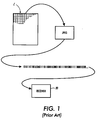
- FIG. 1 is a simplified symbolic rendering of the JPEG compression technique.
- An original image, indicated as I is retained as a quantity of digital data, such as by scanning a hard-copy image, or otherwise creating an image electronically, as on a computer.
- the original image I is divided into a number of square blocks, in a typical case each square block comprising 64 pixels in an 8x8 array.
- Each of these blocks forming image I is then submitted to a JPEG compression technique which, as known in the prior art, converts each image block into a string of binary digits (bits), with each string of bits being of an unpredictable length.
- bits binary digits
- each string of bits emerging from the JPEG technique ends with a special sequence of bits which are recognized by a decompression system as indicated as "end of block,” or EOB.
- EOB end of block
- the letters EOB are used to show an end of block, but in a real-world situation, the EOB symbol would be a recognizable unique sequence of 0's and 1's, such as 1010.
- the strings of bits, each representing one block of pixels, is then sent to a "receiver," which as mentioned above can be in the form of a memory from which the compressed image data can be retrieved at a later time.
- each block could comprise a non-square or even a linear array of pixels within the image.
- a "block” may correspond to any predefined region of an image encompassing multiple colors.
- one or a plurality of blocks of each color separation can be grouped to form larger structures known in JPEG as a minimum coded unit, or MCU. According to the present invention, it is understood that a "block” may represent one or multiple blocks, or one or multiple MCUs.
- a “restart marker” is an optional resource defined by JPEG comprising a specific and unique byte-aligned sequence of bits that can be inserted in the compressed bit stream. When used, it is placed periodically in the bit stream after a fixed number of compressed image blocks.
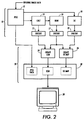
- FIG. 2 is a simplified diagram illustrating the compression and transmission method of the present invention. Shown in Figure 2 is a "transmitter” generally indicated as 10, which sends various data to a “receiver” indicated as 20.
- transmitter 10 and receiver 20 could be parts of the same general apparatus, with the "transmission” steps, as recited in the claims, being in the form of placing the transmitted data in a memory for later retrieval by the receiver.
- data from the original image to be transmitted are first compressed by the standard JPEG compression technique, indicated as function 12.
- the individual strings of bits, each string corresponding to one block of the original image are in turn used to derive a "cost function" for each block.
- the "cost function” is a number related to the length, in number of bits, of a bit string associated with a particular block in the original image. This cost function may be the exact number of bits in a particular string of bits, or could be otherwise related to this number such as the actual number of bits plus or minus some fixed number.
- This cost function may also count the bits generated by "stuffing bytes" which are defined in the JPEG standard. This calculation of the cost function for each block is shown as function 14 in Figure 2.
- the length of the bit string for each block is expected to be small.
- This cost function may be encoded into an 8-bit cost function entry. It may also be optionally encoded using Huffman or any other entropy coding technique.
- the 8-bit encoding allows encoding of all values ranging from the minimum permissible amount of bits in a block up to 255 bits per block. The minimum number is never smaller than 2 and its default value for JPEG luminance tables is 4. Unused codes (below the minimum number) may be used to represent an escape sequence to indicate that more than 255 bits were used in the respective block. After the escape sequence, the real cost function is indicated using any simple format.
- a row of blocks corresponds to a segment of the image encompassing a fixed number of blocks. This "row” may or may not correspond to a row of blocks in a horizontal-scan direction in the image.
- a "row of blocks” will preferably imply a segment of blocks corresponding to one horizontal row of blocks in the original image.
- a "row of blocks” is understood as a segment of blocks corresponding to fractions of the section of blocks in between restart markers" or to an integer number of these sections.
- This "row-sum” can be encoded in typically 2-4 bytes per row without compression, although Huffman-encoding could conceivably be used here, such as at function 17 in the Figure.
- a DC coefficient for each JPEG-compressed block of pixels in the original image is merely the top left entry in the data matrix for the particular block, which equals the average luminance for all of the pixels in the block.
- This decimated DC map can be encoded using any simple format or it can be compressed by means of entropy coding techniques.
- the basic functions of the transmitter 10, according to the illustrated embodiment of the present invention are basic JPEG encoding, calculating the cost functions for each JPEG-encoded block, calculating the sum of cost functions for each row of blocks in the image, and calculating the DC coefficients for each or some block of pixels.
- the cost functions, row functions and DC coefficients can be considered "side information" relative to the compressed image data derived directly from the JPEG compression algorithm. Depending on the particular application of the invention, this "side information" can be transmitted simultaneous with the compressed image data, such as through one or more additional parallel channels, or if the compressed image data is simply to be stored for later retrieval, the side information can be placed in a separate set of portions of the memory.
- the cost function is generally much smaller than the compressed data itself, being roughly 64 times smaller than the original image size. Therefore, the cost function, and by extension the row functions and DC coefficients, is not a major tax on the capacity of a transmission system.
- ECM encoding cost map
- An encoding cost map, or ECM can be defined as a set of the cost functions of various blocks in the original image, understood as a two-dimensional map.
- This ECM can itself be subjected to various image-processing techniques, such as displaying or screening. It is thus clear that the relationship between row functions and cost functions be established so that the various cost functions can be placed into a two-dimensional map.
- This creation of the ECM is indicated as function 24 in Figure 2.
- the compressed image data itself along with a separately-stored memory of the cost function in the form of the ECM, and a separate storage of the DC map, are maintained in a memory 28.
- the various data the JPEG-compressed image data itself and the side information
- either the JPEG-compressed image data and the side information may be transmitted simultaneously through parallel channels, or else the side infromation can be transmitted before or after the JPEG-compressed image data.
- a key practical advantage of calculating the cost functions or ECM at the compression stage, instead of deriving it at decompression, is that the cost function itself can be used as a substitute for the actual image data for purposes such as previewing, editing, or segmentation.
- the cost function data can itself be converted into a series of luminances (i.e., the higher of the cost function, the brighter the luminance), and these luminances can be mapped into an image field.
- Such a function of displaying an ECM as a set of luminances in an image field is illustrated as function 30 in Figure 2.
- the cost functions can be used to locate the beginning of data for a desired block of pixels within a large set of blocks forming an entire image, or in other words one can use the ECM to readily locate the data for a smaller image within a larger received image. For example, if one is interested in the data for the 200th block of pixels in a series, because the 200th block marks the top left corner of a portion of the image which is of interest, one can find the bit corresponding to the beginning of the compressed version of the 200th block by adding up the cost functions for blocks 1 to 199 (assuming, in this case, the cost function is merely the number of bits in each string of bits), to find out the location of the beginning of the 200th block in the original compressed image data.
- the actual number of bits can be derived from the cost function through an algorithm.
- the compressed bit strings with their associated ECM's are received in series. As they are received in series, a count, particularly starting from 1, is assigned to each string of bits and its associated cost function.
- the sum of cost functions of the ECM in a particular row RL [ i ] of image blocks being received gives the total of bits used to encode each block row in the image.
- Each "row of blocks" is partitioned into sections and the DC map entry DC [ i, k ] for section k is the actual DC value of the first block in section k of block-row i.
- the binary data can be "fast-forwarded" to a precisely-defined location which corresponds to the first block in section k .
- the preferred embodiment of the definition of "row of blocks” is assumed and if “restart markers” are used, they are placed in between the rows of blocks.
- a "file pointer” can be incremented through the raw binary in the ECM to locate desired areas within the received binary data. Assuming one wants to crop the region comprising blocks [ i , j ] for an area defined by TOP ⁇ i ⁇ BOTTOM between the top and bottom and LEFT ⁇ j ⁇ RIGHT between the left and right edges of the target region.
Landscapes
- Engineering & Computer Science (AREA)
- Multimedia (AREA)
- Signal Processing (AREA)
- Compression Of Band Width Or Redundancy In Fax (AREA)
- Compression Or Coding Systems Of Tv Signals (AREA)
- Compression, Expansion, Code Conversion, And Decoders (AREA)
- Image Processing (AREA)
Applications Claiming Priority (2)
| Application Number | Priority Date | Filing Date | Title |
|---|---|---|---|
| US08/721,519 US5838831A (en) | 1996-09-26 | 1996-09-26 | Compression of image data with retaining cost data for each compressed image block |
| US721519 | 1996-09-26 |
Publications (3)
| Publication Number | Publication Date |
|---|---|
| EP0833518A2 true EP0833518A2 (de) | 1998-04-01 |
| EP0833518A3 EP0833518A3 (de) | 2001-05-16 |
| EP0833518B1 EP0833518B1 (de) | 2003-01-29 |
Family
ID=24898304
Family Applications (1)
| Application Number | Title | Priority Date | Filing Date |
|---|---|---|---|
| EP97307316A Expired - Lifetime EP0833518B1 (de) | 1996-09-26 | 1997-09-19 | Komprimierung von Bilddaten mit entsprechenden Kostendaten |
Country Status (4)
| Country | Link |
|---|---|
| US (1) | US5838831A (de) |
| EP (1) | EP0833518B1 (de) |
| JP (1) | JPH10112862A (de) |
| DE (1) | DE69718736T2 (de) |
Cited By (3)
| Publication number | Priority date | Publication date | Assignee | Title |
|---|---|---|---|---|
| US6697525B1 (en) | 1998-10-02 | 2004-02-24 | Parthusceva Ltd. | System method and apparatus for performing a transform on a digital image |
| US6868186B1 (en) | 2000-07-13 | 2005-03-15 | Ceva D.S.P. Ltd. | Visual lossless image compression |
| EP2713619A3 (de) * | 2003-11-18 | 2015-01-07 | Mobile Imaging in Sweden AB | Verfahren zum verarbeiten eines digitalen bildes und bildrepräsentationsformat |
Families Citing this family (9)
| Publication number | Priority date | Publication date | Assignee | Title |
|---|---|---|---|---|
| US6058210A (en) * | 1997-09-15 | 2000-05-02 | Xerox Corporation | Using encoding cost data for segmentation of compressed image sequences |
| US6272251B1 (en) | 1998-12-15 | 2001-08-07 | Xerox Corporation | Fully automatic pasting of images into compressed pre-collated documents |
| DE69929660T2 (de) * | 1999-08-31 | 2006-08-17 | Lucent Technologies Inc. | Verfahren und Vorrichtung für Makroblock DC- und AC-Koefficienten-Prädiktion in Videocodierung |
| US6980698B2 (en) * | 2002-07-22 | 2005-12-27 | Xerox Corporation | Image finder method and apparatus for pixography and other photo-related reproduction applications |
| US7643694B2 (en) * | 2004-12-31 | 2010-01-05 | Zoran Corporation | Method and apparatus for processing a compressed image in an order other than the order in which it was compressed |
| US20060228030A1 (en) * | 2005-04-08 | 2006-10-12 | Hadady Craig E | Method and system for image compression for use with scanners |
| US20070091379A1 (en) * | 2005-10-21 | 2007-04-26 | Mobilic Technology Corp. | Universal fixed-pixel-size ISP scheme |
| US7602974B2 (en) * | 2005-10-21 | 2009-10-13 | Mobilic Technology (Cayman) Corp. | Universal fixed-pixel-size ISP scheme |
| JP5247793B2 (ja) * | 2010-12-21 | 2013-07-24 | キヤノン株式会社 | 画像処理装置、画像処理方法、及びプログラム |
Family Cites Families (12)
| Publication number | Priority date | Publication date | Assignee | Title |
|---|---|---|---|---|
| US5101438A (en) * | 1990-02-02 | 1992-03-31 | Ricoh Company, Ltd. | Method of discriminating different kinds of image areas, involving two-dimensional orthogonal transforms |
| US5229864A (en) * | 1990-04-16 | 1993-07-20 | Fuji Photo Film Co., Ltd. | Device for regenerating a picture signal by decoding |
| JP3095804B2 (ja) * | 1991-04-30 | 2000-10-10 | 株式会社リコー | 画像データ伝送装置および画像データ伝送方法 |
| US5257113A (en) * | 1991-09-20 | 1993-10-26 | International Business Machines Corporation | Video mixing technique using JPEG compressed data |
| US5327248A (en) * | 1992-03-23 | 1994-07-05 | Ricoh Company, Ltd. | Compressed image virtual editing system |
| US5408328A (en) * | 1992-03-23 | 1995-04-18 | Ricoh Corporation, California Research Center | Compressed image virtual editing system |
| WO1993023816A1 (en) * | 1992-05-18 | 1993-11-25 | Silicon Engines Inc. | System and method for cross correlation with application to video motion vector estimation |
| US5379122A (en) * | 1992-10-02 | 1995-01-03 | Xerox Corporation | Decompression of standard ADCT-compressed images |
| JP2800633B2 (ja) * | 1993-04-30 | 1998-09-21 | 富士ゼロックス株式会社 | 画像符号化装置 |
| JP3466705B2 (ja) * | 1993-05-28 | 2003-11-17 | ゼロックス・コーポレーション | 圧縮画像の圧縮解除方法 |
| US5517327A (en) * | 1993-06-30 | 1996-05-14 | Minolta Camera Kabushiki Kaisha | Data processor for image data using orthogonal transformation |
| US5521718A (en) * | 1994-12-05 | 1996-05-28 | Xerox Corporation | Efficient iterative decompression of standard ADCT-compressed images |
-
1996
- 1996-09-26 US US08/721,519 patent/US5838831A/en not_active Expired - Lifetime
-
1997
- 1997-09-19 JP JP9255816A patent/JPH10112862A/ja active Pending
- 1997-09-19 EP EP97307316A patent/EP0833518B1/de not_active Expired - Lifetime
- 1997-09-19 DE DE69718736T patent/DE69718736T2/de not_active Expired - Lifetime
Cited By (3)
| Publication number | Priority date | Publication date | Assignee | Title |
|---|---|---|---|---|
| US6697525B1 (en) | 1998-10-02 | 2004-02-24 | Parthusceva Ltd. | System method and apparatus for performing a transform on a digital image |
| US6868186B1 (en) | 2000-07-13 | 2005-03-15 | Ceva D.S.P. Ltd. | Visual lossless image compression |
| EP2713619A3 (de) * | 2003-11-18 | 2015-01-07 | Mobile Imaging in Sweden AB | Verfahren zum verarbeiten eines digitalen bildes und bildrepräsentationsformat |
Also Published As
| Publication number | Publication date |
|---|---|
| EP0833518B1 (de) | 2003-01-29 |
| JPH10112862A (ja) | 1998-04-28 |
| US5838831A (en) | 1998-11-17 |
| DE69718736D1 (de) | 2003-03-06 |
| DE69718736T2 (de) | 2003-08-21 |
| EP0833518A3 (de) | 2001-05-16 |
Similar Documents
| Publication | Publication Date | Title |
|---|---|---|
| EP0833519B1 (de) | Segmentierung und Hintergrundunterdrückung in JPEG-komprimierten Bildern mit Anwendung von Kodierungskostendaten | |
| EP1285399B1 (de) | Verbesserte komprimierung von graustufenbildern | |
| RU2368005C2 (ru) | Способ для обработки цифрового изображения (варианты) | |
| US5327254A (en) | Method and apparatus for compressing and decompressing image data | |
| US6058210A (en) | Using encoding cost data for segmentation of compressed image sequences | |
| US20010043752A1 (en) | Image processing system for compressing image data including binary image data and continuous tone image data by a sub-band transform method with a high-compression rate | |
| JP3990630B2 (ja) | ビデオ処理 | |
| KR20040018413A (ko) | 골롬-라이스를 이용하는 무손실의 프레임내 인코딩 | |
| AU2002316546A1 (en) | Lossless intraframe encoding using golomb-rice | |
| US20020191855A1 (en) | Image processing system for compressing image data including binary image data and continuous tone image data by a sub-band transform method with a high-compression rate | |
| JPH08116447A (ja) | 画像信号の符号化装置 | |
| US5838831A (en) | Compression of image data with retaining cost data for each compressed image block | |
| US20050036695A1 (en) | Image processing apparatus, image processing method, and storage medium | |
| US7630512B2 (en) | Method for performing recoverable video and image watermarking which survives block-based video and image compression | |
| JPH07123269A (ja) | 画像信号の符号化装置 | |
| US20020001415A1 (en) | Image compression method | |
| JP2003531553A (ja) | 固定圧縮率を使用する効率的なビデオデータアクセス | |
| EP0829163B1 (de) | Verfahren und vorrichtung zur kodierung und dekodierung von bildern | |
| CN100535940C (zh) | 处理数字图像的方法以及图像表示格式 | |
| US20090074059A1 (en) | Encoding method and device for image data | |
| KR100530745B1 (ko) | 고해상도 영상신호를 저해상도 디스플레이 장치에 디스플레이하는 디스플레이 방법 | |
| JP4137458B2 (ja) | 固定長画像符号化装置 | |
| KR100189523B1 (ko) | 영상분리와 산술부호화를 이용한 영상 압축 장치 및 방법과 그 복원 방법 | |
| CA2358857C (en) | Data compression using adaptive bit allocation and hybrid lossless entropy encoding | |
| JP2571274B2 (ja) | 符号データ格納・読出方式 |
Legal Events
| Date | Code | Title | Description |
|---|---|---|---|
| PUAI | Public reference made under article 153(3) epc to a published international application that has entered the european phase |
Free format text: ORIGINAL CODE: 0009012 |
|
| AK | Designated contracting states |
Kind code of ref document: A2 Designated state(s): DE FR GB |
|
| PUAL | Search report despatched |
Free format text: ORIGINAL CODE: 0009013 |
|
| AK | Designated contracting states |
Kind code of ref document: A3 Designated state(s): AT BE CH DE DK ES FI FR GB GR IE IT LI LU MC NL PT SE |
|
| 17P | Request for examination filed |
Effective date: 20011116 |
|
| AKX | Designation fees paid |
Free format text: DE FR GB |
|
| 17Q | First examination report despatched |
Effective date: 20020121 |
|
| GRAG | Despatch of communication of intention to grant |
Free format text: ORIGINAL CODE: EPIDOS AGRA |
|
| GRAG | Despatch of communication of intention to grant |
Free format text: ORIGINAL CODE: EPIDOS AGRA |
|
| GRAH | Despatch of communication of intention to grant a patent |
Free format text: ORIGINAL CODE: EPIDOS IGRA |
|
| GRAH | Despatch of communication of intention to grant a patent |
Free format text: ORIGINAL CODE: EPIDOS IGRA |
|
| GRAA | (expected) grant |
Free format text: ORIGINAL CODE: 0009210 |
|
| AK | Designated contracting states |
Designated state(s): DE FR GB |
|
| REG | Reference to a national code |
Ref country code: GB Ref legal event code: FG4D |
|
| REF | Corresponds to: |
Ref document number: 69718736 Country of ref document: DE Date of ref document: 20030306 Kind code of ref document: P |
|
| ET | Fr: translation filed | ||
| PLBE | No opposition filed within time limit |
Free format text: ORIGINAL CODE: 0009261 |
|
| STAA | Information on the status of an ep patent application or granted ep patent |
Free format text: STATUS: NO OPPOSITION FILED WITHIN TIME LIMIT |
|
| 26N | No opposition filed |
Effective date: 20031030 |
|
| PGFP | Annual fee paid to national office [announced via postgrant information from national office to epo] |
Ref country code: DE Payment date: 20130820 Year of fee payment: 17 |
|
| PGFP | Annual fee paid to national office [announced via postgrant information from national office to epo] |
Ref country code: GB Payment date: 20130823 Year of fee payment: 17 |
|
| PGFP | Annual fee paid to national office [announced via postgrant information from national office to epo] |
Ref country code: FR Payment date: 20130920 Year of fee payment: 17 |
|
| REG | Reference to a national code |
Ref country code: DE Ref legal event code: R119 Ref document number: 69718736 Country of ref document: DE |
|
| GBPC | Gb: european patent ceased through non-payment of renewal fee |
Effective date: 20140919 |
|
| REG | Reference to a national code |
Ref country code: FR Ref legal event code: ST Effective date: 20150529 |
|
| PG25 | Lapsed in a contracting state [announced via postgrant information from national office to epo] |
Ref country code: GB Free format text: LAPSE BECAUSE OF NON-PAYMENT OF DUE FEES Effective date: 20140919 Ref country code: DE Free format text: LAPSE BECAUSE OF NON-PAYMENT OF DUE FEES Effective date: 20150401 |
|
| PG25 | Lapsed in a contracting state [announced via postgrant information from national office to epo] |
Ref country code: FR Free format text: LAPSE BECAUSE OF NON-PAYMENT OF DUE FEES Effective date: 20140930 |