EP0834474A2 - Procédé de purification en discontinu et installation pour la mise en oeuvre de ce procédé - Google Patents
Procédé de purification en discontinu et installation pour la mise en oeuvre de ce procédé Download PDFInfo
- Publication number
- EP0834474A2 EP0834474A2 EP97113803A EP97113803A EP0834474A2 EP 0834474 A2 EP0834474 A2 EP 0834474A2 EP 97113803 A EP97113803 A EP 97113803A EP 97113803 A EP97113803 A EP 97113803A EP 0834474 A2 EP0834474 A2 EP 0834474A2
- Authority
- EP
- European Patent Office
- Prior art keywords
- wastewater
- buffer tank
- phase
- filling
- cycle
- Prior art date
- Legal status (The legal status is an assumption and is not a legal conclusion. Google has not performed a legal analysis and makes no representation as to the accuracy of the status listed.)
- Granted
Links
Images


Classifications
-
- C—CHEMISTRY; METALLURGY
- C02—TREATMENT OF WATER, WASTE WATER, SEWAGE, OR SLUDGE
- C02F—TREATMENT OF WATER, WASTE WATER, SEWAGE, OR SLUDGE
- C02F3/00—Biological treatment of water, waste water, or sewage
- C02F3/02—Aerobic processes
- C02F3/12—Activated sludge processes
- C02F3/1236—Particular type of activated sludge installations
- C02F3/1263—Sequencing batch reactors [SBR]
-
- Y—GENERAL TAGGING OF NEW TECHNOLOGICAL DEVELOPMENTS; GENERAL TAGGING OF CROSS-SECTIONAL TECHNOLOGIES SPANNING OVER SEVERAL SECTIONS OF THE IPC; TECHNICAL SUBJECTS COVERED BY FORMER USPC CROSS-REFERENCE ART COLLECTIONS [XRACs] AND DIGESTS
- Y02—TECHNOLOGIES OR APPLICATIONS FOR MITIGATION OR ADAPTATION AGAINST CLIMATE CHANGE
- Y02W—CLIMATE CHANGE MITIGATION TECHNOLOGIES RELATED TO WASTEWATER TREATMENT OR WASTE MANAGEMENT
- Y02W10/00—Technologies for wastewater treatment
- Y02W10/10—Biological treatment of water, waste water, or sewage
Definitions
- the invention relates to a method for discontinuous Wastewater treatment, commonly known as the "SBR process” referred to as.
- the invention further relates a wastewater treatment plant for the implementation of the inventive method, with a raw sewage feed, possibly a mechanical cleaning stage, a multifunctional (i.e. possibly also as (pre-acidifying) Buffer tank to be used), at least one Buffer basin and a biological stage from at least one biological reactor, the Raw sewage feed leads into the buffer basin and out of the Buffer pool the biological reactors in batches (i.e. discontinuous) are provided.
- a wastewater treatment plant for the implementation of the inventive method, with a raw sewage feed, possibly a mechanical cleaning stage, a multifunctional (i.e. possibly also as (pre-acidifying) Buffer tank to be used), at least one Buffer basin and a biological stage from at least one biological reactor, the Raw sewage feed leads into the buffer basin and out of the Buffer pool the biological reactors in batches (i.e. discontinuous) are provided.
- the buffer tank serves as a template / mixing and expansion tank for the biological reactors (hereinafter referred to as SBR reactors).
- SBR reactors biological reactors
- There are one or more stirrers in the buffer tank which, when in operation, bring the settable components of the raw sewage or the filterable substances ( TS 0 ) into suspension.
- Pumps pump the wastewater from the buffer basin into the SBR reactors at defined times.
- Waste water is supplied at the beginning of the filling phases out of the buffer basin preferably without aeration of the or the SBR reactors.
- the revolution in the reactors is started at the same time and can alternatively in the meantime will then be preferred started again before the end of the loading phase.
- the duration of the circulation in the SBR reactors without aeration is determined by the required duration of the denitrification time and possibly anaerobic phase for the biological phosphate redissolution and preferably exceeds the loading duration.
- the BOD 5 portion required for denitrification and biological phosphate redissolution was breathed in anoxically or was stored in the cells as a carbon store as part of the biological phosphate elimination.
- the remaining BOD 5 portion is partially adsorbed by the activated sludge flakes and / or partially anaerobically fermented by the facultative anaerobic bacteria.
- the remaining organic breathes Ingredients and nitrogen oxidation, d. H. the microbiological catalyzed oxidation of ammonium Nitrate.
- This ventilation phase is generally complete (depending on the age of the mud and the temperature) to for complete nitrification. Because of the comparison to continuous processes with higher ammonium concentration at the beginning of the ventilation phase (s) is the Nitrification rate in SBR plants operated in this way significantly higher than with continuously operated systems.
- the microbial occurs during this phase induced above normal physiological If necessary, uptake of the waste water Orthophosphates. This process runs in the opposite direction for phosphate redissolution during the filling and mixing phase and is directly dependent on it because of the uptake rate the higher the redemption rate, the higher the rate.
- volume exchange ratio Ratio of amount of wastewater supplied during a Total cycle or an internal cycle to the volume of the SBR reactor defined at full charge.
- the denitrification capacity is at best (if the Denitrification during the filling and mixing phase (s) completely runs) directly inversely proportional to Volume exchange ratio.
- the denitrification capacity which is limited in principle conventional SBR process is analog to the limited denitrification capacity at continuous operated systems with upstream denitrification; here the denitrification capacity is proportional to the internal recirculation rate.
- a high nitrate concentration at the end of the cycle is also very problematic because (uncontrollable, essentially dependent on the endogenous respiratory capacity) denitrification processes with the result of N 2 outgassing during the sedimentation and decanting phase can lead to a buoyancy of activated sludge flakes, which then the decanter would get into the receiving water.
- the degree of biological phosphorus elimination is thus limited in conventional SBR methods by the fact that the BOD 5 components required for this are first / predominantly used for denitrification.
- BOD 5 components that are still present after denitrification cannot be used as such for biological P redissolution. They must first be fermented under the then existing anaerobic conditions to form BOD 5 components (e.g. low molecular fatty acids) that are more easily degradable.
- This anaerobic fermentation selects facultative anaerobic bacteria, which in many cases are held responsible for the formation of expanded sludge.
- the problem with the conventional methods arises that the creation of conditions for biological P elimination at the same time creates the prerequisite for the development of predominantly filamentous facultative anaerobic bacteria, which are jointly responsible for the formation of expanded sludge.
- the invention has for its object a method of the type mentioned and a wastewater treatment plant of the specified structure with which a complete denitrification and one biological P-elimination as far as possible as well an avoidance of swelling and floating sludge formation and at the same time or as a direct consequence of it the operating costs mainly through minimization the energy costs for ventilation, a reduction in Wastewater tax, a minimization / total elimination of Falling agent costs for chemical P elimination as well a minimization of the excess sludge and the Investment costs through a reduction in the required SBR reactor volume can be reduced.
- the invention teaches a specific method for discontinuous wastewater treatment, in which the wastewater is conveyed from a buffer tank in SBR reactors with at least two internal cycles, during the filling phase of the first internal cycle (s) pre-treated wastewater (i.e. supernatant) the buffer tank (this also serves as a primary clarifier during this time) is conveyed into the SBR reactor, and in the next (possibly last) filling phase, a significantly smaller amount of concentrated waste water (i.e. sediment) from the buffer tank into the SBR reactor Reactor is promoted, pre-clarified wastewater is obtained by taking wastewater from the upper area of the buffer tank while the circulation is switched off (thus it is a wastewater fraction that is largely freed of sedimentable components, i.e.
- B. to provide enough BOD 5 for the required denitrification, the amount to be denitrified being measured / estimated after the first or penultimate cycle and the amount / type of concentrated wastewater for the last internal cycle being determined based thereon.
- a direct measurement can be done online, for example Nitrate measurement, an indirect one over the course of the Redox potential and / or the pH value (the more nitrogen nitrification, the more the pH will drop); an estimate can be made about the time and the amount of wastewater supplied.
- the invention is based on the knowledge that with otherwise constant general conditions, in particular constant BOD 5 / TS 0 ratio, the BOD 5 freight determines linearly proportional how much nitrogen from the raw sewage is incorporated into the excess sludge. Specifically, this means that, for example, if the BOD 5 / N total ratio is doubled by doubling the BOD 5 freight, double the amount of nitrogen is incorporated into the excess sludge and a correspondingly smaller amount is nitrified or can be nitrified.
- the invention proceeds from the knowledge that very many types of wastewater (and only relates to them) the present invention), especially domestic Wastewater, with the help of sedimentation processes in two Fractions can be divided:
- the pre-clarified wastewater with a relatively low BOD 5 / N total ratio is thus conveyed in the SBR reactor as part of the first filling phase (s).
- a relatively high proportion of the total nitrogen is therefore nitrified.
- a further reduction in energy expenditure for the Ventilation results from the fact that with the complete denitrification a correspondingly larger one Nitrate oxygen content is used for breathing, whereby a corresponding reduction in the required Oxygen content results from the ventilation.
- a third advantage of the ventilation equipment results from the fact that the required denitrification volume (essentially equivalent to the filling and mixing phase of the last internal cycle) compared to conventional methods for kinetic reasons (both higher NO 3 and BOD 5 concentration on Beginning of the denitrification phase) is lower. Since the nitrification volume thus becomes relatively larger, the required ventilation equipment can be designed correspondingly smaller.
- the extent of the hydrolysis / pre-acidification becomes decisive on the average length of stay of the primary sludge in the buffer tank; by one To achieve extensive hydrolysis / pre-acidification should preferably a stay of about three days can be set. This can be set as required with the desired impact on the above described fractionation of waste water for the purpose of further Denitrification.
- the invention further proceeds from the Realizing that the effectiveness of biological Phosphorus elimination is very much determined by that during the anaerobic phase (here the filling and Mixed phase of the first internal cycle) Waste water with the lowest possible nitrate concentration is present. Exactly this ratio is used brought about the method according to the invention.
- this can be a wide one achieved higher biological phosphate elimination rate than with conventional methods. As a direct result this results in a lower need for precipitant (This may even - depending on the Raw sewage composition - completely eliminated), a less excess sludge and as a result a higher mud age, which is a reduction of the required SBR reactor volume.
- the circulation in the buffer basin will shortly before the start of the Filling phase of the last internal cycle started.
- This Embodiment is preferably applied if no separate stabilization of the excess sludge is intended for all of the primary sludge biological treatment in the SBR reactors can be.
- the Invention is the filling of the last internal Cycle with predominantly settled primary sludge (the Circulation in the buffer container is therefore a certain one Switched off before the start of this last filling phase).
- the Circulation in the buffer container is therefore a certain one Switched off before the start of this last filling phase.
- Of the remaining primary sludge (as well as the excess sludge from the SBR reactors) is expedient anaerobic stabilization, for example in one Digestion tower, fed.
- the inventive method are significant Construction cost savings possible because only the addition of primary sludge required for the required denitrification to minimize total freight (and thus the required volume) to the SBR reactors leads.
- This embodiment also opens up the possibility of very effectively treating the resulting turbid and filtrate water from the anaerobic sludge treatment with a usually very low BOD 5 / N total ratio:
- this addition mode can be selected to prevent excessive nitrite formation). This ensures that the total N total freight of the cloudy / filtrate water can be completely nitrified as well as completely denitrified.
- the Invention is the filling of the last internal Cycle with predominantly settled primary sludge (the Circulation in the buffer tank is therefore a certain one Switched off before the start of this last filling phase).
- the Circulation in the buffer tank is therefore a certain one Switched off before the start of this last filling phase.
- this is done, however, with several total cycles distributed as evenly as possible, the whole accruing Primary sludge fed to the SBR reactors, see above that only the secondary sludge as excess sludge from the SBR reactors.
- the invention also relates to a wastewater treatment plant for the implementation of the above Process involving a raw sewage supply, one mechanical pre-cleaning, a preliminary / mixing and compensation stage consisting of at least one buffer pool and SBR reactors, the buffer tank (s) with the SBR reactors connected and the raw sewage supply via the mechanical cleaning stage in the buffer tank leads, but only within the first internal cycles pre-treated wastewater from the buffer basin into the SRB reactors is promoted and as part of the last internal Cycle only concentrated wastewater from the Buffer basin in the SBR reactors is promoted and if necessary, an adequate measuring device the amount / type of concentrated Waste water determined in the SBR reactors is promoted, is provided.
- 1 is a sewage treatment plant according to the invention to carry out the method according to the invention shown for wastewater treatment. It deals is a plant with a buffer tank and 2 SBR reactors. The way of mechanical pretreatment and possibly the sludge treatment is related to that Claims not relevant and therefore also here not shown.
- the raw sewage inlet 1 to the buffer tank is shown, the buffer tank 2 with a circulation stirrer 3, Feed pumps 4a and 4b and an optional one actuating primary sludge extraction pump 5.
- the SBR reactors 6 and 7 are on the feed lines 8 and 9 from the buffer tank with fractionated Raw sewage fed.
- the ventilation is 10 and 11 can be operated intermittently.
- the circulating devices 12 and 13 of the SBR reactors are at least during the Sedimentation and decanting phases stopped.
- the Excess sludge pumps 14 and 15 promote the excess sludge preferably at the end of the sedimentation phase the SBR reactors.
- About the clear water drains 16 and 17 the clear water is drained into the (optional) clear water buffer.
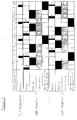
- two exemplary embodiments are exemplary Overall cycle strategies along a time axis shown.
- the total cycle time is for both SBR reactors 8 h with 2 internal ones Cycles, but depending on the raw wastewater composition, Quantity and cleaning goal shorter or longer be and include multiple internal cycles.
- the asynchrony is 4 hours, but it is freely selectable and essentially dependent on the Amount of wastewater, the number of SBR reactors, the type and Way of providing concentrated wastewater as well as the duration of the internal cycles and the temporal Overlap of the internal cycles of the SBR reactors.
- Asynchrony for example, must be geared towards this that there is no overlap in one Reactor and concentrated wastewater on starting the circulation device in the buffer tank in the other Reactor can be funded.
- the provision is made the concentrated wastewater fraction Starting the circulation device 3 in the buffer tank 2 shortly before filling the last internal cycle.
- the feed pumps 4a or 4b then promote the Primary sludge highly enriched wastewater fraction B in an SBR reactor.
- complete denitrification under anoxic conditions C At the end of this phase, you may like to partially anaerobic conditions a certain P-redissolution takes place, however, this process is controlled irrelevant to the invention.
- the ventilation phase takes about 2 hours the respiration of Remaining BOD as well as the inclusion of the remaining solved Phosphates and the nitrification of the relatively low Nitrogen content.
- the feed pumps can be equipped with a plurality of Lines at different heights connected to buffer tank 2 either supernatant or sediment to promote, depending on which of the lines with closed or opened with a corresponding slide is.
- the residual BOD is breathed under oxic conditions D as well as the biological absorption of the phosphate supplied with the raw wastewater and released in the previous anaerobic phase and the complete nitrification of the relatively high nitrogen content.
- a filling process is carried out with a highly enriched wastewater fraction B (see above).
- Deviating from this embodiment are according to the invention more than two internal cycles possible; in the As part of the biological P elimination via the feed with supernatant, however, is only an internal one Cycle makes sense while in the context of denitrification quite a few about loading with desimentat successive internal cycles helpful / useful can be, especially if only a moderate fractionation is possible and a very extensive denitrification is required.
- Fig. 3 the provision the concentrated wastewater fraction B, that from the area of the bottom of the buffer pool is filled while the circulation is switched off is.
- This wastewater fraction therefore essentially exists from sedimented primary sludge.
- the feed pump 4a conveys the primary sludge in an SBR reactor.
- the residual BOD is breathed under oxic conditions D as well as the biological absorption of the phosphate supplied with the raw wastewater and released in the previous anaerobic phase and the complete nitrification of the relatively high nitrogen content.
- a filling process is carried out with a highly enriched wastewater fraction B (see above).
- a total cycle time of 4 hours is selected with only one internal cycle (the result is identical to a total cycle time of 8 hours and two internal cycles of the same length) and thus a maximum volume exchange rate of 18%.
- a nitrate N concentration of approx. 8.6 mg / l results at the end of the cycle.
Landscapes
- Life Sciences & Earth Sciences (AREA)
- Biodiversity & Conservation Biology (AREA)
- Microbiology (AREA)
- Hydrology & Water Resources (AREA)
- Engineering & Computer Science (AREA)
- Environmental & Geological Engineering (AREA)
- Water Supply & Treatment (AREA)
- Chemical & Material Sciences (AREA)
- Organic Chemistry (AREA)
- Purification Treatments By Anaerobic Or Anaerobic And Aerobic Bacteria Or Animals (AREA)
- Activated Sludge Processes (AREA)
Applications Claiming Priority (2)
| Application Number | Priority Date | Filing Date | Title |
|---|---|---|---|
| DE19640762 | 1996-10-02 | ||
| DE19640762A DE19640762C1 (de) | 1996-10-02 | 1996-10-02 | Verfahren zur diskontinuierlichen Abwasserreinigung und Anlage zur Durchführung dieses Verfahrens |
Publications (3)
| Publication Number | Publication Date |
|---|---|
| EP0834474A2 true EP0834474A2 (fr) | 1998-04-08 |
| EP0834474A3 EP0834474A3 (fr) | 2001-06-13 |
| EP0834474B1 EP0834474B1 (fr) | 2003-07-23 |
Family
ID=7807745
Family Applications (1)
| Application Number | Title | Priority Date | Filing Date |
|---|---|---|---|
| EP97113803A Expired - Lifetime EP0834474B1 (fr) | 1996-10-02 | 1997-08-09 | Procédé de purification en discontinu et installation pour la mise en oeuvre de ce procédé |
Country Status (3)
| Country | Link |
|---|---|
| EP (1) | EP0834474B1 (fr) |
| DE (2) | DE19640762C1 (fr) |
| ES (1) | ES2198521T3 (fr) |
Cited By (4)
| Publication number | Priority date | Publication date | Assignee | Title |
|---|---|---|---|---|
| EP1693345A1 (fr) | 2005-02-18 | 2006-08-23 | Niels Christian Holm | Procédé de dénitrification améliorée et d'élimination biologique du phosphore dans un réacteur sequentiel discontinu (SBR) |
| WO2015074636A1 (fr) * | 2013-11-21 | 2015-05-28 | Zwt Wasser- Und Abwassertechnik Gmbh | Dispositif de traitement d'eaux usées et unité de régulation d'un dispositif de traitement d'eaux usées |
| DE102009037433B4 (de) | 2009-08-13 | 2017-03-30 | Niels Christian Holm | Verfahren und Vorklärbecken zur Optimierung der Vorklärung von Kläranlagen |
| AT526134A1 (de) * | 2022-05-02 | 2023-11-15 | Pvs Gmbh | Diskontinuierliches abwasserreinigungsverfahren |
Families Citing this family (6)
| Publication number | Priority date | Publication date | Assignee | Title |
|---|---|---|---|---|
| DE19802957C1 (de) * | 1998-01-27 | 1999-03-04 | Koester Bau Ag & Co | Verfahren zur diskontinuierlichen Abwasserreinigung |
| DE102005048146A1 (de) * | 2005-10-07 | 2007-04-12 | Holm, Niels Christian, Dr. | Verfahren zur diskontinuierlichen Abwasserreinigung |
| CZ301099B6 (cs) * | 2005-12-15 | 2009-11-04 | Medmes, Spol. S R. O. | Zpusob biologického cištení odpadních a deštových vod s prerušovaným provozem a zarízení k provádení tohoto zpusobu |
| EP1903010A1 (fr) * | 2006-09-22 | 2008-03-26 | Holm, Niels Christian | Procédé de traitement d'eaux usées dans des installations à boue activée alimentées en continu comprenant une dénitrification en amont |
| DE102009039316A1 (de) * | 2009-08-31 | 2011-03-31 | Hartwig, Peter, Dr.-Ing. | Abwasserreinigungsanlage und Verfahren zur Abwasserreinigung |
| SI2289855T1 (sl) * | 2009-08-31 | 2015-01-30 | Peter Hartwig | Postrojenje za čiščenje odpadne vode in postopek za čiščenje odpadne vode |
Family Cites Families (4)
| Publication number | Priority date | Publication date | Assignee | Title |
|---|---|---|---|---|
| US5192442A (en) * | 1991-12-02 | 1993-03-09 | Zimpro Passavant Environmental Systems, Inc. | Multiple zone batch treatment process |
| US5395527A (en) * | 1993-07-01 | 1995-03-07 | Eco Equipement Fep Inc. | Process and apparatus for treating wastewater in a dynamic, bio sequenced manner |
| DE4332815A1 (de) * | 1993-09-27 | 1995-04-13 | Uta Ges Fuer Umwelttechnik Und | Kläranlage nach dem SBR-Prinzip |
| DE19519742C2 (de) * | 1994-06-06 | 1996-12-12 | Holm Niels Christian Dr | Verfahren zur Abwasserreinigung mit intermittierender Nitrifikation/Dentrifikation und Abwasserreinigungsanlage zur Durchführung des Verfahrens |
-
1996
- 1996-10-02 DE DE19640762A patent/DE19640762C1/de not_active Expired - Lifetime
-
1997
- 1997-08-09 DE DE59710463T patent/DE59710463D1/de not_active Expired - Lifetime
- 1997-08-09 ES ES97113803T patent/ES2198521T3/es not_active Expired - Lifetime
- 1997-08-09 EP EP97113803A patent/EP0834474B1/fr not_active Expired - Lifetime
Cited By (5)
| Publication number | Priority date | Publication date | Assignee | Title |
|---|---|---|---|---|
| EP1693345A1 (fr) | 2005-02-18 | 2006-08-23 | Niels Christian Holm | Procédé de dénitrification améliorée et d'élimination biologique du phosphore dans un réacteur sequentiel discontinu (SBR) |
| DE102009037433B4 (de) | 2009-08-13 | 2017-03-30 | Niels Christian Holm | Verfahren und Vorklärbecken zur Optimierung der Vorklärung von Kläranlagen |
| WO2015074636A1 (fr) * | 2013-11-21 | 2015-05-28 | Zwt Wasser- Und Abwassertechnik Gmbh | Dispositif de traitement d'eaux usées et unité de régulation d'un dispositif de traitement d'eaux usées |
| AT526134A1 (de) * | 2022-05-02 | 2023-11-15 | Pvs Gmbh | Diskontinuierliches abwasserreinigungsverfahren |
| AT526134B1 (de) * | 2022-05-02 | 2024-03-15 | Gassner Ing Kurt | Diskontinuierliches abwasserreinigungsverfahren |
Also Published As
| Publication number | Publication date |
|---|---|
| ES2198521T3 (es) | 2004-02-01 |
| DE19640762C1 (de) | 1997-12-18 |
| EP0834474A3 (fr) | 2001-06-13 |
| DE59710463D1 (de) | 2003-08-28 |
| EP0834474B1 (fr) | 2003-07-23 |
Similar Documents
| Publication | Publication Date | Title |
|---|---|---|
| DE68904598T2 (de) | Abwasserbehandlungsverfahren. | |
| DE3501585C2 (fr) | ||
| EP0881990B1 (fr) | Procede de purification aerobie d'eaux usees | |
| EP0284976B1 (fr) | Procédé pour la purification d'eau usée avec une alimentation de bassin à boues activées | |
| DE2362334B2 (de) | Verfahren zur biologischen Reinigung von Abwasser | |
| DE2233801B2 (de) | Verfahren zur biologischen Reinigung von Abwasser mit zwei von dem Abwasser nacheinander durchflossenen Stufen | |
| EP0834474B1 (fr) | Procédé de purification en discontinu et installation pour la mise en oeuvre de ce procédé | |
| EP0273111B1 (fr) | Procédé et installation pour la purification des eaux résiduaires contenant des phosphates et pour l'élimination du phosphore par voie biologique | |
| DE3241348C2 (fr) | ||
| DE3833185C2 (fr) | ||
| EP0851844A1 (fr) | Procede d'epuration des eaux usees | |
| DE69729249T2 (de) | Abwasserreinigungsverfahren | |
| DE3907734C1 (fr) | ||
| DE2924449C2 (de) | Verfahren zum Reinigen von Abwasser nach dem Belebtschlammverfahren | |
| EP0483312A1 (fr) | Procede d'elimination de nitrates et de phosphates lors de l'epuration biologique d'eaux d'egouts. | |
| AT396684B (de) | Belebtschlammverfahren zur reinigung von abwasser | |
| DE19640761C1 (de) | Verfahren zur kontinuierlichen Abwasserreinigung und Anlage zur Durchführung dieses Verfahrens | |
| DE3507388A1 (de) | Verfahren fuer die reinigung von abwasser | |
| DE19802957C1 (de) | Verfahren zur diskontinuierlichen Abwasserreinigung | |
| DE3906943C2 (de) | Verfahren zur Abwasserreinigung und Belebtschlammanlage zur Durchführung des Verfahrens | |
| EP0899241B1 (fr) | Procédé et dispositif pour élimination biologique de phosphore | |
| DE19519742C2 (de) | Verfahren zur Abwasserreinigung mit intermittierender Nitrifikation/Dentrifikation und Abwasserreinigungsanlage zur Durchführung des Verfahrens | |
| EP1099668A1 (fr) | Procédé d'épuration de l'eau communale ou similaire usée | |
| EP0802166B1 (fr) | Procédé de traitement et purification des eaux usées industrielles | |
| DE4204590C2 (de) | Verfahren zur biologischen Abwasserreinigung in einem Belebungsbecken |
Legal Events
| Date | Code | Title | Description |
|---|---|---|---|
| PUAI | Public reference made under article 153(3) epc to a published international application that has entered the european phase |
Free format text: ORIGINAL CODE: 0009012 |
|
| AK | Designated contracting states |
Kind code of ref document: A2 Designated state(s): BE DE ES FR GB |
|
| AX | Request for extension of the european patent |
Free format text: AL;LT;LV;RO;SI |
|
| RAP1 | Party data changed (applicant data changed or rights of an application transferred) |
Owner name: HOLM, NIELS, DR. |
|
| RIN1 | Information on inventor provided before grant (corrected) |
Inventor name: HOLM, NIELS, DR. |
|
| PUAL | Search report despatched |
Free format text: ORIGINAL CODE: 0009013 |
|
| AK | Designated contracting states |
Kind code of ref document: A3 Designated state(s): AT BE CH DE DK ES FI FR GB GR IE IT LI LU MC NL PT SE |
|
| AX | Request for extension of the european patent |
Free format text: AL;LT;LV;RO;SI |
|
| 17P | Request for examination filed |
Effective date: 20010602 |
|
| 17Q | First examination report despatched |
Effective date: 20010718 |
|
| AKX | Designation fees paid |
Free format text: BE DE ES FR GB |
|
| GRAH | Despatch of communication of intention to grant a patent |
Free format text: ORIGINAL CODE: EPIDOS IGRA |
|
| GRAH | Despatch of communication of intention to grant a patent |
Free format text: ORIGINAL CODE: EPIDOS IGRA |
|
| GRAA | (expected) grant |
Free format text: ORIGINAL CODE: 0009210 |
|
| AK | Designated contracting states |
Designated state(s): BE DE ES FR GB |
|
| PG25 | Lapsed in a contracting state [announced via postgrant information from national office to epo] |
Ref country code: FR Free format text: LAPSE BECAUSE OF FAILURE TO SUBMIT A TRANSLATION OF THE DESCRIPTION OR TO PAY THE FEE WITHIN THE PRESCRIBED TIME-LIMIT Effective date: 20030723 |
|
| REG | Reference to a national code |
Ref country code: GB Ref legal event code: FG4D Free format text: NOT ENGLISH |
|
| GBT | Gb: translation of ep patent filed (gb section 77(6)(a)/1977) |
Effective date: 20030723 |
|
| REF | Corresponds to: |
Ref document number: 59710463 Country of ref document: DE Date of ref document: 20030828 Kind code of ref document: P |
|
| REG | Reference to a national code |
Ref country code: ES Ref legal event code: FG2A Ref document number: 2198521 Country of ref document: ES Kind code of ref document: T3 |
|
| PLBE | No opposition filed within time limit |
Free format text: ORIGINAL CODE: 0009261 |
|
| STAA | Information on the status of an ep patent application or granted ep patent |
Free format text: STATUS: NO OPPOSITION FILED WITHIN TIME LIMIT |
|
| 26N | No opposition filed |
Effective date: 20040426 |
|
| EN | Fr: translation not filed | ||
| PGFP | Annual fee paid to national office [announced via postgrant information from national office to epo] |
Ref country code: ES Payment date: 20080828 Year of fee payment: 12 |
|
| PGFP | Annual fee paid to national office [announced via postgrant information from national office to epo] |
Ref country code: GB Payment date: 20080821 Year of fee payment: 12 |
|
| GBPC | Gb: european patent ceased through non-payment of renewal fee |
Effective date: 20090809 |
|
| REG | Reference to a national code |
Ref country code: ES Ref legal event code: FD2A Effective date: 20090810 |
|
| PG25 | Lapsed in a contracting state [announced via postgrant information from national office to epo] |
Ref country code: GB Free format text: LAPSE BECAUSE OF NON-PAYMENT OF DUE FEES Effective date: 20090809 |
|
| PGFP | Annual fee paid to national office [announced via postgrant information from national office to epo] |
Ref country code: BE Payment date: 20100810 Year of fee payment: 14 |
|
| PG25 | Lapsed in a contracting state [announced via postgrant information from national office to epo] |
Ref country code: ES Free format text: LAPSE BECAUSE OF NON-PAYMENT OF DUE FEES Effective date: 20090810 |
|
| BERE | Be: lapsed |
Owner name: *HOLM NIELS Effective date: 20110831 |
|
| PG25 | Lapsed in a contracting state [announced via postgrant information from national office to epo] |
Ref country code: BE Free format text: LAPSE BECAUSE OF NON-PAYMENT OF DUE FEES Effective date: 20110831 |
|
| PGFP | Annual fee paid to national office [announced via postgrant information from national office to epo] |
Ref country code: DE Payment date: 20150721 Year of fee payment: 19 |
|
| REG | Reference to a national code |
Ref country code: DE Ref legal event code: R082 Ref document number: 59710463 Country of ref document: DE Representative=s name: BOEHMERT & BOEHMERT ANWALTSPARTNERSCHAFT MBB -, DE Ref country code: DE Ref legal event code: R081 Ref document number: 59710463 Country of ref document: DE Owner name: HOLM, NIELS CHRISTIAN, DR., DE Free format text: FORMER OWNER: HOLM, NILS, DR., 32425 MINDEN, DE |
|
| REG | Reference to a national code |
Ref country code: DE Ref legal event code: R119 Ref document number: 59710463 Country of ref document: DE |
|
| PG25 | Lapsed in a contracting state [announced via postgrant information from national office to epo] |
Ref country code: DE Free format text: LAPSE BECAUSE OF NON-PAYMENT OF DUE FEES Effective date: 20170301 |