EP0834832B1 - Arithmetische Bildkodierung - Google Patents
Arithmetische Bildkodierung Download PDFInfo
- Publication number
- EP0834832B1 EP0834832B1 EP97101299A EP97101299A EP0834832B1 EP 0834832 B1 EP0834832 B1 EP 0834832B1 EP 97101299 A EP97101299 A EP 97101299A EP 97101299 A EP97101299 A EP 97101299A EP 0834832 B1 EP0834832 B1 EP 0834832B1
- Authority
- EP
- European Patent Office
- Prior art keywords
- row
- context model
- data
- bits
- column
- Prior art date
- Legal status (The legal status is an assumption and is not a legal conclusion. Google has not performed a legal analysis and makes no representation as to the accuracy of the status listed.)
- Expired - Lifetime
Links
Images


Classifications
-
- G—PHYSICS
- G06—COMPUTING OR CALCULATING; COUNTING
- G06T—IMAGE DATA PROCESSING OR GENERATION, IN GENERAL
- G06T9/00—Image coding
- G06T9/005—Statistical coding, e.g. Huffman, run length coding
Definitions
- the present invention relates to a method and device for arithmetically encoding an image without the need to buffer an entire row of image data.
- Data compression systems are known in the prior art that encode a stream of digital data signals into compressed digital code signals and decode the compressed digital code signals back into the original data.
- Data compression refers to any process that attempts to convert data in a given format into an alternative format requiring less space than the original.
- the objective of data compression systems is to effect a savings in the amount of storage required to hold or the amount of time required to transmit a given body of digital information.
- a general purpose digital data compression system should satisfy certain criteria.
- the system should have reciprocity.
- the decoded and original data must be identical and indistinguishable with respect to each other.
- the property of reciprocity is synonymous to that of strict noiselessness used in information theory. Some applications do not require strict adherence to the property of reciprocity. One such application in particular is when dealing with graphical data. Because the human eye is not that sensitive to noise, some alteration or loss of information during the compression de-compression process is acceptable.
- the system should provide sufficient performance with respect to the data rates provided by and accepted by the devices with-which the data compression and de-compression systems are communicating.
- the rate at which data can be compressed is determined by the input data processing rate into the compression system, typically in millions of bytes per second (megabytes/sec). Sufficient performance is necessary to maintain the data rates achieved in present day disk, tape and communication systems which rates typically exceed one megabyte/sec. Thus, the data compression and decompression system must have enough data bandwidth so as to not adversely affect the overall system.
- the performance of data compression and decompression systems is typically limited by the computations necessary to compress and de-compress and the speed of the system components such as, random access memory (RAM), and the like, utilized to store statistical data and guide the compression and de-compression process. Performance for a compression device is characterized by the number of processor cycles required per input character under the compressor. The fewer the number of cycles, the higher the performance.
- compression effectiveness is characterized by the compression ratio.
- the compression ratio is the ratio of data size in uncompressed form divided by the size in compressed form.
- Compression effectiveness is determined by how effectively the compression procedure uses the redundancy in the input data.
- redundancy occurs both in the nonuniform usage of individual symbology, example digits, bytes, or characters, and in frequent recurrence of symbol sequences, such as common words, blank record fields and the like.
- Huffman procedure maps full length segments of symbols into variable length words.
- the Huffman data compression procedure suffers from two limitations. Firstly, the Huffman procedure operates under the constraint that the input data to be compressed be parsed into fixed length segments of symbols. Although the Huffman procedure provides the best compression ratio that can be obtained under these constraints, when the constraint is relaxed it is possible to obtain significantly better compression ratios by utilizing other procedures.
- Huffman coding requires full knowledge of the statistical characteristic of the source data. The Huffman procedure operates under the assumption that the probability with which each fixed length input segment occurs is known. This requirement of the Huffman procedure can in practice, be satisfied by the use of an adaptive version of the procedure which accumulates the necessary statistics during processing of the data. This, however, is cumbersome, and requires considerable working memory space and performs sub-optimally during adaptation.
- the Tunstall algorithm which maps variable length segments of symbols into fixed length binary words, is complimentary to the Huffman procedure with the fixed length constraints now applied to the output segments instead of the input segments.
- the Tunstall procedure requires a foreknowledge of the source data probabilities. Again this foreknowledge requirement can be satisfied to some degree by utilizing an adaptive version which accumulates the statistics during processing of the data.
- the Lempel-Ziv procedure maps variable length segments of the symbols into variable length binary words. It is asymptotically optimal when there are no constraints on the input or output segments.
- the input data string is parsed into adaptively grown segments, each segment consisting of an exact copy of an earlier portion of the input string suffixed by one new symbol from the input data.
- the copy which is to be made is the longest possible and is not constrained to coincide with any earlier parsed segment.
- the code word which replaces the segment in the output contains information consisting of a pointer to where the earlier copied portion begins, the length of the copy, and the new symbol.
- Huffman or Shannon-Fano coding is the perfect means of compressing data. However, this is not the case. As mentioned above, these coding methods are optimal when and only when the symbol probabilities are integral powers of 1/2, which is usually not the case.
- the technique of arithmetic coding does not have this restriction: It achieves the same effect as treating the message as one single unit (a technique which would, for Huffman coding, require enumeration of every single possible message), and thus attains the theoretical entropy bound to compression efficiency for any source.
- arithmetic coding In arithmetic coding, one decision after another is encoded to define successfully smaller, lesser included intervals along a number line. Additional information on arithmetic coding can be found in "An Introduction To Arithmetic Encoding”; by G. G. Langdon, Jr., IBM Journal of Research and Development, Vol. 28, n. 2, March 1984, 135-149; and "Arithmetic Compression Code Control Parameters Approximation”; by D. R. Helman, G. G. Langdon, Jr., and J. J. Rissanen, Vol. 23, n. 11, April 1981, 5112-5114 and U.S. Patent No. 4,905,297, "Arithmetic Coding Encoder And Decoder System", Langdon, Jr. et al.
- each decision has a plurality of possible exclusive outcomes "or events".
- Each outcome or event is represented in data by a symbol.
- each decision may correspond to whether or not a given pixel is black.
- the decision outcome being represented by a Y (or YES) symbol if the pixel is black or an N (or NO) symbol if the pixel is not black.
- a plurality of decisions may then be represented by a sequence of symbols, e.g., YNNY...
- a probability line has a current interval defined thereon.
- the first current interval is 0 to 1.
- the current interval is divided into segments in which segment corresponds to one possible outcome for the next decision. Where there are only two possible outcomes for each decision, the current interval is divided into two segments.
- the length of each segment is based on its respective associated probability. The respective probabilities may remain fixed or may adapt as decision data is entered.
- the arithmetic coding approach permits the sequence "aab" to be represented by the value 0.001. Instead of six bits, the information can be represented in three bits. This conservation of bits results as successive events having relatively high associated probabilities occur.
- the compression engine read the data a line at a time. Before the data is compressed, the previous line is read from the line buffer. Finally, the compressed data is store back in memory. Some application access the rows simultaneously. However, simultaneous access requires double or maybe even triple bandwidth to allow retrieval of the precious line data.
- EP 0311265 A2 describes a method and an apparatus for processing picture element signals of an image of a text document.
- the processing seeks to avoid unnecessary redundancy when compressing text data in two different resolutions.
- the processing of the image data is divided into processing stages, one directed to the processing of every other pixel element (PEL) position in the text document and the other directed to the compression of the other pixels.
- the windows used in the two processing stages as sampling windows or templates are defined and indicate the pixels used to compress a certain pixel to be compressed next.
- the window and the pixels to be compressed are shifted along each line to compress the pixel elements of a current line and then shifted vertically to process the next line.
- the processing is implemented such that the image data to be compressed is first stored in an input image buffer and that the pixel element signals needed are fetched sequentially from said buffer.
- a method for encoding image data First a context model is defined. Next, the image data is logically divided into a plurality of columns. Past, current and next rows for the present column are buffered in a compressor. The context model defines bits that are used by the compressor to compress a given bit. These bits, and the bit to be compressed, are transferred to the compressor. The context model is shifted horizontally by a single bit position until each bit in the current row of the present column has been compressed. Next, the context model moves vertically in the present column thereby feeding the next row to the compressor. The vertically movement is most efficiently accomplished by renaming, in the buffer, the current row to the past row and the next row to the current row. After the renaming, the new next row must be retrieved from memory and stored in the buffer.
- the present invention allows the use of previous line data without requiring multiple accesses to the image or the use of a line buffer. Referring now to FIG. 1, the present invention moves vertically through the image storing only a small amount of the previous line data.
- image 10 which is to be compressed, is divided into six columns 100-105. Instead of traversing image 10 horizontally, it is traversed vertically as illustrated by the arrows. Thus, the compressor starts at the top left corner and proceeds down column 100. Once the column 100 is compressed, the compressor continues at the top of column 101. This process continues until column 105 has been compressed.
- information about the previous row is limited by the width of the column. This limited storage of the previous row allows use of a two dimensional context model, which greatly increases the compression ratio. Additionally, the limited previous row data is considerably smaller than saving the entire previous row.
- Hardware compressor 502 requests image data from DRAM 500 under control of DMA controller 512.
- Data retrieved from memory 500 is stored in the appropriate compartment of memory buffer 40 in accordance with the description given below.
- bit 30 is currently being compressed in FIG. 2.
- Related bits 508 form an address for probability ram 506 of the arithmetic coding hardware 503. Based upon the output of probability ram 506 and additional arithmetic operations performed by arithmetic coding hardware 503, an MPS (most probable symbol) for bit 30 is generated. After a particular bit 30 has been compressed, data in shift registers 404 and 405 is shifted allowing for a new bit to be compressed.
- Arithmetic coding hardware 503 passes compressed data to FIFO 504 as it is created. Under the control of DMA controller 505, data is transferred from FIFO 502 into DRAM 501. After all the data in DRAM 500 has been compressed and transferred to DRAM 501, hardware compressor 502 notifies the image processor 520 that the compression is complete.
- Compressed data is transferred from DRAM 501 into FIFO 504 under the control of DMA controller 505.
- Arithmetic coding hardware 503 decompresses the data and outputs a single bit 511 at a time.
- Bit 30 is predicted based upon its relationship with bits 508. Bits 508 form an address for probability ram 506. Based upon the output of probability ram 506 and additional arithmetic operations performed by arithmetic coding hardware 503, the state of bit 30 is generated. Next, shift registers 404 and 405 are shifted allowing for the next bit to be decompressed. Eventually, shift register 405 contains an entire byte of uncompressed data. First the data in shift register 404 is transferred into memory buffer 400. Next, the contents of shift register 404 is transfer into memory buffer 40 and also into shift register 405. Under the control of DMA controller 512, the uncompressed data is transferred from memory 40 into DRAM 500.
- memory 40 is divided into three portions 401-403, which form a circular buffer.
- the width of memory 40 is equal to the width of a vertical column such as 100.
- RAM A 401 contains data for the previous row
- RAM B 402 contains data for the current row
- RAM C 403 is loaded with data for the next row from DRAM.
- data for the current row here RAM B 402
- RAM A 401 is transferred into register 404.
- the compressor works on compressing the information in registers 404 and 405 while new information can be transferred from the main memory into RAM C 403.
- FIG. 4 shows in detail the context model used in the preferred embodiment. This particular context model uses information from the current row as well as from the row above the bit being compressed. Additionally, note that in the row above, the context model uses bits to the right of the current bit and in the current row, bits to the left of the current bit.
- Context model 20 moves horizontally across current row 405 as each bit 30 is compressed.
- compression of the first bits of a row context window 20 attempts to utilize bits which are not present.
- the context model could be modified to not require these bits.
- the first bit could be copied into the missing positions.
- Weighting the effect on the compression ratio against complexity of implementation the preferred embodiment sets these bit to zero (0
- context window 20 when context window 20 reaches the end the context model attempts to use information that is not available.
- the same options as described above are available to the designer.
- the preferred embodiment copies of the last bit or the respective register into the missing bits.
- RAM B 402 now contains data for the previous row
- RAM C 403 contains data for the current row
- RAM A is loaded with data for the next row.
- RAM C 403 is transferred into register 405.
- Data for the previous row, now RAM B 402 is transferred into register 404.
- the compressor works on compressing the information in registers 404 and 405 while new information can be transferred from the main memory into RAM A 401.
- memory buffer 403 is not necessary for the present invention. However, a three stage buffer allows for a constant flow of data to the compressor thereby improving through-put for the system.
- each column is 16 words wide, where each word is 32 bit wide.
- Compression ratio may also be impacted by the discontinuity when the top row of a new column is compressed.
- register 405 contains data from the top row in column 103
- register 404 contains data from the bottom row of column 102.
- this discontinuity in data was found to only minimally effect the compression ratio.
- the impact to the compression ratio may be reduced by setting the previous row to some value such as all zeros or a copy of the current row.
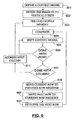
- the flow chart of FIG. 6 shows the logical flow for the preferred embodiment.
- a context model must be defined 601. While this may be dynamically calculated in real time, in the preferred embodiment it is determined during development of the hardware compressor 503.
- the image is divided into columns 602.
- the buffer memory 40 must be pre-loaded 603. With the buffer memory loaded, the compressor 503 is started 603.
- the context model horizontally shifts 605 across the current row as the compressor compresses each bit. Once the current row is compressed 606, the compressor checks if the column is done 607. If the column is done, the next column is addressed 611. If the column is not done, the registers are reloaded 608 and 609, the next row is retrieved 610 and compression continues.
Landscapes
- Engineering & Computer Science (AREA)
- Multimedia (AREA)
- Physics & Mathematics (AREA)
- General Physics & Mathematics (AREA)
- Theoretical Computer Science (AREA)
- Compression, Expansion, Code Conversion, And Decoders (AREA)
- Compression Or Coding Systems Of Tv Signals (AREA)
- Compression Of Band Width Or Redundancy In Fax (AREA)
Claims (8)
- Ein Verfahren zum Codieren von Bilddaten (10), wobei das Verfahren folgende Schritte aufweist:a) Unterteilen (602) der Bilddaten (10) in eine Mehrzahl von Spalten (100 - 105), wobei jede Spalte eine Breite aufweist;b) Definieren (601) eines Kontextmodells (20), wobei das Kontextmodell eine Mehrzahl von Bits einer vorangehenden Zeile einer vorliegenden Säule der Bilddaten und eine Mehrzahl von Bits einer aktuellen Zeile der vorliegenden Spalte der Bilddaten verwendet;c) Wiedergewinnen (603, 610) der aktuellen Zeile der vorliegenden Spalte der Bilddaten;d) Verwenden des Kontextmodells (10), um die aktuelle Zeile (405, 404) zu komprimieren; unde) Bewegen des Kontextmodells (20) vertikal entlang der vorliegenden Spalte in den Bilddaten (10); undf) Wiederholen der Schritte c - f für die anderen Spalten.
- Das Verfahren gemäß Anspruch 1, bei dem das Kontextmodell ein Kontextfenster definiert und die Mehrzahl von Bits der vorangehenden und der aktuellen Zeile verwendet, die in dem Kontextfenster enthalten sind, und wobei der Schritt des Verwendens des Kontextmodells ferner folgenden Schritt aufweist:Einstellen fehlender Bits in dem Kontextfenster, die in der aktuellen und vorangehenden Zeile nicht vorhanden sind, auf einen Wert, der gleich dem nächsten Bit in der jeweiligen Zeile der aktuellen und vorangehenden Zeile bestimmt ist.
- Verfahren gemäß Anspruch 1 oder 2, bei dem der Schritt des Wiedergewinnens (603, 610) ferner folgende Schritte aufweist:erstes Puffern (40) der letzten Reihe (401) aus der vorliegenden Spalte, wobei die letzte Reihe (401) die Breite breit ist;zweites Puffern (40) der aktuellen Zeile (402) aus der vorliegenden Spalte, wobei die aktuelle Zeile (402) die Breite breit ist; unddrittes Puffern (40) der nächsten Zeile (403) aus der vorliegenden Spalte, wobei die nächste Zeile (403) die Breite breit ist.
- Das Verfahren gemäß Anspruch 1, bei dem der Schritt des Verwendens des Kontextmodells ferner folgende Schritte aufweist:wobei der Komprimierer (503) ein Ergebnis erzeugt;mit der Hilfe des Kontextmodells (20), Definieren einer Mehrzahl von Bits (508) der aktuellen Zeile;Übertragen der Mehrzahl von Bits (508) und eines Bits, das komprimiert (30) werden soll, zu einer Komprimierereinrichtung (503);
Verschieben (605) des Kontextmodells (20) horizontal um eine einzelne Bitposition; und Wiederholen der Schritte des Definierens einer Mehrzahl von Bits (508), des Übertragens und Verschiebens (605), bis jedes Bit in einer einzelnen Zeile einer einzelnen Spalte der Mehrzahl von Spalten (100 - 105) komprimiert wurde. - Ein Verfahren zum Decodieren komprimierter Bilddaten (501), wobei das Verfahren folgende Schritte aufweist:a) Definieren (601) eines Kontextmodells, wobei das Kontextmodell eine Mehrzahl von Bits einer vorangehenden Zeile einer aktuellen Spalte der Bilddaten und eine Mehrzahl von Bits einer aktuellen Zeile der aktuellen Spalte der Bilddaten verwendet;b) Lesen eines Abschnitts der komprimierten Bilddaten (501);c) mit der Hilfe des Kontextmodells (20), Dekomprimieren des Abschnitts, wobei ein Bit (30) der O-riginalbilddaten erzeugt wird;d) Übertragen des Bits in eine Position wie definiert durch das Kontextmodell (20);e) Verschieben des Kontextmodells (20) horizontal um eine einzelne Bitposition;f) Wiederholen der Schritte des Dekomprimierens, Übertragens und Verschiebens, bis jedes Bit in einer der Mehrzahl der Spalten der Originaldaten (10) übertragen wurde, wobei jede Spalte eine Breite aufweist;e) Bewegen des Kontextmodells (20) zu einer nächsten Reihe in der einen der Mehrzahl von Spalten (100 - 105); undh) Wiederholen der Schritte b - g für die anderen Spalten.
- Das Verfahren gemäß Anspruch 5, bei dem der Schritt des Übertragens ferner folgende Schritte aufweist:erstes Puffern (40) der vorangehenden Zeile (401), wobei die vorangehende Zeile (401) die Breite breit ist; undzweites Puffern (40) der aktuellen Zeile (402), wobei die aktuelle Zeile die Breite breit ist.
- Eine Vorrichtung zum Reduzieren der Speicheranforderung zum Speichern eines Bildes (10), wobei die Vorrichtung folgende Merkmale aufweist:einen Speicher (500, 501); undeine Komprimierereinrichtung (503, 502) zum Wiedergewinnen (603) eines ersten Abschnitts (402) einer aktuellen Spalte des Bildes (10) und einer aktuellen Zeile der aktuellen Spalte des Bildes aus dem Speicher (500), wobei die Komprimierereinrichtung (503, 502) einen ersten Abschnitt (402) der aktuellen Zeile der aktuellen Spalte gemäß einem Kontextmodell (20) komprimiert, wobei die Komprimierereinrichtung (503, 502) komprimierte Informationen erzeugt und die komprimierten Informationen in dem Speicher (501) speichert, wobei der Komprimierer (503, 502) eine nächste Zeile (403) des Bildes (10) aus dem Speicher (500) wiedergewinnt und die Wiedergewinnungen und die Komprimierung für die Mehrzahl von Spalten in dem Bild wiederholt.
- Die Vorrichtung gemäß Anspruch 7, die ferner folgendes Merkmal aufweist:eine Bildprozessoreinrichtung (520), die mit der Komprimierereinrichtung (502, 503) und dem Speicher (500, 501) verbunden ist, wobei die Bildprozessoreinrichtung (520) zum Anweisen der Komprimierereinrichtung (502, 503) gedacht ist, wo das Bild (10) in dem Speicher (500, 501) gespeichert ist, wobei der Bildprozessor (520) zusätzlich die Komprimierereinrichtung (502, 503) anweist, wo in dem Speicher (500, 501) die komprimierten Informationen gespeichert werden sollen.
Applications Claiming Priority (2)
| Application Number | Priority Date | Filing Date | Title |
|---|---|---|---|
| US703613 | 1996-08-26 | ||
| US08/703,613 US5745603A (en) | 1996-08-26 | 1996-08-26 | Two dimensional context model obtained without a line buffer for arithmetic coding |
Publications (3)
| Publication Number | Publication Date |
|---|---|
| EP0834832A2 EP0834832A2 (de) | 1998-04-08 |
| EP0834832A3 EP0834832A3 (de) | 1999-08-04 |
| EP0834832B1 true EP0834832B1 (de) | 2003-06-25 |
Family
ID=24826083
Family Applications (1)
| Application Number | Title | Priority Date | Filing Date |
|---|---|---|---|
| EP97101299A Expired - Lifetime EP0834832B1 (de) | 1996-08-26 | 1997-01-28 | Arithmetische Bildkodierung |
Country Status (4)
| Country | Link |
|---|---|
| US (1) | US5745603A (de) |
| EP (1) | EP0834832B1 (de) |
| JP (1) | JPH1093967A (de) |
| DE (1) | DE69723019T2 (de) |
Families Citing this family (3)
| Publication number | Priority date | Publication date | Assignee | Title |
|---|---|---|---|---|
| TW366669B (en) | 1996-10-30 | 1999-08-11 | Matsushita Electric Industrial Co Ltd | Picture encoding device and picture encoding method, picture decoding device and picture decoding method, and data recording media |
| KR100238889B1 (ko) * | 1997-09-26 | 2000-01-15 | 전주범 | 형태 부호화를 위한 보더 화소 예측 장치 및 방법 |
| JP4245139B2 (ja) * | 2003-03-31 | 2009-03-25 | 株式会社メガチップス | 画像処理装置 |
Family Cites Families (10)
| Publication number | Priority date | Publication date | Assignee | Title |
|---|---|---|---|---|
| US4463380A (en) * | 1981-09-25 | 1984-07-31 | Vought Corporation | Image processing system |
| JPS6229372A (ja) * | 1985-07-31 | 1987-02-07 | インタ−ナショナル ビジネス マシ−ンズ コ−ポレ−ション | 2値デ−タの圧縮方法 |
| US4905297A (en) | 1986-09-15 | 1990-02-27 | International Business Machines Corporation | Arithmetic coding encoder and decoder system |
| US4785349A (en) * | 1987-10-05 | 1988-11-15 | Technology Inc. 64 | Digital video decompression system |
| JP2534276B2 (ja) * | 1987-10-09 | 1996-09-11 | インターナショナル・ビジネス・マシーンズ・コーポレーション | オリジナル・イメ−ジのペル信号の処理方法 |
| JP3108479B2 (ja) * | 1991-08-28 | 2000-11-13 | 株式会社リコー | 符号化復号化方法およびその装置 |
| US5442458A (en) * | 1991-12-18 | 1995-08-15 | Eastman Kodak Company | Method and associated apparatus for encoding bitplanes for improved coding efficiency |
| US5299197A (en) * | 1992-02-11 | 1994-03-29 | Roger Schlafly | Communications packet server protocol |
| US5381145A (en) * | 1993-02-10 | 1995-01-10 | Ricoh Corporation | Method and apparatus for parallel decoding and encoding of data |
| JP2836467B2 (ja) * | 1993-12-16 | 1998-12-14 | 日本電気株式会社 | 2値シンボルの符号化・復号化回路 |
-
1996
- 1996-08-26 US US08/703,613 patent/US5745603A/en not_active Expired - Lifetime
-
1997
- 1997-01-28 EP EP97101299A patent/EP0834832B1/de not_active Expired - Lifetime
- 1997-01-28 DE DE69723019T patent/DE69723019T2/de not_active Expired - Fee Related
- 1997-08-22 JP JP9226210A patent/JPH1093967A/ja active Pending
Also Published As
| Publication number | Publication date |
|---|---|
| EP0834832A3 (de) | 1999-08-04 |
| US5745603A (en) | 1998-04-28 |
| EP0834832A2 (de) | 1998-04-08 |
| DE69723019T2 (de) | 2004-05-19 |
| JPH1093967A (ja) | 1998-04-10 |
| DE69723019D1 (de) | 2003-07-31 |
Similar Documents
| Publication | Publication Date | Title |
|---|---|---|
| US5745608A (en) | Storing data compressed with arithmetic coding in non-contiguous memory | |
| US5857035A (en) | Arithmetic coding compressor for encoding multiple bit values | |
| US5886655A (en) | Arithmetic coding context model that accelerates adaptation for small amounts of data | |
| US5016009A (en) | Data compression apparatus and method | |
| US5414425A (en) | Data compression apparatus and method | |
| US5126739A (en) | Data compression apparatus and method | |
| US6819271B2 (en) | Parallel compression and decompression system and method having multiple parallel compression and decompression engines | |
| EP0660531A2 (de) | Verfahren und Vorrichtung zur Datenkompression | |
| US20020101367A1 (en) | System and method for generating optimally compressed data from a plurality of data compression/decompression engines implementing different data compression algorithms | |
| EP0734126A1 (de) | Zweischrittkompression mit Lauflängenkodierung und Lempel-ZIV Kodierung | |
| US5751860A (en) | Method for compressing and decompressing digital image data | |
| US5710561A (en) | Method and apparatus for double run-length encoding of binary data | |
| JPH07212242A (ja) | 可変長復号化器 | |
| JP2831888B2 (ja) | Hdtv復号化器 | |
| JP3211640B2 (ja) | 2値化画像の圧縮のための二次元的方法およびシステム | |
| US6442680B1 (en) | Method and system for compressing reduced instruction set computer (RISC) executable code | |
| US5901251A (en) | Arithmetic coding compressor using a context model that is adaptive to variable length patterns in bi-level image data | |
| US5880688A (en) | Arithmetic coding context model that adapts to the amount of data | |
| US5745603A (en) | Two dimensional context model obtained without a line buffer for arithmetic coding | |
| EP0797348A2 (de) | Eindimensionales Kontextmodell zur Entropiekodierung digitaler Halbtonbilder mit arithmetischer Kodierung | |
| JP3266419B2 (ja) | データ圧縮・伸長方式 | |
| JP3283150B2 (ja) | データ圧縮・圧縮解除法 | |
| GB2305277A (en) | A lossy data compression method | |
| JPH10108026A (ja) | 非可逆データ圧縮方法 |
Legal Events
| Date | Code | Title | Description |
|---|---|---|---|
| PUAI | Public reference made under article 153(3) epc to a published international application that has entered the european phase |
Free format text: ORIGINAL CODE: 0009012 |
|
| AK | Designated contracting states |
Kind code of ref document: A2 Designated state(s): DE FR GB |
|
| AX | Request for extension of the european patent |
Free format text: AL;LT;LV;RO;SI |
|
| PUAL | Search report despatched |
Free format text: ORIGINAL CODE: 0009013 |
|
| AK | Designated contracting states |
Kind code of ref document: A3 Designated state(s): AT BE CH DE DK ES FI FR GB GR IE IT LI LU MC NL PT SE |
|
| AX | Request for extension of the european patent |
Free format text: AL;LT;LV;RO;SI |
|
| 17P | Request for examination filed |
Effective date: 19990831 |
|
| R17P | Request for examination filed (corrected) |
Effective date: 19990831 |
|
| AKX | Designation fees paid |
Free format text: DE FR GB |
|
| RAP1 | Party data changed (applicant data changed or rights of an application transferred) |
Owner name: HEWLETT-PACKARD COMPANY, A DELAWARE CORPORATION |
|
| 17Q | First examination report despatched |
Effective date: 20020605 |
|
| GRAH | Despatch of communication of intention to grant a patent |
Free format text: ORIGINAL CODE: EPIDOS IGRA |
|
| GRAH | Despatch of communication of intention to grant a patent |
Free format text: ORIGINAL CODE: EPIDOS IGRA |
|
| GRAA | (expected) grant |
Free format text: ORIGINAL CODE: 0009210 |
|
| AK | Designated contracting states |
Designated state(s): DE FR GB |
|
| REG | Reference to a national code |
Ref country code: GB Ref legal event code: FG4D |
|
| REF | Corresponds to: |
Ref document number: 69723019 Country of ref document: DE Date of ref document: 20030731 Kind code of ref document: P |
|
| ET | Fr: translation filed | ||
| PLBE | No opposition filed within time limit |
Free format text: ORIGINAL CODE: 0009261 |
|
| STAA | Information on the status of an ep patent application or granted ep patent |
Free format text: STATUS: NO OPPOSITION FILED WITHIN TIME LIMIT |
|
| 26N | No opposition filed |
Effective date: 20040326 |
|
| PGFP | Annual fee paid to national office [announced via postgrant information from national office to epo] |
Ref country code: GB Payment date: 20080129 Year of fee payment: 12 |
|
| PGFP | Annual fee paid to national office [announced via postgrant information from national office to epo] |
Ref country code: FR Payment date: 20080117 Year of fee payment: 12 Ref country code: DE Payment date: 20080229 Year of fee payment: 12 |
|
| GBPC | Gb: european patent ceased through non-payment of renewal fee |
Effective date: 20090128 |
|
| PG25 | Lapsed in a contracting state [announced via postgrant information from national office to epo] |
Ref country code: DE Free format text: LAPSE BECAUSE OF NON-PAYMENT OF DUE FEES Effective date: 20090801 |
|
| REG | Reference to a national code |
Ref country code: FR Ref legal event code: ST Effective date: 20091030 |
|
| PG25 | Lapsed in a contracting state [announced via postgrant information from national office to epo] |
Ref country code: GB Free format text: LAPSE BECAUSE OF NON-PAYMENT OF DUE FEES Effective date: 20090128 |
|
| PG25 | Lapsed in a contracting state [announced via postgrant information from national office to epo] |
Ref country code: FR Free format text: LAPSE BECAUSE OF NON-PAYMENT OF DUE FEES Effective date: 20090202 |