EP0835688B1 - Catalyseur à base de titano-silicalites et procédé d'obtention d'hydroxylamine, n,n-disubstituée - Google Patents
Catalyseur à base de titano-silicalites et procédé d'obtention d'hydroxylamine, n,n-disubstituée Download PDFInfo
- Publication number
- EP0835688B1 EP0835688B1 EP97402269A EP97402269A EP0835688B1 EP 0835688 B1 EP0835688 B1 EP 0835688B1 EP 97402269 A EP97402269 A EP 97402269A EP 97402269 A EP97402269 A EP 97402269A EP 0835688 B1 EP0835688 B1 EP 0835688B1
- Authority
- EP
- European Patent Office
- Prior art keywords
- process according
- carbon atoms
- alkali metal
- catalyst
- weight
- Prior art date
- Legal status (The legal status is an assumption and is not a legal conclusion. Google has not performed a legal analysis and makes no representation as to the accuracy of the status listed.)
- Expired - Lifetime
Links
- 239000003054 catalyst Substances 0.000 title claims description 28
- 239000010936 titanium Substances 0.000 title claims description 8
- RTAQQCXQSZGOHL-UHFFFAOYSA-N Titanium Chemical compound [Ti] RTAQQCXQSZGOHL-UHFFFAOYSA-N 0.000 title claims description 5
- 229910052719 titanium Inorganic materials 0.000 title claims description 4
- 238000002360 preparation method Methods 0.000 title description 3
- 150000002443 hydroxylamines Chemical class 0.000 title 1
- MHAJPDPJQMAIIY-UHFFFAOYSA-N Hydrogen peroxide Chemical compound OO MHAJPDPJQMAIIY-UHFFFAOYSA-N 0.000 claims description 35
- 238000000034 method Methods 0.000 claims description 29
- 150000001340 alkali metals Chemical class 0.000 claims description 15
- XUIMIQQOPSSXEZ-UHFFFAOYSA-N Silicon Chemical compound [Si] XUIMIQQOPSSXEZ-UHFFFAOYSA-N 0.000 claims description 14
- 229910052783 alkali metal Inorganic materials 0.000 claims description 14
- 150000001412 amines Chemical class 0.000 claims description 13
- 239000010703 silicon Substances 0.000 claims description 13
- 229910052710 silicon Inorganic materials 0.000 claims description 13
- XLYOFNOQVPJJNP-UHFFFAOYSA-N water Substances O XLYOFNOQVPJJNP-UHFFFAOYSA-N 0.000 claims description 13
- 125000004432 carbon atom Chemical group C* 0.000 claims description 12
- -1 N,N-disubstituted hydroxylamine Chemical class 0.000 claims description 10
- 239000003795 chemical substances by application Substances 0.000 claims description 10
- 229910052784 alkaline earth metal Inorganic materials 0.000 claims description 6
- 239000002184 metal Substances 0.000 claims description 6
- 229910052757 nitrogen Inorganic materials 0.000 claims description 6
- 239000011734 sodium Substances 0.000 claims description 6
- VYPSYNLAJGMNEJ-UHFFFAOYSA-N Silicium dioxide Chemical compound O=[Si]=O VYPSYNLAJGMNEJ-UHFFFAOYSA-N 0.000 claims description 5
- 229910052708 sodium Inorganic materials 0.000 claims description 5
- 239000000725 suspension Substances 0.000 claims description 5
- XROWMBWRMNHXMF-UHFFFAOYSA-J titanium tetrafluoride Chemical compound [F-].[F-].[F-].[F-].[Ti+4] XROWMBWRMNHXMF-UHFFFAOYSA-J 0.000 claims description 5
- RTZKZFJDLAIYFH-UHFFFAOYSA-N Diethyl ether Chemical compound CCOCC RTZKZFJDLAIYFH-UHFFFAOYSA-N 0.000 claims description 4
- 229910052700 potassium Inorganic materials 0.000 claims description 4
- DGAQECJNVWCQMB-PUAWFVPOSA-M Ilexoside XXIX Chemical compound C[C@@H]1CC[C@@]2(CC[C@@]3(C(=CC[C@H]4[C@]3(CC[C@@H]5[C@@]4(CC[C@@H](C5(C)C)OS(=O)(=O)[O-])C)C)[C@@H]2[C@]1(C)O)C)C(=O)O[C@H]6[C@@H]([C@H]([C@@H]([C@H](O6)CO)O)O)O.[Na+] DGAQECJNVWCQMB-PUAWFVPOSA-M 0.000 claims description 3
- ZLMJMSJWJFRBEC-UHFFFAOYSA-N Potassium Chemical compound [K] ZLMJMSJWJFRBEC-UHFFFAOYSA-N 0.000 claims description 3
- BOTDANWDWHJENH-UHFFFAOYSA-N Tetraethyl orthosilicate Chemical group CCO[Si](OCC)(OCC)OCC BOTDANWDWHJENH-UHFFFAOYSA-N 0.000 claims description 3
- 238000010335 hydrothermal treatment Methods 0.000 claims description 3
- 239000011591 potassium Substances 0.000 claims description 3
- 239000011541 reaction mixture Substances 0.000 claims description 3
- VDZOOKBUILJEDG-UHFFFAOYSA-M tetrabutylammonium hydroxide Chemical compound [OH-].CCCC[N+](CCCC)(CCCC)CCCC VDZOOKBUILJEDG-UHFFFAOYSA-M 0.000 claims description 3
- KRHYYFGTRYWZRS-UHFFFAOYSA-M Fluoride anion Chemical compound [F-] KRHYYFGTRYWZRS-UHFFFAOYSA-M 0.000 claims description 2
- 239000004964 aerogel Substances 0.000 claims description 2
- 229910052792 caesium Inorganic materials 0.000 claims description 2
- TVFDJXOCXUVLDH-UHFFFAOYSA-N caesium atom Chemical compound [Cs] TVFDJXOCXUVLDH-UHFFFAOYSA-N 0.000 claims description 2
- 239000000017 hydrogel Substances 0.000 claims description 2
- 125000002887 hydroxy group Chemical group [H]O* 0.000 claims description 2
- 229910052605 nesosilicate Inorganic materials 0.000 claims description 2
- 125000004433 nitrogen atom Chemical group N* 0.000 claims description 2
- 229920006395 saturated elastomer Polymers 0.000 claims description 2
- 239000000377 silicon dioxide Substances 0.000 claims description 2
- 150000005622 tetraalkylammonium hydroxides Chemical group 0.000 claims description 2
- OSBSFAARYOCBHB-UHFFFAOYSA-N tetrapropylammonium Chemical group CCC[N+](CCC)(CCC)CCC OSBSFAARYOCBHB-UHFFFAOYSA-N 0.000 claims description 2
- 150000002739 metals Chemical class 0.000 claims 3
- 229910001413 alkali metal ion Inorganic materials 0.000 claims 1
- 125000001664 diethylamino group Chemical group [H]C([H])([H])C([H])([H])N(*)C([H])([H])C([H])([H])[H] 0.000 claims 1
- 238000006243 chemical reaction Methods 0.000 description 16
- HPNMFZURTQLUMO-UHFFFAOYSA-N diethylamine Chemical compound CCNCC HPNMFZURTQLUMO-UHFFFAOYSA-N 0.000 description 14
- 229920001174 Diethylhydroxylamine Polymers 0.000 description 10
- FVCOIAYSJZGECG-UHFFFAOYSA-N diethylhydroxylamine Chemical compound CCN(O)CC FVCOIAYSJZGECG-UHFFFAOYSA-N 0.000 description 10
- 239000007864 aqueous solution Substances 0.000 description 7
- 239000000203 mixture Substances 0.000 description 7
- 239000000243 solution Substances 0.000 description 7
- 239000002904 solvent Substances 0.000 description 7
- 238000003756 stirring Methods 0.000 description 7
- 150000002500 ions Chemical class 0.000 description 6
- 239000003513 alkali Substances 0.000 description 5
- 238000010438 heat treatment Methods 0.000 description 5
- 230000007062 hydrolysis Effects 0.000 description 5
- 238000006460 hydrolysis reaction Methods 0.000 description 5
- 239000007788 liquid Substances 0.000 description 5
- 239000012429 reaction media Substances 0.000 description 5
- 150000003376 silicon Chemical class 0.000 description 5
- QCOGKXLOEWLIDC-UHFFFAOYSA-N N-methylbutylamine Chemical compound CCCCNC QCOGKXLOEWLIDC-UHFFFAOYSA-N 0.000 description 4
- 239000003153 chemical reaction reagent Substances 0.000 description 4
- LIWAQLJGPBVORC-UHFFFAOYSA-N ethylmethylamine Chemical compound CCNC LIWAQLJGPBVORC-UHFFFAOYSA-N 0.000 description 4
- GVWISOJSERXQBM-UHFFFAOYSA-N n-methylpropan-1-amine Chemical compound CCCNC GVWISOJSERXQBM-UHFFFAOYSA-N 0.000 description 4
- AVXURJPOCDRRFD-UHFFFAOYSA-N Hydroxylamine Chemical compound ON AVXURJPOCDRRFD-UHFFFAOYSA-N 0.000 description 3
- RWRDLPDLKQPQOW-UHFFFAOYSA-N Pyrrolidine Chemical compound C1CCNC1 RWRDLPDLKQPQOW-UHFFFAOYSA-N 0.000 description 3
- 239000002253 acid Substances 0.000 description 3
- 235000011114 ammonium hydroxide Nutrition 0.000 description 3
- 230000000052 comparative effect Effects 0.000 description 3
- 238000002425 crystallisation Methods 0.000 description 3
- 230000008025 crystallization Effects 0.000 description 3
- 238000001914 filtration Methods 0.000 description 3
- 229910052751 metal Inorganic materials 0.000 description 3
- 239000007787 solid Substances 0.000 description 3
- 238000005406 washing Methods 0.000 description 3
- VHUUQVKOLVNVRT-UHFFFAOYSA-N Ammonium hydroxide Chemical compound [NH4+].[OH-] VHUUQVKOLVNVRT-UHFFFAOYSA-N 0.000 description 2
- IJGRMHOSHXDMSA-UHFFFAOYSA-N Atomic nitrogen Chemical compound N#N IJGRMHOSHXDMSA-UHFFFAOYSA-N 0.000 description 2
- VEXZGXHMUGYJMC-UHFFFAOYSA-N Hydrochloric acid Chemical compound Cl VEXZGXHMUGYJMC-UHFFFAOYSA-N 0.000 description 2
- YNAVUWVOSKDBBP-UHFFFAOYSA-N Morpholine Chemical compound C1COCCN1 YNAVUWVOSKDBBP-UHFFFAOYSA-N 0.000 description 2
- NQRYJNQNLNOLGT-UHFFFAOYSA-N Piperidine Chemical compound C1CCNCC1 NQRYJNQNLNOLGT-UHFFFAOYSA-N 0.000 description 2
- FAPWRFPIFSIZLT-UHFFFAOYSA-M Sodium chloride Chemical compound [Na+].[Cl-] FAPWRFPIFSIZLT-UHFFFAOYSA-M 0.000 description 2
- 238000001632 acidimetric titration Methods 0.000 description 2
- 150000001342 alkaline earth metals Chemical class 0.000 description 2
- 125000000217 alkyl group Chemical group 0.000 description 2
- 239000012736 aqueous medium Substances 0.000 description 2
- 230000015572 biosynthetic process Effects 0.000 description 2
- 230000003197 catalytic effect Effects 0.000 description 2
- 239000007795 chemical reaction product Substances 0.000 description 2
- JQVDAXLFBXTEQA-UHFFFAOYSA-N dibutylamine Chemical compound CCCCNCCCC JQVDAXLFBXTEQA-UHFFFAOYSA-N 0.000 description 2
- ZBCBWPMODOFKDW-UHFFFAOYSA-N diethanolamine Chemical compound OCCNCCO ZBCBWPMODOFKDW-UHFFFAOYSA-N 0.000 description 2
- SBZXBUIDTXKZTM-UHFFFAOYSA-N diglyme Chemical compound COCCOCCOC SBZXBUIDTXKZTM-UHFFFAOYSA-N 0.000 description 2
- 238000004821 distillation Methods 0.000 description 2
- 239000012153 distilled water Substances 0.000 description 2
- 239000000706 filtrate Substances 0.000 description 2
- 239000012530 fluid Substances 0.000 description 2
- 239000007789 gas Substances 0.000 description 2
- XLYOFNOQVPJJNP-UHFFFAOYSA-M hydroxide Chemical compound [OH-] XLYOFNOQVPJJNP-UHFFFAOYSA-M 0.000 description 2
- 239000002609 medium Substances 0.000 description 2
- XTNMKCFFSXJRQE-UHFFFAOYSA-N n-ethenylethenamine Chemical compound C=CNC=C XTNMKCFFSXJRQE-UHFFFAOYSA-N 0.000 description 2
- SQDFHQJTAWCFIB-UHFFFAOYSA-N n-methylidenehydroxylamine Chemical compound ON=C SQDFHQJTAWCFIB-UHFFFAOYSA-N 0.000 description 2
- 239000000047 product Substances 0.000 description 2
- 125000001453 quaternary ammonium group Chemical group 0.000 description 2
- 238000010992 reflux Methods 0.000 description 2
- 239000010457 zeolite Substances 0.000 description 2
- RSEBUVRVKCANEP-UHFFFAOYSA-N 2-pyrroline Chemical compound C1CC=CN1 RSEBUVRVKCANEP-UHFFFAOYSA-N 0.000 description 1
- LFQSCWFLJHTTHZ-UHFFFAOYSA-N Ethanol Chemical compound CCO LFQSCWFLJHTTHZ-UHFFFAOYSA-N 0.000 description 1
- UFHFLCQGNIYNRP-UHFFFAOYSA-N Hydrogen Chemical compound [H][H] UFHFLCQGNIYNRP-UHFFFAOYSA-N 0.000 description 1
- 241001207999 Notaris Species 0.000 description 1
- ISWSIDIOOBJBQZ-UHFFFAOYSA-N Phenol Chemical compound OC1=CC=CC=C1 ISWSIDIOOBJBQZ-UHFFFAOYSA-N 0.000 description 1
- 239000004809 Teflon Substances 0.000 description 1
- 229920006362 Teflon® Polymers 0.000 description 1
- GWEVSGVZZGPLCZ-UHFFFAOYSA-N Titan oxide Chemical compound O=[Ti]=O GWEVSGVZZGPLCZ-UHFFFAOYSA-N 0.000 description 1
- 238000002441 X-ray diffraction Methods 0.000 description 1
- 229910021536 Zeolite Inorganic materials 0.000 description 1
- 230000004913 activation Effects 0.000 description 1
- 239000000908 ammonium hydroxide Substances 0.000 description 1
- 238000004458 analytical method Methods 0.000 description 1
- 239000002585 base Substances 0.000 description 1
- 239000011230 binding agent Substances 0.000 description 1
- 238000009529 body temperature measurement Methods 0.000 description 1
- 150000007942 carboxylates Chemical class 0.000 description 1
- 238000006555 catalytic reaction Methods 0.000 description 1
- 238000004587 chromatography analysis Methods 0.000 description 1
- 239000011248 coating agent Substances 0.000 description 1
- 238000000576 coating method Methods 0.000 description 1
- 238000001816 cooling Methods 0.000 description 1
- 238000000354 decomposition reaction Methods 0.000 description 1
- HNPSIPDUKPIQMN-UHFFFAOYSA-N dioxosilane;oxo(oxoalumanyloxy)alumane Chemical compound O=[Si]=O.O=[Al]O[Al]=O HNPSIPDUKPIQMN-UHFFFAOYSA-N 0.000 description 1
- 230000008030 elimination Effects 0.000 description 1
- 238000003379 elimination reaction Methods 0.000 description 1
- 150000002148 esters Chemical class 0.000 description 1
- 125000001495 ethyl group Chemical group [H]C([H])([H])C([H])([H])* 0.000 description 1
- 238000000605 extraction Methods 0.000 description 1
- 238000004817 gas chromatography Methods 0.000 description 1
- 238000007210 heterogeneous catalysis Methods 0.000 description 1
- 239000001257 hydrogen Substances 0.000 description 1
- 229910052739 hydrogen Inorganic materials 0.000 description 1
- 238000001027 hydrothermal synthesis Methods 0.000 description 1
- 238000005805 hydroxylation reaction Methods 0.000 description 1
- 239000012535 impurity Substances 0.000 description 1
- 238000009434 installation Methods 0.000 description 1
- 238000004519 manufacturing process Methods 0.000 description 1
- 125000002496 methyl group Chemical group [H]C([H])([H])* 0.000 description 1
- QHCCDDQKNUYGNC-UHFFFAOYSA-N n-ethylbutan-1-amine Chemical compound CCCCNCC QHCCDDQKNUYGNC-UHFFFAOYSA-N 0.000 description 1
- WSTNFGAKGUERTC-UHFFFAOYSA-N n-ethylhexan-1-amine Chemical compound CCCCCCNCC WSTNFGAKGUERTC-UHFFFAOYSA-N 0.000 description 1
- PXSXRABJBXYMFT-UHFFFAOYSA-N n-hexylhexan-1-amine Chemical compound CCCCCCNCCCCCC PXSXRABJBXYMFT-UHFFFAOYSA-N 0.000 description 1
- QJGQUHMNIGDVPM-UHFFFAOYSA-N nitrogen group Chemical group [N] QJGQUHMNIGDVPM-UHFFFAOYSA-N 0.000 description 1
- 239000003960 organic solvent Substances 0.000 description 1
- 238000007254 oxidation reaction Methods 0.000 description 1
- 239000008188 pellet Substances 0.000 description 1
- 150000002978 peroxides Chemical class 0.000 description 1
- 229910001414 potassium ion Inorganic materials 0.000 description 1
- 239000000843 powder Substances 0.000 description 1
- 125000001436 propyl group Chemical group [H]C([*])([H])C([H])([H])C([H])([H])[H] 0.000 description 1
- ZVJHJDDKYZXRJI-UHFFFAOYSA-N pyrroline Natural products C1CC=NC1 ZVJHJDDKYZXRJI-UHFFFAOYSA-N 0.000 description 1
- 150000003839 salts Chemical class 0.000 description 1
- 239000000741 silica gel Substances 0.000 description 1
- 229910002027 silica gel Inorganic materials 0.000 description 1
- 239000011780 sodium chloride Substances 0.000 description 1
- 229910001415 sodium ion Inorganic materials 0.000 description 1
- 238000001228 spectrum Methods 0.000 description 1
- 150000003871 sulfonates Chemical class 0.000 description 1
- 238000003786 synthesis reaction Methods 0.000 description 1
- LPSKDVINWQNWFE-UHFFFAOYSA-M tetrapropylazanium;hydroxide Chemical compound [OH-].CCC[N+](CCC)(CCC)CCC LPSKDVINWQNWFE-UHFFFAOYSA-M 0.000 description 1
- 150000003608 titanium Chemical class 0.000 description 1
- OGIDPMRJRNCKJF-UHFFFAOYSA-N titanium oxide Inorganic materials [Ti]=O OGIDPMRJRNCKJF-UHFFFAOYSA-N 0.000 description 1
- 238000002211 ultraviolet spectrum Methods 0.000 description 1
Classifications
-
- B—PERFORMING OPERATIONS; TRANSPORTING
- B01—PHYSICAL OR CHEMICAL PROCESSES OR APPARATUS IN GENERAL
- B01J—CHEMICAL OR PHYSICAL PROCESSES, e.g. CATALYSIS OR COLLOID CHEMISTRY; THEIR RELEVANT APPARATUS
- B01J29/00—Catalysts comprising molecular sieves
- B01J29/89—Silicates, aluminosilicates or borosilicates of titanium, zirconium or hafnium
-
- B—PERFORMING OPERATIONS; TRANSPORTING
- B01—PHYSICAL OR CHEMICAL PROCESSES OR APPARATUS IN GENERAL
- B01J—CHEMICAL OR PHYSICAL PROCESSES, e.g. CATALYSIS OR COLLOID CHEMISTRY; THEIR RELEVANT APPARATUS
- B01J37/00—Processes, in general, for preparing catalysts; Processes, in general, for activation of catalysts
- B01J37/08—Heat treatment
-
- C—CHEMISTRY; METALLURGY
- C07—ORGANIC CHEMISTRY
- C07C—ACYCLIC OR CARBOCYCLIC COMPOUNDS
- C07C209/00—Preparation of compounds containing amino groups bound to a carbon skeleton
-
- C—CHEMISTRY; METALLURGY
- C07—ORGANIC CHEMISTRY
- C07C—ACYCLIC OR CARBOCYCLIC COMPOUNDS
- C07C211/00—Compounds containing amino groups bound to a carbon skeleton
- C07C211/01—Compounds containing amino groups bound to a carbon skeleton having amino groups bound to acyclic carbon atoms
-
- C—CHEMISTRY; METALLURGY
- C07—ORGANIC CHEMISTRY
- C07C—ACYCLIC OR CARBOCYCLIC COMPOUNDS
- C07C239/00—Compounds containing nitrogen-to-halogen bonds; Hydroxylamino compounds or ethers or esters thereof
- C07C239/08—Hydroxylamino compounds or their ethers or esters
- C07C239/10—Hydroxylamino compounds or their ethers or esters having nitrogen atoms of hydroxylamino groups further bound to carbon atoms of unsubstituted hydrocarbon radicals or of hydrocarbon radicals substituted by halogen atoms or by nitro or nitroso groups
Definitions
- the present invention relates to a process for obtaining hydroxylamine, N, N-disubstituted from hydrogen peroxide and amine corresponding disubstituted in the presence of a catalyst based on titano-silicalites having a metal or alkali metal content by weight of between 0.05 and 2%.
- titano-silicalites prepared according to US Patent 4,410,501 must undergo several activation steps with hydrogen peroxide and a strong acid, before it can be used as a catalyst (EP 208 311, EP 267,362 and EP 314,147).
- European application EP 665 188 discloses a process for obtaining titano-silicalites from a source of silicon and TiF 4 and optionally in the presence of metal or alkali metal (s).
- the titano-silicalites thus prepared are washed with hydrochloric acid before being used in the hydroxylation reaction of phenol.
- the Applicant has now discovered a catalyst based on titano-silicalites, which is both active and selective in oxidation reactions involving using hydrogen peroxide.
- This catalyst offers selectivity with respect to hydrogen peroxide, more higher than those of the prior art.
- its method of obtaining has the advantage not to present the drawbacks mentioned above.
- the catalyst is based on titano-silicalites having a weight content of metal or alkali metal (s) of between 0.05 and 2%, preferably between 0.9 and 1.5%. It can be prepared by hydrothermal treatment of a reaction mixture consisting of a source of tetravalent silicon, titanium tetrafluoride (TiF 4 ), a structuring agent, water and one or more ion (s). ) alkaline.
- a reaction mixture consisting of a source of tetravalent silicon, titanium tetrafluoride (TiF 4 ), a structuring agent, water and one or more ion (s). ) alkaline.
- silicon As a source of silicon, it is possible to use the derivatives of silicon commonly used such as: finely divided silicas in the form of hydrogels, aerogels or colloidal suspensions; hydrolysable silicic esters such as alkyl orthosilicates of formula Si (OR) 4 in which R represents an alkyl radical containing from one to four carbon atoms (methyl, ethyl, propyl, butyl radicals). Preferably, tetraethyl orthosilicate is used.
- R represents an alkyl radical containing from one to four carbon atoms (methyl, ethyl, propyl, butyl radicals).
- tetraethyl orthosilicate is used.
- the structuring agent can be chosen from those previously proposed and in particular among the tetraalkylammonium hydroxides in which the alkyl groups have from 1 to 4 carbon atoms; we appeal from preferably tetrapropylammonium and tetrabutylammonium hydroxides. Since it is not necessary to use ammonium hydroxides quaternaries free of the alkali ions they contain, solutions commercial aqueous quaternary ammonium hydroxides may be suitable.
- the alkaline ion (s) may or may come from the structuring agent and / or by addition either in the form of hydroxide or in the form of a salt.
- the alkaline ion can be chosen from potassium, sodium and cesium and preferably from potassium and sodium.
- the hydrothermal reaction conditions are those usually used.
- the process takes place in two phases.
- a first phase an aqueous reaction mixture is prepared containing at least one source of silicon, the structuring agent, the alkali ion (s) and titanium tetrafluoride.
- This mixture can be maintained at a temperature between about 15 ° C and approximately 50 ° C and for a sufficient time to carry out the hydrolysis of the source of silicon; the duration of this phase depends on the temperature chosen. In generally, a time of between about 10 min and 2 hours is fine.
- the pH of the reaction medium is preferably greater than 10; a pH of 10 to 12 is fine.
- titanium tetrafluoride can be added to the aqueous medium containing the source of silicon before or after addition of the structuring agent, and in this last case, preferably after having carried out the partial hydrolysis of the source of silicon.
- Titanium tetrafluoride can be added to the hydrolysis medium either in powder form or in the form of a suspension in a carrier liquid. Given its stability to hydrolysis at room temperature, it is possible to use water as a carrier liquid.
- the titano-silicalite is crystallized by heating the reaction mass from the first phase under autogenous pressure, at a temperature ranging from 120 to 200 ° C and, from preferably from 160 to 190 ° C.
- the duration of the crystallization phase depends on the reaction conditions; in general this duration is between 1 and 7 days.
- an alkyl silicate is used as the silicon source, elimination of the alcohol formed during hydrolysis by pressure distillation normal or under reduced pressure, before carrying out the crystallization phase.
- the quantities of silicon derivatives and of TiF 4 expressed in moles can vary within wide limits as a function of the desired composition of the titano-silicalite, that is to say of the Si / Ti ratio sought. These quantities can be close to the stochiometry of the reaction for the targeted composition or deviate substantially from it.
- the amount of TiF 4 expressed in moles per mole of silicon derivative and in particular per mole of alkyl orthosilicate may be in the range of from approximately 0.005 to approximately 0.2 and, preferably, from about 0.05 to about 0.15.
- the amount of structuring agent used in the process expressed in moles per mole of silicon derivative and in particular of alkyl orthosilicate can be in the range of about 0.1 to about 2 and preferably from about 0.2 to about 0.6.
- the amount of water present in the reaction medium is not critical and may vary within wide limits. Generally an amount of water included in an interval of from about 5 to about 100 moles and, preferably, from about 20 to about 50 moles per mole of silicon derivative is suitable.
- the catalyst obtained at the end of the reaction is separated from the medium reaction by filtration, washed with water, dried at temperature greater than or equal to 100 ° C then calcined at a temperature greater than or equal to 500 ° C for eliminate the structuring agent.
- the amount of titanium present in the catalyst is generally understood between 0.6% and 2.5%, preferably between 0.8 and 1.5%.
- the preparation of the catalyst differs mainly that described in European application EP 665 188 by the absence of the washing step. Indeed, acid washing is intended to remove alkali metals.
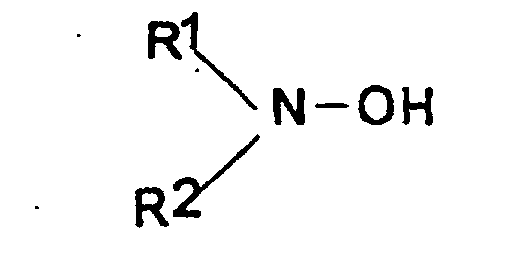
- the catalyst is particularly suitable for manufacturing N, N-disubstituted hydroxylamines of general formula (I): in which R 1 and R 2, which are identical or different, each represent a linear or branched alkyl radical, preferably linear, containing from 1 to 8 carbon atoms, preferably from 1 to 6 carbon atoms, optionally substituted, preferably at the end chain, by groups chosen from hydroxyl, fluoride, sulfonates of alkali or alkaline earth metals, carboxylates of alkali or alkaline earth metals and ether, a cycloalkyl radical containing from 5 to 8 carbon atoms , a linear radical of formula C n H 2n-1 , n being a number between 2 and 6.
- R 1 and R 2 together with the nitrogen atom, can also be linked together by forming a saturated ring or unsaturated comprising from 4 to 7 carbon atoms.
- the object of the invention therefore relates to a process for obtaining of hydroxylamine, N, N-disubstituted of general formula (I) from peroxide of hydrogen and the corresponding amine.
- This process is characterized in that one operates in the presence of a catalyst, as described above.
- Preferred corresponding amines are diethylamine, dibutylamine, dihexylamine, methylethylamine, methylpropylamine, methylbutylamine, ethylbutylamine, ethylhexylamine, diethanolamine, divinylamine, piperidine, morpholine, pyrrolidine and pyrroline.
- Particularly preferred corresponding amines are diethylamine, diethanolamine, divinylamine, methylethylamine, methyl propylamine and methylbutylamine.
- the process of the present invention it is possible to operate either by presence either in the absence of a solvent.
- a solvent water or any organic solvent miscible with water, for example aliphatic alcohols and heavy glyme ethers.
- tertiobutanol and diglyme are chosen.
- the process can be carried out both continuously and discontinuously.
- the reaction temperature is generally between 15 and 150 ° C. and preferably between 60 and 90 ° C.
- the catalyst can be used either in the finely divided state and dispersed in the reaction medium is shaped to give pellets or extrudates.
- the amount of catalyst involved is generally between 0.5 and 50 parts per 100 parts of amine and preferably between 1 and 30 parts.
- the hydrogen peroxide used is generally in the form of a solution aqueous concentration between 10 and 70% by weight. We use the most often an aqueous solution of 20 to 40% by weight of hydrogen peroxide.
- the amount of hydrogen peroxide involved is such that the ratio molar hydrogen peroxide / amine is between 0.2 and 1.5 and preferably between 0.9 and 1.2 when working discontinuously.
- the amount used is such that the concentration of the amine in the solvent is between 1 and 30 parts per 100 parts of solvent.
- a suspension containing the catalyst When working discontinuously, at the end of the reaction, a suspension containing the catalyst.
- the latter can be recovered by filtration of the suspension and the filtrate thus obtained consisting of the unreacted amine and reaction products, is analyzed by gas chromatography.
- the mine unreacted and hydroxylamine, N, N-disubstituted can also be dosed by acidimetry.
- the different reaction products and the unreacted amine can be isolated from the filtrate by known techniques such as distillation, crystallization or extraction.
- the unreacted amine and the solvent can be recycled.
- ADRICH tetrapropylammonium hydroxide
- the reaction medium is then left under stirring for 5 minutes, then transferred to a pressure-resistant reactor, provided with an internal Teflon coating, equipped with a stirring system and a heating device.
- the reaction medium is then brought to 170 ° C in one hour, with stirring (300 rotations per minute) and is thus maintained for 2 days.
- the white solid formed during the reaction is filtered and then washed 5 times with 250 cm 3 of distilled water each time.
- the filtered solid is then dried at 120 ° C for 12 hours, then calcined at 500 ° C in air for 4 hours.
- the mixture is brought, with stirring, to the reflux temperature (79-80 ° C), then introduced into the reactor for one hour, 13.1 g of a 35% by weight aqueous solution of hydrogen peroxide (0.135 mole).
- the heating is stopped 15 minutes after the end of the introduction of the aqueous solution of hydrogen peroxide.
- the water tank which is the device to assess the rate of decomposition of hydrogen peroxide, indicates the absence of gas evolution.
- the unused hydrogen peroxide is dosed by iodometry and the final solution is then analyzed by chromatography gas phase and also dosed by acidimetry.
- the analyzes indicate that at the end of the reaction, a rate of 87% conversion of diethylamine (DEA), selectivity to diethylhydroxylamine (DEHA) and nitrone compared to diethylamine 87% and 11% respectively.
- DEA diethylamine
- DEHA diethylhydroxylamine
- Example 1 At the end of the reaction of Example 1, the catalyst is separated from the solution by filtration. The catalyst thus recovered, not dried, is then used under the same conditions as those described above (example 1).
- Example 1 The procedure is as described in Example 1 except that the catalyst used has been prepared according to the method described in Example 2 of US Pat. No. 4,410,501.
- the water tank indicates the presence of gassing during the reaction. Therefore, part of the hydrogen peroxide consumed, has been broken down.
- Example 1 The procedure is as described in Example 1 except that the catalyst used has been prepared according to the method described in example 2 of the European application EP 665 188. After washing with acid and before use, the catalyst has a content by weight in Ti of 1.39%, in F of 0.083%, in K of 0.01% and in Na of 0.02%.
- Example 3 The procedure is as described in Example 3 except that the catalyst is subjected to pretreatment with an aqueous solution of KCI at 0.1 mol per liter and a 0.01 mole NaCl aqueous solution per liter.
- the pretreated catalyst has a Ti content by weight of 1.04%, in K of 0.85% and 0.065% Na.
- the catalyst prepared according to the mode 80 parts by weight of the catalyst prepared according to the mode are mixed procedure described in this application, with 20 parts of a binder based on silica gel (20% by weight of silica), then it is shaped to give extrudates of diameter and length between 1 mm and 1.6 mm. The the extrudates are then calcined at 500 ° C. in air for 4 hours.
- 12 g of extrudates thus prepared are introduced into a cylindrical reactor with an internal diameter of 20 mm and equipped with a frit and a double wall, thermostatically controlled using a circulating thermal fluid.
- the catalyst bed rests on the sinter located 3 cm from the bottom of the reactor.
- the cylindrical reactor has a reaction zone, consisting of the catalytic bed and a preheating zone, located just below the catalytic bed.
- a solution of diethylamine is continuously introduced into the reactor. 19% by weight in the diglyme with a flow rate of 256 g / h and an aqueous solution 20% by weight hydrogen peroxide with a flow rate of 19.3 g / h. Before being introduced into the reactor, the solutions are mixed.
- the temperature of the thermal fluid is adjusted so as to obtain a temperature in the reaction zone equal to 78 ° C. and all of the installation is swept under nitrogen.
- the liquid is recovered by overflow then cooled before being stored.
Landscapes
- Chemical & Material Sciences (AREA)
- Organic Chemistry (AREA)
- Engineering & Computer Science (AREA)
- Materials Engineering (AREA)
- Chemical Kinetics & Catalysis (AREA)
- Physics & Mathematics (AREA)
- Thermal Sciences (AREA)
- Organic Low-Molecular-Weight Compounds And Preparation Thereof (AREA)
- Catalysts (AREA)
- Low-Molecular Organic Synthesis Reactions Using Catalysts (AREA)
Description

où (DEA)f = nombre de moles de DEA à l'état final
et (H2O2)f = nombre de moles de H2O2 à l'état final
- 11 g de diéthylamine (0,15 mole)
- 60 g de tertiobutanol et
- 2 g de catalyseur préparé selon le mode opératoire ci-dessus.

Claims (11)
- Procédé d'obtention d'hydroxylamine N,N-disubstituée de formule générale :dans laquelle R1 et R2 identiques ou différents, représentent chacun un radical alkyle, linéaire ou ramifié, de préférence linéaire, contenant de 1 à 8 atomes de carbone, de préférence de 1 à 6 atomes de carbone, éventuellement substitué, de préférence en bout de chaíne, par des groupements choisis parmi l'hydroxyle, le fluorure, les sulfonates des métaux alcalins ou alcalino-terreux, les carboxylates de métaux alcalins ou alcalino-terreux et l'éther, un radical cycloalkyle contenant de 5 à 8 atomes de carbone, un radical linéaire de formule CnH2n-1, n étant un nombre compris entre 2 et 6, à partir du peroxyde d'hydrogène et de l'amine disubstituée correspondante et en présence d'un catalyseur à base de titanosilicalites, ayant une teneur pondérale en métal ou métaux alcalin(s) comprise entre 0,05 et 2 % et susceptible d'être obtenu par traitement hydrothermal d'un mélange réactionnel constitué d'une source de silicium tétravalent, de tétrafluorure de titane, d'un agent structurant, d'eau et d'un ou de plusieurs ion(s) alcalin(s).
- Procédé selon la revendication 1 caractérisé en ce que la teneur pondérale en métal ou métaux alcalin(s) du catalyseur est comprise entre 0,9 % et 1,5 %.
- Procédé selon la revendication 1 ou 2 caractérisé en ce que le(s) métal ou métaux alcalin(s) du catalyseur est ou sont choisi(s) parmi le potassium, le sodium et le césium.
- Procédé selon l'une quelconque des revendications 1 à 3 caractérisé en ce que la source de silicium tétravalent est choisie dans le groupe formé par la silice finement divisée sous forme d'hydrogel, d'aérogel, ou de suspension colloïdale et les orthosilicates d'alkyle de formule générale : Si (OR)4 dans laquelle R représente un radical alkyle ayant de 1 à 4 atomes de carbone.
- Procédé selon la revendication 4 caractérisé en ce que la source de silicium est l'orthosilicate de tétraéthyle.
- Procédé selon l'une quelconque des revendications 1 à 5 caractérisé en ce que l'agent structurant est un hydroxyde de tétra alkylammonium dans lequel le radical alkyle comporte de 1 à 4 atomes de carbone.
- Procédé selon la revendication 6 caractérisé en ce que l'agent structurant est l'hydroxyde de tétrapropylammonium ou de tétrabutylammonium.
- Procédé selon l'une quelconque des revendications 1 à 7 caractérisé en ce que la teneur pondérale en titane est comprise entre 0,6 et 2,5 %.
- Procédé selon l'une quelconque des revendications 1 à 8 caractérisé en ce que la température du traitement hydrothermal est comprise entre 120 et 200° C.
- Procédé selon l'une des revendications 1 à 9 caractérisé en ce que R1 et R2 ensemble avec l'atome d'azote peuvent être reliés entre eux en formant un cycle saturé ou insaturé comprenant de 4 à 7 atomes de carbone.
- Procédé selon l'une des revendications 1 à 9 caractérisé en ce que l'amine disubstituée correspondante est la diéthylamine.
Applications Claiming Priority (2)
| Application Number | Priority Date | Filing Date | Title |
|---|---|---|---|
| FR9612459 | 1996-10-11 | ||
| FR9612459 | 1996-10-11 |
Publications (2)
| Publication Number | Publication Date |
|---|---|
| EP0835688A1 EP0835688A1 (fr) | 1998-04-15 |
| EP0835688B1 true EP0835688B1 (fr) | 2004-02-18 |
Family
ID=9496597
Family Applications (1)
| Application Number | Title | Priority Date | Filing Date |
|---|---|---|---|
| EP97402269A Expired - Lifetime EP0835688B1 (fr) | 1996-10-11 | 1997-09-29 | Catalyseur à base de titano-silicalites et procédé d'obtention d'hydroxylamine, n,n-disubstituée |
Country Status (9)
| Country | Link |
|---|---|
| US (1) | US6074622A (fr) |
| EP (1) | EP0835688B1 (fr) |
| JP (1) | JPH10118498A (fr) |
| KR (1) | KR19980032706A (fr) |
| CN (1) | CN1128677C (fr) |
| CA (1) | CA2215490A1 (fr) |
| DE (1) | DE69727634T2 (fr) |
| ES (1) | ES2216116T3 (fr) |
| PL (1) | PL187697B1 (fr) |
Families Citing this family (2)
| Publication number | Priority date | Publication date | Assignee | Title |
|---|---|---|---|---|
| CN111909054A (zh) * | 2020-08-07 | 2020-11-10 | 菏泽鸿特药业有限公司 | 一种n,n-二乙基羟胺的生产方法 |
| CN119038504B (zh) * | 2024-10-31 | 2025-06-03 | 浙江锦华新材料股份有限公司 | 一种二茂铁基分子筛催化制备羟胺溶液的方法 |
Family Cites Families (8)
| Publication number | Priority date | Publication date | Assignee | Title |
|---|---|---|---|---|
| IT1127311B (it) * | 1979-12-21 | 1986-05-21 | Anic Spa | Materiale sintetico,cristallino,poroso costituito da ossidi di silicio e titanio,metodo per la sua preparazione e suoi usi |
| US4471950A (en) * | 1982-10-22 | 1984-09-18 | Labate M D | Expandable, consumable stopper plug for steel making and handling vessels |
| US4938939A (en) * | 1987-09-08 | 1990-07-03 | Engelhard Corporation | Preparation of small-pored crystalline titanium molecular sieve zeolites |
| IT1252047B (it) * | 1991-07-10 | 1995-05-29 | Enichem Anic | Processo catalitico diretto per la produzione di idrossilammina |
| ES2092428B1 (es) * | 1993-06-15 | 1997-08-01 | Univ Valencia Politecnica | Material de estructura tipo zeolita de poros ultragrandes con un red constituida por oxidos de silicio y titanio; su sintesis y utilizacion para la oxidacion selectiva de productos organicos. |
| FR2715647B1 (fr) * | 1994-01-28 | 1996-04-05 | Elf Aquitaine | Procédé d'obtention de zéolithes contenant du titane. |
| DE4435239A1 (de) * | 1994-10-04 | 1996-04-11 | Basf Ag | Verfahren zur Herstellung von Hydroxylaminen aus Ammoniak oder den entsprechenden Aminen, Wasserstoff und Sauerstoff |
| US5646314A (en) * | 1994-11-16 | 1997-07-08 | Arco Chemical Technology, L.P. | Process for titanium silicalite-catalyzed epoxidation |
-
1997
- 1997-09-26 CA CA002215490A patent/CA2215490A1/fr not_active Abandoned
- 1997-09-29 EP EP97402269A patent/EP0835688B1/fr not_active Expired - Lifetime
- 1997-09-29 DE DE69727634T patent/DE69727634T2/de not_active Expired - Fee Related
- 1997-09-29 ES ES97402269T patent/ES2216116T3/es not_active Expired - Lifetime
- 1997-10-09 KR KR1019970051867A patent/KR19980032706A/ko not_active Ceased
- 1997-10-10 PL PL97322546A patent/PL187697B1/pl not_active IP Right Cessation
- 1997-10-11 CN CN97122563A patent/CN1128677C/zh not_active Expired - Fee Related
- 1997-10-13 JP JP9294876A patent/JPH10118498A/ja not_active Abandoned
-
1998
- 1998-08-06 US US09/130,116 patent/US6074622A/en not_active Expired - Fee Related
Also Published As
| Publication number | Publication date |
|---|---|
| DE69727634D1 (de) | 2004-03-25 |
| ES2216116T3 (es) | 2004-10-16 |
| JPH10118498A (ja) | 1998-05-12 |
| US6074622A (en) | 2000-06-13 |
| PL187697B1 (pl) | 2004-09-30 |
| DE69727634T2 (de) | 2004-12-23 |
| EP0835688A1 (fr) | 1998-04-15 |
| KR19980032706A (ko) | 1998-07-25 |
| PL322546A1 (en) | 1998-04-14 |
| CN1128677C (zh) | 2003-11-26 |
| CA2215490A1 (fr) | 1998-04-11 |
| CN1184002A (zh) | 1998-06-10 |
Similar Documents
| Publication | Publication Date | Title |
|---|---|---|
| EP0175399B1 (fr) | Procédé d'obtention d'éthylène à partir d'éthanol | |
| BE1001038A7 (fr) | Procede pour la preparation de materiaux synthetiques cristallins poreux constitues d'oxydes de silicium et de titane. | |
| EP0695217B1 (fr) | Catalyseur a base de silice et de titane et son utilisation dans l'epoxydation d'olefines | |
| ZA200206952B (en) | Method for the production of a titanium-containing zeolite. | |
| EP0665188B1 (fr) | Procédé d'obtention de zéolithes contenant du titane | |
| EP0792863A1 (fr) | Procédé d'obtention d'isophorone | |
| WO2001032306A1 (fr) | Catalyseur de palladium et procede de production d'ether | |
| EP0314582B1 (fr) | Procédé d'hydroxylation de phénols et d'éthers de phénols | |
| EP1131264A1 (fr) | Procede de preparation d'une silicalite de titane de type mel, produit obtenu et ses applications en catalyse | |
| EP0835688A1 (fr) | Catalyseur à base de titano-silicalites et procédé d'obtention d'hydroxylamine, n,n-disubstituée | |
| EP1123159A1 (fr) | Procede de preparation d'une titanozeolite de type mfi, produit obtenu et ses applications en catalyse | |
| WO2001066246A1 (fr) | Utilisation d'un solide de structure hydrotalcite integrant des ions fluorures pour la catalyse basique de reactions de michaël ou de knoevenagel | |
| EP1625108A1 (fr) | Separation d'un diacetal du glyoxal par extraction liquide-liquide a contre-courant | |
| EP0277894B1 (fr) | Procédé de préparation de trialkoxybenzaldéhyde | |
| EP1980531A1 (fr) | Procédé de préparation d'une zéolithe de type structural MEL | |
| EP0921110B1 (fr) | Utilisation de composés de structure de type hydrotalcite pour la préparation de composés carbonyles-bèta-hydroxy et/ou alpha-bèta insaturés | |
| EP0299893A2 (fr) | Procédé d'hydroxylation de phénols et d'éthers de phénols | |
| EP0346250A1 (fr) | Procédé d'hydroxylation de phénols et d'éthers de phénols | |
| FR2730723A1 (fr) | Zeolithe ti-beta, son procede de preparation et son utilisation comme catalyseur d'oxydation | |
| CN115819201B (zh) | 钛硅分子筛催化的邻氯苯甲醛的绿色合成工艺 | |
| CN108658732B (zh) | 制备苯二酚的方法 | |
| FR2835251A1 (fr) | Procede de preparation d'un aldehyde aromatique | |
| JPH08157401A (ja) | トリメチロールプロパン及びジトリメチロールプロパンの製造方法 | |
| EP1737837B1 (fr) | Procede de preparation de methylenedioxybenzene eventuellement substitue. | |
| JP2006513246A (ja) | 水溶性β−ヒドロキシニトリルの製造 |
Legal Events
| Date | Code | Title | Description |
|---|---|---|---|
| PUAI | Public reference made under article 153(3) epc to a published international application that has entered the european phase |
Free format text: ORIGINAL CODE: 0009012 |
|
| 17P | Request for examination filed |
Effective date: 19971004 |
|
| AK | Designated contracting states |
Kind code of ref document: A1 Designated state(s): BE CH DE ES FR GB IT LI NL |
|
| AX | Request for extension of the european patent |
Free format text: AL;LT;LV;RO;SI |
|
| AKX | Designation fees paid |
Free format text: BE CH DE ES FR GB IT LI NL |
|
| RBV | Designated contracting states (corrected) |
Designated state(s): BE CH DE ES FR GB IT LI NL |
|
| RAP1 | Party data changed (applicant data changed or rights of an application transferred) |
Owner name: ATOFINA |
|
| 17Q | First examination report despatched |
Effective date: 20010406 |
|
| GRAH | Despatch of communication of intention to grant a patent |
Free format text: ORIGINAL CODE: EPIDOS IGRA |
|
| GRAS | Grant fee paid |
Free format text: ORIGINAL CODE: EPIDOSNIGR3 |
|
| GRAA | (expected) grant |
Free format text: ORIGINAL CODE: 0009210 |
|
| AK | Designated contracting states |
Kind code of ref document: B1 Designated state(s): BE CH DE ES FR GB IT LI NL |
|
| REG | Reference to a national code |
Ref country code: GB Ref legal event code: FG4D Free format text: NOT ENGLISH |
|
| REG | Reference to a national code |
Ref country code: CH Ref legal event code: EP |
|
| REF | Corresponds to: |
Ref document number: 69727634 Country of ref document: DE Date of ref document: 20040325 Kind code of ref document: P |
|
| GBT | Gb: translation of ep patent filed (gb section 77(6)(a)/1977) |
Effective date: 20040517 |
|
| REG | Reference to a national code |
Ref country code: CH Ref legal event code: NV Representative=s name: SUSI PRYDE-HAENI BSC |
|
| REG | Reference to a national code |
Ref country code: ES Ref legal event code: FG2A Ref document number: 2216116 Country of ref document: ES Kind code of ref document: T3 |
|
| PLBE | No opposition filed within time limit |
Free format text: ORIGINAL CODE: 0009261 |
|
| STAA | Information on the status of an ep patent application or granted ep patent |
Free format text: STATUS: NO OPPOSITION FILED WITHIN TIME LIMIT |
|
| RAP2 | Party data changed (patent owner data changed or rights of a patent transferred) |
Owner name: ARKEMA |
|
| 26N | No opposition filed |
Effective date: 20041119 |
|
| NLT2 | Nl: modifications (of names), taken from the european patent patent bulletin |
Owner name: ARKEMA |
|
| PGFP | Annual fee paid to national office [announced via postgrant information from national office to epo] |
Ref country code: FR Payment date: 20050823 Year of fee payment: 9 |
|
| PGFP | Annual fee paid to national office [announced via postgrant information from national office to epo] |
Ref country code: NL Payment date: 20050904 Year of fee payment: 9 |
|
| PGFP | Annual fee paid to national office [announced via postgrant information from national office to epo] |
Ref country code: DE Payment date: 20050922 Year of fee payment: 9 |
|
| PGFP | Annual fee paid to national office [announced via postgrant information from national office to epo] |
Ref country code: GB Payment date: 20050928 Year of fee payment: 9 Ref country code: CH Payment date: 20050928 Year of fee payment: 9 |
|
| PGFP | Annual fee paid to national office [announced via postgrant information from national office to epo] |
Ref country code: ES Payment date: 20051027 Year of fee payment: 9 |
|
| PGFP | Annual fee paid to national office [announced via postgrant information from national office to epo] |
Ref country code: BE Payment date: 20051123 Year of fee payment: 9 |
|
| PG25 | Lapsed in a contracting state [announced via postgrant information from national office to epo] |
Ref country code: LI Free format text: LAPSE BECAUSE OF NON-PAYMENT OF DUE FEES Effective date: 20060930 Ref country code: CH Free format text: LAPSE BECAUSE OF NON-PAYMENT OF DUE FEES Effective date: 20060930 Ref country code: BE Free format text: LAPSE BECAUSE OF NON-PAYMENT OF DUE FEES Effective date: 20060930 |
|
| PGFP | Annual fee paid to national office [announced via postgrant information from national office to epo] |
Ref country code: IT Payment date: 20060930 Year of fee payment: 10 |
|
| PG25 | Lapsed in a contracting state [announced via postgrant information from national office to epo] |
Ref country code: NL Free format text: LAPSE BECAUSE OF NON-PAYMENT OF DUE FEES Effective date: 20070401 |
|
| PG25 | Lapsed in a contracting state [announced via postgrant information from national office to epo] |
Ref country code: DE Free format text: LAPSE BECAUSE OF NON-PAYMENT OF DUE FEES Effective date: 20070403 |
|
| REG | Reference to a national code |
Ref country code: CH Ref legal event code: PL |
|
| GBPC | Gb: european patent ceased through non-payment of renewal fee |
Effective date: 20060929 |
|
| NLV4 | Nl: lapsed or anulled due to non-payment of the annual fee |
Effective date: 20070401 |
|
| REG | Reference to a national code |
Ref country code: FR Ref legal event code: ST Effective date: 20070531 |
|
| PG25 | Lapsed in a contracting state [announced via postgrant information from national office to epo] |
Ref country code: GB Free format text: LAPSE BECAUSE OF NON-PAYMENT OF DUE FEES Effective date: 20060929 |
|
| REG | Reference to a national code |
Ref country code: ES Ref legal event code: FD2A Effective date: 20060930 |
|
| BERE | Be: lapsed |
Owner name: *ATOFINA Effective date: 20060930 |
|
| PG25 | Lapsed in a contracting state [announced via postgrant information from national office to epo] |
Ref country code: ES Free format text: LAPSE BECAUSE OF NON-PAYMENT OF DUE FEES Effective date: 20060930 |
|
| PG25 | Lapsed in a contracting state [announced via postgrant information from national office to epo] |
Ref country code: FR Free format text: LAPSE BECAUSE OF NON-PAYMENT OF DUE FEES Effective date: 20061002 |
|
| PG25 | Lapsed in a contracting state [announced via postgrant information from national office to epo] |
Ref country code: IT Free format text: LAPSE BECAUSE OF NON-PAYMENT OF DUE FEES Effective date: 20070929 |