EP0836397B1 - Coupe-ongles con u pour recueillir les ongles de mains et de pieds - Google Patents
Coupe-ongles con u pour recueillir les ongles de mains et de pieds Download PDFInfo
- Publication number
- EP0836397B1 EP0836397B1 EP95944250A EP95944250A EP0836397B1 EP 0836397 B1 EP0836397 B1 EP 0836397B1 EP 95944250 A EP95944250 A EP 95944250A EP 95944250 A EP95944250 A EP 95944250A EP 0836397 B1 EP0836397 B1 EP 0836397B1
- Authority
- EP
- European Patent Office
- Prior art keywords
- elongate
- upper arm
- finger
- actuating lever
- arm
- Prior art date
- Legal status (The legal status is an assumption and is not a legal conclusion. Google has not performed a legal analysis and makes no representation as to the accuracy of the status listed.)
- Expired - Lifetime
Links
- 208000019300 CLIPPERS Diseases 0.000 title claims abstract description 87
- 208000021930 chronic lymphocytic inflammation with pontine perivascular enhancement responsive to steroids Diseases 0.000 title claims abstract description 87
- 210000004905 finger nail Anatomy 0.000 title claims abstract description 63
- 210000004906 toe nail Anatomy 0.000 title claims abstract description 62
- 230000015572 biosynthetic process Effects 0.000 claims abstract description 78
- 238000005755 formation reaction Methods 0.000 claims abstract description 78
- 238000005520 cutting process Methods 0.000 claims abstract description 29
- 210000000282 nail Anatomy 0.000 claims description 53
- 210000005069 ears Anatomy 0.000 claims description 9
- 230000000694 effects Effects 0.000 claims description 3
- 230000000295 complement effect Effects 0.000 claims 2
- 230000008878 coupling Effects 0.000 claims 2
- 238000010168 coupling process Methods 0.000 claims 2
- 238000005859 coupling reaction Methods 0.000 claims 2
- 238000004519 manufacturing process Methods 0.000 description 2
- 230000007246 mechanism Effects 0.000 description 2
- 238000000034 method Methods 0.000 description 2
- 230000004048 modification Effects 0.000 description 2
- 238000012986 modification Methods 0.000 description 2
- 230000008569 process Effects 0.000 description 2
- 230000004888 barrier function Effects 0.000 description 1
- 230000000903 blocking effect Effects 0.000 description 1
- 230000008859 change Effects 0.000 description 1
- 238000010276 construction Methods 0.000 description 1
- 230000008030 elimination Effects 0.000 description 1
- 238000003379 elimination reaction Methods 0.000 description 1
- 230000000284 resting effect Effects 0.000 description 1
- 230000000717 retained effect Effects 0.000 description 1
- 238000000926 separation method Methods 0.000 description 1
- 230000000087 stabilizing effect Effects 0.000 description 1
- 238000003860 storage Methods 0.000 description 1
Images





Classifications
-
- A—HUMAN NECESSITIES
- A45—HAND OR TRAVELLING ARTICLES
- A45D—HAIRDRESSING OR SHAVING EQUIPMENT; EQUIPMENT FOR COSMETICS OR COSMETIC TREATMENTS, e.g. FOR MANICURING OR PEDICURING
- A45D29/00—Manicuring or pedicuring implements
- A45D29/02—Nail clippers or cutters
- A45D29/023—Nail clippers or cutters with retainers for nail clippings
-
- A—HUMAN NECESSITIES
- A45—HAND OR TRAVELLING ARTICLES
- A45D—HAIRDRESSING OR SHAVING EQUIPMENT; EQUIPMENT FOR COSMETICS OR COSMETIC TREATMENTS, e.g. FOR MANICURING OR PEDICURING
- A45D29/00—Manicuring or pedicuring implements
- A45D29/02—Nail clippers or cutters
Definitions
- This invention relates generally to finger/toe nail clippers and, more particularly, provides a finger/toe nail clipper and catcher device which prevents nail clippings from scattering during use thereof and offers effective means for catching and retaining the accumulated nail clippings as well as providing improved actuating lever means therefor.
- Conventional finger/toe nail clipper devices generally have a pair of elongate arms arranged overlying and co-extensive.
- the upper arm has limited resilience while the lower arm is rigid.
- the longitudinal sides of the device generally are open.
- the rear ends of the arms are secured.
- the front ends of the arms terminate in jaw formations, each jaw formation terminating in cutting edges spaced apart slightly.
- An actuating lever is provided coupled to mounting means proximate the jaw formations.
- the conventional mounting means for the actuating lever consist of a mounting pin having a head at one end and a passage at the other end. Each arm has a hole adjacent to the jaw area. These holes are aligned. The mounting pin passes through the aligned holes.
- the mounting pin when installed conventionally, partially blocks partially blocks passage between the jaws of the clipper, limiting the entry of the finger/toe nail. Also, the mounting pin obstructs the flow of the nail clippings toward the interior area of the clipper, resulting in the uncontrolled dispersal of the finger/toe nail clippings common to the use of conventional finger/toe nail clipper devices.
- the Ro U.S. Pat.No. 5,072,511 discloses an attempt to deal with these difficulties.
- the Ro structure involves a recess formed in the side walls to facilitate controlled catching and discharge of the clippings. While the structure does contain many clippings within the chamber formed by the side walls, there are open slots between the side walls and jaw formations that permit escape of some of the clippings that have rebounded from the interior surfaces of the jaws and the mounting pin, leaving a retrieval problem which was sought to be avoided. Also, the Ro clipper appears to require considerable shaking to discharge any clippings jammed in the interior, rear narrow portion of the clipper.
- the U.S. Pat. No. 5,150,521 to Han provides a separate nail collecting box into which the nail clipper is slipped. A cover frictionally is engaged over a conventional clipper to retain the clippings.
- the Han solution requires a two-piece unit that is likely to be expensive to manufacture and difficult to separate in order to dispose of the accumulated clippings.
- the Gamble U.S. Pat.No. 4,640,011 describes a hinged retainer with side walls that close off the side openings of the clipper. When the retainer section is dropped, the nail clippings fall out. However,to remove the nail clippings in the rear area of the interior chamber, the retainer must still be removed from the conventional nail clipper. Shaking still is required to dispose of the clippings caught in the rear area of the portion of the clipper.
- U.S. Pat.No. 5,195,544 illustrates a sheath into which the conventional nail clipper is lodged.
- the sheath must be removed from the conventional clipper in order to discharge the accumulated clippings within the chamber.
- An additional element for collection and the separation of such element to remove the clippings is required, making it burdensome for the user.
- U.S. Pat.No. 4,984,366 demonstrates another slip-on device whereby a tubular element is fitted onto the conventional clipper. However, the tube does not extend to the mouth of the clipper, still allowing escape of nail clippings deflected from the mounting pin and the interior of the blades out of the side slots.
- the Williams U.S.Pat.No. 4,996,771 shows a clipper with a retainer and catching mechanism that catches nail clippings in the forward position and empties the clippings when in the rearward position. Random nail clippings may still deflect from the mounting pin.
- the Leininger U.S.Pat.No. 5,131,146 exhibits a receptacle that has a rear sleeve which receives the rear part of the finger/nail clipper as well as a front shield that receives the front portion of said finger/nail clipper and accommodates the nail clippings resulting from the use of the clipper device.
- the front shield is attached to the rear sleeve by a "live" hinge that allows the front sleeve to be pulled away from the body of the clipper device about the hinge, enabling release of the clippings collected within the interior of the device.
- the interior side walls of the front shield engage to the lower arm of the clipper device.
- the Leininger attachment may reduce the amount of scattered clippings, there is still a problem of uncontrolled dispersal with a portion of the clippings since they may, again, deflect from the mounting pin and out the open mouth of the cutting edges.
- the Leininger shield and sleeve unit is a plastic molded product that fits a particular size clipper device, necessitating several sizes of the shield/sleeve unit. Also, it is likely that the plastic molded receptacle will not last an adequate useful life.
- the Chen U.S.Patent No. 4,614,031 divulges a nail clipper with a lower stationary base and side walls that house the clippings within the clipper device. However, there are side slots between the jaw formations and the side walls of the base where random nail clippings may escape.
- the Bumbera U.S.Pat.No. 4,419,134 evidences an attempt to eliminate the deflection problem of the mounting pin by mounting the actuating lever by means at the end of the actuating lever hooked on the band circled around the lower and upper arms of the clipper.
- the Bumbera structure has open side walls, which still allows the scattered escape of nail clippings. However, even if the Bumbera design had side walls, the band would prevent the front portion of the clipper to be shielded, resulting in incomplete protection against scattered escape.
- U.S.Pat. 4,574,475 to Lee presents side walls extending from the jaw area and terminating at the rear area of the device.
- the Lee structure allows for nail clippings to be caught in the narrowed rear portion of the device, resulting in difficult removal of the clippings.
- forward opening end notches or slots in the side walls allow the passage of random nail clippings.
- the Castagna U.S.Pat.No. 5,261,160 also introduces side walls to shield the length of the nail clipper.
- Document US 3,744,131 relates to a nail clipper with receiver for nail clippings. It comprises a pair of elongated legs disposed in adjacent generally parallel relation. Both legs are channel shaped and are so interrelated as to define between them a hollow trapping and collecting receiver for nail clippings. Each channel is formed by a web portion and side flanges. The two legs are fixed to each other at their bowed terminal end portions.
- the opposite end portions are each provided with a respective lip defining a jaw.
- the nail clipper further includes a pivotable lever which is an elongated U-shape yoke.
- the arms of the yoke end by straight portions which straddle the flanges and are provided with aligned journals which are rotatable in bearing holes provided therefore in the side flanges of the lower leg, at the lowest position close to the web portion.
- a median portion of the arms is provided with a dowel-like rigid cross member that provides a thrust member when the lever is pressed toward the clipper.
- the lever can be swung in an inactive position beneath the lower leg.
- US-A-2 179 435 discloses a clipper assembly according to the preambule of claim 1.
- An object of the present invention is to provide an improved nail clipper having an actuating lever that can be moved between an active condition and a passive condition.
- the invention provides a finger/toe nail clipper assembly including elongate upper and lower arms arranged in spaced generally horizontal overlying arrangement; the upper arm having limited resilience; the arms each having first ends secured together and opposite second ends terminating in facing jaw formations; the jaw formations terminating in blade sections having sharpened cutting edges; an actuating lever capable of pivotal movement for selectively bearing against the upper arm for forcably effecting engagement of said sharpened cutting edges for severing the finger/toe nail introduced therebetween; generally vertical side walls being formed along the opposite longitudinal edges of the lower arm along the length thereof and the blade sections of the jaw formations defining an entrance for receiving the finger/toe nail introduced therebetween, said side walls shielding the longitudinal sides between the spaced upper and lower arms; aligned passages being formed in the vertical side walls at a location proximate the jaw formations, said actuating lever being associated with said passages for said pivotal movement; characterized in that said actuating lever comprises: a first member mounted in said passages so as to extend between said side
- the invention preferably further provides the blade sections of said jaw formations characterized by angular facing side sections also terminating in cutting edges and defining movable slots for receiving variable sized finger/toe nails between said jaw formations.
- the invention additionally is characterized in that the interior of said arms, side walls and said jaw formations completely enclose the interior of said device when the cutting edges of the jaw formations are engaged.
- the invention further preferably provides a finger/toe nail clipper device characterized by the provision of selectively accessible disposal means for controllably discarding accumulated nail clippings from the interior thereof including means deflecting the nail clippings to the exterior of said device and selectively operable hatch for blocking egress of said nail clippings.
- the invention further is characterized in that said mounting means for said actuating lever of the finger/toe nail clipper and catcher device is provided with means for maintaining the stability and positioning thereof during use thereof.
- the following benefits can be achieved by the present invention: greater protection against the dispersal of nail clippings by complete enclosure of the interior during use; elimination deflection of clippings off of the conventional mounting pin by providing alternate mounting means for the actuating lever; provision of means to allow various nails to be clipped without sacrificing complete enclosure of the interior during use; provision of more controlled means for removing the accumulated nail clippings by a simple mechanism without any separate attachment units; provision of a clipper device which is capable of simpler manufacture and operation than has be heretofor available; and the provision of a clipper catcher device as a single unit free from the need for separate units as suggested by the prior art.
- a finger/toe nail clipper and catcher device in accordance with the invention is designated generally by reference character 10 and has an elongate upper arm 14 and an elongate lower arm 2 spaced in overlying arrangement with their longitudinal edges substantially parallel.
- the upper arm 14 bends downward at 14c at a location proximate the fastened end 8 of the device 10.
- the finger/toe clipper and catcher 10 has vertical opposite side-walls 4 and 6 unitary with said outer longitudinal edges of said lower arm 2 from a location proximate the fastened end 8 of the device 10 to the beginning of the jaw formation 4e of the lower arm 2.
- the side-walls shield the open longitudinal sides defined by the spaced upper and lower arms 14 and 2.
- Jaw formations 14a and 2a have concave center sections 26 and 28 and angular side sections 36 and 38 on either side of concave center sections 26 and 28.
- the concave center sections 26, 28 of jaw formations 14a and 2a have tapered blades 32, 34 which end in tapered blades 32, 34 that terminate in sharpened cutting edges 32a and 34a.
- the angular sections 36,38 also terminate in sharpened cutting edges 42a and 44a.
- the angular sections 36,38 extend to the adjacent side-walls 4,6.
- the side-walls 4 and 6 have diagonal edges 41 that gradually extend upward and flatten out at 4c proximate the jaw formations 14a and 2a proximate the jaw formations 14a and 2a.
- the front edge 4b of each side-wall dips down and terminates in a hook-like socket 46.
- An interior chamber 24 of the device 10 is isolated by the interior facing surfaces of the lower arm 2, upper arm 14, side-walls 4 and 6, jaw formations 14a and 2a and blades 32,34 and 42a,44a when the cutting edges 34a, 32a,42a and 44a bear against each other to cut a finger/toe nail.
- the interior chamber 24 is completely enclosed, preventing uncontrolled dispersal of the finger/toe clippings exterior of the device 10.
- the actuator lever 16 comprises a rotating portion 17 and a planar front plate 52 which only can move vertically.
- Portion 17 is generally flat and is bent at 17f, continuing in an elongate planar section 17b which functions as the grasping end 17b of the actuator lever 16.
- the rotating portion 17 is bent at 17a to form continuing elongate planar angled section 17c.
- Section 17c is provided with an opening 17d to accommodate fastening rivet 18.
- the bend at 17a forms a heel formation 17e of the actuating lever 16.
- the bend at 17a is at an angle so that the end 17g of the continuing elongate section 17c is parallel with the bend at 17f when the actuating lever is in its inactive position (shown in FIGURE 5).
- Front plate 52 functions as the connector which forms the mounting means for the actuating lever 16 to the side walls 4 and 6 of the device 10.
- the front plate 52 bends at 52a forming angled planar plate 52h so as to accommodate the rivet 18.
- An opening 52f is formed in the angled planar front plate 52h so as to accommodate the rivet 18, which tightly fastens the rotating portion 17 of the actuating lever 16 to said front plate 52 through openings 17d and 52f, the engaged portions 17c and 52h providing the actuating lever 16 with stability and support.
- the rivet 18 still permits rotation of the rotating portion 17 360 degrees enabling alternating between the active position illustrated in FIGURE 4 and the inactive position illustrated in FIGURE 5.
- the front plate 52 has oppositely, outwardly protruding side ends 52b and 52e.
- the side ends 52b and 52e ride within the sockets 46 formed in the side walls 4 and 6, enabling the actuating lever 16 to be mounted to the finger/toe nail clipper and catcher device 10.
- the rotating portion 17 of the actuating lever 16 slopes upward, away from the elongate upper arm 14 with the heel formation 17e against the upper surface of said arm 14.
- the front area 4a and 6a of the side walls 4 and 6 define side barriers which act as means prevent the actuating lever 16 from slipping sideways during use of the device 10, effectively positioning and stabilizing said actuating lever 16 during use.
- the grasping end 17b is pressed toward the upper arm 14.
- the heel formation 17e bears against the lower jaw formation 2a so that the cutting edges 32a and 34a and 42a and 44a engage against the finger/toe nail introduced between the jaw formations 14a and 2a, cutting the nail.
- the interior is completely isolated.
- the grasping end 17b In order for the actuating lever 16 to alternate between active and inactive positions, the grasping end 17b must be lifted upward and then rotated 180 degrees around the rivet 18.
- the rotating portion 17 of the actuating lever 16 When the actuating lever 16 is in its inactive position (FIGURE 5), the rotating portion 17 of the actuating lever 16 is rotated 180 degrees from its active position.
- the rotating portion 17 slopes downward, toward the upper surface of the elongate upper arm 14 with the heel formation 17e pointing upward instead of bearing against the upper surface of said upper arm 14.
- FIGURE 1 the finger/toe nail clipper and catcher 10 is illustrated with the disposal hatch 12 mounted to the undersurface of the lower arm 2 by the rivet 22, which also functions to fasten the elongate upper and lower arms 14,2 together, and the disposal hatch 12 being illustrated extended sideways about the rivet 22 away from the body of the device 10 in FIGURE 1.
- the disposal hatch 12 in the "cutting" stage, the disposal hatch 12 (shown in phantom outline in the undersurface of the lower arm 2) is closed, covering the opening 2c formed in the lower arm 2, through which the accumulated nail clippings may be released.
- the disposal hatch may be opened by swinging the hatch 12 to the side, allowing controlled discarding the accumulated nail clippings.
- FIGURES 6 and 7 a modified embodiment of the finger/nail clipper and catcher device according to the invention is illustrated and designated generally by reference character 20.
- the device 20 provides modified disposal means for nail clippings.
- the phantom outlines reveal the interior chamber 24 and deflector 13 located on the interior surface of the lower arm 2.
- the phantom outlines reveal the opening 15 in the lower arm 2.
- the angled deflector 13 provides controlled means for disposal of the nail clippings.
- the absence of the conventional mounting pin permits the unobstructed entry of the nail clippings.
- the disposal means provided in the device 20 enables one to hold the device 20 above any container or other area to receive the clippings.
- the deflector 13 will deflect the nail clippings, which will fall downwardly, through the opening 15 to the exterior of the device 20 so as to effect controlled disposal of the nail clippings.
- the deflector 13 does not extend upward all the way to the inner surface of the upper arm 14. It is sufficient that the deflector 13 extend upward a sufficient distance without preventing the resilience of upper arm, allowing the cutting edges of the jaw formations 14a and 2a to engage.
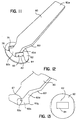
- FIGURES 8 - 12 a further modified embodiment of the finger/toe nail clipper and catcher device is illustrated and designated by reference character 30.
- the modified device 30 includes a modified actuating lever and mounting means therefor.
- the modified actuating lever designated generally by reference character 60 is generally flat with a grasping end 60e and a mounting base 60b.
- the longitudinal edges of actuating lever 60 are substantially parallel until said edges indent inward at 60f, then continuing in a substantially parallel direction to the mounting base 60b.
- the base 60b of the actuating lever 60 has a heel formation 60g and a horizontal bore 60c that extends through the base 60b.
- the lower surface of the base 60b engages the upper surface of the upper arm 14.
- a rotational disc 62 is formed as a planar member which may be circular or may be oval in configuration (see FIGURE 13) and has an axial passage 78 formed therethrough, a pair of oppositely facing mounting ears 64 and 76 extending vertically from the edges 82, 84 of the axial passage 78 formed in the disc 62.
- the mounting ears 64 and 76 carry openings 66.
- Base 60b is dimensioned so as to be received within the axial passage 78 between the ears 64 and 76 and arranged with the bore 60c aligned with the openings 66 and an elongate pin or rod 67, the ends thereof are passed therethrough to fasten the actuating lever 60 to the rotational disc 62.
- the upper edges 4c of the portions of side-walls 4 and 6 that extend above the upper surface of the elongate arm 14 are indented diagonally at 70, continuing in a longitudinal direction and angle outward at 72 proximate the jaw formation 14a.
- the angled and indented side-walls formed by 68, 70 and 72 that define the indented niches, have slots 74 carried by both side-walls 4 and 6, in which slots the rotational disc 62 rides and is capable of 360 degree rotation.
- the said lever 60 slopes upward, away from the elongate upper arm 14 with the heel formation 60g against the upper surface of the upper arm 14.
- the grasping end 60e is pressed toward the upper arm 14.
- the mounted base 60b, via the heel formation 60g is forced to bear against the upper surface of the upper arm, forcing the upper jaw formation 14a of the upper arm 14 against the lower jaw formation 2a.
- the heel formation 60g also functions to keep the actuating lever 60 in its active position by preventing the actuating lever 60 from falling toward the upper arm 14, thus complementing the positioning effect of the mounting ears 64 and 76.
- the grasping end 60e of the actuating lever 60 is lifted so that the heel formation 60g no longer rests upon the upper surface of upper arm 14.
- the actuating lever 60 as mounted to the rotational disc 62 is rotated as a unit 180 degrees so that the upper surface of the active actuating lever 60 faces downward and becomes parallel to the upper arm 14, resting against the upper arm 14 until the device 30 is rotated back to its active condition.
- the rotational disc 62 rotates within the longitudinal slots 74.
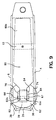
- FIGURES 14-22 wherein a further modified embodiment of the invention is designated generally by reference character 100.
- the finger/toe nail clipper and catcher device 100 differs from the finger/toe nail clipper and catcher devices illustrated in FIGURES 1-13 in that the actuating lever 120 has been is provided with modifications instituted in the means for mounting the modified actuating lever 120 to the device 100 and, modified means for positioning the actuating lever 120 and maintaining the stability of said actuating lever 120 has been provided.
- Device 100 further differs from the finger/toe nail clipper and catcher devices illustrated in FIGURES 1-13 in that the elongate upper and lower arms are planar from the jaw formations thereof through their opposite ends. Additionally, modified deflection means in the form of a trapezoidally configured block 196 has been substituted for the deflection means illustrated in the FIGURES 6,7 and 10. These modifications will be evident from the description to follow.
- the device 100 has an elongate upper arm 176 and an elongate lower arm 174 extending in overlying spaced, generally coextensive relationship with the longitudinal edges thereof substantially parallel when the actuating lever 120 is mounted on the device 100.
- Device 120 is provided with vertical side-walls 146 and 148 along the longitudinal edges of the lower arm 174, said side-walls 146 and 148 functioning to shield substantially the open sides of the device 100 from the beginning of the jaw formations 145 and 147 to a location proximate the rear of the device 100, said side-walls 146 and 148 tapering downwardly as represented by reference characters 148a.
- the device 100 has a rear block 196 which substantially increases the interior space between the arms 176 and 174 so that the capacity of the chamber 125 defined between said arms for accumulating the nail clippings is increased.
- the rear block 196 is trapezoidal in configuration, the diagonal surface 178 facing downwardly and toward the interior of said chamber 125 defining a deflector.
- the rear end of the elongate upper arm 176 is secured tightly to the top surface of the rear block 196 and the elongate lower arm 174 is secured to the opposite or bottom surface of said rear block 196 by a elongate rivet 182 and spot welded.
- the rivet 182 fastens the disposal hatch 172 to the undersurface of the lower arm 174 as well as fastening the upper arm 176 to the upper surface of rear block 196 and the lower arm 174 to the lower surface of said rear block 196.
- said opposite ends of said elongate upper arm 176 and said elongate lower arm 174 terminate in the spaced upper jaw formation 145 and lower jaw formation 147.
- said upper and lower jaw formations 145 and 147 have upper and lower concave center blade sections 156 and 150, upper and lower angular side blade sections 155,157 and 152,154 on the sides of the concave center blade sections 156,150.
- Blade sections 156,150,155,157,154 and 152 each terminate in sharpened cutting edges.
- the jaw formations 184,190 have upper and lower concave blade sections 186,192 that terminate in sharpened cutting edges 188 and 194.
- the lower concave blade section 192 is unitary with the lower arm 174 and portions of said side-walls 146 and 148 as represented in FIGURE 23.
- the concave blade sections 186 and 192 extend from one side wall 146 to the other side wall 148 and are unusually wide, i.e. greater than 5/8ths inches (greater than 1.7 centimeters).
- the side-walls 146 and 148 have coplanar upper longitudinal edges that dip at 158 and 159 defining notches 160 and 149.
- the notches 160 and 149 allow portions of the actuating lever 120 to extend below the uppermost point of the side-walls 146 and 148.
- the upper longitudinal edges then continue, to extend diagnonally upward and then flatten at 163 and 165.
- the upper longitudinal edges of each of said side-walls 146, 148 terminate in a hook-like formation 164 and 168 that defines a slot (or socket) 166,169 defining passage means for mounting the actuating lever 120.
- the modified actuating lever as an example, associated with the finger/toe nail clipper and catcher device 100, is designated by reference character 120.
- Actuating lever 120 comprises an elongate planar bar section 123, side wings 126 and 128 and a cross bar 138.
- One end of said elongate section 123 is slightly bent to define grasping end 124 while the opposite end of said elongate section 123 defines a heel formation 130 that functions as cam means for said actuating lever 120.
- the side wings 126 and 128 extend vertically diagonally from portions of the longitudinal edges of the elongate section 123 proximate to the heel formation 130.
- the side wings 126 and 128 are parallel one to the other and terminate in rounded mounting ends 126b and 128b.
- the mounting ends 126b and 128b are provided with respectively aligned slots 134 and 136 adapted to receive the protruding ends 140, 142 respectively for seating the crossbar 138.
- the ends 140 and 142 when seated within the slots 134 and 136 preferably are flush with the exterior facing surfaces of the side walls 146 and 148.
- Elongate section 123 is indented to form shoulders 123a and 123b.
- the crossbar 138 has a planar (flat) elongate middle section 144 and opposite protrudng ends 140 and 142.
- the elongate middle section is provided with a front longitudinal edge 144a and a rear longitudinal edge 144b.
- the protruding ends 140 and 142 seat within said slots (sockets) 166 and 169 formed in the side walls 146 and 148 as described above, enabling the actuating lever 120 to be mounted to the finger/toe nail clipper and catcher device 100
- the actuating lever 120 When the actuating lever 120 is in its active position, as shown in FIGURES 14 and 15, the elongate bar section 123 thereof slopes upward, away from the elongate upper arm 176. The heel formation 130 then is against the upper surface of the upper arm 176 proximate said notches 160 and 149. During the active position, the front edge 144a of said elongate middle section 144 of crossbar 138 rests against the upper surface of said upper arm 176. This construction keeps the actuating lever 120 from unintentionally flipping back to to any position other than the active position by providing some resistance.
- the grasping end 124 of the actuating lever 120 is pressed toward the upper arm 176, forcing the upper jaw formation 145 against the lower jaw formation 147 so that said jaw formations 145 and 147, i.e. the cutting edges thereof, engage the finger/toe nail introduced between said jaw formations 145 and 147, cutting the nail.
- the interior chamber is completely isolated.
- the grasping end 124 In order for the actuating lever 120 to change from the active position to the inactive position, the grasping end 124 must be lifted upward so that said crossbar 138 rotates within the sockets 166 and 169 of the side-walls 146 and 148 until is in its inactive position below the device. In the inactive position, the rear edge 144b of the middle section 144 of the crossbar 138 rests against the upper surface of the upper arm 176, preventing said actuating lever 120 from swinging to any other position by providing resistance against said motion.
- the actuating lever 120 When the actuating lever 120 is in its inactive position as represented in FIGURE 16, the elongate section 123 rests against the lower surface of said lower arm 174 and said disposal hatch 172 while the side wings 126,128 rest against the side-walls 146,148.
- the grasping end 124 In order to move said actuating lever 120 from its inactive condition to its active condition, the grasping end 124 must be pulled away from the body of the device 100 so that said crossbar 138 again rotates approximately 315 degrees within the sockets 166 and 169 of said side-walls 146,148 until the heel formation 130 rests against said upper arm 176.
- the finger/toe nail clipper and catching device 120 is illustrated with the disposal hatch 172 mounted to the undersurface of the lower arm 174 by the rivet 182, the disposal hatch 172 being extended sideways about the rivet 182 away from the body of the device 120.
- the disposal hatch 172 is closed, covering the opening 170 so that accumulated nail clippings may be retained.
- the disposal hatch may be opened by swinging the hatch 172 to the side, allowing controlled discarding of the accumulated nail clippings.
- Phantom outlines reveal the angled deflecting face 178 of the rear block 196.
Landscapes
- Scissors And Nippers (AREA)
- Portable Nailing Machines And Staplers (AREA)
- Fats And Perfumes (AREA)
- Food-Manufacturing Devices (AREA)
- Orthopedics, Nursing, And Contraception (AREA)
Claims (14)
- Ensemble coupe-ongles de doigts/orteils comportant
des bras supérieur et inférieur allongés (14, 2; 176, 178) disposés selon une disposition superposée espacée généralement horizontale;
le bras supérieur (14; 176) possédant une résilience limitée;
chacun des bras possédant des premières extrémités (8) fixées ensemble et des deuxièmes extrémités opposées se terminant par des formations en mâchoires en regard (14a, 2a; 145, 147);
les formations en mâchoires se terminant par des sections de lame (32, 34; 156, 150) possédant des tranchants aiguisés;
un levier d'actionnement (16; 120) capable de réaliser un mouvement pivotant pour s'appuyer sélectivement contre le bras supérieur afin d'effectuer de manière forcée l'engagement desdits tranchants aiguisés en vue de couper l'ongle de doigt/orteil introduit entre eux;
des parois latérales généralement verticales (4, 6; 146, 148) étant formées le long des bords longitudinaux opposés du bras inférieur dans le sens de sa longueur et les sections de lame des formations en mâchoires définissant une entrée pour recevoir l'ongle de doigt/orteil introduit entre elles, lesdites parois latérales (4, 6; 146, 148) protégeant les côtés longitudinaux entre les bras supérieur et inférieur espacés;
des passages alignés (46; 166, 168) étant formés dans les parois latérales verticales à un emplacement situé à proximité des formations en mâchoires, ledit levier d'actionnement étant associé auxdits passages pour ledit mouvement pivotant;
caractérisé en ce que
ledit levier d'actionnement comprend:un premier élément (52, 62; 138, 144) monté dans lesdits passages de façon à s'étendre entre lesdites parois latérales à proximité étroite dudit bras supérieur;une portion allongée mobile en rotation (17b, 52a; 60b, 60d; 123, 126, 128, 138, 144) s'étendant vers l'arrière depuis ledit premier élément et étant couplée audit premier élément pour rotation autour de celui-ci entre un état actif capable d'exercer une force sur ledit bras supérieur effectuant l'engagement desdits tranchants aiguisés pendant une phase de coupe dudit ensemble, et un état passif incapable d'exercer ladite force; etune formation en talon (17e, 60g, 130) sur ladite portion allongée mobile en rotation pour s'appuyer sélectivement contre ledit bras supérieur (14; 176) afin d'engager lesdits tranchants aiguisés. - Ensemble coupe-ongles de doigts/orteils selon la revendication 1, caractérisé en ce que lesdites sections de lame comprennent des sections de lame latérales angulaires rectilignes (42, 44; 155, 157; 152, 154) se terminant par des tranchants rectilignes aiguisés (42a, 44a), lesdites sections de lame latérales angulaires et leurs tranchants aiguisés étant tournés respectivement vers l'intérieur et vers le bas et engageant les parois latérales adjacentes en définissant une entrée dégagée à l'intérieur dudit ensemble logeant au travers de celle-ci les ongles de doigts/orteils de diverses longueurs et définissant un compartiment intérieur fermé (24) pour en recevoir les morceaux d'ongles coupés résultants pendant la phase de coupe dudit ensemble.
- Ensemble coupe-ongles de doigts/orteils selon la revendication 1 ou 2, caractérisé en ce que ledit premier élément est une plaque frontale immobile (52) et ladite portion allongée mobile en rotation (17), chacune possédant des portions coplanaires inclinées (17c, 52h), celles-ci possédant des alésages pouvant être alignés (17d, 52f) formés en leur sein; un palier/élément de fixation (18) disposé à travers lesdits alésages alignés permettant la rotation sélective de ladite portion allongée mobile en rotation (17).
- Ensemble coupe-ongles de doigts/orteils selon la revendication 1 ou 2, caractérisé en ce que ledit premier élément est une plaque de montage inclinée (52a) pouvant être mise en appui sur le bras supérieur, ladite plaque de montage comprenant une portion frontale (52) possédant un bras angulaire monobloc (52h) définissant une surface inclinée, ladite portion allongée mobile en rotation (17) possédant un coude monobloc (17c) s'étendant à un angle complémentaire à ladite surface inclinée dudit bras angulaire monobloc (52h) et se terminant par une portion de préhension (17b), un palier/élément de fixation (18) couplant ledit bras angulaire monobloc et ledit coude monobloc auxdites surfaces inclinées en contact dans des plans parallèles, surface contre surface, permettant à ladite portion allongée mobile en rotation (17) d'adopter une position s'étendant à l'écart dudit bras supérieur dans l'état actif, et d'adopter un état inactif, ladite extrémité de préhension de celle-ci étant à proximité étroite dudit bras supérieur.
- Ensemble coupe-ongles de doigts/orteils selon la revendication 1 ou 2, caractérisé en ce que lesdits passages comprennent des fentes allongées parallèles alignées à extrémités fermées (74) et ledit premier élément (62) possédant un passage axial (80) et des portions périphériques opposées pouvant être disposées sélectivement dans lesdites fentes allongées à extrémités fermées, des oreilles orientées verticalement (64, 76) portées par ledit premier élément (62) et situées à proximité dudit passage axial, lesdites oreilles (64, 76) possédant des alésages alignés (66, 60c), ledit élément allongé mobile en rotation (60) comprenant une base (60b) et une portion de levier allongée s'étendant vers l'extérieur (60d) possédant une extrémité terminale (60e), ladite base (60b) possédant des goupilles opposées (67) disposées dans lesdits alésages alignés (66, 60b), fixant ainsi de manière pivotante ladite base audit premier élément (62), ledit premier élément pouvant être placé entre lesdites parois latérales (4, 6), ladite base (60b) étant disposée au-dessus dudit bras supérieur à proximité de celui-ci et étant capable d'engagement avec celui-ci, ladite portion de levier allongée étant capable d'une rotation d'au moins 180 degrés en transportant avec elle ledit premier élément (62), au moins une paire de portions périphériques opposées de celui-ci pouvant glisser dans lesdites fentes à extrémités fermées et ledit premier élément étant positionné par-dessus ledit bras supérieur pour appliquer une force audit bras supérieur lors de la manipulation dudit élément allongé mobile en rotation et de sa portion de levier vers ledit bras supérieur, forçant les bords aiguisés desdites sections de lame en engagement de coupe avec un ongle de doigt/orteil introduit entre lesdites formations en mâchoires.
- Ensemble coupe-ongles de doigts/orteils selon la revendication 1 ou 2, caractérisé en ce que ledit levier d'actionnement (120) comprend une section de barre allongée (123), des ailes latérales (126, 128) et une traverse (138) possédant des extrémités opposées (140, 142), ladite section de barre allongée possédant une extrémité de préhension (124), des bords longitudinaux (127, 129), et une formation en talon (130) formée à l'extrémité- opposée de celle-ci, lesdites ailes latérales (126, 128) sont parallèles et s'inclinent verticalement vers le haut à partir de portions des bords longitudinaux de ladite section de barre allongée (123), lesdites parois latérales (146, 148) possédant des cavités alignées (166, 169) formées en leur sein à un emplacement situé à proximité desdites formations en mâchoires (145, 147), lesdites ailes latérales (126, 128) se terminant par des extrémités de montage (126b, 128b), lesdites extrémités de montage (126b, 128b) se terminant par des fentes alignées (134, 136), lesdites extrémités (140, 142) de ladite traverse (138) étant logées dans lesdites fentes alignées (134, 136), lesdites fentes (134, 136) étant adaptées à un alignement avec lesdites cavités (166, 169) et lesdites extrémités de traverse (140, 142) pouvant être reçues dans lesdites cavités (166, 169), ledit levier d'actionnement étant capable d'être disposé en rotation au-dessus dudit bras supérieur pendant l'état actif et au-dessous dudit ensemble pendant l'état inactif de celui-ci.
- Ensemble coupe-ongles de doigts/orteils selon la revendication 1 ou 2, caractérisé en ce que ladite portion allongée rotative est une barre allongée (123) et les ailes latérales (126, 128), ledit premier élément présentant la forme d'une traverse (138) possédant des extrémités opposées (134, 136), ladite barre allongée possédant une extrémité de préhension (124), des bords longitudinaux (127, 129) et une formation en talon (130) formée à l'extrémité opposée de celle-ci, lesdites ailes latérales (126, 128) étant parallèles et inclinées verticalement vers le haut, angulairement vers l'avant, depuis lesdites extrémités opposées, pour définir des portions terminales alignées (126b, 128b), ladite traverse (138) étant disposée entre lesdites portions terminales et étant fixée à celles-ci en les reliant à la manière d'un pont, ladite traverse (138) possédant une section centrale allongée (144) possédant une paire de portions périphériques longitudinales opposées (144a, 144b), une portion périphérique étant capable d'engager ledit bras supérieur lorsque ledit levier d'actionnement (120) adopte son état actif, produisant une résistance à toute rotation accidentelle de celui-ci, ladite autre portion périphérique longitudinale (144b) engageant ledit bras supérieur lorsque ledit levier d'actionnement est à son état passif pour empêcher toute rotation accidentelle dudit levier d'actionnement depuis son état passif, sa formation en talon étant engagée avec la surface inférieure dudit bras inférieur et lesdites ailes latérales étant engagées avec la surface extérieure desdites parois latérales.
- Ensemble coupe-ongles de doigts/orteils selon la revendication 1 ou 2, caractérisé en ce que
ledit levier d'actionnement possède une formation en talon disposée en relation d'appui avec ledit bras supérieur pour effectuer de manière forcée l'engagement de coupe des tranchants aiguisés avec un ongle de doigt/orteil introduit entre eux,
ladite portion allongée mobile en rotation dudit levier d'actionnement présente la forme d'une barre allongée (123) possédant une extrémité de préhension (124) et une extrémité opposée portant une formation capable d'effectuer ladite relation d'appui avec ledit bras supérieur (178), une paire d'ailes latérales parallèles (126, 128) formées le long des bords longitudinaux (127) de ladite barre allongée à un emplacement espacé de ladite extrémité opposée et s'étendant parallèlement l'une par rapport à l'autre et parallèlement verticalement vers le haut par rapport à ladite extrémité opposée définissant les portions terminales (126b, 128b), et
ledit premier élément est une traverse (138) possédant des extrémités (140, 142) fixées auxdites portions terminales en les reliant à la manière d'un pont, lesdites extrémités traversant les passages (136, 134) pour rotation à l'intérieur de ceux-ci entre un état actif et un état passif auquel ladite barre allongée (144) dudit levier d'actionnement est disposée sous ledit bras inférieur (174), lesdites ailes latérales (126, 128) étant engagées contre la surface extérieure desdites parois latérales. - Ensemble coupe-ongles de doigts/orteils selon la revendication 6, caractérisé par une trappe de mise au rebut (12, 170) pour éliminer les morceaux d'ongles de doigts/orteils coupés de l'intérieur dudit ensemble, ladite trappe de mise au rebut comprenant une ouverture longitudinale allongée de mise au rebut (2c, 170) formée dans l'un desdits bras supérieur et inférieur, s'ouvrant vers l'intérieur dudit ensemble, et une plaque de couverture allongée (72) fixée de manière pivotante à la surface opposée dudit bras à proximité de l'ouverture de mise au rebut, pour un déplacement horizontal pouvant osciller latéralement entre une position d'accès à l'intérieur dudit ensemble et une position recouvrant ladite ouverture.
- Ensemble coupe-ongles de doigts/orteils selon la revendication 1 ou 2, caractérisé en ce que ledit premier élément comprend une plaque de montage (52, 62) pouvant être mise en appui par-dessus le bras supérieur à un emplacement situé à proximité de sa formation en mâchoire, et ladite portion allongée mobile en rotation (17) possède une extrémité de préhension et une extrémité opposée; ladite plaque de montage (52, 62; 138; 144) comprenant une section frontale possédant un bras angulaire monobloc (52h) définissant une surface inclinée et un bord d'attaque (52c) opposé à ladite section frontale, ladite extrémité opposée (17b) de ladite portion allongée mobile en rotation (17), ladite extrémité opposée (17a) de ladite portion allongée mobile en rotation (17) possédant un coude angulaire monobloc (17c) définissant une surface inclinée complémentaire à ladite surface angulaire dudit bras angulaire monobloc (52h), ledit bras angulaire monobloc (52h) et ledit coude angulaire monobloc possédant des alésages alignés (52f, 17d) formés respectivement en leur sein; un palier/élément de fixation (18) traversant lesdits alésages alignés couplant ledit bras angulaire monobloc et ledit coude angulaire monobloc selon une disposition respective substantiellement à la manière d'une surface inclinée contre une surface inclinée, permettant à ladite portion allongée mobile en rotation (16) de tourner par rapport audit bras angulaire monobloc entre un état actif dirigé de façon divergente par rapport audit bras supérieur et un état passif dirigé dans le sens inverse par rapport à son état actif, l'extrémité de préhension de ladite portion allongée mobile en rotation étant à proximité étroite dudit bras supérieur, ladite section frontale (52) possédant des portions (51e, 52b) montant de manière pivotante ledit levier d'actionnement sur l'ensemble coupe-ongles de doigts/orteils.
- Ensemble coupe-ongles de doigts/orteils selon la revendication 1 ou 2, caractérisé en ce que lesdits passages présentent la forme de fentes parallèles allongées à extrémités fermées (74), et en ce que ledit premier élément dudit levier d'actionnement comprend un élément en forme de disque plan (62) possédant des portions périphériques diamétralement opposées et une ouverture axiale (82); des oreilles orientées verticalement (64, 76) portées par ledit élément en forme de disque plan et situées à proximité de ladite ouverture axiale; lesdites oreilles possédant des alésages alignés (60c); une base (60b) et une portion allongée s'étendant vers l'extérieur (60) monobloc avec celle-ci, ladite base étant logée dans ladite ouverture axiale entre lesdites oreilles et étant fixée de manière pivotante audit élément en forme de disque plan; ledit élément en forme de disque plan pouvant être placé par-dessus ledit bras supérieur entre lesdites parois latérales et étant capable d'une rotation de 360 degrés, lesdites portions périphériques diamétralement opposées étant configurées pour se glisser dans lesdites fentes allongées à extrémités fermées.
- Levier d'actionnement selon la revendication 11, dans lequel ledit élément en forme de disque plan (62) présente une configuration périmétrique ovale avec un axe long et un axe relativement plus court; ledit élément en forme de disque plan pouvant être positionné par-dessus le bras supérieur (14), son axe long étant parallèle dans le sens de la longueur au bras supérieur, et étant capable d'être tourné d'une position dans laquelle son axe long est dans le sens de la longueur du bras supérieur à une position dans laquelle les portions périphériques axiales le long de l'axe long sont disposées dans lesdites fentes allongées à extrémités fermées (74), les fentes et les portions périphériques axiales le long de l'axe plus court sont situées le long d'une ligne suivant le sens de la longueur du bras supérieur.
- Levier d'actionnement selon la revendication 12, caractérisé en ce que ledit élément en forme de disque plan (62) est capable de tourner de 180 degrés supplémentaires, lors de quoi ladite portion de levier allongée peut être désengagée du bras supérieur dudit ensemble coupe-ongles en soulevant la portion allongée s'étendant vers l'extérieur (60) et sa base, et peut être réengagée sur celui-ci en inversant ladite portion allongée s'étendant vers l'extérieur (60), pour adopter ainsi une disposition parallèle audit bras supérieur et donc adopter un état passif.
- Ensemble coupe-ongles de doigts/orteils selon la revendication 1 ou 2, caractérisé en ce que ladite barre allongée (123) possède une extrémité de préhension (124) et une extrémité opposée possédant une formation d'attaque en talon (130) pouvant être placée en relation d'appui avec le bras supérieur (174) à un emplacement situé à proximité de la formation en mâchoire (145, 147) de celui-ci, ladite barre allongée possédant une paire d'ailes latérales (126, 128) formées le long de ses bords longitudinaux de manière monobloc avec celle-ci à un emplacement espacé de ses extrémités, lesdites ailes latérales étant parallèles l'une par rapport à l'autre et s'étendant verticalement angulairement vers l'avant et vers l'extérieur de la deuxième extrémité de ladite barre allongée pour définir des portions terminales allongées (126b, 128b), une traverse (138) possédant des extrémités opposées (140, 142) configurées pour relier à la manière d'un pont lesdites portions terminales et fixées à celles-ci, ledit premier élément étant une traverse possédant une section centrale allongée (144), ladite section centrale possédant une paire de portions périphériques longitudinales opposées (144a, 144b), une portion périphérique (144a) étant capable d'engager le bras supérieur lorsque ledit levier d'actionnement adopte son état actif, produisant une résistance à toute rotation accidentelle de celui-ci, ladite autre portion périphérique longitudinale (144b) engageant le bras supérieur lorsque ledit levier d'actionnement (120) est à l'état passif pour empêcher toute rotation accidentelle de celui-ci à partir de l'état passif, la formation en talon étant engagée avec la surface inférieure du bras inférieur.
Applications Claiming Priority (5)
| Application Number | Priority Date | Filing Date | Title |
|---|---|---|---|
| US488925 | 1995-06-09 | ||
| US08/488,925 US5617633A (en) | 1995-06-09 | 1995-06-09 | Finger/toe nail clipper assembly |
| US498804 | 1995-07-06 | ||
| US08/498,804 US5564189A (en) | 1995-07-06 | 1995-07-06 | Finger/toe nail clipping and catching device |
| PCT/US1995/016935 WO1996041553A1 (fr) | 1995-06-09 | 1995-12-27 | Coupe-ongles conçu pour recueillir les ongles de mains et de pieds |
Publications (3)
| Publication Number | Publication Date |
|---|---|
| EP0836397A1 EP0836397A1 (fr) | 1998-04-22 |
| EP0836397A4 EP0836397A4 (fr) | 1998-11-18 |
| EP0836397B1 true EP0836397B1 (fr) | 2004-07-28 |
Family
ID=27049532
Family Applications (1)
| Application Number | Title | Priority Date | Filing Date |
|---|---|---|---|
| EP95944250A Expired - Lifetime EP0836397B1 (fr) | 1995-06-09 | 1995-12-27 | Coupe-ongles con u pour recueillir les ongles de mains et de pieds |
Country Status (8)
| Country | Link |
|---|---|
| EP (1) | EP0836397B1 (fr) |
| JP (1) | JPH11507571A (fr) |
| KR (1) | KR100405078B1 (fr) |
| AT (1) | ATE271799T1 (fr) |
| AU (1) | AU715409B2 (fr) |
| CA (1) | CA2221656A1 (fr) |
| DE (1) | DE69533321T2 (fr) |
| WO (1) | WO1996041553A1 (fr) |
Families Citing this family (3)
| Publication number | Priority date | Publication date | Assignee | Title |
|---|---|---|---|---|
| AU672567B1 (en) * | 1996-02-14 | 1996-10-03 | Antonio Francesco Mamprin | Nail clipper |
| ES2155373B1 (es) * | 1999-02-03 | 2001-12-01 | Univ Catalunya Politecnica | Cortauñas doble. |
| JP4810534B2 (ja) * | 2005-07-04 | 2011-11-09 | 泰仁 板垣 | 爪切り器具 |
Family Cites Families (7)
| Publication number | Priority date | Publication date | Assignee | Title |
|---|---|---|---|---|
| GB249289A (en) * | 1925-02-18 | 1926-03-25 | James Allen | Improvements in or relating to nippers, pliers, or the like |
| US2179435A (en) * | 1938-03-21 | 1939-11-07 | Paul H Smith | Nail clipper |
| US3744131A (en) * | 1970-10-14 | 1973-07-10 | L Manes | Nail clipper with receiver for nail clippings |
| CH597789A5 (en) * | 1976-04-28 | 1978-04-14 | Loeliger Biegger Arnold | Manicure aid with two levers |
| US4614031A (en) * | 1985-06-03 | 1986-09-30 | Chen Steve Y | Nail clipper |
| US4776090A (en) * | 1987-10-13 | 1988-10-11 | Grassi Mario R | Nail clipper catcher |
| US5488772A (en) * | 1994-05-04 | 1996-02-06 | Dababneh; Awwad | Collector nail clipper |
-
1995
- 1995-12-27 AU AU46096/96A patent/AU715409B2/en not_active Ceased
- 1995-12-27 AT AT95944250T patent/ATE271799T1/de not_active IP Right Cessation
- 1995-12-27 EP EP95944250A patent/EP0836397B1/fr not_active Expired - Lifetime
- 1995-12-27 DE DE69533321T patent/DE69533321T2/de not_active Expired - Fee Related
- 1995-12-27 CA CA002221656A patent/CA2221656A1/fr not_active Abandoned
- 1995-12-27 WO PCT/US1995/016935 patent/WO1996041553A1/fr not_active Ceased
- 1995-12-27 KR KR1019970707842A patent/KR100405078B1/ko not_active Expired - Fee Related
- 1995-12-27 JP JP9503025A patent/JPH11507571A/ja not_active Ceased
Also Published As
| Publication number | Publication date |
|---|---|
| AU715409B2 (en) | 2000-02-03 |
| KR100405078B1 (ko) | 2004-02-18 |
| AU4609696A (en) | 1997-01-09 |
| KR19990008316A (ko) | 1999-01-25 |
| WO1996041553A1 (fr) | 1996-12-27 |
| DE69533321T2 (de) | 2005-08-11 |
| ATE271799T1 (de) | 2004-08-15 |
| CA2221656A1 (fr) | 1996-12-27 |
| EP0836397A1 (fr) | 1998-04-22 |
| JPH11507571A (ja) | 1999-07-06 |
| EP0836397A4 (fr) | 1998-11-18 |
| DE69533321D1 (de) | 2004-09-02 |
Similar Documents
| Publication | Publication Date | Title |
|---|---|---|
| US5617633A (en) | Finger/toe nail clipper assembly | |
| US5564189A (en) | Finger/toe nail clipping and catching device | |
| US5983498A (en) | Nail clipper with receptacle | |
| US5459926A (en) | Nail clipping and catching implement and collector assembly | |
| US5442902A (en) | Rotary mower having integrated deflector/mulching plug and improved blade | |
| US4150481A (en) | Finger-toe nail clipper having shifting receptacle | |
| US5488772A (en) | Collector nail clipper | |
| US4232472A (en) | Animal trap | |
| US3188737A (en) | Nail clipper attachment to receive the cut clippings | |
| US4809431A (en) | Nail clipping device | |
| US5074041A (en) | Nail clipping retainer | |
| US5632288A (en) | Nail clippings catcher | |
| CN110338458A (zh) | 过滤烟嘴香珠添加装置 | |
| US5261160A (en) | Nail clipper and catcher | |
| AU715409B2 (en) | Finger/toe nail clipper and catcher | |
| US5784830A (en) | Fish hook removing devices | |
| US3154850A (en) | Nail clipper with receiver for clippings | |
| US4934050A (en) | Containment device for a nail clipper | |
| US4744170A (en) | Small animal trap with transverse locking slot on gate | |
| US7222427B1 (en) | Nail clipper | |
| US20060042092A1 (en) | Nail care system with improved nail clipper | |
| JPH044544Y2 (fr) | ||
| JPH0614650Y2 (ja) | 切爪飛散防止カバー付き爪切り | |
| GB2360208A (en) | Nail clipper with side blades | |
| JP2631949B2 (ja) | 蚤取り器 |
Legal Events
| Date | Code | Title | Description |
|---|---|---|---|
| PUAI | Public reference made under article 153(3) epc to a published international application that has entered the european phase |
Free format text: ORIGINAL CODE: 0009012 |
|
| 17P | Request for examination filed |
Effective date: 19980105 |
|
| AK | Designated contracting states |
Kind code of ref document: A1 Designated state(s): AT BE CH DE DK ES FR GB IE IT LI NL PT SE |
|
| A4 | Supplementary search report drawn up and despatched |
Effective date: 19981002 |
|
| AK | Designated contracting states |
Kind code of ref document: A4 Designated state(s): AT BE CH DE DK ES FR GB IE IT LI NL PT SE |
|
| 17Q | First examination report despatched |
Effective date: 20020701 |
|
| GRAP | Despatch of communication of intention to grant a patent |
Free format text: ORIGINAL CODE: EPIDOSNIGR1 |
|
| GRAS | Grant fee paid |
Free format text: ORIGINAL CODE: EPIDOSNIGR3 |
|
| GRAA | (expected) grant |
Free format text: ORIGINAL CODE: 0009210 |
|
| AK | Designated contracting states |
Kind code of ref document: B1 Designated state(s): AT BE CH DE DK ES FR GB IE IT LI NL PT SE |
|
| PG25 | Lapsed in a contracting state [announced via postgrant information from national office to epo] |
Ref country code: NL Free format text: LAPSE BECAUSE OF FAILURE TO SUBMIT A TRANSLATION OF THE DESCRIPTION OR TO PAY THE FEE WITHIN THE PRESCRIBED TIME-LIMIT Effective date: 20040728 Ref country code: IT Free format text: LAPSE BECAUSE OF FAILURE TO SUBMIT A TRANSLATION OF THE DESCRIPTION OR TO PAY THE FEE WITHIN THE PRE;WARNING: LAPSES OF ITALIAN PATENTS WITH EFFECTIVE DATE BEFORE 2007 MAY HAVE OCCURRED AT ANY TIME BEFORE 2007. THE CORRECT EFFECTIVE DATE MAY BE DIFFERENT FROM THE ONE RECORDED.SCRIBED TIME-LIMIT Effective date: 20040728 Ref country code: FR Free format text: LAPSE BECAUSE OF FAILURE TO SUBMIT A TRANSLATION OF THE DESCRIPTION OR TO PAY THE FEE WITHIN THE PRESCRIBED TIME-LIMIT Effective date: 20040728 Ref country code: BE Free format text: LAPSE BECAUSE OF FAILURE TO SUBMIT A TRANSLATION OF THE DESCRIPTION OR TO PAY THE FEE WITHIN THE PRESCRIBED TIME-LIMIT Effective date: 20040728 Ref country code: AT Free format text: LAPSE BECAUSE OF FAILURE TO SUBMIT A TRANSLATION OF THE DESCRIPTION OR TO PAY THE FEE WITHIN THE PRESCRIBED TIME-LIMIT Effective date: 20040728 |
|
| REG | Reference to a national code |
Ref country code: GB Ref legal event code: FG4D |
|
| REG | Reference to a national code |
Ref country code: CH Ref legal event code: EP |
|
| REG | Reference to a national code |
Ref country code: IE Ref legal event code: FG4D |
|
| REF | Corresponds to: |
Ref document number: 69533321 Country of ref document: DE Date of ref document: 20040902 Kind code of ref document: P |
|
| PG25 | Lapsed in a contracting state [announced via postgrant information from national office to epo] |
Ref country code: SE Free format text: LAPSE BECAUSE OF FAILURE TO SUBMIT A TRANSLATION OF THE DESCRIPTION OR TO PAY THE FEE WITHIN THE PRESCRIBED TIME-LIMIT Effective date: 20041028 Ref country code: DK Free format text: LAPSE BECAUSE OF FAILURE TO SUBMIT A TRANSLATION OF THE DESCRIPTION OR TO PAY THE FEE WITHIN THE PRESCRIBED TIME-LIMIT Effective date: 20041028 |
|
| PG25 | Lapsed in a contracting state [announced via postgrant information from national office to epo] |
Ref country code: ES Free format text: LAPSE BECAUSE OF FAILURE TO SUBMIT A TRANSLATION OF THE DESCRIPTION OR TO PAY THE FEE WITHIN THE PRESCRIBED TIME-LIMIT Effective date: 20041108 |
|
| REG | Reference to a national code |
Ref country code: CH Ref legal event code: NV Representative=s name: WILLIAM BLANC & CIE CONSEILS EN PROPRIETE INDUSTRI |
|
| PG25 | Lapsed in a contracting state [announced via postgrant information from national office to epo] |
Ref country code: GB Free format text: LAPSE BECAUSE OF NON-PAYMENT OF DUE FEES Effective date: 20041227 |
|
| PG25 | Lapsed in a contracting state [announced via postgrant information from national office to epo] |
Ref country code: IE Free format text: LAPSE BECAUSE OF NON-PAYMENT OF DUE FEES Effective date: 20041230 |
|
| PG25 | Lapsed in a contracting state [announced via postgrant information from national office to epo] |
Ref country code: LI Free format text: LAPSE BECAUSE OF NON-PAYMENT OF DUE FEES Effective date: 20041231 Ref country code: CH Free format text: LAPSE BECAUSE OF NON-PAYMENT OF DUE FEES Effective date: 20041231 |
|
| NLV1 | Nl: lapsed or annulled due to failure to fulfill the requirements of art. 29p and 29m of the patents act | ||
| PLBE | No opposition filed within time limit |
Free format text: ORIGINAL CODE: 0009261 |
|
| STAA | Information on the status of an ep patent application or granted ep patent |
Free format text: STATUS: NO OPPOSITION FILED WITHIN TIME LIMIT |
|
| PG25 | Lapsed in a contracting state [announced via postgrant information from national office to epo] |
Ref country code: DE Free format text: LAPSE BECAUSE OF NON-PAYMENT OF DUE FEES Effective date: 20050701 |
|
| 26N | No opposition filed |
Effective date: 20050429 |
|
| EN | Fr: translation not filed | ||
| REG | Reference to a national code |
Ref country code: CH Ref legal event code: PL |
|
| GBPC | Gb: european patent ceased through non-payment of renewal fee |
Effective date: 20041227 |
|
| REG | Reference to a national code |
Ref country code: IE Ref legal event code: MM4A |
|
| PG25 | Lapsed in a contracting state [announced via postgrant information from national office to epo] |
Ref country code: PT Free format text: LAPSE BECAUSE OF NON-PAYMENT OF DUE FEES Effective date: 20041228 |