EP0836475B1 - Formulations a liberation lente pour medicaments faiblement solubles - Google Patents
Formulations a liberation lente pour medicaments faiblement solubles Download PDFInfo
- Publication number
- EP0836475B1 EP0836475B1 EP96921053A EP96921053A EP0836475B1 EP 0836475 B1 EP0836475 B1 EP 0836475B1 EP 96921053 A EP96921053 A EP 96921053A EP 96921053 A EP96921053 A EP 96921053A EP 0836475 B1 EP0836475 B1 EP 0836475B1
- Authority
- EP
- European Patent Office
- Prior art keywords
- solid dispersion
- formulation according
- acid
- tablet
- active ingredient
- Prior art date
- Legal status (The legal status is an assumption and is not a legal conclusion. Google has not performed a legal analysis and makes no representation as to the accuracy of the status listed.)
- Expired - Lifetime
Links
Images



Classifications
-
- A—HUMAN NECESSITIES
- A61—MEDICAL OR VETERINARY SCIENCE; HYGIENE
- A61K—PREPARATIONS FOR MEDICAL, DENTAL OR TOILETRY PURPOSES
- A61K9/00—Medicinal preparations characterised by special physical form
- A61K9/14—Particulate form, e.g. powders, Processes for size reducing of pure drugs or the resulting products, Pure drug nanoparticles
- A61K9/141—Intimate drug-carrier mixtures characterised by the carrier, e.g. ordered mixtures, adsorbates, solid solutions, eutectica, co-dried, co-solubilised, co-kneaded, co-milled, co-ground products, co-precipitates, co-evaporates, co-extrudates, co-melts; Drug nanoparticles with adsorbed surface modifiers
- A61K9/146—Intimate drug-carrier mixtures characterised by the carrier, e.g. ordered mixtures, adsorbates, solid solutions, eutectica, co-dried, co-solubilised, co-kneaded, co-milled, co-ground products, co-precipitates, co-evaporates, co-extrudates, co-melts; Drug nanoparticles with adsorbed surface modifiers with organic macromolecular compounds
-
- A—HUMAN NECESSITIES
- A61—MEDICAL OR VETERINARY SCIENCE; HYGIENE
- A61K—PREPARATIONS FOR MEDICAL, DENTAL OR TOILETRY PURPOSES
- A61K9/00—Medicinal preparations characterised by special physical form
- A61K9/14—Particulate form, e.g. powders, Processes for size reducing of pure drugs or the resulting products, Pure drug nanoparticles
-
- A—HUMAN NECESSITIES
- A61—MEDICAL OR VETERINARY SCIENCE; HYGIENE
- A61K—PREPARATIONS FOR MEDICAL, DENTAL OR TOILETRY PURPOSES
- A61K9/00—Medicinal preparations characterised by special physical form
- A61K9/20—Pills, tablets, discs, rods
-
- A—HUMAN NECESSITIES
- A61—MEDICAL OR VETERINARY SCIENCE; HYGIENE
- A61K—PREPARATIONS FOR MEDICAL, DENTAL OR TOILETRY PURPOSES
- A61K9/00—Medicinal preparations characterised by special physical form
- A61K9/20—Pills, tablets, discs, rods
- A61K9/2072—Pills, tablets, discs, rods characterised by shape, structure or size; Tablets with holes, special break lines or identification marks; Partially coated tablets; Disintegrating flat shaped forms
- A61K9/2077—Tablets comprising drug-containing microparticles in a substantial amount of supporting matrix; Multiparticulate tablets
-
- A—HUMAN NECESSITIES
- A61—MEDICAL OR VETERINARY SCIENCE; HYGIENE
- A61K—PREPARATIONS FOR MEDICAL, DENTAL OR TOILETRY PURPOSES
- A61K9/00—Medicinal preparations characterised by special physical form
- A61K9/20—Pills, tablets, discs, rods
- A61K9/28—Dragees; Coated pills or tablets, e.g. with film or compression coating
- A61K9/2806—Coating materials
- A61K9/2833—Organic macromolecular compounds
- A61K9/284—Organic macromolecular compounds obtained by reactions only involving carbon-to-carbon unsaturated bonds, e.g. polyvinyl pyrrolidone
- A61K9/2846—Poly(meth)acrylates
-
- A—HUMAN NECESSITIES
- A61—MEDICAL OR VETERINARY SCIENCE; HYGIENE
- A61K—PREPARATIONS FOR MEDICAL, DENTAL OR TOILETRY PURPOSES
- A61K9/00—Medicinal preparations characterised by special physical form
- A61K9/20—Pills, tablets, discs, rods
- A61K9/28—Dragees; Coated pills or tablets, e.g. with film or compression coating
- A61K9/2806—Coating materials
- A61K9/2833—Organic macromolecular compounds
- A61K9/286—Polysaccharides, e.g. gums; Cyclodextrin
- A61K9/2866—Cellulose; Cellulose derivatives, e.g. hydroxypropyl methylcellulose
-
- A—HUMAN NECESSITIES
- A61—MEDICAL OR VETERINARY SCIENCE; HYGIENE
- A61K—PREPARATIONS FOR MEDICAL, DENTAL OR TOILETRY PURPOSES
- A61K9/00—Medicinal preparations characterised by special physical form
- A61K9/48—Preparations in capsules, e.g. of gelatin, of chocolate
- A61K9/4808—Preparations in capsules, e.g. of gelatin, of chocolate characterised by the form of the capsule or the structure of the filling; Capsules containing small tablets; Capsules with outer layer for immediate drug release
Definitions
- This invention relates to controlled release formulations for poorly soluble drugs for oral administration.
- drugs such as nifedipine
- drugs are non-ionisible and show a low solubility throughout all regions of the gastrointestinal tract.
- Other drugs are either basic or acidic in character and show pH dependent limited solubility in different regions of the gastrointestinal tract.
- cisapride which is basic in nature and has only relatively low solubility in acid conditions in the upper part of the gastrointestinal tract and very poor solubility as it passes further down the gastrointestinal tract.
- EP 0 232 155 B1 and EP 0 274 176 describe adsorbates for use in drug delivery systems.
- EP 0 232 155 B1 describes adsorbates consisting of a mixture of a pharmaceutically useful active ingredient and an inactive substance adsorbed on a cross-linked polymer which is granulated and then blended with a polymer or mixture of polymers to form a sustained release drug delivery matrix system.
- EP 0 274 176 describes sustained release capsule and tablet formulations based on an adsorbate of a mixture of a pharmaceutically useful dihydropyridine and a polyvinylpyrrolidone having an average molecular weight greater than 55,000 adsorbed on a cross-linked polyvinylpyrrolidone, the adsorbate being blended with at least one polymer which gels in the presence of water so as to obtain a sustained release effect.
- EP-A-0 317 780 describes 1,4-dihydropyridine complexes with polyoxypropylene-polyoxyethylene complexes and their use in forming sustained and quick release dosage formulations.
- the formulations are formed by combining the complexes with one or more water soluble cellulose derivatives with molecular weights which provide a viscosity in water of 9 to 30 cps and 3 to 8 cps, respectively at 20°C as a 2%w/w aqueous solution.
- In vitro release data is given for the different types of formulations.
- HPMC hydroxypropylmethylcellulose
- the invention provides a controlled release formulation for oral administration, comprising a solid dispersion of an active ingredient, which has poor aqueous solubility, in a hydrophilic poloxamer polymer, said solid dispersion being blended with a water swellable hydroxypropylmethylcellulose, a 2% solution of which has a viscosity in the range 100-100,000 centipoise, to form a hydrogel matrix, and one or more tabletting ingredients to form a tablet core, said tablet core as such or following coating of the core with a polymeric coating being effective to achieve therapeutic levels of said active ingredient over extended periods of time following oral administration.
- incorporation of a poorly soluble active ingredient into a solid dispersion in a formulation according to the invention achieves a significant level of solubility/wettability enhancement, as well as achieving therapeutic levels of said active ingredient over extended periods in vivo.
- the solid dispersion may need to include one or more ingredients to further improve the solubility/wettability enhancement of the active ingredient.
- the solid dispersion may include a surfactant component.
- the surfactant may be an anionic, cationic or non-ionic surfactant.
- Preferred surfactant components are selected from sodium lauryl sulphate, a sodium carboxylate, an alkyl sulphate, a polyethylene glycol ester, a polyethylene ether, a sorbitan ester, an ethoxylated sorbitan ester and an alkyl trimethylammonium halide and a mixture thereof.
- the solid dispersion may include an acid component.
- Preferred acid components are selected from adipic acid, ascorbic acid, citric acid, fumaric acid, malic acid, succinic acid and tartaric acid.
- the solid dispersion may include a base component.
- Preferred base components are selected from calcium carbonate, calcium hydroxide, magnesium hydroxide, sodium bicarbonate, sodium carbonate, sodium citrate and sodium hydroxide.
- the surfactant, acid or base component is present in a ratio of 0.01:1.0 to 5.0:1.0 by weight of the active ingredient.
- auxiliary agents Any such surfactant, acid or base components are hereinafter collectively referred to as auxiliary agents.
- the active ingredient and the poloxamer are present in an amount of 0.1:1.0 to 10.0:1.0 by weight.
- poloxamer herein is meant also a combination of two or more poloxamers.
- the poloxamer polyols are a series of closely related block copolymers of ethylene oxide and propylene oxide.
- the poloxamer polyols are ⁇ -hydro- ⁇ -hydroxypoly(oxyethylene)poly(oxypropylene)poly(oxyethylene) block copolymers, more generally known as polyethylene - propylene glycol copolymer or polyoxyethylene - polyoxypropylene copolymer.
- Preferred poloxamers are those which contain between 60% and 90%, more especially between 70% and 80%, by weight of the polyoxyethylene portion.
- the polyoxyethylene segment is hydrophilic whilst the polyoxypropylene segment is hydrophobic. All of the poloxamers are chemically similar in composition, differing only in the relative amounts of propylene oxide and ethylene oxide added during manufacture.
- the hydrophilic segment can comprise between 15 and 90% of the molecule. As indicated above, those recommended for use in accordance with the invention have between 60% and 90%, more especially between 70% and 80%, by weight of the hydrophilic polyoxyethylene segment or sequence.
- poloxamer polyols hereinafter referred to as poloxamers, are known by the trade names Lutrol, Monolan and Pluronic.
- Poloxamers are also defined by a number.
- POP polyoxypropylene
- POE polyoxyethylene
- the first two digits, when multiplied by 1000 indicate the total molecular weight, and the third digit, multiplied by 10, represents the approximate percentage of POE in the molecule.
- the preferred poloxamers for use in accordance with the invention are the F series.
- Especially preferred poloxamers of the F series are F68, F108 and F127, especially those sold under the trade marks Lutrol F 68, Pluronic F 108 and Lutrol F 127 by BASF.
- the poloxamer is melted and then the active ingredient and any auxiliary agents(s) are dispersed in the molten poloxamer.
- the poloxamer is suitably melted in a stainless steel container.
- the active ingredient and any auxiliary agent(s) and the inert filler, if used, are added slowly over time.
- the mixture is stirred while it is cooled and milled to a median particle size in the range 30-300 ⁇ m.
- the active ingredient, any auxiliary agent(s), and the poloxamer are dissolved in an organic solvent or solvents; the solvent is evaporated and the molten poloxamer is cooled and milled to a median particle size in the range 30-300 ⁇ m.
- the solid dispersion according to the invention can include excipient agents, such as an inert filler.
- the inert filler is suitably a water soluble inert filler.
- An example of an inert filler is lactose, more especially lactose monohydrate.
- lactose is lactose, more especially lactose monohydrate.
- the inclusion of an inert filler such as lactose may have the effect of lowering the melting point of the poloxamer.
- an inert filler is found to have no detrimental impact on the solubility obtained. However, it does significantly improve overall processability and lead to a fine, powder material which is very suitable for compression into tablets.
- the inert filler is suitably used in an amount of 3-35% by weight.
- the active ingredient can be any poorly soluble drug of the type mentioned above.
- examples of such drugs are cisapride, cyclosporin, diclofenac, felodipine, ibuprofen, indomethacin, nicardipine, nifedipine, terfenadine and theophylline.
- An aim of the present invention is to provide poorly soluble active ingredients such as cisapride in a readily solublised and absorbable form at distal sites in the gastrointestinal tract so as to achieve continuing and extended absorption.
- the aqueous solubility of cisapride which is inherently low and significantly pH dependent, becomes limiting as cisapride is normally presented to more distal sites in the gastrointestinal tract where the water content and the pH adversely impact on the solubility of cisapride.
- the solid oral dosage form according to the invention can be in the form of capsules.
- capsules in accordance with the invention can contain the formulation according to the invention in a multi-particulate form such as mini-tablets.
- the capsules will include an amount of mini-tablets for immediate release of active ingredient comprising a solid dispersion as hereinbefore defined.
- the capsules can be hard or soft gelatin capsules.
- the tablets consist of a tablet core defined by a solid dispersion as hereinbefore described dispersed in a hydrogel matrix.
- the solid dispersion is compressed into a dosage form containing a polymer or mixture of polymers which when wet will swell to form a hydrogel.
- the rate of release of the active ingredient from this dosage form is controlled both by diffusion from the swollen tablet mass and by erosion of the tablet surface over time.
- the rate of release of the active ingredient may be controlled both by the amount of polymer per tablet and by the inherent viscosities of the polymers used.
- the water swellable hydroxypropylmethylcellulose (HPMC) polymer is suitably present in an amount of 5-75% by weight.
- HPMC polymer will be present in an amount of from 5% to 75% by weight, more especially from 10% to 60% by weight.
- HPMC HPMC sold under the trade mark Methocel.
- HPMC polymer used will be dependent on the viscosity thereof. In general, the higher the viscosity of the polymer, the lesser amount of the polymer required to give the desired release properties.
- Suitable Methocels are Methocel K15M, a 2% solution of which has a viscosity of 15,000 centipoise.
- Other suitable Methocels include Methocel K4M, K100M, K100LV or E, F and J grades, depending on the release characteristics desired.
- hydrogel matrices causes the tablet to swell and release drug in a controlled manner by erosion of the tablet surface and diffusion from the tablet mass.
- Cellulose polymers with different inherent viscosities are preferably used to control the dissolution rate.
- HPMC hydrogels are linear macromolecules which swell in water or biological fluids. Drug release in such systems can be basically modified by varying the following parameters:
- the polymer type chosen in accordance with the invention is determined primarily by the solubility characteristics of the solid dispersion to be compressed.
- the viscosity grade is dictated by the desired rate of release of active ingredient from the tablet mass.
- Tablet hardness is also a parameter to be considered in the case of hydrogel tablets.
- the mean hardness of the tablets is in the range 60-260 N.
- a diluent or compacting agent such as microcrystalline cellulose, more especially microcrystalline cellulose sold under the trade mark Avicel, for example, Avicel pH101.
- excipient agents may include lubricants such as magnesium stearate and a glidant such as colloidal silicon dioxide sold under the trade mark Aerosil.
- the solid oral dosage form according to the invention can also be in the form of tablets comprising a core containing a solid dispersion as hereinbefore described surrounded by a multi-porous, rate-controlling membrane.
- the solid dispersion is in the form of an instant release tablet core which is adapted for direct compression followed by coating with the rate-controlling membrane.
- a primary consideration with such formulations is the selection of suitable tablet ingredients to impart the desired effect while compressing easily.
- the solid dispersion is suitably blended with standard tablet excipients such as a standard compressing base, a compressible sugar, a solubilising agent and a lubricating agent. In this type of dosage form, release of the active ingredient is controlled via a diffusion mechanism.
- the rate-controlling membrane will suitably contain a major proportion of a pharmaceutically acceptable film-forming, water insoluble polymer and optionally a minor proportion of a pharmaceutically acceptable film-forming, water soluble polymer.
- water soluble polymer as used herein includes polymers which are freely permeable to water, whilst the term water insoluble polymer as used herein includes polymers which are slightly permeable to water, as hereinafter indicated.
- the water soluble polymer in the membrane is selected from polyvinyl alcohol, polyvinylpyrrolidone, methyl cellulose, hydroxypropyl cellulose, hydroxypropylmethyl cellulose, agar, carrageenan, xanthan or polyethylene glycol or a mixture thereof.
- hydrophilic agents include fumaric acid, citric acid, tartaric acid, sodium citrate, sodium bicarbonate, sodium fumarate, sodium carbonate, monosaccharides and disaccharides.
- An especially suitable monosaccharide is glucose.
- the water soluble polymer in the membrane can be replaced by a polymeric material which is freely permeable to the active ingredient and water and comprises a copolymer of acrylic and methacrylic acid esters.
- a suitable polymer which is freely permeable to various poorly soluble active ingredients and water is a polymer sold under the Trade Mark EUDRAGIT RL.
- the water insoluble polymer in membrane is selected from ethylcellulose, cellulose acetate, cellulose propionate (lower, medium or higher molecular weight), cellulose acetate propionate, cellulose acetate butyrate, cellulose acetate phthalate, cellulose triacetate, poly(methyl methacrylate), poly(ethyl methacrylate), poly(butyl methacrylate), poly(isobutyl methacrylate), poly(hexyl methacrylate), poly(isodecyl methacrylate), poly(lauryl methacrylate), poly(phenyl methacrylate), poly(methyl acrylate), poly(isopropyl acrylate), poly(isobutyl acrylate), poly(octadecyl acrylate), poly(ethylene), poly(ethylene) low density, poly(ethylene) high density, poly(propylene), poly(ethylene oxide), poly(ethylene terephthalate), poly(vinyl isobutyl acrylate),
- the water insoluble polymer of the membrane may also comprise naturally occurring polymers or resins.
- water insoluble polymers are selected from a naturally occurring polymer selected from shellac, chitosan, gum juniper or a mixture thereof.
- the water insoluble polymer in the membrane can be replaced by a polymeric material which is slightly permeable to the active ingredient and water and comprises a copolymer of acrylic and methacrylic acid esters.
- a suitable polymer which is slightly permeable to various poorly soluble active ingredients and water is a polymer sold under the Trade Mark EUDRAGIT RS or a polymer whose permeability is pH dependent and sold under the Trade Mark EUDRAGIT L, EUDRAGIT S or EUDRAGIT E.
- Especially preferred polymers in this category are EUDRAGIT S.
- EUDRAGIT polymers are polymeric lacquer substances based on acrylates and/or methacrylates.
- the polymeric materials sold under the Trade Mark EUDRAGIT RL and EUDRAGIT RS are acrylic resins comprising copolymers of acrylic and methacrylic acid esters with a low content of quaternary ammonium groups and are described in the "EUDRAGIT" brochure of Messrs. Rohm Pharma GmbH (1984) wherein detailed physical-chemical data of these products is given.
- the ammonium groups are present as salts and give rise to the permeability of the lacquer films.
- EUDRAGIT RL and RS are freely permeable (RL) or slightly permeable (RS), respectively, independent of pH.
- EUDRAGIT S is an anionic polymer synthesized from methacrylic acid and methacrylic acid methyl ester. It is insoluble in acids and pure water. It becomes soluble in a neutral to weakly alkaline milieu by forming salts with alkalis. The permeability of EUDRAGIT S is pH dependent. Above pH 6.0 the polymer becomes increasingly permeable. EUDRAGIT S is described in the "EUDRAGIT S" brochure of Messrs. Rohm Pharma GmbH (1986) wherein detailed physical-chemical data of the product is given.
- the coating solution/suspension of the polymeric material comprises one or more polymer(s) dissolved/suspended in a suitable solvent or mixture of solvents.
- concentration of the polymeric material in the coating solution/suspension is determined by the viscosity of the final solution/suspension.
- a plasticizing agent to the polymeric solution/ suspension may be necessary depending on the formulation to improve the elasticity and also the stability of the polymer film and to prevent changes in the polymer permeability over prolonged storage.
- Suitable plasticizing agents include polyethylene glycol, propylene glycol, glycerol, triacetin, dimethyl phthalate, diethyl phthalate, dibutyl phthalate, dibutyl sebacate, triethyl citrate, tributyl citrate, triethyl acetyl citrate, castor oil and varying percentages of acetylated monoglycerides.
- Coating the active tablet core with a differentially permeable membrane allows active dissolution and diffusion from the micro-environment of the active core.
- suitable polymers are cellulose and poly(methacrylate) based polymers for use as coating agents. Polymer coating is most suitably performed in a C.F. 360 granulator.
- Preferred solvents for use in polymer application/coating include acetone, isopropyl alcohol and industrial methylated spirit.
- a tablet formulation was prepared by blending the following tablet ingredients in the indicated proportions: Ingredient Weight % Nifedipine 12.82 Methocel K15M 64.10 Avicel PH101 22.22 Magnesium stearate 0.86
- the tablet blend was tabletted to a mean hardness of 55N in a Killian RTS tablet press.
- the in vitro dissolution for the tablets was determined in a USP Apparatus II (paddles) at 100 r.p.m. in 1.25% SLS aqueous solution at pH 6.8 medium, at a volume of 900ml and a temperature of 37°C ⁇ 0.5.
- Lutrol F127 500g was melted by heating to 80°C.
- Nifedipine 500g was gradually added to, and dispersed in, the molten Lutrol. Mixing was continued for 2hr before the solid dispersion was allowed to cool at room temperature, followed by milling.
- a tablet formulation was prepared by blending the solid dispersion with the following tablet ingredients in the indicated proportions: Ingredient Weight % Solid dispersion 23.43 Methocel K15M 56.30 Avicel PH101 19.52 Magnesium stearate 0.75
- the tablet blend was tabletted to a mean hardness of 52N in a Killian RTS tablet press.
- the in vitro dissolution for the tablets was determined under the conditions as specified in Example 1. The following results were obtained: Time(hours) % Release 1.0 5.3 2.0 8.2 4.0 20.3 6.0 31.6 8.0 42.3 10.0 53.6 24.0 110.8
- Example 1 AUC (0-24) 85.54 ⁇ 54.12 153.10 ⁇ 75.85 Cmax 8.58 ⁇ 4.32 16.10 ⁇ 9.21 Tmax 12.89 ⁇ 9.05 12.78 ⁇ 9.25
- Example 2 The effect of including the solid dispersion (Example 2) with the attendant increase in bioavailability is clear from a comparison of Example 1 (raw material alone) and Example 2.
- Lutrol F127 (1500g) was melted by heating to 80°C. Nifedipine (500g) was gradually added to, and dispersed in, the molten Lutrol. Mixing was continued for 2hr before the solid dispersion was allowed to cool at room temperature, followed by milling.
- a tablet formulation was prepared by blending the solid dispersion with the following tablet ingredients in the indicated proportions: Ingredient Weight % Solid dispersion 35.29 Methocel K15M 30.00 Methocel K100LV 0.1 Avicel PH101 33.35 Magnesium stearate 0.86 Aerosil 200 0.4
- the tablet blend was tabletted to a mean hardness of 73N on a Fette E1 tablet press.
- the in vitro dissolution for the tablets was determined under the conditions as specified in Example 1. The following results were obtained: Time(hours) % Release 1.0 9.8 2.0 19.3 4.0 41.7 6.0 55.8 8.0 67.5 10.0 77.3 12.0 88.6 24.0 103.9
- the solid dispersion corresponded to that prepared in Example 3.
- a tablet formulation was prepared by blending the solid dispersion with the following tablet ingredients in the indicated proportions: Ingredient Weight % Solid dispersion 35.29 Methocel K15M 0.10 Methocel K100LV 40.00 Avicel PH101 23.35 Magnesium stearate 0.86 Aerosil 200 0.40
- the tablet blend was tabletted to a mean hardness of 73N on a Fette E1 tablet press.
- the in vitro dissolution for the tablets was determined under the conditions as specified in Example 1. The following results were obtained: Time(hours) % Release 1.0 22.2 2.0 38.5 4.0 67.9 6.0 92.1 8.0 103.1 10.0 105.6 12.0 105.5 24.0 106.2
- Example 3 which uses a high percentage of a high viscosity Methocel (relative to Example 4) shows a slower dissolution profile and consequently shows a flatter in vivo plasma profile, thus demonstrating the changes in profile that can be achieved with different grades of Methocel.
- Lutrol F127 (4500g) was melted by heating to 80°C. Nifedipine (1500g) was gradually added to, and dispersed in, the molten Lutrol. Mixing was continued for 2 hrs before the solid dispersion was allowed to cool at room temperature, followed by milling.
- a tablet formulation was prepared by blending a solid dispersion with the following tablet ingredients in the indicated proportions: Ingredient Weight % Solid dispersion 35.29 Methocel K15M 15.00 Methocel K100LV 0.1 Avicel PH101 47.95 Magnesium stearate 0.86 Aerosil 200 0.8
- the tablet blend was tabletted to a mean hardness of 90N on a Fette E1 tablet press.
- the in vitro dissolution for the tablets was determined under the conditions as specified in Example 1. The following results were obtained: Time(hours) % Release 1.0 15.7 2.0 40.0 4.0 63.9 6.0 81.7 8.0 103.8 10.0 109.9
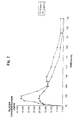
- Example 5 A comparison of the pharmacokinetic data for the formulation prepared in Example 5 with a commercially available once-daily nifedipine tablet (hereinafter referred to as reference) is shown in Table 3 and accompanying Fig. 3.
- Parameter Example 5 Reference AUC (0-36) 374.93 ⁇ 107.68 376.24 ⁇ 135.45 Cmax 39.25 ⁇ 13.54 40.87 ⁇ 15.09 Tmax 3.60 ⁇ 1.43 3.45 ⁇ 1.17 F % 1.04 ⁇ 0.22 -
- Lutrol F127 (463 g) obtained from BASF (Ireland) Limited was melted by heating to 80°C.
- Cisapride (237 g) obtained from Janssen Pharmaceutica N.V.
- tartaric acid 150 g
- lactose 150 g obtained from Forum Chemicals
- a tablet formulation was prepared by blending the solid dispersion with the following tabletting ingredients in the indicated proportions: Ingredient Weight % Solid dispersion 24.2 Methocel K15M 20.0 Avicel pH101 55.3 Magnesium stearate 0.5
- the tablet blend was tabletted to a mean hardness of 129 N in a Killian RTS tablet press.
- the in vitro dissolution for the tablets so prepared was determined using the standard U.S.P. apparatus II (paddles) operating at 50 r.p.m. using a 0.01 M HCl dissolution medium, volume 900 ml and temperature 37°C ⁇ 0.5°C. At the indicated sampling times a 6.0 ml aliquot was removed and filtered through a 0.45 ⁇ m filter. A 4/10 dilution with 0.01 M HCl was performed and the absorbance at 270 nm measured against 0.01 M HCl. The following results were obtained: Time (hours) % Release 0.5 13.8 1.0 16.7 2.0 22.2 4.0 33.0 6.0 41.5 8.0 49.9 10.0 57.0 12.0 61.3 16.0 67.3 24.0 81.2
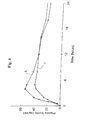
- Plasma levels of cisapride achievable with the tablet formulation prepared above was assessed in 10 healthy male volunteer subjects. The results are shown in accompanying Fig. 4, wherein curve a) corresponds to the present Example.
- Lutrol F127 (463 g) was melted by heating to 80°C.
- a tablet formulation was prepared by blending the solid dispersion with the following tabletting ingredients in the indicated proportions: Ingredient Weight % Solid dispersion 24.2 Methocel K100LV 40.0 Avicel pH101 35.3 Magnesium stearate 0.5
- the tablet blend was tabletted to a mean hardness of 139 N in a Killian RTS tablet press.
- Plasma levels of cisapride achievable with the tablet formulation prepared in accordance with the present Example was assessed in 10 healthy male volunteer subjects as before. The results are shown in Fig. 4, wherein curve b) corresponds to the present Example.
- the main difference between the plasma level profile of the product of Example 6 relative to the product of Example 7 is that the latter product has a more dominant peak concentration (C max) while the former product has the more extended absorption and plasma level profile.
- the respective products while sharing a common solid dispersion formulation, do differ in release rate characteristics and in the viscosity grade of the cellulose-based polymer used to achieve rate control.
- Example 6 (40 mg)
- Example 7 (40 mg) AUC (0-infinity) ngxh/ml 1148.10 ⁇ 595.10 1125.85 ⁇ 276.37 Cmax ng/ml 44.14 ⁇ 16.01 55.71 ⁇ 9.72 Tmax hours 7.30 ⁇ 4.72 5.70 ⁇ 3.83 Kel1/hour 0.082 ⁇ 0.027 0.079 ⁇ 0.023 T1/2 hours 9.24 ⁇ 2.78 9.78 ⁇ 4.13
- Lutrol F68 (2087.4g) was melted by heating to 80°C. Cisapride (522.4g) and tartaric acid (391.4g) were gradually added to, and dispersed in, the molten Lutrol. Mixing was continued for one hour before the solid dispersion was allowed to cool at room temperature, followed by milling thereof.
- a tablet formulation was prepared by blending the solid dispersion with the following tabletting ingredients in the indicated proportions: Ingredient Weight % Solid dispersion 32.8 Methocel K100LV 40.0 Methocel K15M 0.1 Avicel PH101 26.1 Aerosil 200 0.5 Magnesium stearate 0.5
- the tablet blend was tabletted to a mean hardness of 125N in a Killian RTS tablet press.
- the in vitro dissolution for the tablets was determined under the conditions specified in Example 6. The following results were obtained: Time (hours) % Release 0.5 6.3 1.0 8.5 2.0 14.4 4.0 28.6 6.0 37.9 8.0 51.1 10.0 60.7 24.0 104.6
- Tartaric acid (156.4g) was dissolved in ethanol (833g).
- Cisapride 500g was dissolved in acetone (5000g) followed by the Lutrol F68 (2001.7g).
- the two solutions were mixed at 50°C and solvent was evaporated under vacuum at elevated temperatures.
- the resulting molten solid dispersion was allowed to cool at room temperature, followed by milling thereof.
- a tablet formulation was prepared by blending the solid dispersion with the following tabletting ingredients in the indicated proportions: Ingredient Weight % Solid dispersion 30.35 Methocel K100LV 5.0 Methocel K15M 10.0 Avicel PH101 53.65 Aerosil 200 0.5 Magnesium stearate 0.5
- the tablet blend was tabletted to a mean hardness of 108N in a Killian RTS tablet press.
- the in vitro dissolution for the tablets was determined under the conditions specified in Example 6. The following results were obtained: Time (hours) % Release 0.5 6.6 1.0 10.2 2.0 16.7 4.0 26.1 6.0 32.8 8.0 40.0 10.0 44.3 24.0 84.1
- the solid dispersion used was the solid dispersion of Example 9.
- a tablet formulation was prepared by blending the solid dispersion with the following tabletting ingredients in the indicated proportions: Ingredient Weight % Solid dispersion 30.35 Methocel K100LV 40.0 Methocel K15M 0.1 Avicel PH101 28.55 Aerosil 200 0.5 Magnesium stearate 0.5
- the tablet blend was tabletted to a mean hardness of 115N in a Killian RTS tablet press.
- the in vitro dissolution for the tablets was determined under the conditions specified in Example 6. The following results were obtained: Time (hours) % Release 0.5 5.0 1.0 9.5 2.0 16.0 4.0 28.4 6.0 40.1 8.0 49.5 10.0 65.7 24.0 103.9
- the solid dispersion used was the solid dispersion of Example 9.
- a mini-tablet formulation was prepared by blending the solid dispersion with the following tabletting ingredients in the indicated proportions: Ingredient Weight % Solid dispersion 29.57 Avicel PH101 58.93 Aerosil 200 2.0 Magnesium stearate 0.5
- the tablet blend was tabletted to a mean hardness of 75N in a Killian RTS tablet press.
- a 500g quantity of the above mini-tablets was coated with the following coating solution in a Hi-Coater (trade mark) to a weight gain of 10.7%.
- a further 500g of the mini-tablets were coated with the following coating solution in a Hi-Coater to a weight gain of 8.6%.
- the final dosage form was a double zero capsule filled with three uncoated mini-tablets, three Eudragit L coated mini-tablets and three Eudragit S coated mini-tablets. This formulation provided a smooth plasma profile over an extended period as shown in Figure 5.
- the uncoated mini-tablets showed rapid disintegration in acid ( ⁇ 7 minutes) and 95% release on dissolution in 0.01N HCl.
- the enteric coated tablets showed no disintegration in acid (up to 60 minutes) and 100% release on dissolution in pH 6.8 buffer with SLS.
- Example 8 Example 9
- Example 10 Example 11 Reference AUC (Infinity) 2027.58 ⁇ 554.90 1747.99 ⁇ 765.87 1982.09 ⁇ 860.97 1820.12 ⁇ 619.91 2124.80 ⁇ 650.96 Cmax 111.54 ⁇ 31.34 92.36 ⁇ 40.51 84.24 ⁇ 21.86 85.81 ⁇ 22.27 101.94 ⁇ 24.45 Tmax 4.30 ⁇ 0.95 4.20 ⁇ 1.23 7.40 ⁇ 4.25 3.90 ⁇ 1.60 13.55 ⁇ 3.7 F% 99.2 ⁇ 27.3 82.2 ⁇ 23.1 94.7 ⁇ 31.0 88.6 ⁇ 28.5
Landscapes
- Health & Medical Sciences (AREA)
- Animal Behavior & Ethology (AREA)
- Public Health (AREA)
- Pharmacology & Pharmacy (AREA)
- Epidemiology (AREA)
- Life Sciences & Earth Sciences (AREA)
- Chemical & Material Sciences (AREA)
- General Health & Medical Sciences (AREA)
- Medicinal Chemistry (AREA)
- Veterinary Medicine (AREA)
- Engineering & Computer Science (AREA)
- Bioinformatics & Cheminformatics (AREA)
- Medicinal Preparation (AREA)
- Acyclic And Carbocyclic Compounds In Medicinal Compositions (AREA)
- Pharmaceuticals Containing Other Organic And Inorganic Compounds (AREA)
Claims (16)
- Formulation retard destinée à l'administration par voie orale, qui comprend une dispersion solide, dans un polymère poloxamer hydrophile, d'un principe actif présentant une faible solubilité dans l'eau, ladite dispersion solide étant mélangée avec de l'hydroxypropylméthylcellulose capable de gonfler dans l'eau, dont une solution à 2 % présente une viscosité comprise dans la gamme de 100-100 000 centipoises, pour former une matrice d'hydrogel, et un ou plusieurs ingrédients de pastillage permettant de former le noyau d'un comprimé, ledit noyau de comprimé permettant de manière efficace, tel quel ou après enrobage du noyau avec un revêtement polymère, d'atteindre des taux thérapeutiques dudit principe actif pendant des durées prolongées après administration par voie orale.
- Formulation suivant la revendication 1, dans laquelle la dispersion solide comprend un composant tensioactif.
- Formulation selon la revendication 2, dans laquelle le composant tensioactif est choisi parmi le laurylsulfate de sodium, un carboxylate de sodium, un sulfate d'alkyle, un ester de polyéthylèneglycol, un polyéthylène éther, un ester de sorbitan, un ester de sorbitan éthoxylé et un halogénure d'alkyltriméthylammonium, et un mélange de ces composés.
- Formulation selon l'une quelconque des revendications précédentes, dans laquelle la dispersion solide comprend un composant acide.
- Formulation selon la revendication 4, dans laquelle le composant acide est choisi parmi l'acide adipique, l'acide ascorbique, l'acide citrique, l'acide fumarique, l'acide malique, l'acide succinique et l'acide tartrique.
- Formulation selon l'une quelconque des revendications 1 à 3, dans laquelle la dispersion solide comprend un composant basique.
- Formulation selon la revendication 6, dans laquelle le composant basique est choisi parmi le carbonate de calcium, l'hydroxyde de calcium, l'hydroxyde de magnésium, le bicarbonate de sodium, le carbonate de sodium, le citrate de sodium et l'hydroxyde de sodium.
- Formulation selon l'une quelconque des revendications 2 à 7, dans laquelle le tensioactif, le composant acide ou le composant basique est présent dans un rapport de 0,01:1,0 à 5,0:1,0 en poids par rapport au principe actif.
- Formulation selon l'une quelconque des revendications précédentes, dans laquelle le principe actif et le poloxamer sont présents dans un rapport de 0,1:1,0 à 10,0:1,0 en poids.
- Formulation selon l'une quelconque des revendications précédentes, dans laquelle le poloxamer contient de 60 % à 90 % en poids de polyoxyéthylène.
- Formulation selon l'une quelconque des revendications précédentes, ayant une forme multiparticulaire.
- Formulation selon la revendication 11, qui est sous la forme de mini-comprimés.
- Formulation selon la revendication 11 ou 12, qui comprend une certaine quantité de ladite dispersion solide pour une libération immédiate.
- Formulation selon l'une quelconque des revendications précédentes, dans laquelle l'hydroxypropylméthylcellulose est présente en une proportion de 5-75 % en poids.
- Formulation selon l'une quelconque des revendications précédentes, dans laquelle le noyau est entouré d'une membrane poreuse, contrôlant la vitesse de libération.
- Formulation selon l'une quelconque des revendications précédentes, dans laquelle le principe actif est choisi parmi le cisapride, la cyclosporine, le diclofénac, la félodipine, l'ibuprofène, l'indométhacine, la nicardipine, la nifédipine, la terfénadine et la théophylline.
Applications Claiming Priority (5)
| Application Number | Priority Date | Filing Date | Title |
|---|---|---|---|
| IE950492 | 1995-07-03 | ||
| IE950492A IE80467B1 (en) | 1995-07-03 | 1995-07-03 | Controlled release formulations for poorly soluble drugs |
| US89795P | 1995-07-06 | 1995-07-06 | |
| US897P | 1995-07-06 | ||
| PCT/IE1996/000039 WO1997002017A1 (fr) | 1995-07-03 | 1996-07-01 | Formulations a liberation lente pour medicaments faiblement solubles |
Publications (2)
| Publication Number | Publication Date |
|---|---|
| EP0836475A1 EP0836475A1 (fr) | 1998-04-22 |
| EP0836475B1 true EP0836475B1 (fr) | 2001-11-07 |
Family
ID=26319833
Family Applications (1)
| Application Number | Title | Priority Date | Filing Date |
|---|---|---|---|
| EP96921053A Expired - Lifetime EP0836475B1 (fr) | 1995-07-03 | 1996-07-01 | Formulations a liberation lente pour medicaments faiblement solubles |
Country Status (20)
| Country | Link |
|---|---|
| EP (1) | EP0836475B1 (fr) |
| JP (1) | JPH11508587A (fr) |
| KR (1) | KR19990028693A (fr) |
| AT (1) | ATE208192T1 (fr) |
| AU (1) | AU700654B2 (fr) |
| BG (1) | BG102228A (fr) |
| BR (1) | BR9609663A (fr) |
| CA (1) | CA2226008A1 (fr) |
| CZ (1) | CZ413497A3 (fr) |
| DE (1) | DE69616795T2 (fr) |
| HU (1) | HUP9900231A2 (fr) |
| IE (1) | IE80467B1 (fr) |
| IL (1) | IL122663A0 (fr) |
| NO (1) | NO975872L (fr) |
| NZ (1) | NZ311145A (fr) |
| PL (1) | PL324402A1 (fr) |
| SK (1) | SK175997A3 (fr) |
| TW (1) | TW426528B (fr) |
| WO (1) | WO1997002017A1 (fr) |
| ZA (1) | ZA965609B (fr) |
Cited By (3)
| Publication number | Priority date | Publication date | Assignee | Title |
|---|---|---|---|---|
| WO2004010976A1 (fr) * | 2002-07-30 | 2004-02-05 | Whan In Pharm. Co., Ltd | Dispersion solide contenant de l'amlodipine, procede de preparation et composition pharmaceutique contenant la dispersion solide |
| US7067148B2 (en) | 2001-02-15 | 2006-06-27 | King Pharmaceutical Research & Development, Inc. | Stabilized pharmaceutical and thyroid hormone compositions and method of preparation |
| US7101569B2 (en) | 2001-08-14 | 2006-09-05 | Franz G Andrew | Methods of administering levothyroxine pharmaceutical compositions |
Families Citing this family (52)
| Publication number | Priority date | Publication date | Assignee | Title |
|---|---|---|---|---|
| IT1283029B1 (it) * | 1996-05-17 | 1998-04-03 | Resa Farma | Composizioni farmaceutiche a base di diclofenac |
| FR2736550B1 (fr) | 1995-07-14 | 1998-07-24 | Sandoz Sa | Composition pharmaceutique sous la forme d'une dispersion solide comprenant un macrolide et un vehicule |
| US6126970A (en) * | 1995-12-01 | 2000-10-03 | Janssen Pharmaceutica N.V. | Cisapride sustained release |
| CA2275604A1 (fr) * | 1997-01-03 | 1998-07-09 | Kenneth Iain Cumming | Formulation de minicomprimes de cisapride a liberation prolongee |
| DE19710009A1 (de) * | 1997-03-12 | 1998-09-24 | Knoll Ag | Mehrphasige wirkstoffhaltige Zubereitungsformen |
| US6312724B1 (en) | 1997-04-04 | 2001-11-06 | Isa Odidi | Sustained release pharmaceutical matrix tablet of pharmaceutically acceptable salts of diclofenac and process for preparation thereof |
| NZ328751A (en) * | 1997-09-16 | 1999-01-28 | Bernard Charles Sherman | Solid medicament containing an anionic surfactant and cyclosporin |
| US6013280A (en) * | 1997-10-07 | 2000-01-11 | Fuisz Technologies Ltd. | Immediate release dosage forms containing microspheres |
| KR20000069356A (ko) * | 1997-10-07 | 2000-11-25 | 리차드 디. 슈미트 | 급속방출식 약물전달 제형 |
| NZ333474A (en) | 1998-01-02 | 1999-06-29 | Mcneil Ppc Inc | A chewable tablet containing ibuprofen, fumaric acid and a non hydrocolloid binder e.g. a wax or a fat |
| IE980115A1 (en) * | 1998-02-16 | 2000-02-09 | Biovail Internat Ltd | Solubilizing delivery systems and method of manufacture |
| US6787157B1 (en) | 1998-03-10 | 2004-09-07 | Abbott Laboratories | Multiphase active ingredient-containing formulations |
| AU4679999A (en) * | 1998-06-11 | 1999-12-30 | Em Industries, Inc. | Micro-osmotic controlled drug delivery systems |
| TW407058B (en) * | 1998-07-17 | 2000-10-01 | Dev Center Biotechnology | Oral cisapride dosage forms with an extended duration |
| IE981008A1 (en) * | 1998-12-02 | 2000-06-14 | Fuisz Internat Ltd | Microparticles Containing Water Insoluble Active Agents |
| US6706283B1 (en) | 1999-02-10 | 2004-03-16 | Pfizer Inc | Controlled release by extrusion of solid amorphous dispersions of drugs |
| ATE404178T1 (de) * | 1999-02-10 | 2008-08-15 | Pfizer Prod Inc | Vorrichtung mit matrixgesteuerter wirkstofffreisetzung |
| EP1064938A1 (fr) * | 1999-06-28 | 2001-01-03 | Sanofi-Synthelabo | Formes pharmaceutiques à libération contrôlée avec au moins une impulsion temporelle |
| SE9902742D0 (sv) * | 1999-07-20 | 1999-07-20 | Astra Ab | New pharmaceutical formultion |
| KR100379299B1 (ko) * | 2000-01-15 | 2003-04-10 | 주식회사 중외제약 | 펠로디핀의 가용화 방법 및 방출제어형 제제 |
| PT1390063E (pt) * | 2001-05-03 | 2005-03-31 | Hoffmann La Roche | Forma de dosagem farmaceutica de mesilato de nelfinavir amorfo |
| AR033711A1 (es) * | 2001-05-09 | 2004-01-07 | Novartis Ag | Composiciones farmaceuticas |
| TWI252111B (en) * | 2001-12-14 | 2006-04-01 | Solvay Pharm Gmbh | Matrix film tablet with controlled release of a natural mixture of conjugated estrogens |
| US20050232995A1 (en) | 2002-07-29 | 2005-10-20 | Yam Nyomi V | Methods and dosage forms for controlled delivery of paliperidone and risperidone |
| AU2002350719A1 (en) | 2002-11-29 | 2004-06-23 | Janssen Pharmaceutica N.V. | Pharmaceutical compositions comprising a basic respectively acidic drug compound, a surfactant and a physiologically tolerable water-soluble acid respectively base |
| WO2004066981A1 (fr) * | 2003-01-29 | 2004-08-12 | Sun Pharmaceutical Industries Limited | Composition pharmaceutique orale a liberation controlee contenant du metaxalone en tant qu'agent actif |
| WO2004069180A2 (fr) | 2003-01-31 | 2004-08-19 | Smithkline Beecham Corporation | Compositions solides de dispersion |
| JP2006521366A (ja) * | 2003-03-28 | 2006-09-21 | シグモイド・バイオテクノロジーズ・リミテッド | シームレスマイクロカプセルを含む固形経口剤形 |
| CN1901885A (zh) * | 2003-11-13 | 2007-01-24 | 阿尔扎公司 | 包含低水溶性药物和环氧乙烷-环氧丙烷嵌段共聚物的熔混分散体 |
| WO2005065653A1 (fr) * | 2003-12-19 | 2005-07-21 | E.I. Du Pont De Nemours And Company | Enrobage intime d'ibuprofene avec des poloxameres afin d'ameliorer la dissolution aqueuse |
| US8974823B2 (en) | 2003-12-31 | 2015-03-10 | Bend Research, Inc. | Solid compositions of low-solubility drugs and poloxamers |
| KR100598326B1 (ko) | 2004-04-10 | 2006-07-10 | 한미약품 주식회사 | HMG-CoA 환원효소 억제제의 경구투여용 서방형 제제및 이의 제조방법 |
| JP2009519326A (ja) * | 2005-12-16 | 2009-05-14 | ハンミ ファーム. シーオー., エルティーディー. | 低融点の活性成分を含む溶融状の固体分散体、及びこれを含む経口投与用錠剤 |
| KR101462693B1 (ko) | 2006-08-16 | 2014-11-17 | 노파르티스 아게 | 고도 결정질 치료용 화합물의 고체 분산체 제조 방법 |
| EP2142175A2 (fr) * | 2007-03-30 | 2010-01-13 | Wockhardt Research Centre | Compositions pharmaceutiques de diclofénac et de misoprostol |
| EP2061440A2 (fr) | 2007-04-04 | 2009-05-27 | Sigmoid Pharma Limited | Composition pharmaceutique à base de tacrolimus |
| ES2963291T3 (es) | 2007-04-26 | 2024-03-26 | Sublimity Therapeutics Ltd | Fabricación de múltiples minicápsulas |
| AU2010239080B2 (en) | 2009-04-24 | 2014-08-28 | Iceutica Pty Ltd | A novel formulation of diclofenac |
| ES2530049T3 (es) | 2009-05-18 | 2015-02-26 | Sigmoid Pharma Limited | Composición que comprende gotas de aceite |
| BR112012002963A2 (pt) | 2009-08-12 | 2017-10-24 | Sigmoid Pharma Ltd | composições imunomoduladoras compreendendo uma matriz de polímero e uma fase oleosa |
| FR2967576B1 (fr) * | 2010-11-18 | 2013-07-12 | Advicenne Pharma | Composition pharmaceutique comprenant du sel precurseur du cycle de krebs, en particulier du sel de citrate, et son utilisation comme medicament |
| FR2967577B1 (fr) | 2010-11-18 | 2013-07-12 | Advicenne Pharma | Composition pharmaceutique comprenant du sel de bicarbonate, et son utilisation comme medicament |
| GB201020032D0 (en) | 2010-11-25 | 2011-01-12 | Sigmoid Pharma Ltd | Composition |
| DE102012105512A1 (de) * | 2012-06-25 | 2014-04-24 | Hennig Arzneimittel Gmbh & Co. Kg | Arzneiform zur verlängerten Freisetzung von Wirkstoffen |
| GB201212010D0 (en) | 2012-07-05 | 2012-08-22 | Sigmoid Pharma Ltd | Formulations |
| CN102784128B (zh) * | 2012-07-31 | 2015-01-07 | 北京协和药厂 | 一种非洛地平缓释制剂及其制备方法 |
| GB201319791D0 (en) | 2013-11-08 | 2013-12-25 | Sigmoid Pharma Ltd | Formulations |
| US9526734B2 (en) | 2014-06-09 | 2016-12-27 | Iceutica Pty Ltd. | Formulation of meloxicam |
| EA036036B1 (ru) | 2014-11-07 | 2020-09-16 | Сигмойд Фарма Лимитед | Композиции, содержащие циклоспорин |
| WO2019220282A1 (fr) * | 2018-05-14 | 2019-11-21 | Capsugel Belgium Nv | Formes posologiques solides à chargement d'agent actif élevé |
| CN113350309B (zh) * | 2021-08-09 | 2021-11-12 | 北京五和博澳药业股份有限公司 | 一种难溶性药物渗透泵控释片剂及其制备方法 |
| WO2025253272A1 (fr) * | 2024-06-05 | 2025-12-11 | Chiaphua Industries Ltd. | Comprimé antimicrobien moussant à dissolution automatique rapide et son procédé de préparation |
Family Cites Families (1)
| Publication number | Priority date | Publication date | Assignee | Title |
|---|---|---|---|---|
| ATE76292T1 (de) * | 1987-11-25 | 1992-06-15 | American Cyanamid Co | System fuer die verzoegerte (kontrollierte) freisetzung von substituierten dihydropyridincalciumantagonisten. |
-
1995
- 1995-07-03 IE IE950492A patent/IE80467B1/en not_active IP Right Cessation
-
1996
- 1996-07-01 DE DE69616795T patent/DE69616795T2/de not_active Expired - Fee Related
- 1996-07-01 IL IL12266396A patent/IL122663A0/xx unknown
- 1996-07-01 SK SK1759-97A patent/SK175997A3/sk unknown
- 1996-07-01 PL PL96324402A patent/PL324402A1/xx unknown
- 1996-07-01 EP EP96921053A patent/EP0836475B1/fr not_active Expired - Lifetime
- 1996-07-01 AT AT96921053T patent/ATE208192T1/de active
- 1996-07-01 JP JP9504959A patent/JPH11508587A/ja active Pending
- 1996-07-01 CA CA002226008A patent/CA2226008A1/fr not_active Abandoned
- 1996-07-01 CZ CZ974134A patent/CZ413497A3/cs unknown
- 1996-07-01 HU HU9900231A patent/HUP9900231A2/hu unknown
- 1996-07-01 AU AU62394/96A patent/AU700654B2/en not_active Ceased
- 1996-07-01 WO PCT/IE1996/000039 patent/WO1997002017A1/fr not_active Ceased
- 1996-07-01 NZ NZ311145A patent/NZ311145A/xx unknown
- 1996-07-01 BR BR9609663A patent/BR9609663A/pt not_active Application Discontinuation
- 1996-07-01 KR KR1019970710016A patent/KR19990028693A/ko not_active Ceased
- 1996-07-02 ZA ZA965609A patent/ZA965609B/xx unknown
- 1996-08-28 TW TW085110466A patent/TW426528B/zh not_active IP Right Cessation
-
1997
- 1997-12-12 NO NO975872A patent/NO975872L/no not_active Application Discontinuation
-
1998
- 1998-02-02 BG BG102228A patent/BG102228A/xx unknown
Cited By (3)
| Publication number | Priority date | Publication date | Assignee | Title |
|---|---|---|---|---|
| US7067148B2 (en) | 2001-02-15 | 2006-06-27 | King Pharmaceutical Research & Development, Inc. | Stabilized pharmaceutical and thyroid hormone compositions and method of preparation |
| US7101569B2 (en) | 2001-08-14 | 2006-09-05 | Franz G Andrew | Methods of administering levothyroxine pharmaceutical compositions |
| WO2004010976A1 (fr) * | 2002-07-30 | 2004-02-05 | Whan In Pharm. Co., Ltd | Dispersion solide contenant de l'amlodipine, procede de preparation et composition pharmaceutique contenant la dispersion solide |
Also Published As
| Publication number | Publication date |
|---|---|
| HUP9900231A2 (hu) | 1999-06-28 |
| NO975872D0 (no) | 1997-12-12 |
| KR19990028693A (ko) | 1999-04-15 |
| ATE208192T1 (de) | 2001-11-15 |
| BG102228A (en) | 1998-10-30 |
| JPH11508587A (ja) | 1999-07-27 |
| CA2226008A1 (fr) | 1997-01-23 |
| TW426528B (en) | 2001-03-21 |
| DE69616795D1 (de) | 2001-12-13 |
| PL324402A1 (en) | 1998-05-25 |
| WO1997002017A1 (fr) | 1997-01-23 |
| IL122663A0 (en) | 1998-08-16 |
| SK175997A3 (en) | 1998-06-03 |
| CZ413497A3 (cs) | 1998-04-15 |
| ZA965609B (en) | 1997-01-27 |
| AU700654B2 (en) | 1999-01-14 |
| AU6239496A (en) | 1997-02-05 |
| DE69616795T2 (de) | 2002-08-08 |
| BR9609663A (pt) | 1999-05-18 |
| NO975872L (no) | 1998-03-03 |
| EP0836475A1 (fr) | 1998-04-22 |
| MX9710413A (es) | 1998-07-31 |
| NZ311145A (en) | 1999-06-29 |
| IE80467B1 (en) | 1998-07-29 |
Similar Documents
| Publication | Publication Date | Title |
|---|---|---|
| AU700654B2 (en) | Controlled release formulations for poorly soluble drugs | |
| AU2004268663B2 (en) | Sustained release dosage forms of ziprasidone | |
| CN102036654B (zh) | 稳定的非典型抗精神病制剂 | |
| EP0776660A2 (fr) | Préparation de la nifédipine avec une libération soutenue | |
| US6110494A (en) | Cisapride mini-tablet formulations | |
| AU2008288106B2 (en) | Extended release compositions comprising mycophenolate sodium and processes thereof | |
| ZA200309724B (en) | Oral controlled release pharmaceutical composition for one a day therapy for the treatment and prophylaxis of cardiac and circulatory diseases | |
| JP7117975B2 (ja) | テネリグリプチン含有医薬組成物、テネリグリプチン含有医薬組成物の製造方法、テネリグリプチン含有錠剤及びテネリグリプチン含有錠剤の製造方法 | |
| US20110280938A1 (en) | Sustained release pharmaceutical composition of quetiapine and process for preparation thereof | |
| WO2009047799A1 (fr) | Forme posologique pharmaceutique à usage oral unitaire solide à haute dose de mycophénolate de sodium et son procédé de fabrication | |
| US20260007661A1 (en) | Extended release upadacitinib formulations | |
| EP2326312A1 (fr) | Composition de palipéridone comprenant des particules de matrice solide | |
| US20100285125A1 (en) | Delivery system for poorly soluble drugs | |
| CA2374039C (fr) | Preparations d'inhibiteurs specifiques du recaptage de la serotonine a liberation multiparticulaire regulee | |
| EA020477B1 (ru) | Композиция кветиапина | |
| US20100055177A1 (en) | Modified release composition of levetiracetam and process for the preparation thereof | |
| US20040146556A1 (en) | Oral extended release tablets and methods of making and using the same | |
| WO2013181292A1 (fr) | Formulations de nitisinone | |
| EP2853260A1 (fr) | Préparation pharmaceutique comprenant du dabigatran etexilate bismésylate | |
| IE990406A1 (en) | Multiparticulate controlled release selective serotonin reuptake inhibitor formulations. | |
| US20120178810A1 (en) | Extended release formulation of an antiepileptic agent | |
| WO2009087663A2 (fr) | Comprimé oral enrobé à libération contrôlée | |
| MXPA97010413A (en) | Controlled release formulations for poorly solub medications | |
| WO2012053016A1 (fr) | Compositions pharmaceutiques de donépézil à libération prolongée |
Legal Events
| Date | Code | Title | Description |
|---|---|---|---|
| PUAI | Public reference made under article 153(3) epc to a published international application that has entered the european phase |
Free format text: ORIGINAL CODE: 0009012 |
|
| 17P | Request for examination filed |
Effective date: 19980126 |
|
| AK | Designated contracting states |
Kind code of ref document: A1 Designated state(s): AT BE CH DE DK ES FI FR GB GR IE IT LI LU MC NL PT SE |
|
| 17Q | First examination report despatched |
Effective date: 19991116 |
|
| GRAG | Despatch of communication of intention to grant |
Free format text: ORIGINAL CODE: EPIDOS AGRA |
|
| GRAG | Despatch of communication of intention to grant |
Free format text: ORIGINAL CODE: EPIDOS AGRA |
|
| GRAG | Despatch of communication of intention to grant |
Free format text: ORIGINAL CODE: EPIDOS AGRA |
|
| GRAH | Despatch of communication of intention to grant a patent |
Free format text: ORIGINAL CODE: EPIDOS IGRA |
|
| GRAH | Despatch of communication of intention to grant a patent |
Free format text: ORIGINAL CODE: EPIDOS IGRA |
|
| GRAA | (expected) grant |
Free format text: ORIGINAL CODE: 0009210 |
|
| AK | Designated contracting states |
Kind code of ref document: B1 Designated state(s): AT BE CH DE DK ES FI FR GB GR IE IT LI LU MC NL PT SE |
|
| PG25 | Lapsed in a contracting state [announced via postgrant information from national office to epo] |
Ref country code: NL Free format text: LAPSE BECAUSE OF FAILURE TO SUBMIT A TRANSLATION OF THE DESCRIPTION OR TO PAY THE FEE WITHIN THE PRESCRIBED TIME-LIMIT Effective date: 20011107 Ref country code: LI Free format text: LAPSE BECAUSE OF FAILURE TO SUBMIT A TRANSLATION OF THE DESCRIPTION OR TO PAY THE FEE WITHIN THE PRESCRIBED TIME-LIMIT Effective date: 20011107 Ref country code: GR Free format text: LAPSE BECAUSE OF FAILURE TO SUBMIT A TRANSLATION OF THE DESCRIPTION OR TO PAY THE FEE WITHIN THE PRESCRIBED TIME-LIMIT Effective date: 20011107 Ref country code: FI Free format text: LAPSE BECAUSE OF FAILURE TO SUBMIT A TRANSLATION OF THE DESCRIPTION OR TO PAY THE FEE WITHIN THE PRESCRIBED TIME-LIMIT Effective date: 20011107 Ref country code: CH Free format text: LAPSE BECAUSE OF FAILURE TO SUBMIT A TRANSLATION OF THE DESCRIPTION OR TO PAY THE FEE WITHIN THE PRESCRIBED TIME-LIMIT Effective date: 20011107 Ref country code: BE Free format text: LAPSE BECAUSE OF FAILURE TO SUBMIT A TRANSLATION OF THE DESCRIPTION OR TO PAY THE FEE WITHIN THE PRESCRIBED TIME-LIMIT Effective date: 20011107 Ref country code: AT Free format text: LAPSE BECAUSE OF FAILURE TO SUBMIT A TRANSLATION OF THE DESCRIPTION OR TO PAY THE FEE WITHIN THE PRESCRIBED TIME-LIMIT Effective date: 20011107 |
|
| REF | Corresponds to: |
Ref document number: 208192 Country of ref document: AT Date of ref document: 20011115 Kind code of ref document: T |
|
| REG | Reference to a national code |
Ref country code: CH Ref legal event code: EP |
|
| RAP2 | Party data changed (patent owner data changed or rights of a patent transferred) |
Owner name: ELAN CORPORATION, PLC |
|
| REG | Reference to a national code |
Ref country code: IE Ref legal event code: FG4D |
|
| REF | Corresponds to: |
Ref document number: 69616795 Country of ref document: DE Date of ref document: 20011213 |
|
| REG | Reference to a national code |
Ref country code: GB Ref legal event code: IF02 |
|
| ET | Fr: translation filed | ||
| NLT2 | Nl: modifications (of names), taken from the european patent patent bulletin |
Owner name: ELAN CORPORATION, PLC |
|
| PG25 | Lapsed in a contracting state [announced via postgrant information from national office to epo] |
Ref country code: SE Free format text: LAPSE BECAUSE OF FAILURE TO SUBMIT A TRANSLATION OF THE DESCRIPTION OR TO PAY THE FEE WITHIN THE PRESCRIBED TIME-LIMIT Effective date: 20020207 Ref country code: PT Free format text: LAPSE BECAUSE OF FAILURE TO SUBMIT A TRANSLATION OF THE DESCRIPTION OR TO PAY THE FEE WITHIN THE PRESCRIBED TIME-LIMIT Effective date: 20020207 Ref country code: DK Free format text: LAPSE BECAUSE OF FAILURE TO SUBMIT A TRANSLATION OF THE DESCRIPTION OR TO PAY THE FEE WITHIN THE PRESCRIBED TIME-LIMIT Effective date: 20020207 |
|
| NLV1 | Nl: lapsed or annulled due to failure to fulfill the requirements of art. 29p and 29m of the patents act | ||
| REG | Reference to a national code |
Ref country code: CH Ref legal event code: PL |
|
| PG25 | Lapsed in a contracting state [announced via postgrant information from national office to epo] |
Ref country code: ES Free format text: LAPSE BECAUSE OF FAILURE TO SUBMIT A TRANSLATION OF THE DESCRIPTION OR TO PAY THE FEE WITHIN THE PRESCRIBED TIME-LIMIT Effective date: 20020530 |
|
| PG25 | Lapsed in a contracting state [announced via postgrant information from national office to epo] |
Ref country code: LU Free format text: LAPSE BECAUSE OF NON-PAYMENT OF DUE FEES Effective date: 20020701 |
|
| PLBE | No opposition filed within time limit |
Free format text: ORIGINAL CODE: 0009261 |
|
| STAA | Information on the status of an ep patent application or granted ep patent |
Free format text: STATUS: NO OPPOSITION FILED WITHIN TIME LIMIT |
|
| 26N | No opposition filed | ||
| PG25 | Lapsed in a contracting state [announced via postgrant information from national office to epo] |
Ref country code: MC Free format text: LAPSE BECAUSE OF NON-PAYMENT OF DUE FEES Effective date: 20030201 |
|
| PGFP | Annual fee paid to national office [announced via postgrant information from national office to epo] |
Ref country code: GB Payment date: 20030625 Year of fee payment: 8 |
|
| PGFP | Annual fee paid to national office [announced via postgrant information from national office to epo] |
Ref country code: FR Payment date: 20030718 Year of fee payment: 8 |
|
| PGFP | Annual fee paid to national office [announced via postgrant information from national office to epo] |
Ref country code: IE Payment date: 20030721 Year of fee payment: 8 |
|
| PGFP | Annual fee paid to national office [announced via postgrant information from national office to epo] |
Ref country code: DE Payment date: 20030731 Year of fee payment: 8 |
|
| PG25 | Lapsed in a contracting state [announced via postgrant information from national office to epo] |
Ref country code: IE Free format text: LAPSE BECAUSE OF NON-PAYMENT OF DUE FEES Effective date: 20040701 Ref country code: GB Free format text: LAPSE BECAUSE OF NON-PAYMENT OF DUE FEES Effective date: 20040701 |
|
| PG25 | Lapsed in a contracting state [announced via postgrant information from national office to epo] |
Ref country code: DE Free format text: LAPSE BECAUSE OF NON-PAYMENT OF DUE FEES Effective date: 20050201 |
|
| GBPC | Gb: european patent ceased through non-payment of renewal fee |
Effective date: 20040701 |
|
| PG25 | Lapsed in a contracting state [announced via postgrant information from national office to epo] |
Ref country code: FR Free format text: LAPSE BECAUSE OF NON-PAYMENT OF DUE FEES Effective date: 20050331 |
|
| REG | Reference to a national code |
Ref country code: IE Ref legal event code: MM4A |
|
| REG | Reference to a national code |
Ref country code: FR Ref legal event code: ST |
|
| PG25 | Lapsed in a contracting state [announced via postgrant information from national office to epo] |
Ref country code: IT Free format text: LAPSE BECAUSE OF NON-PAYMENT OF DUE FEES;WARNING: LAPSES OF ITALIAN PATENTS WITH EFFECTIVE DATE BEFORE 2007 MAY HAVE OCCURRED AT ANY TIME BEFORE 2007. THE CORRECT EFFECTIVE DATE MAY BE DIFFERENT FROM THE ONE RECORDED. Effective date: 20050701 |