EP0837444A2 - Schaltung zur Erzeugung von Graustufensignalen für eine matrixgesteuerte Flüssigkristallanzeigevorrichtung - Google Patents
Schaltung zur Erzeugung von Graustufensignalen für eine matrixgesteuerte Flüssigkristallanzeigevorrichtung Download PDFInfo
- Publication number
- EP0837444A2 EP0837444A2 EP97116179A EP97116179A EP0837444A2 EP 0837444 A2 EP0837444 A2 EP 0837444A2 EP 97116179 A EP97116179 A EP 97116179A EP 97116179 A EP97116179 A EP 97116179A EP 0837444 A2 EP0837444 A2 EP 0837444A2
- Authority
- EP
- European Patent Office
- Prior art keywords
- gray
- scale
- waveform
- clock signal
- frame
- Prior art date
- Legal status (The legal status is an assumption and is not a legal conclusion. Google has not performed a legal analysis and makes no representation as to the accuracy of the status listed.)
- Withdrawn
Links
Images





Classifications
-
- G—PHYSICS
- G09—EDUCATION; CRYPTOGRAPHY; DISPLAY; ADVERTISING; SEALS
- G09G—ARRANGEMENTS OR CIRCUITS FOR CONTROL OF INDICATING DEVICES USING STATIC MEANS TO PRESENT VARIABLE INFORMATION
- G09G3/00—Control arrangements or circuits, of interest only in connection with visual indicators other than cathode-ray tubes
- G09G3/20—Control arrangements or circuits, of interest only in connection with visual indicators other than cathode-ray tubes for presentation of an assembly of a number of characters, e.g. a page, by composing the assembly by combination of individual elements arranged in a matrix no fixed position being assigned to or needed to be assigned to the individual characters or partial characters
- G09G3/2007—Display of intermediate tones
- G09G3/2018—Display of intermediate tones by time modulation using two or more time intervals
- G09G3/2022—Display of intermediate tones by time modulation using two or more time intervals using sub-frames
- G09G3/2025—Display of intermediate tones by time modulation using two or more time intervals using sub-frames the sub-frames having all the same time duration
-
- G—PHYSICS
- G09—EDUCATION; CRYPTOGRAPHY; DISPLAY; ADVERTISING; SEALS
- G09G—ARRANGEMENTS OR CIRCUITS FOR CONTROL OF INDICATING DEVICES USING STATIC MEANS TO PRESENT VARIABLE INFORMATION
- G09G2320/00—Control of display operating conditions
- G09G2320/02—Improving the quality of display appearance
- G09G2320/0247—Flicker reduction other than flicker reduction circuits used for single beam cathode-ray tubes
-
- G—PHYSICS
- G09—EDUCATION; CRYPTOGRAPHY; DISPLAY; ADVERTISING; SEALS
- G09G—ARRANGEMENTS OR CIRCUITS FOR CONTROL OF INDICATING DEVICES USING STATIC MEANS TO PRESENT VARIABLE INFORMATION
- G09G2330/00—Aspects of power supply; Aspects of display protection and defect management
- G09G2330/02—Details of power systems and of start or stop of display operation
- G09G2330/021—Power management, e.g. power saving
-
- G—PHYSICS
- G09—EDUCATION; CRYPTOGRAPHY; DISPLAY; ADVERTISING; SEALS
- G09G—ARRANGEMENTS OR CIRCUITS FOR CONTROL OF INDICATING DEVICES USING STATIC MEANS TO PRESENT VARIABLE INFORMATION
- G09G3/00—Control arrangements or circuits, of interest only in connection with visual indicators other than cathode-ray tubes
- G09G3/20—Control arrangements or circuits, of interest only in connection with visual indicators other than cathode-ray tubes for presentation of an assembly of a number of characters, e.g. a page, by composing the assembly by combination of individual elements arranged in a matrix no fixed position being assigned to or needed to be assigned to the individual characters or partial characters
- G09G3/34—Control arrangements or circuits, of interest only in connection with visual indicators other than cathode-ray tubes for presentation of an assembly of a number of characters, e.g. a page, by composing the assembly by combination of individual elements arranged in a matrix no fixed position being assigned to or needed to be assigned to the individual characters or partial characters by control of light from an independent source
- G09G3/36—Control arrangements or circuits, of interest only in connection with visual indicators other than cathode-ray tubes for presentation of an assembly of a number of characters, e.g. a page, by composing the assembly by combination of individual elements arranged in a matrix no fixed position being assigned to or needed to be assigned to the individual characters or partial characters by control of light from an independent source using liquid crystals
- G09G3/3611—Control of matrices with row and column drivers
Definitions
- the present invention relates to a circuit for generating a gray-scale signal of the pulse-width modulation type, and to a matrix-addressed liquid crystal display employing this circuit.
- each picture element has only on and off states, so intermediate gray levels are displayed by switching the picture element on and off repeatedly and controlling the on-off duty cycle.
- This technique is known as frame rate control, or more generally as pulse-width modulation.
- a color display such as a color liquid crystal television set
- this technique can be used to display a large number of colors by mixing different intensities of red, blue, and green.
- the term 'gray scale' is commonly employed to denote these intensities, even though color is involved.
- Liquid crystal television sets employ matrix addressing, in which the picture elements on the display screen are scanned a line at a time.
- a problem that arises is that to display the large number of gray levels needed for a natural display appearance, the interval of time during which a picture element is scanned must be finely divided, requiring a high-frequency timing clock signal.
- the use of a high-frequency clock signal increases the power dissipation of the display.
- the liquid crystal material must be capable of responding to voltage changes at speeds comparable to the speed of the timing clock signal, but liquid crystal materials with very fast response times are not easy to find.
- a further object of the invention is to avoid causing flicker.
- a gray-scale signal generated according to the present invention represents a gray level of a picture element in an image that is displayed in successive frames, the picture element being scanned during a certain interval in each frame. Each of these intervals is divided into a first number of parts.
- a waveform is generated spanning these intervals in a second number of frames, having either a high level or a low level in each part of each interval in each frame.
- the waveform thus has a total number of parts equal to the first number multiplied by the second number. Among this total number of parts, the waveform is high for a number of parts that is variable in steps of one part, responsive to the gray level of the picture element.
- the gray-scale signal is generated from this waveform.
- the timing of the gray-scale signals is varied so that, even if a certain number of side-by-side picture elements have identical gray levels, their gray-scale signals have waveforms that do not all go high and low in unison.
- Both embodiments generate gray-scale signals for use in a color liquid crystal display.
- the first embodiment outputs eight gray levels.
- the second embodiment outputs sixteen gray levels.
- the first embodiment comprises a data input terminal 1, a timing clock (TCLK) input terminal 2, a frame clock (FCLK) input terminal 3, a gray-scale memory 4, a gray-scale waveform generator 5, a selector 6, an output driver 7, and an output terminal 8.
- the gray-scale memory 4, gray-scale waveform generator 5, and selector 6 constitute a gray-scale control circuit 9.
- the output driver 7 is coupled to a column electrode in a liquid crystal display (not shown) and drives one column of picture elements of one primary color (red, blue, or green).
- the display is scanned a line at a time, a line comprising a row of picture elements.
- the display has a separate output driver 7 for each primary color in each column, and scans all columns simultaneously.
- the displayed picture signal is, for example, a digital television signal that is divided into successive frames, each frame comprising successive lines, and each line comprising successive picture elements.
- the signal To convert to the line-at-a-time scanning scheme used in a liquid crystal display, the signal must be stored in a memory device.
- the gray-scale memory 4 stores the data for one primary color, for at least one picture element in one column of one frame.
- the frame clock received by the gray-scale waveform generator 5 has a period equal to two frame periods.
- a frame clock signal of this type can be generated from a frame pulse signal, comprising one pulse at the beginning of each frame, by feeding the pulses as a clock signal to a flip-flop circuit configured so as to output a signal that inverts between the high and low states at each pulse.
- the timing clock has a period equal to one-fourth of the duration of one line-scanning interval.
- the gray-scale waveform generator 5 outputs eight pulse-width-modulated gray-scale waveforms.
- the selector 6 selects one of these waveforms according to data for one picture element, read from the gray-scale memory 4, and thereby generates a gray-scale waveform G.
- the output driver 7 converts waveform G to a gray-scale signal with the voltage levels needed to drive the liquid crystal display.
- the gray-scale memory 4 has three output signal lines, each carrying one bit of output data. These bits indicate eight gray levels, from zero to seven, as shown in Table 1.
- FIG. 2 shows the internal structure of the gray-scale waveform generator 5 and selector 6.
- the gray-scale waveform generator 5 comprises a pair of D-type flip-flops 11 and 12 interconnected so as to divide the frequency of the timing clock signal (TCLK) by factors of two and four, an inverter 13 that inverts the frame clock signal (FCLK), and eight logic gates, such as the three-input OR gate 14, two-input OR gate 15, two-input AND gate 16, and three-input AND gate 17, that perform logic operations on the outputs of the flip-flops 11 and 12 and inverter 13. These operations generate eight different waveforms, which are supplied to the selector 6.
- the selector 6 comprises eight three-input AND gates that decode the bit signals from the gray-scale memory 4.
- the selector 6 also comprises eight two-input AND gates, from AND gate 19 to AND gate 20. Responding to the output of three-input AND gate 18, two-input AND gate 19 selects an always-low ground waveform output from the gray-scale waveform generator 5, when bits zero, one, and two received from the gray-scale memory 4 are all low.
- the other two-input AND gates in the selector 6 select waveforms generated by the logic circuits in the gray-scale waveform generator 5, according to the outputs of the other three-input AND gates in the selector 6.
- the outputs of these two-input AND gates, from AND gate 19 to AND gate 20, are coupled in a wired-OR configuration to generate the gray-scale waveform G.
- the level of waveform G is low when the outputs of all of the two-input AND gates in the selector 6 are low, and high when the output of at least one of the two-input AND gates in the selector 6 is high.
- FIG. 3 shows waveforms of the timing clock signal (TCLK), the frame clock signal (FCLK), the inverted frame clock signal ( FCLK ) generated by inverter 13, the output Q 11 of flip-flop 11, the output Q 12 of flip-flop 12, and the output G of the selector 6 for input data values from zero ('000') to seven ('111').
- the output waveforms G are shown during the scanning intervals T S1 and T S2 of the first line in two successive frames: an even-numbered frame 2n, and the following odd-numbered frame 2n + 1.
- the high level corresponds to logic one
- the low level to logic zero.
- the output waveforms G represent the gray level of one picture element in the first line, under the assumption that the data for this picture element do not change between frames 2n and 2n + 1.
- the generation of two of the output waveforms is described below, with reference to both FIGs. 2 and 3.
- the first embodiment carries out pulse-width modulation of the gray-scale waveform G over a period of two successive frames, thereby obtaining eight gray levels, even though the timing clock signal TCLK divides each line-scanning interval into only four parts of duration Tc. This is because the waveform spans two line-scanning intervals, comprising a total of eight parts of duration Tc, and the number of these parts in which the waveform is high can be varied in steps of one part.
- the gray-scale waveform G comprises, of course, not only a waveform for the picture element in the first scanning line, but other waveforms for the picture elements in the same column in other scanning lines, following one after another in each frame.
- the output signal G will remain low throughout interval T S2 , as if the change had not occurred. If the gray level remains at four ('100') or a higher gray level in the next frame 2n + 2, however, the output signal G will go high throughout the first line-scanning interval in frame 2n + 2. There may be, accordingly, a one-frame delay in the output of the new gray level, but at television frame rates, this delay is not readily noticeable.
- the circuit configuration shown in FIG. 2 is used to drive, for example, the even-numbered columns.
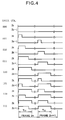
- the circuit configuration is varied by removing the inverter 13 from the gray-scale waveform generator 5.
- FIG. 4 illustrates the result of this removal, showing the gray-scale waveforms G in an even-numbered column 2k and the adjacent odd-numbered column 2k + 1 for each gray level from zero ('000') to seven ('111'). Removing the inverter 13 can be seen to reverse the even-frame and odd-frame halves of the waveforms G in the odd-numbered columns. Accordingly, even if a picture element in column 2k and the adjacent picture element in column 2k + 1 have the same gray level, their gray-scale waveforms to not go high and low in unison.
- a single gray-scale waveform generator 5 can be shared by a plurality of selectors 6 in even-numbered columns, and a single gray-scale waveform generator 5 with the inverter 13 removed can be shared by a plurality of selectors 6 in odd-numbered columns.
- FIG. 5 shows the conventional method of producing eight gray levels by pulse-width modulation within one frame.
- the timing clock signal frequency must be twice as high as in the first embodiment, and power dissipation increases accordingly.
- the second embodiment employs the same timing and frame clock signals as the first embodiment, but obtains twice as many gray levels.
- the second embodiment has the same input terminals 1, 2, and 3, output terminal 8, and output driver 7 as in the first embodiment.
- the gray-scale memory 21 in the second embodiment outputs four-bit data, bit three being the most significant bit.
- a frame clock divider 22 divides the frequency of the frame clock (FCLK) by two.
- the gray-scale waveform generator 23 supplies sixteen gray-scale waveforms to the selector 24, which selects one of these waveforms according to the output of the gray-scale memory 21.
- the gray-scale memory 21, frame clock divider 22, gray-scale waveform generator 23, and selector 24 constitute a gray-scale control circuit 25.
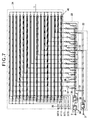
- FIG. 7 shows the internal structure of the frame clock divider 22, gray-scale waveform generator 23, and selector 24.
- the frame clock divider 22 comprises a D-type flip-flop 31.
- the Q output signal of this flip-flop has half the frequency of the frame clock signal (FCLK).
- Logic gates such as the NOR gate 32 and NAND gate 33 perform logic operations on FCLK and the inverted and non-inverted outputs ( Q 31 and Q31) of the flip-flop 31 to produce the output signals of the frame clock divider 22.
- the gray-scale waveform generator 23 comprises a pair of D-type flip-flops 34 and 35 interconnected so as to divide the frequency of the timing clock signal (TCLK) by two and four, and various logic gates, among which are, for example, a NOR gate 36, an AND gate 37, and a NAND gate 38. These gates perform logic operations on the non-inverted outputs (Q34 and Q35) of flip-flops 34 and 35, the inverted output ( Q 35) of flip-flop 35, and the output signals received from the frame clock divider 22, to generate the sixteen gray-scale waveforms supplied to the selector 24.
- TCLK timing clock signal
- the selector 24 comprises four inverters 39 that invert the bit signals (BIT 3, BIT 2, BIT 1, and BIT 0) from the gray-scale memory 21, and sixteen five-input AND gates 40.
- the five-input AND gates 40 select one of the sixteen output signals from the gray-scale waveform generator 23 according to the values of the bit signals.
- the outputs of the five-input AND gates 40 are combined by wired-OR logic to produce a gray-scale waveform G that goes high when the output of any one of the five-input AND gates 40 is high.
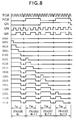
- FIG. 8 shows the waveforms of the timing clock (TCLK), the frame clock (FCLK), the divided frame clock Q31 output by flip-flop 31, the divided timing signals Q34 and Q35 output from the Q output terminals of flip-flops 34 and 35, and the gray-scale waveforms G output in the first line-scanning intervals (T S1 , T S2 , T S3 , or T S4 ) of four consecutive frames, for gray levels from zero ('0000') to fifteen ('1111').
- the frames are numbered from 4n to 4n + 3.
- the circuit configuration shown in FIG. 7 is used to drive every fourth column, e.g. to drive columns with column numbers of the form 4k, where k is an integer.
- the waveform timing is offset by one frame by adding an inverter to the frame clock divider 22, and using the inverted frame clock signal ( FCLK ) in place of the non-inverted frame clock signal (FCLK).
- FCLK In the next adjacent columns (4k + 2), FCLK is not inverted, but connections of the inverted output ( Q 31) and non-inverted output (Q31) of flip-flop 31 are interchanged.
- the waveform timing is thereby offset by two frames with respect to FIG. 8.
- FCLK is inverted, and the connections of Q 31 and Q 31 are also interchanged.
- the waveform timing is thereby offset by three frames.
- FIG. 9 illustrates the gray-scale waveform timing in a group of four columns 4k, 4k + 1, 4k + 2, and 4k + 3 during the first line-scanning intervals of four consecutive frames 4n, 4n + 1, 4n + 2, and 4n + 3.
- a pulse with a width of zero to three-fourths of the line-scanning interval is produced in frame 4n for column 4k, in frame 4n + 1 for column 4k + 1, in frame 4n + 2 for column 4k + 2, or in frame 4n + 3 for column 4k + 3, as indicated by the dotted arrows in the first four waveforms in FIG. 8.
- a pulse with a width of one line-scanning interval is produced in frame 4n, followed by a more narrow pulse in frame 4n + 1.
- These pulses slip back to frames 4n + 1 and 4n + 2 for column 4k + 1, and to frames 4n + 2 and 4n + 3 for column 4k + 2.
- the wide pulse appears in frame 4n + 3, and the more narrow pulse in frame 4n.
- the second embodiment reduces the required timing clock frequency by a factor of four. Considerable power can be saved in this way, and the requirements on the response speed of the liquid crystal material are significantly relaxed.
- the present invention is not limited to the two embodiments shown above.
- the gray-scale waveform generator and selector are not limited to the logic circuit configurations shown in FIGs. 2 and 7. Many variations are possible.
- the frame clock divider 22 was shown as performing logic operations on the divided frame clock signals, and on these signals and the frame clock signal, but these logic operations could of course be performed in the gray-scale waveform generator 23.
- timing offset schemes illustrated in FIGs. 4 and 9 can be refined to prevent flicker of vertical lines, by shifting the output timing from row to row as well as from column to column.
- additional logic can be provided in the gray-scale waveform generator to invert the frame clock signal in alternate line-scanning intervals.
- Liquid crystal television is just one of many possible fields in which the invention can be usefully practiced.
- Liquid crystal projectors are another possible application.
- the invention is potentially applicable to any matrix-addressed device that displays successive image frames, using pulse-width modulation to control the gray levels of the picture elements in the image.
- the gray-scale memory can be eliminated in some applications.
Landscapes
- Engineering & Computer Science (AREA)
- Physics & Mathematics (AREA)
- Computer Hardware Design (AREA)
- General Physics & Mathematics (AREA)
- Theoretical Computer Science (AREA)
- Liquid Crystal Display Device Control (AREA)
- Control Of Indicators Other Than Cathode Ray Tubes (AREA)
- Liquid Crystal (AREA)
Applications Claiming Priority (4)
| Application Number | Priority Date | Filing Date | Title |
|---|---|---|---|
| JP27328496 | 1996-10-16 | ||
| JP273284/96 | 1996-10-16 | ||
| JP168581/97 | 1997-06-25 | ||
| JP9168581A JPH10177370A (ja) | 1996-10-16 | 1997-06-25 | 多階調出力回路及び液晶表示装置 |
Publications (2)
| Publication Number | Publication Date |
|---|---|
| EP0837444A2 true EP0837444A2 (de) | 1998-04-22 |
| EP0837444A3 EP0837444A3 (de) | 1998-06-17 |
Family
ID=26492235
Family Applications (1)
| Application Number | Title | Priority Date | Filing Date |
|---|---|---|---|
| EP97116179A Withdrawn EP0837444A3 (de) | 1996-10-16 | 1997-09-17 | Schaltung zur Erzeugung von Graustufensignalen für eine matrixgesteuerte Flüssigkristallanzeigevorrichtung |
Country Status (6)
| Country | Link |
|---|---|
| US (1) | US6239781B1 (de) |
| EP (1) | EP0837444A3 (de) |
| JP (1) | JPH10177370A (de) |
| KR (1) | KR100337406B1 (de) |
| CN (1) | CN1159691C (de) |
| TW (1) | TW337577B (de) |
Cited By (3)
| Publication number | Priority date | Publication date | Assignee | Title |
|---|---|---|---|---|
| WO2000002186A1 (en) * | 1998-07-01 | 2000-01-13 | Ignatius Tjandrasuwita | Flexible grayscale shading for super twisted nematic displays |
| WO2006026000A3 (en) * | 2004-08-25 | 2008-02-21 | Intel Corp | Segmenting a waveform that drives a display |
| US9922598B2 (en) | 2014-12-24 | 2018-03-20 | Lg Display Co., Ltd. | Organic light emitting diode display and method for sensing characteristic thereof |
Families Citing this family (24)
| Publication number | Priority date | Publication date | Assignee | Title |
|---|---|---|---|---|
| JP4637315B2 (ja) * | 1999-02-24 | 2011-02-23 | 株式会社半導体エネルギー研究所 | 表示装置 |
| US7193594B1 (en) | 1999-03-18 | 2007-03-20 | Semiconductor Energy Laboratory Co., Ltd. | Display device |
| US7145536B1 (en) * | 1999-03-26 | 2006-12-05 | Semiconductor Energy Laboratory Co., Ltd. | Liquid crystal display device |
| US6952194B1 (en) * | 1999-03-31 | 2005-10-04 | Semiconductor Energy Laboratory Co., Ltd. | Liquid crystal display device |
| US6753854B1 (en) | 1999-04-28 | 2004-06-22 | Semiconductor Energy Laboratory Co., Ltd. | Display device |
| KR100291770B1 (ko) * | 1999-06-04 | 2001-05-15 | 권오경 | 액정표시장치 |
| AU8024700A (en) * | 1999-10-21 | 2001-04-30 | William J. Mandl | System for digitally driving addressable pixel matrix |
| GB9925054D0 (en) * | 1999-10-23 | 1999-12-22 | Koninkl Philips Electronics Nv | Display arrangement |
| US6456301B1 (en) * | 2000-01-28 | 2002-09-24 | Intel Corporation | Temporal light modulation technique and apparatus |
| JP3739663B2 (ja) * | 2000-06-01 | 2006-01-25 | シャープ株式会社 | 信号転送システム、信号転送装置、表示パネル駆動装置、および表示装置 |
| EP1303852A1 (de) * | 2000-07-13 | 2003-04-23 | Koninklijke Philips Electronics N.V. | Flüssigkristallanzeigeeinrichtung und steuerungsverfahren dafür mit aktiver adressierung einer gruppe von abtastlinien und durch zeitmodulation ausgeführte graustufen auf der basis einer nicht-binären unterteilung der rahmenzeitdauer |
| JP3620434B2 (ja) * | 2000-07-26 | 2005-02-16 | 株式会社日立製作所 | 情報処理システム |
| JP2002175060A (ja) * | 2000-09-28 | 2002-06-21 | Sharp Corp | 液晶駆動装置およびそれを備えた液晶表示装置 |
| KR100516764B1 (ko) * | 2000-12-22 | 2005-09-22 | 가부시키가이샤 휴네트 | 액정 구동 장치 및 계조 표시 방법 |
| GB2373121A (en) * | 2001-03-10 | 2002-09-11 | Sharp Kk | Frame rate controller |
| WO2003046871A1 (en) * | 2001-11-21 | 2003-06-05 | Silicon Display Incorporated | Method and system for driving a pixel with single pulse chains |
| KR101044212B1 (ko) * | 2002-12-04 | 2011-06-29 | 톰슨 라이센싱 | 균등화된 펄스폭 세그먼트를 갖는 펄스폭 변조 디스플레이 |
| WO2005039167A2 (en) * | 2003-10-17 | 2005-04-28 | Leapfrog Enterprises, Inc. | Frame rate control systems and methods |
| KR20050094017A (ko) * | 2004-03-17 | 2005-09-26 | 비오이 하이디스 테크놀로지 주식회사 | 액정표시장치의 구동회로 |
| JP4116595B2 (ja) * | 2004-06-30 | 2008-07-09 | ファナック株式会社 | モータ制御装置 |
| JP4400401B2 (ja) * | 2004-09-30 | 2010-01-20 | セイコーエプソン株式会社 | 電気光学装置とその駆動方法及び電子機器 |
| TWI316694B (en) | 2006-01-19 | 2009-11-01 | Macroblock Inc | Driving method for led with pulse width modulation |
| JP4840107B2 (ja) * | 2006-11-30 | 2011-12-21 | カシオ計算機株式会社 | 液晶表示装置、液晶表示装置の駆動装置、液晶表示装置の駆動方法 |
| CN109637415A (zh) * | 2018-12-29 | 2019-04-16 | 武汉华星光电技术有限公司 | 扫描信号生成方法、装置及电子设备 |
Family Cites Families (14)
| Publication number | Priority date | Publication date | Assignee | Title |
|---|---|---|---|---|
| EP0193728B1 (de) * | 1985-03-08 | 1992-08-19 | Ascii Corporation | Anzeigesteuersystem |
| JPS6217731A (ja) * | 1985-07-16 | 1987-01-26 | Seiko Epson Corp | 液晶表示式受像装置の駆動方式 |
| GB8728434D0 (en) * | 1987-12-04 | 1988-01-13 | Emi Plc Thorn | Display device |
| FR2633764B1 (fr) * | 1988-06-29 | 1991-02-15 | Commissariat Energie Atomique | Procede et dispositif de commande d'un ecran matriciel affichant des niveaux de gris |
| WO1990003023A1 (en) * | 1988-09-16 | 1990-03-22 | Chips And Technologies, Inc. | Gray scales method and circuitry for flat panel graphics display |
| JP2734570B2 (ja) * | 1988-11-08 | 1998-03-30 | ヤマハ株式会社 | 液晶表示回路 |
| JPH04287584A (ja) * | 1991-03-18 | 1992-10-13 | Toshiba Corp | 液晶表示装置 |
| US5459495A (en) * | 1992-05-14 | 1995-10-17 | In Focus Systems, Inc. | Gray level addressing for LCDs |
| US5485173A (en) * | 1991-04-01 | 1996-01-16 | In Focus Systems, Inc. | LCD addressing system and method |
| US5347294A (en) * | 1991-04-17 | 1994-09-13 | Casio Computer Co., Ltd. | Image display apparatus |
| US5489918A (en) * | 1991-06-14 | 1996-02-06 | Rockwell International Corporation | Method and apparatus for dynamically and adjustably generating active matrix liquid crystal display gray level voltages |
| US5877738A (en) * | 1992-03-05 | 1999-03-02 | Seiko Epson Corporation | Liquid crystal element drive method, drive circuit, and display apparatus |
| US5959603A (en) * | 1992-05-08 | 1999-09-28 | Seiko Epson Corporation | Liquid crystal element drive method, drive circuit, and display apparatus |
| DE69421511T2 (de) * | 1993-06-30 | 2000-04-27 | Koninklijke Philips Electronics N.V., Eindhoven | Matrixanzeigesysteme und verfahren zu deren steuerung |
-
1997
- 1997-06-25 JP JP9168581A patent/JPH10177370A/ja not_active Withdrawn
- 1997-09-13 TW TW086113313A patent/TW337577B/zh active
- 1997-09-17 EP EP97116179A patent/EP0837444A3/de not_active Withdrawn
- 1997-10-06 US US08/944,436 patent/US6239781B1/en not_active Expired - Fee Related
- 1997-10-09 KR KR1019970051869A patent/KR100337406B1/ko not_active Expired - Fee Related
- 1997-10-16 CN CNB971211345A patent/CN1159691C/zh not_active Expired - Fee Related
Cited By (4)
| Publication number | Priority date | Publication date | Assignee | Title |
|---|---|---|---|---|
| WO2000002186A1 (en) * | 1998-07-01 | 2000-01-13 | Ignatius Tjandrasuwita | Flexible grayscale shading for super twisted nematic displays |
| US6198469B1 (en) | 1998-07-01 | 2001-03-06 | Ignatius B. Tjandrasuwita | “Frame-rate modulation method and apparatus to generate flexible grayscale shading for super twisted nematic displays using stored brightness-level waveforms” |
| WO2006026000A3 (en) * | 2004-08-25 | 2008-02-21 | Intel Corp | Segmenting a waveform that drives a display |
| US9922598B2 (en) | 2014-12-24 | 2018-03-20 | Lg Display Co., Ltd. | Organic light emitting diode display and method for sensing characteristic thereof |
Also Published As
| Publication number | Publication date |
|---|---|
| KR100337406B1 (ko) | 2002-09-18 |
| KR19980032707A (ko) | 1998-07-25 |
| EP0837444A3 (de) | 1998-06-17 |
| CN1159691C (zh) | 2004-07-28 |
| JPH10177370A (ja) | 1998-06-30 |
| TW337577B (en) | 1998-08-01 |
| US6239781B1 (en) | 2001-05-29 |
| CN1181571A (zh) | 1998-05-13 |
Similar Documents
| Publication | Publication Date | Title |
|---|---|---|
| US6239781B1 (en) | Gray-scale signal generating circuit and liquid crystal display | |
| US4822142A (en) | Planar display device | |
| CA1298607C (en) | Signal processing system for large screen display apparatus | |
| EP0078402B1 (de) | Steuerschaltung für eine Anzeigeeinrichtung mit Anzeigeelementen in Form einer Matrix | |
| US4775891A (en) | Image display using liquid crystal display panel | |
| EP0843300B1 (de) | Graustufenansteuervorrichtung für eine passive Flüssigkristall-Anzeige | |
| US5206635A (en) | Method and apparatus for multi-level tone display for liquid crystal apparatus | |
| US5053764A (en) | System for the display of images in half tones on a matrix screen | |
| EP0254805A2 (de) | Methode und Vorrichtung für eine Anzeige mit Mehrfach-Helligkeitsabstufung | |
| EP0585466A1 (de) | Steuervorrichtung und -verfahren für flüssigkristallelemente und bildanzeigevorrichtung | |
| US6191767B1 (en) | Multi-tone display device | |
| US5621426A (en) | Display apparatus and driving circuit for driving the same | |
| EP1159730A1 (de) | Signaltreiberschaltung mit rampengenerator für elektrooptische anzeigevorrichtung | |
| US4791415A (en) | Digial driving type color display device | |
| KR20190026438A (ko) | 디스플레이 장치 및 디스플레이 장치에 사용되는 인에이블 신호 생성방법 | |
| US5673061A (en) | Driving circuit for display apparatus | |
| EP0273995B1 (de) | Flaches Anzeigegerät | |
| KR930005369B1 (ko) | 많은색의 컬러 표시방법 및 장치 | |
| JPH02291521A (ja) | 中間調表示方式および中間調表示制御装置 | |
| EP0617399B1 (de) | Flüssigkristallanzeigevorrichtung | |
| EP0655726B1 (de) | Graupegelwählende Schaltung für eine Anzeigesteuerschaltung | |
| US20030085861A1 (en) | Gray scale driving method of liquid crystal display panel | |
| US20010048419A1 (en) | Method of gray scale generation for displays using a binary weighted clock | |
| JPH10161610A (ja) | 液晶表示装置 | |
| US7262755B2 (en) | Multi-tone display device |
Legal Events
| Date | Code | Title | Description |
|---|---|---|---|
| PUAI | Public reference made under article 153(3) epc to a published international application that has entered the european phase |
Free format text: ORIGINAL CODE: 0009012 |
|
| AK | Designated contracting states |
Kind code of ref document: A2 Designated state(s): DE FR |
|
| AX | Request for extension of the european patent |
Free format text: AL;LT;LV;RO;SI |
|
| PUAL | Search report despatched |
Free format text: ORIGINAL CODE: 0009013 |
|
| AK | Designated contracting states |
Kind code of ref document: A3 Designated state(s): AT BE CH DE DK ES FI FR GB GR IE IT LI LU MC NL PT SE |
|
| AX | Request for extension of the european patent |
Free format text: AL;LT;LV;RO;SI |
|
| 17P | Request for examination filed |
Effective date: 19980923 |
|
| AKX | Designation fees paid |
Free format text: DE FR |
|
| RBV | Designated contracting states (corrected) |
Designated state(s): DE FR |
|
| 17Q | First examination report despatched |
Effective date: 20070917 |
|
| STAA | Information on the status of an ep patent application or granted ep patent |
Free format text: STATUS: THE APPLICATION IS DEEMED TO BE WITHDRAWN |
|
| 18D | Application deemed to be withdrawn |
Effective date: 20120320 |