EP0837606A1 - Interaktive Informationsübertragungsanlage für PC-TV - Google Patents
Interaktive Informationsübertragungsanlage für PC-TV Download PDFInfo
- Publication number
- EP0837606A1 EP0837606A1 EP97116058A EP97116058A EP0837606A1 EP 0837606 A1 EP0837606 A1 EP 0837606A1 EP 97116058 A EP97116058 A EP 97116058A EP 97116058 A EP97116058 A EP 97116058A EP 0837606 A1 EP0837606 A1 EP 0837606A1
- Authority
- EP
- European Patent Office
- Prior art keywords
- information transmission
- transmission system
- interactive information
- head
- control
- Prior art date
- Legal status (The legal status is an assumption and is not a legal conclusion. Google has not performed a legal analysis and makes no representation as to the accuracy of the status listed.)
- Granted
Links
Images
Classifications
-
- H—ELECTRICITY
- H04—ELECTRIC COMMUNICATION TECHNIQUE
- H04N—PICTORIAL COMMUNICATION, e.g. TELEVISION
- H04N21/00—Selective content distribution, e.g. interactive television or video on demand [VOD]
- H04N21/80—Generation or processing of content or additional data by content creator independently of the distribution process; Content per se
- H04N21/81—Monomedia components thereof
- H04N21/8166—Monomedia components thereof involving executable data, e.g. software
-
- G—PHYSICS
- G06—COMPUTING OR CALCULATING; COUNTING
- G06F—ELECTRIC DIGITAL DATA PROCESSING
- G06F11/00—Error detection; Error correction; Monitoring
- G06F11/004—Error avoidance
-
- H—ELECTRICITY
- H04—ELECTRIC COMMUNICATION TECHNIQUE
- H04N—PICTORIAL COMMUNICATION, e.g. TELEVISION
- H04N7/00—Television systems
- H04N7/16—Analogue secrecy systems; Analogue subscription systems
- H04N7/162—Authorising the user terminal, e.g. by paying; Registering the use of a subscription channel, e.g. billing
- H04N7/163—Authorising the user terminal, e.g. by paying; Registering the use of a subscription channel, e.g. billing by receiver means only
-
- H—ELECTRICITY
- H04—ELECTRIC COMMUNICATION TECHNIQUE
- H04N—PICTORIAL COMMUNICATION, e.g. TELEVISION
- H04N7/00—Television systems
- H04N7/16—Analogue secrecy systems; Analogue subscription systems
- H04N7/162—Authorising the user terminal, e.g. by paying; Registering the use of a subscription channel, e.g. billing
- H04N7/165—Centralised control of user terminal ; Registering at central
-
- H—ELECTRICITY
- H04—ELECTRIC COMMUNICATION TECHNIQUE
- H04N—PICTORIAL COMMUNICATION, e.g. TELEVISION
- H04N7/00—Television systems
- H04N7/16—Analogue secrecy systems; Analogue subscription systems
- H04N7/173—Analogue secrecy systems; Analogue subscription systems with two-way working, e.g. subscriber sending a programme selection signal
-
- G—PHYSICS
- G11—INFORMATION STORAGE
- G11C—STATIC STORES
- G11C29/00—Checking stores for correct operation ; Subsequent repair; Testing stores during standby or offline operation
- G11C29/70—Masking faults in memories by using spares or by reconfiguring
- G11C29/74—Masking faults in memories by using spares or by reconfiguring using duplex memories, i.e. using dual copies
Definitions
- the invention relates to an interactive information transmission system comprising a head-end station 2, at least one Controller 1, one or more connected to the head-end station Playback devices 6.7 and an antenna network 4.
- the information transmission system is for accommodation and care facilities intended, especially for hotels, hospitals, Retirement homes and dormitories where the entertainment needs different participants must be considered.
- Another information transmission system is from G-U1 91 07 565.3 known that a head-end station, a metering device, a controller connected to the head-end station Playback devices installed at the participants and contains a network.
- the playback devices are special TVs and are said to be those of video players Information broadcast via the head-end station to at least reproduce a specific transmission frequency.
- At least 2 video players are assigned to each television channel. The video players are switched so that at the end an information broadcast by a player another player automatically with the playback the information broadcast on it begins.
- the present invention is a further development of the in the interactive information transmission system described in G 94 10 248.1.
- the playback devices 6.7 at least include a PC TV 7, in which at least 2 hard drives 8.9 are arranged and a copy of the basic configuration of the PC TV is stored on a hard drive 8, which is only by an electronic switch can be connected to the PC TV can.
- the PC TVs contain two of each other independent hard drives, being on a second hard drive the basic configuration of the PC-TV is located as a copy. This hard drive cannot be controlled by the user.
- a electronic switch that can be controlled remotely or is arranged directly on the PC TV, which is accessible to the guest Hard drive 9 of the PC-TV overwritten with the files on hard drive 8 and so the original basic configuration of the PC TV restored.
- the electronic Switch for connecting the hard disk to the basic configuration arranged on an expansion card in PC TV can also be connected to the head-end station Network.
- Is preferably used to control the Hard drive uses software, for example in a ROM of the expansion card of the PC TV is arranged.
- the aim of this system is to create a data carrier in a PC integrate that the user does not have immediate access to can, but is still addressed by special software can be. This makes it e.g. possible on the protected Hard disk a backup of the accessible hard disk to keep that back on the accessible hard drive if necessary can be copied. This ensures that e.g. a guest in a hotel has the same initial configuration of the PC, regardless of in what state the previous guest left the PC.
- This arrangement ensures that sensitive data, which the guest may have saved on the PC, be deleted and it will continue to function security of the computer and its peripheral devices. Also it is possible to control the PC-TV from the outside via a modem and to handle these processes via a corresponding control unit.
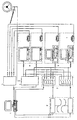
- FIG 1 shows the interactive information transmission system according to the invention.
- the information transmission system owns a controller 1, generally from a computer is performed. This is connected to head station 2.
- Die Head station 2 contains various playback devices such as CD-I players or computers with appropriate playback devices like ROM drive etc.
- the signals come from the head-end station to a signal source switch or modulator 3, which selected program only one participant in a particular Allocates guest room while the other participants cannot access this program.
- the Signals that are emitted from the head-end station 2 also on the signal coming from the antenna network 4, as shown in FIG 1 is shown.
- the control signal of the Participant can once on the television 6 or the PC TVs 7 to be delivered in the guest room, from where it is then over the antenna network 4 is routed to the controller 1.
- the signal goes straight over the telephone system 5 led to the controller 1. In this way are also faster operations, like those in skill games needed, possible.
- control 1 In both cases, the choice of the participant of the control 1 by data transfer either on the existing antenna network 4 or communicated online via telephone. The control 1 then starts exclusively for the participant concerned the corresponding interactive system and switches the associated one Output signal from the head station 2 on a transmission channel on, which then only from this device is received.
- the number 7 shows the PC TV used according to the invention by 8 and 9 are two hard drives.
- the hard drive with the number 9 is directly with the operating system the computer while the hard drive is connected number 8 can only be controlled via the switch.
- Control element can be exerted on the head-end station conceivably the control of the playback devices like the CD-I player, the video player (forward, rewind, slow motion, pause, control a voice mail box, a fax box and a flight terminal). Furthermore, such as interactive functions run the individual programs or databases control such as a hotel information system, city maps, Universal dictionaries, dictionaries, games, traffic information systems and multimedia databases.
Landscapes
- Engineering & Computer Science (AREA)
- Signal Processing (AREA)
- Multimedia (AREA)
- General Engineering & Computer Science (AREA)
- Theoretical Computer Science (AREA)
- Computer Security & Cryptography (AREA)
- General Physics & Mathematics (AREA)
- Physics & Mathematics (AREA)
- Quality & Reliability (AREA)
- Software Systems (AREA)
- Television Systems (AREA)
- Television Signal Processing For Recording (AREA)
- Two-Way Televisions, Distribution Of Moving Picture Or The Like (AREA)
- Data Exchanges In Wide-Area Networks (AREA)
Abstract
Description
- 1
- Steuerung
- 2
- Kopfstation
- 3
- Signalquellenschalter und Modulator
- 4
- Antennennetzwerk
- 5
- Telefonanlage
- 6
- TV im Gästezimmer
- 7
- PC-TV im Gästezimmer
- 8
- Festplatte mit für Benutzer unzugänglicher Basiskonfiguration
- 9
- Festplatte für Benutzer zugänglich
Claims (4)
- Interaktive Informationsübertragungsanlage umfassend eine Kopfstation (2), mindestens eine Steuerung (1), ein oder mehrere mit der Kopfstation verbundene Wiedergabegeräte und ein Antennennetzwerk (4), dadurch gekennzeichnet, daß die Wiedergabegeräte (6,7) mindestens ein PC-TV (7) umfassen, in welchem mindestens zwei Festplatten (8,9) angeordnet sind und eine Kopie der Basiskonfiguration des PC-TV auf einer Festplatte abgelegt ist, die nur durch einen elektronischen Schalter mit dem PC-TV verbunden werden kann.
- Interaktive Informationsübertragungsanlage nach Anspruch 1, dadurch gekennzeichnet, daß der elektronische Schalter auf einer Erweiterungskarte im PC-TV (7) angeordnet ist.
- Interaktive Informationsübertragungsanlage nach Anspruch 2, dadurch gekennzeichnet, daß der elektronische Schalter auf der Erweiterungskarte im PC-TV (7) mit der Kopfstation (2) über ein Netzwerk (4) verbunden ist.
- Interaktive Informationsübertragungsanlage nach den Ansprüchen 1 bis 3, dadurch gekennzeichnet, daß in einer ROM der Erweiterungskarte des PC-TV (7) eine Software zur Steuerung der Festplatte angeordnet ist.
Applications Claiming Priority (2)
| Application Number | Priority Date | Filing Date | Title |
|---|---|---|---|
| DE29618017U | 1996-10-17 | ||
| DE29618017U DE29618017U1 (de) | 1996-10-17 | 1996-10-17 | Interaktive Informationsübertragungsanlage für PC-TV |
Publications (2)
| Publication Number | Publication Date |
|---|---|
| EP0837606A1 true EP0837606A1 (de) | 1998-04-22 |
| EP0837606B1 EP0837606B1 (de) | 2001-11-07 |
Family
ID=8030668
Family Applications (1)
| Application Number | Title | Priority Date | Filing Date |
|---|---|---|---|
| EP97116058A Expired - Lifetime EP0837606B1 (de) | 1996-10-17 | 1997-09-16 | Interaktive Informationsübertragungsanlage für PC-TV |
Country Status (3)
| Country | Link |
|---|---|
| EP (1) | EP0837606B1 (de) |
| AT (1) | ATE208551T1 (de) |
| DE (2) | DE29618017U1 (de) |
Citations (2)
| Publication number | Priority date | Publication date | Assignee | Title |
|---|---|---|---|---|
| US4621259A (en) * | 1982-03-25 | 1986-11-04 | International Standard Electric Corporation | Consumer electronics equipment combination consisting of a television receiver and of a video recording and/or reproducing apparatus |
| DE9107565U1 (de) * | 1991-06-19 | 1991-10-17 | C I S Digitale Informationssysteme GmbH, 2120 Lüneburg | Informationsübertragungsanlage |
-
1996
- 1996-10-17 DE DE29618017U patent/DE29618017U1/de not_active Expired - Lifetime
-
1997
- 1997-09-16 AT AT97116058T patent/ATE208551T1/de not_active IP Right Cessation
- 1997-09-16 DE DE59705261T patent/DE59705261D1/de not_active Expired - Fee Related
- 1997-09-16 EP EP97116058A patent/EP0837606B1/de not_active Expired - Lifetime
Patent Citations (2)
| Publication number | Priority date | Publication date | Assignee | Title |
|---|---|---|---|---|
| US4621259A (en) * | 1982-03-25 | 1986-11-04 | International Standard Electric Corporation | Consumer electronics equipment combination consisting of a television receiver and of a video recording and/or reproducing apparatus |
| DE9107565U1 (de) * | 1991-06-19 | 1991-10-17 | C I S Digitale Informationssysteme GmbH, 2120 Lüneburg | Informationsübertragungsanlage |
Non-Patent Citations (1)
| Title |
|---|
| ANONYMOUS: "Program-Controlled Electronic Switch for Tape Backup", IBM TECHNICAL DISCLOSURE BULLETIN, vol. 31, no. 6, November 1988 (1988-11-01), NEW YORK, US, pages 425 - 426, XP002054378 * |
Also Published As
| Publication number | Publication date |
|---|---|
| ATE208551T1 (de) | 2001-11-15 |
| DE59705261D1 (de) | 2001-12-13 |
| EP0837606B1 (de) | 2001-11-07 |
| DE29618017U1 (de) | 1997-01-09 |
Similar Documents
| Publication | Publication Date | Title |
|---|---|---|
| EP0982695B1 (de) | Multimediabox-Netzwerk | |
| DE69230250T2 (de) | Audio- und video-sendesystem | |
| DE69630579T2 (de) | Personalisierung einer interaktiven unterhaltung | |
| DE69831179T2 (de) | Tragbare vorrichtung zur simulation von bidirektionellen verbindungen für ein-direktionelle datenströme | |
| DE69631755T2 (de) | Informationsverarbeitungsgerät, -system und verfahren für ein datenübertragungsnetzwerk | |
| DE69132518T2 (de) | Interaktives Hausinformationssystem | |
| DE69507706T2 (de) | Kommunikationsverfahren für numerisches, intelligentes, audiovisuelles reproduktionssystem | |
| DE69025607T2 (de) | Video-auswahl und verteilungssystem | |
| DE69826135T2 (de) | Programmerzeugung | |
| DE69519866T2 (de) | Vorrichtung und verfahren zum spielen von computerspielen uber ein telekommunikationsnetz | |
| DE3835779A1 (de) | Elektronische kaufeinrichtung | |
| EP0090292A2 (de) | Gerätekombination von Geräten der Unterhaltungselektronik mit einem Fernsehempfangsgerät und einem Videoaufnahme- und/oder -wiedergabegerät | |
| LU87520A1 (de) | Vorbereitungssystem | |
| EP0837606B1 (de) | Interaktive Informationsübertragungsanlage für PC-TV | |
| DE3535715C2 (de) | ||
| DE19805409B4 (de) | Virtuelle Audio- und/oder Videothek mit Fernzugriff | |
| DE69223644T2 (de) | Dekodiervorrichtung in tv-systemen | |
| DE19646127C1 (de) | Gerät zur Archivierung von Speicherdaten | |
| DE9410248U1 (de) | Interaktive Informationsübertragungsanlage | |
| DE19847686A1 (de) | Multimediabox-Netzwerk | |
| DE4233238A1 (de) | Konferenz-Informationssystem, insbesondere ausgestattet für Hotelanlagen und dergleichen | |
| EP1374457B1 (de) | Übertragungsverfahren und übertragungseinrichtung für audio- und/oder visuelle programme | |
| DE3514881A1 (de) | Dienstleistungsgeraet zum einfachen interaktiven zugriff auf videomaterial, computerbild und bildschirmtext zur waren- und leistungspraesentation | |
| DE3926093C1 (de) | ||
| DE102017100577A1 (de) | Beistellgerät mit erweitertem Funktionsumfang und Kapazität |
Legal Events
| Date | Code | Title | Description |
|---|---|---|---|
| PUAI | Public reference made under article 153(3) epc to a published international application that has entered the european phase |
Free format text: ORIGINAL CODE: 0009012 |
|
| AK | Designated contracting states |
Kind code of ref document: A1 Designated state(s): AT BE CH DE DK ES FI FR GB GR IE IT LI LU MC NL PT SE |
|
| AX | Request for extension of the european patent |
Free format text: AL;LT;LV;RO;SI |
|
| 17P | Request for examination filed |
Effective date: 19980923 |
|
| AKX | Designation fees paid |
Free format text: AT BE CH DE DK ES FI FR GB GR IE IT LI LU MC NL PT SE |
|
| AXX | Extension fees paid |
Free format text: AL PAYMENT 980923;LT PAYMENT 980923;LV PAYMENT 980923;RO PAYMENT 980923;SI PAYMENT 980923 |
|
| RBV | Designated contracting states (corrected) |
Designated state(s): AT BE CH DE DK ES FI FR GB GR IE IT LI LU MC NL PT SE |
|
| GRAG | Despatch of communication of intention to grant |
Free format text: ORIGINAL CODE: EPIDOS AGRA |
|
| 17Q | First examination report despatched |
Effective date: 20001229 |
|
| GRAG | Despatch of communication of intention to grant |
Free format text: ORIGINAL CODE: EPIDOS AGRA |
|
| GRAH | Despatch of communication of intention to grant a patent |
Free format text: ORIGINAL CODE: EPIDOS IGRA |
|
| GRAH | Despatch of communication of intention to grant a patent |
Free format text: ORIGINAL CODE: EPIDOS IGRA |
|
| GRAA | (expected) grant |
Free format text: ORIGINAL CODE: 0009210 |
|
| AK | Designated contracting states |
Kind code of ref document: B1 Designated state(s): AT BE CH DE DK ES FI FR GB GR IE IT LI LU MC NL PT SE |
|
| AX | Request for extension of the european patent |
Free format text: AL PAYMENT 19980923;LT PAYMENT 19980923;LV PAYMENT 19980923;RO PAYMENT 19980923;SI PAYMENT 19980923 |
|
| LTIE | Lt: invalidation of european patent or patent extension | ||
| PG25 | Lapsed in a contracting state [announced via postgrant information from national office to epo] |
Ref country code: NL Free format text: LAPSE BECAUSE OF FAILURE TO SUBMIT A TRANSLATION OF THE DESCRIPTION OR TO PAY THE FEE WITHIN THE PRESCRIBED TIME-LIMIT Effective date: 20011107 Ref country code: IT Free format text: LAPSE BECAUSE OF FAILURE TO SUBMIT A TRANSLATION OF THE DESCRIPTION OR TO PAY THE FEE WITHIN THE PRESCRIBED TIME-LIMIT;WARNING: LAPSES OF ITALIAN PATENTS WITH EFFECTIVE DATE BEFORE 2007 MAY HAVE OCCURRED AT ANY TIME BEFORE 2007. THE CORRECT EFFECTIVE DATE MAY BE DIFFERENT FROM THE ONE RECORDED. Effective date: 20011107 Ref country code: IE Free format text: LAPSE BECAUSE OF FAILURE TO SUBMIT A TRANSLATION OF THE DESCRIPTION OR TO PAY THE FEE WITHIN THE PRESCRIBED TIME-LIMIT Effective date: 20011107 Ref country code: GR Free format text: LAPSE BECAUSE OF FAILURE TO SUBMIT A TRANSLATION OF THE DESCRIPTION OR TO PAY THE FEE WITHIN THE PRESCRIBED TIME-LIMIT Effective date: 20011107 Ref country code: GB Free format text: LAPSE BECAUSE OF FAILURE TO SUBMIT A TRANSLATION OF THE DESCRIPTION OR TO PAY THE FEE WITHIN THE PRESCRIBED TIME-LIMIT Effective date: 20011107 Ref country code: FR Free format text: LAPSE BECAUSE OF FAILURE TO SUBMIT A TRANSLATION OF THE DESCRIPTION OR TO PAY THE FEE WITHIN THE PRESCRIBED TIME-LIMIT Effective date: 20011107 Ref country code: FI Free format text: LAPSE BECAUSE OF FAILURE TO SUBMIT A TRANSLATION OF THE DESCRIPTION OR TO PAY THE FEE WITHIN THE PRESCRIBED TIME-LIMIT Effective date: 20011107 |
|
| REF | Corresponds to: |
Ref document number: 208551 Country of ref document: AT Date of ref document: 20011115 Kind code of ref document: T |
|
| REG | Reference to a national code |
Ref country code: CH Ref legal event code: EP |
|
| REG | Reference to a national code |
Ref country code: IE Ref legal event code: FG4D Free format text: GERMAN |
|
| REF | Corresponds to: |
Ref document number: 59705261 Country of ref document: DE Date of ref document: 20011213 |
|
| REG | Reference to a national code |
Ref country code: GB Ref legal event code: IF02 |
|
| PG25 | Lapsed in a contracting state [announced via postgrant information from national office to epo] |
Ref country code: SE Free format text: LAPSE BECAUSE OF FAILURE TO SUBMIT A TRANSLATION OF THE DESCRIPTION OR TO PAY THE FEE WITHIN THE PRESCRIBED TIME-LIMIT Effective date: 20020207 Ref country code: PT Free format text: LAPSE BECAUSE OF FAILURE TO SUBMIT A TRANSLATION OF THE DESCRIPTION OR TO PAY THE FEE WITHIN THE PRESCRIBED TIME-LIMIT Effective date: 20020207 Ref country code: DK Free format text: LAPSE BECAUSE OF FAILURE TO SUBMIT A TRANSLATION OF THE DESCRIPTION OR TO PAY THE FEE WITHIN THE PRESCRIBED TIME-LIMIT Effective date: 20020207 |
|
| NLV1 | Nl: lapsed or annulled due to failure to fulfill the requirements of art. 29p and 29m of the patents act | ||
| GBV | Gb: ep patent (uk) treated as always having been void in accordance with gb section 77(7)/1977 [no translation filed] |
Effective date: 20011107 |
|
| PG25 | Lapsed in a contracting state [announced via postgrant information from national office to epo] |
Ref country code: ES Free format text: LAPSE BECAUSE OF FAILURE TO SUBMIT A TRANSLATION OF THE DESCRIPTION OR TO PAY THE FEE WITHIN THE PRESCRIBED TIME-LIMIT Effective date: 20020530 |
|
| REG | Reference to a national code |
Ref country code: IE Ref legal event code: FD4D |
|
| EN | Fr: translation not filed | ||
| PLBE | No opposition filed within time limit |
Free format text: ORIGINAL CODE: 0009261 |
|
| STAA | Information on the status of an ep patent application or granted ep patent |
Free format text: STATUS: NO OPPOSITION FILED WITHIN TIME LIMIT |
|
| PG25 | Lapsed in a contracting state [announced via postgrant information from national office to epo] |
Ref country code: LU Free format text: LAPSE BECAUSE OF NON-PAYMENT OF DUE FEES Effective date: 20020916 Ref country code: AT Free format text: LAPSE BECAUSE OF NON-PAYMENT OF DUE FEES Effective date: 20020916 |
|
| PG25 | Lapsed in a contracting state [announced via postgrant information from national office to epo] |
Ref country code: LI Free format text: LAPSE BECAUSE OF NON-PAYMENT OF DUE FEES Effective date: 20020930 Ref country code: CH Free format text: LAPSE BECAUSE OF NON-PAYMENT OF DUE FEES Effective date: 20020930 Ref country code: BE Free format text: LAPSE BECAUSE OF NON-PAYMENT OF DUE FEES Effective date: 20020930 |
|
| 26N | No opposition filed | ||
| BERE | Be: lapsed |
Owner name: *PRODAC MEDIA A.G. Effective date: 20020930 |
|
| PG25 | Lapsed in a contracting state [announced via postgrant information from national office to epo] |
Ref country code: MC Free format text: LAPSE BECAUSE OF NON-PAYMENT OF DUE FEES Effective date: 20030401 |
|
| REG | Reference to a national code |
Ref country code: CH Ref legal event code: PL |
|
| PGFP | Annual fee paid to national office [announced via postgrant information from national office to epo] |
Ref country code: DE Payment date: 20031004 Year of fee payment: 7 |
|
| PG25 | Lapsed in a contracting state [announced via postgrant information from national office to epo] |
Ref country code: DE Free format text: LAPSE BECAUSE OF NON-PAYMENT OF DUE FEES Effective date: 20050401 |