EP0838870A1 - Electrode hydrophile pour générateur électrochimique alcalin et son procédé de fabrication - Google Patents
Electrode hydrophile pour générateur électrochimique alcalin et son procédé de fabrication Download PDFInfo
- Publication number
- EP0838870A1 EP0838870A1 EP97402510A EP97402510A EP0838870A1 EP 0838870 A1 EP0838870 A1 EP 0838870A1 EP 97402510 A EP97402510 A EP 97402510A EP 97402510 A EP97402510 A EP 97402510A EP 0838870 A1 EP0838870 A1 EP 0838870A1
- Authority
- EP
- European Patent Office
- Prior art keywords
- negative electrode
- hydrophilic
- electrode
- microns
- less
- Prior art date
- Legal status (The legal status is an assumption and is not a legal conclusion. Google has not performed a legal analysis and makes no representation as to the accuracy of the status listed.)
- Granted
Links
- 238000000034 method Methods 0.000 title claims abstract description 10
- 238000002360 preparation method Methods 0.000 title description 2
- 239000011149 active material Substances 0.000 claims abstract description 8
- 229920000098 polyolefin Polymers 0.000 claims abstract description 7
- 239000000835 fiber Substances 0.000 claims description 19
- -1 polyethylene Polymers 0.000 claims description 14
- 239000004743 Polypropylene Substances 0.000 claims description 12
- 239000003795 chemical substances by application Substances 0.000 claims description 12
- 229920001155 polypropylene Polymers 0.000 claims description 12
- 230000003647 oxidation Effects 0.000 claims description 8
- 238000007254 oxidation reaction Methods 0.000 claims description 8
- 239000004480 active ingredient Substances 0.000 claims description 4
- 239000000463 material Substances 0.000 claims description 4
- 238000004519 manufacturing process Methods 0.000 claims description 3
- 239000004698 Polyethylene Substances 0.000 claims description 2
- 229920000573 polyethylene Polymers 0.000 claims description 2
- 239000002253 acid Substances 0.000 claims 1
- 230000001590 oxidative effect Effects 0.000 claims 1
- 239000003792 electrolyte Substances 0.000 description 13
- 239000002245 particle Substances 0.000 description 7
- 238000010521 absorption reaction Methods 0.000 description 5
- 239000000956 alloy Substances 0.000 description 5
- 229910045601 alloy Inorganic materials 0.000 description 5
- WMFOQBRAJBCJND-UHFFFAOYSA-M Lithium hydroxide Chemical compound [Li+].[OH-] WMFOQBRAJBCJND-UHFFFAOYSA-M 0.000 description 4
- PXHVJJICTQNCMI-UHFFFAOYSA-N Nickel Chemical compound [Ni] PXHVJJICTQNCMI-UHFFFAOYSA-N 0.000 description 4
- 238000002835 absorbance Methods 0.000 description 4
- 238000002329 infrared spectrum Methods 0.000 description 4
- KWYUFKZDYYNOTN-UHFFFAOYSA-M Potassium hydroxide Chemical compound [OH-].[K+] KWYUFKZDYYNOTN-UHFFFAOYSA-M 0.000 description 3
- HEMHJVSKTPXQMS-UHFFFAOYSA-M Sodium hydroxide Chemical compound [OH-].[Na+] HEMHJVSKTPXQMS-UHFFFAOYSA-M 0.000 description 3
- 239000011324 bead Substances 0.000 description 3
- 229920001477 hydrophilic polymer Polymers 0.000 description 3
- 229910052751 metal Inorganic materials 0.000 description 3
- 239000002184 metal Substances 0.000 description 3
- 229920000642 polymer Polymers 0.000 description 3
- 239000000243 solution Substances 0.000 description 3
- 229910018095 Ni-MH Inorganic materials 0.000 description 2
- 229910018477 Ni—MH Inorganic materials 0.000 description 2
- 239000002270 dispersing agent Substances 0.000 description 2
- 238000001035 drying Methods 0.000 description 2
- 238000000386 microscopy Methods 0.000 description 2
- 239000000203 mixture Substances 0.000 description 2
- 229910052759 nickel Inorganic materials 0.000 description 2
- 238000001878 scanning electron micrograph Methods 0.000 description 2
- 239000000126 substance Substances 0.000 description 2
- OKTJSMMVPCPJKN-UHFFFAOYSA-N Carbon Chemical compound [C] OKTJSMMVPCPJKN-UHFFFAOYSA-N 0.000 description 1
- 229910005580 NiCd Inorganic materials 0.000 description 1
- 239000004952 Polyamide Substances 0.000 description 1
- ZLMJMSJWJFRBEC-UHFFFAOYSA-N Potassium Chemical compound [K] ZLMJMSJWJFRBEC-UHFFFAOYSA-N 0.000 description 1
- 239000000654 additive Substances 0.000 description 1
- 239000011230 binding agent Substances 0.000 description 1
- 230000015572 biosynthetic process Effects 0.000 description 1
- 229910052799 carbon Inorganic materials 0.000 description 1
- 239000001768 carboxy methyl cellulose Substances 0.000 description 1
- 235000010948 carboxy methyl cellulose Nutrition 0.000 description 1
- 150000001732 carboxylic acid derivatives Chemical group 0.000 description 1
- 239000008112 carboxymethyl-cellulose Substances 0.000 description 1
- 229940105329 carboxymethylcellulose Drugs 0.000 description 1
- 238000005260 corrosion Methods 0.000 description 1
- 230000007797 corrosion Effects 0.000 description 1
- 230000001351 cycling effect Effects 0.000 description 1
- 239000008151 electrolyte solution Substances 0.000 description 1
- 239000006260 foam Substances 0.000 description 1
- 238000013467 fragmentation Methods 0.000 description 1
- 238000006062 fragmentation reaction Methods 0.000 description 1
- 239000000178 monomer Substances 0.000 description 1
- BFDHFSHZJLFAMC-UHFFFAOYSA-L nickel(ii) hydroxide Chemical compound [OH-].[OH-].[Ni+2] BFDHFSHZJLFAMC-UHFFFAOYSA-L 0.000 description 1
- 238000002161 passivation Methods 0.000 description 1
- 238000007539 photo-oxidation reaction Methods 0.000 description 1
- 229920001467 poly(styrenesulfonates) Polymers 0.000 description 1
- 229920002647 polyamide Polymers 0.000 description 1
- 229940072033 potash Drugs 0.000 description 1
- 229910052700 potassium Inorganic materials 0.000 description 1
- 239000011591 potassium Substances 0.000 description 1
- BWHMMNNQKKPAPP-UHFFFAOYSA-L potassium carbonate Substances [K+].[K+].[O-]C([O-])=O BWHMMNNQKKPAPP-UHFFFAOYSA-L 0.000 description 1
- 235000015320 potassium carbonate Nutrition 0.000 description 1
- 238000006479 redox reaction Methods 0.000 description 1
- UIIMBOGNXHQVGW-UHFFFAOYSA-N sodium;hydron;carbonate Chemical compound [Na+].OC(O)=O UIIMBOGNXHQVGW-UHFFFAOYSA-N 0.000 description 1
- 230000010148 water-pollination Effects 0.000 description 1
- 230000004580 weight loss Effects 0.000 description 1
Images


Classifications
-
- H—ELECTRICITY
- H01—ELECTRIC ELEMENTS
- H01M—PROCESSES OR MEANS, e.g. BATTERIES, FOR THE DIRECT CONVERSION OF CHEMICAL ENERGY INTO ELECTRICAL ENERGY
- H01M4/00—Electrodes
- H01M4/02—Electrodes composed of, or comprising, active material
- H01M4/24—Electrodes for alkaline accumulators
- H01M4/242—Hydrogen storage electrodes
-
- H—ELECTRICITY
- H01—ELECTRIC ELEMENTS
- H01M—PROCESSES OR MEANS, e.g. BATTERIES, FOR THE DIRECT CONVERSION OF CHEMICAL ENERGY INTO ELECTRICAL ENERGY
- H01M4/00—Electrodes
- H01M4/02—Electrodes composed of, or comprising, active material
- H01M4/62—Selection of inactive substances as ingredients for active masses, e.g. binders, fillers
-
- Y—GENERAL TAGGING OF NEW TECHNOLOGICAL DEVELOPMENTS; GENERAL TAGGING OF CROSS-SECTIONAL TECHNOLOGIES SPANNING OVER SEVERAL SECTIONS OF THE IPC; TECHNICAL SUBJECTS COVERED BY FORMER USPC CROSS-REFERENCE ART COLLECTIONS [XRACs] AND DIGESTS
- Y02—TECHNOLOGIES OR APPLICATIONS FOR MITIGATION OR ADAPTATION AGAINST CLIMATE CHANGE
- Y02E—REDUCTION OF GREENHOUSE GAS [GHG] EMISSIONS, RELATED TO ENERGY GENERATION, TRANSMISSION OR DISTRIBUTION
- Y02E60/00—Enabling technologies; Technologies with a potential or indirect contribution to GHG emissions mitigation
- Y02E60/10—Energy storage using batteries
Definitions
- the present invention relates to an electrode for alkaline electrochemical generator, in particular an electrode based on a hydrurable metal and its manufacturing process. It also concerns the generator by making application.
- electrochemical generators include two electrodes of opposite polarity between which is placed a separator.
- the functioning of alkaline electrochemical generators is based on redox reactions of the electrodes.
- the surface electrochemically active of an electrode depends on the surface wetted by the electrolyte. If the electrode is insufficiently wetted, the active surface is reduced this which leads to an increase in the local current density and therefore a lower loaded capacity. To get good accumulator performance, the electrodes are perfectly irrigated by the electrolyte.
- the negative electrodes commonly used in alkaline generators exhibit hydrophilicity insufficient, in particular the negative electrodes based on a hydrurable metal but also, the negative electrodes NiCd batteries.
- the drying of the electrodes is accentuated by corrosion of the electrodes, which leads to the formation of a so-called passivation layer which absorbs part of the electrolyte.
- a hydrophilic agent is generally added to the material active electrode.
- Document JP 0622 38 22 discloses the use of hydrophilic polyolefin fibers incorporated in said dough.
- the hydrophilicity of the electrode is improved but remains very insufficient.
- the electrode obtained is very friable when cut.
- the present invention relates to a negative electrode an alkaline electrochemical generator comprising a current collector and a paste comprising at least one active ingredient and a hydrophilic agent consisting of small organic elements provided with at least one group hydrophilic.
- Such an electrode is known from document JP 33335-68.
- the hydrophilicity of the electrode obtained remains insufficient; moreover, the mechanical strength of the electrode is not satisfactory.
- the present electrode according to the invention is characterized in that the small elements are in polyolefin and have a substantially rod shape cylindrical, the average diameter of the rods being less than 20 microns, preferably less than 10 microns, and their average length less than 50 microns.
- This electrode has very good hydrophilicity which is maintained over time as well as good behavior mechanical. It is not brittle when cut.
- the sticks have an average diameter of less than 5 microns and a length average less than 20 microns.
- the proportion of hydrophilic agent is preferably between 0.3 and 3% by weight of the dough.
- the invention also relates to the generator electrochemical alkaline comprising a positive electrode at nickel and a negative electrode according to the invention and a aqueous electrolyte.
- hydrophilic agent according to the invention makes it possible to reduce the self-discharge of the generator and improve the mechanical strength of the electrodes used.
- the hydrophilic agent of the invention is obtained by fragmentation of medium diameter polyolefin fibers less than 20 microns and whose average length is greater than 1000 microns in order to obtain rods of a average diameter less than 20 microns, preferably less than 15 microns, and of a lower average length at 50 microns.
- the material of these fibers is for example a polyolefin of which the number of carbons in the monomer corresponding is less than 5. It is preferably the polyethylene or polypropylene, and even more so preferred polypropylene.
- the average diameter of said fibers is less than 5 microns.
- the hydrophilic agent is obtained by oxidation. Oxidation allows on the one hand to split the fibers into small, long sticks average less than 50 microns and secondly to provide the small sticks of hydrophilic groups, in particular at their area.
- Fiber oxidation can be achieved by any process known to those skilled in the art, such as for example a process chosen from a thermal, chemical treatment with radio oxidation or photo-oxidation.
- the group hydrophilic obtained is a carboxylic group. Fibers can be previously grafted by at least one hydrophilic group before undergoing oxidation, by for example by a carboxylic or sulfonic group.
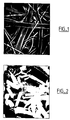
- Figure 1 is an SEM (Microscopy) Scanning Electron (MEB) or "Scanning Electrode” Microscope “in English) in backscattered electrons (magnification 500) of non-oxidized polypropylene fibers from example 5.
- FIG. 3 represents the infrared spectrum of said non-oxidized polypropylene fibers of Example 5, with the wavelength on the abscissa (in cm -1 ) and the absorbance on the ordinate (without unit).
- Figure 2 is an SEM (Microscopy) Scanning Electron (MEB) or "Scanning Electrode” Microscope “in English) in backscattered electrons (1200 magnification) of the oxidized particles according to the invention of Example 5.
- FIG. 4 represents the infrared spectrum of said oxidized particles according to the invention of Example 5, with the wavelength on the abscissa (in cm -1 ) and the absorbance on the ordinate (without unit).
- Hydrophilicity is quantified by measuring the percentage of electrolyte absorbed by the electrode. In particular, the electrode is left four hours at room temperature in an electrolyte solution then drained.
- the electrolyte used is a potassium solution, whose concentration is 8.5 M.
- We define the absorption electrolyte by calculating the mass difference between the negative electrode dries and this same electrode having soaked in the electrolyte and then dividing this value by the mass of the dry negative electrode. We consider that electrode is hydrophilic if the absorption rate electrolyte is greater than 4%.
- the mechanical strength is measured by the so-called drop test.
- An electrode of 4 x 6 cm 2 is dropped 10 times in succession on one face, alternating the faces (5 drop tests on each face).
- the fall height is 50 cm.
- the resulting weight loss is measured as a percentage.
- An electrode is considered to have good mechanical strength if its loss of mass is less than 0.5%.
- the Ni-MH accumulator is produced by associating with the negative electrode a positive electrode whose material active ingredient introduced is nickel hydroxide, a polyamide separator, a ternary electrolyte consisting an aqueous mixture of KOH potash, NaOH soda and LiOH lithine.
- the negative electrode contains no agents hydrophilic.
- An accumulator is produced as described in the example 1 by replacing the negative electrode of Example 1 with a negative electrode of which the active material is an alloy hydrurable and to which a hydrophilic polymer is added (carboxy-methyl-cellulose). Its mass proportion within of the dough is 1%.
- An accumulator is produced as described in the example 1 by replacing the negative electrode of Example 1 with a negative electrode of which the active material is an alloy hydrurable and to which polymer beads are added grafted with hydrophilic functions marketed under the name "DOWEX 50-WX8-250-400" by Dow Chemical. Their average diameter is about 100 ⁇ m and their proportion mass within the dough is 1%.
- An accumulator is produced as described in the example 1 by replacing the negative electrode of Example 1 with a negative electrode of which the active material is an alloy hydrurable and to which hydrophilic fibers are added, whose average length is approximately 2 mm (2000 ⁇ m), of which the average diameter is around 15 ⁇ m, and the proportion mass within the dough is 1%.
- the generator life is satisfactory but the hydrophilicity of the electrode is poor.
- An accumulator is produced as described in the example 1 by replacing the negative electrode of Example 1 with a negative electrode of which the active material is an alloy hydrurable and to which oxidized particles are added which are small rods of oxidized polypropylene of average diameter 4 ⁇ m and average length 15 ⁇ m. The mass proportion of these oxidized particles within the dough is 1%.
- These sticks are synthesized from fibers of nonwoven polypropylene themselves obtained by the technology known as "melt - blown" in English, well known of the skilled person.
- Said polypropylene fibers have an average diameter of 4 ⁇ m and generally have a length average greater than 1000 ⁇ m.
- Figure 1 is an SEM image (magnification 500) said non-oxidized polypropylene fibers. We see that the fibers are long (at least more than 200 ⁇ m).
- FIG. 3 represents the infrared spectrum of said non-oxidized polypropylene fibers, with the wavelength on the abscissa (in cm -1 ) and the absorbance on the ordinate (without unit).
- the small sticks are synthesized from said fibers by a thermal oxidation process, 145 ° C for 12 hours. They are made of oxidized polypropylene, with an average diameter equal to 4 ⁇ m and an average length equal to 15 ⁇ m.
- FIG. 2 is an SEM image (magnification 1200) of the oxidized particles according to the invention. We see in relation in Figure 1 that the particles are much shorter (from 4 to 30 ⁇ m).
- FIG. 4 represents the infrared spectrum of said oxidized particles, with the wavelength on the abscissa (in cm -1 ) and the absorbance on the ordinate (without unit).
Landscapes
- Chemical & Material Sciences (AREA)
- Chemical Kinetics & Catalysis (AREA)
- Electrochemistry (AREA)
- General Chemical & Material Sciences (AREA)
- Battery Electrode And Active Subsutance (AREA)
- Secondary Cells (AREA)
Abstract
Description
- préparation d'une pâte comprenant la matière active de l'électrode et un agent hydrophile,
- application de ladite pâte sur le collecteur de courant,
- séchage.
- les exemples 1 à 4 illustrent les caractéristiques des électrodes de l'art antérieur,
- l'exemple 5 illustre les caractéristiques d'une électrode de l'invention.
- l'hydrophilie,
- la tenue mécanique,
- la durée de vie de l'accumulateur.
- un alliage hydrurable,
- un dispersant,
- un liant,
- du carbone.
| Paramètres | Exemple 1 | Exemple 2 | Exemple 3 | Exemple 4 | Exemple 5 |
| Agent hydrophile | Néant | Polymère hydrophile | Billes hydrophiles | Fibres hydrophiles | Bâtonnets hydrophiles |
| Absorption électrolyte (%) | 1,8 | 5,9 | 3,2 | 3,9 | 8,9 |
| Test de chute Perte de masse (%) | 0,38 | 0,37 | 1,20 | 0,38 | 0,43 |
| Durée de vie (Cycles) | 500 | 550 | 700 | 700 | 850 |
Claims (12)
- Electrode négative d'un générateur électrochimique alcalin comprenant un collecteur de courant et une pâte comportant au moins une matière active et un agent hydrophile constitué de petits éléments organiques munis d'au moins un groupement hydrophile caractérisée en ce que les petits éléments sont en polyoléfine et ont une forme de bâtonnets sensiblement cylindriques, le diamètre moyen des bâtonnets étant inférieur à 20 microns et leur longueur moyenne inférieure à 50 microns.
- Electrode négative selon la revendication 1 tel que le diamètre moyen des bâtonnets est inférieur à 15 microns.
- Electrode négative selon l'une des revendications 1 ou 2 telle que les bâtonnets ont une longueur moyenne inférieure à 20 microns et un diamètre moyen inférieur à 5 microns.
- Electrode négative selon l'une des revendications 1 à 3 telle que la proportion d'agent hydrophile est comprise entre 0,3 et 3 % en poids de la pâte.
- Electrode négative selon l'une des revendications précédentes telle que la matière active de l'électrode est hydrurable.
- Electrode négative selon l'une des revendications précédentes telle que le groupement hydrophile est un acide carboxylique.
- Electrode négative selon l'une des revendications précédentes telle que les bâtonnets sont en polyéthylène ou en polypropylène.
- Electrode négative selon l'une des revendications précédentes telle que les bâtonnets sont en polypropylène.
- Procédé de fabrication d'une électrode de générateur alcalin, caractérisé en ce qu'on fabrique des bâtonnets hydrophiles en oxydant des longues fibres de polyoléfine de diamètre moyen inférieur à 20 microns, on mélange les bâtonnets avec une pâte comprenant une matière active et on l'applique sur un collecteur de courant.
- Procédé selon la revendication 9, caractérisé en ce que la matière active est hydrurable.
- Procédé selon l'une des revendications 9 ou 10, caractérisé en ce qu'avant de procéder à l'oxydation des fibres on les greffe par au moins un groupement hydrophile.
- Procédé selon la revendication 11 tel que ledit groupement hydrophile est un groupement carboxylique ou un groupement sulfonique.
Applications Claiming Priority (2)
| Application Number | Priority Date | Filing Date | Title |
|---|---|---|---|
| FR9612974A FR2755301B1 (fr) | 1996-10-24 | 1996-10-24 | Electrode hydrophile pour generateur electrochimique alcalin et son procede de fabrication |
| FR9612974 | 1996-10-24 |
Publications (2)
| Publication Number | Publication Date |
|---|---|
| EP0838870A1 true EP0838870A1 (fr) | 1998-04-29 |
| EP0838870B1 EP0838870B1 (fr) | 2000-12-06 |
Family
ID=9496985
Family Applications (1)
| Application Number | Title | Priority Date | Filing Date |
|---|---|---|---|
| EP97402510A Expired - Lifetime EP0838870B1 (fr) | 1996-10-24 | 1997-10-23 | Electrode hydrophile pour générateur électrochimique alcalin et son procédé de fabrication |
Country Status (5)
| Country | Link |
|---|---|
| US (1) | US6033803A (fr) |
| EP (1) | EP0838870B1 (fr) |
| JP (1) | JPH10144308A (fr) |
| DE (1) | DE69703645T2 (fr) |
| FR (1) | FR2755301B1 (fr) |
Cited By (1)
| Publication number | Priority date | Publication date | Assignee | Title |
|---|---|---|---|---|
| US11461862B2 (en) | 2012-08-20 | 2022-10-04 | Black Hills Ip Holdings, Llc | Analytics generation for patent portfolio management |
Families Citing this family (4)
| Publication number | Priority date | Publication date | Assignee | Title |
|---|---|---|---|---|
| US20030228755A1 (en) * | 2002-06-07 | 2003-12-11 | Esry Thomas Craig | Method for metal patterning and improved linewidth control |
| TWI237908B (en) * | 2003-08-29 | 2005-08-11 | Ind Tech Res Inst | A method for manufacturing a strained Si having few threading dislocations |
| FR2890784B1 (fr) * | 2005-09-09 | 2013-05-24 | Accumulateurs Fixes | Electrode positive pour accumulateur alcalin |
| US20100062342A1 (en) * | 2008-09-09 | 2010-03-11 | Lin-Feng Li | Polymer membrane utilized as a separator in rechargeable zinc cells |
Citations (2)
| Publication number | Priority date | Publication date | Assignee | Title |
|---|---|---|---|---|
| US4339512A (en) * | 1980-03-19 | 1982-07-13 | General Motors Corporation | Battery having electrode with hydrophilic polymer binder |
| JPS5935360A (ja) * | 1982-08-20 | 1984-02-27 | Sanyo Electric Co Ltd | 亜鉛極 |
Family Cites Families (6)
| Publication number | Priority date | Publication date | Assignee | Title |
|---|---|---|---|---|
| US4877694A (en) * | 1987-05-18 | 1989-10-31 | Eltech Systems Corporation | Gas diffusion electrode |
| US5346781A (en) * | 1989-02-23 | 1994-09-13 | Matsushita Electric Industrial Co., Ltd. | Alkaline storage battery |
| EP0789409B1 (fr) * | 1992-09-14 | 2003-07-09 | Kabushiki Kaisha Toshiba | Alliage absorbant l'hydrogène pour batterie, procédé de fabrication de celui-ci et batterie secondaire au nickel-hydrure de métal |
| JPH06333568A (ja) * | 1993-05-24 | 1994-12-02 | Matsushita Electric Ind Co Ltd | 密閉型金属酸化物−水素電池およびその製造方法 |
| US5527638A (en) * | 1993-06-30 | 1996-06-18 | Matsushita Electric Industrial Co., Ltd. | Hydrogen storage alloy electrode and sealed-type nickel-metal hydride storage battery using the same |
| US5695530A (en) * | 1994-03-14 | 1997-12-09 | Hong; Kuochih | Method for making high charging efficiency and fast oxygen recombination rechargeable hydride batteries |
-
1996
- 1996-10-24 FR FR9612974A patent/FR2755301B1/fr not_active Expired - Fee Related
-
1997
- 1997-10-23 US US08/956,444 patent/US6033803A/en not_active Expired - Lifetime
- 1997-10-23 DE DE69703645T patent/DE69703645T2/de not_active Expired - Lifetime
- 1997-10-23 EP EP97402510A patent/EP0838870B1/fr not_active Expired - Lifetime
- 1997-10-24 JP JP9292002A patent/JPH10144308A/ja active Pending
Patent Citations (2)
| Publication number | Priority date | Publication date | Assignee | Title |
|---|---|---|---|---|
| US4339512A (en) * | 1980-03-19 | 1982-07-13 | General Motors Corporation | Battery having electrode with hydrophilic polymer binder |
| JPS5935360A (ja) * | 1982-08-20 | 1984-02-27 | Sanyo Electric Co Ltd | 亜鉛極 |
Non-Patent Citations (1)
| Title |
|---|
| PATENT ABSTRACTS OF JAPAN vol. 008, no. 123 (E - 249) 8 June 1984 (1984-06-08) * |
Cited By (1)
| Publication number | Priority date | Publication date | Assignee | Title |
|---|---|---|---|---|
| US11461862B2 (en) | 2012-08-20 | 2022-10-04 | Black Hills Ip Holdings, Llc | Analytics generation for patent portfolio management |
Also Published As
| Publication number | Publication date |
|---|---|
| US6033803A (en) | 2000-03-07 |
| DE69703645T2 (de) | 2001-07-05 |
| EP0838870B1 (fr) | 2000-12-06 |
| DE69703645D1 (de) | 2001-01-11 |
| FR2755301A1 (fr) | 1998-04-30 |
| JPH10144308A (ja) | 1998-05-29 |
| FR2755301B1 (fr) | 1998-11-27 |
Similar Documents
| Publication | Publication Date | Title |
|---|---|---|
| DE60103407T2 (de) | Elektrode aus teilchen und mit elektrolyt für eine wiederaufladbare lithium-ionen batterie | |
| EP2619832B1 (fr) | Électrode pour batteries lithium et son procédé de fabrication | |
| CN113133331B (zh) | 包含含有粒径不同的活性材料的双层结构混合物层的二次电池电极及其制造方法 | |
| FR2777698A1 (fr) | Separateur comprenant une matrice macroporeuse et un polymere poreux, son procede de fabrication, generateur electrochimique le comprenant et le procede de fabrication de celui-ci | |
| JPH08507407A (ja) | ハイブリッド重合体電解質を用いた再充電可能リチウム挿入電池 | |
| US20180315992A1 (en) | Manufacturing of thick composite electrode using solvent mixtures | |
| EP3427318B1 (fr) | Electrode pour batterie lithium-ion comprenant un liant forme d'un melange de deux polymeres, le premier polymere etant un premier polyacrylate ou un de ses derives, le deuxieme polymere etant un deuxieme polyacrylate ou une carboxymethyle cellulose ou un de leurs derives, encre pour la realisation d'une telle electrode. | |
| US20030175588A1 (en) | Cathode compositions, cathodes, methods of producing cathodes and lithium secondary batteries including the same | |
| EP3052441B1 (fr) | Électrode pour batterie de stockage d'énergie électrique comprenant un matériau composite graphite/silicium/fibres de carbone | |
| FR2738396A1 (fr) | Anode de generateur electrochimique rechargeable au lithium et son procede de fabrication | |
| EP0935301B1 (fr) | Electrode positive au nickel pour accumulateur alcalin | |
| EP0838870B1 (fr) | Electrode hydrophile pour générateur électrochimique alcalin et son procédé de fabrication | |
| EP1831110A1 (fr) | OXYDE DE LITHIUM ET DE VANDIUM Li1+ V3O8 (0,1 0,25) PROCEDE POUR SA PREPARATION | |
| EP0996185A1 (fr) | Electrode à air bifonctionnelle pour générateur électrochimique secondaire | |
| EP3483953A2 (fr) | Composition specifique pour la fabrication d'electrodes destinees a une batterie au lithium | |
| EP0884791B1 (fr) | Electrode de nickel empatée. | |
| EP2254179A1 (fr) | Electrode plastifiee pour accumulateur alcalin | |
| EP1831109A1 (fr) | Procede de preparation de gamma-liv2o5. | |
| FR3143868A1 (fr) | Electrodes negatives a base de silicium et d’additif fluore | |
| CN116936733A (zh) | 一种极片和电化学装置 | |
| FR2771856A1 (fr) | Electrode en fibres de carbone pour batterie secondaire | |
| EP1837935B1 (fr) | Électrode plastifiée pour accumulateur alcalin | |
| FR3059471A1 (fr) | Procede de fabrication d'une electrode positive pour accumulateur electrochimique lithium-soufre | |
| WO2020178509A1 (fr) | Électrode pour dispositif de stockage de l'énergie rechargeable | |
| EP3660954A1 (fr) | Cathode pour accumulateur électrochimique, accumulateur, dispositif de stockage d'énergie et procédé de fabrication associés |
Legal Events
| Date | Code | Title | Description |
|---|---|---|---|
| PUAI | Public reference made under article 153(3) epc to a published international application that has entered the european phase |
Free format text: ORIGINAL CODE: 0009012 |
|
| AK | Designated contracting states |
Kind code of ref document: A1 Designated state(s): DE ES FI FR GB IE IT NL SE |
|
| 17P | Request for examination filed |
Effective date: 19981029 |
|
| AKX | Designation fees paid |
Free format text: DE ES FI FR GB IE IT NL SE |
|
| RBV | Designated contracting states (corrected) |
Designated state(s): DE ES FI FR GB IE IT NL SE |
|
| GRAG | Despatch of communication of intention to grant |
Free format text: ORIGINAL CODE: EPIDOS AGRA |
|
| 17Q | First examination report despatched |
Effective date: 20000216 |
|
| GRAG | Despatch of communication of intention to grant |
Free format text: ORIGINAL CODE: EPIDOS AGRA |
|
| GRAH | Despatch of communication of intention to grant a patent |
Free format text: ORIGINAL CODE: EPIDOS IGRA |
|
| GRAH | Despatch of communication of intention to grant a patent |
Free format text: ORIGINAL CODE: EPIDOS IGRA |
|
| GRAA | (expected) grant |
Free format text: ORIGINAL CODE: 0009210 |
|
| AK | Designated contracting states |
Kind code of ref document: B1 Designated state(s): DE ES FI FR GB IE IT NL SE |
|
| PG25 | Lapsed in a contracting state [announced via postgrant information from national office to epo] |
Ref country code: SE Free format text: LAPSE BECAUSE OF FAILURE TO SUBMIT A TRANSLATION OF THE DESCRIPTION OR TO PAY THE FEE WITHIN THE PRESCRIBED TIME-LIMIT Effective date: 20001206 Ref country code: NL Free format text: LAPSE BECAUSE OF FAILURE TO SUBMIT A TRANSLATION OF THE DESCRIPTION OR TO PAY THE FEE WITHIN THE PRESCRIBED TIME-LIMIT Effective date: 20001206 Ref country code: IT Free format text: LAPSE BECAUSE OF FAILURE TO SUBMIT A TRANSLATION OF THE DESCRIPTION OR TO PAY THE FEE WITHIN THE PRESCRIBED TIME-LIMIT;WARNING: LAPSES OF ITALIAN PATENTS WITH EFFECTIVE DATE BEFORE 2007 MAY HAVE OCCURRED AT ANY TIME BEFORE 2007. THE CORRECT EFFECTIVE DATE MAY BE DIFFERENT FROM THE ONE RECORDED. Effective date: 20001206 Ref country code: IE Free format text: LAPSE BECAUSE OF FAILURE TO SUBMIT A TRANSLATION OF THE DESCRIPTION OR TO PAY THE FEE WITHIN THE PRESCRIBED TIME-LIMIT Effective date: 20001206 Ref country code: FI Free format text: LAPSE BECAUSE OF FAILURE TO SUBMIT A TRANSLATION OF THE DESCRIPTION OR TO PAY THE FEE WITHIN THE PRESCRIBED TIME-LIMIT Effective date: 20001206 Ref country code: ES Free format text: THE PATENT HAS BEEN ANNULLED BY A DECISION OF A NATIONAL AUTHORITY Effective date: 20001206 |
|
| GBT | Gb: translation of ep patent filed (gb section 77(6)(a)/1977) |
Effective date: 20001219 |
|
| REF | Corresponds to: |
Ref document number: 69703645 Country of ref document: DE Date of ref document: 20010111 |
|
| REG | Reference to a national code |
Ref country code: IE Ref legal event code: FG4D Free format text: FRENCH |
|
| NLV1 | Nl: lapsed or annulled due to failure to fulfill the requirements of art. 29p and 29m of the patents act | ||
| PLBE | No opposition filed within time limit |
Free format text: ORIGINAL CODE: 0009261 |
|
| STAA | Information on the status of an ep patent application or granted ep patent |
Free format text: STATUS: NO OPPOSITION FILED WITHIN TIME LIMIT |
|
| REG | Reference to a national code |
Ref country code: IE Ref legal event code: FD4D |
|
| 26N | No opposition filed | ||
| REG | Reference to a national code |
Ref country code: GB Ref legal event code: IF02 |
|
| PGFP | Annual fee paid to national office [announced via postgrant information from national office to epo] |
Ref country code: DE Payment date: 20120924 Year of fee payment: 16 |
|
| PGFP | Annual fee paid to national office [announced via postgrant information from national office to epo] |
Ref country code: GB Payment date: 20131023 Year of fee payment: 17 Ref country code: FR Payment date: 20131002 Year of fee payment: 17 |
|
| REG | Reference to a national code |
Ref country code: DE Ref legal event code: R119 Ref document number: 69703645 Country of ref document: DE Effective date: 20140501 |
|
| PG25 | Lapsed in a contracting state [announced via postgrant information from national office to epo] |
Ref country code: DE Free format text: LAPSE BECAUSE OF NON-PAYMENT OF DUE FEES Effective date: 20140501 |
|
| GBPC | Gb: european patent ceased through non-payment of renewal fee |
Effective date: 20141023 |
|
| PG25 | Lapsed in a contracting state [announced via postgrant information from national office to epo] |
Ref country code: GB Free format text: LAPSE BECAUSE OF NON-PAYMENT OF DUE FEES Effective date: 20141023 |
|
| REG | Reference to a national code |
Ref country code: FR Ref legal event code: ST Effective date: 20150630 |
|
| PG25 | Lapsed in a contracting state [announced via postgrant information from national office to epo] |
Ref country code: FR Free format text: LAPSE BECAUSE OF NON-PAYMENT OF DUE FEES Effective date: 20141031 |