EP0838960A2 - System und Verfahren zum Nachprüfen eines audiovisuellen Inhalts - Google Patents
System und Verfahren zum Nachprüfen eines audiovisuellen Inhalts Download PDFInfo
- Publication number
- EP0838960A2 EP0838960A2 EP97308605A EP97308605A EP0838960A2 EP 0838960 A2 EP0838960 A2 EP 0838960A2 EP 97308605 A EP97308605 A EP 97308605A EP 97308605 A EP97308605 A EP 97308605A EP 0838960 A2 EP0838960 A2 EP 0838960A2
- Authority
- EP
- European Patent Office
- Prior art keywords
- content
- stream
- audio
- characteristic data
- frame
- Prior art date
- Legal status (The legal status is an assumption and is not a legal conclusion. Google has not performed a legal analysis and makes no representation as to the accuracy of the status listed.)
- Withdrawn
Links
Images



Classifications
-
- H—ELECTRICITY
- H04—ELECTRIC COMMUNICATION TECHNIQUE
- H04N—PICTORIAL COMMUNICATION, e.g. TELEVISION
- H04N21/00—Selective content distribution, e.g. interactive television or video on demand [VOD]
- H04N21/40—Client devices specifically adapted for the reception of or interaction with content, e.g. set-top-box [STB]; Operations thereof
- H04N21/43—Processing of content or additional data, e.g. demultiplexing additional data from a digital video stream; Elementary client operations, e.g. monitoring of home network or synchronising decoder's clock; Client middleware
- H04N21/44—Processing of video elementary streams, e.g. splicing a video clip retrieved from local storage with an incoming video stream or rendering scenes according to encoded video stream scene graphs
- H04N21/44008—Processing of video elementary streams, e.g. splicing a video clip retrieved from local storage with an incoming video stream or rendering scenes according to encoded video stream scene graphs involving operations for analysing video streams, e.g. detecting features or characteristics in the video stream
-
- H—ELECTRICITY
- H04—ELECTRIC COMMUNICATION TECHNIQUE
- H04N—PICTORIAL COMMUNICATION, e.g. TELEVISION
- H04N17/00—Diagnosis, testing or measuring for television systems or their details
- H04N17/004—Diagnosis, testing or measuring for television systems or their details for digital television systems
-
- H—ELECTRICITY
- H04—ELECTRIC COMMUNICATION TECHNIQUE
- H04N—PICTORIAL COMMUNICATION, e.g. TELEVISION
- H04N21/00—Selective content distribution, e.g. interactive television or video on demand [VOD]
- H04N21/40—Client devices specifically adapted for the reception of or interaction with content, e.g. set-top-box [STB]; Operations thereof
- H04N21/41—Structure of client; Structure of client peripherals
- H04N21/426—Internal components of the client ; Characteristics thereof
- H04N21/42646—Internal components of the client ; Characteristics thereof for reading from or writing on a non-volatile solid state storage medium, e.g. DVD, CD-ROM
-
- H—ELECTRICITY
- H04—ELECTRIC COMMUNICATION TECHNIQUE
- H04N—PICTORIAL COMMUNICATION, e.g. TELEVISION
- H04N21/00—Selective content distribution, e.g. interactive television or video on demand [VOD]
- H04N21/40—Client devices specifically adapted for the reception of or interaction with content, e.g. set-top-box [STB]; Operations thereof
- H04N21/43—Processing of content or additional data, e.g. demultiplexing additional data from a digital video stream; Elementary client operations, e.g. monitoring of home network or synchronising decoder's clock; Client middleware
- H04N21/439—Processing of audio elementary streams
- H04N21/4394—Processing of audio elementary streams involving operations for analysing the audio stream, e.g. detecting features or characteristics in audio streams
-
- H—ELECTRICITY
- H04—ELECTRIC COMMUNICATION TECHNIQUE
- H04N—PICTORIAL COMMUNICATION, e.g. TELEVISION
- H04N21/00—Selective content distribution, e.g. interactive television or video on demand [VOD]
- H04N21/40—Client devices specifically adapted for the reception of or interaction with content, e.g. set-top-box [STB]; Operations thereof
- H04N21/47—End-user applications
- H04N21/488—Data services, e.g. news ticker
- H04N21/4884—Data services, e.g. news ticker for displaying subtitles
Definitions
- the present invention relates to audio-visual test and measurement systems and more particularly to a method and apparatus for comparing a given content stream with a reference content stream for verifying the correctness of a given data stream and for detecting various content-related problems, such as missing or distorted content, as well as badly synchronized content streams such as audio or sub-titles delayed with respect to the video stream.
- Audio-visual content is herein defined as a stream or sequence of video, audio, graphics (sub-pictures) and other data where the semantics of the data stream is of value.
- stream or “sequence” is of particular importance, since it is assumed that the ordering of content elements along a time or space line constitutes part of the content.
- Elementary content streams may be combined to a composite stream.
- an application which involves two video streams (for stereoscopic display), six or eight surround audio channels and several sub-picture channels can be formed.
- the relative alignment of these streams is highly significant and should be verified.
- an analysis is made of video signal for detecting disturbances of that signal, such as illegal colors.
- An "illegal color” is one that is outside the practical limit set for a particular format.
- Other types of video measurement involve injecting known signals at the source and evaluating certain properties thereof at the receiving end.
- SDI serial digital interface
- the known video test and measurement systems are, however, generally not capable of detecting content-related problems, such as missing or surplus frames, program time shift, color or luminance distortions which are within the acceptable parameter range, mis-alignment of content streams such as audio or sub-pictures with respect to video, etc.
- an observer will look at the display to detect quality problems.
- An experienced operator may detect and interpret a variety of problems in recording and transmission.
- An observer can do good rule-based or subjective evaluation of video content, however, human inspection of content is costly and unpredictable. Additionally, some content-related defects cannot be detected by an observer.
- the reference stream consists of the original program material and the actual stream consists of the broadcast or played content.
- the designation of one stream as the reference stream is arbitrary, for example, comparing one content stream with a backup stream.
- the terms "reference content stream” and "actual content stream” will be used, without limiting the generality of the invention.
- a daily schedule may consist of hundreds of video segments, intended to play seamlessly.
- Such a schedule is usually implemented by an automation system.
- the schedule is logged into the system as some form of a table (a "play-list") describing the program's name, start time, duration and source, e.g., storage media, unique identifier, time-code of first frame.
- the storage media can be a tape or a digital file.
- the program source material is organized in an hierarchical manner, with most of the content stored off-line.
- the forthcoming programs are loaded on a tape machine and sometimes, as in the case of a commercial or trailer, digitized to a disk-based server.
- the complex paths of the various elements of content may further increase the content mismatch probability.
- ADC-100 from Louth Automation.
- ADC-100 can run up to 16 lists simultaneously, and control multiple devices including disk servers, video servers, tape machines, cart machines, VTRs, switchers, character generators and audio carts.
- the present invention can verify the identity and integrity of the broadcast content, providing important feedback for the automation system or facility manager.
- DVD is a new generation of the compact disc format which provides increased storage capacity and performance, especially for video and multimedia applications.
- DVD for video is capable of storing eight audio tracks and thirty-two "sub-picture" tracks, which are used for subtitles, menus, etc. These can be used to put several selectable languages on each disc.
- the interactive capabilities of consumer DVD players include menus with a small set of navigation and control commands, with some functions for dynamic video stream control, such as seamless branching, which can be used for playing different "cuts" of the same video material for dramatic purposes, censorship, etc.
- DVD-ROM which will be used for multi-media applications, will exhibit a higher level of interactivity.
- DVD contains multiple content streams with many options for branching from one stream to the other or combining several streams, such as a menu or sub-titles overlaid on a video frame, one has to verify that a given set of initial settings, followed by a specific set of navigation commands, indeed produces the correct content.
- This step in DVD production is known as "emulation", currently designed to be performed by an observer.
- the present invention also allows automation of DVD emulation.
- the video image is composed of the motion picture stream overlaid by sub-pictures or graphics, such as sub-titling.
- sub-pictures or graphics such as sub-titling.
- the audio-visual program comprises at least one video channel, or at least one audio channel, or at least one sub-picture channel comprising sub-titles, closed-captions and any kind of auxiliary graphics information which is timed synchronously with the video or audio. While in certain applications sub-pictures are embedded in the video image sequence, in other applications they are carried by a separate stream/file.
- the present invention therefore provides a method of comparing the content obtained by broadcast or playback with a reference content, including the steps of extracting frame characteristic data streams from said reference content and from actual received or playback content, aligning said streams and comparing said streams on a frame-by-frame basis.
- U.S. Patent No. 5,339,166 entitled “Motion-Dependent Image Classification for Editing Purposes,” describes a system for comparing two or more versions, typically of different dubbing languages, of the same feature film. By identifying camera shot boundaries in both versions and comparing sequences of shot length, a common video version, comprising camera shots which exist in all versions, can be automatically generated. While the embodiment described in this patent allows, in principle, the location of content differences between versions at camera shot level, frame-by-frame alignment for all frames in the respective version is not performed. Further, the differences detected are in the existence or absence of video frames as a whole. In contrast, the present invention allows frame-by-frame inspection of color properties, detection of compression artifacts, audio distortions. etc.
- the content of each frame is fixed and characteristic data are computed from the content.
- the present invention addresses the on-line composition of a content stream from basic content streams, such that characteristic data are pre-computed only for these basic streams. Given the branching/navigation/editing commands, a composite reference characteristic data stream is predicted from the component characteristic data stream and then compared with the actual content stream.
- one stream may be analog and the other digital. Additionally, one stream may be compressed and the other may be of full bandwidth.
- the input will be CCIR-601 digital video and AES digital audio. Multiple audio streams may be due to different dubbing languages, as well as stereo and surround sound channels.
- the extraction of characteristic data will be done in real-time, thus saving intermediate storage and also enabling real-time error detection in a broadcasting environment.
- this is not a limitation, since the present invention can be used off-line by recording both the reference and the actual audio-visual program.
- processing can be slower than real-time or faster, depending on the computational resources.
- a faster than real-time performance may be needed, depending, of course, on the availability of a suitable analog to digital converter which can cope with fast-forward video signals.
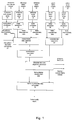
- Fig. 1 shows a top level flow of processing of an audio-visual content verification system according to the present invention.
- Reference sub-picture stream 11, video stream 12 and audio stream 13 are stored in their respective stores 14, 15 and 16, to be eventually processed by processors 17, 18 and 19, respectively.
- the combination of sub-pictures with video, as well as transition/branching between program segments, is applied at characteristic data level by predictor 20, driven by navigation/playback commands 21.
- Actual video stream 22 and audio stream 23 are stored in their respective stores 24 and 25, to be later processed by processors 26 and 27 respectively.
- the video stream 22 and the corresponding characteristic data are composed of video and sub-pictures.
- the data streams are input to the characteristic data alignment processor 30, resulting in frame-aligned characteristic data.
- the alignment process also results in a program time-shift value, as well as indices or time-codes of missing or surplus frames.
- characteristic data are compared on a frame-by-frame basis in comparator 32, yielding a frame quality report.
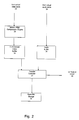
- Fig. 2 shows means for storing detected content problems.
- Recently played/received video from store 24 undergoes compression in engine 34 and is then stored in buffer 35.
- the recently played/received audio from store 25 is directly stored in buffer 36.
- Transfer controller 37 is activated by verification reports 38 to transfer the content into hard disk storage 39, where it can be later analyzed.
- Fig. 3 shows an array of video sequence characteristic data 40.
- the list comprises image difference measures, as well as image motion vectors. These measures may include properties of the histogram of the difference image, obtained by subtracting two adjacent images, as is known per se.
- the "span" characteristic data defined as the difference in gray levels between a high (e.g., 85) percentile and a low (e.g., 15) percentile of said histogram, was found to be useful.
- a measure of difference of intensity histogram of two adjacent images also by a known technique, may be used.
- Motion vector fields are computed at pre-determined locations while using a block-matching motion estimation algorithm.
- a more concise representation may consist of camera motion parameters, preferably estimated from image motion vector fields.
- Fig. 4 shows an array of video frame or still image spatial characteristic data.
- the list comprises color characteristic data 41.
- Useful color characteristic data include the first three moments: average, variance and skewness of color components: where p ij is the value of the i-th color space component of the j-th image pixel.
- Color spaces of convenience may include the (R,G,B) representation or the (Y,U,V), which provide luminance characteristic data through the Y component.
- Texture provides measures to describe the structural composition, as well as the distribution, of image gray-levels.
- Useful texture characteristic data are derived from spatial gray-level dependence matrices. These include measures such as energy, entropy and correlation.
- characteristic data for a specific application of content verification is important. Texture and color data are important for matching still images. Video frame sequences with significant motion can be aligned by motion characteristic data. For more static sequences, color and texture data can facilitate the alignment process.
- the region of support that is, the image region on which these data are computed
- deriving multiple characteristics at numerous, relatively small image regions has two important advantages:
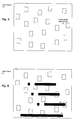
- Fig. 5 shows a set of regions 42 in a video frame 43, such that color or texture characteristic data are computed for each such region.
- Fig. 6 illustrates the relative location of graphics sub-pictures with respect to the video frame. Number 44 represents a sub-title sub-picture and number 45 represents a menu-item sub-picture.
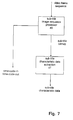
- Figs. 7 and 8 show the extraction of sub-title characteristic data.
- Sub-titles or closed captions in a movie are used to bring translated dialogues to the viewer. Generally, a sub-title will occupy several dozen frames.
- a suitable form for sub-title characteristic data is time-code-in, time-code-out of that specific sub-title, with additional data describing the sub-title bitmap.
- the sub-title image sequence processor 46 analyses every video frame of the sequence to detect specific frames at which sub-title information is changed. The result is a sequence of sub-title bitmaps, with the frame interval each such bitmap occupies in a time-code-in, time-code-out representation. Characteristic data are then extracted by unit 47 from the sub-title bitmap.
- Fig. 8 shows the sub-title image sequence processor 46.
- the video image passes through a character binarization processor 48, operative to identify pixels belonging to sub-title characters and paint them white, for example, where the background pixels are painted black.
- the current frame bitmap 49 is compared, or matched, with the stored sub-title bitmap from the first instance of that bitmap.
- the sub-title bitmap is reported with the corresponding time-code interval, and a new matching cycle begins.
- the matching process can be implemented by a number of binary template-matching or correlation algorithms.
- the spatial search range of the template-matching should accommodate mis-registration of a sub-title and additionally the case of scrolling sub-titles.
- the characteristic data of a single sub-title should be concise and allow for efficient matching.
- the sub-title bitmap usually run-length coded, is a suitable representation.
- sub-pictures consist of graphics elements such as bullets, highlight or shadow rectangles, etc.
- Useful characteristic data are obtained by using circle and rectangle detectors.
- Fig. 9 shows a record 50 of sub-pictures characteristic data.
- Fig. 10 shows the derivation of audio characteristic data.
- the signal is digitized by the arrangement comprising an analog anti-aliasing filter 51 and an A/D converter 52 and then filtered by the pre-emphasis filter 53.
- Spectral analysis uses a digital filter bank 54, 54 1 ...54 n .
- the filter output is squared and integrated by the power estimation unit 55, 55 1 ...55 n .
- the set of characteristic data is computed for each video frame duration (40 msec for PAL, or 33.3 msec for NTSC) and stored in store 56. Window duration controls the amount of averaging or smoothing used in power computation. Typically, a 60 or 50 msec window, for an overlap of 33%, can be used.
- the filter bank is a series of linear phase FIR filters, so that the group delay for all filters is zero and the output signals from the filters are synchronized in time.
- Each filter is specified by its center frequency and its bandwidth.
- the reference characteristic data stream is not available explicitly, but has to be derived from said source characteristic data and from playback commands such as denoted in Fig. 1.
- a simple case is when a program consists of consecutive multiple content segments. Each such segment is specified by a source content identifier , a beginning time-code and an ending time-code.
- Said reference characteristic data stream can be constructed or predicted from the corresponding segments of source characteristic data by means of concatenation. If content verification involves computing the actual content segment insertion points, these source characteristic data segments will be padded by characteristic data margins to allow for inaccuracies in insertion.
- the transitions involve not only cuts, but also dissolves or fades.
- some characteristic data can be predicted based on the original source data as well as the blending values. These data include, for example, color moments computed over some region of support. In alignment and verification, the predicted values are compared against the actual values.
- An important step in the verification process is the frame-by-frame alignment of the characteristic data streams.
- the choice of the subset of characteristic data used for alignment is important to the success of that step.
- frame difference measures such as the span described above, are well suited to alignment.
- a coarse-fine strategy is employed, in which anchor frames are used to solve the major time-shift between the content streams. Once that shift is known, fine frame-by-frame alignment takes place.
- An anchor frame is one with an unique structure of characteristic data in its neighborhood.
- Fig. 11 shows the selection of anchor frames for coarse alignment.
- the frame difference data for example, the span sequence
- local variance estimation is effected in estimator 57 by means of a sliding window.
- Processors 58 and 59 produce a list of local variance maxima which are above a suitable threshold.
- a consecutive processing step in processor 60 estimates the auto-correlation of the candidate anchor frame with its frame difference data neighborhood.
- a further criterion may be used to increase the effectiveness of the alignment step.
- the anchor frames are graded by uniqueness, i.e., dissimilarity with other anchor frames, to reduce the probability of false matches in the next alignment step.
- Uniqueness is computed by means of cross-correlation between the anchor frame and other anchor frames. By associating the number of anchor frames with a cross-correlation value lower than a specified threshold with the specific anchor frame, those frames with highest uniqueness are selected.
- the matching process can be described as a sequence of edit operators which transform the first interval of frame characteristic data to the second interval.
- the sequence consists of three such operators:
- the fine frame alignment problem has now been transformed to finding a minimum cost sequence of operators which implements the transformation. If m is the length of the first interval and n is the length of the second interval in frames, then the matching problem can be solved in space and time proportional to ( m*n ). All that remains is to set the respective costs. Deletion and insertion can be assigned a fixed cost each, based on a-priori information on the probability of dropped or surplus frames. Replacement is a distance measure on the characteristic data vector, such as weighted Euclidean distance.
- Fig. 12 shows the alignment of a composite stream with the component reference streams by means of a processor 61 and geometric filter 62.
- sub-title graphics of the language of choice are combined with the video frame sequence.
- the location of sub-titles in the video frame can be specified either manually, in the characteristic data design workstation as described below, or can be automatically computed, based on analysis of the sub-title sub-picture stream.
- video frame verification is done in the image region free from sub-titles.
- sub-title picture verification is done in the sub-title image region.
- a more difficult case is when graphics are overlaid on the video frame, such as in the case of displaying a menu in a DVD player.
- the location of menu bullets and text may be, for example, as illustrated in Fig. 6.
- the graphics stream has been pre-processed to extract the graphics regions of support, in the form of bounding rectangles for text lines and graphics primitives. These regions are stored as auxiliary characteristic data.
- the streams can be aligned. Once aligned, the composite frame graphics regions are known to be those of the corresponding graphics stream. Then, based on these regions, only color and texture actual frame characteristic data which are not occluded by overlay graphics [see Fig. 6] are compared with the respective reference data.
- Fig. 13 depicts the frame verification processes performed by the frame characteristic data comparator 32 (Fig. 1), which start from aligned characteristic data streams. It is important to note that the characteristic data alignment processor 30 detects a variety of content problems. Failure in alignment may be due to the fact that a wrong content stream is playing, or the content stream is severely time-shifted, or the stream is distorted beyond recognition. A successful alignment yields the indices of missing or surplus frames. Once aligned, each actual content frame is compared with the corresponding reference frame, based on the characteristic data.
- the comparison process requires the notions of distance and threshold.
- C is the co-variance matrix which models pairwise relationships among the individual characteristic data.
- the proper threshold may be computed at a training phase, using the characteristic data design workstation described hereinafter with reference to Fig. 14.
- Comparator 68 compares blockiness characteristic data derived from the reference and actual video frames, respectively.
- data may include power estimates of a filter designed to enhance an edge grid structure, such as, for example, the grid spacing equals the compression block size, which is usually 8 or 16. By comparing these estimates with the reference value, an increase in blockiness may be detected. As described above, absolute blockiness may be misleading, since it may originate from the original frame texture.
- Comparison of sub-pictures can be done at bitmap level, at the exclusive OR of the corresponding bitmaps, by computing the distance between corresponding shape characteristic data vectors, or by comparing recognized sub-title text strings, where applicable.
- frame-by-frame which is used in conjunction with the comparison process, relates to the fact that once the content streams are aligned, inspection of every frame with the corresponding frame can be done.
- comparison may include all frames or a sub-set of the frames.
- Fig. 14 shows a characteristic data design workstation 69.
- the characteristic data acquisition part of the work-station replicates the reference content processing front-end of Fig. 1.
- workstation 69 has access, by network 70, to the actual content data and not just to the characteristic data, for display at 71 and further analysis at 72.
- the development of the specific content verification application is conducted using an arrangement of a combination of manual, semi-automatic and automatic processes.
- the user may specify the sub-titling type-face and its location in the video frame.
- the user may select several representative content segments and the system then extracts a full characteristic data set, possibly in multiple passes or slower than real-time, ranking their discriminating power over the sample reference content and retaining their best features.
- the method of the invention may further comprise the step of computing actual characteristic data from at least part of the actual broadcast or playback content streams. It may also comprise the step of computing reference characteristic data from at least part of said reference content streams.
- Said reference characteristic data may be derived from video frame sequences, still images, audio and graphics, and said actual characteristic data may be derived from a video sequence and an audio channel.
- said video image sequence characteristic data may include an image motion vector field, or data derived from an image difference signal, and said video frame or still image characteristic data may include luminance statistics in predefined regions of said frame or image.
- said video frame or still image characteristic data also include texture characteristic data and/or colour data
- said colour characteristic data include colour moments
- said video frame or still image characteristic data also include a low resolution or highly compressed version of the original image
- said audio characteristic data include audio signal parameters, estimated at a window size which is comparable with video frame duration
- said graphics characteristic data exhibit printed text
- said graphics characteristic data also exhibit common graphics elements, including bullets and highlighted rectangles.
- said step of predicting may include generating a characteristic data stream from source streams and navigation commands or play-lists, branching from one source stream to another source stream. Said step of predicting may also include generating a characteristic data stream from source streams and transition commands such as cut, dissolve, fade to/from black, or said step may include computing characteristic data of graphics sub-pictures overlay on a video image sequence or still.
- the evaluation of the information content of a certain frame may be based on the temporal variation of characteristic data in said frame and in its adjacent frames.
- the method may further comprise grading the information content of all frames in a sequence, denoting frames with locally maximal information content as anchor frames.
- the method may still further comprise evaluating the similarity between two anchor points, based on a measure of temporal correlation between the respective sets of neighbouring characteristic data.
- the method may further comprise evaluating the similarity between all pairs of anchor frames, such that, for each pair, one frame is from the reference data and the other is from the actual data.
- the method may further comprise reporting said alignment results, including the time shift between the designed and actual content broadcast-playback, as well as an indication of missing or surplus frames.
- the step of comparing may comprise first aligning the graphics of said composite frame sequence with said reference graphics streams, and the step of aligning may facilitate computing the location of all overlaid graphics in said composite frame sequence.
- the step of computing may facilitate filtering out colour and texture actual frame characteristic data which are occluded by said overlay graphics.
- the method may further comprise comparing characteristic data of aligned frames to indicate quality or content problems, and said problems may be selected from the group comprising luminance or colour shifts, compression artifacts, audio artifacts, and audio or sub-pictures mismatch or mis-alignment.
Landscapes
- Engineering & Computer Science (AREA)
- Multimedia (AREA)
- Signal Processing (AREA)
- Health & Medical Sciences (AREA)
- Biomedical Technology (AREA)
- General Health & Medical Sciences (AREA)
- Testing, Inspecting, Measuring Of Stereoscopic Televisions And Televisions (AREA)
- Television Signal Processing For Recording (AREA)
Applications Claiming Priority (2)
| Application Number | Priority Date | Filing Date | Title |
|---|---|---|---|
| IL11950496 | 1996-10-28 | ||
| IL11950496A IL119504A (en) | 1996-10-28 | 1996-10-28 | Audio-visual content verification method and system |
Publications (2)
| Publication Number | Publication Date |
|---|---|
| EP0838960A2 true EP0838960A2 (de) | 1998-04-29 |
| EP0838960A3 EP0838960A3 (de) | 1999-03-24 |
Family
ID=11069411
Family Applications (1)
| Application Number | Title | Priority Date | Filing Date |
|---|---|---|---|
| EP97308605A Withdrawn EP0838960A3 (de) | 1996-10-28 | 1997-10-28 | System und Verfahren zum Nachprüfen eines audiovisuellen Inhalts |
Country Status (2)
| Country | Link |
|---|---|
| EP (1) | EP0838960A3 (de) |
| IL (1) | IL119504A (de) |
Cited By (29)
| Publication number | Priority date | Publication date | Assignee | Title |
|---|---|---|---|---|
| EP0921695A1 (de) * | 1997-12-03 | 1999-06-09 | Tektronix, Inc. | Videosynchronisierung unter Verwendung eines ausgewählten Teilbildes |
| EP1003340A1 (de) * | 1998-11-17 | 2000-05-24 | Koninklijke KPN N.V. | Verfahren und Anordnung zum Ausrichten von Eingangs- und Ausgangsvideobildfolgen zur Messung der Videoqualität |
| EP1021040A3 (de) * | 1999-01-13 | 2002-01-16 | Tektronix, Inc. | Aufspüren von inhaltsbezogene Fehlern in videoströmen |
| WO2003041414A1 (en) * | 2001-11-09 | 2003-05-15 | Koninklijke Philips Electronics N.V. | Systems for sensing similarity in monitored broadcast content streams and methods of operating the same |
| FR2835124A1 (fr) * | 2002-01-24 | 2003-07-25 | Telediffusion De France Tdf | Procede de synchronisation de deux flux de donnees numeriques de meme contenu |
| EP1330925A1 (de) * | 2000-10-23 | 2003-07-30 | Telediffusion De France | Verfahren zur synchronisierung von digitalen signalen |
| WO2004019527A1 (en) * | 2002-08-26 | 2004-03-04 | Koninklijke Philips Electronics N.V. | Method of content identification, device, and software |
| EP1202562A3 (de) * | 2000-10-31 | 2005-01-12 | KDDI Corporation | Vorrichtung zur Korrektur der Verzögerungsdifferenz von zwei über unterschiedlichen Kanälen übertragenen Videosignalen |
| WO2006018790A1 (en) * | 2004-08-12 | 2006-02-23 | Koninklijke Philips Electronics N.V. | Selection of content from a stream of video or audio data |
| WO2006136299A1 (de) * | 2005-06-22 | 2006-12-28 | Fraunhofer-Gesellschaft zur Förderung der angewandten Forschung e.V. | Vorrichtung und verfahren zum ermitteln einer stelle in einem film |
| US7233734B2 (en) * | 2001-06-19 | 2007-06-19 | Matsushita Electric Industrial Co., Ltd. | Audio visual data recording/reproducing apparatus |
| EP1427224A3 (de) * | 2002-12-03 | 2007-12-05 | British Broadcasting Corporation | Analyse von digitalen Signalen |
| WO2008140462A1 (en) * | 2007-05-15 | 2008-11-20 | Adams Phillip M | Computerized, copy-detection and discrimination apparatus and method |
| WO2009026803A1 (en) * | 2007-08-27 | 2009-03-05 | Yuvad Technologies Co., Ltd. | A method for identifying motion video content |
| WO2009140824A1 (en) * | 2008-05-22 | 2009-11-26 | Yuvad Technologies Co., Ltd. | A system for identifying motion video/audio content |
| GB2470201A (en) * | 2009-05-12 | 2010-11-17 | Nokia Corp | Synchronising audio and image data |
| US7948557B2 (en) | 2005-06-22 | 2011-05-24 | Fraunhofer-Gesellschaft Zur Foerderung Der Angewandten Forschung E.V. | Apparatus and method for generating a control signal for a film event system |
| CN102075668A (zh) * | 2009-11-13 | 2011-05-25 | 株式会社Ntt都科摩 | 用于同步视频数据的方法和设备 |
| KR101044160B1 (ko) * | 2006-09-22 | 2011-06-24 | 옵티콤 게엠베하 | 두 개의 정보 신호들을 시간적으로 정렬시키기 위해 정보를 결정하는 장치 |
| US8326112B2 (en) | 2005-06-22 | 2012-12-04 | Fraunhofer-Gesellschaft Zur Foerderung Der Angewandten Forschung E.V. | Apparatus and method for performing a correlation between a test sound signal replayable at variable speed and a reference sound signal |
| US8370382B2 (en) | 2008-05-21 | 2013-02-05 | Ji Zhang | Method for facilitating the search of video content |
| US8488835B2 (en) | 2008-05-21 | 2013-07-16 | Yuvad Technologies Co., Ltd. | System for extracting a fingerprint data from video/audio signals |
| US8548192B2 (en) | 2008-05-22 | 2013-10-01 | Yuvad Technologies Co., Ltd. | Method for extracting a fingerprint data from video/audio signals |
| US8611701B2 (en) | 2008-05-21 | 2013-12-17 | Yuvad Technologies Co., Ltd. | System for facilitating the search of video content |
| WO2016097165A1 (fr) * | 2014-12-19 | 2016-06-23 | Softathome | Flux audio-video marque pour en synchroniser les differentes composantes, procede et installation pour l'analyse des artefacts et du synchronisme d'un tel flux |
| US9529870B1 (en) | 2000-09-14 | 2016-12-27 | Network-1 Technologies, Inc. | Methods for linking an electronic media work to perform an action |
| CN107835397A (zh) * | 2017-12-22 | 2018-03-23 | 成都华栖云科技有限公司 | 一种多镜头视频同步的方法 |
| EP1138147B1 (de) * | 1999-10-12 | 2020-09-30 | Nagravision S.A. | Kodierung und dekodierung von zusatzinformation |
| US11178447B1 (en) * | 2020-05-05 | 2021-11-16 | Twitch Interactive, Inc. | Audio synchronization for audio and video streaming |
Family Cites Families (3)
| Publication number | Priority date | Publication date | Assignee | Title |
|---|---|---|---|---|
| US4230990C1 (en) * | 1979-03-16 | 2002-04-09 | John G Lert Jr | Broadcast program identification method and system |
| FR2683415B1 (fr) * | 1991-10-30 | 1996-08-09 | Telediffusion Fse | Systeme d'analyse video du montage d'un programme televise diffuse ou enregistre et son utilisation pour les techniques de post production, notamment multilingues. |
| IL109649A (en) * | 1994-05-12 | 1997-03-18 | Electro Optics Ind Ltd | Movie processing system |
-
1996
- 1996-10-28 IL IL11950496A patent/IL119504A/xx not_active IP Right Cessation
-
1997
- 1997-10-28 EP EP97308605A patent/EP0838960A3/de not_active Withdrawn
Cited By (81)
| Publication number | Priority date | Publication date | Assignee | Title |
|---|---|---|---|---|
| EP0921695A1 (de) * | 1997-12-03 | 1999-06-09 | Tektronix, Inc. | Videosynchronisierung unter Verwendung eines ausgewählten Teilbildes |
| EP1003340A1 (de) * | 1998-11-17 | 2000-05-24 | Koninklijke KPN N.V. | Verfahren und Anordnung zum Ausrichten von Eingangs- und Ausgangsvideobildfolgen zur Messung der Videoqualität |
| WO2000030366A1 (en) * | 1998-11-17 | 2000-05-25 | Koninklijke Kpn N.V. | A method and an arrangement for aligning input and output video sequences for video quality measurement |
| US6906743B1 (en) | 1999-01-13 | 2005-06-14 | Tektronix, Inc. | Detecting content based defects in a video stream |
| EP1021040A3 (de) * | 1999-01-13 | 2002-01-16 | Tektronix, Inc. | Aufspüren von inhaltsbezogene Fehlern in videoströmen |
| EP1138147B1 (de) * | 1999-10-12 | 2020-09-30 | Nagravision S.A. | Kodierung und dekodierung von zusatzinformation |
| US9807472B1 (en) | 2000-09-14 | 2017-10-31 | Network-1 Technologies, Inc. | Methods for using extracted feature vectors to perform an action associated with a product |
| US9824098B1 (en) | 2000-09-14 | 2017-11-21 | Network-1 Technologies, Inc. | Methods for using extracted features to perform an action associated with identified action information |
| US10521471B1 (en) | 2000-09-14 | 2019-12-31 | Network-1 Technologies, Inc. | Method for using extracted features to perform an action associated with selected identified image |
| US10367885B1 (en) | 2000-09-14 | 2019-07-30 | Network-1 Technologies, Inc. | Methods for using extracted features to perform an action associated with selected identified image |
| US10303714B1 (en) | 2000-09-14 | 2019-05-28 | Network-1 Technologies, Inc. | Methods for using extracted features to perform an action |
| US10303713B1 (en) | 2000-09-14 | 2019-05-28 | Network-1 Technologies, Inc. | Methods for using extracted features to perform an action |
| US10305984B1 (en) | 2000-09-14 | 2019-05-28 | Network-1 Technologies, Inc. | Methods for using extracted features to perform an action associated with selected identified image |
| US10205781B1 (en) | 2000-09-14 | 2019-02-12 | Network-1 Technologies, Inc. | Methods for using extracted features to perform an action associated with selected identified image |
| US10108642B1 (en) | 2000-09-14 | 2018-10-23 | Network-1 Technologies, Inc. | System for using extracted feature vectors to perform an action associated with a work identifier |
| US10063936B1 (en) | 2000-09-14 | 2018-08-28 | Network-1 Technologies, Inc. | Methods for using extracted feature vectors to perform an action associated with a work identifier |
| US10063940B1 (en) | 2000-09-14 | 2018-08-28 | Network-1 Technologies, Inc. | System for using extracted feature vectors to perform an action associated with a work identifier |
| US10057408B1 (en) | 2000-09-14 | 2018-08-21 | Network-1 Technologies, Inc. | Methods for using extracted feature vectors to perform an action associated with a work identifier |
| US10540391B1 (en) | 2000-09-14 | 2020-01-21 | Network-1 Technologies, Inc. | Methods for using extracted features to perform an action |
| US9883253B1 (en) | 2000-09-14 | 2018-01-30 | Network-1 Technologies, Inc. | Methods for using extracted feature vectors to perform an action associated with a product |
| US9832266B1 (en) | 2000-09-14 | 2017-11-28 | Network-1 Technologies, Inc. | Methods for using extracted features to perform an action associated with identified action information |
| US10621227B1 (en) | 2000-09-14 | 2020-04-14 | Network-1 Technologies, Inc. | Methods for using extracted features to perform an action |
| US10521470B1 (en) | 2000-09-14 | 2019-12-31 | Network-1 Technologies, Inc. | Methods for using extracted features to perform an action associated with selected identified image |
| US9805066B1 (en) | 2000-09-14 | 2017-10-31 | Network-1 Technologies, Inc. | Methods for using extracted features and annotations associated with an electronic media work to perform an action |
| US9781251B1 (en) | 2000-09-14 | 2017-10-03 | Network-1 Technologies, Inc. | Methods for using extracted features and annotations associated with an electronic media work to perform an action |
| US9558190B1 (en) | 2000-09-14 | 2017-01-31 | Network-1 Technologies, Inc. | System and method for taking action with respect to an electronic media work |
| US9544663B1 (en) | 2000-09-14 | 2017-01-10 | Network-1 Technologies, Inc. | System for taking action with respect to a media work |
| US9536253B1 (en) | 2000-09-14 | 2017-01-03 | Network-1 Technologies, Inc. | Methods for linking an electronic media work to perform an action |
| US10552475B1 (en) | 2000-09-14 | 2020-02-04 | Network-1 Technologies, Inc. | Methods for using extracted features to perform an action |
| US10073862B1 (en) | 2000-09-14 | 2018-09-11 | Network-1 Technologies, Inc. | Methods for using extracted features to perform an action associated with selected identified image |
| US9529870B1 (en) | 2000-09-14 | 2016-12-27 | Network-1 Technologies, Inc. | Methods for linking an electronic media work to perform an action |
| US10621226B1 (en) | 2000-09-14 | 2020-04-14 | Network-1 Technologies, Inc. | Methods for using extracted features to perform an action associated with selected identified image |
| EP1330925A1 (de) * | 2000-10-23 | 2003-07-30 | Telediffusion De France | Verfahren zur synchronisierung von digitalen signalen |
| EP1202562A3 (de) * | 2000-10-31 | 2005-01-12 | KDDI Corporation | Vorrichtung zur Korrektur der Verzögerungsdifferenz von zwei über unterschiedlichen Kanälen übertragenen Videosignalen |
| US6909468B2 (en) | 2000-10-31 | 2005-06-21 | Kddi Corporation | Positional difference correcting apparatus between two-route videos |
| US7233734B2 (en) * | 2001-06-19 | 2007-06-19 | Matsushita Electric Industrial Co., Ltd. | Audio visual data recording/reproducing apparatus |
| WO2003041414A1 (en) * | 2001-11-09 | 2003-05-15 | Koninklijke Philips Electronics N.V. | Systems for sensing similarity in monitored broadcast content streams and methods of operating the same |
| WO2003063514A1 (fr) * | 2002-01-24 | 2003-07-31 | Telediffusion De France | Procede de synchronisation de deux flux de donnees numeriques de meme contenu. |
| US7043684B2 (en) | 2002-01-24 | 2006-05-09 | Telediffusion De France | Method for the synchronization of two digital data flows with identical content |
| FR2835124A1 (fr) * | 2002-01-24 | 2003-07-25 | Telediffusion De France Tdf | Procede de synchronisation de deux flux de donnees numeriques de meme contenu |
| WO2004019527A1 (en) * | 2002-08-26 | 2004-03-04 | Koninklijke Philips Electronics N.V. | Method of content identification, device, and software |
| EP1427224A3 (de) * | 2002-12-03 | 2007-12-05 | British Broadcasting Corporation | Analyse von digitalen Signalen |
| US9414008B2 (en) | 2004-08-12 | 2016-08-09 | Gracenote, Inc. | Method and apparatus for selection of content from a stream of data |
| US8406607B2 (en) | 2004-08-12 | 2013-03-26 | Gracenote, Inc. | Selection of content from a stream of video or audio data |
| US10924816B2 (en) | 2004-08-12 | 2021-02-16 | Gracenote, Inc. | Method and apparatus for selection of content from a stream of data |
| US10945049B2 (en) | 2004-08-12 | 2021-03-09 | Gracenote, Inc. | Method and apparatus for selection of content from a stream of data |
| US9143718B2 (en) | 2004-08-12 | 2015-09-22 | Gracenote, Inc. | Method and apparatus for selection of content from a stream of data |
| US9736549B2 (en) | 2004-08-12 | 2017-08-15 | Gracenote, Inc. | Method and apparatus for selection of content from a stream of data |
| US11368764B2 (en) | 2004-08-12 | 2022-06-21 | Roku, Inc. | Method and apparatus for selection of content from a stream of data |
| US10555052B2 (en) | 2004-08-12 | 2020-02-04 | Gracenote, Inc. | Method and apparatus for selection of content from a stream of data |
| US9986306B2 (en) | 2004-08-12 | 2018-05-29 | Gracenote, Inc. | Method and apparatus for selection of content from a stream of data |
| WO2006018790A1 (en) * | 2004-08-12 | 2006-02-23 | Koninklijke Philips Electronics N.V. | Selection of content from a stream of video or audio data |
| US11617018B2 (en) | 2004-08-12 | 2023-03-28 | Roku, Inc. | Method and apparatus for selection of content from a stream of data |
| CN100592789C (zh) * | 2004-08-12 | 2010-02-24 | 皇家飞利浦电子股份有限公司 | 从视频或音频数据流选择内容 |
| US9794644B2 (en) | 2004-08-12 | 2017-10-17 | Gracenote, Inc. | Method and apparatus for selection of content from a stream of data |
| US7948557B2 (en) | 2005-06-22 | 2011-05-24 | Fraunhofer-Gesellschaft Zur Foerderung Der Angewandten Forschung E.V. | Apparatus and method for generating a control signal for a film event system |
| US8326112B2 (en) | 2005-06-22 | 2012-12-04 | Fraunhofer-Gesellschaft Zur Foerderung Der Angewandten Forschung E.V. | Apparatus and method for performing a correlation between a test sound signal replayable at variable speed and a reference sound signal |
| WO2006136299A1 (de) * | 2005-06-22 | 2006-12-28 | Fraunhofer-Gesellschaft zur Förderung der angewandten Forschung e.V. | Vorrichtung und verfahren zum ermitteln einer stelle in einem film |
| KR101044160B1 (ko) * | 2006-09-22 | 2011-06-24 | 옵티콤 게엠베하 | 두 개의 정보 신호들을 시간적으로 정렬시키기 위해 정보를 결정하는 장치 |
| US7912894B2 (en) | 2007-05-15 | 2011-03-22 | Adams Phillip M | Computerized, copy-detection and discrimination apparatus and method |
| WO2008140462A1 (en) * | 2007-05-15 | 2008-11-20 | Adams Phillip M | Computerized, copy-detection and discrimination apparatus and method |
| US9576115B1 (en) | 2007-05-15 | 2017-02-21 | Phillip M. Adams | Computerized, copy detection and discrimination apparatus and method |
| US8452043B2 (en) | 2007-08-27 | 2013-05-28 | Yuvad Technologies Co., Ltd. | System for identifying motion video content |
| WO2009026803A1 (en) * | 2007-08-27 | 2009-03-05 | Yuvad Technologies Co., Ltd. | A method for identifying motion video content |
| US8437555B2 (en) | 2007-08-27 | 2013-05-07 | Yuvad Technologies, Inc. | Method for identifying motion video content |
| US8370382B2 (en) | 2008-05-21 | 2013-02-05 | Ji Zhang | Method for facilitating the search of video content |
| US8611701B2 (en) | 2008-05-21 | 2013-12-17 | Yuvad Technologies Co., Ltd. | System for facilitating the search of video content |
| US8488835B2 (en) | 2008-05-21 | 2013-07-16 | Yuvad Technologies Co., Ltd. | System for extracting a fingerprint data from video/audio signals |
| WO2009140824A1 (en) * | 2008-05-22 | 2009-11-26 | Yuvad Technologies Co., Ltd. | A system for identifying motion video/audio content |
| US8577077B2 (en) | 2008-05-22 | 2013-11-05 | Yuvad Technologies Co., Ltd. | System for identifying motion video/audio content |
| US8548192B2 (en) | 2008-05-22 | 2013-10-01 | Yuvad Technologies Co., Ltd. | Method for extracting a fingerprint data from video/audio signals |
| GB2470201A (en) * | 2009-05-12 | 2010-11-17 | Nokia Corp | Synchronising audio and image data |
| CN102075668B (zh) * | 2009-11-13 | 2013-06-05 | 株式会社Ntt都科摩 | 用于同步视频数据的方法和设备 |
| JP2011109656A (ja) * | 2009-11-13 | 2011-06-02 | Ntt Docomo Inc | ビデオデータの同期をとる方法及び装置 |
| EP2326091A1 (de) * | 2009-11-13 | 2011-05-25 | NTT DoCoMo, Inc. | Verfahren und Vorrichtung zur Synchronisierung von Videodaten |
| CN102075668A (zh) * | 2009-11-13 | 2011-05-25 | 株式会社Ntt都科摩 | 用于同步视频数据的方法和设备 |
| FR3030973A1 (fr) * | 2014-12-19 | 2016-06-24 | Softathome | Flux audio-video marque pour en synchroniser les differentes composantes, procede et installation pour l'analyse des artefacts et du synchronisme d'un tel flux |
| WO2016097165A1 (fr) * | 2014-12-19 | 2016-06-23 | Softathome | Flux audio-video marque pour en synchroniser les differentes composantes, procede et installation pour l'analyse des artefacts et du synchronisme d'un tel flux |
| CN107835397B (zh) * | 2017-12-22 | 2019-12-24 | 成都华栖云科技有限公司 | 一种多镜头视频同步的方法 |
| CN107835397A (zh) * | 2017-12-22 | 2018-03-23 | 成都华栖云科技有限公司 | 一种多镜头视频同步的方法 |
| US11178447B1 (en) * | 2020-05-05 | 2021-11-16 | Twitch Interactive, Inc. | Audio synchronization for audio and video streaming |
Also Published As
| Publication number | Publication date |
|---|---|
| EP0838960A3 (de) | 1999-03-24 |
| IL119504A0 (en) | 1997-01-10 |
| IL119504A (en) | 2000-09-28 |
Similar Documents
| Publication | Publication Date | Title |
|---|---|---|
| EP0838960A2 (de) | System und Verfahren zum Nachprüfen eines audiovisuellen Inhalts | |
| US7184100B1 (en) | Method of selecting key-frames from a video sequence | |
| Zhang et al. | Automatic partitioning of full-motion video | |
| CN100493186C (zh) | 操纵数据压缩参量的视频内容分析方法和系统 | |
| Pan et al. | Automatic detection of replay segments in broadcast sports programs by detection of logos in scene transitions | |
| US7376274B2 (en) | Method and apparatus for use in video searching | |
| Bescós et al. | A unified model for techniques on video-shot transition detection | |
| Truong et al. | Automatic genre identification for content-based video categorization | |
| US6928233B1 (en) | Signal processing method and video signal processor for detecting and analyzing a pattern reflecting the semantics of the content of a signal | |
| KR100636910B1 (ko) | 동영상검색시스템 | |
| EP1779659B1 (de) | Auswahl bestimmter inhalte von bild- oder tonsignaldatenströmen | |
| US20070242880A1 (en) | System and method for the identification of motional media of widely varying picture content | |
| US20110234900A1 (en) | Method and apparatus for identifying video program material or content via closed caption data | |
| CN107306342B (zh) | 一种监视视听内容的方法和系统 | |
| US5790236A (en) | Movie processing system | |
| US20090196569A1 (en) | Video trailer | |
| EP1046283A1 (de) | Vorrichtung und verfahren zur manipulation von bildfrequenzen | |
| US11386548B2 (en) | Method, apparatus and computer program product for storing images of a scene | |
| WO1999051022A1 (en) | Method of selecting key-frames from a video sequence | |
| CN119383400B (zh) | 基于内容瑕疵检测的多角度视频自动剪辑方法 | |
| GB2446276A (en) | Method of detecting correction methods applied to a video containing a harmful feature | |
| JP2010509828A (ja) | スローモーションを検出するための方法及び装置 | |
| JPH07111630A (ja) | 動画像編集装置及びカット統合方法 | |
| Shen et al. | Cut detection via compressed domain edge extraction | |
| Gu et al. | Replay detection in sports video sequences |
Legal Events
| Date | Code | Title | Description |
|---|---|---|---|
| PUAI | Public reference made under article 153(3) epc to a published international application that has entered the european phase |
Free format text: ORIGINAL CODE: 0009012 |
|
| AK | Designated contracting states |
Kind code of ref document: A2 Designated state(s): CH DE DK ES FR GB IE IT LI LU NL SE |
|
| AX | Request for extension of the european patent |
Free format text: AL;LT;LV;RO;SI |
|
| PUAL | Search report despatched |
Free format text: ORIGINAL CODE: 0009013 |
|
| AK | Designated contracting states |
Kind code of ref document: A3 Designated state(s): AT BE CH DE DK ES FI FR GB GR IE IT LI LU MC NL PT SE |
|
| AX | Request for extension of the european patent |
Free format text: AL;LT;LV;RO;SI |
|
| 17P | Request for examination filed |
Effective date: 19990923 |
|
| AKX | Designation fees paid |
Free format text: CH DE DK ES FR GB IE IT LI LU NL SE |
|
| STAA | Information on the status of an ep patent application or granted ep patent |
Free format text: STATUS: THE APPLICATION IS DEEMED TO BE WITHDRAWN |
|
| 18D | Application deemed to be withdrawn |
Effective date: 20020501 |