EP0840079A2 - Procédé de séparation cryogénique de courants contenant de l'hydrogène, méthane, C3-, C4- ou C3/C4 hydrocarbures - Google Patents
Procédé de séparation cryogénique de courants contenant de l'hydrogène, méthane, C3-, C4- ou C3/C4 hydrocarbures Download PDFInfo
- Publication number
- EP0840079A2 EP0840079A2 EP97117620A EP97117620A EP0840079A2 EP 0840079 A2 EP0840079 A2 EP 0840079A2 EP 97117620 A EP97117620 A EP 97117620A EP 97117620 A EP97117620 A EP 97117620A EP 0840079 A2 EP0840079 A2 EP 0840079A2
- Authority
- EP
- European Patent Office
- Prior art keywords
- stream
- hydrogen
- rich
- hydrocarbon
- decomposition
- Prior art date
- Legal status (The legal status is an assumption and is not a legal conclusion. Google has not performed a legal analysis and makes no representation as to the accuracy of the status listed.)
- Granted
Links
Images

Classifications
-
- F—MECHANICAL ENGINEERING; LIGHTING; HEATING; WEAPONS; BLASTING
- F25—REFRIGERATION OR COOLING; COMBINED HEATING AND REFRIGERATION SYSTEMS; HEAT PUMP SYSTEMS; MANUFACTURE OR STORAGE OF ICE; LIQUEFACTION SOLIDIFICATION OF GASES
- F25J—LIQUEFACTION, SOLIDIFICATION OR SEPARATION OF GASES OR GASEOUS OR LIQUEFIED GASEOUS MIXTURES BY PRESSURE AND COLD TREATMENT OR BY BRINGING THEM INTO THE SUPERCRITICAL STATE
- F25J3/00—Processes or apparatus for separating the constituents of gaseous or liquefied gaseous mixtures involving the use of liquefaction or solidification
- F25J3/06—Processes or apparatus for separating the constituents of gaseous or liquefied gaseous mixtures involving the use of liquefaction or solidification by partial condensation
- F25J3/063—Processes or apparatus for separating the constituents of gaseous or liquefied gaseous mixtures involving the use of liquefaction or solidification by partial condensation characterised by the separated product stream
- F25J3/0655—Processes or apparatus for separating the constituents of gaseous or liquefied gaseous mixtures involving the use of liquefaction or solidification by partial condensation characterised by the separated product stream separation of hydrogen
-
- C—CHEMISTRY; METALLURGY
- C01—INORGANIC CHEMISTRY
- C01B—NON-METALLIC ELEMENTS; COMPOUNDS THEREOF; METALLOIDS OR COMPOUNDS THEREOF NOT COVERED BY SUBCLASS C01C
- C01B3/00—Hydrogen; Gaseous mixtures containing hydrogen; Separation of hydrogen from mixtures containing it; Purification of hydrogen; Reversible storage of hydrogen
- C01B3/50—Separation of hydrogen or hydrogen-containing gases from gaseous mixtures, e.g. purification
- C01B3/506—Separation of hydrogen or hydrogen-containing gases from gaseous mixtures, e.g. purification at low temperatures
-
- C—CHEMISTRY; METALLURGY
- C07—ORGANIC CHEMISTRY
- C07C—ACYCLIC OR CARBOCYCLIC COMPOUNDS
- C07C7/00—Purification; Separation; Use of additives
- C07C7/09—Purification; Separation; Use of additives by fractional condensation
-
- F—MECHANICAL ENGINEERING; LIGHTING; HEATING; WEAPONS; BLASTING
- F25—REFRIGERATION OR COOLING; COMBINED HEATING AND REFRIGERATION SYSTEMS; HEAT PUMP SYSTEMS; MANUFACTURE OR STORAGE OF ICE; LIQUEFACTION SOLIDIFICATION OF GASES
- F25J—LIQUEFACTION, SOLIDIFICATION OR SEPARATION OF GASES OR GASEOUS OR LIQUEFIED GASEOUS MIXTURES BY PRESSURE AND COLD TREATMENT OR BY BRINGING THEM INTO THE SUPERCRITICAL STATE
- F25J3/00—Processes or apparatus for separating the constituents of gaseous or liquefied gaseous mixtures involving the use of liquefaction or solidification
- F25J3/06—Processes or apparatus for separating the constituents of gaseous or liquefied gaseous mixtures involving the use of liquefaction or solidification by partial condensation
- F25J3/0605—Processes or apparatus for separating the constituents of gaseous or liquefied gaseous mixtures involving the use of liquefaction or solidification by partial condensation characterised by the feed stream
- F25J3/062—Refinery gas, cracking gas, coke oven gas, gaseous mixtures containing aliphatic unsaturated CnHm or gaseous mixtures of undefined nature
-
- F—MECHANICAL ENGINEERING; LIGHTING; HEATING; WEAPONS; BLASTING
- F25—REFRIGERATION OR COOLING; COMBINED HEATING AND REFRIGERATION SYSTEMS; HEAT PUMP SYSTEMS; MANUFACTURE OR STORAGE OF ICE; LIQUEFACTION SOLIDIFICATION OF GASES
- F25J—LIQUEFACTION, SOLIDIFICATION OR SEPARATION OF GASES OR GASEOUS OR LIQUEFIED GASEOUS MIXTURES BY PRESSURE AND COLD TREATMENT OR BY BRINGING THEM INTO THE SUPERCRITICAL STATE
- F25J3/00—Processes or apparatus for separating the constituents of gaseous or liquefied gaseous mixtures involving the use of liquefaction or solidification
- F25J3/06—Processes or apparatus for separating the constituents of gaseous or liquefied gaseous mixtures involving the use of liquefaction or solidification by partial condensation
- F25J3/063—Processes or apparatus for separating the constituents of gaseous or liquefied gaseous mixtures involving the use of liquefaction or solidification by partial condensation characterised by the separated product stream
- F25J3/0645—Processes or apparatus for separating the constituents of gaseous or liquefied gaseous mixtures involving the use of liquefaction or solidification by partial condensation characterised by the separated product stream separation of CnHm with 3 carbon atoms or more
-
- C—CHEMISTRY; METALLURGY
- C01—INORGANIC CHEMISTRY
- C01B—NON-METALLIC ELEMENTS; COMPOUNDS THEREOF; METALLOIDS OR COMPOUNDS THEREOF NOT COVERED BY SUBCLASS C01C
- C01B2203/00—Integrated processes for the production of hydrogen or synthesis gas
- C01B2203/04—Integrated processes for the production of hydrogen or synthesis gas containing a purification step for the hydrogen or the synthesis gas
- C01B2203/046—Purification by cryogenic separation
-
- C—CHEMISTRY; METALLURGY
- C01—INORGANIC CHEMISTRY
- C01B—NON-METALLIC ELEMENTS; COMPOUNDS THEREOF; METALLOIDS OR COMPOUNDS THEREOF NOT COVERED BY SUBCLASS C01C
- C01B2203/00—Integrated processes for the production of hydrogen or synthesis gas
- C01B2203/04—Integrated processes for the production of hydrogen or synthesis gas containing a purification step for the hydrogen or the synthesis gas
- C01B2203/0465—Composition of the impurity
- C01B2203/048—Composition of the impurity the impurity being an organic compound
-
- F—MECHANICAL ENGINEERING; LIGHTING; HEATING; WEAPONS; BLASTING
- F25—REFRIGERATION OR COOLING; COMBINED HEATING AND REFRIGERATION SYSTEMS; HEAT PUMP SYSTEMS; MANUFACTURE OR STORAGE OF ICE; LIQUEFACTION SOLIDIFICATION OF GASES
- F25J—LIQUEFACTION, SOLIDIFICATION OR SEPARATION OF GASES OR GASEOUS OR LIQUEFIED GASEOUS MIXTURES BY PRESSURE AND COLD TREATMENT OR BY BRINGING THEM INTO THE SUPERCRITICAL STATE
- F25J2210/00—Processes characterised by the type or other details of the feed stream
- F25J2210/12—Refinery or petrochemical off-gas
-
- F—MECHANICAL ENGINEERING; LIGHTING; HEATING; WEAPONS; BLASTING
- F25—REFRIGERATION OR COOLING; COMBINED HEATING AND REFRIGERATION SYSTEMS; HEAT PUMP SYSTEMS; MANUFACTURE OR STORAGE OF ICE; LIQUEFACTION SOLIDIFICATION OF GASES
- F25J—LIQUEFACTION, SOLIDIFICATION OR SEPARATION OF GASES OR GASEOUS OR LIQUEFIED GASEOUS MIXTURES BY PRESSURE AND COLD TREATMENT OR BY BRINGING THEM INTO THE SUPERCRITICAL STATE
- F25J2210/00—Processes characterised by the type or other details of the feed stream
- F25J2210/62—Liquefied natural gas [LNG]; Natural gas liquids [NGL]; Liquefied petroleum gas [LPG]
-
- F—MECHANICAL ENGINEERING; LIGHTING; HEATING; WEAPONS; BLASTING
- F25—REFRIGERATION OR COOLING; COMBINED HEATING AND REFRIGERATION SYSTEMS; HEAT PUMP SYSTEMS; MANUFACTURE OR STORAGE OF ICE; LIQUEFACTION SOLIDIFICATION OF GASES
- F25J—LIQUEFACTION, SOLIDIFICATION OR SEPARATION OF GASES OR GASEOUS OR LIQUEFIED GASEOUS MIXTURES BY PRESSURE AND COLD TREATMENT OR BY BRINGING THEM INTO THE SUPERCRITICAL STATE
- F25J2215/00—Processes characterised by the type or other details of the product stream
- F25J2215/02—Mixing or blending of fluids to yield a certain product
-
- F—MECHANICAL ENGINEERING; LIGHTING; HEATING; WEAPONS; BLASTING
- F25—REFRIGERATION OR COOLING; COMBINED HEATING AND REFRIGERATION SYSTEMS; HEAT PUMP SYSTEMS; MANUFACTURE OR STORAGE OF ICE; LIQUEFACTION SOLIDIFICATION OF GASES
- F25J—LIQUEFACTION, SOLIDIFICATION OR SEPARATION OF GASES OR GASEOUS OR LIQUEFIED GASEOUS MIXTURES BY PRESSURE AND COLD TREATMENT OR BY BRINGING THEM INTO THE SUPERCRITICAL STATE
- F25J2235/00—Processes or apparatus involving steps for increasing the pressure or for conveying of liquid process streams
- F25J2235/60—Processes or apparatus involving steps for increasing the pressure or for conveying of liquid process streams the fluid being (a mixture of) hydrocarbons
-
- F—MECHANICAL ENGINEERING; LIGHTING; HEATING; WEAPONS; BLASTING
- F25—REFRIGERATION OR COOLING; COMBINED HEATING AND REFRIGERATION SYSTEMS; HEAT PUMP SYSTEMS; MANUFACTURE OR STORAGE OF ICE; LIQUEFACTION SOLIDIFICATION OF GASES
- F25J—LIQUEFACTION, SOLIDIFICATION OR SEPARATION OF GASES OR GASEOUS OR LIQUEFIED GASEOUS MIXTURES BY PRESSURE AND COLD TREATMENT OR BY BRINGING THEM INTO THE SUPERCRITICAL STATE
- F25J2245/00—Processes or apparatus involving steps for recycling of process streams
- F25J2245/02—Recycle of a stream in general, e.g. a by-pass stream
-
- F—MECHANICAL ENGINEERING; LIGHTING; HEATING; WEAPONS; BLASTING
- F25—REFRIGERATION OR COOLING; COMBINED HEATING AND REFRIGERATION SYSTEMS; HEAT PUMP SYSTEMS; MANUFACTURE OR STORAGE OF ICE; LIQUEFACTION SOLIDIFICATION OF GASES
- F25J—LIQUEFACTION, SOLIDIFICATION OR SEPARATION OF GASES OR GASEOUS OR LIQUEFIED GASEOUS MIXTURES BY PRESSURE AND COLD TREATMENT OR BY BRINGING THEM INTO THE SUPERCRITICAL STATE
- F25J2270/00—Refrigeration techniques used
- F25J2270/04—Internal refrigeration with work-producing gas expansion loop
- F25J2270/06—Internal refrigeration with work-producing gas expansion loop with multiple gas expansion loops
-
- F—MECHANICAL ENGINEERING; LIGHTING; HEATING; WEAPONS; BLASTING
- F25—REFRIGERATION OR COOLING; COMBINED HEATING AND REFRIGERATION SYSTEMS; HEAT PUMP SYSTEMS; MANUFACTURE OR STORAGE OF ICE; LIQUEFACTION SOLIDIFICATION OF GASES
- F25J—LIQUEFACTION, SOLIDIFICATION OR SEPARATION OF GASES OR GASEOUS OR LIQUEFIED GASEOUS MIXTURES BY PRESSURE AND COLD TREATMENT OR BY BRINGING THEM INTO THE SUPERCRITICAL STATE
- F25J2270/00—Refrigeration techniques used
- F25J2270/12—External refrigeration with liquid vaporising loop
-
- F—MECHANICAL ENGINEERING; LIGHTING; HEATING; WEAPONS; BLASTING
- F25—REFRIGERATION OR COOLING; COMBINED HEATING AND REFRIGERATION SYSTEMS; HEAT PUMP SYSTEMS; MANUFACTURE OR STORAGE OF ICE; LIQUEFACTION SOLIDIFICATION OF GASES
- F25J—LIQUEFACTION, SOLIDIFICATION OR SEPARATION OF GASES OR GASEOUS OR LIQUEFIED GASEOUS MIXTURES BY PRESSURE AND COLD TREATMENT OR BY BRINGING THEM INTO THE SUPERCRITICAL STATE
- F25J2270/00—Refrigeration techniques used
- F25J2270/60—Closed external refrigeration cycle with single component refrigerant [SCR], e.g. C1-, C2- or C3-hydrocarbons
-
- F—MECHANICAL ENGINEERING; LIGHTING; HEATING; WEAPONS; BLASTING
- F25—REFRIGERATION OR COOLING; COMBINED HEATING AND REFRIGERATION SYSTEMS; HEAT PUMP SYSTEMS; MANUFACTURE OR STORAGE OF ICE; LIQUEFACTION SOLIDIFICATION OF GASES
- F25J—LIQUEFACTION, SOLIDIFICATION OR SEPARATION OF GASES OR GASEOUS OR LIQUEFIED GASEOUS MIXTURES BY PRESSURE AND COLD TREATMENT OR BY BRINGING THEM INTO THE SUPERCRITICAL STATE
- F25J2270/00—Refrigeration techniques used
- F25J2270/90—External refrigeration, e.g. conventional closed-loop mechanical refrigeration unit using Freon or NH3, unspecified external refrigeration
- F25J2270/904—External refrigeration, e.g. conventional closed-loop mechanical refrigeration unit using Freon or NH3, unspecified external refrigeration by liquid or gaseous cryogen in an open loop
Definitions
- the invention relates to a process for the low-temperature decomposition of a stream consisting essentially of hydrogen, methane and C 3 -, C 4 - or C 3 / C 4 hydrocarbons, which previously undergoes dehydrogenation, the hydrogen obtained during the decomposition of the stream at least partially is mixed with the C 3 -, C 4 - or C 3 / C 4 -hydrocarbon-rich dehydrogenation stream, which is carried out for the purpose of providing cold by the low-temperature decomposition, during which the C 3 -, C 4 - or C 3 / C 4 -Carbon-rich dehydrogenation stream admixed hydrogen and the C 3 -, C 4 - or C 3 / C 4 -hydrocarbon-rich stream obtained during the decomposition of the stream are subtracted from the decomposition.
- FIG. 13 shows a process for decomposing a stream consisting essentially of hydrogen, methane and C 4 hydrocarbons, in which part of the gas mixture obtained, consisting of hydrogen and methane, is removed from the system (net fuel gas) and part is returned to the dehydrogenation reactor (recycle gas).
- This return of part of the gas mixture to the dehydrogenation reactor is done in order to reduce undesirable coke formation in it.
- this is only incomplete. It has now been found that the higher the hydrogen content and the lower the olefin content in the stream returned to the dehydrogenation reactor, the better the undesirable coke formation can be suppressed.
- Additional substances, such as B. methane are only an unnecessary ballast, which both blocks the capacity and deteriorates the economics of the process.
- the process streams supplied to or removed from the low-temperature decomposition are often cooled in a single heat exchanger and partially condensed or heated and evaporated. It is also known to divide the process streams into two heat exchangers, but the heat exchanger, in which the cooling and partial condensation of the stream consisting essentially of hydrogen, methane and C 3 -, C 4 - or C 3 / C 4 hydrocarbons and the heating and evaporation of the C 3 -, C 4 - or C 3 / C 4 -hydrocarbon-rich dehydrogenation feed stream takes place, through which at least two further process streams, which are involved in the heat exchange between the two process streams mentioned, flow.
- the distribution is carried out over the individual channels of the or, if appropriate, the heat exchanger and the evaporation of the C 3 -, C 4 - or C 3 / C 4 -hydrocarbon-rich dehydrogenation feed stream, to which at least part of the hydrogen is admixed, not nearly ideal, both the system capacity and the product purity of the gas stream drawn from the dehydrogenation are severely impaired by an uneven heat transfer.
- the aim and object of the present invention is to provide a process for the low-temperature decomposition of a feed stream consisting essentially of hydrogen, methane and C 3 -, C 4 - or C 3 / C 4 hydrocarbons, which avoids the disadvantages mentioned.
- the further (process) stream involved in the heat exchange between the two process streams mentioned is a partial stream of the liquid C 3 -, C 4 - or C 3 / C 4 withdrawn from the low-temperature decomposition and obtained during the decomposition of the stream - Hydrocarbon-rich electricity is.
- a further embodiment of the method according to the invention is characterized in that the heat exchanger for the heat exchange between the stream consisting essentially of hydrogen, methane and C 3 -, C 4 - or C 3 / C 4 hydrocarbons and the C 3 -, C 4 - or C 3 / C 4 hydrocarbon-rich dehydrogenation stream a plate heat exchanger, preferably an aluminum plate heat exchanger, is used.
- the C 3 -, C 4 - or C 3 / C 4 -hydrocarbon-rich dehydrogenation stream which is carried out for the purpose of providing cold by the low-temperature separation, is mixed at different temperature levels with the hydrogen obtained in the low-temperature separation .
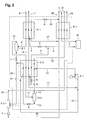
- FIGS. 1 and 2 The line drawn in dashed lines in FIGS. 1 and 2 encloses the area which is implemented in practice as a so-called cold box. Not shown in the Figures 1 and 2 are the or the dehydrogenation stages and compression and optionally pretreatment steps.
- FIG. 1 shows a process for the low-temperature decomposition of a feed stream consisting essentially of hydrogen, methane and C 3 hydrocarbons.
- the liquid hydrocarbon-rich feed stream fed to the dehydrogenation is fed via line 1 to the low-temperature decomposition or the heat exchanger E 3. In this, it is subcooled against process flows to be heated. This stream is withdrawn from the heat exchanger E 3 via line 2 and then divided into two partial streams 3 and 4. Both sub-streams 3 and 4 will be mixed below with a hydrogen-rich stream.
- the first partial stream 3 is first expanded in the valve a and then mixed in front of or in the heat exchanger E 1 with the hydrogen-rich stream in line 6.
- the second sub-stream 4 is further subcooled in the heat exchanger E 2, expanded in the valve b and then added to the hydrogen-rich gas stream in line 16 via line 5.
- This hydrogen-rich gas stream in lines 6 and 16 and its origin will be discussed in the following.
- the mixture stream from the hydrogen and hydrocarbon-rich stream withdrawn via line 7 from the heat exchanger E 1 is now fed to a one- or multi-stage dehydrogenation.
- the reaction product withdrawn from the dehydrogenation is then compressed in one or more stages, if appropriate a pretreatment such as. B. drying, HCl removal, etc., subjected and fed as an essentially consisting of hydrogen, methane and C 3 hydrocarbons via line 8 again the low-temperature decomposition or the heat exchanger E 1.
- This stream is cooled in the heat exchanger E 1 in heat exchange with process streams to be heated, partially condensed and then fed via line 9 to a first separator D 1.
- a hydrogen-rich gas fraction is drawn off via line 10, cooled in the heat exchanger E 2 and partially condensed and then fed via line 11 to a second separator D 2.
- a hydrogen-rich gas fraction is drawn off via line 10, cooled in the heat exchanger E 2 and partially condensed and then fed via line 11 to a second separator D 2.
- a C 3 hydrocarbon-rich liquid fraction is likewise drawn off from the bottom of the separator D 2 via line 12 and valve d and fed to the separator D 3.
- a hydrogen-rich gas fraction is drawn off via line 13 and heated in the heat exchanger E 2 against process streams to be cooled.
- the warmed gas fraction is fed to the heat exchanger E 3 via line 20, further heated in the latter against process streams to be cooled, and finally discharged via line 21 from the low-temperature decomposition.
- a partial flow of the hydrogen-rich gas fraction fed to the heat exchanger E 2 via line 13 is first fed via line 14 to a first expansion turbine T 1, via line 15 to a second expansion turbine T 2 and finally via line 16 to the heat exchanger E 2, before or immediately at the Feed into the heat exchanger E 2 is mixed with the hydrocarbon-rich liquid fraction in line 5.
- the energy released during the cold and work-relieving expansion of the hydrogen-rich gas fraction in the expansion turbines T 1 and T 2 can, for. B. can be used to generate electricity.
- a methane-rich gas stream is drawn off via line 23, which under certain circumstances can be returned to the compression and pretreatment steps.
- a C 3 hydrocarbon-rich product fraction is drawn off from the bottom of the separator D 3, pumped to the desired discharge pressure by means of the pump P and then fed to the heat exchanger E 3 via line 25. In this, the product fraction is warmed and evaporated against process streams to be cooled and then led out of the low-temperature decomposition via line 26.
- a partial stream of the product fraction supplied to the heat exchanger E 3 in the line 25 can be supplied to the heat exchanger E 1 via line 27 and used in the latter to provide cooling. From the heat exchanger E 1, this part of the product fraction is then admixed to the product fraction in line 26 again via control valve e and line 28.
- FIG. 2 shows a process which is largely identical to that of FIG. 1 and which is particularly suitable for the low-temperature decomposition of a stream essentially consisting of hydrogen, methane and C 4 -hydrocarbon. In the following, only the differences between the procedures of Figures 1 and 2 will be discussed.
- the hydrocarbon-rich stream which is fed via line 1 to the heat exchanger E 3 and is cooled and partially condensed in the latter, is then fed via line 1 'to an additional cooling unit R.
- a refrigerant such as. B. propylene or propane
- the C 4 hydrocarbon-rich liquid fraction drawn off at the bottom of the second separator D 2 via line 12 and valve d is now not fed directly to the third separator D 3. Instead, after admixing a partial stream of the hydrogen-rich stream which is introduced via line 18 and expanded in the expansion turbine T 1, it is first warmed in process exchanger E 2 against process streams to be cooled and partially evaporated. It is then added to the C 3 hydrocarbon-rich liquid fraction in line 30 and, together with this or via a separate line 31 shown in dash-dot lines, reaches third separator D 3.
- the methane-rich gas fraction drawn off at the top of the third separator D 3 via line 23 is now likewise exchanged in heat with process streams to be cooled passed through the heat exchanger E 3 and then withdrawn via line 24 from low-temperature decomposition.
- the heat exchanger E 1 is made up of only three process streams, namely the stream in line 8 or essentially consisting of hydrogen, methane and C 3 -, C 4 - or C 3 / C 4 hydrocarbons.
- the heat exchanger E 1 can thus be designed as simply and symmetrically as possible, so that both the theoretical calculations relating to the heat exchange and the implementation of the heat exchanger E 1 are considerably simplified.
Landscapes
- Engineering & Computer Science (AREA)
- Chemical & Material Sciences (AREA)
- Organic Chemistry (AREA)
- Thermal Sciences (AREA)
- General Engineering & Computer Science (AREA)
- Physics & Mathematics (AREA)
- Mechanical Engineering (AREA)
- Analytical Chemistry (AREA)
- Oil, Petroleum & Natural Gas (AREA)
- Water Supply & Treatment (AREA)
- Combustion & Propulsion (AREA)
- Inorganic Chemistry (AREA)
- Hydrogen, Water And Hydrids (AREA)
- Production Of Liquid Hydrocarbon Mixture For Refining Petroleum (AREA)
- Separation By Low-Temperature Treatments (AREA)
Applications Claiming Priority (2)
| Application Number | Priority Date | Filing Date | Title |
|---|---|---|---|
| DE19644106 | 1996-10-31 | ||
| DE19644106A DE19644106C1 (de) | 1996-10-31 | 1996-10-31 | Verfahren zur Tieftemperaturzerlegung eines im wesentlichen aus Wasserstoff, Methan und C¶3¶-, C¶4¶- oder C¶3¶/C¶4¶-Kohlenwasserstoffen bestehenden Stromes |
Publications (3)
| Publication Number | Publication Date |
|---|---|
| EP0840079A2 true EP0840079A2 (fr) | 1998-05-06 |
| EP0840079A3 EP0840079A3 (fr) | 1998-06-17 |
| EP0840079B1 EP0840079B1 (fr) | 2002-02-13 |
Family
ID=7809800
Family Applications (1)
| Application Number | Title | Priority Date | Filing Date |
|---|---|---|---|
| EP97117620A Expired - Lifetime EP0840079B1 (fr) | 1996-10-31 | 1997-10-10 | Procédé de séparation cryogénique de courants contenant de l'hydrogène, méthane, C3-, C4- ou C3/C4 hydrocarbures |
Country Status (3)
| Country | Link |
|---|---|
| EP (1) | EP0840079B1 (fr) |
| DE (2) | DE19644106C1 (fr) |
| ES (1) | ES2173362T3 (fr) |
Cited By (2)
| Publication number | Priority date | Publication date | Assignee | Title |
|---|---|---|---|---|
| RU2395046C2 (ru) * | 2005-05-25 | 2010-07-20 | Линде Акциенгезельшафт | Способ низкотемпературного разделения содержащего углеводороды массопотока |
| WO2019015806A1 (fr) * | 2017-07-20 | 2019-01-24 | Linde Aktiengesellschaft | Dispositif pour la décomposition du flux de produit d'une déshydrogénation d'alcane |
Families Citing this family (1)
| Publication number | Priority date | Publication date | Assignee | Title |
|---|---|---|---|---|
| DE10110462A1 (de) * | 2001-03-05 | 2002-09-12 | Linde Ag | Verfahren zur Tieftemperaturzerlegung eines im Wesentlichen aus Wasserstoff, Methan und C¶3¶-, C¶4¶- oder C¶3¶/C¶4¶-Kohlenwasserstoffen bestehenden Stromes |
Family Cites Families (2)
| Publication number | Priority date | Publication date | Assignee | Title |
|---|---|---|---|---|
| DE3626560A1 (de) * | 1986-08-06 | 1988-02-11 | Linde Ag | Verfahren zum abtrennen von c(pfeil abwaerts)4(pfeil abwaerts)-kohlenwasserstoffen aus einem gasgemisch |
| DE4235006A1 (de) * | 1992-10-16 | 1994-04-21 | Linde Ag | Verfahren zum Auftrennen eines im wesentlichen aus Wasserstoff, Methan und C¶3¶/C¶4¶-Kohlenwasserstoffen bestehenden Einsatzstromes |
-
1996
- 1996-10-31 DE DE19644106A patent/DE19644106C1/de not_active Expired - Fee Related
-
1997
- 1997-10-10 EP EP97117620A patent/EP0840079B1/fr not_active Expired - Lifetime
- 1997-10-10 ES ES97117620T patent/ES2173362T3/es not_active Expired - Lifetime
- 1997-10-10 DE DE59706371T patent/DE59706371D1/de not_active Expired - Fee Related
Cited By (2)
| Publication number | Priority date | Publication date | Assignee | Title |
|---|---|---|---|---|
| RU2395046C2 (ru) * | 2005-05-25 | 2010-07-20 | Линде Акциенгезельшафт | Способ низкотемпературного разделения содержащего углеводороды массопотока |
| WO2019015806A1 (fr) * | 2017-07-20 | 2019-01-24 | Linde Aktiengesellschaft | Dispositif pour la décomposition du flux de produit d'une déshydrogénation d'alcane |
Also Published As
| Publication number | Publication date |
|---|---|
| ES2173362T3 (es) | 2002-10-16 |
| EP0840079B1 (fr) | 2002-02-13 |
| DE19644106C1 (de) | 1998-01-29 |
| DE59706371D1 (de) | 2002-03-21 |
| EP0840079A3 (fr) | 1998-06-17 |
Similar Documents
| Publication | Publication Date | Title |
|---|---|---|
| DE68911179T2 (de) | Membranverfahren zur Rückgewinnung von flüssigen Kohlenwasserstoffen. | |
| DE69706186T2 (de) | Verfahren zur aufbereitung eines kohlenwasserstoffgases | |
| DE102007010032A1 (de) | Verfahren zum Abtrennen von Stickstoff aus verflüssigtem Erdgas | |
| DE69112024T2 (de) | Integriertes Verfahren zur Herstellung von Iso-Buten und Alkyl-Tert-Butylethern. | |
| DE69909143T2 (de) | Trennung von Kohlenstoffmonoxid aus stickstoffverschmutzten, Wasserstoff und Methan enthaltenden Gasgemischen | |
| DE102013013883A1 (de) | Kombinierte Abtrennung von Schwer- und Leichtsiedern aus Erdgas | |
| EP1729077B1 (fr) | Procédé et dispositif pour la récupération de produits d'un gaz de synthèse | |
| DE69405330T2 (de) | Selbstkühlendes Verfahren zur kryogenischen Fraktionierung und Reinigung von Gas, sowie Wärmetauscher zu seiner Durchführung | |
| DE2849344C2 (de) | Verfahren zur Abtrennung einer C↓2↓↓+↓-Kohlenwasserstoff-Fraktion aus Erdgas | |
| EP4179269A1 (fr) | Méthode et système servant à séparer un flux d'alimentation | |
| EP0626935B1 (fr) | Procede de separation d'un courant de charge constitue essentiellement d'hydrogene, de methane et d'hydrocarbures c 3/c 4 | |
| DE2155366C2 (de) | Verfahren zum Trennen einer vorwiegend Stickstoff und Methan enthaltenden hochgespannten Erdgas-Beschickungsmischung | |
| DE2854508A1 (de) | Verfahren zur tieftemperaturzerlegung eines gasgemisches | |
| EP2095047A2 (fr) | Procédé et dispositif d'obtention de produits provenant d'un gaz de synthèse | |
| EP0840079B1 (fr) | Procédé de séparation cryogénique de courants contenant de l'hydrogène, méthane, C3-, C4- ou C3/C4 hydrocarbures | |
| DE3113093A1 (de) | "kuehlverfahren zur rueckgewinnung oder fraktionierung eines hauptsaechlich aus butan und propan bestehenden, in erdgas enthaltenden gemisches" | |
| WO1999058917A1 (fr) | Procede et dispositif pour fluidifier un courant riche en hydrocarbures | |
| DE102017002737A1 (de) | Erzeugung eines Einsatzstroms für eine Alkan-Dehydrierung | |
| DE102007062213A1 (de) | Verfahren und Vorrichtung zur Gewinnung von Oxogas | |
| DE4417584A1 (de) | Verfahren zur Trennung von C¶2¶/C¶3¶-Kohlenwasserstoffen in Ethylenanlagen | |
| DE10005722A1 (de) | Verfahren zur Tieftemperaturzerlegung eines im wesentlichen aus Wasserstoff, Methan und C3-, C4- oder C3/C4-Kohlenwasserstoffen bestehenden Stromes | |
| DE102010049444A1 (de) | Verfahren zum Abkühlen eines kryogenen Gaszerlegers | |
| DE10110462A1 (de) | Verfahren zur Tieftemperaturzerlegung eines im Wesentlichen aus Wasserstoff, Methan und C¶3¶-, C¶4¶- oder C¶3¶/C¶4¶-Kohlenwasserstoffen bestehenden Stromes | |
| DE102005024106A1 (de) | Verfahren zur Tieftemperaturzerlegung eines kohlenwasserstoffhaltigen Stoffstromes | |
| WO2006094676A1 (fr) | Extraction d'helium dans des installations de gnl |
Legal Events
| Date | Code | Title | Description |
|---|---|---|---|
| PUAI | Public reference made under article 153(3) epc to a published international application that has entered the european phase |
Free format text: ORIGINAL CODE: 0009012 |
|
| PUAL | Search report despatched |
Free format text: ORIGINAL CODE: 0009013 |
|
| AK | Designated contracting states |
Kind code of ref document: A2 Designated state(s): BE DE ES NL |
|
| AX | Request for extension of the european patent |
Free format text: AL;LT;LV;RO;SI |
|
| AK | Designated contracting states |
Kind code of ref document: A3 Designated state(s): AT BE CH DE DK ES FI FR GB GR IE IT LI LU MC NL PT SE |
|
| AX | Request for extension of the european patent |
Free format text: AL;LT;LV;RO;SI |
|
| 17P | Request for examination filed |
Effective date: 19980518 |
|
| AKX | Designation fees paid | ||
| RBV | Designated contracting states (corrected) | ||
| RBV | Designated contracting states (corrected) |
Designated state(s): BE DE ES NL |
|
| 17Q | First examination report despatched |
Effective date: 20000616 |
|
| GRAG | Despatch of communication of intention to grant |
Free format text: ORIGINAL CODE: EPIDOS AGRA |
|
| GRAG | Despatch of communication of intention to grant |
Free format text: ORIGINAL CODE: EPIDOS AGRA |
|
| GRAH | Despatch of communication of intention to grant a patent |
Free format text: ORIGINAL CODE: EPIDOS IGRA |
|
| GRAH | Despatch of communication of intention to grant a patent |
Free format text: ORIGINAL CODE: EPIDOS IGRA |
|
| GRAA | (expected) grant |
Free format text: ORIGINAL CODE: 0009210 |
|
| AK | Designated contracting states |
Kind code of ref document: B1 Designated state(s): BE DE ES NL |
|
| REF | Corresponds to: |
Ref document number: 59706371 Country of ref document: DE Date of ref document: 20020321 |
|
| PG25 | Lapsed in a contracting state [announced via postgrant information from national office to epo] |
Ref country code: ES Free format text: LAPSE BECAUSE OF NON-PAYMENT OF DUE FEES Effective date: 20021011 |
|
| PGFP | Annual fee paid to national office [announced via postgrant information from national office to epo] |
Ref country code: DE Payment date: 20021011 Year of fee payment: 6 |
|
| REG | Reference to a national code |
Ref country code: ES Ref legal event code: FG2A Ref document number: 2173362 Country of ref document: ES Kind code of ref document: T3 |
|
| PG25 | Lapsed in a contracting state [announced via postgrant information from national office to epo] |
Ref country code: BE Free format text: LAPSE BECAUSE OF NON-PAYMENT OF DUE FEES Effective date: 20021031 |
|
| PLBE | No opposition filed within time limit |
Free format text: ORIGINAL CODE: 0009261 |
|
| STAA | Information on the status of an ep patent application or granted ep patent |
Free format text: STATUS: NO OPPOSITION FILED WITHIN TIME LIMIT |
|
| 26N | No opposition filed |
Effective date: 20021114 |
|
| BERE | Be: lapsed |
Owner name: *LINDE A.G. Effective date: 20021031 |
|
| PG25 | Lapsed in a contracting state [announced via postgrant information from national office to epo] |
Ref country code: NL Free format text: LAPSE BECAUSE OF NON-PAYMENT OF DUE FEES Effective date: 20030501 |
|
| NLV4 | Nl: lapsed or anulled due to non-payment of the annual fee |
Effective date: 20030501 |
|
| PG25 | Lapsed in a contracting state [announced via postgrant information from national office to epo] |
Ref country code: DE Free format text: LAPSE BECAUSE OF NON-PAYMENT OF DUE FEES Effective date: 20040501 |
|
| REG | Reference to a national code |
Ref country code: ES Ref legal event code: FD2A Effective date: 20031112 |