EP0841103A2 - Dispositif pour la décontamination des courants d'eaux souterraines - Google Patents
Dispositif pour la décontamination des courants d'eaux souterraines Download PDFInfo
- Publication number
- EP0841103A2 EP0841103A2 EP97890217A EP97890217A EP0841103A2 EP 0841103 A2 EP0841103 A2 EP 0841103A2 EP 97890217 A EP97890217 A EP 97890217A EP 97890217 A EP97890217 A EP 97890217A EP 0841103 A2 EP0841103 A2 EP 0841103A2
- Authority
- EP
- European Patent Office
- Prior art keywords
- groundwater
- decontamination
- perforated
- wall
- flow
- Prior art date
- Legal status (The legal status is an assumption and is not a legal conclusion. Google has not performed a legal analysis and makes no representation as to the accuracy of the status listed.)
- Granted
Links
Images

Classifications
-
- B—PERFORMING OPERATIONS; TRANSPORTING
- B09—DISPOSAL OF SOLID WASTE; RECLAMATION OF CONTAMINATED SOIL
- B09C—RECLAMATION OF CONTAMINATED SOIL
- B09C1/00—Reclamation of contaminated soil
- B09C1/002—Reclamation of contaminated soil involving in-situ ground water treatment
-
- B—PERFORMING OPERATIONS; TRANSPORTING
- B09—DISPOSAL OF SOLID WASTE; RECLAMATION OF CONTAMINATED SOIL
- B09C—RECLAMATION OF CONTAMINATED SOIL
- B09C2101/00—In situ
Definitions
- the invention has a device for decontaminating groundwater flows with an uninterrupted, essentially fluid-tight wall, which extends from a lower groundwater horizon to an upper groundwater horizon and has at least one area which is specifically water-permeable.
- Groundwater flows serve to supply water to areas used in particular in agriculture.
- One method for removing volatile pollutants is to draw off air above the water table.
- the air enriched with the volatile pollutant is sucked out, and unloaded air from the earth's surface takes its place, which then opens up Due to the vapor pressure of the pollutants is enriched with the same.
- Hiebei on the one hand there is a large amount of energy due to the suction of the air and on the other hand there is a risk that the groundwater flow will not be adequately decontaminated, so that either a contaminated groundwater flow will continue to flow or additional suction points will have to be provided.
- Another procedure for treating the groundwater is that the natural flow of the groundwater flow is used and the groundwater is passed through treatment beds which are arranged in a stationary manner. For this, it is necessary that the entire groundwater flow, which is contaminated, is fed to a treatment. It is possible to provide a wall across the entire contaminated groundwater flow that absorbs or converts the pollutants when the groundwater flow passes. If the contamination of the groundwater is only minor and the groundwater flow is small in terms of quantity, an essentially fluid-tight wall can be provided, in which areas are provided which are permeable to the groundwater flow and at the same time have agents for absorbing or converting the pollutants in the groundwater flow.
- DE-44 25 061-C discloses a permeable treatment bed for cleaning contaminated groundwater flows.
- a wall is built up across the groundwater flow with building blocks.
- These building blocks have wall elements which are arranged at a distance from one another and are connected via a spacer element. These modules are also staggered.
- the decontamination agent which is introduced into the cavity enclosed by these is in loose form. Separate devices are required to remove the decontaminant, which absorb both the groundwater and the decontaminant from the cavity.
- the walls of the wall elements can also be perforated, although access to the contaminated groundwater flow should take place via the design-related target openings between the individual building blocks.
- the exchange of the decontamination agents requires that the containers in which they are arranged are exchanged, so that, on the one hand, the container connects directly to the contaminated soil, the same falls, or, if an additional container is provided in the container, a groundwater flow can occur between the two containers, which is significantly larger in quantity than that caused by the decontamination agent flowing groundwater so that the desired decontamination of the groundwater does not take place to the required extent.
- the decontamination agent is surrounded by a geotextile, as a result of which the amount of groundwater flowing through the decontamination agent is additionally limited due to the flow resistance to the side stream.
- the present invention has for its object to provide a device for decontaminating groundwater flows, with which it can be ensured that the entire groundwater flow can be acted upon uniformly with a decontamination agent and no flow paths of the groundwater can exist, which the same without contact with the decontamination agent through the Let the wall pass through.
- the device according to the invention for decontaminating groundwater flows with an uninterrupted, essentially fluid-tight wall which extends from a lower groundwater horizon to an upper groundwater horizon and has at least one area which is specifically water-permeable in the direction of the groundwater flow and has perforated walls arranged transversely to the groundwater flow Decontamination room for entry and exit of the groundwater flow, in which decontamination agent for the groundwater, for. B. adsorbents, agents or the like.
- the decontamination agents are arranged, and extends substantially to the surface of the earth and is optionally completed with at least one cover element upwards, consists essentially in the fact that the decontamination agents are arranged in at least one sack made of geotextiles, which is closed at the bottom, the geotextiles lying directly against at least the first perforated, optionally coated wall, seen in the direction of the groundwater flow, and the sack which holds the decontamination agents absorbs and carries, together with the decontamination agent from the decontamination room with the perforated walls is removable.
- the first wall seen in the direction of flow, which is placed transversely to a contaminated groundwater stream, which extends over the entire height of the groundwater stream and is sealed above the subsurface, ensures that no bypass occurs, but the entire contaminated groundwater stream is detected.
- the transverse extension of the wall must be such that only non-contaminated groundwater flows to both lateral ends of the wall.
- the wall can have rooms with perforated walls, in which the decontamination means are arranged, either in their entirety or only at certain points. Since these spaces extend to the surface of the earth, the decontamination agents can be removed, for example when they are exhausted.
- the geotextiles being in direct contact with at least the first perforated wall, as seen in the direction of flow, it is ensured that the groundwater flow through the perforated wall into the geotextiles and then into the decontamination agent then again into the geotextiles and out of the room through the further perforated wall.
- the fact that the geotextiles are in direct contact with the perforated wall means that no shunt currents can occur and then untreated groundwater can pass through the room without having any significant contact with the decontamination agents.
- the decontamination agents can be exchanged with the simplest of means, since it is only necessary to lift the sack out of the room and it immediately afterwards the room can be filled with a new bag of decontamination agent.
- the used decontamination agent can then be processed either on site or in its own regeneration facility.
- the geotextiles lying against the perforated walls are connected to one another by tapes, there is a so-called two-wall fabric, with a predetermined shape in the sack when it is filled with decontamination agent, so that a particularly tight fit of the geotextiles on the perforated walls is ensured can be.
- the perforations of the wall are additionally covered with a geotextile which is arranged outside the decontamination room, it can be prevented that finely divided sludges or the like penetrate into the room and thus undesirably increase the flow resistance of the room.
- the perforated walls are formed with perforated wooden plates, the perforated can be finished after the decontamination of the groundwater and the decontamination device have been dismantled Walls remain in the ground after the decontamination agent has been removed, since they do not represent a special flow barrier and, at the same time, the greater resistance to flow, which still remains slightly, is reduced over time by rotting the wood.
- the decontamination room for receiving the decontamination agent is constructed with perforated wall elements arranged parallel to one another, it does not matter in which area a groundwater flow enters the room, a predetermined uniform residence time of the groundwater flow in the decontamination agent is guaranteed.
- the decontamination agent can be exchanged particularly easily and effectively, and samples of the decontamination agent can also be taken from different depths.
- the decontamination room is sealed against surface water, it is prevented that the contaminants in the groundwater flow of the decontamination room are diluted, which prevents effective decontamination of the groundwater flow.
- a hoist can also be used to which can only lift less weight, an exchange of the decontamination agent can be carried out, furthermore the opening from which the bags can be removed does not have to be excessively large.
- the sacks are only slackly filled with the decontamination agent, it can easily be ensured that the geotextiles fit well against one another and against the perforated walls, since a slackly filled sack has only little resistance to a change in shape.
- geotextiles a random fiber fleece made of organic fibers, e.g. B. polyethylene or polypropylene, so a particularly long life of the bags is guaranteed, which can also fall back on particularly proven substances.
- organic fibers e.g. B. polyethylene or polypropylene
- the perforated wall 1 shown in FIG. 1 is constructed with perforated wooden panels 2.
- the circular perforations have a diameter of 3.0 cm.
- other perforated elements such as expanded metal, plastic mesh, perforated sheets can also be used.
- the perforated wall 1 with a height of 400 cm is sealed over concrete 3 in the area 4 no longer carrying groundwater and the upper area 5, which is also free of groundwater. Bentonite is also particularly suitable for sealing.
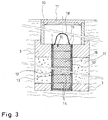
- two perforated walls 1 are arranged in parallel at a distance of 50 cm from one another, thereby forming a decontamination space 6 which is at a distance of 480 cm from one another with respect to the ground and thus the groundwater flow via side walls 7 are connected to the perforated walls 1 in a liquid-tight manner.
- Fluid-tight walls 8 are arranged transversely to the direction of the groundwater flow, which is indicated by arrow a. These fluid-tight walls 8 are connected in a liquid-tight manner to the perforated wall 1 which is first acted upon in the flow direction.
- the fluid-tight walls are formed by sheet piling.
- sheet piles 9 made of steel are placed. Then the space is dredged and the perforated wooden panels 2 with the side walls 7 are placed. Concrete rings 10 are placed on top, which as Serve manhole and are closed by a lid 11. The surface and lids can be driven on without special precautions. This prevents surface water from entering the decontamination room 6.
- the space between perforated wooden panels 2 and the sheet piles 9 can be provided for sealing with concrete or bentonite on its sole, whereupon a layer of gravel 17, u. is introduced as a filter gravel, on which a layer of concrete or bentonite 3 is then placed again for further sealing of the perforated wall 1. Then, after the concrete has hardened, the sheet piling 9 can be pulled so that the groundwater flow is conducted via the fluid-tight walls 8 to the decontamination room 6, in which a decontamination agent 16 is arranged.
- the perforated walls 1 are outside with a geotextile 12, u. between a random fiber fleece made of polypropylene fibers.
- a pebble layer 17 then clings to the random fiber fleece, so that both the inflow of groundwater into the decontamination space 6 and the outflow thereof with a uniform flow resistance are particularly well guaranteed.
- the sealing of the perforated walls with respect to the areas not leading to groundwater is also particularly clear.
- a geotextile u.
- a so-called two-wall fabric in which a predetermined structure is ensured via the belts 14 even when the decontamination agent is filled with slack.
- a sack 15 closed at the bottom is formed by this geotextile, which ensures that the sack 15 fits snugly against the perforated walls, thus preventing any side streams of groundwater outside the decontamination agent.
- a Decontamination agent 16 usually a granular substance, arranged.
- Bands 18 are arranged in a plurality on the bags, e.g. B.
- Activated carbon is particularly suitable for decontaminating groundwater flows which are contaminated, for example, with hydrocarbons, chlorinated or fluorinated hydrocarbons, dyes or the like. If this activated carbon is then loaded with the impurities, it can be removed together with the sack and regenerated either on site or at a suitable location. A sack with decontamination agent can then be inserted again through the manhole.
- chemically active agents e.g. B. iron filings for dechlorination of perchlorethylene, ion exchange resins, biologically active substances
- the wall as a whole can also be designed as a decontamination room.
- probes can be placed behind the wall in the direction of flow in order to take groundwater samples for analysis.
Landscapes
- Life Sciences & Earth Sciences (AREA)
- Engineering & Computer Science (AREA)
- Hydrology & Water Resources (AREA)
- Water Supply & Treatment (AREA)
- Soil Sciences (AREA)
- Environmental & Geological Engineering (AREA)
- Processing Of Solid Wastes (AREA)
- Water Treatment By Sorption (AREA)
- Solid-Sorbent Or Filter-Aiding Compositions (AREA)
- Treatment Of Water By Oxidation Or Reduction (AREA)
- Sewage (AREA)
Applications Claiming Priority (3)
| Application Number | Priority Date | Filing Date | Title |
|---|---|---|---|
| AT1979/96 | 1996-11-12 | ||
| AT197996 | 1996-11-12 | ||
| AT0197996A AT404608B (de) | 1996-11-12 | 1996-11-12 | Vorrichtung zum dekontaminieren von grundwasserströmen |
Publications (3)
| Publication Number | Publication Date |
|---|---|
| EP0841103A2 true EP0841103A2 (fr) | 1998-05-13 |
| EP0841103A3 EP0841103A3 (fr) | 1998-05-27 |
| EP0841103B1 EP0841103B1 (fr) | 2001-03-21 |
Family
ID=3525214
Family Applications (1)
| Application Number | Title | Priority Date | Filing Date |
|---|---|---|---|
| EP97890217A Expired - Lifetime EP0841103B1 (fr) | 1996-11-12 | 1997-11-04 | Dispositif pour la décontamination des courants d'eaux souterraines |
Country Status (6)
| Country | Link |
|---|---|
| EP (1) | EP0841103B1 (fr) |
| AT (1) | AT404608B (fr) |
| DE (1) | DE59703175D1 (fr) |
| DK (1) | DK0841103T3 (fr) |
| ES (1) | ES2156629T3 (fr) |
| HU (1) | HU220739B1 (fr) |
Family Cites Families (5)
| Publication number | Priority date | Publication date | Assignee | Title |
|---|---|---|---|---|
| GB9208822D0 (en) * | 1992-04-23 | 1992-06-10 | Univ Waterloo | System for treating contaminated groundwater |
| US5403491A (en) * | 1993-07-19 | 1995-04-04 | Holland; Herbert W. | Monitor well hydrocarbon absorber and solidifier |
| GB2289688B (en) * | 1994-05-27 | 1998-11-11 | Fibertech Group Inc | Articles and methods for sorbing,filtering and disposing of fluid waste |
| DE4425061C1 (de) * | 1994-07-15 | 1995-10-26 | Wci Umwelttechnik Gmbh | Permeables Behandlungsbett zur Reinigung kontaminierter Grundwasserströme in situ |
| DE4431331A1 (de) * | 1994-09-02 | 1996-03-07 | Weber Ingenieure Pforzheim Gmb | Verfahren und Einrichtung zur Reinigung von mit Schadstoff kontaminiertem Grundwasser |
-
1996
- 1996-11-12 AT AT0197996A patent/AT404608B/de not_active IP Right Cessation
-
1997
- 1997-10-17 HU HU9701662A patent/HU220739B1/hu not_active IP Right Cessation
- 1997-11-04 EP EP97890217A patent/EP0841103B1/fr not_active Expired - Lifetime
- 1997-11-04 DK DK97890217T patent/DK0841103T3/da active
- 1997-11-04 ES ES97890217T patent/ES2156629T3/es not_active Expired - Lifetime
- 1997-11-04 DE DE59703175T patent/DE59703175D1/de not_active Expired - Fee Related
Also Published As
| Publication number | Publication date |
|---|---|
| EP0841103B1 (fr) | 2001-03-21 |
| ATA197996A (de) | 1998-05-15 |
| AT404608B (de) | 1999-01-25 |
| HU9701662D0 (en) | 1997-12-29 |
| ES2156629T3 (es) | 2001-07-01 |
| DK0841103T3 (da) | 2001-08-06 |
| DE59703175D1 (de) | 2001-04-26 |
| HUP9701662A2 (hu) | 1999-11-29 |
| HUP9701662A3 (en) | 1999-12-28 |
| HU220739B1 (hu) | 2002-05-28 |
| EP0841103A3 (fr) | 1998-05-27 |
Similar Documents
| Publication | Publication Date | Title |
|---|---|---|
| DE2726012C2 (fr) | ||
| DE69304048T2 (de) | Anordnung zur behandlung von verunreinigtem grundwasser | |
| DE3741001A1 (de) | Verfahren, provisorische stuetzvorrichtung und wasser sammelnder und ableitender block zum bauen von sickeranlagen, hauptsaechlich von tiefsickeranlagen, austrocknungsrippen bzw. stuetzrippen und aehnlichen bauobjekten | |
| DE3419163A1 (de) | Verfahren und vorrichtung zur abdichtung gegen deponie-sickerwasser | |
| DE19622159A1 (de) | Vorrichtung zur Boden- und Grundwassersanierung und Verfahren zum Erstellen und Betreiben einer solchen Vorrichtung | |
| DE4425061C1 (de) | Permeables Behandlungsbett zur Reinigung kontaminierter Grundwasserströme in situ | |
| DE4431331A1 (de) | Verfahren und Einrichtung zur Reinigung von mit Schadstoff kontaminiertem Grundwasser | |
| DD300411A5 (de) | Verfahren zum dekontaminieren eines schadstoffbelasteten erdbodenbereiches | |
| DE4319992C2 (de) | Verfahren zur Behandlung von kontaminierten Böden und Vorrichtung zur Durchführung des Verfahrens | |
| DE3616380C2 (de) | Vorrichtung mit mindestens einer Dichtungsbahn zum Abdichten von Lagerstätten | |
| AT404608B (de) | Vorrichtung zum dekontaminieren von grundwasserströmen | |
| DE4400183A1 (de) | Drän-Entwässerungselement für Abfalldeponien und sonstige Verwendung im Erd-, Grund- und Wasserbau | |
| DE19715038B4 (de) | Wasserdurchlässige Filterwand und Verfahren zur Herstellung der Filterwand | |
| DE69212318T2 (de) | Unterirdische verseuchungsverhuetende barriere | |
| DE69704754T2 (de) | System zur Behandlung und Abführung von Grundwasser aus einem verunreinigten und von der Umgebung durch eine Dichtwand im Boden isolierten Standort | |
| DE3937593C2 (de) | Verfahren zur biologischen in-situ-Reinigung | |
| AT411358B (de) | Vorrichtung zum dekontaminieren von grundwasserströmen sowie verfahren zur herstellungeiner derartigen vorrichtung | |
| DE3729653A1 (de) | Verfahren zum vorsorglichen oder nachtraeglichen schutz des um eine deponie anstehenden erdreichs gegen aus der deponie austretende schadfluessigkeit | |
| DE4410585C2 (de) | Verfahren zum Entfernen von Schwermetallen aus Erdboden | |
| DE10004063C1 (de) | Deponie für ein Material mit einem hohen Feuchtigkeitsgehalt sowie Verfahren zum Betreiben einer Deponie | |
| DE19647901C2 (de) | Verfahren zur Verhinderung oder Verminderung des Austrages von Schadstoffen aus Deponien | |
| DE4026049C1 (en) | Rubbish dump drainage system - uses slot trenches by roadways feeding pipes lying on impermeable layer | |
| DE19859862B4 (de) | Verfahren und Vorrichtung zur Grundwassersanierung mittels Dichtwand-Heber-Reaktor | |
| WO2025056197A1 (fr) | Lit de décharge multicouche pour filtrer le lixiviat de décharge | |
| DE3720917A1 (de) | Vorrichtung zum entgiften grosser wassermengen mit hilfe von aktivkohle |
Legal Events
| Date | Code | Title | Description |
|---|---|---|---|
| PUAI | Public reference made under article 153(3) epc to a published international application that has entered the european phase |
Free format text: ORIGINAL CODE: 0009012 |
|
| PUAL | Search report despatched |
Free format text: ORIGINAL CODE: 0009013 |
|
| AK | Designated contracting states |
Kind code of ref document: A2 Designated state(s): BE CH DE DK ES IT LI NL |
|
| AX | Request for extension of the european patent |
Free format text: AL;LT;LV;MK;RO;SI |
|
| AK | Designated contracting states |
Kind code of ref document: A3 Designated state(s): AT BE CH DE DK ES FI FR GB GR IE IT LI LU MC NL PT SE |
|
| AX | Request for extension of the european patent |
Free format text: AL;LT;LV;MK;RO;SI |
|
| 17P | Request for examination filed |
Effective date: 19981001 |
|
| AKX | Designation fees paid |
Free format text: BE CH DE DK ES IT LI NL |
|
| RBV | Designated contracting states (corrected) |
Designated state(s): BE CH DE DK ES IT LI NL |
|
| GRAG | Despatch of communication of intention to grant |
Free format text: ORIGINAL CODE: EPIDOS AGRA |
|
| 17Q | First examination report despatched |
Effective date: 20000523 |
|
| GRAG | Despatch of communication of intention to grant |
Free format text: ORIGINAL CODE: EPIDOS AGRA |
|
| GRAH | Despatch of communication of intention to grant a patent |
Free format text: ORIGINAL CODE: EPIDOS IGRA |
|
| RAP1 | Party data changed (applicant data changed or rights of an application transferred) |
Owner name: PORR UMWELTTECHNIK GMBH |
|
| GRAH | Despatch of communication of intention to grant a patent |
Free format text: ORIGINAL CODE: EPIDOS IGRA |
|
| GRAA | (expected) grant |
Free format text: ORIGINAL CODE: 0009210 |
|
| AK | Designated contracting states |
Kind code of ref document: B1 Designated state(s): BE CH DE DK ES IT LI NL |
|
| REG | Reference to a national code |
Ref country code: CH Ref legal event code: EP |
|
| REF | Corresponds to: |
Ref document number: 59703175 Country of ref document: DE Date of ref document: 20010426 |
|
| REG | Reference to a national code |
Ref country code: CH Ref legal event code: NV Representative=s name: BRAUN & PARTNER PATENT-, MARKEN-, RECHTSANWAELTE |
|
| ITF | It: translation for a ep patent filed | ||
| REG | Reference to a national code |
Ref country code: ES Ref legal event code: FG2A Ref document number: 2156629 Country of ref document: ES Kind code of ref document: T3 |
|
| REG | Reference to a national code |
Ref country code: DK Ref legal event code: T3 |
|
| EN | Fr: translation not filed | ||
| PG25 | Lapsed in a contracting state [announced via postgrant information from national office to epo] |
Ref country code: DK Free format text: LAPSE BECAUSE OF NON-PAYMENT OF DUE FEES Effective date: 20011104 |
|
| PG25 | Lapsed in a contracting state [announced via postgrant information from national office to epo] |
Ref country code: BE Free format text: LAPSE BECAUSE OF NON-PAYMENT OF DUE FEES Effective date: 20011130 |
|
| PLBE | No opposition filed within time limit |
Free format text: ORIGINAL CODE: 0009261 |
|
| STAA | Information on the status of an ep patent application or granted ep patent |
Free format text: STATUS: NO OPPOSITION FILED WITHIN TIME LIMIT |
|
| 26N | No opposition filed | ||
| BERE | Be: lapsed |
Owner name: PORR UMWELTTECHNIK G.M.B.H. Effective date: 20011130 |
|
| PG25 | Lapsed in a contracting state [announced via postgrant information from national office to epo] |
Ref country code: NL Free format text: LAPSE BECAUSE OF NON-PAYMENT OF DUE FEES Effective date: 20020601 |
|
| REG | Reference to a national code |
Ref country code: DK Ref legal event code: EBP |
|
| NLV4 | Nl: lapsed or anulled due to non-payment of the annual fee |
Effective date: 20020601 |
|
| PGFP | Annual fee paid to national office [announced via postgrant information from national office to epo] |
Ref country code: ES Payment date: 20051031 Year of fee payment: 9 |
|
| PGFP | Annual fee paid to national office [announced via postgrant information from national office to epo] |
Ref country code: IT Payment date: 20061130 Year of fee payment: 10 Ref country code: DE Payment date: 20061130 Year of fee payment: 10 Ref country code: CH Payment date: 20061130 Year of fee payment: 10 |
|
| REG | Reference to a national code |
Ref country code: ES Ref legal event code: FD2A Effective date: 20061106 |
|
| PG25 | Lapsed in a contracting state [announced via postgrant information from national office to epo] |
Ref country code: ES Free format text: LAPSE BECAUSE OF NON-PAYMENT OF DUE FEES Effective date: 20061106 |
|
| PG25 | Lapsed in a contracting state [announced via postgrant information from national office to epo] |
Ref country code: LI Free format text: LAPSE BECAUSE OF NON-PAYMENT OF DUE FEES Effective date: 20071130 Ref country code: CH Free format text: LAPSE BECAUSE OF NON-PAYMENT OF DUE FEES Effective date: 20071130 |
|
| REG | Reference to a national code |
Ref country code: CH Ref legal event code: PL |
|
| PG25 | Lapsed in a contracting state [announced via postgrant information from national office to epo] |
Ref country code: DE Free format text: LAPSE BECAUSE OF NON-PAYMENT OF DUE FEES Effective date: 20080603 |
|
| PG25 | Lapsed in a contracting state [announced via postgrant information from national office to epo] |
Ref country code: IT Free format text: LAPSE BECAUSE OF NON-PAYMENT OF DUE FEES Effective date: 20071104 |