EP0841308A1 - Wärmedämmung und ihre Herstellung - Google Patents
Wärmedämmung und ihre Herstellung Download PDFInfo
- Publication number
- EP0841308A1 EP0841308A1 EP97119712A EP97119712A EP0841308A1 EP 0841308 A1 EP0841308 A1 EP 0841308A1 EP 97119712 A EP97119712 A EP 97119712A EP 97119712 A EP97119712 A EP 97119712A EP 0841308 A1 EP0841308 A1 EP 0841308A1
- Authority
- EP
- European Patent Office
- Prior art keywords
- insulation
- thermal insulation
- range
- composite
- hectorite clay
- Prior art date
- Legal status (The legal status is an assumption and is not a legal conclusion. Google has not performed a legal analysis and makes no representation as to the accuracy of the status listed.)
- Withdrawn
Links
- 238000009413 insulation Methods 0.000 title claims abstract description 49
- 238000002360 preparation method Methods 0.000 title description 3
- 239000004927 clay Substances 0.000 claims abstract description 77
- 239000004964 aerogel Substances 0.000 claims abstract description 49
- KWLMIXQRALPRBC-UHFFFAOYSA-L hectorite Chemical compound [Li+].[OH-].[OH-].[Na+].[Mg+2].O1[Si]2([O-])O[Si]1([O-])O[Si]([O-])(O1)O[Si]1([O-])O2 KWLMIXQRALPRBC-UHFFFAOYSA-L 0.000 claims abstract description 47
- 229910000271 hectorite Inorganic materials 0.000 claims abstract description 40
- 239000002131 composite material Substances 0.000 claims abstract description 38
- 229920002134 Carboxymethyl cellulose Polymers 0.000 claims abstract description 20
- 235000010948 carboxy methyl cellulose Nutrition 0.000 claims abstract description 20
- XLYOFNOQVPJJNP-UHFFFAOYSA-N water Substances O XLYOFNOQVPJJNP-UHFFFAOYSA-N 0.000 claims abstract description 20
- 239000001768 carboxy methyl cellulose Substances 0.000 claims abstract description 17
- 239000008112 carboxymethyl-cellulose Substances 0.000 claims abstract description 17
- 229940105329 carboxymethylcellulose Drugs 0.000 claims abstract description 17
- 239000002245 particle Substances 0.000 claims abstract description 17
- 238000002156 mixing Methods 0.000 claims abstract description 7
- 238000001035 drying Methods 0.000 claims abstract description 6
- 239000000203 mixture Substances 0.000 claims description 42
- 230000013011 mating Effects 0.000 claims description 17
- 239000000835 fiber Substances 0.000 claims description 16
- VYPSYNLAJGMNEJ-UHFFFAOYSA-N Silicium dioxide Chemical compound O=[Si]=O VYPSYNLAJGMNEJ-UHFFFAOYSA-N 0.000 claims description 10
- 239000011490 mineral wool Substances 0.000 claims description 9
- 239000011230 binding agent Substances 0.000 claims description 7
- 239000000463 material Substances 0.000 claims description 7
- 238000000034 method Methods 0.000 claims description 7
- 239000004965 Silica aerogel Substances 0.000 claims description 5
- 239000003063 flame retardant Substances 0.000 claims description 5
- 229920002678 cellulose Polymers 0.000 claims description 4
- 239000001913 cellulose Substances 0.000 claims description 4
- 239000000919 ceramic Substances 0.000 claims description 3
- 239000011152 fibreglass Substances 0.000 claims description 3
- 239000010451 perlite Substances 0.000 claims description 3
- 235000019362 perlite Nutrition 0.000 claims description 3
- 239000010456 wollastonite Substances 0.000 claims description 3
- 229910052882 wollastonite Inorganic materials 0.000 claims description 3
- 239000000945 filler Substances 0.000 claims description 2
- 239000003605 opacifier Substances 0.000 claims description 2
- 239000000049 pigment Substances 0.000 claims description 2
- 239000004094 surface-active agent Substances 0.000 claims description 2
- 239000004615 ingredient Substances 0.000 abstract description 3
- 238000000465 moulding Methods 0.000 abstract description 2
- 239000000047 product Substances 0.000 description 24
- 239000000654 additive Substances 0.000 description 7
- 239000000853 adhesive Substances 0.000 description 7
- 230000001070 adhesive effect Effects 0.000 description 7
- 239000007787 solid Substances 0.000 description 6
- 239000006185 dispersion Substances 0.000 description 5
- 230000000996 additive effect Effects 0.000 description 4
- 239000000843 powder Substances 0.000 description 4
- 239000000499 gel Substances 0.000 description 3
- 238000009434 installation Methods 0.000 description 2
- 230000001681 protective effect Effects 0.000 description 2
- 239000000377 silicon dioxide Substances 0.000 description 2
- 229910021647 smectite Inorganic materials 0.000 description 2
- 239000000779 smoke Substances 0.000 description 2
- 230000008961 swelling Effects 0.000 description 2
- BPQQTUXANYXVAA-UHFFFAOYSA-N Orthosilicate Chemical compound [O-][Si]([O-])([O-])[O-] BPQQTUXANYXVAA-UHFFFAOYSA-N 0.000 description 1
- 239000004820 Pressure-sensitive adhesive Substances 0.000 description 1
- BOTDANWDWHJENH-UHFFFAOYSA-N Tetraethyl orthosilicate Chemical compound CCO[Si](OCC)(OCC)OCC BOTDANWDWHJENH-UHFFFAOYSA-N 0.000 description 1
- 229910000323 aluminium silicate Inorganic materials 0.000 description 1
- FUFJGUQYACFECW-UHFFFAOYSA-L calcium hydrogenphosphate Chemical compound [Ca+2].OP([O-])([O-])=O FUFJGUQYACFECW-UHFFFAOYSA-L 0.000 description 1
- 239000007795 chemical reaction product Substances 0.000 description 1
- 238000005253 cladding Methods 0.000 description 1
- 239000002734 clay mineral Substances 0.000 description 1
- 239000011248 coating agent Substances 0.000 description 1
- 238000000576 coating method Methods 0.000 description 1
- 239000008119 colloidal silica Substances 0.000 description 1
- 150000001875 compounds Chemical class 0.000 description 1
- 239000013078 crystal Substances 0.000 description 1
- 230000001627 detrimental effect Effects 0.000 description 1
- GUJOJGAPFQRJSV-UHFFFAOYSA-N dialuminum;dioxosilane;oxygen(2-);hydrate Chemical compound O.[O-2].[O-2].[O-2].[Al+3].[Al+3].O=[Si]=O.O=[Si]=O.O=[Si]=O.O=[Si]=O GUJOJGAPFQRJSV-UHFFFAOYSA-N 0.000 description 1
- 239000000428 dust Substances 0.000 description 1
- 238000004134 energy conservation Methods 0.000 description 1
- -1 for example Chemical class 0.000 description 1
- NLYAJNPCOHFWQQ-UHFFFAOYSA-N kaolin Chemical group O.O.O=[Al]O[Si](=O)O[Si](=O)O[Al]=O NLYAJNPCOHFWQQ-UHFFFAOYSA-N 0.000 description 1
- 239000007788 liquid Substances 0.000 description 1
- 229910052901 montmorillonite Inorganic materials 0.000 description 1
- 231100000252 nontoxic Toxicity 0.000 description 1
- 230000003000 nontoxic effect Effects 0.000 description 1
- 239000011368 organic material Substances 0.000 description 1
- 230000035939 shock Effects 0.000 description 1
Images

Classifications
-
- F—MECHANICAL ENGINEERING; LIGHTING; HEATING; WEAPONS; BLASTING
- F16—ENGINEERING ELEMENTS AND UNITS; GENERAL MEASURES FOR PRODUCING AND MAINTAINING EFFECTIVE FUNCTIONING OF MACHINES OR INSTALLATIONS; THERMAL INSULATION IN GENERAL
- F16L—PIPES; JOINTS OR FITTINGS FOR PIPES; SUPPORTS FOR PIPES, CABLES OR PROTECTIVE TUBING; MEANS FOR THERMAL INSULATION IN GENERAL
- F16L59/00—Thermal insulation in general
- F16L59/02—Shape or form of insulating materials, with or without coverings integral with the insulating materials
- F16L59/021—Shape or form of insulating materials, with or without coverings integral with the insulating materials comprising a single piece or sleeve, e.g. split sleeves; consisting of two half sleeves; comprising more than two segments
- F16L59/024—Shape or form of insulating materials, with or without coverings integral with the insulating materials comprising a single piece or sleeve, e.g. split sleeves; consisting of two half sleeves; comprising more than two segments consisting of two half sleeves
-
- C—CHEMISTRY; METALLURGY
- C04—CEMENTS; CONCRETE; ARTIFICIAL STONE; CERAMICS; REFRACTORIES
- C04B—LIME, MAGNESIA; SLAG; CEMENTS; COMPOSITIONS THEREOF, e.g. MORTARS, CONCRETE OR LIKE BUILDING MATERIALS; ARTIFICIAL STONE; CERAMICS; REFRACTORIES; TREATMENT OF NATURAL STONE
- C04B14/00—Use of inorganic materials as fillers, e.g. pigments, for mortars, concrete or artificial stone; Treatment of inorganic materials specially adapted to enhance their filling properties in mortars, concrete or artificial stone
- C04B14/02—Granular materials, e.g. microballoons
- C04B14/04—Silica-rich materials; Silicates
- C04B14/06—Quartz; Sand
- C04B14/064—Silica aerogel
-
- C—CHEMISTRY; METALLURGY
- C04—CEMENTS; CONCRETE; ARTIFICIAL STONE; CERAMICS; REFRACTORIES
- C04B—LIME, MAGNESIA; SLAG; CEMENTS; COMPOSITIONS THEREOF, e.g. MORTARS, CONCRETE OR LIKE BUILDING MATERIALS; ARTIFICIAL STONE; CERAMICS; REFRACTORIES; TREATMENT OF NATURAL STONE
- C04B30/00—Compositions for artificial stone, not containing binders
- C04B30/02—Compositions for artificial stone, not containing binders containing fibrous materials
-
- C—CHEMISTRY; METALLURGY
- C04—CEMENTS; CONCRETE; ARTIFICIAL STONE; CERAMICS; REFRACTORIES
- C04B—LIME, MAGNESIA; SLAG; CEMENTS; COMPOSITIONS THEREOF, e.g. MORTARS, CONCRETE OR LIKE BUILDING MATERIALS; ARTIFICIAL STONE; CERAMICS; REFRACTORIES; TREATMENT OF NATURAL STONE
- C04B2111/00—Mortars, concrete or artificial stone or mixtures to prepare them, characterised by specific function, property or use
- C04B2111/56—Compositions suited for fabrication of pipes, e.g. by centrifugal casting, or for coating concrete pipes
Definitions
- This invention describes a composite insulation containing silica aerogel and a method for its preparation.
- Thermal insulation is an important and valuable product. Although many insulative compositions are already in use, there is a continuing desire for energy conservation pushing a drive to achieve insulation having lower thermal conductivity (Tk).
- insulation In addition to a low Tk, furthermore, insulation ideally should have other qualities. It should be easily prepared, non-toxic, environmentally safe in both use and preparation, and it should have good handling properties. Insulation which is capable of being molded into large sheets or other needed shapes, and which has sufficient flexibility and compressibility to be transported, handled and installed in homes, buildings, and even manufactured goods is called for.
- Aerogels are known to be advantageously insulative; but, as insulation, they are disadvantageous in several ways. As a loose fill, aerogel is dusty, and is prone to settling over time. In addition to this, the aerogel is brittle, non-flexible and when compressed it fractures. As a result, aerogel can't be flexed during use. An attempt to compress or flex large pieces of it will result in breaking them. Transportation, handling and installation are difficult with aerogels due to the lack of shock resistance and flexibility.
- the present invention provides thermal insulation having a low Tk, good handling properties, and is also environmentally safe and is easily made.
- Thermally insulative composites can be prepared using a process which comprises mixing water and either hectorite clay or a product of a combination of carboxy methyl cellulose with hectorite clay or both the clay and the product, to form a wet mixture, and combining comminuted aerogel particles and the wet mixture to form a wet, uniform mixture, and drying the wet uniform mixture to obtain thermal insulation.
- the thermal insulation comprises a composite composition of comminuted aerogel and either hectorite clay or a product of a combination of carboxy methyl cellulose with hectorite clay (also called the "clay product” and “the hectorite clay product”) or both the clay and the clay product.
- the aerogel is present at an amount of at least about 5% by total dry weight of the composite (TDW).
- the clay or clay product must be present at an amount of at least about 5% by TDW. As long as these minimum amounts are present, an intact composite suitable for insulation can be obtained. In fact it has been discovered that both the aerogel and the clay or clay product must be present in order to form an intact composite unless another additive such as a binder or perlite is used.
- the clay and clay product perform the function of binding the composite together.
- other ingredients such as a binder might used to allow a reduction in the level of clay or aerogel to form an intact composite, the binder will normally be detrimental to fire and smoke properties and to thermal conductivity.
- the present insulative composite can be made into pipe insulation.
- the insulative composite can be formed (such as, for example, by molding the wet mixture) into a pipe covering material which is also insulative and can be secured around a pipe to cover it and provide effective insulation for the pipe.
- the composite composition forms substantially identical sections which, when put together, form the hollow structure, shaped so that it can snugly embrace the pipe to be covered.
- Each section has mating surfaces which, when put together form a tubular shaped hollow structure with a central bore that has a size which allows it to snugly embrace the pipe to be covered.
- any suitable means can be used.
- a pipe wrap can be put around the outside of the structures, holding the mating surfaces together and holding the insulation on the pipe.
- an adhesive coating can be put on at least one surface which will be brought into contact with and hold the mating surface (which can also optionally have adhesive) on the other section of pipe covering.
- both surfaces will have an adhesive so that the sections will be secured to each other and held together by the cohesion of the adhesives.
- a layer of protective sheet material can be put over the adhesive on the coated surface of each pipe covering section to keep it from sticking until it is ready for installation.
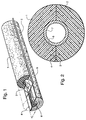
- Fig. 1 is a view of the pipe insulation showing substantially identical mating sections 1 and 2 of the pipe covering.
- Each of the sections has an adhesive coated mating surface 3 and 4 of each section with the protective sheet of release paper 5 in between the mating surfaces to prevent them from sticking to each other.
- the tubular structure or jacket
- the tubular structure has a bore 6 which has a suitable size to receive a pipe.
- Fig. 2 is a cross sectional view through the pipe covering and pipe 7 which it covers. Mating sections 1 and 2 are shown along with the mating surfaces 3 and 4, the bore 6 and pipe 7.
- Fig. 3 is a view of the pipe insulation covering (jacket) which is in an open position with a pipe 7 in one section and the exposed, substantially identical mating surfaces 8 and 9. the two sections can be placed together and secured by suitable means for holding the sections in place (such as ties or cladding). Alternatively, as in Fig. 1, a pressure sensitive adhesive can be used so that the two identical mating sections 1 and 2 can be put together so that the mating surfaces touch and stick to each other.
- the present insulative composite can be prepared by mixing the water and the hectorite clay and/or the hectorite clay product to hydrate the clay and/or the product, and form a wet mixture.
- the water must be used in an amount which is effective to allow the aerogel to be combined with the clay, the clay product or the mixture of both.
- the amount of water used in the process will be in the range of from about 60 to about 85% by weight of the total wet mixture.
- the comminuted aerogel must be added to form a wet, uniform mixture (a wet mixture in which the aerogel is uniformly mixed).
- the wet, uniform mixture can then be formed into any suitable shape for the insulation.
- the mixture is put into a mold. If desired, however, the mixture can also be extruded. In some applications the mixture can be extruded directly into the place to be insulated.
- the wet, uniform mixture is then dried. Although drying can be done at any suitable temperature, including ambient, it is preferred to heat the mixture to accelerate the drying step.
- a preferred temperature to dry the wet, uniform mixture can be selected from the range of from about 60 to about 98°C.
- the insulation has good handling properties and can be put into the area to be insulated. At a minimum of 30% by weight aerogel, the insulation can deliver a thermal conductivity of about .03 watt/meterK° (W/mK) or lower.
- the present invention at least about 5% by weight of the dried, composite must be comminuted aerogel.
- the aerogel thus, can range from about 5 to about 95% by weight in the dry composite.
- a suitable aerogel for the present invention can be prepared by removing liquid from a silica-based gel under conditions which minimize the shrinkage of the gel's solid structure.
- silica-based refers to gels made with solicon compounds (such as, for example, tetraethylorthosilicate, silicate, or colloidal silica).
- Typical processes for making aerogels minimize shrinkage by using supercritical conditions while drying to form the porous, solid aerogel.
- the aerogel can, therefore, be commercially obtained, or it can be prepared using suitable procedures known to the art, such as those indicated in, for example, U.S. Patents 4,954,327, 4,610,863, and 2,978,298.
- the aerogel is in comminuted form and is dispersed in the wet clay mixture. It has been discovered that comminuted aerogel is needed for the clay and/or clay product to form a solid, intact composite unless some other clay-binding ingredient (such as fiber) is added.
- the comminuted aerogel can have particles ranging in size from about 6mm in diameter or less. There is no actual limit to how small the aerogel particles can get.
- the aerogel can have an average particle size in the range of from about .0001 to about 6 mm in diameter.
- the aerogel has an average particle size in the range of from about .001 to about 5 millimeters (mm) in diameter.
- the aerogel is used in the composite at an amount in the range of from about 5 to about 95% by weight.
- the aerogel is used in the composite at an amount in the range of from about 30 to about 90% by weight. Since the aerogel is responsible for low thermal conductivity, however, it is most preferred that the aerogel be present in an amount in the range of from about 50 to about 95% by weight of the dry composite.
- Hectorite clay belongs to the smectite clay mineral group.
- Smectites are a group of layered hydrous alumino-silicates. They exhibit the unique property of swelling in the presence of water because of their expanding crystal lattice properties.
- the highest swelling smectite is hectorite clay, which can swell to 35 times its weight.
- the use of hectorite is critical to the end product, although the use of other smectites such as montmorillonite for example, produces a crumbled product.
- Clays in the kaolin group are also not suitable since they do not swell and are unable to bind the aerogel as the hectorite can.
- a minimum preferred amount of carboxy methyl cellulose is about 5% by weight of CMC in the hectorite.
- a preferred range is from about 10 to about 50% by weight of the CMC in the hectorite.
- Additives can be added to the present composites. Additives can be used for one or more purposes, such as to improve tensile strength, modify density, decrease friability, optimize thermal conductivity, and even make the composite adhesive. For example, it is preferred to use a suitable binder with the composite when hectorite clay is used because of its friability and tendency to crumble.
- a preferred binder for the instant composites is fiber.
- a preferred fiber is mineral wool.
- additives include materials such as a fire retardant, a filler, an opacifier, a surfactant, a pigment, perlite, a binder and fiber.
- materials such as a fire retardant, a filler, an opacifier, a surfactant, a pigment, perlite, a binder and fiber.
- such materials can be added to the wet mixture or the wet, uniform mixture at an amount in the range of from about 5 to about 45% by weight of the total dry composite.
- organic materials may be used, it is important to keep the fire and smoke properties down in the insulation.
- an additive it is preferred to use an inorganic, or non-flammable additive.
- fiber for example, it is preferred to use mineral wool, although any fiber may be used to increase the strength of the composite.
- Fiber is a useful and preferred additive. It can be included in order to increase the product strength. Preferred amounts for the fiber are in the range of from about .5 to about 25% by dry total weight of the product composite. Although any fiber can be used, preferred fibers include fiberglass, mineral wool, wollastonite, fire retarded cellulose, and ceramic.
- Clay products for use with the present invention can be obtained which are a combination of carboxy methyl cellulose with hectorite clay.
- a product for example, is commercially available from American Colloid Co. which offers Hectabrite Lt clay which is hectorite clay modified by carboxy methyl cellulose.
- Such products are suitable to prepare the insulation of the present invention.
- a sample was prepared by combining 250 ml (milliliters) of water and 20 g (grams) of the carboxy methyl cellulose treated hectorite clay (Hectabrite Lt clay from American Colloid Co.) to form an aqueous clay dispersion.
- the Hectabrite Lt clay was the product of the hectorite clay modified by carboxy methyl cellulose.
- a particulate silica aerogel was combined with the clay to form a mixture.
- the aerogel was in the form of a comminuted powder having particle sizes in the range of from about 4 to about 7 millimeters.
- the wet mixture was then put into a rectangular mold and dried. The sample was demolded. It was noted that the sample remained intact as it was handled.
- the thermal conductivity of the sample was measured by ASTM C1114-92 and was found to be 0.0229 w/mK (watt/meter°K).
- a sample was prepared by combining 250 ml of water and 20 g (grams) of the carboxy methyl cellulose treated hectorite clay which was used in Example 1 (from American Colloid Co.) to form an aqueous clay dispersion.
- the wet mixture was then put into a rectangular mold and dried. Without the aerogel, however, the clay-cellulose material collapsed into a loose dust. An intact, solid sample was not obtained.
- a sample was prepared by combining 250 ml of water and 10 g of the carboxy methyl cellulose treated hectorite clay (Hectabrite Lt clay from American Colloid Co. used in Examples 1 and 2) to form an aqueous clay dispersion.
- the carboxy methyl cellulose treated hectorite clay Hectabrite Lt clay from American Colloid Co. used in Examples 1 and 2
- Example 2 After mixing the water with the Hectabrite, 90 g of a particulate silica aerogel of the same type as was used in Example 1 was combined with the clay to form a mixture.
- the aerogel was in the form of a comminuted powder having particle sizes in the range of from about 4 to about 5 millimeters.
- the wet mixture was then put into a rectangular, 4x6 inch mold and dried. The sample was demolded. It was noted that the sample could be handled, and yet it remained an intact solid even with this handling.
- the thermal conductivity of the sample was measured by ASTM C-1114-92 and was found to be 0.0187 w/mK (watt/meter°K).
- a sample was prepared by combining 250 ml of water and 5 g of the carboxy methyl cellulose modified hectorite clay (Hectabrite Lt clay from American Colloid Co.) to form an aqueous clay dispersion.
- carboxy methyl cellulose modified hectorite clay Hectabrite Lt clay from American Colloid Co.
- the wet mixture was then put into a rectangular mold and dried.
- the sample was demolded. It was noted that the sample remained intact as it was handled.
- the thermal conductivity of the sample was measured by ASTM C1114-92 and was found to be 0.0192 w/mK (watt/meter°K).
- This sample was prepared with hectorite clay and mineral wool.
- the sample was prepared by combining 250 ml (milliliters) of water with the mineral wool.
- the mineral wool fiber was dispersed in the water then fire retardant was added, and then the hectorite clay was dispersed in the mixture.
- the clay used was HectabriteAW from American Colloid Co.
- Aerogel was then combined.
- the aerogel was in the form of a comminuted powder having particle sizes in the range of from about 4 to about 7 millimeters.
- the wet mixture was then put into a rectangular mold and dried. The sample was demolded. It was noted that the sample remained intact as it was handled.
- the composite was 65% aerogel, 10% hectorite, 20% CaHPO 4 as a fire retardant, and 5% mineral wool.
- a sample was prepared using hectorite clay.
- the sample was prepared by combining 250 ml (milliliters) of water with the fire retardant followed by combining the hectorite clay.
- the clay used was HectabriteAW from American Colloid Co. After the clay and water had mixed so that the clay was completely wet, forming a clay dispersion, this wet mixture was combined with the aerogel.
- the aerogel was in the form of a comminuted powder having particle sizes in the range of from about 4 to about 7 millimeters.
- the wet mixture was then put into a rectangular mold and dried.
- the sample, measuring 12" x 12" x 1" (inches) was demolded. It was noted that the sample remained intact as it was handled.
- This example shows that intact insulation can be made using hectorite clay and aerogel.
Landscapes
- Chemical & Material Sciences (AREA)
- Engineering & Computer Science (AREA)
- Ceramic Engineering (AREA)
- Materials Engineering (AREA)
- Structural Engineering (AREA)
- Organic Chemistry (AREA)
- General Engineering & Computer Science (AREA)
- Mechanical Engineering (AREA)
- Dispersion Chemistry (AREA)
- Civil Engineering (AREA)
- Thermal Insulation (AREA)
- Compositions Of Macromolecular Compounds (AREA)
Applications Claiming Priority (2)
| Application Number | Priority Date | Filing Date | Title |
|---|---|---|---|
| US74659896A | 1996-11-12 | 1996-11-12 | |
| US746598 | 1996-11-12 |
Publications (1)
| Publication Number | Publication Date |
|---|---|
| EP0841308A1 true EP0841308A1 (de) | 1998-05-13 |
Family
ID=25001521
Family Applications (1)
| Application Number | Title | Priority Date | Filing Date |
|---|---|---|---|
| EP97119712A Withdrawn EP0841308A1 (de) | 1996-11-12 | 1997-11-11 | Wärmedämmung und ihre Herstellung |
Country Status (4)
| Country | Link |
|---|---|
| EP (1) | EP0841308A1 (de) |
| CA (1) | CA2216594A1 (de) |
| GB (1) | GB2322682A (de) |
| NO (1) | NO975162L (de) |
Cited By (9)
| Publication number | Priority date | Publication date | Assignee | Title |
|---|---|---|---|---|
| WO2012013812A1 (en) * | 2010-07-30 | 2012-02-02 | Rockwool International A/S | Method for manufacturing an aerogel-containing composite and composite produced by that method |
| WO2012013817A1 (en) * | 2010-07-30 | 2012-02-02 | Rockwool International A/S | Method for manufacturing an aerogel-containing composite and composite produced by that method |
| RU2469967C2 (ru) * | 2009-12-23 | 2012-12-20 | Парок Ой Аб | Композит из минеральной ваты и способ его изготовления |
| AU2010277551B2 (en) * | 2009-07-31 | 2013-08-29 | Rockwool International A/S | Method for manufacturing an aerogel-containing composite and composite produced by that method |
| RU2540128C2 (ru) * | 2010-06-16 | 2015-02-10 | Парок Ой Аб | Способ изготовления трубной секции из минеральной ваты и трубная секция, изготовления этим способом |
| EP2281962B1 (de) | 2009-06-25 | 2017-04-05 | Knauf Insulation | Aerogelhaltige Verbundwerkstoffe |
| CN111981248A (zh) * | 2019-05-23 | 2020-11-24 | 李振声 | 一种气凝胶保温保冷材料在管道中的施工方法 |
| EP4008698A3 (de) * | 2009-04-27 | 2022-06-29 | Rockwool International A/S | Aerogelzusammensetzungen sowie verfahren zur herstellung und verwendung davon |
| JP2023516146A (ja) * | 2020-02-28 | 2023-04-18 | エボニック オペレーションズ ゲーエムベーハー | シリカ系断熱成形体 |
Citations (4)
| Publication number | Priority date | Publication date | Assignee | Title |
|---|---|---|---|---|
| US3988190A (en) * | 1970-10-06 | 1976-10-26 | Micropore Insulation Limited | Method of forming thermal insulation materials |
| JPS60195017A (ja) * | 1984-03-19 | 1985-10-03 | Agency Of Ind Science & Technol | モンモリロン石群鉱物、陰イオン性水溶性高分子化合物、シリカより成る微細多孔質粘土材料 |
| EP0672635A1 (de) * | 1994-03-18 | 1995-09-20 | Basf Aktiengesellschaft | Formkörper, enthaltend Silica-Aerogel-Partikel sowie Verfahren zu ihrer Herstellung |
| WO1996015998A1 (de) * | 1994-11-23 | 1996-05-30 | Hoechst Aktiengesellschaft | Aerogelhaltiges verbundmaterial, verfahren zu seiner herstellung sowie seine verwendung |
Family Cites Families (3)
| Publication number | Priority date | Publication date | Assignee | Title |
|---|---|---|---|---|
| DE3235708A1 (de) * | 1982-09-27 | 1984-03-29 | Brown, Boveri & Cie Ag, 6800 Mannheim | Thermische isolierung |
| DE4038784A1 (de) * | 1990-12-05 | 1992-06-11 | Basf Ag | Verbundschaumstoffe mit niedriger waermeleitfaehigkeit |
| US5569513A (en) * | 1994-08-10 | 1996-10-29 | Armstrong World Industries, Inc. | Aerogel-in-foam thermal insulation and its preparation |
-
1997
- 1997-09-24 CA CA002216594A patent/CA2216594A1/en not_active Abandoned
- 1997-11-10 NO NO975162A patent/NO975162L/no not_active Application Discontinuation
- 1997-11-11 EP EP97119712A patent/EP0841308A1/de not_active Withdrawn
- 1997-11-12 GB GB9723911A patent/GB2322682A/en not_active Withdrawn
Patent Citations (4)
| Publication number | Priority date | Publication date | Assignee | Title |
|---|---|---|---|---|
| US3988190A (en) * | 1970-10-06 | 1976-10-26 | Micropore Insulation Limited | Method of forming thermal insulation materials |
| JPS60195017A (ja) * | 1984-03-19 | 1985-10-03 | Agency Of Ind Science & Technol | モンモリロン石群鉱物、陰イオン性水溶性高分子化合物、シリカより成る微細多孔質粘土材料 |
| EP0672635A1 (de) * | 1994-03-18 | 1995-09-20 | Basf Aktiengesellschaft | Formkörper, enthaltend Silica-Aerogel-Partikel sowie Verfahren zu ihrer Herstellung |
| WO1996015998A1 (de) * | 1994-11-23 | 1996-05-30 | Hoechst Aktiengesellschaft | Aerogelhaltiges verbundmaterial, verfahren zu seiner herstellung sowie seine verwendung |
Non-Patent Citations (1)
| Title |
|---|
| DATABASE WPI Section Ch Week 8546, Derwent World Patents Index; Class A97, AN 85-286146, XP002055802 * |
Cited By (11)
| Publication number | Priority date | Publication date | Assignee | Title |
|---|---|---|---|---|
| EP4008698A3 (de) * | 2009-04-27 | 2022-06-29 | Rockwool International A/S | Aerogelzusammensetzungen sowie verfahren zur herstellung und verwendung davon |
| EP2281962B1 (de) | 2009-06-25 | 2017-04-05 | Knauf Insulation | Aerogelhaltige Verbundwerkstoffe |
| AU2010277551B2 (en) * | 2009-07-31 | 2013-08-29 | Rockwool International A/S | Method for manufacturing an aerogel-containing composite and composite produced by that method |
| RU2469967C2 (ru) * | 2009-12-23 | 2012-12-20 | Парок Ой Аб | Композит из минеральной ваты и способ его изготовления |
| EP2338853A3 (de) * | 2009-12-23 | 2013-02-27 | Paroc Oy Ab | Mineralwollenverbundmaterial und Verfahren zu dessen Herstellung |
| RU2540128C2 (ru) * | 2010-06-16 | 2015-02-10 | Парок Ой Аб | Способ изготовления трубной секции из минеральной ваты и трубная секция, изготовления этим способом |
| WO2012013812A1 (en) * | 2010-07-30 | 2012-02-02 | Rockwool International A/S | Method for manufacturing an aerogel-containing composite and composite produced by that method |
| WO2012013817A1 (en) * | 2010-07-30 | 2012-02-02 | Rockwool International A/S | Method for manufacturing an aerogel-containing composite and composite produced by that method |
| US9975270B2 (en) | 2010-07-30 | 2018-05-22 | Rockwool International A/S | Method for manufacturing an aerogel-containing composite and composite produced by that method |
| CN111981248A (zh) * | 2019-05-23 | 2020-11-24 | 李振声 | 一种气凝胶保温保冷材料在管道中的施工方法 |
| JP2023516146A (ja) * | 2020-02-28 | 2023-04-18 | エボニック オペレーションズ ゲーエムベーハー | シリカ系断熱成形体 |
Also Published As
| Publication number | Publication date |
|---|---|
| GB9723911D0 (en) | 1998-01-07 |
| CA2216594A1 (en) | 1998-05-12 |
| GB2322682A (en) | 1998-09-02 |
| NO975162D0 (no) | 1997-11-10 |
| NO975162L (no) | 1998-05-13 |
Similar Documents
| Publication | Publication Date | Title |
|---|---|---|
| RU2161143C2 (ru) | Композиционный материал, содержащий аэрогель, способ его изготовления, а также его применение | |
| US6083619A (en) | Composite material containing aerogel, process for its preparation, and its use | |
| US6136216A (en) | Aerogel-in-foam thermal insulation and its preparation | |
| CA1329984C (en) | Lightweight, soundproofing, insulation and fireproofing material and method | |
| JP2839149B2 (ja) | 防火材 | |
| KR101222732B1 (ko) | 에어로겔 함유 블랭킷 | |
| US9102076B2 (en) | Methods for making aerogel composites | |
| KR101618352B1 (ko) | 파라핀계 상변화 물질을 이용한 내열성 축열재 및 이의 제조방법 | |
| KR20000070452A (ko) | 하나 이상의 에어로겔-함유 층 및 하나 이상의 또 다른 층을갖는 다층 복합 물질, 이의 제조방법 및 이의 용도 | |
| JPH11513349A (ja) | 繊維を含有するエーロゲル複合材料 | |
| AU5090593A (en) | A fire resistant and high temperature insulating composition | |
| CA2216594A1 (en) | Thermal insulation and its preparation | |
| KR20170120714A (ko) | 에어로겔 조성물 및 그의 제조 방법 및 사용 방법 | |
| CA2552129C (en) | Insulation having a thermal enhancement material and method of making same | |
| AU663185B2 (en) | Ceramic products | |
| JP7717639B2 (ja) | 耐火断熱シート | |
| US5053282A (en) | Non-inflammable insulating composite material | |
| EP0829459B1 (de) | Nichtbrennbare Wärmedämmplatten auf der Basis von expandierter Perlite-Körnung | |
| NL8200599A (nl) | Werkwijze ter bereiding van keramische vezels bevattende, vlamwerende of vuurvaste massa's, volgens de werkwijze bereide massa's en toepassing daarvan. | |
| EP2655294A2 (de) | Dämm- und baumaterialien sowie herstellungsverfahren dafür | |
| HU209856B (en) | Insulating dry-mortar | |
| EA005771B1 (ru) | Легкий теплоизоляционный формованный продукт с высокой механической прочностью и способ его получения | |
| JPS6116753B2 (de) | ||
| KR20150086570A (ko) | 나노셀루로스 에어로젤 단열재 및 이의 제조방법 | |
| KR101906045B1 (ko) | 발포성 단열 소재를 이용한 불연 단열재 |
Legal Events
| Date | Code | Title | Description |
|---|---|---|---|
| PUAI | Public reference made under article 153(3) epc to a published international application that has entered the european phase |
Free format text: ORIGINAL CODE: 0009012 |
|
| STAA | Information on the status of an ep patent application or granted ep patent |
Free format text: STATUS: THE APPLICATION HAS BEEN WITHDRAWN |
|
| AK | Designated contracting states |
Kind code of ref document: A1 Designated state(s): AT BE CH DE DK ES FI FR GB GR IE IT LI LU MC NL PT SE |
|
| AX | Request for extension of the european patent |
Free format text: AL;LT;LV;MK;RO;SI |
|
| 18W | Application withdrawn |
Withdrawal date: 19980409 |