EP0841781A2 - Elément de commutation Fibre-Channel à files d'attente reparties - Google Patents
Elément de commutation Fibre-Channel à files d'attente reparties Download PDFInfo
- Publication number
- EP0841781A2 EP0841781A2 EP97630053A EP97630053A EP0841781A2 EP 0841781 A2 EP0841781 A2 EP 0841781A2 EP 97630053 A EP97630053 A EP 97630053A EP 97630053 A EP97630053 A EP 97630053A EP 0841781 A2 EP0841781 A2 EP 0841781A2
- Authority
- EP
- European Patent Office
- Prior art keywords
- port
- frame
- destination
- source
- controller
- Prior art date
- Legal status (The legal status is an assumption and is not a legal conclusion. Google has not performed a legal analysis and makes no representation as to the accuracy of the status listed.)
- Granted
Links
Images


Classifications
-
- H—ELECTRICITY
- H04—ELECTRIC COMMUNICATION TECHNIQUE
- H04L—TRANSMISSION OF DIGITAL INFORMATION, e.g. TELEGRAPHIC COMMUNICATION
- H04L49/00—Packet switching elements
- H04L49/60—Software-defined switches
- H04L49/608—ATM switches adapted to switch variable length packets, e.g. IP packets
-
- H—ELECTRICITY
- H04—ELECTRIC COMMUNICATION TECHNIQUE
- H04L—TRANSMISSION OF DIGITAL INFORMATION, e.g. TELEGRAPHIC COMMUNICATION
- H04L49/00—Packet switching elements
- H04L49/35—Switches specially adapted for specific applications
- H04L49/356—Switches specially adapted for specific applications for storage area networks
- H04L49/357—Fibre channel switches
-
- H—ELECTRICITY
- H04—ELECTRIC COMMUNICATION TECHNIQUE
- H04Q—SELECTING
- H04Q11/00—Selecting arrangements for multiplex systems
- H04Q11/04—Selecting arrangements for multiplex systems for time-division multiplexing
- H04Q11/0421—Circuit arrangements therefor
-
- H—ELECTRICITY
- H04—ELECTRIC COMMUNICATION TECHNIQUE
- H04L—TRANSMISSION OF DIGITAL INFORMATION, e.g. TELEGRAPHIC COMMUNICATION
- H04L49/00—Packet switching elements
- H04L49/10—Packet switching elements characterised by the switching fabric construction
- H04L49/103—Packet switching elements characterised by the switching fabric construction using a shared central buffer; using a shared memory
-
- H—ELECTRICITY
- H04—ELECTRIC COMMUNICATION TECHNIQUE
- H04L—TRANSMISSION OF DIGITAL INFORMATION, e.g. TELEGRAPHIC COMMUNICATION
- H04L49/00—Packet switching elements
- H04L49/35—Switches specially adapted for specific applications
- H04L49/351—Switches specially adapted for specific applications for local area network [LAN], e.g. Ethernet switches
Definitions
- the present invention relates an apparatus for distributed source and destination queuing in a high performance memory based switch and, more particularly, to a Fibre channel switch having a distributed queuing algorithm.
- Mainframes, super computers, mass storage systems, workstations and very high resolution display subsystems are frequently connected together to facilitate file and print sharing.
- Common networks and channels used for these types of connections oftentimes introduce communications bottle necking, especially in cases where the data is in a large file format typical of graphically-based applications.
- a "channel” provides a direct or switched point-to-point connection between communicating devices. The channel's primary task is merely to transport data at the highest possible data rate with the least amount of delay. Channels typically perform simple error correction in hardware.
- a "network,” by contrast, is an aggregation of distributed nodes (e.g., Workstations, mass storage units) with its own protocol that supports interaction among these nodes. Typically, each node contends for the transmission medium, and each node must be capable of recognizing error conditions on the network and must provide the error management required to recover from the error conditions
- Fibre Channel One type of communications interconnect that has been developed is Fibre Channel.
- the Fibre channel protocol was developed and adopted as the American National Standard for Information Systems (ANSI) . See Fibre Channel Physical and Signaling Interface, Revision 4.2, American National standard for Information Systems (ANSI) (1993) for a detailed discussion of the fibre channel standard.
- ANSI American National Standard for Information Systems
- Fibre channel is a switched protocol that allows concurrent communication among workstations, super computers and various peripherals.
- the total network bandwidth provided by fibre channel is on the order of a terabit per second.
- Fibre channel is capable of transmitting frames at rates exceeding 1 gigabit per second in both directions simultaneously. It is also able to transport commands and data according to existing protocols such as Internet protocol (IP), small computer system interface (SCSI), high performance parallel interface (HIPPI) and intelligent peripheral interface (IPI) ever both optical fiber and copper cable.
- IP Internet protocol
- SCSI small computer system interface
- HIPPI high performance parallel interface
- IPI intelligent peripheral interface
- Fig. 1 illustrates a variable-length frame 11 as described by the Fibre Channel standard.
- the variable-length frame 11 comprises a 4-byte start-of-frame (SOF) indicator 12, which is a particular binary sequence indicative of the beginning of the frame 11.
- SOF indicator 12 is followed by a 24-byte header 14, which generally specifies, among other things, the frame source address and destination address as well as whether the frame 11 is either control information or actual data.
- the header 14 is followed by a field of variable-length data 16.
- the length of the data 16 is 0 to 2112 bytes.
- the data 16 is followed successively by a 4-byte CRC (cyclical redundancy check) code 17 for error detection, and by a 4 byte end-of-frame (EOF) indicator 18.
- the frame 11 of Fig. 1 is much more flexible than a fixed frame and provides for higher performance by accommodating the specific needs of specific applications.
- FIG. 2 illustrates a block diagram of a representative fibre channel architecture in a fibre channel network 100.
- a workstation 120, a mainframe 122 and a super computer 124 are interconnected with various subsystems (e.g., a tape subsystem 126, a disk subsystem 128, and a display subsystem 130) via a fibre channel fabric 110 (i.e. fibre channel switch).
- the fabric 110 is an entity that interconnects various node-ports (N_ports) 140 and their associated workstations, mainframes and peripherals attached to the fabric 110 through the F_ports 142.
- the essential function of the fabric 110 is to receive frames of data from a source N_port and, using a first protocol, route the frames to a destination N_port.
- the first protocol is the fibre channel protocol.
- Other protocols, such as the asynchronous transfer code (ATM) could be used without departing from the scope of the present invention.
- ATM asynchronous transfer code
- the fibre channel is a channel-network hybrid, containing enough network features to provide the needed connectivity, distance and protocol multiplexing, and enough channel features to retain simplicity, repeatable performance and reliable delivery.
- Fibre channel allows for an active, intelligent interconnection scheme, known as a "fabric," or fibre channel switch to connect devices.
- the fabric includes a plurality of fabric-ports (F_ports) that provide for interconnection and frame transfer between a plurality of node-ports (N_ports) attached to associated devices that may include workstations, super computers and/or peripherals.
- the fabric has the capability of routing frames based upon information contained within the frames.
- the N_port manages the simple point-to-point connection between itself and the fabric.
- N_port and associated device dictates the rate that the N_port transmits and receives data to and from the fabric. Transmission is isolated from the control protocol so that different topologies (e.g., point-to-point links, rings, multidrop buses, cross point switches) can be implemented.
- topologies e.g., point-to-point links, rings, multidrop buses, cross point switches
- a class 1 transfer requires circuit switching, i.e., a reserved data path trough the network switch, and generally involves the transfer of more than one frame, oftentimes numerous frames, between two identified network elements.
- a class 2 transfer requires allocation of a path through the network switch for each transfer of a single frame from one network element to another.
- Frame switching for class 2 transfers is more difficult to implement than class 1 circuit switching as frame switching requires a memory mechanism for temporarily storing incoming frames in a source queue prior to their routing to a destination port, or a destination queue at a destination port.
- a memory mechanism typically includes numerous input/output (I/O) connections with associated support circuitry and queuing logic. Additional complexity and hardware is required when channels carrying data at different bit rates are to be interfaced.
- Another disadvantage of distributed destination queuing is apparent when the frame at the end of the head of the queue is sourced from a port that is already forwarding a frame such that the path is blocked and the frame cannot be transferred.
- Fibre channel switch that provides for efficient transfer of queuing information between Fibre channel ports, especially if the new switch provided an improvement in any of the following areas: increased bandwidth, decreased no-load latency and increased throughput under load (due to parallelism of distributed queuing).
- a fibre channel switch employing distributed source and destination queuing for interconnecting a plurality of devices (workstations, supercomputer, peripherals) through their associated node ports (N_ports).
- the fibre channel switch provides a fabric having a shared memory coupled to a plurality of fabric ports (F_ports) through a bit-slicing memory controller over which memory addresses, frame data and communications commands are transmitted.
- Each F_port includes a port controller employing a distributed queuing algorithm associated with a control network for communicating commands between the ports related to when and where frame transfers are to be made.
- the bit-slicing memory controller provides an independent data network for access to the shared memory such that frames can be transferred to and from the shared memory in response to port controller commands.
- Each port controller further comprises a link controller (LC) for controlling the optical interface with the N_port, a frame transfer controller (FTC) for receiving and transmitting data between the LC and the shared memory, an address validation /translation controller (AVTC) for obtaining frame header information and for generating destination port numbers, buffer numbers, and timeout values, and a writer and reader that together implement distributed source/destination queuing, a synchronizer (sync) for synchronizing port state transitions and the activities of the reader and writer, a statistics controller (SC) for counting statistics, and a port communications controller (PCC) for enabling port controllers to communicate.
- LC link controller
- FTC frame transfer controller
- AVTC address validation /translation controller
- SC statistics controller
- PCC port communications controller
- the present invention provides a Fibre Channel switch based upon a distributed queuing algorithm for interconnecting a plurality of devices through their associated node ports (N_ports).
- the fibre channel switch provides a fabric having a shared memory coupled to a plurality of fabric ports (F_ports) through a bit-slicing shared memory controller through which memory addresses, frame data are transmitted.
- the Fibre Channel switch supports both circuit and frame switched connections for multiple baud rate interfaces.
- FIG. 3 illustrates a block diagram of an Fibre Channel switch 300 having eighteen ports 305 numbered Port 1 to Port 18 (only Port 1, Port 2, Port 17 and Port 18 are illustrated) coupled to a 512 kByte shared memory 330 through a bit-slicing memory controller 340.
- Each of the eighteen ports 305 include a port controller 310 having memory address (ADD) lines 312 for transmitting memory addresses and Rx lines 313 for transmitting frame data to the bit-slicing memory controller 340, and Tx lines 314 for receiving frame data from the bit-slicing memory controller 340, and an OLM/GLC media adapter 315 for interfacing to the Fibre channel.
- ADD memory address
- a bit-sliced memory architecture is disclosed in U.S. Patent Application Serial No. 08/330,279, filed October 27, 1994 and entitled "Channel Module for a Fibre Optic Switch with Bit Sliced Memory Architecture for Data Frame Storage” by Dwayne Bennett and is hereby incorporated by reference.
- the memory architecture disclosed in 08/330,279 teaches only bit slicing of the Rx frame data.
- the preferred embodiment of the invention employs bit-slicing of both the Rx frame data and the Tx frame data. This allows the shared memory 330 to be used not only for data frame storage, but also for the multiplexing function delivered by the bit-slicing memory controller 340.
- An independent communications command bus 315 provides interconnections between the eighteen port controllers 310 and is employed for sending communication commands related to the timing and destination of frame transfers.
- the switch 300 also includes a single non-core port controller 325 interconnected with each port controller 310 over a micro controller bus 327.
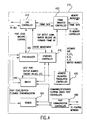
- FIG. 4 illustrates a block diagram of a port controller 310 illustrated in FIG. 3, comprising a link controller (LC) 410, a frame transfer controller (FTC) 420, an address validation /translation controller (AVTC) 430, a writer 440 and reader 450, a synchronizer (sync) 460, a statistics controller (SC) 470, and a port communications controller (PCC) 480.
- LC link controller
- FTC frame transfer controller
- AVTC address validation /translation controller
- SC statistics controller
- PCC port communications controller
- the link controller 410 further comprises a control processor for OLC control (lock-to-ref, loopback control, etc.), elastic store, 8B/10B conversion, work synchronization, ordered set encoding/decoding, port state machine (offline to online protocol, link recovery handshaking, etc.), CRC generation and checking, and frame validation.
- the FTC 420 is an interface for receiving and transmitting data between the LC 410 and the shared memory controller 340. Upon receipt of data from the LC 410, the FTC 420 forwards the memory address and the data to the shared controller memory 340. The memory address is based on the available source buffers. The FTC 420 tells the writer 440 which destination port and receive buffer the frame has been put in via the address validation/translation controller (AVTC) 430, such that the designated receive buffer will not be reused until the reader 440 tells it to reclaim the receive buffer.
- AVTC address validation/translation controller
- the FTC 420 When transmitting data, the FTC 420 gets a message from the reader 450 (originating from the control network, through the port communication controller 480) to retrieve a frame from the shared memory 330 and send it to the destination F_port via the LC 410 and the OLC 315. The FTC 420 determines the memory address from the source port and buffer number contained in the message from the reader 450. When the FTC 420 passes the EOF to the LC 410, it signals the reader 450 to indicate that the transfer is complete.
- the AVTC 430 gets frame header information of inbound frames from the FTC 420.
- the frame header information includes: SOF, frame header words 1 and 2, and buffer number.
- the AVTC 30 also generates the following outputs to the writer 440: a destination port number, buffer number, forward frame timeout value, and busy frame timeout value and a flag indicating if the frame would be forwarded or rejected/discarded.
- the writer 440 and reader 450 of each port controller in the switch together implement distributed source/destination queuing.
- Each source port maintains a separate queue for each destination port, and each queue contains only frames received by that particular source port, resulting in a separate queue for each source/destination port combination in the switch.
- the queues are distributed because each source port passes the buffer descriptor at the head of its destination queues to the destination port before the source port is actually ready to forward the frame. Thus, the destination port knows about the next frame that each of the source ports wants to forward to it next.
- the destination port When the destination port begins forwarding a frame from a particular source port, the destination port requests the next buffer descriptor in the source port queue. Depending on the latency of the request and response between the two port controllers and the length of the frame being transmitted, the destination port will get the next buffer descriptor before or at approximately the same time transmission of the current frame completes. By overlapping these two operations, a very high rate of sustained bandwidth can be maintained between two ports sending frames back and forth to each other.
- the destination port When the destination port has seen the EOF command go out, the destination port sends a message to the source port telling the source port to free up the source buffer and send a receiver ready (RRDY) command.
- RRDY receiver ready
- Source blocking does not occur in a shared memory architecture as the destination port is free to choose a buffer from any source port.
- the destination port is therefore free to use any forwarding priority scheme the destination port desires.
- a simple round-robin scheme is employed for fairness.
- a priority scheme may be employed that gives higher priority to a particular source port, or to pace the traffic from a source port that is flooding the destination port with frames (i.e., class 3 traffic that isn't paced by end-to-end flow control) by servicing it less often than the other ports, for example, based on traffic history.
- the source prioritizes frames to each destination port based on frame type. For example, link control frames may be given higher priority than data frames in a simple first-come first-serve scheme.
- the source port controller Upon passing a buffer descriptor to the destination port, the source port controller must remember the frame. In particular, a busy frame signal must be sent back to source N_Port, or the frame must be discarded if the frame cannot be forwarded out of the destination port within some fixed time.
- the source port has responsibility for timing the frame upon passing of the buffer descriptor.
- the destination tort may have responsibility for timing the frame and will forward a request to the source port to return a busy frame signal when the timer times out.
- the source port may be link reset, requiring the contents of the buffer to be discarded.
- the source port therefore still needs to be able to stop the destination port from forwarding the frame, and the same race condition exists between the destination port starting to forward the frame and the source port telling the destination port not to forward.
- the source port retains responsibility for timing the frame as the source port must time the frame until the source port buffer descriptor makes it to the head of the queue and is passed to the destination port.
- the amount of logic required in the FTC portion of the port controller is reduced as the source tort is not required to generate busy and reject frame commands. Instead, the buffer descriptor of the frame to be busied or rejected is queued to a "non-core" port controller 325 (FIG. 3) having an imbedded processor 326. Software is employed to manipulate the frame header, and queuing the frame back out to the original source port. While the original frame is queued to the "non-core" port controller 325, the source continues to time the frame. If the frame is not forwarded within a predetermined period of time, the source port makes a request to the "non-core" port controller 325 not to forward the original frame to the processor.
- the "non-core” port controller must time the frame and discard it if necessary.
- the timer within the "non-core” port controller should take into account the time between when the frame was first queued to the "non-core” port controller 325 and when it was actually delivered to it.
- the buffer information passed to the "non-core” port controller 325 includes a time stamp. The processor time stamps frames upon receipt such that a time out value can be calculated that will ensure that in the worst case, the frame is discarded within R_A_TOV.
- a synchronizer (sync) 460 is employed or synchronizing port state transitions and the activities of the reader 450 and writer 440. For example, when a port goes into link recovery, the synchronizer 460 prevents the link controller 410 from taking the link active again until the writer has freed up all of the source buffers by either discarding the frames or waiting for a destination to complete transmission of a frame. The synchronizer 460 also waits for the reader to recognize that the port is no longer active and aborts the current forward operation or waits until it is finished. The synchronizer 460 does basically the same thing when the port goes offline or into link failure, but it must also wait for software to tell it that the port has been logged out of the fabric before allowing the link controller 410 to take the link back on-line.
- the statistics controller (SC) 470 is located between the reader/writer and the LC/FTC such that it can count statistics, and pass information through, for example, when the writer 440 releases a buffer, the SC 470 tells the FTC 420 that the buffer space is available and also tells the LC 410 to send a receiver ready (RRDY) signal.
- the SC 470 is given the source port and buffer number information, allowing it to count frames transmitted on a per destination port basis, and it also passes the information on to the frame transfer controller so it calculates the shared memory address of the frame data.
- the SC 470 connection to the FTC 420 and LC 410 would also allow Fibre channel class one error and word count statistics to be counted if required.
- the port communication controller (PCC) 480 allows port controllers 310 to communicate with one another. More specifically, writers 440 communicate with readers 450 and vice-versa, but readers 450 don't communicate with one another, nor do writers 440.
- Each port controller 310 has a single serial output line that is connected to all the ports (including itself so that an N_Port can send frames to itself). In an 18 port switch, each port controller will have one serial output and 18 serial inputs. Messages must include the intended destination port number so that the destination ports can ignore messages that are not addressed to it. The source port number need not be included, it is implicit based on which serial input the message was received from. The serial lines would be clocked at 26 or 53 Mhz.
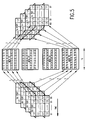
- FIG. 5 illustrates data organization for a bit-sliced memory in accordance with the invention as embodied in a simplified four port fibre channel switch.
- B0 to B7 indicates bytes 0 through 7 accumulated over eight clock cycles.
- the numbers in the memory locations indicate bit positions.
- a write to a memory location is sixteen bits wide (eight two bit slices, from eight bytes are concatenated), meanwhile, all four memories are written at the same time.
- Each read cycle delivers eight bytes of data corresponding to a particular port as directed by a shared memory controller.
Landscapes
- Engineering & Computer Science (AREA)
- Computer Networks & Wireless Communication (AREA)
- Signal Processing (AREA)
- Data Exchanges In Wide-Area Networks (AREA)
- Multi Processors (AREA)
- Mobile Radio Communication Systems (AREA)
- Small-Scale Networks (AREA)
- Use Of Switch Circuits For Exchanges And Methods Of Control Of Multiplex Exchanges (AREA)
- Time-Division Multiplex Systems (AREA)
Applications Claiming Priority (2)
| Application Number | Priority Date | Filing Date | Title |
|---|---|---|---|
| US714029 | 1996-09-11 | ||
| US08/714,029 US5894481A (en) | 1996-09-11 | 1996-09-11 | Fiber channel switch employing distributed queuing |
Publications (3)
| Publication Number | Publication Date |
|---|---|
| EP0841781A2 true EP0841781A2 (fr) | 1998-05-13 |
| EP0841781A3 EP0841781A3 (fr) | 2002-09-11 |
| EP0841781B1 EP0841781B1 (fr) | 2006-05-24 |
Family
ID=24868515
Family Applications (1)
| Application Number | Title | Priority Date | Filing Date |
|---|---|---|---|
| EP97630053A Expired - Lifetime EP0841781B1 (fr) | 1996-09-11 | 1997-09-05 | Elément de commutation Fibre-Channel à files d'attente reparties |
Country Status (6)
| Country | Link |
|---|---|
| US (2) | US5894481A (fr) |
| EP (1) | EP0841781B1 (fr) |
| JP (1) | JPH10135952A (fr) |
| AT (1) | ATE327620T1 (fr) |
| DE (1) | DE69735921T2 (fr) |
| WO (1) | WO1998011691A1 (fr) |
Cited By (3)
| Publication number | Priority date | Publication date | Assignee | Title |
|---|---|---|---|---|
| US6353612B1 (en) | 1998-06-19 | 2002-03-05 | Brocade Communications Systems, Inc. | Probing device |
| EP0980168A3 (fr) * | 1998-08-11 | 2004-06-23 | Nortel Networks Limited | Procédé de transfert universelle et réseaux avec commutateur distribué |
| EP1425672A4 (fr) * | 2001-08-17 | 2006-07-19 | Mcdata Corp | Architecture de memoire partagee a plusieurs cadences pour memorisation et commutation de trames |
Families Citing this family (124)
| Publication number | Priority date | Publication date | Assignee | Title |
|---|---|---|---|---|
| US6031842A (en) | 1996-09-11 | 2000-02-29 | Mcdata Corporation | Low latency shared memory switch architecture |
| US5978379A (en) | 1997-01-23 | 1999-11-02 | Gadzoox Networks, Inc. | Fiber channel learning bridge, learning half bridge, and protocol |
| JP3156623B2 (ja) * | 1997-01-31 | 2001-04-16 | 日本電気株式会社 | ファイバチャネルファブリック |
| US6185203B1 (en) | 1997-02-18 | 2001-02-06 | Vixel Corporation | Fibre channel switching fabric |
| US6118776A (en) * | 1997-02-18 | 2000-09-12 | Vixel Corporation | Methods and apparatus for fiber channel interconnection of private loop devices |
| US6160813A (en) * | 1997-03-21 | 2000-12-12 | Brocade Communications Systems, Inc. | Fibre channel switching system and method |
| JP3228182B2 (ja) * | 1997-05-29 | 2001-11-12 | 株式会社日立製作所 | 記憶システム及び記憶システムへのアクセス方法 |
| US6370145B1 (en) * | 1997-08-22 | 2002-04-09 | Avici Systems | Internet switch router |
| US6285679B1 (en) * | 1997-08-22 | 2001-09-04 | Avici Systems, Inc. | Methods and apparatus for event-driven routing |
| US6088352A (en) * | 1997-08-29 | 2000-07-11 | Lucent Technologies Inc. | Bit sliced digital cross connect switching system controlled by port units |
| US6148004A (en) * | 1998-02-11 | 2000-11-14 | Mcdata Corporation | Method and apparatus for establishment of dynamic ESCON connections from fibre channel frames |
| US6693904B1 (en) * | 1998-04-09 | 2004-02-17 | Lucent Technologies Inc. | Trace format for a sliced switch fabric |
| US6070200A (en) | 1998-06-02 | 2000-05-30 | Adaptec, Inc. | Host adapter having paged data buffers for continuously transferring data between a system bus and a peripheral bus |
| US6202105B1 (en) * | 1998-06-02 | 2001-03-13 | Adaptec, Inc. | Host adapter capable of simultaneously transmitting and receiving data of multiple contexts between a computer bus and peripheral bus |
| US6298403B1 (en) | 1998-06-02 | 2001-10-02 | Adaptec, Inc. | Host adapter having a snapshot mechanism |
| US6765919B1 (en) * | 1998-10-23 | 2004-07-20 | Brocade Communications Systems, Inc. | Method and system for creating and implementing zones within a fibre channel system |
| US7430171B2 (en) | 1998-11-19 | 2008-09-30 | Broadcom Corporation | Fibre channel arbitrated loop bufferless switch circuitry to increase bandwidth without significant increase in cost |
| US6608819B1 (en) | 1999-01-12 | 2003-08-19 | Mcdata Corporation | Method for scoring queued frames for selective transmission through a switch |
| US7382736B2 (en) * | 1999-01-12 | 2008-06-03 | Mcdata Corporation | Method for scoring queued frames for selective transmission through a switch |
| US6400730B1 (en) * | 1999-03-10 | 2002-06-04 | Nishan Systems, Inc. | Method and apparatus for transferring data between IP network devices and SCSI and fibre channel devices over an IP network |
| US6697359B1 (en) * | 1999-07-02 | 2004-02-24 | Ancor Communications, Inc. | High performance switch fabric element and switch systems |
| GB2352145A (en) * | 1999-07-16 | 2001-01-17 | Texas Instruments Ltd | Prevention of bottlenecking in data transfers |
| US6625117B1 (en) | 1999-09-30 | 2003-09-23 | International Business Machines Corporation | Method and apparatus for switching messages from a primary message channel to a secondary message channel in a message queuing system |
| JP2003516657A (ja) | 1999-12-10 | 2003-05-13 | キューロジック スウィッチ プロダクツ,インコーポレイティド | ファイバチャネル・クレジット・エクステンダ及び中継器 |
| JP2001167040A (ja) * | 1999-12-14 | 2001-06-22 | Hitachi Ltd | 記憶サブシステム及び記憶制御装置 |
| US6578096B1 (en) * | 1999-12-30 | 2003-06-10 | Agilent Technologies, Inc. | Method and system for efficient I/O operation completion in a fibre channel node |
| US6684209B1 (en) * | 2000-01-14 | 2004-01-27 | Hitachi, Ltd. | Security method and system for storage subsystem |
| US7657727B2 (en) * | 2000-01-14 | 2010-02-02 | Hitachi, Ltd. | Security for logical unit in storage subsystem |
| JP4651230B2 (ja) | 2001-07-13 | 2011-03-16 | 株式会社日立製作所 | 記憶システム及び論理ユニットへのアクセス制御方法 |
| JP4953541B2 (ja) * | 2000-02-24 | 2012-06-13 | 富士通株式会社 | 入出力制御装置及び装置識別方法並びにストレージシステム |
| US6636239B1 (en) | 2000-02-24 | 2003-10-21 | Sanavigator, Inc. | Method of operating a graphical user interface to selectively enable and disable a datapath in a network |
| US6988236B2 (en) * | 2000-04-07 | 2006-01-17 | Broadcom Corporation | Method for selecting frame encoding parameters in a frame-based communications network |
| JP4719957B2 (ja) * | 2000-05-24 | 2011-07-06 | 株式会社日立製作所 | 記憶制御装置及び記憶システム並びに記憶システムのセキュリティ設定方法 |
| US7197545B1 (en) | 2000-08-28 | 2007-03-27 | Sanavigator, Inc. | Techniques for dynamically loading modules for devices discovered in a storage network |
| US6763417B2 (en) | 2000-12-20 | 2004-07-13 | Computer Network Technology Corporation | Fibre channel port adapter |
| US6715111B2 (en) | 2000-12-27 | 2004-03-30 | Intel Corporation | Method and apparatus for detecting strobe errors |
| US6877042B2 (en) * | 2001-01-02 | 2005-04-05 | Dell Products L.P. | System and method for generating world wide names |
| US6941252B2 (en) * | 2001-03-14 | 2005-09-06 | Mcdata Corporation | Striping data frames across parallel fibre channel links |
| US7301956B2 (en) * | 2001-05-10 | 2007-11-27 | Brocade Communications Systems, Inc. | System and method for storing and retrieving multi-speed data streams within a network switch |
| US7366194B2 (en) | 2001-04-18 | 2008-04-29 | Brocade Communications Systems, Inc. | Fibre channel zoning by logical unit number in hardware |
| US20030056000A1 (en) * | 2001-07-26 | 2003-03-20 | Nishan Systems, Inc. | Transfer ready frame reordering |
| US6532212B1 (en) * | 2001-09-25 | 2003-03-11 | Mcdata Corporation | Trunking inter-switch links |
| US7404000B2 (en) * | 2001-09-28 | 2008-07-22 | Emc Corporation | Protocol translation in a storage system |
| US7362751B2 (en) * | 2001-10-03 | 2008-04-22 | Topside Research, Llc | Variable length switch fabric |
| US6862293B2 (en) * | 2001-11-13 | 2005-03-01 | Mcdata Corporation | Method and apparatus for providing optimized high speed link utilization |
| US7082132B1 (en) * | 2001-12-26 | 2006-07-25 | Nortel Networks Limited | Universal edge node |
| US8051197B2 (en) | 2002-03-29 | 2011-11-01 | Brocade Communications Systems, Inc. | Network congestion management systems and methods |
| US7391723B2 (en) | 2002-04-22 | 2008-06-24 | Computer Network Technology Corporation | Frame-level fibre channel CRC on switching platform |
| US7307951B2 (en) * | 2002-04-24 | 2007-12-11 | International Business Machines Corporation | Timeout determination method and apparatus |
| US7154886B2 (en) * | 2002-07-22 | 2006-12-26 | Qlogic Corporation | Method and system for primary blade selection in a multi-module fiber channel switch |
| WO2004012399A1 (fr) * | 2002-07-30 | 2004-02-05 | Xyratex Technology Limited | Appareil et procede de connexion de dispositifs de canal de fibres optiques par des tampons de deviation |
| US7334046B1 (en) | 2002-08-05 | 2008-02-19 | Qlogic, Corporation | System and method for optimizing frame routing in a network |
| US7397768B1 (en) | 2002-09-11 | 2008-07-08 | Qlogic, Corporation | Zone management in a multi-module fibre channel switch |
| US7219300B2 (en) * | 2002-09-30 | 2007-05-15 | Sanavigator, Inc. | Method and system for generating a network monitoring display with animated utilization information |
| US7362717B1 (en) | 2002-10-03 | 2008-04-22 | Qlogic, Corporation | Method and system for using distributed name servers in multi-module fibre channel switches |
| US7319669B1 (en) | 2002-11-22 | 2008-01-15 | Qlogic, Corporation | Method and system for controlling packet flow in networks |
| US20040120333A1 (en) * | 2002-12-24 | 2004-06-24 | David Geddes | Method and apparatus for controlling information flow through a protocol bridge |
| US7352740B2 (en) * | 2003-04-29 | 2008-04-01 | Brocade Communciations Systems, Inc. | Extent-based fibre channel zoning in hardware |
| US7388843B2 (en) * | 2003-07-16 | 2008-06-17 | Qlogic, Corporation | Method and apparatus for testing loop pathway integrity in a fibre channel arbitrated loop |
| US7620059B2 (en) | 2003-07-16 | 2009-11-17 | Qlogic, Corporation | Method and apparatus for accelerating receive-modify-send frames in a fibre channel network |
| US7463646B2 (en) * | 2003-07-16 | 2008-12-09 | Qlogic Corporation | Method and system for fibre channel arbitrated loop acceleration |
| US7453802B2 (en) | 2003-07-16 | 2008-11-18 | Qlogic, Corporation | Method and apparatus for detecting and removing orphaned primitives in a fibre channel network |
| US7525910B2 (en) | 2003-07-16 | 2009-04-28 | Qlogic, Corporation | Method and system for non-disruptive data capture in networks |
| US7471635B2 (en) * | 2003-07-16 | 2008-12-30 | Qlogic, Corporation | Method and apparatus for test pattern generation |
| US7355966B2 (en) * | 2003-07-16 | 2008-04-08 | Qlogic, Corporation | Method and system for minimizing disruption in common-access networks |
| US7630384B2 (en) * | 2003-07-21 | 2009-12-08 | Qlogic, Corporation | Method and system for distributing credit in fibre channel systems |
| US7430175B2 (en) * | 2003-07-21 | 2008-09-30 | Qlogic, Corporation | Method and system for managing traffic in fibre channel systems |
| US7558281B2 (en) | 2003-07-21 | 2009-07-07 | Qlogic, Corporation | Method and system for configuring fibre channel ports |
| US7646767B2 (en) * | 2003-07-21 | 2010-01-12 | Qlogic, Corporation | Method and system for programmable data dependant network routing |
| US7580354B2 (en) * | 2003-07-21 | 2009-08-25 | Qlogic, Corporation | Multi-speed cut through operation in fibre channel switches |
| US7447224B2 (en) * | 2003-07-21 | 2008-11-04 | Qlogic, Corporation | Method and system for routing fibre channel frames |
| US7420982B2 (en) * | 2003-07-21 | 2008-09-02 | Qlogic, Corporation | Method and system for keeping a fibre channel arbitrated loop open during frame gaps |
| US7406092B2 (en) * | 2003-07-21 | 2008-07-29 | Qlogic, Corporation | Programmable pseudo virtual lanes for fibre channel systems |
| US7512067B2 (en) | 2003-07-21 | 2009-03-31 | Qlogic, Corporation | Method and system for congestion control based on optimum bandwidth allocation in a fibre channel switch |
| US7792115B2 (en) | 2003-07-21 | 2010-09-07 | Qlogic, Corporation | Method and system for routing and filtering network data packets in fibre channel systems |
| US7573909B2 (en) | 2003-07-21 | 2009-08-11 | Qlogic, Corporation | Method and system for programmable data dependant network routing |
| US7583597B2 (en) | 2003-07-21 | 2009-09-01 | Qlogic Corporation | Method and system for improving bandwidth and reducing idles in fibre channel switches |
| US7522522B2 (en) * | 2003-07-21 | 2009-04-21 | Qlogic, Corporation | Method and system for reducing latency and congestion in fibre channel switches |
| US7525983B2 (en) | 2003-07-21 | 2009-04-28 | Qlogic, Corporation | Method and system for selecting virtual lanes in fibre channel switches |
| US7684401B2 (en) | 2003-07-21 | 2010-03-23 | Qlogic, Corporation | Method and system for using extended fabric features with fibre channel switch elements |
| US7466700B2 (en) * | 2003-07-21 | 2008-12-16 | Qlogic, Corporation | LUN based hard zoning in fibre channel switches |
| US7522529B2 (en) | 2003-07-21 | 2009-04-21 | Qlogic, Corporation | Method and system for detecting congestion and over subscription in a fibre channel network |
| US7894348B2 (en) | 2003-07-21 | 2011-02-22 | Qlogic, Corporation | Method and system for congestion control in a fibre channel switch |
| US7477655B2 (en) | 2003-07-21 | 2009-01-13 | Qlogic, Corporation | Method and system for power control of fibre channel switches |
| JP4432388B2 (ja) * | 2003-08-12 | 2010-03-17 | 株式会社日立製作所 | 入出力制御装置 |
| US7707330B2 (en) * | 2003-09-18 | 2010-04-27 | Rao G R Mohan | Memories for electronic systems |
| US7352701B1 (en) | 2003-09-19 | 2008-04-01 | Qlogic, Corporation | Buffer to buffer credit recovery for in-line fibre channel credit extension devices |
| US7593336B2 (en) | 2003-10-31 | 2009-09-22 | Brocade Communications Systems, Inc. | Logical ports in trunking |
| US7619974B2 (en) | 2003-10-31 | 2009-11-17 | Brocade Communication Systems, Inc. | Frame traffic balancing across trunk groups |
| US20050108444A1 (en) * | 2003-11-19 | 2005-05-19 | Flauaus Gary R. | Method of detecting and monitoring fabric congestion |
| US7391728B2 (en) * | 2003-12-30 | 2008-06-24 | Cisco Technology, Inc. | Apparatus and method for improved Fibre Channel oversubscription over transport |
| US7430203B2 (en) * | 2004-01-29 | 2008-09-30 | Brocade Communications Systems, Inc. | Fibre channel zoning hardware for directing a data packet to an external processing device |
| US7564789B2 (en) | 2004-02-05 | 2009-07-21 | Qlogic, Corporation | Method and system for reducing deadlock in fibre channel fabrics using virtual lanes |
| US7480293B2 (en) | 2004-02-05 | 2009-01-20 | Qlogic, Corporation | Method and system for preventing deadlock in fibre channel fabrics using frame priorities |
| JP4521865B2 (ja) * | 2004-02-27 | 2010-08-11 | 株式会社日立製作所 | ストレージシステム、計算機システムまたは記憶領域の属性設定方法 |
| US20050196168A1 (en) * | 2004-03-03 | 2005-09-08 | Fujitsu Limited | Optical connection switching apparatus and management control unit thereof |
| JP4427463B2 (ja) * | 2004-03-30 | 2010-03-10 | 富士通株式会社 | 光配線切替装置及びその管理制御装置 |
| US7340167B2 (en) * | 2004-04-23 | 2008-03-04 | Qlogic, Corporation | Fibre channel transparent switch for mixed switch fabrics |
| US7930377B2 (en) | 2004-04-23 | 2011-04-19 | Qlogic, Corporation | Method and system for using boot servers in networks |
| US7404020B2 (en) * | 2004-07-20 | 2008-07-22 | Qlogic, Corporation | Integrated fibre channel fabric controller |
| US8295299B2 (en) | 2004-10-01 | 2012-10-23 | Qlogic, Corporation | High speed fibre channel switch element |
| US7411958B2 (en) * | 2004-10-01 | 2008-08-12 | Qlogic, Corporation | Method and system for transferring data directly between storage devices in a storage area network |
| US7380030B2 (en) * | 2004-10-01 | 2008-05-27 | Qlogic, Corp. | Method and system for using an in-line credit extender with a host bus adapter |
| US7593997B2 (en) * | 2004-10-01 | 2009-09-22 | Qlogic, Corporation | Method and system for LUN remapping in fibre channel networks |
| US7814280B2 (en) * | 2005-01-12 | 2010-10-12 | Fulcrum Microsystems Inc. | Shared-memory switch fabric architecture |
| US7519058B2 (en) | 2005-01-18 | 2009-04-14 | Qlogic, Corporation | Address translation in fibre channel switches |
| US7660302B2 (en) * | 2006-06-15 | 2010-02-09 | Qlogic, Corporation | Method and system for inter-fabric routing |
| US20080159260A1 (en) * | 2006-12-15 | 2008-07-03 | Brocade Communications Systems, Inc. | Fibre channel over ethernet frame |
| US20080181243A1 (en) * | 2006-12-15 | 2008-07-31 | Brocade Communications Systems, Inc. | Ethernet forwarding in high performance fabrics |
| US20080159277A1 (en) * | 2006-12-15 | 2008-07-03 | Brocade Communications Systems, Inc. | Ethernet over fibre channel |
| US7916718B2 (en) * | 2007-04-19 | 2011-03-29 | Fulcrum Microsystems, Inc. | Flow and congestion control in switch architectures for multi-hop, memory efficient fabrics |
| US8583780B2 (en) * | 2007-11-20 | 2013-11-12 | Brocade Communications Systems, Inc. | Discovery of duplicate address in a network by reviewing discovery frames received at a port |
| US8108454B2 (en) * | 2007-12-17 | 2012-01-31 | Brocade Communications Systems, Inc. | Address assignment in Fibre Channel over Ethernet environments |
| US20090296726A1 (en) * | 2008-06-03 | 2009-12-03 | Brocade Communications Systems, Inc. | ACCESS CONTROL LIST MANAGEMENT IN AN FCoE ENVIRONMENT |
| US8223633B2 (en) * | 2008-10-03 | 2012-07-17 | Brocade Communications Systems, Inc. | Port trunking at a fabric boundary |
| US8068482B2 (en) | 2008-11-13 | 2011-11-29 | Qlogic, Corporation | Method and system for network switch element |
| US8848575B2 (en) * | 2009-02-23 | 2014-09-30 | Brocade Communications Systems, Inc. | High availability and multipathing for fibre channel over ethernet |
| US8412831B2 (en) * | 2009-08-03 | 2013-04-02 | Brocade Communications Systems, Inc. | Per priority TCP quality of service |
| US8554948B2 (en) * | 2010-03-03 | 2013-10-08 | At&T Intellectual Property I, L.P. | Methods, systems and computer program products for identifying traffic on the internet using communities of interest |
| US8495251B2 (en) | 2011-09-28 | 2013-07-23 | Emc Corporation | Hardware method for detecting timeout conditions in a large number of data connections |
| US8995455B1 (en) * | 2012-11-15 | 2015-03-31 | Qlogic, Corporation | Memory devices for network devices and associated methods |
| US9965211B2 (en) * | 2016-09-08 | 2018-05-08 | Cisco Technology, Inc. | Dynamic packet buffers with consolidation of low utilized memory banks |
| US10769080B2 (en) * | 2017-03-30 | 2020-09-08 | Futurewei Technologies, Inc. | Distributed and shared memory controller |
| US11171890B1 (en) * | 2018-12-28 | 2021-11-09 | Innovium, Inc. | Reducing power consumption in an electronic device |
Family Cites Families (32)
| Publication number | Priority date | Publication date | Assignee | Title |
|---|---|---|---|---|
| US4683564A (en) * | 1982-11-22 | 1987-07-28 | Data Switch Corporation | Matrix switch system |
| US4635250A (en) * | 1984-04-13 | 1987-01-06 | International Business Machines Corporation | Full-duplex one-sided cross-point switch |
| US5233603A (en) * | 1988-04-21 | 1993-08-03 | Nec Corporation | Packet switch suitable for integrated circuit implementation |
| GB8824972D0 (en) * | 1988-10-25 | 1988-11-30 | Plessey Telecomm | Time division switch |
| CA1320257C (fr) * | 1989-04-20 | 1993-07-13 | Ernst August Munter | Methode et appareil de commutation en mode de transfert asynchrone a tampon d'entree |
| JP3169217B2 (ja) * | 1990-01-19 | 2001-05-21 | 株式会社日立製作所 | 時分割多元速度回線接続方法及び装置 |
| FR2659813B1 (fr) * | 1990-03-19 | 1994-06-03 | Cit Alcatel | Unite de commutation elementaire pour equipement de brassage de trains numeriques multiplexes par multiplexage temporel d'affluents numeriques a differents debits. |
| JP3161717B2 (ja) * | 1990-06-18 | 2001-04-25 | 株式会社日立製作所 | 通信システム、通信装置、およびその制御方法 |
| FI85319C (fi) * | 1990-06-21 | 1992-03-25 | Valtion Teknillinen | Kopplingselement. |
| DE69031220T2 (de) * | 1990-12-20 | 1998-02-12 | Ibm | Hochgeschwindigkeitsmultiport-FIFO-Pufferschaltung |
| DK0512143T3 (da) * | 1991-05-08 | 1996-11-11 | Siemens Ag | Styringsindretning til et bredbåndsomstillingssystem |
| US5307342A (en) * | 1991-08-30 | 1994-04-26 | International Business Machines Corporation | Heterogeneous ports switch |
| US5309432A (en) * | 1992-05-06 | 1994-05-03 | At&T Bell Laboratories | High-speed packet switch |
| US5329524A (en) * | 1992-10-20 | 1994-07-12 | At&T Bell Laboratories | TDM circuit-switching arrangement that handles frames of different sizes |
| US5351236A (en) * | 1992-10-20 | 1994-09-27 | At&T Bell Laboratories | Multirate, sonet-ready, switching arrangement |
| US5390181A (en) * | 1993-06-04 | 1995-02-14 | Illinois Institute Of Technology | Method for detecting collisions on and controlling access to a transmission channel |
| US5390184A (en) * | 1993-09-30 | 1995-02-14 | Northern Telecom Limited | Flexible scheduling mechanism for ATM switches |
| US5455825A (en) * | 1994-04-28 | 1995-10-03 | Mitsubishi Electric Research Laboratories | Tag-based scheduling system for digital communication switch |
| JP2550913B2 (ja) | 1994-06-15 | 1996-11-06 | 日本電気株式会社 | 出力バッファ型atmスイッチ |
| US5452294A (en) * | 1994-07-05 | 1995-09-19 | Motorola, Inc. | Method and apparatus for adaptive route selection in communication networks |
| JPH08122885A (ja) * | 1994-10-18 | 1996-05-17 | Nikon Corp | 表示装置 |
| US5598541A (en) * | 1994-10-24 | 1997-01-28 | Lsi Logic Corporation | Node loop port communication interface super core for fibre channel |
| US5519695A (en) * | 1994-10-27 | 1996-05-21 | Hewlett-Packard Company | Switch element for fiber channel networks |
| US5528584A (en) * | 1994-10-27 | 1996-06-18 | Hewlett-Packard Company | High performance path allocation system and method with fairness insurance mechanism for a fiber optic switch |
| US5502719A (en) * | 1994-10-27 | 1996-03-26 | Hewlett-Packard Company | Path allocation system and method having double link list queues implemented with a digital signal processor (DSP) for a high performance fiber optic switch |
| US5603064A (en) * | 1994-10-27 | 1997-02-11 | Hewlett-Packard Company | Channel module for a fiber optic switch with bit sliced memory architecture for data frame storage |
| US5490007A (en) * | 1994-10-31 | 1996-02-06 | Hewlett-Packard Company | Bypass switching and messaging mechanism for providing intermix data transfer for a fiber optic switch |
| US5619497A (en) * | 1994-12-22 | 1997-04-08 | Emc Corporation | Method and apparatus for reordering frames |
| US5519596A (en) * | 1995-05-16 | 1996-05-21 | Hewlett-Packard Company | Moldable nesting frame for light emitting diode array |
| US5610745A (en) * | 1995-10-26 | 1997-03-11 | Hewlett-Packard Co. | Method and apparatus for tracking buffer availability |
| US5592160A (en) * | 1995-10-26 | 1997-01-07 | Hewlett-Packard Company | Method and apparatus for transmission code decoding and encoding |
| US5655153A (en) * | 1995-11-07 | 1997-08-05 | Emc Corporation | Buffer system |
-
1996
- 1996-09-11 US US08/714,029 patent/US5894481A/en not_active Expired - Fee Related
-
1997
- 1997-09-02 WO PCT/US1997/015343 patent/WO1998011691A1/fr not_active Ceased
- 1997-09-05 DE DE69735921T patent/DE69735921T2/de not_active Expired - Lifetime
- 1997-09-05 AT AT97630053T patent/ATE327620T1/de not_active IP Right Cessation
- 1997-09-05 EP EP97630053A patent/EP0841781B1/fr not_active Expired - Lifetime
- 1997-09-11 JP JP9246900A patent/JPH10135952A/ja active Pending
-
2000
- 2000-01-12 US US09/481,437 patent/US6240096B1/en not_active Expired - Fee Related
Cited By (4)
| Publication number | Priority date | Publication date | Assignee | Title |
|---|---|---|---|---|
| US6353612B1 (en) | 1998-06-19 | 2002-03-05 | Brocade Communications Systems, Inc. | Probing device |
| EP0980168A3 (fr) * | 1998-08-11 | 2004-06-23 | Nortel Networks Limited | Procédé de transfert universelle et réseaux avec commutateur distribué |
| US7061910B2 (en) | 1998-08-11 | 2006-06-13 | Nortel Networks Limited | Universal transfer method and network with distributed switch |
| EP1425672A4 (fr) * | 2001-08-17 | 2006-07-19 | Mcdata Corp | Architecture de memoire partagee a plusieurs cadences pour memorisation et commutation de trames |
Also Published As
| Publication number | Publication date |
|---|---|
| US6240096B1 (en) | 2001-05-29 |
| US5894481A (en) | 1999-04-13 |
| DE69735921T2 (de) | 2006-11-30 |
| EP0841781A3 (fr) | 2002-09-11 |
| ATE327620T1 (de) | 2006-06-15 |
| WO1998011691A1 (fr) | 1998-03-19 |
| JPH10135952A (ja) | 1998-05-22 |
| DE69735921D1 (de) | 2006-06-29 |
| EP0841781B1 (fr) | 2006-05-24 |
Similar Documents
| Publication | Publication Date | Title |
|---|---|---|
| US5894481A (en) | Fiber channel switch employing distributed queuing | |
| US6031842A (en) | Low latency shared memory switch architecture | |
| EP1454440B1 (fr) | Procede et dispositif assurant une utilisation de liaisons grande vitesse optimisee | |
| US5610745A (en) | Method and apparatus for tracking buffer availability | |
| US5872822A (en) | Method and apparatus for memory sequencing | |
| US5502719A (en) | Path allocation system and method having double link list queues implemented with a digital signal processor (DSP) for a high performance fiber optic switch | |
| US5828475A (en) | Bypass switching and messaging mechanism for providing intermix data transfer for a fiber optic switch using a bypass bus and buffer | |
| US5519695A (en) | Switch element for fiber channel networks | |
| US5490007A (en) | Bypass switching and messaging mechanism for providing intermix data transfer for a fiber optic switch | |
| US4929939A (en) | High-speed switching system with flexible protocol capability | |
| US7512067B2 (en) | Method and system for congestion control based on optimum bandwidth allocation in a fibre channel switch | |
| US5528584A (en) | High performance path allocation system and method with fairness insurance mechanism for a fiber optic switch | |
| US5592472A (en) | High performance path allocation system and method for a fiber optic switch for a fiber optic network | |
| EP1400074B1 (fr) | Procédé et dispositif servant à rendre un commutateur cellulaire utile pour des protocols d'application à base de trames | |
| US8072988B2 (en) | Method and system for buffer-to-buffer credit recovery in fibre channel systems using virtual and/or pseudo virtual lanes | |
| KR19980080498A (ko) | 피브리 채널 스위칭 시스템과 방법 | |
| EP0766429A2 (fr) | Procédé et dispositif pour la gestion de mémoire tampon |
Legal Events
| Date | Code | Title | Description |
|---|---|---|---|
| PUAI | Public reference made under article 153(3) epc to a published international application that has entered the european phase |
Free format text: ORIGINAL CODE: 0009012 |
|
| AK | Designated contracting states |
Kind code of ref document: A2 Designated state(s): AT BE CH DE DK ES FI FR GB GR IE IT LI LU MC NL PT SE |
|
| AX | Request for extension of the european patent |
Free format text: AL;LT;LV;RO;SI |
|
| PUAL | Search report despatched |
Free format text: ORIGINAL CODE: 0009013 |
|
| AK | Designated contracting states |
Kind code of ref document: A3 Designated state(s): AT BE CH DE DK ES FI FR GB GR IE IT LI LU MC NL PT SE |
|
| AX | Request for extension of the european patent |
Free format text: AL;LT;LV;RO;SI |
|
| 17P | Request for examination filed |
Effective date: 20021121 |
|
| 17Q | First examination report despatched |
Effective date: 20030227 |
|
| AKX | Designation fees paid |
Designated state(s): AT BE CH DE DK ES FI FR GB GR IE IT LI LU MC NL PT SE |
|
| GRAP | Despatch of communication of intention to grant a patent |
Free format text: ORIGINAL CODE: EPIDOSNIGR1 |
|
| RIC1 | Information provided on ipc code assigned before grant |
Ipc: H04L 12/56 19900101AFI20051111BHEP |
|
| GRAS | Grant fee paid |
Free format text: ORIGINAL CODE: EPIDOSNIGR3 |
|
| GRAA | (expected) grant |
Free format text: ORIGINAL CODE: 0009210 |
|
| AK | Designated contracting states |
Kind code of ref document: B1 Designated state(s): AT BE CH DE DK ES FI FR GB GR IE IT LI LU MC NL PT SE |
|
| PG25 | Lapsed in a contracting state [announced via postgrant information from national office to epo] |
Ref country code: NL Free format text: LAPSE BECAUSE OF FAILURE TO SUBMIT A TRANSLATION OF THE DESCRIPTION OR TO PAY THE FEE WITHIN THE PRESCRIBED TIME-LIMIT Effective date: 20060524 Ref country code: LI Free format text: LAPSE BECAUSE OF FAILURE TO SUBMIT A TRANSLATION OF THE DESCRIPTION OR TO PAY THE FEE WITHIN THE PRESCRIBED TIME-LIMIT Effective date: 20060524 Ref country code: IT Free format text: LAPSE BECAUSE OF FAILURE TO SUBMIT A TRANSLATION OF THE DESCRIPTION OR TO PAY THE FEE WITHIN THE PRE;WARNING: LAPSES OF ITALIAN PATENTS WITH EFFECTIVE DATE BEFORE 2007 MAY HAVE OCCURRED AT ANY TIME BEFORE 2007. THE CORRECT EFFECTIVE DATE MAY BE DIFFERENT FROM THE ONE RECORDED.SCRIBED TIME-LIMIT Effective date: 20060524 Ref country code: FI Free format text: LAPSE BECAUSE OF FAILURE TO SUBMIT A TRANSLATION OF THE DESCRIPTION OR TO PAY THE FEE WITHIN THE PRESCRIBED TIME-LIMIT Effective date: 20060524 Ref country code: CH Free format text: LAPSE BECAUSE OF FAILURE TO SUBMIT A TRANSLATION OF THE DESCRIPTION OR TO PAY THE FEE WITHIN THE PRESCRIBED TIME-LIMIT Effective date: 20060524 Ref country code: BE Free format text: LAPSE BECAUSE OF FAILURE TO SUBMIT A TRANSLATION OF THE DESCRIPTION OR TO PAY THE FEE WITHIN THE PRESCRIBED TIME-LIMIT Effective date: 20060524 Ref country code: AT Free format text: LAPSE BECAUSE OF FAILURE TO SUBMIT A TRANSLATION OF THE DESCRIPTION OR TO PAY THE FEE WITHIN THE PRESCRIBED TIME-LIMIT Effective date: 20060524 |
|
| REG | Reference to a national code |
Ref country code: GB Ref legal event code: FG4D |
|
| REG | Reference to a national code |
Ref country code: CH Ref legal event code: EP |
|
| REG | Reference to a national code |
Ref country code: IE Ref legal event code: FG4D |
|
| REF | Corresponds to: |
Ref document number: 69735921 Country of ref document: DE Date of ref document: 20060629 Kind code of ref document: P |
|
| PG25 | Lapsed in a contracting state [announced via postgrant information from national office to epo] |
Ref country code: SE Free format text: LAPSE BECAUSE OF FAILURE TO SUBMIT A TRANSLATION OF THE DESCRIPTION OR TO PAY THE FEE WITHIN THE PRESCRIBED TIME-LIMIT Effective date: 20060824 Ref country code: DK Free format text: LAPSE BECAUSE OF FAILURE TO SUBMIT A TRANSLATION OF THE DESCRIPTION OR TO PAY THE FEE WITHIN THE PRESCRIBED TIME-LIMIT Effective date: 20060824 |
|
| PG25 | Lapsed in a contracting state [announced via postgrant information from national office to epo] |
Ref country code: ES Free format text: LAPSE BECAUSE OF FAILURE TO SUBMIT A TRANSLATION OF THE DESCRIPTION OR TO PAY THE FEE WITHIN THE PRESCRIBED TIME-LIMIT Effective date: 20060904 |
|
| PG25 | Lapsed in a contracting state [announced via postgrant information from national office to epo] |
Ref country code: IE Free format text: LAPSE BECAUSE OF NON-PAYMENT OF DUE FEES Effective date: 20060905 |
|
| PG25 | Lapsed in a contracting state [announced via postgrant information from national office to epo] |
Ref country code: MC Free format text: LAPSE BECAUSE OF NON-PAYMENT OF DUE FEES Effective date: 20060930 |
|
| PG25 | Lapsed in a contracting state [announced via postgrant information from national office to epo] |
Ref country code: PT Free format text: LAPSE BECAUSE OF FAILURE TO SUBMIT A TRANSLATION OF THE DESCRIPTION OR TO PAY THE FEE WITHIN THE PRESCRIBED TIME-LIMIT Effective date: 20061024 |
|
| NLV1 | Nl: lapsed or annulled due to failure to fulfill the requirements of art. 29p and 29m of the patents act | ||
| REG | Reference to a national code |
Ref country code: CH Ref legal event code: PL |
|
| PLBE | No opposition filed within time limit |
Free format text: ORIGINAL CODE: 0009261 |
|
| STAA | Information on the status of an ep patent application or granted ep patent |
Free format text: STATUS: NO OPPOSITION FILED WITHIN TIME LIMIT |
|
| 26N | No opposition filed |
Effective date: 20070227 |
|
| EN | Fr: translation not filed | ||
| PG25 | Lapsed in a contracting state [announced via postgrant information from national office to epo] |
Ref country code: GR Free format text: LAPSE BECAUSE OF FAILURE TO SUBMIT A TRANSLATION OF THE DESCRIPTION OR TO PAY THE FEE WITHIN THE PRESCRIBED TIME-LIMIT Effective date: 20060825 Ref country code: FR Free format text: LAPSE BECAUSE OF FAILURE TO SUBMIT A TRANSLATION OF THE DESCRIPTION OR TO PAY THE FEE WITHIN THE PRESCRIBED TIME-LIMIT Effective date: 20070309 |
|
| PG25 | Lapsed in a contracting state [announced via postgrant information from national office to epo] |
Ref country code: LU Free format text: LAPSE BECAUSE OF NON-PAYMENT OF DUE FEES Effective date: 20060905 |
|
| PG25 | Lapsed in a contracting state [announced via postgrant information from national office to epo] |
Ref country code: FR Free format text: LAPSE BECAUSE OF FAILURE TO SUBMIT A TRANSLATION OF THE DESCRIPTION OR TO PAY THE FEE WITHIN THE PRESCRIBED TIME-LIMIT Effective date: 20060524 |
|
| PGFP | Annual fee paid to national office [announced via postgrant information from national office to epo] |
Ref country code: GB Payment date: 20100708 Year of fee payment: 14 |
|
| PGFP | Annual fee paid to national office [announced via postgrant information from national office to epo] |
Ref country code: DE Payment date: 20100730 Year of fee payment: 14 |
|
| GBPC | Gb: european patent ceased through non-payment of renewal fee |
Effective date: 20110905 |
|
| REG | Reference to a national code |
Ref country code: DE Ref legal event code: R119 Ref document number: 69735921 Country of ref document: DE Effective date: 20120403 |
|
| PG25 | Lapsed in a contracting state [announced via postgrant information from national office to epo] |
Ref country code: DE Free format text: LAPSE BECAUSE OF NON-PAYMENT OF DUE FEES Effective date: 20120403 |
|
| PG25 | Lapsed in a contracting state [announced via postgrant information from national office to epo] |
Ref country code: GB Free format text: LAPSE BECAUSE OF NON-PAYMENT OF DUE FEES Effective date: 20110905 |