EP0841792B1 - Interaktives Telefonendgerät mit einer automatischen Verwaltungsfunktion zur Fernladung von Software - Google Patents
Interaktives Telefonendgerät mit einer automatischen Verwaltungsfunktion zur Fernladung von Software Download PDFInfo
- Publication number
- EP0841792B1 EP0841792B1 EP97308793A EP97308793A EP0841792B1 EP 0841792 B1 EP0841792 B1 EP 0841792B1 EP 97308793 A EP97308793 A EP 97308793A EP 97308793 A EP97308793 A EP 97308793A EP 0841792 B1 EP0841792 B1 EP 0841792B1
- Authority
- EP
- European Patent Office
- Prior art keywords
- terminal
- telephone
- remote server
- subscriber
- telephone number
- Prior art date
- Legal status (The legal status is an assumption and is not a legal conclusion. Google has not performed a legal analysis and makes no representation as to the accuracy of the status listed.)
- Expired - Lifetime
Links
Images



Classifications
-
- H—ELECTRICITY
- H04—ELECTRIC COMMUNICATION TECHNIQUE
- H04M—TELEPHONIC COMMUNICATION
- H04M1/00—Substation equipment, e.g. for use by subscribers
- H04M1/247—Telephone sets including user guidance or feature selection means facilitating their use
- H04M1/2471—Configurable and interactive telephone terminals with subscriber controlled features modifications, e.g. with ADSI capability [Analog Display Services Interface]
-
- H—ELECTRICITY
- H04—ELECTRIC COMMUNICATION TECHNIQUE
- H04M—TELEPHONIC COMMUNICATION
- H04M1/00—Substation equipment, e.g. for use by subscribers
- H04M1/26—Devices for calling a subscriber
- H04M1/27—Devices whereby a plurality of signals may be stored simultaneously
- H04M1/274—Devices whereby a plurality of signals may be stored simultaneously with provision for storing more than one subscriber number at a time, e.g. using toothed disc
- H04M1/2745—Devices whereby a plurality of signals may be stored simultaneously with provision for storing more than one subscriber number at a time, e.g. using toothed disc using static electronic memories, e.g. chips
- H04M1/2749—Automatic dialling or redialling systems, e.g. on off-hook or redial on busy
-
- H—ELECTRICITY
- H04—ELECTRIC COMMUNICATION TECHNIQUE
- H04M—TELEPHONIC COMMUNICATION
- H04M3/00—Automatic or semi-automatic exchanges
- H04M3/42—Systems providing special services or facilities to subscribers
- H04M3/42136—Administration or customisation of services
- H04M3/42178—Administration or customisation of services by downloading data to substation equipment
-
- H—ELECTRICITY
- H04—ELECTRIC COMMUNICATION TECHNIQUE
- H04M—TELEPHONIC COMMUNICATION
- H04M1/00—Substation equipment, e.g. for use by subscribers
- H04M1/57—Arrangements for indicating or recording the number of the calling subscriber at the called subscriber's set
-
- H—ELECTRICITY
- H04—ELECTRIC COMMUNICATION TECHNIQUE
- H04M—TELEPHONIC COMMUNICATION
- H04M2203/00—Aspects of automatic or semi-automatic exchanges
- H04M2203/05—Aspects of automatic or semi-automatic exchanges related to OAM&P
- H04M2203/053—Aspects of automatic or semi-automatic exchanges related to OAM&P remote terminal provisioning, e.g. of applets
Definitions
- This invention relates to telephone subscriber terminals of the type having a display screen and softkeys which are controlled by management software generated by a remote server.
- ADSI Analog Display Services Interface
- Bell Communications Research Inc. Bell Communications Research Inc.
- This standard protocol also defines the formats for the large scrollable displays and softkeys to support new enhanced, interactive, services.
- Typical of the interactive subscriber terminals (telephone sets) designed to support the ADSI protocol is the one described in United States patent application Serial No. 354,599 filed on December 13, 1994 in the name of William V. Pezzullo et al and entitled "Screen-Based Telephone Set For Interactive Enhanced Telephony Service".
- the subscriber terminal described in the pending application has a relatively large scrollable display and context-sensitive softkeys which enable the terminal to make full use of services typically provided by telephone operating companies, as well as those services provided by enhanced service providers (ESP) delivering third party services and applications through the PSTN (public switched telephone network).
- ESP enhanced service providers
- ESPs Enhanced service providers
- ADSI-based services Enhanced service providers
- ESP applications are driven by information downloaded to the terminal from a server - for example, an interactive voice-responsive system located in a bank.
- the terminal supports the ADSI protocol which includes the concept of FDM (feature download management) software scripts which can control the display and the softkeys and cause the terminal to go on-hook, off-hook and dial numbers.
- the terminal also supports an extension to the Bellcore specifications which allows a server to download an FDM script without any intervention by the subscriber.
- This capability called Server Initiated Download or ADSI On-Hook Alerting for Automatic Feature Download, requires access to the Tip and Ring of the telephone line connected to the target subscriber terminal while the terminal is on-hook.
- the downloading of the FDM script is carried out unobtrusively - i.e., without ringing the telephone.
- This Server Initiated Download capability is not universally available on all types of Central Office Switching equipment and requires specialized connections from the FDM download server to the Central Office Switching equipment.
- the invention provides an interactive subscriber telephone terminal as defined in claim 1; a method of downloading management software as defined in claim 14 and a system for automatically downloading management software as defined in claim 21.
- the invention is characterized in that the initiating means comprises means for selectively storing one or more calling line ID numbers, means for identifying calling line ID numbers received from the telephone switching office, means for comparing each identified calling line ID number with the stored one or more calling line ID numbers, and means causing the terminal to go off-hook when an identified calling line ID number matches one of the stored numbers whereby a connection is established with one of said remote servers after the terminal has gone off-hook, said connection enabling a download of management software to the terminal from said server.
- This aspect of the invention is particularly but not exclusively targeted at those countries that support Calling Line ID transmission before the first power ringing burst is sent to the terminal. These include the United Kingdom and Australia at this time.
- the subscriber terminal is capable of calling out to predetermined server lines to obtain the ADSI scripts.
- This dial out of stored telephone numbers may be done on an automatic timed basis or may be initiated by a server calling a pager network which sends a numeric page to a pager embedded in the subscriber terminal.
- This aspect can be used irrespective of whether the country supports Calling Line ID transmission before the first power ringing burst is sent to the subscriber terminal.
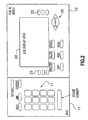
- FIG. 1 of the drawings shows a block schematic of Analog Display Services Interface (ADSI) subscriber terminal 10, which comprises telephone (or terminal) base 11 and plug-in module 12.
- the base 11 connects to the TIP and RING of the telephone line connecting it to the central office (CO) of the telephone company.
- the base 11 comprises a line interface and electronic hook switch circuits 13, ring detector and alerter circuits 14, transducer interface and analog-to-digital (A/D) converter circuits 15, processor interface and EEPROM circuits 16, and standard touch-tone telephone keypad 17.
- a handset 18 is, of course, part of the standard telephone components of the base 11.
- the ADSI plug-in module 12 comprises a data burst alert circuit 19, a microprocessor 20, an LCD display driver 21, an LCD display 22, softkeys (redefinable keys) 23 adjacent the display 22, and a printer (or printer port for an external printer) 24.
- the keys 23 will also include hard-keys such as scrolling cursor keys 25 and so on (as shown in Figure 2).
- the module 12 plugs into the base 11 and connects to the latter by means of two buses 26 and 27, the former being the processor bus, and the latter for scanning the keys 23.
- the data burst alert 19, which comprises two switched-capacitor filters for detecting two pre-burst tones, receives signals through the interface 15 via connection 28.
- the sole function of the alert circuit 19 is to tell the processor 20 by means of high-tone and low-tone leads 29 and 30 that a data burst will follow.
- a calling line identifier device (CLID) 35 is also provided in base 11 and a static RAM 36 and a non-volatile random access memory (NVRAM) 37 are provided in module 12 and connected to microprocessor 20.
- the NVRAM 37 is preloaded with the calling line ID numbers of one or more servers.
- the preloading of the calling line ID numbers could be carried out by preprogramming in the factory when the terminal 10 is being manufactured.
- the terminal could be provided with any appropriate means for allowing the subscriber to enter a preselected list in a manner similar to selecting entries in a directory.
- Probably the preferred method of preloading involves adding/deleting or changing entries in the list by sending an appropriate command from the remote server over the PSTN.
- Each number would be required to be 12 bytes in length, each nibble of which represents a single digit of the Calling Line ID number, for a maximum number length of 24 digits.
- the software running the microprocessor 20 includes instructions to compare the calling line ID with the numbers in NVRAM 37 and, if there is a match, go off-hook (i.e., connect the subscriber terminal to the server) and follow the protocol for a Server Initiated Download.
- ADSI information (such as application and softkey definition data) is transmitted to the terminal at a rate of 1200 baud using the same type of signal that provided the calling line ID.
- the ADSI information can be transmitted as in-band signalling by previously transmitting two tones, 2130 Hz and 2750 Hz, simultaneously for 80 msecs which the data burst alert 19 recognizes as preceding a burst of ADSI information.
- the voice paths are muted during data reception to ensure that data is not corrupted and that the user will not hear the data being transmitted.
- the two frequencies chosen can be isolated from voice because they are not among those generated by the dialpad and also do not occur frequently in conversation.
- ADSI signals pass through the Line Interface and Electronic Hookswitch 13, through the Transducer Interfaces and A/D Converter 15 where they are sampled and converted to digital signals by the A/D converter, through the Processor Interface and EEPROM 16 which further processes the digital samples and then to the microprocessor 20 which is running S/W code contained in built-in masked ROM.
- the microprocessor 20 decodes the command and takes appropriate action on the RAM 36 contained within the microprocessor block 20.
- the method outlined above is illustrated in the flowchart of Figure 3. More particularly it can be seen that two timers are started immediately when the terminal 10 goes off-hook. The first is a 1.2 second timer and the second is a 2 minute timer. Normally data would be received by the terminal 10 within 1.2 seconds and if data is not received by this time the terminal sends a DTMF B to the remote server and then goes on-hook thereby abandoning the FDM download.
- the line be released from the FDM download process when the subscriber indicates he wants to use the terminal 10 by pressing any key or taking the phone off-hook or by using an extension. It may take up to 2 minutes for the entire process and during that time the system constantly monitors whether the terminal is in use and if so abandonment is instructed by sending the DTMF B and going on-hook.
- the sixteen numbers stored in the NVRAM could be dialled out to attempt to connect to the remote servers either on an automatic timed basis or when paged by a specific number.
- Figure 4 is a flowchart illustrating the first of these alternatives.
- the NVRAM 37 stores 16 preprogrammed numbers. These strictly should be referred to as telephone numbers rather than calling line ID numbers as they are numbers to be dialled out.
- the NVRAM 37 also stores against each number times of day that the respective number is to be dialled out.
- a time of day clock 40 in the terminal 10 increments in minutes. At each minute the times of day stored in the NVRAM 37 are compared with the real time of day provided by clock 40 and if there is a match the telephone goes off-hook and the telephone number corresponding to the matched time of day is dialled. The phone would only dial out to the number if the telephone line was idle (not being used by the telephone or any extension) and there had not been any key presses on the phone within the last 45 seconds. If there had been any activity or if the phone line was in use the phone would wait until the line was not busy and there had not been any key presses for the last 45 seconds and then dial out to the server.
- a 15 second timer and a 2 minute timer are started. If at any time during the timed 2 minutes any key is pressed, any extension is used or the telephone is taken off-hook or if the 15 second timer expires the call is aborted. (15 seconds should be sufficient time for a call to be connected and data received). Call abort is indicated in the flowchart by "Go on-hook". The same number is redialled after a delay of 45 seconds during which there is no activity on the telephone. This can be repeated up to a maximum of five attempts and if still data is not received the call to that number is abandoned.
- FIG. 5 is a flowchart illustrating the second alternative, i.e., a dial out process using a pager in the terminal 10.
- the NVRAM 37 stores 16 preprogrammed telephone numbers. However there is no time of day data stored with the numbers as in the Figure 4 embodiment. Instead a pager is embedded in the terminal such that, when a server calls the paging service and enters the telephone number of the server, that number is radio transmitted by the paging service and received in the pager where it is compared in turn with the numbers stored in the NVRAM 37 and if there is a match the same number is dialled out. The remainder of the process is exactly the same as for the embodiment illustrated in Figure 4.
- dial out embodiments described with reference to Figures 4 and 5, whether used in North America or elsewhere, are unobtrusive to the subscriber terminal 10 as the terminal 10 dials out to the server. If it were desired to signal the arrival of an EMERGENCY or URGENT message a locally generated ring could be manufactured.
Landscapes
- Engineering & Computer Science (AREA)
- Signal Processing (AREA)
- Computer Vision & Pattern Recognition (AREA)
- Human Computer Interaction (AREA)
- Telephonic Communication Services (AREA)
- Mobile Radio Communication Systems (AREA)
Claims (21)
- Interaktives Teilnehmer-Telefonendgerät, mit einem Anzeigebildschirm (22), einer Anzahl von programmierbaren Tasten (23), einer örtlichen Steuereinrichtung und einer Speichereinrichtung (37) zum Speichern einer Telefonnummer, dadurch gekennzeichnet, dass die in der Speichereinrichtung gespeicherten Telefonnummern der Telefonnummer eines entfernt angeordneten Servers entsprechen, und dass das Endgerät (10) Initialisierungseinrichtungen (20) zur automatischen Initialisierung der Herstellung einer Verbindung über ein Telefonnetz mit dem entfernten Server auf der Grundlage der gespeicherten Telefonnummer, und zum Herunterladen von Verwaltungssoftware von dem entfernt angeordneten Server auf das Endgerät einschließt.
- Endgerät nach Anspruch 1, dadurch gekennzeichnet, dass die örtliche Steuereinrichtung so ausgebildet ist, dass sie selektiv bewirkt, dass der Anzeigebildschirm durch Femsignale gesteuert wird, die an das Endgerät von einem Telefonvermittlungsamt und/oder der örtlichen Steuereinrichtung ausgesandt werden.
- Endgerät nach Anspruch 2, dadurch gekennzeichnet, dass die programmierbaren Tasten (23) eine Anzahl von vorübergehend definierbaren Antwort-/Dateneingabe-Tasten (23) umfassen.
- Endgerät nach einem der Ansprüche 1-3, dadurch gekennzeichnet, dass die Initiatisierungseinrichtung eine Einrichtung (37) zum selektiven Speichern einer oder mehrerer Anruferleitungs-ID-Nummern, eine Einrichtung (35) zur Identifikation der Anruferleitungs-ID-Nummern, die von dem Telefonvermittlungsamt empfangen werden, eine Einrichtung (20) zum Vergleich jeder identifizierten Anruferleitungs-ID-Nummer mit der gespeicherten einen oder mehreren Anruferleitungs-ID-Nummern und eine Einrichtungen (20) umfasst, die bewirkt, dass das Endgerät in den Aushängezustand übergeht, wenn eine identifizierte Anruferleitungs-ID-Nummer mit einer der gespeicherten Nummern übereinstimmt, wodurch eine Verbindung mit einem der entfernten Server hergestellt wird, nachdem das Endgerät in den Aushängezustand übergegangen ist, wobei die Verbindung ein Herunterladen von Verwaltungssoftware von dem Server auf das Endgerät ermöglicht.
- Endgerät nach einem der Ansprüche 1-3, dadurch gekennzeichnet, dass die Initialisierungseinrichtung eine Einrichtung (20) zum automatischen Anwählen der gespeicherten Telefonnummern von dem Endgerät (10) zu vorgegebenen Zeiten umfasst, um eine Verbindung mit dem entfernt angeordneten Server herzustellen.
- Endgerät nach Anspruch 2 oder 3, dadurch gekennzeichnet, dass die Initialisierungseinrichtung eine Suchrufeinrichtung zum Empfang von Funkmitteilungen von einem Suchrufdienst, die jeweils eine von einem anrufenden Teilnehmer über das Telefonvermittlungsamt eingegebene Telefonnummer einschließen, eine Einrichtung (20) zum Vergleich jeder empfangenen Telefonnummer mit jeder der einen oder mehreren in der Speichereinrichtung (37) gespeicherten Telefonnummern und eine Einrichtung (20) zum automatischen Anwählen einer der gespeicherten Telefonnummern von dem Endgerät (10) umfaßt, wenn eine Übereinstimmung mit einer empfangenen Telefonnummer festgestellt wird, wodurch eine Verbindung mit einem entfernt angeordneten. Server hergestellt wird, um das Herunterladen von Verwaltungssoftware von dem entfernt angeordneten Server auf das Endgerät zu ermöglichen.
- Endgerät nach einem der Ansprüche 4-6, dadurch gekennzeichnet, dass die Einrichtung zum selektiven Speichern einer oder mehrerer Anruferleitungs-ID-/Telefonnummern ein NVRAM (nicht-flüchtiger Lese-Schreib-Speicher) ist.
- Endgerät nach Anspruch 7, dadurch gekennzeichnet, dass der NVRAM (37) durch einen Befehl von einem entfernt angeordneten Server programmierbar ist, um die eine oder mehrere Anruferleitungs-ID-/Telefonnummern, die in dem NVRAM gespeichert sind, hinzuzufügen, zu löschen oder zu ändern, oder dass der NVRAM werksmäßig mit einer oder mehreren darin gespeicherten Anruferleitungs-ID-/Telefonnummern vorprogrammiert wurde, oder dass der NVRAM an dem Endgerät durch einen Teilnehmer programmierbar ist, um die eine oder mehrere Anruferleitungs-ID-/Telefonnummem, die in dem NVRAM gespeichert sind, hinzuzufügen, zu löschen oder zu ändern.
- Endgerät nach Anspruch 8 unter Rückbeziehung auf Anspruch 5, bei dem der NVRAM (37) außerdem die vorgegebenen Zeiten speichert, die jeder Telefonnummer zugeordnet sind.
- Endgerät nach einem der Ansprüche 1-9, dadurch gekennzeichnet, dass die von dem entfernt angeordneten Server auf das Endgerät heruntergeladene Verwaltungssoftware den Anzeigebildschirm (22) und die Anzahl von programmierbaren Tasten (23) steuert.
- Endgerät nach einem der Ansprüche 1-10, dadurch gekennzeichnet, dass die in der Speichereinrichtung (37) gespeicherte Telefonnummer in der Speichereinrichtung (37) vorgeladen wird, wenn das Endgerät hergestellt wird.
- Endgerät nach einem der Ansprüche 1-10, dadurch gekennzeichnet, dass es Einrichtungen einschließt, die es einem Teilnehmer ermöglichen, eine in der Speichereinrichtung zu speichemde Telefonnummer eines entfernt angeordneten Servers einzugeben.
- Endgerät nach einem der Ansprüche 1-12, dadurch gekennzeichnet, dass das Endgerät so angeordnet ist, dass es die Verbindung mit dem entfernt angeordneten Server über das Telefonnetz während eines Herunterladens der Verwaltungssoftware von dem Server auf das Endgerät trennt, wenn der Teilnehmer während dieses Herunterladens der Verwaltungssoftware anzeigt, dass er das Endgerät benutzen möchte.
- Verfahren zum Herunterladen von Verwaltungssoftware von einem entfernt angeordneten Server auf ein interaktives Teilnehmer-Telefonendgerät, das einen Anzeigebildschirm (22), eine Anzahl von programmierbaren Tasten (23), eine örtliche Steuereinrichtung und eine Einrichtung (37) zum Speichern einer Telefonnummer aufweist, dadurch gekennzeichnet, dass die Telefonnummer der Telefonnummer eines entfernt angeordneten Servers entspricht, wobei das Verfahren die automatische Initialisierung der Herstellung einer Verbindung über ein Telefonnetz mit dem entfernt angeordneten Server und ein Herunterladen von Verwaltungssoftware von dem entfernt angeordneten Server auf der Grundlage der in dem Endgerät gespeicherten Telefonnummer einschließt, die der Telefonnummer des entfernt angeordneten Servers entspricht.
- Verfahren nach Anspruch 14, dadurch gekennzeichnet, dass das Verfahren weiterhin das Anwählen des Teilnehmer-Endgerätes durch den Server, die Identifikation der Anruferleitungs-ID-Nummer des Servers in dem Endgerät, den Vergleich der identifizierten Anruferleitungs-ID-Nummer mit jeder von einer oder mehreren Anruferleitungs-ID-Nummem, die in dem Teilnehmer-Endgerät gespeichert sind, und bei Feststellen einer Übereinstimmung zwischen der identifizierten Anruferleitungs-ID-Nummer und der einen oder mehreren gespeicherten Anruferleitungs-ID-Nummem das Bewirken eines Übergangs des Teilnehmer-Endgerätes in den Aushängezustand und die Herstellung einer Verbindung mit dem entfernt angeordneten Server und das Herunterladen der Verwaltungssoftware von dem entfernt angeordneten Server umfasst.
- Verfahren nach Anspruch 15, dadurch gekennzeichnet, dass der Schritt der Identifikation der Anruferleitungs-ID-Nummer ausgeführt wird, bevor irgendein Anrufton-Leistungsburst an das Teilnehmer-Endgerät gesandt wird.
- Verfahren nach Anspruch 15, dadurch gekennzeichnet, dass der Schritt der Identifikation der Anruferleitungs-ID-Nummem zwischen einem ersten Anrufton-Leistungsburst und einem zweiten Anrufton-Leistungsburst ausgeführt wird.
- Verfahren nach Anspruch 14, dadurch gekennzeichnet, dass das Verfahren weiterhin das Wählen einer Telefonnummer eines Suchrufdienstes des Teilnehmers durch den Server und Aussenden der Server-Telefonnummer, das Aussenden der Server-Telefonnummer durch den Suchrufdienst über Funk, die in einem in dem Teilnehmer-Endgerät eingebetteten Suchrufempfänger empfangen wird, das Vergleichen der empfangenen Telefonnummer mit jeder von einer oder mehreren in dem Teilnehmer-Endgerät gespeicherten Telefonnummern, und das Bewirken, bei Feststellung einer Übereinstimmung zwischen der empfangenen Telefonnummer und der einen oder mehreren Telefonnummern, des automatischen Anwählens der die Übereinstimmung aufweisenden Telefonnummer durch das Teilnehmer-Endgerät umfasst, um eine Verbindung mit dem entfernt angeordneten Server herzustellen und von dem entfernt angeordneten Server die Verwaltungssoftware herunterzuladen, wenn die Verbindung zwischen dem entfernt angeordneten Server und dem Teilnehmer-Endgerät hergestellt ist.
- Verfahren nach Anspruch 14, dadurch gekennzeichnet, dass das Verfahren weiterhin das automatische Wählen der Telefonnummer des entfernt angeordneten Servers durch das Teilnehmer-Endgerät zu vorgegebenen Zeiten und das Herunterladen der Verwaltungssoftware von dem entfernt angeordneten Server umfasst, wenn die Verbindung zwischen dem entfernt angeordneten Server und dem Teilnehmer-Endgerät hergestellt ist.
- Verfahren nach Anspruch 19, dadurch gekennzeichnet, dass das Teilnehmer-Endgerät eine Anzahl von Telefonnummern von entfernt angeordneten Servern und zugehörige vorgegebene Zeiten speichert, und dass das Teilnehmer-Endgerät automatisch alle die Server-Telefonnummern zu den zugehörigen vorgegebenen Zeiten anwählt, wodurch jeder entfernt angeordnete Server Verwaltungssoftware herunterlädt, wenn eine Verbindung zwischen dem entfernt angeordneten Server und dem Teilnehmer-Endgerät hergestellt ist.
- System zum automatischen Herunterladen von Verwaltungssoftware auf ein interaktives Teilnehmer-Telefonendgerät, mit:einem Teilnehmer-Endgerät, das einen Anzeigebildschirm (22), eine Anzahl von programmierbaren Tasten (23), eine örtliche Steuereinrichtung und eine Einrichtung (37) zum Speichern einer Telefonnummer aufweist; und mit einem entfernt angeordneten Server, der im Gebrauch eine Verbindung mit dem Teilnehmer-Telefonendgerät (10) herstellen kann, dadurch gekennzeichnet, dass die in der Speichereinrichtung des Teilnehmer-Telefonendgerätes gespeicherte Telefonnummer der Nummer des entfernt angeordneten Servers entspricht, und dass das Teilnehmer-Telefonendgerät Initialisierungseinrichtungen (20) zur automatischen Initialisierung einer Verbindung über ein Telefonnetz mit dem entfernt angeordneten Server auf der Grundlage der gespeicherten Nummer und des Herunterladens von Verwaltungssoftware von dem entfernt angeordneten Server auf das Endgerät einschließt.
Applications Claiming Priority (2)
| Application Number | Priority Date | Filing Date | Title |
|---|---|---|---|
| US743897 | 1996-11-06 | ||
| US08/743,897 US5937347A (en) | 1996-11-06 | 1996-11-06 | Interactive subscriber telephone terminal with automatic management software download feature |
Publications (3)
| Publication Number | Publication Date |
|---|---|
| EP0841792A2 EP0841792A2 (de) | 1998-05-13 |
| EP0841792A3 EP0841792A3 (de) | 2000-03-29 |
| EP0841792B1 true EP0841792B1 (de) | 2004-05-12 |
Family
ID=24990630
Family Applications (1)
| Application Number | Title | Priority Date | Filing Date |
|---|---|---|---|
| EP97308793A Expired - Lifetime EP0841792B1 (de) | 1996-11-06 | 1997-11-03 | Interaktives Telefonendgerät mit einer automatischen Verwaltungsfunktion zur Fernladung von Software |
Country Status (5)
| Country | Link |
|---|---|
| US (2) | US5937347A (de) |
| EP (1) | EP0841792B1 (de) |
| JP (1) | JPH10215329A (de) |
| CA (1) | CA2219602C (de) |
| DE (1) | DE69729047T2 (de) |
Families Citing this family (32)
| Publication number | Priority date | Publication date | Assignee | Title |
|---|---|---|---|---|
| US5937347A (en) * | 1996-11-06 | 1999-08-10 | Nortel Networks Corporation | Interactive subscriber telephone terminal with automatic management software download feature |
| US6195546B1 (en) * | 1997-03-14 | 2001-02-27 | Nortel Networks Limited | Method and apparatus for network initiated parameter updating |
| US6337898B1 (en) * | 1997-04-22 | 2002-01-08 | Nortel Networks Limited | Method for monitoring voicemail calls using ADSI capable CPE |
| US5936547A (en) * | 1997-07-15 | 1999-08-10 | Ameritech Corporation | System and method for providing user-selected information to a paging-capable device |
| US6321098B1 (en) * | 1998-09-15 | 2001-11-20 | Qualcomm Incorporated | System and method for the recording and processing of information in a wireless communication device |
| US6891931B1 (en) | 1999-02-26 | 2005-05-10 | Bellsouth Intellectual Property Corporation | Methods and systems for enabling return to same position in a review of messages in a voice mail system using tag or identifier stored in the voice mail system |
| JP2000270376A (ja) * | 1999-03-17 | 2000-09-29 | Fujitsu Ltd | 携帯電話保守サービスシステム及び保守サービス方法 |
| US7062484B2 (en) * | 1999-04-16 | 2006-06-13 | Pass Dwayne A | Interactive wireless devices to on-line system |
| US6487403B2 (en) * | 1999-08-19 | 2002-11-26 | Verizon Laboratories Inc. | Wireless universal provisioning device |
| EP1100282A1 (de) * | 1999-11-04 | 2001-05-16 | Motorola Semiconducteurs S.A. | Transparenter Zugang zu entfernten Geräten |
| JP2001156905A (ja) * | 1999-11-29 | 2001-06-08 | Matsushita Electric Ind Co Ltd | 電話装置及びコーラーidサービス対応装置及び通信システム |
| US6826173B1 (en) | 1999-12-30 | 2004-11-30 | At&T Corp. | Enhanced subscriber IP alerting |
| US6775267B1 (en) | 1999-12-30 | 2004-08-10 | At&T Corp | Method for billing IP broadband subscribers |
| US6889321B1 (en) | 1999-12-30 | 2005-05-03 | At&T Corp. | Protected IP telephony calls using encryption |
| US6937713B1 (en) | 1999-12-30 | 2005-08-30 | At&T Corp. | IP call forward profile |
| US7180889B1 (en) | 1999-12-30 | 2007-02-20 | At&T Corp. | Personal control of address assignment and greeting options for multiple BRG ports |
| US7319743B1 (en) * | 2000-01-10 | 2008-01-15 | Cisco Technology, Inc. | Method for enabling a user interface for a network telephone |
| US6922721B1 (en) | 2000-10-17 | 2005-07-26 | The Phonepages Of Sweden Ab | Exchange of information in a communication system |
| US8400946B2 (en) | 2000-01-19 | 2013-03-19 | Sony Corporation | System and method for sharing common location-related information between communication devices |
| US6977909B2 (en) * | 2000-01-19 | 2005-12-20 | Phonepages Of Sweden, Inc. | Method and apparatus for exchange of information in a communication network |
| US6996072B1 (en) * | 2000-01-19 | 2006-02-07 | The Phonepages Of Sweden Ab | Method and apparatus for exchange of information in a communication network |
| US7248862B2 (en) * | 2000-01-19 | 2007-07-24 | Sony Ericsson Mobile Communications Ab | Method and apparatus for retrieving calling party information in a mobile communications system |
| DE10011407A1 (de) * | 2000-03-09 | 2001-09-13 | Tenovis Gmbh & Co Kg | Verfahren zum Konfigurieren eines Telekommunikationssystems, Vermittlungsanlage und Terminal zur Durchführung des Verfahrens |
| US7093009B2 (en) * | 2001-07-05 | 2006-08-15 | Intel Corporation | Uploading personal agents to personalize network services |
| SE0102729D0 (sv) | 2001-08-15 | 2001-08-15 | Phone Pages Sweden Ab | Method and apparatus for exchange of information in a communication network |
| US6947772B2 (en) | 2002-01-31 | 2005-09-20 | Qualcomm Incorporated | System and method for providing messages on a wireless device connecting to an application server |
| US7039398B2 (en) | 2002-08-30 | 2006-05-02 | Qualcomm Incorporated | Server processing of interactive screens for a wireless device |
| US6996394B2 (en) | 2002-08-30 | 2006-02-07 | Qualcomm Incorporated | Server processing in providing messages for a wireless device connecting to a server |
| US7463620B2 (en) * | 2002-09-10 | 2008-12-09 | 3Com Corporation | Architecture and method for controlling features and services in packet-based networks |
| US6920205B2 (en) * | 2003-05-23 | 2005-07-19 | Cisco Technology, Inc. | System and method for interactive communications with an end-user |
| JP4577381B2 (ja) * | 2008-03-05 | 2010-11-10 | ブラザー工業株式会社 | 電話装置 |
| EP3893459A1 (de) * | 2020-04-09 | 2021-10-13 | Anbarchian, Vida | Telefonnummerverifizierung |
Family Cites Families (13)
| Publication number | Priority date | Publication date | Assignee | Title |
|---|---|---|---|---|
| US5416831A (en) * | 1993-04-15 | 1995-05-16 | Bellsouth Corporation | System for communicating with an ADSI-compatible telephone via a service circuit node |
| US5812647A (en) * | 1993-06-14 | 1998-09-22 | New North Media Inc. | Display based marketing message control system and method |
| US5541986A (en) * | 1993-07-27 | 1996-07-30 | Bell Communications Research, Inc. | Method and system for automated telecommunications service script consolidation and downloading |
| CA2112757C (en) * | 1994-01-04 | 2005-12-20 | William V. Pezzullo | Screen-based telephone set for interactive enhanced telephony service |
| GB2285897B (en) * | 1993-12-30 | 1998-11-18 | Northern Telecom Ltd | Screen-based telephone set for interactive enhanced telephony service and method of operating same by microprocessor control |
| US5581599A (en) * | 1993-12-30 | 1996-12-03 | Northern Telecom Limited | Cordless telephone terminal |
| US5864604A (en) * | 1994-05-20 | 1999-01-26 | General Patent Corp | Method of providing message service for limited access telecommunications |
| CA2135350A1 (en) * | 1994-11-08 | 1996-05-09 | David Myers | Telemetry interface unit |
| US5761485A (en) * | 1995-12-01 | 1998-06-02 | Munyan; Daniel E. | Personal electronic book system |
| US5737400A (en) * | 1996-02-27 | 1998-04-07 | U-Tel Incorporated | Telecommunications system for accessing subscriber premises equipment using ring suppression |
| US5850433A (en) * | 1996-05-01 | 1998-12-15 | Sprint Communication Co. L.P. | System and method for providing an on-line directory service |
| US5937347A (en) * | 1996-11-06 | 1999-08-10 | Nortel Networks Corporation | Interactive subscriber telephone terminal with automatic management software download feature |
| US5822415A (en) * | 1996-12-02 | 1998-10-13 | Northern Telecom Limited | Method for counting pay per use feature activations in CPE |
-
1996
- 1996-11-06 US US08/743,897 patent/US5937347A/en not_active Expired - Lifetime
-
1997
- 1997-10-29 CA CA002219602A patent/CA2219602C/en not_active Expired - Fee Related
- 1997-11-03 DE DE69729047T patent/DE69729047T2/de not_active Expired - Lifetime
- 1997-11-03 EP EP97308793A patent/EP0841792B1/de not_active Expired - Lifetime
- 1997-11-05 JP JP9302587A patent/JPH10215329A/ja active Pending
-
1999
- 1999-06-16 US US09/334,184 patent/US6157708A/en not_active Expired - Lifetime
Also Published As
| Publication number | Publication date |
|---|---|
| DE69729047T2 (de) | 2004-09-09 |
| EP0841792A3 (de) | 2000-03-29 |
| DE69729047D1 (de) | 2004-06-17 |
| CA2219602A1 (en) | 1998-05-06 |
| US6157708A (en) | 2000-12-05 |
| JPH10215329A (ja) | 1998-08-11 |
| CA2219602C (en) | 2003-06-03 |
| US5937347A (en) | 1999-08-10 |
| EP0841792A2 (de) | 1998-05-13 |
Similar Documents
| Publication | Publication Date | Title |
|---|---|---|
| EP0841792B1 (de) | Interaktives Telefonendgerät mit einer automatischen Verwaltungsfunktion zur Fernladung von Software | |
| CA2235492C (en) | Method for monitoring voicemail calls using adsi capable cpe | |
| US5615257A (en) | Screen-based telephone set for interactive enhanced telephony service | |
| US6493428B1 (en) | Text-enhanced voice menu system | |
| CA2165710C (en) | Arrangement for interfacing a telephone device with a personal computer | |
| US6427009B1 (en) | Enhanced apparatus for use with caller ID system | |
| US5822415A (en) | Method for counting pay per use feature activations in CPE | |
| US6574318B1 (en) | Call related information receiver to receiver transfer | |
| CA2138069C (en) | Screen-based telephone set for interactive enhanced telephony service and method of operating same by microprocessor control | |
| US5790647A (en) | Subscriber feature services in a telecommunications system | |
| US6041111A (en) | Remote telephone data access and display | |
| US6687359B1 (en) | Method for controlling a telephone call between two items of terminating equipment | |
| CA2422234A1 (en) | Interactive subscriber telephone terminal with automatic management software download feature | |
| AU739213B2 (en) | Remote function setting for telecommunication terminal | |
| US6868150B1 (en) | Method for use with caller ID system | |
| JPH08223267A (ja) | ダイヤリング装置 | |
| CN1269948A (zh) | 将标准电话机连接至无线电话系统的接口 | |
| US6970544B1 (en) | Method and apparatus for caller ID system | |
| KR100268672B1 (ko) | 부재중발신자정보알림장치및방법 | |
| JP2908423B1 (ja) | 発呼者番号情報通知方式および発呼者番号情報通知方法 | |
| GB2342809A (en) | Method for monitoring voicemail calls using ADSI capable CPE | |
| KR100332416B1 (ko) | 간이 사설교환기에서 내부직통전화를 이용한 수신자 부담전화 방법 | |
| KR100226768B1 (ko) | 자동 재다이얼 기능을 갖는 전화기 | |
| KR100238881B1 (ko) | 간이교환시스템에서 자동재다이얼 잔여시간 표시방법 | |
| KR20000025073A (ko) | 부재중 음성 메시지 자동 전달 시스템 및 그 방법 |
Legal Events
| Date | Code | Title | Description |
|---|---|---|---|
| PUAI | Public reference made under article 153(3) epc to a published international application that has entered the european phase |
Free format text: ORIGINAL CODE: 0009012 |
|
| AK | Designated contracting states |
Kind code of ref document: A2 Designated state(s): DE FR GB |
|
| RAP3 | Party data changed (applicant data changed or rights of an application transferred) |
Owner name: NORTEL NETWORKS CORPORATION |
|
| PUAL | Search report despatched |
Free format text: ORIGINAL CODE: 0009013 |
|
| AK | Designated contracting states |
Kind code of ref document: A3 Designated state(s): AT BE CH DE DK ES FI FR GB GR IE IT LI LU MC NL PT SE |
|
| RAP1 | Party data changed (applicant data changed or rights of an application transferred) |
Owner name: NORTEL NETWORKS LIMITED |
|
| 17P | Request for examination filed |
Effective date: 20000929 |
|
| AKX | Designation fees paid |
Free format text: DE FR GB |
|
| 17Q | First examination report despatched |
Effective date: 20010417 |
|
| RAP1 | Party data changed (applicant data changed or rights of an application transferred) |
Owner name: NORTEL NETWORKS LIMITED |
|
| GRAP | Despatch of communication of intention to grant a patent |
Free format text: ORIGINAL CODE: EPIDOSNIGR1 |
|
| GRAS | Grant fee paid |
Free format text: ORIGINAL CODE: EPIDOSNIGR3 |
|
| GRAA | (expected) grant |
Free format text: ORIGINAL CODE: 0009210 |
|
| AK | Designated contracting states |
Kind code of ref document: B1 Designated state(s): DE FR GB |
|
| REG | Reference to a national code |
Ref country code: GB Ref legal event code: FG4D |
|
| REF | Corresponds to: |
Ref document number: 69729047 Country of ref document: DE Date of ref document: 20040617 Kind code of ref document: P |
|
| ET | Fr: translation filed | ||
| PLBE | No opposition filed within time limit |
Free format text: ORIGINAL CODE: 0009261 |
|
| STAA | Information on the status of an ep patent application or granted ep patent |
Free format text: STATUS: NO OPPOSITION FILED WITHIN TIME LIMIT |
|
| 26N | No opposition filed |
Effective date: 20050215 |
|
| PGFP | Annual fee paid to national office [announced via postgrant information from national office to epo] |
Ref country code: DE Payment date: 20141201 Year of fee payment: 18 Ref country code: FR Payment date: 20141027 Year of fee payment: 18 Ref country code: GB Payment date: 20141027 Year of fee payment: 18 |
|
| REG | Reference to a national code |
Ref country code: DE Ref legal event code: R119 Ref document number: 69729047 Country of ref document: DE |
|
| GBPC | Gb: european patent ceased through non-payment of renewal fee |
Effective date: 20151103 |
|
| REG | Reference to a national code |
Ref country code: FR Ref legal event code: ST Effective date: 20160729 |
|
| PG25 | Lapsed in a contracting state [announced via postgrant information from national office to epo] |
Ref country code: DE Free format text: LAPSE BECAUSE OF NON-PAYMENT OF DUE FEES Effective date: 20160601 Ref country code: GB Free format text: LAPSE BECAUSE OF NON-PAYMENT OF DUE FEES Effective date: 20151103 |
|
| PG25 | Lapsed in a contracting state [announced via postgrant information from national office to epo] |
Ref country code: FR Free format text: LAPSE BECAUSE OF NON-PAYMENT OF DUE FEES Effective date: 20151130 |